QoE-based Packet Dropper Controllers for Multimedia
Streaming in WiMAX Networks
Allan Costa
Carlos Quadros
Adalberto Melo
Eduardo Cerqueira
Antônio Abelém
Federal University of Para. 66075-110 - Belem, PA - Brazil{allan, cjq, amelo, cerqueira, abelem}@ufpa.br
Augusto Neto
Federal University of Ceara Campus do Pici, Parquelandia 60755-640 – Fortaleza, CE - Brasil.Edmundo Monteiro
David Rodrigues
University of Coimbra DEI – Pinhal de Marrocos 3030-029 - Coimbra - Portugal.[email protected] [email protected]
ABSTRACT
The proliferation of broadband wireless facilities, together with the demand for multimedia applications, are creating a wireless multimedia era. In this scenario, the key requirement is the delivery of multimedia content with Quality of Service (QoS) and Quality of Experience (QoE) support for thousands of users (and access networks) in broadband in the wireless systems of the next generation. . This paper sets out new QoE-aware packet controller mechanisms to keep video streaming applications at an acceptable level of quality in Worldwide Interoperability for Microwave Access (WiMAX) networks. In periods of congestion, intelligent packet dropper mechanisms for IEEE 802.16 systems are triggered to drop packets in accordance with their impact on user perception, intra-frame dependence, Group of Pictures (GoP) and available wireless resources in service classes. The simulation results show that the proposed solutions reduce the impact of multimedia flows on the user´s experience and optimize wireless network resources in periods of congestion. . The benefits of the proposed schemes were evaluted in a simulated WiMAX QoS/QoE environment, by using the following well-known QoE metrics: Peak Signal-to-Noise Ratio (PSNR), Video Quality Metric (VQM), Structural Similarity Index (SSIM) and Mean Option Score (MOS).
Keywords
Quality of Service, Quality of Experience, Multimedia, IEEE 802.16.
1.
INTRODUCTION
The demand for broadband wireless services and real-time video streaming is growing and paving the way for the widespread deployment of bandwidth-intensive multimedia content for thousands of wireless users (including backhaul). In the context of broadband wireless networks, Worldwide Interoperability for Microwave Access (WiMAX) technology is based on the IEEE
802.16 standard and aims at enabling wireless broadband services to be provided in an ubiquitous manner [1 and 2]. WiMAX represents a new era in wireless access, and allows fixed, nomadic, and mobile devices to connect at speeds previously only possible over wireline networks.
In this multimedia broadband wireless scenario, the delivery of real-time multimedia content can be expected at any time, anywhere and at an acceptable level of quality. It is also anticipated that thousands of new users and access networks will be connected to WiMAX links and be able to distribute content from/to the Internet. However, owing to the lack of Quality of Service (QoS), Quality of Experience (QoE) and multimedia-aware packet controller mechanisms in WiMAX networks, new approaches are required.
The IEEE 802.16 working group was set up to meet the needs of QoS and packet differentiation in the WiMAX wireless link,, where the draft version [2], incorporated in the standard version in 2006, brought new MAC optimization. . The IEEE 802.16-2004 standard defines four classes of service: Unsolicited Grant Service (UGS), Real-Time Polling Service (rtPS), Non-Real Time Polling Service (nrtPS) and Best Effort (BE). The IEEE 802.16e-2005 extends the classes of service which are supported by introducing the Extended Real-Time Polling Service (ertPS) class of service. Incoming packets (service flows) are mapped to a queue of a service class, where each has different priorities, sizes and dropper policies. In periods of congestion, packets are discarded in a random and “black-box” manner, without any account being taken of their impact on user experience.
QoE-aware packet dropper mechanisms could be used in IEEE 802.16 links to provide quality level assurance for video streaming flows based on human perception. Thus, in congestion periods, packets would be dropped in accordance with their degree of importance, Coder-Decoders (CODECs), frame type, inter-dependence and other video characteristics, such as complexity. In the future, this procedure will aim to keep multimedia applications at acceptable quality levels, while optimizing the usage of wireless resources.
Regarding the question of multimedia video and voice encoding, several CODECs have been developed to reduce the bandwidth required to distribute multimedia content. The Moving Picture Experts Group (MPEG) codifier is widely used and employs a structure composed of 3 frame types, designated I, P
Permission to make digital or hard copies of all or part of this work for personal or classroom use is granted without fee provided that copies are not made or distributed for profit or commercial advantage and that copies bear this notice and the full citation on the first page. To copy otherwise, to republish, to post on servers or to redistribute to lists, requires prior specific permission and/or a fee. LANC 2011, October 12-13, 2011 Quito, Ecuador.
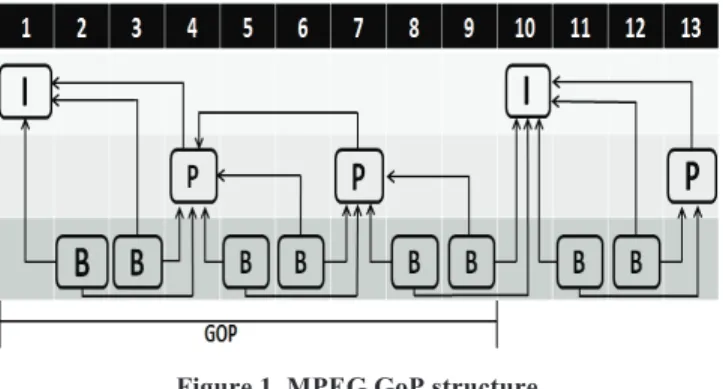
and B, as shown in Figure 2 [3]. I frames (intra coded frames) are encoded by means of spatial compression and without any reference to other frames in the sequence. To achieve temporal compression, P frames (predicted frames) are reconstructed with the aid of motion prediction from the last I or P frames. As a result, P frames have a better compression ratio than I frames but this depends on the amount of motion present in the sequence. B frames (bidirectional frames) file the better compression ratio by using prediction from the last and next I or P frame. The sequence of frames that depends on an I frame is called GOP.
Figure 1. MPEG GoP structure
To increase user satisfaction and save wireless network resources in WiMAX networks, packet dropper controllers must be used to select which, how and what packets should be discarded in congestion periods, while taking into consideration factors such as user perception, multimedia-awareness and enqueued packets (not in a black-box manner as undertaken by current dropper mechanisms).
This paper presents and evaluates new QoE-based multimedia packet control mechanisms for WiMAX systems (IEEE 802.16 links). The proposed schemes have been designed to take account of the impact of multimedia flows on human perception, where packets are discarded on the basis of their importance, intra-dependence, GOP size and user experience, as well as the need to optimize the usage of wireless network resources. Performance evaluations were carried out in a simulated WiMAX/IEEE 802.16 environment to demonstrate the impact and benefits of QoE-aware packet dropper decisions. These were conducted in accordance with the user´s perception, by analysing the following well-known QoE metrics: Peak Signal-to-Noise Ratio (PSNR)[4], Video Quality Metric (VQM) [5], Structural Similarity Index (SSIM) [6] and Mean Option Score (MOS) [7].
The remainder of this paper is organized as follows. Section 2 provides an overview QoE metrics. Section 3 examines relevant related work. The proposed QoE-aware dropper mechanisms are described in Section 4. Section 5 analyzes the evaluation of the performance. Finally, conclusions and suggestions for future work are summarized in Section 6.
2.
RELATED WORK
There have been extensive studies of QoE-based quality level controlers for video streaming services in both wired and wireless networks. This section discusses most of the important works that manage/control the quality level of multimedia content by adapting video packets to the current network conditions.
A QoE-control proposal to drop packets for various packet loss rates is outlined in [8]. A network-based packet loss visibility model is used to evaluate the visual importance of each
H.264 packet inside the network. In congestion periods, by drawing on the estimated loss visibility of each packet, the proposed mechanism drops the least visible frames and/or the least visible packets until the required bit reduction rate is achieved. However, the proposed solution does not take into acount the frame-dependence, WiMAX systems or the GOP size during the adaptation process.
In [9] the authors introduced a simulation study to evaluate the QoE of users (using PSNR as the representative metric) when a video is streamed from a source to a Mobile Station (MS) via a WiMAX Base Station (BS). However, PSNR measurements alone are not enough to provide a good relationship between the packet drop and QoE.
In [10], a framework for MPEG video delivery over heterogeneous networks is analyzed. This system, called Two Markers System (TMS), comprises an application-level source marker and an Enhanced Token Bucket Three Color Marker (ETBCM) based on a Two Rate Three Color Marker (TRTCM) and Single Rate Three Color Marker (SRTCM) of DiffServ. The application-level source pre-marks the packets before they are transmitted. If the packets transport I or P frames, they are marked with 10. If the packets transport B frames, the 01 value will be assigned. Two other bits are used to determine the drop probability with the aid of three colors: 00 for green, 01 for yellow and 10 for red. Packets with a green color have the lowest drop probability. When the number of packets begins to exceed the network limits, the packets containing I or P frames are marked with a medium drop probability (yellow) and B frames with a high drop probability (red). However, the proposed solution only uses QoS metrics and PSNR in the evaluation process and no HVS-based metrics are measured.
Another approach that employs MPEG encoding parameters and user perception, was adopted in [11]. This study defines optimal encoder settings for loss-based network scenarios. It suggests using 2 B frames between each P frame, or a lower number in case of delay constraints. A high value of B frames reduces the quality of these frames and causes a longer delay, since the next I or P frames are needed for the decoding. Regarding the number of P frames, it must be equal to or less than 5, since a large number of P frames can lead to problems of interactivity. Moreover, a large number of P frames does not lead to significant gains. However, this approach can be extended to incorporate adaptation mechanisms to control the quality level of multimedia applications and ensure that they comply with to the current network conditions and user requirements.
Other schemes seek to provide QoE-aware assessment in wireless systems for video and voice applications [12-14]. However, they are focused on fixed or/and wired scenarios, and fail to take account of intra-frame dependence, different GoP sizes or IEEE 802.16 environments in their approaches.
The analysis of the related work has shown that QoE is a key requirement for the success of emerging wireless systems, but that current packet control approaches do not assure quality level support based on user perception in IEEE 802.16 networks or take account of different GoP sizes. Furthermore, the dependency of each frame on a sequence during the period of adaptation, has rarely been addressed. Existing solutions also fail to take note of the QoE metrics during the evaluation processes.
3.
QUALITY OF EXPERIENCE METRICS
performance on the delivery of applications. However, conventional QoS metrics only give information about the network condition (network/packet level). New metrics, known as QoE metrics have now emerged to enhance network information with user perception and multimedia-awareness. . QoE metrics allow control and assessment systems to know how the user is perceiving the service and are divided into objective metrics [15 and 16].
The PSNR is a traditional objective metric used to measure the level of video quality, in decibels (dB), and are based on original and processed video sequences. Typical values for the PSNR in lossy videos are between 30 dB and 50 dB, where the higher valeu is better. The PSNR of a video is defined through the
Mean Square Error (MSE) metric; by noting the luminance (Y) of the processed and original frames and assuming frames with MxN
pixels, the MSE is obtained by applying Equation 1.
( )
( )
∑∑
− = − =−
=
1 0 1 0 2,
,
1
M i N jj
i
Yd
j
i
Ys
MxN
MSE
(Eq. 1)( ) ( ) ⎟⎟ ⎟ ⎟ ⎟ ⎠ ⎞ ⎜ ⎜ ⎜ ⎜ ⎜ ⎝ − =
∑∑
− = − = 1 0 1 0 2 10 , , 1 255 log 20 M i N j j i Yd j i Ys MxNPSNR (Eq. 2)
In Equation 1, while Ys(i,j) designates the pixel in the position (i, j) of the original frame, the Yd(i,j) represents the pixel located in the position (i, j) of the processed frame. Based on the MSE definition and on 8bits per sample, the PSNR can be calculated in a logarithmic scale, by using Equation 2. The PSNR can also be used to map the MOS values, as described in Table 1.
Table 1. PSNR to MOS conversion PSNR (db) MOS
> 37 5 (Excellent) 31 – 37 4 (Good) 25 – 31 3 (Fair) 20 – 25 2 (Poor) < 20 1 (Bad)
To make a comparison that takes into account the structure of objects and provides a better evaluation, the Structural Similarity Index (SSIM) metric decomposes the sent and received images into three HVS components: luminance, contrast and structural distortions. The SSIM evaluation is based on a frame-by -frame comparison that involves several steps. The first step is the comparison with the luminance signal. A standard deviation is then used to remove the mean intensity from the signal and estimate the signal contrast. Moreover, the signal is normalized by its own standard deviation so that it can conduct the structural comparison. A final result, that combines the three components, is then computed to output the video quality level, ranging from 0 (worst) to 1 (best).
The Video Quality Metric (VQM) measures the perceptual effects of video impairments that arise from the Human Visual System (HVS) characteristics, by analysing blurring, jerky/unnatural motion, global noise, block distortion and colour distortion, and combining them into one single metric. VQM gets values between 0 (best) and 5 (worst).
4.
Intelligent QoE Dropper Controllers for
WiMAX Systems
Intelligent QoE dropper controllers for IEEE 802.16 systems are essential to keep multimedia applications at an acceptable level of quality and improve the usage of wireless network resources in congestion situations. The mechanisms must be implemented in a way that takes into account the impact of multimedia flows on the end-user perception. In addition, the adaptation process must comply with the current network conditions (e.g., queue availability), and be aware of factors such as GoP size, user experience, importance of each frame and intra-frame dependence.
This section introduces three QoE-based mechanisms to optimize the quality of real-time video streaming services for IEEE 802.16 networks, by extending the current scheduler/dropping schemes with multimedia and user-awareness. The two mechanisms focus on advanced drop solutions based on intra-flow packet control.
4.1
PRiority Mechanism (PRM)
As depicted in Figure 1, the MPEG encoding structure is composed of frames with different priorities. In this context, all the frames in a GOP depend on an I frame and this is the most important one from the perspective of the user. P frames are also important, since a part of the GOP depends on them. Finally, B
frames can be dropped with a minimal impact on the other frames or on the user perception.
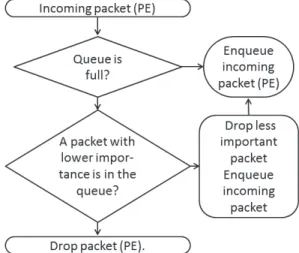
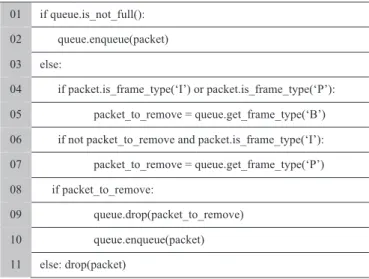
In view of the importance of each video frame, the Priority Mechanism (PRM) seeks to control the quality level of the video sequences; this process is also based on the importance of each frame of a GoP. An I frame discard will only occur if no P and B packets/frames are currently in the buffer. Since the number of frames that depends on P or B frames is reduced, the loss of these frames will have a reduced impact on the user perception. The same process occurs when a P frame is marked to be dropped and a B frame is in the queue. From the standpoint of the user, it is better to drop a B frame than a P frame.
Algorithm 1 - Simplified pseudo-code for PRN
01 if queue.is_not_full():
02 queue.enqueue(packet)
03 else:
04 if packet.is_frame_type(‘I’) or packet.is_frame_type(‘P’):
05 packet_to_remove = queue.get_frame_type(‘B’)
06 if not packet_to_remove and packet.is_frame_type(‘I’):
07 packet_to_remove = queue.get_frame_type(‘P’)
08 if packet_to_remove:
09 queue.drop(packet_to_remove)
10 queue.enqueue(packet)
11 else: drop(packet)
4.2
Broken Dependency Mechanism (BDM)
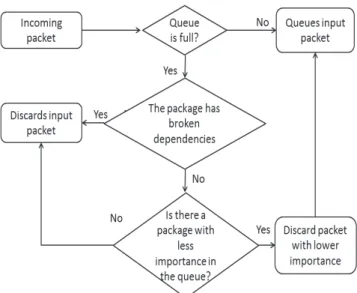
The Broken Dependency Mechanism (BDM) enhances the drop packet procedures by including the intra-frame dependency during the discarding of the packets. Hence, it aims to improve the usage of wireless network resources and increase the user perception. BDM recovers a packet marked to be discarded if there is a packet in the queue containing a frame with broken dependencies, that is, a frame that cannot be completely reconstructed on the receiver side, as shown in Figure 3.Figure 3. Operation mode in BDM
As displayed in Figure 4, if the P2 frame is lost, then
B3, B4, B5 and B6 cannot be completely reconstructed by the receiver and will waste scarce wireless network resources. In view of this, if the P3 frame is assigned to be discarded and the P2
frame has been dropped before, it is advisable to check if there is a packet in the queue that contains a B2, B3, B4, B5 or B6 frame to be discarded and enqueue the incoming packet with the P3
frame.
Figure 4. MPEG Structure with broken dependencies
The BDM algorithm improves the packet dropping process, by also including intra-frame dependency in the drop decision. When a packet is assigned to be dropped, BDM checks if it has broken dependencies. A frame is only discarded if no dependency is found. Algorithm 2 describes the BDM pseud-code.
Algorithm 2 - Simplified pseudo-code for BDM
01 if queue.is_not_full():
02 queue.enqueue(packet)
03 else:
04 if has_broken_dependences(packet):
05 drop(packet)
06 else:
07 packet_to_remove =
queue.get_frame_with_broken_dependences()
08 if packet_to_remove:
09 queue.drop(packet_to_remove)
10 queue.enqueue(packet)
11 else: drop(packet)
4.3
Priority and Broken Dependency
Mechanism (PBDM)
Figure 5. Operation mode in PBDM
5.
PERFORMANCE EVALUATION
This section outlines the evaluation procedures and analyzes the results obtained in the paper. These simulations aim to show the impact and benefits of the proposed advanced dropping schemes in the WiMAX networks. Simulations were carried out to define a scenario similar to a real system, where the Network Simulator 2 (NS2)[17] with real video sequence, was used to simulate an IEEE 802.16 WiMAX environment with QoS/QoE assurance. The WiMAX NIST module was extended to support QoE and adapted to multimedia-aware dropping procedures [18]. The Evalvid framework [19] was implemented to add real video sequence to the simulation environment, while The Video Quality Measurement Tool (VQMT) is used for objective video quality assessment [20]. Objective (PSNR, VQM and SSIM) and subjective (MOS) QoE metrics were used to assess the levels of video quality when the system is configured with each of the dropping mechanisms and with different GoP sizes.
A well-known Common Intermediate Format (CIF) video sequence, called Akiyo, was used with 30 frames per second (fps), 2 B frames between each P frames, a bitrate of 512 kbps and different GoP sizes (from 4 to 30). The WiMAX topology is composed of one Connectivity Service Network (CSN), one Access Service Network – Gateway (ASN-GW), with BS and one SS (using a point-to-multipoint communication). The video flows are mapped to the rtPS QoS class and FTP traffic is used as background. In order to simplify the experiment, only downstream communication is analysed together with the congestions (up to 50%) that only occur in the IEEE 802.16 interface. Figure 6 illustrates the scenario in a simplified manner.
Figure 6. Simulated scenario
With regard to the PSNR, the results reveal that the pure IEEE 802.16 QoS solution is the worst scheme to assure multimedia quality level support in periods of congestion.. When the congestion is 30% and the GoP size is 4, PBDM has a PSNR value of 34 dB (considered good according to the mapping of PSNR to MOS), while the IEEE 802.11 has a PSNR of 27 dB. As Figures 7 and 8 and the GoP show, the impact of an I frame is lost, which from the standpoint of the user is terrible. When the congestion rate is 15% and the system is only configured with the IEEE 802.16 QoS scheme, the video quality level is mapped to fair (based on MOS).
Figure 7. PSNR with a GoP size of 20
Figure 8. PSNR with a GoP size of 30
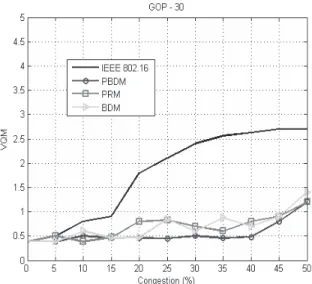
Figures 9, 10 and 11 introduce the VQM results for different GoP sizes (4, 15 and 30). The IEEE 802.16 drop controller does not distinguish between the I, P and B frames and random values of loss exist for the different frame types. Thus, improvements in video quality can be attained if the importance of each frame type is taken into consideration (see PRM results). On average, the VQM values for GoP value of 15 and a congestion of 20% when IEEE 802.16, PRM, BDM and PBDM mechanisms are used are 1.9, 1.2, 0.7 and 0.5 respectively.
Figure 9. VQM with a GoP size of 4
Figure 10. VQM with a GoP size of 15
When large values of GoP size are used to transmit video content, and as a result, the number of P and B frames is high in relation to the number of I frames, the number of dropped packets with I frames reaches zero. This is because the advanced drop controllers seek to protect the most important frame of a GoP.
The same results are achieved with the number of packets dropped with P frames. By increasing the GOP size, the number of B
frames is increased and the drop of other frames becomes less probable. The evaluation data show that the best results for GoP
sizes are higher than 10. Since the most important frames are protected, there are fewer broken dependencies and hence the quality values remain high even for large values of GoP size.
Figure 11. VQM with a GoP size of 30
Figure 12 provides the SSIM results for all the approaches when the GoP size is of 30. It can be seen that PBDM is still the best approach to configure a WiMAX system with QoE-awareness.
Figure 12. SSIM with a GoP size of 30
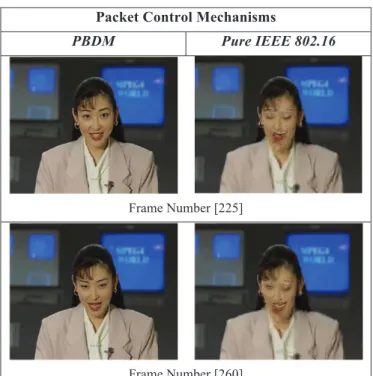
Table 2: Some “akiyo” frames with different packet control
mechanisms
Packet Control Mechanisms
PBDM Pure IEEE 802.16
Frame Number [225]
Frame Number [260]
6.
CONCLUSION
Integrated wireless communication and multimedia content systems will be essential for the success of next generation wireless networks, especially WiMAX for last mile access. In this context, it is necessary to provide new QoE dropping approaches to control high-quality multimedia application based on the user´s experience and not on a “black box” manner, as supported by pure IEEE 802.16 packet controllers. Throughout this paper, various advanced mechanisms to improve video flows have been analyzed, compared, discussed and evaluated. It was found that the simulation results show better video experience in IEEE 802.16 systems when advanced mechanisms are used. To achieve this goal, video stream characteristics, which are not being used in current systems, were investigated and used to implement new adaptation mechanisms in a wireless system.
The results reveal that the GoP size should be taken into account during the dropping process. The proposed mechanisms aim to keep the multimedia content at acceptable levels of quality in the congestion periods. For instance, compared with the pure IEEE 802.16 QoS scheduler, the PBDM improves the SSIM by 90% when the congestion is 40% and the GoP size 30%.
In future studies, the proposed mechanisms will be enhanced to take into account video motion and complexity in the adaptation process. Subjective experiments with human viewers will also be conducted.
ACKNOWLEDGMENTS
The work is supported by the National Council for Scientific and Technological Development (CNPq) and Fudação
de Amparo à Pesquisa do Estado do Pará (FAPESPA - Para State Research Foundation) in Brazil.
REFERENCES
[1] IEEE. 802.16-2004 Standard for local and metropolitan area networks part 16: Air interface to fixed and mobile broadband wireless access systems, 2004.
[2] IEEE. 802.16-2005 Standard for local and metropolitan area networks part 16: Air interface to fixed and mobile broadband wireless access systems, 2005.
[3] Venkataraman, M. and Chatterjee, M. 2011. Effects of internet path selection on video-QoE. Proceedings of the second annual ACM conference on Multimedia systems. [4] K. Nishikawa, K. Munadi, and H. Kiya. 2008. No-Reference
PSNR estimation for quality monitoring of motion JPEG2000 video over lossy packet networks. Multimedia, IEEE Transactions on, 10(4):637–645.
[5] Tianyi Wang, Pervez, A. and Hua Zou, 2010 VQM-based QoS/QoE mapping for streaming video in Broadband Network and Multimedia Technology (IC-BNMT), 2010 3rd IEEE International Conference on, pp. 807.
[6] Chun-Ling Yang, Rong-Kun Leung, Lai-Man Po and Zhi-Yi Mai, 2009. An SSIM-optimal H.264/AVC inter frame encoder. In Intelligent Computing and Intelligent Systems, ICIS 2009. IEEE International Conference on.
[7] Villapol, M.E. and Chatterjee, M. 2010. Optimal feedback-based adaptive WiMax MAC for improving quality of video. In Communications (LATINCOM), IEEE Latin-American Conference on, pp 1-6. Conference Proceedings.
[8] Serral-Gracia, R., Cerqueira, E., Curado, M., Monteiro, E., Yannuzzi M., Masip-Bruin X. 2010 . An Overview of Quality of Experience Measurement Challenges for Video Applications in IP Networks. In Proceedings of The International Conference on Wired/Wireless Internet Communications (WWIC 2010), Loule.
[9] Hyun Jong Kim and Seong Gon Choi. 2011. Design of video streaming service quality control system using available bandwidth information. In Advanced Communication Technology (ICACT).
[10]Lin, T.L. and Shin, J. and Cosman, P. 2010. Packet dropping for widely varying bit reduction rates using a network-based packet loss visibility model. Data Compression Conference. pages 445-454.
[11]Vishwanath, A. and Dutta, P. and Chetlu, M. and Gupta, P. and Kalyanaraman, S. and Ghosh, A. 2010. Perspectives on Quality of Experience for Video Streaming over WiMAX. ACM SIGMOBILE Mobile Computing and Communications Review, vol. 13, no. 4, pp 15-25.
[12]Chih-Heng Ke and Naveen Chilamkurti. 2008. A new framework for MPEG video delivery over heterogeneous networks. Computer Communications, 31(11):2656–2668. [13]Huahui Wu, Mark Claypool, and Robert Kinicki. 2006.
[14]Pablo Ameigeiras, Juan J. Ramos-Munoz, Jorge Navarro-Ortiz, Preben Mogensen, and Juan M. Lopez-Soler. 2009.
QoE oriented cross-layer design of a resource allocation algorithm in beyond 3g systems. Computer Communications. [15]Lu LIU, Wen-an ZHOU, and Jun-de SONG. 2009.
Quantitative and qualitative research on service quality evaluation system in ngn. volume 16, pages 71–77.
[16]Tobias Hoßfeldand Andreas Binzenhöfer. 2008. Analysis of Skype VoIP traffic in UMTS: End-to-end QoS and QoE measurements. Computer Networks, Vol 55. N 3, pages 650-666.
[17]EvalVid - A Video Quality Evaluation Tool-set http://140.116.72.80/~smallko/ns2/myevalvid2.htm May 2011.
[18]Rouil R National institute of standards and technology. The network simulator NS-2 NIST add-on-IEEE 802.16 model (MAC+PHY).
http://www.nist.gov/itl/antd/emntg/ssm_seamlessandsecure.c fm. Last visited in Fev 2011
[19]The network simulator ns-2. http://www.isi.edu/nsnam/ns/. Last visited in Fev 2011