Correlates of Queen Pineapple
(
Ananascomosus
Linn) Farming Practices in
Camarines Norte, Philippines
Sonia S. Carbonell (Ph.D)
CamarinesNorte State College, Daet, CamarinesNorte, Philippines [email protected]
Date Received: October 30, 2015; Date Revised: December 2, 2015
Asia Pacific Journal of Multidisciplinary Research
Vol. 3 No.5,39-49 December 2015 Part I P-ISSN 2350-7756 E-ISSN 2350-8442
www.apjmr.com
Abstract - This study aimed to provide valuable information about the realities of the Queen pineapple (QP) farmers in Camarines Norte, highlighting their farming practices and worldview about sustainable development. Most of the respondents are owner-operator having a mean farm size of 1.33 hectares devoted to queen pineapple farming and crop diversification with two to seven crops combined to augment income. Cropping pattern employed by most of the respondents is multiple cropping, specifically intercropping, rotational cropping, and fallowing. Soil nutrient and weed management of most respondents is conventional: inorganic fertilizers and chemical based, respectively. However, pest control management by most of the respondents is of the alternative method. Overall, QP farmer respondents were found to be practicing alternative farming methods. The problems cited by the respondents were mainly production, marketing and communication-related. The respondents showed that they have moved towards alternative farming. However, more attention should be given to soil nutrient and weed management practices. Strengthening communication-related activities, improved technology, and ensured availability of resources is necessary to have good avenue for change. These findings should make agencies concerned to promote alternative farming and sustainable agriculture. The significant attributes of the QP farmer respondents can be used as entry point for any development program to fully advocate alternative farming among the local people as a social movement.
Keywords –Conventional and alternative farming, cropping pattern, soil management, weed management.
INTRODUCTION
Agriculture is the backbone of the rural world. It occupies 70 percent of the world’s land and consumes an estimated 80 – 90 percent of the water in the developing countries [1], [2]. The sector has not been spared the scrutiny primarily because of the various environmental and social externalities associated with the practice of modern agriculture [3]. Understandably, there has been an increase in the number of advocates of sustainable agriculture.
Cognizant to this, one of the most promising components of Philippine agriculture is the fruit sector. Pineapple is one of the important fruit crops in the country and it is a traditional fruit export of the Philippines. The demand for fruits in the world market is getting a big boost from health conscious sector of the populace across the globe. Hence, it remains the second top fruit export of the country [4]. The crop is
extensively cultivated with large plantations found in Mindanao mainly for export while those in Luzon and Visayas primarily supply the domestic markets.
40
In terms of area planted, the province of
Camarines Norte is in fourth rank in the top ten
Queen pineapple producing provinces throughout
the country. The variety is highly adapted to the
soil and climatic condition of the province. It is
grown largely as coconut intercrop with average
density of 30,000 plants per hectare. Of the
98,000 hectares coconut areas of the province,
50% is available for pineapple production [6].The
potentials
for
increased
queen
pineapple
production in Camarines Norte can be realized
through an increase in the productivity of existing
areas, expansion of area planted, and the adoption
of improved production technologies such as land
preparation, plant density, weed control and
fertilization. Seemingly, it conforms to the
findings of Kim [7] that the larger the farm, the
more favorable were the farmers perception of
and attitude toward adoption. Early adaptors
usually have bigger farms and tend to be more
progressive than late adaptors. Similarly, Jones
[8] found out that the degree of favorable attitude
toward adoption was positively related to farm
size. The larger the farm, the more favorable were
the perceptions of and attitude towards adoption.
This was proven by Agustin [9] who found out
positive correlation between farm size and
assisted outreach project. His findings indicated
that as farm became bigger, the project tended to
be more sustainable.
Today, there is now a growing interest in the
use of organic material as fertilizers, mainly for
two reasons. First is agronomic such as
improvement of soil physical properties, balanced
nutrient supply for crops and a sustainable
cropping system. Second is economic such as
efficient use of wastes and by-products and
higher consumer demand for organically grown
products. In fact, organically fertilized pineapple
was analyzed and the results were promising.
Devadas et al. [10] compared the influence of
various organic manures and biofertilizers to the
quality of pineapple var. Mauritius in farmers’
field during 2000-2001.
Farmers expressed a wide variety of motives
for conversion to organic practices. Goode [11]
revealed that material factors such as increased in
financial gains and better market opportunities
emerged as a motivation of farmers in their
decision to convert to organic production.
On this basis, it can be hypothesized that the
goals of organic farmers consist of a mixture of
non-financial and financial ones, as well as other
objectives [12]. It appears that previous organic
farmers are more strongly motivated by
husbandry problems and religious concerns,
whereas “newer” organic farmers, who are
concerned about the environment, have economic
reasons and increasingly see organic farming as a
great challenge.
Apparently, farmers have varying cultural management practices as far as queen pineapple farming is concerned. For decades, they have been growing pineapple and undeniably, this farming enterprise has made economic contribution to their families and communities. Moreover, their pineapple farming practices which reflect their worldview of what agriculture practices should be may or may not have detrimental effects on the environment. In view of the foregoing, it is imperative to gather empirical data on the realities of pineapple farmers, particularly their farming practices. The data may make government efforts gear toward their development that will not only be fruitful but more importantly, sustainable; hence this research was conducted.
OBJECTIVES OF THE STUDY
41 MATERIALS AND METHODS
Research Design
Correlational research design was used to determine the degree of relationship of independent and dependent variables.
Population and Sampling Technique
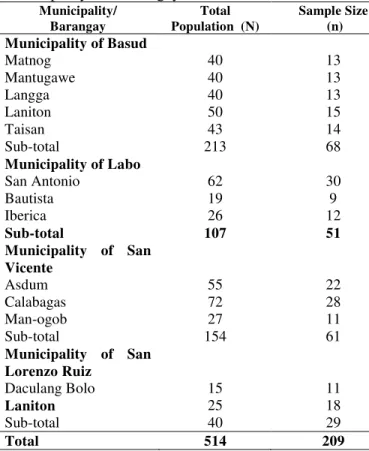
The respondents of this study were the household heads from the four municipalities noted to engage in queen pineapple farming as main source of livelihood. This study employed the multi-stage and purposive sampling as follows:
1. First, four municipalities were purposively selected because they are the major producing areas of queen pineapple in the region. These were Basud, Labo, San Vicente and San Lorenzo Ruiz.
Table 1. Distribution of farmer respondents by municipality and barangay
Municipality/ Barangay
Total Population (N)
Sample Size (n) Municipality of Basud
Matnog 40 13
Mantugawe 40 13
Langga 40 13
Laniton 50 15
Taisan 43 14
Sub-total 213 68
Municipality of Labo
San Antonio 62 30
Bautista 19 9
Iberica 26 12
Sub-total 107 51
Municipality of San Vicente
Asdum 55 22
Calabagas 72 28
Man-ogob 27 11
Sub-total 154 61
Municipality of San Lorenzo Ruiz
Daculang Bolo 15 11
Laniton 25 18
Sub-total 40 29
Total 514 209
2. Second, five barangays from the municipality of Basud, three barangays each from the municipalities of San Vicente and Labo, and two barangays from the municipality of San Lorenzo Ruiz were purposively selected. The basic considerations in the choice of the barangays were the number of
farmers engaged in queen pineapple farming and their production income.
In the selected barangays, proportional allocation of the farmer respondents was made using the minimum size of 10 percent margin error of Slovin [13].
The sampling process arrived at a total of 209 respondents for the study. The sample respondents were drawn randomly from the selected barangays of each municipality where queen pineapple was extensively grown. Random sampling technique was used based on the sampling frame formulated to give equal chance to all queen pineapple households in each municipality to be included as a sampling unit in the study (Table 1).
Research Instrument
A structured interview schedule was used to gather the needed data. The interview schedule was prepared in English but translated in Tagalog and Bicol for easy understanding of the interviewees. Pre-testing of the interview schedule was undertaken involving 25 farmers outside the study area (Sto. Domingo, Vinzons) in order to determine the validity of the instrument. Four selected and well-trained enumerators were hired to assist in pre-testing and data gathering in the study areas.
Data Gathering
42 Method of Data Analysis
Data gathered were analyzed using the Statistical Package for Social Science (SPSS) software with the guidance of a professional statistician. Descriptive statistics such as percentage, mean, frequency counts, standard deviations were used to describe the farmer’s farm characteristics, farmer’s worldview of agriculture, material and non-material benefits of conventional and alternative farming. The Pearson Product Moment Correlation was used in the analysis of relationships of independent variables and dependent variables. Significance level in all tests was set at 0.01 and 0.05.
RESULTS AND DISCUSSION
Farm-Related Factors
This section includes selected farm characteristics. These were farm size, land tenure, crop diversity and soil fertility as shown in Table 2, 3 and 4, respectively.
Farm Size
The farm size devoted to queen pineapple farming system ranges from 0.25 to 14.0 hectares with a mean of 1.33 hectares and a standard deviation of 1.99 hectares as shown in Table 2. This finding implies a widely dispersed distribution as far as size of farm holdings of the respondents is concerned.
Most (77.0%) respondents had a hectare or less for pineapple farming. Some (12.9%) had 2 to 3 hectares and 3.0 hectares or more (10.0%).
Tenurial Status
Table 2. Farm Size and Tenurial Status of Respondents
Category Frequency
(n = 209)
Percent % Farm Size
0.25 – 1.99 2.00 – 2.99 3.0 and above Mean (ha.) SD Range Land Tenure Owner-operator Tenant Lessee
Others (Overseer) Amortizing owner
161 27 21 1.33 1.99 0.25 – 14.0
76 62 56 11 4
77.0 12.9 10.0
36.4 29.7 26.8 5.3 1.9
More than one-third (36.4%) of the respondents were categorized as owner-operators. Only 29.7 percent was categorized as tenants of coconut farms permitted to plant pineapple with or without any sharing agreement with the landowners on the sales proceeds of the pineapple except for some fruits given as gifts during harvest time (Table 2).
Crop Diversification
Table 3 shows nearly forty percent (39.2%) of the respondents have coconut and pineapple planted to enhance the productivity of the main crop. While 22 percent plant three crops (pineapple, banana, and papaya), four crops (8.6%) such as pineapple, camote, cassava, and gabi, a few respondents have planted five crops (6.7%), six crops (4.3%) and seven crops (2.4%). Nonetheless, 16.7 percent of the total respondents have planted pineapple only.
Table 3. Crop Diversification followed by the Respondents
Category Frequency
(n = 209)
Percent % One crop ( Pineapple only )
Two crops ( Pineapple + coconut or tiger grass ) Three Crops (Pineapple + papaya + banana)
Four crops ( Pineapple + coconut + gabi + cassava ) Five crops ( Pineapple + coconut + banana + camote + gabi )
Six crops ( Pineapple + coconut + papaya + banana + string beans + Cassava )
Seven crops (Pineapple + coconut+ papaya + root crops (gabi, cassava, camote, cocoyam) + pepper + banana + fruit trees (cacao, jackfruit, pomelo, santol, rambutan, pili, kalamansi, coffee)
35
82
46
18
14
9
5
16.7
39.2
22.0
8.6
6.7
4.3
2.4
Soil Fertility
43 based on the plant appearance (87.08%, reporting) like greenish color of the leaves, size and growth of the plants. Another basis is the soil appearance in which majority of the respondents (81.8%) reported that the soil color is blackish and humus-like which they can attribute to their practice of fallowing with the pineapple leaves and other crop residue left on the farm. This allows the soil to rejuvenate and improves the fertility and productivity of the farm.
Table 4. Soil Fertility of the Farm as Perceived by the Respondents
Category Frequency
(n = 209)
Percent % Soil Fertility
0 - 24 % 25 – 49 50 – 74 75 – 100 Bases for rating Soil Fertility*
Use a soil test kit Based on the yield Based on soil appearance Based on plant appearance
Others (size of fruit)
10 46 86 67
6 115
171
182 4
4.8 22.0 41.1 32.1
2.9 55.0
81.8
87.08 1.9 * Multiple Responses
Queen Pineapple Farming Practices
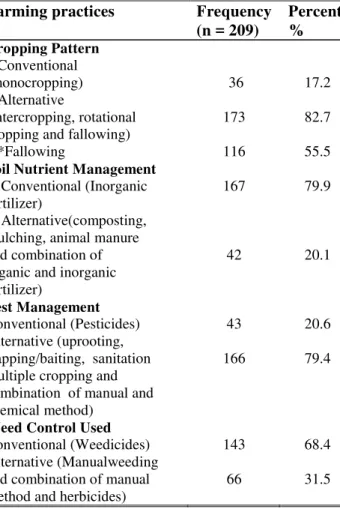
The farming practices referred to in this study includes cropping pattern, soil nutrient management and pest/weed management practiced by the respondents. Based on their farming practices the respondents were categorized into two: either they were practicing the alternative or conventional way of farming.
Figure 1. Multiple Cropping (pineapple, jackfruit, coconut, kalamansi and other permanent crops)
Figure 2. Coconut + pineapple cropping system
Figure 3. Pineapple + papaya + banana cropping system
Figure 4. Monocropping System (pineapple plant only)
44 %, respectively) claimed immediate effect of chemical use in pineapple plant. They claimed they have not tried organic farming yet. They manifested their hesitance to subject their produce to risks. Similarly, it is too laborious and complicated to prepare and manage its application and that there is an inadequate supply of organic supply in agricultural business centers. However, 20.1 percent of the respondents confirmed the use alternative practice even though others find it disadvantageous.
Table 5. Respondents’ Farming Practices Farming practices Frequency
(n = 209)
Percent % Cropping Pattern
Conventional (monocropping) Alternative
(intercropping, rotational cropping and fallowing) *Fallowing
Soil Nutrient Management Conventional (Inorganic fertilizer)
Alternative(composting, mulching, animal manure and combination of organic and inorganic fertilizer)
Pest Management Conventional (Pesticides) Alternative (uprooting, trapping/baiting, sanitation multiple cropping and combination of manual and chemical method) Weed Control Used Conventional (Weedicides) Alternative (Manualweeding and combination of manual method and herbicides)
36
173
116
167
42
43
166
143
66
17.2
82.7
55.5
79.9
20.1
20.6
79.4
68.4
31.5
Summing up, the overall type of farming practices of the queen pineapple farmers in Camarines Norte was measured and determined by obtaining the combined scores of the following indicators: cropping pattern, soil nutrient management and pest and weed management. These were categorized as conventional farming practices when the combined scores ranged from 1 to 4 and alternative farming practices when scores ranged from 5 to 8.
Overall, most (84.61%) of the farmer respondents had a combined score of 5-8. This suggests that
farmers are now moving towards low external input agriculture, diversification, and optimal use of local resources and natural processes (Table 6).
Table 6. Respondents Classified According to Combined Scores on Farming Practices Total
scores obtained
Classification Conventional Alternative
(f) % (f) %
4 5 6 7 8
32 15.3 7
97 69 4
3.3 46.41
33.0 1.9
TOTAL 32 15.3 177 84.61
Overall scores of type of farming practices
(1 – 4) 1 Conventional (5 – 8) 2 Alternative
On the other hand, 15.3 percent of the respondents still engage in conventional farming practices.
Material and Non-material Benefits
Material Benefits
Net income of queen pineapple farmers was computed by deducting the production costs per cropping from the gross income (Table 7). Findings showed that the total mean expenses of the respondents was approximately P29,785.68 for hired labor (P7,353.62) and cost of fertilizer (P6,315.39) topping the list of expenditures. This could be attributed to size of landholding and non-farm activity engaged in by the respondents. Production cost (P29,785.00) and net income (P36,941.98, ROE = 124%) are better compared with the production cost (P72,035.00) and net income (P25,205.00, ROE = 34%) reported when the Department of Agriculture recently made an assessment of the pineapple production in Camarines Norte[14].
45 Table 7. Cost and Return Analysis of Queen Pineapple Farming for Main Cropping Season 2003 – 2005
Cost and Return Analysis Mean
Fertilizer expenses
Pesticides/Herbicides expenses Planting material expenses Rental for land
For draft animal For machinery Labor expenses Family labor Hired labor
Total Expenses Total Sales Net Income
ROE (Net income/production costs)
6,315.39 1,379.67 4,852.91 2,915.21 1,695.00 2,625.00 2,648.88 7,353.62
29,785.68 66,727.66 36,941.98 124%
More than half (50.2%) of the respondents said that their net income during the 2003-2005 cropping season was comparatively better than it was five years ago (Table 8). A number of respondents (27.8%) declared their net income was at par with five years ago. Furthermore, majority of the respondents (58.4%) showed more optimism in their projected net income from pineapple five years from now, foreseeing that they will have improved income due to 1) proper scheduling of fruiting inducement to ensure good market price; 2) expansion of pineapple planting area; 3) improved fruit size as a result of improved soil fertility; 4)decreased cost as a result of using low external inputs; and 5) as a result of expected increase in the harvest of additional crops planted. On the other hand, 25.4 percent expected neither improvement nor decrease of their current income in the next five years.
Table 8. Respondents’ Perception of Net Income from Queen Pineapple Production
Perception Frequency
(n = 209)
Percent % Net income compared to 5
years ago Value at par Worse Better
Expected net income five years ahead as compared to current income.
The same Improved Lower
58 46 105
53 122 34
27.8 22
50.2
25.4 58.4 16.3
Non-material Benefits
Respondents were asked of other benefits derived from their choice of farming practices specifically in terms of ecological and social dimensions of sustainability as shown in Table 9. Nearly half (44.5%) of the respondents claimed that their farming practices improved the soil condition of their farm. Others cited that their fruit yield became sweeter and tastier (29.2%) while 21.1 percent concurred that their farms’ soil fertility was still intact. It is noteworthy to mention that 4.8 percent of the respondents agreed on decreased occurrence of pests.
Social benefits derived from their choice of queen pineapple farming practices were indicated by the respondents. A little more than one-third of the respondents (35.9%) cited that they obtained greater access to land, market and technology. Some respondents (27.8%) also mentioned that they were able to send their children to school and obtained a college degree, while the others (27.3%) reported that no one from their household suffered from infectious diseases. A few respondents (9.1%) seemed to agree with Obrero[16] claimed that pineapple is a money-maker crop because it offers better profitability thus can help improve the living condition of the family. Informal interviews with the respondents revealed that because of pineapple farming they were able to acquire properties such as land, concrete houses, and vehicles.
Table 9. Perception on the Non-material Benefit from Queen Pineapple Production
Perception Frequency
of mention*
Percent %
Ecological
Improved soil condition Increased soil fertility Decreased occurrence of pests
Increased beneficial micro-organisms
Fruits are tasty and sweet Socially Improved health condition of the family Greater access to land, market and technology Able to send their children to school Improved the living condition of the family
93 44
10
1 61
57
75
58
19
44.5 21.1
4.8
0.5 29.2
27.3
35.9
27.8
46
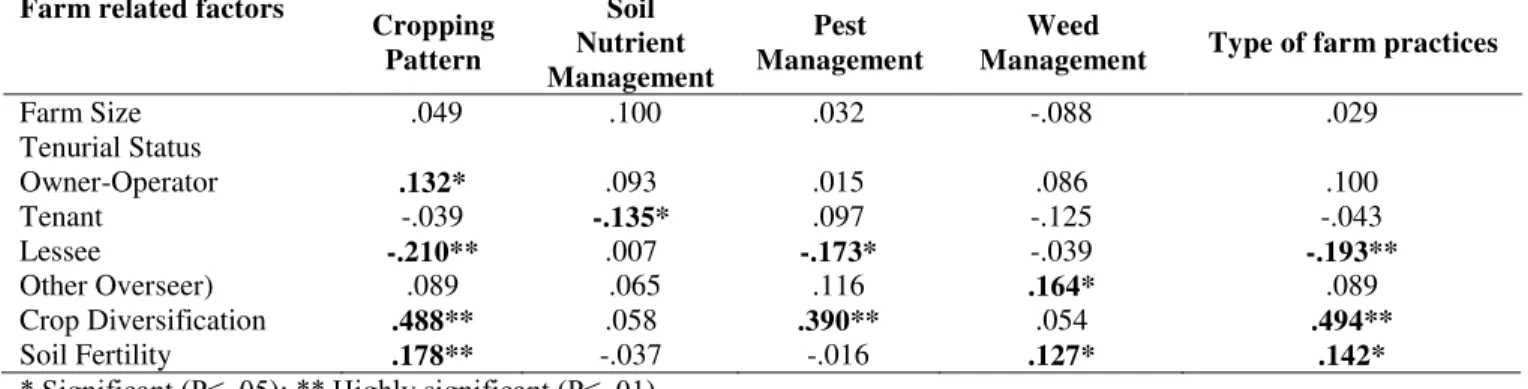
Table 10. Relationship between Farm Related Factors and Farming Practices Farm related factors
Cropping Pattern Soil Nutrient Management Pest Management Weed
Management Type of farm practices
Farm Size Tenurial Status Owner-Operator Tenant Lessee Other Overseer) Crop Diversification Soil Fertility .049 .132* -.039 -.210** .089 .488** .178** .100 .093 -.135* .007 .065 .058 -.037 .032 .015 .097 -.173* .116 .390** -.016 -.088 .086 -.125 -.039 .164* .054 .127* .029 .100 -.043 -.193** .089 .494** .142*
* Significant (P≤ .05); ** Highly significant (P≤ .01)
Relationships Between Farm-Related Factors and Farming Practices
This section includes selected farming characteristics and practices hypothesized to be associated with the choice of farming practices of queen pineapple farmers in Camarines Norte (Table 10).
Generally, land tenure, crop diversity and soil fertility showed a significant relationship with farming practices used by the queen pineapple farmers. Only farm size was not significantly associated with the choice of farming practices. Therefore, the null hypothesis for these variables was rejected.
Relationships Between the Practices and the Perceived Benefitsof the Queen Pineapple Farming
Results in Table 11 show the correlation coefficients of perceived benefits and prospects in relation to the choice of farming practices of queen pineapple farmers.
Material and non-material benefits. A positive and significant relationship between the net income five years ago (r = 0.136) and the pest management practices used by respondents showed an increase in net income the respondents as compared to five years due to their choice of pest control using less synthetic inputs. Results also showed that net income five years ago was significantly related (r = 0.125) with the overall choice of farming practices. This means that their income was better when they use alternative farming practices.
Social benefits, in terms of access to land, market and technology, also had a positive and highly significant relationship with soil nutrient management (r = 0.191) and significant relationship with weed management practices (r = 0.149). This implies that
the more they use the alternative way of fertilizing the soil and controlling weed in their pineapple farms, the better their access to land, market and technology.
Table 11. Relationship between Perceived Benefits, Prospects and Farming Practices
Benefits and prospects Cropping Pattern Soil Nutrient Management Pest Management Weed Manage ment Type of farm practices Net Income from pineapple farming Net Income five years ago Net Income five years from now Social benefits a. greater access to land, market and technology b. able to send their children to school c. improved the living condition of the family .041 .117 .098 -.102 .056 .094 .124 .053 -.084 .191** -.070 -.111 .007 .136* .128* .012 .025 .140* -.053 .072 .005 .149* .135* .071 .001 .125* .032 .088 .055 .083
* Significant (P≤ .05); ** Highly significant (P≤ .01)
47 Problems Encountered and Suggested Solutions
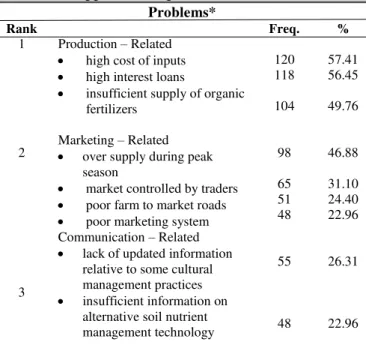
Three major problems were identified to be related to queen pineapple farming. These problems were categorized into production, marketing and communication-related (Table 12).
Table 12. Problems Encountered by Respondents in Queen Pineapple Farming
Problems*
Rank Freq. %
1
2
3
Production – Related
high cost of inputs
high interest loans
insufficient supply of organic fertilizers
Marketing – Related
over supply during peak season
market controlled by traders
poor farm to market roads
poor marketing system
Communication – Related
lack of updated information relative to some cultural management practices
insufficient information on alternative soil nutrient management technology
120 118
104
98
65 51 48
55
48
57.41 56.45
49.76
46.88
31.10 24.40 22.96
26.31
22.96
* Multiple responses
Table 13. Suggested Solutions to the Enumerated Problems
Suggested solutions*
Rank Freq. %
1
2
Production – Related
Tap government and private banks to support pineapple farmers in terms of loan and input assistance with minimal interest rates
Provide incentive packages for investors to manufacture organic fertilizer in the province. Marketing – Related
Organization of pineapple growers into association and/or
cooperatives.
Establish village level pineapple processing plant to serve as the market outlet for their pineapple produce and regulate traders pricing monopoly of fruits.
Local Government Units (LGU)
should allocate sufficient funds for the construction/improvements of roads and bridges along the production areas.
118
98
51
48
55
56.45
46.88
24.40
22.96
26.31
* Multiple responses
Table 13 (cont). Suggested Solutions to the Enumerated Problems*
Rank Suggested Solution F %
3 Communication – Related Government agencies and
NGOs serving in their capacities as regular technical consultants should help the farmers in the production and provide updated trainings, meetings and workshops on cultural management practices.
48 22.96
Massive training on alternative farming and put up show window for organically managed
pineapple farm
36 17.22
* Multiple responses
CONCLUSION AND RECOMMENDATION
Long-term productivity, farm diversification and economic profitability were the motivations of the farmers to gear towards alternative farming as reflected by their positive perspective on their farming approaches, environmental actions and knowledge about sustainable agriculture. The farm-related factors of the queen pineapple farms are highly varied and favourable which accounts for the diverse crops being raised. This implies that with scarce resources, big family to support and the necessity for continuous income vital to sustenance of their farm and family needs, the farmers are compelled to find some means to augment income and reduce expenses. Hence, they engaged in multiple cropping patterns. Yet, majority of the respondents still engage in conventional way of soil nutrient management and weed management.
However, manual method of pest control through uprooting of the infected plants, sustained baiting for rat and sanitation around the farm was the common practice of the queen pineapple farmers. These practices are akin to alternative agriculture. The implication is clear although their main objective is economic profitability. The pineapple farmers are not remiss of the need to conserve the environment. The queen pineapple farmers in Camarines Norte practice the alternative way of farming; they are now moving towards low external input by using minimal chemical-based inputs and practicing crop diversification.
48 the null hypothesis that states “Respondent characteristics to their farm-related factors have no significant relationship with the choice of farming practices”. This implies that several antecedent variables predispose the selection of farmers farming practices to be used in their pineapple production venture. Moreover, some material and non-material benefits and prospects derived from queen pineapple farming were significantly associated with the choice of farming practices of queen pineapple farmers. The hypothesis which stated no significant relationship between the practices and the perceived benefits and prospects of the queen pineapple farming was likewise rejected. Finally, the problems enumerated by the respondents all related to pineapple production merit serious attention from concerned authorities.
It is therefore recommended that government and non-government agencies and institutions committed to boost the queen pineapple industry like the LGUs, DA and the CamarinesNorte State College should have common program domains. Consultation and discussions could initially focus on the results of empirical studies (Carbonell for one) delving on queen pineapple farming. Items which are relatively still vague should be prioritized as R & D agenda by implementing agencies. Production of Instructional, Education and Communication (IEC) materials on queen pineapple alternative farming should be spearheaded by the CamarinesNorte State College (CNSC), the only SUC within the province. The CNSC could likewise develop program, particularly on the alternative farming technical aspects, processing, marketing, and other techno promotion modalities. Likewise, package of technology for queen pineapple alternative farming must be developed by the DA-RFU, CNSC in cooperation with OPA, and LGUs, considering the indicators of sustainable development such as technical feasibility, economic viability, ecological soundness, socio-cultural acceptability and political viability. This is to attract more users/adopters of the technology
The DA at the provincial level should spearhead in collaboration with LGUs at the municipal and provincial levels, Department of Trade and Industry, Department of Environmental and Natural Resources, Department of Science and Technology, Village Level and federated cooperatives or associations and non-government organizations (e.q. PRRM, environmentalists) should collaborate to push for the massive promotion of the alternative ways of farming
to save the deteriorating environment and assures food security of future generations as well. Interventions that promote the involvement of women should be considered as their active participation in decision making and farm labor. They contribute positively to the promotion of crop diversification and in the non-use of synthetic chemicals in pest and soil nutrient management. Therefore, involvement of not just the household head, but also the wife in all development activities will improve the women’s competence of both. This can be done by the LGUs and the MAOs of the queen pineapple major producing areas. In this way, everyone can competently follow the technology and promote sustainable agriculture.
Due emphasis should be given to other farm conditions that promote farm sustainability like benefit to improvement in the biophysical properties, management skills and practices and documentation of other indigenous and innovative practices. Hence, case studies, feasibility studies, economic analysis and follow-up studies considering the viability of these approaches are imperative. This can be done by the municipal and provincial researchers of the Department of Agriculture and the technical scientists and social scientists of the academe, particularly the CamarinesNorte State College. The establishment and/or giving of incentive packages to alternative farming inputs suppliers who will put up business in the province for farmers to have access to steady supply of inputs should also be seriously considered. It should be noted that one of the major hindrances to adoption of alternative farming practices is the inaccessibility of organic agricultural supply in the study areas.
49 REFERENCES
[1] Serageldin, I. 1999. Sustainable agriculture for a food secure third world. Social research 66 (1): 106 – 115
[2] Baconguis, R.D. 2002. Conventional/alternative rice farming in M’Lang, Cotabato, Philippines. Unpublished dissertation. University of the Philippines, Los Baños, College Laguna.
[3] Viado, M. F. 1997. Routing sustainable agriculture. Vol. 1. Ateneo de Manila University. Quezon City, Philippines: Institute of Philippine Culture.
[4] D. A. 1989. Queen Pineapple Profile. OPAG Provincial Capitol, Daet, Camarines Norte [5] Food And Nutrition Research Institute (FNRI).
2001. Nutritional Facts of Queen Pineapple. [6] http://www.camarinesnorte.gov.ph. Retrieved
August 2012.
[7] Kim, J. H. 1985. Bio-physical environments and adoption of modern rice varieties in rainfed lowland of Cagayan Province, Philippines. Unpublished dissertation, University of the Philippines Los Baños, College, Laguna.
[8] Jones, J. F. 1962. Factors affecting the adoption of new farm practices with particular reference to Central Wales and the Midlands of England. J. of Ag. Econ. 15:103.
[9] Agustin, E. T. 1991. Sustainability of AEOP-assisted outreach projects. The case of Aklan Agricultural College. Unpublished dissertation, University of the Philippine Los Baños, College, Laguna.
[10] Devadas, V. S. & KURIAKOSE, K. P. 2001. Evaluation of different organic manures on yield and quality of pineapple var.mauritius. ISHS Acta HORTICULTURAL 666. 1V International Pineapple Symposium Retrieved on July 14, 2005 from http://goo.gl/IF2mA2 .
[11] Goode, S. E. 1999. The motivation of farmers to convert to organic production. Unpublished dissertation, Royale Agricultural College. Corencester, Retrieved: November 2, 2005
from UK//:I Royale Agric’l
College.res.com.htm.
[12] Padel, S. 2001. Conversion to organic farming: A typical example of the diffusion of innovation? Sociologia Ruralis 41(1),41-61. [13] Slovin, R. E. 1980. Research methods in
education. A Practical Guide. Englewood Cliff,
New Jersey: Prentice Hall, Inc., 1984 (Re-printed by National Book Store).
[14] Laviste, V. L. 2004. Assessment of Pineapple Production in CamarinesNorte, Department of Agriculture, Region V.
[15] PAO. 2004. Camarines Norte Pineapple Production Efficiency Profile. Camarines Norte Provincial Agricultural Office, Daet, Camarines Norte.
[16] Obrero, I. Q. 1989. Cropping Pattern Trial: Coconut + Pineapple + Bush sitao. DA-ROS, Department of Agriculture, Region V, Camarines Norte.
Copyrights