www.bjorl.org
Brazilian
Journal
of
OTORHINOLARYNGOLOGY
ORIGINAL
ARTICLE
Complications
of
otitis
media
---
a
potentially
lethal
problem
still
present
夽
Norma
de
Oliveira
Penido
a,∗,
Sujana
Sreedevi
Chandrasekhar
b,
Andrei
Borin
a,
André
Souza
de
Albuquerque
Maranhão
a,
José
Ricardo
Gurgel
Testa
aaDepartmentofOtorhinolaryngologyHeadandNeckSurgery,UniversidadeFederaldeSãoPaulo(UNIFESP),EscolaPaulistade
Medicina,SãoPaulo,SP,Brazil
bFACS,NewYorkOtology,NewYorkHeadandNeckInstitute,NewYork,NY,USA
Received11March2015;accepted12April2015
Availableonline9September2015
KEYWORDS
Otitismedia; Intracranial complications; Meningitis; Brainabscess
Abstract
Introduction:Itisanerroneousbutcommonlyheldbeliefthatintracranialcomplications(ICCs) ofchronicandacuteotitismedia(COMandAOM)arepastdiseasesorfromdevelopingcountries. Theseproblemsremain,despiteimprovementsinantibioticcare.
Objective: Thispaperanalyzestheoccurrenceandclinicalcharacteristicsandcourseofthe mainICCsofotitismedia(OM).
Methods:Retrospectivecohortstudyof51patientswithICCsfromOM,drawnfromallpatients presentingwithOMtotheemergencyroomofalargeinner-citytertiarycarehospitalovera 22-yearperiod.
Results:80%ofcasesweresecondarytoCOMofwhichtheincidenceofICCwas0.8%;20%were duetoAOM.Thedeathoccurrencewas7.8%,hearinglossin90%,andpermanentneurological sequelaein29%.Patientswere61%male.Inthemajority,onsetofeardiseasehadoccurred duringchildhood.DelayofdiagnosisofboththeinitialinfectionaswellasthesecondaryICC wassignificant.ICCsincludedbrainabscessandmeningitisin78%,andlateralsinusthrombosis, empyema and otitic hydrocephalusin 13%,8% and1% of cases,respectively. Twenty-seven neurosurgical proceduresand43 otologicsurgeryprocedureswere performed.Twopatients weretooillforsurgicalintervention.
夽 Pleasecitethisarticleas:PenidoNO,ChandrasekharSS,BorinA,MaranhãoASA,TestaJRG.Complicationsofotitismedia---apotentially lethalproblemstillpresent.BrazJOtorhinolaryngol.2016;82:253---62.
∗Correspondingauthor.
E-mail:[email protected](N.O.Penido).
http://dx.doi.org/10.1016/j.bjorl.2015.04.007
Conclusion:ICCsofOM,althoughuncommon,stilloccur.Thesecasesrequireexpensive, com-plex and long-term inpatient treatment andfrequently result inhearing loss,neurological sequelaeandmortality.ItisimportanttobeawareofthispotentialityinchildrenwithCOM, especially,andmaintainahighindexofsuspicioninordertoreferforotologicspecialtycare beforesuchcomplicationsoccur.
© 2015Associac¸˜ao Brasileira de Otorrinolaringologiae CirurgiaC´ervico-Facial. Publishedby ElsevierEditoraLtda.Allrightsreserved.
PALAVRAS-CHAVE
Otitemédia; Complicac¸ões intracranianas; Meningite; Abscessocerebral
Complicac¸õesdasotitesmédia---umproblemapotencialmenteletalaindapresente
Resumo
Introduc¸ão:Éumacrenc¸acomum,porémerrônea,quecomplicac¸õesintracranianas(CICs)de otitemédiatantoaguda(OMA)quantocrônica(OMC)sejamdoenc¸asdopassadooudepaíses emdesenvolvimento.Noentanto,essesproblemascontinuam,apesardemelhoriasnaterapia antimicrobiana.
Objetivo:Analisar a ocorrência,as características clínicas ea evoluc¸ão dasprincipais CICs secundáriasàsotitesmédias(OM).
Método: Estudodecoorteretrospectivo de51 pacientescomCICsecundárias aOM, prove-nientesdopronto-socorrodeumHospitalUniversitárioaolongodeumperíodode22anos.
Resultado:Nototal,80%doscasosdeCICsforamsecundáriosaOMC,cujaincidênciafoide 0,8%,eapenas20%foramsecundáriasaOMA.Aletalidadefoide7,8%,perdaauditivaem90%, comsequelaneurológica permanenteem29%.Dentreospacientes,61%eram dosexo mas-culino.Namaioria,oiníciodadoenc¸aotológicatinhaocorridoduranteainfância.Ademorano diagnóstico,tantodainfecc¸ãoprimáriacomodacomplicac¸ãosecundária,foisignificativa.CICs, incluindoabscessocerebralemeningite,corresponderama78%,etrombosedoseiolateral, empiemaehidrocefaliaotíticaem13%,8%e1%doscasos,respectivamente.Foramrealizados 27procedimentosneurocirúrgicose43cirurgiasotológicas.Doispacientesnãoapresentavam condic¸õesclínicasparaaintervenc¸ãocirúrgica.
Conclusão:CICsdeOM,emboraincomuns,aindaocorrem.Essescasosexigemtratamento hos-pitalaroneroso,complexoedelongoprazo,efrequentementeresultamemperdaauditiva, sequelasneurológicasemortalidade.Éimportanteestarcientedessapotencialidade especial-menteemcrianc¸ascomOMCemanterumaltoíndicedesuspeita,encaminharparaavaliac¸ão otológicaeanteciparaocorrênciasdetaiscomplicac¸ões.
©2015Associac¸˜aoBrasileira deOtorrinolaringologiaeCirurgiaC´ervico-Facial.Publicadopor ElsevierEditoraLtda.Todososdireitosreservados.
Introduction
Otitismedia(OM)isoneofthemostprevalentinfectious dis-easesworldwide:over80%ofchildrenhaveacuteOM(AOM) oncebeforeage3,and40%have6ormorerecurrencesby age7.1 Globally,OMis the third mostimportant causeof
hearingloss(HL),withaprevalenceof30.82per10,000.1,2
Indevelopedcountries,OMaccountsforthelargestnumber ofnon-well-childdoctorvisitsandistheprimaryreasonfor childhoodantibioticprescriptions.Childrenspendameanof 90daysonantibioticsforOMintheirfirsttwoyearsoflife.3
AOM, which is generally self-limited,has an incidence of 10.9%. Chronic OM(COM) is more difficult to diagnose andtreatandhasanincidenceof4.8%,4---6OMcomplication
ratesareashighas12.5%6,7andcanbeextracranialand/or
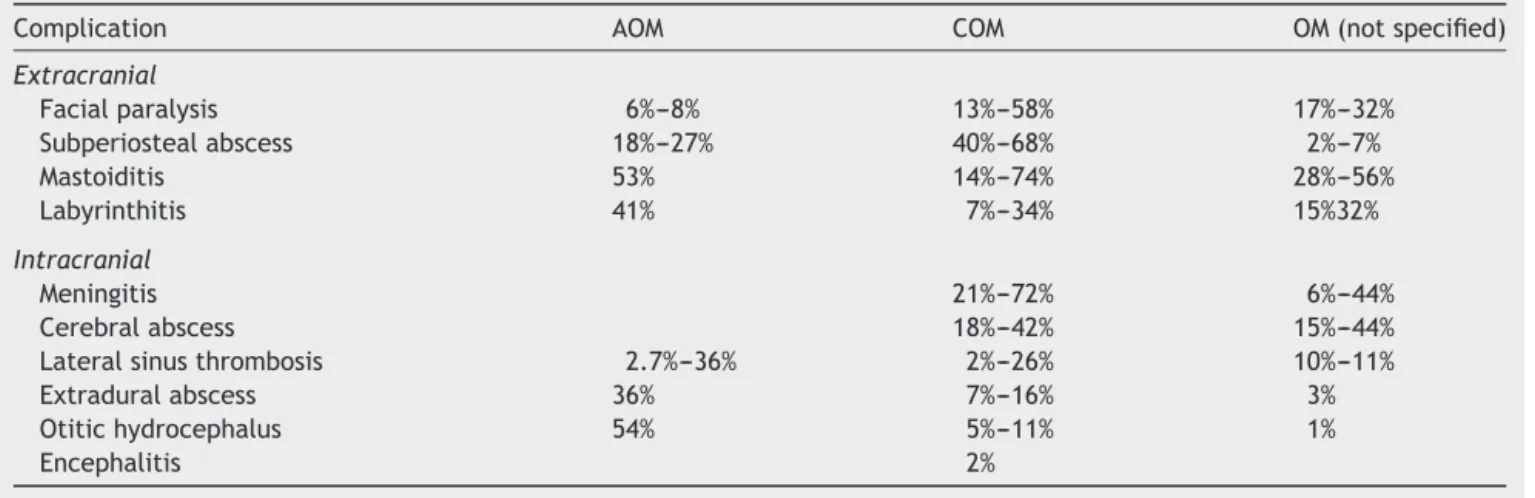
intracranial.Themostcommonextracranialcomplications ofOMincludefacialparalysis,subperiostealabscess, mas-toiditis, and labyrinthitis. The most common intracranial
complications(ICCs)ofOMaremeningitis,cerebralabscess, lateral sinus thrombosis (LST), extradural abscess, otitic hydrocephalus, and encephalitis.8---11 Reported incidences
for these complications (summarized in Table 1) range widely.
Despitetheintroductionofeffectiveantibiotictherapy, the rate of ICC from OM is still about 8%. Anaero-bic bacteria play a significant role.12 Thirty percent of
complications from OM are intracranial; of ICCs, 5---26% resultinmortality.13---15ICCsofAOMusuallydeveloprapidly
andare oftenrecognizedand treatedpromptly,with rea-sonable recovery of function.16 Conversely, early COM is
often unrecognized and untreated,and itmay take years todevelopcomplications,whichareoftenhardtodiagnose andaremuchmoresevereandlife-threatening.
Table1 Complicationratesfromotitismedia.
Complication AOM COM OM(notspecified)
Extracranial
Facialparalysis 6%---8% 13%---58% 17%---32%
Subperiostealabscess 18%---27% 40%---68% 2%---7%
Mastoiditis 53% 14%---74% 28%---56%
Labyrinthitis 41% 7%---34% 15%32%
Intracranial
Meningitis 21%---72% 6%---44%
Cerebralabscess 18%---42% 15%---44%
Lateralsinusthrombosis 2.7%---36% 2%---26% 10%---11%
Extraduralabscess 36% 7%---16% 3%
Otitichydrocephalus 54% 5%---11% 1%
Encephalitis 2%
AOM,acuteotitismedia;COM,chronicotitismedia;OM,otitismedia.Refs.:8---12,17,27.
and otolaryngologists. In a study of 590 children, only 62% were diagnosed accurately by their PCPs, more fre-quently in complicated rather than simple AOM.17 Using
video-recorded otoscopyofAOM, OMwitheffusion (OME), andnormal,otolaryngologistswerecorrect74±16%ofthe time; pediatricians, 51±11%; and general practitioners, 46±21%.18 ThereisalackofformalizedPCPresident
edu-cationinOMdiagnosis,despitethisbeingthemostpediatric diagnosis.19,20DiagnosticaccuracyismostimportantinCOM,
topreventthehigherlikelihoodofintra-andextra-cranial complications.13 However,theaverageageatdiagnosisfor
evencongenitalcholesteatomais4---5yearsold.21Evenafter
entering otolaryngologic care, thereis an average of 3.2 yearsdelayindiagnosisof pediatriccholesteatoma.22 This
unrecognized,andthereforeuntreated,COMcancause sig-nificantcomplicationslateron.
A15-yearreviewofnegligenceclaimsintheUnited King-domfoundthatotologicclaimsmadeup137(26%);ofthe97 successfulclaims,15wererelatedtomisdiagnosis/delayed diagnosis, with COM being the condition most frequently missed, and4 additional cases were claims for morbidity duetodelayedsurgery.23
Even complicationsaredifficulttodiagnose:astudyof fourcasesofpediatriclateralsinusthrombosis(LST),3from OMand1fromtonsillitis,reportedonthenon-specific pre-sentationandpropensity tomissearly diagnosis.24 InaUS
tertiarycarehospital,asymptomaticICCswerefoundin8of 11childrenwithacutemastoiditistreatedoveraone-year period.25TheclinicalevolutionofLSTisveryvariableandis
oftenmissedbecauseoflackof‘‘pathognomonic’’features, suchaspicketfencefever,whichare,infact,infrequently seen.26
ICCs of AOM andCOM represent life-threatening situa-tions and require immediate action. Due to atypical manifestations and the possibility of hidden expression, oftenrelatedtotheprevioususeofantibiotics,theprompt identification ofICCs requiresa highclinical indexof sus-picionandateamapproachbyphysicians,includingPCPs, infectious disease specialists, otolaryngologists, radiolo-gists,andneurosurgeons.27---29
GiventhehighincidenceofOM,theinaccuraciesin diag-nosis,andthepossibilityoflifethreatening sequelae,this isanimportantongoingproblem.30
Theaimofthisstudyistodescribetheepidemiological andclinicalaspectsofICCsresultingfromOM,toanalyzethe progressionoftheconditionandtodeterminetherelevant aspectsthatshouldbeevaluatedtominimizemorbidityand mortality.
Methods
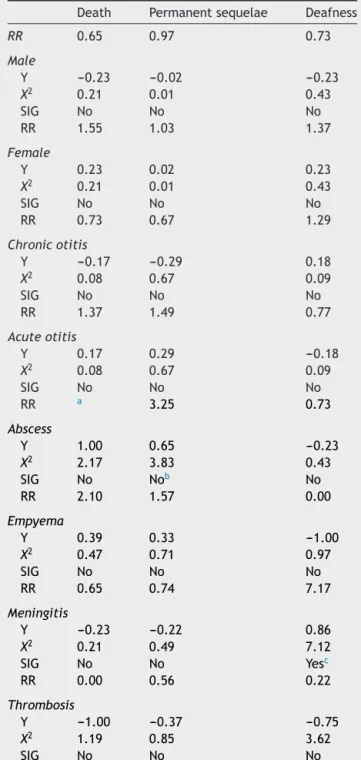
Thisisaretrospectivereviewofclinicaldatathatwas car-ried out in a teaching and research institution. Fifty-one casesofICCfromOMidentifiedfromoneemergencyroom (ER)overa 22-yearperiod,from1990to2012, were ana-lyzed. In addition, the single year 2010 was selected for moredetailedanalysisoftheincidenceofearinfectionsand theircomplicationsastheypresentedtotheERofthe ter-tiaryreferralhospitalwith743inpatientbedsand366,488 emergencyroom(ER)visitsintherepresentativeyear2010. The treatment team included neuroradiology, neuro-surgery, pediatrics, infectious disease, medical intensive care,andotolaryngologyphysicians.Specifictests,suchas computerizedtomography (CT) scan, magnetic resonance imaging(MRI), magnetic resonance (MR) angiography,and lumbarpunctureweretailoredtothepatientandthe pre-sentation.The outcomesconsideredfor analysisincluded: death, other permanent sequelae, anddeafness. Patients werestratifiedbygender,typeofotitis,andtypeof intracra-nialcomplication.
Datawerecollectedinfourmaincategories:
1. Demographicdata:ageatpresentation,gender. 2. Disease data:the typeof otitis media--- AOMor COM,
which was divided into non-cholesteatomatous COM (NCCOM) and cholesteatomatous COM (CCOM); patient age at first COM diagnosis; duration of illness (time betweeninitialsymptomsofOMandthedevelopmentof theICC);timedelaytoICCdiagnosis (intervalbetween presentationwithinitialICCsymptomsanddiagnosisof theICC);thetypeofICC,thebacteriologyinvolved,and resultsofotherspecifictestsasoutlinedabove. 3. Treatment data: the clinical and surgical treatments
4. Outcome data:thedurationofhospitalization,hearing status post-treatment,neurological sequelae and mor-talityrate.
Statisticalanalysiswasperformedbycalculatingthe rela-tiveriskandcorrelationcoefficientofYule,withsubsequent calculationoftheX2testandPearsonassociation.Statistical
significancewassetat5% alphawith1degreeof freedom (criticalvalueof3.84).
ThisstudywasapprovedbytheInstitutionalEthics Com-mittee(protocol:0352/08).
Results
Demographicdata
In2010,therewasatotalof21,096emergencyroom(ER) visitsrelatedtoearnoseandthroat(ENT)complaints.1816 ofthesepatientswerediagnosedwithotitismedia,foran incidenceinourERof8.6%.Ofthe1816OMpatients,52% werefemale,andthemeanagewas31years.
Diseasedata
Ofthe1816casesofOMseenin2010,1224(67%)wereAOM, and 592 (33%) were COM. This equates to 5.8% and 2.8% ofall ER ENTvisits, respectively. Inthe singleyear 2010, thereweretwocasesofICCsecondarytoCOM,andnocase secondarytoAOM.
Over the entire 22-year period of the study, the ENT servicefollowed5667patientswithCOM,3060(54%)female, and2607(46%)male,withameanageof32years(range: 1---100).Duringthisperiod,51patientshadICCsecondaryto OM,31(61%)oftheICCpatientsweremale,20werefemale, andthemeanageofthepatientsatthetimeofICCdiagnosis was27years.
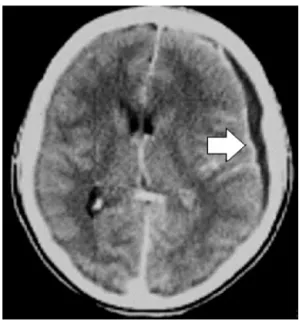
ICCs were related to AOM in 10 cases and COM in 41 cases, with a 0.8% incidence rate for the chronic cases, withCCOM in 39 casesand NCCOM in 2 cases. The mean age of ear disease onset was 11 years in patients with COM.The mean age at the time of ICC diagnosis was30 years for AOM patients, and 26 years for COM patients. The mean period between onset of COM and manifesta-tion of the intracranial complication was 15 years. The timedelayfor ICCdiagnosis(theintervalbetweenthe ini-tial ICC symptoms and definitive diagnosis) was 25 days in AOM cases and 34 days in COM cases. Thirty patients presentedwithtwoormoreconcomitantICCs,totaling84 different intracranial complications in 51 patients. Cere-bralabscessesandmeningitisrepresented78% ofallICCs, followed byempyema, lateral sinus thrombosisand otitic hydrocephalus(Figs.1and2).Thegreatmajorityofcerebral abscesseswerelocatedinthevicinityofthepetrousbone: the temporal lobe and cerebellum were involved in 62% and38% of cases,respectively. Proteus mirabilis,
Entero-coccus, Pseudomonas aeruginosa, Staphylococcus aureus
and extended-spectrum beta-lactamase Klebisiella were themostcommonmicroorganismsinCOM-relatedICC,and
Pneumococcus,Haemophilusand Staphylococcuswerethe
mostcommonmicroorganismsinAOM-relatedICC.
Figure1 AxialCTscanshowingsubduralempyema.
Treatmentdata
Allpatientsreceivedintravenousantibioticsfor3---8weeks, initially withcombination therapy employinga third gen-erationcephalosporin(ceftriaxone)andeitherclindamycin or metronidazole, and then adjusted as culture and sen-sitivityresults becameavailable.Asmallnumberof cases required vancomycin, imipenem or meropenem. Addition-ally,oralantibioticsweregivenforLST.
Atotalof27neurosurgicalprocedureswereperformedto draincerebralabscesses,6forAOMand21forCOM.TwoAOM casesand5COMcasesrequiredtwoor moreneurosurgical drainageproceduresduetoabscessrecurrence.Forty-three otologicalsurgerieswereperformed,4inAOMcases(3 tym-panocentesisand1tympanomastoidectomy)and39inCOM cases (35 canal walls down mastoidectomies and4 intact canal walltympanomastoidectomies). In8 casesof recur-rent abscess after initial neurosurgical drainage attempt, definitivedrainageoftheintracranialabscesswasachieved through the mastoidectomy approach. This drainage into the temporal bone was performed at the same time as cholesteatoma removal. There was no recurrence in any of these8cases.Infiveadditionalcases,theabscesswas drainedonlythroughthemastoidapproachandtherewas no need for any neurosurgical intervention. Two patients withICCfromCOMwerecriticallyillanddiedbeforesurgery couldbeperformed.
Outcomedata
Figure2 (A)AxialCTscanshowingcerebellarabscessandsubperiostealabscess.(B)CoronalCTscanshowinglabyrinthinefistula
atthesamepatient.
patientsdevelopeddeafness:11intheCOMgroup,and1in theAOMgroup.
Patients with the ICC complication of meningitis had over seven time’s higherrisk of deafness (p<0.05). Audi-ological tests were obtained for 4 patients with ICCs relatedtoAOM:3caseshadinitialconductivehearingloss whichresolvedaftertreatment,thefourthcasepresented withmoderate tosevere sensorineural hearing losswhich evolvedintopermanentdeafness.BilateralHLwaspresent in 10 patients; 9 withbilateral COM and 1 withbilateral AOM.
Permanent sequelae occurred in 15 patients (29.4% of allICCcases).CranialnerveVII andVInervepalsieswere themostcommonpermanentconsequencesseen.Allcases offacialpalsy(n=7)wereobserved inpatientswithCOM. ThreepatientswithCOMdeveloped2ormoreneurological sequelae including hemiparesis (n=3), reduced intellec-tualability (n=2), dysmetria(n=1) anddysarthria(n=1). Patientswithcerebralabscesshadover3time’shigherrisk ofdevelopingpermanentsequelae(p<0.05).
Four of 51patients withICC died,yielding a mortality rateof7.8%.Allpatientswhodiedhadanabscess.Itisnot possibletocalculatetherelativerisk,sincetherewereno deathswithoutabscess.Abscessanddeathhadahigh cor-relationofYulebutcouldnotreachstatisticalsignificance, probablyduetotherelativelylownumberofevents. Pres-enceof intracranialempyema was alsoassociated with a high(>2)relativeriskofdeath,butthiscouldalsonotreach statisticalsignificance.
Overthe22years,3---7casesofICCfromOMwereseen consistentlyevery2years(Fig.3).Therewasahigher per-centage of ICCs in cases of AOM among patients at the extremes of age (Fig.4). A totalof 60% of complications duetoAOMoccurredininfantsandchildren;30%occurred intheelderly,andonly10%occurredinnon-elderlyadults. On the other hand, ICCs inCOM casesoccurred mostlyin teenagersandyoungadults(aged10---39years).
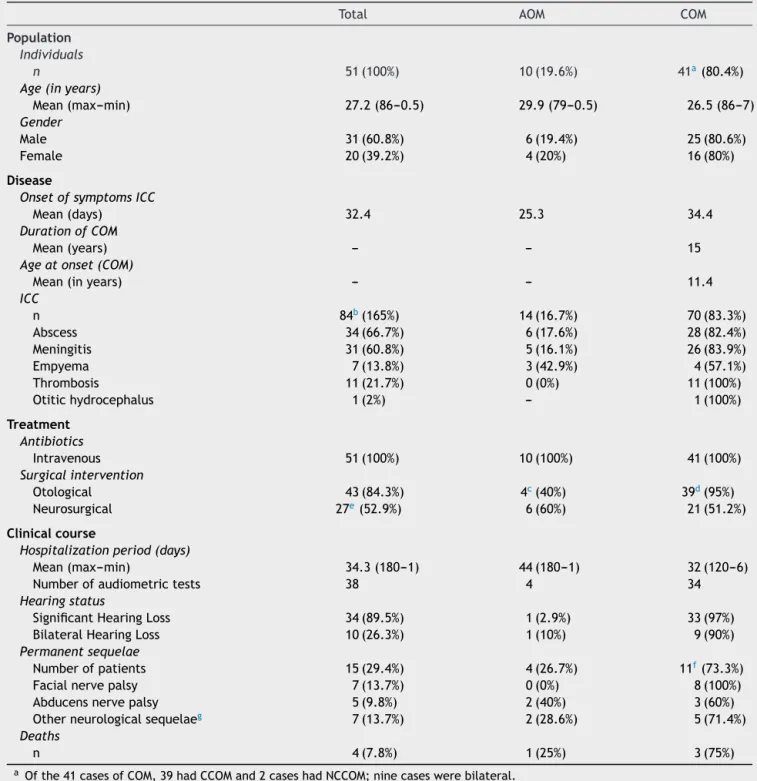
ThesedataaresummarizedinTables2---4.
Discussion
ICC from OM is seen predominantly in malechildren and young adults, which agrees with other reports in the literature.31---34 CCOM is responsible for over 76% of cases
8
7
6
5
4
3
2
0
1990-92 1992-4 1994-6 1996-8 1998-00 2000-02 2002-04 2004-06 2006-08 2008-10 2010-12
1
Figure3 Occurrenceofintracranialcomplicationsin22years dividedinbiennium.Thisbargraphdemonstratestherelatively
constant number of ICCs seen in OM over 22 years,despite
advancesinantibiotictreatmentoverthatsametimeframe.
12
10
8
6
4
2
0
0-9y 10-14y 15-19y 20-29y 30-39y 40-49y 50-59y >60y
AOM COM
Table2 Summaryofcurrentstudydataregardingcasesofintracranialcomplicationsecondarytootitismedia.
Total AOM COM
Population
Individuals
n 51(100%) 10(19.6%) 41a(80.4%)
Age(inyears)
Mean(max---min) 27.2(86---0.5) 29.9(79---0.5) 26.5(86---7)
Gender
Male 31(60.8%) 6(19.4%) 25(80.6%)
Female 20(39.2%) 4(20%) 16(80%)
Disease
OnsetofsymptomsICC
Mean(days) 32.4 25.3 34.4
DurationofCOM
Mean(years) --- --- 15
Ageatonset(COM)
Mean(inyears) --- --- 11.4
ICC
n 84b(165%) 14(16.7%) 70(83.3%)
Abscess 34(66.7%) 6(17.6%) 28(82.4%)
Meningitis 31(60.8%) 5(16.1%) 26(83.9%)
Empyema 7(13.8%) 3(42.9%) 4(57.1%)
Thrombosis 11(21.7%) 0(0%) 11(100%)
Otitichydrocephalus 1(2%) --- 1(100%)
Treatment Antibiotics
Intravenous 51(100%) 10(100%) 41(100%)
Surgicalintervention
Otological 43(84.3%) 4c(40%) 39d(95%)
Neurosurgical 27e(52.9%) 6(60%) 21(51.2%)
Clinicalcourse
Hospitalizationperiod(days)
Mean(max---min) 34.3(180---1) 44(180---1) 32(120---6)
Numberofaudiometrictests 38 4 34
Hearingstatus
SignificantHearingLoss 34(89.5%) 1(2.9%) 33(97%)
BilateralHearingLoss 10(26.3%) 1(10%) 9(90%)
Permanentsequelae
Numberofpatients 15(29.4%) 4(26.7%) 11f(73.3%)
Facialnervepalsy 7(13.7%) 0(0%) 8(100%)
Abducensnervepalsy 5(9.8%) 2(40%) 3(60%)
Otherneurologicalsequelaeg 7(13.7%) 2(28.6%) 5(71.4%)
Deaths
n 4(7.8%) 1(25%) 3(75%)
aOfthe41casesofCOM,39hadCCOMand2caseshadNCCOM;ninecaseswerebilateral. b 30patientshad2ormoreconcomitantICCsforatotalof84ICCsin51patients.
c OtologicproceduresforAOMcases:3patientsunderwentmyringotomy;1underwenttympanomastoidectomy.
d OtologicalproceduresforCOMcases:36patientshadcanalwalldownmastoidectomyand3patientshadcanalwallup tympanomas-toidectomy;only2patientswithCOMweretoosickanddiedbeforeanyotologicalsurgicalinterventioncouldbeperformed.
e Neurosurgicalprocedures:4casesofAOMand15casesofCOMrequiredtwoormoreneurosurgicalinterventions. f FivepatientswithCOMhad2ormoresequelae.
gOtherneurologicalsequelae:hemiparesis(3),reducedintellectualability(2),dysmetria(1)anddysarthria(1).
ofICCs.AOM-relatedICCsoccurmostlybelowage15,which correspondswiththehighestoccurrenceofAOM.Itis cus-tomarytothinkaboutAOMasachildhoodproblem;however, one cannot overlook the second ‘‘bump’’ of AOM in the geriatricpopulation.Thisbimodaldistributionofincidence
skewstheaverageageofpatientswithICCfromAOM mis-leadinglyhigher.
complications
of
otitis
media
259
Table3 Incidenceoftheoutcomesofdeath,permanentsequelae,anddeafnessinrelationtoage,gender,diagnosisofotitisandmajorintracranialcomplications.
Studypopulation Death Permanentsequelae Deafness
n Yes No Yes No Yes No
ICCoccurrence 51 4/51 47/51 15/51 36/51 12/38a 26/38a
Incidenceinthepopulation 7.84% 92.16% 29.41% 70.59% 31.58% 68.42%
Meanage±SD 27.62±19.66 40.00±21.26 26.56±19.40 18.37±16.38 31.47±19.82 29.68±21.55 25.42±13.58
Male 31/51 2/31 29/31 9/31 22/31 7/25 18/25
Incidence 60.78% 6.45% 93.55% 29.03% 70.97% 28% 72%
Incidenceoftheoutcomes 60.78% 2/4(50%) 29/47(61.7%) 9/15(60%) 22/36(61.1%) 7/12(58.33%) 18/26(69.2%)
Meanage±SD 28.45±21.51 29.00±8.45 28.41±22.20 18.56±9.99 32.50±21.20 35.71±26.80 24.61±14.37
Female 20/51 2/20 18/20 6/20 14/20 5/13 8/13
Incidence 39.22% 10% 90% 30% 70% 38.46% 61.54%
Incidenceoftheoutcomes 39.22% 2/4(50.0%) 18/47(38.3%) 6/15(40.0%) 14/36(38.9%) 5/12(41.66%) 8/26(30.76%)
Meanage±SD 26.32±16.84 51.00±28.28 23.58±13.80 18.08±10.55 29.86±18.09 21.00±6.52 27.25±12.34
COM 41/51 3/41 38/41 11/41 30/41 11/34 23/34
Incidence 80.51% 7.32% 92.68% 26.83% 73.17% 32.35% 67.65%
Incidenceoftheoutcomes 80.39% 3/4(75.0%) 38/47(80.9%) 11/15(73.3%) 30/36(83.3%) 11/12(91.7%) 23/26(88.5%)
Meanage±SD 27.07±14.50 29.67±6.11 26.87±16.97 22.45±17.10 28.77±16.23 31.45±21.56 24.61±10.89
Meanduration(years) 15 11 16 15 15 20 13
AOM 10/51 1/10 9/10 4/10 6/10 1/4 3/4
Incidence 19.61% 10% 90% 40% 60% 25% 75%
Incidenceoftheoutcomes 19.61% 1/4(25.0%) 9/47(19.1%) 4/15(26.7%) 6/36(16.7%) 1/12(8.33%) 3/26(11.6%)
Meanage±SD 29.85±30.52 71.00 25.28±28.51 7.13±6.86 45.00±30.98 9.00 31.66±30.59
Abscess 34/51 4/34 30/34 13/34 21/34 7/25 18/25
Incidence 66.66% 11.76% 88.23% 38.24% 61.76% 28% 72%
Incidenceoftheoutcomes 66.66% 4/4(100%) 30/47(63.8%) 13/15(86.7%) 2/36(5.5%) 7/12(58.3%) 18/26(69.2%)
Meanage±SD 28.07±21.11 40.00±21.26 26.56±19.40 18.65±17.47 33.90±21.42 33.28±26.45 25.94±14.96
Empyema 7/51 1/7 6/7 3/7 4/7 0/2 2/2
Incidence 13.72% 14.28% 85.72% 42.86% 57.14% 0% 100%
Incidenceoftheoutcomes 13.72% 1/4(25.0%) 6/47(12.8%) 3/15(20.0%) 4/36(11.1%) 0/12(0%) 2/26(7.7%)
Meanage±SD 13.79±6.93 23.00 12.25±6.14 9.50±8.05 17.00±4.55 --- 16.00±2.82
Meningitis 31/51 2/31 29/31 8/31 23/31 11/23 12/23
Incidence 60.78% 6.45% 93.55% 25.81% 74.19% 47.83% 52.17%
Incidenceoftheoutcomes 60.78% 2/4(50.0%) 29/47(61.7%) 8/15(53.3%) 23/36(63.9%) 11/12(91.7%) 12/26(46.2%)
Meanage±SD 24.26±15.00 27.00±5.65 24.06±15.47 16.50±9.21 26.96±15.82 24.45±12.81 23.38±10.44
Thrombosis 11/51 0/11 11/11 2/11 9/11 1/10 9/10
Incidence 21.56% 0% 100% 18.18% 81.82% 10% 90%
Incidenceoftheoutcomes 21.56% 0(0%) 11/47(23.4%) 2/15(13.3%) 9/36(25.0%) 1/12(8.3%) 9/26(34.6%)
Meanage±SD 26.64±12.31 --- 26.63±12.31 17.00±9.90% 28.78±12.19 45.00 26.77±11.49
Table4 Statisticalanalysisofriskfactorsfordeath, per-manentsequelaeanddeafness.
Death Permanentsequelae Deafness
RR 0.65 0.97 0.73
Male
Y ---0.23 ---0.02 ---0.23
X2 0.21 0.01 0.43
SIG No No No
RR 1.55 1.03 1.37
Female
Y 0.23 0.02 0.23
X2 0.21 0.01 0.43
SIG No No No
RR 0.73 0.67 1.29
Chronicotitis
Y ---0.17 ---0.29 0.18
X2 0.08 0.67 0.09
SIG No No No
RR 1.37 1.49 0.77
Acuteotitis
Y 0.17 0.29 ---0.18
X2 0.08 0.67 0.09
SIG No No No
RR a 3.25 0.73
Abscess
Y 1.00 0.65 ---0.23
X2 2.17 3.83 0.43
SIG No Nob No
RR 2.10 1.57 0.00
Empyema
Y 0.39 0.33 ---1.00
X2 0.47 0.71 0.97
SIG No No No
RR 0.65 0.74 7.17
Meningitis
Y ---0.23 ---0.22 0.86
X2 0.21 0.49 7.12
SIG No No Yesc
RR 0.00 0.56 0.22
Thrombosis
Y ---1.00 ---0.37 ---0.75
X2 1.19 0.85 3.62
SIG No No No
RR,relativerisk;Y,Yuleassociationcoefficient;X2,X2testof associationofPearson;SIG,X2 testofsignificanceassociated withPearson’s1 degreeoffreedom and alphaof5% (critical value3.84).
aNopossiblecalculation.
b Valueextremelyclosetosignificance.
c Valuewithasignificanceleveloffreedomandalpha(1% crit-icalvalue6.64).
of the disease’’ is approximately 15 years, we can pos-tulate that indolent pediatric cases of COM, which were notproperlydiagnosed,treatedorfollowed,wouldbecome moreaggressivediseasethatwouldculminatewith intracra-nialcomplicationsduringadolescenceandearlyadulthood.
COM, inparticular CCOM, wasthe most common etiology in this report,a result that is similartoreports by other authorsfromotherdevelopingcountries.Incontrast,a dif-ferentscenariohasbeenobservedindevelopedcountries, suchasFinland,whereAOMaccountsformorethan80%of thecomplications,andCOMandCCOMareresponsiblefor only12%and8%ofcomplications,respectively.
Withtheprogressachievedthroughcollectiveactionand publichealth,themortalityratefrominfectiousdiseaseshas beendecreasinginmostoftheworld.Inthemid-twentieth century,itwaseventhoughtthattheeradicationof infec-tious diseases would be achieved imminently;35 however,
thispredictionfailedtomaterialize,evenincountries cur-rentlyconsideredhighlydeveloped.Infact,whatoccurred in many places wasa change in the pattern ofinfectious diseases.36 At thepresent time,althoughotitis mediahas
a benign course and typicallyresponds well totreatment overall, some cases (both AOM and COM) develop severe andlethalcomplicationswithconsiderable mortalityrates rangingfrom8%to18.6%.
Accurate examination with early diagnosis and inter-vention in cases of COM, before a complication has already developed, is very important in prevention of delayed ICC. Nonetheless, although there have been sig-nificantadvancesinthediagnosisandtreatmentresources available in medical practice, as well as undeniable socioeconomic improvements in Brazil over the last two decades, we observed a stable occurrence of ICCs over time.
Hearing loss due to OM is a worldwide public health issue.Ourdataconfirmahighprevalenceofsignificant hear-ing loss and deafness in cases of COM. The inflammatory andinfectiousevents thattakeplaceinOMcasesarestill undervaluedin this regard.Additionally, our dataconfirm thatpatientswithICCsduetoOMhavehighhospitalcosts, permanent neurological sequelae in 29%, and a mortality rate of 7.8%, seen in the young and economically active. AccordingtotheBrazilianstatewidesystemofdataanalysis (www.seade.gov.br),therewasa totalof 6701 admissions to the Brazilian public health system in the state of Sao Paulorelatedto‘‘diseasesoftheearandmastoidprocess’’ whichcostR$2.5millionandresultedin30reporteddeaths inoneyear. Duetoitsprevalenceandhighsocioeconomic cost,OMremainsapressingpublichealthissue.Education andtrainingof PCPsis essentialfor earlyidentification of uncomplicatedeardisease,asearlyandappropriate treat-mentmaypreventthedevelopmentofmoreaggressiveOM andavoidtheICCsduetoOM.
Oncethecomplicationhasoccurred,amultidisciplinary approachisrequiredtomaximizerecovery.Currently,itis commonthatwhenthereisasickpatientwithatemporal lobe or cerebellar abscess,the possibility of concomitant OM is often overlooked. However, because the primary infection responsible is often not immediately diagnosed, the time of hospitalization and chances of sequelae are increased.
duringthesame hospitalization.The abscessis frequently abletobedrainedintotheear.
Conclusion
Life-threatening intracranial complications from otitis media still occur. Complications in cases of acute oti-tis media usually occur in children or in the elderly. In contrast, complications of chronic otitis media are gen-erally observed in young adulthood, particularly cases of cholesteatoma that begin in childhood and take several yearstodevelop. Patients withintracranialcomplications remain hospitalized for a long periodof time, and these individualshavesignificantmorbidityfrompermanent audi-tory and neurological sequelae, as well as a substantial mortalityrate.We have shown thatthehigh incidenceof OM,theinaccuraciesindiagnosis,andthepossibilityoflife threateningsequelaemakethisanimportantongoing prob-lem.Assuch,theprimarytreatingphysicianmustmaintain a high index of suspicion when examining a patient with OM.
Conflicts
of
interest
SujanaS.Chandrasekhar,MD---shareholderandboard mem-ber, ScientificDevelopment and Research,Inc.(Intranasal SurfactantResearch).Otherauthors:none.
References
1.World Health Organization. Primary ear and hearing care training resource; 2006 http://www.who.int/pbd/deafness/ activities/hearingcare/advanced.pdf
2.MonastaL, Ronfani L, Marchetti F, Montico M, Brumatti LV, Bavcar A, et al. Burden of disease caused by otitismedia: systematic review and global estimates. PLoS ONE. 2012;7: e36226.
3.ParadiseJL,RocketteHE,ColbornDK,BernardBS,SmithCG, Kurs-LaskyM,etal.Otitismediain2253Pittsburgh-areainfants: prevalenceand riskfactorsduringthefirsttwoyearsoflife. Pediatrics.1997;99:318---33.
4.WorldHealthOrganization.Preventionofhearingimpairment from chronic otitis media. Report of a WHO/CIBA Foun-dation Workshop; 1996 http://www.who.int/pbd/deafness/ en/chronicotitismedia.pdf
5.Casselbrant ML, Mandel EM. Acute otitis media and otitis mediawitheffusion.In:CummingsCW,HaugheyBH,Thomas JR, Harker LA, Flint PW, editors. Cummings otolaryngology --- head and neck surgery. 5th ed. St. Louis: Mosby; 2010. p.461---77.
6.MostafaBE,ElFikyLM,ElSharnoubyMM.Complicationsof sup-purativeotitismedia:stillaprobleminthe21stcentury.ORLJ OtorhinolaryngolRelatSpec.2009;71:87---92.
7.Wu JF, Jin Z, Yang JM, Liu YH, Duan ML. Extracranial and intracranialcomplicationsofotitismedia:22-yearclinical expe-rienceandanalysis.ActaOtolaryngol.2012;132:261---5.
8.VerhoeffM,vanderVeenEL,RoversMM,SandersEAM,Schilder AGM.Chronicsuppurativeotitismedia:areview.IntJPediatr Otorhinolarngol.2006;70:1---12.
9.PellegriniS,GonzalezMacchiME,SommerfleckPA,Bernáldez PC. Intratemporal complications from acute otitis media in children: 17 cases in two years. Acta Otorrinolaringol Esp. 2012;63:21---5.
10.GhoshPS,GhoshD,GoldfarbJ,SabellaC.Lateralsinus throm-bosisassociatedwithmastoiditisandotitismediainchildren:a retrospectivechartreviewandreviewoftheliterature.JChild Neurol.2011;26:1000---4.
11.Bales CB, Sobol S, Wetmore R, Elden LM. Lateral sinus thrombosis as a complication of otitismedia: 10-year expe-rienceat the Children’s Hospitalof Philadelphia.Pediatrics. 2009;123:709---13.
12.ZevallosJP,VrabecJT,WilliamsonRA, GiannoniC,LarrierD, SulekM,etal.Advancedpediatricmastoiditiswithandwithout intracranialcomplications.Laryngoscope.2009;119:1610---5.
13.YorgancılarE,YıldırımM,GunR,BakırS,TekınR,GocmezC, etal.Complicationsofchronicsuppurativeotitismedia:a ret-rospectivereview.EurArchOtorhinolaryngol.2013;270:69---76.
14.ManzarN,ManzarB,KumarR,BariME.Thestudyofetiologic anddemographiccharacteristicsofintracranialbrainabscess:a consecutivecaseseriesstudyfromPakistan.WorldNeurosurg. 2011;76:195---200.
15.OsmaU,CureogluS,HosogluS.Thecomplicationsofchronic oti-tismedia:reportof93cases.JLaryngolOtol.2000;114:97---100.
16.LeskinenK,JeroJ.Acutecomplicationsofotitismediainadult. ClinOtolaryngol.2005;30:511---6.
17.AsherE,LeibovitzE,PressJ,GreenbergD,BilenkoN,Reuven H.Accuracyofacuteotitismediadiagnosisincommunityand hospitalsettings.ActaPaediatr.2005;94:423---8.
18.PichicheroME,PooleMD.Comparisonofperformanceby oto-laryngologists, pediatricians, and general practioners on an otoendoscopic diagnostic video examination. Int J Pediatr Otorhinolaryngol.2005;69:361---6.
19.SteinbachWJ,SectishTC,BenjaminDKJr,ChangKW,Messner AH. Pediatricresidents’ clinicaldiagnosticaccuracy of otitis media.Pediatrics.2002;109:993---8.
20.MarchisioP,MiraE,KlersyC,FabioP,SusannaE,SoniaB,etal. Medicaleducationandattitudesaboutacuteotitismedia guide-lines: a surveyof Italianpediatricians and otolaryngologists. PediatrInfectDisJ.2009;28:1---4.
21.LevensonMJ,ParisierSC,ChuteP,WenigS,JuarbeC.Areview of20congenitalcholesteatomasofthemiddleearinchildren. OtolaryngolHeadNeckSurg.1986;94:560---7.
22.SempleCW,MahadevanM,BerkowitzRG. Extensiveacquired cholesteatomain children: when thepenny drops. AnnOtol RhinolLaryngol.2005;114:539---42.
23.MathewR,AsimacopoulosE,ValentineP.Towardsaferpractice inotology:areporton15yearsofclinicalnegligenceclaims. Laryngoscope.2011;121:2214---9.
24.MatarNE,RassiSJ,MelkaneAE,HaddadAC.Lateralsinus throm-bosisinthepediatricpopulation:multiplepresentationsfora potentiallylethaldisease.PediatrEmergCare.2009;25:681---3.
25.MallurPS,HarirchianS,LalwaniAK.Preoperativeand postop-erativeintracranialcomplicationsofacutemastoiditis.AnnOtol RhinolLaryngol.2009;118:118---23.
26.PenidoNO,TestaJRG,InoueDP,CruzOLM.Presentation, treat-ment,andclinicalcourseofotogeniclateralsinusthrombosis. ActaOto-Laryngol.2009;129:729---34.
27.Wanna GB, Dharamsi LM, Moss JR, Bennett ML, Thompson RC, Haynes DS. Contemporary management of intracra-nial complications of otitis media. Otol Neurotol. 2009;31: 111---7.
28.PenidoNO,BorinA, FukudaY.Necessityofan otorhinolaryn-gologicalevaluationandtreatmentinpatientswithencephalic abscess.BrazJOtorhinolaryngol.2002;68:794---9.
29.PenidoNO,BorinA, IhaLCN, SuguriVM,OnishiE,FukudaY., et al. Intracranial complications of otitis media: 15 years of experience in 33 patients. Otolaryngol Head Neck Surg. 2005;132:37---42.
31.ViswanathaB.Unsafenessofsurgicallysafeear.IntJPediatr OtorhinolaryngolExtra.2010;5:114---7.
32.KangsanarakJ,Fooanant S,RuckphaopuntK,NavacharoanN, TeotrakulS.Extracranialandintracranialcomplicationsof sup-purative otitismedia: report of 102cases. J Laryngol Otol. 1993;107:999---1004.
33.Miura MS, Krumennauer RC, Lubianca Neto JF. Intracranial complicationsofchronicsuppurativeotitismediainchildren. BrazJOtorhinolaryngol.2005;71:639---43.
34.GowerD,McGuirtWF,SalemW.Intracranialcomplicationsof acuteandchronicinfectionseardisease:aproblemstillwith us.Laryngoscope.1983;93:1028---33.
35.DubosR. Adaptingman adapting:curing, helping,consoling. YaleJBiolMed.1979;52:211---8.