53
Study of adolescents’ multifactorial self
-image components based on
their own self-characterizations
Zsófia Irén Horváth
121 Universitatea Sapientia, Târgu Mureş, Romania 2 University of Szeged, Hungary
The most important questions of human existence and development – Who am I? What am I like? – concerned every thinking human in all cultural-historical ages. These questions remain timely even in our rapidly changing postmodern society.
The goal of our research is the examination of adolescents’ self-characterization, the outlining of the self-image components age characteristics, the establishment of differences resulting from their environment. Our examination is part of the 2005/2006 school year evaluation (Pletl, 2011) regarding Transylvanian students’ composition skills. In the present research we have analyzed a total of 1602 self-characterization of Transylvanian Hungarian students.
Results show that fifth grade students have dichotomous thinking that becomes more sophisticated by the time they get into the eighth grade. Eighth grade students referred significantly more often to the categories Emotions, Satisfaction, Social attitudes, School achievement, Special interests and mentioned more personality traits. In the comparison by location, more similarities and fewer differences were outlined. However, urban students referred significantly more often to emotions and satisfaction, while rural students mentioned more frequently characteristics like good-hearted and diligent.
The study also outlined two major deficiencies. No significant difference was found between the two grades in naming abilities, and referring to Science and Language.
We strongly believe that school should be more than simply a place for traditional teaching; effective education and personal development should spread to new areas like the development of self-reflective thinking, the shaping of personal competence and the operation of Career and Vocational Counseling.
Keywords: multifactorial self-image, adolescents, self-characterization.
Address of correspondence: Zsófia Irén Horváth, Târgu Mureş, 35 Primaverii str., 540174; email: [email protected]
The most important questions of human existence and development – Who am I? What am I like? – concerned every thinking human in all cultural-historical ages. These questions remain timely even in our rapidly changing postmodern society, because the faster the cultural values and environmental conditions are changing the greater is the need for creating inner stability. The formation of the
individual’s self-identity is supported by self-knowledge and understanding, that is the result of a long developmental process.
Self-concept theories
William James’ basic writing that appeared in 1890 is
considered to be the starting point of modern self-research.
The authors’ concept of multiple selves refers to the
versatility and complexity of the self. According to his fundamental assumption, the self is an independent psychic
formation that evolves in the process of individual development and socialization. The two basic components of the self-system are the pure ego (I) and empirical self (Me). The pure ego can be conceptualized as the subjectof cognition that carries the consciousness and self-awareness. The analysis and psychological interpretation of the pure ego is much more difficult and complicated than
the empirical self’s, because it has no directly and vividly
tangible experiences (Pataki, 2004; Zlate, 2004). In the following decades, the concept of the studiable, cognizable, examinable empirical self constituted the starting point of numerous scientific inquiries.
The psychoanalytic theory representatives described the self as a psychic apparatus. Psychoanalysis is a theory
54 personality as well. This theory of personality is dynamic, developmental, and intrapsychic (Aiken, 1999, p.25).
Freud’s theory was based almost entirely on clinical
observations. Although further empirical studies contradicted his theory on several points, it still had an unquestionable influence on different areas of human sciences. The theory’s credits are the development of
several personality analysis techniques, like clinical observations, clinical interview, dream analysis, various projective techniques. (Aiken, 1999; Zlate, 2004).
Jung was also a representative of the psychoanalytic school, but he developed his views in a new direction, which, by his own admission, in many cardinal issues
contradicted Freud’s theory. Regarding personality, Jung
distinguished the extraversion and introversion dimensions. Depending on the extent to which a person is opened toward others, or on what scale he is distant from others, he is situated between the two end points of an imaginary dimension. Jung emphasizes the phenomenon of sociability. (Aiken, 1999).
Aiken (1999) mentions Gordon Allport (1897-1967) as the first representative of trait theories. Personality traits or characteristics are a predisposition that makes possible for the individual to respond to another person, object or situation in his own, unique way. Traits are less general than types of personality. People possess characteristics in various proportions, so the types are the combinations or clusters of characteristics. Allport defines personality as a dynamic unit of characteristics that are responsible for a
person’s individual attitude toward his environment (Aiken, 1999; Zlate, 2004).
Humanistic or Phenomenological theory, beside psychoanalysis and behaviorist schools, is the third major tendency of modern psychology. The humanistic
psychology’s most influential personality is Maslow. The roots of this tendency go back until the existential
philosophy, which “considers a person as someone who,
starting from itself, is able to determine his own destiny,
and constantly aspires to develop.” (Tringer, 2004, p.22)
The most important prominent of the person-centered psychology is Carl Rogers, according to whom prerequisite of human relations, the unconditional acceptance is identical with the concept of love. The unconditional acceptance of ourselves and others is the most important factor regarding not only therapeutic relationship, but everyday relationships as well. Self-image is a key concept of person-centered psychology, and is the totality of our self-knowledge. Eventhough our self-knowledge is changeable, self-image means some sort of consistency. (Tringer, 2004).
The cognitive view considered that the self is knowable, it can be studied. Our notions about the self consist of information obtained by perception and sensation and stored in our memory. Information develop, change because of the influence of other cognitive functions like attention, information processing, thinking, imagination, etc. (Linville & Carlston, 1994). In cognitive psychology the self is visualized as an information-mappingschema, as a prototype, a category, a structure or as an associational network. The representation schemes are not passive impressions, but self-forming, active processes. (Linwille &Carlson, 1994).
The social cognitionbased approach evolved sometime in the second half of the seventies. This emerged from the
social psychology and cognitive psychology. It’s key
concepts, views are a combination of these two tendencies, and this is why it got the social cognition name (Carlson & Linwille, 1994). According to social understanding our self-knowledge is organized in a cognitive way, similarly to the knowledge of other cognitive areas. (Linwille & Carlson, 1994).
From the mid-eighties onwards, social cognition studies became a decisive research area regarding the self. Thereby, such psychological measurement instruments were developed that can provide relatively objective
information about the individual’s self-referential knowledge and experiences, studying self-concept became a recognized area in modern research (Marsh & Shavelson, 1985).
The self-concept is a multifaceted, hierarchical system (Marsh & Shavelson, 1985; Marcus, H. & Nurius, P. 1986; Marsh, 1989; Marcus & Kitayama, 1991; Marsh, Parada, &
Ayotte, 2003). In Marsh & Shavelson’s (1985, p.107) definition the self-concept is a “person’s perceptions of
him- or herself.” This perception system is developed as a result of the individual’s experiences and interpretations of
his own environment. The formation and functioning of this is influenced by the significant others evaluation, the resultant attributes of our own behavior, and self-reinforcement. According to their model, self-concept has the following characteristics:
1.Multifaceted: indicates that people categorize the information obtained about themselves, which are structured in various categories.
2.The self is hierarchically organized: simple motions, actions are organized into subunits, this into subcategories, the subcategories in main categories, and one with another being in a subordinate-superior relation.
3.The general self-concept is considered to be stable: at the top of hierarchy, general self-image is relatively stable, but moving downwards the hierarchy of subsystems it becomes more and more situation dependant.
4.During the process of development, self-concept becomes more multifaceted.
5.Self-concept includes both descriptive and evaluative dimensions.
6.Its subsystems are to be distinguished into academic self-concept and non-academic self-concept (Marsh & Shavelson, 1985, p. 107-108).
The academic self-concept is also hierarchically organized and can be further divided into distinct subunits like native language, mathematical, historical and scientific self-concept (Marsh & Shavelson, 1985; Marsh & Kit-Tai Hau, 2003; Marsh, 1989; Watt, 2004). The components of the non-academic self-concept are the social, emotional and physical self-concepts (Montemayor & Eisen, 1977; Marsh & Shavelson, 1985; Marsh 1989, Markus & Kitayama, 1991; Damon & Hart 1991; Osterweggel & Oppenheimer, 1993; Harter, at al., 1997; Sallay, 2001; Zlate, 2004, Horváth, 2011). The components of the social self-concept are the contemporary’s and the significant other’s self-concept, whilst the physical self-concept can be divided into physical skills and appearance related self-concept.
Hattie’s (2004) New Rope Model combined views of a
55 him, our amount of information about the self is organized in our knowledge system as the fibers are interwoven in a rope. Fibers by mutual strengthening form yarns, the concentration of yarns form strands, and strands by merging form a rope. In Hattie’s opinion, the advantage of
the model is that the units of self-concept are not distinct, rigid parts, but interact with one another, enhance,
influence each other’s content, thereby forming a flexible
system.
The adolescents’ self-image characteristics
As years pass by, self-concept becomes more and more abstract, and is less specific in adolescence than during childhood (Montemayor & Eisen, 1977). According to the authors, the phenomenon when our image of the world changes till adolescence by going from the display of specific terms in the direction of the abstract, is a characteristic to the self-concept too. In their opinion, during development a structural change occurs in the self-concept: subjective and abstract terms replace concrete and objective terms. Children characterizes themselves in free compositions, using concrete terms, objective categories, referring to physical characteristics, objects and animals they possess, play activities. The adolescents use more abstract and subjective notion such as beliefs, motivation, social and personality characteristics. They aspire to create
a smart and unique image of themselves. Adolescents don’t
just use more abstract terms in their self-characterizations, the transformation is flexible because there are things they omit or what they formulate differently. For example,
children say “I am smart”, “I am a good football player”, they don’t compare themselves to others. Adolescents
already make a comparison between themselves and their
peers, therefore they say “I am a sportsman”, “I like sports”. The adolescents refer to more personality traits,
skills, motivation, than elementary school children. According to the authors (Montemayor & Eisen, 1977) objective notions are such as physical characteristics, specific activities, owned objects and animals. Subjective terms are skills, personality characteristics, emotions, and mixed notions (contains both subjective and objective components) like the motivation, or interest.
Marsh’s (1989) research results confirmed the phenomenon that self-concept varies in function af the age: in the case of elementary school aged children the self-concept indicators are high, but then they decrease starting with prepuberty. At the end of adolescence the indicators increase again. From elementary school age till adolescence, the graphic illustration of the self-image examination results is similar to a U-shaped curve, which’s
lowest point consists of the seventh-eighth grade student’
results.
According to Harter at al. (1997) the self-system is more adequate explained by the multidimensional models, than by the one-dimensional models. During adolescence self-concept differentiates, with the transition from childhood to adolescence the evaluable self-image components increase. Adolescents characterize themselves in very different ways in function of their relationships. For example, when they characterize themselves in terms of the relationship with their mother, they enumerate other attributes than in the case of their relationship with the father. Likewise, their self-characterization differs when
they characterize themselves regarding their relationships with friends, classmates or teachers.
In adolescence, individuals are capable of displaying their whole being, intentions and actions to themselves. They have a high demand for self-knowledge, and are strongly interested in their own self. (Vajda, 2006)
Self-understanding is a fundamental human desire, which starts in the early period of life and lasts a lifetime. A small child observes his facial features in the mirror, an adolescent compares himself to his peers, an adult uses abstract concepts to build the personally experienced identity. Self-understanding is the conceptual system of our thoughts regarding ourselves, and the attitude toward ourselves, which includes all knowledge and emotion that distinguishes the self from the other. (Damon & Hart, 1993).
Study hypotheses
The goal of our research was the examination of
adolescents’ self-characterization, the outlining of the self-image components age characteristics, the establishment of differences resulting from their environment, and due to these – the formulation of educational tasks. Our examination is part of the 2005/2006 school year evaluation (Pletl, 2008, 2011) regarding Transylvanian
students’ composition skills. We were searching answers
for the following questions: what is the difference between
the eighth grade students’ and fifth grade students’ self -characterization; what is the difference between the self-characterization of children from the urban areas and those from rural areas.
According to this we assume that until fifth grade (age 11-12) the basic physical self-schema categories are developed (color of eyes, color of hair, height, constitution, face). The eighth grade students are more preoccupied by their looks, therefore they refer more often to the categories of clothes, constitution, look, than their fifth grade schoolmates. Due to their life style, rural students have regular physical activities, therefore they more often refer to the physical activity and physical ability categories. We assume eighth grade students to name more abilities and refer to more characteristics than the fifth grade students.
Method
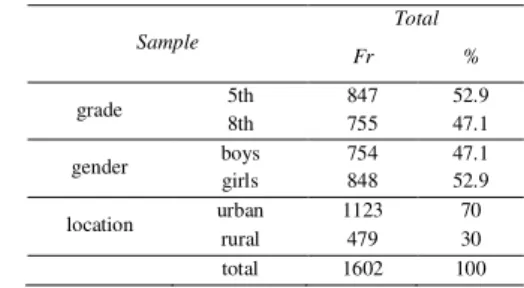
We have analyzed the self-characterization of 1602 Hungarian students from Transylvania (Table 1). The distribution according to study year: 52.9% fifth grade students, 47.1% eighth grade students. The distribution according to location: 70% urban, 30% rural.
Table 1 – Sample
Sample
Total
Fr %
grade 5th 847 52.9
8th 755 47.1
gender boys 754 47.1
girls 848 52.9
56 The research method was the written self-characterization (self-portrait), in the course of which students prepared their self-portrait by presenting their own external and internal characteristics.Task: “List your most
important external and internal characteristics, than plan the logical structure used in the text composition (e.g. face, torso, hands, etc., detailed and/or general characterization) and finally prepare your self-characterization!”
The self-characterizations were processed by means of content analysis (Montemaior & Eisen 1977; Osterveggel & Opperheimer 1993; Sallay, 2001; Ehmann, 2003; Zlate, 2004; Nicolinia, Cherubinia & Bomprezzib, 2010).
Results
When processing the self-characterizations we formed two main content categories. The category of physical-self includes all contents related to the body. These fourteen categories are the following: eye color, hair color, hair length, face, arms, legs, skin, clothes, height, weight, constitution, look (beautiful), physical activity and physical skills. The psychological-self category includes contents that are related to the personality and also other references to the psyche. These are the following: abilities, emotions, satisfaction, social attitudes, interests, personality traits, school achievement.
Physical-self
In the description of the physical-self (Table 2) the most often specified categories were the eye (90%) and hair color (91.1%) as well as the height (81%). Specific features of the constitution follow this with 46.5%. The face form (37.7%) is ahead of the hair (30.8%) and weight (22.7%) categories. Physical activities are mentioned in lower proportions (18.8%). Furthermore: arms (17.2%), legs (16.3%), clothes (14.9%), physical ability (12.4%), skin (9.8 %) and look (beautiful) (5.5%).
Table 2 – Frequency distribution of the physical-self category by grade
Categories 5th % 8th % Total
% Signif.
Color of eyes 90.6 89.4 90 n.s Color of hair 91.3 90.7 91 n.s Length of hair 29.4 32.4 30.8 n.s Form of face 38.8 36.4 37.7 n.s Arms 19.7** 14.5 17.2 χ²(2)=7.318, p=.007 Legs 19.6** 12.8 16.3 χ²(2)=13.195, p<001
Skin 9.1 10.6 9.8 n.s
Dress 12.3 17.9** 14.9 χ²(2)=9.661, p=.002 Height 78.1 84.1** 81 χ²(2)=28.546, p<.001 Weight 19.6 26.2** 22.7 χ²(2) = 9.834, p=.001 Look (beautiful) 7.2* 3.9 5.5 χ²(2) = 7.961, p=.019 Constitution 44.4 48.7** 46.5 χ²(2) = 25.404, p<.001 Physical
Activity
15.40 22.4** 18.8 χ² (2)= 13.609, p=.009
Physical Ability 15.7** 8.7 12.4 χ²(2) = 22.953, p<.001 ** p<0.01, * p<0.05, n.s. – not significant
The results of the comparison by grades are summarized in Table 2. Out of the fourteen physical categories, in the case of nine categories we found significant differences, of which, four categories (arms, legs, look, physical ability) were most often mentioned by the fifth grade students, while the other five by the eighth grade students. The categories mentioned by the eighth
graders were clothes, height, weight, constitution and physical activity. In the case of eye color, hair color and skin categories there were no significant differences.
Reference to the categories of cloth and constitution were significantly higher in the case of the eighth grade students, while the fifth graders referred more often to the look (beautiful) category. The second hypothesis is partially proven, because based on the results we can establish that eighth grade students are preoccupied by their looks in a different way than the fifth graders. Students in lower grades still think within the dimension of beautiful-ugly, while the eighth graders classify their constitution and are more attentive about their clothing.
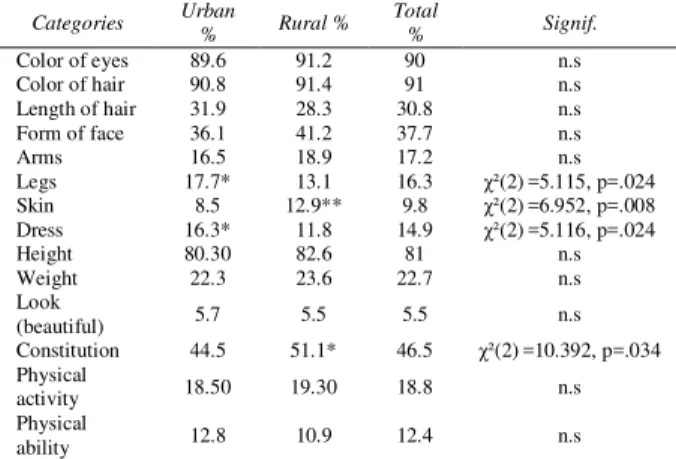
As a result of comparison by location (Table 3) we found significant differences only in three categories: urban children referred more often to the category of legs, while rural children to the categories of skin and constitution. In the case of both locations the order is identical: color of hair, color of eyes, height, constitution, length of hair. Opposite to our assumption we found no difference in the physical activity and physical ability categories.
According to the frequencies we set up an order, with the help of which we determined the most common components of the self-portrait. The following order was established in both grades: color of hair and eyes, height, constitution, face. Regarding the self-characterization, the fifth grade students think in the same categories/schemas as the eighth grade students. We can conclude that by the time of elementary school age the body-image schema is formed, which is the combination of the following categories: color of eyes, hair color, height, constitution, length of hair, etc.
Table 3 – Frequency distribution of the physical-self category by location
Categories Urban % Rural % Total % Signif.
Color of eyes 89.6 91.2 90 n.s Color of hair 90.8 91.4 91 n.s Length of hair 31.9 28.3 30.8 n.s Form of face 36.1 41.2 37.7 n.s
Arms 16.5 18.9 17.2 n.s
Legs 17.7* 13.1 16.3 χ²(2)=5.115, p=.024 Skin 8.5 12.9** 9.8 χ²(2)=6.952, p=.008 Dress 16.3* 11.8 14.9 χ²(2)=5.116, p=.024
Height 80.30 82.6 81 n.s
Weight 22.3 23.6 22.7 n.s
Look
(beautiful) 5.7 5.5 5.5 n.s Constitution 44.5 51.1* 46.5 χ²(2)=10.392, p=.034 Physical
activity 18.50 19.30 18.8 n.s Physical
ability 12.8 10.9 12.4 n.s
** p<0.01, * p<0.05, n.s. – not significant
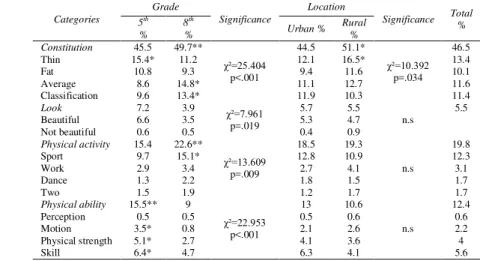
57 Frequency distributions within grades (Table 4) are as it follows: in the fifth grade 15.4% consider themselves thin, 10.8% fat, 8.6% average and 9.6% classifies regarding their appearance. In the eighth grade 11.2% thin, 9.3% fat, 14.8% average and 13.4% classify. Based on the results the eighth grade students refer to their constitution
significantly more often (p=0.000, χ²=25.404) than the fifth
grade students, many rank themselves into the average subcategory and qualify their constitution positively.
According to the results by the location (Table 4) rural students refer to their constitution significantly more often than urban students, many of them think on bipolar dimension of fat-thin, or classify their constitution.
Table 4 – Constitution, look, physical activity, physical ability by grades and location
Categories
Grade
Significance
Location
Significance Total %
5th
% 8th
% Urban %
Rural %
Constitution 45.5 49.7**
χ²=25.404
p<.001
44.5 51.1*
χ²=10.392
p=.034 46.5
Thin 15.4* 11.2 12.1 16.5* 13.4
Fat 10.8 9.3 9.4 11.6 10.1
Average 8.6 14.8* 11.1 12.7 11.6
Classification 9.6 13.4* 11.9 10.3 11.4
Look 7.2 3.9 χ²=7.961
p=.019
5.7 5.5
n.s 5.5
Beautiful 6.6 3.5 5.3 4.7
Not beautiful 0.6 0.5 0.4 0.9
Physical activity 15.4 22.6**
χ²=13.609
p=.009
18.5 19.3
n.s
19.8
Sport 9.7 15.1* 12.8 10.9 12.3
Work 2.9 3.4 2.7 4.1 3.1
Dance 1.3 2.2 1.8 1.5 1.7
Two 1.5 1.9 1.2 1.7 1.7
Physical ability 15.5** 9
χ²=22.953
p<.001
13 10.6
n.s
12.4
Perception 0.5 0.5 0.5 0.6 0.6
Motion 3.5* 0.8 2.1 2.6 2.2
Physical strength 5.1* 2.7 4.1 3.6 4
Skill 6.4* 4.7 6.3 4.1 5.6
** p<0.01, * p<0.05, n.s. – not significant
Beside constitution it’s worth paying attention to the
results of the look category. This was divided into two subcategories. The beautiful subcategory includes the following references: beautiful, good looking, with a good appearance. And the not beautiful subcategory includes the ugly, unpleasant appearance. The fifth grade students refer
significantly more often (p=0.019, χ²=7.961) to the look
category than the eighth graders. By location there are no significant differences.
Summarizing the results of the constitution and look categories we can observe that student from the fifth grade mostly think in the dimensions of beautiful-ugly, thin-fat, while by the eighth grade students, appearances, their constitution classification are considered to be relevant. In both age groups looks are very important, but in the case of the eight grade students the expression of this is proven to be more shaded: several students described themselves by using expressions like pretty, proportional, or in the case of boys muscular, tough.
One of the economic, cultural changes’ most obvious
consequence is the decrease of physical activity and work. At the beginning of the 20th century 80% of the people performed physical work, meanwhile at the beginning of the 21st century this percentage decreased to 20-30%. The form of physical activity completely changed, because
some time ago work constituted it’s largest part, but
nowadays sports stand on the first place.
In the following we have analyzed in detail the results of physical activity. The category of physical activity includes regular physical activities, like sports, work and dance. Its importance is seen in the fact that we can form a picture about the role that activities have in children’s life.
18.8% of the students (Table 4) who participated in the study, regularly perform physical activities. Of them 77.3% is doing some kind of sports, 8.6% is working, 4.7% is dancing and 9.4% performs two forms of the mentioned
activities. As we see work appears in extremely small proportion. Significantly more eighth grade students
(p=0.009 χ²=13.609) mentioned the physical activity.
Within this they refer to sports in much higher proportions and in both groups work, dance and also two forms of activity are mentioned in much smaller proportions. Contrary to our presupposition by location there are no differences regarding physical activity. Urban students refer more often to sports while rural children to work, but the difference is not significant.
To sum up the results regarding physical activity we can clearly establish that sports dominate regarding age and location as well. The housework, and any other work around the house are almost entirely disappearing. A small number of children refer to dance, but two forms of regular activities are rarely mentioned. The results reflect the characteristics of modern life according to which sports are the only form of activity that students regularly perform.
The regular physical activity is related to the designation of physical abilities, because abilities can only be identified if some form of physical activity is being performed. Physical abilities (Table 4) are mentioned (12.4%) in smaller proportions than physical activities (18.8%). Significantly more students from the fifth grade refer to physical abilities than students from the eighth grade: physical strength, as well as skills are more frequently mentioned. There are no differences between urban and rural areas.
Psychological-self
The components of the psychological-self are Skills, Emotions, Satisfaction, Social attitudes, Interests, Personality traits, School achievement.
58 forms of cognitive abilities with the collective term Cognitive 1, while the negative forms of cognitive abilities were labeled as Cognitive 2. The following references belong to the five categories: (1) the Cognitive 1 abilities include characteristics as smart, clever, intelligent, quick-witted, good memory, quick perception; (2) in the group of Cognitive 2 we listed characteristics like stupid, oblivious, slow-witted, difficulties to understand the lesson; (3) abilities related to communication include good composition skills, varied speech, neatly formulates, recites beautifully, no orthographic mistakes; (4) to the art related abilities we listed the music and drawing skills; (5) the more than one category contains answers where the students named more than one ability.
Emotions reflect subjective experiencing regarding the environment and ourselves. The presence of positive emotions, self-satisfaction is prerequisites our well-balanced mental health. Regarding the designation of emotional states we established two groups: positive and negative emotions. Positive emotions include: joy, merriment, cheerfulness, happiness. Negative emotions include: sad, furious, upset, angry, depressed. The Satisfaction category express students’ emotional attitudes towards themselves therefore we labeled it as a separate category.
In the category of social attitudes we listed the
following references: “I am companionable”, “I have a lot of friends”, “I like the company of others”, “I like to be in
the center of others attention”, as well as the contradiction of these, like “I am aloof”, “I have only a few friends”, “I don’t like when many people are around me”.
The category of School achievement contains references regarding the subjective classification of
students’ learning achievements. Based on their
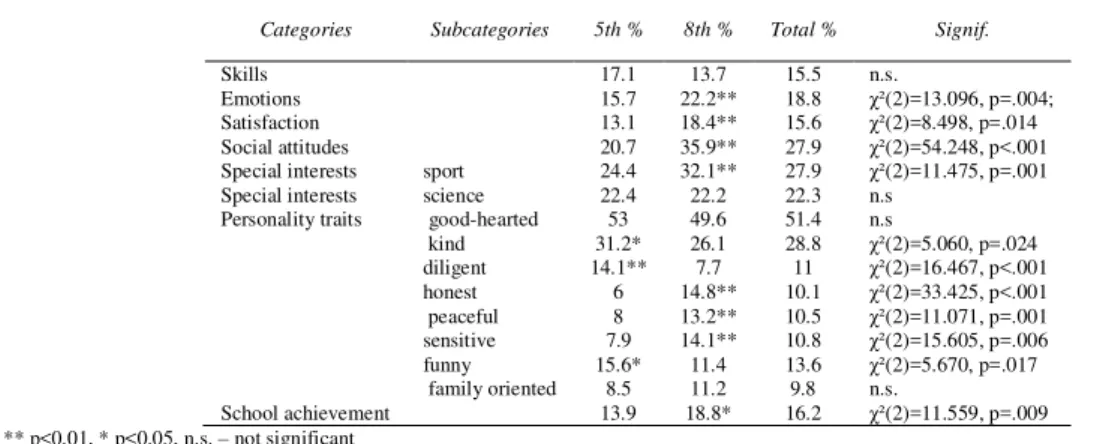
compositions we created three groups: good students, average students and weak students. In Table 5 we summarized the results of the psychological-self category: 15.5% of the students mentioned skills, 18.8% emotions, 15.6% satisfaction and 27.9% social attitudes. Regarding the fields of interest the most frequently identified categories are sports (27.9%) and science (22.3 %). The most frequently mentioned characteristics are: good-hearted (51.4%), kind (28.8%), funny (13.6%), diligent (11%), sensitive (10.8%), peaceful (10.5%), honest (10.1%) and family oriented (9.8%). The category of school achievement was mentioned by a total of 16.2% of the students.
Table 5 - Frequency distribution of the psychological-self category by grade
Categories Subcategories 5th % 8th % Total % Signif.
Skills 17.1 13.7 15.5 n.s.
Emotions 15.7 22.2** 18.8 χ²(2)=13.096, p=.004; Satisfaction 13.1 18.4** 15.6 χ²(2)=8.498, p=.014 Social attitudes 20.7 35.9** 27.9 χ²(2)=54.248, p<.001 Special interests sport 24.4 32.1** 27.9 χ²(2)=11.475, p=.001 Special interests science 22.4 22.2 22.3 n.s
Personality traits good-hearted 53 49.6 51.4 n.s
kind 31.2* 26.1 28.8 χ²(2)=5.060, p=.024 diligent 14.1** 7.7 11 χ²(2)=16.467, p<.001 honest 6 14.8** 10.1 χ²(2)=33.425, p<.001 peaceful 8 13.2** 10.5 χ²(2)=11.071, p=.001 sensitive 7.9 14.1** 10.8 χ²(2)=15.605, p=.006 funny 15.6* 11.4 13.6 χ²(2)=5.670, p=.017 family oriented 8.5 11.2 9.8 n.s.
School achievement 13.9 18.8* 16.2 χ²(2)=11.559, p=.009 ** p<0.01, * p<0.05, n.s. – not significant
Table 6 – Frequency distribution of the psychological-self category by location
Categories Subcategories Urban % Rural % Total % Signif.
Skills 16.3 13.7 15.5 n.s.
Emotions 19** 18.2 18.8 χ²(2)=19.068, p<.001 Satisfaction 16.6* 13.3 15.6 χ²(2)=7.632, p=.022
Social attitudes 27.9 27.9 27.9 n.s.
Special interests sport 28.6** 26.8 27.9 χ²(2)=11.475, p=.001 Special interests science 22.2 22.5 22.3 n.s Personality traits good-hearted 49.1 56.7** 51.4 χ²(2)=7.402, p=.007
kind 28.6 29.2 28.8 n.s.
diligent 9.9 13.7* 11 χ²(2)=4.900, p=.027
honest 10 10.5 10.1 n.s.
peaceful 11.5* 7.9 10.5 χ²=4.516, p=.034 sensitive 10.8 10.9 10.8 n.s.
funny 14.4 11.8 13.6 n.s.
family oriented 9.4 10.7 9.8 n.s. School achievement 16.9 14.6 16.2 n.s. ** p<0.01, * p<0.05, n.s. – not significant
Due to the comparison of grades we found significant differences within more categories (Table 5). Eighth grade students referred significantly more often to Emotions
(p=0.004; χ²=13.096), Satisfaction (p=0.014; χ²=8.498), Social attitudes (p=0.000; χ²=54.248) and School
achievement (p=0.009; χ²=11.559). There are no
significant differences regarding the categories of skills and science.
Regarding personality traits, the honest (p=0.000;
59
(p=0.006; χ²=15.605) subcategories are significantly more frequent in the case of the eighth grade students. The fifth grade students referred significantly more often to the
categories diligent (p=0.000; χ²=16.467) and funny (p=0.017; χ²=5.670). There are no significant differences in the case of good-hearted and family oriented characteristics.
According to the result by location (Table 6) urban children refer more often to the category skills but the difference is not significant. Urban students mention significantly more often the categories Satisfaction
(p=0.022; χ²=7.632) and Sport (p=0.001; χ²=11.475). Rural
students refer significantly more often to the good-hearted
(p=0.007; χ²=7.402) and diligent characteristics (p=0.027; χ²=4.900). There are no significant differences in the case of Social attitudes, Science and School achievement, neither in the case of the following characteristics: kind, honest, sensitive, funny, family oriented.
Special interests
The denotation of interest fields is the specific territory of self-characterization. Students have the possibility to name what they like to do, what truly interests them. This is the topic that is less defined by the external expectations, therefore it reflects in its most natural way the child’s
favorite activities. If teachers and parents are sincerely interested in the psyche of the children, from these information they might obtain indications regarding the territories from which students, children could be approached.
The special interests identified by the adolescents were divided into seven groups: science, sports, nature, art, language, entertainment, media. Each denomination related to learning, different subjects (mathematics, physics, history) or reading, are listed into the Science category. In the Sport category there can be found references to different kinds of movement activities like football, running, skiing, basketball, skating, hockey, cycling, badminton, handball, ball games, etc. The Nature category contains references regarding time spent outdoors, interest for the fauna and flora. Some examples are trip, walking, hiking, climbing, orienteering, traveling etc. In the category of Art we included references such as: likes to play the flute, likes to draw, likes to listen to music, etc. The Languages category contains interest shown in foreign languages. The Entertainment category includes all forms of game, and other forms of entertainment such as partying and disco. Within the Media category, watching television, and computer and Internet use are included, and a subcategory entitled Both, which contains both television and computer.
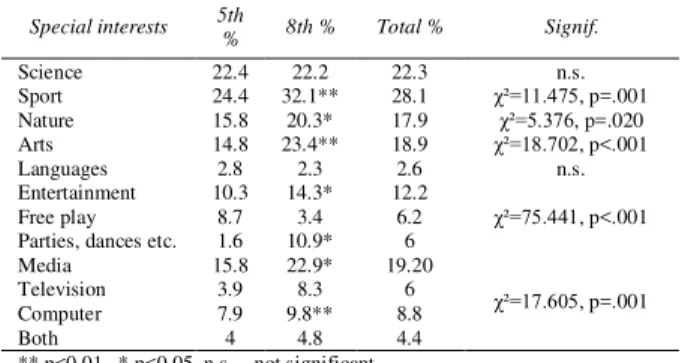
According to the results summarized in Table 7, the frequency distribution based order of the interest fields is the following: (1) 28.1% Sport, (2) 22.3% Science, (3) 19.20% Media, (4) 18.9 % Arts, (5) 17.9% Nature, (6) 12.2% Entertainment, (7) 2.6% Languages. The categories of Sport and Science proved to be the most popular among students. Reference to the categories of Media, Arts and Nature are also significant. The percentage of the interest in foreign languages is very low, only 2.6%.
The results of the fifth grade students (Table 7): (1) 24.4% Sport, (2) 22.4% Science, (3) 15.8% Nature and (4) Media, (5) 14.8% Arts, (6) 10.3% Entertainment, (7) 2.8% Languages.
Table 7 – Frequency distribution of the special interests category by grade
Special interests 5th
% 8th % Total % Signif.
Science 22.4 22.2 22.3 n.s.
Sport 24.4 32.1** 28.1 χ²=11.475, p=.001 Nature 15.8 20.3* 17.9 χ²=5.376, p=.020 Arts 14.8 23.4** 18.9 χ²=18.702, p<.001
Languages 2.8 2.3 2.6 n.s.
Entertainment 10.3 14.3* 12.2
χ²=75.441, p<.001 Free play 8.7 3.4 6.2
Parties, dances etc. 1.6 10.9* 6 Media 15.8 22.9* 19.20
χ²=17.605, p=.001 Television 3.9 8.3 6
Computer 7.9 9.8** 8.8
Both 4 4.8 4.4
** p<0.01, * p<0.05, n.s. – not significant
The results of the eighth grade students: (1) 32.1% Sport, (2) 23.4% Arts, (3) 22.9% Media, (4) 22.2% Science, (5) 20.3% Nature, (6) 14.3% Entertainment, and (7) 2.3% Languages.
There are significant differences between grades, regarding five categories out of seven. These are the
following: Sport (p=0.001; χ²=11.475), Nature (p=0.020; χ²=5.376), Arts (p=0.000; χ²=18.702), Entertainment
(p=0.000; χ²=75.441) and Media (p=0.001; χ²=17.605). In
each case the eighth grade students referred more often to fields of interest. Regarding the category of Entertainment we can see that fifth grade students more frequently identify free play as their favorite form of activity, while eighth grade student mostly refer to parties and disco. In the Media category we see that Television and Computers
are equally preferred. It’s pleasing to see that students, by
the time they get to the eighth grade, refer more often to special interests, because regarding career choice, it is of a great relevance for them to be aware of their interest fields. We can see that students from both grades refer to Science in the same proportions, but the eighth graders interest is more increased regarding the categories Nature and Arts. In both grades the Sport category is the favorite. The eighth grade students referred more frequently to the Media category: television 8.3%, computer 9.8%. The difference
is significant (p=0.001; χ²=17.605). Overall, it seems that students from the eighth grade prefer these forms of media more than the fifth graders, however there is no difference between watching television or using the computer instead. Table 8 contains the comparison by location. Results of
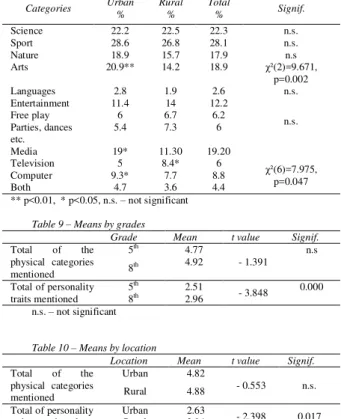
students’ from urban regions: (1) Sports 28.6%, (2)
Science 22.2%, (3) Arts 20.9%, (4) Media 19%, (5) Nature 18.9%, (6) Entertainment, 11.4% (7) Languages 2.8%.
Results of students’ from rural regions: (1) Sport 26.8%,
(2) Science 22.5%, (3) Nature 15.7%, (4) Arts 14.2%, (5) Entertainment 14%, (6) Media 11.3 %, (7) Languages 1.9%. In both groups, the most preferred category is Sport, the second place being taken by Sciences. Only few of the children mentioned the Languages category, both from urban and rural areas. Their interest of Nature is equally important. We can see that urban students mentioned significantly more often the categories of Arts (p=0.002;
χ²=9.671) and Media (p=0.047; χ²=7.975). Television is
60 families – computers are more accessible, and presumably
the peer group’s influence is greater.
Table 8 – Frequency distribution of the fields of interest category by location
Categories Urban % Rural % Total % Signif.
Science 22.2 22.5 22.3 n.s.
Sport 28.6 26.8 28.1 n.s.
Nature 18.9 15.7 17.9 n.s
Arts 20.9** 14.2 18.9 χ²(2)=9.671, p=0.002
Languages 2.8 1.9 2.6 n.s.
Entertainment 11.4 14 12.2
n.s.
Free play 6 6.7 6.2
Parties, dances
etc. 5.4 7.3 6
Media 19* 11.30 19.20
χ²(6)=7.975, p=0.047
Television 5 8.4* 6
Computer 9.3* 7.7 8.8
Both 4.7 3.6 4.4
** p<0.01, * p<0.05, n.s. – not significant
Table 9 – Means by grades
Grade Mean t value Signif.
Total of the physical categories mentioned
5th 4.77
- 1.391 n.s 8th 4.92
Total of personality traits mentioned 5
th 2.51
- 3.848 0.000 8th 2.96
n.s. – not significant
Table 10 – Means by location
Location Mean t value Signif.
Total of the physical categories mentioned
Urban 4.82
- 0.553 n.s. Rural 4.88
Total of personality
traits mentioned Urban Rural 2.63 2.94 - 2.398 0.017 n.s. – not significant
To establish the difference between the physical-self and psychological-self, we created the Total of the physical categories mentioned (Total 1) and Total of personality traits mentioned (Total 2) variables. The Total of the physical categories mentionedvariable is the mean of the subcategories of the physical-self, and the Total of personality traits mentioned variable is the mean of all mentioned personality characteristics. There is no significant difference between the fifth graders (4.77) and eighth graders (4.92) means for Total 1 (Table 9). There is a significant difference (t = -3.848, p = 0.000) between the means regarding Total 2: 2.51 is the mean of fifth graders, and 1.96 of the eighth grade students. Regarding Total 1, there is no significant difference between the mean of students from urban areas and those from rural areas (Table 10). In the case of Total 2 a significant difference (t = -2.398, p = 0.017) was found, because the mean of rural students is 2.94, while the mean of urban students is 2.63.
Conclusions
The analysis of the written self-characterizations provided the opportunity of creating an authentic picture of
adolescents’ multifactorial self-image characteristics. The developmental similarities and differences were outlined. Until the end of early school years the body-image schema is developed, this being combined of the following categories: color of eyes, color of hair, height, constitution, hair length and face. Results show that fifth grade students
have dichotomous thinking that becomes more sophisticated by the time they get into the eighth grade, which is justified by the fact that fifth graders have the tendency of thinking on bipolar dimensions like beautiful-ugly, thin-fat, while eighth graders tend to classify their constitution, their appearances. The presumption, according to which eighth grade students are more preoccupied by their looks was partially proven, because students from the eighth grade referred more often to the categories Clothes and Constitution, meanwhile the Look category was mentioned more frequently by the fifth grade students.
Results regarding physical activity clearly reflect changes in lifestyle. Regarding both age and location, sports dominate, while work has almost completely disappeared.
In the case of the Psychological-self category several developmental differences were found, because eighth grade students referred significantly more often to the categories Emotions, Satisfaction, Social attitudes, School achievement, Fields of interest (Sport, Nature, Arts, Entertainment, Media) and mentioned more personality traits.
The study also outlined two major absences. No significant difference was found between the two grades in naming abilities, and referring to Science and Languages. We believe that naming abilities and showing increased interest in languages would help eighth grade students in their process of decision-making when changing schools. The absence of these makes Career and Vocational Counseling unavoidable.
In the comparison by location more similarities and fewer differences were outlined. In most categories of the Physical-self and Psychological-self no significant differences were found. However, it is very interesting that urban students referred significantly more often to emotions and satisfaction, while rural students mentioned more frequently characteristics like good-hearted and diligent. In both groups, the Sport category is most preferred, while the Languages category is the less mentioned. The categories Arts and Media are more preferred by urban students. Both urban and rural students use the same categories to characterize their physique, but rural students mention more personality traits.
We strongly believe that school should be more than simply a place for traditional teaching; effective education and personal development should spread to new areas like the development of self-reflective thinking, the shaping of personal competence and the operation of Career and Vocational Counseling.
References
AlarcoAiken, L. R. (1999). Personality Assesment Methods and Practices. Hogrefe & Huber Publishers, USA. Damon, W., & Hart, D. (1991). Self-understanding in
childhood and adolescence. Cambrige University Press.
Ehmann, B. (2002). A szöveg mélyén. Új mandátum, Budapest.
61 Hattie, J. (2004). Models of Self-Concept that are Neither
Top-Down or Bottom-Up: The Rope Model of Self
Concept. Available online at:
http://www.education.auckland.ac.nz/webdav/site/educ ation/shared/hattie/docs/hattie-models-of-self-concept-%282004%29.pdf.
Horváth, Zs. I. (2011). The comparative study of minority
and majority adolescents’ self-image based on their own self-characterizations. Practice and Theory in Systems of Education, 6. 1, 63-76.
Linville, P. W. & Carlston, Donald.E. (1994). Az én és a szociális megismerés. In. V. Komlósi, A. & Nagy, J. (2003 ed.): Énelméletek. Személyiség és egészség. ELTE Eötvös Kiadó, Budapest.
Marcus, H. & Nurius, P. (1986). Possible Selves. American Psychologist, 41, 954-969.
Marcus, H.R., & Kitayama, Sh. (1991). Culture and Self: Implications for Cognition, Emotion, and Motivation. Psychological Review, 98, 224-253.
Marsh, H. W. & Shavelson, R. (1985). Self-Concept. It’s
Multifaceted, Hierarchical Structure. Educational Psychologie, 20, 107-123.
Marsh, H.W. (1989). Age and Sex Effects in Multiple Dimensions of Self-Concept: Preadolescence to Early Adulthood. Journal of Educational Psychology, 81, 417-430.
Marsh, H.W., Parada, H. R. & Ayotte,V. (2003). Multidimensional Vs. Unidimensional Perspectives of Self-Concepts in Adolescent Mental Health. Paper presented at NZARE AARE, Auckland, New Zealand, November 2003.
Marsh, H.W & Kit Tai Hau (2003). Negative Effects of Academically Selective Schools on Academic Self –
Concept: Cross Cultural Comparitions of Australian Results with those in 26 Countries. Paper presented at NZARE AARE, Auckland, New Zealand.
Marsh, H.W. (2005). Big Fish Little Pound Effect on Academic Self-concept: cultural and
Cross-Disciplinary Generalizability. AARE Conference Paper, 2005.
Montemayor, R. & Eisen, M (1977). The Development of Self-Conceptions from Childhood to Adolescence. Developmental Psychology, 13, 314-319.
Nicolinia, P., Cherubinia,L., & Bomprezzib, M. (2010).Self report and self image: a study on a sample of Italian adolescents. Procedia Social and Behavioral Sciences, 2, 895–901.
Osterweggel, A. & Oppenheimer, L. (1993). The self-system. Developmental Changes Between and Within Self-concepts. Lawrence Erlbaum Associates Publishers, Hillsdale, New Jersy.
Pataki, F. (2004). Érzelem és identitás. Új Mandátum Könyvkiadó , Budapest.
Pletl, R. (2008). Az anyanyelvoktatás metamorfózisa. Scientia Kiadó, Kolozsvár.
Pletl, R (2011). Az anyanyelvoktatás mozaikjai. Scientia Kiadó, Kolozsvár.
Sallay, H. (2001). A szelf vizsgálata: kérdések, problémák és kihívások. Alkalmazott pszichológia, 1, 15-28. Tringer, L. (2004). A gyógyító beszélgetés. Semmelweis
Orvostudományi Egyetem Képzéskutató, Oktatástechnológiai és Dokumentációs Központ, Budapest.
Vajda, Zs. (2006). A gyermek pszichológiai fejlődése. Helikon Kiadó.
Watt, H.M.G. (2004). Development of Adolescents’ Self -Perceptions, Values, and Task Perceptions According to Gender and Domain in 7th- through 11th-Grade Australian Students. Child Development, 75, 1556-1574.
Zlate, M. (2004). Eul si personalitatea. Editura Trei,
Bucureşti