6
CHIRAL WAVES IN GRAPHENE TUNNELING
H. Torres-Silva 1 & D. Torres Cabezas2
1 Escuela de Ingeniería Eléctrica y Electrónica, Universidad de Tarapacá, Arica, Casilla 6-D, Chile
2
Modernización y Gobierno Electrónico, Ministerio Secretaría General de la Presidencia, Gobierno de Chile, Santiago, Chile, Código Postal 8340382
ABSTRACT
We derive the Dirac equation for graphene where the Fermi velocity
v
F is deduced from the chiral electrodynamicswith
v
F
c
(1
k T
0)
, where T is the chiral parameter in a metamaterial condition. This result is capital to our approach because we find a contact point between the graphene system and optical metamaterial putting0
(1
)
F
v
c
k T
, no makingc
v
F in the conventional Dirac Theory as other authors do it. The important point is that if we establish the relationship k T0 1 , where 20
/ (4 )
e c
is the fine structure constant, we can verify that our chiral Dirac theory shows a connection between the chirality of electrons and the fine structure constant.
We calculate the influence of the chiral radiation on the chiral tunneling in graphene by using the finite- difference time-domain method (FDTD). We find that perfect tunneling can be strongly suppressed by the optically induced band mixing, even at large detuning. These properties might be useful in device applications, such as the fabrication of an optically controlled field-effect transistor that has ultrafast switching times and low power consumption.
Keywords:Chiral, Graphene, Tunneling, Metamaterial, Electron
1. INTRODUCTION
In modern age Engineers have paved the way for a new generation of faster, more powerful cell phones, computers and other electronics by developing a practical technique to replace silicon with carbon on large surface. The capability of silicon, the material at the heart of computer chips has been harnessed beyond its limits by engineers and carbon has come up as an integrating replacement for the same. The material called“Graphene” which is a single layer of atoms arranged in honeycomb lattice could let electronics to process information and produce radio transmission 10 times better than silicon based devices
Such a material is referred to as graphene and is of uttermost importance in condensed-matter physics since, by wrapping it, one gets carbon nanotubes or fullerenes. Since then, an intense activity has flourished in the field and nurtured the dreams of a full carbon-based electronics. For theorists, such a system is also of great interest because it provides a physical realization of two-dimensional field theories with quantum anomalies. Indeed, the continuum limit of the effective theory describing the electronic transport in graphene is that of two-dimensional massless Dirac fermions. The reported and predicted phenomena include the Klein paradox (the perfect transmission of relativistic particles through high and wide potential barriers), the anomalous quantum Hall effect induced by Berry phases and its corresponding modified Landau levels and the experimental observation of a minimal conductivity.
Graphene is a single layer of carbon atoms densely packed in a honeycomb lattice, or it can be viewed as an individual atomic plane pulled out of bulk graphite. From the point of view of its electronic properties, graphene is a two-dimensional zero-gap semiconductor with the cone energy spectrum , and its low-energy quasiparticles are formally described by the Dirac-like Hamiltonian [1, 2]
0 Fˆ
H i v
(0)
where 6 1
10
F
v ms is the Fermi velocity and ˆ ( x, y) are the Pauli matrices. The fact that charge carriers in graphene are described by the Dirac-like equation (1), rather than the usual Schrödinger equation, can be seen as a
consequence of graphene’s crystal structure, which consists of two equivalent carbon sublattices [1, 2]. Quantum mechanical hopping between the sublattices leads to the formation of two cosine-like energy bands, and their intersection near the edges of the Brillouin zone yields the conical energy spectrum. As a result, quasiparticles in graphene exhibit the linear dispersion relation EG E kvF, as if they were massless relativistic particles with momentum k (for example, photons) but the role of the speed of light is played here by the Fermi velocity
/ 300
F
v c . Owing to the linear spectrum, it is expected that graphene’s quasiparticles will behave differently from
7
From a crystallographic point of view, the graphene is a triangular Bravais lattice with a diamond-shaped unit tile consisting of two sites so one gets the honeycomb structure. The electronic propagation in such a perfect crystal is described by Bloch waves (a generalization to lattices of the ordinary plane waves in free space). The corresponding Bloch wave vector k spans the so-called Brillouin zone and the way the energy of these Bloch waves depends on k is encoded in the band structure. The very unique feature of the graphene band structure is that the two lowest-energy bands, known as the valence and the conduction band touch at two isolated points located at the corners of the Brillouin zone. In the immediate vicinity of these degeneracy points, known as the Dirac points, the band structure is a cone. In natural graphene samples, there is exactly one electron per site, and thus, at zero temperature, all levels in the valence band are filled (a situation known as half-filling). As a result, the energy of the last occupied level precisely slices the band structure at the Dirac points. The low-energy excitations of this system are then described by the massless two-dimensional Weyl-Dirac equation and their energy dispersion relation v kF is that of
relativistic massless fermions with particle-hole symmetry. In graphene these massless fermions propagate with a velocity vF. The maths is simple but the principles are deep. We will review the formulation of graphene’s massless
Dirac Hamiltonian, under the chiral electromagnetism approach, like a metamaterial media [3-9], hopefully
demystifying the material’s unusual chiral, relativistic, effective theory. The novel result here is that in our theory
we do not make cvFbut we obtain vFas
v
F
c
(1
k T
0)
ifk T
0
0
orv
F
c
(1
k T
0)
ifk T
0
0
. Theseresults are derived of the Chiral Electrodynamics with T as the chiral parameter and
k
0
/
c
.[7, 10-12].
2. TWO COMPONENT EQUATIONS ANDTUNNELING RATE OF DIRAC ELECTRON IN GRAPHENE
The usual choice of an orthogonal set of four plane-wave solutions of the free-particle Dirac equation does not lend itself readily to direct and complete physical interpretation except in low energy approximation. A different choice of solutions can be made which yields a direct physical interpretation at all energies. Besides the separation of positive and negative energy states there is a further separation of states for which the spin is respectively parallel or antiparallel to the direction of the momentum vector. This can be obtained from the Maxwell’s equation without charges and current in the
E
parallel toH
configuration. Dirac's four-component equation for the relativistic electron as. [10-12]. Here we considerer a bidimensional graphene system so the Dirac's four-component equationfor the “relativistic” electron is:
DH
t
ˆ
i
, (1)where:
(
E,
H)
t with
E
ˆ
E
,
H
ˆ
H
so we can write
2
ˆ
ˆ
D(
)
F F
H
v
p
mv
, (2),
3
,
2
,
1
,
0
0
k
k k
k
(3)0
0
zI
I
(4)andI is the two-by-two identity matrix and the Fermi velocity
v
F is deduced from the chiral electrodynamics with0
(1
)
F
v
c
k T
, where T is the chiral parameter in a metamaterial condition. This result is capital to our approachbecause we fin a contact point between the graphene system and optical metamaterial making
v
F
c
(1
k T
0)
, no makingc
v
F as other authors do it. This Hamiltonian commutes with the momentum vectorp
. In order toresolve this degeneracy we seek a dynamical variable which commutes with both H and
p
. Such a variable is
ˆ
p
,where
ˆ
is the matrix Pauli. The eigenfunctions of the commuting variablesp
and
ˆ
p
are simultaneous:
2 2
ˆ
p
p
8
Thus for a simultaneous eigenstate of
p
and
ˆ
p
, the value of
ˆ
p
will be +p or –p, corresponding to states for which the spin is parallel or antiparallel, respectively, to the momentum vector like a graphene system.A simultaneous eigenfunction of H and p will have the form of a plane wave
exp
p r
,
1, 2,3, 4
j
u
ji
Et
h
j
, (6)where the
j are the four components of the state function andu
j four numbers to be determined. Then E canhave either of the two values
.
12
2 4 2 2
F F
E
m v
v
p
. (7)We now demand that
j be also an eigenfunction of
ˆ
p
belonging to one of the eigenvaluesp
E, say, wherep
E
p
, The eigenvalue equation isˆ
pp
p
E
, (8)Since
W
can be given either of the two values
andp
E, the two values
p
, we have found for given p four linearly independent plane wave solutions. It is easily verified that they are mutually orthogonal.The physical interpretation of the solutions is now clear. Each solution represents a homogeneous beam of particles of definite momentum p, of definite energy, either
, and with the spin polarized either parallel or antiparallel to the direction of propagation. From here we can obtain the well known equation for grapheneH0 i v Fˆ , Eq.(0) of the introduction
.
In this paper, we study the tunneling rate of Dirac electrons in graphene through a barrier with an intense electromagnetic field. A one transport phenomenon in graphene is the chiral tunneling [4, 5, 13-14]. In mono layer graphene a perfect transmission through a potential barrier in the normal direction is expected. This tunneling effect is due to the chirality of the Dirac electrons, which prevents backscattering in general. This kind of reflectionless transmission is independent of the strength of the potential, which limits the development of graphene-based field-effect transistors (FET). The perfect transmission can be suppressed field-effectively when the chiral symmetry of the Dirac electrons is broken by a laser field, when the n-p junctions in graphene are irradiated by an electromagnetic field in the resonant condition [15,16].We consider a rectangular potential barrier with height H0, width D in the X
direction, and infinite length in the Y direction. The Fermi level lies in the valence band in the barrier region and in the conduction band outside the barrier. The gray filled areas indicate the occupied states. The optical field under chiral condition is propagated perpendicular to the layer surface and it is circularly polarized along the Z,Y direction with a detuning 0 2Eb . We choose 0 0to ensure that there is no inter-band absorption inside the
barrier. Meanwhile, 2Ek is used to guarantee that the influence of the optical field outside the barrier can be
neglected. Thus, neglecting the scattering between different valleys, the scattering process of Dirac electrons in K
point is described by the time-dependent Dirac equation, Eq. (1) withm0, so
g
(
E,
H)
twhere t means transposed wavefunction.i g( , )r t
He H I0 Hint
g( , )r tt
(9)
where g( , )r t
A( , ),r t B( , )r t
t is the wave function, HevFˆ p i v Fˆ is the unperturbed DiracHamiltonian obtained from the chiral electrodynamics [17], ˆ( x y)are the Pauli matrices, 106 1
F
v ms is the
Fermi velocity, H r0( ) is the height of the potential barrier, I is the unit matrix, and Hintis the interaction
Hamiltonian with a chiral electromagnetic potential.
12int
21 0
ˆ A
0
F
H
H ev
H
(10)
where e is the electron charge and
A i t, i t x yA e iA e
with i 1 and Ax Ay so we have circular polarized
chiral vector potentials of the electromagnetic field. When the Dirac electrons perpendicularly collide with the barrier perpendicularly, we can rewrite Eq. (9) as a set of partial differential equations
0 12
( , ) ( , ) ( , ) ( ) ( , )
A F B A B
i x t iv x t V x t H t x t
t x
9
0 21
( , ) ( , ) ( , ) ( ) ( , )
B F A B A
i x t iv x t V x t H t x t
t x
(12)
Since the tunneling time is of order of sub-picosecond and the potential H12( )t and H21( )t vary as fast as the
frequency of incident light beams, this scattering process is strongly time-dependent.
3. PROPOSED ALGORITHM AND SIMULATION
In order to study such a strongly time-dependent scattering process, we employ the finite- difference time-domain (FDTD) method to solve Eq. (3) and Eq. (4) numerically in the time-domain [18]. In the traditional FDTD method,
the Maxwell’s equations are discretized by using central-difference approximations of the space and time partial derivatives. As a time-domain technique, the FDTD method can demonstrate the propagation of electromagnetic
fields through a model in real time. Similar to the discretization of Maxwell’s equations in FDTD, we denote a grid
point of the space and time as ( , )i k (i x k t, ) [19]. For the nodal variables we can apply the usual Lee
discretization method in 2-D systems with 2 2
0 1
k T . (See figure 1)
Figure 1: Lee discretization. Here Hx ( A)x
( (1 )A / )
x x
E T t and withJ0 (See [10-12, 17])
.
For any function of space and time G i x k t( , ) G ik( )
, the first order in time or space partial differential can be expressed as:
( 1/2 ( 1/2
( 1/ 2) ( 1/ 2) ( ) ( ) ( ( , )) ,..., ( ( , ))
k k k k
x i x t k t
G i G i G i G i
G x t G x t
x x t t
These eqs. can be replaced by a finite set of finite differential equations like:
1/ 2 0 0 1/ 2
12
12
( ) ( )
1 1
( ) ( )
2 2
( 1 / 2)
( 1 / 2) 2
( 1 / 2)
( 1 / 2) 2
k k
A A
k
k F
B
k
k F
B
H i H i
i i
t i t i
v H i
i
x i
v H i
i
x i
(13)
For computational stability, the space increment and the time increment need to satisfy the relation x vF t
[17]. Furthermore, the space increment x must far smaller than the wavelength of electrons x e/10 , and the
time increment must be far smaller than the period of the electromagnetic field Tl.
At the boundary, one-dimensional Mur absorbing boundary conditions are used [18-19]. To compare our results with [20] which use linear polarization for the vector potentialAwhere the chiral parameter T is zero, we considerer at the input boundary, a normalized Gaussian electronic wave packet, wheretgand gdenote the peak position and
the pulse width, respectively. Thus, by solving Eq. (13) directly in the time domain we can demonstrate the propagation of a wave packet through a barrier in real time.
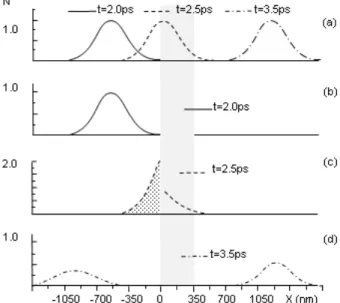
Numerical simulations are shown in Fig. 2. The following parameters are used in our calculation: the peak position
0
t = 1.5 ps, the pulse width g = 1.0 ps, the space increment x = 0.1 nm, the time increments
5
5 10
t ps , and the height of the potential barrier H0 = 500 meV.
10
To explain the suppression of chiral tunneling, we first investigate the chiral potential wave in the barrier within a rotating wave approximation [16, 17]. Figure 2(a) shows the renormalized band as a function of momentum k with
intensity 2
3 /
I MW cm .
Fig. 2: (a) Numerical simulations of a wave packet given by 2 2
A B
N , tunneling through a barrier without pump beams. Figures (b)-(d) show the time sequence of a wave packet tunneling through a barrier with pump
intensity 2
3 /
I MW cm , 0= 5meV, and D = 350 nm. The light grey shows the barrier area.
Here, the important point is that we makek T0 1 1.0073, where 2
0
/ (4 )
e c
is the fine structure constant, so we verify that our chiral theory is correct. Without external beams, (fig. 2 (a)), we verify the known results on chiral tunneling [11]. Figures 2 (b)-(d) show the time sequence of a wave packet tunneling through a barrier with pump intensityI 3MW cm/ 2
, 0= 5meV, and D = 350 nm
.
Figure 3 Left: The reflectance R(circles) and the transmittance T (squares) of the barrier as a function of the detuning for 2
3 /
I MW cm and D = 350 nm. Right: The transmittance versusI(MW cm/ 2). Having D as parameter.
Here, 2 2
0 1
k T , that is the wave electric field is almost parallel to the wave magnetic field within the graphene device.
Under intense light beams, the dressed states are strongly mixed with valence states and conduction states. Therefore, the chiral symmetry of Dirac electrons in graphene can be broken and perfect chiral tunneling is strongly suppressed. Numerical results are shown in Fig. 3(left) with pump intensity I 3MW cm/ 2
and D = 350 nm. From
Fig. 3(left) we can find that the transmission is strongly suppressed, even with laser detuning (e.g., 0 = 10 meV,
the transmittance is about 0.03).
11
however we think that inside of a plate of graphene, the eigenvectors of A have to be characterized as chiral waves, because the electrons have a chiral nature in a graphene device.
4. OVERALL CONCLUSIONS
In conclusion we are derived the Dirac equation for graphene electrons where the Fermi velocity
v
F is deducedfrom the chiral electrodynamics with
v
F
c
(1
k T
0)
, where T is the chiral parameter in a metamaterial condition.This result is capital to our approach because we find a contact point between the graphene system and optical metamaterial putting
v
F
c
(1
k T
0)
, no makingc
v
F as other authors do it. The important point is that we make k T0 1 , where 20
/ (4 )
e c
is the fine structure constant, so we can verify that our chiral Dirac theory is correct.
We have calculated the influence of the chiral radiation on the chiral tunneling in graphene by using the FDTD method. We find that perfect tunneling can be strongly suppressed by the optically induced band mixing, even at large detuning. These properties might be useful in device applications, such as the fabrication of an optically controlled field-effect transistor that has ultrafast switching times and low power consumption.
To do that, we reviewed the geometrical aspects of electromagnetic field variables. Vector potentials are 1-forms.The vector potential was assigned to the links of the grid. The proposed potential formulation, in terms of the vector field A, is a viable method to solve the Maxwell field problem in graphene systems.
The influences of intense coherent laser fields on the transport properties of a single layer graphene are investigated by solving the time-dependent Dirac equation numerically. Under an intense laser field, the valence band and conduction band states mix via the optical effect. The chiral symmetry of Dirac electrons is broken and the perfect chiral tunneling is strongly suppressed. These properties might be useful in the fabrication of an optically controlled field-effect transistor
5. ACKNOWLEDGEMENTS
The present work is part of future FIC of GORE ARICA PARINACOTA CHILE, project of Graphene as potential solar panel. We are also grateful to Ing Roberto Ahumada, for the supply of the general idea.
6. REFERENCES
[1]. K. S. Novoselov et al. Two-dimensional gas of massless Dirac fermions in graphene. Nature 438, 197–200 (2005).
[2]. M. I. Katsnelson et al, Chiral Tunnelling and the Klein paradox in grapheme, Nature Physics, vol 2, 620-624, (2006)
[3]. R. A. Shelby et al., “Experimental verification of a negative index of refraction”, Science, vol. 292, no. 5514, pp. 77-79, 6 (2001).
[4]. V. G. Veselago, “The electrodynamics of substances with simultaneously negative values of
and
,” Soviet Physics Uspekhi, vol. 10, no. 4, pp. 509-514, 1968. (Usp. Fiz. Nauk, vol. 92, pp. 517-526, 1967)[5]. D. R. Smith et al., “Composite medium with simultaneously negative permeability and permittivity”, Phys. Rev. Lett., vol. 84, no. 18, pp. 4184-4187, (2000).
[6]. C.Monzon and D.W. Forester, “Negative refraction and focusing of circularly polarized waves in optically active media,” Phys. Rev. Lett. 95, 123904 (2005).
[7]. H. Torres- Silva et al., “Chiral waves in a metamaterial medium”, International Journal of Pure and Applied Sciences and Technology , vol. 2 (2), pp. 54-65, (2011).
[8]. E. Plum., J. Zhou, J. Dong, V.A. Fedotov, T. Koschny, C.M. Soukolis y N.I. Zheledev,” Metamaterial with Negative Index due to Chirality”, Physical Review B. 79(3), 0354071-0354076. (2009)
[9]. J. Zhou , J. Dong , B. Wang , T. Koschny , M. Kafesaki and C. Soukoulis “ Negative refractive index due to Chirality” Phys. Rev. B 79 121104(2009)
[10]. H. Torres-Silva, The Close Relation Between the Maxwell System and the Dirac Equation when the Electric Field is Parallel to the Magnetic Field, Ingeniare,: 16(1), 43-47, (2008).
[11]. H. Torres-Silva, Dirac Matrices in Chiral Representation and the Connection with the Electric Field Parallel to the Magnetic Field, Ingeniare,: 16(1), 48-52, (2008).
[12]. H. Torres-Silva, Chiral Transverse Electromagnetic Standing Waves with E II H in the Dirac Equation and the Spectra of the Hydrogen Atom, Chapter 15, pp 301-324, Book Intech, Behavior of Electromagnetic Waves in Different Media and Structures, Ed, Ali Akdagli, 2011.
[13]. W.-R. Hannes and M. Titov, Europhysics Letters 89, 47007 (2010). [14]. D. A. Abanin and L. S. Levitov, Science 317, 641 (2007).
[15]. D. C. Elias et al, Science 323, 610 (2009).
[16]. M. V. Fistul and K. B. Efetov, Phys. Rev. Lett. 98, 256803 (2007). [17]. H. Torres-Silva, Ingeniare, 19, 67-75, (2011).