Chiral Symmetry Restoration and Pion Properties in a q-Deformed NJL Model
V. S. Tim´oteo
Centro Superior de Educac¸˜ao Tecnol´ogica, Universidade Estadual de Campinas, 13484-370, Limeira, SP, Brazil
and C. L. Lima
Instituto de F´ısica, Universidade de S˜ao Paulo, CP 66318, 05315-970, S˜ao Paulo, SP, Brazil
Received on 27 October, 2005
We review the implementation of a q-deformed fermionic algebra in the Nambu–Jona-Lasinio model (NJL). The gap equations obtained from a deformed condensate as well as from the deformation of the NJL Hamiltonian are discussed. The effect of both temperature and deformation in the chiral symmetry restoration process as well as in the pion properties is studied.
Keywords: Deformed algebras; Effective models; Chiral symmetry
I. INTRODUCTION
Chiral symmetry breaking is an important phenomena in hadron physics and is of fundamental importance for hadron properties. The difficulties involved in obtaining low-energy properties directly from QCD, the fundamental theory of strong interactions, have motivated the construction of effec-tive models. Due to its simplicity and effeceffec-tiveness in describ-ing hadrons at low energies, the NJL model [1] has become the most familiar effective model for strong interactions.
The standard scenario for spontaneous chiral symmetry breaking is the arising of a quark condensate. In the NJL model the condensates appear when the strength of the contact interaction exceeds a critical value, separating the Wigner-Weyl and Nambu-Goldstone realizations of chiral symmetry. The condensate<qq¯ >is the order parameter.
Apart from giving a reasonable description of the light mesons, the NJL model is also very useful for studying the chiral symmetry breaking process as well as its restoration at finite temperature [2, 3]. The NJL model is in addition very suitable for testing new ideas. In previous works, we have investigated the effect of q-deformation in the chiral symme-try breaking process within the context of the NJL model. In particular, we observed how the condensate is affected by the deformation. As a direct consequence, the dynamical quark mass, the chiral symmetry breaking and restoration processes are accordingly affected [4, 5].
The aim of this work is to study the effect of both tem-perature and deformation in the chiral symmetry restoration, and evaluate the pion properties in a q-deformed NJL model at finite temperature. This paper is organized as follows. In Sec. II briefly review the Nambu–Jona-Lasinio model, Sec. III introduces the q-deformed fermionic algebra which will be used along this work, and shows how the deformed algebra is implemented in the NJL model. In Sec. IV, we present the in-vestigation of the chiral symmetry restoration with both finite temperature and q-deformation. Finally, Sec. V contains our main conclusions.
II. THE NAMBU–JONA-LASINIO MODEL
The Nambu–Jona-Lasinio model was first introduced to de-scribe the nucleon-nucleon interaction via a four-fermion con-tact interaction. Later, the model was extended to quark de-grees of freedom becoming an effective model for quantum chromodynamics.
The Lagrangian of the NJL model is given by
L
NJL=ψiγµ∂µψ+L
int, (1)L
int=G h(ψψ)2+ (ψiγ5τψ)2i. (2) Linearizing the above interaction in a mean field approach, the last term does not contribute if the vacuum is parity and Lorentz invariant. The Lagrangian with the linearized interac-tion is then
L
NJL=ψiγµ∂µψ+2Ghψψiψψ. (3) Regarding this Lagrangian as a Dirac Lagrangian for massive quarks we obtain a dynamical mass for the quarksm=−2Ghψψi, (4)
wherehψψiis the vacuum expectation value of the scalar den-sityψψ, representing the quark condensates. Eq. (4) describes how the dynamical mass is generated with the appearance of the quark condensates. The quarks are massless if the conden-sate vanishes.
From the anti-commutation relations for the fermionic fields, the condensate can be written as
hψ(x)ψ(x)i=−Tr lim
y→x+hT[ψ(x)ψ(y)]i, (5) where
hT[ψ(x)ψ(y)]i=iSF(x−y), (6) and SF(x−y)is the Feynman propagator in the configuration space. In the momentum space this propagator is given by
SF(p) = γµp
A Fourier transformation let us write the condensate in the following fashion
hψ(x)ψ(x)i=−i lim y→x+Tr
Z d4p
(2π)4SF(p)e
−i(x−y)p, (7)
which after a 3D non-covariant cutoff becomes
hψψi=−NπcN2f
ZΛ
0
d pp2p m
p2+m2, (8)
whereφ(p) =2θ(p), Ncis the number of colors and Nf is the number of flavors. Using this result we obtain the NJL gap equation in its more familiar form (see reference [3])
m=2NcNf 1 π2
Z Λ
0
d pp2p m
p2+m2. (9)
A. The Bogoliubov-Valatin approach
The Bogoliubov-Valatin variational approach is an alterna-tive way to obtain the NJL gap equation and observe the dy-namical chiral symmetry breaking process [6]. The variational approach to obtain the gap equation consists on the following procedure: a) to define a variational vacuum, b) to calculate the vacuum expectation value of the Hamiltonian, obtaining the functional for the total energy, and c) to minimize the functional, obtaining the variational parameters and the gap equation. For this purpose we start with the NJL Hamiltonian corresponding to the Lagrangian Eq.(1)
HNJL=−iψγ·∇ψ−G h
(ψψ)2+ (ψ
iγ5τψ)2 i
, (10)
and make a Fourier decomposition in the quark fields ψ(x,0) =
∑
s
Z d3p (2π)3
h
b(p,s)u(p,s)eip·x+d†(p,s)v(p,s)e−ip·x i
,
(11) defining the annihilation operators b(p,s)and d(p,s)of parti-cles and anti-partiparti-cles with momentum p and helicity s, which
destroy the bare vacuum|0i:
b(p,s)|0i=d(p,s)|0i=0. (12) The spinors u(p,s)and v(p,s)are normalized helicity eigen-states satisfying
γµpµu(p,s) =γµpµv(p,s) =0, (13) u†(p,s)u(p,s) =v†(p,s)v(p,s) =1. (14) We now introduce the following BCS-like vacuum
|NJLi=
∏
p,s=±1 h
cosθ(p) +s sinθ(p)b†(p,s)d†(−p,s)i|0i,
(15) which, for a given momentum p, is expanded as
|NJLi=cos2θ(p)|0i
+sinθ(p)cosθ(p)b†(p,+)d†(−p,+)|0i −sinθ(p)cosθ(p)b†(p,−)d†(−p,−)|0i
−sin2θ(p)b†(p,−)d†(−p,−)b†(p,+)d†(−p,+)|0i.
(16) The operators which annihilate this vacuum are given by the Bogoliubov-Valatin transformations
B(p,s) =cosθ(p)b(p,s) +s sinθ(p)d†(−p,s), (17)
D(p,s) =cosθ(p)d(p,s)−s sinθ(p)b†(−p,s), (18)
B(p,s)|NJLi=D(p,s)|NJLi=0. (19) To calculate the expectation value of the NJL Hamiltonian with respect to the state Eq. (15)
NJL¯¯
H
NJL ¯¯NJL®, (20) it is convenient to express ψin terms of the quasi-particles operators B(p,s)and D(p,s)as
ψ(x,0) =
∑
sZ d3p (2π)3
h
B(p,s)M1(p,s)eip·x+D†(p,s)M2(p,s)e−ip·x i
, (21)
where
M1(p,s) =£cosθ(p) +γ0sinθ(p)¤u(p,s), (22)
M2(p,s) =£cosθ(p)−γ0sinθ(p)¤u(p,s). (23) Making use of the spinor relations
∑
su(p,s)u†(p,s) =1 2
µ
1−γ· p |p|γ
0 ¶
, (25)
the functional for the total energy in the Hartree approximation is obtained as
W[φ] =−2NcNf
Z d3p
(2π)3p cosφ(p)−4G(NcNf) 2
"Z d3p
(2π)3sinφ(p) #2
. (26)
The form ofφ(p)which minimizes the total energy Eq. (26) is obtained from the condition
δW[φ]
δφ(p) =0. (27)
This procedure yields to
p tanφ(p) =4GNcNf
Z d3p′
(4π)3sinφ(p
′), (28)
which becomes
m=4GNcNf
Z d3p (2π)3
m p
p2+m2, (29)
provided the variational angles acquire the following form tanφ(p) =m
p, sinφ(p) = m p
p2+m2. (30)
III. q-DEFORMATION IN THE NJL MODEL
In this section we discuss the implementation of the de-formed algebra to the NJL model. The q-dede-formed fermionic algebra [7] that we shall use is based in the work of Ubriaco [8], where the thermodynamic properties of a many fermion system were studied. In the construction of a q-covariant form of the BCS approximation [9], it was shown that the creation and annihilation operators of the suq(2 j+1)fermionic alge-bra are given by
A
jmj=ajmj∏
i=mj+1
³
1+Qa†jiaji ´
, (31)
A
†jmj =a†jm j∏
i=mj+1
³
1+Qa†jiaji ´
, (32)
where Q=q−1−1, j=1/2 and mj=±1/2. As discussed in [4], the first consequence of the above deformation is that only the operators corresponding to mj=−12 are modified, mean-ing that only negative helicity quarks (anti-quarks) operators will be deformed since in the NJL model we deal with quarks (anti-quarks) creation and annihilation operators.
We have two different approaches to obtain a new gap equa-tion. The first one consists in to perform the q-deformation in the condensate, which is a part of the self-consistent equa-tion for the dynamical mass. In the second one the q-deformation is performed in the NJL Hamiltonian, and we use the Bogoliubov-Valatin procedure to obtain the new gap equation. We now turn to a detailed discussion of these two different approaches.
A. Deforming the condensates
To obtain the deformed gap equation we work with the BCS-like vacuum (15) in the standard Bogoliubov-Valatin variational approach. The quark fields are expressed in terms of q-deformed creation and annihilation operators as
ψq(x,0) =
∑
sZ d3p (2π)3
h
B
(p,s)u(p,s)eip·x+D
†(p,s)v(p,s)e−ip·xi, (33)where the q-deformed quark and anti-quark creation and an-nihilation operators
B
,B
†,D
, andD
†, are expressed in termsof the non-deformed ones according to Eqs. (31) and (32)
B
−=b−³
1+Qb†+b+ ´
,
B
−†=b†−³
1+Qb†+b+ ´
, (34)
D
−=d−³
1+Qd+†d+ ´
,
D
−†=d−†³
1+Qd+†d+ ´
B
+=b+,B
+† =b†+, (36)D
+=d+,D
+†=d+†, (37) where+ (−)stands for the positive (negative) helicity and the notation has been simplified: (p,s)→s. We would like to note that, as discussed in Ref. [9], the deformed vacuum differs from the non-deformed one only by a phase and, there-fore, the effects of the deformation comes solely from the modified field operators. Additionally, the q-deformed NJL Lagrangian, constructed using ψq instead of ψ, is invariant under the quantum group SUq(2)transformations. This can be seen by using the two-dimensional representation of the SUq(2)unitary transformation given in Ref. [8].The deformed gap equation is
m=−2Ghψψiq, (38)
wherehψψiq is the q-deformed condensate calculated using the BCS-like vacuum, Eq. (15), and Eq. (11),
hψψiq=NJL¯¯ψqψq¯ ¯¯NJL®
=hψψi+hNJL|
Q
|NJLi, (39)where hψψi is the non-deformed condensate and
hNJL|
Q
|NJLi represents all non-vanishing matrix ele-ments arising from the q-deformation of the quark fields. The contribution of these q-deformed matrix elements ishNJL|
Q
|NJLi=Q Z d3p(2π)3[sin 2θ(p)−sin 2θ(p)cos 2θ(p)]. (40)
The calculation of the deformed condensate will be performed in a similar way as in the usual case. It requires also a regularization procedure since the NJL interaction is not perturbatively renormalizable. For reasons of simplicity a non-covariant trimomentum cutoff is applied arising
hψψiq=−3mπ2
"µ 1−Q
2 ¶ZΛ
0
d p p
2 p
p2+m2+ Q 2
Z Λ
0
d p p 3
p2+m2 #
(41)
for each quark flavor. At this point we see that the dynamical mass is again given by a self-consistent equation since the condensate depends also on the mass. Inserting Eq. (41) into Eq. (38) we obtain the deformed NJL gap equation
m=2Gm π2
"µ 1−Q
2 ¶ZΛ
0
d p p
2
p
p2+m2+ Q 2
Z Λ
0
d p p 3
p2+m2 #
. (42)
It is easy to see that for Q=0 (q=1), we recover the NJL gap equation in its more familiar form
m=2Gmπ2
Z Λ
0
d p p
2
p
p2+m2+m0, (43)
where m0appears only if we consider the current quark mass term
L
mass=−m0ψψin the NJL Lagrangian Eq. (1).The pion decay constant is calculated from the vacuum to one pion axial vector current matrix element, which, in the simple 3D non-covariant cutoff we are using [6], is given by
fπ2=Ncm2
Z Λ
0 d3p (2π)3
1
(p2+m2)3/2, (44) for each quark flavor. The deformed calculation of fπ is per-formed directly by substituting the dynamical mass in Eq. (44) from the one obtained in Eq. (42).
As in the deformed case, the q-gap equation has non-trivial solutions when the coupling G exceeds a critical value
Gc related to the cutoff. The dynamical mass is accordingly modified through the deformed gap equation (42).
The behavior of the condensate around the critical cou-pling, Gc, is similar for both deformed and non-deformed cases, meaning that the adopted procedure to q-deform the underlying su(2)algebra in a two flavor NJL model does not change the behavior of the phase transition around Gc. The formalism developed in [8, 9] allow q-values smaller than one (which corresponds to Q>0). It is worth to mention that in this case the q-deformation effect goes in the opposite direc-tion, namely, the condensate value and the dynamical mass decrease for q<1.
B. Deforming the NJL Hamiltonian
solely from the deformation of the Hamiltonian.
The deformed functional for the total energy will be ob-tained from the vacuum expectation value of the q-deformed NJL Hamiltonian:
W
q[θ(p)] =NJL¯¯H
NJLq ¯¯NJL®, (45) where the q-deformed Hamiltonian isH
NJLq =−iψqγ·∇ψq−G ³ψqψq ´2
−G ³
ψqiγ5ψq ´2
, (46) andψqis given by Eq. (33). Due to the additive structure of the q-deformation, the deformed Hamiltonian can be written as
H
NJLq =HNJL+H
(Q), (47) and the functional will have the same formW
q[θ(p)] =W[θ(p)] +W
[Q,θ(p)]. (48)The last terms of Eqs. (47) and (48), namely
H
(Q) andW
[Q,θ(p)], stand for the new terms of first order in Q gener-ated when the algebra is deformed, and, therefore, they vanish for q=1(Q=0). The full resulting interaction includes 3-, 4-, 5-, and 6-body interactions, which corresponds to the new terms of order Q,Q2,Q3,and Q4,respectively. We have con-sidered only the three-body terms of order Q.The non-deformed case, which corresponds to q = 1(Q=0), has been discussed in Sec. II. In order to obtain the new gap equation, we need to calculate the new matrix elements arising from the q-deformation of the NJL Hamil-tonian, and add them to the non-deformed functional. This procedure yields to the full q-deformed functional for the to-tal energy:
W
q[θ(p)] = −2NcNf(1+Q)
Z d3p
(2π)3p cosφ+NcNf Q
2
Z d3p (2π)3p cos
2φ
+NcNf NcNf
3π2 QGΛ
3Z d3p
(2π)3cosφ−(NcNf)
2G(4+Q) (Z
d3p (2π)3sinφ
)2
. (49)
Defining the new variables
Pq = P+P0, (50)
P = (1+Q)p, (51)
P0 = − NcNf
6π2 GΛ
3Q, (52)
K = −Q
2p, (53)
G′ = G µ
1+Q 4
¶
, (54)
and performing the same minimization procedure as in the non-deformed case we obtain
Pq tanφ+K sinφ=4G′NcNf
Z d3p′
(2π)3sinφ. (55)
The term K sinφ was overlooked in a previous paper [5] [14]. Trying to keep as much similarity as possible with the usual solution, instead of solving the equation Pqtanφ(p) + K sinφ(p) =M, the sinφ(p)will be substituted byαtanφ(p), withα=0.59 chosen to minimize the difference between sinφ and tanφin the interval[0,π/4].
The new gap equation then becomes M=4G′NcNf
Z d3p (2π)3
M q
K2 q+M2
, (56)
provided the variational angles have the same old structure (but they now are q-dependent)
tan 2θq(p) = M Kq
,sin 2θq(p) =q M K2
q+M2
,
cos 2θq(p) =q Kq K2
q+M2
, (57)
where
Kq=Pq+αK. (58)
It is easy to see that, when q→1(Q→0), Eqs. (55), (56), and (57) reduce to their non-deformed versions Eqs. (28), (29), and (30), since Kq→p and G
′
→G.
In analogy with the non-deformed case we can write the gap equation in terms of the quark condensates as
M=−2G′ΨΨ®. (59)
Comparing the two forms of the gap equation Eqs. (42) and (59), we find a new deformed condensate given by
ΨΨ®
=−NπcN2f
ZΛ
0
d p p2q M K2
q+M2
This condensate is different from the one obtained in the pre-vious section, where the condensate was explicitly deformed [4]. It also has exactly the same form of the non-deformed one, but is written in terms of the new variables. It is worth to mention that the new condensate is not obtained by calculating the vacuum expectation value of a deformed scalar density. In fact, it corresponds to the gap equation which arises from the variational procedure started from the q-deformed Hamil-tonian. The new pion decay constant can also be obtained in analogy to the non-deformed case
Fπ2=NcM2
Z Λ
0 d3p (2π)3
1 ¡
K2 q+M2
¢3/2. (61) A closer look to the left side of Eq. 55 shows that the dy-namical mass has two components: one proportional to the original dynamical mass m and another term which we call M0
M= [1+ (1−α/2)Q]p tan 2θ(p) | {z }
m
| {z }
Mdyn
+p0tan 2θ(p) | {z }
M0
, (62)
where p0=−QGΛ
3
π2 is P0 (Eq. 52) for Nc=3 and Nf =2. We can then calculate the effect of the deformation on the dynamical mass m:
m= M
1+ (1−α/2)Q, (63) where M is obtained by solving Eq. (59). In an analogous way, the effect on the condensate can be calculated by substi-tuting M→m in the numerator of Eq. (60) [15] .
IV. TEMPERATURE AND q-DEFORMATION
In this section we want to study the interplay of temperature and q-deformation in the NJL model. We review the standard approach to introduce finite temperature and chemical poten-tial in the NJL model [2, 3] in subsections IV.A and IV.B. When temperature is introduced in the model, the condensate is replaced by the thermal expectation value of the scalar den-sity, which contains the Fermi-Dirac distributions. We also have a gap equation for the chemical potential, which is mod-ified by the interactions in such a way that we need to solve a system of coupled gap equations. In subsections IV.C and IV.D, the standard formalism is extended to incorporate the effects of q-deformation. In particular, aspects of chiral sym-metry restoration and pionic properties in the q<1 regime will be discussed.
A. The NJL model at Finite Temperature
The starting point for the study of the thermodynamics of the NJL model is the partition function
Z
=Tr exp[−β(H
NJL−µiN
i)], (64) whereβ=T−1,N
iis the valence quark number operator of flavor i, and µiare the corresponding chemical potential. Fromthe above partition function, one can calculate the thermal ex-pectation value of an operator
A
hh
A
ii= 1Z
TrA©
exp[−β(
H
NJL−µiN
i)] ª, (65)
where the operator in question can be, for example, the scalar densityψψor the quarks densityψ†ψ.
Here the Hamiltonian is given by
H
NJL=−iψγ·∇ψ−G(ψψ)2−G(ψiγ5τψ)2+m0ψψ, (66)=−iψγ·∇ψ−
L
int+m0ψψ, (67)which, in the mean field approximation, is written as
H
MF=−iψγ·∇ψ+mψψ+Gσ21+G Nc
σ2
N
− G2Ncσ 2 2, (68) where m is the effective quark mass
m=m0−2Gσ1, (69)
N
is the number operatorN
=ψγ0ψ=ψ†ψ, (70)andσ1,σ2are defined as
σ1=hhψψii, (71) σ2=hhψγ0ψii. (72) The Hamiltonian in the mean field approximation represents a system of free particles of mass m and the chemical potential is given by
µ=µ0− G Nc
σ2, (73)
where µ0is the chemical potential when there is no vector in-teraction, generated by the Fierz transformation of
L
int. Equa-tions (69) and (73) form a system of self-consistent coupled equations½
m=m0−2Gσ1,
µ=µ0−NGcσ2. (74)
Solving the above equations we obtain the effective mass and chemical potential, which we can put back in the expressions forσ1 andσ2 to obtain the condensate and the density at a given temperature T .
B. Thermal Expectation Values
0.4 0.6 0.8 1 0
0.1 0.2
0.3 0.4 0
0.3 0.6 0.9 1.2 1.5
q
T (GeV)
Chiral Condensate (−10
−2
GeV
3
)
0.4 0.6 0.8 1
0 0.1
0.2 0.3
0.4 0
0.05 0.1 0.15 0.2 0.25 0.3 0.35 0.4
q T (GeV)
Dynamical Mass (GeV)
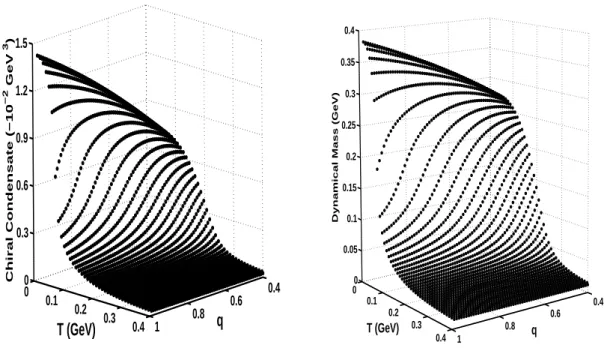
FIG. 1: Chiral condensate (in units of−10−2GeV3) and dynamical quark mass as functions of both temperature and q-deformation in the q<1 regime. The results presented in the figures were obtained with the following parameters: G=6.58 GeV−2,Λ=0.6 GeV, m0=5.87 MeV, and µ0=0.35 GeV.
SF(p; T,µ) = p /+m
p2−m2+iε+2πiδ ¡
p2−m2¢
×(p/+m) [θ(po)n(p,T,µ) +θ(−po)n(p,T,µ)], (75)
where
n(p,T,µ) = 1
1+exp[−β(E−µ)], (76)
and
n(p,T,µ) = 1
1+exp[−β(E+µ)], (77)
are the fermions and anti-fermions distribution function respectively with E=pp2+m2.
Making use of the anti-commutation relation for the fermionic fields, the expectation values can be written as
hhψ(x)ψ(x)ii=−Tr lim
y→x+hhT[ψ(x)ψ(y)]ii, (78)
hhψγ0ψii=−Tr lim
y→x+γ0hhT[ψ(x)ψ(y)]ii. (79) The term on the right-hand side of the above equations is the definition of the thermal Green function in the configuration space:
iSF(x−y; T,µ) =hhT[ψ(x)ψ(y)]ii. (80)
The expectation values are then re-written as
hhψ(x)ψ(x)ii=−i lim y→x+Tr
Z d4p
(2π)4SF(p; T,µ)e
−i(x−y)p, (81)
hhψγ0ψii=−i lim y→x+Tr
Z d4p
(2π)4γ0SF(p; T,µ)e
−i(x−y)p. (82)
Applying a cutoff in the momentum, the results forσ1andσ2 are the following
σ1=hhψψii=−NπcN2f
Z Λ
0
d pp2m
E[1−n−n], (83) σ2=hhψγ0ψii=NπcN2f
ZΛ
0
d pp2[n−n], (84)
and the barion density can be written as ρB=1
3hhψγ0ψii= NcNf
3π2
ZΛ
0
0.4 0.6
0.8
1 0
0.2 0.4 0
1 2 3 4 5
T (GeV)
q
ρ
/
ρo
FIG. 2: The barion density in units of the nuclear matter density
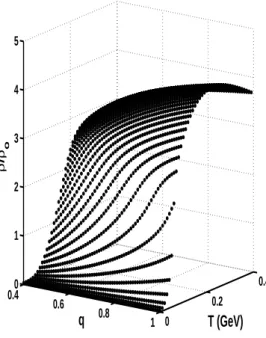
ρ0=0.15 f m−3as a function of both temperature and q-deformation in the q<1 regime.
C. Condensates, mass, and chiral symmetry restoration
An interesting window to the application of q-deformation to hadronic physics can be opened for q-values smaller than one. It is tempting to explore the behavior of the condensate in this new regime for smaller values of q, even considering that the truncation at order Q may not be granted. In this case, we observed in [5] that the chiral symmetry is restored in the limit q→0, since the condensate vanishes. It is then worth to investigate the effect of both temperature and q-deformation in the chiral symmetry restoration process as well as in the pion properties.
In order to study the effect of both temperature and q-deformation in the chiral symmetry restoration process, we can replace the gap equation for the mass in the system of coupled equations by its deformed version Eq. (86)
M=m0−2G′
ΨΨ®®
, (86)
so that the new system of coupled equation we need to solve is
½
M=m0−2G′Σ1,
µ=µ0−NGcσ2, (87)
whereΣ1represents the deformed version of the thermal con-densateσ1.
Solving the new set of coupled gap equations we can ob-serve the condensate as a function of temperature for different values of the deformation parameter. It is important to men-tion that the effects of the algebra deformamen-tion come from
gap equation for the mass. However, the chemical potential is also affected once it depends on the mass through the cou-pled equations. Thus, for a given temperature, we obtain the mass and the chemical potential by solving the system of cou-pled gap equations. We then calculate the condensate and the density.
In order to visualize the chiral symmetry restoration process with the influence from both temperature and deformation, we plot the surfaces shown in Fig. (1) where the chiral condensate and the constituent quark mass are plotted as functions of both temperature and q-deformation.
At q<1 deformations, an interesting result is observed: the chiral symmetry restoration is similar to the one observed by Klimt et al. as function of temperature and density [13]. How-ever, the process is slower as q gets smaller when compared with the case ofρgetting larger. Figure 1 shows that the con-densate is substantially affected by the deformation and low-ers as q decreases, while the effect of temperature is softened. The same behavior is observed in the dynamical quark mass since it is linearly constrained to the condensate by the gap equation.
We have also calculated the barion density as a function of T and q, which is displayed in Fig. 2. The effect of the defor-mation on the barion density in only observed as the tempera-ture increases. The density also lowers as q decreases, and the temperature effect is also smoothed down.
The behavior of the dynamical mass and the chiral conden-sate directs to chiral symmetry restoration. We would there-fore expect the pion to become massless in the limit q→0. In the next section, we evaluate the pion decay constant and mass in order to investigate the pion properties in a regime where condensate is lower than in the standard NJL model due to the effects of the q-deformation.
D. Pion Properties in the q<1 regime
Recent works [12] have shown that the spontaneous chiral symmetry breaking may result from a balance of the density of states and their mobility in the medium. It may occur with a vanishing<qq¯ >condensate as long as the low density of states is compensated by a high mobility. In this case, the condensate is no longer the order parameter.
The effective models for QCD, like the NJL, fail to describe hadronic observables when the condensate is small or null. The q-deformed version of the NJL model seems to be an al-ternative to study the low condensation scenario. As a first application, we start with the pion mass since it cannot be re-produced in the standard NJL model in a low condensation regime.
With a fixed value for the current quark mass, after obtain-ing the pion decay constant through Eq. 61, we obtain the pion mass by using the Gell-Mann-Oakes-Renner (GOR) relation
0.4
0.6
0.8
1 0
0.1 0.2
0.3 0.4 0
20 40 60 80 100
q T (GeV)
fπ
(MeV)
0.4 0.6
0.8
1 0
0.2 0.4 100
150 200 250 300 350 400 450 500
T (GeV)
q
m
π
(MeV)
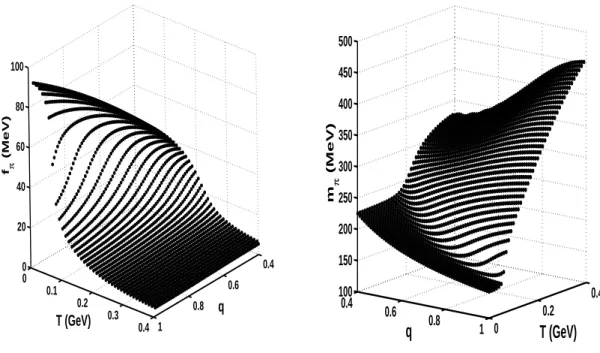
FIG. 3: The pion decay constant and the pion mass as functions of both temperature and q-deformation in the q<1 regime.
have an idea of the effect of the deformation in a low conden-sation regime, we consider the case of q=0.5, where conden-sation is approximately 35% lower than in the non-deformed case (see Fig. 1). In this particular scenario, we obtain a pion mass of about 190 MeV. The standard NJL model would give a pion mass of about 100 MeV in such condensation scenario. The correlations between the constituents of the system intro-duced when the underlying su(2)algebra is deformed seems to compensate the low condensation, which is responsible for keeping a reasonable mass for the pion even when the value of the condensate is getting smaller.
V. FINAL REMARKS
So far we have performed the q-deformation of the NJL model with finite temperature also taken into account. We studied the q-deformation of the underlying su(2)algebra in a two flavor version of the NJL model and investigated an important feature of chiral symmetry: its restoration at finite temperature. Also, we studied the pion properties in a low condensation scenario, where the standard NJL model would underestimate the pion mass.
As far as the effects of both temperature and deformation are concerned, our main conclusions can be summarized as
follows. The quark condensate and the dynamical mass de-crease as q gets smaller than one, and chiral symmetry would be restored in the limit q→0 [5]. This effect is specially observed at low temperatures, since we have thermal restora-tion at large T . Surprisingly, as the condensate lowers due to the deformation, the pion not only keeps massive but also in-creases. The GOR relation, Eq. 88, with our deformed quan-tities gives the reason for this behavior, where the pion decay constant decreases faster than the square root of the conden-sate.
It seems that the effect of the deformation compensates the lower condensation, suggesting that the quarks’ mobility is af-fected when the algebra is deformed. In fact, the correlations introduced by the deformation generate an extra momentum P0 for the constituents of the system (see Eq. 52) which is responsible for enhancing the mobility in the medium.
Acknowledgments
The authors are grateful to U-G. Meißner and M. R. Ro-bilotta for the suggestion which motivated our study on the mπ and fπ behavior, and to D. Galetti and B. M. Pimentel for very helpful discussions. This work was supported by FAPESP grant number 2002/10896-7. V. S. T. would like to thank FAEPEX/UNICAMP for financial support.
[1] Y. Nambu and G. Jona-Lasinio, Physical Review 122, 345 (1961).
[2] M. Asakawa and K. Yasaki, Nucl. Phys. A504, 668 (1989).
[3] U. Vogl and W. Weise, Prog. Part. Nucl. Phys. 27, 195 (1991), and references therein.
[5] V. S. Tim´oteo and C. L. Lima, Mod. Phys. Lett. A15, 219 (2000).
[6] S. P. Klevansky, Reviews of Modern Physics 64, 649 (1992). [7] D. Galetti and B. M. Pimentel, An. Acad. Bras. Ci. 67, 7 (1995);
S. S. Avancini, A. Eiras, D. Galetti, B. M. Pimentel, and C. L. Lima, J. Phys. A: Math. Gen. 28, 4915 (1995); D. Galetti, J. T. Lunardi, B. M. Pimentel, and C. L. Lima, Physica A242, 501 (1997).
[8] M. Ubriaco, Phys. Lett. A 219, 205 (1996).
[9] L. Tripodi and C. L. Lima, Phys. Lett. B 412, 7 (1997). [10] J. Gasser and H. Leutwyler, Ann. Phys. 158, 142 (1984).
[11] L. Dolan and R. Jackiw, Phys. Rev. 9, 3320 (1974). [12] J. Stern, hep-ph/9801282.
[13] S. Klimt, M. Lutz, and W. Weise, Phys. Lett. B 249, 386 (1990). [14] Figure 1 of Ref. [5] shows the variational angle as a function of q when the dynamical mass is equal to p, not 300 MeV as stated in the caption.