Journal of Computer Science 7 (3): 431-433, 2011 ISSN 1549-3636
© 2011 Science Publications
Corresponding Author: Venkatesh Sekar, Department of Electronics and Communication Engineering, Kumaraguru College of Technology, Coimbatore, Tamil Nadu, India
431
Performance Analysis of IEEE 802.16d using Forward Error Correction
1
Venkatesh Sekar, 2V. Palanisamy and 3K. Baskaran 1
Department of Electronics and Communication Engineering, Kumaraguru College of Technology, Coimbatore, Tamil Nadu, India
2
Department of Electronics and Communication Engineering, Info Institute of Engineering, Coimbatore, Tamil Nadu, India
3
Department of Computer Science Engineering,
Government College of Technology, Coimbatore, Tamil Nadu, India
Abstract: Problem statement: Worldwide Interoperability for Microwave Access is the broadband wireless technology for terrestrial broadcast services in Metropolitan Area Networks. This BWA technology is based on Orthogonal Frequency Division Multiplex (OFDM) technology and considers the radio frequency range up to 2-11 GHz and 10-66 GHz. The objective of this research work is the performance analysis of AWGN, SUI-1 and SUI-2 fading channels in IEEE802.16d using FEC to improving BER at different SNR under QPSK digital modulation technique. Approach: Channel coding part is composed of three steps randomization, Forward Error Correction (FEC) and interleaving. FEC is done in two phases through the outer Reed Solomon (RS) and inner Convolutional Code (CC). The implementation and analysis will be made on using MATLAB simulation. Results: In this analysis the Bit Error Rate under QPSK modulation technique over AWGN, SUI-1 and SUI-2 fading channel with encoder for a SNR value of 5dB but in the case of without encoder is found SNR value of 9dB,10dB and 8dB respectively. Conclusion: It was concluded that all the three fading channel had same SNR with FEC .The optional Block Turbo Coding (BTC) can be implemented to enhance the performance of FEC.
Key words: OFDMA, Convolutional Code (CC), QPSK, Forward Error Correction (FEC), AWGN, Block Turbo Coding (BTC), Reed Solomon (RS), WiMAX, Line Of Sight (LOS), Signal-to-Noise Ratio (SNR)
INTRODUCTION
The rapid growth of wireless internet causes a demand for high-speed access to the World Wide Web. To serve the demand for access to the internet “anywhere any time” and ensure quality of service, the IEEE 802.16 working group brought out a new broadband wireless access technology called WiMAX meaning Worldwide Interoperability for Microwave Access. It is the most recent solution for the provision of fixed broadband wireless services in a wide geographical scale and proved to be a real effective solution for the establishment of wireless metropolitan area networks. WiMAX will represent a serious competitor to third generation cellular systems as high speed mobile data applications will be achieved with the 802.16 specification. WiMAX is especially popular in wireless applications because of its resistance to forms of interference and degradation. In short,
16-J. Computer Sci., 7 (3): 431-433, 2011
432 QAM or 64-QAM (Hasan and Hossain, 2010). The implementation of RS encoder is derived from a systematic RS (N=255, K=239, T=8) code using GF (28).The encoder support shortened and punctured code to facilitate variable block sizes and variable error correction capability. The outer RS encoded block is fed to inner binary convolutional encoder has rate of 1/2 .
MATERIALS AND METHODS
The MATLAB simulation model consists of three main components namely transmitter, receiver and channel. Transmitter and receiver components consist of channel coding and modulation sub-components whereas channels are modeled as fading channels. This structure corresponds to the physical layer of the IEEE 802.16 2004 Wireless MAN OFDM air interface. WiMAX supports a number of modulation and Forward Error Correction (FEC) coding schemes and allows the scheme to be changed on a per user and per frame basis, based on channel conditions. Adaptive modulation and coding is an effective mechanism to maximize throughput in a time-varying channel. The adaptation algorithm typically calls for the use of the highest modulation and coding scheme that can be supported by the signal-to-noise and interference ratio at the receiver such that each user is provided with the highest possible data rate that can be supported in their respective links.
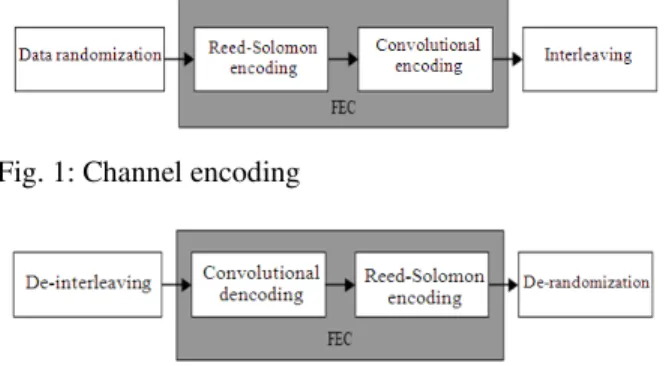
Channel coding part (Fig.1 and 2) is composed of three steps randomization, Forward Error Correction (FEC) and interleaving. FEC is done in two phases through the outer Reed Solomon (RS) and inner Convolutional Code (CC).Reed Solomon Encoder that encapsulates the data with coding blocks and these coding blocks are helpful in dealing with the burst errors. The block formatted (Reed Solomon encoded) data stream is passed through a convolutional interleaver. Here a code rate can be defined for convolutional codes as well. If there are k bits per second input to the convolutional encoder and the output is n bits per second, the code rate is k/n (Venkatesh et al., 2010 and Bayan et al., 2010).
The following Table 1 shows the simulation parameters and its values used in MATLAB simulation model to analyze fading channels (AWGN,SUI-1 and SUI-2) using forward error correction scheme.
The radio architecture of a communication system plays very significant role in the modeling of a channel. The wireless channel is characterized by: Path loss, Multipath delay Spread, Fading characteristics, Doppler spread, co channel and adjacent channel interference.
Fig. 1: Channel encoding
Fig. 2: Channel decoding
Table 1: Simulated Coding, Modulation Scheme and Noisy channels
Parameter Value
Nominal channel bandwidth 2.5 MHz
Cyclic prefix 1/4
Number of used sub carriers 200
Modulation QPSK Channels AWGN,
SUI-1, SUI-2
RS Code (255, 239, 8)
CC Code 1/2
Table 2: Channel Model parameters
Parameter Value
P in dB [0 -15 -20]
[0 -12 -15]
K [4 0 0]
[2 0 0]
Tap delay [0.0 0.4 0.9]
[0.0 0.4 1.1]
Dop (Hz) [0.4 0.3 0.5]
[0.2 0.15 0.25]
Auto_corr 0.7, 0.5
Normalized factor -0.1771, -0.3930
of gain (dB)
SUI channel models are an extension of the earlier study by ATaT Wireless and Erceg et al. (2001). This model can be used for simulations, design and development and testing of technologies suitable for fixed broadband wireless applications .The parameters for the model were selected based upon some statistical models. From these six channels we considered two channels for analysis (Erceg et al., 2001; Baum, 2001). The Table 2 below depicts the parametric view of the SUI-1 and SUI-2 channel.
RESULTS
J. Computer Sci., 7 (3): 431-433, 2011
433 Simulation results in figure from 3 to 5 shows the advantage of considering a 1/2 rated convolutinal coding and Reed-Solomon coding (255, 239, 8) for the QPSK digital modulation scheme.
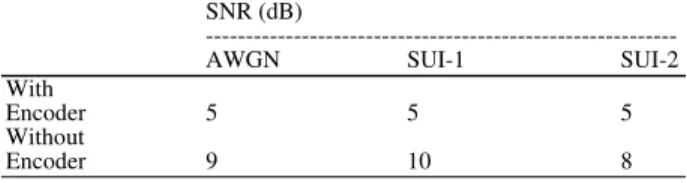
The following Table 3 shows the Bit Error Rate under QPSK modulation technique over AWGN, SUI-1 and SUI-2 fading channel with encoder for a Signal to Noise Ratio value of 5dB but in the case of without encoder is found Signal to Noise Ratio value of 9dB,10dB and 8dB respectively.
Fig. 3: Comparative study between with and without encoder using QPSK modulation under AWGN channel
Fig. 4: Comparative study between with and without encoder using QPSK modulation under SUI-1 channel
Fig. 5: Comparative study between with and without encoder using QPSK modulation under SUI-2 channel
Table 3: SNR in dB using QPSK modulation with and without encoder
SNR (dB)
---
AWGN SUI-1 SUI-2
With
Encoder 5 5 5
Without
Encoder 9 10 8
DISCUSSION
Broadband Wireless Access (BWA) has emerged as a promising solution for last mile access technology to provide high speed internet in the residential as well as small and medium sized enterprise sectors. In this study, we have analyzed the performance improvement due to convolutinal coding and Reed-Solomon coding on QPSK modulation and coding profiles has been observed on AWGN, SUI-1 and SUI-2 channel model. The same method can be used to analyze the BER performance of other SUI channels also.
CONCLUSION
The comparative analysis of the Bit Error Rate under QPSK modulation technique over AWGN, SUI-1 and SUI-2 fading channel with Forward Error Correction for a Signal to Noise Ratio value of 5dB but in the case of without encoder is found SNR value of 9dB,10dB and 8dB respectively. All the three fading channels had same Signal to Noise Ratio of 5dB with FEC .The optional Block Turbo Coding can be implemented to enhance the performance of Forward Error Correction.
REFERENCES
Baum, D.S., 2001. Simulating the SUI Channel model.
IEEE 802.16.3c-01/53.
http://wirelessman.org/tg3/contrib/802163c-01_53.pdf
Bayan, A.F., T.C. Wan and S. Ramadass, 2010. Delay analysis and system capacity control for mobile WiMAX relay networks. J. Comput. Sci., 6: 1137-1143. DOI: 10.3844/jcssp.2010.1137.1143
Erceg, V., K.V.S. Hari, M.S. Smith, D.S. Baum et al, 2001. “Channel Model for Fixed Wireless Applications. IEEE 802.16.3 Task Group Contributions.
http://www.ieee802.org/16/tga/docs/80216a-03_01.pdf
Hasan, M.Z. and M.R. Hossain, 2010. Performance evaluation of a concatenated FEC scheme based WiMAX system with application to the digital image transmission over white guassian noise and fading channels. Asian J. Inform. Technol., 9: 62-66. Koffman, I. and V. Roman, 2002. Broadband wireless
access solutions based on OFDM access in IEEE 802.16. IEEE Communi. Magazine, 40: 96-103. DOI: 10.1109/35.995857