arXiv:1202.3076v2 [hep-ex] 28 Jun 2012
Search for Pair Production of a Heavy Up-Type Quark Decaying to a W Boson
and a b Quark in the Lepton+Jets Channel with the ATLAS Detector
ATLAS Collaboration
(Dated: February 22, 2013)
A search is presented for production of a heavy up-type quark (t′) together with its antiparticle,
assuming subsequent decay to a W boson and a b quark, t′t¯′→ W+bW−¯b. The search is based on
1.04 fb−1of proton-proton collisions at√s = 7 TeV collected by the ATLAS detector at the CERN
Large Hadron Collider. Data are analyzed in the lepton+jets final state, characterized by a high transverse momentum isolated electron or muon, high missing transverse momentum and at least three jets. No significant excess of events above the background expectation is observed. A 95% C.L. lower limit of 404 GeV is set for the mass of the t′ quark.
PACS numbers: 12.60-i,13.85.Rm,14.65.Jk,14.80.-j
The discovery of the top quark [1] completed the third generation of fundamental fermions in the quark sector of the Standard Model (SM) of particle physics. It is natural to ask whether heavier quarks may exist. These quarks are often present in new physics models aimed at solving the limitations of the SM. For example, mod-els with a fourth generation of heavy chiral fermions could provide new sources of CP violation to explain the matter-antimatter asymmetry in the Universe, and allow for a heavier Higgs boson while remaining consis-tent with precision electroweak data [2]. The latter is accomplished by keeping a small mass splitting between
the heavy up-type quark (t′) and the heavy down-type
quark (b′). Assuming that m
t′− mb′ < mW, where mW
is the W boson mass, results in the t′ quark
predomi-nantly decaying to a W boson and a down-type quark q (q=d, s, b). Another possibility is the addition of isospin singlets or doublets of vector-like quarks, which appear in many extensions of the SM such as Little Higgs or
extra-dimensional models [3]. In both scenarios the t′
quark can decay into W b with a large branching ratio, provided there is a significant mixing with the third gen-eration of quarks, consistent with the existing mass and mixing patterns of the known quarks.
The high center-of-mass energy and integrated lumi-nosity in pp collisions available at the Large Hadron Col-lider (LHC) offers a unique opportunity to probe these scenarios. At the LHC, these new heavy quarks would be predominantly produced in pairs via the strong inter-action for masses below ∼ 1 TeV, while for larger masses electroweak production of single heavy quarks could be-come the primary production mechanism, depending on the strength of their interactions with the SM quarks and weak gauge bosons [3].
A search is presented in this Letter for t′t¯′ production
using pp collision data at √s = 7 TeV collected with
the ATLAS detector. It is assumed that the t′ quark
de-cays exclusively into W b. The lepton+jets final state
sig-nature is considered, characterized by a high transverse
momentum (pT) isolated electron or muon, high
miss-ing transverse momentum (Emiss
T ) and at least three jets.
Similar searches in this channel have been published by the CDF and D0 collaborations [4, 5]; the most stringent
limits preclude the existence of a t′ quark with a mass
below 358 GeV at 95% confidence level (C.L.). A search
for t′t¯′ in the dilepton final state has been performed by
the ATLAS collaboration [6], excluding a t′ quark with
a mass below 350 GeV at 95% C.L. The lepton+jets sig-nature has also been recently exploited by the ATLAS
collaboration to search for b′b¯′ → W−tW+t [7].¯
The ATLAS detector [8] consists of an inner track-ing system surrounded by a superconducttrack-ing solenoid, electromagnetic and hadronic calorimeters, and a muon spectrometer (MS). The inner detector is immersed in a 2 T axial magnetic field, and consists of pixel and sil-icon microstrip detectors inside a transition radiation tracker, providing charged particle tracking in the re-gion |η| < 2.5 [9]. The electromagnetic (EM) calorimeter is based on lead/liquid-argon (LAr). Hadron calorime-try is based on two different detector technologies, with scintillator tiles or LAr as active media, and with either steel, copper, or tungsten as the absorber material. The calorimeters provide coverage up to |η| < 4.9. The MS consists of superconducting air-core toroids, a system of trigger chambers covering the range |η| < 2.4, and high-precision tracking chambers allowing muon momentum measurements within |η| < 2.7.
The data set used in this analysis was recorded between March and June 2011 using single electron and muon triggers and includes only events collected under stable beam conditions and for which all detector subsystems were fully operational. The corresponding integrated
lu-minosity is 1.04 fb−1. The event selection criteria closely
follow those used in recent ATLAS top quark studies, e.g. Ref. [10]. Electron candidates are required to satisfy
region 1.37 < |η| < 1.52 between the barrel and end-cap EM calorimeters. Muon candidates are required to
satisfy pT> 20 GeV and |η| < 2.5. The pTthreshold
re-quirement ensures that the selected leptons are in the ef-ficiency plateau of the single-lepton triggers. Background from multi-jet production is suppressed by a requirement
of Emiss
T > 35(20) GeV [11] in the electron (muon)
chan-nel, followed by Emiss
T + mT > 60 GeV, where mT is
the transverse mass of the lepton and Emiss
T [12]. The
Emiss
T is constructed from the vector sum of all
calorime-ter cells contained in topological cluscalorime-ters [13], calibrated
at the energy scale of the associated high-pTobject, and
including contributions from selected muons. Further requirements are that there be at least three jets with
pT> 25 GeV and |η| < 2.5, with at least one jet
satisfy-ing pT> 60 GeV. Jets are reconstructed with the anti-kt
algorithm [14] with radius parameter R = 0.4, from topo-logical clusters of energy deposits in the calorimeters cal-ibrated at the EM scale. These jets are then calcal-ibrated to
the particle level [15] using a pT- and η-dependent
correc-tion factor derived from simulated events and validated using data. Finally, to further reduce the backgrounds, at least one jet is required to be identified as originating from the hadronization of a b quark (b-tagging). This is achieved via an algorithm [16] using multivariate tech-niques to combine information from the impact parame-ters of displaced tracks as well as topological properties of secondary and tertiary decay vertices reconstructed within the jet; a working point is used with ∼ 70% ef-ficiency for b-quark jets and a rejection factor of ∼ 100 for jets originating from light quarks (u, d, s) or gluons. Events with exactly one electron or one muon, and with exactly three jets or with four or more jets are analyzed separately to take advantage of their different signal-to-background ratio and signal-to-background composition, as dis-cussed below.
After event selection the main background is t¯t
produc-tion, followed by the production of a W boson in associa-tion with jets (W +jets). Smaller contribuassocia-tions arise from multi-jet events, single top quark, Z+jets and diboson production. All of the backgrounds which do not involve top quarks are significantly suppressed by the b-tagging requirement. Multi-jet events contribute to the selected sample via the misidentification of a jet or a photon as an electron or the presence of a non-prompt lepton, e.g. from a semileptonic b- or c-hadron decay. The normalization and shape of the multi-jet background kinematic distri-butions are estimated via data-driven methods [11]. For the W +jets background, the shape is estimated from the simulation but the normalization is estimated from
the asymmetry between W++jets and W−+jets
produc-tion [17] in data. All other backgrounds, as well as the signal, are estimated from the simulation and normal-ized to their theoretical cross sections. A summary of the background estimates in each of the four channels analyzed, and a comparison with the observed yields in
data are presented in Table I, showing a good agreement within the uncertainties.
Monte Carlo (MC) samples of t¯t and single top quark
background are generated using MC@NLO v3.41 [18], assuming a top quark mass of 172.5 GeV, using the CTEQ6.6 set of parton distribution functions (PDF) [19], and are normalized to the approximate next-to-next-to-leading-order (NNLO) theoretical cross
sec-tions [20, 21]. Samples of W/Z+jets background are
generated using Alpgen v2.13 [22] and the CTEQ6L1
PDF set [19]. The Z+jets background is normalized
to the NNLO theoretical cross section [23], while the W +jets background normalization is extracted from data. Both MC@NLO and Alpgen are interfaced to Herwig v6.5 [24] to model the parton shower and frag-mentation, while Jimmy [25] is used to simulate the un-derlying event. The diboson backgrounds are modeled using Herwig v6.5 and normalized to their NLO theo-retical cross sections [26]. The signal is modeled using Pythia 6.421 [27]. Signal samples are generated for a
range of masses, mt′, from 250 to 500 GeV in steps of
50 GeV and are normalized to the approximate NNLO theoretical cross sections [20] using the CTEQ6.6 PDF. The MC samples generated using Herwig or Pythia use the MRST2007 LO* PDF set [28]. All MC sam-ples include multiple pp interactions and are processed through a full simulation [29] of the detector geometry and response using Geant4 [30], and the same
recon-struction software as the data. Simulated events are
corrected to match the object identification efficiencies and resolutions determined in data control samples. The total signal detection efficiency, considering both lepton flavors and jet multiplicities analyzed, ranges from 5.2%
for mt′ = 250 GeV to 17.3% for mt′ = 500 GeV.
This analysis uses the reconstructed heavy quark mass
(mreco) as the primary discriminating variable. In the
case of events with ≥ 4 jets, mreco is estimated by
per-forming a kinematic likelihood fit [17] to the t′t¯′ →
W+bW−¯b → ℓνbq¯q′¯b hypothesis, imposing the
con-straints that t′ and ¯t′ have the same mass, and that the
mass of the lepton-neutrino system, as well as that of a jet pair, equals the nominal W boson mass. The final state
objects considered are the lepton, Emiss
T and the four jets
with highest pT. Among all possible jet-parton
permuta-tions, the one yielding the highest likelihood value after maximization over the fit parameters is kept. In the case
of events with exactly three jets, mreco is taken to be
the invariant mass of the three-jet system. In order to ensure a robust background prediction in the tail of the
mrecodistribution, a dynamic binning scheme is adopted;
starting from the high side and low side of the distribu-tions, bins are merged until the statistical uncertainty in the sum of the background predictions in that bin drops below 5%.
Systematic uncertainties affecting the normalization
e+3 jets µ+3 jets e+≥4 jets µ+≥4 jets t¯t 2320 ± 460 3000 ± 630 4470 ± 920 5900 ± 1200 W +jets 1440 ± 790 2200 ± 1200 830 ± 580 1160 ± 790 Z+jets 92 ± 53 118 ± 62 86 ± 56 83 ± 46 Single top 382 ± 68 554 ± 94 262 ± 70 325 ± 79 Dibosons 28 ± 7 37 ± 11 12 ± 5 17 ± 5 Multi-jet 520 ± 520 550 ± 550 320 ± 320 340 ± 340 Total prediction 4800 ± 1000 6500 ± 1500 6000 ± 1100 7800 ± 1400 Data 4533 6421 6145 8149 t′t¯′(400 GeV) 20.0 ± 3.3 21.0 ± 3.6 102.0 ± 10.5 98.1 ± 11.1
TABLE I. Number of events observed compared to the background expectation after final event selection in each of the four channels considered. Also shown are the expected signal yields assuming mt′ = 400 GeV. The quoted uncertainties are prior to the fit to data and include both statistical and systematic contributions, taking into account correlations among processes.
both signal and background, taking into account corre-lations among processes as well as channels. The domi-nant sources of uncertainty arise from the modeling of the
t¯t background. The uncertainties on the t¯t background
come from the theoretical uncertainty on the cross
sec-tion (+7.0−9.6%) as well as the effects on both
normaliza-tion and shape of the mreco distribution from a number
of sources; these are uncertainties on the fragmentation model (based on the comparison of Herwig and Pythia fragmentations), on the NLO event generator (based on the comparison of MC@NLO and Powheg [31]) and on the top quark mass (taken to be ±1 GeV).
The uncertainty on the jet energy scale affects the nor-malization of signal (2–12%) and backgrounds (5–30%) modeled through the simulation, as well as the shape of
their mreco distributions.
Uncertainties on the modeling of initial- and final-state QCD radiation (ISR/FSR), evaluated by varying sponding generator parameters, are considered as
corre-lated between the t¯t background and the t′t¯′ signal.
While the normalization is obtained from the asymme-try measurement, the uncertainties on the normalization of the W +jets background are derived from measure-ments of W +2 jets dominated data samples and take into account the uncertainty on the heavy-flavor content of the samples as well as the extrapolation to higher jet multiplicities. The total uncertainty on the W +jets nor-malization is 50% and 70% for events with exactly 3 jets and ≥4 jets, respectively. Uncertainties on the shape of
the mreco distribution for the W +jets background are
estimated by varying the choices of the matching scale (from 15 to 10 GeV) and the factorization scale (from µ2
F= m2W +P p2T,jet to µ2F= m2W + p2T,W) in Alpgen.
Uncertainties on the modeling of the b-tagging algo-rithms affect the identification of b/c-jets (6–8% for sig-nal and backgrounds containing top quarks, 6–12% for the other backgrounds) as well as the mis-identification of light jets (< 0.5% for signal and backgrounds contain-ing top quarks and up to 5% for the other backgrounds). The Z+jets, single top and diboson backgrounds are
var-ied within the uncertainty on their theoretical cross sec-tions. The uncertainty on the multi-jet background event normalizations is conservatively taken as 100%. Uncer-tainties on the shapes of the multi-jet background are derived by varying the lepton identification criteria used to extract this background.
The uncertainties on the lepton identification and trig-ger efficiencies, as well as their energy scales and resolu-tions, impact the yields by 3% for electrons and 6% for muons.
Uncertainties on the integrated luminosity (3.7%) [32], jet reconstruction efficiency, jet resolution modeling, ef-fect of multiple pp interactions on the modeling of the
Emiss
T and treatment of imperfections in the detector
de-scription in the MC simulation are also considered and are all found to have a very small effect on the result.
Good agreement between the data and the background prediction is observed both in terms of overall
nor-malization and shape of the mreco distribution. The
mreco distribution is analyzed using a log-likelihood
ra-tio LLR = −2 log(Ls+b/Lb) as test-statistic, where Ls+b
(Lb) is a Poisson likelihood to observe the data under
the signal-plus-background (background-only) hypothe-sis. The per-bin signal and background predictions are parameterized in terms of 12 nuisance parameters, de-scribing the effect of leading sources of systematic
uncer-tainty such as jet energy scale, ISR/FSR, and t¯t, W +jets
and QCD multi-jet normalizations. The impact of sys-tematic uncertainties on the sensitivity of the search is
re-duced by maximizing both likelihood functions, Ls+band
Lb, with respect to these nuisance parameters, subject to
Gaussian constraints of their prior values. The set of fit-ted nuisance parameters is chosen based on their overall impact on the search sensitivity, the expected constrain-ing power of the data and their suitability to be treated as continuous parameters. The simultaneous constraint of several of these systematic uncertainties is possible be-cause of the inclusion of the 3-jet channel in the analysis. The latter has a higher fraction of W +jets background than the ≥4-jets channel, and provides sensitivity to
event migration to different jet multiplicities when vary-ing uncertainties such as jet energy scale or ISR/FSR. In addition to the jet multiplicity spectrum, the jet
en-ergy scale affects the peak position of the mrecospectrum
for t¯t background, and can be constrained owing to the
small uncertainty on the measured top quark mass [33]. Nuisance parameters associated with smaller systematic uncertainties (e.g. lepton identification/trigger) are only weakly constrained.
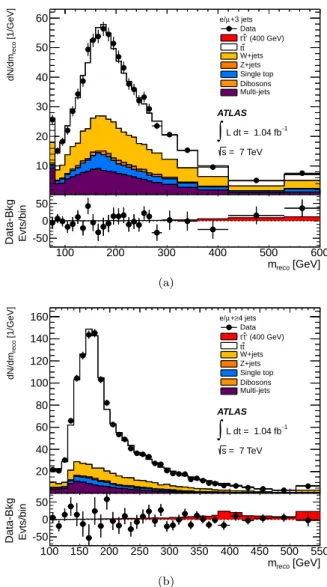
Figure 1 shows a comparison of the post-fit mreco
dis-tribution between data and the background prediction for the combined e/µ + 3 jets and e/µ+ ≥ 4 jets channels. The fitted parameters are typically within one standard deviation of their nominal values and their uncertain-ties are consistent with expectations based on pseudo-experiments. Several additional studies were performed to check the integrity of the fitting procedure. The likeli-hood was verified to be parabolic near the minimum for each of the fitted parameters and to yield reasonable fit
uncertainties; the lack of sensitivity to the assumed pT
and η correlation of the jet energy scale uncertainty was verified.
In the absence of any significant data excess, ei-ther in the e+jets or µ+jets channels individually or in their combination, 95% C.L. upper limits on the
t′t¯′ production cross section are derived using the CLS
method [34], which employs the LLR test-statistic de-scribed above. Pseudo-experiments are generated under both the signal-plus-background (s+b) and background-only (b) hypotheses, taking into account per-bin statis-tical fluctuations of the total predictions according to Poisson statistics, as well as Gaussian fluctuations in the signal and background expectations describing the effect of systematic uncertainties. The fraction of s+b and b pseudo-experiments with LLR larger than the median or
observed LLR defines CLs+b and CLb for the expected
or observed limits, respectively. Signal cross sections for
which CLs = CLs+b/CLb < 0.05 are deemed excluded
at the 95% C.L.
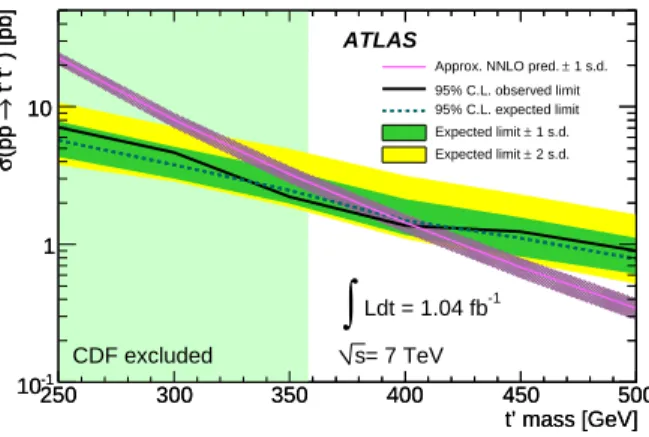
The resulting observed and expected upper limits on
the t′t¯′ production cross section are shown in Fig. 2 as
a function of the t′ mass, compared to the theoretical
prediction, assuming a BR(t′ → W b) = 1. As a result,
an observed (expected) 95% C.L. lower limit of 404 (394)
GeV on the mass of the t′ quark is derived.
In summary, a search for t′t¯′ production has been
per-formed in the lepton+jets final state under the
assump-tion BR(t′ → W b) = 1. No significant excess of events
in the tail of the mreco distribution was found, resulting
in an observed lower limit of mt′ > 404 GeV at 95% C.L.
This represents the most stringent limit to date. This limit is also directly applicable to a down-type vector-like quark with electric charge of −4/3 decaying into a W boson and a b quark [3].
We thank CERN for the very successful operation of the LHC, as well as the support staff from our institutions
100 200 300 400 500 600 [1/GeV] reco dN/dm 10 20 30 40 50 60 e/µ+3 jets Data ’ (400 GeV) t t’ t t W+jets Z+jets Single top Dibosons Multi-jets -1 L dt = 1.04 fb
∫
= 7 TeV s ATLAS [GeV] reco m 100 200 300 400 500 600 Data-Bkg -50 0 50 Evts/bin (a) 100 150 200 250 300 350 400 450 500 550 [1/GeV] reco dN/dm 20 40 60 80 100 120 140 160 e/µ+≥4 jets Data ’ (400 GeV) t t’ t t W+jets Z+jets Single top Dibosons Multi-jets -1 L dt = 1.04 fb∫
= 7 TeV s ATLAS [GeV] reco m 100 150 200 250 300 350 400 450 500 550 Data-Bkg -50 0 50 Evts/bin (b)FIG. 1. mreco distribution in the combined (a) e/µ+3 jets
and (b) e/µ+≥4 jets channels. The data (points) are com-pared to the SM background predictions using the values of the nuisance parameters obtained from the fit to data under the background-only hypothesis (stacked histograms). In the top panels the bin contents have been divided by bin width. The bottom panels show the background-subtracted data dis-tribution. The underflow and overflow have been folded into the first and last bins, respectively. Also shown is the ex-pected contribution from a signal with mass mt′ = 400 GeV (histogram).
without whom ATLAS could not be operated efficiently. We acknowledge the support of ANPCyT, Argentina; YerPhI, Armenia; ARC, Australia; BMWF, Austria; ANAS, Azerbaijan; SSTC, Belarus; CNPq and FAPESP, Brazil; NSERC, NRC and CFI, Canada; CERN; CONI-CYT, Chile; CAS, MOST and NSFC, China; COLCIEN-CIAS, Colombia; MSMT CR, MPO CR and VSC CR, Czech Republic; DNRF, DNSRC and Lundbeck Founda-tion, Denmark; ARTEMIS and ERC, European Union; IN2P3-CNRS, CEA-DSM/IRFU, France; GNAS,
Geor-t’ mass [GeV] 250 300 350 400 450 500 ’ ) [pb]t t’ → (pp σ -1 10 1 10 t’ mass [GeV] 250 300 350 400 450 500 ’ ) [pb]t t’ → (pp σ -1 10 1 10 -1 Ldt = 1.04 fb
∫
= 7 TeV s CDF excluded 1 s.d. ±Approx. NNLO pred. 95% C.L. observed limit 95% C.L. expected limit 1 s.d. ± Expected limit 2 s.d. ± Expected limit ATLAS
FIG. 2. Observed (solid line) and expected (dashed line) 95% C.L. upper limits on the t′t¯′cross section as a function of the
t′ mass. The surrounding shaded bands correspond to the 1
and 2 standard deviations (s.d.) around the expected limit. The thin line shows the theoretical prediction including its 1 s.d. uncertainty band. The shaded area is the mass region previously excluded by the CDF experiment [4].
gia; BMBF, DFG, HGF, MPG and AvH Foundation, Germany; GSRT, Greece; ISF, MINERVA, GIF, DIP and Benoziyo Center, Israel; INFN, Italy; MEXT and JSPS, Japan; CNRST, Morocco; FOM and NWO, Netherlands; RCN, Norway; MNiSW, Poland; GRICES and FCT, Portugal; MERYS (MECTS), Romania; MES of Rus-sia and ROSATOM, RusRus-sian Federation; JINR; MSTD, Serbia; MSSR, Slovakia; ARRS and MVZT, Slovenia; DST/NRF, South Africa; MICINN, Spain; SRC and Wallenberg Foundation, Sweden; SER, SNSF and Can-tons of Bern and Geneva, Switzerland; NSC, Taiwan; TAEK, Turkey; STFC, the Royal Society and Lever-hulme Trust, United Kingdom; DOE and NSF, United States of America.
The crucial computing support from all WLCG part-ners is acknowledged gratefully, in particular from CERN and the ATLAS Tier-1 facilities at TRIUMF (Canada), NDGF (Denmark, Norway, Sweden), CC-IN2P3 (France), KIT/GridKA (Germany), INFN-CNAF (Italy), NL-T1 (Netherlands), PIC (Spain), ASGC (Tai-wan), RAL (UK) and BNL (USA) and in the Tier-2 fa-cilities worldwide.
[1] F. Abe et al. (CDF Collaboration),
Phys. Rev. Lett. 74, 2626 (1995); S. Abachi et al. (D0 Collaboration), Phys. Rev. Lett. 74, 2632 (1995). [2] See e.g. B. Holdom et al., PMC Physics A 3, 4 (2009)
and references therein.
[3] See e.g. J. A. Aguilar-Saavedra,
J. High Energy Phys. 0911, 030 (2009) and references therein.
[4] T. Aaltonen et al. (CDF Collaboration), Phys. Rev. Lett. 107, 261801 (2011).
[5] V. M. Abazov et al. (D0 Collaboration), Phys. Rev. Lett. 107, 082001 (2011).
[6] ATLAS Collaboration, (2012), submitted for publication to Phys. Rev. D, arXiv:1202.3389 [hep-ex].
[7] ATLAS Collaboration, (2012), submitted for publication to Phys. Rev. Lett., arXiv:1202.6540 [hep-ex].
[8] ATLAS Collaboration, J. Instrum. 3, S08003 (2008). [9] Pseudorapidity is defined as η = − ln[tan(θ/2)], where θ
is the polar angle relative to the beam direction and φ is the azimuthal angle in the plane transverse to the beam direction.
[10] ATLAS Collaboration, (2012), accepted for publication in Phys. Lett. B, arXiv:1201.1889 [hep-ex].
[11] ATLAS Collaboration, Eur. Phys. J. C 71, 1577 (2011). [12] The transverse mass is defined by the formula mT =
p 2pℓ TE miss T (1 − cos ∆φ), where p ℓ
Tis the pTof the lepton
and ∆φ is the azimuthal angle separation between the lepton and Emiss
T .
[13] ATLAS Collaboration, Eur. Phys. J. C 72, 1844 (2012). [14] M. Cacciari, G. P. Salam, and G. Soyez,
J. High Energy Phys. 0804, 063 (2008).
[15] ATLAS Collaboration, (2011), submitted for publication to Eur. Phys. J. C, arXiv:1112.6426 [hep-ex].
[16] ATLAS Collaboration, ATLAS-CONF-2011-102 (2011), https://cdsweb.cern.ch/record/1369219.
[17] ATLAS Collaboration, (2012), submitted for publication to Eur. Phys. J. C, arXiv:1203.4211 [hep-ex].
[18] S. Frixione and B. R. Webber,
J. High Energy Phys. 0206, 029 (2002); S. Frix-ione, E. Laenen, P. Motylinski, and B. R. Webber, J. High Energy Phys. 2006, 092 (2006); S. Frixione, E. Laenen, P. Motylinski, C. White, and B. R. Webber, J. High Energy Phys. 2008, 029 (2008).
[19] P. M. Nadolsky et al., Phys. Rev. D 78, 013004 (2008). [20] M. Aliev et al., Comput. Phys. Commun. 182, 1034 (2011). [21] N. Kidonakis, Phys. Rev. D 83, 091503 (2011);
Phys. Rev. D 81, 054028 (2010).
[22] M. L. Mangano et al.,
J. High Energy Phys. 2003, 001 (2003).
[23] K. Melnikov and F. Petriello,
Phys. Rev. D 74, 114017 (2006).
[24] G. Corcella et al., J. High Energy Phys. 2001, 010 (2001). [25] J. Butterworth, J. Forshaw, and M. Seymour,
Z. Phys. C 72, 637 (1996).
[26] J. Campbell, R. K. Ellis, and D. Rainwater, Phys. Rev. D 68, 094021 (2003).
[27] T. Sjostrand et al., Comput. Phys. Commun. 135, 238 (2001).
[28] A. Sherstnev and R. Thorne,
Eur. Phys. J. C 55, 553 (2008).
[29] ATLAS Collaboration, Eur. Phys. J. C 70, 823 (2010).
[30] S. Agostinelli et al., Nucl. Instr. Methods Phys. Res. A 506, 250 (2003) [31] P. Nason, J. High Energy Phys. 2004, 040 (2004).
[32] ATLAS Collaboration, Eur. Phys. J. C 71, 1630 (2011);
ATLAS-CONF-2011-116 (2011),
https://cdsweb.cern.ch/record/1376384.
[33] K. Nakamura et al. (Particle Data Group), J. Phys. G 37, 075021 (2010), and 2011 partial up-date for the 2012 edition.
[34] T. Junk, Nucl. Instr. Methods Phys. Res. A 434, 435 (1999); A. L. Read, J. Phys. G 28, 2693 (2002).
The ATLAS Collaboration
G. Aad48, B. Abbott110, J. Abdallah11, A.A. Abdelalim49, A. Abdesselam117, O. Abdinov10, B. Abi111,
M. Abolins87, O.S. AbouZeid157, H. Abramowicz152, H. Abreu114, E. Acerbi88a,88b, B.S. Acharya163a,163b,
L. Adamczyk37, D.L. Adams24, T.N. Addy56, J. Adelman174, M. Aderholz98, S. Adomeit97, P. Adragna74,
T. Adye128, S. Aefsky22, J.A. Aguilar-Saavedra123b,a, M. Aharrouche80, S.P. Ahlen21, F. Ahles48, A. Ahmad147,
M. Ahsan40, G. Aielli132a,132b, T. Akdogan18a, T.P.A. ˚Akesson78, G. Akimoto154, A.V. Akimov93, A. Akiyama66,
M.S. Alam1, M.A. Alam75, J. Albert168, S. Albrand55, M. Aleksa29, I.N. Aleksandrov64, F. Alessandria88a,
C. Alexa25a, G. Alexander152, G. Alexandre49, T. Alexopoulos9, M. Alhroob20, M. Aliev15, G. Alimonti88a,
J. Alison119, M. Aliyev10, B.M.M. Allbrooke17, P.P. Allport72, S.E. Allwood-Spiers53, J. Almond81,
A. Aloisio101a,101b, R. Alon170, A. Alonso78, B. Alvarez Gonzalez87, M.G. Alviggi101a,101b, K. Amako65,
P. Amaral29, C. Amelung22, V.V. Ammosov127, A. Amorim123a,b, G. Amor´os166, N. Amram152, C. Anastopoulos29,
L.S. Ancu16, N. Andari114, T. Andeen34, C.F. Anders20, G. Anders58a, K.J. Anderson30, A. Andreazza88a,88b,
V. Andrei58a, M-L. Andrieux55, X.S. Anduaga69, A. Angerami34, F. Anghinolfi29, A. Anisenkov106, N. Anjos123a,
A. Annovi47, A. Antonaki8, M. Antonelli47, A. Antonov95, J. Antos143b, F. Anulli131a, S. Aoun82, L. Aperio Bella4,
R. Apolle117,c, G. Arabidze87, I. Aracena142, Y. Arai65, A.T.H. Arce44, S. Arfaoui147, J-F. Arguin14, E. Arik18a,∗,
M. Arik18a, A.J. Armbruster86, O. Arnaez80, C. Arnault114, A. Artamonov94, G. Artoni131a,131b, D. Arutinov20,
S. Asai154, R. Asfandiyarov171, S. Ask27, B. ˚Asman145a,145b, L. Asquith5, K. Assamagan24, A. Astbury168,
A. Astvatsatourov52, B. Aubert4, E. Auge114, K. Augsten126, M. Aurousseau144a, G. Avolio162, R. Avramidou9,
D. Axen167, C. Ay54, G. Azuelos92,d, Y. Azuma154, M.A. Baak29, G. Baccaglioni88a, C. Bacci133a,133b, A.M. Bach14,
H. Bachacou135, K. Bachas29, M. Backes49, M. Backhaus20, E. Badescu25a, P. Bagnaia131a,131b, S. Bahinipati2,
Y. Bai32a, D.C. Bailey157, T. Bain157, J.T. Baines128, O.K. Baker174, M.D. Baker24, S. Baker76, E. Banas38,
P. Banerjee92, Sw. Banerjee171, D. Banfi29, A. Bangert149, V. Bansal168, H.S. Bansil17, L. Barak170, S.P. Baranov93,
A. Barashkou64, A. Barbaro Galtieri14, T. Barber48, E.L. Barberio85, D. Barberis50a,50b, M. Barbero20,
D.Y. Bardin64, T. Barillari98, M. Barisonzi173, T. Barklow142, N. Barlow27, B.M. Barnett128, R.M. Barnett14,
A. Baroncelli133a, G. Barone49, A.J. Barr117, F. Barreiro79, J. Barreiro Guimar˜aes da Costa57, P. Barrillon114,
R. Bartoldus142, A.E. Barton70, V. Bartsch148, R.L. Bates53, L. Batkova143a, J.R. Batley27, A. Battaglia16,
M. Battistin29, F. Bauer135, H.S. Bawa142,e, S. Beale97, T. Beau77, P.H. Beauchemin160, R. Beccherle50a,
P. Bechtle20, H.P. Beck16, S. Becker97, M. Beckingham137, K.H. Becks173, A.J. Beddall18c, A. Beddall18c,
S. Bedikian174, V.A. Bednyakov64, C.P. Bee82, M. Begel24, S. Behar Harpaz151, P.K. Behera62, M. Beimforde98,
C. Belanger-Champagne84, P.J. Bell49, W.H. Bell49, G. Bella152, L. Bellagamba19a, F. Bellina29, M. Bellomo29,
A. Belloni57, O. Beloborodova106,f, K. Belotskiy95, O. Beltramello29, S. Ben Ami151, O. Benary152,
D. Benchekroun134a, C. Benchouk82, M. Bendel80, N. Benekos164, Y. Benhammou152, E. Benhar Noccioli49,
J.A. Benitez Garcia158b, D.P. Benjamin44, M. Benoit114, J.R. Bensinger22, K. Benslama129, S. Bentvelsen104,
D. Berge29, E. Bergeaas Kuutmann41, N. Berger4, F. Berghaus168, E. Berglund104, J. Beringer14, P. Bernat76,
R. Bernhard48, C. Bernius24, T. Berry75, C. Bertella82, A. Bertin19a,19b, F. Bertinelli29, F. Bertolucci121a,121b,
M.I. Besana88a,88b, N. Besson135, S. Bethke98, W. Bhimji45, R.M. Bianchi29, M. Bianco71a,71b, O. Biebel97,
S.P. Bieniek76, K. Bierwagen54, J. Biesiada14, M. Biglietti133a, H. Bilokon47, M. Bindi19a,19b, S. Binet114,
A. Bingul18c, C. Bini131a,131b, C. Biscarat176, U. Bitenc48, K.M. Black21, R.E. Blair5, J.-B. Blanchard135,
G. Blanchot29, T. Blazek143a, C. Blocker22, J. Blocki38, A. Blondel49, W. Blum80, U. Blumenschein54,
G.J. Bobbink104, V.B. Bobrovnikov106, S.S. Bocchetta78, A. Bocci44, C.R. Boddy117, M. Boehler41, J. Boek173,
N. Boelaert35, J.A. Bogaerts29, A. Bogdanchikov106, A. Bogouch89,∗, C. Bohm145a, V. Boisvert75, T. Bold37,
V. Boldea25a, N.M. Bolnet135, M. Bona74, V.G. Bondarenko95, M. Bondioli162, M. Boonekamp135, C.N. Booth138,
S. Bordoni77, C. Borer16, A. Borisov127, G. Borissov70, I. Borjanovic12a, M. Borri81, S. Borroni86,
V. Bortolotto133a,133b, K. Bos104, D. Boscherini19a, M. Bosman11, H. Boterenbrood104, D. Botterill128,
J. Bouchami92, J. Boudreau122, E.V. Bouhova-Thacker70, D. Boumediene33, C. Bourdarios114, N. Bousson82,
A. Boveia30, J. Boyd29, I.R. Boyko64, N.I. Bozhko127, I. Bozovic-Jelisavcic12b, J. Bracinik17, A. Braem29,
P. Branchini133a, G.W. Brandenburg57, A. Brandt7, G. Brandt117, O. Brandt54, U. Bratzler155, B. Brau83,
J.E. Brau113, H.M. Braun173, B. Brelier157, J. Bremer29, R. Brenner165, S. Bressler170, D. Britton53, F.M. Brochu27,
I. Brock20, R. Brock87, T.J. Brodbeck70, E. Brodet152, F. Broggi88a, C. Bromberg87, J. Bronner98, G. Brooijmans34,
W.K. Brooks31b, G. Brown81, H. Brown7, P.A. Bruckman de Renstrom38, D. Bruncko143b, R. Bruneliere48,
S. Brunet60, A. Bruni19a, G. Bruni19a, M. Bruschi19a, T. Buanes13, Q. Buat55, F. Bucci49, J. Buchanan117,
N.J. Buchanan2, P. Buchholz140, R.M. Buckingham117, A.G. Buckley45, S.I. Buda25a, I.A. Budagov64, B. Budick107,
V. B¨uscher80, L. Bugge116, O. Bulekov95, M. Bunse42, T. Buran116, H. Burckhart29, S. Burdin72, T. Burgess13,
S. Burke128, E. Busato33, P. Bussey53, C.P. Buszello165, F. Butin29, B. Butler142, J.M. Butler21, C.M. Buttar53,
G. Calderini77, P. Calfayan97, R. Calkins105, L.P. Caloba23a, R. Caloi131a,131b, D. Calvet33, S. Calvet33,
R. Camacho Toro33, P. Camarri132a,132b, M. Cambiaghi118a,118b, D. Cameron116, L.M. Caminada14, S. Campana29,
M. Campanelli76, V. Canale101a,101b, F. Canelli30,g, A. Canepa158a, J. Cantero79, L. Capasso101a,101b,
M.D.M. Capeans Garrido29, I. Caprini25a, M. Caprini25a, D. Capriotti98, M. Capua36a,36b, R. Caputo80,
C. Caramarcu24, R. Cardarelli132a, T. Carli29, G. Carlino101a, L. Carminati88a,88b, B. Caron84, S. Caron103,
G.D. Carrillo Montoya171, A.A. Carter74, J.R. Carter27, J. Carvalho123a,h, D. Casadei107, M.P. Casado11,
M. Cascella121a,121b, C. Caso50a,50b,∗, A.M. Castaneda Hernandez171, E. Castaneda-Miranda171,
V. Castillo Gimenez166, N.F. Castro123a, G. Cataldi71a, F. Cataneo29, A. Catinaccio29, J.R. Catmore29, A. Cattai29,
G. Cattani132a,132b, S. Caughron87, D. Cauz163a,163c, P. Cavalleri77, D. Cavalli88a, M. Cavalli-Sforza11,
V. Cavasinni121a,121b, F. Ceradini133a,133b, A.S. Cerqueira23b, A. Cerri29, L. Cerrito74, F. Cerutti47, S.A. Cetin18b,
F. Cevenini101a,101b, A. Chafaq134a, D. Chakraborty105, K. Chan2, B. Chapleau84, J.D. Chapman27,
J.W. Chapman86, E. Chareyre77, D.G. Charlton17, V. Chavda81, C.A. Chavez Barajas29, S. Cheatham84,
S. Chekanov5, S.V. Chekulaev158a, G.A. Chelkov64, M.A. Chelstowska103, C. Chen63, H. Chen24, S. Chen32c,
T. Chen32c, X. Chen171, S. Cheng32a, A. Cheplakov64, V.F. Chepurnov64, R. Cherkaoui El Moursli134e,
V. Chernyatin24, E. Cheu6, S.L. Cheung157, L. Chevalier135, G. Chiefari101a,101b, L. Chikovani51a, J.T. Childers29,
A. Chilingarov70, G. Chiodini71a, A.S. Chisholm17, M.V. Chizhov64, G. Choudalakis30, S. Chouridou136,
I.A. Christidi76, A. Christov48, D. Chromek-Burckhart29, M.L. Chu150, J. Chudoba124, G. Ciapetti131a,131b,
K. Ciba37, A.K. Ciftci3a, R. Ciftci3a, D. Cinca33, V. Cindro73, M.D. Ciobotaru162, C. Ciocca19a, A. Ciocio14,
M. Cirilli86, M. Citterio88a, M. Ciubancan25a, A. Clark49, P.J. Clark45, W. Cleland122, J.C. Clemens82,
B. Clement55, C. Clement145a,145b, R.W. Clifft128, Y. Coadou82, M. Cobal163a,163c, A. Coccaro171, J. Cochran63,
P. Coe117, J.G. Cogan142, J. Coggeshall164, E. Cogneras176, J. Colas4, A.P. Colijn104, N.J. Collins17,
C. Collins-Tooth53, J. Collot55, G. Colon83, P. Conde Mui˜no123a, E. Coniavitis117, M.C. Conidi11, M. Consonni103,
V. Consorti48, S. Constantinescu25a, C. Conta118a,118b, F. Conventi101a,i, J. Cook29, M. Cooke14, B.D. Cooper76,
A.M. Cooper-Sarkar117, K. Copic14, T. Cornelissen173, M. Corradi19a, F. Corriveau84,j, A. Cortes-Gonzalez164,
G. Cortiana98, G. Costa88a, M.J. Costa166, D. Costanzo138, T. Costin30, D. Cˆot´e29, R. Coura Torres23a,
L. Courneyea168, G. Cowan75, C. Cowden27, B.E. Cox81, K. Cranmer107, F. Crescioli121a,121b, M. Cristinziani20,
G. Crosetti36a,36b, R. Crupi71a,71b, S. Cr´ep´e-Renaudin55, C.-M. Cuciuc25a, C. Cuenca Almenar174,
T. Cuhadar Donszelmann138, M. Curatolo47, C.J. Curtis17, C. Cuthbert149, P. Cwetanski60, H. Czirr140,
P. Czodrowski43, Z. Czyczula174, S. D’Auria53, M. D’Onofrio72, A. D’Orazio131a,131b, P.V.M. Da Silva23a,
C. Da Via81, W. Dabrowski37, T. Dai86, C. Dallapiccola83, M. Dam35, M. Dameri50a,50b, D.S. Damiani136,
H.O. Danielsson29, D. Dannheim98, V. Dao49, G. Darbo50a, G.L. Darlea25b, W. Davey20, T. Davidek125,
N. Davidson85, R. Davidson70, E. Davies117,c, M. Davies92, A.R. Davison76, Y. Davygora58a, E. Dawe141,
I. Dawson138, J.W. Dawson5,∗, R.K. Daya-Ishmukhametova22, K. De7, R. de Asmundis101a, S. De Castro19a,19b,
P.E. De Castro Faria Salgado24, S. De Cecco77, J. de Graat97, N. De Groot103, P. de Jong104, C. De La Taille114,
H. De la Torre79, B. De Lotto163a,163c, L. de Mora70, L. De Nooij104, D. De Pedis131a, A. De Salvo131a,
U. De Sanctis163a,163c, A. De Santo148, J.B. De Vivie De Regie114, S. Dean76, W.J. Dearnaley70, R. Debbe24,
C. Debenedetti45, D.V. Dedovich64, J. Degenhardt119, M. Dehchar117, C. Del Papa163a,163c, J. Del Peso79,
T. Del Prete121a,121b, T. Delemontex55, M. Deliyergiyev73, A. Dell’Acqua29, L. Dell’Asta21, M. Della Pietra101a,i,
D. della Volpe101a,101b, M. Delmastro4, N. Delruelle29, P.A. Delsart55, C. Deluca147, S. Demers174, M. Demichev64,
B. Demirkoz11,k, J. Deng162, S.P. Denisov127, D. Derendarz38, J.E. Derkaoui134d, F. Derue77, P. Dervan72,
K. Desch20, E. Devetak147, P.O. Deviveiros104, A. Dewhurst128, B. DeWilde147, S. Dhaliwal157, R. Dhullipudi24 ,l,
A. Di Ciaccio132a,132b, L. Di Ciaccio4, A. Di Girolamo29, B. Di Girolamo29, S. Di Luise133a,133b, A. Di Mattia171,
B. Di Micco29, R. Di Nardo47, A. Di Simone132a,132b, R. Di Sipio19a,19b, M.A. Diaz31a, F. Diblen18c, E.B. Diehl86,
J. Dietrich41, T.A. Dietzsch58a, S. Diglio85, K. Dindar Yagci39, J. Dingfelder20, C. Dionisi131a,131b, P. Dita25a,
S. Dita25a, F. Dittus29, F. Djama82, T. Djobava51b, M.A.B. do Vale23c, A. Do Valle Wemans123a, T.K.O. Doan4,
M. Dobbs84, R. Dobinson29,∗, D. Dobos29, E. Dobson29,m, J. Dodd34, C. Doglioni49, T. Doherty53, Y. Doi65,∗,
J. Dolejsi125, I. Dolenc73, Z. Dolezal125, B.A. Dolgoshein95,∗, T. Dohmae154, M. Donadelli23d, M. Donega119,
J. Donini33, J. Dopke29, A. Doria101a, A. Dos Anjos171, M. Dosil11, A. Dotti121a,121b, M.T. Dova69, J.D. Dowell17,
A.D. Doxiadis104, A.T. Doyle53, Z. Drasal125, J. Drees173, N. Dressnandt119, H. Drevermann29, C. Driouichi35,
M. Dris9, J. Dubbert98, S. Dube14, E. Duchovni170, G. Duckeck97, A. Dudarev29, F. Dudziak63, M. D¨uhrssen29,
I.P. Duerdoth81, L. Duflot114, M-A. Dufour84, M. Dunford29, H. Duran Yildiz3a, R. Duxfield138, M. Dwuznik37,
F. Dydak29, M. D¨uren52, W.L. Ebenstein44, J. Ebke97, S. Eckweiler80, K. Edmonds80, C.A. Edwards75,
N.C. Edwards53, W. Ehrenfeld41, T. Ehrich98, T. Eifert142, G. Eigen13, K. Einsweiler14, E. Eisenhandler74,
T. Ekelof165, M. El Kacimi134c, M. Ellert165, S. Elles4, F. Ellinghaus80, K. Ellis74, N. Ellis29, J. Elmsheuser97,
M. Elsing29, D. Emeliyanov128, R. Engelmann147, A. Engl97, B. Epp61, A. Eppig86, J. Erdmann54, A. Ereditato16,
C. Escobar122, X. Espinal Curull11, B. Esposito47, F. Etienne82, A.I. Etienvre135, E. Etzion152, D. Evangelakou54,
H. Evans60, L. Fabbri19a,19b, C. Fabre29, R.M. Fakhrutdinov127, S. Falciano131a, Y. Fang171, M. Fanti88a,88b,
A. Farbin7, A. Farilla133a, J. Farley147, T. Farooque157, S.M. Farrington117, P. Farthouat29, P. Fassnacht29,
D. Fassouliotis8, B. Fatholahzadeh157, A. Favareto88a,88b, L. Fayard114, S. Fazio36a,36b, R. Febbraro33,
P. Federic143a, O.L. Fedin120, W. Fedorko87, M. Fehling-Kaschek48, L. Feligioni82, D. Fellmann5, C. Feng32d,
E.J. Feng30, A.B. Fenyuk127, J. Ferencei143b, J. Ferland92, W. Fernando108, S. Ferrag53, J. Ferrando53, V. Ferrara41,
A. Ferrari165, P. Ferrari104, R. Ferrari118a, D.E. Ferreira de Lima53, A. Ferrer166, M.L. Ferrer47, D. Ferrere49,
C. Ferretti86, A. Ferretto Parodi50a,50b, M. Fiascaris30, F. Fiedler80, A. Filipˇciˇc73, A. Filippas9, F. Filthaut103,
M. Fincke-Keeler168, M.C.N. Fiolhais123a,h, L. Fiorini166, A. Firan39, G. Fischer41, P. Fischer20, M.J. Fisher108,
M. Flechl48, I. Fleck140, J. Fleckner80, P. Fleischmann172, S. Fleischmann173, T. Flick173, A. Floderus78,
L.R. Flores Castillo171, M.J. Flowerdew98, M. Fokitis9, T. Fonseca Martin16, D.A. Forbush137, A. Formica135,
A. Forti81, D. Fortin158a, J.M. Foster81, D. Fournier114, A. Foussat29, A.J. Fowler44, K. Fowler136, H. Fox70,
P. Francavilla11, S. Franchino118a,118b, D. Francis29, T. Frank170, M. Franklin57, S. Franz29, M. Fraternali118a,118b,
S. Fratina119, S.T. French27, F. Friedrich43, R. Froeschl29, D. Froidevaux29, J.A. Frost27, C. Fukunaga155,
E. Fullana Torregrosa29, J. Fuster166, C. Gabaldon29, O. Gabizon170, T. Gadfort24, S. Gadomski49,
G. Gagliardi50a,50b, P. Gagnon60, C. Galea97, E.J. Gallas117, V. Gallo16, B.J. Gallop128, P. Gallus124, K.K. Gan108,
Y.S. Gao142,e, V.A. Gapienko127, A. Gaponenko14, F. Garberson174, M. Garcia-Sciveres14, C. Garc´ıa166, J.E. Garc´ıa
Navarro166, R.W. Gardner30, N. Garelli29, H. Garitaonandia104, V. Garonne29, J. Garvey17, C. Gatti47,
G. Gaudio118a, B. Gaur140, L. Gauthier135, I.L. Gavrilenko93, C. Gay167, G. Gaycken20, J-C. Gayde29, E.N. Gazis9,
P. Ge32d, C.N.P. Gee128, D.A.A. Geerts104, Ch. Geich-Gimbel20, K. Gellerstedt145a,145b, C. Gemme50a,
A. Gemmell53, M.H. Genest55, S. Gentile131a,131b, M. George54, S. George75, P. Gerlach173, A. Gershon152,
C. Geweniger58a, H. Ghazlane134b, N. Ghodbane33, B. Giacobbe19a, S. Giagu131a,131b, V. Giakoumopoulou8,
V. Giangiobbe11, F. Gianotti29, B. Gibbard24, A. Gibson157, S.M. Gibson29, L.M. Gilbert117, V. Gilewsky90,
D. Gillberg28, A.R. Gillman128, D.M. Gingrich2,d, J. Ginzburg152, N. Giokaris8, M.P. Giordani163c,
R. Giordano101a,101b, F.M. Giorgi15, P. Giovannini98, P.F. Giraud135, D. Giugni88a, M. Giunta92, P. Giusti19a,
B.K. Gjelsten116, L.K. Gladilin96, C. Glasman79, J. Glatzer48, A. Glazov41, K.W. Glitza173, G.L. Glonti64,
J.R. Goddard74, J. Godfrey141, J. Godlewski29, M. Goebel41, T. G¨opfert43, C. Goeringer80, C. G¨ossling42,
T. G¨ottfert98, S. Goldfarb86, T. Golling174, A. Gomes123a,b, L.S. Gomez Fajardo41, R. Gon¸calo75,
J. Goncalves Pinto Firmino Da Costa41, L. Gonella20, A. Gonidec29, S. Gonzalez171, S. Gonz´alez de la Hoz166,
G. Gonzalez Parra11, M.L. Gonzalez Silva26, S. Gonzalez-Sevilla49, J.J. Goodson147, L. Goossens29,
P.A. Gorbounov94, H.A. Gordon24, I. Gorelov102, G. Gorfine173, B. Gorini29, E. Gorini71a,71b, A. Goriˇsek73,
E. Gornicki38, S.A. Gorokhov127, V.N. Goryachev127, B. Gosdzik41, M. Gosselink104, M.I. Gostkin64,
I. Gough Eschrich162, M. Gouighri134a, D. Goujdami134c, M.P. Goulette49, A.G. Goussiou137, C. Goy4,
S. Gozpinar22, I. Grabowska-Bold37, P. Grafstr¨om29, K-J. Grahn41, F. Grancagnolo71a, S. Grancagnolo15,
V. Grassi147, V. Gratchev120, N. Grau34, H.M. Gray29, J.A. Gray147, E. Graziani133a, O.G. Grebenyuk120,
T. Greenshaw72, Z.D. Greenwood24,l, K. Gregersen35, I.M. Gregor41, P. Grenier142, J. Griffiths137,
N. Grigalashvili64, A.A. Grillo136, S. Grinstein11, Y.V. Grishkevich96, J.-F. Grivaz114, M. Groh98, E. Gross170,
J. Grosse-Knetter54, J. Groth-Jensen170, K. Grybel140, V.J. Guarino5, D. Guest174, C. Guicheney33,
A. Guida71a,71b, S. Guindon54, H. Guler84,n, J. Gunther124, B. Guo157, J. Guo34, A. Gupta30, Y. Gusakov64,
V.N. Gushchin127, P. Gutierrez110, N. Guttman152, O. Gutzwiller171, C. Guyot135, C. Gwenlan117, C.B. Gwilliam72,
A. Haas142, S. Haas29, C. Haber14, H.K. Hadavand39, D.R. Hadley17, P. Haefner98, F. Hahn29, S. Haider29,
Z. Hajduk38, H. Hakobyan175, D. Hall117, J. Haller54, K. Hamacher173, P. Hamal112, M. Hamer54,
A. Hamilton144b,o, S. Hamilton160, H. Han32a, L. Han32b, K. Hanagaki115, K. Hanawa159, M. Hance14, C. Handel80,
P. Hanke58a, J.R. Hansen35, J.B. Hansen35, J.D. Hansen35, P.H. Hansen35, P. Hansson142, K. Hara159, G.A. Hare136,
T. Harenberg173, S. Harkusha89, D. Harper86, R.D. Harrington45, O.M. Harris137, K. Harrison17, J. Hartert48,
F. Hartjes104, T. Haruyama65, A. Harvey56, S. Hasegawa100, Y. Hasegawa139, S. Hassani135, M. Hatch29, D. Hauff98,
S. Haug16, M. Hauschild29, R. Hauser87, M. Havranek20, B.M. Hawes117, C.M. Hawkes17, R.J. Hawkings29,
A.D. Hawkins78, D. Hawkins162, T. Hayakawa66, T. Hayashi159, D. Hayden75, H.S. Hayward72, S.J. Haywood128,
E. Hazen21, M. He32d, S.J. Head17, V. Hedberg78, L. Heelan7, S. Heim87, B. Heinemann14, S. Heisterkamp35,
L. Helary4, C. Heller97, M. Heller29, S. Hellman145a,145b, D. Hellmich20, C. Helsens11, R.C.W. Henderson70,
M. Henke58a, A. Henrichs54, A.M. Henriques Correia29, S. Henrot-Versille114, F. Henry-Couannier82, C. Hensel54,
T. Henß173, C.M. Hernandez7, Y. Hern´andez Jim´enez166, R. Herrberg15, A.D. Hershenhorn151, G. Herten48,
R. Hertenberger97, L. Hervas29, G.G. Hesketh76, N.P. Hessey104, E. Hig´on-Rodriguez166, D. Hill5,∗, J.C. Hill27,
N. Hill5, K.H. Hiller41, S. Hillert20, S.J. Hillier17, I. Hinchliffe14, E. Hines119, M. Hirose115, F. Hirsch42,
D. Hirschbuehl173, J. Hobbs147, N. Hod152, M.C. Hodgkinson138, P. Hodgson138, A. Hoecker29, M.R. Hoeferkamp102,
Y. Homma66, T.M. Hong119, L. Hooft van Huysduynen107, T. Horazdovsky126, C. Horn142, S. Horner48,
J-Y. Hostachy55, S. Hou150, M.A. Houlden72, A. Hoummada134a, J. Howarth81, D.F. Howell117, I. Hristova15,
J. Hrivnac114, I. Hruska124, T. Hryn’ova4, P.J. Hsu80, S.-C. Hsu14, G.S. Huang110, Z. Hubacek126, F. Hubaut82,
F. Huegging20, A. Huettmann41, T.B. Huffman117, E.W. Hughes34, G. Hughes70, R.E. Hughes-Jones81,
M. Huhtinen29, P. Hurst57, M. Hurwitz14, U. Husemann41, N. Huseynov64,p, J. Huston87, J. Huth57, G. Iacobucci49,
G. Iakovidis9, M. Ibbotson81, I. Ibragimov140, R. Ichimiya66, L. Iconomidou-Fayard114, J. Idarraga114, P. Iengo101a,
O. Igonkina104, Y. Ikegami65, M. Ikeno65, Y. Ilchenko39, D. Iliadis153, N. Ilic157, M. Imori154, T. Ince20,
J. Inigo-Golfin29, P. Ioannou8, M. Iodice133a, V. Ippolito131a,131b, A. Irles Quiles166, C. Isaksson165, A. Ishikawa66,
M. Ishino67, R. Ishmukhametov39, C. Issever117, S. Istin18a, A.V. Ivashin127, W. Iwanski38, H. Iwasaki65,
J.M. Izen40, V. Izzo101a, B. Jackson119, J.N. Jackson72, P. Jackson142, M.R. Jaekel29, V. Jain60, K. Jakobs48,
S. Jakobsen35, J. Jakubek126, D.K. Jana110, E. Jankowski157, E. Jansen76, H. Jansen29, A. Jantsch98, M. Janus20,
G. Jarlskog78, L. Jeanty57, K. Jelen37, I. Jen-La Plante30, P. Jenni29, A. Jeremie4, P. Jeˇz35, S. J´ez´equel4,
M.K. Jha19a, H. Ji171, W. Ji80, J. Jia147, Y. Jiang32b, M. Jimenez Belenguer41, G. Jin32b, S. Jin32a, O. Jinnouchi156,
M.D. Joergensen35, D. Joffe39, L.G. Johansen13, M. Johansen145a,145b, K.E. Johansson145a, P. Johansson138,
S. Johnert41, K.A. Johns6, K. Jon-And145a,145b, G. Jones117, R.W.L. Jones70, T.W. Jones76, T.J. Jones72,
O. Jonsson29, C. Joram29, P.M. Jorge123a, J. Joseph14, J. Jovicevic146, T. Jovin12b, X. Ju171, C.A. Jung42,
R.M. Jungst29, V. Juranek124, P. Jussel61, A. Juste Rozas11, V.V. Kabachenko127, S. Kabana16, M. Kaci166,
A. Kaczmarska38, P. Kadlecik35, M. Kado114, H. Kagan108, M. Kagan57, S. Kaiser98, E. Kajomovitz151,
S. Kalinin173, L.V. Kalinovskaya64, S. Kama39, N. Kanaya154, M. Kaneda29, S. Kaneti27, T. Kanno156,
V.A. Kantserov95, J. Kanzaki65, B. Kaplan174, A. Kapliy30, J. Kaplon29, D. Kar43, M. Karagounis20,
M. Karagoz117, M. Karnevskiy41, K. Karr5, V. Kartvelishvili70, A.N. Karyukhin127, L. Kashif171, G. Kasieczka58b,
R.D. Kass108, A. Kastanas13, M. Kataoka4, Y. Kataoka154, E. Katsoufis9, J. Katzy41, V. Kaushik6, K. Kawagoe66,
T. Kawamoto154, G. Kawamura80, M.S. Kayl104, V.A. Kazanin106, M.Y. Kazarinov64, R. Keeler168, R. Kehoe39,
M. Keil54, G.D. Kekelidze64, J. Kennedy97, C.J. Kenney142, M. Kenyon53, O. Kepka124, N. Kerschen29,
B.P. Kerˇsevan73, S. Kersten173, K. Kessoku154, J. Keung157, F. Khalil-zada10, H. Khandanyan164, A. Khanov111,
D. Kharchenko64, A. Khodinov95, A.G. Kholodenko127, A. Khomich58a, T.J. Khoo27, G. Khoriauli20,
A. Khoroshilov173, N. Khovanskiy64, V. Khovanskiy94, E. Khramov64, J. Khubua51b, H. Kim145a,145b, M.S. Kim2,
S.H. Kim159, N. Kimura169, O. Kind15, B.T. King72, M. King66, R.S.B. King117, J. Kirk128, L.E. Kirsch22,
A.E. Kiryunin98, T. Kishimoto66, D. Kisielewska37, T. Kittelmann122, A.M. Kiver127, E. Kladiva143b,
J. Klaiber-Lodewigs42, M. Klein72, U. Klein72, K. Kleinknecht80, M. Klemetti84, A. Klier170, P. Klimek145a,145b,
A. Klimentov24, R. Klingenberg42, J.A. Klinger81, E.B. Klinkby35, T. Klioutchnikova29, P.F. Klok103, S. Klous104,
E.-E. Kluge58a, T. Kluge72, P. Kluit104, S. Kluth98, N.S. Knecht157, E. Kneringer61, J. Knobloch29,
E.B.F.G. Knoops82, A. Knue54, B.R. Ko44, T. Kobayashi154, M. Kobel43, M. Kocian142, P. Kodys125, K. K¨oneke29,
A.C. K¨onig103, S. Koenig80, L. K¨opke80, F. Koetsveld103, P. Koevesarki20, T. Koffas28, E. Koffeman104,
L.A. Kogan117, F. Kohn54, Z. Kohout126, T. Kohriki65, T. Koi142, T. Kokott20, G.M. Kolachev106, H. Kolanoski15,
V. Kolesnikov64, I. Koletsou88a, J. Koll87, M. Kollefrath48, S.D. Kolya81, A.A. Komar93, Y. Komori154, T. Kondo65,
T. Kono41,q, A.I. Kononov48, R. Konoplich107,r, N. Konstantinidis76, A. Kootz173, S. Koperny37, K. Korcyl38,
K. Kordas153, V. Koreshev127, A. Korn117, A. Korol106, I. Korolkov11, E.V. Korolkova138, V.A. Korotkov127,
O. Kortner98, S. Kortner98, V.V. Kostyukhin20, M.J. Kotam¨aki29, S. Kotov98, V.M. Kotov64, A. Kotwal44,
C. Kourkoumelis8, V. Kouskoura153, A. Koutsman158a, R. Kowalewski168, T.Z. Kowalski37, W. Kozanecki135,
A.S. Kozhin127, V. Kral126, V.A. Kramarenko96, G. Kramberger73, M.W. Krasny77, A. Krasznahorkay107,
J. Kraus87, J.K. Kraus20, A. Kreisel152, F. Krejci126, J. Kretzschmar72, N. Krieger54, P. Krieger157,
K. Kroeninger54, H. Kroha98, J. Kroll119, J. Kroseberg20, J. Krstic12a, U. Kruchonak64, H. Kr¨uger20, T. Kruker16,
N. Krumnack63, Z.V. Krumshteyn64, A. Kruth20, T. Kubota85, S. Kuday3a, S. Kuehn48, A. Kugel58c, T. Kuhl41,
D. Kuhn61, V. Kukhtin64, Y. Kulchitsky89, S. Kuleshov31b, C. Kummer97, M. Kuna77, N. Kundu117, J. Kunkle119,
A. Kupco124, H. Kurashige66, M. Kurata159, Y.A. Kurochkin89, V. Kus124, E.S. Kuwertz146, M. Kuze156,
J. Kvita141, R. Kwee15, A. La Rosa49, L. La Rotonda36a,36b, L. Labarga79, J. Labbe4, S. Lablak134a, C. Lacasta166,
F. Lacava131a,131b, H. Lacker15, D. Lacour77, V.R. Lacuesta166, E. Ladygin64, R. Lafaye4, B. Laforge77,
T. Lagouri79, S. Lai48, E. Laisne55, M. Lamanna29, C.L. Lampen6, W. Lampl6, E. Lancon135, U. Landgraf48,
M.P.J. Landon74, J.L. Lane81, C. Lange41, A.J. Lankford162, F. Lanni24, K. Lantzsch173, S. Laplace77, C. Lapoire20,
J.F. Laporte135, T. Lari88a, A.V. Larionov127, A. Larner117, C. Lasseur29, M. Lassnig29, P. Laurelli47,
V. Lavorini36a,36b, W. Lavrijsen14, P. Laycock72, A.B. Lazarev64, O. Le Dortz77, E. Le Guirriec82, C. Le Maner157,
E. Le Menedeu9, C. Lebel92, T. LeCompte5, F. Ledroit-Guillon55, H. Lee104, J.S.H. Lee115, S.C. Lee150, L. Lee174,
M. Lefebvre168, M. Legendre135, A. Leger49, B.C. LeGeyt119, F. Legger97, C. Leggett14, M. Lehmacher20,
G. Lehmann Miotto29, X. Lei6, M.A.L. Leite23d, R. Leitner125, D. Lellouch170, M. Leltchouk34, B. Lemmer54,