CERN-PH-EP/2012-356 2013/06/21
CMS-EXO-11-095
Search for heavy resonances in the W/Z-tagged dijet mass
spectrum in pp collisions at 7 TeV
The CMS Collaboration
∗Abstract
A search has been made for massive resonances decaying into a quark and a vector boson, qW or qZ, or a pair of vector bosons, WW, WZ, or ZZ, where each vector boson decays to hadronic final states. This search is based on a data sample corresponding to an integrated luminosity of 5.0 fb−1 of proton-proton collisions collected in the CMS experiment at the LHC in 2011 at a center-of-mass energy of 7 TeV. For sufficiently heavy resonances the decay products of each vector boson are merged into a single jet, and the event effectively has a dijet topology. The background from QCD dijet events is reduced using recently developed techniques that resolve jet substructure. A 95% CL lower limit is set on the mass of excited quark resonances decaying into qW (qZ) at 2.38 TeV (2.15 TeV) and upper limits are set on the cross section for resonances decaying to qW, qZ, WW, WZ, or ZZ final states.
Published in Physics Letters B as doi:10.1016/j.physletb.2013.05.040.
c
2013 CERN for the benefit of the CMS Collaboration. CC-BY-3.0 license ∗See Appendix A for the list of collaboration members
1
Introduction
New resonances that decay preferentially into hadronic final states are of particular interest in a variety of scenarios for physics beyond the standard model (SM) [1–9]. Searches for events having a pair of hadronic jets with large invariant mass have been performed by the Compact Muon Solenoid (CMS) and ATLAS experiments at the Large Hadron Collider (LHC) [10, 11]. In principle, these searches are also sensitive to final states that include one or two massive vector bosons W/Z because the vector bosons have large hadronic branching fractions and because their masses are much smaller than those of the hypothetical parent states, i.e. they are highly “boosted”. This implies that the pairs of quark jets produced by the vector boson decays merge into single W/Z-jets in a real detector. Due to the large hadronic branching fractions of the vector bosons, at the highest accessible resonance masses, a search in the fully hadronic final state can be more sensitive than searches in leptonic channels. The sensitivity of the present large mass dijet searches is limited by the presence of background from ordinary strong interaction processes that produce pairs of quark and gluon jets.
The analysis presented here exploits the enhancement of the sensitivity of a standard dijet anal-ysis for processes that produce W/Z-jets in the final state by the application of techniques that can identify W/Z-jets and suppress quark and gluon jets (“W/Z-tagging”). This CMS study is performed on pp collision data at a center-of-mass energy of 7 TeV, corresponding to an in-tegrated luminosity of 5.0 fb−1. We consider events with two high-transverse-momentum jets in the final state. We identify “subjets” inside jets using recent developments in the area of jet substructure [12]. Pairs of subjets are used to explicitly reconstruct W or Z bosons, therefore substantially suppressing backgrounds from quantum chromodynamics (QCD) interactions. This search follows closely the procedures of the corresponding dijet search [10], performed in the same dataset, but with strongly reduced QCD background because of the W/Z-tagging. We consider three benchmark scenarios that would produce singly or doubly tagged events: an excited quark q∗[4] decaying into a quark and a W or Z boson; a Randall–Sundrum (RS) gravi-ton GRS[13] decaying to WW or ZZ; and a heavy partner of the SM W boson W
0
which decays to WZ [8]. The most stringent limits on the q∗ model have been set in dijet resonance searches at the LHC by considering the qg final state [10] or inclusively all-hadronic final states [11]. The most stringent lower limit (at 95% CL) on the q∗mass to date is 3.3 TeV [10]. Specific searches for the qW and qZ final states have previously been reported at the Tevatron [14, 15], which exclude resonances decaying to qW or qZ with masses up to 540 GeV, and at the LHC [16], which extends the mass exclusion of qZ resonances up to 1.94 TeV. For the GRS, there are phe-nomenological models favoring the decay of the GRS into vector bosons rather than photons or fermions [17–19]. In particular, the ZZ final state has been explored experimentally [20–22], setting lower limits on the GRS mass as a function of the coupling parameter k/MPl, where k is the curvature of the warped space and MPl the reduced Planck mass (MPl ≡ MPl/
√ 8π). For the W0, the most stringent limits are reported in searches with leptonic final states [23, 24], and the current lower limit on the W0 mass is 2.5 TeV. The limit varies by 0.1 TeV, depending on the chirality of the W0 couplings. Specific searches in the WZ final state have also been reported [25, 26] setting a lower limit of 1.1 TeV.
This paper is organized as follows. First, the CMS detector, and the simulated and collision data samples on which the analysis is based are briefly described. Then the event reconstruction, and selection are detailed, and the W/Z-tagging technique is described. The following section describes the modeling of detector acceptances and signal efficiencies as well as the validation of the W/Z-tagging techniques with data. After this follows the description of the modeling of the background, the systematic uncertainties and the limit setting procedure. Finally the
2 3 Simulated and collision data samples
results and conclusions are presented.
2
CMS detector
The CMS detector [27] is well-suited to the reconstruction of hadronic jets because it incor-porates finely segmented electromagnetic and hadronic calorimeters, and a charged-particle tracking system. Charged particles are reconstructed in the inner tracker, which is immersed in a 3.8 T axial magnetic field. The inner tracker consists of three cylindrical layers and two endcap disks at each end of silicon pixel detectors, and ten barrel layers and twelve endcap disks at each end of silicon strip detectors. This arrangement results in full azimuthal coverage (0 ≤ φ ≤ 2π) within|η| < 2.5, where η is the pseudorapidity defined as η = −ln[tan(θ/2)].
CMS uses a polar coordinate system, with the z axis coinciding with the beam axis; θ is the polar angle defined with respect to the positive z axis. Muons are measured in gas-ionizing de-tectors embedded in the steel return yoke. A lead-tungstate crystal electromagnetic calorimeter (ECAL) up to|η| = 3 and a brass/scintillator hadronic calorimeter (HCAL) up to|η| =5
sur-round the tracking volume and allow photon, electron, and jet reconstruction. The ECAL and HCAL cells are grouped into towers projecting radially outward from the interaction region. In the central region (|η| < 1.74) the towers have dimensions∆η = ∆φ = 0.087; at higher|η|,
the∆η and ∆φ widths increase. For optimum jet reconstruction, the tracking and calorimeter information is combined in an algorithm called particle flow [28], which is described below.
3
Simulated and collision data samples
The sample of proton-proton collision data at √s = 7 TeV, corresponding to an integrated luminosity of 5.0 fb−1, was collected in 2011. The events were collected using the logical “or” of a set of triggers based on requirements on HT =∑jetspT(pTis the transverse momentum of a jet) and the invariant mass of the two highest pTjets in an event, whose thresholds were raised progressively to cope with an increase in the peak luminosity during 2011.
Data are compared to Monte Carlo (MC) simulations of the QCD background generated us-ing both PYTHIA 6.424 [29] and HERWIG++ 2.4.2 [30]. PYTHIA 6 is used with CTEQ61L [31]
andHERWIG++ with MRST2001 [32] parton distribution functions. Tune Z2 (identical to tune Z1 [33] except that Z2 uses the CTEQ6L PDF while Z1 uses CTEQ5L) is used withPYTHIA 6, while the tune version 23 [30] is used withHERWIG++. In this analysis, the background shape is modeled from the data themselves. Therefore, the analysis depends on QCD simulation only to provide guidance and cross checks.
The sensitivity of the event selection to the benchmark processes is evaluated using simulated samples of events from excited quarks, RS gravitons, and W0 production and decay models. The process qg→ q∗ → W/Z+jet is generated usingPYTHIA6 assuming the coupings to the SU(2), U(1) and SU(3) groups are f = f0 = fs = 1 for the production and decay of the q∗. The process GRS →WW/ZZ is generated usingHERWIG++ and its cross section is taken from PYTHIA 6. WhileHERWIG++ contains a more detailed description of the angular distributions thanPYTHIA 6 for this process [34], the cross section is taken from PYTHIA 6 which has been used as a reference model in related analyses [20]. RS graviton production is studied with k/MPl = 0.1, which determines a resonance width of about 1% of the resonance mass which is about a factor 5 smaller than the experimental resolution for dijets. This width is much smaller than suggested by the model in Ref. [17], which predicts resonance widths of the order of the experimental resolution, allowing for interpretation in this model only approximately.
and without applying k-factors. All Monte Carlo events are passed through the CMS detector simulation based on GEANT4 [35].
4
Event reconstruction and selection
Events are reconstructed using the particle flow algorithm, which attempts to identify and measure all the stable particles in a collision by combining information from all the subdetec-tors. This algorithm categorizes all particles into five types: muons, electrons, photons, charged and neutral hadrons. The resulting particle flow candidates are passed to the anti-kT [36] and Cambridge-Aachen (CA) [37, 38] jet clustering algorithms, as implemented in FASTJET[39, 40]
to create jets. A distance parameter of size R = p(∆η)2+ (∆φ)2 = 0.8 is used for the CA algorithm, while R = 0.5 is used for the anti-kT algorithm. While the anti-kT jets are used to select events and reconstruct the dijet invariant mass mjj, the CA jets are used to identify events containing hadronically decaying W or Z bosons. This choice has been made because the CA algorithm was found to be more efficient (for the same mistag rate) at finding hard sub-jets within the sub-jets in simulation-based studies [12], while the anti-kTjets have the best energy calibration.
Events must have at least one reconstructed vertex within |z| < 15 cm, to suppress back-grounds solely triggered by calorimeter noise. The primary vertex is defined as the vertex with highest sum of squared track transverse momenta (p2T). Charged particles not originating from it are removed from the inputs to the jet clustering algorithms. This requirement removes particles which arise from additional pp interactions in the same pp bunch crossing (pileup interactions). An event-by-event jet-area-based correction [41–43] is applied to remove the re-maining pileup energy which is due to neutral particles originating from the other vertices. The pileup-subtracted jet four momenta are finally corrected to account for the difference between the measured and true responses to hadrons [43]. When jets are decomposed into subjets, as de-scribed later, the energy estimate relies on the calibrated reconstructed input particles without further corrections.
Events are initially selected by requiring that they have at least two anti-kT jets with pT > 30 GeV and|η| <2.5. The two highest-pTjets are required to have a pseudorapidity separation |∆η| <1.3 to reduce the QCD dijet background [44]. Finally, the dijet invariant mass is required to be larger than 890 GeV. This threshold is defined by the triggers, which were found to be 99% efficient for dijet events with masses above this threshold.
In events passing this selection, “boosted” (high pT) hadronically decaying W or Z bosons are identified with a W/Z-tagging algorithm using jet pruning [45], a technique which removes the softest components of the jets. In the jet pruning technique [46, 47], a jet is reclustered using all the particles used to build a CA jet, ignoring in each recombination step the softer “protojet” if the recombination is softer than a given threshold zcut =0.1 or forms an angle∆R wider than Dcut =0.5morig/porigT with respect to the previous recombination step, where morigand porigT are the mass and transverse momentum of the original CA jet. The hardness of a recombination z is defined as z=min(piT, pTj)/pTp, where piTand pTj are the pTof the two protojets to be combined and ppTis the pT of the combined jet. The following selection is then applied to the pruned jets to identify jets from hadronic W/Z decays by exploiting the variables used in Ref. [48]. The total pruned jet mass mjet must satisfy 70 GeV < mjet < 100 GeV. Two subjets are obtained by undoing the last clustering iteration of the pruned jet clustering. The ratio of masses of the highest mass subjet (m1) and the total pruned jet mass is defined as the mass drop mmjet1. To discriminate against QCD jets, the mass drop is required to satisfy m1
4 5 Signal characterization
are designed to select W and Z candidates in which the subjets are similar in energy and mass.
Dijet Mass (GeV)
1000 1500 2000 2500 3000 3500 4000Events
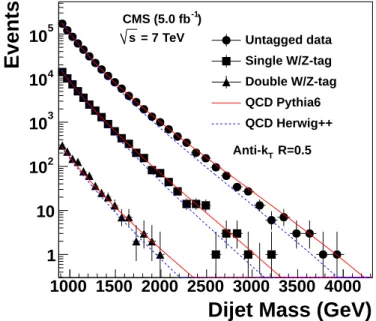
1 10 2 10 3 10 4 10 5 10 Untagged data Single W/Z-tag Double W/Z-tag QCD Pythia6 QCD Herwig++ ) -1 CMS (5.0 fb = 7 TeV s R=0.5 T Anti-kFigure 1: Comparisons of the dijet invariant mass distributions between data and Monte Carlo (PYTHIA6 andHERWIG++) simulations. The three sets of lines correspond to the inclusive dijet category (no W/Z-tag required), single W/Z-tagged, and double W/Z-tagged events. The simulations are normalized to the number of data events in each category.
Comparisons of the dijet invariant mass distributions for untagged, single-tagged, and double-tagged event samples are shown in Fig. 1. The data are shown as solid points and thePYTHIA
6 and HERWIG++ simulations are shown as solid red and dashed blue curves, respectively.
The simulations are normalized to the number of data events in each category and the shapes are compared; the agreement of the normalization driven by the W/Z-tagging efficiency is discussed in the next section. ThePYTHIA6 prediction is found to agree with the data while the
HERWIG++ prediction decreases more steeply with mass. However, no systematic uncertainties are taken into account and only the dominant background from QCD interactions is considered.
5
Signal characterization
A search for dijet resonances corresponding to several benchmark physics models is performed. Using the W/Z-tagging algorithm, both single W/Z-tag and double W/Z-tag events are ex-amined. The signals that would be produced by the benchmark physics models have different characteristics that are described below.
The pruned jet mass and mass drop distributions in data, signal, and background simulations are shown in Fig. 2. The discriminating power of the pruned jet mass and mass drop for the different signals is evident. In both the pruned jet mass and the mass drop distributions, small differences may be seen between the results obtained withHERWIG++ (WW, ZZ) andPYTHIA6 (WZ, qW, qZ), which arise from differences in the showering and hadronization models used by these generators. This effect is taken into account in the estimate of the systematic uncer-tainties on the tagging efficiency, as described below.
The acceptance, defined as the product of signal branching fraction into dijet final states B(W/Z→ jets) times angular acceptance (|η| < 2.5,|∆η| < 1.3), is shown in Fig. 3. Each model relevant
Jet Mass (GeV) 0 20 40 60 80 100 120 140 160 180 200 Events 0 20 40 60 80 100 120 140 160 180 200 220 3 10 × Untagged data QCD Pythia6 QCD Herwig++ qW (1.5 TeV) → q* qZ (1.5 TeV) → q* WZ (1.5 TeV) → W' WW (1.5 TeV) → RS G ZZ (1.5 TeV) → RS G ) -1 CMS (5.0 fb = 7 TeV s CA pruned R=0.8 Mass drop 0 0.1 0.2 0.3 0.4 0.5 0.6 0.7 0.8 0.9 1 Events 0 50 100 150 200 250 3 10 × Untagged data QCD Pythia6 QCD Herwig++ qW (1.5 TeV) → q* qZ (1.5 TeV) → q* WZ (1.5 TeV) → W' WW (1.5 TeV) → RS G ZZ (1.5 TeV) → RS G ) -1 CMS (5.0 fb = 7 TeV s CA pruned R=0.8
Figure 2: Pruned jet mass (left) and mass drop (right) in data, signal and background simu-lations. The signal simulation distributions are plotted as smooth curves connecting the his-togram entries (using the same binning as the data distribution). All simulation distributions have been scaled to match the number of data events.
Resonance Mass (GeV)
1000 1500 2000 2500 3000 acceptance × jj) → B(W/Z 0 0.1 0.2 0.3 0.4 0.5 0.6 0.7 0.8 0.9 1 CMS Simulation qW → q* qZ → q* WZ → W' WW → RS G ZZ → RS G
Figure 3: The branching fraction into dijet final states B(W/Z→jets) times angular acceptance (|η| <2.5,|∆η| <1.3). The W/Z-tagging efficiencies are excluded from the acceptance.
for the singly (doubly) tagged data analysis is shown in the dijet invariant mass range up to 2 TeV (3 TeV). The fraction of events that produce dijet events, which have survived the kine-matic selection, is between 26% and 47%. This fraction includes also the branching fraction of W/Z decaying into objects which are reconstructed as jets. The different behaviour of the ac-ceptance for W0 and GRSat low dijet masses is due to different angular distributions generated byPYTHIA6 andHERWIG++.
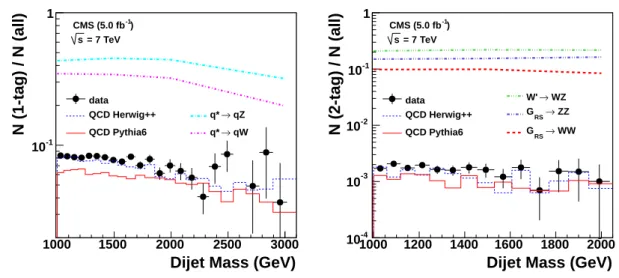
The W/Z-tagging efficiency, which is not part of the acceptance, is shown for signal and back-ground events in Fig. 4. The signal efficiency, determined from the simulation, is found to be between 20% and 45% (8% and 22%) for single (double) W/Z-tagged signals. The W-tagging efficiency is larger than the Z-tagging efficiency due to the choice of the jet mass window cut, which rejects a larger fraction of W bosons by requiring mjet > 70 GeV. The simulation
6 5 Signal characterization
Dijet Mass (GeV)
1000 1500 2000 2500 3000 N (1-tag) / N (all) -1 10 1 qZ → q* qW → q* data QCD Herwig++ QCD Pythia6 ) -1 CMS (5.0 fb = 7 TeV s
Dijet Mass (GeV)
1000 1200 1400 1600 1800 2000 N (2-tag) / N (all) -4 10 -3 10 -2 10 -1 10 1 WZ → W' ZZ → RS G WW → RS G data QCD Herwig++ QCD Pythia6 ) -1 CMS (5.0 fb = 7 TeV s
Figure 4: Efficiency of requiring 1 W/Z-tag (left) and 2 W/Z-tags (right) in signal and background simulations, and in data for events passing the angular acceptance requirement (|η| <2.5,|∆η| <1.3).
Dijet Mass (GeV)
1000 1200 1400 1600 1800 Arbitrary Scale 0 0.05 0.1 0.15 0.2 0.25 0.3 0.35 0.4 0.45 0.5
1.5 TeV resonances CMS Simulation qW → q* qZ → q* WZ → W' WW → RS G ZZ → RS G
Figure 5: The signal dijet invariant mass distributions for 1.5 TeV GRS → WW, GRS → ZZ, W0 → WZ, q∗ → qW, and q∗ → qZ resonances, computed using anti-kT jets with R = 0.5. Crystal-Ball functions fit to the simulated distributions are shown. The distributions in the plot are scaled to the same integral.
modeling of the signal efficiency is cross-checked by measuring the W/Z-tagging efficiency in semileptonic tt data and by comparing it with the same efficiency obtained using the same pro-cedure for tt simulation generated with MADGRAPH4.4.12 [49] and showered withPYTHIA6. We follow the same procedure as described in Ref. [50]. The ratio of the two efficiencies results in a scale factor of 0.98±0.03 which is then applied to the efficiencies for signals in the dijet data. The uncertainties on the scale factor are propagated into the systematic uncertainties on the overall signal efficiency.
As described above, the production and decay of the GRSis modeled withHERWIG++. A differ-ence of up to 18% on the double-tag efficiency in the RS graviton WW/ZZ signal simulations betweenPYTHIA6 andHERWIG++ is observed. The difference can be attributed in equal parts
to the different showering algorithms and the hadronization algorithms. The different under-lying event modeling has only a small impact of<1%. This discrepancy is accounted for as a systematic uncertainty on the double-tag efficiency. For the single-tag efficiency a 9% uncer-tainty is assigned based on the double-tag efficiency unceruncer-tainty of 18% assuming an identical difference in tagging efficiency for the two vector bosons in the case of 100% efficiency, repre-senting an upper limit on this uncertainty.
The effect of pileup on the W/Z-tagging efficiency was also checked. Because of the rejection of charged particles not originating from the primary vertex and the application of pruning, the pileup dependence is weak and the uncertainty of the modeling of the pileup distribution is less than 2%.
The dijet mass dependence of the W/Z-tagging efficiency for background events shown in Fig. 4 is adequately described by the simulation. Therefore, no additional systematic uncer-tainty is assigned on the dijet mass dependence of the modeling of the W/Z-tagging in simu-lation.
Figure 5 shows the signal shapes for GRS → ZZ/WW, W
0
→ WZ, and q∗ → qW/qZ, all
of which correspond to a resonance mass of 1.5 TeV. The differences for the different models are to a large extent due to the different tagging efficiencies for W and Z and to a smaller extent to differences in the models in PYTHIA 6 and HERWIG++. The lower cut of 70 GeV on the jet mass in the W/Z-tag biases the resonance peak for WW, WZ and qW towards higher masses, especially when two tags are applied on the WW sample. We have checked that this behavior is reproduced in bothPYTHIA6 andHERWIG++. The difference in resolution between the singly tagged and doubly tagged resonance shapes is also due to this bias of the extra W/Z-tag requirement. Resonance shapes were simulated at masses of 1, 1.5, 2 and 3 TeV and a linear interpolation was used to obtain the shapes at intermediate masses.
Dijet Mass (GeV)
1000 1500 2000 2500 3000 /dm (pb/GeV) σ d -7 10 -6 10 -5 10 -4 10 -3 10 -2 10 -1 10
1 Single W/Z-tag data
Fit qW → q* ) -1 CMS (5.0 fb = 7 TeV s | < 1.3 η ∆ | < 2.5, | η | R=0.5 T Anti-k qW (2 TeV) → q*
Dijet Mass (GeV)
1000 1500 2000 2500 3000 Data σ Data-Fit -2 0 2
Dijet Mass (GeV)
1000 1200 1400 1600 1800 2000 /dm (pb/GeV) σ d -6 10 -5 10 -4 10 -3 10 -2
10 Double W/Z-tag data
Fit WW → RS G ) -1 CMS (5.0 fb = 7 TeV s | < 1.3 η ∆ | < 2.5, | η | R=0.5 T Anti-k WW (1.5 TeV) → RS G
Dijet Mass (GeV)
1000 1200 1400 1600 1800 2000 Data σ Data-Fit -2 0 2
Figure 6: The single (left) and double (right) W/Z-tagged mjj distributions (points) in data fitted with the QCD background parametrization (solid curve). For the double W/Z-tagged distribution P3 = 0 is assumed in Eq. (1). Signal shape distributions for q∗ →qW and GRS → WW with arbitrary cross sections are also shown. The bottom panes show the corresponding pull distributions (Dataσ −Fit
Data ). There are no data events with dijet masses larger than the range of
8 8 Limit setting procedure
6
Background shape parametrization
The shape of the QCD background in the dijet spectrum is modeled using a simple parametriza-tion which has been successfully deployed in previous searches [51]. The background model is given by: dσ dm = P0(1−m/ √ s)P1 (m/√s)P2+P3ln(m/ √ s) , (1)
where m denotes the dijet mass and√s the pp center of mass energy. P0acts as a normalization parameter for the probability density function, and P1, P2, P3describe its shape. For the single W/Z-tagged analysis, all parameters are free to float in the fit. For the double W/Z-tagged analysis, P3 is not needed as suggested by a Fisher F-test [52] and a simpler parametrization with P3fixed to 0 is used.
Figure 6 shows the dijet mass spectra from single and double W/Z-tagged data fitted to Eq. (1) and the corresponding pull distributions, demonstrating the agreement between the background-only probability density function and the data.
Since no sizeable deviation from the background-only hypothesis is seen, exclusion limits are set on the product of cross section, acceptance, and branching fraction for the five considered final states: qW, qZ, WW, WZ, and ZZ.
7
Systematic uncertainties
The sources of systematic uncertainties are summarized as follows. The only background-related systematic uncertainty is the choice of background parametrization which is discussed in Section 8. The leading signal-related systematic uncertainties are the W/Z-tagging efficiency (Section 5), jet energy scale (JES), jet energy resolution (JER), and luminosity measurement. Because the trigger and reconstruction efficiencies are larger than 99% in the relevant dijet mass range, the uncertainties associated with these efficiencies are negligible.
In the jet pT- and η-regions considered in this analysis, the JES has an uncertainty of 2-3% [43]. The pT- and η-dependent uncertainty is propagated to an uncertainty on the reconstructed dijet invariant mass of 2.2%, which is approximately mass independent. The effect of the JES uncertainty on the calculation of the limits is estimated by varying the resonance dijet mass in the statistical analysis. The JER is known to a precision of 10% and its tails are in agreement between data and simulation [43]. The effect of the JER uncertainty on the calculation of the limits is estimated by varying the reconstructed resonance width in the statistical analysis. The luminosity has an uncertainty of 2.2% [53], which is also taken into account in the statistical analysis.
8
Limit setting procedure
For setting upper limits on the resonance production cross section a Bayesian formalism with uniform prior for the cross section is used, following the procedure used in Ref. [51]. The binned likelihood, L, can be written as:
L=
∏
i µniie−µi ni! , (2) where µi =αNi(S) +Ni(B), (3)ni is the observed number of events in the ith dijet mass bin, Ni(S)is the expected number of events from the signal in the ith dijet mass bin, α scales the signal amplitude, and Ni(B)is the expected number of events from background in the ith dijet mass bin. The background Ni(B) is estimated as the background component of the best 5(4)-parameter fit of equation 3 to the singly (doubly) tagged data points. The signal is not restricted to be positive for the background estimate fit although it is restricted in the Bayesian prior for the signal. A flat prior in α, which is the same as a flat prior in the resonance production cross section, is assumed.
The dominant sources of systematic uncertainty (the jet energy scale, the jet energy resolution, the integrated luminosity, and the W/Z-tagging efficiency) are considered as nuisance param-eters associated to log-normal priors. The uncertainty on the background shape is taken into account with nuisance parameters associated to Gaussian priors representing variations of the fit parameters along the eigenvectors of their correlation matrix. The systematic uncertainties are accounted for using a fully Bayesian treatment and integrating the likelihood over nuisance parameters.
The 95% confidence level (CL) upper limit σSis calculated from the normalized posterior prob-ability density Ppostas follows:
Z σS
0 Ppost
(σ)dσ=0.95 . (4)
This method of using the data first to constrain the background fit and second to extract the limit induces a bias in the coverage of the limits. The actual coverage is reduced to 93.6% (94.3%) at a WW (qW) signal mass of 1200 GeV (1800 GeV).
9
Results
Figure 7 shows the 95% CL cross section upper limits derived from the single and double W/Z-tagged event samples. The predicted cross sections as a function of resonance mass for the considered benchmark models are overlaid. A 95% CL lower limit is set on the mass of ex-cited quark resonances decaying into qW (qZ) at 2.38 TeV (2.15 TeV), whereas a limit of 2.43 TeV (2.07 TeV) is expected. These are the most stringent limits in the qW and qZ final states to date. The sensitivity of our measurement with the present dataset is not sufficient to extract substan-tive mass limits on the GRS with k/MPl = 0.1 nor the heavy SM-like W
0
boson, but the cross section limits are the most stringent in the fully hadronic final state to date. Comparing to the cross section limits on GRSdecays to ZZ in the corresponding semileptonic final states [20–22], this analysis sets a stronger cross section limit above a GRS mass of roughly 1.4 TeV. The cross section limits on final states with ZZ are stronger than those with WW because the efficiency for tagging a Z is larger than that for a W. The predicted cross section for WW is twice as large as for ZZ in the GRSmodel because of charge-conjugation.
The dominant source of systematic uncertainty is the jet energy scale. Removing all systematic uncertainties on the single and double tagged searches would decrease the upper limit on the cross section by less than 20% at all values of resonance mass, which would translate into a change on resonances mass limits of roughly 3%.
10
Summary
A data sample corresponding to an integrated luminosity of 5.0 fb−1collected in pp collisions at √
10 10 Summary
qW Resonance Mass (GeV)
1000 1500 2000 2500 3000 A ( p b ) × B × σ -3 10 -2 10 -1 10 1 -1) CMS (5.0 fb = 7 TeV s
Observed 95% CL Upper Limit Expected 95% CL Upper Limit
σ 1 ± Expected Limit σ 2 ± Expected Limit qW → q*
qZ Resonance Mass (GeV)
1000 1500 2000 2500 3000 A ( p b ) × B × σ -3 10 -2 10 -1 10 1 -1) CMS (5.0 fb = 7 TeV s
Observed 95% CL Upper Limit Expected 95% CL Upper Limit
σ 1 ± Expected Limit σ 2 ± Expected Limit qZ → q*
WW Resonance Mass (GeV)
1000 1200 1400 1600 1800 2000 A ( p b ) × B × σ -3 10 -2 10 -1 10 ) -1 CMS (5.0 fb = 7 TeV s
Observed 95% CL Upper Limit Expected 95% CL Upper Limit
σ 1 ± Expected Limit σ 2 ± Expected Limit = 0.1) PL M WW (k/ → RS G
ZZ Resonance Mass (GeV)
1000 1200 1400 1600 1800 2000 A ( p b ) × B × σ -3 10 -2 10 -1 10 ) -1 CMS (5.0 fb = 7 TeV s
Observed 95% CL Upper Limit Expected 95% CL Upper Limit
σ 1 ± Expected Limit σ 2 ± Expected Limit = 0.1) PL M ZZ (k/ → RS G
WZ Resonance Mass (GeV)
1000 1200 1400 1600 1800 2000 A ( p b ) × B × σ -3 10 -2 10 -1 10 -1) CMS (5.0 fb = 7 TeV s
Observed 95% CL Upper Limit Expected 95% CL Upper Limit
σ 1 ± Expected Limit σ 2 ± Expected Limit WZ → W'
Figure 7: Expected and observed limits for qW (top-left), qZ (top-right), WW (center-left), ZZ (center-right) and WZ (bottom) resonances. Here, B × A in the vertical axis label contains the branching fraction of GRS → WW/ZZ → 2 jets or q∗ → qW/qZ → 2 jets, as well as the acceptance for reconstructing the jets in|η| <2.5,|∆η| <1.3. The predicted cross sections as a
using the two leading jets within the pseudorapidity range|η| <2.5 and with pseudorapidity
separation|∆η| < 1.3. By suppressing the QCD background with the selection of candidates for vector bosons decaying to hadrons within jets, no evidence was found for new particle production in the W/Z-tagged dijet spectrum. A 95% CL lower limit is set on the mass of excited quark resonances decaying into qW (qZ) at 2.38 TeV (2.15 TeV) and upper limits on the cross section for resonances decaying to qW, qZ, WW, WZ, or ZZ final states. These are the most stringent limits in the qW and qZ final states to date.
Acknowledgements
We congratulate our colleagues in the CERN accelerator departments for the excellent perfor-mance of the LHC and thank the technical and administrative staffs at CERN and at other CMS institutes for their contributions to the success of the CMS effort. In addition, we gratefully ac-knowledge the computing centres and personnel of the Worldwide LHC Computing Grid for delivering so effectively the computing infrastructure essential to our analyses. Finally, we ac-knowledge the enduring support for the construction and operation of the LHC and the CMS detector provided by the following funding agencies: BMWF and FWF (Austria); FNRS and FWO (Belgium); CNPq, CAPES, FAPERJ, and FAPESP (Brazil); MEYS (Bulgaria); CERN; CAS, MoST, and NSFC (China); COLCIENCIAS (Colombia); MSES (Croatia); RPF (Cyprus); MoER, SF0690030s09 and ERDF (Estonia); Academy of Finland, MEC, and HIP (Finland); CEA and CNRS/IN2P3 (France); BMBF, DFG, and HGF (Germany); GSRT (Greece); OTKA and NKTH (Hungary); DAE and DST (India); IPM (Iran); SFI (Ireland); INFN (Italy); NRF and WCU (Re-public of Korea); LAS (Lithuania); CINVESTAV, CONACYT, SEP, and UASLP-FAI (Mexico); MSI (New Zealand); PAEC (Pakistan); MSHE and NSC (Poland); FCT (Portugal); JINR (Arme-nia, Belarus, Georgia, Ukraine, Uzbekistan); MON, RosAtom, RAS and RFBR (Russia); MSTD (Serbia); SEIDI and CPAN (Spain); Swiss Funding Agencies (Switzerland); NSC (Taipei); ThEP-Center, IPST and NSTDA (Thailand); TUBITAK and TAEK (Turkey); NASU (Ukraine); STFC (United Kingdom); DOE and NSF (USA).
References
[1] L. A. Anchordoqui et al., “Jet signals for low mass strings at the Large Hadron Collider”, Phys. Rev. Lett. 100 (2008) 171603, doi:10.1103/Physrevlett.100.171603,
arXiv:0712.0386.
[2] S. Cullen, M. Perelstein, and M. E. Peskin, “TeV strings and collider probes of large extra dimensions”, Phys. Rev. D 62 (2000) 055012, doi:10.1103/PhysRevD.62.055012,
arXiv:hep-ph/0001166.
[3] J. L. Hewett and T. G. Rizzo, “Low-energy phenomenology of superstring-inspired E6 models”, Phys. Rept. 183 (1989) 193, doi:10.1016/0370-1573(89)90071-9. [4] U. Baur, I. Hinchliffe, and D. Zeppenfeld, “Excited Quark Production at Hadron
Colliders”, Int. J. Mod. Phys. A 2 (1987) 1285, doi:10.1142/S0217751X87000661. [5] U. Baur, M. Spira, and P. M. Zerwas, “Excited Quark and Lepton Production at Hadron
Colliders”, Phys. Rev. D 42 (1990) 815, doi:10.1103/PhysRevD.42.815.
[6] P. H. Frampton and S. L. Glashow, “Chiral color: An alternative to the standard model”, Phys. Lett. B 190 (1987) 157, doi:10.1016/0370-2693(87)90859-8.
12 References
[7] E. H. Simmons, “Coloron phenomenology”, Phys. Rev. D 55 (1997) 1678, doi:10.1103/PhysRevD.55.1678, arXiv:hep-ph/9608269. [8] E. Eichten et al., “Supercollider physics”, Rev. Mod. Phys. 56 (1984) 579,
doi:10.1103/RevModPhys.56.579.
[9] L. Randall and R. Sundrum, “An alternative to compactification”, Phys. Rev. Lett. 83 (1999) 4690, doi:10.1103/PhysRevLett.83.4690.
[10] CMS Collaboration, “Search for narrow resonances and quantum black holes in inclusive and b-tagged dijet mass spectra from pp collisions at√s = 7 TeV”, (2012).
arXiv:1210.2387. Submitted to JHEP.
[11] ATLAS Collaboration, “ATLAS search for new phenomena in dijet mass and angular distributions using pp collisions at√s = 7 TeV”, (2012). arXiv:1210.1718. Submitted to JHEP.
[12] CMS Collaboration, “A Cambridge-Aachen (C-A) based Jet Algorithm for boosted top-jet tagging”, CMS Physics Analysis Summary CMS-PAS-JME-09-001, (2009).
[13] L. Randall and R. Sundrum, “A large mass hierarchy from a small extra dimension”, Phys. Rev. Lett. 83 (1999) 3370, doi:10.1103/PhysRevLett.83.3370,
arXiv:hep-ph/9905221.
[14] CDF Collaboration, “Search for excited quarks in p ¯p collisions at√s = 1.8 TeV”, Phys. Rev. Lett. 72 (1994) 3004, doi:10.1103/PhysRevLett.72.3004.
[15] D0 Collaboration, “Search for a heavy resonance decaying into a Z+ jet final state in p ¯p collisions at√s = 1.96 TeV using the D0 detector”, Phys. Rev. D 74 (2006) 011104, doi:10.1103/PhysRevD.74.011104, arXiv:hep-ex/0606018.
[16] CMS Collaboration, “Search for anomalous production of highly boosted Z bosons decaying to dimuons in pp collisions at√s = 7 TeV”, (2012). arXiv:1210.0867. Submitted to Phys. Lett. B.
[17] K. Agashe et al., “Warped Gravitons at the LHC and Beyond”, Phys. Rev. D 76 (2007) 036006, doi:10.1103/PhysRevD.76.036006, arXiv:hep-ph/0701186.
[18] O. Antipin, D. Atwood, and A. Soni, “Search for RS gravitons via WLWLdecays”, Phys. Lett. B 666 (2008) 155, doi:10.1016/j.physletb.2008.07.009,
arXiv:0711.3175.
[19] O. Antipin and A. Soni, “Towards establishing the spin of warped gravitons”, JHEP 10 (2008) 018, doi:10.1088/1126-6708/2008/10/018, arXiv:0806.3427.
[20] CMS Collaboration, “Search for a narrow spin-2 resonance decaying to a pair of Z vector bosons in the semileptonic final state”, (2012). arXiv:1209.3807. Submitted to Phys. Lett. B.
[21] ATLAS Collaboration, “Search for new particles decaying to ZZ using final states with leptons and jets with the ATLAS detector in√s = 7 TeV proton-proton collisions”, Phys. Lett. B 712 (2012) 331, doi:10.1016/j.physletb.2012.05.020,
[22] CDF Collaboration, “Search for high-mass resonances decaying into ZZ in p ¯p collisions at√s = 1.96 TeV”, Phys. Rev. D 85 (2012) 012008,
doi:10.1103/PhysRevD.85.012008, arXiv:1111.3432.
[23] CMS Collaboration, “Search for leptonic decays of W√ 0 bosons in pp collisions at
s =7 TeV”, JHEP 08 (2012) 023, doi:10.1007/JHEP08(2012)023.
[24] ATLAS Collaboration, “Search for a heavy gauge boson decaying to a charged lepton and a neutrino in 1 fb−1of pp collisions at√s = 7 TeV using the ATLAS detector”, Phys. Lett. B 705 (2011) 28, doi:10.1016/j.physletb.2011.09.093, arXiv:1108.1316. [25] CMS Collaboration, “Search for a W√ 0 or ρTCdecaying to WZ in pp collisions at
s =7 TeV”, Phys. Rev. Lett. 109 (2012) 141801, doi:10.1103/PhysRevLett.109.141801.
[26] ATLAS Collaboration, “Search for resonant WZ production in the WZ to l nu l’ l’ channel in√s = 7 TeV pp collisions with the ATLAS detector”, Phys. Rev. D 85 (2012) 112012, doi:10.1103/PhysRevD.85.112012, arXiv:1204.1648.
[27] CMS Collaboration, “The CMS experiment at the CERN LHC”, JINST 03 (2008) S08004,
doi:10.1088/1748-0221/3/08/S08004.
[28] CMS Collaboration, “Particle–Flow Event Reconstruction in CMS and Performance for Jets, Taus, and Emiss
T ”, CMS Physics Analysis Summary CMS-PAS-PFT-09-001, (2009).
[29] T. Sj ¨ostrand, S. Mrenna, and P. Skands, “PYTHIA 6.4 physics and manual”, JHEP 05 (2006) 026, doi:10.1088/1126-6708/2006/05/026, arXiv:hep-ph/0603175. [30] M. B¨ahr et al., “Herwig++ physics and manual”, Eur. Phys. J. C 58 (2008) 639,
doi:10.1140/epjc/s10052-008-0798-9, arXiv:0803.0883.
[31] J. Pumplin et al., “New generation of parton distributions with uncertainties from global QCD analysis”, JHEP 07 (2002) 012, doi:10.1088/1126-6708/2002/07/012, arXiv:hep-ph/0201195.
[32] A. D. Martin et al., “MRST2001: partons and alpha S from precise deep inelastic scattering and Tevatron jet data”, Eur. Phys. J. C 23 (2002) 73,
doi:10.1007/s100520100842, arXiv:hep-ph/0110215.
[33] R. Field, “Early LHC Underlying Event Data – Findings and Surprises”, in Proceeedings of the Hadron Collider Physics Symposium 2010. 2010. arXiv:1010.3558.
[34] CMS Collaboration, “Search for Randall-Sundrum Graviton Excitations in the CMS Experiment”, (2002). arXiv:hep-ex/0207061.
[35] GEANT4 Collaboration, “GEANT4—a simulation toolkit”, Nucl. Instrum. Meth. A 506 (2003) 250, doi:10.1016/S0168-9002(03)01368-8.
[36] M. Cacciari, G. P. Salam, and G. Soyez, “The anti-ktjet clustering algorithm”, JHEP 04 (2008) 063, doi:10.1088/1126-6708/2008/04/063, arXiv:0802.1189. [37] M. Wobisch and T. Wengler, “Hadronization corrections to jet cross sections in
deep-inelastic scattering”, (1998). arXiv:hep-ph/9907280.
[38] Y. L. Dokshitzer et al., “Better jet clustering algorithms”, JHEP 08 (1997) 001,
14 References
[39] M. Cacciari and G. P. Salam, “Dispelling the N3myth for the ktjet-finder”, Phys. Lett. B
641(2006) 57, doi:10.1016/j.physletb.2006.08.037,
arXiv:hep-ph/0512210.
[40] M. Cacciari, G. P. Salam, and G. Soyez, “FastJet User Manual”, Eur. Phys. J. C 72 (2012) 1896, doi:10.1140/epjc/s10052-012-1896-2, arXiv:1111.6097.
[41] M. Cacciari, G. P. Salam, and G. Soyez, “The Catchment Area of Jets”, JHEP 04 (2008) 005, doi:10.1088/1126-6708/2008/04/005, arXiv:0802.1188.
[42] M. Cacciari and G. P. Salam, “Pileup subtraction using jet areas”, Phys. Lett. B 659 (2008) 119, doi:10.1016/j.physletb.2007.09.077, arXiv:0707.1378.
[43] CMS Collaboration, “Determination of jet energy calibration and transverse momentum resolution in CMS”, JINST 6 (2011) P11002,
doi:10.1088/1748-0221/6/11/P11002.
[44] CMS Collaboration, “Search for resonances in the dijet mass spectrum from 7 TeV pp collisions at CMS”, Phys. Lett. B 704 (2011) 123,
doi:10.1016/j.physletb.2011.09.015.
[45] CMS Collaboration, “Study of Jet Substructure in pp Collisions at 7 TeV in CMS”, CMS Physics Analysis Summary CMS-PAS-JME-10-013, (2010).
[46] S. D. Ellis, C. K. Vermilion, and J. R. Walsh, “Techniques for improved heavy particle searches with jet substructure”, Phys. Rev. D 80 (2009) 051501,
doi:10.1103/PhysRevD.80.051501, arXiv:0903.5081.
[47] S. D. Ellis, C. K. Vermilion, and J. R. Walsh, “Recombination Algorithms and Jet Substructure: Pruning as a Tool for Heavy Particle Searches”, Phys. Rev. D 81 (2010) 094023, doi:10.1103/PhysRevD.81.094023, arXiv:0912.0033.
[48] J. M. Butterworth et al., “Jet substructure as a new Higgs search channel at the LHC”, Phys. Rev. Lett. 100 (2008) 242001, doi:10.1103/PhysRevLett.100.242001, arXiv:0802.2470.
[49] J. Alwall et al., “MadGraph/MadEvent v4: the new web generation”, JHEP 09 (2007) 028, doi:10.1088/1126-6708/2007/09/028, arXiv:0706.2334.
[50] CMS Collaboration, “Search for anomalous t¯t production in the highly-boosted all-hadronic final state”, JHEP 09 (2012) 029, doi:10.1007/JHEP09(2012)029,
arXiv:1204.2488.
[51] CMS Collaboration, “Search for resonances in the dijet mass spectrum from 7 TeV pp collisions at CMS”, Phys. Lett. B 704 (2011) 123,
doi:10.1016/j.physletb.2011.09.015, arXiv:1107.4771.
[52] R. G. Lomax and D. L. Hahs-Vaughn, “Statistical Concepts: A Second Course”. p.10, Routledge Academic, 2007.
[53] CMS Collaboration, “Absolute Calibration of the Luminosity Measurement at CMS: Winter 2012 Update”, CMS Physics Analysis Summary CMS-PAS-SMP-12-008, (2012).
A
The CMS Collaboration
Yerevan Physics Institute, Yerevan, Armenia
S. Chatrchyan, V. Khachatryan, A.M. Sirunyan, A. Tumasyan
Institut f ¨ur Hochenergiephysik der OeAW, Wien, Austria
W. Adam, E. Aguilo, T. Bergauer, M. Dragicevic, J. Er ¨o, C. Fabjan1, M. Friedl, R. Fr ¨uhwirth1, V.M. Ghete, J. Hammer, N. H ¨ormann, J. Hrubec, M. Jeitler1, W. Kiesenhofer, V. Kn ¨unz, M. Krammer1, I. Kr¨atschmer, D. Liko, I. Mikulec, M. Pernicka†, B. Rahbaran, C. Rohringer, H. Rohringer, R. Sch ¨ofbeck, J. Strauss, A. Taurok, W. Waltenberger, G. Walzel, E. Widl, C.-E. Wulz1
National Centre for Particle and High Energy Physics, Minsk, Belarus
V. Mossolov, N. Shumeiko, J. Suarez Gonzalez
Universiteit Antwerpen, Antwerpen, Belgium
M. Bansal, S. Bansal, T. Cornelis, E.A. De Wolf, X. Janssen, S. Luyckx, L. Mucibello, S. Ochesanu, B. Roland, R. Rougny, M. Selvaggi, Z. Staykova, H. Van Haevermaet, P. Van Mechelen, N. Van Remortel, A. Van Spilbeeck
Vrije Universiteit Brussel, Brussel, Belgium
F. Blekman, S. Blyweert, J. D’Hondt, R. Gonzalez Suarez, A. Kalogeropoulos, M. Maes, A. Olbrechts, W. Van Doninck, P. Van Mulders, G.P. Van Onsem, I. Villella
Universit´e Libre de Bruxelles, Bruxelles, Belgium
B. Clerbaux, G. De Lentdecker, V. Dero, A.P.R. Gay, T. Hreus, A. L´eonard, P.E. Marage, A. Mohammadi, T. Reis, L. Thomas, G. Vander Marcken, C. Vander Velde, P. Vanlaer, J. Wang
Ghent University, Ghent, Belgium
V. Adler, K. Beernaert, A. Cimmino, S. Costantini, G. Garcia, M. Grunewald, B. Klein, J. Lellouch, A. Marinov, J. Mccartin, A.A. Ocampo Rios, D. Ryckbosch, N. Strobbe, F. Thyssen, M. Tytgat, P. Verwilligen, S. Walsh, E. Yazgan, N. Zaganidis
Universit´e Catholique de Louvain, Louvain-la-Neuve, Belgium
S. Basegmez, G. Bruno, R. Castello, L. Ceard, C. Delaere, T. du Pree, D. Favart, L. Forthomme, A. Giammanco2, J. Hollar, V. Lemaitre, J. Liao, O. Militaru, C. Nuttens, D. Pagano, A. Pin, K. Piotrzkowski, N. Schul, J.M. Vizan Garcia
Universit´e de Mons, Mons, Belgium
N. Beliy, T. Caebergs, E. Daubie, G.H. Hammad
Centro Brasileiro de Pesquisas Fisicas, Rio de Janeiro, Brazil
G.A. Alves, M. Correa Martins Junior, T. Martins, M.E. Pol, M.H.G. Souza
Universidade do Estado do Rio de Janeiro, Rio de Janeiro, Brazil
W.L. Ald´a J ´unior, W. Carvalho, A. Cust ´odio, E.M. Da Costa, D. De Jesus Damiao, C. De Oliveira Martins, S. Fonseca De Souza, D. Matos Figueiredo, L. Mundim, H. Nogima, V. Oguri, W.L. Prado Da Silva, A. Santoro, L. Soares Jorge, A. Sznajder
Universidade Estadual Paulistaa, Universidade Federal do ABCb, Sao Paulo, Brazil
T.S. Anjosb, C.A. Bernardesb, F.A. Diasa,3, T.R. Fernandez Perez Tomeia, E.M. Gregoresb, C. Laganaa, F. Marinhoa, P.G. Mercadanteb, S.F. Novaesa, Sandra S. Padulaa
Institute for Nuclear Research and Nuclear Energy, Sofia, Bulgaria
V. Genchev4, P. Iaydjiev4, S. Piperov, M. Rodozov, S. Stoykova, G. Sultanov, V. Tcholakov, R. Trayanov, M. Vutova
16 A The CMS Collaboration
University of Sofia, Sofia, Bulgaria
A. Dimitrov, R. Hadjiiska, V. Kozhuharov, L. Litov, B. Pavlov, P. Petkov
Institute of High Energy Physics, Beijing, China
J.G. Bian, G.M. Chen, H.S. Chen, C.H. Jiang, D. Liang, S. Liang, X. Meng, J. Tao, J. Wang, X. Wang, Z. Wang, H. Xiao, M. Xu, J. Zang, Z. Zhang
State Key Lab. of Nucl. Phys. and Tech., Peking University, Beijing, China
C. Asawatangtrakuldee, Y. Ban, Y. Guo, W. Li, S. Liu, Y. Mao, S.J. Qian, H. Teng, D. Wang, L. Zhang, W. Zou
Universidad de Los Andes, Bogota, Colombia
C. Avila, J.P. Gomez, B. Gomez Moreno, A.F. Osorio Oliveros, J.C. Sanabria
Technical University of Split, Split, Croatia
N. Godinovic, D. Lelas, R. Plestina5, D. Polic, I. Puljak4
University of Split, Split, Croatia
Z. Antunovic, M. Kovac
Institute Rudjer Boskovic, Zagreb, Croatia
V. Brigljevic, S. Duric, K. Kadija, J. Luetic, S. Morovic
University of Cyprus, Nicosia, Cyprus
A. Attikis, M. Galanti, G. Mavromanolakis, J. Mousa, C. Nicolaou, F. Ptochos, P.A. Razis
Charles University, Prague, Czech Republic
M. Finger, M. Finger Jr.
Academy of Scientific Research and Technology of the Arab Republic of Egypt, Egyptian Network of High Energy Physics, Cairo, Egypt
Y. Assran6, S. Elgammal7, A. Ellithi Kamel8, M.A. Mahmoud9, A. Radi10,11
National Institute of Chemical Physics and Biophysics, Tallinn, Estonia
M. Kadastik, M. M ¨untel, M. Raidal, L. Rebane, A. Tiko
Department of Physics, University of Helsinki, Helsinki, Finland
P. Eerola, G. Fedi, M. Voutilainen
Helsinki Institute of Physics, Helsinki, Finland
J. H¨ark ¨onen, A. Heikkinen, V. Karim¨aki, R. Kinnunen, M.J. Kortelainen, T. Lamp´en, K. Lassila-Perini, S. Lehti, T. Lind´en, P. Luukka, T. M¨aenp¨a¨a, T. Peltola, E. Tuominen, J. Tuominiemi, E. Tuovinen, D. Ungaro, L. Wendland
Lappeenranta University of Technology, Lappeenranta, Finland
K. Banzuzi, A. Karjalainen, A. Korpela, T. Tuuva
DSM/IRFU, CEA/Saclay, Gif-sur-Yvette, France
M. Besancon, S. Choudhury, M. Dejardin, D. Denegri, B. Fabbro, J.L. Faure, F. Ferri, S. Ganjour, A. Givernaud, P. Gras, G. Hamel de Monchenault, P. Jarry, E. Locci, J. Malcles, L. Millischer, A. Nayak, J. Rander, A. Rosowsky, I. Shreyber, M. Titov
Laboratoire Leprince-Ringuet, Ecole Polytechnique, IN2P3-CNRS, Palaiseau, France
S. Baffioni, F. Beaudette, L. Benhabib, L. Bianchini, M. Bluj12, C. Broutin, P. Busson, C. Charlot, N. Daci, T. Dahms, M. Dalchenko, L. Dobrzynski, R. Granier de Cassagnac, M. Haguenauer, P. Min´e, C. Mironov, I.N. Naranjo, M. Nguyen, C. Ochando, P. Paganini, D. Sabes, R. Salerno, Y. Sirois, C. Veelken, A. Zabi
Institut Pluridisciplinaire Hubert Curien, Universit´e de Strasbourg, Universit´e de Haute Alsace Mulhouse, CNRS/IN2P3, Strasbourg, France
J.-L. Agram13, J. Andrea, D. Bloch, D. Bodin, J.-M. Brom, M. Cardaci, E.C. Chabert, C. Collard, E. Conte13, F. Drouhin13, C. Ferro, J.-C. Fontaine13, D. Gel´e, U. Goerlach, P. Juillot, A.-C. Le Bihan, P. Van Hove
Centre de Calcul de l’Institut National de Physique Nucleaire et de Physique des Particules, CNRS/IN2P3, Villeurbanne, France
F. Fassi, D. Mercier
Universit´e de Lyon, Universit´e Claude Bernard Lyon 1, CNRS-IN2P3, Institut de Physique Nucl´eaire de Lyon, Villeurbanne, France
S. Beauceron, N. Beaupere, O. Bondu, G. Boudoul, J. Chasserat, R. Chierici4, D. Contardo, P. Depasse, H. El Mamouni, J. Fay, S. Gascon, M. Gouzevitch, B. Ille, T. Kurca, M. Lethuillier, L. Mirabito, S. Perries, L. Sgandurra, V. Sordini, Y. Tschudi, P. Verdier, S. Viret
Institute of High Energy Physics and Informatization, Tbilisi State University, Tbilisi, Georgia
Z. Tsamalaidze14
RWTH Aachen University, I. Physikalisches Institut, Aachen, Germany
G. Anagnostou, C. Autermann, S. Beranek, M. Edelhoff, L. Feld, N. Heracleous, O. Hindrichs, R. Jussen, K. Klein, J. Merz, A. Ostapchuk, A. Perieanu, F. Raupach, J. Sammet, S. Schael, D. Sprenger, H. Weber, B. Wittmer, V. Zhukov15
RWTH Aachen University, III. Physikalisches Institut A, Aachen, Germany
M. Ata, J. Caudron, E. Dietz-Laursonn, D. Duchardt, M. Erdmann, R. Fischer, A. G ¨uth, T. Hebbeker, C. Heidemann, K. Hoepfner, D. Klingebiel, P. Kreuzer, M. Merschmeyer, A. Meyer, M. Olschewski, P. Papacz, H. Pieta, H. Reithler, S.A. Schmitz, L. Sonnenschein, J. Steggemann, D. Teyssier, M. Weber
RWTH Aachen University, III. Physikalisches Institut B, Aachen, Germany
M. Bontenackels, V. Cherepanov, Y. Erdogan, G. Fl ¨ugge, H. Geenen, M. Geisler, W. Haj Ahmad, F. Hoehle, B. Kargoll, T. Kress, Y. Kuessel, J. Lingemann4, A. Nowack, L. Perchalla, O. Pooth, P. Sauerland, A. Stahl
Deutsches Elektronen-Synchrotron, Hamburg, Germany
M. Aldaya Martin, J. Behr, W. Behrenhoff, U. Behrens, M. Bergholz16, A. Bethani, K. Borras, A. Burgmeier, A. Cakir, L. Calligaris, A. Campbell, E. Castro, F. Costanza, D. Dammann, C. Diez Pardos, G. Eckerlin, D. Eckstein, G. Flucke, A. Geiser, I. Glushkov, P. Gunnellini, S. Habib, J. Hauk, G. Hellwig, H. Jung, M. Kasemann, P. Katsas, C. Kleinwort, H. Kluge, A. Knutsson, M. Kr¨amer, D. Kr ¨ucker, E. Kuznetsova, W. Lange, W. Lohmann16, B. Lutz, R. Mankel, I. Marfin, M. Marienfeld, I.-A. Melzer-Pellmann, A.B. Meyer, J. Mnich, A. Mussgiller, S. Naumann-Emme, O. Novgorodova, J. Olzem, H. Perrey, A. Petrukhin, D. Pitzl, A. Raspereza, P.M. Ribeiro Cipriano, C. Riedl, E. Ron, M. Rosin, J. Salfeld-Nebgen, R. Schmidt16, T. Schoerner-Sadenius, N. Sen, A. Spiridonov, M. Stein, R. Walsh, C. Wissing
University of Hamburg, Hamburg, Germany
V. Blobel, J. Draeger, H. Enderle, J. Erfle, U. Gebbert, M. G ¨orner, T. Hermanns, R.S. H ¨oing, K. Kaschube, G. Kaussen, H. Kirschenmann, R. Klanner, J. Lange, B. Mura, F. Nowak, T. Peiffer, N. Pietsch, D. Rathjens, C. Sander, H. Schettler, P. Schleper, E. Schlieckau, A. Schmidt, M. Schr ¨oder, T. Schum, M. Seidel, J. Sibille17, V. Sola, H. Stadie, G. Steinbr ¨uck, J. Thomsen, L. Vanelderen
18 A The CMS Collaboration
Institut f ¨ur Experimentelle Kernphysik, Karlsruhe, Germany
C. Barth, J. Berger, C. B ¨oser, T. Chwalek, W. De Boer, A. Descroix, A. Dierlamm, M. Feindt, M. Guthoff4, C. Hackstein, F. Hartmann, T. Hauth4, M. Heinrich, H. Held, K.H. Hoffmann, U. Husemann, I. Katkov15, J.R. Komaragiri, P. Lobelle Pardo, D. Martschei, S. Mueller, Th. M ¨uller, M. Niegel, A. N ¨urnberg, O. Oberst, A. Oehler, J. Ott, G. Quast, K. Rabbertz, F. Ratnikov, N. Ratnikova, S. R ¨ocker, F.-P. Schilling, G. Schott, H.J. Simonis, F.M. Stober, D. Troendle, R. Ulrich, J. Wagner-Kuhr, S. Wayand, T. Weiler, M. Zeise
Institute of Nuclear Physics ”Demokritos”, Aghia Paraskevi, Greece
G. Daskalakis, T. Geralis, S. Kesisoglou, A. Kyriakis, D. Loukas, I. Manolakos, A. Markou, C. Markou, C. Mavrommatis, E. Ntomari
University of Athens, Athens, Greece
L. Gouskos, T.J. Mertzimekis, A. Panagiotou, N. Saoulidou
University of Io´annina, Io´annina, Greece
I. Evangelou, C. Foudas, P. Kokkas, N. Manthos, I. Papadopoulos, V. Patras
KFKI Research Institute for Particle and Nuclear Physics, Budapest, Hungary
G. Bencze, C. Hajdu, P. Hidas, D. Horvath18, F. Sikler, V. Veszpremi, G. Vesztergombi19 Institute of Nuclear Research ATOMKI, Debrecen, Hungary
N. Beni, S. Czellar, J. Molnar, J. Palinkas, Z. Szillasi
University of Debrecen, Debrecen, Hungary
J. Karancsi, P. Raics, Z.L. Trocsanyi, B. Ujvari
Panjab University, Chandigarh, India
S.B. Beri, V. Bhatnagar, N. Dhingra, R. Gupta, M. Kaur, M.Z. Mehta, N. Nishu, L.K. Saini, A. Sharma, J.B. Singh
University of Delhi, Delhi, India
Ashok Kumar, Arun Kumar, S. Ahuja, A. Bhardwaj, B.C. Choudhary, S. Malhotra, M. Naimuddin, K. Ranjan, V. Sharma, R.K. Shivpuri
Saha Institute of Nuclear Physics, Kolkata, India
S. Banerjee, S. Bhattacharya, S. Dutta, B. Gomber, Sa. Jain, Sh. Jain, R. Khurana, S. Sarkar, M. Sharan
Bhabha Atomic Research Centre, Mumbai, India
A. Abdulsalam, R.K. Choudhury, D. Dutta, S. Kailas, V. Kumar, P. Mehta, A.K. Mohanty4, L.M. Pant, P. Shukla
Tata Institute of Fundamental Research - EHEP, Mumbai, India
T. Aziz, S. Ganguly, M. Guchait20, M. Maity21, G. Majumder, K. Mazumdar, G.B. Mohanty, B. Parida, K. Sudhakar, N. Wickramage
Tata Institute of Fundamental Research - HECR, Mumbai, India
S. Banerjee, S. Dugad
Institute for Research in Fundamental Sciences (IPM), Tehran, Iran
H. Arfaei22, H. Bakhshiansohi, S.M. Etesami23, A. Fahim22, M. Hashemi, H. Hesari, A. Jafari, M. Khakzad, M. Mohammadi Najafabadi, S. Paktinat Mehdiabadi, B. Safarzadeh24, M. Zeinali
INFN Sezione di Baria, Universit`a di Barib, Politecnico di Baric, Bari, Italy
Filippisa,c,4, M. De Palmaa,b, L. Fiorea, G. Iasellia,c, G. Maggia,c, M. Maggia, B. Marangellia,b, S. Mya,c, S. Nuzzoa,b, N. Pacificoa,b, A. Pompilia,b, G. Pugliesea,c, G. Selvaggia,b, L. Silvestrisa, G. Singha,b, R. Vendittia,b, G. Zitoa
INFN Sezione di Bolognaa, Universit`a di Bolognab, Bologna, Italy
G. Abbiendia, A.C. Benvenutia, D. Bonacorsia,b, S. Braibant-Giacomellia,b, L. Brigliadoria,b, P. Capiluppia,b, A. Castroa,b, F.R. Cavalloa, M. Cuffiania,b, G.M. Dallavallea, F. Fabbria, A. Fanfania,b, D. Fasanellaa,b,4, P. Giacomellia, C. Grandia, L. Guiduccia,b, S. Marcellinia, G. Masettia, M. Meneghellia,b,4, A. Montanaria, F.L. Navarriaa,b, F. Odoricia, A. Perrottaa, F. Primaveraa,b, A.M. Rossia,b, T. Rovellia,b, G.P. Sirolia,b, R. Travaglinia,b
INFN Sezione di Cataniaa, Universit`a di Cataniab, Catania, Italy
S. Albergoa,b, G. Cappelloa,b, M. Chiorbolia,b, S. Costaa,b, R. Potenzaa,b, A. Tricomia,b, C. Tuvea,b
INFN Sezione di Firenzea, Universit`a di Firenzeb, Firenze, Italy
G. Barbaglia, V. Ciullia,b, C. Civininia, R. D’Alessandroa,b, E. Focardia,b, S. Frosalia,b, E. Galloa, S. Gonzia,b, M. Meschinia, S. Paolettia, G. Sguazzonia, A. Tropianoa,b
INFN Laboratori Nazionali di Frascati, Frascati, Italy
L. Benussi, S. Bianco, S. Colafranceschi25, F. Fabbri, D. Piccolo INFN Sezione di Genovaa, Universit`a di Genovab, Genova, Italy
P. Fabbricatorea, R. Musenicha, S. Tosia,b
INFN Sezione di Milano-Bicoccaa, Universit`a di Milano-Bicoccab, Milano, Italy
A. Benagliaa,b, F. De Guioa,b, L. Di Matteoa,b,4, S. Fiorendia,b, S. Gennaia,4, A. Ghezzia,b, S. Malvezzia, R.A. Manzonia,b, A. Martellia,b, A. Massironia,b,4, D. Menascea, L. Moronia, M. Paganonia,b, D. Pedrinia, S. Ragazzia,b, N. Redaellia, S. Salaa, T. Tabarelli de Fatisa,b
INFN Sezione di Napolia, Universit`a di Napoli ”Federico II”b, Napoli, Italy
S. Buontempoa, C.A. Carrillo Montoyaa, N. Cavalloa,26, A. De Cosaa,b,4, O. Doganguna,b, F. Fabozzia,26, A.O.M. Iorioa,b, L. Listaa, S. Meolaa,27, M. Merolaa, P. Paoluccia,4
INFN Sezione di Padovaa, Universit`a di Padovab, Universit`a di Trento (Trento)c, Padova, Italy
P. Azzia, N. Bacchettaa,4, D. Biselloa,b, A. Brancaa,b,4, R. Carlina,b, P. Checchiaa, T. Dorigoa, U. Dossellia, F. Gasparinia,b, A. Gozzelinoa, K. Kanishcheva,c, S. Lacapraraa, I. Lazzizzeraa,c, M. Margonia,b, A.T. Meneguzzoa,b, J. Pazzinia,b, N. Pozzobona,b, P. Ronchesea,b, F. Simonettoa,b, E. Torassaa, M. Tosia,b, S. Vaninia,b, P. Zottoa,b, A. Zucchettaa,b, G. Zumerlea,b
INFN Sezione di Paviaa, Universit`a di Paviab, Pavia, Italy
M. Gabusia,b, S.P. Rattia,b, C. Riccardia,b, P. Torrea,b, P. Vituloa,b
INFN Sezione di Perugiaa, Universit`a di Perugiab, Perugia, Italy
M. Biasinia,b, G.M. Bileia, L. Fan `oa,b, P. Laricciaa,b, G. Mantovania,b, M. Menichellia, A. Nappia,b†, F. Romeoa,b, A. Sahaa, A. Santocchiaa,b, A. Spieziaa,b, S. Taronia,b
INFN Sezione di Pisaa, Universit`a di Pisab, Scuola Normale Superiore di Pisac, Pisa, Italy
P. Azzurria,c, G. Bagliesia, J. Bernardinia, T. Boccalia, G. Broccoloa,c, R. Castaldia, R.T. D’Agnoloa,c,4, R. Dell’Orsoa, F. Fioria,b,4, L. Fo`aa,c, A. Giassia, A. Kraana, F. Ligabuea,c, T. Lomtadzea, L. Martinia,28, A. Messineoa,b, F. Pallaa, A. Rizzia,b, A.T. Serbana,29, P. Spagnoloa, P. Squillaciotia,4, R. Tenchinia, G. Tonellia,b, A. Venturia, P.G. Verdinia
INFN Sezione di Romaa, Universit`a di Romab, Roma, Italy
20 A The CMS Collaboration
P. Meridiania,4, F. Michelia,b, S. Nourbakhsha,b, G. Organtinia,b, R. Paramattia, S. Rahatloua,b, M. Sigamania, L. Soffia,b
INFN Sezione di Torino a, Universit`a di Torino b, Universit`a del Piemonte Orientale (No-vara)c, Torino, Italy
N. Amapanea,b, R. Arcidiaconoa,c, S. Argiroa,b, M. Arneodoa,c, C. Biinoa, N. Cartigliaa, M. Costaa,b, N. Demariaa, C. Mariottia,4, S. Masellia, E. Migliorea,b, V. Monacoa,b, M. Musicha,4, M.M. Obertinoa,c, N. Pastronea, M. Pelliccionia, A. Potenzaa,b, A. Romeroa,b, M. Ruspaa,c, R. Sacchia,b, A. Solanoa,b, A. Staianoa, A. Vilela Pereiraa
INFN Sezione di Triestea, Universit`a di Triesteb, Trieste, Italy
S. Belfortea, V. Candelisea,b, M. Casarsaa, F. Cossuttia, G. Della Riccaa,b, B. Gobboa, M. Maronea,b,4, D. Montaninoa,b,4, A. Penzoa, A. Schizzia,b
Kangwon National University, Chunchon, Korea
S.G. Heo, T.Y. Kim, S.K. Nam
Kyungpook National University, Daegu, Korea
S. Chang, D.H. Kim, G.N. Kim, D.J. Kong, H. Park, S.R. Ro, D.C. Son, T. Son
Chonnam National University, Institute for Universe and Elementary Particles, Kwangju, Korea
J.Y. Kim, Zero J. Kim, S. Song
Korea University, Seoul, Korea
S. Choi, D. Gyun, B. Hong, M. Jo, H. Kim, T.J. Kim, K.S. Lee, D.H. Moon, S.K. Park
University of Seoul, Seoul, Korea
M. Choi, J.H. Kim, C. Park, I.C. Park, S. Park, G. Ryu
Sungkyunkwan University, Suwon, Korea
Y. Cho, Y. Choi, Y.K. Choi, J. Goh, M.S. Kim, E. Kwon, B. Lee, J. Lee, S. Lee, H. Seo, I. Yu
Vilnius University, Vilnius, Lithuania
M.J. Bilinskas, I. Grigelionis, M. Janulis, A. Juodagalvis
Centro de Investigacion y de Estudios Avanzados del IPN, Mexico City, Mexico
H. Castilla-Valdez, E. De La Cruz-Burelo, I. Heredia-de La Cruz, R. Lopez-Fernandez, R. Maga ˜na Villalba, J. Mart´ınez-Ortega, A. Sanchez-Hernandez, L.M. Villasenor-Cendejas
Universidad Iberoamericana, Mexico City, Mexico
S. Carrillo Moreno, F. Vazquez Valencia
Benemerita Universidad Autonoma de Puebla, Puebla, Mexico
H.A. Salazar Ibarguen
Universidad Aut ´onoma de San Luis Potos´ı, San Luis Potos´ı, Mexico
E. Casimiro Linares, A. Morelos Pineda, M.A. Reyes-Santos
University of Auckland, Auckland, New Zealand
D. Krofcheck
University of Canterbury, Christchurch, New Zealand
National Centre for Physics, Quaid-I-Azam University, Islamabad, Pakistan
M. Ahmad, M.H. Ansari, M.I. Asghar, J. Butt, H.R. Hoorani, S. Khalid, W.A. Khan, T. Khurshid, S. Qazi, M.A. Shah, M. Shoaib
National Centre for Nuclear Research, Swierk, Poland
H. Bialkowska, B. Boimska, T. Frueboes, R. Gokieli, M. G ´orski, M. Kazana, K. Nawrocki, K. Romanowska-Rybinska, M. Szleper, G. Wrochna, P. Zalewski
Institute of Experimental Physics, Faculty of Physics, University of Warsaw, Warsaw, Poland
G. Brona, K. Bunkowski, M. Cwiok, W. Dominik, K. Doroba, A. Kalinowski, M. Konecki, J. Krolikowski
Laborat ´orio de Instrumenta¸c˜ao e F´ısica Experimental de Part´ıculas, Lisboa, Portugal
N. Almeida, P. Bargassa, A. David, P. Faccioli, P.G. Ferreira Parracho, M. Gallinaro, J. Seixas, J. Varela, P. Vischia
Joint Institute for Nuclear Research, Dubna, Russia
P. Bunin, M. Gavrilenko, I. Golutvin, V. Karjavin, V. Konoplyanikov, G. Kozlov, A. Lanev, A. Malakhov, P. Moisenz, V. Palichik, V. Perelygin, M. Savina, S. Shmatov, S. Shulha, V. Smirnov, A. Volodko, A. Zarubin
Petersburg Nuclear Physics Institute, Gatchina (St. Petersburg), Russia
S. Evstyukhin, V. Golovtsov, Y. Ivanov, V. Kim, P. Levchenko, V. Murzin, V. Oreshkin, I. Smirnov, V. Sulimov, L. Uvarov, S. Vavilov, A. Vorobyev, An. Vorobyev
Institute for Nuclear Research, Moscow, Russia
Yu. Andreev, A. Dermenev, S. Gninenko, N. Golubev, M. Kirsanov, N. Krasnikov, V. Matveev, A. Pashenkov, D. Tlisov, A. Toropin
Institute for Theoretical and Experimental Physics, Moscow, Russia
V. Epshteyn, M. Erofeeva, V. Gavrilov, M. Kossov, N. Lychkovskaya, V. Popov, G. Safronov, S. Semenov, V. Stolin, E. Vlasov, A. Zhokin
Moscow State University, Moscow, Russia
A. Belyaev, E. Boos, M. Dubinin3, L. Dudko, A. Ershov, A. Gribushin, V. Klyukhin, O. Kodolova, I. Lokhtin, A. Markina, S. Obraztsov, M. Perfilov, S. Petrushanko, A. Popov, L. Sarycheva†, V. Savrin, A. Snigirev
P.N. Lebedev Physical Institute, Moscow, Russia
V. Andreev, M. Azarkin, I. Dremin, M. Kirakosyan, A. Leonidov, G. Mesyats, S.V. Rusakov, A. Vinogradov
State Research Center of Russian Federation, Institute for High Energy Physics, Protvino, Russia
I. Azhgirey, I. Bayshev, S. Bitioukov, V. Grishin4, V. Kachanov, D. Konstantinov, V. Krychkine, V. Petrov, R. Ryutin, A. Sobol, L. Tourtchanovitch, S. Troshin, N. Tyurin, A. Uzunian, A. Volkov
University of Belgrade, Faculty of Physics and Vinca Institute of Nuclear Sciences, Belgrade, Serbia
P. Adzic30, M. Djordjevic, M. Ekmedzic, D. Krpic30, J. Milosevic
Centro de Investigaciones Energ´eticas Medioambientales y Tecnol ´ogicas (CIEMAT), Madrid, Spain
M. Aguilar-Benitez, J. Alcaraz Maestre, P. Arce, C. Battilana, E. Calvo, M. Cerrada, M. Chamizo Llatas, N. Colino, B. De La Cruz, A. Delgado Peris, D. Dom´ınguez V´azquez, C. Fernandez
22 A The CMS Collaboration
Bedoya, J.P. Fern´andez Ramos, A. Ferrando, J. Flix, M.C. Fouz, P. Garcia-Abia, O. Gonzalez Lopez, S. Goy Lopez, J.M. Hernandez, M.I. Josa, G. Merino, J. Puerta Pelayo, A. Quintario Olmeda, I. Redondo, L. Romero, J. Santaolalla, M.S. Soares, C. Willmott
Universidad Aut ´onoma de Madrid, Madrid, Spain
C. Albajar, G. Codispoti, J.F. de Troc ´oniz
Universidad de Oviedo, Oviedo, Spain
H. Brun, J. Cuevas, J. Fernandez Menendez, S. Folgueras, I. Gonzalez Caballero, L. Lloret Iglesias, J. Piedra Gomez
Instituto de F´ısica de Cantabria (IFCA), CSIC-Universidad de Cantabria, Santander, Spain
J.A. Brochero Cifuentes, I.J. Cabrillo, A. Calderon, S.H. Chuang, J. Duarte Campderros, M. Felcini31, M. Fernandez, G. Gomez, J. Gonzalez Sanchez, A. Graziano, C. Jorda, A. Lopez Virto, J. Marco, R. Marco, C. Martinez Rivero, F. Matorras, F.J. Munoz Sanchez, T. Rodrigo, A.Y. Rodr´ıguez-Marrero, A. Ruiz-Jimeno, L. Scodellaro, I. Vila, R. Vilar Cortabitarte
CERN, European Organization for Nuclear Research, Geneva, Switzerland
D. Abbaneo, E. Auffray, G. Auzinger, M. Bachtis, P. Baillon, A.H. Ball, D. Barney, J.F. Benitez, C. Bernet5, G. Bianchi, P. Bloch, A. Bocci, A. Bonato, C. Botta, H. Breuker, T. Camporesi, G. Cerminara, T. Christiansen, J.A. Coarasa Perez, D. D’Enterria, A. Dabrowski, A. De Roeck, S. Di Guida, M. Dobson, N. Dupont-Sagorin, A. Elliott-Peisert, B. Frisch, W. Funk, G. Georgiou, M. Giffels, D. Gigi, K. Gill, D. Giordano, M. Girone, M. Giunta, F. Glege, R. Gomez-Reino Garrido, P. Govoni, S. Gowdy, R. Guida, M. Hansen, P. Harris, C. Hartl, J. Harvey, B. Hegner, A. Hinzmann, V. Innocente, P. Janot, K. Kaadze, E. Karavakis, K. Kousouris, P. Lecoq, Y.-J. Lee, P. Lenzi, C. Lourenc¸o, N. Magini, T. M¨aki, M. Malberti, L. Malgeri, M. Mannelli, L. Masetti, F. Meijers, S. Mersi, E. Meschi, R. Moser, M.U. Mozer, M. Mulders, P. Musella, E. Nesvold, T. Orimoto, L. Orsini, E. Palencia Cortezon, E. Perez, L. Perrozzi, A. Petrilli, A. Pfeiffer, M. Pierini, M. Pimi¨a, D. Piparo, G. Polese, L. Quertenmont, A. Racz, W. Reece, J. Rodrigues Antunes, G. Rolandi32, C. Rovelli33, M. Rovere, H. Sakulin, F. Santanastasio, C. Sch¨afer, C. Schwick, I. Segoni, S. Sekmen, A. Sharma, P. Siegrist, P. Silva, M. Simon, P. Sphicas34, D. Spiga, A. Tsirou, G.I. Veres19, J.R. Vlimant, H.K. W ¨ohri, S.D. Worm35, W.D. Zeuner
Paul Scherrer Institut, Villigen, Switzerland
W. Bertl, K. Deiters, W. Erdmann, K. Gabathuler, R. Horisberger, Q. Ingram, H.C. Kaestli, S. K ¨onig, D. Kotlinski, U. Langenegger, F. Meier, D. Renker, T. Rohe
Institute for Particle Physics, ETH Zurich, Zurich, Switzerland
L. B¨ani, P. Bortignon, M.A. Buchmann, B. Casal, N. Chanon, A. Deisher, G. Dissertori, M. Dittmar, M. Doneg`a, M. D ¨unser, J. Eugster, K. Freudenreich, C. Grab, D. Hits, P. Lecomte, W. Lustermann, A.C. Marini, P. Martinez Ruiz del Arbol, N. Mohr, F. Moortgat, C. N¨ageli36, P. Nef, F. Nessi-Tedaldi, F. Pandolfi, L. Pape, F. Pauss, M. Peruzzi, F.J. Ronga, M. Rossini, L. Sala, A.K. Sanchez, A. Starodumov37, B. Stieger, M. Takahashi, L. Tauscher†, A. Thea, K. Theofilatos, D. Treille, C. Urscheler, R. Wallny, H.A. Weber, L. Wehrli
Universit¨at Z ¨urich, Zurich, Switzerland
C. Amsler38, V. Chiochia, S. De Visscher, C. Favaro, M. Ivova Rikova, B. Millan Mejias, P. Otiougova, P. Robmann, H. Snoek, S. Tupputi, M. Verzetti
National Central University, Chung-Li, Taiwan
Y.H. Chang, K.H. Chen, C.M. Kuo, S.W. Li, W. Lin, Z.K. Liu, Y.J. Lu, D. Mekterovic, A.P. Singh, R. Volpe, S.S. Yu
National Taiwan University (NTU), Taipei, Taiwan
P. Bartalini, P. Chang, Y.H. Chang, Y.W. Chang, Y. Chao, K.F. Chen, C. Dietz, U. Grundler, W.-S. Hou, Y. Hsiung, K.Y. Kao, Y.J. Lei, R.-W.-S. Lu, D. Majumder, E. Petrakou, X. Shi, J.G. Shiu, Y.M. Tzeng, X. Wan, M. Wang
Chulalongkorn University, Bangkok, Thailand
B. Asavapibhop, N. Srimanobhas
Cukurova University, Adana, Turkey
A. Adiguzel, M.N. Bakirci39, S. Cerci40, C. Dozen, I. Dumanoglu, E. Eskut, S. Girgis, G. Gokbulut, E. Gurpinar, I. Hos, E.E. Kangal, T. Karaman, G. Karapinar41, A. Kayis Topaksu, G. Onengut, K. Ozdemir, S. Ozturk42, A. Polatoz, K. Sogut43, D. Sunar Cerci40, B. Tali40, H. Topakli39, L.N. Vergili, M. Vergili
Middle East Technical University, Physics Department, Ankara, Turkey
I.V. Akin, T. Aliev, B. Bilin, S. Bilmis, M. Deniz, H. Gamsizkan, A.M. Guler, K. Ocalan, A. Ozpineci, M. Serin, R. Sever, U.E. Surat, M. Yalvac, E. Yildirim, M. Zeyrek
Bogazici University, Istanbul, Turkey
E. G ¨ulmez, B. Isildak44, M. Kaya45, O. Kaya45, S. Ozkorucuklu46, N. Sonmez47 Istanbul Technical University, Istanbul, Turkey
K. Cankocak
National Scientific Center, Kharkov Institute of Physics and Technology, Kharkov, Ukraine
L. Levchuk
University of Bristol, Bristol, United Kingdom
J.J. Brooke, E. Clement, D. Cussans, H. Flacher, R. Frazier, J. Goldstein, M. Grimes, G.P. Heath, H.F. Heath, L. Kreczko, S. Metson, D.M. Newbold35, K. Nirunpong, A. Poll, S. Senkin, V.J. Smith, T. Williams
Rutherford Appleton Laboratory, Didcot, United Kingdom
L. Basso48, K.W. Bell, A. Belyaev48, C. Brew, R.M. Brown, D.J.A. Cockerill, J.A. Coughlan, K. Harder, S. Harper, J. Jackson, B.W. Kennedy, E. Olaiya, D. Petyt, B.C. Radburn-Smith, C.H. Shepherd-Themistocleous, I.R. Tomalin, W.J. Womersley
Imperial College, London, United Kingdom
R. Bainbridge, G. Ball, R. Beuselinck, O. Buchmuller, D. Colling, N. Cripps, M. Cutajar, P. Dauncey, G. Davies, M. Della Negra, W. Ferguson, J. Fulcher, D. Futyan, A. Gilbert, A. Guneratne Bryer, G. Hall, Z. Hatherell, J. Hays, G. Iles, M. Jarvis, G. Karapostoli, L. Lyons, A.-M. Magnan, J. Marrouche, B. Mathias, R. Nandi, J. Nash, A. Nikitenko37, A. Papageorgiou, J. Pela, M. Pesaresi, K. Petridis, M. Pioppi49, D.M. Raymond, S. Rogerson, A. Rose, M.J. Ryan, C. Seez, P. Sharp†, A. Sparrow, M. Stoye, A. Tapper, M. Vazquez Acosta, T. Virdee, S. Wakefield, N. Wardle, T. Whyntie
Brunel University, Uxbridge, United Kingdom
M. Chadwick, J.E. Cole, P.R. Hobson, A. Khan, P. Kyberd, D. Leggat, D. Leslie, W. Martin, I.D. Reid, P. Symonds, L. Teodorescu, M. Turner
Baylor University, Waco, USA
K. Hatakeyama, H. Liu, T. Scarborough
The University of Alabama, Tuscaloosa, USA