ENGENHARIAS, TECNOLOGIA, GESTÃO E TURISMO
ENGINEERING, TECHNOLOGY, MANAGEMENT AND TOURISM
INGENIERÍA, TECNOLOGÍA, ADMINISTRACIÓN Y TURISMO
mill
e
nium
11
1
Millenium, 2(2), 111-120.
QUALIDADE DO AR INTERIOR EM GINÁSIOS - ESTUDO DE CASO NO MUNICÍPIO DE COIMBRA
INDOOR AIR QUALITY IN GYMS - A CASE STUDY IN THE COUNTY OF COIMBRA
CALIDAD DEL AIRE INTERIOR EN LOS GIMNASIOS - ESTUDIO DE CASO EN EL MUNICIPIO DE COIMBRA
Fábio Monteiro
1Ana Ferreira
1Fernando Moreira
11Instituto Politécnico de Coimbra, Escola Superior de Tecnologias da Saúde, Coimbra, Portugal
Fábio Monteiro - [email protected] | Ana Ferreira - [email protected] | Fernando Moreira - [email protected]
Autor Correspondente
Fábio Monteiro
Instituto Politécnico de Coimbra,
Escola Superior de Tecnologias da Saúde, Coimbra, Portugal Rua 5 de Outubro, 3046-854 Coimbra
RECEBIDO: 05 de Setembro de 2016 ACEITE: 12 de janeiro de 2017
Monteiro, F., Ferreira, A. & Moreira, F. (2017). Indoor air quality in gyms - a case study in the county of Coimbra. Millenium, 2(2), 111-120.
m
11
2
1
RESUMO
Introdução: o aparecimento da qualidade do ar interior (IAQ) como ciência aparece nos anos 70 devido à crise energética com a
consequente construção de prédios particulares. Esta visão só ganhou alívio mundial devido à descoberta de que uma diminuição nas taxas de troca de ar neste tipo de edifícios foi a principal causa de aumento da concentração de poluentes no ar interior.
Métodos: O presente estudo caracteriza-se por ser de coorte de nível II, observacional e transversal.
A amostra foi constituída por 3 ginásios de Coimbra e por 7 trabalhadores /. Para atingir esse objetivo, houve uma avaliação analítica dos parâmetros físicos e químicos e preenchimento de questionários pelos trabalhadores.
Resultados: Em relação aos resultados obtidos dos parâmetros avaliados, é possível concluir que os PM 10 (Diâmetro de
Partículas de 10 mg / m3), os VOCs (Compostos Orgânicos Voláteis) e a Umidade Relativa apresentaram valores de risco relativos à saúde dos trabalhadores.
Conclusões: Os dados coletados, mostram a relevância dos estudos sobre a qualidade do ar para garantir no futuro ações
preventivas de uma melhor qualidade de vida para todos.
Palavras-chave: Qualidade do Ar Interior; Parâmetros ambientais físico-químicos; Saúde pública.
ABSTRACT
Introduction: The appearance of the Indoor Air Quality (IAQ) as a Science appear in the 70's due to the energy crisis with
consequent construction of private buildings. This vision only gained worldwide relief because of the discovery that a decrease in rates of air exchange in this type of buildings was the main cause for air increased pollutant concentration in the indoor air.
Objetives: To evaluate the IAQ regarding the applicable legislation in gyms.
Methods: The present study is characterized by being of level II, observational and cross-sectional cohort.
The sample consisted of 3 gyms Coimbra and by 7 workers/. In order to achieve this objective, there was an analytical assessment of both physical and chemical parameters and filling questionnaires by the workers.
Results: Regarding the obtained results of the evaluated parameters, it is possible to conclude that the PM 10 (Particulate Matter
diameter of 10 mg/m3), the VOC's (Volatile Organic Compounds) and Relative Humidity presented risk values concerning workers health.
Conclusions: The data collected it was possible to verify the importance and relevance of the studies in the future to ensure a
better quality of life for all.
Keywords: Indoor Air Quality; Physical-Chemical Environmental Parameters; Public Health.
RESUMEN
Introducción: La aparición de la Calidad del Aire Interior (IAQ) como Ciencia aparece en los años 70 debido a la crisis energética
con la consecuente construcción de edificios privados. Esta visión sólo obtuvo un alivio mundial debido al descubrimiento de que una disminución en las tasas de intercambio de aire en este tipo de edificios fue la principal causa de aire aumentado la concentración de contaminantes en el aire interior.
Objetivos: Evaluar la IAQ sobre la legislación aplicable en los gimnasios.
Métodos: El presente estudio se caracteriza por ser de nivel II, observacional y transversal.
La muestra consistió en 3 gyms Coimbra y en 7 trabajadores /. Para lograr este objetivo, se realizó una evaluación analítica de los parámetros físicos y químicos y de los cuestionarios de los trabajadores.
Resultados: Respecto a los resultados obtenidos de los parámetros evaluados, se puede concluir que los PM 10 (Diámetro de
Partículas de 10 mg / m3), los COV (Compuestos Orgánicos Volátiles) y la Humedad Relativa presentan valores de riesgo para la salud de los trabajadores.
Conclusiones: Los datos recogidos muestran la importancia y relevancia de los estudios para asegurar en el futuro una mejor
calidad de vida para todos.
Monteiro, F., Ferreira, A. & Moreira, F. (2017). Indoor air quality in gyms - a case study in the county of Coimbra.
Millenium, 2(2), 111-120.
m
1
113
INTRODUCTION
In the past, the purpose of building a habitation was only to provide necessary conditions for man, so that he could develop activities of their daily life. However, time has changed and knowledge concerning the structure of buildings has been improved, in particular themes such as safety, comfort, protection from natural causes, among others. However with this trend, new challenges have emerged regarding energy consumption, subsequently causing the Indoor Air Quality (IAQ) to be placed aside Carmo & Prado 1999).
This study aimed to evaluate the IAQ regarding chemical parameters such as CO (carbon monoxide), CO2 (carbon dioxide), PM 2.5
(Particulate Matter diameter 2.5 mg/m3), PM 10, VOC's , HCHO (Formaldehyde) and physical parameters such as the Relative Humidity
(%) and Air Temperature (°C) in 3 gymnasiums located in the district of Coimbra.
1 - THEORETICAL FRAMEWORK
Today, although many challenges are still being confronted, environmental concern has been growing and the impact that IAQ has on health and well-being of people has become a subject of study in the field of Public Health(Costa & Costa, 2006).
In this sense and according to the World Health Organization (WHO), an acceptable IAQ presumes that "the physical nature and air
chemistry that is breathed by the occupants of a building produces a complete well-being, mental, physical and social and cannot cause absenteeism, illness or infirmities" (Marques, 2013).
Nowadays there is a continuous increase of scientific evidence that the contaminated air which is present inside a building may be more danger that the contaminated air presented outside of that same building, even in industrialized areas(Ramos, 2013). This information becomes extremely important due to the fact that a large number of people (80% to 90%) spend most of their time in buildings and consequently exposed to various existing pollutants(Schirmer, Pian, Sílvia, Szymanski, & Gauer, 2011).
Environments showing a low IAQ are characterized by having a high concentration of pollutants that are harmful to the occupant’s health, which are inserted into chemical parameters. These environments combined with an increase in humidity and temperature (physical parameters) can lead to the appearance of a large number of fungi and bacteria (biological parameters) (Fraga et al., 2008). These parameters have become a study base regarding the IAQ since these can be found, for example in cleaning products, materials and/or damaged equipment and polluted, due to human presence, their activities and poor conditions of ventilation and air renewal (Schirmer et al., 2011); (Alves, 2012).
Due to the multiple pollutants that can be found in a building, the WHO has classified "Sick Building Syndrome" (SBS) as a danger to public health. SED is used to mention situations in which the residents of a building show symptoms harmful to health and comfort. These symptoms arise associated with the residence time of an individual inside the building, but no pathology or effect can be identified. Symptoms such as headache; dizziness; nausea; apathy; somnolence; tiredness and/or weakness; among others, depend on the concentration and exposure to short or long term to a given pollutant (Marques, 2013), (Brickus, & Neto, 1999); (Madureira et al., 2015).
The IAQ is directly related to the ventilation conditions in buildings. In this way, a verification and/or repair of the ventilation system is required, consequently improving the quality of air in any type of building (Robertson, 2016).
With regard to the IAQ in sports facilities, few studies are known which implies greater attention in these establishments, since these areas are frequented by many people regardless of their age and purpose for which they train. Staying in these locations can differ from a few hours to every day in the case of the monitors (Marques, 2013). In this sense it is imperative to carry out a continuous assessment of these areas, in order to ensure the best possible conditions for the occupants of these spaces.
2 - METHODS
This study was conducted in the academic year 2015/2016 and the data collection was performed between days 21 December 2015 until 20 January 2016. It was conducted in three gyms located in the county of Coimbra, which were close to transport routes. This study was presented as Level II, observational type and cross-sectional cohort type.
2.1 – Data Collection Instruments and Procedures
This study was based on data collection inside and outside the gym, having collected 9 samples in each, along with the preparation of a questionnaire given to the workers of each establishment. With this in mind, the study showed two moments of investigation. Initially referring the collection of values for the CO, CO2, PM 2.5, PM 10, COV's, HCHO, Relative Humidity and Air Temperature; A second stage
which involved the collection of information regarding the health of workers in each establishment by completing a questionnaire. In particular, the study sample consists of three gyms located in the county of Coimbra and the monitors that showed willingness to participate in this study. Regarding the fulfillment of the questionnaire, the sample was represented by 7 employees.
Monteiro, F., Ferreira, A. & Moreira, F. (2017). Indoor air quality in gyms - a case study in the county of Coimbra. Millenium, 2(2), 111-120.
m
114
1
The total area was recorded, the type of ventilation, and other characteristics of critical areas, with regard to the building conditions of each gym. For these rooms, the gym A has an area of 70 m3 and 0 ventilation equipment, gym B has an area of 370 m3 and 0 of ventilation equipment and gym C has an area of 50 m3 and 3 ventilation equipment.
According to the first moment of evaluation, the parameters mentioned above were evaluated according to an analytical data collection respecting all procedures for a good assessment of the site under study. Each measurement was carried out using four monitoring equipment of Air Quality (Formaldemeter - Model HTV-M - Formaldehyde, Lighthouse - Model 3016 - PM 2.5 and PM 10,
Q-Track - Model 8554 - CO, CO2, Relative Humidity and Air temperature; PhotoVac - Model 2020 Combo Pro - COV's). The place where
data collection was performed was based on the worst possible conditions present, according to time and room that presented a greater number of people, and its exterior allowing the collection of variations regarding the concentrations of pollutants in the study. The measurement of chemical parameters varied regarding the duration of the measurement, since we used two different devices (Lighthouse - Model 3016, Q-Track - Model 8554). To assess CO, CO2, humidity and air temperature an average of 5 minutes was spent
and to evaluate PM 10 and PM 2.5 about 15 minutes, both inside and outside. Note that all measurements were done outside after
performing the evaluation inside each gym.
As discussed above, an assessment was conducted on the outside and inside the rooms where a larger number of people were presented (in the evening) in all gymnasiums. The devices were placed in an area where the environment presented being more unfavorable for the people, in the area around their airways (between 1m and 1.5m height at least 1m apart walls). In the case of the Outdoor Air Quality (OAQ), the devices were placed near the entrance of the gyms and on the basis of the same height and distance of the inner walls.
According to Decree No. 353-A/2013 of December 4th, the maximum concentration of each pollutant presents a protection threshold. In the case of CO, a limit of 10 mg/m3 (9 ppm), CO2 of 2250 mg/m3 (1250 ppm), PM 2.5 of 25 ug/m3,PM 10 of 50 ug/m3, VOCs 's of 600
ug/m3 and the formaldehyde of 100 ug/m3 (0,08 ppm) (Portugal, 2013).
In the case of physical parameters, the protection threshold for the air temperature varies according to the season. Since this study was conducted in winter, the reference value is 20ºC. Regarding Relative Humidity normal values are between thresholds of 30% and 70%.
All data collected, whether interior or exterior, was recorded by hand in a notebook, due to the fact that some equipment lacked any way to store the values obtained.
At the second assessment, the delivered questionnaires are related to the health of the respondents, with questions concerning the number of years in the said profession, the workload, rating their level of work (between monotonous and stimulating), health conditions (had any symptoms or diseases that could be related to the activity performed) and finally concerning their smoking habits, whether or not they presented it. Finally it should be noted that all data collected for the present statistical study were based on curricular and academic purposes and not for profit, without any economic or commercial interest associated. The measurements made and the questionnaires carried out had the consent of the directors of each gym after being informed about the study's objectives, always keeping anonymous the data and any references to the gym.
2.2 – Statiscal analysis
Statistical analysis of the data collected was performed using the IBM SPSS Statistic software version 23.0 for Windows 8.1. Using this software it was possible to use descriptive statistics, such as location measures (mean) and dispersion (standard deviation). The tests used were the t-Student test for independent samples, t-Student test for one sample, Kruskal-Wallis test and the Independence X2 test. For statistical inference it was possible to establish a 95% confidence level for a random error less or equal to 5%.
3 - RESULTS
Regarding the presented sample, 3 gyms were located in the county of Coimbra, where it was performed various sport activities, such as cycling, zumba, fitness, among others, in a room where all participants could train.
Due to the contribution of workers, it was found that, of the seven individuals who completed the questionnaire, 42.9% were male (3 subjects) and 57.1% were female (4 individuals). With regard to the age of respondents, the average was 28 years (standard deviation = 4.756), the maximum age was 36 years and the minimum age is 21 years. In the case of qualifications it was possible to point out that 71.4% of respondents had a bachelor degree (5 subjects).
After data collection and statistical analysis, it was possible to proceed to compare the mean values estimated from concentrations obtained from both chemical and physical parameters of the air from gyms in study with the protection thresholds indicated in the Decree mentioned above (Table 1).
Monteiro, F., Ferreira, A. & Moreira, F. (2017). Indoor air quality in gyms - a case study in the county of Coimbra.
Millenium, 2(2), 111-120.
m
1
11
5
Table 1: Results of the chemical air parameters
N Mean Standard Deviation Protection Threshold Mean Difference p-value
CO (mg/m3) 18 9,300 14,618 10 mg/m3 -0,700 0,841
CO2 (mg/m3) 18 1232,722 1561,164 2250 mg/m3 -1017,278 0,013
PM 2.5 (ug/m3) 18 24,351 8,566 25 ug/m3 -0,649 0,752
PM 10 (ug/m3) 18 83,027 41,616 50 ug/m3 33,027 0,004
COV´s (ug/m3) 18 616,111 259,686 600 ug/m3 16,111 0,769
Formaldehyde (ppmv) 18 0,064 0,259 0,08 ppmv -0,016 0,802
Maximum Formaldehyde
(ppmv) 18 0,082 0,329 0,08 ppmv 0,002 0,978
Relative Humidity (%) 18 85,039 11,473 30%-70% 15,039 <0,0001
Air Temperature (ºC) 18 13,344 2,747 20ºC -6,656 <0,0001
Test: t-Student for 1 sample
In the pollutants, it was found that the average concentrations of CO, CO2, PM 2.5, Formaldehyde and Air Temperature were
presented below the danger threshold for the users of gymnasiums.
Certain parameters showed values higher than the limit threshold stipulated by law, such the case of PM 10, VOC's and Relative
Humidity, whose difference presents a risk to the health of the participants during their physical activity in gyms of the study. Among the parameters with a high significant impact on the health of occupants of gyms, it was the pollutant PM 10 (p = 0.004)
which demonstrated a greater discrepancy in which the values exceeded on average 33.027 ppm over the limit established by law, which was 50 ug/m3.
It was then performed an analytical evaluation for the internal and external environment in order to check which one presented a higher concentration of pollutants studied (Table 2).
Table 2: Results of the chemical indoor and outdoor air parameters
N=9 Measurement Place
(Indoor and Outdoor) Mean Standard Deviation p-value
CO (mg/m3) Indoor 11,322 16,202 0,595 Outdoor 7,278 13,503 CO2 (mg/m3) Indoor 2222,778 1723,737 <0,0001 Outdoor 242,667 48,757 PM 2.5 (ug/m3) Indoor 25,101 11,074 0,930 Outdoor 23,600 5,659 PM 10 (ug/m3) Indoor 89,899 34,903 0,070 Outdoor 76,154 48,537
COV´s (ug/m3) Indoor 563,333 291,595 0,507
Outdoor 668,889 228,169
Formaldehyde (ug/m3) Indoor 0,129 0,365 0,146
Outdoor 0,000 0,000
Maximum Formaldehyde (ug/m3) Indoor 0,164 0,464 0,146
Outdoor 0,000 0,000
Relative Humidity (%) Indoor 85,100 16,134 0,093
Outdoor 84,978 4,406
Air Temperature (ºC) Indoor 15,133 2,055 0,007
Outdoor 11,556 2,148
Monteiro, F., Ferreira, A. & Moreira, F. (2017). Indoor air quality in gyms - a case study in the county of Coimbra. Millenium, 2(2), 111-120.
m
116
1
With these results it was found that there were significant differences in CO2 and air temperature. However, although it was not
observed differences between the place (inside/outside) with respect to PM 10 (p = 0,07), it was possible to state that the indoor
revealed, on average, higher values marginally significant when compared to exterior locations.
From the average of CO2, this has a much higher concentration in the indoor environment compared to measurements outside
the gyms. In the other parameters it was not possible to verify significant differences.
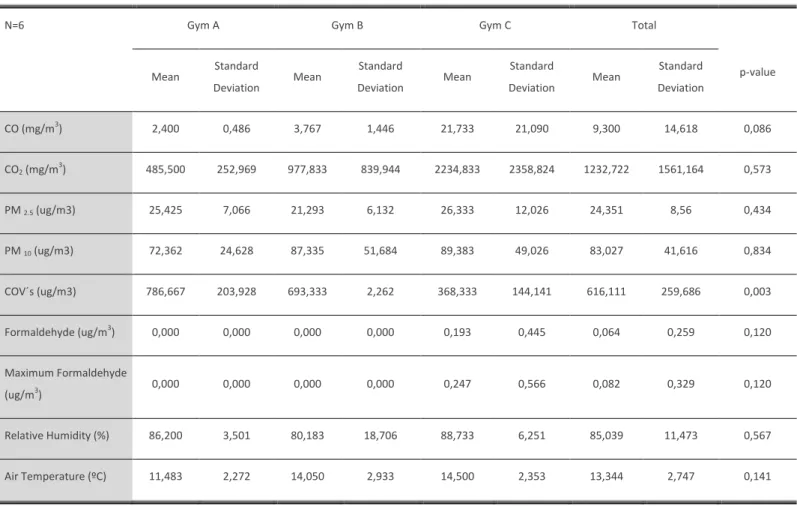
Then it was intended to evaluate the pollutants from the spaces (indoor and outdoor) and verify if these varied depending on the various gyms (Table 3).
Table 3: Results of the chemical air parameters in gyms
N=6 Gym A Gym B Gym C Total
p-value Mean Standard Deviation Mean Standard Deviation Mean Standard Deviation Mean Standard Deviation CO (mg/m3) 2,400 0,486 3,767 1,446 21,733 21,090 9,300 14,618 0,086 CO2 (mg/m3) 485,500 252,969 977,833 839,944 2234,833 2358,824 1232,722 1561,164 0,573 PM 2.5 (ug/m3) 25,425 7,066 21,293 6,132 26,333 12,026 24,351 8,56 0,434 PM 10 (ug/m3) 72,362 24,628 87,335 51,684 89,383 49,026 83,027 41,616 0,834 COV´s (ug/m3) 786,667 203,928 693,333 2,262 368,333 144,141 616,111 259,686 0,003 Formaldehyde (ug/m3) 0,000 0,000 0,000 0,000 0,193 0,445 0,064 0,259 0,120 Maximum Formaldehyde (ug/m3) 0,000 0,000 0,000 0,000 0,247 0,566 0,082 0,329 0,120 Relative Humidity (%) 86,200 3,501 80,183 18,706 88,733 6,251 85,039 11,473 0,567 Air Temperature (ºC) 11,483 2,272 14,050 2,933 14,500 2,353 13,344 2,747 0,141
Test: t-Student for independent samples
It was found that regarding the assessment by gyms, these didn´t present significant differences in the parameters studied except for one, the VOC's, which showed different values being higher in gyms A and B and lower in the gym C relative to the limit. However it is also important to note that CO2 has values close to those stipulated by the legislation in the gym C.
However it is noteworthy that although there may be differences when compared each gym relative to environment (indoor and outdoor), it may not be the same when separating each environment. With this in mind a separation of each environment and an analysis was proceeded to see if those same differences existed (Table 4).
Monteiro, F., Ferreira, A. & Moreira, F. (2017). Indoor air quality in gyms - a case study in the county of Coimbra.
Millenium, 2(2), 111-120.
m
1
117
Table 4: Results of chemical parameters of indoor air in each gym
N=3 Gym A Gym B Gym C Total
p-value Mean Standard Deviation Mean Standard Deviation Mean Standard Deviation Mean Standard Deviation CO (mg/m3) 2,233 0,208 4,433 1,050 27,300 21,700 11,322 16,202 0,061 CO2 (mg/m3) 711,000 11,358 1719,000 339,080 4238,333 1366,522 2222,778 1723,737 0,027 PM 2.5 (ug/m3) 26,117 7,764 17,400 4,918 31,787 15,764 25,101 11,074 0,193 PM 10 (ug/m3) 90,000 22,805 68,450 2,948 111,247 54,502 89,899 34,903 0,430 COV´s (ug/m3) 826,667 2,715 603,333 73,711 260,000 1,277 563,333 291,505 0,032 Formaldehyde (ug/m3) 0,000 0,000 0,000 0,000 0,387 0,618 0,129 0,365 0,105 Maximum Formaldehyde (ug/m3) 0,000 0,000 0,000 0,000 0,493 0,786 0,164 0,464 0,105 Relative Humidity (%) 84,933 0,924 76,233 28,205 94,133 2,108 85,100 16,134 0,097 Air Temperature (ºC) 12,700 1,044 16,100 1,473 16,600 0,346 15,133 2,055 0,064
Test: t-Student for independent samples
When comparing gyms indoor environment it was found that almost all the parameters showed no significant differences with the exception of CO2 and VOC's, however some are close to present significant differences such as CO, air temperature and relative humidity (Table 5).
Table 5: Results of chemical parameters of outdoor air in each gym
N=3 Ginásio A Ginásio B Ginásio C Total
p-value Mean Standard Deviation Mean Standard Deviation Média Standard Deviation Média Standard Deviation CO (mg/m3) 2,567 0,681 3,100 1,670 16,167 23,412 7,278 13,503 0,871 CO2 (mg/m3) 260,000 85,458 236,667 28,361 231,333 26,539 242,667 48,757 0,967 PM 2.5 (ug/m3) 24,733 7,945 25,187 4,934 20,880 4,880 23,600 5,659 0,587 PM 10 (ug/m3) 54,723 7,931 106,220 74,829 67,520 40,054 76,154 48,537 0,288 COV´s (ug/m3) 746,667 159,478 783,333 313,422 476,667 20,817 668,889 228,169 0,088 Formaldehyde (ug/m3) 0,000 0,000 0,000 0,000 0,000 0,000 0,000 0,000 1,000 Maximum Formaldehyde (ug/m3) 0,000 0,000 0,000 0,000 0,000 0,000 0,000 0,000 1,000 Relative Humidity (%) 87,467 4,997 84,133 5,698 83,333 2,401 84,978 4,405 0,430 Air Temperature (ºC) 10,267 2,715 12,000 2,594 12,400 0,700 11,556 2,148 0,561
Monteiro, F., Ferreira, A. & Moreira, F. (2017). Indoor air quality in gyms - a case study in the county of Coimbra. Millenium, 2(2), 111-120.
m
11
8
1
On the outside environment it was possible to verify that all parameters did not show significant differences, however one of the parameters is close to show significant differences, in particular VOC's.
Regarding the health of the workers an analysis was made in order to verify if the malaise that workers had could be related to the fact that they carry out activities outside the gym or not.
4 - DISCUSSION
Improving the quality of life of a population/community it is increasingly becoming a factor aggregated to the air quality levels that each person breathes. Thus the air quality can affect our well-being, influencing our present and future thus becoming one of the main risk factors for public health (Santos, 2008); (Ferreira & Cardoso, 2013).
After analyzing the results it was possible to verify that in the average values, obtained in 3 gyms concerning chemical and physical parameters of IAQ, most of the parameters were not excessive when compared to the threshold values, except three parameters PM 10, VOC's and Relative humidity, which exceeded the limit (50 ug/m3 600 ug/m3, a range of 30% -70%
respectively).
Given that a large percentage of people spend most of the time indoors, the IAQ is fundamental to the health of those same people. Interior spaces usually have little air exchange rate when comparing with the outside environment, thus there is a tendency to accumulate harmful pollutants. Due to this trend, it is important to monitor the indoor air quality with respect to maintenance, inspection and possible recovery of IAQ (Barbosa, 2012).
Nowadays people are more sensitized regarding IAQ, associating some discomforts that can be felt to the poor indoor air quality. It is known that the presence of living beings (humans and animals), all types of equipment (ventilation) and materials (curtains, furniture, etc.) which are in the buildings may be possible sources of contamination(Sodré, Tórtora, & Corrêa, 2014). According to the analysis presented in Table 2 it is possible to see that the indoor air has higher values than the air outside. Regarding the parameters that had values above the limit threshold set by legislation, they become harmful and have many complications.
Although CO2 did not show a mean higher than the protection limits, it is important to refer its properties because of its
potential both as a way to evaluate IAQ as of dangerous.
Carbon dioxide, being at room temperature, is characterized by being colorless, odorless and non-flammable resulting from metabolism of building occupants and other sources such as combustion appliances (oven, fireplaces, boilers, etc.). Thus CO2 is
recognized as an indicator of ventilation rates and own assessment of IAQ. When performing minor tasks, people release about 0,3L/min of CO2, varying the concentration depending on the size of the space, the time of day and also depending on the level
of physical activity, leading to a minimum ventilation rate per person 10L/s in order to ensure good IAQ in buildings recommended by the ASHRAE Standard 62-1989. Very low concentration levels of CO2 don´t present any kind of danger, but
when it exceeds 30 000 ppmv, it can cause headaches, dizziness and even nausea(Santos, 2008); (Sodré et al., 2014).
The particulate material consists of condensed particles that are classified by diameter feature. It is known that the density, shape and particle size are harmful factors when they reach the lungs. The smaller it is the more dangerous it becomes to health. They can be found in many places such as in smoke of cars, the type of pipes isolation, carpets and in the ventilation system filters. High levels can cause symptoms such as allergy, irritation to the eyes and nose, coughing and breathing difficulties, bearing in mind that most dangerous particles may eventually cause asthma and/or bronchitis (Sodré et al., 2014); (Matos & Andrade, 2013).
The VOC's can contribute to tropospheric ozone formation and the destruction of the stratospheric ozone layer, which can be found in various sources inside a building such as carpets, paints and varnishes, cleaning agents, photocopiers, among others. Depending on the exposed concentration it can be more or less damaging, in other words, concentrations between 0.3 and 3 mg/m3 may cause irritation, discomfort, and even stress. Amounts exceeding 25mg/m3 can cause other more dangerous symptoms such as respiratory irritation (Santos, 2008); (Sodré et al., 2014).
Regarding the relative humidity, this may result due to a poor control of the moisture levels, the amount of equipment, occupational density and also the possible inability of the building in terms of air exchange rates. High humidity values can lead to proliferation of microorganisms and even worse pollutant concentration. Symptoms that can be associated with moisture are the thermal discomfort, increased irritability, and further lead to loss of concentration of the occupants(Sodré et al., 2014). Although the values found are above the threshold values, it is important to note that in all the studied areas there were means that could provide exchanges between the indoor and outdoor air.
The use of ventilation systems aims to renew air, consequently removal of pollutants and/or harmful particles generated by human activities or from used machinery and equipment. This measure has other advantages, such as ensuring good hygiene and good health to the building occupants favoring the comfort of the same, increasing the oxygen rate and still control the
Monteiro, F., Ferreira, A. & Moreira, F. (2017). Indoor air quality in gyms - a case study in the county of Coimbra.
Millenium, 2(2), 111-120.
m
1
119
humidity and temperature levels, contributing to the improvement of indoor air quality. However it should only be performed when the outdoor environment has good air quality (Schossler, Santana, & Spinelli, 2015; Barros, 2013).
Given the values found in respect of the parameters evaluated it can be seen that there is a possibility of risk to the health of occupants in gyms relative to the concentrations of PM 10, VOC's and Relative humidity.
When conducting physical activity it is necessary to pay attention to the type of exercise performed, frequency, time and even the intensity of it. These factors are directly related to energy expenditure in the body. Other associated aspects that can be highlighted are the type of diet, physical condition and morphology of the athlete. All these conditions influence the effort recovery time, the performance and concentration in which the activity is performed, especially if the exercise is of short duration and high intensity (Ramos, 2013; (Ferreira & Cardoso, 2013).
Information gathered from surveys has shown that most workers had symptoms such as fatigue, stress and perturbations of sleep/insomnia.
When the evaluation in gyms was performed, it was possible to observe some situations that can be improved, though they may be already legally enforceable. Thus, some recommendations are given.
In order to prevent the appearance of high pollutant concentrations, a good ventilation of spaces should be performed, thus creating a form of daily-ventilated either through mechanical ventilation equipment (insert clean air) or air conditioning equipment filtering the outside air when it has good air quality, either by opening windows and doors of the building, in order to ensure air changes.
Another measure goes through the habit of performing a proper cleaning of the space and maintenance of HVAC equipment in order to control the pollution parameters of indoor air. Taking this information into account it would be essential to prevent or eliminate, if possible, the appearance of signs regarding moisture and clean fixed surfaces and furniture so that there is no possibility of the dust.
CONCLUSIONS
In short, with the analysis carried out it is possible to verify that three of all parameters were indicated with values above the protection threshold, namely PM 10, VOC's and Relative humidity, therefore conclude that existed at the time of data collection a
poor air ventilation, which caused an air saturation in the area. However other types of ventilation should be adopted to improve filtration and air cleaning that may eventually come from the outside contaminated air, or from the place itself and the people who attend it.
It should be noted that the study was conducted in winter and in a few days it was raining. Another important limitation is the small number of surveys conducted since each gym had few permanent workers.
Thus it is relevant the need for more studies in this area, regardless of the county, with a larger sample and respectively more employees willingly to respond more simple and direct questionnaires regarding their perception of the air they breathe indoors.
However it would be interesting to compare data collected in different seasons of the year in order to make the study more representative and the sample more significant thus making a most comprehensive study.
The development of IAQ area becomes, therefore, very important for environmental health because it includes the various professionals involved in this area that perform the most various activities. Thus it is necessary to intervene to prevent problems associated with IAQ in buildings, in order to contribute to a better level of comfort, well-being and health of its occupants, whether workers or people who attend this type of establishment.
ACKNOWLEDGEMENTS
I want to thank all the lecturers, professors and staff from Coimbra Health School for all their presentations, assistance, opportunities and all the hard work that provided me with the wisdom and the necessary tools to move forward in the future. Finally, I want to give special thanks to my parents for being the base that supports me, all the hopes, opportunities and courage they gave me during my stay at the university and every day of my life.
Monteiro, F., Ferreira, A. & Moreira, F. (2017). Indoor air quality in gyms - a case study in the county of Coimbra. Millenium, 2(2), 111-120.
m
120
1
REFERENCES
Alves, C. A. (2012). Formaldeído em escolas: Uma revisão. Química Nova, 35(10), 2025–2039.
Barbosa, A. R. P. (2012). Avaliação da qualidade do ar interior em edifícios do ISEP (Sissertação de Mestrado, Instituto Superior de Engenharia do Instituto Politécnico de Porto). Obtido de: http://recipp.ipp.pt/handle/10400.22/4414
Barros, C. C. A. (2013). Estudo de edifício visando eficiência energética e qualidade do ambiente interior (Dissertação de Mestrado, Universidade do Minho). Obtido de: http://repositorium.sdum.uminho.pt/handle/1822/30709
Brickus, L. S. R., & Neto, F. R. A. (1999). A qualidade do ar de interiores e a química. Química Nova, 22(1), 65–74. Carmo, A. T., & Prado, R. T. A. (1999). Qualidade do ar interno. São Paulo: Escola Politécnica da USP. ISSN 1413-0386 Costa, M. F. B. & Costa, M. A. F. (2006). A qualidade do ar interiores e a saúde humana. Interfacehs, 1(2), 1–10.
Ferreira, A. M. C., & Cardoso, S. M. (2013). Estudo exploratório da qualidade do ar em escolas de educação básica, Coimbra, Portugal. Revista de Saúde Pública, 47(6), 1059–1068.
Fraga, S., Ramos, E., Martins, A., Samúdio, M. J., Silva, G., Guedes, J., … Barros, H. (2008). Qualidade do ar interior e sintomas respiratórios em escolas do Porto. Revista Portuguesa de Pneumologia, 14(4), 487–507.
Madureira, J., Paciência, I., Rufo, J., Ramos, E., Barros, H., Teixeira, J. P., & Fernandes, E. O. (2015). Indoor air quality in schools and its relationship with children’s respiratory symptoms. Atmospheric Environment, 118, 145–156.
Marques, L. R. D. (2013). Qualidade do ar interior em instalações desportivas (Dissertação de Mestrado, Universidade de Aveiro). Obtido de: https://ria.ua.pt/bitstream/10773/12433/1/Tese.pdf
Matos, C. E., & Andrade, R. D. (2013). Toxicologia ambiental: Aspectos toxicológicos e políticos sobre a poluição do ar. Revinter,
6(2), 75–89.
Portaria n.º 353-A/2013. (2013, Dezembro 4). Estabelece os valores mínimos de caudal de ar novo por espaço, bem como os limiares de proteção e as condições de referência para os poluentes do ar interior dos edifícios de comércio e serviços novos, sujeitos a grande intervenção e existentes e a respetiva metodologia de avaliação [Portugal]. Diário da
República, 1(235), pp. 6644-(2)-6642(9). Retrieved from https://dre.pt/application/file/a/331946
Ramos, C. A. A. M. C. (2013). Qualidade do ar interior em ginásios: Exposição a poluentes do ar interior durante a atividade física (Dissertação de Mestrado, Instituto Superior de Educação e Ciências). Obtido de:
http://comum.rcaap.pt/handle/10400.26/9022
Robertson, G. (2016). Clearing the air: Improving indoor air quality in libraries. In Robertson on library security and disaster
planning (pp. 211-217). Waltham, MA: Elsevier
Santos, J. P. C. M. (2008). Avaliação experimental dos níveis de qualidade do ar interior em quartos de dormir: Um caso de estudo (Dissertação de Mestrado, Faculdade de Ciências e Tecnologia da Universidade Nova de Lisboa). Obtido de: https://run.unl.pt/handle/10362/1834
Schirmer, W. N., Pian, L. B., Sílvia, M., Szymanski, E., & Gauer, M. A. (2011). A poluição do ar em ambientes internos e a síndrome dos edifícios doentes. Ciência e Saúde Coletiva, 16(8), 3583–3590.
Schossler, I. S., Santana, E. R. R. & Spinelli, R. (2015). Avaliação de qualidade do ar interior em relação às características de ventilação das edificações. Revista Destaques Académicos, 7(4), 230–243.
Sodré, E. D., Tórtora, J. C. O., & Corrêa, S. M. (2014). Avaliação da qualidade do ar interior do Hospital Universitário Pedro Ernesto. Sustinere – Revista de Saúde e Educação, 2(2), 36–56.