Commop
Creating a Communication
Management Framework
Miguel Reimão Pinto Cabral Burguete
Dissertation submitted in partial fulfilment of requirements for the degree of MSc in Business Administration, at the Universidade Católica Portuguesa, August 2016.
1
Abstract
Commop - Creating a Communication Management Framework Miguel Burguete
Commop reached one strategic client in a very recent past. With limited resources combined with the need for a reduced time-to-market, the company must decide on the best path of actions and strategy to address the new challenge in order to respond positively to it.
This case study presents an innovative solution sold to advertisers in order to help them dealing more efficiently with customized communication. For complete understanding of the innovation behind Commop’s product, the author describes the traditional methods used to create customized communication, the characteristics and advantages of the new solution and its most recent evolution.
The case brings to discussion the most recent challenge faced by Commop, and goes over its history, covers in detail its most relevant shifts regarding distribution channels, provides an overview analysis of the media sector as well as the input to understand Commop’s clients, the advertisers, regarding their needs, more specifically in the point of sale communication. Research confirmed the possibility to adopt a strategic partnership as a solution for the present situation, however the suggested solution presented in the teaching note is not the only possibility for the company.
Key-words: start-up, customised communication, strategic partnerships; point-of-sale communication
2
Resumo
Commop - Creating a Communication Management Framework Miguel Burguete
A Commop conquistou um cliente estratégico muito recentemente. Para ter o sucesso necessário no desafio que enfrenta no presente, a empresa tem agora que decidir qual é a melhor estratégia para responder a este novo desafio, tendo em conta os seus recursos limitados e a necessidade de fazer uma entrada rápida no mercado.
Este caso apresenta uma solução inovadora desenhada para ser vendida aos anunciantes, permitindo aos mesmos, lidarem com a criação de comunicação customizada de uma forma mais eficiente. Para se poder compreender a inovação desenvolvida pela empresa, o autor descreve o método utilizado anteriormente para criar comunicação customizada, explica as características e vantagens da nova solução e as mais recentes evoluções da plataforma. O caso fomenta a discussão sobre o mais recente desafio que a empresa enfrenta, descrevendo a sua história, as maiores alterações que foram feitas ao nível do seu modelo de distribuição e venda do serviço, fazendo uma análise do mercado da comunicação e oferecendo uma perspetiva das necessidades do cliente Commop, o anunciante, mais especificamente em relação às suas necessidades de comunicação no ponto de venda.
A pesquisa realizada confirma a possibilidade de se adotar uma parceria estratégica como forma de responder ao desfio a que a empresa foi apresentada. No entanto a solução apresentada na teaching note não é a única solução para a empresa.
Palavras-chave: start-up, comunicação customizada, parcerias estratégicas; comunicação no ponto de venda
3
Preface
I would like to start by thanking Commop for the opportunity to create a close relation between my academic project and the real needs of the company, allowing me to better understand and address real situations of a start-up company. It was a rewarding experience. Commop was able to present its business, the team and their present challenges and daily activities.
I am grateful to both José Burguete, Commop’s CEO and Manuel Garnel, CTO for their assistance and commitment during the entire project.
The recommendations, insights and support from my thesis advisor, Professor João Simão Pires were a strong support during the process.
Finally, I would like to thank my family and my girlfriend, who were always available and helpful in what they could.
4
Table of Contents
Abstract ... 1 Resumo ... 2 Preface ... 3 Table of Contents ... 4 List of Abbreviations ... 5 List of Figures ... 5 List of Tables ... 5 List of Exhibits ... 6Commop - Creating a Communication Management Framework ... 8
1. Introduction ... 8
2. Commop – Company Background ... 8
3. Status Quo - Standard Process Workflow ... 9
4. Commop Process Workflow ... 12
5. Commop’s Offer... 14
6. Media Industry Overview ... 15
Software Industry – Products to Support Communication ... 16
Competition Analysis - Brand Asset Management & Integrated Software ... 16
Competition Analysis – Advertising Agencies ... 19
7. Distribution Channels ... 19
Phase 0 – Selling Directly to the Advertisers ... 20
Phase 1 – Spin-off from Rasgo & New target ... 20
Phase 2 – Targeting Advertising Agencies ... 21
Eudora - First Client Using Automatic “final art” Documents ... 21
Phase 3 – Back to the Initial Target – Advertisers ... 22
8. Customer Needs – User’s Perspective ... 22
9. Revenue Model... 25
10. Commop in 2016 ... 26
Exhibits... 28
Case Analysis and Teaching Notes ... 40
Synopsis ... 40
Learning Objectives and Use of the Case... 41
Suggested Assignment Questions ... 41
Relevant Theory ... 42
Analysis and Discussion ... 47
5
List of Abbreviations
AA - Advertising Agency B2B - Business to Business
CAGR - Compound Avergage Growth Rate EMEA – Europe, Middle East and Africa FMCG - Fast Moving Consumer Goods GMR – Global Media Report
OOH - Out of Home PoP - Point of Purchase SaaS - Software as a Service
List of Figures
Figure 1 – Different versions of the main template
Figure 2 – Standard Process Workflow of Personalized Communication Figure 3 – Classic Process vs Commop
List of Tables
Table 1 - Competition Analysis – Similar Products
Table 2 - Competition Analysis – Complementary Features
6
List of Exhibits
Exhibit 1 – Commop’s focus in Brazil
Exhibit 2 – Potential customizable materials – Terrace area Exhibit 3 – Potential customizable materials – Counter area Exhibit 4 – Potential customizable materials – Inside area Exhibit 5 – Potential customizable materials – Store front
Exhibit 6 – Detailed analysis for communication software – Medium level of similarities Exhibit 7 – Detailed analysis for communication software – Low level of similarities Exhibit 8 – Detailed process of content creation with Commop’s platform
Exhibit 9 – Interview with André Marques from Heineken Portugal Exhibit 10 – Total global spending by category1 (US $ millions) Exhibit 11 – Total global spending by region1 (US $ million)
Exhibit 12 – Consumer spending: traditional vs digital (US $ millions)
7
Case Study
8
Commop - Creating a Communication Management Framework
1. Introduction
From several different existent drivers of evolution in business, technology is probably the strongest. It creates new industries, improves operations and workflows of existing ones and drives others out of business. It is inevitable that adaptation is a critical factor all managers should have present on a daily basis.
In March 2015, the CEO of Commop met his recently hired private consultant for growth. The consultant had a very strong career path, essentially focused on fast moving consumer goods (FMCG), particularly on beverages. He was CEO of one of the top two companies in the brewing sector in Portugal and a member of the Heineken group. He was President of the
Brewers of Europe1 for almost five years, an entity that brings together national brewers’ associations from many European countries representing their interests.
After the first briefing of what Commop really is and does, the consultant was both surprised and confident, “a first moment believer”, saying that the product was not meant to be sold seven years back when it was first developed and commercialized, but now.
Commop is a “Software as a Service” (SaaS) commercialized by a Portuguese start-up acting in a very specific area, as they first came to market with a tool to optimize and control customized communication with high focus on the “Point of Purchase” (PoP) format of advertisement.
The present case study aims to bring into discussion the most recent and critical problems that Commop faces, as well as possible solutions for those, after careful analysis of the market, of company’s history, its capabilities and portfolio.
2. Commop – Company Background
Back in 2006 the CEO and co-owner of a Portuguese advertising agency, Rasgo Publicidade2 brainstormed for months with his team in order to find an efficient solution to improve the process of creating customized communication and advertisement. The work-frame for such
1http://www.brewersofeurope.org/site/index.php 2http://www.rasgo.pt/
9
tasks was essentially labour intensive, implying that to increase product output, companies used to resort to more people, either fixed employees or freelancers, in moments of heavy workload. This method is still used and many do not question the procedure, passing the inefficiency to the client side by charging higher amounts and increasing the time of the delivery schedule instead of improving the efficiency along the process. At the time, this advertising agency was using 50% of its workforce to support the tasks related with personalized communication for one of its best clients.
The labour intensive traditional method was suggestive of inefficiency, creating a need to improve and change the status quo. From this simple need to rethink the traditional methods, the current CEO of Commop relied on the expertise of his partner, current CTO of Commop, an entrepreneur and technology passionate computer engineer. Together they created the product that would later, be called Commop, the abbreviation for Communication
Opportunities3.
On their first approach to the market, Commop strived to be sold to clients as a combination between a platform and a service that would increase clients’ flexibility and efficiency when creating customized communication campaigns, disrupting the classical process. Such approach was thought to be positioned as non-competing service of the advertising agencies, so that it could work together with the already existent advertising agency working with the same client. Commop was designed to be a complementary asset of the services provided by advertising agencies such as the creation and development of content or image and campaign planning to its clients’ brands. Commop aimed to focus and solve simple constraints related with the customization of advertising materials that brands place in the PoP where their products are sold.
3. Status Quo - Standard Process Workflow
Creating communication materials is one of the oldest and elementary consequences of marketing departments’ actions all over the world, to promote new services, products or just to increase brand awareness next to customers.
Customized communication can be seen as a strategy to communicate in a more personal manner with customers, it allows companies to create more specific or targeted
10
communication by adapting a main communication template, with all the pre-defined and important information that needs to be passed to the customer side. The differences between different versions of the same template can be as simple as the price tag, allowing some PoPs to charge higher prices while keeping the same “style” of visual communication, or it can be the name of the PoP, content of the promotion among many different others.
In order to create different versions of the same promotion materials, the advertiser must create one masterpiece of such promotion, defined as the basis for future, usually minor modifications. The main communication template contains all the relevant information regarding the promotion, the product or service it involves, the price conditions and all the respective visuals.
To create such pieces of communication, advertisers usually rely on external or in-house advertising agencies that in accordance with the company’s marketing and communication strategies create the combination of visuals and messages for advertisement campaigns. From that template, the advertising agency will create as many pieces as the ones required by the advertiser for different situations. One of the most common is the need to adapt communication to the PoP’s name or environment, meaning that the main template can suffer more than thousands of small changes, according to the number of existent PoPs.
In order to perform that operation of selection and collection of information to include in the communication materials (different for each PoP), the advertiser usually relies on their sales teams due to their proximity with clients. After collecting the data, it is sent to the advertising agency, which depends on employees or freelancers to manually perform the modifications to
11
the main template for each specific PoP or for each promotion’s title. It means that a designer must open the template as many times as the number of different PoP’s names, manually make all the necessary changes using a design software and save it in order to be printed and further delivered to the PoP.
Figure 2, resumes the classical process, starting with the sales person with strong ties with the client, who, in accordance with his client and based on the future communication objectives of its company, the advertiser, decides what to produce in terms of content and format to be exposed in his client’s PoP. After collecting that information from different clients, it is sent and fulfilled by the advertisement agency through its designers and then sent to production, in case of physical materials, or to the web in case of the digital formats.
Physical materials usually considered to be personalized, are wall posters, menus, inside and outside furniture, employee’s clothes, table tents and wall decoration. Clear examples of those materials and their practical application can be found in exhibits 2 to 5.
The most common digital formats are banners, both static and dynamic. Such type of communication is usually used by advertisers on social media and other web based platforms. The process described is still widely used and represents significant time consumption during all process, mostly from the advertising agency side.
Illustrative Description of the Status-Quo Process
Company “A” represents a typical client of Commop, and its short example provides a better and clearer understanding of the traditional process of customized communication, summarised in Figure 2.
Company “A” sells the “xyz” beer nationwide, being its strongest segment the “hotels, restaurants and cafes” (HORECA). As a brand with high presence in the PoP, company “A” must promote and continuously highlight its “xyz” brand in order to obtain and maintain a higher visibility over its competitors in the same physical space. That requires the approval and motivation of company “A” clients, the owners of each PoP. To improve relationships
Advertiser
Advertising Agency Advertising Materials Distribution Points of Sale12
and persuade PoP owners, brands have to adapt their communication to the PoP needs and it is common for companies to offer many different communication materials, including tables and chairs with their own brand. Company “A” is not different and needs to motivate its clients, keeping them interested, by offering something different from its competitors, customizing the in-store communication with the name of the PoP or specific menus or promotions for that client. Such menus can be different from PoP to PoP, implying different text descriptions, images and prices while keeping company “xyz” beer always present and according to the national or international wide image.
To be able to do that to all of its clients, company “A” must collect the information regarding each PoP’s needs and send it to the adverting agency according to the process described before. Those materials will be design and then sent to production, in case of physical products such as billboards, posters or table tents, and finally distributed to the respective PoP.
4. Commop Process Workflow
The process that the advertiser must complete to customise its communication can be dramatically reduced both in terms of time and resources when performed under the services provided by Commop.
Commop offers its clients a completely different workflow when compared with the status quo of the industry. With Commop’s platform, the advertisers are allowed to have a diversity of pre-approved templates uploaded and stored inside the platform. Those are the exact same templates as the ones described before, usually developed by the advertiser’s advertising agency.
The main difference starts with the online storage of such templates, allowing the advertiser’s sales teams to create new pieces of communication from any of the pre-approved templates from anywhere as long as there is an internet connection. The modifications on the main template are all automatically done by the software when the member of a sales team selects different options from dropdown lists in the Commop interface. The process is smooth and user friendly for non-technological persons. This enables sales team members to create communication pieces from its client PoP location, choosing the template, and automatically editing it by choosing features, specific name or price he wants to have printed in the final
13
piece of communication. The entire process is developed automatically by Commop, associating the images and the chosen text to the main template. Besides that, the platform allows the user to preview what will be then printed and delivered at the PoP. By analysing figure 3 one can have a more visual sense of the impact of Commop’s workflow when compared with the traditional approach by the majority of the advertising agencies.
Illustrative Description of Commop’s Process
Company “A”, from previous example could use Commop as an alternative to the standard process. To generate customised communication, it would start with the same step, the creation of one or more main templates of communication materials.
The second step would now be different once each member of sales teams is able to, according to company “A” objectives and budget, create communication materials from the PoP location in the presence of its client, being able to show him several pre-views of the materials created in any internet connected device (see exhibit 8 for complete content creation process). The time to market for each communication material also suffers major changes, since it no longer passes through a designer and a design software to be altered, reducing abruptly the time to produce each piece thus reducing the period until the advertising materials are delivered to the respective PoP.
14
5. Commop’s Offer
Commop is a service, more specifically a Software as a Service (SaaS) with the mission to reduce the time and number of processes involved in the creation of customized communication for advertisers, providing total control and real time metrics that can be crossed with many other business metrics from the advertiser’s perspective, allowing the best and most efficient practices.
It´s first face, the beta version, was officially launched in 2007 in order to be implemented in record time to one of the top two brewers in Portugal, Unicer, with the goal of promoting its best seller beer, Super Bock. As a requisite to acquire the service, Unicer requested that the service be tested and ready to be running during its summer campaign.
Commop developers worked hard in order to accomplish such a demanding goal, and the beta version was successfully working during the entire summer, with no severe bugs or anomalies. The overall feedback from Unicer´s trade marketing department was positive regarding many features of the platform.
In the following years the platform was redesigned, improved and fine-tuned in several fronts, including the number of features, speed of processing, general appearance of its interface and detail of generated data.
Developed inside an advertising company and benefiting for the existent clients was a good market test for the platform, but it was clear for the founders that Commop could be present in many other companies across different industries and not only the current clients of the advertising agency. The majority of the clients in the advertising agency portfolio were retailers, FMCG companies and restaurant’s chains, with a combination of shared needs regarding PoP communication.
With the shared knowledge from the advertising agency, Commop’s team developed an early focus on PoP communication needs and challenges faced by the advertisers, including the severe and competitive scenario faced by those in order to get a visible and noble instore position for their advertising materials.
15
6. Media Industry Overview
Media consumption and investment is changing fast over time and according to McKinsey & Company’s 2015 Global Media Report (GMR) there are two main themes to focus on, when analysing the market, the shift to digital and the developing markets.
Traditional media such as television advertisement, newspaper and magazines and
out-of-home (OOH) advertising is progressively replaced by digital formats, mainly represented by
internet and mobile advertising. McKinsey & Company estimate digital media to represent 50 percent of world’s media expenditure by 2019.
The main reasons underling the dramatic shift to digital are, according to the 2015 GMR, the growing number of connected consumers as well as the penetrations and adoption of mobile phones across the world. According to the same report, mobile will become the principal digital platform, meaning that mobile media access will be the fastest-growing sector of the total amount spent on media around the world (see exhibit 12).
The same GMR focus the rise of global content, essentially promoted by Social Networks when integrating different kind of content from external sources bringing it directly to users thus, resulting in the aggregation of content in a unique platform.
Developing countries are increasing their role in the media industry, largely due to its economic expansion and growing incomes. Such countries are specifically important to analyse from the traditional media perspective since it still remains stronger and more effective than digital formats.
According to 2015 GMR, predictions for the following years define digital advertising as the leading segment in growth, with a 12.7 percent compound annual growth rate (CAGR) while OOH adverting is listed in the end of the list with a CAGR of 4.9 percent for the next four years. To access complete information regarding each segment see exhibit 9.
“Total global media spending will rise from US $1.6 trillion in 2014 to a projected US $2.1 trillion in 2019, a 5.1 percent compound annual increase”4
A detailed analysis over each relevant region shows that Latin America was the region with higher growth with 11.8 percent followed by Asia Pacific with 7.2 percent. The slowest-growing region was Europe and the Middle East and African (EMEA) market although the
16
Midle East and Africa have a projected CAGR of 11.5 percent. For detailed information
regarding global spending by region see exhibit 10.
Regarding consumer spending, digital components accounted for 46.2 percent of the market and McKinsey & Company project the digital consumer to overtake traditional consumer spending in 2017, see exhibit 11.
Software Industry – Products to Support Communication
Being Commop a complex platform, combining software with services and assuming a modular structure formed by different features, the detailed analysis of the market must be segmented regarding the different features Commop is offering in the market. The first market segment to analyse is the so called “Status Quo” of, in this case, the customized communication. As described before, the standard process of customized communication is a manual and non-automated process usually performed by an AA. Such information is critical when analysing the market since it defines AA as a competitor for Commop.
The second segment to analyse is the software segment related to communication and content creation. The most common software in the market, related with communication and already selling to many companies around the world is the so called Brand Asset Management
Software.
Competition Analysis - Brand Asset Management & Integrated Software
The categories with more similar products in terms of features are the Brand Asset
Management and Brand Resource Management software which are also both alike. These
type of software offers their customers the capability to control their brand assets, such as logos and corporate images, avoiding incorrect using of those as well as the overseas control of a unique brand presence. It works as an image repository with a certain number of users with access. It usually does not require any parameterization and the pricing system tends to be very simple and intuitive, usually with two or three different levels of price according to the number of users and the volume of content.
17
Software Segment
ProofHQ Approving Process Manager
Brand Center Complete Software
BrandMaker Complete Software
Brandifyer Marketing Resource Management (MRM)
Brand Muscle Complete Software
Elateral MSC Complete Software
Encode Marketing Complete Software
Table 1 - Competition Analysis – Similar Products
The most similar competitors are summarized on the table above (table 1) as well as in exhibit 6, allowing a deeper understanding of the features provided by their software.
ProofHQ can be considered similar to Commop and is already selling to more than 3.000
clients. Its main purpose in the market relates with the complexity of approving content inside a company and that is what ProofHQ aims to solve by streamlining the review and approval process in order to let marketers focus on their core tasks.5
Brand Center can be considered a very complete and modular system that offers similar
features of what Commop is offering, including some automation regarding the artwork automation, meaning that their clients can have pre-approved templates in the platform, thus generating faster and controlled customized communication. Other relevant features are the control it gives its customers over the workflow and the possibility to have a digital asset manager. 6
Brand Maker offers several features and analytic information regarding the client’s online
presence and interaction with their customers. The platform is highly focused on the online market instead of physical communication. Brand Maker is also providing a control feature focused on external service providers of the communication process and its customization is not focused on changing a template but rather in creating entire new pieces without specific designing knowledge.7
Brandyfier offers its clients different bundles of features allowing users to create certain types
of communication according to templates provided by the software. It focuses highly on the
5 http://www.proofhq.com 6 https://www.brandcenter.dsm.com 7 http://www.brandmaker.com/en/en.html
18
brand asset manager feature as well as the possibility to users to create immediate communication materials from the images available on the image bank.8
“Headquartered in Chicago, with offices in Cleveland, Austin and Los Angeles, Brandmuscle
is the result of the 2012 unification of three local marketing software and service innovators: Centiv, with its unmatched print-on-demand PoP and cross-media capabilities; TradeOne, with its industry-leading channel program management and co-op reimbursement offerings; and Brandmuscle, with its web-based user-friendly ad builder platform for customizing traditional and digital media, campaign execution tools and local media planning and buying services.”9 Brandmuscle offers its clients several modular solutions with the mission to empower their network “of local distributors, dealers, franchisees and salespeople with everything they need to deliver brand-approved marketing tactics customized to local needs”10
“Elateral MSCTM enables marketers to source any content in any form from any system; customize content in any dimension from creative to copy, size, shape, layout & language; and output market-ready materials in any format for distribution by any experience management or content delivery platform, both online and offline.”11
Encode can offer different services related with the reduction of time consumed by marketing
departments including, managing the relation between all stakeholders in the communication process, it “optimise the agency’s workflow between clients, internal teams and vendors from client brief to content delivery.”12
Software Segment
Integrate Campaign & Leads
PubliSphere Brand Asset Manager
Amplifinity Referral Marketing Platform Referral Management Platform/Software
Bethebrand Marketing Resource Management (MRM)
BrandSpot Brand Resource Management
Campaign Drive Marketing Resource Management (MRM)
Ceros Content Creation
BrandWorks Complete Software
Table 2 - Competition Analysis – Complementary Features
8 http://brandifyer.com 9 http://www.brandmuscle.com 10 http://www.brandmuscle.com 11 http://www.elateral.com 12 http://www.encode.dk
19
Competition Analysis – Advertising Agencies
Advertising agencies offer its clients several different services related with brand promotion and presence next to consumers and are usually recognized by their creativity in regards to content and image creation.
When discussing customized communication, AA usually perform on initial creative task, where the general bundle of visuals and content are created and it will further rely on repetitive and non-creative actions to reproduce each piece of advertising for a specific PoP or product.
7. Distribution Channels
As many start-up companies, Commop suffered several modifications regarding the way they operate, more specifically regarding their distribution channels. Many variables influenced such shifts, including market response and the entrance of early investors with different visions for future of the platform.
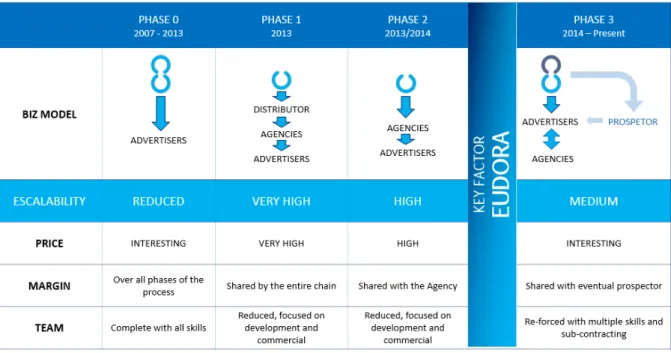
Table 3 represents a brief summary of all relevant changes that Commop suffered and adopted during its life in business.
20
Phase 0 – Selling Directly to the Advertisers
At phase 0 the platform was being sold under the name of the advertising agency which allowed Commop to offer very interesting prices to its clients selling direct to them as a complete service. The platform was automatically producing the customized communication, while Commop’s team was dealing with the entire chain, from production of materials to its distribution until each piece of advertisement reaches the respective PoP. Such model allowed the advertisers to save time and resources on the entire chain, starting with the content creation, its customization and all the involved logistics of distribution.
The model adopted in phase 0 generated margins on every step of the process, allowing Commop to charge a very competitive price for the services related with the platform itself. On another hand, it lacks on scalability, requiring a team and market knowledge to be able to manage the entire chain of the process, dealing with the printing and logistic companies creates an involvement from Commop’s team that becomes a barrier to fast growth.
Phase 1 – Spin-off from Rasgo & New target
Phase 1 represented the biggest business model shift suffered by Commop. It was mainly caused by the spinoff of the original advertising agency and the platform, generating a new company with the single purpose of selling software as a service (SaaS). One of the main supporters of such approach was the fact that the new product would not be directly competing with advertising agencies, instead, it would be sold to them as a tool to either create more value to their actual clients or to increase the number of clients. The new vision defined a completely different target, shifting from the final advertiser to advertising agencies. With this new vision motivated by entrance of capital from business angels, combined with their equity and vision of the platform, Commop would be able to increase their international presence, by selling its services through a distributor that would then sell it to advertising agencies worldwide. The idea was that such distributors (for different countries) would be people with market knowledge and contacts that would more efficiently reach the AAs, thus receiving commissions according to sales. In the business angels vision, the new target and distribution system would increase international penetration promoted by a more scalable business model, without Commop’ team involvement in any step of the process except for the customized communication generation. In such scenario, the advertiser would be charged a
21
higher amount when compared with the previous model, since the AA could charge any price on the full service where Commop was also included.
Phase 2 – Targeting Advertising Agencies
The following shift of the business model was extremely similar to the approach of phase 1. With some market experience and after several sales meeting and presentations, the team decided to remove the distributor once such intermediary was not efficient on dealing and creating a relationship with the AAs. In theory, new approach was less scalable when compared to the previous one, once Commop must sell direct to each AA, requiring a greater effort and focus on sales. The price charged by Commop could be lower when compared to the model adopted on phase 1, mainly promoted by the savings on the distributer’s share. Eudora - First Client Using Automatic “final art” Documents
Eudora is a business unit from Boticário Group launched in 2011 focused on modern women with busy lives with some specific products for men as well. The company has around 600 products in their portfolio from perfumes and makeup to hair and body products for women and shaving gels, deodorants and aftershave product for men.13
It is based in São Paulo, Brazil and it is the first national company in the segment using a multi-channel including direct sales, e-commerce and some experimental stores. The main and most relevant channel is the direct selling with official representatives across the nation. Commop & Eudora
At the time, before Commop presented its platform, Eudora was producing a certain number of standardized banners nationwide, with no differentiation across states, regions or products. Such approach was not allowing their representatives to use direct communication according to some regions’ preferences or their own stocks.
After starting using Commop, Eudora representatives could generate differentiated banners for each region’s preferences and adapt or generate new banners according to their stocks,
22
which can be extremely useful to avoid promoting out-of-stock items as well as to increase the focus on in-stock items.
Eudora’s project represented an important milestone in Commop’s history. Due to Eudora’s digital needs Commop developed an important feature that allowed the platform to automatically generate every piece of communication ordered by Eudora without any human intervention on the platform side, becoming faster and more efficient.
Phase 3 – Back to the Initial Target – Advertisers
After several business presentations and direct contact with both advertising agencies and advertisers it was becoming clear to the team that the impact of the sales speech was more efficient and appealing to the advertisers going in line with their needs and interests, being that feedback the main motivation to perform another distribution channel shift. Commop was then assuming a very similar, almost identical approach of what it had before the spin-off when it was selling directly to the advertisers but with possible intervention of some sort of distributor or prospector. With this strategy on delivering the service, Commop is not competing directly with the core activity performed by the advertising agencies, once it is not creating any kind of creativity or image work for advertisers. Despite not being the core business of AA, the process of creating customized communication without Commop is usually performed by those. The scalability of the phase 3 model is reduced when compared to models of phase 1 or 2.
8. Customer Needs – User’s Perspective
For Commop, besides the necessity to be general and useful in more than one industry it would be important to assume the form of a cloud based software, since it would decrease abruptly the implementation and installation costs, by eliminating the need for companies’ IT departments to do it in-house after the software’s purchase. It also allows the advertisers to be flexible regarding the number of employees using the platform. To support the analysis and improve the understanding of Commop’s services, important inputs were collected through an interview with André Marques from Heineken Portugal.
The main focus is the necessity for advertisers in the FMCG market to state their presence inside PoP which can be analysed from two different and important perspectives.
23
First approach of PoP communication relates with its final customer’s decision to buy their products instead of their competitors. In-store communication can play an important role here since it reminds the final customer of a certain product, promotion or novelty he or she was not aware.
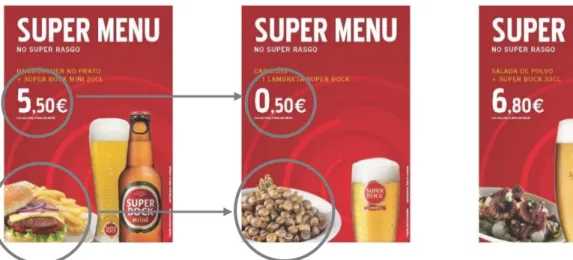
The second but not least important aspect of PoP communication relates with the relation between the advertiser and the PoP owner. The quality, quantity and format of the advertising materials can be critical when negotiating with PoP owners in order for them to both sell and promote certain product in their stores. A very simple example of the power of customized communication impact for PoP owner is the fact that he can create “menus” or “combos” with their own products and the products sold by the advertiser. If the PoP sells burgers, it can create different burger menus with different beers from the advertiser, without investing his money and time on such communication materials for example. “The need to customize
communication is notorious from our clients once they want to differentiate from their competitors and value the creation of promotions related with their business.”14 According to André, it is also a differentiation factor for the advertiser that is able to offer such customized communication to its distribution network when compared to its competitors, since PoP owners want to differentiate from their competitors as well.
Portfolio
During its life Commop already worked with some relevant players from diverse sectors and markets. The description of those as well as the project details can be highly useful to understand Commop’s functions and advantages for different clients.
The first client of, an embryonic stage of the platform was Unicer, in 2007, being an early believer of Commop and its services. Unicer allowed Commop to grow, developing and continually improving the platform and its interface, requiring Commop to be responsible for the entire process, from generating the customized communication to managing the entire supply and logistic chain until each piece of tangible communication reaches its PoP.
Delivering the exact same complete service, Commop started providing services to BP Portugal, a company that recognized such service to be the most effective process to produce in-store promotions and advertising materials. In-store communication was a serious challenge to BP since several of their stores are not controlled directly by BP, increasing the
24
difficulty to manage and to provide customers with homogeneous communication and presence across all stores. Besides that, Commop allowed BP to control the budgets and campaigns activated by each store, giving them the opportunity to reward the ones in need. One year after, in 2009, Commop began to produce the marketing and advertising pieces of Ford’s official dealers and retailers in Portugal, once again allowing different automobile stands to produce differentiated communication regarding the models or type of campaign they wanted to promote at different moments in time.
In 2010 Commop’s team was proud to add to their portfolio one of the national leaders in the FMCG sector, Unilever JM (Jerónimo Martins). As the previously mentioned clients, Unilever started to work with Commop under the same scheme of complete service delivery, activating some of their brands, Olá (Heart), Lipton, Carte D’Or Scooping and Carte D’Or Monoportions. With many PoP, Unilever was using Commop in order to produce customized advertising materials for each PoP, avoiding the common overwriting of such materials by the PoP owner. This was and still is an image control problem that many brands face, mostly in the Hotels, Restaurants and Cafes (HORECA) sector, once PoP managers may want to change prices, cut products out due to PoP owner option or stock inexistence. To do that, PoP owners write over promotional materials of the brands selling instore, giving it a less professional and less appealing look which goes against the goal of such materials. Depending on different companies’ perspective those situations can, in a certain way damage brand image.
In 2011, Commop closed its first international client, Refriango, a company leading the beverages sector in Angola with several market leading products. Refriango used the service to answer both the HORECA and Retail Stores needs in Angola.
In 2012 Commop began to manage the Telepizza’s on-trade promotions in the Portuguese market. With different stores along the country Telepizza needs to be able to generate promotional pieces customized for each store, meaning that contacts and addresses of each store would be immediately added when the manager of each store logs in to create any kind of communication with Commop.
The year of 2013 represented an important mark for the team, partnering with HP Brazil; Commop sold a project for Ambev, the leader in the Brazilian brewing sector. Ambev chose Commop to help managing their HORECA channel “Induced Prices” project in São Paulo, Brazil, being the onsite production implemented by HP Brazil.
25
During early 2014, Eudora hired Commop to create the banners and newsletters for their sales cycles in Brazil.
One year after, in 2015 Commop started working for Heineken Portugal the leading brewery in the Portuguese market. The objective was to strengthen the bond between their brands, such as Sagres, Sagres Radler, Heineken, Desperados and Strongbow and their consumers.
9. Revenue Model
Commop has three main sources of income, a Start-up Fee, a Monthly Fee and a Maintenance Fee, being the two first ones the most relevant.
The Start-up Fee is a single initial fee in the early stage of the contract and includes all the parameterization for the specific new client, data base, creation of the different users and respective permissions plus inclusion of all visual material information to be used by the future Commop users when generating new communication. Such templates and visual materials are usually provided by the client’s agency. This cost can vary from 12.500€ to 25.000€ for the majority of the companies (excluding retailing due to the vast number of products) according to the number of users and the complexity of the operation. That complexity can vary according to the number of services required, such as spelling check before printing.
The Monthly Fee is a monthly fee that can go from 2.500€ to 5.000€ mostly regarding the expected number of activations from the company.
The last source of income, labelled by Commop, as the “Maintenance Fee”, represents an ad.doc fee, practiced when client need major changes on the platform regarding the current number of users, services or products. The Maintenance Fee can be seen as a new Start-up Fee once it regards many parameterization procedures.
Besides the referred sources of revenue, Commop is making money by charging a margin over the production of the materials produced. The main reason underlying the control over production is the fact that the market is not yet prepared for the service and still needs some support over the complete process. One strong example of such need was the case of Ambev in Brazil where they needed the complete process solved which lead Commop to partner with
26
HP Brazil in order to be able to produce those high quantities; they were printing over 500 m2 daily, mostly big formats such as Outdoors.
So far Commop had different type of annual revenues per client where the bigger clients represent on average 400.000€ annual revenue and smaller ones 50.000€ (the actual values of
revenue per client cannot be presented due to confidentiality issues).
Throughout its life, Commop suffered changes regarding pricing strategies. It started by charging what is called the “Pay Per-use”, giving a low price per activation, Commop was able to charge its clients a fixed price any time a user requested any new communication material through the platform. It was making sense during the initial stage mostly because it was mainly focused on the Portuguese market where the scale of the business players can be considered low when compared with bigger economies in Europe and all over the world, maintaining the overall cost paid by the client relatively low.
After the first international customer acquisitions, Commop had to rethink the pricing model in order to address high scale players, for whom the “Pay Per-use” strategy would represent vast amounts of money, making it overpriced for the service provided by Commop.
At the present, Commop is offering a Monthly Fee instead, calibrated on many variables of the client’s needs and the project such as number of users, activations and services provided.
10. Commop in 2016
As mentioned above, during 2015 Commop suffered a new shift regarding its distribution and service provided, going back to its original model, when the company provided a full service including the customization of content throughout Commop’s platform to final advertising materials delivered to each PoP.
Such strategic shift allowed the company to closed a strategic deal with Heineken Portugal which was critical to reach a reference market, the United States. With the brand experience acquired while dealing with Heineken in Portugal, Commop’s CEO got the US Heineken’s Marketing and Trade-Marketing’s attention and performed one more sale’s pitch to both teams. Furthermore, Heineken’s teams considered to launch a demo version of Commop’s services in one city, Miami. In line with past experiences, the sales process was long due to
27
client’s analysis period as well as the associated resistance to adopt new and uncommon solutions.
With a reduced commercial conversion rate in the European Market and Brazil, Commop is facing a critical moment, requiring the company to be able to exceed US Heineken teams’ expectations, allowing Commop to grow its business in US as well as to create several new opportunities across the globe supported by the representative client that Heineken in the Us market is.
28
Exhibits
Exhibit 1 – Commop’s focus in Brazil
29
Exhibit 3 – Potential customizable materials – Counter area
30
Exhibit 5 – Potential customizable materials – Store front
Exhibit 6 – Detailed analysis for communication software – Medium level of similarities
Software Segment Comments
ProofHQ Approving Process Manager Cover part of what Commop is doing in the
process
Brand Center Complete Software Not focused on the personalized
Communication but strong on other parts of the process Modular; SaaS; Very similar features
BrandMaker Complete Software Online focused only
Brandifyer Marketing Resource Management
(MRM)
Modular; SaaS; Very similar features
Brand Muscle Complete Software Very similar with Commop at many levels;
Modular
Elateral MSC Complete Software Very similar with Commop at many levels;
Modular
Encode Marketing Complete Software Very similar with Commop at many levels;
31
Exhibit 7 – Detailed analysis for communication software – Low level of similarities
Software Segment Comments
Integrate Campaign & Leads
PubliSphere Brand Asset Manager Web to print
Amplifinity Referral Marketing Platform
Referral Management Platform/Software
Online focus only
Bethebrand Marketing Resource Management
(MRM)
No Control
BrandSpot Brand Resource Management Similar; No Control; No Customized Communication
Campaign Drive Marketing Resource Management
(MRM)
Focused on the Marketing team needs; Interesting to incorporate it on Commop
A lot of options to use in order to improve Commop
Ceros Content Creation Also a good source of ideas;
Only online Focused; Very interesting!
BrandWorks Complete Software Similar with no control and no customized
communication
35
Exhibit 9 – Interview with André Marques from Heineken Portugal
Question: After using the platform and Commop’s services, how would you briefly describe the platform to a Marketing or Trade-Marketing Director that would not be aware of it?
André: Commop is a platform that helps the management and implementation of a Trade-Marketing strategy aligned with the Trade-Marketing campaigns but with flexible implementation, cost control and autonomy for the sales teams who implement it.
Question: Can you please nominate one or more competitors? They can be similar platforms or alternative processes.
André: I am not aware of any similar system or platform.
Question: Central de Cervejas is a brand with a strong presence and communication on the PoP. Can you please briefly describe the biggest needs and challenges faced by the company regarding PoP communication?
André: Communicate the brand according to the company standards, increase sales, stimulate consumption and give our brand a position that stands out when compared to competitors and substitutes while keep it in accordance with the environment of each PoP.
Question: How was Commop a valuable asset for your team?
André: Commop helped creating the autonomy of execution respecting a framework previously defined within our company. It also increased budget control, reducing waste. Commop was very efficient on bringing additional benefices to the PoP through its personalization of the communication allowing it to be “co-created” with the PoP’s the client (PoP’s owner) through a mobile device such as an iPad. The last but not less important is the short implementation period, only one week.
Question: I would ask you to, based in your experience with the brand Heineken, make a brief comment on “customized communication”. Is there a need nowadays to customize communication for different situations or PoPs? Do brands value that control over all the promotional materials related with their brand?
André: The need to customize communication is notorious from our clients once they want to differentiate from their competitors and value the creation of promotions related with their business. Some visible materials should remain “standard” as long as the benefit of scale
36
covers the added value of customized communication and the savings on non-wasted resources.
Exhibit 10 – Total global spending by category1 (US $ millions)
37
Exhibit 11 – Total global spending by region1 (US $ million)
Source: McKinsey & Company Global Media Report 2015
Exhibit 12 – Consumer spending: traditional vs digital (US $ millions)
38
Exhibit 13 – Mobile media consumption – Global broadband penetration (percent)
39
Case Analysis and Teaching Notes
40
Case Analysis and Teaching Notes
“Commop – Creating a Communication Management Framework” case study was written by Miguel Burguete, under the supervision of Professor João Simão Pires and is intended to be discussed in strategy and entrepreneurship classes.
The case study is based on Commop’s history, written and supported directly from Commop’s team.
This document is composed by two distinguished parts:
“Commop – Creating a Communication Management Framework” Case Study: Developed for students, containing all the necessary information to allow class participation and discussion.
“Commop – Creating a Communication Management Framework” Teaching Note: A document restricted to instructors, including theory and strategic suggestions needed to support the teaching of the case. It also includes recommended questions to students regarding the case, as well as some guidelines, representing possible answers.
Synopsis
Launched as a private and independent company, after a spin-off from an advertising agency, Commop got its first Business Angels investment in order to grow and address new markets. With such investment and presence Commop was force to embrace different visions and strategic approaches for the future lying ahead.
Like many start-up companies, Commop suffered business model, target and market approach changes over time, some influenced by the Business Angels, others by the market and its response to the product.
In 2013, after a highly recommended suggestion from the Business Angels to address international markets, Commop closed a deal with a biggest player in the brewer sector in Brazil, Ambev. This relevant mark somehow proved the concept as well as the need of such platform for PoP communication. After some other contracts with relevant companies,
41
Commop started to focus in Portugal again where they have clients with a very interesting scope and market presence.
This case study introduces the company, their major achievements and their actual situation, pushing the reader for the role of an external consultant with the mission to understand critical decisions for the future of the Portuguese start-up. Relevant topics to explore are the definition of a possible strategy for Commop to adopt in order to be able to, conditioned by its limited human and financial resources, respond to its new challenge in the American market.
Learning Objectives and Use of the Case
The goal of the present case study is to provide its readers some insights regarding strategic decisions faced by start-ups. It is a present real life example of a small company operating in a niche market with a very specific product, which was recently challenged by a very big player in an international market.
The present case study pretends to develop the following learning topics for its readers: Analyze opportunities for small companies to address big markets
Understand and define possible growth strategies with limited resources Understand advantages and disadvantages of strategic partnerships
Suggested Assignment Questions
The following section introduces a recommended question to analyze the case study and to promote class discussion between students. Regarding Commop’s critical present situation with Heineken US, the question aims to bring to discussion possible strategies to be adopted by the company in order to exceed expectations in Miami, leading to a future business relation with Heineken.
Case Question
Based on Commop’s history, its portfolio and the most recent challenges, suggest a possible strategy for this start-up to be able to respond to Heineken US conditioned by its limited resources.
42
To help the student organizing and structuring the answer, it is advisable to cover the following topics:
Understand the advantages of PoP customized communication
Understand the advantages of using Commop to create communication materials
Understand the distribution model used by Commop with Heineken Portugal
Relevant Theory
The following chapter contains relevant theory regarding start-ups critical factors for success to better support a business case focused on a critical moment for a start-up.
Israel is small and geographically isolated from the main markets15. Even though Portugal is not as distant from main markets it is still far from important markets such as the US, Asia and South America. Not as much as in Israel, but the Portuguese entrepreneurship development is growing fast mostly motivated by higher unemployment rates from the 2011 financial crisis.
Professor Paulo Soares de Pinho, who teaches at Nova School of Business and Economics in Lisbon, and runs his own investment fund, says that one of the biggest changes brought by Portugal's economic crisis was "to transform many unemployed people into wannabe entrepreneurs".16
In the paper, Success in Israeli high-tech start-ups; Critical factors and process, the authors define critical factors for success in high-tech start-up, being highlighted, the entrepreneur, the product, markets, finance, resource based capability and competitive strategy.
Strategy
There are, according to the same paper, two schools defining different start-up strategies to gain competitive advantage. One is called the formal strategy which is based on frameworks such as Porter’s Five Forces model, and the other is the adaptive, where the company is managed according to a mission and decisions are shaped by learning and experience.
15 Schaul Chorev, Alistair R. Anderson - Success in Israeli high-tech start-ups; Critical factors and process 16 http://www.bbc.com/news/business-29027462
43
After creating and analyzing a questionnaire with the objective of rank important topics for start-up success, the authors defined a final model based on the results. The model highlights
the topics deemed to be critical for success and describes some elements of successful process.17 Despite the focus on the of the present paper in Israel, several critical factor for success are applicable worldwide.
Business Model
There are two main questions regarding the Business Model for a company, especially for a start-up where the business model can suffer higher changes when compared to bigger and established companies. The first question relies on what is a business model and the second on what is its importance for the company.
The most frequently cited definition of a business model suggests a value-based perspective: “a construct that describes how a company creates and captures value”18
17 Schaul Chorev, Alistair R. Anderson - Success in Israeli high-tech start-ups; Critical factors and process
18Ruseva, R. 2015. Patterns for startup business models. In proceedings of 20th European Conference on Pattern Languages of Programs,
44
The business model should not be seen only from a financial perspective but rather as a set of elements that describe how is a business set and organized which can be called a business modelling framework.
When focusing on software companies, the most critical factors regarding its business model are the fact that they are trading intangible goods making it low fix operating costs companies.
According to (Ruseva & Ruskov 2011) there are six types of business models for software companies:
Independent software vendors (ISV) – software manufacturer, who can sell software in different ways, directly or through a distribution channel
Value added reseller (VAR) – companies reselling software licenses from ISV to consumers or business, and offering additional services, like consulting, installation, customization, maintenance and so on
Distributors – Intermediaries in the software distribution process, usually between ISV and VAR Original equipment manufacturers (OEM) – companies buying wholesale licenses from vendors, who modify and repackage them to create a separate self-branded product. The latter can be redistributed in either way.
System integrators (SI) – Companies realizing solutions on the basis of products of a couple of vendors for business customers
Software-as-a-Service (SaaS) providers – software provided as a service through the internet
When defining a business model there are three core elements that are transversal for every business, Marketing Product, Technological Solution and Sales Channels.
The marketing product is the answer to the customer need, usually answering questions such as “What is the customer problem?”. The technological solution is what the company creates or uses to solve the problem and the sales channel is used to capture the value out of the technological solution.
45
Strategic Partnerships
A strategic alliance involves at least two partner firms that:
remain legally independent after the alliance is formed;
share benefits and managerial control over the performance of assigned tasks;
and
make continuing contributions in one or more strategic areas, such as technology
or products (Yoshino and Rangan, 1995, p. 5).19
Firms must have a reason to create or develop a partnership. Bleeke and Ernst (1993)
summarize the generic needs of firms seeking alliance as cash, scale, skills, access, or their combinations.20
Types of strategic alliances:
There are several types of relationship between firms when operation as a group. The list below characterizes the most relevan.t ones for the present case, from the most common ones in theoretical and research literatures
Hierarchical relations: when one of the firms gains full control over the other, it can be achieved by an acquisition or a merger
Joint ventures: when more than two firms create another firm, legally hold by the firms with the specific purpose of its creators
Strategic cooperative agreements: based on contracts where partners collaborate on key strategic decisions and share responsibility.
Licensing: when the owner of a certain technology or production processes sells the right to use such asset in return for a royalty or a fee.
Subcontractor networks: when a firm negotiates its suppliers’ long-term prices, production runs, and delivery schedules.
The motives for companies to look for partnerships or alliances can vary depending on firm’s characteristics as well as environmental factors.
19Emanuela Todeva David Knoke, (2005),"Strategic alliances and models of collaboration", Management Decision, Vol. 43 Iss 1 pp. 123 -
148
20Emanuela Todeva David Knoke, (2005),"Strategic alliances and models of collaboration", Management Decision, Vol. 43 Iss 1 pp. 123 - 148
46
According to (Emanuela Todeva David Knoke, 2005), the diversity of reasons for companies to seek alliances trigged the development of several classifications in theoretical literature. The following list from the same paper describes most of those classifications:
market seeking;
acquiring means of distribution;
gaining access to new technology, and converging technology; learning and internalization of tacit, collective and embedded skills; obtaining economies of scale;
achieving vertical integration, recreating and extending supply links in order to adjust to environmental changes;
diversifying into new businesses; restructuring, improving performance; cost sharing, pooling of resources;
developing products, technologies, resources; risk reduction and risk diversification;
developing technical standards; achieving competitive advantage;
cooperation of potential rivals, or pre-emptying competitors; complementarity of goods and services to markets;
co-specialization;
overcoming legal/regulatory barriers; and
legitimation, bandwagon effect, following industry trends21
Managing Partnerships
According to (Koza & Lewin, 2000) the most common answers from managers when asked for reasons to enter into a partnership are, the access to restricted markets overtaking entrance barriers, acquiring technology, products or skills, sharing risks as well as speed up the process of market entry. In the same article from the European Management Journal the most common reasons given by managers for the dissolution of partnerships are, the lack of cooperation, the lack of future planning and strategic mismatch.
21Emanuela Todeva David Knoke, (2005),"Strategic alliances and models of collaboration", Management Decision, Vol. 43 Iss 1 pp. 123 - 148