F
ACULDADE DEE
NGENHARIA DAU
NIVERSIDADE DOP
ORTOCatalogue of Unexpected Interactions
Between Aspects
M´ario Rui Cabral Aguiar
Thesis Report
Master in Informatics and Computing Engineering Supervisor: Ademar Manuel Teixeira de Aguiar (Ph.D.) Co-Supervisor: Andr´e Monteiro de Oliveira Restivo (M.Sc.)
Catalogue of Unexpected Interactions Between Aspects
M´ario Rui Cabral Aguiar
Thesis Report
Master in Informatics and Computing Engineering
Approved in oral examination by the committee:
Chair: Eug´enio da Costa Oliveira (Ph.D.)
External Examiner: Fernando Brito e Abreu (Ph.D.)
Internal Examiner: Ademar Manuel Teixeira de Aguiar (Ph.D.)
Abstract
This dissertation focuses on problems related with Aspect-Oriented Programming, in con-crete the unexpected interactions between aspects. These unexpected interactions are an important issue of AOP software evolution, they may compromise the entire development of a software project. It is important to address these issues by studying and documenting the origin of its problems.
It is important to make clear at this point what these interactions are. We state in this dissertation that unexpected aspect interactions are the result of interferences between two or more aspects. Interference is the action of one aspect disrupting or changing the behavior of another fine working aspect. A conflict is the resulting problem that arises from the interference that an aspect does.
By studying other author’s classifications systems of aspects, interactions and tech-niques for the detection of these unwanted interactions, we started tracing the main causes of these issues. With this information it is possible to document each different interaction that can occur between aspects.
A catalogue describing these conflicts was produced to be useful for future work in this field of computer science. The catalogue describes the conflicts, by naming each one and gives a small description about them. It introduces a context where the conflict may appear and defines the category of the conflict according to its origin. A small example is also given to understand how it can appear in a program source code, and, finally, it suggests how one can fix the conflict or even prevent it.
Currently, there is not yet satisfactory tool support for detecting these conflicts that appear on AOP applications. A conflict detector was another objective of this thesis. A small experimental prototype was implemented and it can detect three of the eight conflicts documented in the catalogue.
Resumo
Esta dissertac¸˜ao foca-se nos problemas relacionados com Aspect-Oriented Programming em concreto as interacc¸˜oes inesperadas que ocorrem entre aspectos. Estas interacc¸˜oes inesperadas s˜ao o principal obst´aculo na evoluc¸˜ao da AOP, estas podem comprometer o desenvolvimento de um projecto de software. ´E importante encontrar soluc¸˜oes para esta quest˜ao e documentar quais as poss´ıveis origens dos problemas.
´
E necess´ario desde j´a esclarecer o que s˜ao estas interacc¸˜oes. Esta tese defende que uma interacc¸˜ao inesperada ´e o resultado de interferˆencias entre dois ou mais aspectos. Uma interferˆencia ´e a acc¸˜ao que ocorre quando um aspecto interrompe ou altera o com-portamento de um outro aspecto que estava funcionando correctamente. O conflito ´e o resultado que ocorre da interferˆencia que um aspecto faz.
Atrav´es do estudo do trabalho de outros autores, sobre sistemas de classificac¸˜ao de interacc¸˜oes e de t´ecnicas de detecc¸˜ao destas interacc¸˜oes ´e poss´ıvel descobrir quais s˜ao as principais causas destes problemas. Com esta informac¸˜ao pode-se documentar cada interacc¸˜ao que pode ocorrer entre aspectos. Foi produzido um cat´alogo descrevendo estes conflitos que tem como objectivo ajudar outros investigadores que trabalhem nesta ´area de inform´atica.
O cat´alogo descreve os conflitos de acordo com os seus nomes e apresenta uma pe-quena descric¸˜ao sobre cada conflito. Tamb´em introduz o contexto no qual o conflito pode aparecer e categoriza os conflitos de acordo com a sua origem. ´E tamb´em apresentado um pequeno exemplo para compreender como o conflito poder´a aparecer no c´odigo e finalmente ´e sugerido como se pode reparar ou at´e mesmo prevenir o conflito.
Actualmente, n˜ao h´a um grande suporte de ferramentas para detecc¸˜ao destes confli-tos que aparecem em aplicac¸˜oes AOP. Um detector de confliconfli-tos era outro objectivo da tese. Um pequeno prot´otipo foi implementado e consegue detectar trˆes dos oito conflitos documentados no cat´alogo.
Acknowledgements
Finally this long journey comes to an end. It was not an easy task to perform as this is one of the hardest courses in the faculty. Of course I couldn’t do it without the help of the many people that received me here.
My first thanks go to my friends that shared with me the same problems and sleepless nights here at the Faculty of Engineering.
Secondly I wish to thank my two thesis supervisors Ademar Aguiar and Andr´e Restivo for being always available, during the entire semester.
Finally the most important people who helped me a lot were my mother Eduarda Cabral, my father Carlos Aguiar and my little sister Filipa Aguiar they were always there to support me in the moments were I needed them most.
“Because a thing seems difficult for you, do not think it impossible for anyone to accomplish. ”
Contents
1 Introduction 1
1.1 Context . . . 1
1.2 Motivation and Objectives . . . 2
1.3 Structure of the dissertation . . . 3
2 Aspect-Oriented Programming 5 2.1 Introduction . . . 5
2.2 Separation of Concerns . . . 5
2.3 Object-Oriented Programming . . . 6
2.4 Java . . . 6
2.4.1 Example Shopping List . . . 7
2.5 Aspect Oriented Programming . . . 9
2.5.1 Code Scattering and Tangling . . . 10
2.5.2 Quantification and Obliviousness . . . 10
2.6 AspectJ . . . 11
2.6.1 Joinpoints . . . 11
2.6.2 Pointcuts . . . 12
2.6.3 Advice . . . 13
2.6.4 Inter-Type Declarations and Reflection . . . 14
2.6.5 Aspects . . . 14
2.7 Key Issues of AOP . . . 16
3 Aspect Interactions and Conflicts 17 3.1 Introduction . . . 17
3.2 Aspect Interactions Classifications . . . 17
3.2.1 Katz Classification of Aspects . . . 17
3.2.2 Munoz, Barais and Baudry Classification . . . 18
3.2.3 Kienzle Classification . . . 19
3.2.4 Frans Sanen et al. Classification . . . 19
3.2.5 Rinard, S˘alcianu and Bugrara Classification . . . 20
3.2.6 Clifton and Leavens Classification . . . 21
3.3 Conflicts Detection . . . 21
3.3.1 Violation of Language Rules . . . 25
3.3.2 Introduction has unintended effects . . . 25
3.3.3 Ambiguous aspect specification . . . 26
3.4 Program Slicing . . . 28
CONTENTS
3.6 Aspect Interactions Charts . . . 29
3.7 Summary . . . 29
4 Catalogue of Conflicts 31 4.1 Catalogue Structure . . . 31
4.2 Conflicts Categories . . . 32
4.3 Conflicts Documented . . . 32
4.4 Conflict Fragile Pointcuts . . . 34
4.5 Conflict Shared Joinpoint . . . 36
4.6 Conflict Shared Variables . . . 38
4.7 Conflict Dependent Aspects . . . 41
4.8 Conflict Advice Interference . . . 43
4.9 Conflict Incorrect Method Call . . . 45
4.10 Conflict Dependent Annotations . . . 47
4.11 Conflict Incorrect Aspect Precedence . . . 49
4.12 Summary . . . 52
5 Prototype 53 5.1 Eclipse Architecture . . . 53
5.2 Conflict Detector Plug-in . . . 54
5.2.1 Design and Implementation . . . 55
5.3 Plug-in Demonstration . . . 58
5.4 Execution Results . . . 60
5.5 Summary . . . 61
6 Conclusions and Future Work 63 6.1 Objectives Satisfaction . . . 63 6.1.1 Catalogue . . . 64 6.1.2 Prototype . . . 64 6.2 Future Work . . . 64 6.3 Concluding Remarks . . . 65 References 71
List of Figures
2.1 Decomposition of requirements into a set of concerns. Extracted from
[Lad03]. . . 6
2.2 Code scattering in different classes. The same concern (grey rectangles)is defined in several places. . . 10
2.3 Code tangling. This software module contains several concerns. Ex-tracted from [Lad03]. . . 10
2.4 Aspect weaver. . . 11
2.5 Joinpoint inside an Object. . . 12
3.1 Analysis of a semantic conflict. Adapted from [DBA05]. . . 22
3.2 Detection of shared join points. Adapted from [ARS09]. . . 24
4.1 Two aspects are superimposed in the same joinpoint. . . 36
4.2 Transitive interaction, the value of x is passed to y . . . 40
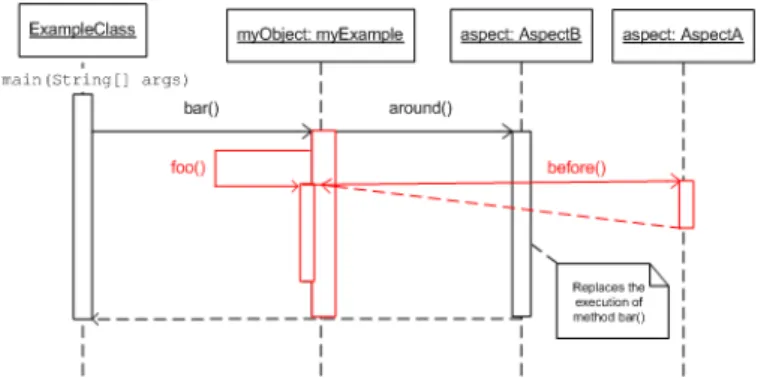
4.3 Advice around replaces the method execution . . . 43
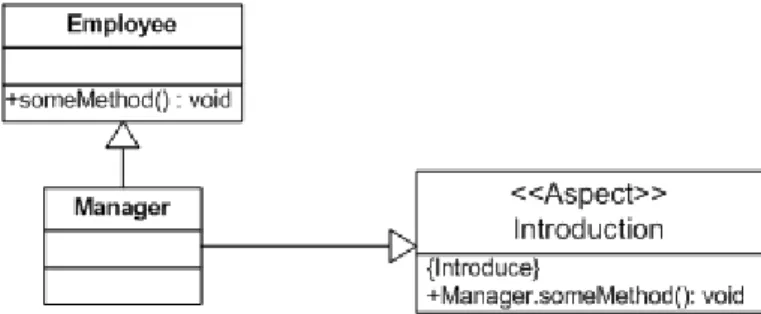
4.4 Introduction of a new method . . . 45
4.5 Conflict Resolution Categories. Extracted from [CPSM07]. . . 51
5.1 Eclipse extensibility, products can extend other products functionalities.Adapted from [iS09]. . . 54
5.2 Eclipse SDK layers. Adapted from [iS09]. . . 55
5.3 Build project on menu bar. . . 58
5.4 Build project on popup menu. . . 58
5.5 Open views menu. . . 59
5.6 Open conflict detector view. . . 59
List of Listings
2.1 Class ShoppingList . . . 8
2.2 Class Logger . . . 8
2.3 New ShoppingList Class . . . 9
2.4 Aspect Logging . . . 15
2.5 Final ShoppingList Class . . . 15
3.1 Violation of Language Rules . . . 25
3.2 Introduction has unintended effects . . . 26
3.3 Ambiguous aspect specification . . . 26
3.4 Class Product . . . 27
3.5 Declaration of a pointcut . . . 27
3.6 Introduction of annotations . . . 28
4.1 Pointcut payColaborators . . . 34
4.2 Define precedence between two aspects . . . 37
4.3 Class Object and aspects DoSomething and DoSomethingElse . . . 38
4.4 Solution . . . 39 4.5 Aspect checkRaise . . . 41 4.6 Aspect DBEmployeePersistence . . . 42 4.7 Annotation @TransientClass . . . 47 4.8 Annotation @TransientField . . . 47 4.9 Example . . . 49 4.10 Association LogAcc . . . 50 4.11 Example of a solution . . . 50 5.1 Method CompilationUnit . . . 55 5.2 ClassVisitor . . . 56 5.3 AspectVisitor . . . 56
Abbreviations
AIC Aspect Interactions Charts AJDT AspectJ Development Tools AOP Aspect-Oriented Programming
AOSD Aspect-Oriented Software Development API Application Programming Interface IDE Integrated Development Environment JDT Java Development Tools
LSC Live Sequence Charts MVC Model View Controller
PDE Plug-in Development Environment OOP Object-Oriented Programming RCP Rich Client Platform
SDK Software Development Kit SoC Separation of Concerns
Chapter 1
Introduction
The most important stages in software life cycle are the maintenance and the evolution, namely the addition of new modules that weren’t anticipated in previous stages.
Because Aspect-Oriented Programming (AOP) can be used to develop software in a better modularized way, many researchers are studying AOP as the ideal paradigm for this type of requirement. However there are some issues with this paradigm, unexpected interactions between aspects, that are still an obstacle in the applicability of AOP. These situations usually occur in big software projects where many developers and often new team members are involved in the process.
This dissertation addresses the issues of aspects interactions and the conflicts that arise from these interactions. A catalogue containing a description about these conflicts was produced as well as a small prototype to detect these conflicts in a software project.
1.1
Context
This master thesis addresses the feature interaction problem [AG95] in software devel-opment. A feature can be a component that adds a new functionality to the core of a software application. Generally features are added in different stages in the lifecycle of software development and usually this is done by different developers. The problem with feature interaction is that some features can compromise the correct behavior of other fea-tures.The behavior of a feature can be defined by the flow of its execution and the output for a given input. This means that the unwanted interaction changes the execution flow and output of the interacting features for a given input. These unwanted and unexpected interactions can really bring some serious issues on the development and maintenance of software.
Introduction
It is important to develop tools that can in fact detect and manage the interactions between the different features of a software application. The problem with managing feature interactions is how to differentiate the good and harmful ones and how to enable the desirable interactions. There are some techniques that can help to avoid or diminish unexpected feature interactions. Some of these techniques consist in the specification and development of system architectures with well defined interfaces that are used in the implementation of services or by establishing guidelines that are incorporated into the creation of services.
The same problems can occur in AOP, with unexpected interactions occurring when adding new modules to a system. We define here some of the most important concepts which will be discussed through this thesis.
The interference is the concept that will be recurrent. We can define interference as the action that one module does when disturbs the correct behavior of another module. The result of this interference is a conflict which can be of various types.
These unwanted interactions can bring some serious delay in the development of ap-plication. It is imperative to detect and solve or prevent these interactions to occur.
1.2
Motivation and Objectives
AOP is a programming paradigm that aims to improve modularity by allowing crosscut-ting concerns to be developed as single units of modularity. One of the major drawbacks of AOP is that unexpected interactions between aspects are more likely to occur than in normal Object Oriented Programming (OOP).
Unexpected interactions are a key issue with the evolution of AOP, which can seriously compromise the development process. It is important to address this problem by studying and documenting the origins of its problems.
The first objective of the thesis is to study AOP, this will be done by practicing pro-gramming exercises with the AspectJ language and understanding the architecture of AOP applications. The second objective is to study AOP interaction detection and to find out which classification systems researchers on this field use to classify interactions between aspects. The third and main objective of this thesis is the writing of a catalogue to doc-ument how these unexpected interactions occur and how they can be detected and dealt with, or even which preventive measure should be applyed in order to avoid them. The catalogue will contain a description and several examples of each type of interaction. This will be useful for future programmers when studying this new programming paradigm. The last objective is the implementation of a small prototype to detect unwanted interac-tions between aspects.
Introduction
1.3
Structure of the dissertation
This dissertation is divided in six chapters. The first chapter introduces the context of this thesis as well as its motivation and objectives. Chapter 2 introduces fundamental concepts about this field, compares OOP and AOP and explains the main advantages of AOP. Chapter 3 describes the several classifications of aspect interactions that authors have proposed and interaction detection techniques. Chapter 4 contains the catalogue with the description of each conflict. Chapter 5 explains the implementation of the prototype to detect conflicts between aspects. Finally chapter 6 presents the final conclusions about the thesis as well as some proposals for improvements on the catalogue and prototype.
Chapter 2
Aspect-Oriented Programming
2.1
Introduction
This chapter introduces the basics concepts of Aspect-Oriented Programming (AOP) and the main issues that led to the development of this paradigm. First we introduce one of the major problems that AOP addresses, the separation of concerns (SoC), it is explained and then a comparison is made between Object-Oriented Programming (OOP) and AOP, using the refactoring of a small example.
In the end of this section the Java and AspectJ languages are also compared in or-der to unor-derstand which are the new mechanisms that AspectJ has to offer to software programmers.
2.2
Separation of Concerns
Before introducing the concepts of aspect-oriented software development (AOSD), one must have to consider the principle of separation of concerns (SoC), which is one of the most important principles in software engineering. This principle considers that a sup-posed engineering problem involves several kinds of concerns, which can be identified and separated to handle with the complexity and to ensure the necessary software qual-ity factors such as robustness, adaptabilqual-ity, maintainabilqual-ity and reusabilqual-ity. Figure 2.1
illustrates the process of decomposing the requirements into a set of concerns.
Although there is a consensus that is important to design software systems having in attention the principle of separation of concerns, many ways to implement this feature have been created. In OOP the separated concerns are modeled as objects and classes. For example, the design pattern model-view-controller (MVC) separates content from presentation and data-processing from the content. Procedural programming separate
Aspect-Oriented Programming
concerns into procedures. Service-oriented design separates concerns into services. AOP separates concerns into its basic unit the aspect.
2.3
Object-Oriented Programming
OOP defines objects as the basic building block of a computer program.These ”objects” are introduced as a mean to define data or information and to represent interactions be-tween the several components of a program. OOP languages offer some powerful tech-niques like, information hiding (encapsulation), data abstraction, modularity, polymor-phism, and inheritance.
The definition and rules established in object oriented-programming paradigm make available some very important benefits: the mechanism of class inheritance makes it pos-sible to create subclasses of data objects, which inherit all of the parent class characteris-tics. This technique reduces development time and ensures a more robust coding. Security is one of the most important properties of a programming language. Since the class, only represents the information that it needs to be concerned with when it runs it will never accidentally access other program data. This is a great benefit since the system security is guaranteed and data will never be corrupted. The classes are reusable, not only to the ap-plication for which they are created but also by other object-oriented projects, and for this they are extremely useful for distributed applications to use in computer networks. Finally one of the major characteristic is that it enables us to create new data types, that were not defined previously in the programming language, as they usually are user-defined.
2.4
Java
Java is a OOP language. Unlike other programming languages Java isn’t compiled into native code, instead it is compiled into bytecode, which is later interpreted by a Java
Aspect-Oriented Programming
tual Machine, making Java a truly portable programming language. Java is distributed and is designed to supply powerful libraries with networking ability helping in the devel-opment of distributed software
It is a multithread programming language that enables to create a program with differ-ent threads at the same time. Java is also robust and secure due to its automatic garbage collector and its security manager that allows determining the accessibility options of a class.
Being an OOP language, Java offers some more technical features expected to this kind of programming languages. The Java inheritance allows classes to inherit methods and behaviors from its parent class; Java does not support multiple inheritance i.e. a class can’t have more than one class parent. One of the resources that inheritance provides is polymorphism, i.e. the ability that a method has to respond in different ways. This is called method overriding and it happens when a sub class redefines a method that was already declared on its parent class, with the same parameters and return type. A similar mechanism that Java offers is method overloading. It enables a class to define several with the same name, but have different numbers and type of parameters and may also have a different return type.
One of the most interesting features of Java is reflection. It enables one to exam-ine or modify the runtime behavior of applications running in the Java virtual machexam-ine. Although reflection may be a powerful tool, we must have in consideration that some is-sues may appear if it is not used correctly. We must have in consideration the following concerns when using Java reflection:
• Performance overhead since reflection need to resolve types dynamically.
• Security restrictions. Java has a security manager that controls accesses from classes, but this might not be possible with reflection because it requires a runtime permis-sion that may not be present when running under a security manager.
• Exposure of Internals. As reflection enables operations that were not legal in a non reflective code, such as accessing private fields and methods, this can lead to unexpected side effects.
2.4.1 Example Shopping List
Despite OOP introduced some of the most useful concepts for software development, there are some issues with this paradigm.
Consider the following requirements for a software project. A client needs an appli-cation to register products added to a shopping list.
For this problem there are two main concern: one is to register the total whenever a new product is added, and the second is log the changes to the total of the shopping list.
Aspect-Oriented Programming
We can model the shopping list in the class described in listing2.1, below
Listing 2.1: Class ShoppingList
1 public class ShoppingList {
2 private double total; 3
4 ShoppingList(){ 5 total=0; 6 }
7 public void addProduct(Product p){
8 //business logics add a new product to the list
9 }
10 public double getTotal(){
11 return total;
12 }
13 public void setTotal(double t){
14 total=t;
15 }
16 }
According to the first requirement, not everything is implemented, but only the es-sential for this demonstration. So far the properties of OOP are maintained, however the second requirement is not implement yet and will be demonstrated that it will break some of the SoC properties.
The next requirement is about logging all the changes to the total in the shopping list. For that we, must implement a class that logs the changing event. In listing2.2 we can see the logging code.
Listing 2.2: Class Logger
1 public class Logger { 2
3 Logger() {
4 //logger constructor
5 }
6
7 void writeLog(String message) {
8 //log the new value of total
9 }
10 }
Again the fundaments of OOP remain intact as the class Logger only implements its own concern. To use the Logger class we must initialize a logger object and then use the writeLogmethod to log the changes to the total variable.
To log the changes of the total variable the class ShopppingList, needs to be updated with the new functionalities.
Aspect-Oriented Programming
Listing 2.3: New ShoppingList Class
1 public class ShoppingList { 2
3 private double total;
4 Logger logger;
5
6 ShoppingList(){
7 total=0;
8 logger = new Logger();
9 }
10 public void addProduct(Product p){
11 //business logics add a new product to the list
12 logger.writeLog("total has been updated to "+ total);
13 }
14 public double getTotal(){ 15 return total;
16 }
17 public void setTotal(double t){ 18 total=t;
19 }
20 }
Now with the inclusion of the logger class code to the ShoppingList, the two concerns are now implemented in the same module making it less readable for future analysis.
Like any other technology, computer programming is constantly evolving according to the needs of programmers. With all the new programming paradigms, some problems are solved but unfortunately other issues appear. OOP isn’t satisfactory enough to imple-ment some of the design decisions that are desirable for the program. Traditional OOP languages and modularization mechanisms suffer from a limitation called the Tyranny of the Dominant Decomposition[DD02]. This limitation refers to the fact that the program can be modularized in only one way at a time, and the many kinds of concerns that do not align with that modularization end up scattered across many modules and tangled with one another.This ”tangled” code is very hard to develop and to maintain leading to great costs if some new functionality is needed to implement.
2.5
Aspect Oriented Programming
AOP is an emerging paradigm in the computer programming science. It can provide the modularity and separation of crosscutting concerns that others programming paradigms
Aspect-Oriented Programming
Figure 2.2: Code scattering in different classes. The same concern (grey rectangles)is defined in several places.
cannot achieve. With these new features that AOP brings to software development an easier solution to develop and maintain software code.
2.5.1 Code Scattering and Tangling
OOP has some flaws which can bring some issues that can be a problem to software evo-lution. Code scattering and tangling are the main problems. Code scattering means that the same piece of code is scattered across different modules of software system Figure2.2
depicts this situation. Code tangling Figure2.3is when one module contains a mix up of code that addresses several concerns. These two issues can increase software complexity, evolution and maintenance cost.
2.5.2 Quantification and Obliviousness
AOP comes to aid software developers to attend those two previous flaws. Robert Filman [FF00] [Fil01] states that an AOP application must have two important properties, quan-tification and obliviousness. Quanquan-tification is the ability to write small piece of code in one place that can affect other places of a programming system. In other words Filman says that quantification must support the expression of statements of the form:
Figure 2.3: Code tangling. This software module contains several concerns. Extracted from [Lad03].
Aspect-Oriented Programming
Figure 2.4: Aspect weaver.
In programs P, whenever condition C arises, perform action A.
Quantification involves the reuse of the functionality defined only in action A without requiring the programmer to write in all of the places in program P where condition C arises.
Obliviousness is achieved when software modules are not aware that other software module is colaborating with it. It also guarantees that the code for each concern is modu-larized making it easier to read and understand.
To implement an AOP application, first we start by coding the requisites that are needed for the project in question in an object-oriented programming language and then the programmer should deal with the separation of concerns by implementing the aspects. In the end, the code from the classes and the code from the aspects are weaved together into a final program, Figure2.4illustrates this final step.
2.6
AspectJ
AspectJ is the most commonly used programming language, when one uses the AOP paradigm, because of its simplicity and usability. AspectJ is an extension to the Java programming language, thus making its learning easier, for experienced programmers.
The primary element of AspectJ is the aspect. Aspects, looks just like a class, it has methods, variables, access restrictions. AspectJ, introduces the AOP elements that compose an aspect, joinpoints, pointcuts and advices [KM05][KHH+01][SB06].
2.6.1 Joinpoints
Joinpoints are identifiable at any point during the AspectJ implementation of a program. AspectJ allows different types of join points: entries and exits of methods, treatment of
Aspect-Oriented Programming
exceptions, access to variables of objects, constructors, among others.
To better understand AspectJ joinpoints, one must consider the basic principles of the Java programming language. For instance consider the previous class ShoppingList and its method setTotal(double). This piece of code states that whenever the method setTotal with a double argument is called on an object of the type ShoppingList, then its method body { total=t; } is executed.
A pattern can be identified with this description. It says that when something happens, then something gets executed. In object-oriented applications, there are some ”things that happen”, that are determined by the language. These are the joinpoints of Java Figure2.5, which can be method calls, executions of methods, instantiation of new objects, execu-tions of constructors, references to object fields and handler execuexecu-tions.
2.6.2 Pointcuts
Pointcuts are program constructs that can select one or more joinpoints and collect context at these joinpoints. For example, a pointcut can pick up an joinpoint that is a call to a method and capture the target object on which the method was invoked as well as its arguments.
AspectJ offers a variety of pointcuts constructs, some of the most important are pre-sented in the following list.
• Method execution - execution(void setTotal(double)); • Method call - call(void setTotal(double));
• Read access of a field - get(double ShoppingList.total); • Write access of a field - set(double ShoppingList.total); • Exception handling - handler(IOException);
• When the executed code belongs to the ShoppinList class - within(ShoppinList);
Aspect-Oriented Programming
• When the joinpoint is in the control flow of call to the method setTotal -cflow(void setTotal(double)));
• When the executed object is of the type ShoppingList - this(ShoppingList); • When the target object is of the type ShoppingList - target(ShoppingList).
To select the joinpoints, AspectJ offers operators to compose the compose the point-cuts.
• And operator selects a and b joinpoints - a && b; • Or operator selects a or b joinpoints - a | | b; • The not operator to exclude a joinpoint - !a.
Because pointcuts are built at a semantic level, AspectJ offers the use of wildcards as a means to construct pointcuts. This is very useful since one can select several joinpoints that have some different characteristics, such as return type, number of arguments, similar methods names etc.
• Selects all the joinpoints of any return type - call(* setTotal(double)); • All the joinpoints that start with the set word - call(* set*());
• Any joinpoints with different number of arguments - call(* setTotal(..)); 2.6.3 Advice
Joinpoins and pointcuts don’t do anything by themselves it’s the advices that really do the work in AOP. The advice is a bit of code to be executed at the junction selected for a pointcut. AspectJ has three different types of advices.
• Before advice runs as a joinpoint is reached, before the program proceeds with the join point. For example, a before advice on a method call join point runs before the actual method starts running, just after the arguments to the method call are evaluated.
• The after advice is opposite of the before advice; it runs just after the program proceeds with the joinpoint. There are different kinds of after advice, the after re-turning adviceexecutes after the joinpoints returns something, the after throwing handles the throw of an exception and the plain after advice handles the two situa-tions described here.
• The around advice is the most powerful, it has the ability to be executed before and after the joinpoint, and it also can even replace the execution of the joinpoint.
Aspect-Oriented Programming
2.6.4 Inter-Type Declarations and Reflection
AspectJ can provide some other mechanisms like introduction and reflection. Introduc-tions or inter-type declaraIntroduc-tions are the possibility to add new methods and variables to classes. The inheritance from a class can be modified with introductions too. Aspects can modify classes to implement one or more interfaces or to make one class inherit methods from a parent class. This last example follows the Java inheritance rules, i.e. multiple inheritance isn’t allowed in AspectJ.
The second mechanism, reflection, allows one to examine information about the ex-ecution of a pointcut. This reflective process is very useful in logging and debugging. Despite all these new functionalities that AspectJ offers, there are some conflicts that may arise between aspects. Since the main function of aspects is to interact with classes and others aspects, it is obvious at some point of a development of a new application that some aspects that were working previously with the expected behavior, they won’t work anymore with the introduction of new aspects or others modifications to the code.
2.6.5 Aspects
The more important element that AOP introduces is the aspect. Aspects are entities like Java classes, which are the basic block to implement aspect-oriented crosscutting con-cerns. The AspectJ compiler analyses the instructions defined in each aspect of the system and uses them to wove in with the Java code, modifying the behavior of the system.
These instructions that are in the aspect code are, of course, joinpoints, pointcuts, advices and member introductions.
We can see an aspect as a normal class, as it also has similar properties that a class has, like the ones listed below:
• Aspects can also have members and methods; • Aspects can define access specifications; • An aspect can be abstract;
• Aspects can extend classes and abstract aspects, as well as implement interfaces; • Aspects can be defined inside classes and interfaces;
• An aspect cannot be instantiated;
• Aspects cannot inherit from concrete aspects; • Aspects can be privileged.
Aspect-Oriented Programming
Now that some of the basic concepts of aspect-oriented programming have been in-troduced we can implement the previous example of the ShoppingList, modularizing it according to its concerns.
Let’s recall its previous requirements, the first one was to register the new total in ShoppingList and the second one was to log the action of adding a new product. The problem with the object-oriented approach was that the crosscutting concern of logging the change was introduced in the business logic of adding new product to the shopping list. With AspectJ it is possible to define the second concern in an independent aspect, that should be responsible for the logging operation. In the Logging aspect we can use a pointcut to capture the method which will add a new product. We can define a pointcut like the one in listing2.4, that will crosscut the method addProduct, and then the after advice will execute the logging operations defined in the software requirements. Listing
2.5 shows the class ShoppingList without the concern of logging action thus making it a truly oblivious system, which doesn’t know that the logging action will take place in another software module.
Listing 2.4: Aspect Logging
1 public aspect Logging{
2
3 Logger logger = new Logger ( ) ;
4
5 public pointcut change(ShoppinList l, double total):
6 execution(void addProduct ( Product)) && this(l) && args(total);
7
8 after(ShoppinList l, double total) : change(l,total){ 9
10 logger . writeLog ( "total has been updated to" + total ) ; 11
12 }
13 }
Listing 2.5: Final ShoppingList Class
1 public class ShoppingList {
2 private double total;
3
4 ShoppingList(){
5 total=0;
6 }
7 public void addProduct(Product p){
8 //business logics add a new product to the list
9 }
10 public double getTotal(){ 11 return total;
12 }
Aspect-Oriented Programming
14 total=t;
15 }
16 }
2.7
Key Issues of AOP
Despite the advantages that Aspect orientation has brought to the software development industry, it also has its own disadvantages, such as conflicts appearing in an unexpected way.
The most common conflicts in AOP tend to be semantic conflicts. This may happen when a pointcut isn’t correctly specified, or it is shared by more than one aspect. One of the most recurring conflict is when the order of execution between aspects isn’t the desirable by the programmer, this may appear when one adds a new aspect to the system and didn’t notice that it would interfere in a harmful way with other aspects. Since the code to be executed is weaved in the end by the compiler, this can interfere too with the expected functionality of the system, one must have in attention when this happens. The introduction mechanism that AspectJ implements is a source of conflicts too, which may introduce naming conflicts. Consider that one introduces a method in an interface with the name modifyItem, inside an aspect, in other aspect someone introduces a method with the same name in a class that implements the previous interface. This will lead to a conflict because the compiler doesn’t know which method to call.
Chapter 3
Aspect Interactions and Conflicts
3.1
Introduction
In this chapter the state of aspect interactions and conflicts is reviewed and therefore some of the most important work is presented here in order to understand the respective key issues. The first section starts by introducing some proposals by several authors to classify the different interactions aspects or its internal mechanisms.
We can now define one of the main issues discussed on this thesis, aspect interference. We can define aspect interference as the main consequence that occurs when one tries to weave two independently working aspects into a system and as result it will happen an unexpected behavior. This is of course the real definition of conflict when two opposing parts try to accomplish its own objectives.
Studies have been made in order to detect these conflicts, so in the second section of this chapter some most relevant techniques will be described.
3.2
Aspect Interactions Classifications
In this section the different types of interactions aspects are presented, to better understand the conflicts that may appear in aspect oriented programming. The relations between as-pects and its components are identified according to several authors that categorize aspect interactions within their own ideas and beliefs.
3.2.1 Katz Classification of Aspects
The first classification for aspect interaction was proposed by Katz [Kat04] he separates aspects in three distinct categories:
Aspect Interactions and Conflicts
• Spectative Aspects only observe the line of execution, gathering information about the variables of the system. The only variables that may change are its local vari-ables;
• Regulative Aspects have the same functions as the spectative aspect, but also can change the control flow of the execution i.e. can restrict the conditions for activating a method call of the original system;
• Invasive Aspects can change the variables or the state of the original system. 3.2.2 Munoz, Barais and Baudry Classification
Freddy Munoz, Olivier Barais and Benoit Baudry [MBB08] classify aspects interactions from three points of view. First they classify advices, according to its behavioral interac-tion between them and the methods that are crosscut by them. In this category there are five types of interaction:
• Augmentation: The crosscut method is always executed, and the advice augments the actions of the method with new actions that won’t interfere with the original behavior;
• Replacement: After the crosscut, the method will never be executed. Instead the advice replaces the behavior of the method with a new behavior;
• Conditional replacement: Following the crosscut of the method, it is not always executed. The advice checks for a condition and it will potentially replace the orig-inal behavior with a new one.
• Multiple: After the crosscut, the method is executed multiple times. The advice will invoke two or more times the method and it may change the intended behavior; • Crossing: Following the crosscutting of the method, the advice will invoke a method that it does not cross. This means that the advice has a dependency to the class that has the invoked method.
Next they classify, advice interaction according to the way they access the objects fields and method arguments.
• Write: An advice can write an object field. This access may break the protection that was declared on that particular field and can change the behavior of the pro-gram;
Aspect Interactions and Conflicts
• Read: When and advice reads a protected object field, this may expose critical data; • Argument passing: After crosscut, the advice changes the parameters of the method it crosscuts and then it invokes the method. The method is always executed at least once.
The last category presented classifies aspects according the modification that they in-troduce to the structure of a class.
• Hierarchy: The hierarchy of a class is modified. A good example for this would be, that an aspect adds a new parent interface to a class.
• Field addition: The aspect add new fields to a class.
• Operation addition: The aspects add new methods to a class. 3.2.3 Kienzle Classification
Kienzle [KYX03] proposed two classification criterias to evaluate aspect interaction, the activation mechanism and the dependencies to classify aspect interactions.
The activation mechanism is defined when one analyzes the functionality of a aspect. One can separate this category in two kinds: the autonomous and triggered. An aspect is autonomous if it doesn’t need to be called to perform its functionality, normally it does it’s actions continuously or periodically. The triggered aspects wait for others to activate it, and only then the aspect would execute.
The dependencies category has three kinds of dependencies: orthogonal, uni-directional and circular. The orthogonal aspect provides functionalities to the system that are abso-lutely independent from others functionalities of the system. An uni-directional aspect depends on one or more functionality delivered by others aspects in the system. The uni-directional aspects are divided: in uni-directional preserving, which deliver new services based on other aspects, but do not change the other services, thus preserving others aspects functionalities; and uni-directional modifying that replaces or modifies functionalities in the system.
Finally the circular dependencies, occur when one aspect depends on services pro-vided by other aspect which in turn the second aspects also depends on a service offered by the first aspect.
3.2.4 Frans Sanen et al. Classification
Frans Sanen et al.[STJ+06] distinguishes four distinct categories to classify different as-pects interactions. This classification is based on the different manners that aspect may interact with each other.
Aspect Interactions and Conflicts
• Mutual exclusion: happens when the interaction of mutual exclusiveness is en-capsulate. Take for example two aspects that execute similar algorithms, and the situation that only one aspect is needed. Negotiation will not take place because only one can be executed and the other cannot.
• Dependency: this category is similar to the ones presented in [KYX03], it happens when one aspect needs another aspect and therefore depends on it. This kind of dependency will not bring conflict as long as the aspect that has a dependant doesn’t change or isn’t erased.
• Reinforcement: occurs when an aspect interacts with another aspect in a positive manner, consequently reinforcing the functionality of the second aspect. For exam-ple one aspect can add new features to other aspect.
• Conflict:this category happens when one adds an aspect to a working system and as a result some of the aspects that were previously in the system may not work correctly.
3.2.5 Rinard, S˘alcianu and Bugrara Classification
Martin Rinard, Alexandru S˘alcianu, and Suhabe Bugrara [RSB04], have classified aspect interactions having in attention the relationship between advices and methods. They have identified two kinds of interaction:
• Direct interaction: occurs between advices and methods that the advice crosscuts • Indirect interactions: happens when advices and methods may access the same
object fields.
The direct interaction is divided in four categories. In Augmentation the method crosscut is always executed, the advice is orthogonal to the execution of the method. The logging aspects example is a clear augmentation type of interaction. Narrowing defines that after the crosscutting of the method one of the following situations occurs either the body of the method is executed or none of the body is executed. This interaction occurs whenever the advice checks safety conditions before the execution of the advice. In the Replacement interaction, the method will not execute at all, the advice will replace the entire body of the method. Finally, the Combination interaction will combine the crosscut method and the aspect in order to make a complete new behavior.
The indirect interactions define the scope which advices and methods have over the core of the application, as for example the access to objects and its fields. The Orthogonal
Aspect Interactions and Conflicts
interaction is when one advice and the method access different fields, in this situation the scopes of both are orthogonal. An interaction is Independent when neither the advice nor the method write or read a field that the other has access to read or write. The Observation is defined when the advice may read one or more fields that the method writes. The Actuation interaction is the opposite, this when the advice writes one or more fields that the method reads. At last, the Interference occurs when one advice and one method write in the same field, this is the real interference problem in AOP that are in the origin of many conflicts.
3.2.6 Clifton and Leavens Classification
Clifton and Leavens [RSB04] propose a much simpler aspect interaction definition. They define that the advices may be Spectators and Assistants. Spectators are advices that do not modify the control flow of an advised method and also don’t change fields, while Assistants can alter the control flow of the crosscut, method and change objects fields.
3.3
Conflicts Detection
Some of aspect interaction classifications presented in the previous section introduce the kinds of conflicts that are present in AOP. These conflicts are the consequence of the functionality that some mechanisms provide. Several authors have developed detection techniques in order to better understand how aspects interact with each other and possible conflict detection. This section will explain how some of these techniques are applied in AOSD.
One of the major problems with AOP is that when a new aspect is added to a system an unexpected behavior can occur. Due to the semantic nature of pointcuts, it is some-times difficult to assure that they will crosscut the expected methods and somesome-times they crosscut methods that weren’t supposed to be crosscut. This is clearly a semantic conflict. A semantic conflict is an emerging behavior that conflicts with the originally intended behavior of one or more of the involved components. This conflict arise when there are shared joinpoints in the code. This kind of conflict happens when there is no idea which aspect should execute first when we are in the presence of a shared joint point.
Consider the following example: a simple class that implements a protocol. It has two main functions sendData and receiveData. But the client wants two more requirements, encryption and logging . We are using AOP as our programming paradigm we should develop two aspects, EncryptionAspect to encrypt outgoing messages, decrypt ingoing
Aspect Interactions and Conflicts
Figure 3.1: Analysis of a semantic conflict. Adapted from [DBA05].
messages and finally LoggingAspect to keep track when both methods are executed. The conflict arises when these aspects are applied to the same joinpoint that led to an unde-sired behavior. The order of execution of the two aspects should be defined to avoid this situation. But in big software projects this may not be an easy task.
The way to detect this conflict was presented by Durr et al. [DBA05] It consists in a formalization that make possible to express a behavior and conflict detection rules.
For a better understanding of this, a resource model was developed to represent the critical behavior of an advice and for the detection of semantic conflicts between advices. Figure3.1explains the necessary steps for this technique.
The Pointcut Designators(PCD),are the inputs for the pointcut designator analysis phase. During this stage the PCDs are evaluated according to the base program.
The next stage of this technique is the abstraction phase. From the previous phase we get a sequence of advices per shared joinpoints. The resource model is the last input for this phase. Along this stage the sequence of advices are transformed into sequences of resource-operation tuples per shared join point.
The final stage has as input the operation sequences per resource per shared joinpoint, and the conflict detection rules. In the end of this stage a verdict is determined, i.e. if a conflict is present or not, for each that was previously obtained.
Aspect Interactions and Conflicts
Koppen and St¨orzer [SK04], have also proposed a technique to prevent the problem concerning pointcuts. The PointCut Delta Analysis is able to detect how many and which pointcuts have been added or eliminated. With this information, one can know exactly the steps taken before any conflict involving the pointcuts that may appear.
Their approach can be read as follows:
Let P be the program before, P’ the program after the edits. Let joinpoints (P) be a func-tion calculating all joinpoints for the given program P, advice( j,P) a funcfunc-tion listing all pieces of advice at a given joinpoint j in program P (for j∈ joinpoints(P)de f ineadvice( j, P) =/
/0). Let
JP =jointpoints(P’)∪ joint points(P) be the set of joinpoints in both program versions.
Let
add(P,P’) = S
j∈ JP
advice( j, P0) − advice( j, P)) be the set of additional advice matches and
del(P,P’) = S
j∈ JP
advice( j, P) − advice( j, P0)) the set of lost advice matches. We are then interested in the set
deltaPC(P,P’) = (add(P,P’)∪(del(P, P0))
Istv ´an Nagy,Lodewijk Bergmans and Mehmet Aksit [NBA04] have proposed a solu-tion which permits to specify the composisolu-tion of the aspects. They implemented a model that can be built in the various AOP languages. To build this model they have determined two constraints to specify the composition of aspects at shared joinpoints. These con-straints define the dependencies between advices. The Ordering concon-straints indicates the order of execution of a set of advices. The Control constraints, also affect the execution order too, but they can impose conditions on the execution of the advices.
Mehmet Aksit et al. [ARS09] have developed a very powerful technique for the de-tection of shared joinpoints, using graphs. This approach applies a graph transformation formalism to identify the different semantics of aspect-oriented programming languages
Aspect Interactions and Conflicts
Figure 3.2: Detection of shared join points. Adapted from [ARS09].
in a specific way. With this graph model it is possible to simulate the execution of as-pects, and one can observe the different advice orders and detect interferences between the aspects.
Figure 3.2 describes all the process of the technique, first the graph for each shared joinpoint is generated and then the semantics of the aspect-oriented language are speci-fied, with the help of the graph production rules. The graph of the shared joinpoint rep-resents a snapshot of the system, but only the fraction in which is needed for the current simulation. This is done in order to reduce the cost of the computation since it would be too expensive to simulate the entire system. The graph of the shared joinpoints and the se-mantics rules system are then passed to the simulator which will create a state space(LTS-labeled transition system) of the execution of the all the advices at a specific joinpoint in all possible order. With the LTS we can analyze the joinpoints, and detect any possible interference by comparing the results of all the possible orders of execution.
Havinga et al. [HNBA07] have identified conflicts which had their origin in the inter-type declaration also called introduction mechanism.
These composition conflicts happen, for example when one add a new method, vari-able, annotations or even change the inheritance struture. These changes can be intented
Aspect Interactions and Conflicts
but they may also be unintented causing a program to fail, compile or even become am-biguous.
Havinga has identified three types of errors that can bring conflicts related to the in-troductions:
3.3.1 Violation of Language Rules
In listing3.1we have two different aspects, both introduce a new method named saveChanges. Aspect PersistenceImplementation introduces this new method in all classes that imple-ments the interface Persistent. The second aspect ObjectCache adds a method with the same name to the class BusinessObject. At a first look it isn’t obvious that we are in the presence of a conflict, because the type patterns used to introduce these methods are dif-ferent. Though, as the BusinessObject class implements the Persistent interface, the two aspects introduce a method exactly with the same name to the class, which eventually will bring us a naming conflict.
Listing 3.1: Violation of Language Rules
1 public interface Persistent { ... }
2
3 public class BusinessObject implements Persistent { ... }
4
5 aspect PersistenceImplementation {
6 void Persistent.saveChanges() { db.update(...); }
7 }
8
9 aspect ObjectCache { ...
10 void BusinessObject.saveChanges(){ cache.setVal(...); }
11 }
3.3.2 Introduction has unintended effects
The introduction may have unexpected effects. The example in listing3.2 describes this situation. Aspect Printing introduces a new method named getSize in the class AlertDi-alog. But this introduction has a secondary effect, it overrides a method with the same name that the class AlertDialog already inherited from its parent class DialogWindow. This is clearly another type of conflict that can appear when one uses the introduction mechanism.
Aspect Interactions and Conflicts
Listing 3.2: Introduction has unintended effects
1 public class DialogWindow { 2
3 public Rect getSize() {
4 // return window dimension..};}
5
6 public class AlertDialog extends DialogWindow {
7
8 public AlertDialog(String alertMsg) {..}}
9
10 aspect Printing {
11
12 public Rect AlertDialog.getSize() {
13 // return paper dimension..} }
3.3.3 Ambiguous aspect specification
The third type of composition conflict is caused by composition specifications referencing and modifying the same program model. The structure of the program is changed when one introduces new modifications to the base class, but it is also ”queried” by the pointcut designators. It is possible that a pointcut can point to the new elements that were changed or introduced in an aspect. Therefore, introductions can influence the composition as specified by pointcuts. Listing3.3designates a pointcut, which selects all classes that im-plement the interface PersistentRoot. Nevertheless, classes can be modified to imim-plement this interface by using the declare parents construct. With this approach, the pointcut de-pends on this modification of the program structure. This may be intentionally, but these dependencies can be harmful and lead to ambiguous code.
Listing 3.3: Ambiguous aspect specification
1 declare parent: BusinessObject implements PersistentRoot; 2
3 pointcut persistence():
4 execution(* PersistentRoot+.*(..));
Havinga uses a graph-based approach to model and detect, composition conflicts re-lated to introductions. This method analyzes these conflicts by converting the struture of the source code of Java and AspectJ programs into a graph-based model. The introduc-tions made in the aspects code are converted into graph transformation rules that can be applied to the program model built previously. The model is then analysed with another tool and composition conflicts are modelled as graph matching patterns. These patterns
Aspect Interactions and Conflicts
are matched against the program model, in order to identify possible conflicts that exist in the program.
Havinga et al. [HNBA06] have also studied issues related to the introduction of anno-tations in AOP applications resulting in inter-dependencies conflicts. First, let’s introduce how annotations work in Java and AspectJ. Annotations in AspectJ can help preventing the problem with fragile pointcuts. In listing3.4the annotation @Persistent class Prod-uct, defines that the class Product has attached the annotation Persistence.
Listing 3.4: Class Product
1 @Persistent class Product{ 2
3 String name; 4 Double price;
5 }
The annotations can be applied to classes, methods and fields. Listing 3.5 shows an example of a pointcut declared with annotation. The first * refers that it will match any return type of the methods, the (@Persistent *), means that the class that contains the crosscut method needs to have the annotation Persistent. The rest of the pointcut specifies that all methods will be matched regardless their name and number and type of parameters. Since these pointcuts are specified with annotations, we can select joinpoints based on the design information, rather than using semantic patterns,assuring more robust pointcuts.
Listing 3.5: Declaration of a pointcut
1 pointcut isPersistent():
2 execution(* (@Persistent *).*(..));
The example above is quite useful in helping preventing the fragility of pointcuts, however the problem with annotations is when they are used in inter-types declarations. The annotations can bring dependencies between introductions of annotations, i.e. the order of the declaration of each annotation is important. If the order of the introductions isn’t specified, ambiguities may occur. Consider now listing3.6, the first line states that the annotation @TransientClass() is applied to the class SessionID and all its subclasses. The second line indicates that all the fields of class marked with the @TransientClass annotation, should be marked with the @TransientField annotation.
Aspect Interactions and Conflicts
Listing 3.6: Introduction of annotations
1 declare @type : SessionID+ : @TransientClass(); 2
3 declare @field: (@TransientClass *) * :@TransientField();
The above code doesn’t have any problem related with introduction of annotations, but if the order of the declaration is changed, i.e. if the declare field is introduced first, it wouldn’t have any effect on code. The second introduction clearly depends on the first statement, causing a dependency problem. This case is real simple to analyze but there are some cases that this analysis isn’t so easy to detect, because it can exist more than one level of dependency.
To help prevent this problem Havinga [HNBA06] proposed an algorithm that analyses the source code that contains annotations, detecting possible dependencies, and providing a correct resolution for any dependency that may exist.
Mussbacher et al. [MWA08] have proposed a new approach for the detection of inter-actions based on lightweight semantic annotations of aspect models.
Each aspect model is annotated with domain-specific markers and a separate goal model is used to describe how the semantic markers from other domains can influence each other. When the aspect models are composed, the resulting models are inspected to check for any semantic marker that can be a potential conflict. This is achieved by the propagation of values trough the goal model to detect which goals are satisfied by the composition and the ones that are not satisfied.
This technique can be used both to highlight potential aspect conflicts and to trade off aspects.
3.4
Program Slicing
The idea of program slicing analysis in AspectJ programs was suggested by Balzarotti [BM04]. This technique considers that a slice of a program is a set of statements which affect a certain point in an executable program. Because AspectJ programs are woven in the Java byte codes, which are executed by the Java Virtual Machine, he considers two slicing approaches:
• Advices and methods, are considered as first class entities. • Analyze the woven code.
Aspect Interactions and Conflicts
The condition to check non interfering aspects proposed by Balzarotti is the following one:
Let A1 and A2 be two aspects and S1 and S2 the corresponding backward slices obtained by using all the statements defined in A1 and A2 as slicing criteria. A1 does not interfere with A2 if:
A1∩S2 = /0
3.5
Regression Testing
Katz [Kat04] has suggested that regression testing can be used in order to detect harmful aspects that are added to a software system. It is a very simple idea this one. First the system is tested to see if it has any errors. If the system passes in the tests i.e. it has no errors, the new aspect can be added to the application and then the tests are run again to see if the system still works correctly. If an error occurs the test may need to be changed in order to be more explicit to the new aspect that was added, but if the system doesn’t pass the tests then we may be in the presence of a conflict.
3.6
Aspect Interactions Charts
All of the detection techniques mentioned before, are integrated in tools that analyze AOP programs in a static or a dynamic way, so it implies that some code has already been writ-ten. Shubhanan Bakre and Tzilla Elrad [BE07] have proposed another approach. They state that the detection of aspect interactions is the responsibility of the system design-ers and since the current modeling languages aren’t enough to capture the abstraction that aspect interactions require, they propose the use of Aspect Interactions Charts (AIC) which are build on Live Sequence Charts(LSC). These charts can be used to identify the numerous interactions between the various aspects at their join points.
3.7
Summary
This chapter has introduced the different classification systems of aspects interactions proposed by some authors. With these definitions it becomes easy to understand how aspects interact with each other. We can also notice that not only it is important to take in attention the aspects that interact in other aspect but also the mechanisms of the aspects are relevant to understand the origins of the conflicts that arise.
Despite the detection techniques that were introduced in the second section represent the most advanced tehcniques that we have at our diposal, these aren’t quite reliable as
Aspect Interactions and Conflicts
we should expected. This is because some of conflicts that exist in AOP are really hard to identify and some technique may even discover false negatives, i.e. some of the issues that detect may not really be conflicts.
We can conclude that the most important property of AOP can be also its Achilles kneel, the obliviousness that some authors praise so much can really bring some heavy problems to the AOP evolution.
Chapter 4
Catalogue of Conflicts
The objective of AOP is to improve modularity by allowing crosscutting concerns to be developed as single units of software. Despites all the advantages that AOP brings to software development it is not clean of critical issues. One of the major drawbacks of AOP is the unexpected interactions that occur between aspects that can be quite frequently than those that happen in normal OOP development.
The main objective of this master thesis was to write a catalogue containing a descrip-tion and examples of each type of conflicting interacdescrip-tion, in order to better understand how these interactions happen and how they can be detected. This catalogue will be ex-tremely helpful for future research work or to develop techniques and tools for conflict detection and resolution.
4.1
Catalogue Structure
The first thing to decide before composing the catalogue is to define the fields that should compose each catalogue entry. To get the much information as possible about a conflict the catalogue was composed having in attention six fields. The following list explains the function and what they mean of each field in the catalogue.
• Conflict Name: The name of the conflict;
• Description: A brief description about the conflict; • Context: The context in which the conflict may arise; • Category: The type of conflict;
Catalogue of Conflicts
• Resolution or Preventive Measures: Because not all conflicts have a solution some preventives actions are suggested in order to avoid further problems.
4.2
Conflicts Categories
To identify the conflicts that appear in AOP, it was important to study which were the causes of such problems. The best way to start the study on this issue was to under-stand how aspects could interact with each other. This was done by investigating how researchers classified interactions between aspects. Some of these classifications systems proved to be very useful when we started to write the catalog.
In some of the articles that were studied already contained some information about the conflicts. But the lack of some details about them introduced some difficulty to understand them. The other method used to identify the conflicts was the testing of some source code that could have conflicts. There are some examples in the catalogue that do not refer to any specific example, but these conflicts are possible to occur.
This catalogue aims to give a good resource about the conflicts. Other researchers may find this as a good guide when studying the same concepts that are documented.
We have distinguished three types of category to classify the conflicts. They are on the following list:
• Semantic Conflict: This conflict occurs because of the semantic nature of designat-ing pointcuts, and joinpoints. Normally these are the hardest conflicts to detect. • Behavioral Conflict: This category is called behavioral because these conflicts only
change the behavior of the system.
• Introduction Conflict: The Introduction conflicts have their origin when we add new members to classes.
4.3
Conflicts Documented
We have identified eight conflicts. Some may be very similar but are in fact a quite different when we analyze the source code example. The following list does a small presentation of them:
• Fragile Poincuts: This conflict occurs when one pointcut was working correctly, before a change of the original code. After the changing the pointcut doesn’t work anymore.
• Shared Joinpoint: Appears because it wasn’t defined the order of execution of aspects.
Catalogue of Conflicts
• Shared Variables: This conflict occurs when two aspects have read and write access to the same variable.
• Dependent Aspects: This situation occurs when one aspect depends on some con-dition of another aspect.
• Advice Interference: The advice around defined in one aspect replaces the ex-ecution of the method that it crosscuts. Because this method has a call to an-other method that is crosscut by anan-other aspect, the control flow of the program is changed.
• Incorrect Method Call: An aspect introduces a new method member in a class. That already inherits from its parent class a method with the same name of the new introduced method.
• Dependent Annotations: Annotations made in classes may be dependent so its declaration order is important to define.
• Incorrect Aspect Precedence: This isn’t a real conflict like the previous ones. It’s more a like a conflict that occurs in the requirements stage of the life cycle of soft-ware. Because the declare statement of AspectJ doesn’t support conditional execu-tion it may conflict with some requirement of a software project.
In the next sections all the documented conflicts are explained in detail according to each field that we defined to describe the conflicts.
Catalogue of Conflicts
4.4
Conflict Fragile Pointcuts
Description
This conflict occurs when one pointcut was working correctly, before a change of the original code. After the changing the pointcut doesn’t work anymore.
Context
Since software is constantly evolving, naturally, new implementations will be made to the software. These changes may be the addition of new pointcuts or deleting old ones, changing the original code etc.
Because pointcuts are defined at a semantic level it’s hard to guarantee that they in-tercept the correct methods, when using wildcards. The programmer has to be extremely careful when coding the pointcuts.
Category
Semantic Conflict Example
This kind of problem, isn’t a conflict per se. The difficulty here is that it will bring conflicts that didn’t exist before any code adjustment or due a bad coded pointcut. For in-stance take a look on listing 4.1, one can conclude that this point is too weak and will crosscut many methods. This pointcut is supposed to crosscut methods that pay the salaries of the collaborators of a company, but what if someone added a new method called payBills(), that would pay the bills that the company had. This pointcut would surely crosscut this method.
Listing 4.1: Pointcut payColaborators
1 public pointcut payColaborators(): 2 execution(* pay*(..));
Catalogue of Conflicts
Resolution or Preventive Measures
For this type of conflict the only resolution possible would be that programmers need to be very careful when coding pointcuts. They should take in attention the requirements of each project that they are working on.Therefore one must have in attention the strength of the pointcut, i.e., the pointcut can be too strong and capture only a few desired methods or too weak and will capture way too many methods.
![Figure 2.1: Decomposition of requirements into a set of concerns. Extracted from [Lad03].](https://thumb-eu.123doks.com/thumbv2/123dok_br/15001453.1009933/26.892.287.653.867.1076/figure-decomposition-requirements-set-concerns-extracted-lad.webp)
![Figure 2.3: Code tangling. This software module contains several concerns. Extracted from [Lad03].](https://thumb-eu.123doks.com/thumbv2/123dok_br/15001453.1009933/30.892.296.656.865.1052/figure-code-tangling-software-module-contains-concerns-extracted.webp)


![Figure 3.1: Analysis of a semantic conflict. Adapted from [DBA05].](https://thumb-eu.123doks.com/thumbv2/123dok_br/15001453.1009933/42.892.319.614.140.535/figure-analysis-semantic-conflict-adapted-dba.webp)
![Figure 3.2: Detection of shared join points. Adapted from [ARS09].](https://thumb-eu.123doks.com/thumbv2/123dok_br/15001453.1009933/44.892.337.604.142.541/figure-detection-shared-join-points-adapted-ars.webp)