2013/03/13
CMS-EXO-11-067
Search for new physics with long-lived particles decaying
to photons and missing energy in pp collisions at
√
s
=
7 TeV
The CMS Collaboration
∗Abstract
A search is performed for long-lived neutral particles decaying into a photon and in-visible particles. An example of such a signature is the decay of the lightest neutralino with nonzero lifetime into a gravitino and a photon in gauge-mediated supersymme-try, with the neutralino as the next-to-lightest supersymmetric particle and the grav-itino as the lightest. The search uses events containing photons, missing transverse energy, and jets. The impact parameter of the photon relative to the beam–beam col-lision point can be reconstructed using converted photons. The method is sensitive to lifetimes of the order of 0.1 to 1 ns. The data sample corresponds to an integrated luminosity of 2.23 fb−1in pp collisions at√s=7 TeV, recorded in the first part of 2011 by the CMS experiment at the LHC. Cross-section limits are presented on pair pro-duction for such particles, each of which decays into a photon and invisible particles. The observed 95% confidence level limits vary between 0.11 and 0.21 pb, depending on the neutral particle lifetime.
Submitted to the Journal of High Energy Physics
c
2013 CERN for the benefit of the CMS Collaboration. CC-BY-3.0 license
∗See Appendix A for the list of collaboration members
the standard model (SM), including models with gauge-mediated supersymmetry breaking (GMSB) [1–9] and certain classes of hidden valley models [10]. Such particles may be neutral and decay into photons and invisible particles, which escape detection. Their lifetime is es-sentially a free parameter of the models, which motivates searches sensitive to a wide range of potential lifetimes. For sufficiently long lifetimes, of order of 1 to 10 ns, measurement of the shower direction by the D0 experiment [11] or time-of-flight by the CDF experiment [12] with an electromagnetic calorimeter can be used to identify such decays, and limits have been obtained by using such techniques at the Tevatron.
In this paper, we present a new analysis method that is sensitive to neutral particles with life-times of the order of 0.1 to 1 ns. In a fraction of events, photons undergo conversion into e+e− pairs in the material of the LHC beam pipe or the CMS charged-particle tracking system, providing a clear experimental signature. The tracks of the electrons can be precisely recon-structed and used to calculate the photon trajectory. In particular, the photon impact parameter with respect to the primary vertex can be determined.
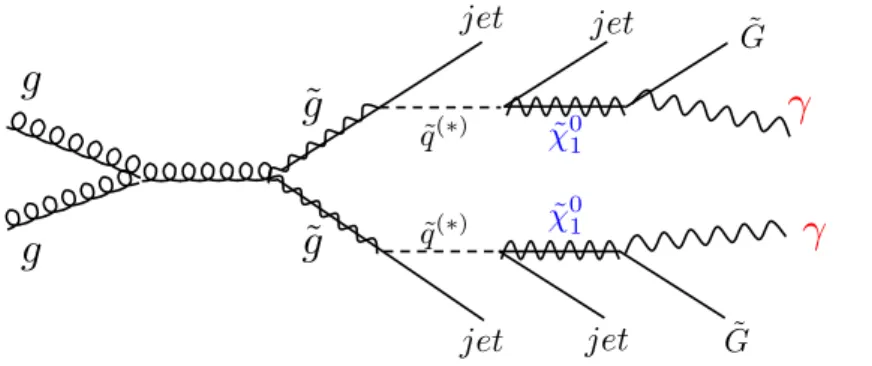
We search for diphoton events with at least one converted photon having a significant im-pact parameter produced in association with missing transverse energy. Models with gauge-mediated supersymmetry breaking, e.g., general gauge-mediation (GGM), are used to demon-strate the kinematics of the production and decay. Figure 1 shows one of the production and decay diagrams. Assuming that R-parity is conserved [13], SUSY particles are produced in pairs and decay into SM particles and the lightest neutralino (χe
0
1). The neutralino decays into
a photon and a gravitino ( eG), the lightest SUSY particle in this model, which escapes the de-tector, leading to apparent missing transverse energy ETmiss. Moreover, in many models, theχe
0 1
is produced in association with high transverse momentum (pT) jets. We consider neutralino
proper decay lengths between cτ =2 and 25 cm, corresponding to a lifetime τ on the order of 0.1 to 1 ns.
g
g
˜
g
˜
g
˜ q(⇤) ˜ q(⇤) ˜01 ˜01 jet jet jet jet ˜ G ˜ G Figure 1: Example diagram ofχe0
1pair production andχe
0
1 →γ+G decay.e
The data sample was collected in 2011 by the Compact Muon Solenoid (CMS) experiment at the LHC from proton–proton collisions at a center-of-mass energy of 7 TeV, corresponding to an integrated luminosity of 2.23±0.05 fb−1. A detailed description of the CMS detector can be found elsewhere [14]. The detector’s central feature is a superconducting solenoid pro-viding a 3.8 T axial magnetic field along the beam direction. Charged particle trajectories are measured by a silicon pixel and strip tracker system, covering 0 ≤ φ ≤ 2π in azimuth and |η| < 2.5, where pseudorapidity is defined as η = −ln tan θ/2, and θ is the polar angle with respect to the counterclockwise beam direction. The amount of material crossed by a particle
2 2 Event sample and selections
traversing the tracker volume from the interaction region varies from 0.4 to more than 2 ra-diation lengths, depending on the particle direction. A lead-tungstate crystal electromagnetic calorimeter (ECAL) and a brass–scintillator hadron calorimeter (HCAL) surround the tracker volume. For the barrel and endcap calorimeters (|η| <3.0), the modules are arranged in projec-tive towers. Muons are measured with gaseous detectors embedded in the steel return yoke of the magnet. The detector is nearly hermetic with calorimeter coverage up to|η| =5.0, allowing reliable measurement of EmissT .
The analysis strategy consists of selecting events with a diphoton final state with at least one converted photon, and then examining the impact parameter of each single photon for a dis-placed photon signal. Missing transverse energy and at least two jets are also required. The background is estimated using a low Emiss
T control sample. Upper limits on the cross section for
pair production of neutral particles, each of which decays into a photon and invisible particles, are then computed as a function of the neutral particle’s lifetime.
2
Event sample and selections
The data were recorded using the CMS two-level trigger system. This analysis selects events with at least two photons. A diphoton trigger is required with ECAL transverse energy thresh-olds ET set to values increasing from 32 (22) to 40 GeV (28 GeV) for the leading (sub-leading)
photon, as the instantaneous luminosity rose over the course of the data-taking period. To en-sure being on the plateau of the trigger efficiency, the offline analysis selects events with at least two photons with ET>45 GeV (30 GeV) for the leading (sub-leading) photon in the event. The
data sample is used both for the selection of signal candidates and for control samples used for background estimation.
ThePYTHIA 6.4 event generator [15] is used to simulate SUSY signal events. In particular, we
generate SUSY GMSB signal datasets in the SPS8 benchmark model [16] withΛ around 100 TeV. Every event in this sample has two neutralinos, each having a mass of 140 GeV. The neutralinos in each dataset have a specific mean lifetime. The signal selection efficiency can depend on the
e
χ01mass, but for masses around 100 GeV this dependence has a negligible effect in this analysis.
Each of the neutralinos decays to a photon and a light gravitino. The CMS detector response is fully simulated using GEANT4 [17].
Because of the high luminosity during the run, many events had multiple pp interactions lead-ing to a distribution of primary vertices, called “pile-up”. The pile-up conditions at high lu-minosity affect the event selections, in particular conversion reconstruction efficiencies. The generated pile-up distribution in the Monte Carlo samples was reweighted to reproduce the 2011 data-taking conditions.
The unconverted and converted photon candidates are reconstructed from clusters of energy in the ECAL. At least one photon candidate with transverse energy ET > 45 GeV and
re-constructed in the ECAL barrel region is required. The transverse distribution of energy in the associated cluster of ECAL crystals must be consistent with that expected from a pho-ton, and the energy detected in the HCAL behind the photon shower cannot exceed 5% of the ECAL energy. To suppress hadronic jets misreconstructed as photon candidates, we re-quire the latter to be isolated from other particles in the tracker, ECAL, and HCAL. A cone of ∆R = p
(∆η)2+ (∆φ)2 = 0.4 is constructed around the candidate’s direction, and the
scalar sums of transverse energies of tracks and calorimeter deposits within this cone are determined, after excluding the contribution from the candidate itself. The isolation sums are required to be ∑ EECAL < 0.006·ET +4.2 GeV, ∑ EHCAL < 0.0025·ET+2.2 GeV, and
track and not be part of a reconstructed conversion track pair.
Photon-like signals that satisfy the same requirements as photons except for isolation are de-fined as “fake photons”. These objects, predominantly jets containing energetic neutral parti-cles such as π0s, are used for the background estimation.
Jets are reconstructed from energy deposits in the calorimeters using the anti-kTclustering
al-gorithm [18]. The energies of these jets are corrected using the pT of the charged tracks
re-constructed in the tracker [19]. At least two jets are required with |η| ≤ 2.6 and leading jet transverse momentum pT1 >80 GeV and sub-leading jet transverse momentum pT2 >50 GeV.
Missing transverse energy is calculated from calorimeter energy deposits. It is corrected us-ing trackus-ing information for energy missed owus-ing to incomplete calorimeter measurements of muons and charged hadron energies, especially for soft tracks that do not reach the calorime-ters [20]. The EmissT threshold of 30 GeV discriminates between signal and background.
3
Photon conversion and the photon impact parameter
The CMS silicon tracker provides robust and precise reconstruction of charged-particle mo-menta in the high-occupancy environment of LHC collisions. Photon conversions in the tracker material can be used to obtain the photon direction. By extrapolation along the momentum di-rection from the conversion vertex back to the beam line, we can calculate the impact parameter of the displaced photons, as shown in Figure 2. If theχe
0
1has a nonzero lifetime, the decay
pho-ton can originate from a displaced secondary vertex rather than close to the primary vertex. The momentum direction determined from conversion tracks for this photon will point away from the primary vertex, giving a nonzero impact parameter (IP), which could be a signature for a long-livedχe
0
1signal. The conversion reconstruction efficiency is approximately 5%.
Primary vertex
˜
01˜
G
e
+ e LX LY dXY↵
ECAL cluster Primary vertexFigure 2: Left: Illustration of χe
0
1 → γ+G decay. Right: In x-y plane, a neutralino travelse with a finite lifetime and decays into γ+G. The diagram shows the photon converting into ane e+e− pair, and the subsequent reconstruction of the impact parameter.
4 3 Photon conversion and the photon impact parameter
to the beam line in the transverse plane to the beam. The longitudinal impact parameter dZ is
the distance of closest approach of the photon trajectory to the primary vertex projected on to the z direction. The photon trajectory is defined as a straight line from the conversion vertex along the conversion momentum. The impact parameters dXY and dZ are expressed in terms
of the vector~L = (LX, LY, LZ)between the conversion point and the primary vertex, and the
angle α of the conversion momentum vector~p projected on to the x-y plane as follows:
dXY = −LX·sin α+LY·cos α dZ = LZ− LX·pX+LY·pY pT · pZ pT . (1)
The momentum~p is calculated as the vector sum of the e+e− pair momenta at the conversion vertex.
The e+e− tracks at the conversion vertex are produced with a small opening angle. As a kine-matic constraint on their θ and φ angular directions, the momenta of the tracks are required to be parallel. This constraint is applied to select conversion tracks. Similarly, the conversion ver-tex is fitted using kinematic constraints. Three algorithms are used to reconstruct conversions: the “tracker-only” [21, 22], the “ECAL-seeded” [23], and the “Gaussian sum filter” (GSF) [24]. The tracker-only algorithm selects track pairs from all reconstructed tracks, with the kinematic constraint, and fits the conversion vertex; the ECAL-seeded algorithm takes the energy deposits in the ECAL as seeds and then extrapolates back to the tracker to fit the conversion tracks and vertices; the GSF electron algorithm follows a procedure similar to the tracker-only algorithm but uses electrons identified by the GSF algorithm to find the track pairs. The conversions from these three algorithms are merged and the duplicates are removed. Among the reconstructed conversion tracks, the one with the largest number of hits is kept if it passes the necessary quality cut. To be selected, the tracks of two opposite-signed conversion particles both need at least five valid hits; in addition, the conversion vertex requires a valid fit with χ2probability
>5×10⁻⁴.
In high luminosity conditions, multiple collisions occur within a single bunch crossing, pro-ducing a number of primary vertices. The true primary vertex can have a large deviation from the interaction point in the longitudinal direction but a much smaller uncertainty in the trans-verse direction. To be robust against pile-up conditions, the transtrans-verse impact parameter (dXY)
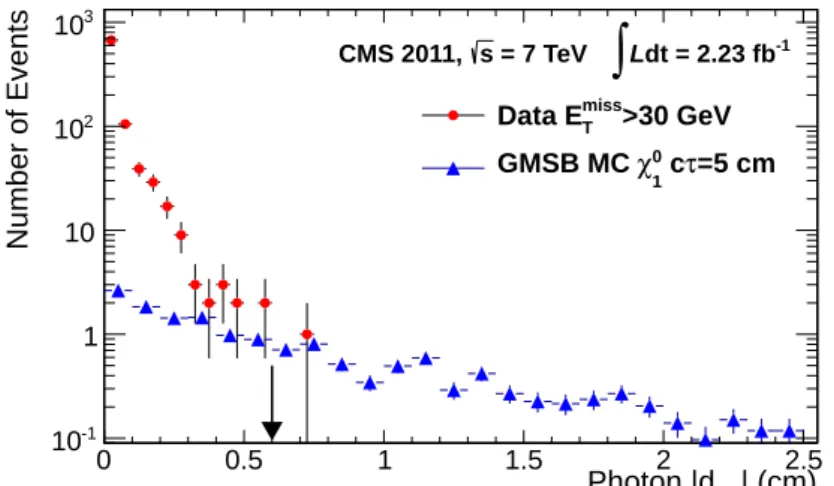
with respect to the transverse position of the beam line is used in this analysis. To illustrate the dXYsignature, the distribution of its absolute value in data for events with ETmiss >30 GeV
is compared with a Monte Carlo sample withχe
0
1 proper decay length cτ = 5 cm, as shown in
Figure 3. The requirement that|dXY|be larger than 0.6 cm then defines the signal region. This
cut on|dXY|is derived by optimizing the expected limits on the production cross section. This
limit-based optimization is cross-checked against an optimization on the expected signal sig-nificance, and the results obtained are the same. In addition, we evaluate the search for several values of the|dXY|cut, in the range from 0 to 1.0 cm, and establish that the results are stable for
both expected and observed limits. As seen in Figure 3, one event passes all selection criteria. The Monte Carlo sample is normalized to the integrated luminosity, and on average 8.3 events from the SPS8 benchmark model are expected to pass all selections.
The effect of the event selection is illustrated in Table 1 for the cτ = 5 cm sample. Of the 45 057 simulated events, 711 events survive the cuts, for an overall event selection efficiency of 1.58%. Efficiencies for four neutralino lifetimes are given in Table 2. On average, the signal efficiency is about 1% to 2% after the trigger requirements and selection criteria are applied. Beyond cτ = 25 cm, the signal efficiency decreases due to the limitations of the tracking algorithms for
| (cm) XY Photon |d 0 0.5 1 1.5 2 2.5 Number of Events -1 10 1 10 2 10 >30 GeV miss T Data E =5 cm τ c 0 1 χ GMSB MC
Figure 3: The|dXY|distribution for data with ETmiss>30 GeV compared with signal simulation
for cτ = 5 cm normalized to the integrated luminosity of the data. The arrow indicates the|dXY|
requirement of the signal region.
reconstructing highly displaced tracks.
Table 1: Signal selection cut flow for cτ = 5 cm.
Selection Events in Monte Carlo
Total 45057
Diphoton trigger 39988
Leading (sub-leading) photon
ET >45 (30) GeV 37398
Any ECAL barrel photon ET>45 GeV
and photon identification 27766 Jets pT1 >80 GeV and pT2 >50 GeV 26229
Conversion selection 1602 EmissT >30 GeV 1542
|dXY| >0.6 cm 711
Table 2: Event selection efficiency vs.χe
0
1proper decay length.
cτ [cm] 2 5 10 25
Efficiency 0.92% 1.58% 1.80% 1.39% Statistical errors 0.05% 0.06% 0.06% 0.06%
4
Background determination
The background contributions to the sample of events with photon-plus-jets with missing transverse energy arise mainly from QCD events with real photons, and QCD multijet events, due to the effect of finite detector resolution on the measurement of Emiss
T . In QCD events with
real photons, there are typically one real photon and one jet that is misidentified as a pho-ton in the final selection. The rate of QCD multijet events is sufficiently large to have a finite probability for jets to be misidentified as photons. There are additional sources of background
6 5 Systematic uncertainties
with intrinsic missing transverse energy, such as the W+jets process, but these are heavily sup-pressed by the ETcut for the photon and make a negligible contribution to the final selection.
The χe
0
1 → γ+G decay has two signatures: Ee missT from the unseen eG and a large impact pa-rameter from the displaced photons. The strategy for determining the background is to use control samples that are kinematically similar to the candidate sample while having no real Emiss
T . The data with ETmiss < 20 GeV are selected as such a control sample. The background
is then estimated as the number of events with Emiss
T < 20 GeV and satisfying all the other
selection criteria.
To ensure that the EmissT < 20 GeV region of data gives a correct estimation of the background, the|dXY|distributions of fake photons, defined previously, and isolated photons are compared.
First, the|dXY|distribution of fake photons for events with ETmiss<20 GeV (background region)
is normalized by the total number of conversions and compared with the|dXY|distribution of
fake photons in the region where Emiss
T > 30 GeV (signal region), as shown in Figure 4(top).
The |dXY| distribution in the ETmiss < 20 GeV (background) region is reweighted by the
con-version vertex χ2 probability of the ETmiss < 20 GeV (signal) region. This takes into account that the distributions of the χ2 probability are not the same in the background and signal re-gion. Second, the |dXY| distributions of isolated photons and fake photons in the low EmissT
region are compared by normalizing to the total number of conversions, also reweighted by the conversion vertex χ2 probability, as shown in Figure 4(bottom). The|dXY|distributions of
fake photons and isolated photons agree, and thus we conclude that the|dXY|distribution for
events with Emiss
T < 20 GeV gives a good description of the background. The residual
differ-ences in the fake and isolated photon distributions in the low Emiss
T control sample are consistent
with the expected enhancement of jets misreconstructed as photons in the fake photon sample. We therefore take the isolated photon sample in the low EmissT control sample as the basis for the background estimate in the signal region, after we apply conversion vertex χ2probability reweighting.
The isolated photon |dXY|distributions for the signal and background regions are shown in
Figure 5. They are normalized to the same number of conversions and reweighted by the conversion vertex χ2 probability to predict the number of background events. A requirement
that |dXY| > 0.6 cm is applied to the background region ETmiss < 20 GeV, which gives a total
background of 0.78+−1.250.48events. As a cross check, Monte Carlo background samples are fitted with a general functional form to extrapolate the expected tail of events for isolated photons beyond the|dXY| >0.6 cm cut. Applying this general functional form to the background
sam-ple derived from data and integrating the expected rate above the|dXY| > 0.6 cm cut gives a
background estimate consistent with the number quoted above.
5
Systematic uncertainties
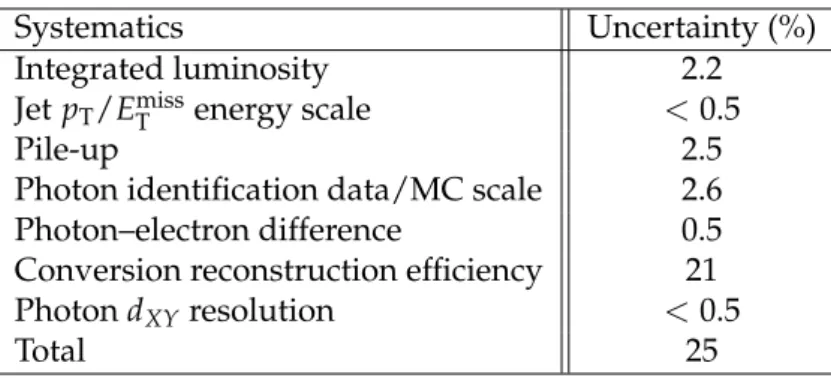
Table 3 summarizes the systematic uncertainties affecting this analysis. To determine the un-certainty in the conversion reconstruction efficiency, we compared the predicted and observed numbers of conversions for Z → µµγevents. For photons with ET > 20 GeV, a scale factor of
0.87±0.08 is derived. High ETphotons have a reconstruction efficiency of(7.0±0.5)% in the
Drell–Yan to dimuon Monte Carlo samples, and the corresponding high ET photon efficiency
in the GMSB Monte Carlo samples is(6.0±0.7)%, yielding a Z → µµγ–GMSB scale factor of
1.16±0.08. Considering the correlations between the conversion reconstruction efficiency and the high-ETdependence, the uncertainty of conversion reconstruction is determined to be 21%
| (cm) XY Photon |d 0 0.5 1 1.5 2 2.5 Number of Events -1 10 1 10 2 10 <20 GeV miss T Fake Photons E >30 GeV miss T Fake Photons E | (cm) XY Photon |d 0 0.5 1 1.5 2 2.5 Number of Events -1 10 1 10 2 10 3 10 <20 GeV miss T Isolated Photons E <20 GeV miss T Fake Photons E -1 dt = 2.23 fb L
∫
= 7 TeV s CMS 2011,Figure 4: Top: Fake photon|dXY|distributions in the background (EmissT < 20 GeV) and signal
(EmissT > 30 GeV) regions. Bottom: Isolated and fake photon |dXY| distributions in the
back-ground region (EmissT <20 GeV).
| (cm) XY Photon |d 0 0.2 0.4 0.6 0.8 1 1.2 1.4 Number of Events -1 10 1 10 2 10 3 10 -1 dt = 2.23 fb L
∫
= 7 TeV s CMS 2011, <20 GeV miss T Isolated Photons E >30 GeV miss T Isolated Photons EFigure 5: |dXY|distributions for isolated photons: background region (EmissT < 20 GeV)
8 6 Results and interpretation
The dXY resolution is studied by comparing the dXY resolution for converted photons from
Z → µµγevents between Monte Carlo and data. The data and Monte Carlo samples are in
agreement and a dXYresolution of 0.06 cm extracted from data gives less than 0.5% uncertainty
for the signal selection. The resolution uncertainty includes tails in the fitted resolution func-tion.
Other sources of uncertainty include the integrated luminosity (2.2%), the jet pT/ETmissselection
requirement, and photon identification. The jet pT/EmissT resolution contributes less than 0.5%
to the total uncertainty [19, 20]. The photon identification efficiency is studied in [25] and includes the uncertainties from pile-up (2.5%), the photon data/MC scale measured in a Z→ee data sample (2.6%), and the photon–electron identification difference as studied in MC samples (0.5%). Other sources of uncertainty give negligible contributions to the systematic uncertainty. The systematic error from the dXY cut is taken into account when evaluating the limits on the
contribution from the photon dXYresolution. The total systematic uncertainty is determined to
be 25% by considering all the correlations among pile-up, photon identification data/MC scale, and conversion reconstruction efficiency.
Table 3: Summary of systematic uncertainties. Systematics Uncertainty (%) Integrated luminosity 2.2 Jet pT/EmissT energy scale <0.5
Pile-up 2.5
Photon identification data/MC scale 2.6 Photon–electron difference 0.5 Conversion reconstruction efficiency 21 Photon dXYresolution <0.5
Total 25
6
Results and interpretation
One event with|dXY| = 0.74 cm and ETmiss= 44.9 GeV satisfying all the other selection criteria
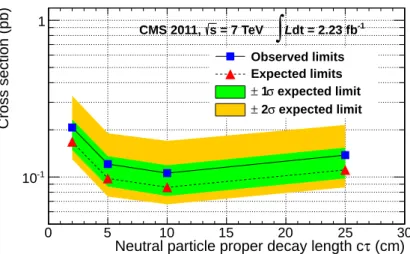
is observed. The estimated background is 0.78+−1.250.48 events. We determine the upper limits for the cross section for pair production of neutral particles, each of which decays into one photon and invisible particles. A CLs limit setting method [26, 27] is employed using log-normal uncertainties for the total background rate to incorporate the uncertainties in the total background rate, integrated luminosity, and total acceptance times efficiency. The observed 95% confidence level limits vary between 0.11 and 0.21 pb, depending on the neutral particle proper decay length (Table 4 and Figure 6).
Table 4: 95% confidence level (CL) upper limits on the cross section for pair production of neutral particles, each of which decays into a photon and invisible particles, as a function of the neutral particle proper decay length.
cτ (cm) 2 5 10 25
(cm)
τ
Neutral particle proper decay length c
0 5 10 15 20 25 30 Cross section (pb) -1 10 Observed limits Expected limits expected limit σ 1 ± expected limit σ 2 ±
Figure 6: 95% confidence level upper limits on the pair production cross section for neutral particles, each of which decays into a photon and invisible particles, as a function of the neutral particle proper decay length. The observed values as a function of the neutral particle proper decay length are shown by the solid line. The dashed line indicates the expected median of results for the background-only hypothesis, while the green (dark) and yellow (light) bands indicate the ranges that are expected to contain 68% and 95% of all observed excursions from the median, respectively.
7
Summary
We have introduced a novel method using the photon conversion impact parameter to search for new physics involving long-lived particles decaying into photons. The high resolution of the impact parameter reconstruction enabled our analysis to probe for new physics to much lower values of EmissT compared to other LHC searches [25]. The search was performed using the final state of photons, jets, and missing transverse energy. Cross-section limits on pair production for such particles, each of which decays into a photon and invisible particles, were set as a function of the long-lived particle’s lifetime. These upper limits are applicable to a general class of new physics processes with diphotons in the final state.
Acknowledgments
We congratulate our colleagues in the CERN accelerator departments for the excellent performance of the LHC machine. We thank the technical and administrative staff at CERN and other CMS institutes, and acknowledge support from: FMSR (Austria); FNRS and FWO (Belgium); CNPq, CAPES, FAPERJ, and FAPESP (Brazil); MES (Bulgaria); CERN; CAS, MoST, and NSFC (China); COLCIENCIAS (Colombia); MSES (Croatia); RPF (Cyprus); MoER,
SF0690030s09 and ERDF (Estonia); Academy of Finland, MEC, and HIP (Finland); CEA and CNRS/IN2P3 (France); BMBF, DFG, and HGF (Germany); GSRT (Greece); OTKA and NKTH (Hungary); DAE and DST (India); IPM (Iran); SFI (Ireland); INFN (Italy); NRF and WCU (Korea); LAS (Lithuania); CINVESTAV, CONACYT, SEP, and UASLP-FAI (Mexico); MSI (New Zealand); PAEC (Pakistan); MSHE and NSC (Poland); FCT (Portugal); JINR (Armenia,
Belarus, Georgia, Ukraine, Uzbekistan); MON, RosAtom, RAS and RFBR (Russia); MSTD (Serbia); MICINN and CPAN (Spain); Swiss Funding Agencies (Switzerland); NSC (Taipei); TUBITAK and TAEK (Turkey); STFC (United Kingdom); DOE and NSF (USA).
10 References
References
[1] S. Ambrosanio et al., “Search for supersymmetry with a light gravitino at the Fermilab Tevatron and CERN LEP colliders”, Phys. Rev. D 54 (1996) 5395,
doi:10.1103/PhysRevD.54.5395, arXiv:hep-ph/9605398.
[2] S. Dimopoulos, S. D. Thomas, and J. D. Wells, “Sparticle spectroscopy and electroweak symmetry breaking with gauge mediated supersymmetry breaking”, Nucl. Phys. B 488 (1997) 39, doi:10.1016/S0550-3213(97)00030-8, arXiv:hep-ph/9609434. [3] G. F. Giudice and R. Rattazzi, “Theories with gauge mediated supersymmetry breaking”,
Phys. Rept. 322 (1999) 419, doi:10.1016/S0370-1573(99)00042-3, arXiv:hep-ph/9801271.
[4] L. M. Carpenter, “Surveying the phenomenology of general gauge mediation”, (2008). arXiv:0812.2051.
[5] A. Rajaraman et al., “Parameter space of general gauge mediation”, Phys. Lett. B 678 (2009) 367, doi:10.1016/j.physletb.2009.06.047, arXiv:0903.0668.
[6] S. Abel et al., “Phenomenology of pure general gauge mediation”, JHEP 0912 (2009) 001, doi:10.1088/1126-6708/2009/12/001, arXiv:0910.2674.
[7] P. Meade, M. Reece, and D. Shih, “Prompt decays of general neutralino NLSPs at the Tevatron”, JHEP 1005 (2010) 105, doi:10.1007/JHEP05(2010)105,
arXiv:0911.4130.
[8] P. Meade, M. Reece, and D. Shih, “Long-lived neutralino NLSPs”, JHEP 1010 (2010) 067, doi:10.1007/JHEP10(2010)067, arXiv:1006.4575.
[9] J. T. Ruderman and D. Shih, “General neutralino NLSPs at the early LHC”, (2011). arXiv:1103.6083.
[10] M. J. Strassler and K. M. Zurek, “Echoes of a hidden valley at hadron colliders”, Phys. Lett. B 651 (2007) 374, doi:10.1016/j.physletb.2007.06.055,
arXiv:hep-ph/0604261.
[11] D0 Collaboration, “Search for long-lived particles decaying into electron or photon pairs with the D0 detector”, Phys. Rev. Lett. 101 (2008) 111802,
doi:10.1103/PhysRevLett.101.111802, arXiv:0806.2223.
[12] CDF Collaboration, “Search for heavy, long-lived particles that decay to photons at CDF II”, Phys. Rev. Lett. 99 (2007) 121801, doi:10.1103/PhysRevLett.99.121801, arXiv:0704.0760.
[13] G. R. Farrar and P. Fayet, “Phenomenology of the production, decay, and detection of new hadronic states associated with supersymmetry”, Phys. Lett. B 76 (1978) 575, doi:10.1016/0370-2693(78)90858-4.
[14] CMS Collaboration, “The CMS experiment at the CERN LHC”, JINST 0803 (2008) S08004, doi:10.1088/1748-0221/3/08/S08004.
[15] T. Sj ¨ostrand, S. Mrenna, and P. Z. Skands, “PYTHIA 6.4 physics and manual”, JHEP 0605 (2006) 026, doi:10.1088/1126-6708/2006/05/026, arXiv:hep-ph/0603175.
[17] GEANT4 Collaboration, “GEANT4–a simulation toolkit”, Nucl. Instrum. Meth. A 506 (2003) 250, doi:10.1016/S0168-9002(03)01368-8.
[18] M. Cacciari, G. P. Salam, and G. Soyez, “The anti-k(t) jet clustering algorithm”, JHEP
0804(2008) 063, doi:10.1088/1126-6708/2008/04/063, arXiv:0802.1189. [19] CMS Collaboration, “Jet Performance in pp Collisions at√s=7 TeV”, CMS Physics
Analysis Summary CMS-PAS-JME-10-003, (2010).
[20] CMS Collaboration, “Missing transverse energy performance of the CMS detector”, J. Instrum. 6 (2011) P09001, doi:10.1088/1748-0221/6/09/P09001.
[21] CMS Collaboration, “CMS tracking performance results from early LHC operation”, Eur. Phys. J. C 70 (2010) 1165, doi:10.1140/epjc/s10052-010-1491-3.
[22] CMS Collaboration, “Studies of Tracker Material in the CMS Detector”, CMS Physics Analysis Summary CMS-PAS-TRK-10-003, (2010).
[23] N. Marinelli, “Track finding and identification of converted photons”, CMS NOTE 2006/005, (2006).
[24] CMS Collaboration, “Electromagnetic physics objects commissioning with first LHC data”, CMS Physics Analysis Summary CMS-PAS-EGM-10-001, (2010).
[25] CMS Collaboration, “Search for supersymmetry in pp collisions at√s=7 TeV in events with two photons and missing transverse energy”, Phys. Rev. Lett. 106 (2011) 211802, doi:10.1103/PhysRevLett.106.211802, arXiv:1103.0953.
[26] A. L. Read, “Presentation of search results: the CL(s) technique”, J. Phys. G 28 (2002) 2693, doi:10.1088/0954-3899/28/10/313.
[27] L. Moneta et al., “The RooStats Project”, in 13thInternational Workshop on Advanced Computing and Analysis Techniques in Physics Research (ACAT2010). SISSA, 2010. arXiv:1009.1003. PoS(ACAT2010)057.
S. Chatrchyan, V. Khachatryan, A.M. Sirunyan, A. Tumasyan
Institut f ¨ur Hochenergiephysik der OeAW, Wien, Austria
W. Adam, E. Aguilo, T. Bergauer, M. Dragicevic, J. Er ¨o, C. Fabjan1, M. Friedl, R. Fr ¨uhwirth1, V.M. Ghete, J. Hammer, N. H ¨ormann, J. Hrubec, M. Jeitler1, W. Kiesenhofer, V. Kn ¨unz, M. Krammer1, I. Kr¨atschmer, D. Liko, I. Mikulec, M. Pernicka†, B. Rahbaran, C. Rohringer,
H. Rohringer, R. Sch ¨ofbeck, J. Strauss, A. Taurok, W. Waltenberger, G. Walzel, E. Widl, C.-E. Wulz1
National Centre for Particle and High Energy Physics, Minsk, Belarus
V. Mossolov, N. Shumeiko, J. Suarez Gonzalez
Universiteit Antwerpen, Antwerpen, Belgium
M. Bansal, S. Bansal, T. Cornelis, E.A. De Wolf, X. Janssen, S. Luyckx, L. Mucibello, S. Ochesanu, B. Roland, R. Rougny, M. Selvaggi, Z. Staykova, H. Van Haevermaet, P. Van Mechelen, N. Van Remortel, A. Van Spilbeeck
Vrije Universiteit Brussel, Brussel, Belgium
F. Blekman, S. Blyweert, J. D’Hondt, R. Gonzalez Suarez, A. Kalogeropoulos, M. Maes, A. Olbrechts, W. Van Doninck, P. Van Mulders, G.P. Van Onsem, I. Villella
Universit´e Libre de Bruxelles, Bruxelles, Belgium
B. Clerbaux, G. De Lentdecker, V. Dero, A.P.R. Gay, T. Hreus, A. L´eonard, P.E. Marage, T. Reis, L. Thomas, G. Vander Marcken, C. Vander Velde, P. Vanlaer, J. Wang
Ghent University, Ghent, Belgium
V. Adler, K. Beernaert, A. Cimmino, S. Costantini, G. Garcia, M. Grunewald, B. Klein, J. Lellouch, A. Marinov, J. Mccartin, A.A. Ocampo Rios, D. Ryckbosch, N. Strobbe, F. Thyssen, M. Tytgat, P. Verwilligen, S. Walsh, E. Yazgan, N. Zaganidis
Universit´e Catholique de Louvain, Louvain-la-Neuve, Belgium
S. Basegmez, G. Bruno, R. Castello, L. Ceard, C. Delaere, T. du Pree, D. Favart, L. Forthomme, A. Giammanco2, J. Hollar, V. Lemaitre, J. Liao, O. Militaru, C. Nuttens, D. Pagano, A. Pin, K. Piotrzkowski, N. Schul, J.M. Vizan Garcia
Universit´e de Mons, Mons, Belgium
N. Beliy, T. Caebergs, E. Daubie, G.H. Hammad
Centro Brasileiro de Pesquisas Fisicas, Rio de Janeiro, Brazil
G.A. Alves, M. Correa Martins Junior, D. De Jesus Damiao, T. Martins, M.E. Pol, M.H.G. Souza
Universidade do Estado do Rio de Janeiro, Rio de Janeiro, Brazil
W.L. Ald´a J ´unior, W. Carvalho, A. Cust ´odio, E.M. Da Costa, C. De Oliveira Martins, S. Fonseca De Souza, D. Matos Figueiredo, L. Mundim, H. Nogima, V. Oguri, W.L. Prado Da Silva, A. Santoro, L. Soares Jorge, A. Sznajder
Instituto de Fisica Teorica, Universidade Estadual Paulista, Sao Paulo, Brazil
T.S. Anjos3, C.A. Bernardes3, F.A. Dias4, T.R. Fernandez Perez Tomei, E. M. Gregores3, C. Lagana, F. Marinho, P.G. Mercadante3, S.F. Novaes, Sandra S. Padula
Institute for Nuclear Research and Nuclear Energy, Sofia, Bulgaria
V. Genchev5, P. Iaydjiev5, S. Piperov, M. Rodozov, S. Stoykova, G. Sultanov, V. Tcholakov,
14 A The CMS Collaboration
University of Sofia, Sofia, Bulgaria
A. Dimitrov, R. Hadjiiska, V. Kozhuharov, L. Litov, B. Pavlov, P. Petkov
Institute of High Energy Physics, Beijing, China
J.G. Bian, G.M. Chen, H.S. Chen, C.H. Jiang, D. Liang, S. Liang, X. Meng, J. Tao, J. Wang, X. Wang, Z. Wang, H. Xiao, M. Xu, J. Zang, Z. Zhang
State Key Lab. of Nucl. Phys. and Tech., Peking University, Beijing, China
C. Asawatangtrakuldee, Y. Ban, Y. Guo, W. Li, S. Liu, Y. Mao, S.J. Qian, H. Teng, D. Wang, L. Zhang, W. Zou
Universidad de Los Andes, Bogota, Colombia
C. Avila, J.P. Gomez, B. Gomez Moreno, A.F. Osorio Oliveros, J.C. Sanabria
Technical University of Split, Split, Croatia
N. Godinovic, D. Lelas, R. Plestina6, D. Polic, I. Puljak5
University of Split, Split, Croatia
Z. Antunovic, M. Kovac
Institute Rudjer Boskovic, Zagreb, Croatia
V. Brigljevic, S. Duric, K. Kadija, J. Luetic, S. Morovic
University of Cyprus, Nicosia, Cyprus
A. Attikis, M. Galanti, G. Mavromanolakis, J. Mousa, C. Nicolaou, F. Ptochos, P.A. Razis
Charles University, Prague, Czech Republic
M. Finger, M. Finger Jr.
Academy of Scientific Research and Technology of the Arab Republic of Egypt, Egyptian Network of High Energy Physics, Cairo, Egypt
Y. Assran7, S. Elgammal8, A. Ellithi Kamel9, S. Khalil8, M.A. Mahmoud10, A. Radi11,12
National Institute of Chemical Physics and Biophysics, Tallinn, Estonia
M. Kadastik, M. M ¨untel, M. Raidal, L. Rebane, A. Tiko
Department of Physics, University of Helsinki, Helsinki, Finland
P. Eerola, G. Fedi, M. Voutilainen
Helsinki Institute of Physics, Helsinki, Finland
J. H¨ark ¨onen, A. Heikkinen, V. Karim¨aki, R. Kinnunen, M.J. Kortelainen, T. Lamp´en, K. Lassila-Perini, S. Lehti, T. Lind´en, P. Luukka, T. M¨aenp¨a¨a, T. Peltola, E. Tuominen, J. Tuominiemi, E. Tuovinen, D. Ungaro, L. Wendland
Lappeenranta University of Technology, Lappeenranta, Finland
K. Banzuzi, A. Karjalainen, A. Korpela, T. Tuuva
DSM/IRFU, CEA/Saclay, Gif-sur-Yvette, France
M. Besancon, S. Choudhury, M. Dejardin, D. Denegri, B. Fabbro, J.L. Faure, F. Ferri, S. Ganjour, A. Givernaud, P. Gras, G. Hamel de Monchenault, P. Jarry, E. Locci, J. Malcles, L. Millischer, A. Nayak, J. Rander, A. Rosowsky, I. Shreyber, M. Titov
Laboratoire Leprince-Ringuet, Ecole Polytechnique, IN2P3-CNRS, Palaiseau, France
S. Baffioni, F. Beaudette, L. Benhabib, L. Bianchini, M. Bluj13, C. Broutin, P. Busson, C. Charlot, N. Daci, T. Dahms, L. Dobrzynski, R. Granier de Cassagnac, M. Haguenauer, P. Min´e, C. Mironov, I.N. Naranjo, M. Nguyen, C. Ochando, P. Paganini, D. Sabes, R. Salerno, Y. Sirois, C. Veelken, A. Zabi
E. Conte14, F. Drouhin14, C. Ferro, J.-C. Fontaine14, D. Gel´e, U. Goerlach, P. Juillot, A.-C. Le
Bihan, P. Van Hove
Centre de Calcul de l’Institut National de Physique Nucleaire et de Physique des Particules (IN2P3), Villeurbanne, France
F. Fassi, D. Mercier
Universit´e de Lyon, Universit´e Claude Bernard Lyon 1, CNRS-IN2P3, Institut de Physique Nucl´eaire de Lyon, Villeurbanne, France
S. Beauceron, N. Beaupere, O. Bondu, G. Boudoul, J. Chasserat, R. Chierici5, D. Contardo, P. Depasse, H. El Mamouni, J. Fay, S. Gascon, M. Gouzevitch, B. Ille, T. Kurca, M. Lethuillier, L. Mirabito, S. Perries, V. Sordini, Y. Tschudi, P. Verdier, S. Viret
Institute of High Energy Physics and Informatization, Tbilisi State University, Tbilisi, Georgia
Z. Tsamalaidze15
RWTH Aachen University, I. Physikalisches Institut, Aachen, Germany
G. Anagnostou, S. Beranek, M. Edelhoff, L. Feld, N. Heracleous, O. Hindrichs, R. Jussen, K. Klein, J. Merz, A. Ostapchuk, A. Perieanu, F. Raupach, J. Sammet, S. Schael, D. Sprenger, H. Weber, B. Wittmer, V. Zhukov16
RWTH Aachen University, III. Physikalisches Institut A, Aachen, Germany
M. Ata, J. Caudron, E. Dietz-Laursonn, D. Duchardt, M. Erdmann, R. Fischer, A. G ¨uth, T. Hebbeker, C. Heidemann, K. Hoepfner, D. Klingebiel, P. Kreuzer, C. Magass, M. Merschmeyer, A. Meyer, M. Olschewski, P. Papacz, H. Pieta, H. Reithler, S.A. Schmitz, L. Sonnenschein, J. Steggemann, D. Teyssier, M. Weber
RWTH Aachen University, III. Physikalisches Institut B, Aachen, Germany
M. Bontenackels, V. Cherepanov, Y. Erdogan, G. Fl ¨ugge, H. Geenen, M. Geisler, W. Haj Ahmad, F. Hoehle, B. Kargoll, T. Kress, Y. Kuessel, A. Nowack, L. Perchalla, O. Pooth, P. Sauerland, A. Stahl
Deutsches Elektronen-Synchrotron, Hamburg, Germany
M. Aldaya Martin, J. Behr, W. Behrenhoff, U. Behrens, M. Bergholz17, A. Bethani, K. Borras, A. Burgmeier, A. Cakir, L. Calligaris, A. Campbell, E. Castro, F. Costanza, D. Dammann, C. Diez Pardos, G. Eckerlin, D. Eckstein, G. Flucke, A. Geiser, I. Glushkov, P. Gunnellini, S. Habib, J. Hauk, G. Hellwig, H. Jung, M. Kasemann, P. Katsas, C. Kleinwort, H. Kluge, A. Knutsson, M. Kr¨amer, D. Kr ¨ucker, E. Kuznetsova, W. Lange, W. Lohmann17, B. Lutz, R. Mankel, I. Marfin, M. Marienfeld, I.-A. Melzer-Pellmann, A.B. Meyer, J. Mnich, A. Mussgiller, S. Naumann-Emme, J. Olzem, H. Perrey, A. Petrukhin, D. Pitzl, A. Raspereza, P.M. Ribeiro Cipriano, C. Riedl, E. Ron, M. Rosin, J. Salfeld-Nebgen, R. Schmidt17, T. Schoerner-Sadenius, N. Sen, A. Spiridonov, M. Stein, R. Walsh, C. Wissing
University of Hamburg, Hamburg, Germany
C. Autermann, V. Blobel, J. Draeger, H. Enderle, J. Erfle, U. Gebbert, M. G ¨orner, T. Hermanns, R.S. H ¨oing, K. Kaschube, G. Kaussen, H. Kirschenmann, R. Klanner, J. Lange, B. Mura, F. Nowak, T. Peiffer, N. Pietsch, D. Rathjens, C. Sander, H. Schettler, P. Schleper, E. Schlieckau, A. Schmidt, M. Schr ¨oder, T. Schum, M. Seidel, V. Sola, H. Stadie, G. Steinbr ¨uck, J. Thomsen, L. Vanelderen
16 A The CMS Collaboration
Institut f ¨ur Experimentelle Kernphysik, Karlsruhe, Germany
C. Barth, J. Berger, C. B ¨oser, T. Chwalek, W. De Boer, A. Descroix, A. Dierlamm, M. Feindt, M. Guthoff5, C. Hackstein, F. Hartmann, T. Hauth5, M. Heinrich, H. Held, K.H. Hoffmann, S. Honc, I. Katkov16, J.R. Komaragiri, P. Lobelle Pardo, D. Martschei, S. Mueller, Th. M ¨uller,
M. Niegel, A. N ¨urnberg, O. Oberst, A. Oehler, J. Ott, G. Quast, K. Rabbertz, F. Ratnikov, N. Ratnikova, S. R ¨ocker, A. Scheurer, F.-P. Schilling, G. Schott, H.J. Simonis, F.M. Stober, D. Troendle, R. Ulrich, J. Wagner-Kuhr, S. Wayand, T. Weiler, M. Zeise
Institute of Nuclear Physics ”Demokritos”, Aghia Paraskevi, Greece
G. Daskalakis, T. Geralis, S. Kesisoglou, A. Kyriakis, D. Loukas, I. Manolakos, A. Markou, C. Markou, C. Mavrommatis, E. Ntomari
University of Athens, Athens, Greece
L. Gouskos, T.J. Mertzimekis, A. Panagiotou, N. Saoulidou
University of Io´annina, Io´annina, Greece
I. Evangelou, C. Foudas, P. Kokkas, N. Manthos, I. Papadopoulos, V. Patras
KFKI Research Institute for Particle and Nuclear Physics, Budapest, Hungary
G. Bencze, C. Hajdu, P. Hidas, D. Horvath18, F. Sikler, V. Veszpremi, G. Vesztergombi19 Institute of Nuclear Research ATOMKI, Debrecen, Hungary
N. Beni, S. Czellar, J. Molnar, J. Palinkas, Z. Szillasi
University of Debrecen, Debrecen, Hungary
J. Karancsi, P. Raics, Z.L. Trocsanyi, B. Ujvari
Panjab University, Chandigarh, India
S.B. Beri, V. Bhatnagar, N. Dhingra, R. Gupta, M. Kaur, M.Z. Mehta, N. Nishu, L.K. Saini, A. Sharma, J. Singh
University of Delhi, Delhi, India
Ashok Kumar, Arun Kumar, S. Ahuja, A. Bhardwaj, B.C. Choudhary, S. Malhotra, M. Naimuddin, K. Ranjan, V. Sharma, R.K. Shivpuri
Saha Institute of Nuclear Physics, Kolkata, India
S. Banerjee, S. Bhattacharya, S. Dutta, B. Gomber, Sa. Jain, Sh. Jain, R. Khurana, S. Sarkar, M. Sharan
Bhabha Atomic Research Centre, Mumbai, India
A. Abdulsalam, R.K. Choudhury, D. Dutta, S. Kailas, V. Kumar, P. Mehta, A.K. Mohanty5, L.M. Pant, P. Shukla
Tata Institute of Fundamental Research - EHEP, Mumbai, India
T. Aziz, S. Ganguly, M. Guchait20, M. Maity21, G. Majumder, K. Mazumdar, G.B. Mohanty, B. Parida, K. Sudhakar, N. Wickramage
Tata Institute of Fundamental Research - HECR, Mumbai, India
S. Banerjee, S. Dugad
Institute for Research in Fundamental Sciences (IPM), Tehran, Iran
H. Arfaei, H. Bakhshiansohi22, S.M. Etesami23, A. Fahim22, M. Hashemi, H. Hesari, A. Jafari22, M. Khakzad, M. Mohammadi Najafabadi, S. Paktinat Mehdiabadi, B. Safarzadeh24, M. Zeinali23
INFN Sezione di Baria, Universit`a di Barib, Politecnico di Baric, Bari, Italy
INFN Sezione di Bolognaa, Universit`a di Bolognab, Bologna, Italy
G. Abbiendia, A.C. Benvenutia, D. Bonacorsia,b, S. Braibant-Giacomellia,b, L. Brigliadoria,b, P. Capiluppia,b, A. Castroa,b, F.R. Cavalloa, M. Cuffiania,b, G.M. Dallavallea, F. Fabbria, A. Fanfania,b, D. Fasanellaa,b,5, P. Giacomellia, C. Grandia, L. Guiduccia,b, S. Marcellinia, G. Masettia, M. Meneghellia,b,5, A. Montanaria, F.L. Navarriaa,b, F. Odoricia, A. Perrottaa, F. Primaveraa,b, A.M. Rossia,b, T. Rovellia,b, G. Sirolia,b, R. Travaglinia,b
INFN Sezione di Cataniaa, Universit`a di Cataniab, Catania, Italy
S. Albergoa,b, G. Cappelloa,b, M. Chiorbolia,b, S. Costaa,b, R. Potenzaa,b, A. Tricomia,b, C. Tuvea,b
INFN Sezione di Firenzea, Universit`a di Firenzeb, Firenze, Italy
G. Barbaglia, V. Ciullia,b, C. Civininia, R. D’Alessandroa,b, E. Focardia,b, S. Frosalia,b, E. Galloa, S. Gonzia,b, M. Meschinia, S. Paolettia, G. Sguazzonia, A. Tropianoa
INFN Laboratori Nazionali di Frascati, Frascati, Italy
L. Benussi, S. Bianco, S. Colafranceschi25, F. Fabbri, D. Piccolo INFN Sezione di Genova, Genova, Italy
P. Fabbricatore, R. Musenich, S. Tosi
INFN Sezione di Milano-Bicoccaa, Universit`a di Milano-Bicoccab, Milano, Italy
A. Benagliaa,b, F. De Guioa,b, L. Di Matteoa,b,5, S. Fiorendia,b, S. Gennaia,5, A. Ghezzia,b, S. Malvezzia, R.A. Manzonia,b, A. Martellia,b, A. Massironia,b,5, D. Menascea, L. Moronia,
M. Paganonia,b, D. Pedrinia, S. Ragazzia,b, N. Redaellia, S. Salaa, T. Tabarelli de Fatisa,b
INFN Sezione di Napolia, Universit`a di Napoli ”Federico II”b, Napoli, Italy
S. Buontempoa, C.A. Carrillo Montoyaa, N. Cavalloa,26, A. De Cosaa,b,5, O. Doganguna,b, F. Fabozzia,26, A.O.M. Iorioa, L. Listaa, S. Meolaa,27, M. Merolaa,b, P. Paoluccia,5
INFN Sezione di Padovaa, Universit`a di Padovab, Universit`a di Trento (Trento)c, Padova, Italy
P. Azzia, N. Bacchettaa,5, P. Bellana,b, D. Biselloa,b, A. Brancaa,5, P. Checchiaa, T. Dorigoa, U. Dossellia, F. Gasparinia,b, A. Gozzelinoa, K. Kanishcheva,c, S. Lacapraraa, I. Lazzizzeraa,c, M. Margonia,b, A.T. Meneguzzoa,b, M. Nespoloa,5, J. Pazzinia, N. Pozzobona,b, P. Ronchesea,b, F. Simonettoa,b, E. Torassaa, M. Tosia,b,5, S. Vaninia,b, P. Zottoa,b, G. Zumerlea,b
INFN Sezione di Paviaa, Universit`a di Paviab, Pavia, Italy
M. Gabusia,b, S.P. Rattia,b, C. Riccardia,b, P. Torrea,b, P. Vituloa,b
INFN Sezione di Perugiaa, Universit`a di Perugiab, Perugia, Italy
M. Biasinia,b, G.M. Bileia, L. Fan `oa,b, P. Laricciaa,b, A. Lucaronia,b,5, G. Mantovania,b, M. Menichellia, A. Nappia,b†, F. Romeoa,b, A. Sahaa, A. Santocchiaa,b, A. Spieziaa,b, S. Taronia,b
INFN Sezione di Pisaa, Universit`a di Pisab, Scuola Normale Superiore di Pisac, Pisa, Italy
P. Azzurria,c, G. Bagliesia, T. Boccalia, G. Broccoloa,c, R. Castaldia, R.T. D’Agnoloa,c, R. Dell’Orsoa, F. Fioria,b,5, L. Fo`aa,c, A. Giassia, A. Kraana, F. Ligabuea,c, T. Lomtadzea,
L. Martinia,28, A. Messineoa,b, F. Pallaa, A. Rizzia,b, A.T. Serbana,29, P. Spagnoloa, P. Squillaciotia,5, R. Tenchinia, G. Tonellia,b,5, A. Venturia, P.G. Verdinia
INFN Sezione di Romaa, Universit`a di Roma ”La Sapienza”b, Roma, Italy
18 A The CMS Collaboration
P. Meridiania,5, F. Michelia,b, S. Nourbakhsha,b, G. Organtinia,b, R. Paramattia, S. Rahatloua,b, M. Sigamania, L. Soffia,b
INFN Sezione di Torino a, Universit`a di Torino b, Universit`a del Piemonte Orientale (No-vara)c, Torino, Italy
N. Amapanea,b, R. Arcidiaconoa,c, S. Argiroa,b, M. Arneodoa,c, C. Biinoa, N. Cartigliaa, M. Costaa,b, P. De Remigisa, N. Demariaa, C. Mariottia,5, S. Masellia, E. Migliorea,b, V. Monacoa,b, M. Musicha,5, M.M. Obertinoa,c, N. Pastronea, M. Pelliccionia, A. Potenzaa,b, A. Romeroa,b, M. Ruspaa,c, R. Sacchia,b, A. Solanoa,b, A. Staianoa, A. Vilela Pereiraa
INFN Sezione di Triestea, Universit`a di Triesteb, Trieste, Italy
S. Belfortea, V. Candelisea,b, F. Cossuttia, G. Della Riccaa,b, B. Gobboa, M. Maronea,b,5,
D. Montaninoa,b,5, A. Penzoa, A. Schizzia,b
Kangwon National University, Chunchon, Korea
S.G. Heo, T.Y. Kim, S.K. Nam
Kyungpook National University, Daegu, Korea
S. Chang, D.H. Kim, G.N. Kim, D.J. Kong, H. Park, S.R. Ro, D.C. Son, T. Son
Chonnam National University, Institute for Universe and Elementary Particles, Kwangju, Korea
J.Y. Kim, Zero J. Kim, S. Song
Korea University, Seoul, Korea
S. Choi, D. Gyun, B. Hong, M. Jo, H. Kim, T.J. Kim, K.S. Lee, D.H. Moon, S.K. Park
University of Seoul, Seoul, Korea
M. Choi, J.H. Kim, C. Park, I.C. Park, S. Park, G. Ryu
Sungkyunkwan University, Suwon, Korea
Y. Cho, Y. Choi, Y.K. Choi, J. Goh, M.S. Kim, E. Kwon, B. Lee, J. Lee, S. Lee, H. Seo, I. Yu
Vilnius University, Vilnius, Lithuania
M.J. Bilinskas, I. Grigelionis, M. Janulis, A. Juodagalvis
Centro de Investigacion y de Estudios Avanzados del IPN, Mexico City, Mexico
H. Castilla-Valdez, E. De La Cruz-Burelo, I. Heredia-de La Cruz, R. Lopez-Fernandez, R. Maga ˜na Villalba, J. Mart´ınez-Ortega, A. S´anchez-Hern´andez, L.M. Villasenor-Cendejas
Universidad Iberoamericana, Mexico City, Mexico
S. Carrillo Moreno, F. Vazquez Valencia
Benemerita Universidad Autonoma de Puebla, Puebla, Mexico
H.A. Salazar Ibarguen
Universidad Aut ´onoma de San Luis Potos´ı, San Luis Potos´ı, Mexico
E. Casimiro Linares, A. Morelos Pineda, M.A. Reyes-Santos
University of Auckland, Auckland, New Zealand
D. Krofcheck
University of Canterbury, Christchurch, New Zealand
Institute of Experimental Physics, Faculty of Physics, University of Warsaw, Warsaw, Poland
G. Brona, K. Bunkowski, M. Cwiok, W. Dominik, K. Doroba, A. Kalinowski, M. Konecki, J. Krolikowski
Soltan Institute for Nuclear Studies, Warsaw, Poland
H. Bialkowska, B. Boimska, T. Frueboes, R. Gokieli, M. G ´orski, M. Kazana, K. Nawrocki, K. Romanowska-Rybinska, M. Szleper, G. Wrochna, P. Zalewski
Laborat ´orio de Instrumenta¸c˜ao e F´ısica Experimental de Part´ıculas, Lisboa, Portugal
N. Almeida, P. Bargassa, A. David, P. Faccioli, P.G. Ferreira Parracho, M. Gallinaro, J. Seixas, J. Varela, P. Vischia
Joint Institute for Nuclear Research, Dubna, Russia
I. Belotelov, P. Bunin, I. Golutvin, A. Kamenev, V. Karjavin, V. Konoplyanikov, G. Kozlov, A. Lanev, A. Malakhov, P. Moisenz, V. Palichik, V. Perelygin, M. Savina, S. Shmatov, V. Smirnov, A. Volodko, A. Zarubin
Petersburg Nuclear Physics Institute, Gatchina (St Petersburg), Russia
S. Evstyukhin, V. Golovtsov, Y. Ivanov, V. Kim, P. Levchenko, V. Murzin, V. Oreshkin, I. Smirnov, V. Sulimov, L. Uvarov, S. Vavilov, A. Vorobyev, An. Vorobyev
Institute for Nuclear Research, Moscow, Russia
Yu. Andreev, A. Dermenev, S. Gninenko, N. Golubev, M. Kirsanov, N. Krasnikov, V. Matveev, A. Pashenkov, D. Tlisov, A. Toropin
Institute for Theoretical and Experimental Physics, Moscow, Russia
V. Epshteyn, M. Erofeeva, V. Gavrilov, M. Kossov, N. Lychkovskaya, V. Popov, G. Safronov, S. Semenov, V. Stolin, E. Vlasov, A. Zhokin
Moscow State University, Moscow, Russia
A. Belyaev, E. Boos, M. Dubinin4, L. Dudko, A. Ershov, A. Gribushin, V. Klyukhin, O. Kodolova,
I. Lokhtin, A. Markina, S. Obraztsov, M. Perfilov, S. Petrushanko, A. Popov, L. Sarycheva†, V. Savrin, A. Snigirev
P.N. Lebedev Physical Institute, Moscow, Russia
V. Andreev, M. Azarkin, I. Dremin, M. Kirakosyan, A. Leonidov, G. Mesyats, S.V. Rusakov, A. Vinogradov
State Research Center of Russian Federation, Institute for High Energy Physics, Protvino, Russia
I. Azhgirey, I. Bayshev, S. Bitioukov, V. Grishin5, V. Kachanov, D. Konstantinov, A. Korablev, V. Krychkine, V. Petrov, R. Ryutin, A. Sobol, L. Tourtchanovitch, S. Troshin, N. Tyurin, A. Uzunian, A. Volkov
University of Belgrade, Faculty of Physics and Vinca Institute of Nuclear Sciences, Belgrade, Serbia
P. Adzic30, M. Djordjevic, M. Ekmedzic, D. Krpic30, J. Milosevic
Centro de Investigaciones Energ´eticas Medioambientales y Tecnol ´ogicas (CIEMAT), Madrid, Spain
20 A The CMS Collaboration
Llatas, N. Colino, B. De La Cruz, A. Delgado Peris, D. Dom´ınguez V´azquez, C. Fernandez Bedoya, J.P. Fern´andez Ramos, A. Ferrando, J. Flix, M.C. Fouz, P. Garcia-Abia, O. Gonzalez Lopez, S. Goy Lopez, J.M. Hernandez, M.I. Josa, G. Merino, J. Puerta Pelayo, A. Quintario Olmeda, I. Redondo, L. Romero, J. Santaolalla, M.S. Soares, C. Willmott
Universidad Aut ´onoma de Madrid, Madrid, Spain
C. Albajar, G. Codispoti, J.F. de Troc ´oniz
Universidad de Oviedo, Oviedo, Spain
H. Brun, J. Cuevas, J. Fernandez Menendez, S. Folgueras, I. Gonzalez Caballero, L. Lloret Iglesias, J. Piedra Gomez31
Instituto de F´ısica de Cantabria (IFCA), CSIC-Universidad de Cantabria, Santander, Spain
J.A. Brochero Cifuentes, I.J. Cabrillo, A. Calderon, S.H. Chuang, J. Duarte Campderros, M. Felcini32, M. Fernandez, G. Gomez, J. Gonzalez Sanchez, A. Graziano, C. Jorda, A. Lopez Virto, J. Marco, R. Marco, C. Martinez Rivero, F. Matorras, F.J. Munoz Sanchez, T. Rodrigo, A.Y. Rodr´ıguez-Marrero, A. Ruiz-Jimeno, L. Scodellaro, M. Sobron Sanudo, I. Vila, R. Vilar Cortabitarte
CERN, European Organization for Nuclear Research, Geneva, Switzerland
D. Abbaneo, E. Auffray, G. Auzinger, M. Bachtis, P. Baillon, A.H. Ball, D. Barney, J.F. Benitez, C. Bernet6, G. Bianchi, P. Bloch, A. Bocci, A. Bonato, C. Botta, H. Breuker, T. Camporesi, G. Cerminara, T. Christiansen, J.A. Coarasa Perez, D. D’Enterria, A. Dabrowski, A. De Roeck, S. Di Guida, M. Dobson, N. Dupont-Sagorin, A. Elliott-Peisert, B. Frisch, W. Funk, G. Georgiou, M. Giffels, D. Gigi, K. Gill, D. Giordano, M. Giunta, F. Glege, R. Gomez-Reino Garrido, P. Govoni, S. Gowdy, R. Guida, M. Hansen, P. Harris, C. Hartl, J. Harvey, B. Hegner, A. Hinzmann, V. Innocente, P. Janot, K. Kaadze, E. Karavakis, K. Kousouris, P. Lecoq, Y.-J. Lee, P. Lenzi, C. Lourenc¸o, N. Magini, T. M¨aki, M. Malberti, L. Malgeri, M. Mannelli, L. Masetti, F. Meijers, S. Mersi, E. Meschi, R. Moser, M.U. Mozer, M. Mulders, P. Musella, E. Nesvold, T. Orimoto, L. Orsini, E. Palencia Cortezon, E. Perez, L. Perrozzi, A. Petrilli, A. Pfeiffer, M. Pierini, M. Pimi¨a, D. Piparo, G. Polese, L. Quertenmont, A. Racz, W. Reece, J. Rodrigues Antunes, G. Rolandi33, C. Rovelli34, M. Rovere, H. Sakulin, F. Santanastasio, C. Sch¨afer, C. Schwick, I. Segoni, S. Sekmen, A. Sharma, P. Siegrist, P. Silva, M. Simon, P. Sphicas35, D. Spiga, A. Tsirou, G.I. Veres19, J.R. Vlimant, H.K. W ¨ohri, S.D. Worm36, W.D. Zeuner
Paul Scherrer Institut, Villigen, Switzerland
W. Bertl, K. Deiters, W. Erdmann, K. Gabathuler, R. Horisberger, Q. Ingram, H.C. Kaestli, S. K ¨onig, D. Kotlinski, U. Langenegger, F. Meier, D. Renker, T. Rohe, J. Sibille37
Institute for Particle Physics, ETH Zurich, Zurich, Switzerland
L. B¨ani, P. Bortignon, M.A. Buchmann, B. Casal, N. Chanon, A. Deisher, G. Dissertori, M. Dittmar, M. Doneg`a, M. D ¨unser, J. Eugster, K. Freudenreich, C. Grab, D. Hits, P. Lecomte, W. Lustermann, A.C. Marini, P. Martinez Ruiz del Arbol, N. Mohr, F. Moortgat, C. N¨ageli38,
P. Nef, F. Nessi-Tedaldi, F. Pandolfi, L. Pape, F. Pauss, M. Peruzzi, F.J. Ronga, M. Rossini, L. Sala, A.K. Sanchez, A. Starodumov39, B. Stieger, M. Takahashi, L. Tauscher†, A. Thea, K. Theofilatos, D. Treille, C. Urscheler, R. Wallny, H.A. Weber, L. Wehrli
Universit¨at Z ¨urich, Zurich, Switzerland
C. Amsler, V. Chiochia, S. De Visscher, C. Favaro, M. Ivova Rikova, B. Millan Mejias, P. Otiougova, P. Robmann, H. Snoek, S. Tupputi, M. Verzetti
National Taiwan University (NTU), Taipei, Taiwan
P. Bartalini, P. Chang, Y.H. Chang, Y.W. Chang, Y. Chao, K.F. Chen, C. Dietz, U. Grundler, W.-S. Hou, Y. Hsiung, K.Y. Kao, Y.J. Lei, R.-W.-S. Lu, D. Majumder, E. Petrakou, X. Shi, J.G. Shiu, Y.M. Tzeng, X. Wan, M. Wang
Cukurova University, Adana, Turkey
A. Adiguzel, M.N. Bakirci40, S. Cerci41, C. Dozen, I. Dumanoglu, E. Eskut, S. Girgis, G. Gokbulut, E. Gurpinar, I. Hos, E.E. Kangal, T. Karaman, G. Karapinar42, A. Kayis Topaksu,
G. Onengut, K. Ozdemir, S. Ozturk43, A. Polatoz, K. Sogut44, D. Sunar Cerci41, B. Tali41,
H. Topakli40, L.N. Vergili, M. Vergili
Middle East Technical University, Physics Department, Ankara, Turkey
I.V. Akin, T. Aliev, B. Bilin, S. Bilmis, M. Deniz, H. Gamsizkan, A.M. Guler, K. Ocalan, A. Ozpineci, M. Serin, R. Sever, U.E. Surat, M. Yalvac, E. Yildirim, M. Zeyrek
Bogazici University, Istanbul, Turkey
E. G ¨ulmez, B. Isildak45, M. Kaya46, O. Kaya46, S. Ozkorucuklu47, N. Sonmez48 Istanbul Technical University, Istanbul, Turkey
K. Cankocak
National Scientific Center, Kharkov Institute of Physics and Technology, Kharkov, Ukraine
L. Levchuk
University of Bristol, Bristol, United Kingdom
F. Bostock, J.J. Brooke, E. Clement, D. Cussans, H. Flacher, R. Frazier, J. Goldstein, M. Grimes, G.P. Heath, H.F. Heath, L. Kreczko, S. Metson, D.M. Newbold36, K. Nirunpong, A. Poll, S. Senkin, V.J. Smith, T. Williams
Rutherford Appleton Laboratory, Didcot, United Kingdom
L. Basso49, K.W. Bell, A. Belyaev49, C. Brew, R.M. Brown, D.J.A. Cockerill, J.A. Coughlan,
K. Harder, S. Harper, J. Jackson, B.W. Kennedy, E. Olaiya, D. Petyt, B.C. Radburn-Smith, C.H. Shepherd-Themistocleous, I.R. Tomalin, W.J. Womersley
Imperial College, London, United Kingdom
R. Bainbridge, G. Ball, R. Beuselinck, O. Buchmuller, D. Colling, N. Cripps, M. Cutajar, P. Dauncey, G. Davies, M. Della Negra, W. Ferguson, J. Fulcher, D. Futyan, A. Gilbert, A. Guneratne Bryer, G. Hall, Z. Hatherell, J. Hays, G. Iles, M. Jarvis, G. Karapostoli, L. Lyons, A.-M. Magnan, J. Marrouche, B. Mathias, R. Nandi, J. Nash, A. Nikitenko39, A. Papageorgiou,
J. Pela, M. Pesaresi, K. Petridis, M. Pioppi50, D.M. Raymond, S. Rogerson, A. Rose, M.J. Ryan,
C. Seez, P. Sharp†, A. Sparrow, M. Stoye, A. Tapper, M. Vazquez Acosta, T. Virdee, S. Wakefield, N. Wardle, T. Whyntie
Brunel University, Uxbridge, United Kingdom
M. Chadwick, J.E. Cole, P.R. Hobson, A. Khan, P. Kyberd, D. Leggat, D. Leslie, W. Martin, I.D. Reid, P. Symonds, L. Teodorescu, M. Turner
Baylor University, Waco, USA
K. Hatakeyama, H. Liu, T. Scarborough
The University of Alabama, Tuscaloosa, USA
22 A The CMS Collaboration
Boston University, Boston, USA
A. Avetisyan, T. Bose, C. Fantasia, A. Heister, J. St. John, P. Lawson, D. Lazic, J. Rohlf, D. Sperka, L. Sulak
Brown University, Providence, USA
J. Alimena, S. Bhattacharya, D. Cutts, A. Ferapontov, U. Heintz, S. Jabeen, G. Kukartsev, E. Laird, G. Landsberg, M. Luk, M. Narain, D. Nguyen, M. Segala, T. Sinthuprasith, T. Speer, K.V. Tsang
University of California, Davis, Davis, USA
R. Breedon, G. Breto, M. Calderon De La Barca Sanchez, S. Chauhan, M. Chertok, J. Conway, R. Conway, P.T. Cox, J. Dolen, R. Erbacher, M. Gardner, R. Houtz, W. Ko, A. Kopecky, R. Lander, T. Miceli, D. Pellett, F. Ricci-tam, B. Rutherford, M. Searle, J. Smith, M. Squires, M. Tripathi, R. Vasquez Sierra
University of California, Los Angeles, Los Angeles, USA
V. Andreev, D. Cline, R. Cousins, J. Duris, S. Erhan, P. Everaerts, C. Farrell, J. Hauser, M. Ignatenko, C. Jarvis, C. Plager, G. Rakness, P. Schlein†, P. Traczyk, V. Valuev, M. Weber
University of California, Riverside, Riverside, USA
J. Babb, R. Clare, M.E. Dinardo, J. Ellison, J.W. Gary, F. Giordano, G. Hanson, G.Y. Jeng51, H. Liu, O.R. Long, A. Luthra, H. Nguyen, S. Paramesvaran, J. Sturdy, S. Sumowidagdo, R. Wilken, S. Wimpenny
University of California, San Diego, La Jolla, USA
W. Andrews, J.G. Branson, G.B. Cerati, S. Cittolin, D. Evans, F. Golf, A. Holzner, R. Kelley, M. Lebourgeois, J. Letts, I. Macneill, B. Mangano, S. Padhi, C. Palmer, G. Petrucciani, M. Pieri, M. Sani, V. Sharma, S. Simon, E. Sudano, M. Tadel, Y. Tu, A. Vartak, S. Wasserbaech52,
F. W ¨urthwein, A. Yagil, J. Yoo
University of California, Santa Barbara, Santa Barbara, USA
D. Barge, R. Bellan, C. Campagnari, M. D’Alfonso, T. Danielson, K. Flowers, P. Geffert, J. Incandela, C. Justus, P. Kalavase, S.A. Koay, D. Kovalskyi, V. Krutelyov, S. Lowette, N. Mccoll, V. Pavlunin, F. Rebassoo, J. Ribnik, J. Richman, R. Rossin, D. Stuart, W. To, C. West
California Institute of Technology, Pasadena, USA
A. Apresyan, A. Bornheim, Y. Chen, E. Di Marco, J. Duarte, M. Gataullin, Y. Ma, A. Mott, H.B. Newman, C. Rogan, M. Spiropulu, V. Timciuc, J. Veverka, R. Wilkinson, S. Xie, Y. Yang, R.Y. Zhu
Carnegie Mellon University, Pittsburgh, USA
B. Akgun, V. Azzolini, A. Calamba, R. Carroll, T. Ferguson, Y. Iiyama, D.W. Jang, Y.F. Liu, M. Paulini, H. Vogel, I. Vorobiev
University of Colorado at Boulder, Boulder, USA
J.P. Cumalat, B.R. Drell, C.J. Edelmaier, W.T. Ford, A. Gaz, B. Heyburn, E. Luiggi Lopez, J.G. Smith, K. Stenson, K.A. Ulmer, S.R. Wagner
Cornell University, Ithaca, USA
J. Alexander, A. Chatterjee, N. Eggert, L.K. Gibbons, B. Heltsley, A. Khukhunaishvili, B. Kreis, N. Mirman, G. Nicolas Kaufman, J.R. Patterson, A. Ryd, E. Salvati, W. Sun, W.D. Teo, J. Thom, J. Thompson, J. Tucker, J. Vaughan, Y. Weng, L. Winstrom, P. Wittich
Fairfield University, Fairfield, USA
I. Fisk, J. Freeman, Y. Gao, D. Green, O. Gutsche, J. Hanlon, R.M. Harris, J. Hirschauer, B. Hooberman, S. Jindariani, M. Johnson, U. Joshi, B. Kilminster, B. Klima, S. Kunori, S. Kwan, C. Leonidopoulos, J. Linacre, D. Lincoln, R. Lipton, J. Lykken, K. Maeshima, J.M. Marraffino, S. Maruyama, D. Mason, P. McBride, K. Mishra, S. Mrenna, Y. Musienko53, C. Newman-Holmes, V. O’Dell, O. Prokofyev, E. Sexton-Kennedy, S. Sharma, W.J. Spalding, L. Spiegel, P. Tan, L. Taylor, S. Tkaczyk, N.V. Tran, L. Uplegger, E.W. Vaandering, R. Vidal, J. Whitmore, W. Wu, F. Yang, F. Yumiceva, J.C. Yun
University of Florida, Gainesville, USA
D. Acosta, P. Avery, D. Bourilkov, M. Chen, T. Cheng, S. Das, M. De Gruttola, G.P. Di Giovanni, D. Dobur, A. Drozdetskiy, R.D. Field, M. Fisher, Y. Fu, I.K. Furic, J. Gartner, J. Hugon, B. Kim, J. Konigsberg, A. Korytov, A. Kropivnitskaya, T. Kypreos, J.F. Low, K. Matchev, P. Milenovic54, G. Mitselmakher, L. Muniz, R. Remington, A. Rinkevicius, P. Sellers, N. Skhirtladze, M. Snowball, J. Yelton, M. Zakaria
Florida International University, Miami, USA
V. Gaultney, S. Hewamanage, L.M. Lebolo, S. Linn, P. Markowitz, G. Martinez, J.L. Rodriguez
Florida State University, Tallahassee, USA
T. Adams, A. Askew, J. Bochenek, J. Chen, B. Diamond, S.V. Gleyzer, J. Haas, S. Hagopian, V. Hagopian, M. Jenkins, K.F. Johnson, H. Prosper, V. Veeraraghavan, M. Weinberg
Florida Institute of Technology, Melbourne, USA
M.M. Baarmand, B. Dorney, M. Hohlmann, H. Kalakhety, I. Vodopiyanov
University of Illinois at Chicago (UIC), Chicago, USA
M.R. Adams, I.M. Anghel, L. Apanasevich, Y. Bai, V.E. Bazterra, R.R. Betts, I. Bucinskaite, J. Callner, R. Cavanaugh, O. Evdokimov, L. Gauthier, C.E. Gerber, D.J. Hofman, S. Khalatyan, F. Lacroix, M. Malek, C. O’Brien, C. Silkworth, D. Strom, N. Varelas
The University of Iowa, Iowa City, USA
U. Akgun, E.A. Albayrak, B. Bilki55, W. Clarida, F. Duru, S. Griffiths, J.-P. Merlo,
H. Mermerkaya56, A. Mestvirishvili, A. Moeller, J. Nachtman, C.R. Newsom, E. Norbeck, Y. Onel, F. Ozok, S. Sen, E. Tiras, J. Wetzel, T. Yetkin, K. Yi
Johns Hopkins University, Baltimore, USA
B.A. Barnett, B. Blumenfeld, S. Bolognesi, D. Fehling, G. Giurgiu, A.V. Gritsan, Z.J. Guo, G. Hu, P. Maksimovic, S. Rappoccio, M. Swartz, A. Whitbeck
The University of Kansas, Lawrence, USA
P. Baringer, A. Bean, G. Benelli, O. Grachov, R.P. Kenny Iii, M. Murray, D. Noonan, S. Sanders, R. Stringer, G. Tinti, J.S. Wood, V. Zhukova
Kansas State University, Manhattan, USA
A.F. Barfuss, T. Bolton, I. Chakaberia, A. Ivanov, S. Khalil, M. Makouski, Y. Maravin, S. Shrestha, I. Svintradze
Lawrence Livermore National Laboratory, Livermore, USA
J. Gronberg, D. Lange, D. Wright
University of Maryland, College Park, USA
24 A The CMS Collaboration
T. Kolberg, Y. Lu, M. Marionneau, A.C. Mignerey, K. Pedro, A. Peterman, A. Skuja, J. Temple, M.B. Tonjes, S.C. Tonwar, E. Twedt
Massachusetts Institute of Technology, Cambridge, USA
A. Apyan, G. Bauer, J. Bendavid, W. Busza, E. Butz, I.A. Cali, M. Chan, V. Dutta, G. Gomez Ceballos, M. Goncharov, K.A. Hahn, Y. Kim, M. Klute, K. Krajczar57, W. Li, P.D. Luckey, T. Ma, S. Nahn, C. Paus, D. Ralph, C. Roland, G. Roland, M. Rudolph, G.S.F. Stephans, F. St ¨ockli, K. Sumorok, K. Sung, D. Velicanu, E.A. Wenger, R. Wolf, B. Wyslouch, M. Yang, Y. Yilmaz, A.S. Yoon, M. Zanetti
University of Minnesota, Minneapolis, USA
S.I. Cooper, B. Dahmes, A. De Benedetti, G. Franzoni, A. Gude, S.C. Kao, K. Klapoetke, Y. Kubota, J. Mans, N. Pastika, R. Rusack, M. Sasseville, A. Singovsky, N. Tambe, J. Turkewitz
University of Mississippi, University, USA
L.M. Cremaldi, R. Kroeger, L. Perera, R. Rahmat, D.A. Sanders
University of Nebraska-Lincoln, Lincoln, USA
E. Avdeeva, K. Bloom, S. Bose, J. Butt, D.R. Claes, A. Dominguez, M. Eads, J. Keller, I. Kravchenko, J. Lazo-Flores, H. Malbouisson, S. Malik, G.R. Snow
State University of New York at Buffalo, Buffalo, USA
U. Baur, A. Godshalk, I. Iashvili, S. Jain, A. Kharchilava, A. Kumar, S.P. Shipkowski, K. Smith
Northeastern University, Boston, USA
G. Alverson, E. Barberis, D. Baumgartel, M. Chasco, J. Haley, D. Nash, D. Trocino, D. Wood, J. Zhang
Northwestern University, Evanston, USA
A. Anastassov, A. Kubik, N. Mucia, N. Odell, R.A. Ofierzynski, B. Pollack, A. Pozdnyakov, M. Schmitt, S. Stoynev, M. Velasco, S. Won
University of Notre Dame, Notre Dame, USA
L. Antonelli, D. Berry, A. Brinkerhoff, M. Hildreth, C. Jessop, D.J. Karmgard, J. Kolb, K. Lannon, W. Luo, S. Lynch, N. Marinelli, D.M. Morse, T. Pearson, M. Planer, R. Ruchti, J. Slaunwhite, N. Valls, M. Wayne, M. Wolf
The Ohio State University, Columbus, USA
B. Bylsma, L.S. Durkin, C. Hill, K. Kotov, T.Y. Ling, D. Puigh, M. Rodenburg, C. Vuosalo, G. Williams, B.L. Winer
Princeton University, Princeton, USA
N. Adam, E. Berry, P. Elmer, D. Gerbaudo, V. Halyo, P. Hebda, J. Hegeman, A. Hunt, P. Jindal, D. Lopes Pegna, P. Lujan, D. Marlow, T. Medvedeva, M. Mooney, J. Olsen, P. Pirou´e, X. Quan, A. Raval, B. Safdi, H. Saka, D. Stickland, C. Tully, J.S. Werner, A. Zuranski
University of Puerto Rico, Mayaguez, USA
J.G. Acosta, E. Brownson, X.T. Huang, A. Lopez, H. Mendez, S. Oliveros, J.E. Ramirez Vargas, A. Zatserklyaniy
Purdue University, West Lafayette, USA
E. Alagoz, V.E. Barnes, D. Benedetti, G. Bolla, D. Bortoletto, M. De Mattia, A. Everett, Z. Hu, M. Jones, O. Koybasi, M. Kress, A.T. Laasanen, N. Leonardo, V. Maroussov, P. Merkel, D.H. Miller, N. Neumeister, I. Shipsey, D. Silvers, A. Svyatkovskiy, M. Vidal Marono, H.D. Yoo, J. Zablocki, Y. Zheng
Rice University, Houston, USA
A. Adair, C. Boulahouache, K.M. Ecklund, F.J.M. Geurts, B.P. Padley, R. Redjimi, J. Roberts, J. Zabel
University of Rochester, Rochester, USA
B. Betchart, A. Bodek, Y.S. Chung, R. Covarelli, P. de Barbaro, R. Demina, Y. Eshaq, T. Ferbel, A. Garcia-Bellido, P. Goldenzweig, J. Han, A. Harel, D.C. Miner, D. Vishnevskiy, M. Zielinski
The Rockefeller University, New York, USA
A. Bhatti, R. Ciesielski, L. Demortier, K. Goulianos, G. Lungu, S. Malik, C. Mesropian
Rutgers, the State University of New Jersey, Piscataway, USA
S. Arora, A. Barker, J.P. Chou, C. Contreras-Campana, E. Contreras-Campana, D. Duggan, D. Ferencek, Y. Gershtein, R. Gray, E. Halkiadakis, D. Hidas, A. Lath, S. Panwalkar, M. Park, R. Patel, V. Rekovic, J. Robles, K. Rose, S. Salur, S. Schnetzer, C. Seitz, S. Somalwar, R. Stone, S. Thomas
University of Tennessee, Knoxville, USA
G. Cerizza, M. Hollingsworth, S. Spanier, Z.C. Yang, A. York
Texas A&M University, College Station, USA
R. Eusebi, W. Flanagan, J. Gilmore, T. Kamon58, V. Khotilovich, R. Montalvo, I. Osipenkov, Y. Pakhotin, A. Perloff, J. Roe, A. Safonov, T. Sakuma, S. Sengupta, I. Suarez, A. Tatarinov, D. Toback
Texas Tech University, Lubbock, USA
N. Akchurin, J. Damgov, C. Dragoiu, P.R. Dudero, C. Jeong, K. Kovitanggoon, S.W. Lee, T. Libeiro, Y. Roh, I. Volobouev
Vanderbilt University, Nashville, USA
E. Appelt, A.G. Delannoy, C. Florez, S. Greene, A. Gurrola, W. Johns, C. Johnston, P. Kurt, C. Maguire, A. Melo, M. Sharma, P. Sheldon, B. Snook, S. Tuo, J. Velkovska
University of Virginia, Charlottesville, USA
M.W. Arenton, M. Balazs, S. Boutle, B. Cox, B. Francis, J. Goodell, R. Hirosky, A. Ledovskoy, C. Lin, C. Neu, J. Wood, R. Yohay
Wayne State University, Detroit, USA
S. Gollapinni, R. Harr, P.E. Karchin, C. Kottachchi Kankanamge Don, P. Lamichhane, A. Sakharov
University of Wisconsin, Madison, USA
M. Anderson, D. Belknap, L. Borrello, D. Carlsmith, M. Cepeda, S. Dasu, L. Gray, K.S. Grogg, M. Grothe, R. Hall-Wilton, M. Herndon, A. Herv´e, P. Klabbers, J. Klukas, A. Lanaro, C. Lazaridis, J. Leonard, R. Loveless, A. Mohapatra, I. Ojalvo, F. Palmonari, G.A. Pierro, I. Ross, A. Savin, W.H. Smith, J. Swanson
†: Deceased
1: Also at Vienna University of Technology, Vienna, Austria
2: Also at National Institute of Chemical Physics and Biophysics, Tallinn, Estonia 3: Also at Universidade Federal do ABC, Santo Andre, Brazil