Booklet 1of 2
A Work Project presented as part of the requirements for the Award of a Masters Degree in Managementfrom the Nova School of Business and Economics.
West Sea: an analysis of the internationalization process
Ana Rita Ventura, 2524 Joana Correia, 2750
A Project carried out on the Export and Internationalization Field Lab, under the supervision of Professor Pedro Pereira Gonçalves and Professor Pedro Teixeira Santos
1
We wish to express our sincere gratitude to Professor Pedro Teixeira Santos and Professor Pedro Pereira Gonçalves, for the guidance and continuous support that allowed us to write this thesis. We have been extremely lucky to have two supervisors that cared so much about our work.
We would also like to thank Dr. Filipe Rosa, for providing us the opportunity to do our thesis and project with West Sea.
Finally, we would like to thank AICEP for all the information provided and for believing on this field lab and the potential of the students of Nova School of Business and Economics.
I am grateful to my parents for making this possible and be always there for me, to my brother who is an inspiration and to my boyfriend who makes the distance between Lisbon and Coimbra seems redundant. I want also to thank my friends that are the best in the world and never disappoint me.
I cannot forget my team of Loyalty and Customer Intelligence Department of Jerónimo Martins, Ana Lúcia Silva e Patrícia Pereira, for making possible to coordinate the development of this thesis and daily routine in this amazing company. Joana Correia, it was a pleasure to share this adventure with you!
Although a thesis is not something which is usual to be dedicated, this one is for my uncle Eurico who was a manager as well and no matter where he is, he is certainly proud of his
girl.
Ana Rita Ventura
I want to express my gratitude to my parents and brothers that always believed in me and push myself to give the best of me in every single day.
To my friends who showed me that it is possible to conciliate both professional and personal life.
I want also to thank my partner in this thesis, Ana Rita, for her dedication to this project
2
Abstract
This paper studies the potential of the internationalization strategy of West Sea. The original project was the export of a power barge to Cuba. However, the project was rejected and it was crucial to focus on an alternative. Two options were analyzed: implement the barge in another country or focusing on a different project in Cuba. Both strategies took into consideration the firm’s capabilities and market opportunities. Final results showed Mozambique and Senegal as the countries with highest potential to export the barge while the exploration of Caribbean Drydock is the most suitable project for the company in Cuba.
3
Index
1. Introduction ...4 2. West Sea ...4 2.1. The Project ...5 2.1.1. Product ...5 2.1.2. Market ...63. Cuba: description of the country and analysis of the market ...6
4. Energy Sector ...8
4.1. Energy Sector in Cuba ...8
4.2. Porter’s Five Forces ...10
5. Can West Sea sustain a competitive advantage when internationalize? ...13
5.1. Analysis of the resource-based view: VRIO analysis ...14
5.2. West Sea potential competitive Advantage ...15
6. West Sea at the Crossroads ...16
6.1. Current Situation ...16
6.2. West Sea at the crossroads ...17
7. Market Selection Tool ...18
7.1. Literature Review ...18
7.1.1. Internationalization and stages ...18
7.1.2. First Stage- Country Selection ...19
7.1.3. Screening phase ...19
7.2. Country Selection Tool ...21
7.2.1. Tool Description ...21
7.2.2. Criteria ...21
7.2.3. Tool Application ...26
8. Project Alternatives: insisting on power barge or choosing an alternative: ...32
8.1. Introduction ...32
8.2. Methodology ...32
8.3. Project Description ...33
8.4. How to evaluate them and Selected Criteria: ...37
8.5. Final Results ...44
8.6. Conclusion and Limitations ...44
9. Conclusion and Main Contributions ...45
4
1. Introduction
Energy has emerged as an important factor in a country’s growth prospects. With evidence showing a high correlation between electricity usage and the level of economic development and growth (R. Ferguson, 2000), energy can be considered a critical enabler of economic development. Moreover, with an important role in both production and consumption of goods and services, its availability has been a major contributor to the technological advances that have improved the standard of living across countries (Apergis,N. & Payne, J.E, 2006).
Advanced economies have been focused on securing access to modern sources of energy, domestic energy security and decarbonizing their energy mix. However, there are still many countries that are seeking to secure energy to meet basic human needs. According to the United Nations, 1.2 billion people have no access to electricity and one billion have access only to unreliable electricity networks.
2. West Sea
West Sea is a shipyard founded in 2014 by group Martifer, with the main purpose of performing construction, repair and ship conversion. As these activities were already performed by Estaleiros Navais de Viana do Castelo, a sub-concession contract of the land and infrastructures was signed. West Sea’s shipyard is one of the most import infrastructures in Western Europe, with a docking capacity for barges with middle and large dimensions. Located in Viana do Castelo, the firm has a strategic location near to some of the most important ports of Portugal and in the center of main international routes.
Its main activity is defined as “construction of metallic vessels and floating structures except recreational and sporting” according to Economic Activities Code. Actually, the company has a contract signed with the Portuguese Navy for the construction of Oceanic Patrol Vessels. Apart from this, West Sea is responsible for the construction of hotel ships being these two the main pillars of the business nowadays.
5
2.1. The Project
West Sea has been searching for new markets to enter to increase its profitability. As stated before, the energy sector has proved to be a pool of opportunities for investors. Recognizing this opportunity, West Sea is developing a new project with the aim of providing electric energy to these countries, mainly to developing countries.
2.1.1. Product
West Sea has been developing a floating power plant with an electric power of 100 MW, with liquefied natural gas (LNG) as a source of power. This power barge will be connected to an LNG storage barges, both working in high sea. This project will imply an investment of 150M€ and involves four different investors: West Sea which holds a subcontract for ship repair and construction, Martifer focused at metallic construction, Wärtsilä specialized in motors and leader in advanced technologies for energetic and naval sectors and WinPower which constructs and manages energy plants.
Since the power barge is movable, the investment does not need to be done in a specific region. Furthermore, by being movable, it is a great solution for countries that are affected by natural catastrophes. Moreover, if the product is not successful in a given country it can be easily changed to another market, avoiding being transformed into something inoperable. Overall, the investors’ risk is reduced when comparing with a traditional solution as a power plant.
Second, by being produced in a controlled industrial environment, all the required infrastructures and qualified workforce are already available making this option more cost-effective when compared with a central power plant since energy cost can decrease to 0,12€/kWh. Furthermore, West Sea offers a faster solution to implement since it takes 6 months to build and implement. Therefore, it is a better option when a country is facing an excess of demand and needs to produce electricity in the short-run.
6
2.1.2. Market
For several years, under a communist regime, Cuba has been close to the world economy. With the recent political reform, investors see an appropriate time to invest in the country creating several changes in the industry sector and tourism. With these developments, energy it is crucial for the government to increase its energy capacity. A commercial proposal of a power barge of 100MW was presented to the Cuban government.
3. Cuba: description of the country and analysis of the market
After identifying Cuba as a target market, one should analyze the market conditions to better understand how to adapt its strategy and product. For the external analysis, a PESTEL was performed (Appendix 1).
Political
The republic of Cuba is largely repressed by the state interference. With Fidel Castro’s official resignation in 2008, the current President of Cuba, Raúl Castro, have made several reduce the state sector interference and restore international relations. Moreover, the tension between Cuba and the United States fading away which is expected to boost investment, trade, and consumption. With the economy growing, the government understands that it is necessary to make an effort to modernize the country and invest in basic infrastructures in order to attract foreign investment. Therefore, the Cuban government will need to invest in the energy sector to meet not only the population basic needs but also to guarantee that firms the necessary conditions.
Economical
Most companies in Cuba are state-owned which creates a lack of dynamism aggravated by corruption and bureaucracy. The growth of real GDP has been modest with a rate of 1.3% in 2014 (Heritage Foundation's Economic Freedom Index , 2016), mainly explained by the good increasing number of tourists. All of these activities are expecting to increase the demand for electricity that needs to be fulfilled in order to the country to develop itself.
7
Regarding its trade balance, Cuba relies heavily on imports of food and energy, while exports mainly services such as tourism and medical. The public-sector is also characterized by high levels of inefficiency with public spending above 60% of total domestic output. (Heritage Foundation's Economic Freedom Index , 2016).
Social
Cuba society is a mix of diverse influences being famous worldwide by this cultural diversity (Glazier, 1985). Moreover, with the US embargo, Cuba stopped in time which gives a feeling of going back to the 50’s, attracting a large number of tourists every year. With tourism increasing, new firms have been attracted which increased the energy necessity.
Cuba has a population of 11.2 million people with one of the highest literacy rates across Latin America (The World Bank- adult literacy rate, 2015). Despite, there are limited employment opportunities in the country. Furthermore, real wages have fallen over time, leaving many consumers with little to spend except on necessities. At the same time, there are persistent shortages of power which show a necessity for the government to invest in its energy capacity.
Technological
Cuba invests 1.17% of its GDP in technological research and development. Still, the technological sector faces several barriers such as few and expensive connections, antiquated hardware and minimal access to technical books and industry journals. The tech revolution is one of the main priorities of the government, which includes making internet access available and affordable (Ashby, 2015). With foreign firms, investing in projects to increase internet access, energy demand is expected to increase once again.
Environmental
So far Cuba has been one of the Latin American nations most effective protecting its ecosystems. However, the recent boom in tourism may jeopardize Cuba’s natural heritage. In 2006 a series of reforms were instituted, divided by three main blocks. One of the main blocks
8
of the “La Revolución Energetic” is to increase the use of renewable energy technologies, with a target of producing 24% of its electricity from renewable sources by 2030. So far, the energy revolution has been successful with the consumption of gasoline being reduced by 20% while carbon dioxide emissions were cut by 5 million tons (18% of Cuba’s total emissions in 2002). However, with renewable energy only accounting for 4% of electricity production, there is still a long way to reach its target of 24% (Goode, 2015)
Legal
Cuba has a poor regulatory framework. In recent years and to promote commerce and foreign investment, Law No.118, April of 2014, was created in order to provide guarantees for international investors such as greater protection against expropriation but also tax incentives in the form of credits and exemptions. Cuba’s 2014 foreign investment law allows wholly owned foreign enterprises, but thus far all joined ventures with the government. (Paparelli, 2015). However, it’s still not clear if this law will be able to provide a more investor-friendly environment.
Main Conclusions
Cuba has been trying to open its economy to the world. At the same time, the government realizes that it is crucial to invest in the country in order to attract foreign firms which allow the country to grow. With this, several opportunities have emerged which makes Cuba an attractive country for investment. However, West Sea needs to be cautious since foreign firms’ interests are still not fully protected.
4. Energy Sector
4.1. Energy Sector in Cuba
As stated before, West Sea plans to produce a power barge which can be included in the energy supply market. Therefore, this is the market that one will analyze. Cuba’s energy sector has suffered many changes in the last years mainly with the fall of the Soviet Union and the
9
embargo done by the United States. These factors, together with natural disasters, caused an inefficiency of infrastructures which lead to constant blackouts. (Mira Käkönen, 2014).
Cuba’s rate of electrification can be considered high, being approximately 97% (J.A.Suarez, Beaton, & Luengo, 2016). Still, the country has a low consumption per capita of 1.4 MWh (Energy Atlas, 2014). Due to the expected increase in tourism, a sharp increase in electricity demand is expected in the next years (John H. Thomas & Valle, 2015). With an electricity generation of 19.4 TWh (Energy Atlas), it is urgent for the country to find ways to guarantee that this demand is satisfied.
Nowadays, Cuba is highly dependent on fossil sources with 87% energy consumption deriving from this source. (The World Bank, 2013). After the government deal signed in 2000 between Hugo Chavez and Fidel Castro, Venezuela became its main oil source creating a great dependency on this country (Mira Käkönen, 2014). According to data, 57% of total consumption is imported from Venezuela. Regarding its domestic production, Cuban four oil refineries produce 50.000 barrels per day. However, this is not sufficient or has the necessary quality to satisfy the country’s needs. The quality of the infrastructures is low with most of the refineries being 25 years old. Moreover, these infrastructures are not efficient, only being able to work during 60% of the time (La Revolucion Energetica: Cuba's Energy Revolution, 2016).
To reduce its dependence, natural gas production can be seen as a viable option. (Léon S. V., 2016). Moreover, there are several indicators about the potential of renewable energies in the country. As it was stated before, the exploitation of renewable energy contributes only to 4% of the national electricity generation. With a privileged location, this number is expected to increase.
Since data regarding the future of the energy in Cuba is scarce, one couldn’t forecast the expected growth of demand. However, it is clear that tourism will create a high impact on the sector. As it was mentioned before, the number of tourists is expected to boom in the next years which attracted several hotel chains to the main cities such as Havana and Varadero. Hotels
10
need to make sure that electricity is reliable, which has led them to install generations to make sure they have electricity during the constant blackouts. Furthermore, with temperatures above 20ºC during the entire year, air conditioner is necessary even during winter.
According to the most recent estimates, the number of hotel rooms is expected to increase by 100.000 until 2030 (Johnson, 2016). A hotel has, on average, 300 rooms so one can assume that it is expected the construction of 333 new hotels in Cuba. Since a hotel represents a consumption of 4.274.106 kWh (Marylynn Placet, 2011) per year it is possible to estimate that just to fulfill the total demand by the hotels it will be needed 1.423.277.298 kWh per year which corresponds to 1,4TWh. As it was stated before, Cuba’s current electricity generation is 1,4TWh which means that only with tourism, capacity needs to at least double. Hence, it is clear that Cuba needs a solution that can be implemented quickly to avoid a shortage of electricity. These predictions were made before the results of the American elections. However, even if the relationship with the United States is negatively affected, tourism is still expected to growth from countries in Europe. Therefore, energy demand is still expected to continue increasing (Appendix 2 and 3) in the next years.
4.2. Porter’s Five Forces
To assess industry attractiveness, Porter’s five-forces model will be used. Before presenting the five-forces, one should start by the market definition. This requires the identification of both product and geographic markets. In terms of product, one will consider barges that are able to produce electricity. Regarding the geographical scope, buyers are willing to purchase this product from any firm around the world. Therefore, firms compete at an international level (Bezanko, Dranove, Shanley, & Schaefar) (Appendix 4).
Internal Rivalry
This market is characterized by the existence of few firms such as Smith Cogeneration, Power Barge Corporation, Waller Marine Inc, IHI Corporation, Karadeniz Energy, MAN and Wärtsilä that have as main aim the production of power ships. Most of them appeared recently,
11
during the 90’s, due to the increase in popularity in this way of providing energy since it is an easier and faster way to supply energy to countries with a high necessity. These competitors are not diversified and the product that is formed can be considered homogeneous. Moreover, one can consider this market as a high concentrated one with few firm representing high shares of the market. Regarding barriers to exit they can be considered as high since when not in use, a power barge deteriorates therefore for firms it is better to keep them even at a lower price. At last, it is also important to assess the evolution of the industry. With countries looking for new solutions to increase their energy capacity, this industry is expected to growth. Consequently, it may attract newer firms which will then increase the internal rivalry but at the same time, it may diminish the concentration of the market. Taking into consideration all these factors one could
say that internal rivalry is medium high.
Threat of New Entry
For a new firm to enter in this market, it is required a great investment on infrastructures. Moreover, entrance in this market also requires access to know-how which creates a barrier to entry. However, naval construction firms already have the necessary equipment for the construction of the ship which increases its ability to enter the power barge market. With the increasing number of opportunities in the energy market, new firms will be attracted by the profit potential. On the other hand, consumers’ value reputation. Therefore, this necessary reputation can increase barriers to entry which decreases the threat of new entry once again. Due to all these barriers to entry, the main threat is originated by naval construction firms which makes the threat of new entry low.
Substitutes and Complements
There is a high availability of substitutes for a power barge. A central power plant can be considered as the main threat since it is the most traditional form of energy production which means that countries already have the necessary know-how to use these plants. Moreover, a
12
central plant also provides a reliable source of energy during 24 hours of the day. However, central plants are a costly solution comparing with a power barge.
Regarding products that use renewable sources of energy, they represent several disadvantages. As an example, the location of solar panels is of great importance since areas that are cloudy produce energy at a reduced rate. At the same time, since not all the light is absorbed, panels have a low-efficiency rate. At last, this is non-reliable product since it doesn’t produce enough energy during the night or winter. Regarding hydroelectric power, the installation cost is great and alters the natural system of water which will have drastic effects on agriculture. Moreover, it has a limited use since it depends on the yearly rainfalls. On the other hand, countries have been investing in products that use renewable sources in order to reduce pollution worldwide. With this, firms have been investing in new ways to overcome all the disadvantages stated before. Taking all these factors into consideration, one believes that there is a medium threat of substitution but can increase in the future.
It is also important to evaluate complement products since these can shape the profitability of the product by offering more value to consumers. In this case, one can identify the shipyard service as a complement industry. Since power barge requires maintenance over the years, a firm could also provide its shipyard service which would decrease the costs with maintenance.
Buyer Power
However, a power barge it is an expensive solution and provides a capacity that is much larger than most facilities need. Therefore, the potential buyers of the barge itself are the governments around the world. Since governments are responsible for the legislation in each country, it’s power is great. Therefore, in a case of conflict, the government will prevail. Furthermore, with several substitutes available, the government is high sensitive to price changes. Overall, one can consider the buyer power as high.
13
Supplier Power
In 2015, the global trade of LNG reached the highest volume ever (244,8 million tons- MT). However, the number of suppliers has been decreasing over the years. In contrast, the LNG imports have been increasing around the world (World LNG Report, 2016). This increases the power of suppliers since several countries are dependent on LNG imports to meet gas demand. However, since this is a relatively homogeneous product, suppliers are not able to price discriminate since it is easy for a country to change from one supplier to another. Regarding the necessary materials such as metal and the energy motors, there is a high number of suppliers. It is also important to evaluate the necessary human resources to built and operate a LNG power barge. In terms of production, there is a high number of individuals with the necessary know-how. Regarding its operation, these barges are easy to operate which means it doesn’t require any specific expertise. Therefore, the supplier power threat is originated mainly from the LNG suppliers and is medium.
Main Conclusion
Observing all the different forces, one can see that West Sea will enter into a high and growing competitive market, facing an increasing threat caused by the high number of substitutes. Moreover, with governments as the only buyer, the power of buyers is great. It is clear that the energy market is growing and provides a large number of opportunities for the firms. However, one should be cautious when entering into this market.
5. Can West Sea sustain a competitive advantage when internationalize?
A firms’ ability to earn profits depends on the industry’s attractiveness and the establishment of competitive advantage over its rivals. As it was seen by the porter’s 5 forces, West Sea will face many threats if it decided to enter the LNG power barge market. However, the energy market size is not only large but it is also expected to grow with countries investing in their energy capacity and trying to reduce its dependence on energy import. Consequently,
14
this industry can be seen as an attractive one. Consequently, the ability to develop a competitive advantage becomes even more important.
5.1. Analysis of the resource-based view: VRIO analysis
One should analyze the organizational readiness to go abroad and the specific resources that may guarantee West Sea success when following an internationalization strategy, not only to Cuba but also to other developing countries.
A competitive advantage is based on resources which act as a basis for company’s ability. (Grant, The Resource - Based Theory of Competitive Advantage: Implications for Strategy Implication, 1991). To identify the internal and idiosyncratic unique organizational resources, a VRIO analysis (see appendix 5) was developed. West Sea’s resource based platform is constituted by strategic competencies, specialized assets, and architecture of relationships. In terms of strategic competencies, one can identify business innovation and expansion proactivity, and businesses management as the ones that may be more relevant for the internationalization process. The first refers to the capability to expand the portfolio of activities. As it happened in the past, the company entered into the production of maritime patrol boats in Portugal showing its capacity to invest into new products. The second corresponds to the firm’s ability to adapt its operations depending on these new activities. Both can be a crucial advantage when considering the possibility of expanding to the power barge, a new and innovative project for the firm. Third, the ability to manage its human capital can also be a crucial resource. When expanding to developing countries, the company may be required to send its Portuguese workers to these countries, mainly in the initial phase of the project. Hence, a good relationship with its workers it is crucial for them accept the change to a new country with great cultural differences.
In terms of the specialized assets, West Sea has a large and qualified portfolio of previous constructions. Therefore, West Sea is able to show to the new buyers its previous work proving that the firm is trustworthy. Furthermore, the firm can enjoy of learning economies since most of its human capital has years of experience in the sector. Hence, the firm will be able to
15
achieve lower costs than its competitors. Moreover, most of these workers already suffered from a disruptive change when group Martifer acquired Viana do Castelo’s shipyards. Therefore, these workers will be able to easily adapt to new working conditions if required to go to a developing country.
Regarding architecture of relationships, West Sea has built strategic alliances with important partners such as AICEP, which can help the firm to expand its business to new countries. AICEP has strong relationships with government bodies which will allow West Sea to easily reach its buyers. This is especially important in a country known to have high government intervention such as Cuba. West Sea also has an important relationship with Wärtsilä and Winpower. Wärtsilä is one of the leaders in the power barge market while WinPower has the expertise of developing and installing the required technology. Both relationships will not only help West Sea with its expertise but also increase the firm reputation. Lastly, the firm has good relations with its suppliers, which allows the firm to enhance its bargaining power and benefit from better agreements.
5.2. West Sea potential competitive Advantage
To access the profit earning potential of these resources it is necessary to evaluate them regarding its strategic importance, from an industry perspective, and relative strength (appendix 6). Regarding the strategic importance, the industry needs to be defined. As it was stated before, the international power barge industry was considered for this analyze. In terms of relative strength, the competitive set also needs to be established. West Sea aims to internationalize, therefore the international competitors need to be considered as a competitive set. This includes firms such as Smith Cogeneration, Power Barge Corporation, and Karadeniz Energy.
After defining both the competitive set and the industry, the resources that were considered high on relative strength and strategic importance were considered as key strengths. One was able to identify 10 resources that matched these criteria. However, to guarantee the potential of these resources as a source of profit one needs to make sure they are valuable, rare, inimitable
16
and organizational embedded. One believes that West Sea has three resources that can act as the basis for the firm to reach a profit and with the right capabilities a sustainable competitive advantage if it is then able to capture resources’ value.
First, its competency of business innovation and expansion allows the firm to adapt and react quickly to the world’s pace of change which is critical when following an internationalization strategy to developing countries where specific characteristics of doing business are so different from the country of origin. Second, the firm’s new businesses management will allow the firm to potentially build a competitive advantage since the firm already has an expanded well-known portfolio of construction making it easier to show the quality and complexity of the projects that they have already done. Taking into consideration this is the first time that West Sea is competing in the energy sector, this competency will be crucial for the success of the project.
As Grant stated, “while resources are the source of a firm’s capabilities, capabilities are the main source of its competitive advantage”. While the resource based platform allows the identification of the potential of unique resources, is the ability to have appropriability of value that makes possible for the company to derive a competitive advantage. For it, it is necessary to develop a strategy that considers: 1) the resources that were identified as the ones with potential to derive it, 2) certain capabilities such as adaptability to new countries and new projects. It is the combination of both that will allow West Sea to hold a competitive advantage and capture value.
6. West Sea at the Crossroads
6.1. Current Situation
On October 2016, the Cuban government contacted West Sea with its decision regarding the investment on the power barge. According to the government’s answer, Cuba was very interested in the project since there are clear advantages comparing with a more traditional solution. However, the government is afraid that it will be difficult to find workers that have the
17
necessary expertise to guarantee the daily functioning of the power barge. The power barge does not require any special technical expertise comparing with a typical central. However, since West Sea never produced this type of barge, it is impossible to show to the Cuban government that this solution is easy to function.
6.2. West Sea at the crossroads
After this negative answer from the Cuban government, West Sea needs to define a new strategy in order to follow its internationalization plan. This new strategy should take into consideration both firms’ resources and capabilities and the opportunities that exist in the market. Therefore, two strategies were defined: 1) the development of a power barge to implement in another developing country, 2) investment in Cuba with a different product rather than a power barge. As it was seen in the VRIO analysis, West Sea is able to establish a competitive advantage over its rivals when investing abroad in developing countries. Therefore, both strategies would be suitable for West Sea.
Regarding the first option, despite the high force of substitutes and competitors, the energy market has been growing creating an attractive opportunity for West Sea. Moreover, the firm already has the necessary partnerships to develop this project and introduce it quickly in the market. With this, West Sea seeks a country to introduce its first power barge. Therefore, a comparison tool was developed in order to help the firm to identify possible countries to invest.
Observing the second possible strategy, Cuba has proved to be a country with several opportunities for foreign investors. With a relationship already established with the Cuban government, other opportunities can be explored by West Sea. Therefore, a tool was developed in order to help West Sea compare these opportunities.
Both these strategies will be analyzed individually and are not mutually exclusive. Therefore, West Sea might follow both strategies if it believes that this is the right option for the firm. Having these in mind, in the following sections both these strategies will be further
18
developed with the goal of defining the next steps for West Sea, regarding its internationalization strategy.
7. Market Selection Tool
As it was stated, one potential strategy for the firm would be to invest in a developing country in order to introduce its first power barge. The firm is already planning the production of a power barge of 29MW, which represents a more affordable investment for a developing country compared with a power barge of 100MW. However, West Sea is still not sure about which country represents the highest potential. Evaluation of prospective markets can be one of the most difficult tasks for a firm that decides to internationalize. Therefore, one will focus on developing a customized model with the main goal of helping Wes Sea to identify a country with the potential to install a power barge.
One can divide its work into four major parts: literature review, tool description, tool application and findings, and tool limitations. In the literature review, one will present the definitions and studies that support the developed tool. After, the tool will be described and applied to a subset of countries that was chosen by the firm. The results will be analyzed and the limitations of the tool will be considered.
7.1. Literature Review
In this part of the report, one will present a selection of the existent literature and research on the evaluation of prospective markets when a company aspires to internationalize its business. Later on, this literature will be serve as the basis for the developed model.
7.1.1. Internationalization and stages
Scholars and academics have tried to define internalization using different views. Root (1994) sees international strategy as a comprehensive plan with several steps: 1) choice of a target product/market; 2) definition of the objectives and goals in the target market; 3) choice of an entry mode to penetrate the target market; 4) development of a marketing plan to penetrate the target market; 5) monitor the performance in the target market and revise the entry strategy
19
(Appendix 7). These steps shouldn’t be seen as a logical sequence of activities and decisions but as an interactive loop.
7.1.2. First Stage- Country Selection
The evaluation of prospective markets is not only the first but one of the most important decisions when a company aspires to internationalize. Ozorhon, Dikmen and Borgonul (2006) define international market selection as a complex decision-making issue that depends on several aspects that depend not only on the country but also the project.
This process is also one of the most difficult tasks, taking into consideration the number of countries that exist in the world. Therefore, a firm needs to decide in which subset of countries should focus its efforts taking into consideration that all resources, time and financial, are limited. Hence, firms do not look to the entire world when seeking to invest. This leads to the first stage of the country selection process defended by several authors (Russow & Okoroafo, 1996). Only after this preliminary screening phase of the examination, a firm can emerge into an in-depth assessment of the prospective market.
7.1.3. Screening phase
Several definitions can be found in the relevant literature. Screening can be defined as the preliminary stage of the in-depth global assessment of opportunities (Russow & Solocha, 1993). According to several authors, the screening phase allows a firm to identify potential markets quickly and inexpensively without regard to the mode of entry.
Relevant literature with different country selection models can be found. These models can be divided into one-stage models and multi-stage models. One-stage models group together countries that are similar regarding several criteria which can be micro-related (product-specific factors), or macro-related (political and economic general facts for example) (Liander at al, 1967). A one-stage model can also be based on the estimation of the product’s potential sales. Regarding multi-stage models, it starts by a screening phase through macro-environment
20
criteria, followed by in-depth screening phase and later a selection based on the corporate specific aspects (Johansson, 2003) (Appendix 8).
As it was stated, several models have emerged using different criteria which can divide it into physical, technological, economic, legal, political, cultural and ecological (Bosáková et al, 2013). Some of these factors are product specific while others are not. As an example, some products have a high level technology sensitivity which means that for them technological criteria is fundamental. On the opposite, political criteria are less product-related: government stability or the attitude toward foreign firms is crucial for any firm when accessing to enter into a new country (Bradley, 1991).
Although theoretical literature shows a consensus about which criteria should be used, there is a lack of consistency in the results obtained by empirical studies (Na & Lightfoot, 2006). The lack of consensus between the different studies might be related to the fact that most studies were conducted based on developed countries when recently less developed countries, such as China or India, have attracted new firms and also new research. Hence, factors that influence foreign direct investment differ depending on the development of the country (Blonigen, 2005). Moreover, this shows that while some factors are more important in less developed countries, such as resource endowments or infrastructure, in more developed countries firms tend to weight more the degree of innovation. This leads to the second problem: how should one weight different criteria.
There is no clear definition of which criteria should be ranked as more important. Several studies have been trying to understand which factors contribute the most to the success of firms in a new country. One of the first studies one could find goes back to 1976 when the relationship between the flow of American foreign direct investment (FDI) and political and social-economic indicators. However, this study only determined which factors are relevant but not the relative importance of each one of them. Since then, several studies have emerged (Kumar, 1994). However, none was able to determine which criterion is more relevant when
21
deciding to internationalize. Later on 1999, a study was developed in order to determine which factors were more relevant when deciding to open a manufacturing operation in another country. Using a survey approach, this study tried to determine to what degree economic, political, legal and cultural factors influenced the managers’ decision when choosing a country (Brush et al, 1999). However, this study does not provide any analysis of the success of each one of these decisions. Therefore, it only allows one to understand until which degree indicators influence the managers’ decision based on their experience.
7.2. Country Selection Tool
7.2.1. Tool Description
West Sea is in the process of choosing where to install its first power barge. Therefore, one will try to develop a tool that can be applied by the firm in order to help it to select a potential market to invest. Hence, this tool will be positioned in the first step of the internationalization process, more specifically in the preliminary screening phase. Therefore, as after this first stage, West Sea must go into deeper analysis of the market and later on develop a marketing plan taking into consideration both market analysis and the firm’s resources.
This tool can be seen as a one-stage model by comparing a subset of countries based on both macro and micro criteria. Furthermore, as it was seen in the literature review, the stage of development of a country influences the criteria that should be used. Despite being developed for a specific product and specific firm, this tool can be applied by any firm that desires to enter into the energy industry of a developing country.
7.2.2. Criteria
Three main areas were covered in the developed tool: the macro environment, business environment, and energy sector. The macro environment comprises all the indicators regarding external factors such as economic and legal conditions. Business environment corresponds to the indicators that might influence the firm’s daily operations. At last, energy sector aggregates all the indicators that will help the firm to evaluate the energy market conditions in the country.
22
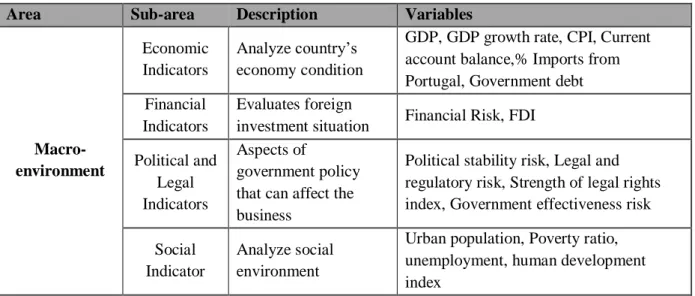
Each one of the areas mentioned before was divided into several subtopics. Macro environment sector includes 1) economic indicators, 2) financial indicators, 3) political and legal indicators and 4) social indicators. Economic indicators comprise all the variables that allow one to evaluate the state of the country’s economy. GDP growth and current account balance are included in this part of the tool. One believes it is also important to evaluate the business relationships of these countries with Portugal. Therefore, the variable % of imports from Portugal was also included. Financial indicators correspond to the financial risk and foreign direct investment in each country. Third, political and legal indicators analyze the aspects of government policy that can affect the firm’s business. At last, social indicators includes all the variables that allow one to understand the social conditions of the country. As an example, human development index and unemployment rate were included in this subtopic. As it can be seen on table 1, the macro environment is the area of the tool with the largest number of variables: six variables were included in the economic indicators, two in the financial indicators, four variables in the political and legal indicator and at last four for in the social indicators. Overall, the macro environment is characterized by four subareas and sixteen variables.
Table 1: Country selection tool: macro-environment criteria
Area Sub-area Description Variables
Macro-environment Economic Indicators Analyze country’s economy condition
GDP, GDP growth rate, CPI, Current account balance,% Imports from Portugal, Government debt Financial
Indicators
Evaluates foreign
investment situation Financial Risk, FDI Political and
Legal Indicators
Aspects of
government policy that can affect the business
Political stability risk, Legal and regulatory risk, Strength of legal rights index, Government effectiveness risk Social
Indicator
Analyze social environment
Urban population, Poverty ratio, unemployment, human development index
Observing the second area of the tool, business environment, one can find three main subtopics: 1) investment factors, 2) bureaucracy and 3) conflict resolution. Investment factors include all the variables that allow one to evaluate the risk of investment in a country. As an
23
example, security risk and property risk are two of the variables included in this topic. Regarding bureaucracy, this subarea includes variables that help the firm understanding how time costly it will be to start and operate a business. At last, conflict resolution helps the firm understand until what degree the firm is protected in case of conflict. Protecting minority investors rank and enforcing contracts rank are two of the variables included in conflict resolution. Opposite to macro environment, the business environment is the area with the smallest number of variables: both investment factor and bureaucracy are composed of four different indicators while conflict resolution aggregates three variables. Overall, the business environment is characterized by three subareas and eleven variables.
Table 2: Country selection tool: business environment criteria
Area Sub-area Description Variables
Business Environment
Investment Factors
Evaluates the risk of investment
Corruption rank, Security risk, Getting credit rank, property rights
Bureaucracy
Assesses how time costly it will be to start and operate a business
Documents to import, Time to import, Starting a business rank, Doing business rank
Conflict Resolution
Evaluates the degree the firm is protected in case of conflict
Protecting minority investors rank, Enforcing contracts rank, Resolving insolvency rank
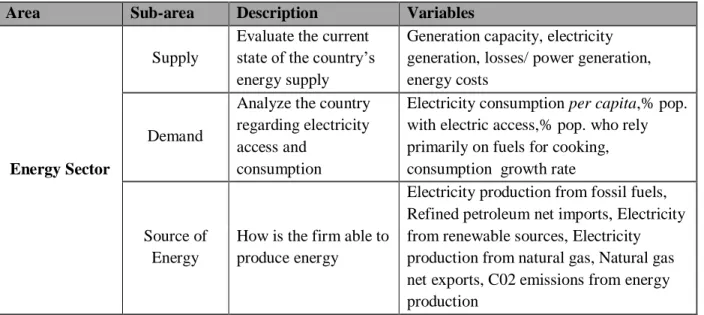
The energy sector is divided into three main subareas: 1) supply, 2) demand and 3) source of energy. Supply includes all the variables that will allow one to evaluate the current state of the country’s energy supply. Generation capacity and percentage of losses of total production were included in this subtopic. Regarding the second subarea, demand includes all the indicators that allow one to understand the situation of the country regarding both the consumption of energy and access to it. The variable percentage of people who rely primarily on fuels for cooking was introduced in this part of the model. Since it is also important to evaluate the market potential, the variable demand growth rate was also included. At last, the source of energy analyses how the firm is able to produce energy. In this topic is important to observe what are the main sources of energy and if these are imported. Overall, energy sector
24
includes three different subtopics with fourteen indicators: supply is composed of four indicators, demand by four and source of energy by six variables.
Table 3: Country selection tool: energy sector criteria
Area Sub-area Description Variables
Energy Sector
Supply
Evaluate the current state of the country’s energy supply
Generation capacity, electricity generation, losses/ power generation, energy costs
Demand
Analyze the country regarding electricity access and
consumption
Electricity consumption per capita,% pop. with electric access,% pop. who rely primarily on fuels for cooking, consumption growth rate
Source of Energy
How is the firm able to produce energy
Electricity production from fossil fuels, Refined petroleum net imports, Electricity from renewable sources, Electricity production from natural gas, Natural gas net exports, C02 emissions from energy production
One can classify the forty-one variables into positive or negative influencers. Positive influencer variables are the ones that will benefit a certain country over another. GDP growth rate can be considered as a positive influencer since a high growth rate increases the country’s potential to invest. On the opposite, negative influencer variables decrease West Sea’s interest. Corruption rank is an example of a negative influencer. Hence, the largest the corruption rate, the lowest potential that country has as a future market to invest (Appendix 9).
As it was stated before, the tool presented works as a comparison tool. With this comparison as the main goal, points will be attributed to each country in order to classify them according to the potential as future markets. These points will be based on the data find for each one of the variables mentioned before. One believes it’s not only important to understand which country as the best result in a certain indicator but also how much this country’s performance outstands the remaining. First, all countries were ranked for each variable. Depending on the variable classification, positive or negative influencer, the highest or lowest country was ranked as number 1. Only after being ranked, points were attributed. Starting by the positive influencer variables, the following formula was used:
25 𝑃𝑜𝑖𝑛𝑡𝑠 = 𝑣𝑎𝑙𝑢𝑒 𝑜𝑓 𝑡ℎ𝑎𝑡 𝑐𝑜𝑢𝑛𝑡𝑟𝑦
𝑣𝑎𝑙𝑢𝑒 𝑜𝑓 𝑡ℎ𝑒 𝑣𝑎𝑟𝑖𝑎𝑏𝑙𝑒 𝑟𝑎𝑛𝑘𝑒𝑑 1∗ 100
Observing the formula above, 100 points were attributed to the country ranked as number one. As it was stated before, since one considers important to evaluate the difference between countries, the result for the highest variable was used as a benchmark. Hence, two countries with similar results will be allocated with a similar number of points. This process was repeated for all the positive influencer variables. Regarding the negative influencer variables, the following formula was used:
𝑃𝑜𝑖𝑛𝑡𝑠 = 100 − 𝑣𝑎𝑙𝑢𝑒 𝑜𝑓 𝑡ℎ𝑎𝑡 𝑐𝑜𝑢𝑛𝑡𝑟𝑦 𝑣𝑎𝑙𝑢𝑒 𝑜𝑓 𝑡ℎ𝑒 𝑐𝑜𝑢𝑛𝑡𝑟𝑦 𝑟𝑎𝑛𝑘𝑒𝑑 4
In this case, the country ranked in the last position was used as a benchmark. Since these variables are negative influencers, if a certain country was ranked in the lowest position it means that its value was the highest in the group. Using the corruption rank as an example, if a country has the highest corruption rank it will be ranked in number four and used as a benchmark. Therefore, the country in the lowest position will be evaluated with 0 points while the country ranked first will have the highest number of points.
After choosing the criteria, one must determine how to weight them. As it was seen before, there is no consensus regarding how to weight each variable. The first solution found was to give equal importance to each subtopic. Since each subtopic has a different number of variables, an average was calculated for each one of the indicators. For that, the following function was used: 𝑇𝑜𝑡𝑎𝑙 𝑃𝑜𝑖𝑛𝑡𝑠 =𝐸𝑐𝑜𝑛𝑜𝑚𝑖𝑐 𝐼𝑛𝑑𝑖𝑐𝑎𝑡𝑜𝑟𝑠 6 + 𝐹𝑖𝑛𝑎𝑛𝑐𝑖𝑎𝑙 𝐼𝑛𝑑𝑖𝑐𝑎𝑡𝑜𝑟𝑠 2 + 𝑃𝑜𝑙𝑖𝑡𝑖𝑐𝑎𝑙 𝑎𝑛𝑑 𝐿𝑒𝑔𝑎𝑙 𝐼𝑛𝑑𝑖𝑐𝑎𝑡𝑜𝑟𝑠 4 +𝑆𝑜𝑐𝑖𝑎𝑙 𝐼𝑛𝑑𝑖𝑐𝑎𝑡𝑜𝑟𝑠 4 + 𝐼𝑛𝑣𝑒𝑠𝑡𝑚𝑒𝑛𝑡 𝐹𝑎𝑐𝑡𝑜𝑟𝑠 4 + 𝐵𝑢𝑟𝑒𝑎𝑢𝑐𝑟𝑎𝑐𝑦 4 +𝐶𝑜𝑛𝑓𝑙𝑖𝑐𝑡 𝑅𝑒𝑠𝑜𝑙𝑢𝑡𝑖𝑜𝑛 3 + 𝑆𝑢𝑝𝑝𝑙𝑦 4 + 𝐷𝑒𝑚𝑎𝑛𝑑 4 + 𝑃𝑜𝑤𝑒𝑟 𝑆𝑢𝑝𝑝𝑙𝑦 6
However, as it was observed in the literature review, the importance of each indicator is not the same when a firm takes a decision. Therefore, the second potential solution would be to weight the different variables based on West Sea’s managers’ expertise. After meeting the
26
person responsible for the project, it was clear that the main factor used to take a decision it would be the energy sector. Therefore, this was the area considered as most relevant (50% overall weight). Regarding the remaining two areas, macro environment was considered the most relevant with 30% of the overall weight. In this case, total points were calculated using the following formula: 𝑇𝑜𝑡𝑎𝑙 𝑃𝑜𝑖𝑛𝑡𝑠 = 0,3 ∗𝑀𝑎𝑐𝑟𝑜 𝐸𝑛𝑣𝑖𝑟𝑜𝑛𝑚𝑒𝑛𝑡 16 + 0,2 ∗ 𝐵𝑢𝑠𝑖𝑛𝑒𝑠𝑠 𝐸𝑛𝑣𝑖𝑜𝑟𝑛𝑚𝑒𝑛𝑡 11 +0,6 ∗𝐸𝑛𝑒𝑟𝑔𝑦 𝑆𝑒𝑐𝑡𝑜𝑟 14
Not only different weights were attributed to each area of the tool, but also to different subtopic and variable. For further explanation, see appendix 10.
7.2.3. Tool Application
As it was seen before, firms do not have the resources to focus on all countries around the world. Therefore, firms must start by choosing a certain region and define a subset of countries that might have a potential for investment. After meeting with West Sea, it was clear that the region that would be most interesting for the firm would be the Sub-Saharan Africa mainly for two reasons: first is close to Portugal and several countries already have an established relationship with the Portuguese government, second is one of the regions with the highest potential regarding the energy sector.
From the Sub-Saharan Africa, West Sea believes that Benin, Mozambique, São Tomé and Senegal are the countries with the highest potential for the firm. Since West Sea was initially interested in Cuba, one will use this country as a comparison. Also, with the goal of understanding the potential of the subset of countries, data for a developed country was also retrieved. United States of America (USA) was the chosen country for this purpose.
7.2.3.1. Final Results
7.2.3.1.1. Equally weighted criteria
Table 4: Final Results: equally weighted criteria method
Benin Mozambique São Tomé Senegal
27
As it was seen before, two potential solutions for how to weight each criterion were considered. When considering equal weights, the final results were not clear. While some countries performed better in some areas, the remaining countries compensated in others. Therefore, weight all sectors equally will not help West Sea to determine which country has a potential for future investment. Hence, one will focus its main conclusions by weighting criteria differently.
Table 5: Final Results: equally weighted criteria method
Macro-environment
Business Environment
Energy
Sector Final Score Rank
Benin 44,46 28,11 66,78 139,35 2
Mozambique 38,98 19,36 62,5 120,85 3
São Tomé 26,63 21,22 55,70 103,54 4
Senegal 44,36 36,67 65,92 146,94 1
7.2.3.1.2. Different weighted criteria
Table 6: Final Results: different weighted criteria method
Macro-environment
Business Environment
Energy
Sector Final Score Rank
Benin 2,83 2,49 3,72 3,21 3
Mozambique 2,43 2,23 4,82 3,58 1
São Tomé 1,67 1,85 2,76 2,25 4
Senegal 2,89 3,52 3,85 3,50 2
By weighting the subtopics differently, one can see that Mozambique and Senegal are the countries with the highest score of 3,58 and 3,50 respectively. Once again, since this is a comparison tool, one cannot state that West Sea should invest in these countries. However, from the four selected countries by the firm, these two are the ones that offer the highest potential. During the meetings with the firm, the responsible for the project showed a high interest in investing in São Tomé. However, the results from both methods have shown that this country is the one with the lowest potential mainly due to the lack of economic development and the low levels of future demand compared with other countries.
Observing the results, one can state that Mozambique was the country with the highest performance in the energy sector while Senegal overperforms in the macro-environment and
28
business environment areas. Starting with the macro-environment, with a GDP growth rate around 7%, Mozambique has been attracting foreign firm as it can be seen by the high levels of foreign direct investment (FDI) equals to 3,7 billion US$. Senegal presents a smaller growth rate of 4,4% also translated into lower levels of FDI of 0,3 billion US$. Still, both these countries present a higher growth compared with the United States (1,3%). Comparing with Cuba (2,4%), the country that was initially chosen by West Sea, once again GDP growth is more accentuated for the African countries (appendix 11 and 12).
In terms of the political and legal framework, Mozambique shows an unstable political environment with a risk of 54, higher than Cuba (50) and Senegal (40) (appendix 13). The same happens with the strength of legal rights (appendix 14). From a social perspective point of view, Mozambique is still one of the last developed countries with a poverty ratio of 55%. Senegal follows not much behind with a poverty ratio of 47% (appendix 15). Employment is also larger for Mozambique with a rate around 22% compared with Senegal (10%). According to the available data, Cuba’s unemployment rate is approximately 3% while the US has a rate of 6% (appendix 16) However, Cuba’s unofficial rate is expected to be must larger. It is crucial to state that when analyzing Cuba, data can be not reliable. Therefore, one should be cautious when making comparisons with this country. Overall it is clear that Mozambique has been growing for the past years, attracting foreign investors. However, Senegal has been showing a higher degree of development associated with a legal and politically stable environment.
Observing the business environment of both countries, Senegal over performs in most of the variables. With a starting business rank of 90, this country has a high potential for new firms. On the other hand, Mozambique was ranked in the 134th position by the doing business 2017 report (appendix 17). It might be necessary for the firm to import certain materials required for the maintenance of the barge. Therefore, Senegal has an advantage compared with Mozambique since it only takes 14 days to import for this country while Mozambique requires 25 days (almost twice as much) (appendix 18). At last, corruption is one of the main problems
29
in both countries. However, this problem is more accentuated in Mozambique with a rank of 112 (appendix 19). Overall, one can state that Senegal has a more prone business environment for investors.
At last, it is important to analyze the energy sector, the area with the highest weight in the model. From the African countries in the analysis, Mozambique is the one with the highest capacity (2.600 thousand kWh). However, has also the highest percentage of losses when compared with its power generation (27%). Regarding Senegal, its capacity is much lower (1.000 thousand kWh) but also lower losses (16%). With a lower energy capacity and less efficiency system in comparison with both Cuba (6.600 thousand kWh of capacity and an efficiency rate of 15%) and the US (capacity of 10.750.000 thousand kWh and an efficiency rate of 6%), Mozambique and Senegal show a high potential (appendix 20 and 21).
In terms of demand, Mozambique electricity consumption has been growing at a rate of 13% with a consumption per capita of 0,5 MWh. However, only 20% of the population has access to it. Senegal consumption has also been growing (9%) however with a lower consumption per capita (0,22 MWh). Regarding electricity access, most of the population of Senegal has access to it (57%). With a high consumption growth rate, both these countries show a high potential (appendix 22, 23 and 24). However, with a higher consumption per capita and a lower electricity access rate, Mozambique has a higher potential to grow in the future.
At last, the source of energy can play a major role when evaluating the countries’ potential by showing the country’s dependency on fossil fuels and imports. Electricity in Senegal is mainly produced by fossil fuel sources (99,7%), with most of this fuel being imported (net imports equals to 56% of total consumption). Regarding Mozambique, this country uses mostly renewable sources for electricity production, with 90% of production originated by these sources. On the other hand, refined petroleum net imports are much larger in comparison with the remaining countries (117% of total consumption) (appendix 25 and 26). One of the main advantages of Mozambique is its natural gas production. From the countries in this analysis,
30
Mozambique is the only exporter of natural gas, with more than half of its production being exported. However, only 2,3% of energy is originated by this source of power (appendix 27 and 28).
Taking into consideration the results in the energy area of the tool, one can state that Mozambique has an urge to invest in its energy capacity to meet a growing electricity demand. Moreover, with high reserves of natural gas, the country has a high potential for West Sea’s power barge.
As it was observed, both Mozambique and Senegal are potential markets for West Sea to explore. Taking into consideration what mentioned before, while Mozambique offers better conditions regarding the energy industry attractiveness, Senegal has a more stable business environment and overall a better macro-environment. Therefore, as one mentioned before, West Sea should further develop its analysis.
7.2.3.2. Tool Limitations
As it was stated before, this tool can be applied by any firm that is interested in investing in the energy market of a developing country. Therefore, one believes it is important to mention all the limitations that firms should take into consideration, including West Sea.
One of the main limitations is related to the reliability of data. Since the results are highly dependent on the quality of the data, only reliable sources were used such as the World Data Bank. Since the main goal is to compare different countries, one tried to use data from the same source when analyzing each variable. However, regarding the energy sector, data was difficult to find and was mainly collected from countries’ government documents. However, government documents can be an unreliable source of data since the statistical capacity of developing countries is low most of the times. Furthermore, governments can release wrongful information in order to achieve government’s interests. In the case of Senegal, Benin, and Mozambique all these three countries have a similar level of statistical capacity of 70 out of 100 (The World Bank, 2016). Once again, since this is a comparison tool, with a similar level of statistical
31
comparison one can consider that the results for these countries will be valid. Regarding São Tomé, with a capacity of 60 out of 100, further analysis will be required if West Sea still believes that it should invest in this country (appendix 29).
The second limitation is related to the weights attributed to each criterion. As it was stated before, the importance of each sector was based on West Sea’s managers’ expertise. However, managers don’t have any experience in the energy sector which might have led to wrong weight attributions.
The subset of countries that was chosen also influences the final results. As it was mentioned before, one of the chosen countries is used as a benchmark. Therefore, the results always depend on the countries that were chosen. If the four countries introduced in the tool don’t have a success potential, the tool will not be able to detect this. Hence, the countries that are ranked in the first positions don’t necessarily mean that are a good solution for the firm.
At last, as it was stated before, this tool only serves as a preliminary screening phase. Since several factors cannot be included in the tool, a firm must go through a deeper market analysis. In the case of West Sea, one of the main disadvantages of Senegal is related to the difficulties regarding the repatriation of profits. According to Senegal Investment Guide, there are no limits or restrictions on the transfer or repatriation of capital and income. However, similar to Cuba, it is not clear that if this rule is put into practice. This cannot be included in the model. Furthermore, Mozambique presents two great advantages when compared to Senegal. First, due to the same language and cultural proximity, Mozambique as a close relationship with Portugal. Second, Mozambique has emerged as one of the leaders in the global LNG industry. Anadarko has worked collaboratively with the government in order to develop the first onshore LNG park on the east coast of Africa (Anadarko Petroleum Corporation, 2016). With government showing commitment to keep part the natural gas in the domestic market, West Sea’s power barge could be a great solution for the country. Once again, this cannot be included in the tool.
32
8. Project Alternatives: insisting on power barge or choosing an
alternative
:8.1. Introduction
Leveraging the market knowledge acquired and relationships built while pursuing the power barge project, West Sea aims to diversify the business portfolio and is looking, at this moment, for an investment opportunity in Cuba. Regarding this, five different opportunities related to different business areas were identified as the ones that may be interesting for the company. Some of these opportunities are represented in “Cartera de Oportunidades” while others are not. Choosing among them may not be easy and is necessary to evaluate each of them based on specific criteria.
It is the existence of some West Sea’s Resources such as new business management and innovation and expansion that make it possible to consider the expansion for new projects considering that company has the ability to deal with them and make them successful.
In the next section, a general model for project selection based on diverse criteria and more focus on markets was developed and will be explained. After it, the tool will be applied to these opportunities, that it will be possible to reach a conclusion regarding the most attractive project.
It is important to refer that the tool may be applied to different projects taking into account that it necessary to evaluate them based on equal criteria so that a conclusion can be reached.
8.2. Methodology
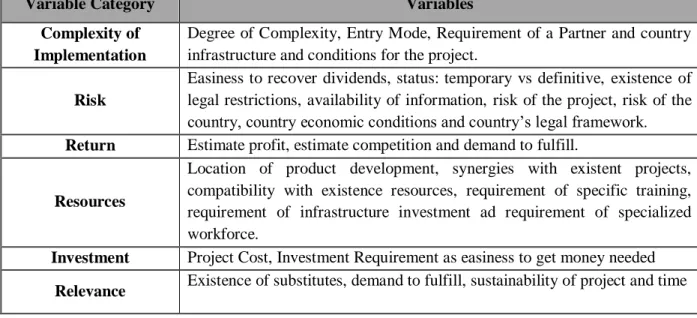
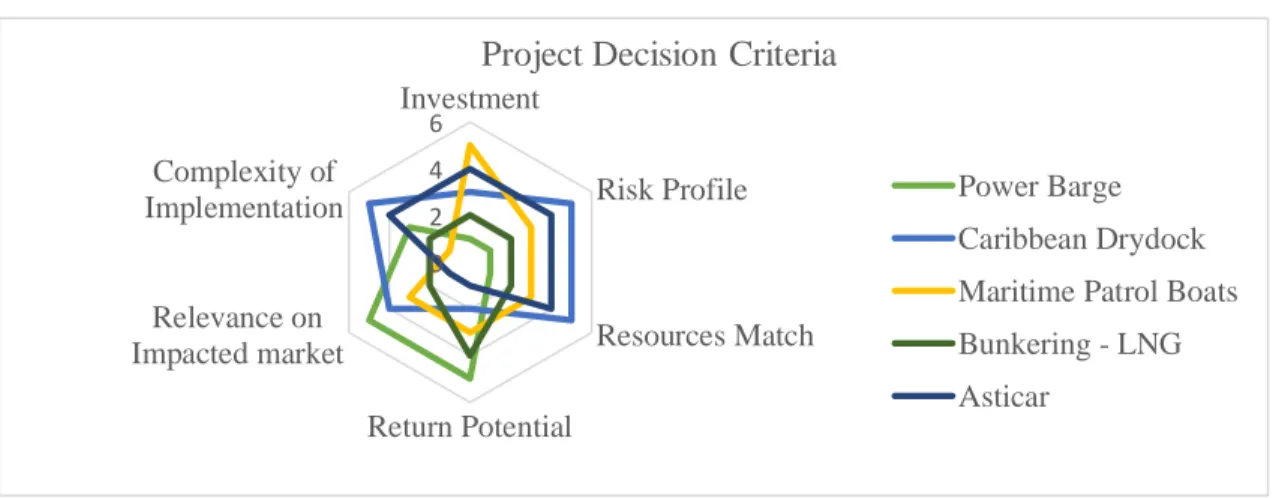
To develop a model of project comparison the starting point was the clear definition of the aim of this report: the goal was to reach a conclusion regarding which project should West Sea invest in. For that, an analysis, research, and description of each project that may interest to West Sea was done and five were chosen as the ones that fit West Sea interest: they are projects related to its actual activity or with the energy sector. To assess the chosen projects, a set of criteria was defined starting from more than twenty-five sub-criterion and ended up in six aggregate ones: risk profile, return potential, investment, relevance, complexity, and resources