Memoriza on of Brand marks in short-term
Memorização das Marcas gráficas a curto prazo
Valente, J. Laginha, C. Raposo, D.
IPCB/ESALD - Escola Superior de Saúde Dr. Lopes Dias do Ins tuto Politécnico de Castelo Branco IPCB/ESART - Escola Superior de Artes Aplicadas do Ins tuto Politécnico de Castelo Branco IPCB/ESART - Escola Superior de Artes Aplicadas do Ins tuto Politécnico de Castelo Branco Re rado de: h p://convergencias.esart.ipcb.pt
1. Introduc on
In Branding research related to Neuroscience has been conducted from marke ng perspec ve, in what has been designated as neuromarke ng and is par cularly linked to consumer psychology of brands.
Correlated research use Neuroscience methods and theories to create knowledge about consumer psychology and behaviour, witch may allow the improvement of Branding efficiency in holis c and strategic terms. However, consumer neuroscience refers to academic research intersec ng neuroscience with consumer psychology, whereas neuromarke ng refers the use of eye tracking, skin conductance, electroencephalography (EEG) or func onal magne c resonance imaging (fMRI) or other neurophysiologic tools to guide market research (Plassmann, et al., 2012).
Neuromarke ng can provide eye monitoring data and biological measurements that measure unconscious responses. Therefore, through Neuromarke ng researchers can obtain an insight that contributes to advance the understanding of the consumer biological behaviour in a specific context and his psychology of brands.
Brands represent themselves and iden fy their products thought a Brand mark. In other words, brands use marks to iden fy themselves and their related products. Brand marks are graphic signs or specifically logotypes and symbols used together or individually to invoke a Brand (a set of values and symbolic a ributes).
Thus, the Brand mark is the minimum symbolic unit to represent the Brand (Costa, 2010) and one of the elements of the Brand Visual Iden ty system. But Brand marks are the most used element in visual communica on media, to create visual coherence, to mark ownership or authorship, and to ensure recogni on and differen a on.
RESUMO: Este estudo tem como obje vo compreender o processo de memorização das Marcas gráficas (logó po e símbolo), par cularmente, revelando a relação entre os parâmetros de rastreamento ocular e a memorização de marca de curto prazo. Desenho / metodologia / abordagem - O estudo foi realizado online através da ferramenta BrainAnswer, u lizando um sistema de rastreio ocular e um ques onário, com 63 consumidores portugueses de azeite. Foi pedido aos consumidores que visualizassem um painel de 15 Marcas gráficas de azeite, seguido de um processo de distração, após o qual lhes foi pedido que iden ficassem as Marcas gráficas agora misturadas com outras. Os resultados mostram que é possível estabelecer uma correlação entre o processo de memorização de Marcas gráficas a curto prazo e: o Glances r (-0,375), as úl mas visualizações r (0,4929), o maior tempo médio de fixação r (-0,28954), Grande variação no tamanho de fixação r (0,21626) e fixações mais longas r (0,21626), como podemos detectar no r de Spearman. Não foi iden ficada nenhuma correlação entre a seqüência de visualização eo processo de memória. A sequência de visualização é esta s camente significa va considerando o processo de leitura ocidental.
PALAVRAS-CHAVE: Marca gráfica; eye tracking; neuromarke ng; Logó po; símbolo; Memorização; Sector agro-alimentar.
ABSTRACT: This study aims to understand the process of memoriza on of Brand marks par cularly, revealing rela on between eye-tracking parameters and short-term memoriza on of Brand marks (logotype and symbol). Design/methodology/approach – The study was conducted online through BrainAnswer tool, using eye-tracker and ques onnaire, with 63 Portuguese olive oil consumers. Consumers were asked to visualize a 15 olive oil brands marks panel, followed by a distrac on process a er which they were asked to iden fy the sawed Brand marks now mixed with others. The results show that it’s possible to establish a correla on between the process of short-term memoriza on of Brand marks and: the Glances r(-0,375), latest views r(0,4929), Higher average fixa on me r(-0.28954), large varia on in fixa on size r(0.21626) and more longer fixa ons r(0.21626), like we can detect in Spearman's r. It wasn’t iden fied any correla on between the visualiza on sequence and the memory process. The visualiza on sequence is sta s cally significant with the occidental reading process.
KEYWORDS: brand marks; eye tracking; neuromarke ng; logotype; symbol; memorability; agri-food sector.
Brand marks are used to ensure the iden fica on of the product, and to do so, this graphic signs need to be memorized.
Therefore, it would be expected to find informa on about how to design or evaluate a Brand mark according to scien fic data and project grounded.
Even though there are many studies related to brands, there are not many studies conducted in the context of graphic design to see how the graphic aspect of Brand marks help in it’s memorizing. In fact, the conducted studies tend to isolate Brand marks components, such as typography and symbols or to evaluate them indifferently.
2. The purpose of this study
There is some agreement on how Brand marks contribute to brand success. In the same sense, much of the empirical informa on indicates that the memoriza on depends on the systema c use of the same brand mark, similarly repeated in the largest number of graphic media and over me.
In this sense, the Brand marks are presented over me to increase the probability of being viewed and memorized.
Studies such as Carpenter & Nakamoto (1989) and Kardes & Kalyanaram (1992) indicate that memoriza on occurs when the brand is introduced in the market, benefi ng from its novelty factor, which s mulates curiosity and a en on, that is, because they are a en on-drawing (Kahneman, 1973). Thus, adver sing campaigns and communica on media contribute to increased memoriza on, enabling consumers to formulate their judgment and preference (Kardes & Kalyanaram, 1992).
A more recent study indicates that in 313 ms consumers can iden fy two different food brands and decide which one they prefer (Milosavljevic, Koch, & Rangel (2011)
Although Brand marks do not guarantee the success of the brand, they are one of the main ways of recognizing products, par cularly when the company does not invest in adver sing. In this way it is essen al that the graphic mark is quickly memorizing.
As observed, the majority of studies focused on the understanding and percep on of value, and there is a lack of data on the process of memorizing Brand marks. According to Wheeler (2003), the sequence of visual percep on is the shape, color and lastly the content, indica ng that percep on occurs firstly at connota ve meaning level and only a er at the denota ve, which takes more me.
However, knowing this sequence is not enough to understand which graphic features have influence to brand mark memoriza on. On the other hand, some studies indicate that the percep on can occur in the conscious, supraliminary and subliminal levels.
At the conscious level the brain processes s muli of which it is cognizant. Schiffman &Kanuk (2010) report that subliminal percep on or subcep on occurs with s muli too weak or too brief for their conscious percep on, but strong enough to be picked up by one or more recipient cells.
According to Lewis's (2013) study in about 10 milliseconds it is possible to ac vate archetypes and stereotypes stored in memory, allowing to make judgments about an image, that is, supraliminal meanings perceived at the edge of consciousness, before being subliminal.
Addi onally, also the study of Chartrand, Huber, Shiv, & Tanner (2008) confirmed that consumer choice also depends of unconscious percep on process. Study’s such as Wolfe & Horowitz (2004) indicate that consumers eye movement and a en on is related with the iden fica on of the most relevant informa on among available data, based in visual inputs such as colours, luminance, orienta on, size, shape, movement, etc.
Norton & Stark (1971) iden fied three types visual of scan paths or eye movements in ads, such as scanning (the eyes goes to headline and graphics), ini al (the eyes move to the headline, graphics and to brand) and sustained (when the eye moves to the headline, graphics, brand, and text).
According to Plassmann, et al. (2012), representa on and a en on are complex processes with impact in all brand decisions, and neuroscience can help to be er understand how a en on and its effects impact on consumer behavior and psychology of brands. But there are few studies devoted to this subject and less about the impact of graphic features of Brand marks in consumer decision and in consumer memoriza on or recogni on process.
Ques onnaires or interviews seem to generate insufficient data, unrepresenta ve or perhaps inaccurate, which don't acknowledge knowing how Brand marks memoriza on is processed. So, Neuroscience methods represent an opportunity to advance knowledge.
Considering what has been stated and based on the described assump ons and shortcomings, the study was carried out taking into account the following hypotheses:
It’s possible to establish a correla on between short-term memoriza on of Brand marks and its graphics features Glances, including long eye fixa ons.
H1 The display sequence used by par cipants to observe the panel of Brand marks coincides with the normal reading process of an Western reader.
H2 The fixa on number changes with the advance in the reading sequence. Study on the memory process:
H3 The fixa on sequence of the Brand marks is related with its memoriza on. H4 The number of revisits to a brand mark will increase the its memoriza on capacity. H5 The last brand mark to be visited before leaving the pannel is more likely to be remembered. H6 The me spent on each brand mark increases its probability to be remembered.
H7 An ac ve view with small and large a achments is correlated with the memoriza on process. H8 The me spent focusing on small details, focus, is correlated with memoriza on.
Was made an effort to get a set of Brand marks in two by typologies: symbol and logotype (with or without designa on) and only logotype (with or without designa on).
Was conducted a non-interven onist research based on ques onnaire and eye tracking.
A er the ques onnaire was drawn up and tested, started the data collec on with a sample of 63 respondents, consumers of olive oil, considering that consump on implies the purchase of olive oil for own consump on. The sample consisted in 45 female and 18 male subjects, aged between 18-25, 26-35, 36-45, 46-56, 57-65 and> 66, who par cipated randomly and voluntarily in the study, being informed of study par cipa on condi ons.
The experiment took place in one mee ng rooms, because of its isola on from external disturbances, which could influence the quality of data. Each par cipant was inquired in a single compu ng device (laptop) individually in the company of a monitor responsible for checking the data collec on devices and for the promo on of a friendly atmosphere.
There was no men on to the memory measurement and they were sent directly to the experiment. The control of me was given to the par cipant, who accessed directly the informa on protocol, using online to BrainAnswer tool thought the computer.
At the equipment level, a computer was used, an eye tracking system that allows measuring the field of vision of each individual, that is, allows to measure the posi oning and behaviour of the eye. The eye tracker is composed of infrared sensors that capture all parameters, such as fixa on (when the eye remains s ll over a period of 9 me), eye movement, and the focus of a en on, to the smallest detail. In the informa on analysis phase, we will be able to provide behavioural informa on that the respondent unconsciously acquired in the context of the inves ga on, while another ques onnaire without the aid of equipment with this type of func on allows us to only Collec ng informa on that was consciously given, that is to say, according to what the respondent wanted to answer, which corresponds to what he thinks he will feel and not to the way he actually reacted.
Each par cipant flowed the instruc ons and filled in the ques onnaire in front of the passive monitors supervision, allowing collec ng eye tracking informa on and memorized Brand marks.
Organized in four parts, the study was divided in 18 steps considering instruc ons and tasks to execute by par cipants, monitoring responses in terms of asser on and me, as well as by eye-tracker.
Fig.1 – Study steps
The first part comprises step 1 (the instruc on) and 2 (the task), were each par cipant is asked to watch a frame with the 15 Brand marks in study for as long as he wants.
A second part was organized between steps 3 to 10, reques ng par cipants to complete four popular Portuguese sayings. This part has been defined to introduce a distrac ng element, which acts as noise element, adjacent to the visualiza on process, which might affect the memoriza on process.
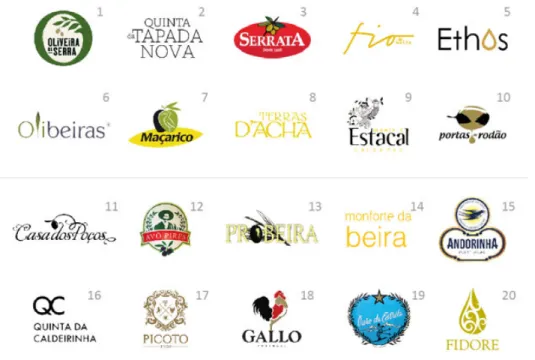
During the third part (steps 11 to 14), two Brand marks boards were displayed and par cipants were asked to iden fy the 15 Brand marks in study among others five na onal Brand marks (Serrata, Gallo, Andorinha, Oliveira da Serra and Maçarico), also from olive oil, introduced in the panel as distrac ng elements to increase the recogni on difficulty.
In the part (step 15 to 18) par cipants were asked to iden fy their prior knowledge of Brand marks, before his par cipa on in the study. And the experiment ended a er the collec on of par cipant’s demographic informa on.
Fig. 3 – Frames with Brand marks including those for distrac on
The me was measured during all process and each task solving.
To collect data from eye tracker, was defined an AOI (Area of Interest, also known as ROI, Region of Interest) around each brand mark. This method was adopted in all frames with Brand marks, allowing comparing results in terms of Dwell Time (each visit in AOI, from entry to exit, Measur-Sum of dura ons from all fixa ons and sacades that hit the AOI).
Looking for the sequence of fixa on of Brand marks, several metrics were considered, such as the number of fixa on; the me of fixa on; the last and first fixa on and the number of mes that each brand mark was reviewed.
Considering the need to compare diverse parameters with different nature, was used the non-parametric test Spearman's Rho, which allowed to measure the strength of associa on between two variables, where the value r = 1 means a perfect posi ve correla on and the value r = -1 means a perfect nega ve correla on.
For example, permi ed to observe possible correla ons between the visualiza on ranking and the reading sequence or between the visualiza on ranking and the ranking of Brand marks memoriza on.
The memoriza on of Brand marks considered the correct correspondence between the Brand marks presented in the first frame (step 2. Also see figure 2) and the correct correla on in the frames from steps 12 and 14 (see figure 3). Therefore, the number of hits related to the memoriza on of the brands marks was counted and converted to percentage, for crea ng a ranking with the most remembered. The same process was followed to create a ranking of previously known Brand marks.
The study of eye tracking data was detailed through the use of the described metrics, Figure 4.
1. Brand sequence: Number assigned to each mark that also corresponds to the reading sequence that the Western reader would use to read a text. 2. Visualiza on sequence: order of gaze hits into AOIs based in entry me, obtained during the analysis of the frame with Brand marks.
3. Fixa on number: number of fixa ons each par cipant made on each brand.
4. Memory sequence: sequence of the most remembered Brand marks at the end of the test by consumers; 5. Time stamp fixa on: is the start me of each fixa on.
6. Revisits number: is the number of revisits corresponds to the number of mes a given par cipant looked at inside of brand. 7. Last visit: The last visit corresponds to the last instant that a par cipant visited a par cular brand.
4. Study results
Considering the number of checks of memorized Brand marks was obtained the percentage results and converted in ranking.
It’s possible to observe, through the percentages, that there exist some Brand marks with equal checks such as Portas de Rodão (71.4%) and Fio da Beira (71.4%), Quinta da Caldeirinha (22.2%) and Oliveira da Serra (22.2%), Serrata (11.1%) and Gallo (11.1%). In order to unblock this e in the ranking we considered the brands for alphabe cal order.
Is possible to understand that in this phase where the 15 brands were mix with the 5 foreign brands, the la er brands were not let do considered even though they had never been previously observed in the ques onnaire. However, there was a e between Quinta da Caldeirinha (22, 2%) - case study, with Oliveira da Serra (22.2%) - outsider brand.
We may suppose that the fact that foreign brands have a very significant presence in people's daily lives are easily associated or suggested un l they have not been visualized, perhaps for reasons such as the associa on of form, color, typography.
Through the analysis of Hit map, we can see where occurred the largest center of a en on during the panel observa on process. This informa on is very useful since it allows us to perceive which regions were more focused on deterring others. In a study about the design of Brand marks is relevant to perceive what draws the par cipants a en on and what is ignored, as well as the degree of dispersion of the look in design details. We can see there is a certain tendency to read the symbol and the center elements in the brand mark, ignoring extremity details, allowing a qualita ve analysis of brand design.
For a more quan ta ve analysis, an AOI was defined for each Brand mark in the panel, allowing to obtain metrics for each one. These parameters were analyzed using the Spearman coefficient.
The Spearman coefficient was calculated to each variable in the study involving the 15 Brand marks and the result is presented in Table 1 and 2, where the means of the variables obtained for each one are presented.
Table 1 – Data obtained for each numbered Brand mark from 1 to 15, taking into account the behavior of the eye
5. Analysis of results
Study results related to the visualiza on sequence process
H1) The data showed that the visualiza on sequence (the order of gaze hits into AOI, based on entry me) is related to occidental reading process, has correspondence to brand numbers sequence (1,2,3,4,5,6,7,8,9,10,11,12,13,14,15) with r(0.9964), on the other hand that the fixa on sequence is correlated with the visualiza on sequence and is sta s cally significant. The fixa on sequence is strongly related to the visualiza on sequence. So it’s indicates that the consumers followed the visualiza on sequence to observe the Brand marks.
H2) Looking for number of fixa on was possible to observe how the number of fixa ons decreases with the increase of the visualiza on sequence with r(-0.9357). This means that there is a tendency to decrease the number of fixa on of reading, making more fixa ons at the beginning and less at the end.
The average of the fixa on sequence is strongly related to the visualiza on sequence. So, it’s indicates that the consumers followed the visualiza on sequence to observe the Brand marks.
Study results related to the memoriza on process
The order a ributed to each brand resul ng from its posi on in the ranking of the most remembered Brand marks by the respondent when responding to the survey was (1, 10, 13, 11, 3, 3, 8, 5, 14, 15, 7, 6, 12, 2, 9).
H3) Looking for number fixa on sequence and memoriza on sequence, the results indicate that it is not possible to establish a correla on between the natural reading sequence and the memory process, since Spearman's indexes are too low r(less than 0.2). Although there is no correla on between the sequence fixa on and memory it should be noted that the Brand mark that occupies the first place in the fixa on sequence is also the first ranking in memory.
H4) The result show that the revisits number to AOIs increase the likelihood of Brand marks being remembered r(-0.375).
H5) From results of last visit it’s possible to conclude that the last visited (viewed) Brand marks are more easily remembered r(0.4929).
H6) For the dwell me parameter, the Spearman coefficient was r(-0,2786). So, the me spent (mean) in each AOI contributed to the brand memoriza on process. The fact that it is inverted indicates that more fixa on me facilitates memoriza on.
H7) Ac ve fixa on r(0,2286). An ac ve view with focus and scan on the Brand marks (small and large fixa ons) has contributed to the memoriza on process. H8) Focus r(0,23771). The fact that there are longer fixa ons accelerates Brand marks memoriza on.
6. Conclusions and sugges ons for future direc ons
Through this study, the researchers wanted to understand which metrics can be used to be er understand how short-term memoriza on of Brand marks is processed, because this will enable future research to focus on which Graphic Features of Brand marks improve their memoriza on.
The study indicates that the applica on of neuroscience methods allows understanding on how short-term memoriza on of Brand marks is processed. First of all, because it able to observe how consumers eye processes Brand marks memoriza on, improving data quality and rigour of informa on that we would obtain through ques onnaires.
Consequently, this study value resides in its valida on of neuroscience as tool in the study of Brand marks memoriza on process, but also by establishment of metrics that allow studying marks memoriza on process through the eye tracking process.
The defined metrics of eye tracking allowed observing whit sta s c significance, that par cipant’s visualiza on sequence followed the occidental reading process, although we used Brand marks (not text) organized in a horizontal frame, with similar visual dimensions and arranged in rows and columns. We consider that this result gives validity to our metric, but that does not exist any correla on between the visualiza on sequence and the Brand marks memory process. S ll, the first presented brand mark was the most remembered.
At the beginning, it was predicted that the memoriza on of Brand marks was higher with more number of Glances and whit longer eye fixa ons. And the results confirm par ally this hypothesis, once they show a correla on, sta s cally relevant and according to Spearman's Rho, between the short-term memoriza on of Brand marks and the Glances. This means that a larger number of eyes review of the brand mark get a higher memoriza on. This gives relevance to the role of the brand mark graphic characteris c in terms of eye interest, but also gives the importance of displaying the brand on various media.
The study shows that the last seen Brand marks were the most remembered (latest views). This fact does not demonstrate the importance of brand mark design, but indicates how important is to granted the brand presence in consumer environment, so that it is remembered.
The importance of eye fixa on to brand mark memoriza on is correlated by three of the defined metrics, as the higher average fixa on me, large varia on in fixa on size and more longer fixa ons.
Some limita ons of the study may be presented. First, there is a lack of correla on between eye tracking data and biological measurements by unconscious responses, whereby it is a work in process.
As far as this experiment is concerned, for the sake of accuracy, we believe that the first Brand marks display panel should allow them in a random order, to ensure that none is privileged by its posi on on the screen. S ll, our data doesn’t show that this created any interference.
Instead of the popular sayings, it’s recommended to use a visual distrac ng element; witch represents a huger disturbance on memory, once it would act in the same cerebral area where the memoriza on of Brand marks takes place.
On the other hand, we consider that in a future study it should be used an equal number between Brand marks under study and distrac ng Brand marks. The stra fica on of the respondents was done previously, and therefore does not guarantee that they are grouped according to a common behaviour. By expanding the sample of respondents, we can detect clusters, sta s cally relevant, that will allow us to deepen the reading of data by age, gender and other shared a ributes.
Finally, we consider it’s important to deepen the study about possible correla ons between the features of distrac ng Brand marks and those of the 15 brands under study, considering the confusion matrix.
Acknowledgments
The authors would like to thank the par cipants in this study par cularly those at the Escola Superior de Artes Aplicadas do Ins tuto Politécnico de Castelo Branco. Also, the coopera on of InovCluster – Associação do Cluster Agroindustrial do Centro, CATAA – Associação Centro de Apoio Tecnológico Agro-Alimentar and to APABI – Associação de Produtores de Azeite da Beira Interior
References
Carpenter, Gregory S. and Kent Nakamoto (1989). "Consumer Preference Forma on and Pioneering Advantage,"
Chartrand, T. L., Huber, J., Shiv, B., & Tanner, R. J. (2008). Nonconscious goals and consumer choice. Journal of Consumer Research, 35(2), 189–201. Journal of Marke ng Research, 26 (August), 285-98.
Kahneman, Daniel (1973). A en on and Effort. Englewood Cliffs, NJ: Pren ce-Hall, Inc.
Kardes, F., & Kalyanaram, G. (1992). Order-of-Entry Effects on Consumer Memory and Judgment: An Informa on Integra on Perspec ve. Journal of Marke ng Research, 29(3), 343-357. doi:10.2307/3172744
Lewis, D. (2013). The brain sell: When Science Meets Shopping. London: Nicholas Brealey Publishing.
Milosavljevic,M., Koch, C., & Rangel, A. (2011). Consumers can make choices in as li le as a third of a second. Judgment and Decision Making, 6(6), 520–530. Plassmann, H., et al., Branding the brain: A cri cal review and outlook, Journal of Consumer Psychology (2012), doi:10.1016/j.jcps.2011.11.010
Wheeler, A. (2003). Designing Brand Iden ty: A complete guide to crea ng, building and mantaining strong brands. New York: John Wiley & Sons, Inc.
Wolfe, J. M., & Horowitz, T. S. (2004). What a ributes guide the deployment of visual a en on and how do they do it? Nature Reviews Neuroscience, 5(6), 495– 501.
Reference According to APA Style, 5th edi on:
Valente, J. Laginha, C. Raposo, D. ; (2016) Memoriza on of Brand marks in short-term. Convergências - Revista de Inves gação e Ensino das Artes , VOL IX (18) Retrieved from journal URL: h p://convergencias.ipcb.pt