Journal of Exercise Physiology
online
October 2016Volume 19 Number 5
Editor-in-Chief
Tommy Boone, PhD, MBA Review Board Todd Astorino, PhD Julien Baker, PhD Steve Brock, PhD Lance Dalleck, PhD Eric Goulet, PhD Robert Gotshall, PhD Alexander Hutchison, PhD M. Knight-Maloney, PhD Len Kravitz, PhD James Laskin, PhD YitAun Lim, PhD Lonnie Lowery, PhD Derek Marks, PhD CristineMermier, PhD Robert Robergs, PhD Chantal Vella, PhD Dale Wagner, PhD Frank Wyatt, PhD Ben Zhou, PhD
Official Research Journal of the American Society of
Exercise Physiologists
ISSN 1097-9751
Official Research Journal of the American Society of
Exercise Physiologists ISSN 1097-9751
JEP
onlineEffect of Water Aerobics on the Quality of Life,
Satisfaction, and Perception of Body Image among
Elderly Women
Nuno Garrido1,2, Juliana D. P. Silva1,2, Jefferson S. Novaes3, Maria S. Cirilo-Sousa4,5, Gabriel R. Neto3,4,5
1Sport Sciences Department, University of Trás-os-Montes e Alto Douro, Vila
Real, Portugal; 2Research Center in Sports Sciences, Health Sciences and
Human Development, Vila Real, Portugal; 3Physical Education Graduate
Program, Federal University of Rio de Janeiro (UFRJ), Rio de Janeiro;
4Associate Graduate Program in Physical Education UPE/UFPB,
Department of Physical Education, Federal University of Paraíba (UFPB), João Pessoa, Paraíba, Brazil. 5Kinanthropometry and Human Development
Laboratory - LABOCINE - Department of Physical Education, Federal University of Paraíba (UFPB), João Pessoa, Paraíba, Brazil
ABSTRACT
Garrido N, Silva JDP, Novaes JS, Cirilo-Sousa MS, Neto GR. Effect of Water Aerobics on the Quality of Life, Satisfaction and Perception of Body Image among Elderly Women. JEPonline 2016;19(5):30-37. This study
investigated the effect of water aerobics on quality of life, satisfaction and perception of body self-image in elderly people and to verify the relationship between satisfaction with body image (BI) and body mass index (BMI). The study consisted of 90 elderly women, 60 of whom practiced water aerobics (73.30 ± 6.83 yrs old) and 30 of whom were not regularly physically active (74.75 ± 8.49 yrs old). The World Health Organization Quality of Life Questionnaire - WHOQOL-BREF was administered. The Stunkard scale was used for the analysis of body perception and satisfaction. It was found that elderly women who practiced water aerobics were not significantly different in perceived BI, ideal BI, and body image satisfaction (BISL) compared to the non-practicing group (P>0.05). Regarding quality of life, there was a significant improvement in the physical domain for the women who practiced water aerobics (P=0.001). Significant correlations were identified between perceived BI and BMI for those who practiced water aerobics (r=0.617, P=0.000) and those who did not (r=0.735, P=0.000). Additionally, significant correlations were detected between the BI satisfaction levels and BMI for those who practiced water aerobics (r=0.515, P=0.000) and those who did not (r=0.765, P=0.000). Thus, water aerobics may be an alternative for elderly women to improve their quality of life, BI perception, and satisfaction. Keywords: Water Aerobics, Elderly, Quality of Life, Body Image
INTRODUCTION
Aging is a process that occurs in an individual’s body. It continues as long as we live with the loss of capacity and decreased functionality that affects the quality of life of individuals (16). The decreased habitual physical activity levels of the elderly contribute to the decrease in functional fitness, which facilitates the occurrence of illnesses that cause further deterioration in the aging process. The overall result is the decrease in quality of life and body perception and satisfaction (12,14,19).
In addition, at older ages, morphological changes and dissatisfaction with the body are common issues (7,14,19). For Cash and Pruzinsky (4), body image (BI) is a multidimensional construction that broadly describes the internal representation of the body structure and physical appearance of who we are and others. In particular, BI is often distorted in older age groups because the elderly typically associate old age with the idea of physical and mental deterioration (24). These distortions can be improved as the elderly person engages in physical exercises (7,18).
Water aerobics is an exercise that is commonly practiced by the elderly and offers benefits such as reduced heart rate and increases in maximum oxygen uptake (VO2), muscle mass, and range of
motion as well as improvements in physical and psychological well-being and cognitive function (2,20,21). However, in reviewing the literature, it was observed that few studies have assessed the effect of the practice of water aerobics on the quality of life among the elderly (1,6,10,17) and the influence of water aerobics on BI (15). Furthermore, there were no studies that verified the association of BI and body mass index (BMI). Thus, the aims of this study were: (a) to investigate the effects of the practice of water aerobics on the quality of life and body self-image satisfaction and perception of elderly people; and (b) to verify the relationship between satisfaction with BI and BMI. METHODS
Subjects
The study included 90 healthy elderly women. The women were divided into two groups: sixty women that had practiced water aerobics for at least six months (73.30 ± 6.83 yrs old; 24.76 ± 1.81 kg·m-2)
and thirty sedentary women (74.75 ± 8.49 yrs old, 25.97 ± 2.64 kg·m-2). The study excluded the
following: (a) smokers; (b) those that had some type of musculoskeletal injury to the upper or lower limbs; and (c) those who answered positively to any of the items in the Physical Activity Readiness Questionnaire/PAR-Q (22). After being informed of the risks and benefits of the research, the subjects signed the informed consent form, which was prepared in accordance with the declaration of Helsinki. The study was approved by the Ethics Committee on Research Involving Human Subjects of a local University.
Procedures
Anthropometric Assessment
The subjects’ height and weight were measured to the nearest 0.5 cm and 0.1 kg, respectively, using a Welmy stadiometer (Santa Barbara D’oeste, São Paulo, 2002) and the Sanny scale (AD1010, São Paulo, Brazil).
Silhouette Matching Task (SMT) – Scale of Silhouettes
The scale of silhouettes proposed by Stunkard et al. (23) was used for the evaluation of BI. This scale consists of a set of nine images of the human body, numbered 1 to 9 and composed of two questions: What is the silhouette that best represents your current physical appearance? What silhouette would
you like to have? To verify body dissatisfaction, the difference between the actual silhouette (AS) and the ideal silhouette (IS), as indicated by the individual, was used. The assessor did not give his opinion during the choice of silhouette.
The World Health Organization Quality of Life Questionnaire - WHOQOL-BREF
The short version of the World Health Organization WHOQOL-100 questionnaire, WHOQOL-BREF, Portuguese version, was applied to evaluate the quality of life (3). This questionnaire consists of a set of 26 questions, two of a general nature, providing a comprehensive indicator of quality of life of the individual. The remaining 24 questions represent the WHOQOL-100 facets. These facets are evaluated in only one question, originating four domains: physical; psychological; social relations; and environment. The answers to the questionnaire are assessed using a Likert scale in which the subjects have the opportunity to indicate their level of agreement/disagreement in a scale from 1 to 5. Water Aerobics
The water aerobics classes took place 3 times·wk-1 in city pools in the municipality of Paredes (Portugal). Each class lasted 60 min. All of the subjects had a minimum experience of 1 yr and a maximum of 3 yrs. The classes were composed of 10 min of warm-up, 40 min of aerobic and neuromuscular exercises, and 10 min of stretching and relaxation. The water aerobics classes were conducted in a pool at 27 ± 2 °C, measuring 20.0 m x 10.0 m, and 1.25 to 1.50 m deep. The group that did not participate in the classes maintained their basic activities of daily living.
Statistical Analyses
The statistical analysis was initially performed using the Kolmogorov-Smirnov normality test. The variables showed non-parametric distribution (P<0.05). The Mann-Whitney U test was used for independent samples, and Spearman’s correlation coefficient (r) was used to verify the degree of association between the BMI variable and body perception and satisfaction.
RESULTS
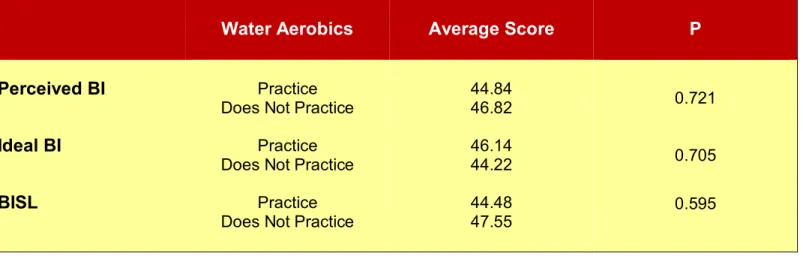
In the comparative analysis of perceived BI, ideal BI, and body image satisfaction (BISL), there were no significant differences between the women who practiced water aerobics and those who did not (P=0.721; P=0.705; P=0.595), respectively (Table 1).
Table 1. Comparative Analysis between Perceived Body Image (BI), Ideal BI, and Body Image Satisfaction Level (BISL) Among the Groups.
Water Aerobics Average Score P
Perceived BI Practice 44.84 0.721
Does Not Practice 46.82
Ideal BI Practice 46.14
0.705 Does Not Practice 44.22
BISL Practice
Does Not Practice
44.48
In the comparative analysis of the different domains that make up the WHOQOL-BREF, there were no significant differences between those who practiced water aerobics and those who did not for the general facet, psychological, social relations, and environment domains (P=0.972; P=0.731; P=0.687; P=0.215), respectively. However, there was a significant improvement in the physical domain of the quality of life for the elderly women who practiced water aerobics (P=0.001) (Table 2).
Table 2. Comparative Analysis of Levels of Quality of Life Domains Among the Groups.
Water Aerobics Average Score P
General Practice 45.56
0.972 Does Not Practice 45.38
Physical Practice 51.85 0.001*
Does Not Practice 32.80
Psychological Practice 46.16 0.731
Does Not Practice 44.18
Social Relations Practice 44.74 0.687
Does Not Practice 47.02
Environment Practice 43.10 0.215
Does Not Practice 50.30 *Significant difference among the groups
Table 3 shows the level of correlation between perceived BI and BMI and between the body image satisfaction level (BISL) and BMI. Significant correlations were observed between perceived BI and BMI and between BISL and BMI (r=0.617, P=0.000; r=0.515, P=0.000) for those who practiced water aerobics and for those who did not (r=0.735, P=0.000; r=0.765, P=0.000), respectively.
Table 3. Correlation between Perceived Body Image (BI) and Body Mass Index (BMI) and between Body Image Satisfaction Level (BISL) and BMI.
BMI
Water Aerobics Correlation Coefficient (r) p
Perceived BI Does Not Practice Practice 0.617 0.735 0.000* 0.000*
BISL Practice
Does Not Practice
0.515 0.765
0.000* 0.000* *Significant correlations between perceived BI and BMI and between the BISL and BMI
DISCUSSION
This study investigated the effects of the practice of water aerobics on the quality of life, self-image satisfaction, and perception among elderly women, and the relationship between BI satisfaction and BMI. The first finding was that only the physical domain showed significant differences for the elderly subjects who practiced water aerobics. Similar results were reported by Sato et al. (19) when investigating the effects of a water aerobics program on quality of life among elderly individuals. Interestingly, contrary to the findings in the present study, the authors observed improvements in all domains of quality of life related to health.
Junior et al. (8) compared muscle strength and quality of life among elderly women who practiced water aerobics and those who did not. The authors concluded that the water aerobics classes improved strength and quality of life in elderly women. Similarly, Fisken et al. (6) compared the effect of a water aerobics program on the quality of life of elderly individuals with osteoarthritis. They concluded that a water aerobics program offered a number of functional and psychosocial benefits for elderly individuals with osteoarthritis.
In a somewhat similar study by Rica et al. (17) investigated the effect of a water aerobics program on the functional fitness, anthropometry, and quality of life of obese women. The authors found that the program did not improve the anthropometric parameters, but did improve the subjects’ aerobic capacity, strength, and quality of life of the subjects. Collectively, the findings from the previous studies and their comparison with the present study indicate that water aerobics improves the subjects’ functional autonomy and, consequently, the levels of quality of life among the elderly, but it does not seem to change the body composition.
Also, the elderly women who practiced water aerobics did not have a significant difference in BI perception and BISL when compared to the group that did not participate in physical exercise. These results do not agree with the findings by Mazo et al. (15), who evaluated self-esteem and self-image and the relationship with the motivational factors for the registration and permanence of elderly individuals in a water aerobics program. The authors concluded that the elderly had high self-esteem and self-image and that there was a statistically significant difference between the reasons to stay in the program and their body self-image. They also noted that a water aerobics program can be a strategy to improve self-image and self-esteem among elderly individuals, and that their motivation enabled them to stay with the exercise program. However, it is important to point out that limiting factors are described in the study by Mazo et al. (15). The authors did not compare the results with other groups and used a questionnaire without validation. In addition, the study showed a discrepancy in the number of subjects among the genders (53 women and 7 men), which could influence the results.
Damasceno et al. (5) quantified the ideal physical type and verified the dissatisfaction level with BI among 186 regular walkers. The authors concluded that there is an ideal physical type for both genders, but there seems to be no difference in the degree of BI dissatisfaction between the genders. Therefore, it was observed that the practice of physical exercise, whether on land or water, benefits the body self-image perception.
The present study noted that there is a correlation between perceived BI and BMI and the level of BI satisfaction and BMI among individuals who engaged in water aerobics and those who did not. Hence, for the elderly, it seems that as the BMI increases, the perceived BI levels and BI satisfaction
levels may also increase. This study appears to be the first to investigate the relationship between BI and BMI in elderly women who practice water aerobics.
Additionally, it is interesting that different studies have characterized this association for regular walkers (5), college students (9), and teenagers (11). Damasceno et al. (5), for example, identified the association between BMI and BI in 186 regular walkers of both genders. The authors concluded that there is a relationship between BMI and BI for women and men. Kakeshita et al. (9) analyzed the relationship between BMI and BI in 106 university students. They suggested that college men and women exhibit BI dissatisfaction because they desire to have leaner bodies. Martins et al. (11) verified the association of BI dissatisfaction and the nutritional status of adolescent girls. They concluded that the BI dissatisfaction showed an association with nutritional status and that overweight teenagers showed a greater dissatisfaction level. These studies demonstrate that regardless of age, gender, and type of exercise, the subjects were dissatisfied with their BI. This phenomenon seems to occur when BI is associated with BMI.
Thus, a key factor for this functional autonomy is the physical independence that is related to the level of physical activity that is also driven by the characteristics of the training. However, the psychological dimension of the quality of life is related to the physical activity in that it brings benefits to self-esteem, the self-concept of body image, cognitive functions, socialization, and the reduction of stress levels (13).
CONCLUSION
It was found that elderly women who practiced water aerobics were not significantly different in perceived BI, ideal BI, and body image satisfaction (BISL) compared to the non-practicing group (P>0.05). Regarding quality of life, there was a significant improvement in the physical domain for the women who practiced water aerobics. Significant correlations were identified between perceived BI and BMI for those who practiced water aerobics and those who did not. Additionally, significant correlations were detected between the BI satisfaction levels and BMI for those who practiced water aerobics and those who did not. Thus, water aerobics may be an alternative for elderly women to improve their quality of life, BI perception, and satisfaction.
ACKNOWLEDGMENTS We have nothing to declare.
Address for correspondence: Gabriel Rodrigues Neto, MD, Department of Physical Education - Associate Graduate Program in Physical Education UPE / UFPB, Federal University of Paraíba, University City, Research Center for Human Movement Sciences, Kinanthropometry Laboratory, Room 06 and 08. Castelo Branco. João Pessoa – 58051-900, Brazil, Phone: 55 083 99612-2726 Email: [email protected]
REFERENCES
1. Alves RV, Mota J, Costa MC, Alves JGB. Physical fitness and health of the elderly: Influence of water aerobics. Rev Bras Med Esporte. 2004;10:31-37.
2. Assis RS, Junior LFSS, Santos LR, Navarro AC. Water aerobics improves the physical conditioning of the aged ones. Rev Bras Pres Fis Exer. 2007;1:62-75.
3. Canavarro MC, Simões MR, Vaz Serra A, Pereira M, Rijo D, Quartilho MJ, Gameiro S, Paredes T, Carona C. Instrument for Assessing the Quality of Life of the World Health Organization: WHOQOL-Bref. Coimbra: Quarteto Editora, 2007.
4. Cash TF, Pruzinsky TE. Body Images: Development, Deviance, and Change. New York: Guilford Press; 1990.
5. Damasceno VO, Lima JRP, Vianna JM, Vianna VRÁ, Novaes JS. Ideal physical type and body image satisfaction of regular walkers. Rev Bras Med Esporte. 2005;11:181-186.
6. Fisken AL, Waters DL, Hing WA, Steele M, Keogh JW. Comparative effects of 2 aqua exercise programs on physical function, balance, and perceived quality of life in older adults with osteoarthritis. J Geriatr Phys Ther. 2014;37.
7. Hausenblas HA, Fallon EA. Exercise and body image: A meta-analysis. Psychol Health. 2006;21:33-47.
8. Junior HR, Schuster RC, Polese JC. Muscular strength and quality of life in elderly people who practice and those who don’t practice hydrogymnastic. ConScientiae Saúde. 2009;8:635-40. 9. Kakeshita IS, Almeida SS. Relationship between body mass index and self-perception among
university students. Rev Saúde Pública. 2006;40:497-504.
10. Latorre PÁ, Santos MA, Heredia-Jiménez JM, Delgado-Fernández M, Soto VM, Mañas A, Carbonell-Baeza A. Effect of a 24-week physical training programme (in water and on land) on pain, functional capacity, body composition and quality of life in women with fibromyalgia. Clin Exp Rheumatol. 2013;31:S72-S80.
11. Martins CR, Pelegrini A, Matheus SC, Petroski EL. Body image dissatisfaction and its relationship with nutritional status, body fat, and anorexia and bulimia symptoms in adolescents. Rev Psiquiatr RS. 2010;32:19-23.
12. Matsudo SM, Matsudo VKR, Barros Neto TL. The impact of aging on anthropometric, neuromotor, and metabolic variables of physical fitness. Rev Bras Cien Mov. 2000;8:21-32. 13. Matsudo SM, Matsudo VKR, Barros Neto TL. Physical activity and aging: Epidemiological. Rev
Bras Med Esporte. 2001;7:2-13.
14. Matsuo RF, Velardi M, Brandão MRF, Jesus MML. Older women’s body image and physical activity. Rev Mackenzie Educ Fís Esporte. 2007;6:37-43.
15. Mazo GZ, Cardoso FL, Aguiar DL. Water gymnastics program for elderly: Motivation, self-steam and self-image. Rev Bras Cineantropom Desempenho Hum. 2006;8:67-72.
16. Ribeiro AP, Souza ER, Atie S, Souza AC, Schilithz AO. The influence of falls on the quality of life of the aged. Ciênc Saúde Cole. 2008;13:1265-1273.
17. Rica RL, Carneiro RMMs, Serra AJ, Rodriguez D, Junior P, Francisco L, Bocalini DS. Effects of water-based exercise in obese older women: Impact of short-term follow-up study on anthropometric, functional fitness and quality of life parameters. Geriatr Gerontol Int. 2013; 13:209-214.
18. Ricciardelli LA, McCabe MP, Banfield S. Body image and body change methods in adolescent boys: Role of parents, friends and the media. J Psychosom Res. 2000;49:189-197.
19. Sato D, Kaneda K, Wakabayashi H, Nomura T. The water exercise improves health-related quality of life of frail elderly people at day service facility. Qual Life Res. 2007;16:1577-1585. 20. Sato D, Seko C, Hashitomi T, Sengoku Y, Nomura T. Differential effects of water-based
exercise on the cognitive function in independent elderly adults. Aging Clin Exp Res. 2014:1-11.
21. Schuch FB, Pinto SS, Bagatini NC, Zaffari P, Alberton CL, Cadore EL, Silva RF, Kruel LFM. Water-based exercise and quality of life in women: The role of depressive symptoms. Women Health. 2014;54:161-175.
22. Shephard RJ. PAR-Q, Canadian Home Fitness Test and exercise screening alternatives. Sports Med. 1988;5:185-195.
23. Stunkard AJ, Sørensen T, Schulsinger F. Use of the Danish adoption register for the study of obesity and thinness. In: Kety S.S., Rowland L.P., Sidman R.L., Matthysse S.W. (Editors). The Genetics of Neurological and Psychiatric Disorders. 60. New York: Raven; 1983, p. 115-20.
24. Volkwein K, McConatha JT. Cultural contours of the body-The impact of age and fitness. Innovations in Sport Psychology: Linking Theory and Practice Tel-Aviv: ISSP. 1997:744-746.
Disclaimer
The opinions expressed in JEPonline are those of the authors and are not attributable to JEPonline, the editorial staff or the ASEP organization.