Universidade do Minho
Escola de Psicologia
Divo Octávio Azevedo Faustino
Sudden gains in psychotherapy:
The role of ambivalence about change
Junho de 2019 UMinho | 2019 Div o F austino Sudden g ains in psy cho ther ap y: The r ole of ambiv alence about c hang e
Divo Octávio Azevedo Faustino
Sudden gains in psychotherapy:
The role of ambivalence about change
Dissertação de Mestrado
Mestrado Integrado em Psicologia
Trabalho realizado sob a orientação do
Doutor João Tiago Oliveira
e do
Professor Doutor Miguel M. Gonçalves
Universidade do Minho
Escola de Psicologia
ii
DIREITOS DE AUTOR E CONDIÇÕES DE UTILIZAÇÃO DO TRABALHO POR TERCEIROS
Este é um trabalho académico que pode ser utilizado por terceiros desde que respeitadas as regras e boas práticas internacionalmente aceites, no que concerne aos direitos de autor e direitos conexos.
Assim, o presente trabalho pode ser utilizado nos termos previstos na licença abaixo indicada. Caso o utilizador necessite de permissão para poder fazer um uso do trabalho em condições não previstas no licenciamento indicado, deverá contactar o autor, através do RepositóriUM da Universidade do Minho.
Licença concedida aos utilizadores deste trabalho
Atribuição-NãoComercial-SemDerivações CC BY-NC-ND
iii
Agradecimentos
Este é apenas mais um passo dado nesta minha aventura peculiar e irregular, mas é um que dou com orgulho. A entrega desta tese não significa que cheguei ao meu destino, significa apenas que estou mais próximo. Se até aqui cheguei, foi porque tive o apoio de outros.
Tenho de agradecer a todos os professores com quem tive o prazer de aprender. Começando por São Jorge, quero agradecer ao professor Eduardo Guimarães por me ter estimulado a vontade de saber mais, por ter colocado sorrateiramente o bichinho da psicologia em mim e por ter acreditado nas minhas capacidades. Em São Miguel, tenho de agradecer a toda a equipa docente. Quero agradecer por me terem reforçado o pensamento crítico, alimentado a minha curiosidade e por me terem fornecido os meios para me desenvolver. Finalmente em Braga, quero agradecer antes de mais ao professor Miguel Gonçalves. Desde a primeira aula que percebi o quanto me identificava com a sua maneira de pensar. O seu discurso repleto de genuinidade e personalidade, as diversas áreas de conhecimento que domina e a forma como sempre respeitou todas as pessoas presentes nas suas aulas marcaram-me e inspiraram-me. Gostava de agradecer a todas as pessoas que fazem parte da unidade de investigação de Processos de Mudança em Psicoterapia. Ao presenciar o encontro semanal destas grandes mentes percebi o quanto ainda tenho para aprender. Isto serviu-me como uma lição de humildade ao mesmo tempo que me ajudou a traçar objetivos e a manter-me motivado para me desenvolver como investigador. Por fim, a pessoa a quem devo o maior agradecimento na escrita desta tese é ao meu orientador João Tiago. Quero agradecer por ter despendido comigo o tempo que despendeu, por me ter explicado os seus (frequentemente complexos e geniais) pontos de vista da forma que o fez e acima de tudo por me servir de modelo de investigador que guardarei para o resto da minha vida como referência.
Quero também agradecer aos meus pais e ao resto da minha família por me terem ensinado os valores que serviram de base para a formação da pessoa que sou hoje em dia. Aos amigos que conheci na licenciatura e que me acompanham até hoje, obrigado Andrea, Alex, Joana, Omar, Özge, Paula e Sara. Ás pessoas fantásticas que me acompanharam ao longo deste mestrado, obrigado Andreia, Clara, Diana, Kevin, Soraia e Rui pela amizade e pelo calor com que me acolheram. Obrigado Tânia pela presença e apoio incondicional que me tens dado.
Obrigado a todos os que acreditam em mim. Carrego com gosto o peso das vossas expectativas. Partilho com gosto o mérito das minhas conquistas. Obrigado!
iv
STATEMENT OF INTEGRITY
I hereby declare having conducted this academic work with integrity. I confirm that I have not used plagiarism or any form of undue use of information or falsification of results along the process leading to its elaboration.
I further declare that I have fully acknowledged the Code of Ethical Conduct of the University of Minho.
v
Ganhos súbitos em psicoterapia: O papel da ambivalência acerca da mudança Resumo
Ganhos súbitos (GS) são melhorias sintomáticas rápidas e substanciais que estão associadas ao sucesso terapêutico. No entanto, pouco se sabe acerca da razão pela qual ocorrem ou acerca dos seus mecanismos subjacentes. A ambivalência em relação à mudança é uma variável do cliente associada ao resultado terapêutico, contudo, até ao momento não foi estudada no contexto dos GSs. Objetivo: O objetivo principal deste estudo foi o de explorar o papel da ambivalência no contexto dos GSs. Método: A amostra consistiu em 58 clientes de psicoterapia que sofriam de perturbações de ansiedade e/ou depressivas. Os clientes foram atendidos numa clínica universitária, recebendo um tratamento manualizado desenvolvido para perturbações emocionais. Os GS foram identificados com recurso ao Outcome Questionnaire 10.2. Resultados e discussão: 22,4% dos participantes experienciaram GSs, ocorrendo estes mais frequentemente na sessão oito. Os níveis de ambivalência desceram após um GS e análises multinível sugeriram que a trajetória da ambivalência tende a ser mais acentuada no grupo dos GSs. Em contraposição, não encontramos associação entre a aliança terapêutica e GSs. Os resultados sugerem que os GS e a ambivalência estão associados e reforçam a ideia de que a resolução da ambivalência está fortemente associada com o sucesso terapêutico.
Palavras-chave: Aliança Terapêutica; Ambivalence in Psychotherapy Questionnaire (APQ); Ambivalência; Ganhos Súbitos; Outcome Questionnaire 10.2 (OQ10.2)
vi
Sudden gains in psychotherapy: The role of ambivalence about change Abstract
Sudden gains (SG) are large and rapid improvements of symptoms experienced by clients that are related to positive effects on outcome. However, little is known on why SGs happen or what are the mechanisms that underlie them. Ambivalence towards change is a client’s variable related to outcome, however, it has not been previously studied in the context of SGs. Objective: The main purpose of this study was to explore the role of ambivalence in the context of SGs. Method: The sample consisted of 58 outpatients suffering from depression and/or anxiety disorders. The clients were treated using a manualized treatment for emotional disorders at an outpatient university-based clinic. SGs were detected with the Outcome Questionnaire 10.2. Results: 22.4% of the participants experienced a SG, occurring more frequently in session eight. Ambivalence levels dropped after a SG and the multilevel analysis suggested that the trajectory of ambivalence tends to be steeper in sudden-gainers. Contrarily, no association was found between therapeutic alliance and SGs. The results suggest that SGs are associated with ambivalence and reinforce the idea that ambivalence resolution is closely related with treatment success.
Keywords: Ambivalence; Ambivalence in Psychotherapy Questionnaire (APQ); Outcome Questionnaire 10.2 (OQ10.2); Sudden Gains; Therapeutic Alliance
vii
Table of Contents
Introduction ... 8
Method ... 12
Sample ... 12
Treatment and Therapists ... 13
Measures ... 13
Procedure ... 14
Results ... 16
Discussion... 20
List of tables Longitudinal progression (comparing SG status) of the APQ throughout therapy ... 19
List of illustrations OQ10.2 scores during treatment ... 17
APQ scores during treatment ... 18
WAI-SR scores during treatment ... 19
Appendix Ethical commission aproval ... 33
Running head: SUDDEN GAINS IN PSYCHOTHERAPY
8
Sudden gains in psychotherapy: The role of ambivalence about change
A large body of research has been done in the field of the drastic improvement in symptoms (Vittengl, Clark, & Jarrett, 2005). The effects that these gains can have at post-treatment (e.g., Aderka, Anholt, et al., 2012; Hamdeh et al., 2019; Vincent & Norton, 2018) and, to some degree, in follow-up scores (Tang, 2015; Tang & DeRubeis, 1999), are well documented. However, less is known about the predictors and mechanisms of these sudden improvements (Durland, Wyszynski, & Chu, 2018; Heinzel, Tominschek, & Schiepek, 2014). Recent studies have suggested that client’s ambivalence towards change is strongly related to therapy outcome (Braga, Oliveira, Ribeiro, & Gonçalves, 2016; Braga et al., 2018; Gonçalves et al., 2017; Montesano, Gonçalves, & Feixas, 2017; Oliveira, 2018; Ribeiro, Gonçalves, Silva, Brás, & Sousa, 2016), being considered an extremely important component of psychotherapy (Engle & Arkowitz, 2006). However, to the best of our knowledge there are no studies evaluating the role of client’s ambivalence in treatments where the clients experience sudden improvements. In this study, we explore the predictive power and trajectory of ambivalence in the context of rapid symptom improvement.
The Study of Sudden Gains
There is an ongoing dispute in the psychotherapeutic setting regarding the shape and rate in which outcome therapeutic factors progress (Stulz, Lutz, Kopta, Minami, & Saunders, 2013). On one hand, there is Howard, Kopta and Orlinsky (1986) dose-effect model of change, in which the authors suggested that improvement in therapy tends to follow a negatively accelerated curve. Howard et al. (1986) found supportive evidence for this model in their analysis by noting that by session eight 50% of all clients had already achieved measurable improvement and by session 26, 75% had improved, suggesting that most change happened in earlier stages of treatment. On the other hand, it is common to assume that interventions lead to a slow and gradual improvement in symptomatology throughout the course of treatment (Hayes, Laurenceau, Feldman, Strauss, & Cardaciotto, 2007). Based on the latter premise, fluctuations found in symptoms are usually attributed to a random variability (Kelly, Roberts, & Ciesla, 2005) that conceals the gradual nature of improvement through, for example, significant life events (Stiles et al., 2003). Although some clients do improve gradually during therapy, not all progress in the same way (Lutz et al., 2013). For some clients, symptom improvement does not follow a slow incremental path (Aderka, Nickerson, Bøe, & Hofmann, 2012; Haugen, Goldman, & Owen, 2015). The concept of experiencing a sudden improvement at some point of treatment dates back at least as far as to Freud and Breuer’s (Freud, 1955 as cited in Norton, Klenck, & Barrera, 2010) idea of catharsis in the psychoanalytic theory (Norton et al., 2010). Still, the rapid improvement concept gained only more
SUDDEN GAINS IN PSYCHOTHERAPY
9
recently the attention of the cognitive and behavioral movements (Lutz et al., 2013; Norton et al., 2010; Tang & DeRubeis, 1999). Tang and DeRubeis (1999) were the first to do an empirical and intensive research into the sudden, substantial symptom improvement phenomenon, using the term sudden gain (SG) to describe it. According to the authors, for a SG to occur the symptom improvement must happen in between sessions and fulfill certain criteria: (a) – it must be large in absolute terms; (b) – it must be large in comparison to the previous session; (c) – it must be stable relative to symptom fluctuations before and after the gain.
In line with the dose-effect model of change (Howard et al., 1986), SGs tend to occur early in therapy. Studies have showed that the median and mode of the session prior to the abrupt improvement, the “pregain session” (session N), are frequently found close to session five (e.g., Abel, Hayes, Henley, & Kuyken, 2016; Adler, Harmeling, & Walder-Biesanz, 2013; Tang & DeRubeis, 1999). Additionally, the findings on SGs suggest that this phenomenon is relatively common (Collins & Coles, 2017), with the percentage of participants experiencing it spanning from approximately 20% (e.g., Koffmann, 2018; Stiles et al., 2003; Zilcha-Mano, Eubanks, & Muran, 2019) to around 50% (Collins & Coles, 2017; Holzhauer et al., 2017; O’Mahen, Moberly, & Wright, 2018). While in samples suffering only from major depression disorder SGs occur in around 40% of the participants (Lemmens, DeRubeis, Arntz, Peeters, & Huibers, 2016), this phenomenon seems to be far less frequent in samples with varied disorders. In the studies developed with samples composed mainly by both major depression and anxiety disorders the SGs rates are frequently around 20% (e.g., Greenfield, Gunthert, & Haaga, 2011; Koffmann, 2018; Lutz et al., 2013).
SGs are usually detected by using a single measure that captures the construct or disorder of interest for the authors. A common example of this practice is the usage of the Beck Depression Inventory (BDI-II; Beck, Steer, & Brown, 1996) to assess SGs in studies with major depressive disorder (e.g., Keinonen, Kyllönen, Astikainen, & Lappalainen, 2018; Lemmens et al., 2016; Tang & DeRubeis, 1999). However, in some studies, such as Greenfield et al. (2011) and Koffmann (2018), the authors used measures that assess general symptomatology such as the Outcome Questionnaire 45.2 (OQ45.2; Lambert et al., 1998). Studies using ultra-brief measures to detect SGs (e.g., Nogueira-Arjona et al., 2017; Singla, Hollon, Fairburn, Dimidjian, & Patel, 2019) are scarce. In this sense, still little is known about the discriminatory capabilities of such instruments in this context. Ultra-brief measures are more easily accepted by clinicians and clients (Seidel, Andrews, Owen, Miller, & Buccino, 2016), furthermore, instruments that take more than five minutes to complete are rarely used by care professionals (Brown, Deis, & Nace, 1999).
SUDDEN GAINS IN PSYCHOTHERAPY
10
Many studies focused on replicating and extending Tang and DeRubeis (1999) research centered in individual cognitive behavioral therapy (CBT) for depression (e.g., Abel, Hayes, Henley, & Kuyken, 2016; Lemmens et al., 2016; Wucherpfennig, Rubel, Hollon, & Lutz, 2017). Nonetheless, SGs were found and studied in other types of therapy, like Group CBT (e.g., Nogueira-Arjona et al., 2017; Thorisdottir, Tryggvadottir, Saevarsson, & Bjornsson, 2018; Vincent & Norton, 2018), Behavioral Activation (e.g., Hunnicutt-Ferguson, Hoxha, & Gollan, 2012; Masterson et al., 2014; Singla et al., 2019) and Acceptance and Commitment Therapy (Keinonen et al., 2018). SGs were found in different disorders as well, such as anxiety disorders (Durland et al., 2018; Thorisdottir et al., 2018; Vincent & Norton, 2018), obsessive compulsive disorder (Buchholz, Abramowitz, Blakey, Reuman, & Twohig, 2018; Hamdeh et al., 2019; Storch et al., 2019), post-traumatic stress disorder (Haugen et al., 2015; Keller, Feeny, & Zoellner, 2014; König, Karl, Rosner, & Butollo, 2014) and eating disorders (Cartwright, Cheng, Schmidt, & Landau, 2017; Cavallini & Spangler, 2013; Utzinger, Goldschmidt, Crosby, Peterson, & Wonderlich, 2016). According to Aderka, Nickerson, Bøe, and Hofmann (2012) meta-analysis, although the percentage of SGs found in CBTs tends to be the similar to non-CBTs (around 37.5%), the SGs in the CBT groups showed a significantly larger Hedges’ g effect size on outcomes (0.75) than the non-CBT group (0.23).
SGs have a positive effect on the immediate and short term therapeutic outcome (Tang & DeRubeis, 1999). The gain in symptoms from the pregain session (session N) to the session after the gain, the “postgain session” (session N+1) frequently represents more than half of the total improvement accomplished during therapy (e.g., Aderka, Nickerson, et al., 2012; Collins & Coles, 2017; Tang & DeRubeis, 1999). Moreover, clients with SGs have consistently showed better results at the end of the acute phase treatment when compared to the non-SG group (Aderka, Nickerson, et al., 2012; Hamdeh et al., 2019; Vincent & Norton, 2018). In some studies, SGs were also found to be followed in the subsequent sessions by greater cognitive change (Bohn, Aderka, Schreiber, Stangier, & Hofmann, 2013) and a better therapeutic alliance (Lutz et al., 2013; Tang & DeRubeis, 1999; Vincent & Norton, 2018).
The SG group tends to present better results than the non-SG group in the long term as well (Tang, 2015). In Tang and DeRubeis (1999) original study, the authors found that the SG group was doing significantly better in terms of symptoms at the 6 and 18 months follow up. Similar results were found in most posterior studies as well (e.g., Hamdeh et al., 2019; Hedman et al., 2014; Nogueira-Arjona et al., 2017), although not uniformly across researches (Aderka, Nickerson, et al., 2012). Nonetheless, in Aderka et al. (2012) meta-analysis, the authors found that the SG group had a significantly greater improvement from the start of treatment to the follow-ups when compared to the non SG-group.
SUDDEN GAINS IN PSYCHOTHERAPY
11
Although a large body of research showed that SGs are associated with a more positive response to treatment across multiple types of therapy and diagnoses, few attempts were made on trying to discover its predictors (Durland et al., 2018). Baseline variables such as demographic characteristics (e.g., Adler et al., 2013; Hardy et al., 2005; Keller et al., 2014; Kelly, Cyranowski, et al., 2007), social support (Adler et al., 2013), hope, depression related schemas (Kelly, Roberts, & Bottonari, 2007), depressive cognition, social-interpersonal functioning (Vittengl et al., 2005), medication and client’s insight (Storch et al., 2019), have consistently showed to be poor SGs predictors. These findings suggest that SGs can be better explained by therapeutic events during the course of therapy than by the baseline values of the variables (Storch et al., 2019).
Some authors compared the pregain session with a control session, typically the session before the pregain session (session N-1) (e.g., Tang & DeRubeis, 1999), under the assumption that indicators of critical change in the variable of interest would be more prevalent in the session that preceded the SG. Therapeutic factors such as cognitive change (Tang & DeRubeis, 1999), client’s engagement (Vincent & Norton, 2018) and the narrative themes of processing and narrative coherence (Adler et al., 2013) were found to precede SG. On the other hand, changes in therapeutic alliance (Tang & DeRubeis, 1999; Vincent & Norton, 2018), hope, hopelessness, dysfunctional attitudes and self-esteem (Kelly, Roberts, et al., 2007) did not seem to be especially prevalent in the pregain session.
Since previous studies have not successfully provided a clear understanding of the mechanisms that underlie SGs (Heinzel et al., 2014), the necessity to further comprehend the therapeutic factors associated with this phenomenon remains (Vincent & Norton, 2018). Considering that SGs have been found across multiple disorders and treatments, exploring transtheoretical variables hypothesized to be associated with SGs can provide valuable information (Abel et al., 2016). Client’s ambivalence towards change is one such variable.
Sudden Gains and Ambivalence About Change
Departing from the complex systems theory (Gelo & Salvatore, 2016; Schiepek, 2009), Olthof et al. (in press), using client’s daily self-ratings of the psychotherapeutic process, found in a recent study that SGs were preceded by a high instability in certain Early-Warning Signals (e.g., Therapy progress, relationship quality and trust in therapists, dysphoric affect, relationships with fellow clients). Furthermore, this instability was shown to predict SGs in the span of four days. The instability in these indicators of the psychotherapeutic process can be conceptualized as high levels of client’s ambivalence about change. In fact, ambivalence is considered an important construct in therapy (Engle & Arkowitz, 2006), and it has recently been showed to be strongly related to outcome (Braga et al., 2016; Gonçalves et al., 2017;
SUDDEN GAINS IN PSYCHOTHERAPY
12
Oliveira, 2018). Furthermore, Vincent and Norton (2018) found that client’s engagement with therapy, a variable related to ambivalence (Engle & Arkowitz, 2006), preceded SGs. In this sense, exploring the role of ambivalence in SGs can provide new insights, especially considering that, to the best of our knowledge, it has not been previously explored in this context. Ambivalence is characterized by an oscillatory movement between simultaneously wanting and not wanting to change (Button, Westra, Hara, & Aviram, 2015) which emerges from an intrapsychic struggle between two positions of the self (Urmanche, Oliveira, Gonçalves, Eubanks, & Muran, 2019), one in favour of change and another one in favour of the stability of the self (Braga et al., 2018). Ambivalence is a natural and common phenomenon in change processes (Engle & Arkowitz, 2006), such as therapy. In this sense, it is natural that clients are frequently highly ambivalent when they seek psychological help (Miller & Arkowitz, 2015). Ambivalence tends to decrease during treatment and reductions between session 4 and 8 seem to predict post-treatment therapeutic gains (Oliveira, Gonçalves, et al., 2019b) which coincides with the span of sessions where SGs occur more frequently (e.g., Abel et al., 2016). When ambivalence is not properly addressed and resolved, it can become problematic (Braga et al., 2016; Miller & Rollnick, 2002). Additionally, Oliveira et al. (2019a) found that ambivalence was able to explain more variance in treatment discontinuation than therapeutic alliance or general symptomatology.
In sum, since Tang and DeRubeis’ (1999) study there has been an extensive and prolific body of research done with SGs (Singla et al., 2019). The large and long-lasting effects of SGs have led researchers to believe that this rapid improvement might be able to capture important details of the client’s change process (Zilcha-Mano et al., 2019). However, little is known on why SGs happen or what therapists and clients can do to promote them (Abel et al., 2016). The current study aimed to examine the characteristics of SGs assessed by an ultra-brief measure in a manualized CBT treatment on a sample with multiple disorders. More specifically, the main objective was to: (1) Explore the adequacy of the OQ10.2 to detect SGs. (2) Explore the therapeutic construct of ambivalence in the context of SGs, and (3) analyze the therapeutic alliance in the SG context.
Method Sample
The participants in this study were 58 outpatients (43 females) that underwent treatment in a university-based clinical psychology service. The participant ages spanned from 18 to 56, with a mean of 30.07 years old (SD = 10.8). In terms of occupation, 32 participants (55%) were undergraduate students. In this sample, most were cases with depression and anxiety disorders, with the remaining clients (3)
SUDDEN GAINS IN PSYCHOTHERAPY
13
presenting obsessive compulsive disorder. Regarding initial symptomatology, the mean score in the OQ10.2 in session one was 23.35 (SD = 4.06).
Treatment and Therapists
All participants in the present study received a single manualized treatment, the Unified Protocol for Transdiagnostic Treatment of Emotional Disorders (UP; Barlow et al., 2011). The UP integrates the advances made on emotion regulation with empirically supported CBT strategies, resulting in a treatment that is particularly adequate for clients with anxiety disorders and major depression (Barlow et al., 2011). The therapy modules included in the UP are: motivation enhancement for treatment engagement, psychoeducation and tracking of emotional experiences, emotional awareness training, cognitive appraisal and reappraisal, emotion avoidance and emotion-driven behaviors, awareness and tolerance of physical sensations, interoceptive and situation-based emotion exposures and relapse prevention (see Barlow et al., 2011). UP sessions follow a well-planned structure. Usually the session starts with a review of the therapeutic homework assigned in the previous session, followed by a brief review of the client’s week. Finally, the main objective for that session is approached and the next session homework is suggested by the therapist. UP treatment consists in a minimum of 16 to a maximum of 20 individual sessions with an approximate duration of 60 minutes each. Several previous studies have chosen the UP as the treatment of choice (e.g., Boswell, Gallagher, & Farchione, 2017; Farchione et al., 2012) and it has proved to be effective (see Barlow et al., 2017; Bullis, Fortune, Farchione, & Barlow, 2014).
Treatment was administered by four therapists (three female) that had two years on average of professional practice. One therapist was a PhD student, another had a PhD and the other two had a MSc in Clinical Psychology. Their mean age was 30.75 years old.
Measures
Outcome Questionnaire 10.2. The Outcome Questionnaire 10.2 (OQ10.2; Lambert et al.,
2005). is the abbreviated version of the more extensive OQ45.2 (Lambert et al., 1996). The OQ-10.2 assesses symptomatic change in psychological distress throughout the course of therapy in the dimensions of psychological wellness and psychological distress. It is composed of 10 items rated on a 5-point Likert scale ranging from 0 (never) to 4 (almost always), with higher total scores indicating more symptomatic distress. A preliminary validation of the instrument for the Portuguese population has shown the OQ-10.2 to have a good internal consistency (α = 0.80) and test-retest reliability (r = 0.81) (Oliveira, Machado, Gonçalves, Ribeiro, & Gonçalves, 2019).
Ambivalence in Psychotherapy Questionnaire. The Ambivalence in Psychotherapy
SUDDEN GAINS IN PSYCHOTHERAPY
14
ambivalence towards change in psychotherapy. It is based on the Innovative Moments Coding System (IMCS; Gonçalves, Ribeiro, Inês, Matos, & Santos, 2011) and the Ambivalence Coding System (ACS; Gonçalves, Ribeiro, Stiles, et al., 2011). This questionnaire is composed by 9 items answered in a Likert scale that ranges from 1 (totally disagree) to 5 (Totally agree). The dimension of Demoralization has five items (e.g., “As much as I am sure of what I want to change, the next minute I feel lost”) and the dimension of Wavering has four (e.g., “Sometimes I think that everything will go well, and other times I think that everything will stay the same or get worse”). The questionnaire shown adequate values of internal consistency (α = 0.88) and test-retest reliability (r = 0.70) for the global score. Satisfactory consistency and reliability were found for both the demoralization (α = 0.85 and r = 0.74) and the wavering (α = 0.82 and r = 0.52) dimensions. The APQ has also been translated and shown to have good internal consistency and reliability in its adaptation for Spain (Perez, 2018) and Brazil (Santos, 2019)
Working Alliance Inventory – Short Revised. The Working Alliance Inventory – Short
Revised (WAI-SR; Hatcher & Gillaspy, 2006) was extracted from the more extensive Working Alliance Inventory (Horvath & Greenberg, 1989). This inventory is one of the most widely used measurements of the quality of the therapeutic alliance (Doran, Safran, & Muran, 2017). It has 12 items in total, assessing the dimensions of bonds (e.g. “I feel that the therapist appreciates me”), goals (e.g. “We agree on what is important for me to work on”) and tasks (e.g. “As a result of these sessions I am clearer as to how I might be able to change.”). It is composed of 12 items that are rated on a 5-point Likert scale that ranges from 1 (seldom) to 5 (always). This inventory presented high levels of internal consistency (α = 0.91) and reliability (r = 0.89) in Hatcher and Gillaspy (2006) original version. In the Portuguese validation by Ramos (2008), similarly high levels internal consistency (α = 0.85) were found.
Procedure
The data used on this study was previously collected in a research that studied the role of ambivalence in psychotherapy (Oliveira, 2018). That study was granted permission to collect the data by the ethical committee responsible for the Clinical Psychology Service of University of Minho (see the appendix). Participants were seeking psychological help for numerous complaints. Using the Anxiety Disorders Interview Schedule for DSM-IV: Lifetime Version (ADIS-IV-L; DiNardo, Brow, & Barlow, 1994) therapists screened the clients, excluding the ones that exhibited, for example, severe suicidal ideation, psychotic symptoms or bipolar disorder (for further details, see Oliveira, 2018). The clients were informed on the objectives of the study that they would be participating in and signed an informed consent that also assured their anonymity. They were attended by trained therapists that worked in the clinic, according to their availability. The instruments were administered in all sessions, with the OQ10.2 and the APQ at
SUDDEN GAINS IN PSYCHOTHERAPY
15
the start and the WAI-SR at end of the session. All the clients gave their consent for participating in this study.
Inclusion criteria. There were 90 clients that underwent at least one session of therapy in the
UP treatment in the database. Consistent with past research that followed Tang and DeRubeis (1999) (e.g., Lemmens et al., 2016; Wucherpfennig et al., 2017), we only included in this sample clients that attended at least eight sessions of the protocol, as this allowed us to be sure that the clients had received a minimum dosage of CBT (Tang & DeRubeis, 1999). This inclusion criterion prevented misleading results as well, since clients with seven or less sessions might not have had enough time to achieve a SG (Aderka, Anholt, et al., 2012; Tang, 2015). We also kept the second inclusion criteria proposed by Tang and DeRubeis (1999). Therefore, we excluded clients that reported an OQ10.2 score below the cut-off point for that scale (16; Oliveira et al., 2019) in the first session. This allowed us to exclude from the analysis clients that started therapy with only mild symptoms (Tang & DeRubeis, 1999).
Sudden gain criteria. SGs were calculated by using a modified and improved version (Tang,
Beberman, DeRubeis, & Pham, 2005) of the original criteria developed by Tang and DeRubeis (1999), nonetheless, the core premise for each criterion was maintained. Therefore, the gain had to be (a) large in absolute terms, (b) large relative to the score in the previous session, and (c) large when comparing symptom stability in preceding and following sessions to the critical session.
Criterion a (the gain must be large in absolute terms). In Tang and DeRubeis’ (1999)
original study, the authors acknowledged that the value used to operationalize this criterion (7-points decrease in the BDI) was somewhat arbitrary. Stiles et al. (2003) improved on it by noting that the 7-point improvement in the BDI was very similar to the reliable change index (RCI; Jacobson & Truax, 1991) found for that scale in other studies (e.g., 6-points decrease in the BDI; Barkham et al., 1996). Using the RCI not only allows a clinically significant value of improvement to be established, but also allows a relatively reliable way to compare the results of this study with other findings, even when using different instruments (Cavallini & Spangler, 2013). Consistent with many previous studies that followed Stiles et al. (2003) suggestion (e.g., Durland et al., 2018; Lutz et al., 2013; Vincent & Norton, 2018) we considered the 6-point RCI of the OQ-10.2 (Oliveira et al., 2019) as the minimum in between sessions improvement required to fulfill this criterion.
Criterion b (the gain must be large relative to the score in the previous session).
Although this criterion is the less stringent of the three and has previously been shown to have little impact on the SGs identified (Tang, 2015), most studies (e.g., Abel et al., 2016; Durland et al., 2018; Vincent & Norton, 2018) kept the operationalization proposed by Tang and DeRubeis (1999) for replicability
SUDDEN GAINS IN PSYCHOTHERAPY
16
purposes. The same logic was adopted in the present study. As Tang and DeRubeis (1999) suggested, the gain’s magnitude must be at least as large as 25% of the OQ-10.2 score in the pregain session (OQ-10.2N+1 – OQ-10.2N ≥ 0.25 X OQ-10.2N).
Criterion c (the gain must be stable relative to the sessions preceding and following it). The original operationalization proposed by Tang and DeRubeis (1999), consisted in a two-sample
t-test comparison between the mean of the scores in the three scores before the gain and the three session after the gain with an alpha of 0.05. This allowed the authors to exclude “false SGs” in the form of brief symptom decreases that were quickly followed by a return to the usual high symptom score. However, as Vittengl, Clark, and Jarrett (2005) stated, by using this method the danger of a potential bias due to autocorrelation of the scores is great. Therefore, the most common operationalization of this criterion, and the one we will be using in the present study, postulates that the mean difference between the scores of the three sessions before the gain (pregain and the two previous sessions) and the three sessions after the gain (postgain and the two following sessions) must be at least 2.78 larger than the pooled standard deviation of these two groups (e.g., Durland et al., 2018; Hamdeh et al., 2019; Zilcha-Mano et al., 2019).
Data analysis. As Tang (2015) recommended, if a measure’s score for a session was missing
it was not replaced, preventing false positives. A recently developed R package that detects SGs was applied (Wiedemann, Thew, Scott, & Ehlers, 2019). Once the SG and non-SG groups were properly identified, descriptive analyses were conducted to explore their characteristics. Considering the low sample size of the SG-group, to explore if the SG group differed from the non-SG group in terms of pre and post treatment scores, the non-parametric Mann-Whitney U test was applied to the OQ 10.2, the APQ and the WAI-SR. Similar to previous studies, session N-1 was selected as the control session for the analysis. For the same previously exposed reason, a non-parametric Wilcoxon rank-sum test was applied in the within-subject analysis to compare the scores of the previously mentioned measures in the pregain session with the scores in the control session. The same test was applied to compare the pregain and postgain sessions. Finally, a comparison between the SG and non-SG groups in terms of the evolution of the APQ was done by conducting a hierarchical linear model (HLM) with an exponential correlation structure. The analysis in this study were carried out using a nonlinear mixed-effects modelling (nlme) package for R (version 3.1.2, R Development Core Team, 2013).
Results
Characteristics of Sudden Gains Measured by the OQ10.2
Using the previously mentioned criteria on the OQ10.2, 13 participants (22.4% of the total sample) were identified as having experienced a SG during treatment. The OQ10.2 mean in the pregain
SUDDEN GAINS IN PSYCHOTHERAPY
17
session was 21.23 (SD = 4.11) and the mean of the postgain session was 13.46 (SD = 3.95). Considering that the SG group presented a decrease of 15.07 points in the OQ10.2 from the first (M = 24.15; SD = 4.04) to the last (M = 9.08; SD = 5.5) session, the average magnitude of a SG (M = 7.77; SD = 1.42) accounted for approximately 52% of the total improvement. A detailed representation of how the OQ10.2 scores varied during treatment in the SG group is shown in Figure 1.
Figure 1. The Outcome questionnaire 10.2 (OQ10.2) average scores and standard deviations for the first, N-2, N-1, N, N+1, N+2, N+3 and last sessions.
In terms of timing, session eight was both the mode and the median, with four SGs. In the UP, this session is usually dedicated to emotion-driven behaviors. It is worth noting that approximately 75% of all SG occurred before session 10. In the Mann-Whitney U tests no significant differences were noted between the SG (M = 24.15; SD = 4.04) and the non-SG groups (M = 23.11; SD = 4.09) at baseline (p = 0.495). However, the SG group (M = 9.08; SD = 5.5) had a significantly lower score at posttreatment (p = 0.007) than the non-SG group (M = 15.53; SD = 7.5) in the OQ10.2.
Ambivalence and Sudden Gains
No significant differences between the SG (M = 33.67; SD = 5.28) and the non-SG groups (M = 32.04; SD = 5.95) were found in the Mann-Whitney U tests at pre-treatment (p = 0.456). The SG-group
SUDDEN GAINS IN PSYCHOTHERAPY
18
(M = 15.75; SD = 6.38) scores also did not have a significant difference (p = 0.131) from the non-SG group (M = 19.4; SD = 7.84) when comparing the average APQ scores in the final session. Additionally, the SG-group APQ scores did not show any significant differences (p = 0.175) between the pregain (M = 26.2; SD = 8.84) and the control sessions (M = 29.09; SD = 7.84) in the Wilcoxon rank-sums test. On the other hand, the APQ score in the postgain session (M = 20.44; SD = 5.72) is significantly lower (p = 0.007) than the pregain score (M = 26.2; SD = 8.84). Furthermore, the average improvement (M = 5.76; SD = 5.38) between these two sessions represented approximately 32% of the total improvement during treatment reported in the APQ (M = 17.92; SD = 6.43). It is worth noting that the scores in the three sessions before the SG all averaged above 26, while none of the three sessions after the SG surpassed the average score of 21. Additionally, there seems to be some variability in the three APQ scores preceding the gain. A representation of how the APQ scores varied during treatment in the SG group is shown below, in Figure 2.
Figure 2. The Ambivalence in Psychotherapy (APQ) average scores and standard deviations for the first, N-2, N-1, N, N+1, N+2, N+3 and last sessions.
The results of the multilevel analysis indicated that there are significant differences (SE = 0.17, t = -2.17, p = 0.03, R² = 0.82) between the SG and the non-SG group in the way that the APQ evolves
SUDDEN GAINS IN PSYCHOTHERAPY
19
0.82 during treatment, with the SG-group with a steeper trajectory of change in terms of ambivalence about change. For a more detailed analysis, see Table 1.
Table 1
Longitudinal progression (sudden gainers vs non-sudden gainers) of the APQ throughout therapy
Coefficient SE t p R²
Intercept 32.09 1.06 30.37 0.000
Time -0.76 0.07 -10.25 0.000
Factor (SG) 2.45 2.23 1.09 0.278 0.82
Time:Factor (SG) -0.31 0.15 -2.08 0.038
Therapeutic Alliance and Sudden Gains
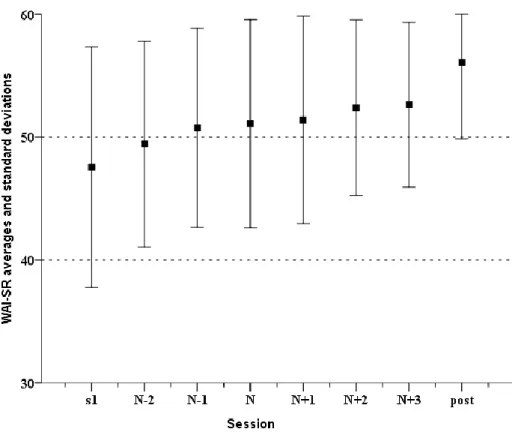
A representation of how the WAI-SR scores varied during treatment in the SG group is shown in Figure 3.
Figure 3. The Working Alliance Inventory – Short Revised (WAI-SR) average scores and standard deviations for the first, N-2, N-1, N, N+1, N+2, N+3 and last sessions.
SUDDEN GAINS IN PSYCHOTHERAPY
20
No significant differences were found in the Mann-Whitney U tests at pre-treatment (p = 0.572). Sudden-gainers started treatment with an average score of 47.54 (SD = 9.79) in the WAI-SR and individuals that did not experience a SG commenced treatment with an average score of 47.26 (SD = 5.35). A similar result was found at posttreatment (p = 0.788), with the SG-group (M = 56.08; SD = 6.24) averaging a similar score as the non-SG group (M = 55.35; SD = 5.99). Although the WAI-SR scores seem to be gradually increasing in the three session before and after the SG, no significant differences were found in any of the within-subject tests applied. No significant differences (p = 0.524) were found between the control session (M = 50.75; SD = 8.09) and the pregain session (M = 51.08; SD = 8.46) in the Wilcoxon rank-sums test. A similar result was found in the Wilcoxon rank-sums test (p = 0.429) comparing the pregain (M = 51.08; SD = 8.46) and the postgain (M = 51.38; SD = 8.45) sessions.
Discussion
This study investigated the relation between SGs and ambivalence and/or therapeutic alliance, in a manualized transdiagnostic CBT treatment with multiple disorders. The results suggested that the SG group drastically reduces their ambivalence levels in the postgain session and have a more steeped trajectory in the APQ during treatment. On the other hand, the therapeutic alliance and SGs do not seem to mutually affect each other in this sample.
OQ10.2 Adequacy for Detecting Sudden Gains
Consistent with previous studies, SGs were found to be relatively common in this sample, with 22.4% of the participants experiencing a substantial gain between two consecutive sessions. In samples with similar characteristics to the ones of the present study (outpatient participants suffering mainly from depression and anxiety disorders), the percentage of SGs was strikingly similar. Some examples were the 23.4% in Lutz et al. (2013), 23% in Greenfield et al. (2011) and 17% in Koffmann (2018). Also, similarly to previous studies (e.g., Abel, Hayes, Henley, & Kuyken, 2016), in the present research the SG group was found to start treatment with similar scores to the non-SG group, but finished with significantly lower scores in the measure used to assess gains. The non-SG group finished treatment with a score of 15.53 in average (SD = 7.5) in the OQ10.2, a result that is very close to its 16 points cut-off (Oliveira et al., 2019). In contrast the SG group finished treatment with a mean score of 9.08 (SD = 5.5).
In sum, the results of this study strongly suggest that the OQ10.2 can reliably detect SGs and, considering its brevity, should be considered in future SG studies. Clinicians tend to avoid the use of time consuming instruments (Brown et al., 1999), so brief instruments such as the BDI-II are frequently used not only in general psychotherapy (Mira et al., 2019) but also in the SG research (Lemmens et al., 2016; Tang & DeRubeis, 1999). Ultra-brief instruments are an even briefer option that have previously been
SUDDEN GAINS IN PSYCHOTHERAPY
21
shown to be well accepted by clinicians and clients (Seidel et al., 2016). Additionally, the use of ultra-brief measures, such as the OQ10.2, allows researchers to save time and obtain data from larger samples at a lower cost.
Ambivalence and Sudden Gains
In the between-subject analysis, no significant differences were found at baseline in the APQ between the SG and the non-SG group. Considering that high ambivalence values are expected in the earlier stages of treatment (Miller & Arkowitz, 2015), this result is congruent with the literature.
Unexpectedly, no significant differences were found in the APQ average scores between the SG and the non-SG group in the posttreatment as well. Previous studies have found that ambivalence (e.g., Gonçalves et al., 2017; Oliveira, 2018; Oliveira, Gonçalves, et al., 2019b) and SGs (e.g., Hamdeh et al., 2019; Tang & DeRubeis, 1999; Vincent & Norton, 2018) are both associated with symptom decrease and better posttreatment results. In this sense, a lower APQ score was also expected in the posttreatment SG-group. A possible explanation for these results is the inclusion criteria applied in the present study of clients having to be present in at least eight sessions. Highly ambivalent clients are also prone to dropout (Oliveira, Gonçalves, et al., 2019a). In this sense, it is probable that highly ambivalent clients dropped out of therapy before the eighth session and therefore were not included in this sample, affecting the posttreatment APQ scores.
The results found in the within-subject analysis when analyzing the APQ in the adjacent sessions to the SGs were very intriguing. Although ambivalence does not appear to be significantly different in the pregain session when compared to the control session, it drastically drops in the postgain session. In Olthof et al. (in press) study, SGs were found to be preceded by instability in symptoms, reflecting that clients were quickly alternating between choosing change and stability. Additionally, the authors found that a high symptom instability successfully predicted SGs within four days. Considering that those authors measured symptoms in a daily basis as opposed to the weekly measurement in the present study, it is possible that the pregain volatility in symptoms ended up not being detected. Nonetheless, the postgain results are in agreement with Olthof et al. (in press) results. After the SG, a drastic and stable decrease in ambivalence also happens. This decrease might reflect a crucial point where clients resolved their ambivalence, by accepting change and abandoning the stability of their maladaptive pattern.
The results of the HLM analysis suggested that the trajectory of the APQ is significantly more accelerated throughout treatment in the SG group. Considering that ambivalence decreases seem to be related to a faster decrease in symptoms (Oliveira, Gonçalves, et al., 2019b) and SGs have consistently been associated with better results in therapy (Tang, 2015), these findings are in agreement with past
SUDDEN GAINS IN PSYCHOTHERAPY
22
studies. The findings in this study suggest that the therapeutic construct of ambivalence and the phenomenon of SGs may be related, further stressing the importance of focusing ambivalence in therapy. In doing so, practitioners are promoting symptom decrease, better outcomes and probably even increasing the chances of clients achieving SGs.
Therapeutic Alliance and Sudden Gains
No significant differences were found at baseline in the WAI-SR between the SG and the non-SG group. Previous studies did not compare the two groups at baseline. Nonetheless, considering that in the earlier stages of treatment, most clients are still learning about the setting of therapy, lower scores in the WAI-SR are expected. Regardless of future gains, it is expected that agreement in goals, tasks and the overall bond in the client-therapist dyad (dimensions measured in the WAI-SR) will improve during the therapeutic process and the WAI-SR scores will increase. Even so, SG and the non-SG group did not present differences in WAI-SR in the posttreatment as well. Considering that in previous studies, therapeutic alliance has been found to improve after a SG (Lutz et al., 2013; Tang & DeRubeis, 1999; Vincent & Norton, 2018), this result was quite unexpected. Nonetheless, the scarcity of poor outcome cases in this sample might explain it. Therapeutic alliance is a crucial component of therapy that has been consistently related to outcome (Wampold, 2015). Therefore when clients develop a strong and secure alliance with the therapist, their chances of achieving better results increase (Zilcha-Mano, 2017). Since most cases in the present sample were good outcome cases (even the non-SG group finished treatment below the cut-off point for the OQ10.2), a considerably high therapeutic alliance was expected by the end of treatment, regardless of SG status. Another possible explanation (probably related to the previous one) is that the WAI-SR suffers from a ceiling effect in this sample. The SG group averaged 47-points in the WAI-SR scores of the first session, a result that is close to the 60-47-points maximum for this measure. Therefore, the lack of space for improvement might help explain why the SG group scores in the WAI-SR were not significantly higher in the postgain session.
The results found when comparing the WAI-SR in the sessions preceding to the SGs were in agreement with past research. Like in previous studies, such as Tang and DeRubeis (1999) and Vincent and Norton (2018), we found that therapeutic alliance did not significantly differed between the pregain and the control sessions. However, contrarily to the findings of those authors, in the present study SGs did not seem to be followed by a significant increase in therapeutic alliance. Once again, the characteristics of the WAI-SR in this sample might explain these results. Although the high WAI-SR scores from the start of therapy could simply reflect that clients and therapists were well synched together, this linear interpretation should imply some caution. Reese et al. (2013) found that alliance measures scores
SUDDEN GAINS IN PSYCHOTHERAPY
23
(including the WAI-SR) were not affected by anonymity status, however, no study, to the best of our knowledge, has tested the same in Portugal. The WAI-SR is a measure that is prone to be effected by social desirability (Reese et al., 2013) and the high averages in this sample throughout the whole therapeutic process might reflect that issue.
Limitations and Future Research
The present study presents several limitations, the first of which is the low sample size (N = 58). This is particularly problematic as the within-subject comparisons were limited to the analysis of a subsample of N = 13 (SG-group). Considering that the SG rates in samples with multiple diagnoses are around 20%, future researches similar to this one should attempt to collect samples of around 150 participants. This would allow a much larger SG-group subsample and consequently solider results.
Another possible drawback of the present study is the presence of multiple diagnosis in the sample. Although major depression and anxiety disorders have emotional dysregulation in common, these disorders are distinct and unique in many other ways. Furthermore, previous studies have found a lower percentage of SGs in anxiety disorders when compared to major depression disorder, raising the possibility that this phenomenon might manifests itself differently in different disorders (Tang, 2015). We suggest that future research should explore ambivalence in the SG context with samples diagnosed with a single disorder.
Finally, there were some issues in the collected data and measures used. In approximately 25% of this sample, the APQ was only collected every four sessions instead of every session. Furthermore, as we previously mentioned, the WAI-SR displayed a ceiling effect in this sample, probably affecting the findings with this measure. In future studies, authors could use a different measure of therapeutic alliance. A good option would be the Working Alliance Inventory—Short Observer-rated Version (WAI-O-S; Tichenor & Hill, 1989; Tracey & Kokotovic, 1989). This scale is rated by an observer, solving the social desirability issues that arise from the usage of the WAI-SR.
Considering that ambivalence seems to be associated with SGs, future studies should continue exploring this relation. Using the approach utilized by Olthof et al. (in press) of applying daily measurement could allow a better understanding of pregain ambivalence fluctuation. Additionally, in order to make the SG literature more relevant for clinical practice, future studies could focus in analyzing in depth the therapeutic events that occurred in the pregain session.
SUDDEN GAINS IN PSYCHOTHERAPY
24 References
Abel, A., Hayes, A. M., Henley, W., & Kuyken, W. (2016). Sudden gains in cognitive-behavior therapy for treatment-resistant depression: Processes of change. Journal of Consulting and Clinical Psychology, 84(8), 726–737. doi:10.1037/ccp0000101
Aderka, I. M., Anholt, G. E., Van Balkom, A. J. L. M., Smit, J. H., Hermesh, H., & Van Oppen, P. (2012). Sudden gains in the treatment of obsessive-compulsive disorder. Psychotherapy and Psychosomatics, 81(1), 44–51. doi:10.1159/000329995
Aderka, I. M., Nickerson, A., Bøe, H. J., & Hofmann, S. G. (2012). Sudden gains during psychological treatments of anxiety and depression: A meta-analysis. Journal of Consulting and Clinical Psychology, 80(1), 93–101. doi:10.1037/a0026455
Adler, J. M., Harmeling, L. H., & Walder-Biesanz, I. (2013). Narrative meaning making is associated with sudden gains in psychotherapy clients’ mental health under routine clinical conditions. Journal of Consulting and Clinical Psychology, 81(5), 839–845. doi:10.1037/a0033774
Barkham, M., Rees, A., Stiles, W. B., Shapiro, D. A., Hardy, G. E., & Reynolds, S. (1996). Dose-effect relations in time-limited psychotherapy for depression. Journal of Consulting and Clinical Psychology, 64, 927–935. doi:10.1037/0022-006X.64.5.927
Barlow, D. H., Farchione, T. J., Bullis, J. R., Gallagher, M. W., Murray-latin, H., Sauer-zavala, S., … Cassiello-robbins, C. (2017). The unified protocol for transdiagnostic treatment of emotional disorders compared with diagnosis-specific protocols for anxiety disorders a randomized clinical trial. JAMA Psychiatry, 74(9), 875–884. doi:10.1001/jamapsychiatry.2017.2164
Barlow, D. H., Farchione, T. J., Fairholme, C. P., Ellard, K. K., Boisseau, C. L., Allen, L. B., & Ehrenreich-May, J. T. (2011). Unified protocol for transdiagnostic treatment of emotional disorders: Therapist Guide. New York: Oxford University Press.
Beck, A. T., Steer, R. A., & Brown, G. (1996). Beck Depression Inventory: Manual (2nd ed.). San Antonio, TX: The Psychological Corporation.
Bohn, C., Aderka, I. M., Schreiber, F., Stangier, U., & Hofmann, S. G. (2013). Sudden gains in cognitive therapy and interpersonal therapy for social anxiety disorder. Journal of Consulting and Clinical Psychology, 81(1), 177–182. doi:10.1037/a0031198
Boswell, J. F., Iles, B. R., Gallagher, M. W., & Farchione, T. J. (2017). Behavioral activation strategies in cognitive-behavioral therapy for anxiety disorders. Psychotherapy, 54(3), 231–236. doi:10.1037/pst0000119
SUDDEN GAINS IN PSYCHOTHERAPY
25
Braga, C., Oliveira, J. T., Ribeiro, A. P., & Gonçalves, M. M. (2016). Ambivalence resolution in emotion-focused therapy: The successful case of Sarah. Psychotherapy Research, 28(3), 423–432. doi:10.1080/10503307.2016.1169331
Braga, C., Ribeiro, A. P., Gonçalves, M. M., Oliveira, J. T., Botelho, A., Ferreira, H., & Sousa, I. (2018). Ambivalence resolution in brief psychotherapy for depression. Clinical Psychology and Psychotherapy, 25(3), 369–377. doi:10.1002/cpp.2169
Brown, J., Deis, S., & Nace, D. (1999). What really makes a difference in psychotherapy outcome? Why does managed care want to know? In M. A. Hubble, B. L. Duncan, & S. D. Miller (Eds.), The heart and soul of change: What works in therapy (pp. 389–406). Washington, DC: American Psychological Association.
Buchholz, J. L., Abramowitz, J. S., Blakey, S. M., Reuman, L., & Twohig, M. P. (2018). Sudden Gains: How Important Are They During Exposure and Response Prevention for Obsessive-Compulsive Disorder? Behavior Therapy. doi:10.1016/j.beth.2018.10.004
Bullis, J. R., Fortune, M. R., Farchione, T. J., & Barlow, D. H. (2014). A preliminary investigation of the long-term outcome of the Unified Protocol for Transdiagnostic Treatment of Emotional Disorders. Comprehensive Psychiatry, 55(8), 1920–1927. doi:10.1016/j.comppsych.2014.07.016
Button, M. L., Westra, H. A., Hara, K. M., & Aviram, A. (2015). Disentangling the impact of resistance and ambivalence on therapy outcomes in cognitive behavioural therapy for generalized anxiety disorder. Cognitive Behaviour Therapy, 44(1), 44–53. doi:10.1080/16506073.2014.959038 Cartwright, A., Cheng, Y. P., Schmidt, U., & Landau, S. (2017). Sudden gains in the outpatient treatment
of anorexia nervosa: A process-outcome study. International Journal of Eating Disorders, 50(10), 1162–1171. doi:10.1002/eat.22773
Cavallini, A. Q., & Spangler, D. L. (2013). Sudden gains in cognitive behavioral therapy for eating disorders. International Journal of Cognitive Therapy, 6(3), 292–310. doi: 10.1521/ijct.2013.6.3.292
Collins, L. M., & Coles, M. E. (2017). Sudden gains in exposure therapy for obsessive-compulsive disorder. Behaviour Research and Therapy, 93, 1–5. doi:10.1016/j.brat.2017.03.003
DiNardo, P. A., Brow, T. A., & Barlow, D. H. (1994). Anxiety Disorders Interview Schedule for DSM- IV: Life Time Version (ADIS-IV-L). San Antonio, TX: Corporation, Psychologic.
Doran, J. M., Safran, J. D., & Muran, J. C. (2017). An investigation of the relationship between the alliance negotiation scale and psychotherapy process and outcome. Journal of Clinical Psychology, 73(4), 449–465. doi:10.1002/jclp.22340
SUDDEN GAINS IN PSYCHOTHERAPY
26
Durland, P. H., Wyszynski, C. M., & Chu, B. C. (2018). Predictors and outcomes of sudden gains and sudden regressions in cognitive behavioral therapy for youth anxiety. Behavior Therapy, 49(5), 823– 835. doi:10.1016/j.beth.2018.01.006
Engle, D., & Arkowitz, H. (2006). Ambivalence in psychotherapy: Facilitating readiness to change. New York, NY: Guilford Press.
Farchione, T. J., Fairholme, C. P., Ellard, K. K., Boisseau, C. L., Thompson-hollands, J., Carl, J. R., … Barlow, D. H. (2012). Unified Protocol for Transdiagnostic Treatment of Emotional Disorders : A randomized controlled trial. Behavior Therapy, 43(3), 666–678. doi:10.1016/j.beth.2012.01.001 Gelo, O. C. G., & Salvatore, S. (2016). A dynamic systems approach to psychotherapy: A meta-theoretical
framework for explaining psychotherapy change processes. Journal of Counseling Psychology, 63(4), 379–395. doi:10.1037/cou0000150
Gonçalves, M. M., Ribeiro, A. P., Mendes, I., Alves, D., Silva, J. R., Rosa, C., … Oliveira, J. T. (2017). Three narrative-based coding systems: Innovative moments, ambivalence and ambivalence resolution. Psychotherapy Research, 27(3), 270–282. doi:10.1080/10503307.2016.1247216 Gonçalves, M. M., Ribeiro, A. P., Mendes, I., Matos, M., & Santos, A. (2011). Tracking novelties in
psychotherapy process research: The innovative moments coding system. Psychotherapy Research, 21(5), 497–509. doi:10.1080/10503307.2011.560207
Gonçalves, M. M., Ribeiro, A. P., Stiles, W. B., Conde, T., Matos, M., Martins, C., & Santos, A. (2011). The role of mutual in-feeding in maintaining problematic self-narratives: Exploring one path to
therapeutic failure. Psychotherapy Research, 21(1), 27–40.
doi:10.1080/10503307.2010.507789
Greenfield, M. F., Gunthert, K. C., & Haaga, D. A. F. (2011). Sudden gains versus gradual gains in a psychotherapy training clinic. Journal of Clinical Psychology, 67(1), 17–30. doi:10.1002/jclp.20748
Hamdeh, A. A., Bjureberg, J., Lenhard, F., Hedman, E., Flygare, O., Lundström, L., … Andersson, E. (2019). Sudden gains in internet-based cognitive behavior therapy for obsessive-compulsive disorder. Journal of Obsessive-Compulsive and Related Disorders, 21, 75–81. doi:10.1016/j.jocrd.2018.12.005
Hardy, G. E., Stiles, W. B., Cahill, J., Ispan, C., Macaskill, N., & Barkham, M. (2005). Sudden gains in cognitive therapy for depression: A replication and extension. Journal of Consulting and Clinical Psychology, 73(1), 59–67. doi:10.1037/0022-006X.73.1.59
SUDDEN GAINS IN PSYCHOTHERAPY
27
Working Alliance Inventory. Psychotherapy Research, 16(1), 12–25. doi:10.1080/10503300500352500
Haugen, P. T., Goldman, R. E., & Owen, J. (2015). Sudden gains and deteriorations in the treatment of posttraumatic stress disorder in world trade center responders. Journal of Nervous and Mental Disease, 203(3), 205–209. doi:10.1097/NMD.0000000000000263
Hayes, A. M., Laurenceau, J., Feldman, G., Strauss, J. L., & Cardaciotto, L. (2007). Change is not always linear : The study of nonlinear and discontinuous patterns of change in psychotherapy. Clinical Psychology Review, 27, 715–723. doi:10.1016/j.cpr.2007.01.008
Hedman, E., Lekander, M., Ljótsson, B., Lindefors, N., Rück, C., Hofmann, S. G., … Schulz, S. M. (2014). Sudden gains in internet-based cognitive behaviour therapy for severe health anxiety. Behaviour Research and Therapy, 54, 22–29. doi:10.1016/j.biotechadv.2011.08.021.Secreted
Heinzel, S., Tominschek, I., & Schiepek, G. (2014). Dynamic patterns in psychotherapy- Discontinuous changes and critical instabilities during the treatment of obsessive compulsive disorder. Nonlinear Dynamics, Psychology, and Life Sciences, 18(2), 155–176.
Holzhauer, C. G., Epstein, E. E., Hayaki, J., Marinchak, J. S., McCrady, B. S., & Cook, S. M. (2017). Moderators of sudden gains after sessions addressing emotion regulation among women in treatment for alcohol use. Journal of Substance Abuse Treatment, 83, 1–9. doi:10.1016/j.jsat.2017.09.014
Horvath, A. O., & Greenberg, L. S. (1989). Development and validation of the Working Alliance Inventory. Journal of Counseling Psychology, 36(2), 223–233. doi:10.1016/j.jcin.2014.01.154
Howard, K. I., Kopta, S. M., & Orlinsky, D. E. (1986). The dose-effect relationship in psychotherapy. American Psychologist, 159–164. doi:10.1037/0003-066X.41.2.159
Hunnicutt-Ferguson, K., Hoxha, D., & Gollan, J. (2012). Exploring sudden gains in behavioral activation therapy for Major Depressive Disorder. Behaviour Research and Therapy, 50(3), 223–230. doi:10.1016/j.brat.2012.01.005
Jacobson, N. S., & Truax, P. (1991). Clinical significance: A statistical approach to denning meaningful change in psychotherapy research. Journal of Consulting and Clinical Psychologv, 59(1), 12–19. doi:10.1037/0022-006X.59.1.12
Keinonen, K., Kyllönen, H., Astikainen, P., & Lappalainen, R. (2018). Early sudden gains in an acceptance and values-based intervention: Effects on treatment outcome for depression and psychological flexibility. Journal of Contextual Behavioral Science, 10, 24–30. doi:10.1016/j.jcbs.2018.07.010 Keller, S. M., Feeny, N. C., & Zoellner, L. A. (2014). Depression sudden gains and transient depression
SUDDEN GAINS IN PSYCHOTHERAPY
28
spikes during treatment for PTSD. Journal of Consulting and Clinical Psychology, 82(1), 102–111. doi:10.1037/a0035286
Kelly, M., Cyranowski, J. M., & Frank, E. (2007). Sudden gains in interpersonal psychotherapy for depression. Behaviour Research and Therapy, 45(11), 2563–2572. doi:10.1016/j.brat.2007.07.007
Kelly, M., Roberts, J. E., & Bottonari, K. A. (2007). Non-treatment-related sudden gains in depression: The role of self-evaluation. Behaviour Research and Therapy, 45(4), 737–747. doi:10.1016/j.brat.2006.06.008
Kelly, M., Roberts, J. E., & Ciesla, J. A. (2005). Sudden gains in cognitive behavioral treatment for depression: When do they occur and do they matter? Behaviour Research and Therapy, 43(6), 703– 714. doi:10.1016/j.brat.2004.06.002
Koffmann, A. (2018). Intersession improvement and outcome in psychotherapy. Clinical Psychology and Psychotherapy, 26, 146–155. doi:10.1002/cpp.2337
König, J., Karl, R., Rosner, R., & Butollo, W. (2014). Sudden gains in two psychotherapies for posttraumatic stress disorder. Behaviour Research and Therapy, 60, 15–22. doi:10.1016/j.brat.2014.06.005
Lambert, M. J., Finch, A., Okiishi, J., Burlingame, G., McKelvey, C., & Reisinger, C. (2005). Administration and Scoring Manual for the OQ-10.2. Salt Lake City, UT: OQ Measures, LLC.
Lambert, M. J., Hansen, B. P., Umphress, V., Lunnen, K., Okiishi, J., Burlingame, G., & Reisinger, C. (1996). Administration and scoring manual for the Outcome Questionnaire (OQ 45.2). Wilmington, DE: American Professional Credentialing.
Lemmens, L. H. J. M., DeRubeis, R. J., Arntz, A., Peeters, F. P. M. L., & Huibers, M. J. H. (2016). Sudden gains in Cognitive Therapy and Interpersonal Psychotherapy for adult depression. Behaviour Research and Therapy, 77, 170–176. doi:10.1016/j.brat.2015.12.014
Lutz, W., Ehrlich, T., Rubel, J. A., Hallwachs, N., Röttger, M. A., Jorasz, C., … Tschitsaz-Stucki, A. (2013). The ups and downs of psychotherapy: Sudden gains and sudden losses identified with session reports. Psychotherapy Research, 23(1), 14–24. doi:10.1080/10503307.2012.693837
Masterson, C., Ekers, D., Gilbody, S., Richards, D., Toner-Clewes, B., & McMillan, D. (2014). Sudden gains in behavioural activation for depression. Behaviour Research and Therapy, 60, 34–38. doi:10.1063/1.2756072
Miller, W., & Arkowitz, H. (2015). Learning, Applying, and Extending Motivational Interviewing. In H. Arkowitz, W. Miller, & S. Rollnick (Eds.), Motivational Interviewing in the treatment of psychological
SUDDEN GAINS IN PSYCHOTHERAPY
29
problems (2nd ed., pp. 1–32). New York, NY: The Guildford Press.
Miller, W., & Rollnick, S. (2002). Motivational interviewing: Preparing people for change (2nd ed.). New York: Guilford Press.
Mira, A., Soler, C., Alda, M., Baños, R., Castilla, D., Castro, A., … Botella, C. (2019). Exploring the relationship between the acceptability of an internet-based intervention for depression in primary care and clinical outcomes: Secondary analysis of a randomized controlled trial. Frontiers in Psychiatry, 10(325). doi:10.3389/fpsyt.2019.00325
Montesano, A., Gonçalves, M. M., & Feixas, G. (2017). Self-narrative reconstruction after dilemma-focused therapy for depression: A comparison of good and poor outcome cases. Psychotherapy Research, 27(1), 112–126. doi:10.1080/10503307.2015.1080874
Nogueira-Arjona, R., Santacana, M., Montoro, M., Rosado, S., Guillamat, R., Vallès, V., & Fullana, M. A. (2017). Sudden gains in exposure-focused cognitive-behavioral group therapy for panic disorder. Clinical Psychology and Psychotherapy, 24(6), 1285–1291. doi:10.1002/cpp.2093
Norton, P., Klenck, S., & Barrera, T. (2010). Sudden gains during cognitive behavioral group therapy for anxiety disorders. Journal of Anxiety Disorders, 28(8), 887–892. doi:10.1016/j.immuni.2010.12.017
O’Mahen, H. A., Moberly, N. J., & Wright, K. A. (2018). Trajectories of change in a group behavioral activation treatment for severe, recurrent depression. Behavior Therapy, 50(3), 504–514. doi:10.1016/j.beth.2018.08.007
Oliveira, J. T. (2018). Ambivalence in psychotherapy: From measuring ambivalence to providing feedback to the therapist (Doctoral dissertation). University of Minho, Portugal.
Oliveira, J. T., Gonçalves, M. M., Sousa, I., Ribeiro, A. P., Ribeiro, E., & Machado, P. P. P. (2019a). Premature termination of psychotherapy: The role of ambivalence in psychotherapy. Manuscript submitted for publication.
Oliveira, J. T., Gonçalves, M. M., Sousa, I., Ribeiro, A. P., Ribeiro, E., & Machado, P. P. P. (2019b). To change or not to change? The impact of ambivalence about change on therapeutic outcomes. Manuscript submitted for publication.
Oliveira, J. T., Machado, P. P. P., Gonçalves, M. M., Ribeiro, E., & Gonçalves, S. (2019). The psychometric properties and the reliable change index of the outcome questionnaire 10.2 on the portuguese population. Manuscript in preparation.
Oliveira, J. T., Ribeiro, A. P., & Gonçalves, M. M. (2019). Ambivalence in Psychotherapy Questionnaire: Development and validation studies. Manuscript submitted for publication.
SUDDEN GAINS IN PSYCHOTHERAPY
30
Olthof, M., Hasselman, F., Strunk, G., van Rooij, M., Aas, B., Helmich, M., … Shiepek, G. (in press). Critical fluctuations as an early-warning signal for sudden gains and losses in patients receiving psychotherapy for mood disorders. Clinical Psychological Science.
Perez, M. R. (2018). Adaptación y validación del Cuestionario de Ambivalencia en Psicoterapia en población clínica española (Master’s thesis). Universitat de Barcelona, Spain.
Ramos, M. A. F. (2008). Análise das características psicométricas da versão portuguesa do Working Alliance Inventory - Short Revised (Master’s thesis). University of Minho, Portugal.
Reese, R. J., Gillaspy, J. A., Owen, J. J., Flora, K. L., Cunningham, L. C., Archie, D., & Marsden, T. (2013). The influence of demand characteristics and social desirability on clients ratings of the therapeutic alliance. Journal of Clinical Psychology, 69(7), 696–709. doi:10.1002/jclp.21946
Ribeiro, A. P., Gonçalves, M. M., Silva, J. R., Brás, A., & Sousa, I. I. (2016). Ambivalence in narrative therapy: A comparison between recovered and unchanged cases. Clinical Psychology and Psychotherapy, 23(2), 166–175. doi:10.1002/cpp.1945
Santos, C. (2019). Propriedades psicométricas da versão brasileira do Questionário de Ambivalência em Psicoterapia (QAP) (Master’s thesis). Universidade Federal de Juiz de Fora, Brasil.
Schiepek, G. (2009). Complexity and nonlinear dynamics in psychotherapy. European Review, 17, 331– 356. doi:10.1017/s1062798709000763
Seidel, J. A., Andrews, W. P., Owen, J., Miller, S. D., & Buccino, D. L. (2016). Preliminary validation of the rating of outcome scale and equivalence of ultra-brief measures of well-being. Psychological Assessment, 29(1), 65–75. doi:10.1037/pas0000311
Singla, D. R., Hollon, S. D., Fairburn, C. G., Dimidjian, S., & Patel, V. (2019). The roles of early response and sudden gains on depression outcomes: Findings from a randomized controlled trial of behavioral activation in Goa, India. Clinical Psychological Science, 1–10. doi:10.1177/2167702619825860
Stiles, W. B., Leach, C., Barkham, M., Lucock, M., Iveson, S., Shapiro, D. A., … Hardy, G. E. (2003). Early sudden gains in psychotherapy under routine clinic conditions: Practice-based evidence. Journal of Consulting and Clinical Psychology, 71(1), 14–21. doi:10.1037/0022-006X.71.1.14 Storch, E. A., McGuire, J. F., Schneider, S. C., Small, B. J., Murphy, T. K., Wilhelm, S., & Geller, D. A.
(2019). Sudden gains in cognitive behavioral therapy among children and adolescents with obsessive compulsive disorder. Journal of Behavior Therapy and Experimental Psychiatry, 64(February 2018), 92–98. doi:10.1016/j.jbtep.2019.03.003