R E V I E W
Open Access
Jaburetox: update on a urease-derived
peptide
Arlete Beatriz Becker-Ritt
1*, Camila Saretta Portugal
1and Célia Regina Carlini
2Abstract
Urease fromCanavalia ensiformisseeds was the first enzyme ever to be crystallized, in 1926. These proteins, found in plants, bacteria and fungi, present different biological properties including catalytic hydrolysis of urea, and also enzyme-independent activities, such as induction of exocytosis, pro-inflammatory effects, neurotoxicity, antifungal and insecticidal properties. Urease is toxic to insects and fungi per se but part of this toxicity relies on an internal peptide (~11 kDa), which is released upon digestion of the protein by insect enzymes. A recombinant form of this peptide, called jaburetox (JBTX), was constructed usingjbureIIgene as a template. The peptide exhibits liposome disruption properties, and insecticidal and fungicidal activities. Here we review the known biological properties activities of JBTX, and comment on new ones not yet fully characterized. JBTX was able to cause mortality ofAedes aegyptilarvae in a feeding assay whereas in a dose as low as of 0.1μg it provoked death ofTriatoma infestans
bugs. JBTX (10−5
–10−6
M) inhibits the growth ofE. coli, P. aeruginosaandB. cereusafter 24 h incubation. Multilamellar liposomes interacting with JBTX undergo reorganization of the membrane’s lipids as detected by small angle X-ray scattering (SAXS) studies. Encapsulating JBTX into lipid nanoparticles led to an increase of the peptide’s antifungal activity. Transgenic tobacco and sugarcane plants expressing the insecticidal peptide JBTX, showed increased resistance to attack of the insect pestsSpodoptera frugiperda,Diatraea saccharalisandTelchin licus licus. Many questions remain unanswered; however, so far, JBTX has shown to be a versatile peptide that can be used against various insect and fungus species, and in new bacterial control strategies.
Keywords:Peptide, Bacteria, Membranes, Nanoparticles
Background
Ureases (urea amidohydrolases; EC 3.5.1.5) are enzymes that catalyze the hydrolysis reaction of urea to ammonia and carbamate, which then decomposes through a spon-taneous reaction of carbon dioxide in a second molecule of ammonia. These enzymes have been isolated from a wide variety of organisms including plants, fungi and bacteria [1, 2].
The urease extracted from Canavalia ensiformisseeds is one of the landmarks in the study of enzymes. It was the first enzyme to be crystallized, demonstrating that enzymes are proteins [3]. It was also the first one to be identified as a metalloenzyme containing nickel in its active site [4].
The classical urease, called jack bean urease (JBU), is composed of a polypeptide chain of 840 amino acid residues and has a molecular mass of 90 kDa. The mini-mum active form is a trimer of 270 kDa and it is often found in its native form as a hexamer of 540 kDa [5, 6]. The second isoform of jack bean urease, canatoxin (CNTX), was isolated from the seed and originally char-acterized as a neurotoxic protein [7]. It features two chains with a molecular mass of 95 kDa held together by non-covalent bonds, and it has about 40% of the enzym-atic activity of JBU; each subunit contains one zinc atom and one nickel atom [8]. Importantly, despite the high similarity with JBU, this less abundant isoform has lower ureolytic activity [6].
Ureases and derived peptides show several bio-logical activities including membrane disruption and permeabilization, fungicidal and insecticidal properties [9]. Jaburetox2Ec and jaburetox (JBTX) are the two first ver-sions of a recombinant peptide with 91 amino acids, based * Correspondence:[email protected];[email protected]
1Graduate Program in Cellular and Molecular Biology Applied to Health, Lutheran University of Brazil (ULBRA), Canoas, RS, Brazil
Full list of author information is available at the end of the article
on jack bean urease sequence, with a potent effect against insects, yeasts and filamentous fungi [10–12].
Urease and its derived peptide were evaluated for their action on the diuresis of the bug Rhodnius prolixus
through an in vitro assay with Malpighian tubules [13]. It was observed that although both urease and JBTX inhibited diuresis, they recruited distinct signaling cas-cades. While urease activates the eicosanoid pathways and depends on the transport of calcium ions, JBTX inhibits diuresis by changes in levels of cGMP and in the transmembrane potential [13].
The insecticidal activity of JBTX occurs at very low doses (0.01 and 0.1% w/w) when compared to other plant derived entomotoxic proteins, regardless of the route of administration, either orally or by injection into the hemocell [12].
Molecular studies of JBTX revealed that the peptide contains a sequence that could adopt a β-hairpin con-formation at its C-terminal region, a structure similar to that found in antimicrobial peptides (AMPs) with mem-brane rupture properties [10]. To assess the importance of the peptide structure in the biological activities of JBTX, Martinelli et al. [14] conducted molecular studies and site-directed mutagenesis, aiming to identify struc-tural motifs related to the toxic activities.
The mutants derived from jaburetox were called: jaburetox N-terminal, corresponding to residues from 1 to 44 (JBTX N-ter); jaburetox C-terminal, residues from 45 to 93 (JBTX C-ter); and jaburetox-Δβ, without the amino acids 61 to 74 (JBTXΔ-β), which corresponds to theβ-hairpin region. All mutants were tested in different biological assays. In insect toxicity tests, the data suggest that theβ-hairpin region is not important for entomotoxi-city and that the N-terminal portion of JBTX is respon-sible for insecticidal activity. However, the C-terminal region of the peptide, which contains the β-hairpin moi-ety, is likely to contribute significantly to the ability of JBTX to interact with a lipid bilayer [12, 14].
The ability of these peptides to form ion channels in lipid bilayers was also confirmed by testing with planar lipid bilayers (PLB) [15]. In this study, it was shown that the peptide, as well as the above mentioned mutants can insert themselves into planar lipid bilayers and form cation selective ion channels. The data obtained by Martinelli et al. [14] brought important contributions to the understanding of the JBTX’s mechanism of action, suggesting that it represents a new type of active peptide in membranes, with insecticidal and fungitoxic proper-ties. The antifungal activity of JBTX against yeasts oc-curs at higher doses (9 to18 μM) than those observed for JBU (0.27 μM), suggesting that other regions of the protein could probably be involved in this activity [11].
The overall conformation of the peptide JBTX was elucidated using techniques such as light scattering,
circular dichroism and nuclear magnetic resonance [16]. The authors demonstrated the intrinsically disordered na-ture of the peptide, which exists in a“pre molten globule” state, and its tendency to form anα-helix motif near the N-terminus and two turn-like structures (located in its central/C-terminal polypeptide portions). Thus, although JBTX has low propensity to present secondary structure, and despite being an intrinsically disordered protein, the peptide has some degree of folding [16].
What’s New?
Can the peptide control disease vectors and insect pest in agriculture?
The mosquito Aedes aegypti (Diptera: Culicidae) is the vector responsible for transmitting diseases to humans, such as urban yellow fever, dengue and more recently, Chikungunya and Zika viruses [17]. Presently the main form of control of these diseases still is by fighting its vector, which requiers complex and coordinated actions of various sectors of the society as well as changes in population habits [18].
In Brazil, endemic disease fighting agents and national and municipal health agents are working together with the population and are responsible for promoting the chemical mechanical control of the disease vector. The actions are focused on detecting and destroying natural or artificial reservoirs of water that can serve as a de-posit for the mosquito’s eggs. Educational activities are another strategy postulated by the Ministry of Health including community agents visiting residences, in order to ensure the sustainability of the elimination of breed-ing sites, in an attempt to break the transmission chain of the disease [17].
In order to test a new mosquito control strategy, the insecticidal activity of lyophilized Escherichia coli cells overexpressing the peptide JBTX against A. aegypti lar-vae was evaluated [19]. Peptide quantification performed by ELISA showed thatE. colicells produced about 27μg JBTX per mg of dry matter. For the test, mosquito larvae were feed with fish food containing the recombinant E. coli cells to 10 or 100 μg of JBTX. As control, E. coli
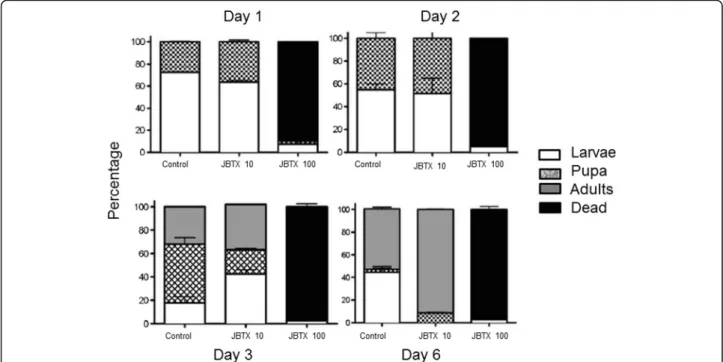
cells without JBTX were used in the same proportion. The survival rate and stage of progression of the bio-logical cycle from pupa to adult were accompanied. A suspension of E. coli containing 100 μg of JBTX pro-moted 90% mortality ofA. aegyptilarvae on the first day and 97.5% in 6 days Fig. 1. The results emphasized the entomotoxic potential of JBTX to control A. aegypti by interfering in the mosquito biological cycle and produ-cing mortality of larvae as well as adult insects [19].
Triatoma infestans is the main vector of Chagas disease in South American countries and the control of the disease strongly depends on vector eradication [20]. Despite extensive insecticide application, the disease is
still endemic in South America [21]. Using T. infestans
as a model, Galvani et al. [22] demonstrated that injec-tion of 0.1 μg of JBTX/mg of body weight into adults caused death of all insects in less than 24 h. After 3 h of injection, insects show neurotoxic symptoms such as abnormal behavior of antennae and uncoordinated leg movements, which precede death. JBTX was found to bind to neuronal cells and to interfere with at least two enzymes of the insect brain:
JBTX strongly inhibited the activity of nitric oxide
synthase, thereby reducing the levels of the nitric oxide neurotransmitter;
JBTX was found to physically interact with and to
increase the activity of UDP-N-acetylglucosamine pyrophosphorylase (UDP-GlcNAcP), an enzyme involved in glycosylation pathways and in the synthesis of chitin [22].
In an in vitro study, JBTX also activated UDP-GlcNAcP from the cotton stainer bugDysdercus peruvianus, an in-sect that is susceptible to the inin-secticidal activity of both, urease and JBTX [22, 23].
Rhodnius prolixus, another triatomine vector of Chagas disease in South America, has been extensively used as an insect model in the studies to elucidate the mechanism of action of urease and derived peptides.
Besides interfering with diuresis, crop physiology and causing effects related to the central nervous system (CNS), JBTX was shown to disrupt the immune re-sponse ofR. prolixus, affecting the ability of the insect to effectively counteract bacterial infection [24].
According to the United Nations data, about one billion people are still hungry worldwide [25]. In addition, according to the World Hunger [26], almost all the hungry people are living in developing countries. Globally, every year about 35% of all crop production is lost to pre-harvest biotic stresses and an additional 6 to 20% of losses are due to post-harvest events [27]. With an average annual loss of 25 million tons, corresponding to 7.7% of the Brazilian agricultural production, the financial damage can reach $ 16 billion per year [28].
If we take only into account the sugarcane crop, Brazil is the largest producer in the world. Data from the Na-tional Supply Company (Conab) show that in the 2016/ 2017 harvest, the country harvested over 657 million tons of sugarcane with a production of 38 million tons of sugar [29]. The losses that the giant borer, Telchin licus licus, can potentially cause include reduction of 12.1% in sugarcane production, 4% loss in sugar produc-tion and 3% reducproduc-tion in ethanol producproduc-tion. Moreover, annual expenditures on insect control methods allow estimating that the losses caused by this insect can reach R$ 4.88 billion per year [29].
Fig. 1Effects of jaburetox-V5-loaded lyophilizedE. colionA. aegypti. Mosquito larvae, 25 per experimental condition, were fed fish diet soaked with a suspension of lyophilizedE. colicells containing 0 (control), 10 or 100μg of JBTX, as quantified by ELISA. Controls with non-transformed
E. coliwere run in parallel. The larvae were kept at 28oC with a photoperid of 8:16 (light:dark) and developmental stage and mortality were
To access the effect of JBTX on the cotton stainer bug
Dysdercus peruvianus an insect model that relies on ca-thepsins as its main digestive enzyme was employed. Third instars insects were fed artificial cottonseeds containing lyophilized 0.01% (w/w) JBTX. After 10 days, the mortality was two times higher for bugs that fed on freeze-dried purified JBTX than that observed for those that ingested the jackbean urease isoform canatoxin, at the same dose [10, 23].
Insects relying on trypsin-like alkaline serine-proteinases as main digestive enzymes, such as the fallworm Spodop-tera frugiperda, were shown to be resistant to canatoxin’s insecticidal effect. This fact was attributed to the break-down of canatoxin by the proteolytic enzymes produced by these insects as well as to the lack of production of the entomotoxic peptide. On the other hand, third instar S. frugiperda reared on Phaseolus vulgaris foliar discs con-taining air-dried JBTX were susceptible to the entomotoxic activity of JBTX. These experiments demonstrated that lepidopterans and other insects relying on trypsin-based digestion, although not being able to hydrolyze urease to release its internal peptide, could be targets of the preformed toxic peptide [10, 23].
Another example is that of the polyphagous pest
Helicoverpa armigera(corn earworm). It was first identi-fied in Brazil during the 2012–2013 crop season, causing serious damage to the production of cotton, soybean, corn, green beans, tomatoes, citrus and pastures. Asia, Europe, Africa, and Australia reports U$ 2 billion dam-ages caused by H. armigera annually, whereas Brazil suffered a damage of approximately U$ 0.8 billion when it first emerged [30]. Feeding on a few micrograms of JBTX, or its truncated version with deletion of a β -hairpin, caused mortality and a significant reduction in dietary intake in Helicoverpa armigera caterpillars [14]. When newborn caterpillars were fed on disks of corn leaves containing the peptides, 69% mortality and a 70% reduction in consumption were observed (Didoné et al., unpublished data).
Can bacteria be controlled using the peptide? Bacteria are responsible for causing heavy agricultural losses and for the vast majority of hospital infections [31]. The USA expends per year about 30 billion dollars dealing with hospital infections, and this amount is expected to increase as more bacteria become drug resistant [31].
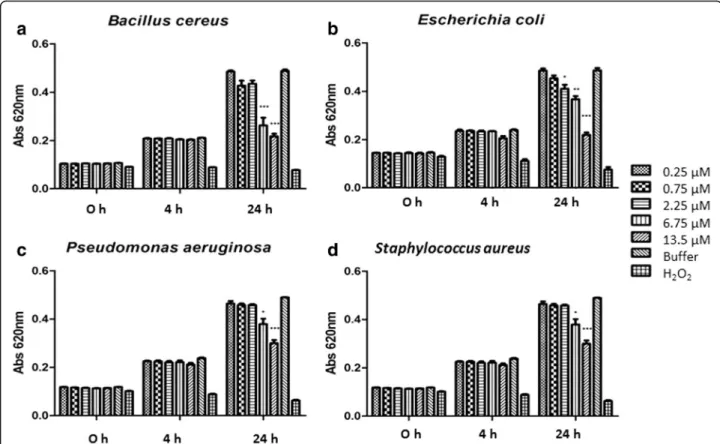
Following the method described by Pompilio et al. [32], JBTX–at a wavelength of 620 nm and turbidimet-rically monitored – revealed a bacteriostatic effect against Bacillus cereus, Escherichia coli, Pseudomonas aeruginosa and Staphylococcus. Bacteria were incubated with different concentrations of JBTX (from 0.25 up to 13.5 μM) added to the growth medium. Their multipli-cation rate was compared to that in the presence of
buffer (Tris HCl 10 mM, pH 7.0) as a negative control and H2O2as a positive control. Figure 2 shows a
dose-dependent inhibitory effect of JBTX on the four bacterial strains. Growth inhibition of 50% was seen forE. coli,P. aeruginosa and B. cereus with 13.5 μM of JBTX after 24 h of incubation [33]. This inhibitory effect was reversed upon transferring the bacteria to a JBTX-free medium (not shown).
In the context of plant-derived antibacterial peptides, JBTX is as effective as other molecules described in the lit-erature, as summarized in Table 1. Thus fabatins show bacterial activity against gram-negative bacteria in the range of 4–20μM [34, 35]. Cp thionine-2 is active at 12– 25 μM concentration [36]. Hispidalin, from the seeds of
Benincasa hispida, at 7-μM concentration demonstrated a broad inhibitory effect against bacteria and caused signifi-cant inhibition of the filamentous fungi [37].
The yet preliminary evaluation of the antibacterial ac-tivity of JBTX demonstrated its inhibitory acac-tivity against bacteria of medical and agricultural importance at doses ranging from 2.25μM (forE. coli) to 6.75μM (B. cereus,
P. aeruginosa, S. aureus). The antibacterial activity of JBTX reinforces previous findings of antimicrobial activity of this plant-derived peptide against fungi and yeast of biomedical importance [11]. Therefore, jaburetox is a promising lead molecule for development of new antibi-otics and antifungal drugs (Fig. 2) [33].
Is there any effect on membranes?
JBTX’s ability to interact with lipid membranes has been previously described. Barros et al. [38] observed that JBTX was able to permeabilize acidic liposomes to re-lease entrapped carboxy-fluorescein. Piovesan et al. [15] reported that JBTX, as well as some of its truncated mu-tants, was capable of inserting itself into neutral planar lipid bilayers forming cation-selective ion channels. More recently, Micheletto et al. [39] studied by small angle X-ray scattering (SAXS) the interaction among JBTX and multilamellar liposomes with a lipid compos-ition typical of human platelets membrane. The inter-action among JBTX and the liposomes led to alterations of the Bragg peak, indicating a significant reduction of the lamellar repeat distance and in the number of lamel-lar repeats. The data suggested that, besides not causing lysis of the vesicles, JBTX promoted a reduction in the size of the liposomes probably due to reorganization of the membrane lipids in the presence of the peptide. A reduction of the Caillé parameter indicated that the lipo-some membrane became more rigid, which altered the peptide insertion into the lipid membrane.
Interestingly, jack bean urease (JBU), from which JBTX is derived, showed similar behavior towards platelet-like multilamellar liposomes. Since the JBU internal sequence corresponding to JBTX is well exposed at the protein
surface, we hypothesized that the JBTX-equivalent region of JBU drives the interaction of the protein with mem-branes [15]. The data revealed that indeed JBTX can insert itself into a lipid bilayer, eventually traversing the mem-brane, thereby disrupting the multilamellar structure of the liposomes [39]. There is no data so far to explain why or how JBTX can be selective towards pathogens or pests, while sparing host cells. In fact, JBTX has proved not to be cytotoxic against a panel of mammal tumoral cells at concentrations in the micromolar range (Portugal et al., unpublished data).
Are JBTX-expressing transgenic plants more resistant to insect pests?
With the exponential growth of the world population and the accompanying need for increasing food produc-tion, the advance of agriculture implies the creation of new insect control technologies that protect plants both during their development and at post-harvest (storage). The promise of transgenic crops expressing insecticidal polypeptides that dates back from the 1970s is now be-coming true [40]. Corn plants producing Cry proteins derived from Bacillus thuringiensis (Bt) soil bacterium
are produced since the early 1990s [41]. It is estimated that around 60 million hectares of Bt maize are grown globally and of these, 13 million hectares are cultivated in Brazil alone [42]. However, because insect resistance to the present Bt-expressing crops rapidly evolves, there is an urgent need to find new insecticidal polypeptides for the next generation of pest resistant transgenic plants to be used alone or in“stacking”strategies.
Preliminary biosafety studies showed that high doses of JBTX are innocuous to mice and rats, administered either orally or via injection. This finding encouraged studies on how to develop insect-resistant transgenic plants by heterol-ogous expression of JBTX. A first attempt was conducted by Mulinari in 2008 [43], in which the peptide was inserted into the genome of tobacco SR1 plants by using a binary vector pCAMBIA2300-AMV-35Sd-jaburetox2-Tnos through Agro-bacterium transformation. Young leaves of different trans-genic tobacco plants expressing different levels of JBTX (as measured by ELISA) were then offered toSpodoptera frugi-perda larvae. While leaves of some plants induced 50% lethality of caterpillars (20 larvae per condition–plants with different amount of JBTX) after 30 days, other plants killed 100% of the larvae after 15 days [43].
Fig. 2Effects of jaburetox on bacteria. Bacterial multiplication was evaluated by absorbance at 620 nm at time zero, and 4 and 24 h after incubation in the presence of different concentrations of JBTX.aBacillus cereus;bEscherichia coli;cPseudomonas aeruginosa;dStaphylococcus aureus. Growth in the presence of buffer (Tris HCl 10 mM pH 7.0) or H2O2was considered as negative and positive control, respectively. Each
In preliminary studies, transgenic sugarcane plants (cultivar SP803280) expressing the JBTX peptide under the 35S promoter were obtained by callus bombardment. About 22 PCR-positive clones were generated and after
regeneration, the transgenic sugarcane plants expressing JBTX (0.35 to 0.65μg per mg of total protein, quantified by ELISA) are now being screened for insect resistance. When challenged with Diatraea saccharalis, the stem Table 1Antimicrobial activity of some peptide classes
AMP class AMP name Plant species Antimicrobial activity Reference
Defensin Cp-thionin-2 Vigna unguiculata Staphylococcus aureus(128μg · mL−1)
Escherichia coli(64μg · mL−1) [36]
Defensin Fabatin-1 Vicia faba E. coli(100μg · mL−1)
Pseudomonas aeruginosa(30μg · mL−1) [35]
Defensin Fabatin-2 V. faba E. coli(100μg · mL−1)
P. aeruginosa(30μg · mL−1) [35]
Defensin StPTH1 Solanum tuberosumcv Jaerla Clavibacter michiganensis(7μM)
Ralstonia solanacearum(25μM) R. solanacearum(rfa-) (25μM)
EC50–Effective concentration for 50% inhibition [44]
Defensin Cn-AMP1 Cocos nucifera Bacillus subtilis(76μg · mL−1)
S. aureus(80μg · mL−1)
E. coli(82μg · mL−1)
P. aeruginosa(79μg · mL−1)
[45]
Defensin Cn-AMP2 C. nucifera B. subtilis(150μg · mL−1)
S. aureus(170μg · mL−1)
E. coli(170μg/mL) P. aeruginosa(169μg · mL−1)
[45]
Defensin Cn-AMP3 C. nucifera B. subtilis(257μg · mL−1)
S. aureus(274μg/mL); E. coli(302μg · mL−1)
P. aeruginosa(259μg · mL−1)
[45]
Cyclotide Kalata B1 Oldenlandia affinis(Roem. & Schuld.) DC. S. aureus(0.75μg · mL−1) and
Klebsiella oxytoca(158.37μg · mL−1) [46] Cyclotide Circulin A CollinsiaparvifoliaSchum. S. aureus(0.59μg · mL−1) and
Proteus vulgaris(172.04μg · mL−1) [46] Cyclotide Circulin B C. parvifoliaSchum. S. aureus(44.32μg · mL−1),
E. coli(1.35μg · mL−1),
P. aeruginosa(83.7μg · mL−1),
P. vulgaris(22.3μg · mL−1) and
K. oxytoca(26.92μg · mL−1)
[46]
Cyclotide Cycloviolacin O2 Viola odorata Salmonella enterica(8.75μg · mL−1)
E. coli(2.2μg · mL−1)
S. aureus(>50μg · mL−1)
[47]
α/β-Thionin Alpha-1-purothionin Triticum aestivum Pseudomonas solanacearum(5μg · mL−1)
Xanthomonas phaseoli(27μg · mL−1)
Xanthomonas campestres(56μg · mL−1)
Erwinia amylovora(540μg · mL−1)
Corynebacterium flaccumfaciens(110μg · mL−1)
Clavibacter michiganense(450μg · mL−1)
Corynebacterium poinsettiae(56μg · mL−1)
Corynebacterium sepedonicun(1μg · mL−1)
[48]
α/β-Thionin PR-13 thionins Nicotiana attenuate Pseudomonas syringaepv.Tomato(0.25μg · mL−1) [49]
Snakin Snakin-1 S. tuberosum Listeria monocytogenes(10μg · mL−1) [50]
Snakin StSN1 S. tuberosumcv Jaerla C. michiganensis(4μM)
R. solanacearum(rfa-) (15μM)
EC50–Effective concentration for 50% inhibition
[44,51]
Snakin StSN2 S. tuberosumcv Jaerla Clavibacter michiganensis(1μM)
R. solanacearum(rfa-) (30μM) Rhizobium meliloti(8μM)
EC50–Effective concentration for 50% inhibition
[44,51]
LTP LTP-s1 LTP-s2 Spinacia oleracea C. michiganensissubsp.Sepedonicus(100μg · mL−1) [51]
borer, several of these plants proved to be more resistant to the caterpillar attack and in some cases caterpillar mortality reached 100% (Becker-Ritt et al., unpublished data). The JBTX-expressing plants were also tested for resistance against the giant borer, Telchin licus licus, a relevant pest of sugarcane crops in some parts of Brazil. The young caterpillar feeds initially on the leaves of sugarcane and then penetrates through the soft parts of the stem (sheath). In some cases, when transgenic sugar-cane plants expressing JBTX were exposed to giant borer larvae, 100% lethality of caterpillars was observed (Becker-Ritt et al, unpublished).
Thinking about the future
While diseases transmitted by A. aegypti continue to cause many deaths and insect pests damage livestock and agricultural production, there will be room for research on new and promising insecticidal agents such as JBTX. Not to mention the potent antifungal and bac-tericidal properties of this urease-derived polypeptide. However, many questions remain and should be clarified before any potential use of JBTX can be devised.
The mechanism of action of JBTX should be better understood. Is the ability of the peptide to interact with lipids what drives its interaction with cells or is there a “receptor” for the peptide in insect membranes? What happens with the intrinsically disordered regions of the peptide when it interacts with biological membranes? Does it acquire a more ordered biologically active struc-ture or is its disordered nastruc-ture required for its effects? How exactly does JBTX exert its neurotoxic effects or its immunomodulatory action? How specific is JBTX to-wards insects? Would the biosafety profile of JBTX allow the continuation of studies with insect resistant trans-genic plants? Can nanoparticle technologies applied to JBTX, which aim at a controlled and efficient delivery of the entomotoxic peptide to its targets, provide novel solutions to overcome insect resistance, protect the en-vironment and improve crop production? These are only a few questions awaiting to be answered. Meanwhile, although putting all our efforts to unravel the mysteries of JBTX, we still feel mesmerized on the wonders of this beautiful and versatile molecule.
Conclusions
Our goal with this article was to briefly review the bio-logical activities performed by a recombinant peptide ob-tained from the Canavalia ensiformis urease sequence. The idea was to demonstrate that this recombinant pep-tide is capable of exerting inhibitory activity on fungi, yeasts, bacteria and insects, and similarly to other plant ureases, JBTX is also capable of acting on plant defense. In addition, the peptide is effective in inhibiting bacteria of medical and agronomic interest and is capable of
causing lethality in insect pests of sugarcane, tobacco and corn. In spite of these biological activities, the peptide is innocuous to mammals and non-target organisms and can be used both in the development of transgenic plants resistant to diseases and pests and in the formulation of bioinsecticides.
Abbreviations
AMPs:Antimicrobial peptides; Bt:Bacillus thuringiensis; CNS: Central nervous system; CNTX: Canatoxin; H2O2: Hydrogen peroxide; Jaburetox-Δβ: Jaburetox
without the amino acids 61 to 74; JBTX: Jaburetox; JBTX ter: Jaburetox C-terminal; JBTX N-ter: Jaburetox N-C-terminal; JBU: Jack bean urease; PLB: Planar lipid bilayers; SAXS: Small angle X-ray scattering; UDP-GlcNAcP: UDP-N-acetylglucosamine pyrophosphorylase
Acknowledgments
The authors would like to thank ULBRA, PUCRS, CAPES and CNPq for their support. Thanks are also due to the Center for the Study of Venoms and Venomous Animals (CEVAP) of UNESP for enabling the publication of this paper (Edital Toxinologia CAPES no. 063/2010, Process no. 230.38.006285/ 2011-21, AUXPE Toxinologia 1219/2011).
Funding
The present study was supported by the Coordination for the Improvement of Higher Education Personnel (CAPES) through the Toxicology Program 63/2010, process 1205/2011; and the National Council for Scientific and Technological Development (CNPq) through the universal program, processes 475908/2012-0 and 446052/2014-1.
Authors’contributions
All authors participated in writing and revising the manuscript. Moreover, all authors read and approved the final manuscript.
Competing interests
The authors declare that they have no competing interests.
Consent for publication
Not applicable.
Ethics approval and consent to participate
Not applicable.
Publisher’s Note
Springer Nature remains neutral with regard to jurisdictional claims in published maps and institutional affiliations.
Author details
1Graduate Program in Cellular and Molecular Biology Applied to Health, Lutheran University of Brazil (ULBRA), Canoas, RS, Brazil.2Brain Institute (Instituto do Cérebro-INSCER), Pontifical Catholic University of Rio Grande do Sul (PUCRS), Porto Alegre, RS, Brazil.
Received: 23 December 2016 Accepted: 6 June 2017
References
1. Carter EL, Flugga N, Boer JL, Mulrooney SB, Hausinger RP. Interplay of metal ions and urease. Metallomics. 2009;1(3):207–21.
2. Krajewska B, Ureases I. Functional, catalytic and kinetic properties: a review. J Mol Catal B Enzym. 2009;59(1-3):9–21.
3. Sumner JB. The isolation and crystallization of the enzyme urease: preliminary paper. J Biol Chem. 1926;69:435–41.
4. Dixon NE, Gazzola C, Watters JJ, Blakely RL, Zerner B. Inhibition of Jack Bean urease (EC 3.5.1.5) by acetohydroxamic acid and by phosphoramidate. An equivalent weight for urease. J Am Chem Soc. 1975;97(14):4130–1. 5. Zerner B. Recent advances in the chemistry of an old enzyme, urease.
Bioorg Chem. 1991;19(1):116–31.
variant form of urease (EC 3.5.1.5): biological effects of urease independent of its ureolytic activity. Biochem J. 2001;360(Pt 1):217–24.
7. Carlini CR, Guimarães JA. Isolation and characterization of a toxic protein fromCanavalia ensiformis(jack bean) seeds, distinct from concanavalin A. Toxicon. 1981;19(5):667–76.
8. Follmer C, Carlini CR, Yoneama ML, Dias JF. PIXE analysis of urease isoenzymes isolated fromCanavalia ensiformis(jack bean) seeds. Nucl Instrum Methods Phys Res B. 2002;189(1-4):482–6.
9. Becker-Ritt AB, Carlini CR. Fungitoxic and insecticidal plant polypeptides. Biopolymers. 2012;98(4):367–84.
10. Mulinari F, Stanisçuaski F, Bertholdo-Vargas LR, Postal M, Oliveira-Neto OB, Rigden DJ, et al. Jaburetox-2Ec: an insecticidal peptide derived from an isoform of urease from the plantCanavalia ensiformis. Peptides. 2007;28(10):2042–50.
11. Postal M, Martinelli AH, Becker-Ritt AB, Ligabue-Braun R, Demartini DR, Ribeiro SF, et al. Antifungal properties ofCanavalia ensiformisand derived peptides. Peptides. 2012;38(1):22–32.
12. Carlini CR, Ligabue-Braun R. Ureases as multifunctional toxic proteins: a review. Toxicon. 2016;110:90–109.
13. Stanisçuaski F, Te Brugge V, Carlini CR, Orchard I. In vitro effect ofCanavalia ensiformisurease and the derived peptide Jaburetox-2Ec onRhodnius prolixusMalpighian tubules. J Insect Physiol. 2009;55(3):255–63. 14. Martinelli AH, Kappaun K, Ligabue-Braun L, Defferrari MS, Piovesan AR,
Stanisçuaski F, et al. Structure-function studies on Jaburetox, a recombinant insecticidal peptide derived from jack bean (Canavalia ensiformis) urease. Biochim Biophys Acta. 2014;1840(3):935–44.
15. Piovesan AR, Martinelli AHS, Ligabue-Braun R, Schwartz JL, Carlini CR.
Canavalia ensiformisurease, Jaburetox and derived peptides form ion channels in planar lipid bilayers. Arch Biochem Biophys. 2014;547:6–17. 16. Lopes FC, Dobrovolska O, Real-Guerra R, Broll V, Zambelli B, Musiani F, et al.
Pliable natural biocide: Jaburetox is an intrinsically disordered insecticidal and fungicidal polypeptide derived from jack bean urease. FEBS J. 2015; 282(6):1043–64.
17. Zara ALSA, Santos SM, Fernandes-Oliveira ES, Carvalho RG, Coelho GE. Estratégias de controle doAedes aegypti: Uma revisão. Epidemiol Serv Saúde. 2016;25(2):391–404.
18. Nunes ML, Carlini CR, Marinowic D, Neto FK, Fiori HH, Scotta MC, et al. Microcephaly and Zika virus: a clinical and epidemiological analysis of the current outbreak in Brazil. J Pediatr (Rio J). 2016;92(3):230–40.
19. Kappaun K. Estudos com o Jaburetox: efeito tóxico deE. coliliofilizadas carregadas com o peptídeo e análise da influência do epitopo v5 na formação de agregados. Trabalho de conclusão de curso, Faculdade de Farmácia, Universidade Federal do Rio Grande do Sul. 2011. http://www. lume.ufrgs.br/handle/10183/70125. Accessed 22 May 2017.
20. Lardeux F, Depickère S, Aliaga C, Chavez T, Zambrana L. Experimental control ofTiatoma infestansin poor rural villages of Bolivia through community participation. Trans R Soc Trop Med Hyg. 2015;109(2):150–8. 21. Dias JCP, Silveira AC, Schofield CJ. The impact of Chagas disease control in
Latin America: a review. Mem Inst Oswaldo Cruz. 2002;97(5):603–12. 22. Galvani GL, Fruttero LL, Coronel MF, Nowicki S, Demartini DR, Defferrari MS,
et al. Effect of the urease-derived peptide Jaburetox on the central nervous system ofTriatoma infestans(Insecta: Heteroptera). Biochim Biophys Acta. 2015;1850(2):255–62.
23. Stanisçuaski F, Ferreira-Dasilva CT, Mulinari F, Pires-Alves M, Carlini CR. Insecticidal effects of canatoxin on the cotton stainer bugDysdercus peruvianus(Hemiptera: Pyrrhocoridae). Toxicon. 2005;45(6):753–60. 24. Fruttero LL, Moyetta NR, Uberti AF, Grahl MVC, Lopes FC, Broll V, et al.
Humoral and cellular immune responses induced by the urease-derived peptide Jaburetox in the model organismRhodnius prolixus. Parasit Vectors. 2016;9:412.
25. ONU Brasil. Brasil e países africanos debatem proteção social em fórum na África do Sul. https://nacoesunidas.org/brasil-e-paises-africanos-debatem-protecao-social-em-forum-na-africa-do-sul/. Accessed 21 Nov 2016. 26. 2016 World Hunger and Poverty Facts and Statistics. http://www.
worldhunger.org/2015-world-hunger-and-poverty-facts-and-statistics/. Accessed 06 Apr 2017.
27. Popp J, PetőK, Nagy J. Pesticide productivity and food security. A review. Agron Sustain Dev. 2013;33:243–55.
28. Sugayama RL, da Silva ML, Silva SXB, Ribeiro LC, Rangel LEP. Defesa vegetal: fundamentos, ferramentas, políticas e perspectivas. 2015. http://www. defesaagropecuaria.net/livrodefesavegetal.
29. Companhia Nacional de Abastecimento (Conab). Acompanhamento da safra brasileira de cana-de-açúcar, v. 3, safra 2016/17, n. 3. Brasília: Conab; 2016. ISSN 2318-7921. http://www.conab.gov.br/OlalaCMS/uploads/arquivos/ 16_12_27_16_30_01_boletim_cana_portugues_-3o_lev_-_16-17.pdf. Accessed 30 May 2017.
30. Pomari-Fernandes A, Bueno AF, Sosa-Gómez DR.Helicoverpa armigera: current status and future perspectives in Brazil. Curr Agri Sci Tech. 2015;21(1):1–7. 31. Terra IA, Portugal CS, Becker-Ritt AB. Plant antimicrobial peptides. In:
Méndez-Vilas A, editor. The battle against microbial pathogens: Basic Science, technological advances and educational programs. Spain: Formatex; 2015. p. 199–207.
32. Pompilio A, Scocchi M, Pomponio S, Guida F, Di Primio A, Fiscarelli E, et al. Antibacterial and anti-biofilm effects of cathelicidin peptides against pathogens isolated from cystic fibrosis patients. Peptides. 2011;32(9):1807–14. 33. Terra IA. Avaliação da atividade antibacteriana do peptídeo jaburetox.
Doctoral thesis. Programa de Pós-Graduação em Biologia Celuar e Molecular Aplicada à Saúde, Universidade Luterana do Brasil. 2016. https://sucupira. capes.gov.br/sucupira/public/consultas/coleta/trabalhoConclusao/ viewTrabalhoConclusao.jsf?popup=true&id_trabalho=3725605. Accessed 10 June 2017.
34. Zhang Y, Lewis K. Fabatins: new antimicrobial plant peptides. FEMS Microbiol Lett. 1997;149(1):59–64.
35. Carvalho Ade O, Gomes VM. Plant defensins–prospects for the biological functions and biotechnological properties. Peptides. 2009;30(5):1007–20. 36. Franco OL, Murad AM, Leite JR, Mendes PAM, Prates MV, Bloch Jr C.
Identification of a cowpea gamma-thionin with bactericidal activity. FEBS J. 2006;273(15):3489–97.
37. Sharma S, Verma HN, Sharma NK. Cationic Bioactive Peptide from the Seeds ofBenincasa híspida.Int J Pept. 2014;2014. doi: 10.1155/156060.
38. Barros PR, Stassen H, Freitas MS, Carlini CR, Nascimento MA, Follmer C. Membrane-disruptive properties of the bioinsecticide Jaburetox-2Ec: implications to the mechanism of the action of insecticidal peptides derived from ureases. Biochim Biophys Acta. 2009;1794(12):1848–54. 39. Micheletto YMS, Moro CF, Lopes FC, Ligabue-Braun R, Martinelli AHS, Marques
CM, et al. Interaction of jack bean (Canavalia ensiformis) urease and derived peptide with lipid vesicles. Colloids Surf B: Biointerfaces. 2016;145:576–85. 40. Carlini CR, Grossi-De-Sá MF. Plant toxic proteins with insecticidal
properties. A review on their potentialities as bioinsecticides. Toxicon. 2002;40(11):1515–39.
41. Hellmich RL, Hellmich KA. Use and impact of Bt maize. Nat Educ Know. 2012;3(10):4.
42. ISAAA. Global Status of Commercialized Biotech/GM Crops: 2016. ISAAA Brief no. 52. Ithaca, NY: ISAAA; 2016. https://www.isaaa.org/resources/publications/ briefs/52/download/isaaa-brief-52-2016.pdf. Accessed 30 May 2017. 43. Mulinari F. Ureases deCanavalia ensiformise peptídeo inseticida derivado.
Tese de doutorado. Centro de Biotecnologia, Universidade Federal do Rio Grande do Sul. 2008. http://www.lume.ufrgs.br/handle/10183/13944. Accessed 10 June 2017.
44. Berrocal-Lobo M, Segura A, Moreno M, López G, García-Olmedo F, Molina A. Snakin-2, an antimicrobial peptide from potato whose gene is locally induced by wounding and responds to phatogen infection. Plant Physiol. 2002;128(3):951–61. 45. Mandal SM, Dey S, Mandal M, Sarkar S, Maria-Neto S, Franco OL.
Identification and structural insights of three novel antimicrobial peptides isolated from green coconut water. Peptides. 2009;30(4):633–7. 46. Gruber CW. Global cyclotide adventure: a journey dedicated to the discovery
of circular peptides from flowering plants. Biopolymers. 2010;94(5):565–72. 47. Pränting M, Lööv C, Burman R, Göransson ULF, Andersson DI. The cyclotide
cycloviolacin O2 fromViola odoratahas potent bactericidal activity against Gram-negative bacteria. J Antimicrob Chemother. 2010;65(9):1964–71. 48. Fernandez de Caleya R, Gonzalez-Pascual B, García-Olmedo F, Carbonero P.
Susceptibility of phytopathogenic bacteria to wheat purothionins in vitro. Appl Microbiol. 1972;23(5):998–1000.
49. Rayapuram C, Wu J, Haas C, Baldwin IT. PR-13/Thionin but not PR-1 mediates bacterial resistance inNicotiana attenuatain nature, and neither influences herbivore resistance. Mol Plant Microbe Interact. 2008;21(7):988–1000.
50. Yount NY, Yeaman MR. Multidimensional signatures in antimicrobial peptides. Proc Natl Acad Sci U S A. 2004;101(19):7363–8.
51. Segura A, Moreno M, Madueño F, Molina A, García-Olmedo F. Snakin-1, a peptide from potato that is active against plant pathogens. Mol Plant Microbe Interact. 1999;12(1):16–23.