Evaluating the implementation of article 22 of the UN Convention on
the Rights of the Child in Uganda - Nakivale Refugee Settlement:
Duty bearers’ and Children’s voices
Author: Greta Alessandri
Erasmus Mundus Master’s Programme in Social Work with Families and Children
Supervisor: Dr. Denis Muhangi
Author: Greta Alessandri Signature Supervisor: Dr. Denis Muhangi Signature
ACRONYMS
AHSPR Annual Health Sector Performance Report art. Article
CARA Control of Alien Refugees Act
CRC United Nations Convention on the Rights of the Child DRC Democratic Republic of Congo
FGD Focus group discussion GoU Government of Uganda IP Implementing partner MTI Medical Teams International NGO Non-governmental Organization OAU Organization of African Unity OP Operating partner
OPM Office of the Prime Minister of Uganda RLP Refugee Law Project
SRS Self-Reliance Strategy UN United Nations
UNCRC United Nations Convention on the Rights of the Child UNHCR United Nations High Commissioner for Refugees UNICEF United Nations Children's Fund
UPE Universal Primary Education URCS Uganda Red Cross Society
ABSTRACT
The aim of this study was to evaluate how the United Nations Convention on the Rights of the Child (CRC) article (art.) 22, has been operationalized in the Ugandan Legislation, and implemented in the local context of Nakivale Refugee Settlement.
The researcher tried to comprehend specifically how the refugee children themselves perceive the implementation of CRC art.22 through their own voice. Hence, an important approach when presenting the empiric data was to provide the perspective of the child, not just to have a child perspective (i.e. an adult perspective on children's experiences).
Finally, through the assessment of the children’s well-being, this study evaluated whether the anticipated goals of the mentioned legislation have been achieved in Nakivale. Data for this study were collected using qualitative methods, including: documents review, semi-structured individual interviews, focus group discussions and participant observation. The study population was primarily composed by refugee children, and secondly by staff from humanitarian organizations operating in the settlement. Ethical considerations were particularly important in this study, due to its extensive engagement with refugee children, an inherently vulnerable population. The assessment of the status quo of the life of refugee children in Nakivale reveals failure in ensuring the greatest possible implementation of art.22 by the aid workers operating in the settlement and a general feeling of hopeless and disorientation among the refugee children. The study includes recommendations to the main humanitarian institutions in charge of protection of refugee children. Overall, extraordinary efforts are urgently needed in order to guarantee refugee children of Nakivale Refugee Settlement the respect of fundamental rights and a treatment according to the internationally recognized legal standards.
Title
Evaluating the implementation of article 22 of the UN Convention on the Rights of the Child in Uganda - Nakivale Refugee Settlement: Duty bearers’ and Children’s voices
Author
Greta Alessandri
Key words
TABLE OF CONTENTS ACRONYMS ...i ABSTRACT ... vi LIST OF TABLES ... x ACKNOWLEDGMENTS ... xi DEDICATION ... xii 1. INTRODUCTION ...1 1.1 Introduction ... 1 1.2 Background ... 1
1.2.1 National Context: Protection of Refugees in Uganda ... 1
1.2.2 Local Settlement Policy ... 2
1.3 Problem Statement... 2
1.4 Objectives of the Study ... 3
1.4.1 General Objective ... 3
1.4.2 Specific Objectives ... 3
1.5 Research Questions ... 3
1.6 Scope of the Study ... 4
1.7 Justification and Policy Relevance ... 4
2. LITERATURE REVIEW ...5
2.1 Local Settlement Policy in Uganda ... 5
2.2 Refugee Self-Reliance Policy in Nakivale Refugee Settlement ... 5
2.3 International legal instruments for Refugee Protection ... 6
2.3.1 Definition of Refugee ... 6
2.3.2 Implementation of international legal instruments for Refugee Protection in Uganda ... 7
2.4 CRC article 22 ... 8
2.4.1 CRC article 22 in the international scenario... 9
2.4.2 Implementation of CRC article 22 in Uganda ... 9
2.5 Definition of Refugee Child ... 10
2.6 Debate on Refugee Children: multiple aspects and perspectives ... 10
2.7 Children living in Refugee Settlements ... 11
3. THEORETICAL FRAMEWORK...12
3.1 Dualist-Monist Theories of International Law ... 12
3.1.1 Monism ... 12
3.1.2 Dualism ... 12
3.2 The Strengths Perspective ... 13
4. METHODOLOGY ... 18
4.1 Description of the Study Site ... 18
4.2 Description of the Research Design ... 19
4.3 Study Population ... 19
4.3.1 Refugee Children... 19
4.3.2 Staff ... 19
4.4 Sample size and Sample selection procedures ... 19
4.4.1 Refugee Children... 19
4.4.2 Staff ... 21
4.5 Data collection: sources and methods... 21
4.5.1 Documents Review ... 21
4.5.2 Semi-structured Interviews... 21
4.5.3 Focus Group Discussions ... 23
4.5.4 Participant Observation ... 24
4.6 Data Processing and Analysis ... 25
4.6.1 Management and Analysis of Primary Data... 25
4.6.2 Management and Analysis of Secondary Data ... 26
4.7 Ethical Issues ... 26
4.8 Limitations to the Study ... 28
4.8.1 General Limitations ... 28
4.8.2 Refugee children ... 29
4.8.3 Staff ... 30
4.8.4 Language barriers ... 30
5. FINDINGS: ANALYSIS AND DISCUSSION ... 31
5.1 Introduction ... 31
5.2 Children’s background characteristics and arrival in Nakivale Refugee Settlement ... 31
5.3 Life for Children in Nakivale Refugee Settlement: main challenges ... 32
5.3.1 Special needs for Adolescent Refugees ... 34
5.4 Asylum Seeker Children ... 35
5.5 Unaccompanied and Separated Children ... 37
5.6 Child Labour... 38
5.7 Implementation of CRC art. 22 in Nakivale Refugee Settlement ... 39
5.7.1 Right to Health and Nutrition... 39
5.7.2 The Right of Education ... 45
5.7.3 Right of Safety and Protection ... 55
5.7.4 Right of Participation ... 57
5.7.5 The role of local authorities in the implementation of CRC art.22 ... 59
5.7.6 Effectiveness of the implementation of CRC art.22 in Nakivale Refugee Settlement ... 61
5.8 Future for refugee children in Nakivale Refugee Settlement ... 62
5.8.1 Hope for Resettlement in a third Country ... 63
5.8.2 Repatriation ... 64
5.8.3 Suggestions from aid-workers ... 65
6.1 Conclusions ... 67
6.2 Recommendations... 68
BIBLIOGRAPHY... 71
APPENDICES...78
Appendix 1: Refugees and Asylum Seekers in Uganda: January 2015 ... 78
Appendix 2: Research photos in Nakivale Refugee Settlement ... 79
Appendix 3: Interview-Guide for Aid Workers (Semi-structured Interviews) ... 82
Appendix 4: Interview- Guide for Children – (Individual, Semi-structured Interviews) ... 84
Appendix 5: Parental Consent to Child Participation in a Research Study ... 86
Appendix 6: Consent Form for Participation in a Research Study (Aid Workers) ... 88
LIST OF TABLES
TABLE 1: SAMPLE OF GIRLS IN THE STUDY... 20
TABLE 2: SAMPLE OF BOYS IN THE STUDY ... 20
TABLE 3: CHARACTERISTICS OF GIRLS IN THE SAMPLE... 22
TABLE 4: CHARACTERISTICS OF BOYS IN THE SAMPLE ... 22
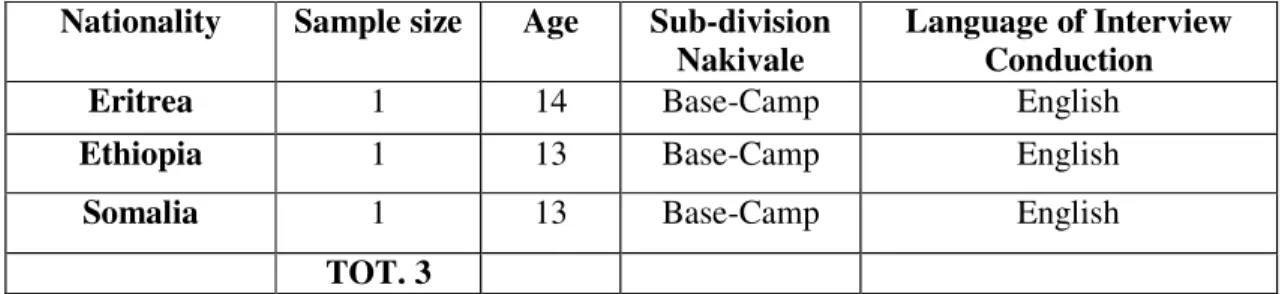
TABLE 5: CHARACTERISTICS OF FGDS CONDUCTED AMONG REFUGEE CHILDREN ... 23
ACKNOWLEDGMENTS
I am extremely grateful to the Refugee Children of Uganda - Nakivale Refugee Settlement, who generously and confidently shared their stories with me. Without them, this research would have been impossible.
I would love to thank Abadir, Sadiq, Patrick, Alan and the whole refugee population of Nakivale, for letting me enter their life, and giving me the opportunity to know first-hand the injustices, which refugees have to accept. I am thankful to them, for leaving an indelible sign in my life and for confirming me what I would like to do in my professional career.
I would like to express my gratitude to the Department of Social Work and Social Administration of Makerere University for giving me the opportunity of conducting my master research in Uganda. Among this, I would like to mention the Head of Department, Dr. Eddy Walakira, my Supervisor Dr. Denis Muhangi and my co-supervisor Dr. Janestic Twikirize, for the support received during the thesis elaboration.
In this moment, finding myself in Uganda to write the acknowledgments of my master thesis, I cannot avoid thinking also of the two wonderful years that have led me here.
I feel very grateful to the European Commission. Without the funds assigned to the Erasmus Mundus Programme, I would have never had the opportunity of living such an important experience, which will certainly mark my future. It gave me the extraordinary opportunity of receiving an academic formation, which benefited of the possibility of living and studying in four different European and non-European Countries.
I am very thankful to the MFamily Erasmus Mundus Committee for selecting me among many other candidates, and giving trust in my potential and capacities. Amongst this, I would like to thank a particular person, our coordinator Prof. Maria Das Dores Guerreiro, for the perseverance and commitment, she showed from the beginning until the end.
I would like to thank the numerous friends, which have accompanied me towards these two years. The experiences I have lived with them starting from the wonderful Lisboa, passing through the cold Scandinavian countries, and ending with the fabulous Uganda, will accompany me all my life long.
Among the beautiful gifts I have received in these two years, I need to mention Robin, for entering my life and becoming one of the most important persons I have.
I consider it also fundamental to thank my sister Elisa and Marni for the wonderful gift of Mia. I cannot describe the joy she has given me in these years even from far away.
My best appreciation goes to my parents, who despite not approving my life choices, have continued to believe and support me. I recognize their great sacrifice in bearing the long distance, which has separated us since already many years. I owe them everything I have obtained in my life. I am especially grateful to them for giving me such a stable and secure life, without any difficulties and concerns, which allowed me to explore outside “my little and safe garden”, to expose myself to the world and towards other people’s needs and in so doing, make me touch first-hand global injustices, such as the one of Refugees.
DEDICATION
To my parents…my wholeness.
To the cause of Refugees. To all the children and people who have experienced the hardship in living as refugees, whose civil and political rights have been unfairly denied, first from their own nation and most of the times, from other countries too.
I dedicate my Master Thesis to the Refugee Children of Nakivale, with the hope that they will be able to see peace and justice one day. I dedicate to them my greatest respect.
1. INTRODUCTION
1.1 Introduction
According to the various definitions used by the Office of the United Nations High Commissioner for Refugees (UNHCR), the United Nations and non-governmental organizations (NGOs), the size of the world’s “refugee population” – including internally displaced persons (IDPs), asylum-seekers, and other categories of forced migrants – is of the order of fifty million people, about half of whom are children. The issue of refugee children is recognized as one of the most important humanitarian challenges of our time. (Hieronymi, 2009)
Usually more than half of any refugee population are children. Refugee children are children first and foremost children, and as such, they need special attention. As refugees, they are particularly at risk with the uncertainty and unprecedented upheavals, which are increasingly marking the post-Cold War era. There are many reasons why children need special care and assistance:
• Children are vulnerable. They are susceptible to disease, malnutrition and physical injury.
• Children are dependent. They need the support of adults, not only for physical survival, particularly in the early years of childhood, but also for their psychological and social well-being.
• Children are developing. They grow in developmental sequences, like a tower of bricks, each layer depending on the one below it. Serious delays interrupting these sequences can severely disrupt development. (UNHCR, 1994)
1.2 Background
1.2.1 National Context: Protection of Refugees in Uganda
Uganda has hosted refugees since the end of the Second World War and is currently a safe oasis for around 190,000 refugees who have fled violent conflicts in East and Central Africa, particularly in Rwanda, the Democratic Republic of Congo (DRC), South Sudan, Burundi and Somalia (UNHCR, 2014b). These refugees often stay in Uganda for many years, creating multiple challenges for effective refugee assistance. (Svedberg, 2014).
Uganda is a signatory to all principal international legal instruments for refugee protection: the 1951 Refugee Convention, the 1976 Protocol and the 1969 Organization of African Unity (OAU) Convention. Hence, Uganda, according to the regulations concerning the states, which accede to the 1951 Convention and its 1967 protocol, should demonstrate its commitment to treating refugees in accordance with internationally recognized legal and humanitarian standards; and enable refugees a possibility to find safety (UHNCR, 2011). In 2006, Uganda adopted new refugee legislation, the Refugees Act, which reflected the international standards of refugee protection established within these preceding international legal instruments.
However, the situation for refugees in Uganda still fails in certain respects to reach regional and international benchmarks, especially in relation to the situation of refugee children. The Government of Uganda (GoU) ratified the United Nations Convention on the Rights of the Child (CRC) in 1990.
The CRC art.22 declares that special protection shall be granted to a refugee child or to a child seeking refugee status. It is the State's obligation to co-operate with competent organizations, which provide such protection and assistance. Art.22 upholds the same principle in relation to both children with refugee status and children seeking it. Moreover, the Convention’s provisions cover all children within the country’s jurisdiction (art.2), so even those children who have been refused refugee status are still protected for as long as they remain in the country (UNICEF, 2007).
1.2.2 Local Settlement Policy
Presently applied in most countries within the African region, the Local Settlement Policy entails the encampment of refugees in designated and enclosed tracts of land, known as settlements. In Uganda’s case, all refugee settlements are located in rural sections of the country and, as such, restrained from mainstream economic and political activity within the country. Under the local settlement approach, no refugee can leave the settlement, except after acquisition of a permit from the camp commandant, who is the administrative head of the settlement. Each refugee family in the settlement is initially given some food rations, as well as non-food items like hoes, sickles and basic household utensils. The family is also given a small parcel of land for subsistence agriculture. With each season, the family is expected to be more self-sufficient and, eventually “phased off” food and other humanitarian assistance. Today, the GoU policy for refugees is still founded on colonial legislation, which grew out of the perception that refugees are largely a burden to the host state rather than a resource for development. Therefore, although art.26 of the 1951 United Nations Convention relating to the Status of Refugees confers upon refugees the right to freedom of movement within the host State, this right is often brushed aside by pragmatic imperatives. Although local settlements are believed to maximise efficiency in aid distribution, this answer does not justify the limited mobility.
1.3 Problem Statement
Refugee children face far greater dangers to their safety and well-being than the average child. The sudden and violent onset of emergencies, the disruption of families and community structures as well as the acute shortage of resources with which most refugees are confronted, deeply affect the physical and psychological well-being of refugee children. Infants and young children are often the earliest and most frequent victims of violence, diseases and malnutrition, which accompany population displacement, and refugee outflows (UNHCR, 1994).
Humanitarian organizations operating for the protection of refugee children in settlements or camps should ensure that these innocent and vulnerable individuals, after having experienced injustice and violence, are finally able to fully enjoy their rights.
However, this is not always the case.
There is a vast scholarship, which provides a child perspective about children’s life in refugee settlements, meaning an adult perspective on children's experiences.
However, there have been few evaluations on refugee children’s own voices and perspectives. Based on these considerations, the researcher addressed her study in Nakivale Refugee Settlement towards refugee children’s own experiences. She investigated whether they face
any kinds of discriminations founded on age or ethnicity, whether they are treated with humanity and respect, whether their voices are heard and whether the principle of the best interest of the child is applied. Concerning the primary life necessities, she analysed whether refugee children are provided with shelter, food and health services. Finally, she examined if the right of free and universal Education, the right for Participation and the right for Protection have been adequately implemented.
1.4 Objectives of the Study
1.4.1 General Objective
The general objective of this study was principally to assess how the GoU, along with its OPs and IPs, practically implemented CRC art.22 in Nakivale Refugee Settlement. In order to analyse whether the intentions of this international instrument have been achieved, children’s voices were particularly emphasized.
1.4.2 Specific Objectives
This research endeavoured to:
1) Analyse how CRC article 22 has been implemented in practice in the local context of Nakivale Refugee Settlement in Uganda.
2) Explore refugee children’s experiences, through their own voice and in so doing, providing the genuine and truthful perspective of the child and not just to have a child perspective (i.e. an adult perspective on children's experiences).
3) Evaluate children’s well-being in Nakivale Refugee Settlement, taking into consideration the objectives of CRC and of the other international instruments ratified by GoU.
1.5 Research Questions
The question of refugee children is a very important and very complex issue to which no full justice can be done in the space of a single research. However, during this study the researcher examined the following research questions:
1. How has the CRC article 22 been implemented in practice in the local context of Nakivale Refugee Settlement in Uganda?
2. How do children perceive their own life as refugees in Nakivale Refugee Settlement in Uganda?
3. What are the refugee children’s experiences with regard to health, education, participation, protection and promotion of their rights?
1.6 Scope of the Study
This research sought to explore, how CRC art.22 has been practically implemented in Nakivale Refugee Settlement. It tries to explore if and how the host government and the humanitarian organisations operating in the settlement do provide the right support and protection to refugee children or enabling them to express their problems and to be heard. The views of the practitioners are therefore presented and analysed. However, the main focus is on the voice, views and experiences of the children themselves.
1.7 Justification and Policy Relevance
Literature review showed that there is a clear gap in terms of academic investigation of the varied methods used to assess the practical implementation of the legislation regarding policies for refugee children. Particularly interesting and relevant is the debate in the literature on the gap between the rhetoric and practise of child protection in the specific context of refugee settlements. The existing research moreover, provides a little consideration of the real opinion and perspective of children. This study, therefore, intended to emphasize children’s own voice and ultimately examine the relationship between the legislation and the children’s effective wellbeing.
This study aimed to provide context for the complex and multi-layered issues currently faced by the children living in Nakivale Refugee Settlement. By doing this, the study intends to provide a realistic and genuine picture of the children’s voice, which constitutes a useful foundation for future investigations. Finally, this research strives to identify how the policy and its implementation could be improved. The results of this study may be utilized by key stakeholders such as UNHCR, GoU and their partners involved in addressing the situation of
2. LITERATURE REVIEW
2.1 Local Settlement Policy in Uganda
Three particular arguments form the foundation for the Local Settlement Policy and the restriction of refugee movement. First, from a political standpoint, it is argued that refugees, as persons fleeing conflict zones, are themselves potential agents of insecurity who, therefore, cannot be allowed free movement and integration into the host community. Based on this reasoning, the policy of sequestering refugees within designated locations in the host State is considered appropriate. The second argument is of an economic nature. It is generally believed that allowing refugees free integration into the host community might damage the often fragile host economy, by increasing competition for jobs (hence, unemployment) or greater demands on the host State’s socioeconomic infrastructure, such as schools and hospitals. The third argument relates to the generalisation that refugees, because they come from areas often marked by social collapse, generally carry with them a germ of social regression. Therefore, allowing them free integration into host communities means creating further social issues, which the host country cannot cope with. Taking this into consideration, along with the perception of the refugee phenomenon as largely temporary, local settlement is the standard response to refugee influxes into Uganda (Bagenda, Naggaga & Smith, 2003).
2.2 Refugee Self-Reliance Policy in Nakivale Refugee Settlement
One of the main features of the Ugandan refugee policy is the Self-Reliance Strategy (SRS), a policy that aims to provide refugees the means to economically support themselves while at the same time lessening their dependence on humanitarian assistance.
The new policy would aim to ease the two biggest issues caused by the protracted refugee situations in Uganda: refugee dependence on humanitarian assistance and the growing financial burden that this aid placed upon the host country (Svedberg, 2014).
The result was the SRS, a new philosophy and approach to refugee support that was initially implemented in 1999 in settlements in the West Nile sub-region of Uganda (Meyer, 2006, p. 19). This new strategy made promoting refugee self-reliance the foundation for Uganda refugee policy. This term is defined by the UNHCR’s Handbook for Self- Reliance (2005) as the basis for refugee wellbeing:
Self-reliance is the social and economic ability of an individual, a household or a community to meet essential needs (including protection, food, water, shelter, personal safety, health and education) in a sustainable manner and with dignity. Self-reliance, as a programme approach, refers to developing and strengthening livelihoods of persons of concern, and reducing their vulnerability and long-term reliance on humanitarian/external assistance. (UNHCR, 2005 p. 1)
In order to promote refugee self-reliance, the SRS utilizes subsistence agriculture as the basis for its objectives. Refugees are allocated a small piece of land that they are expected to cultivate for personal consumption. In conjunction with this responsibility, refugee food rations are decreased in relation to the amount of time they have spent in the settlement. Ideally, this
not experience a lack of food when rations are reduced. This arrangement aims to both help refugees support themselves and to lessen the burden on aid-providing agencies (UNHCR, 2004).
2.3 International legal instruments for Refugee Protection
International Refugee Law is a set of rules and procedures that aims to protect, first, persons seeking asylum from persecution, and second those recognized as refugees under the relevant instruments. Its legal framework provides a distinct set of guarantees for these specific groups of persons, although, inevitably, this legal protection overlaps to a certain extent with International Human Rights Law as well as the legal regime applicable to armed conflicts under International Humanitarian Law.
The main sources of Refugee Law are treaty law, notably the 1951 Convention relating to the Status of Refugees (1951 Refugee Convention) and its 1967 Protocol, and customary international law. Customary international law applies to all states irrespective of whether they are a party to relevant treaties or not. Regional instruments represent a further set of protections, particularly the 1969 OAU Convention (for Africa) and, although it is not formally legally binding, the 1984 Cartagena Declaration (for Latin America). (RULAC – ADH Geneva, 2015)
The 1951 Refugee Convention is the foundation of International Refugee Law. The Refugee Convention defines the term “refugee” and sets minimum standards for the treatment of persons who are found to qualify for refugee status. Since the Convention was drafted in the wake of World War II, its definition of a refugee focuses on persons who are outside their country of origin and are refugees as a result of events occurring in Europe or elsewhere before 1 January 1951. As new refugee crises emerged during the late 1950s and early 1960s, it became necessary to widen both the temporal and geographical scope of the Refugee Convention. Thus, a Protocol to the Convention (1967) was drafted and adopted. (UNHCR, 2013)
UNHCR serves as the ‘guardian’ of the 1951 Convention and its 1967 Protocol. The 1951 Convention expressly provides that States are expected to cooperate with UNHCR in ensuring that the rights of refugees are respected and protected. The 1951 Convention and its 1967 Protocol are applicable to all persons who are refugees as defined in the instruments. “All persons” clearly includes children and adolescents. Age is taken for granted with respect to the non-discriminatory application of the articles in the Convention, and as the Convention defines a refugee regardless of age, no special provisions for the status of refugee children exist. Children thus have a right to seek asylum and obtain protection under the refugee instruments, based on their own claims (ARC, 2002).
2.3.1 Definition of Refugee
According to the 1951 Refugee Convention art.1, the term “refugee” is referred to any person who:
“(…) owing to well-founded fear of being persecuted for reasons of race, religion, nationality, membership of a particular social group or political opinion, is outside the country of his nationality and is unable or, owing to such fear, is unwilling to avail himself to the protection of that country; or who, not having a nationality
and being outside the country of his former habitual residence as a result of such events, is unable or, owing to such fear, is unwilling to return to it.”
Hence, according to this provision, refugees are defined by three basic characteristics:
• They are outside their country of origin or outside the country of their formal habitual residence;
• They are unable or unwilling to avail themselves of the protection of that country owing to a well-founded fear of being persecuted;
• The persecution feared is based on at least one of five grounds: race, religion, nationality, membership of a particular social group, or political opinion.
(RULAC – ADH Geneva, 2015)
The principle of “non-refoulement”
According to the 1951 Refugee Convention art. 33, refugees cannot be sent to a country or a territory where s/he would be at risk of persecution:
“No Contracting State shall expel or return a refugee in any manner whatsoever to the frontiers of territories where his life or freedom would be threatened on account of his race, religion, nationality, membership of a particular social group or political opinion.”
The principle of non-refoulement is considered part of customary International Law and therefore binding on all states. The principle is also incorporated in several international human rights treaties, for example the 1984 Convention against Torture, which prohibits the forcible removal of persons to a country where there is a real risk of torture (RULAC – ADH Geneva, 2015).
2.3.2 Implementation of international legal instruments for Refugee Protection in Uganda
Uganda is a common law country having been a former British colony. It is a dualist country, and international law therefore does not operate automatically but requires a process of domestication and incorporation into the national legal system (Kamumba, 2010). Uganda is a signatory to all principal international legal instruments for refugee protection, in primis the 1951 Refugee Convention and its 1976 Protocol, both of which were ratified in 1976. In 1987, Uganda validated the 1969 Organization of African Unity-Convention Relating to the Specific Aspects of Refugee Problems in Africa (OAU Convention). Additionally, the GoU ratified many other regional and international instruments for the protection of refugees. Of particular relevance in this context are the African Charter on Human and Peoples’ Rights (ACHPR), which Uganda ratified without reservation in 1986; the International Covenant on Civil and Political Rights (ICCPR), which it ratified without reservation in 1995; the International Covenant on Economic, Social and Cultural Rights (ICESCR), which it ratified without reservation in 1987.
On 24th May 2006, Uganda passed a new domestic legislation relating to refugees, replacing the antiquated Control of Alien Refugees Act (CARA) of 1964. This new refugee law marks a significant legislative step towards the rationalisation of refugee status determination (RSD) and the protection of the rights of Uganda’s refugees as enshrined in the 1951 Convention
relating to the Status of the Refugees1 and its 1967 Protocol (Sharpe and Namusobya, 2012).
However, it has been hard for Uganda to reflect this generosity of commitments in practice.
2.4 CRC article 22
Even though the CRC (1989) is not a refugee treaty, refugee children are covered because all CRC rights are to be granted to all persons under 18 years of age (art.1) without discrimination of any kind (art.2). The CRC offers indeed the highest standards of protection and assistance for children of any international instruments and it offers potential for the protection of refugee and displaced children because of its near universal acceptance. The prohibition of discrimination (art.2) means that whatever benefits a State gives to the children who are its citizens; it must give to all children, including those who are refugees on its territory. It sets comprehensive standards, in which every aspect of a child's life is covered, from health and education to social and political rights (UNHCR, 1994).
The CRC contains 54 articles of children’s rights, which can also be divided into three general categories, commonly known as "three Ps", rights to Provision, Protection and Participation.
• Rights to Provision: these are the rights to the resources, the skills, services; the "inputs" that
are necessary to ensure children's survival and development to their full potential (i.e. food, education, healthcare, and a basic standard of living).
• Rights to Protection: these are the rights that ensure children are protected from acts of
exploitation, neglect or abuse, in the main by adults or institutions that threaten their dignity, their survival and development (i.e. protection and care in the best interests of the child in Article 3).
• Rights to Participation: these are the rights that provide children with the means by which
they can engage in those processes of change that will bring about the realisation of their rights, and prepare them for an active part in society and change (i.e. the right express views and to be heard in decision-making or in legal proceedings in Article 12) (Save the Children, 2013). The CRC is indivisible and its articles interdependent; therefore, art.22 should not be considered in isolation.
Art.22 states:
1. “States Parties shall take appropriate measures to ensure that a child who is seeking refugee status or who is considered a refugee in accordance with applicable international or domestic law and procedures shall, whether unaccompanied or accompanied by his or her parents or by any other person, receive appropriate protection and humanitarian assistance in the enjoyment of applicable rights set forth in the present Convention and in other international human rights or humanitarian instruments to which the said States are Parties.
2. For this purpose, States Parties shall provide, as they consider appropriate, co- operation in any efforts by the United Nations and other competent intergovernmental organizations or nongovernmental organizations cooperating with the United Nations to protect and assist such a child and to trace the parents or other members of the family of any Refugee Child in order to obtain information necessary for reunification with his or her family. In cases where no parents or other members of the family can be found, the child shall be accorded the same protection as any other child permanently or temporarily deprived of his or her family environment for any reason, as set forth in the present Convention.”
Children who are seeking asylum or who have been granted refugee status are entitled to full enjoyment of all their rights under the CRC. For instance, refugee children often have experienced war, displacement and other traumas. Therefore, refugee children may also need treatment to promote their rehabilitation and reintegration into society (CRC art.39). According to art.22, no discrimination should occur because States have devolved power and responsibilities to local administrations, even though some variations in services to children are an inevitable product of decentralization. Hence, States should not permit local governments to violate children’s human rights under the Convention (UNICEF, 2007).
2.4.1 CRC article 22 in the international scenario
Although the CRC was adopted by the United Nations General Assembly in New York on 20th November 1989, the document did not become available for signature until 26th January 1990 and it entered into force on 2nd September 1990. When a State Party signs a treaty, it is indicating approval "in principle," but there is no commitment to incorporate the provisions into its own national laws. That is achieved by ratification or an equivalent procedure. Within one year of 26th January 1990, the Convention had been ratified by 67 member states,
and 105 within two years.
The CRC has gained importance to refugee children because of the near-universal ratification of the treaty. The CRC has received more signatures, ratifications or accessions than any other human rights treaty – a total of 193 countries as of May 2015. Somalia, South Sudan and USA are the only nations that have not ratified the treaty, by January 2015).
2.4.2 Implementation of CRC article 22 in Uganda
The GoU ratified the CRC in 1990. In 1996 Uganda domesticated the CRC by enacting a law for children, the Children Statute, now Children Act (Cap. 59), Laws of Uganda.
In order to strengthen the protection of children, Uganda also ratified the Optional Protocol to the CRC on the Sale of Children, Child Prostitution and Child Pornography on 19th August
2002.
The GoU is using additional Regional instruments in order to protect the rights of children: the African Charter on the Rights and Welfare of the Child. This Charter came into force on
29th November 1999. The Charter was drafted in response to natural disasters, armed
conflicts, exploitation and hunger, which have hit the Continent (UNICEF & FIDA UGANDA, 2005).
2.5 Definition of Refugee Child
The term children has been used in this paper in keeping with the UN CRC definition of every human being below the age of eighteen.
The 1951 Refugee Convention and the 1967 Protocol (Relating to the Status of Refugees) set standards that apply to children in the same way as to adults:
1) a child who has a "well-founded fear of being persecuted";
2) a child who holds refugee status cannot be forced to return to the country of origin (the principle of non-refoulement);
3) no distinction is made between children and adults in social welfare and legal rights.
The 1969 OAU Convention (Governing the Specific Aspects of Refugee Problems in Africa) broadened the definition of "refugee" to include persons in Africa who flee from war and other events that seriously disrupt public order. The OAU Convention makes no distinction between children and adults.
Depending on the law of the State, a child-seeking asylum may be granted:
• Refugee status for having a "well-founded fear of being persecuted," as defined in the 1951 Convention and the 1967 Protocol;
• Refugee status as defined in the 1969 OAU Convention or the 1984 Cartagena Declaration;
• If the refugee claim is denied, the child might be permitted to stay with an immigration status granted for another humanitarian reason, or receive rejection or deportation order (UNHCR, 1994).
2.6 Debate on Refugee Children: multiple aspects and perspectives
According to UNHCR (2014b), 46% of refugees and 56% of people living in refugee camps are children. The issue of children should be at the heart of the “refugee debate” not only because they constitute half the total refugee population in the world, not only because of their vulnerability, or conversely because of their ability to cope, but primarily because they are even more directly affected in their lives than their parents and other adults by the “success” or “failure” of their refugee experience (Hieronymi, 2009).
The issue of Refugee Children raises many questions and, like the refugee issue as a whole, it can be approached from many different points of views.
A) There is an immediate short-term perspective, one that is often a question of life and death. The issue of survival is particularly an acute challenge. There is, however, also a medium - and long-term perspective that ultimately is the most important one. This is true not only because many refugees, including children, remain refugees for a long period, sometimes for years or even decades. The long-term perspective is important also because relatively short-term situations and decisions, often a question of chance, will have a profound impact on the rest of the life of the refugees, including refugee children. (ibid.)
B) The situation and the fate of refugee children can be considered from the point of view of humanitarian actors – those who try to help and protect refugee children and who often, explicitly or implicitly, make some of the crucial decisions in the name and for the refugee children. These humanitarian actors include international organizations, national and local NGOs.
C) Finally, there is the own perspective of the child, as a single individual and as a group. This is the most genuine and trustful perspective, which analyses the thoughts and points of view of children, directly through listening to their own voice.
2.7 Children living in Refugee Settlements
Refugee settlements, no matter in which part of the world are located, are primarily artificial environments where everyone is restricted in their freedom of movements. There is a growing body of evidence, which proves that settlements affect children from many different perspectives.
A major consequence of life in a refugee camp or settlement in Africa is the almost inevitable exposure to a sub nutritional diet. Epidemics of nutrition related diseases are common in camps. They are caused by the lack of micro-nutrients-vitamins- in the rations supplied by international aid. It is proved that a child’s ability to learn is permanently affected by prolonged state of malnutrition. Refugee settlements most of the times, cannot even ensure the Right of security and protection for children. Gathering people in refugee camps might make them easy targets for regular attacks from across borders. For instance, in April 1996, Juma Oris’s group entered Uganda from Sudan, attacking Ikafe refugee camp, cutting off noses and ears, and kidnapping. (Harrel-Bond, 2000).
Moreover, the school attendance for both boys and girls is affected by the settlement life. One of the most common causes of school absenteeism is the need to be present at food distributions to secure and to transport the family’s ration.
Children’s development is jeopardized by the lack of role models. Even if the parents are present, refugee children grow up under unusual conditions. To feed their children, parents are dependent on donations from strangers. Parents are therefore deprived of their authority; their roles as carers and breadwinners are undermined by their dependence on a system over which they have no control. Parents become easily degraded under the eyes of their children (Levarch, 1997). UNHCR (1994) has recognized that also social life for children and adolescents is threatened in settlements’ life. It is common to find among youths prostitutes, drug abusers or
3. THEORETICAL FRAMEWORK
3.1 Dualist-Monist Theories of International Law
Monism and Dualism are theories that have been developed to explain the relationship of International Law and National Law. International law does not determine which point of view is to be preferred, Monism or Dualism. Every state decides for itself, according to its legal traditions. International Law only requires that its rules are respected, and states are free to decide on the manner in which they want to respect these rules and make them binding on its citizens and agencies (Dixon, 2007).
3.1.1 Monism
The Monist theory supposes that international law and national law are simply two components of a single body of knowledge called ‘law’ (Tapiwa, 2002). According to this theory, both sets of rules operate in the same sphere of influence and are concerned with the same subject matter, and for this reason, there may be conflict between the two systems. If this happens in a concrete case, International Law is said to prevail (Dixon, 2007).
In Monist States, International Law does not need to be translated into National Law. The act of ratifying the International Law immediately incorporates the law into national law. International law can be directly applied by a national judge, and can be directly invoked by citizens, just as if it were national law. In case of conflict, a judge can declare a national rule invalid if it contradicts international rules because, in “monist states”, the latter has the priority. Hence, in its most pure form, monism dictates that national law, which contradicts international law, is null and void, even if it predates international law, and even if it is the constitution. (ibid.)
3.1.2 Dualism
Dualists emphasize the difference between National and International Law, and therefore, it requires the translation of International Law into the National one. Without this translation, international law does not exist as law. This theory further postulates that before incorporation of such international law, citizens cannot rely on it and judges cannot apply it. National laws that contradict it remain in force (Tapiwa, 2002). According to dualists, national judges never apply International Law, if this has not been translated into national law. Furthermore, they deny that International Law and National Law operate in the same sphere, although they do accept that they deal with the same subject matter” (Dixon, 2007).
The choice of the Monist-Dualist Theory was grounded on its predicted relevance in analysing and thereby obtaining an understanding of the implications for the implementation of International Legislation about refugee children (and CRC art.22 in a specific way) into the Ugandan Law. Taken into consideration that Uganda is a Dualistic State, the intention of presenting this theory is not to judge it for adhering to the dualistic system nor to make a defence or a persuasion for a monistic system. It is rather to highlight the implications of the country’s legal system in relation to International Law as far as the implementation of refugee
3.2 The Strengths Perspective
If refugee children are assessed only by emotional problems, trauma and psychiatric diagnosis, researchers and aid-workers face the risk of constructing them as passive and vulnerable, i.e. not seeing them as able – despite sometimes being in a highly vulnerable position – and as actors in their own right.
There is some literature that views refugee children as capable and own actors in their own right, particularly when exploring their own coping strategies, resilience and adaptation. The strengths perspective concretizes ideas from such literature and calls for an approach to studying children that considers their inner strengths rather than simply their vulnerability. The Strengths Perspective as an approach to social work practice began in the early 1980s at the University of Kansas’ School of Social Welfare. (Saleeby, 2008)
In 1989, Weick, Rapp, Sullivan, and Kishardt coined the term Strengths Perspective to address a system in which practitioners recognize the authority and the strengths of people. It is an attempt in response to the demand to end the longstanding conflict between social work values and practice caused by the traditional deficit-focused approach.
Saleebey (2006, pp. 16-20) has described several principles in strengths perspective, which are: 1) Every individual, group, family and community has its strength.
2) Trauma and abuse, illness and struggle may be injurious but they may also be sources of challenge and opportunity.
3) Assume that you do not know the upper limits of the capacity to grow and change and take individual, group, and community aspirations seriously.
4) We best serve clients by collaborating with them. 5) Every environment is full of resources.
6) Caring, caretaking and context.
Saleebey (2006, p.10) defines client’s strengths through three interlinked aspects, called
“CPR”. C represents competence, capacities and courage; P stands for promise, possibility,
and positive expectations; and R means resilience, reserves, and resources.
The Strengths model embodies a holistic respect for the dignity and uniqueness of individuals recognizing their way to experience and construct their social realities. It enables a social worker to approach clients with a positive attitude, which enhances clients’ motivation and gives clients hope.
The role of language is extremely important in the Strengths-approach. Language and words have power. Words can lift and inspire or frighten and constrain. Therefore, social workers are obligated to improve their vocabulary of helping. Any approach to practise speaks a language that at the end, will certainly effect the way the clients think of themselves and how they will act.
This perspective is composed of some key words:
• Strengths: what people have learned about themselves and others. People learn from their success but also from trials and tribulations. We learn from the world around us, through formal education or through the day-to-day experience. Playing an instrument, cooking, telling stories, carpentry, etc., may become tools for helping to build a better
narratives and traditions. Finally, people who have overcome abuse and trauma often experience the “survivor’s-pride”.
• Empowerment means assisting individuals, families, communities in discovering and using the resources and tools within and around them.
• Resilience means the skills, abilities and insights that accumulate over time as people struggle to surmount adversity and meet challenges. It is not a static dimension. On the contrary, it is understood as the continuing articulation of capacities and knowledge, which will be used in order to overcome difficult like experiences and pains.
• Membership means that people need to be citizens or members of a group or a community. Being without membership means being alienated, and to face the risk of marginalization and oppression.
• The community is considered a physical, interpersonal and institutional terrain full of resources. The work of community development is also dedicated to making strengths flourish.
• Health and Wellness: in a sense, the strengths perspective itself begins with appreciating the body and its incredible restorative capacities as well as its powers to resist diseases. Supported by positive beliefs and a supportive environment, the brain works as “health maintenance organization”. When people believe that they can recover, their bodies often respond optimally (Ornstein & Sobel, 1987).
Baker (2003, p. 420)2 considers the meaning of the Strengths Perspective as:
“An orientation in social work and other professional practises that emphasizes the client’s resources, capabilities, support systems, and motivation to meet challenges and overcome adversity”. Contrary to the traditional deficit approaches, the strengths perspective comes in with a different orientation by emphasising the resources, capacities, energies and survival skills of people instead of stressing pathologies and problems (Saleebey, 2006; Payne, 2014). Therefore, the Strengths Perspective is premised on the belief that all people, even the most humble and abused, have inherent capacities and wisdom to transform their lives. The Strengths Perspective is also embedded in key social work and human rights principles, such as participation; equality and non-discrimination; respect for diversity, inclusion, and social justice (Berg & Kelly, 2000).
Rather than focusing on individual weaknesses or deficits, Strength-based is an innovative approach to social work with children, where practitioners collaborate with them in order to discover individual and family functioning and strengths (Laursen, 2000). At the foundation of the Strength-based approach is the belief that children are experts of their own lives, have unique talents, skills, and life events, in addition to specific unmet needs (Epstein et al., 2004). The main difference to the traditional Problem-solving approach is that the social worker spends little time trying to understand what caused the problem or trying to name it.
The strengths-based approach shifts the emphasis of the intervention from what went wrong to what can be done to enhance functionality, and what builds on the child’s strengths and resources that enable mastering life’s challenges and the healthy development of the child. The practitioner would focus on identifying or uncovering strengths, recognizing that a problem- and deficit-focus may create a mind-set that is an obstacle when looking at positive factors of the child development.
Epstein and Sharm’s study on Strength-based assessment have contributed significantly to develop instruments designed to assess skills and competencies of children and youth. Working from a strength-based model of development, researchers consider strength- based assessment to be founded on the following principles:
1. All children have strengths.
2. Focusing on children’s strengths instead of weaknesses may result in enhanced motivation and improved performance.
3. Failure to demonstrate a skill should first be viewed as an opportunity to learn the skill as opposed to a problem.
4. Service plans that begin with a focus on strengths are more likely to involve families and children in treatment (Epstein et al., 2004, pp.353-367).
As Salebeey (2006) suggests, the central proposition of social work practise with children is to exploit the best in all of us; to work together to overcome adversity and trouble; to confront the difficult life’s conditions and events with all the tools available within and around us; to wrestle distress and disillusionment to the ground with determination and grit; to grab the hands of others firmly, even heroically, in the direction of hopes, dreams and possibilities. Children have indeed surprising reserves of resistance and a much greater instinct of survival than most adults, men or women. Moreover, children have a great capacity of adaptation to new circumstances. They are like an unwritten book: they learn languages, customs, rules, and opportunities much more quickly than their parents do. Children “fit in” much more quickly than adults or older people (Hieronymi, 2009). They may be passive partners, but children know, that the objective is to have a better future than the past that was left behind. Children may be desperate because of what and whom they remember from back home, but they also expect every day that the future will be better than the situation that was left behind (ibid.).
Based on these considerations, there is an urgent need for investigations focused on the young persons’ own perspectives of well-being as well as the factors contributing to it. For this reason, the main actors of this research were the children themselves through their own voices. The researcher used the Strengths Perspective during the interviews with children as well as during the analysis of the data collected from the children’s interviews.
3.3 African Refugee Theory
Kibreab (1991, p.21) affirms that the current causes, which continue to create high influxes of refugees in Africa are still numerous. He also states that “…at the heart of the African refugee
problem lies a lack of respect for fundamental human rights, including the right of peoples to determine their own destiny…”
He continues declaring that: “…The refugee problem in Africa is a result of an inter-play of
political, social, economic and environmental factors. It is not easy, therefore to isolate one factor to the neglect of others and to state the real cause with certainty. The factors that generate refugees are inextricably intertwined with each other…” (Kibreab, 1991, p. 23) Each refugee migration, no matter if it is large or small, long or short term, has its origin in socio-economic causes that do not occur elsewhere in the same form. The causes and the solutions of refugee migrations in Africa lie in the complex social and economic interactions manifest in everyday life. While inter-ethnic conflict might be the catalyst in one refugee migration, another might be the result of environmental stress brought on by economic and demographic pressures. The governments of many African states are increasingly directly involved in situations that cause refugee migrations, through enforced villagization, or the direct persecution of a single ethnic group. The complex interplay of socio-economic factors which can lead to refugee migrations does not affect each migrant in the same modality. The varieties of different refugee migrations are as complex as the situations, which can create them. People have different perceptions of exactly what they consider is a threat to them. In some situations, the mere rumour of instability can be enough to impel people to move. In other situations, people do not flee until they have been overtaken by violent conflict. Since in the African context, the line between political and economic repression can become blurred, many refugees could (and are) classified as economic migrants.
Rogge (1994) cited in Collins (1996) formulated a typology of refugees based upon an examination of the activating agent for the refugee migration, the objective of the migration, and whether the migrants possess refugee characteristics. Rogge’s typology initially identifies two classes of involuntary migration: impelled and forced.
An impelled migration might be caused by the need of escaping persecution or perceived danger. Impelled migrants do retain some degree of choice regarding their possible flight. Before making the decision to migrate, impelled migrants have the opportunity to weigh the factors involved and then make a choice between moving or remaining in the face of an external threat. In this category, refugees are classified into:
a. Escapees (i.e. Somalis in Kenya);
b. Victims of hostility (i.e. internal displaces in South Sudan); c. Refugees sur place (i.e. Rwandan students abroad);
d. Evacuees (i.e. White Rhodesians from Zimbabwe)
Impelled migrants might also escape deteriorating environmental conditions, in such cases, Rogge defines them as Ecological migrants, and one example might be Ethiopians in Sudan. Whereas forced migrants are expelled from an area by an external force, such as a government, the people involved have absolutely no choice in the matter of their removal. In Africa, examples include Asian expellees, expelled from Uganda by the Amin regime in the 1970s, or
It is important to notice that the terms forced and impelled were introduced into the migration literature by Petersen (1958) cited in Shain (2005). According to Petersen, the difference between these two classes of migration lies in the amount of free choice an individual has when they are involved in forced migration.
The motivation for a refugee’s migration becomes important when their legal status is determined. According to Rogge’s typology, some types of refugees are more likely to obtain
4. METHODOLOGY
This section spells out how the study was conducted. It describes the study site, research design, study population, sample size and selection procedure, data collection methods and tools, data analysis, and ethical considerations.
4.1 Description of the Study Site
This study was conducted in Uganda, specifically in Nakivale Refugee Settlement, which is located in Isingiro district, in the Ankole region in the South-Western part of the country. It was chosen as the study location because it is one of the oldest settlements in Uganda and subsequently has well-established procedures and refugee assistance infrastructure. Many of its refugees have been in the settlement for a number of years, providing a perfect environment for the analysis of long-term refugee issues.
Nakivale Refugee Settlement constitutes one of Uganda’s first examples of the colonial government’s policy of local settlement. It was established in 1958 in the wake of an unprecedented influx of Rwandese Tutsi refugees fleeing persecution from the new Hutu regime. It was officially recognized as a refugee settlement in 1960 through the Uganda Gazette General Notice No. 19 (UNHCR, 2014).
To address this situation, the colonial government exchanged a few scattered parcels of land it owned in the Nyabushozi area of Mbarara, for six parcels of land in the Nakivale area owned by the Omugabe.3 Because the land in Nakivale area was fairly proximate to the border with
Rwanda, and had a low population of nationals (owing to tsetse fly infestation), the colonial government considered it more conducive for accommodating refugees than the land in Nyabushozi. The Nakivale land then became the nucleus of what is today Nakivale Refugee Settlement (Bagenda et al., 2003).
Currently Nakivale Refugee Settlement is 185Km2 and it is home to 74,763 (Uganda Red Cross Society (URCS) February 2015) refugees of primarily Congolese and Rwandan origin. There are also smaller but significant populations of refugees from Somalia, South Sudan, Eritrea, Ethiopia, Burundi and Liberia. It is divided in three main areas: Base Camp, which is the main centre and where the Office of the Prime Minister (OPM) and all the Operating Partners (OPs) and Implementing Partners (IPs) are located; Rubondo, and Juru, which are mostly rural areas. These areas are divided into 79 villages with an average of 800 to 1,000 people per village. There is also an estimated population of 35,000 nationals surrounding the Refugee Settlement who directly benefit from water, education, health and nutrition programmes in the settlement (UNHCR, 2014).
The settlement is governed cooperatively by OPM and UNHCR. OPM is in charge of the settlement management, coordination and security of the camp and has moreover, legal authority over all other organizations who work in the camp. UNHCR, working cooperatively with the OPM, oversees the wellbeing of the refugees and supervises the operations of the various IPs, who directly carry out livelihoods projects and provide services in the settlement (Svedberg, 2014).
3 The Omugabe of Ankole is the title given to the monarch of the Kingdom of Ankole. The kingship was abolished in 1967 by President Milton Obote.
4.2 Description of the Research Design
The study was exclusively qualitative in nature. The reason for this choice was determined by the need of describing the research issue (implementation of CRC art.22) within a particular context (Uganda – Nakivale Refugee Settlement). The significance of qualitative approaches is to present an understanding of particular research phenomena within the context in which they are happening; as well as an emphasis of the subjective experiences of the participants within a given context (Natasha, Woodson, MacQueen, Guest & Namey, 2005).
More specifically this was an evaluation study. Evaluation research usually denotes the study of the impact of an intervention, such as a new social policy or an innovation in organizations (Bryman, 2012). Hence, this evaluation study assessed the impact of the Legislation regarding refugee children (and specifically of CRC art.22) ratified by GoU in the local context of Nakivale Refugee Settlement. Through the own voice of the refugee children, this study attempted to evaluate if the anticipated goals of this legislation have been achieved.
4.3 Study Population
The population from which the sample was drawn included primarily refugee children, and secondly aid workers of IPs and OPs operating in Nakivale Refugee Settlement.
4.3.1 Refugee Children
Refugee children were the primary study population. The study targeted refugee children aged between 13-17. The interviews with children constitutes the outline of the empirical part of this paper. The main objective was to contextualise their statements concerning how CRC art.22 and other legislations concerning the rights of refugee children have been implemented in this local context.
4.3.2 Staff
This category was considered not only because they directly work with children’s rights and with implementation of International and National Law, but also because they were envisaged to potentially contribute to the subject from different perspectives.
The researcher targeted to include the views of professionals from different organizations operating in the settlement: Ugandan Red Cross Society (URCS), American Refugee Council (ARC), Windle Trust and the OPM.
4.4 Sample size and Sample selection procedures
4.4.1 Refugee Children
In the procedure for sample selection, in order to provide a wider view of the complicated setting of Nakivale, the researcher considered the sex, age, nationality, location in the camp, duration of stay in the camp, and whether the children were accompanied or unaccompanied.
The respondents selected came from six different nationalities: Burundi, DRC, Eritrea, Ethiopia, Rwanda and Somalia. This choice was defined by taking into consideration the weight that these populations represent over the total refugee population living in the settlement. For instance, children from DRC represent the greatest majority of the study, eleven (11) out thirty-six (36), since the Congolese population in Nakivale represents more than 50% of the total one.
The researcher chose to interview children from three different sub-divisions of Nakivale: Base Camp, which is the main centre, Sangano - the main trade centre of the Base Camp and of the whole settlement - and Juru, that is one of the most rural areas of all the settlement and one of the furthest ones from the Base Camp. The sample was also purposely selected, taking into consideration the different arrival times, from children who were born in the settlement to the ones who arrived just two months before the study.
The sample was selected through a “snowball” approach. The researcher asked for the assistance of the interpreters, who were very familiar with the different refugee communities and who were aware of the characteristics to find among the respondents, to approach the potential research subjects. This initial “core” of subjects were asked to name others who might be willing to be interviewed.
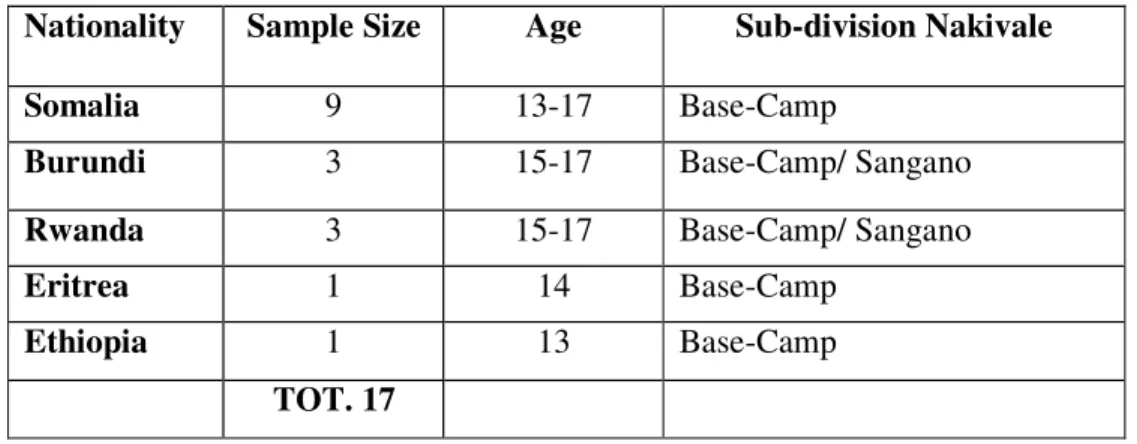
The total number of children interviewed is 36, including 17 girls and 19 boys as shown in the tables below.
Table 1: Sample of Girls in the Study
Nationality Sample Size Age Sub-division Nakivale
Somalia 9 13-17 Base-Camp
Burundi 3 15-17 Base-Camp/ Sangano
Rwanda 3 15-17 Base-Camp/ Sangano
Eritrea 1 14 Base-Camp
Ethiopia 1 13 Base-Camp
TOT. 17
Table 2: Sample of Boys in the Study
Nationality Sample Size Age Sub-division Nakivale
Burundi 1 15 Base-Camp DRC 8 13-15 Base-Camp 3 15-16 Juru Eritrea 3 15-17 Base-Camp Ethiopia 3 15-17 Base-Camp Rwanda 1 14 Sangano TOT. 19