Ensaios Econômicos
EPGE Escola Brasileira de Economia e Finanças N◦ 804 ISSN 0104-8910Stop Suffering!
Economic Downturns and
Pentecostal Upsurge
Francisco Costa, Angelo Marcantonio, Rudi Rocha
Os artigos publicados são de inteira responsabilidade de seus autores. As
opiniões neles emitidas não exprimem, necessariamente, o ponto de vista da
Fundação Getulio Vargas.
EPGE Escola Brasileira de Economia e Finanças Diretor Geral: Rubens Penha Cysne
Vice-Diretor: Aloisio Araujo
Diretor de Regulação Institucional: Luis Henrique Bertolino Braido
Diretores de Graduação: Luis Henrique Bertolino Braido & André Arruda Villela
Coordenadores de Pós-graduação Acadêmica: Humberto Moreira & Lucas Jóver Maestri Coordenadores do Mestrado Profissional em Economia e Finanças: Ricardo de Oliveira Cavalcanti & Joísa Campanher Dutra
Costa, Francisco
Stop Suffering! Economic Downturns and Pentecostal Upsurge/ Francisco Costa, Angelo Marcantonio, Rudi Rocha – Rio de Janeiro : FGV,EPGE, 2018
49p. - (Ensaios Econômicos; 804) Inclui bibliografia.
Stop Suffering!
Economic Downturns and Pentecostal Upsurge
∗
Francisco Costa
†Angelo Marcantonio
‡Rudi Rocha
§December 1, 2018
Abstract
This paper estimates the effects of economic downturns on religious conversion to Pentecostal Evangelicalism across Brazilian regions between 1991 and 2010. We find that regions more exposed to economic distress experienced an increase in Pentecostal affiliation during the 1990s, accompanied by a decrease in adherents to other Christian denominations. Our estimates show that this conversion persisted over the following decade. We also show that economic downturns are associated with the growth in the vote share of candidates explicitly connected to Pentecostal churches in national elec-tions in both the short and long run. These results uncover a causal link between eco-nomic distress and the political entrenchment of more fundamentalist religious groups in a secular democracy.
Key Words: economic distress, religious conversion, Pentecostalism, elections.
JEL Codes: Z12, D72, O15.
∗We would like to thank Francesco Amodio, Eli Berman, Filipe Campante, Rafael Dix-Carneiro,
Clau-dio Ferraz, Fred Finan, Jason Garred, Paola Giuliano, Gordon Hanson, Dan Hungerman, Jonathan Medina, Torsten Persson, João Paulo Pessoa, Rodrigo R. Soares, Edson Severnini, Gabriel Ulyssea, and seminar par-ticipants at SBE 2016, CAEN-EPGE 2017, ASREC 2018 Conference, McGill University, University of Ottowa, Ridge/Lacea POL 2018, 4th REAP&SBE Workshop 2018. We are grateful to Vinicius Peçanha for provid-ing excelent research assistance, and to Laura Barros and Manuel Santos Silva for sharprovid-ing relevant data on electoral outcomes.
†FGV EPGE Brazilian School of Economics and Finance; Rio de Janeiro, Brazil; francisco.costa at fgv.br. ‡angelomarcantoniojunior at gmail.com.
1
Introduction
Economic distress and impoverishment have been generally associated with the rise of religiosity and religious fundamentalism in several contexts, even within developed coun-tries.1 More generally, expectations that religiosity would fade away in increasingly mod-ern societies have given way to a renewed recognition of religions’ influence on the world’s social and political landscape. As shown byInglehart and Norris(2004), religiosity has in-deed eroded among the most prosperous social sectors living in the most affluent countries. Yet, this comes in tandem with the fact that the world has more people with traditional reli-gious views than ever before, particularly in impoverished contexts. The growth of ethno-religious conflicts, of fundamentalist movements in Muslim communities, and the upsurge of Pentecostal Evangelicalism are some of the most prominent indicators of the vitality of religions in the world today.
The debate over how economic conditions affect religiosity has long been framed by the theory of secularization, which explains religion as an elaborate reflection of existential in-security and a painkiller for frustration, deprivation, and suffering (Fink and Stark, 2003). In that sense, religiosity might be particularly responsive to economic downturns, with in-dividuals being more susceptible to the influence of religious rhetoric in times of scarcity and risk. Decreased income and consumption during recessions may change the oppor-tunity cost of religious participation (Gruber and Hungerman, 2008). At the same time, religious communities usually provide members with informal insurance to such adverse shocks, with more sectarian groups providing greater support for fellow members. By considering religious communities as social clubs, religious participation may be a mecha-nism to cope with adverse conditions (Iannaccone,1992;Berman,2000;Dehejia et al.,2007; Chen, 2010; Ager and Ciccone, 2018). Despite the conceptually dense debate in the social sciences, and its relevance for understanding ideological fundamentalism, causal evidence on the extent to which economic conditions affect religious participation and religiosity is rather scant and mixed, in particular regarding effects on religious conversion.
In this paper, we estimate the impacts of economic downturns on the expansion of Pen-tecostalism in Brazil. The share of Pentecostal adherents doubled throughout the 1990s, amidst a period of economic opening and poor economic performance. Brazilian Pen-tecostals belong either to historical Pentecostal denominations, or to newer independent churches, which are increasingly prevalent in developing countries (The Pew Research Center,2006). These independent churches are often called Neopentecostal or Neo-Charismatic. In common, these churches generally stand out for being more religiously observant than
other Christians, for their belief in more literal and originalist interpretations of sacred texts, as well as for their convictions in more traditional moral values and doctrines.2 We side withInglehart and Norris(2004) in using the term fundamentalist “in a neutral way to refer to those with an absolute conviction in the fundamental principles of their faith, to the extent that they will not accept the validity of any other beliefs”. In that sense, affili-ation to Pentecostal Evangelicalism has come apace with a rise in religiosity and religious fundamentalism in Brazil, a predominantly Catholic country.
We first examine the effects of economic downturns on religious affiliation. We use the Brazilian demographic censuses from 1980, 1991, 2000, and 2010 to get the share of Pen-tecostals, Catholics and affiliates to other religious denominations across local economies (i.e., microregions) within Brazil. We exploit the reduction of trade tariffs in the 1990s, during the process of economic liberalization, as a source of exogenous variation for lo-cal economic conditions. Between 1990 and 1995, the Federal Government progressively reduced the import tariffs of different products, with the most protected industries facing an increase in competition from the international markets. The variation in tariffs across industries interacting with the employment composition across regions led to exogenous trade-induced shocks to local labor markets across the country. As in Kovak (2013), we define these shocks as regional tariff changes. Relatively more affected regions experienced a larger decline in wages and in formal-sector employment (Kovak,2013; Dix-Carneiro and Kovak, 2017a), as well as a reduction in the provision of public goods, and an increase in crime rates (Dix-Carneiro et al.,2018). Taken together, the evidence indicates that local ex-posure to trade openness is associated with overall worsening of local economic and living conditions.
We find that economic downturns lead to religious conversions to Pentecostalism from other Christian denominations. Our benchmark specification indicates that a reduction of one standard deviation in regional tariffs increased the share of Pentecostals among the working age population in 6.1 log-points between 1991 and 2000. This corresponds to ap-proximately 21% of a standard deviation of the growth of Pentecostals per capita across mi-croregions. This result is robust to a series of specifications that allow for differential trends by state, baseline local demographic characteristics, local Pentecostal growth in the previ-ous decade, and population weighting. In a falsification exercise, we find that the 1990s tariff change is not associated with the growth of Pentecostal affiliation between 1980 and 1990. Our results show that economic downturns affect the growth of the share of other Christians similarly, but in the opposite direction. Regions greatly affected by the trade 2Also in common, they are more likely to report having experienced manifestations of the Holy Spirit,
experienced or witnessed divine healings, and received direct revelations from God (Balmer,2002;The Pew
liberalization experienced a larger decrease in the share of Catholics and traditional Protes-tants. We observe no statistically significant effect of exposure to tariff changes on the share of people holding any religious beliefs. While we find evidence of conversion in response to tariff changes across different demographic groups, point estimates are smaller among the elderly, women, and the less educated – exactly those for which religious beliefs tend to be relatively more entrenched. Furthermore, effects persist throughout the following decade. A reduction of one standard deviation in regional tariffs during the early 1990s in-creased the share of Pentecostals in 4.6 log-points between 1991 and 2010. Adverse shocks to employment seem a relevant mediator of the relationship between economic downturns and Pentecostal affiliation, triggering demand-side determinants of religious conversion, with alternative mechanisms bearing little influence in both the short and long run.
We also examine whether the expansion of Pentecostalism in society has been associ-ated with greater participation of Pentecostalism in politics. The link between religion and politics can be particularly salient as a mediator between non-secular beliefs, policy choices and institutions in new political equilibria. If this link is indeed active, initial impacts on religious affiliation could have deeper and long-lasting effects on society, even in secular democracies. In Brazil, Pentecostalism entered politics in the 1990s, with church leaders directly running for office. Since then, Pentecostal denominations have successfully lever-aged their political structure and influence. Evangelical politicians currently hold 74 out of 513 seats in the Lower House of the Brazilian Federal Congress (DIAP, 2014), which is responsible for proposing and voting laws over a range of both constitutional and infra-constitutional topics – such as civil rights and regulation over social and moral issues, in-cluding abortion, drugs, and discrimination. More specifically, we use official electoral data, from different election years, to calculate the vote count of candidates for the Lower House of Congress that are connected to Pentecostal churches. We then analyze how the vote share of Pentecostal candidates has responded to economic downturns and to the ex-pansion of Pentecostalism at the microregion level.
We find a robust association between trade-induced economic downturns and the vote share of Pentecostal candidates, in both the short and long run. Coefficients are statisti-cally similar across different specifications within election years, long-term estimates being significantly higher than the short-term ones, by nearly twofold. Our benchmark estimate implies that a reduction of one standard deviation in regional tariffs in the early 1990s was accompanied by an increase of 2 percentage points in the vote share of Pentecostal candidates two decades later. This corresponds to approximately 30% of a standard devia-tion of the growth of the vote share of Pentecostal candidates across microregions over the last two decades. Together with the results on religious conversion, and additional OLS
and IV exercises, the overall picture provides supportive evidence of a positive association between a demand-side expansion of Pentecostalism in society and of Pentecostal partici-pation in politics, as a response to economic downturns. This indicates that the conversion towards more fundamentalist religious beliefs in society has also been reflected in terms of political representation of religious leaders. We speculate that this process may eventually undermine the democratic endorsement of individual rights, such as freedom of speech and worship, which allow different sects to bloom.
There exists well-known cross-country evidence on the relationship between economic conditions and religiosity. WhileMcCleary and Barro (2006) show that higher per capita GDP leads to lower religiosity, as captured by different indicators,Barro et al.(2010) find no robust relationship between per capita GDP and religious conversion. More recently, schol-ars have started to explore subnational income shocks to elicit causality within countries (for an extensive review, seeIyer,2016).3 Most notably,Chen(2010) estimates the impacts of the exposure to the 1998 Indonesian financial crisis on the intensification of religious practices, as measured by communal studies of the Koran and Islamic schools attendance. He finds that local economic distress increased religious intensity in the year following the crisis. Buser(2015), on the other hand, finds that cash transfers at the household level were positively associated with church attendance and with adherence to Evangelicalism in poor neighborhoods in Ecuador. AsChen (2010), we look at distressful economic shocks at the local level, but document the effects on religious conversion rather than on the intensifica-tion of religious practices. The conversion of beliefs rather than the intensificaintensifica-tion of prac-tices within a common set of beliefs may have deeper social implications, as indoctrination may sway people’s preferences (Alesina and Fuchs-Schündeln,2007). We also characterize both the short- and long-run effects, over multiple layers of Census data, across hundreds of local economies. In particular, we find that economic distress can have persistent effects on religious affiliation.
This paper is also the first to document a causal link between economic distress and the political entrenchment of religious groups in contemporary democracies. Chaney (2013) documents in historical Egypt that abnormal Nile floods reduced the probability of dis-missal of religious authorities, who used their control over popular support to political ends in times of scarcity and famine. These findings parallel ours, established in a contem-porary democracy, thousands of years later, as the political power of Pentecostal leaders stems from the popular support of millions of Pentecostal voters. More generally, our 3On the opposite direction of causality, it has been shown that different religious proscriptions have causal
effects on economic outcomes. Campante and Yanagizawa-Drott(2015) show that longer Ramadan fasting days have a negative impact on countries’ economic growth. In a randomized evaluation,Bryan et al.(2018) show that teaching Protestant values increased the income of the ultra-poor in the Philippines.
results lend support to the view that religious conversion may lead to wider changes of attitudes, not only towards religion but also politics, and possibly with long-lasting impli-cations for the public support of a religion-oriented policy agenda in a secular democracy.4 Finally, this paper contributes to the growing literature on the political consequences of globalization. Recent papers show that exposure to international competition has deep-ened political polarization in the United States (Feigenbaum and Hall, 2015; Che et al., 2016;Autor et al.,2016) and in Western Europe (Dippel et al.,2015; Colantone and Stanig, 2018b), as well as enhanced public support for Brexit in the UK (Colantone and Stanig, 2018a). As religious identity may influence political attitudes (Inglehart and Norris, 2004; Grzymala-Busse, 2012), our results suggest that religious conversion towards more fun-damentalist beliefs, as a side effect of globalization, can be a relevant channel underlying political polarization.
The remainder of this paper is structured as follows. Section2characterizes the Pente-costal expansion and the trade liberalization in Brazil. Section3contains a description of the data and provides descriptive statistics. We describe our empirical strategy in Section 4. Section5 presents the results on religious conversion. We analyze the political conse-quences of religious conversion in Section6. Section7concludes.
2
Empirical Context and Conceptual Background
In this section, we first describe the Pentecostal movement in Brazil and conceptually dis-cuss the triggers of the upsurge of Pentecostalism in impoverished contexts worldwide. We then characterize Pentecostals’ values and attitudes towards public life and politics. Last, we describe the process of trade liberalization in Brazil during the 1990s, provide an overview of the existing evidence of its effects on local economies, and conceptually discuss the channels that link trade openness, local economic downturns, and religious affiliation.
2.1
Pentecostalism in Brazil
Pentecostalism is a renewal movement within Protestantism, with roots in the American religious revivals of the Azusa Street in the early 20th century. The movement has rapidly spread across the globe and fragmented into thousands of autonomous segments. Pente-costals are said to belong either to historical denominations, such as the Assemblies of God
4In that sense, our results complementBarro and McCleary(2005) findings. While the authors show that
the effect of per capita GDP on the probability of state religion is unclear, we find that economic distress has increased the de jure political power of religious leaders in a non-state religion.
and the Church of God in Christ, or to newer, independent churches, often called Neopen-tecostal and increasingly prevalent in developing countries (The Pew Research Center, 2006). In common, these denominations or independent churches teach that all Christians should seek the baptism of the Holy Spirit, a religious experience that grants spiritual gifts and the abilities to practice physical healing and speak in tongues (Balmer,2002).
According to The Pew Research Center (2011), Pentecostalism is comprised of nearly 280 million people in the world today, and is one of the fastest-growing segments of Chris-tianity. It has reached about 15% of the Sub-Saharan population, and 11% of the population in the Americas. Brazil is considered a frontrunner. As shown in the upper graphic of Fig-ure 1, over the last half-century, Catholicism’s historical dominance has continuously de-creased in the country alongside an expansion of Protestantism, with Pentecostalism being the overwhelmingly fastest growing Protestant community. The latest figures indicate that 29% of the Brazilian population is Protestant, 72% of which being Pentecostal (Datafolha, 2016). Brazil now has the largest Pentecostal community across developing countries, and the second largest in the entire world, behind only the US (Freston,2001).
Brazilian Pentecostalism has experienced three major waves of growth. The beginning of the first wave occurred in the 1910s, when the Christian Congregation and the Assem-blies of God arrived in the country, just after the Azusa Street revivals in 1906. The second wave came in the 1950s and early 1960s, with the fragmentation of the existing Pentecostal field into new independent churches. At that time, three major denominations consolidated their presence in the country: Church of the Fourth-Square Gospel (Igreja Quadrangular), Brazil for Christ (Igreja Brasil por Cristo) and God is Love (Deus é Amor). The third wave came in the late 1970s and the 1980s, with the foundation and rapid expansion of Neopen-tecostal churches. Its main representatives were the Universal Church of the Kingdom of God (UCKG) and the International Church of the Grace of God.
While second-wave churches reduced the rigid behavioral codes and asceticism, typ-ically found in historical denominations, third-wave churches further extended these in-novations and embraced a higher entrepreneurial profile, marketing faith as something compatible with middle-class values and upwardly mobile lifestyles (Kramer,2005). These churches have intensively incorporated elements of ordinary daily life into religious ritu-als, relying on exorcism to guide the process of self-transformation and empowerment, and making extensive use of a range of media channels to promote evangelization campaigns. Also notable, this model of religious entrepreneurship has been successfully replicated by third-wave Brazilian churches in other Latin American countries, as well as in Africa and in developed countries (Levine,2009).
2.2
Stop Suffering!
There is some qualitative evidence that help to explain why Pentecostalism has thrived, and why particularly so in impoverished contexts. According to Chesnut (2003), Pentecostal churches have offered some of the most authentically popular religious services through successful methods of delivery to the popular classes. This claim is rather consistent with the emblematic UCKG’s slogan “Stop suffering!”. On the one hand, this slogan reflects the way religious services are marketed by Pentecostal denominations, in close communi-cation with the local popular culture and often targeted at those in pressing situations. In fact, Pentecostal churches were created by and for the poor people. AsChesnut(2003, p.42) notes: “Pentecostal doctrine and worship reflect the Weltanschauung5 and aesthetics of the popular classes (...). Here there are no seminary-trained priests who make (self) conscious decisions to opt for the poor. Rather, there are mostly poor and uneducated Pentecostal preachers who minister easily to their impoverished brethren”. In particular, Neopente-costal churches have moved a step forward in marketing communication. As noted by Lehmann(2001, p.9), the kitsch-like interior design of UCKG’s temples “contrasts sharply with the austerity of contemporary Catholic church architecture: neon signs, uniforms for different categories of church activists and preachers, electronic keyboards, and decorated Christmas trees. The sense of being in another world, and of being part of that other world is surely strengthened by the use of television as a vehicle of evangelization. The use of a microphone held in the same style as a television performer, the use of marketing and communication techniques drawn from business and thrust into a religious sphere (which for decades and centuries has been dominated by priestly gravitas and monotonous into-nation) has to be understood as an evocation of and an invitation to share in the originating context of these practices. The church is saying to its followers that they too can join in that other world of consumption and accumulation.”
On the other hand, the slogan also comes attached to religious services aimed at over-coming various types of suffering, faith healing and conversion being some of the most appealing practices. As noted byChesnut (2003), while Catholic Masses offer little litur-gical space for the healing of believers’ afflictions, Pentecostal churches have made faith healing a centerpiece of both doctrine and practice, attracting particularly those seeking the cure for illness, domestic conflict, and alcoholism. Hence the importance of exorcism, which provides people with a sense of expelling those evil forces from their lives (Rocha and Torres, 2009). The practice of conversion refers to a process of spiritual rebirth, which allows the believer to be born again into an environment free of the afflictions of the old life. This is attractive among those seeking to turn away from poverty.
More generally, existential insecurity might raise susceptibility to religious rhetoric ( In-glehart and Norris,2004). The core idea of human, or existential, security denotes freedom from various risks and dangers. In this sense, regardless of the specific nature of the risks, the absence of existential security should be instrumental for religiosity no matter time or place. Religiosity might be thus responsive to economic downturns and living conditions, and individuals might be particularly more susceptible to the influence of religious rhetoric in times of scarcity and risk. Specifically regarding risk, religious communities usually pro-vide members with informal insurance to adverse shocks. More generally, according to the club-good model of religious participation, religious communities can be considered so-cial clubs (Iannaccone,1992; Berman,2000). Consistent with that,Chen (2010) shows that, within Muslim communities, members hit by adverse income shocks may also increase religious participation in return for aid as an ex-post insurance mechanism.
As the qualitative evidence suggests, Pentecostal churches have been particularly suc-cessful in attracting new believers among the popular classes, in a context of impoverish-ment, illness, conflict, and substance abuse. In fact, as shown in the bottom graphic of Figure1, Brazil experienced a substantial growth of Pentecostalism during the 1990s, when the share of Pentecostal affiliates nearly doubled, amidst a decade of poor economic and labor market performance and trade liberalization.
2.3
Values, Attitudes and Influence on Public Life and Politics
Despite the large and growing influence of Pentecostalism in the world, there is relatively little research characterizing Pentecostals’ values and attitudes towards public life. We rely on a cross-country survey conducted byThe Pew Research Center(2006) to provide some comparative figures. Table1 summarizes a number of items from this survey, comparing the answers of Pentecostals and other Christians, from respondents from Brazil as well as from the US and selected countries in Africa and Asia.
Panel A shows that Pentecostals tend to be more religiously observant than other tians in many dimensions. Pentecostals often stand out for their belief in traditional Chris-tian doctrines, and tend to engage more at higher rates in more traditional ChrisChris-tian prac-tices. For example, Pentecostals are more likely to say they go to church frequently, pray frequently, and read the Bible more often and more literally. In Brazil, 86% of Pentecostals interviewed said they attended religious services at least once a week, while only 32% of other Christians answered the same. They also displayed higher levels of private religious practices. In Brazil, 51% of Pentecostals said they read the Bible daily in comparison to only 10% of other Christians. As expected, they are much more likely than other Christians to report experiencing manifestations of the Holy Spirit, receiving direct revelations from
God, and witnessing divine healings or exorcisms. The majority of Pentecostals agreed that miracles still occur, that angels and demons are active, and that God will grant good health, relief from sickness, and material prosperity to the most faithful believers.
In Panel B, we observe they also stand out for their traditional moral values on a wide range of social issues, from homosexuality to extramarital sex to alcohol consumption. In particular, most Pentecostals believe that a wife must always obey her husband. Consistent with the recent and rapid expansion of Pentecostalism in the world, Panel C reports that a great share of Pentecostals have not always belonged to the movement. In Brazil, for instance, 62% of Pentecostals said not to have always belonged to their current religion, while only 13% of other Christians answered the same. Amongst new Brazilian believers, almost half said they converted from Catholicism, which is expected due to a common Christian background and Catholicism’s historical dominance in the country. Also related to conversion, Panel D reports that Pentecostals are much more active in sharing their faith with non-believers and tend to agree more that believers have a duty to convert others. They also use religious media more extensively. Finally, Pentecostals stand out for their trust in fellow church members and for their view that it is important for political leaders to have strong religious beliefs. In all countries, and particularly in the US, Pentecostals are less likely to state that seperation of church and state should exist. Consistent with Panel D, there is indeed qualitative evidence in support of the view that Brazilian Pentecostals tend to vote for candidates who share their faith (Kramer,2005). In Section6, we further discuss, and empirically examine, the political consequences of the expansion of Pentecostalism in Brazil.
2.4
Trade Liberalization in Brazil and Its Discontents
Until the end of the 1980s, the Brazilian economy was relatively closed to international trade, mainly due to a long-lasting import substitution policy. Trade barriers were high, with high nominal tariffs and several non-tariff barriers. In 1989, the first presidential elec-tion after the re-democratizaelec-tion process brought President Fernando Collor, an outsider, into power. In the following year, the new government started the trade liberalization pro-cess, revoking most of the special trade regimes and suspending import licenses (Kume et al.,2003). From 1990 until 1995, the government reduced import tariffs across industries, with the average tariff falling about 60% in the period. In particular, the most protected sectors experienced the largest tariff reductions, leading to a decrease in the variation in tariffs across industries.
The Brazilian trade liberalization had a profound impact on local labor markets. Dif-ferent regions tend to specialize in difDif-ferent economic activities, so the composition of the
labor force often varies substantially across regions. The variation in tariffs across indus-tries and the employment composition across regions thus interacted and led to trade-induced shocks to local employment and earnings across the country. Kovak(2013) finds that Brazilian regions that were relatively more affected by trade-induced shocks expe-rienced a relatively larger decline in wages. Moreover, harder-hit regions expeexpe-rienced a larger and long-lasting reduction in formal-sector employment and earnings, enhanced employment transition into non-tradable sector jobs, particularly in low-paying service in-dustries, and a permanent increase in informal employment (Menezes-Filho and Muendler, 2011; Dix-Carneiro and Kovak,2017a,b). There is also mounting evidence supporting the view that the trade-induced shocks that followed the trade liberalization in Brazil affected many other regional outcomes related to the initial impacts on labor markets. For instance, Dix-Carneiro et al.(2018) document that areas relatively more affected by the reduction in tariffs experienced an increase in crime rates. The authors further show that while the labor market channel accounted for more than 75% of the increase in criminality, regions rela-tively more exposed to trade-induced shocks also experienced a reduction in government revenues and in the provision of public goods, as well as an increase in income inequality.
The findings from the Brazilian setting are consistent with the existing evidence from several other contexts.6 Taken together, the evidence indicates that exposure to trade open-ness is associated with overall economic distress and the worsening of living conditions in regions that are negatively hit by trade-induced shocks – the losers of the globalization process. In the Brazilian context, we hypothesize that economic distress would lead to the rise of religiosity, as individuals may become more susceptible to the influence of religious rhetoric in times of economic hardship and enhanced risk. Specifically regarding risk, as documented by previous studies, employment in harder-hit regions experienced a signifi-cant transition into non-tradable sectors, particularly in low-paying service positions, and a permanent increase in informality. In that sense, trade-induced shocks have been associ-ated with increased employment vulnerability. According to club-good models, this could also lead to an increase in religious participation in return for aid, as an ex-post insurance mechanism (Iannaccone,1992;Berman,2000;Chen,2010).
6For example, seeDavid et al.(2013),Pierce and Schott(2016),Pavcnik(2017),Feler and Senses(2017),
3
Data and Descriptive Statistics
3.1
Demographic Variables
Our main sources of data are the 1980, 1991, 2000, and 2010 Brazilian Censuses, which are comprehensive demographic surveys publicly provided by the Brazilian Institute of Geography and Statistics (IBGE). The microdata contain socioeconomic variables as well as religious affiliation at the individual level. We aggregate the microdata at the microre-gion level, officially defined by IBGE as a cluster of geographically contiguous municipal-ities with similar economic characteristics and integrated economic activmunicipal-ities. This unit of analysis has been used in many studies as the relevant delimitation of a local economy, particularly in the literature of local effects of trade shocks in Brazil.7 Since the borders of some municipalities and microregions have changed over time, we group microregions into Minimum Comparable Areas (MCAs), which are the smallest geographic units that can be consistently compared over time. Our final sample consists of 412 MCAs – in the remainder of the paper we use the terms MCA and microregion interchangeably.8 Our sample of microdata comprises the working age population, defined as those individuals aged between 15 and 65 years. Throughout the rest of the paper, variables collapsed at the microregion level or defined in per capita terms refer to the working age population.
The main dependent variables are computed at the microregion level as the logarithm of the total number of individuals affiliated to a given religious denomination per capita. We classify individuals by religious affiliation according to IBGE’s coding procedure, pre-sented in Appendix TableA1. We also construct control variables using Census microdata collapsed at the microregion level. We additionally compute the share of women, the share of nonwhites, average age and its square, and the average years of schooling. All aggrega-tions at the microregion level use sample weights from their respective Censuses.
3.2
Exposure to Trade Shocks
Our main variable of interest measures local economic shocks, and follows closely the lit-erature on local labor market effects of trade liberalization. We rely on Hirata and Soares (2015) andDix-Carneiro et al.(2018) to define a measure for the microregion’s exposure to the early-1990s tariff changes. Both studies followKovak(2013), which provides a theoret-ical framework for computing average tariffs for local labor markets. More speciftheoret-ically, we
7SeeKovak(2013);Dix-Carneiro and Kovak(2015);Costa et al.(2016);Dix-Carneiro et al.(2018).
8We obtained the coding of MCAs from Ipeadata, and grouped the microregions’ codes into MCAs’ codes
by using the 1980 layer of MCAs as reference (Reis et al.,2011, for methodological details). The remote archipelago of Fernando de Noronha is itself a microregion but was excluded from the sample.
define the change of the microregion’s exposure to tariffs as: ∆Tari f fj =
∑
r6=R Ljrejr ∑r6=RLjrejr [ln(1+Tari f fr1995) −ln(1+Tari f fr1990)] (1) Where ∆Tari f fj is the exposure of microregion j to changes in tariffs between 1990 and 1995 across sectors r 6= R, being R the set of non-tradable sectors. Kume et al. (2003) provide the terms Tari f fr1990 and Tari f fr1995, which measure sector-specific tariffs in 1990 and 1995, respectively. The term Ljr is the number of individuals employed in each sector r and microregion j. In our benchmark specification, this term is built on microdata from the 1991 Census, the baseline year and prior to the trade liberalization shock. The term ejr is the elasticity of the demand for labor. As inHirata and Soares(2015), we define ejr = σθjrjr,
where σjr is the elasticity of substitution between inputs, and θjr is the share of capital in total capital cost. We also assume σjr = 1 and that the share of capital cost varies only across sectors r. We thus assume that θr = (VAr−LEr)/(VAr),∀j, where VArand LErare, respectively, the value added and the labor earnings of sector r. The values of VAr and LEr are calculated with information from the National Accounts (IBGE), specifically the Tabela de Recursos e Usos for 1991. Appendix TableA2presents tariffs by sectors and by year, based on Kume et al. (2003). Sectors considered in Kume et al.(2003) (listed in the first column of TableA2) differed from sector coding in the census data (last column of Table A2). We make both classifications compatible following the same procedure as inHirata and Soares (2015). We are left with 20 tradable sectors, listed in the column “Aggregated Sectors” of TableA2, plus a non-tradable one.
As defined in equation (1), the term ∆Tari f fj measures the extent to which labor de-mand in region j is affected by changes in tariffs across industries, taking into consideration the relative importance of each industry in the composition of regional employment. For this reason, throughout the rest of the paper the term∆Tari f fjrefers to changes in regional tariffs.
3.3
Descriptive Statistics
Table 2presents descriptive statistics, separately for each census year, at the microregion level. Panel A displays statistics for religious affiliation. We first observe that the share of individuals that report being affiliated to a religious denomination is remarkably high in Brazil, above 90%, but has continuously decreased through the decades. We observe substantial changes in the composition of religious affiliation. In particular between 1991 and 2000, the share of Catholics decreased nearly 7.5 percentage points, alongside a sim-ilar increase in affiliation to other denominations. In particular, the share of Pentecostals
increased nearly 80% throughout the decade, from 4.9% to 8.9%. More generally, the share of Pentecostals has continuously increased over time. As mentioned in Section2, the latest figures indicate that more than 20% of the Brazilian population were Pentecostal in the mid 2010s (Datafolha,2016).
Panel B reports summary statistics of our auxiliary variables at the microregion level. We observe that the demographic composition remains roughly stable between censuses, except for education. Indeed, there has been a rapid expansion in educational attainment in the country. Finally, Panel C presents summary statistics of our proxy for local economic conditions, the exposure to tariff change ∆Tari f fj, as defined in equation (1). We observe an average of -0.036 log-point (SD 0.038) across microregions. Consistent with the fact that the most protected sectors faced the largest reductions, FigureA1shows that regional tariff changes between 1990 and 1995 (∆Tari f fj) are negatively and strongly correlated with initial levels of tariffs across microregions. Also important to note, we observe that most microregions experienced a reduction in tariffs. In our setting, this effectively refers to a decline in labor demand and downturn in economic conditions in most regions. We further provide discussion on this in the following section.
4
Empirical Strategy
4.1
Conceptual Setup
Our first goal in this paper is to examine the extent to which economic downturns are asso-ciated with changes in religious affiliation. The following equation provides our conceptual setup:
∆Religionjs =α+β∆Tari f fj+δs+W
0
jλ+εjs (2)
In our benchmark specification, ∆ refers to changes between 1991 and 2000. The term Religionjscorresponds to the logarithm of the number of individuals per capita that belong to a given religious denomination in microregion j of state s (e.g. Catholics or Pentecostals). The variable ∆Tari f fj was previously defined in equation (1). The term δs corresponds to state fixed-effects, Wj is a vector of controls at the microregion level, while εjs is the error term. As mentioned inDix-Carneiro et al.(2018), state-fixed effects should absorb the po-tential confounding influence of relevant policies that are decentralized towards the state level by constitutional mandate (e.g., health and educational policies). Moreover, great heterogeneity in historical immigration and development patterns have affected social and human capital accumulation as well as long-run income per capita across states. For
in-stance, while some states were mostly occupied by European settlers (e.g. Southern states), others received a substantial influx of peoples from Africa through the slave trade (e.g. Bahia and Rio de Janeiro). In that sense, heterogeneity in deep-rooted cultural values is potentially associated with variation in susceptibility to religious rhetoric across regions. By exploring variation in economic conditions across microregions within states, we thus restrict treatment and control comparisons among well balanced units of observation. The term Wj includes a series of controls computed at the baseline year, 1991: the share of women, the share of nonwhites, average age and its square, average years of schooling, and the logarithm of the working age population. We also add lagged dependent vari-ables when testing for pre-trends. Our most saturated specifications therefore compare the variation in economic conditions and in religious affiliation in microregions within states, allowing for differential trends according to initial demographic characteristics as well as pre-trends on the outcome of interest. We estimate heteroscedastic robust standard errors.
As in previous studies, conditioning upon controls and fixed-effects, we expect the re-maining variation in∆Tari f fjto be exogenous to any latent determinant of religious affili-ation. In this case, the parameter of interest β captures the average causal effect of changes in regional tariffs on changes in religious affiliation. In particular, variation in regional tar-iffs is expected to be orthogonal to any unobservable trends in social capital as well as to supply-side determinants of religious choice.
4.2
Trade-Induced Shocks and Economic Downturns
In this section we provide empirical evidence and further discussion on the relationship between changes in regional tariffs and local economic downturns. We first construct a proxy for local economic condition as the logarithm of the average expected earnings at the microregion level. We followHirata and Soares (2015) to compute this variable by us-ing individual-level regressions, for each census year. Separately, for each census year, we first regress individual log earnings on age and its square, dummies for gender and for educational attainment levels, and microregion fixed-effects. The microregion fixed-effects capture the microregion log average earnings that are not explained by individuals’ socioe-conomic characteristics, i.e., net of composition effects. Second, again separately for each census year, we regress a dummy indicating whether the individual has non-zero earnings on the same set of variables. In this case, the microregion fixed-effects capture the average probability of employment in each microregion, net of composition effects. Finally, sepa-rately for each year, we compute the log average expected earnings for microregion j as Earningsj = log(wj×pj) ≡ log(wj) +log(pj), where the term log(wj) corresponds to the microregion j fixed-effect estimated in earnings regressions, and the term log(pj) refers to
the logarithm of the microregion j fixed-effect estimated in employment regressions. Vari-ation in expected earnings therefore directly reflects changes in local economic conditions, specifically through a composite variable that combines earnings and employment, net of composition effects.9Next, we regress our proxy for local economic conditions on∆Tari f fj. More specifically, we follow the equation below:
∆Earningsjs =µ+θ∆Tari f fjs+δs+W
0
jsγ+ξjs (3)
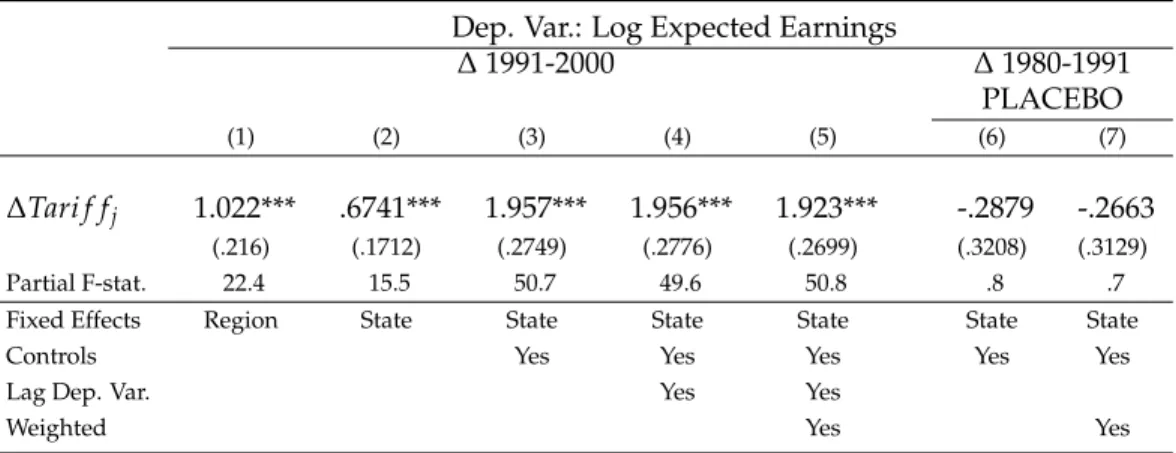
Where∆Earningsjsis the variation in the logarithm of the average expected earnings at the microregion level between 1991 and 2000. The remaining terms are analogously defined as in equation (2). Table 3presents the results. Column 1 reports a lighter specification, in which we regress the log of expected earnings against tariff changes, conditional only on macroregion fixed-effects – Brazil has officially five macroregions. We find a positive coef-ficient, meaning that microregions exposed to larger tariff reductions – tariff change holds a negative value – also experienced larger reductions in expected earnings over the 1990s. The coefficient decreases as we add state fixed-effects (column 2) and absorb unobserved variation across states over the decade. The point estimate then increases to 1.956 as we include demographic controls in levels at the baseline (column 3), and remains roughly stable as we add the lagged change in the dependent variable (column 4), and further use population weights (column 5).10 The stability of the point estimates across columns 4 and 5 indicates that the results are generally robust to weighting, which minimizes concerns re-lated to noisy cells and the influence of outliers. The stability of the coefficient in columns 3 through 4 indicates that pre-trends are not expected to have any confounding influence on the estimates. The remaining columns of Table3further test this conjecture. We exam-ine whether the tariff changes in the 1990s correlates with trends in log expected earnings between 1980 and 1991. We find very small and statistically insignificant point estimates in both columns 6 and 7, which display results from unweighted and weighted regressions, respectively. This reassures our assumption that the variation in regional tariffs is uncorre-lated with pre-trends or any other unobserved dynamics of employment and earnings.
As also documented in previous studies, the relative magnitude of the estimated effect is economically relevant. One standard deviation of the change in log expected earnings be-tween 1991 and 2000 is 16.9 log-points. The point estimate of approximately 1.95 observed in columns 3 through 5 of Table3means that the expected earnings of a microregion hit by a one standard deviation (0.038) negative variation in tariffs grew 7.5 log points [0.038 ×
9In this analysis, all individual-level regressions use sample weights from the respective Census.
10Population weights refer to the share of the microregion population out of the total Brazilian population
in 1991. Lagged variables are analogously computed by using census data. In this case,∆ refers to changes between 1980 and 1991.
1.956] less than the median microregion exposed to the tariff change. This equals to a vari-ation of approximately 7.2% in expected earnings, or nearly half a standard devivari-ation of the dependent variable [7.5/16.9∼44%]. In that sense, in our setting, variation in regional tariffs is generally associated with economic downturns.
5
Economic Downturns and Religious Affiliation
In this section, we present and discuss the effects of local economic downturns on religious affiliation. We do this by examining whether religious affiliation responds to changes in regional tariffs across microregions. We further investigate heterogeneous effects by demo-graphic groups, analyze whether the effects persist in the long run, and discuss its potential mechanisms.
5.1
Pentecostal Affiliation
We begin with Table 4, which presents the estimated effects of regional tariff changes on Pentecostal affiliation. Column 1 reports our lighter specification, conditional only on macroregion fixed-effects.11 We find a negative and significant coefficient, which means that exposure to larger reductions in regional tariffs was accompanied by relatively larger increases in Pentecostal affiliation. The point estimate slightly increases in module from -1.319 to -1.670 as we add state fixed effects (column 2), and remains roughly stable in the range between -1.563 and -1.473 as we include demographic controls in levels at the base-line (column 3), add the lagged change in the dependent variable (column 4), and further use population weights (column 5). Again, the stability of the coefficient in columns 3 through 5 indicates that pre-trends are not expected to have any confounding influence on the estimates. We further examine this claim in the remaining columns of Table 4, which test whether exposure to the tariff changes observed in the 1990s correlates with trends in Pentecostal affiliation between 1980 and 1991. We find small and statistically insignif-icant point estimates in both columns 6 and 7, which display results from unweighted and weighted regressions, respectively. This reassures the assumption that trade-induced shocks are uncorrelated with pre-trends or any other unobserved dynamics that could chal-lenge our identification strategy.
The magnitude of the estimated effects is non-trivial. Column 4 of Table4displays one of our most conservative specifications, which compares variation in economic conditions and in religious affiliation in microregions within states, allowing for differential trends
cording to initial demographic characteristics and pre-trends in religious conversion. The point estimate of -1.603 implies that a reduction of one standard deviation in regional tar-iffs (0.038) is accompanied by an increase of 6.1 log-points in the number of individuals affiliated to Pentecostal denominations per capita [0.038×1.603]. Put differently, the num-ber of Pentecostals per capita grew 5.9% more in a microregion exposed to a reduction of one standard deviation in regional tariffs relative to the median variation in tariffs. This corresponds to approximately 21% of a standard deviation of the growth of Pentecostals per capita across microregions [6.1/28.5∼21%].
The point estimates also provide suggestive evidence on an implicit income-elasticity of Pentecostal affiliation around -0.873 (see Table3). A negative variation of 1% in expected earnings is associated with an increase of approximately 0.8% in the number of individuals affiliated to Pentecostal churches per capita. Overall, these results thus confirm that the growth in Pentecostalism during the 1990s in Brazil can be traced back to greater exposure to tariff reductions and deeper local economic downturns.
5.2
Religious Conversion
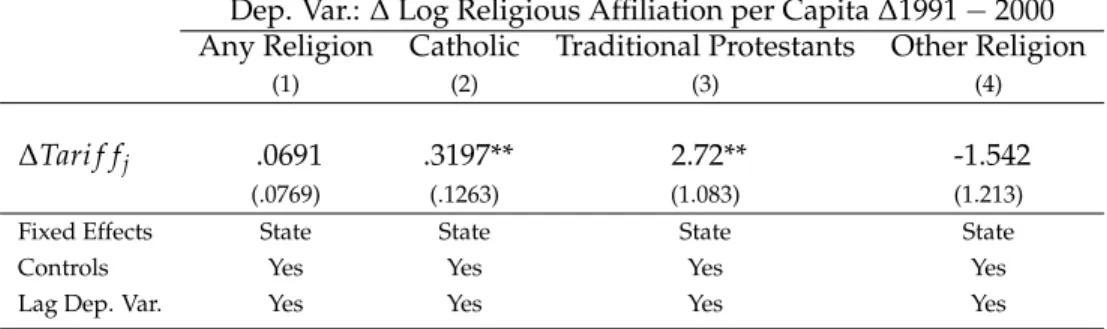
We now investigate the extent to which the observed effects on Pentecostal affiliation come from individuals being converted from other religions or simply from non-religious indi-viduals adhering to Pentecostalism. To do so, we replicate the same exercise of column 4 from Table4, our benchmark specification, for the other main religious denominations and for the share of religious individuals.
Table 5presents the results. In column 1, we assess whether greater exposure to tariff reduction, or deeper local economic downturns, is associated with changes in the num-ber of individuals per capita who confirm some type of religious belief. We find a small and statistically insignificant coefficient, which indicates that economic downturns are not particularly associated with conversion into religiousness. In the remaining columns of Table5, we test whether the growth of Pentecostalism has come from the conversion from other religious denominations. In columns 2 and 3, we examine whether greater exposure to regional tariff reductions is associated with changes in affiliation to Catholicism and to traditional Protestant denominations, respectively. We find positive coefficients in both columns, which means that economic downturns are associated with a decline in affilia-tion to religious denominaaffilia-tions that share a common Christian background with Pente-costal churches. In column 4 we observe that regional tariff changes are not significantly associated with affiliation to religious denominations from other backgrounds.
Overall, these results parallel the descriptive figures presented on Table 1. As men-tioned in Section2.3, most Pentecostals mentioned not always belonging to the movement.
According to The Pew Research Center (2006), in Brazil, 62% of Pentecostals said they have not always belonged to their current religion, while only 13% of other Christians an-swered the same. Amongst the new Brazilian believers, almost half said they converted from Catholicism. This is consistent with the estimates from Table 5. On the one hand, the larger coefficient in column 3 suggests relatively greater conversion from traditional Protestantism, which is consistent with the fact that Pentecostalism and historical Protes-tant denominations share a closer Christian background. On the other hand, nearly 87% of the Brazilian population was affiliated to Catholicism in 1991. In that sense, in column 2 of Table5we observe a relatively smaller elasticity in comparison to that of column 3, but still sufficiently large enough to free a considerable number of Catholics into Pentecostalism as a response to economic distress.
5.3
Heterogeneity by Demographics
We now explore potential heterogeneous effects by demographics. We have two main rea-sons to conjecture that greater exposure to tariff change may differentially affect conver-sion across groups. First, individuals’ characteristics shape the demand for religion and, potentially, their religiosity in response to local economic conditions. The pioneer model ofAzzi and Ehrenberg(1975) rationalizes that people with lower opportunity costs of time are expected to be relatively more devoted to religion – this would be the case of low-skilled workers, the elderly and women out of the labor force. In general, these groups are more religiously observant and adherent to religion, as shown inDeaton(2011) in a within-countries analysis. The author finds that religiosity increases with age, that women are more religious than men, and that more educated people are less likely to be religious. In that sense, one could expect greater religiosity and attachment to a religious denomination among these groups, and thus a lower probability of conversion. In particular, we expect that resilience to religious conversion should increase with age, as religious beliefs become more ingrained over the course of a lifetime. Second, trade liberalization may differentially affect some segments of society. Dix-Carneiro(2014) estimates that older, female, and less educated workers faced substantially higher adjustment costs on the labor market follow-ing the Brazilian trade liberalization. In principle, we can only assess the combination of these two potential channels of heterogeneity.
In Table6, we examine the extent to which economic distress affected affiliation to Pen-tecostalism within different demographic cells according to age, gender, and educational level. The table shows the estimates of our benchmark specification (column 4 of Table4). Overall, we find evidence of conversion in response to tariff changes in nearly all demo-graphic groups. The effects are not statistically different across most columns, but the point
estimates are informative. First, we find relatively greater effects among youth and young adults, and small and insignificant estimates for older adults. We also find smaller point estimates among women and the less educated. These result-form estimates suggest that youth and young adults, as well as men, are relatively more susceptible to religious con-version in response to economic downturns. A similar reasoning applies to the remaining two columns, with less educated individuals facing a lower probability of conversion.
5.4
Persistence and Potential Mechanisms
Next, we examine whether the effects of economic downturns on Pentecostalism persist in the long run. In Table7, we replicate the first five columns of Table4, but now consider the change in Pentecostalism affiliation between the 1991 and the 2010 Censuses as the outcome variable. This gives us a span of time of nearly two decades since the beginning of the trade liberalization process, in the early 1990s. Table7presents slightly smaller point estimates, but still statistically significant at 10% and similar to those reported in Table 4. Column 4 displays a point estimate of -1.207, which implies that a reduction of one standard deviation in regional tariffs (0.038) in the early 1990s was accompanied by an increase of 4.6 log-points in the number of individuals affiliated to Pentecostal denominations per capita in the long run [0.038 × 1.207]. This corresponds to approximately 75% of the short-term impact (6.1 log-points), and indicates that economic downturns have had persistent effects on Pentecostal affiliation.
As mentioned in Section2, the existing evidence indicates that regions that were nega-tively hit by trade-induced shocks experienced overall economic distress and the worsen-ing of livworsen-ing conditions, not only directly related to labor markets outcomes, but also asso-ciated with a reduction in government spending and in the provision of public goods, as well as an increase in income inequality and crime rates. In Table8, we investigate whether these regional outcomes mediate the impacts of local economic downturns on Pentecostal expansion over time. Column 1 replicates our benchmark estimates for both the short-term (Panel A) and the long-term (Panel B) impacts, previously reported on Tables4and 7, re-spectively. In the remaining columns, we sequentially add changes in regional outcomes as controls in order to test the extent to which the observed covariation in changes in tariffs and in Pentecostal affiliation is absorbed by local-specific dynamics.
Panel A reports remarkably robust and stable effects of changes in tariffs on Pentecostal-ism affiliation in the short term, except in column 2, which controls for changes in employ-ment and, to a lesser extent, in column 3, which adds changes in the Gini index. Although we find statistically similar effects across columns, in column 2 the coefficient of changes in tariffs drops a third (in module) in comparison to column 1, from -1.603 to -1.004, and
be-comes only borderline significant at 10%. The point estimate slightly decreases in column 3, and remains stable in columns 4 and 5. The overall pattern suggests that labor mar-ket conditions are a relevant short-term mediator of the effects of economic downturns on Pentecostalism, followed by inequality. We observe a similar pattern in Panel B, as the long-term effects of changes in tariffs on Pentecostal affiliation are again stable across columns. Yet, the covariation between tariffs and Pentecostalism is now relatively less affected once we control for long-term changes in either employment or inequality. This result suggests that a transitory variation in economic conditions may have persistent effects on religiosity and more fundamentalist religious beliefs, irrespective of long-term dynamics in regional outcomes.
We are not able to precisely identify the ultimate triggers for religious conversion at the individual level, as the worsening of each of the regional outcomes generally reflects a combination of enhanced insecurity, deprivation, and risk. However, the results of Table8 importantly suggest that short-term adverse shocks to employment seem a relevant media-tor of the relationship between economic downturns and Pentecostal affiliation, alternative mechanisms bearing little influence in both the short and long run. Also important to note, we find no evidence that public spending has attenuated the relationship between economic distress and Pentecostal expansion.
5.5
Supply vs Demand
Economic downturns may have triggered Pentecostalism expansion not only through the demand-side, but also via supply-side determinants of religiousness. As regions are hit by adverse shocks, local vulnerability may attract churches and religious services competing for adherents, possibly leading to increased affiliation. Although it is difficult to disentan-gle mechanisms, we perform a simple exercise to test whether supply-side triggers were relevant in our empirical setting. We rely on census data on employment and occupations to calculate the change in the prevalence of Pentecostal Pastors at the microregion level, in both the short and long run. This should be considered a proxy for the supply of Pen-tecostal churches and religious services at the local level. Table 9 shows the estimates of our benchmark specification (column 4 of Table4), in which the dependent variable is the change in the logarithmic of the number of Pentecostal Pastors per capita (columns 1 and 2) or per Pentecostal population (columns 3 and 4). We find statistically insignificant results for both dependent variables, in both the short and long run. Overall, these results suggest that supply-side mechanisms did not play a relevant role in the Pentecostalism expansion as a response to economic downturns.
6
Political Consequences
Religion and politics have always been connected in Brazil. The country has a strong Catholic tradition, and the Catholic Church has been influential over the centuries. During the dictatorship period, the military government had the informal support of more conser-vative sectors of the Catholic Church, while sectors more inclined towards redistributive issues backed the left-wing parties (Tuñón,2017). Yet, the relationship between religion and politics has become explicit more recently, with members of the clergy running as candi-dates for political offices. Although not exclusively, this movement has mostly come from those affiliated with Pentecostal denominations.
Pentecostalism entered politics in the 1990s, with church leaders directly running for office. Since then, Pentecostal denominations have successfully leveraged their political structure and influence. As noted byKramer(2005, p.98), “churches, especially those that own radio and television stations, have increasingly fielded and succeeded in electing their own candidates to political office. The pulpit and its electronic surrogates offer regular and unsurpassed access to an evangelical public. [In Brazil’s 2002 election], Brazilians elected 4 evangelical senators and 45 federal deputies, which represented nearly 10 per-cent of Congress (...). Of these, 22 federal representatives and a senator from Rio, Bishop Marcelo Crivella, are from the UCKG. Two decades ago, while Brazil was redemocratizing itself, this degree of political presence for evangelicals was unthinkable”.
Evangelical politicians currently hold 74 out of 513 seats in the lower-house of the Brazilian Federal Congress (DIAP, 2014), while Bishop Marcelo Crivella is currently the mayor of the city of Rio de Janeiro, the second largest in Brazil, having received 1.7 million votes or 59% of the total number of valid votes in the last elections (TSE, 2016). Also, the presence of Pentecostalism in politics has increased in close connection with their role as media owners. Pentecostal leaders acquired more than 600 TV and radio channels (Watts, 2014), including Rede Record, the second most influential TV company in the country. Rede Record is owned by Bishop Edir Macedo, the UCKG’ founder and Crivella’s uncle.
In this section, we further discuss, and empirically examine, whether electoral outcomes reflect the expansion of Pentecostalism in society. We assess whether this expansion can be associated with greater participation of affiliates as well as religious leaders in politics. The link between religious adherence and participation in politics can be particularly salient as a mediator between non-secular beliefs and policy choices. According toDurkheim(1912, p.47), “a religion is a unified system of beliefs and practices relative to sacred things (...) which unite into one single moral community called a Church all those who adhere to them”. The more fundamentalist religious communities and sects could therefore unite towards common moral and political views as well as in support of common political
plat-forms. Indeed, there is qualitative evidence in support of the view that Brazilian Pente-costals tend to vote for candidates who share their faith (Kramer,2005). As shown in Table 1, Pentecostals stand out for their trust in fellow church members and for their view that it is important for political leaders to have strong religious beliefs. They are also less likely to say that separation of church and state should exist.
Next, we provide empirical evidence on the extent to which tariff changes and the Pen-tecostal expansion during the 1990s are associated with the electoral performance of can-didates connected to Pentecostal denominations running for office. We start by describing the background of the political system in Brazil. We then describe the data and the model used in the empirical analysis, and present the results.
6.1
Background on the Political Organization of Brazil
Brazil is composed of the federal government, 26 states and a federal district, and over 5,500 municipalities. The federal government is divided into three independent powers: executive, legislative, and judiciary. The executive branch is commanded by the President, while the federal legislative congress is divided into a two-chamber legislature comprising the Senate and the Chamber of Deputies (Camara dos Deputados).
Federal elections for president are held jointly with elections for the Senate and the Chamber of Deputies. The 513 members of the Chamber of Deputies are elected to a four-year term by proportional elections within each state. More specifically, Federal Deputies are elected under an open-list proportional representation system, with a given state being a single multi-member district. Under the open-list rule, a citizen casts a vote for one individual candidate or for a party.12
While the Senate represents the interests of the Brazilian states, the Chamber of Deputies (the Lower House of Congress) represents the Brazilian people. Deputies create federal laws and control the acts of the Public Administration. They are responsible for discussing, proposing, and voting laws over a range of both constitutional and infra-constitutional top-ics, which include, for instance, civil rights and regulation over social and moral issues – such as abortion, drugs, and discrimination. We focus on the election of Federal Deputies primarily because these are the representatives that propose and vote for legislations sen-sitive to moral values that are more salient to religious communities. A second reason is that candidates compete in an open-list system, differently from candidates to the Senate or the executive branches, who need to bargain and to gain nominations within their party. In this section, we assess the electoral performance of candidates associated with religious denominations running for the Federal Chamber of Deputies.
6.2
Electoral Data
We use electoral microdata publicly available from the Federal Electoral Authority (Tri-bunal Superior Eleitoral – TSE) for the 1994, 2002 and 2014 federal elections, thus covering two decades of electoral outcomes in Brazil.13 Brazil is a secular country and the offi-cial records do not contain the religious affiliation of candidates. We identify candidates’ connections to Pentecostal churches and to other different religious denominations in two ways. First, we rely on a wider classification of candidates associated with Pentecostal churches from Lacerda (2017). The author hand-coded a list of Pentecostal candidates by using: (i) religious designations in candidacy names; (ii) literature review matching candi-dates names and churches; (iii) online searches on the websites of the major national and regional newspapers; and (iv) direct contact with the major Pentecostal churches.14 The main caveat of this classification is that selection based on (ii) to (iv) can be biased toward the identification of the most popular and the elected candidates. The second caveat refers to availability of data, as the information on candidacy names is incomplete for the 1994 election. For this year, we only have information from approximately half the Brazilian states.15
In our second approach, we identify candidates who actively disclose their occupa-tional identity according to their campaign bynames. When registering a candidacy in the Federal Electoral Authority, each candidate chooses the candidacy name that is officially used in the elections. This chosen name is the one that appears on the voting ballots (i.e., voting machines). The candidate can choose virtually any name.16 In particular, the use of professional or clerical designations is common. For example, “Jose Divino Oliveira De Souza” ran as candidate for the Chamber of Deputies by the State of Rio de Janeiro in the 2002 election under the name of “Pastor Divino” (literal translation for Divine Pastor). In this approach, we code candidates according to two types of religious designations in their candidacy names. We classify the candidate as a Pastor if the candidate uses one of the most common clergy designations from Pentecostal and Protestant denominations – Pas-tor, Bishop, Reverend, or Minister. We classify a candidate as a Priest if he explicitly uses this Catholic designation in the ballot.17 The main virtue of identifying candidates’ con-13We consider 1994 as our baseline year, as microdata from previous elections do not provide information
on candidates’ profiles. We use microdata from the 2002 federal elections to examine the immediate effects of the trade liberalization, and right after the release of the 2000 Census; and microdata from the 2014 federal elections in our long-term analysis, as these are the most recent data available from TSE.
14We refer toLacerda(2017) for the detailed classification procedure. We double checked the classification. 15We have data for the following states: AC, AL, AM, AP, BA, GO, MA, MS, PI, RR, RS, SC, SE, SP. 16For instance, “Rosangela Barros Assed Matheus De Oliveira” was elected Governor of the State of Rio de
Janeiro in 2002, but her candidacy name was “Rosinha Garotinho”, which is the combination of her personal nickname and the nickname of her husband, the incumbent state Governor at the time.
nections to Pentecostal or Catholic designations based on the candidacy name is that this is a systematic method to classify candidates homogeneously across elections and regions of the country. This is not a simple task in the Brazilian context, in which party identity is relatively weak, and campaigns often exploit candidates’ personalities rather than their po-litical agenda. Another virtue is that, by making it explicit in their candidacy names, these candidates reveal a strong attachment to their religious groups. This approach, however, likely underestimates the number of candidates de facto associated with religious groups.18 We aggregate the microdata on votes at the microregion level, for each election year. Our main outcome variable is the vote share of all candidates connected to Pentecostal churches combined – classified either from candidacy names (Pastors) or from Lacerda’s list (Pentecostals). We also compute the total vote share of priests based on candidacy names (Priests).
Table 10presents the descriptive statistics. Panel A presents figures for all candidates in Brazil, while Panel B is restricted to those states for which we have information on can-didacy names from 1994. In both panels, statistics for Pentecostals refer to those candi-dates who were identified as being connected to Pentecostal churches based on the wider definition of Lacerda (2017), while figures for Pastors and Priests refer to candidates and votes identified by candidacy name designation. Columns 1 through 6 show an impres-sive increase in the number of candidates and votes associated with Pentecostal churches, irrespective of coding method or sample. According to the classification based on the can-didacy name method, the average number of votes on Pentecostal candidates at the mi-croregion level increased nearly 40 times between 1994 and 2014, while their vote share rose from 0.1 to 1.6 percent. Statistics of Panel A, based on the wider classification method, show that the average share of votes on Pentecostal candidates reached nearly 8% in 2014.
6.3
Results
We first follow equation (2) to examine the reduced-form relationship between tariff changes and vote shares, separately for each election year. The dependent variable is the total vote share of candidates connected to a given religious denomination in a given election. Since the political presence of candidates associated with Pentecostal churches was virtu-ally nonexistent in the early 1990s (Kramer,2005), we interpret the dependent variables as variations; and those for Priests are “Padre”, “Pr.”, “Frei” and “Dom”. Note that there are Bishops in the Catholic Church, but no Catholic Bishop has become a politician in Brazil so far. Since some of these terms may be a family name, we only consider candidacy names where the designation appears before the personal name.
18For example, the Senator elected by the State of Rio de Janeiro in 2002, Marcelo Crivella, was a