Semantic Links for Portuguese
Fabricio Chalub
1, Livy Real
1, Alexandre Rademaker
1,2, Valeria de paiva
31IBM Research Brazil,2FGV/EMAp Brazil,3Nuance Communications USA [email protected], [email protected], [email protected], [email protected]
Abstract
This paper describes work on incorporating Princenton’s WordNet morphosemantics links to the fabric of the Portuguese OpenWordNet-PT. Morphosemantic links are relations between verbs and derivationally related nouns that are semantically typed (such as for instance “tune-tuner” — in Portuguese “afinar-afinador” – linked through an agent link). Morphosemantic links have been discussed for Prince-ton’s WordNet for a while, but have not been added to the official database. These links are very useful, they help us to improve our Portuguese WordNet. Thus we discuss the integration of these links in our base and the issues we encountered with the integration. Keywords: Wordnet, Morphosemantics, Portuguese
1.
Introduction
Fellbaum, Osherson and Clark (Fellbaum and Clark, 2007) discuss how, to aid automatic reasoning using WordNet, it would be useful to classify and label the relations between nouns and verbs that are derivationally and semantically re-lated. Many traditional paper dictionaries include morpho-logical derivations between verb and noun pairs, but they tend to simply list them as run-ons without any information on their meaning. For example, the large-scale database of categorial variations of English lexemes, known as Cat-Var (Habash and Dorr, 2003) contains some 100,000 unique English word forms; however, no information is given on the meanings of these words. Similarly, for Portuguese, the “Portal da L´ıngua Portuguesa”1lists more than 5,400 dever-bals with their respective verbs, but again has no meanings associated.
By contrast, the work on WordNet itself pays special at-tention to meanings as logical constructs. They say “We are currently working to transform WordNet into a Knowl-edge Base that better supports such reasoning and inferenc-ing” (Fellbaum and Clark, 2007, p.02). Thus it is surprising to us that for several years they have provided a collection of files, manually checked, with almost 17k typed links, re-lating verbs and nouns, but that these links have not been made part of the official distribution of WordNet, nor of the online version, available for users’ consultation.
For many NLP tasks and also for people trying to construct semi-automatically wordnets in other languages such a re-source would seem very useful. We started our own version of morphosemantic links, not knowing about the Princeton Wordnet ones to begin with. The method we used to pro-duce our original morphosemantic links in Portuguese was somewhat tortuous, as deciding what semantics types are relevant and how to label them are not trivial tasks. When we realized the existence of the Princeton morphoseman-tics links we decided to integrate our previous work with theirs, as described below.
2.
OpenWordNet-PT and NomLex-PT
Our main reason for producing lexical resources is to cap-ture the meaning of natural language expressions in
rep-1http://www.portaldalinguaportuguesa.org/
.
resentations suitable for performing inferences, that is, we want to do computational semantics.
Semantic information in the shape of lexical resources is relevant for several NLP tasks, such as machine trans-lation, information extraction and even to assist the cre-ation of annotcre-ations for machine learning tools. We have been working on what we consider our first long-term and wide-scale lexical resource OpenWordNet-PT (de Paiva et al., 2012) for some years now. OpenWordnet-PT is a freely available wordnet for Portuguese, browsable at http://wnpt.brlcloud.com/wn/ and download-able at http://github.com/own-pt/.
We have also been working on a smaller lexical resource, a lexicon of nominalizations in Portuguese called NomLex-PT (de Paiva et al., 2014), embedded into OpenWordnet-NomLex-PT and freely available for download at http://github. com/own-pt/nomlex-pt. NomLex-PT offers a list with some 4,240 pairs of related verb/noun forms in Por-tuguese. To construct NomLex-PT, we semi-automatically translated the original English NomLex (Macleod et al., 1998), the French Nomage (Balvet et al., 2011), the Span-ish AnCora-Nom (Peris and Taul´e, 2011) and manually ver-ified the pairs acquired. Then worrying that we would be missing truly Portuguese deverbals, we investigated a col-lection of Portuguese corpora (the AC/DC corpora (Costa et al., 2009) collection) to complete our collection of nomi-nalizations, obtaining the resource described in (de Paiva et al., 2014).
Nominalizations, nouns formed from other part-of-speech words, such as for example “construction” and “govern-ment”, constitute one of most well known polysemous and problematic issues of formal theories in Linguistics. These nominals have a clear morphological link with the related verb, but their meanings are not automatically derivable from the meaning of the base verb nor are they directly obtainable from the composition between the meaning of the base verb and its suffix. “Government”, for example, is formed by the suffix “-ment” which, in general means “the event of doing X”, but “government” (and the Portuguese governo) has several possible meanings: the event of gov-erning, the result of govgov-erning, the period of time some governing happened, the people that govern, etc.
theoret-ical and computational linguistics. (Chomsky, 1970) was one of the first works which have pointed out the phe-nomenon and proposed a whole theory based on the lex-icalization of deverbals nouns, the Lexicalist Hypothesis. Many linguistic works have paid attention to nominaliza-tions (Clark, 1979; Pustejovsky, 1995; Alexiadou, 2001; Brandtner, 2011; Jezek and Melloni, 2009; Jezek and Mel-loni, 2011) and their logical polysemy has been a hot topic in lexical semantics, as it poses challenges to formal the-ories and to computational treatments of deverbals alike. The computational treatments try to automatically predict the meaning of deverbals and to uncover the implicit verbal arguments when confronted with a nominal deverbal (Gure-vich et al., 2008; Gure(Gure-vich and Waterman, 2009).
The work in (Real and Retor´e, 2014) argues that one needs to have nominalization meanings encoded in the lexicon, as their formation do not follow a general semantic pattern. The work in (Fellbaum and Clark, 2007, p.04) remarks that the most regular formation of nominalizations in English, the agentive pattern brought about by the suffix er” or “-or”, works for only two thirds of their listed examples. Thus a computational treatment that hopes to provide semantics for all those nominals must have this information encoded in a lexical resource.
One major issue here is the polysemy of both verbs and nouns, related by morphosemantic links. Table 1 summa-rizes the number of monosemous (a single sense) nominal-izations for verbs and nouns, described in NomLex-PT and in the morpholinks of PWN. That is, from 4,238 nominal-izations in NomLex-PT, we have only 315 nominalnominal-izations where both the verb and the noun are monosemous, less than 10% of the listed pairs. The numbers for English pairs are even smaller, only 717 of the almost 17 thousand mor-phosemantic links have unambiguous verb and noun in En-glish. The analysis of the effect of polysemy in both the English and the Portuguese resources is another issue where we believe this work on morphosemantic links will be help-ful with in the very near future.
nomlex morphosemantic links
(OWN-PT) (PWN)
verb 963 (22.7%) 1,208 (7.1%)
noun 1,202 (28.3%) 2,832 (16.6%)
both 315 (7.4%) 717 (4.21%)
total 4,238 (100%) 16,995 (100%) Table 1: Monosemy of verbs and deverbal nouns in Por-tuguese and English
The highly polysemic nature of nominalizations has being heavily investigated by formal linguistics, specially by lexi-cal semanticists, as (Asher, 2011), that are interested on the behavior of nominalizations, mainly in copredication con-texts — that are concon-texts in which one single token brings about more than one semantic pattern to the sentence. An example of copredication is “The heavy translation was re-vised twice”, where “translation” concomitantly means the physical result of the act of translating (characterized by the adjective “heavy”) and its informational content (that is what can be revised) . There are many works on this subject
and, for now, there is no uniform treatment to understand, and more than that, to predict, their polysemy.
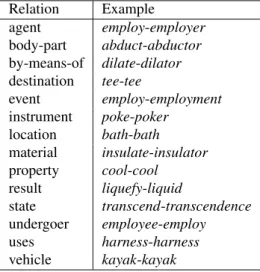
The polysemic pattern “event/result” — present in “con-struction”, “development” and “accomplishment” — is surely the most recurrent in, at least, West Germanic and Romance languages, as English, Dutch, Portuguese, Span-ish, French, etc. But there is no work that correctly predicts when a nominalization would have only one of those two possible meanings or both (Real and Retor´e, 2014). Since the polysemy of nominalization is still an unsolved chal-lenge even for theoretical analysis, we believe that lexical resources as wordnets should encode systematically this in-formation, however considering the high degree of poly-semy we did not expect that it would be an easy task. One established way of codifying these kinds of semantic information between nominalizations and their correspond-ing verbs in a lexical resource is uscorrespond-ing the idea of mor-phosemantics links. These relate a noun and a verb senses, adding a label that indicates the kind of relationship the lex-ical items have between themselves. Princeton’s Wordnet team did one project to obtain such links in 2007, but they do not offer those semantic links in their main database. The list is available as a standoff file with 16,995 typed links between noun/verb senses.2 The semantic relations used in this list are: agent, body-part, by-means-of, desti-nation, event, instrument, location, material, property, re-sult, state, undergoer, uses and vehicle; which is a slightly different list from the one discussed in the paper (Fellbaum and Clark, 2007).
Here we describe how we added to OpenWordnet-PT a set of morphosemantic links between noun/verb senses pairs. As basic resources we have used the previous work done by the Princeton’s Wordnet team, described in (Fellbaum and Clark, 2007), and our own NomLex-PT. Rather than simply attempting to manually project the verb-noun pairs between words forms from Nomlex-PT to links between particular senses of those words, a difficult task given the fine-grained nature of Princeton’s synsets and the state (not fully curated) of our Portuguese OpenWordnet-PT, we de-cided to use Princeton’s morphosemantic links as helping data to both discover issues with OpenWordNet-PT synsets and to help to project the links from NomLex-PT. Thus the work we describe here consists in adding to the pairs of translated morphosemantic links, that is to pairs of senses of verbs/nouns in Portuguese, a label from Princeton’s table and making such a triple, a link of the OpenWordnet-PT.
3.
Semantic Links
Before describing the several different uses we see for the newly properly attached collection of morphose-mantic links to our Portuguese wordnet, we thought it might be relevant to discuss some examples of these linkages. The paradigmatic examples given by the Princeton’s team are a good place to start discussing the morphosemantic links and how they can be incor-porated into a Portuguese wordnet. They exemplify
2
Actually the WordNet Princetons file has 17,739 links, but some of them are repeated. This list can be downloaded from http://wordnet.princeton.edu/wordnet/ download/standoff/.
their relations via the Table 2, as expounded in their morphosemantic-links-README.txtfile. Relation Example agent employ-employer body-part abduct-abductor by-means-of dilate-dilator destination tee-tee event employ-employment instrument poke-poker location bath-bath material insulate-insulator property cool-cool result liquefy-liquid state transcend-transcendence undergoer employee-employ uses harness-harness vehicle kayak-kayak
Table 2: Morphosemantic Relations from PWN But out of these 14 examples only three would work eas-ily in Portuguese. The pair employ-employer (empregar-empregador) also has the right relationship agent in Por-tuguese. We also have the undergoer relationship in this case employ-employee (empregar-empregado) and the re-sultlink for liquefy-liquid (liquidificar-l´ıquido). But all the others do not seem to work.
Either there is no direct translation (we do not have a spe-cific verb for “teeing” in Portuguese) or the verb is rarely, if ever, used, kayak-kayak (caiacar-caiaque). More com-monly, as in the example “bath-bath”, the relationship is ambiguous, as it happens in English too. “Bath” can be thought of the place/location where one bathes (banheira in Portuguese) but can be the artifact or instrument used to bathe, like in “baby bath”. Of course “bath” can also be the result/event/action of bathing (banho in Portuguese). We also use in Brazil banheiro, for bathroom, which is casa de banhosin European Portuguese.
While the pair “abduct-abductor” can be used in the mus-cular sense in Portuguese — {01449427-v abduct, ab-duzir— pull away from the body; “this muscle abducts”}, it seems more commonly used in its kidnapping sense, {01471043-v snatch, kidnap, abduct, nobble, abduzir, se-questrar, raptar — take away to an undisclosed location against their will and usually in order to extract a ransom; “The industrialist’s son was kidnapped”}, where the role would be agent.
However looking up the pair “dilate-dilator”, we see one of the first applications of the work morphosemantic links do for us. They help us to complete empty synsets in Por-tuguese, especially for verbs that are not very commonly used and hence were not picked up by the Wikipedia-based construction of the OpenWordNet-PT. Thus looking up “di-late” we find {00305537-v dilate, distend expandir, dilatar — become wider; “His pupils were dilated”} and realize that the verb distender is not in the OpenWordNet-PT. Then looking up the empty (in Portuguese) synsets 00257087-v and 00256862-v, we realize that we should also complete them with the verb distender:
1. {00257087-v distend — cause to expand as it by inter-nal pressure; “The gas distended the animal’s body”} 2. {00256862-v distend — swell from or as if from
in-ternal pressure; “The distended bellies of the starving cows”}
3. {00305537-v dilate, distend expandir, dilatar — be-come wider; “His pupils were dilated”}
Moreover, when searching for “dilate” in English, we see that we have the synset {00955601-v expand, expound, di-late, expatiate, lucubrate, flesh out, elaborate, enlarge, ex-posit elaborar}. This synset fails our guidelines, which try to have a similar number of words in English and in Por-tuguese. This synset has 9 words in English and a sin-gle one in Portuguese. So the Portuguese synset should be completed with verbs corresponding to these other ele-ments: we can add elocubrar, expor, expandir to this synset and while expor, expandir were already in the lexicon (in other synsets), we were missing elocubrar (“locubrate”) altogether. This application of the morphosemantic links, helping to complete wordnets in other languages, was the one original application of this work, described for Turkish in (Bilgin et al., 2004) and for Bulgarian in (Stoyanova et al., 2013).
4.
Opportunities and Challenges
From almost 17,000 morphosemantic links available from Princeton’s wordnet, we could automatically derive around 2,700 morphosemantic links for OpenWordnet-PT. A first checking of these links pointed out to an unbelievably high accuracy: looking at the words of the extracted links in Por-tuguese and the labels (associated to approximately half of these links), we had around 96% of correct morphoseman-tic links in Portuguese. Later on a more thorough investi-gation of the synsets themselves revealed many issues. Simply reading words in synsets, we could superficially check the correctness of links and these look very good. However, simply reading the glosses (and assuming glosses correct), we could and did miss more subtle errors. For ex-ample we have the link agent in escrever-escritor between the verbs in {01744611-v publish, write — have (one’s written work) issued for publication; “How many books did Georges Simenon write?”} and the noun corresponding to the synset {10794014-n author, writer — writes (books or stories or articles or the like) professionally (for pay)} which looks correct, as a writer (escritor) is an agent who writes (escreve) for payment. However this verb synset turns out to be about publishing books, not about writing them. And the nominalization publish-publisher does not seem to exist in Portuguese.
We then manually checked 10% of the proposed relation-ships, comparing the synsets that the relations link, the type of the label inherited from the PWN work and all the other possible synsets in PWN that contain the related words. From 261 manually checked pairs, we found 60 wrong pairs. (We intend to continue checking the other links ex-tracted, but believe that this error rate is reasonable.) The quality of these links is still surprisingly high, espe-cially considering the discussion above that indicates that
the links could fail for many different reasons: our Por-tuguese wordnet is still missing many translations for lexi-cal items, there are verbs that only make sense in English, there are verbs that are only verbs in Portuguese (e.g. to give or receive solidarity to/from someone (solidarizar)), PWN relations are not so well curated, we do not expect always to have the same nominalizations in English and in Portuguese, etc.
One example of when things work well is, for instance, the link labelled event between the verb Americanize (americanizar) (synsets 00409643-v and 00410406-v) and the nominal Americanization (americanizac¸˜ao) (synset 13429888-n). One may perhaps dispute the need for two verbal synsets for the verb Americanize (one for becom-ing American yourself, the other one for makbecom-ing somethbecom-ing or someone more American) in PWN but it is clear that the meanings correspond exactly to the ones in Portuguese in the nomlex-pt link americanizar-americanizac¸˜ao. Note that in this case both the verbal synsets and the nominal synset have a single word form, if one does not consider the merely orthographic difference between “Americanize” and “Americanise”.
Other cases where things seem to work well are the ones where the senses are narrowly defined, e.g. allocate (alo-car) (synset 02234087-v). If the morphologically related nouns associated with a pair of directly translated verbs exist in both languages, they seem to have a similar re-lation, in this case to the nominal allocation (alocac¸˜ao) (synset 13289467-n). This is a disputable case for the label though, PWN has undergoer but event or result might be better. Differently from the last example, the synset allocate (alocar) (synset 02234087-v) has not just a single word, it has two: “allocate” and “apportion”, and both of those words are morphologically related to nominalizations, “allocation” and “apportionment”. Since we have no Portuguese pair that directly corresponds to “apportion” and “apportionment”, morphosemantic links generated from this pair, if any, are considered as con-necting alocar-alocac¸˜ao in Portuguese. Although PWN keeps the link between {“apportion”,“apportionment”} and {“allocate”,“allocation”}, the word form “apportioning” in the {01083645-n allocation, allotment, apportionment, ap-portioning, parceling, parcelling, assignation — the act of distributing by allotting or apportioning} does not have a morphosemantic link relating it to the verbal synset, nor a morphological relation. This shows us that even between the PWN synsets, the morphosemantic relations are not very consistent.
There are however, many kinds of bad links and we are, of course, more interested on the failures than on the successes of our heuristics. There are bad links where the label seems wrong, but the synsets are connected. For example we have an agent link between suspect-suspect (suspeitar-suspeito) but the noun {09762101-n suspect, defendant acusado, r´eu, suspeito, arg¨uido— a person or institution against whom an action is brought in a court of law; the person being sued or accused} is not the agent, but some kind of patient or un-dergoer of the verb suspect {00924873-v suspect suspeitar — hold in suspicion; believe to be guilty}.
Another example of a wrong link is the one between
sorrir-sorrisoin Portuguese, created via the pair “grin-smile” in English. Clearly the pair sorrir-sorriso is a correct nom-inalization in Portuguese, which corresponds to the pair “smile-smile” in English. Unfortunately the system gets the pair sorrir-sorriso also from a relationship between the pair “grin-smile”, as the verb {00029025-v grin — to draw back the lips and reveal the teeth, in a smile, grimace, or snarl} is not necessarily related by an event to the noun “smile” (in the sense of a facial expression characterized by turn-ing up the corners of the mouth; usually shows pleasure or amusement), but they get connected by the rule 1 (see next section). However, there is a not so subtle difference in meaning in English. The verb “grin”, which can be “sor-rir”, is also used for making a more general facial expres-sion, which we might call a “careta” in Portuguese. Only a pleasant facial expression corresponds to a “sorriso” in Portuguese. Portuguese does not have the verb for the gen-eral facial expression associated to a “grin”, the closest in Portuguese would be the verbal expression make grimaces (fazer careta). This false positive or wrong candidate came about as the word “grin” appears both in the verbal and in the nominal synsets for smiling in PWN {06878071-n grin, grinning, smile, smiling — a facial expression char-acterized by turning up the corners of the mouth; usually shows pleasure or amusement}. Both pairs of words (grin-grin, smile-smile) are related through derivationally related links, which indicate the morphological relation between them. However, only one of these links the pair (smile-smile) should create a morphosemantic link in Portuguese. We found several bad links following this pattern, in which there are obvious morphological relations between the words, but only some of the links in PWN correspond to a morphosemantic link in Portuguese.
There seems to be several reasons for the existence of ‘wrong’ candidate pairs in Portuguese. To begin with, morphosemantic links are between morphologically related words, but the converse is not true: not all morphologically related forms are also semantically related. An easy exam-ple in Portuguese is the pair procurar-procurac¸˜ao, where the verb means “to seek”, while the noun means “powers of attorney”. The nominalization is lexicalized and it has lost any connection with the verb, but they are clearly mor-phologically related.
Then English has many near-synonyms that are translated to a single word in Portuguese. An example here is the verbal synset {01684337-v sculpt, sculpture — esculpir}. This pair of verbs will cause multiplication of links, but no semantic issues. More importantly, our initial heuristics, described in detail in the next section, have some draw-backs. When PWN offers a large number of synsets con-taining the same words and there are many morphoseman-tic links involved, our heurismorphoseman-tics do not always link the right word forms within synsets. Thus we obtain the link pu-rificar-purificac¸˜ao from the connection between the synsets {00475183-v purify, sublimate, make pure, distill — re-move impurities from, increase the concentration of, and separate through the process of distillation; ”purify the wa-ter”} and {13468306-n distillment, distillation — the pro-cess of purifying a liquid by boiling it and condensing its vapors}. Clearly the pairs purify-purification,
sublimate-sublimation, distill-distilation should all be amongst the sources of the nominalization pairs in Portuguese. The pairs purificar-purificac¸˜ao, sublimar-sublimac¸˜ao and des-tilar-destilac¸˜ao are clearly nominalizations in Portuguese. But we should not obtain purificar-purificac¸˜ao from the synset that has only distillment-distillation as a nominal. These examples show that the kind of manual checking we have done so far is not enough to guarantee correct-ness of all the links. We can have the same word pair in Portuguese experimentar-experiˆencia (translated as experi-ment-experience) and the same kind of semantic link event with different senses in English: the synset 02532886-v is the verb experiment in the sense of the act of “trying out” a new experience, while 01771535-v is about the feeling one experiments and both will have the the same word ex-periˆencia as their nominalization, but with very different meanings.
An interesting example, that shows a different use of the work described here, is improving PWN itself. When we look at the morphosemantic link labelled event be-tween the Portuguese pair passear-passeio, that means take a walk (a walk), we found from one single Nom-Lex relation (passear-passeio) two links candidates: the pairs amble-amble and the stroll-stroll, that are in differ-ent verbal synsets but very closely related: {01917980-v stroll, saunter — walk leisurely and with no apparent aim} and {01918183-v walk leisurely — no gloss}. A single NomLex-PT link, then, allow us to find synsets that are good candidates to be merged, which seems work that some of the PWN team are interested in doing.
Another challenge is the fact that a single verb in Portuguese, like esperar can have two nominalizations esperanc¸a and espera that correspond to two different verbs in English, “hope” (with nominalization “hope”) and “wait” (again with nominalization “wait”).
Deciding which semantic type each pair in Portuguese should have is also a very difficult question, the differences between the types are far from obvious and many senses are not specific enough to be easily distinguished. Within our own group we have fierce discussions on the need or advantages of having all the many varieties of links of the Princeton WordNet as compared to our smaller set of un-derspecified labels from our previous work.
5.
Implementing morphosemantic links
To construct the Portuguese morphosemantic links we com-bined the information from the NomLex-PT database with the Princeton morphosemantic links as follows (see the in-tuitive rule 1 below).
We look for a NomLex-PT relation between a verb in Por-tuguese verbptand a noun in Portuguese nounpt. Then we look for a morphosemantic link between a word sense of a verb in English senseven and a noun in English sensenen (belonging to synsets ss1en and ss2en respectively) where verbptappears in the list of words in ss1ptand nounpt ap-pears in the lists of words in ss2pt. The synsets ss1ptand ss2pt are the Portuguese synsets related to the PWN synsets ss1en and ss2en, respectively.
We have a one-to-one relation between English synsets and Portuguese synsets, by construction. Because the relation
between nouns and verbs in nomlex(verbpt, nounpt) was manually created in NomLex-PT and the semantic rela-tion in morpholink(sensev
en, sensenen, type) was manu-ally checked by the PWN team, the first two conjuncts are, in principle, true. The conjuncts relating synsets in PWN and OWN-PT are true by the alignment of the wordnets. So we have to make sure that the senses in both PWN and the OWN-PT are correct, to infer a correct morphosemantic link in Portuguese. morpholink(senseven, sense n en, type) ∧ nomlex(verbpt, nounpt) ∧ sense(senseven, verben, ss1en) ∧ sense(sensenen, nounen, ss2en) ∧ same(ss1 en, ss1pt) ∧ same(ss2en, ss2pt) ∧ sense(sensev pt, verbpt, ss1pt) ∧ sense(sensen pt, nounpt, ss2pt) → morpholink(sensev pt, sense n pt, type) (1)
Figure 1 shows an example of a Portuguese morphoseman-tic link between to senses of the words cantor and cantar produced by rule 1 from the English morphosemantic link between the senses of the words “singer” and “sing”. In Figure 1 note also the bidirectional link between senses called “derivationallyRelated” from PWN. Note that all morphosemantic links are among noun and verb synsets containing words that share an underlying meaning and are derivationally related.
From the heuristics above, we got 2,735 possible links to add to OpenWordNet-PT. Some of them are mistakes that came from the original wordnet directly, as the pair fess-confessor” linked by an agent link. The nominal “con-fessor”, the priest that hears the confession, is not the agent of the confession, but its patient/undergoer, usually. This is the same kind of issue as the “suspect-suspect” above. Those cases will be reported and hopefully discussed with the PWN team.
Some more mistakes were found when looking at the Por-tuguese senses and we are in the process of removing these. However, this is a laborious project, because, as we men-tioned before, we want to use the incorrect links as oppor-tunities to complete the correct ones.
When we cannot find all the elements in rule 1 above, say we miss a Portuguese verb sense, but the other elements are present, we can use SPARQL queries to produce large numbers of possible candidate links. Clever heuristics, per-haps using the number of senses of a verb or using words in glosses and definitions might be used to narrow down the number of candidate links reasonable to present to the evaluation team. For example the algorithm produced the pair bray-bray (zurrar-zurro) for which we did not have the verb zurrar in OWN-PT. (Actually we had the word only in the “wrong” or metaphoric meaning of “bray”, that is to laugh coarsely.) The OpenWordNet-PT missed the lit-eral meaning of making the noise characteristic of donkeys. But both NomLex-PT and the morphosemantic links had the connection, so it was suggested and we could add it. In
Figure 1: Subgraph showing one projection of an English morphosemantic link to Portuguese (bold). The gray nodes are Word instances, the yellow nodes are the WordSense instances and synsets are the purple ones. Remember the a word may have more than one sense, being each sense connected to at most one synset.
our GitHub repository we have listed those candidate lists and while we can see that many will work as morphoseman-tic links in Portuguese we are still formulating heurismorphoseman-tics to extract the most probable pairs to manually verify.
It is also true that our processing of parallel English and Portuguese links has allowed us to produce other collec-tions of candidate links3, that would get us closer to the almost 17k links that Princeton WordNet has, however one should remember that our Portuguese wordnet is roughly half the size of PWN.
6.
Future Work
Improving an automatically created resource, to make sure that meanings are not mangled and that bad translations are not solidified, is a hard task. Even if our OpenWordNet-PT were to be fully manually verified, mistakes and omissions have a tendency to creep into big lexica and we all know that even the gold standard resources like PWN have fail-ings. Some of them are failings of sparsity of linking be-tween synsets, which the project on morphosemantic links was supposed to alleviate. Other failings are the too fine-grained character of some synsets that the Global WordNet Association seems to have decided to improve on, using a new collection of interlingual indices. In any case adding morphosemantic links to the exposed face of PWN and to OpenWordNet-PT seemed to us useful in many ways. Despite the relatively lower numbers of links already added in comparison to the previous PWN numbers, the exercise of adding the morphosemantic links, verifying the ones au-tomatically created and brainstorming on the ways of ex-tending those to other links that we believe are missing in the Portuguese wordnet, but present in the English one, all seem valuable ways of improving the quality of our re-source. Concretely, this exercise helped us to address many issues in OpenWordnet-PT, removing and adding words from synsets to make the new links work. While trying to
3The reports of missing nouns and verbs are available at
http://wnpt.brlcloud.com/wn/prototypes.
complete this process, we need to consider ways of evaluat-ing the improvement that we are achievevaluat-ing. This is another hard problem that we expect to address soon.
As further future work we realize that the work relating nouns and verbs described in the creation of NomLex-PT is just a beginning. Similar work needs to be done to relate semantically verbs and adjectives redden-red (avermelhar-vermelho) and pairs of adjectives and adverbs fast-fast (r´apido-rapidamente). Also a serious discussion on what are exactly the morphosemantic links we need for special-ized tasks is required. The hope is to break down this work in small chunks and to be able to build on other researchers’ work, if their research is open source and open use.
7.
Bibliographical References
Alexiadou, A. (2001). Functional Structure in Nominals: Nominalization and Ergativity. John Benjamins Publish-ing.
Asher, N. (2011). Lexical Meaning in Context. A Web of Words. Cambridge University Press, Cambridge. Balvet, A., Barque, L., Condette, M., Haas, P., Huyghe, R.,
Mar´ın, R., and Merlo, A. (2011). La ressource Nomage. TAL, 52(3):1–24.
Bilgin, O., Cetinoglu, O., and Oflazer, K. (2004). Mor-phosemantic relations in and across wordnets. In Global WordNet Conference. Global WordNet Association. Brandtner, R. (2011). Deverbal nominals in context:
Meaning variation and copredication. SinSpeC, 8. Chomsky, N. (1970). Remarks on Nominalization. In
R. A. Jacobs et al., editors, Readings in English Trans-formational Grammar. Waltham, Massachussets. Clark, Eve.; Clark, H. (1979). When nouns surface as
verbs. Language, 55(4):767–811, dec.
Costa, L., Santos, D., and Rocha, P. A. (2009). Estudando o portuguˆes tal como ´e usado: o servic¸o AC/DC. In The 7th Brazilian Symposium in Information and Human Language Technology (STIL 2009), 8-11 de Setembro.
de Paiva, V., Rademaker, A., and de Melo, G. (2012). OpenWordNet-PT: An Open Brazilian WordNet for Rea-soning. In Proc. of 24th International Conference on Computational Linguistics, COLING (Demo Paper). de Paiva, V., Real, L., Rademaker, A., and de Melo,
G. (2014). NomLex-PT: A Lexicon of Portuguese Nominalizations. In N. Calzolari (Conference Chair), et al., editors, Proceedings of the Ninth International Conference on Language Resources and Evaluation (LREC’14), Reykjavik, Iceland, may. European Lan-guage Resources Association (ELRA).
Fellbaum, C.; Osherson, A. and Clark, P. (2007). Putting semantics into WordNet’s “Morphosemantic” links. Proc. of the Third Language and Technology Con-ference, Poznan, Poland. Reprinted in: Responding to In-formation Society Challenges: New Advances in Human Language Technologies, eds. Z. Vetulani and H. Uszkor-eit. Springer Lecture Notes in Informatics vol. 5603:350-358 (2009).
Gurevich, O. and Waterman, S. A. (2009). Mining of parsed data to derive deverbal argument structure. In Proceedings of the 2009 Workshop on Grammar Engi-neering Across Frameworks, GEAF ’09, pages 19–27, Stroudsburg, PA, USA. Association for Computational Linguistics.
Gurevich, O., Crouch, R. S., King, T. H., and Paiva, V. D. (2008). Deverbal Nouns in Knowledge Representation. Journal of Logic and Computation, 18:385–404. Habash, N. and Dorr, B. (2003). A categorial variation
database for english. In Proceedings of the 2003 Con-ference of the North American Chapter of the Asso-ciation for Computational Linguistics on Human Lan-guage Technology-Volume 1, pages 17–23. Association for Computational Linguistics.
Jezek, E. and Melloni, C. (2009). Complex types in the (morphologically) complex lexicon. Proceedings of the GL2009.
Jezek, E. and Melloni, C. (2011). Nominals, Polysemy, and Co-predication. Journal of Cognitive Science, 22:1– 31.
Macleod, C., Grishman, R., Meyers, A., Barret, L., and Reeves, R. (1998). Nomlex: a lexicon of nominaliza-tions. Proceedings of Euralex.
Peris, A. and Taul´e, M. (2011). AnCora-Nom: A Spanish Lexicon of Deverbal Nominalizations. Procesamiento del Lenguaje Natural, 46:11–18.
Pustejovsky, J. (1995). The generative Lexicon. MIT Press, Crambridge.
Real, L. and Retor´e, C. (2014). On the semantics of de-verbals in a richly typed system. Journal of Logic, Lan-guage and Information.
Stoyanova, I., Koeva, S., and Leseva, S. (2013). Wordnet-based cross-language identification of semantic rela-tions. In Proceedings of the 4th Biennial International Workshop on Balto-Slavic Natural Language Process-ing, pages 119–128, Sofia, Bulgaria, August. Associa-tion for ComputaAssocia-tional Linguistics.