Introduction
The Active Life Improving Health (VAMOS) program uses the self-efficacy concept to demonstrate the degree
of confidence in adopting or maintaining a same beha-vior in adverse conditions1. Self-efficacy is considered a self-regulatory measure of perceptions for physical Copyright: This is an open-access article distributed
under the terms of the Creative Commons Attribution License®, which permits unrestricted use, distribution, and reproduction in any medium, provided that the original author and source are credited.
Effect of participation in a behavior modification
program on perceived self-efficacy for physical
activity
Efeito de um programa de mudança de comportamento na percepção de autoeficácia
para atividade física
AUTHOR’S Gabriel de Aguiar Antunes1
Lúcia Midori Damaceno Tonosaki2
Enaiane Cristina Menezes3 Cassiano Ricardo Rech2 Tânia Rosane Bertoldo Benedetti2 Giovana Zarpellon Mazo3
1 Vale do Itajaí University, Health Science Center, Biguaçu, Santa Catarina, Brazil.
2 Federal University of Santa Catarina, Sports Center, Physical Education Department, Florianópolis, Santa Catarina, Brazil.
3 Santa Catarina State University, Health Science and Sports Center, Physical Education Department, Florianópolis, Santa Catarina, Brazil.
CORRESPONDING Gabriel de Aguiar Antunes
Rua Baldicero Filomeno, Ribeirão da Ilha, Florianópolis, Santa Catarina, Brazil. CEP: 88064-000.
DOI
10.12820/rbafs.v.22n6p546-53
ABSTRACT
This study aimed to evaluate perceived self-efficacy for physical activity after participation in a be-havior modification program in adults and seniors. This is a pre-experimental study, with no control/ comparison group, of 20 individuals with mean age of 60.5 years (sd= 2.08) who participated in the Active Life Improving Health (VAMOS) program, for three months, with a weekly session of no more than two hours. Sociodemographic data were collected and the self-efficacy perception scale for physical activity was applied. Scores on the instrument range between 0 and 100 points in the pre/post intervention. Descriptive and inferential statistics, the paired t-test and the Wilcoxon test were used. There was a significant increase in the mean values of nine self-efficacy scale items: “work” (52,5 vs. 69,0; p= 0,047), “injury recovery” (58,4 vs. 73,6; p= 0,021), “personal problems” (55,0 vs. 74,0; p= 0,005), “physical exercise discomfort” (48,0 vs. 61,5; p= 0,020), “housework” (49,5 vs. 64,0; p= 0,042), “when receiving visitors” (30,5 vs. 56,0; p= 0,031), “goals with physical exercise” (68,5
vs. 81,5; p= 0,022), “during vacation” (63,0 vs. 78,0; p= 0,044) and “commitments” (41,5 vs. 66,5;
p<0,001, p<0.001). Moreover, the score increased after the intervention (57,0 ± 16,9vs. 70,4 ± 12,0; p= 0,003). It was concluded that the VAMOS program promoted positive changes in the degree of perceived self-efficacy for physical activity. The strategies used by the VAMOS program are effective in promoting greater self-efficacy for physical activity and may be promising for interventions in the area.
Keywords: Physical activity; Self-efficacy; Seniors; Health promotion.
RESUMO
Este estudo teve como objetivo analisar os efeitos da participação em um programa de mudança de compor-tamento sobre a percepção de autoeficácia para atividade física em adultos e idosos. Trata-se de um estudo pré-experimental com 20 pessoas, com média de idade de 60,5 anos (dp= 2,1 anos), que participaram do programa Vida Ativa Melhorando a Saúde – VAMOS, durante três meses, com uma sessão semanal, de no máximo duas horas de duração. Foram coletados dados sociodemográficos e aplicada a escala de autoeficácia para atividade física (18 itens) no pré e pós-intervenção. Os testes t pareado e de Wilcoxon foram utilizados para comparar a autoeficácia pré e pós-intervenção. Houve aumento significativo, nos valores médios, em nove itens da escala de autoeficácia: “trabalho” (52,5 vs. 69,0; p= 0,047),“recuperação de lesão” (58,4 vs. 73,6; p= 0,021), “problemas pessoais” (55,0 vs. 74,0; p= 0,005), “desconforto no exercício físico” (48,0 vs. 61,5; p= 0,020), “trabalho em casa” (49,5 vs. 64,0; p= 0,042), “visitas” (30,5 vs. 56,0; p= 0,031), “metas com o exercício físico (68,5 vs. 81,5; p= 0,022), “férias” (63,0 vs. 78,0; p= 0,044) e, “compromissos” (41,5 vs. 66,5; p<0,001). Também, verificou-se um aumento médio no escore após a intervenção (57,0 ± 16,9 vs. 70,4
± 12,0; p= 0,003). Concluiu-se que o programa VAMOS promoveu alterações positivas no grau de percepção
de autoeficácia para atividade física dos participantes. As estratégias utilizadas pelo Programa VAMOS se mostram efetivas para promover maior nível de autoeficácia para atividade física e podem ser promissores para intervenções na área.
activity in all age groups,2-4 since it is associated with adherence to physical activity, directly and indirectly influencing health-related behavior modification5-7.
Health promotion programs based on behavioral changes for physical activity take place in different countries, such as the United States, Australia and a number of European countries, reporting positive re-sults in terms of the adoption and shift to active behav-ior by the population8-10. In Brazil, in the context of the National Health System (SUS), these programs consol-idate a change in the Basic Health Units (BHUs) from a hospital-centered to an integrated model, supported primarily by the aims of the Family Health Strategy (ESF) program and the Center for Family Support and Health (NASF), which have been promoting changes in basic care with the help of different human resourc-es, including physical education professionals11,12.
Thus, the VAMOS program, which uses a behavio-ral approach based on sociocognitive evidence1,12,13, was implemented at the BHUs of Florianópolis Santa Cata-rina state. It considers the importance of studies that analyze the effects of this program on physical activity mediators, as is the case of perceived self-efficacy for en-gaging in physical activity. This variable has a key role in behavior modification2,4. In this respect, VAMOS pro-gram activities in a Basic Health Unit community set-ting should be analyzed to determine whether they can change self-efficacy for physical activity among adults and the elderly. It is believed that by knowing the effect of interventions on mediators (self-efficacy) of the out-come (physical activity), more effective strategies can be established for the population. As such, the aim of this study was to analyze the effects of participating in a be-havior modification program on perceived self-efficacy for physical activity in adults and the elderly.
Method
This is a quantitative pre-experimental study that investiga-tes the exposure of a group of adults and seniors to an inter-vention, in order to analyze the relationships of dependent variables (self-efficacy) even without a control group14,15.
To establish the target population of this study, BHUs employing physical education professionals, trained and certified to apply the VAMOS 2.0 pro-gram, were identified. This version was created in 2013 by programmers at the Federal University of Santa Catarina (UFSC). Two professionals were qualified to apply the VAMOS program at their BHUs, and one of these took part in the study.
The physical education professional conducted ac-tivities at the BHU located in the Continente Sanitary District of Florianópolis, Santa Catarina (SC) state. He was asked to indicate which of the BHUs met the requirements to offer the VAMOS program. He sug-gested two BHUs, hereafter denominated BHU “I” and BHU “II”. At the time the program was being disseminated, the users of BHU II were being treated at BHU I, due to ongoing renovations at the former.
Three meetings were held between the researchers and professionals from both BHUs in the BHU I au-ditorium to introduce the VAMOS program. The pro-gram and its objectives were explained, in addition to the duration, location, times, days of the week and the need to adhere to the intervention from beginning to end. The teams were also invited to participate in the research and implement VAMOS in their BHU. Both BHU teams accepted to take part in the study.
The population consisted of 13,460 adults and sen-iors of both sexes enrolled in the BHU of the Conti-nente District of Florianópolis (SC). The population was composed of 6,737 adults of both sexes, including 1,354 elderly women and 883 elderly men, enrolled at UBS I, and 6,723 adults of both sexes, consisting of 1,073 elderly women and 694 elderly men, at BHU II.
Sample size was calculated according to the web-site of the Lee/USP Laboratory of Epidemiology and Statistics, in order to obtain a study power of 80% and 5% significance level. After the study variables were calculated, it was determined that the sample should have at least 36 individuals to be representative and produce reliable results.
Convenience sampling was used to recruit the sub-jects. The following inclusion criteria were used: aged 18 years or older, enrolled in the BHU selected, and having used BHU services in the six months prior to the VAMOS program.
The VAMOS 2.0 program was applied by a physi-cal education professional from the Municipal Health Department of Florianópolis (SC), employed by both BHUs under study, who was trained and certified be-fore the intervention.
After the study was approved by the BHU profes-sionals, formative meetings were held to discuss ade-quate strategies to disseminate the program, invite and convince BHU users to take part in it. The BHU pro-fessionals were given illustrative invitation flyers to be handed out to BHU users when they came the unit to receive medication or at community agent home visits.
The number of BHU users enrolled by the profes-sionals was small (n= 11), requiring the researchers to provide assistance in disseminating the VAMOS pro-gram to social groups, churches, community dances and through telephone calls to registered BHU users. Two afternoon meetings were held at BHU 1 with 48 recruits to provide a detailed explanation of the VA-MOS program and invite them to take part in the re-search. The final sample consisted of 13 participants at BHU I and 19 at BHU II.
When subjects were absent from any VAMOS meeting, they were contacted by telephone to deter-mine why they missed it. They were then invited to make up for the absence by attending a meeting on another day. Those who missed four meetings with-out compensating for these absences were considered dropouts. A total of 20 participants concluded the VA-MOS program (Figure 1).
Data collection was performed by previously trained undergraduate and graduate physical education students from the Federal University of Santa Catarina (UFSC) and Santa Catarina State University (UDESC), who also attended the VAMOS program meetings. Training was conducted by physical activity and health research-ers, who were professors at the Sports Center (CDS) and Graduate Physical Education program (PPEF) of UFSC, and members of the Physical Activity for the Elderly Study Group (GEAFI) of UFSC. Students were trained on how to apply research instruments and analysis methods, with a class load of 8 hours a day.
For data collection, a questionnaire was applied by a trained professional to measure the sociodemograph-ic variables: sex (male/female), age, marital status (sin-gle, separated/divorced, married, widowed); schooling (incomplete elementary, complete elementary, complete secondary, incomplete university, complete university and graduate school); occupation (employed or unemployed),
health conditions: presence of disease: yes or no, engaged in physical activity in the last six months: yes or no.
Self-efficacy was measured by the Bandura self-effi-cacy scale for physical activity 13, validated by Boff16 for Brazilians, in a sample of 303 subjects aged between 20 and 70 years (Kappa’s interrater reliability k= 0.50; in-ternal reliability - Cronbach’s alpha α= 0.97). The scale is used to assess how confident the participant feels about engaging in physical activity in situations that may compromise adherence. The scale covers contexts involving self-regulated motivation, thinking process-es, emotional states or changes in conditions, on which personal influence can be exerted in order to engage in physical activity in real life situations16.
The scale is composed of 18 items (questions), an-chored by a Likert scale (0= not confident at all to 100= very confident). For the purpose of results, each item on the scale was analyzed individually. A score was calculated by the average of the 18 questions, and classified as follows: low perceived self-efficacy: 0 to 49 points, medium: 50 to 79and high: 80 to 10016. The instruments were applied in an individual interview with VAMOS participants before (pre-test) and after (post-test) the intervention.
To increase adherence, two shifts were made availa-ble (shift “A” in the morning and shift “B” in the after-noon), both conducted by the same physical education professional (multiplier).
The 2-hour weekly VAMOS program meetings were held for 12 months. After 3 months, the instru-ments were reapplied (post-test).
The VAMOS 2.0 is a behavior modification pro-gram for physical activity and healthy eating habits. The intervention consisted of 12 meetings per person aged ≥ 18 years, containing the following activities: pre-senting the objectives, contents, strategies, techniques, dynamics, tasks, goals and activities aimed at behav-ior modification17.During the VAMOS meetings, the
Figure 1 – Recruitment of adults and seniors and data collection for the VAMOS program, Florianópolis, 2014. Legend: BHU= Basic Health Unit.
participants were encouraged to increase their physical activity level, using the reports and testimony of peo-ple who had changed their lifestyle. VAMOS also uses examples of social support (family and friends) to pro-mote a healthier lifestyle. Participants discussed their physical activity experiences, the obstacles leading to possible dropouts and how to overcome them. These elements are the foundation for improvements in in-dividual self-efficacy17. Detailed information about the VAMOS program can be found athttp://vamos.ufsc.br.
At each VAMOS meeting the multiplier handed out an educational booklet outlining healthy physical activity levels and eating habits. At the sixth encoun-ter, participants were given a pedometer to encourage them to record the number of steps they take every day and establish new daily and weekly goals using strate-gies to increase the number of steps.
At each VAMOS meeting a different booklet con-taining the topic of discussion was handed out. Fur-thermore, an appendix was created with illustrative sug-gestions for engaging in independent and autonomous physical activities and exercises. The booklet also con-tained blank pages formaking notes on each meeting and a field diary was used to maintain a record of attendance. Data entry was done using the Epi info7.1.5 pro-gram, stored in Microsoft Excel, and analyzed by the SPSS statistical package version 20.0. Descriptive sta-tistics were used in the form of absolute and relative fre-quency (categorical variables) and measures of position and dispersion (numerical variables). The Shapiro-Wilk test was applied to check data normality (numerical var-iables). To compare self-efficacy before and after VA-MOS, the Wilcoxon test was used when the variables were not normally distributed and the paired t-test for dependent samples for normally distributed variables.
The present study complied with the ethical prin-ciples of National Health Council Resolution no. 466/1996 and is affiliated with the project entitled “Active Elderly Life (VIA): discovering healthy paths”, currently denominated “VAMOS –Active Life Im-proving Health”, and was approved by the National Research Ethics Commission (CONEP) under proto-col no. 480560 and the Human Being Research Ethics Committee of the Federal University of Santa Catari-na (CEPSH/UFSC) under process no. 2.387. All the study participants gave their informed consent.
Results
Of the 48 adults and seniors recruited with mean age of 60.73 (sd= 8.61), 16 did not participate in the
interven-tion alleging the following barriers: health problems, distance, other commitments, accessibility, travel, care of family member, work and change of address. On the first day of the intervention at BHU 1, 32 adults and seniors were present. During the program, 12 partici-pants dropped out, leaving a final sample of 20 adults and seniors, 17 women and three men with an average age of 60.5 years (SD=2.1). The average attendance of these subjects at the VAMOS program meetings was 82.1%, and adherence was 62.5% (n= 20).
Table 1 shows the sociodemographic characteris-tics, health condition and physical activity of the study participants. Most of the subjects were women (n= 17; 85%), aged between 60 and 69 years (n= 10; 50%), married (n= 13; 65%)and unemployed (n= 15; 75%). A total of 40% (n= 8) had secondary schooling and 20% (n= 4) a university degree.
Table 1 – Sociodemographic characteristics, health conditions and physical activity of the study participants (n= 20), Florianópolis, 2014.
Variables Categories n % Sex
Male 3 15.0
Female 17 85.0
Age Range (years)
< 59 8 40.0 60 to 69 10 50.0 >70 2 10.0 Marital Status Single (a) 1 5.0 Separated/divorced (a) 1 5.0 Married (as) 13 65.0 Widowed (as) 5 25.0 Schooling Incomplete elementary 2 10.0 Complete elementary 2 10.0 Incomplete secondary 2 10.0 Complete secondary 8 40.0 Incomplete university 1 5.0 Complete university 4 20.0 Graduate school 1 5.0 Occupation Unemployed 15 75.0 Employed 5 25.0 Presence of diseases Yes 19 95.0 No 1 5.0 Physical activity Yes 11 55.0 No 9 45.0
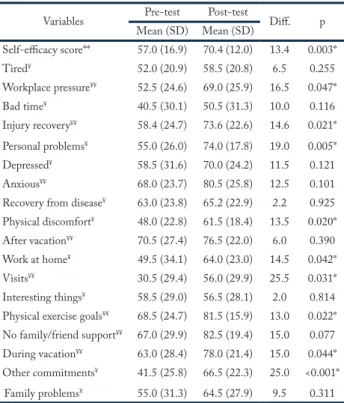
Changes in self-efficacy for physical activity after the VAMOS program are presented in Table 2.There was an increase in the mean of nine self-efficacy scale items for physical activity: “work” (p= 0.047), “injury recovery” (p= 0.021), “personal problems” (p= 0.005), “discomfort during physical exercise” (p= 0.020), “work at home” (p= 0.042), “when receiving visitors” (p= 0.031), “goal with physical exercise” (p= 0.022), “dur-ing vacation” (p= 0.044) and “commitments” (p<0.001). Furthermore, the overall perceived self-efficacy rose af-ter the VAMOS inaf-tervention (p= 0.003).
Table 2 – Self-efficacy score and items for the physical activity of the study participants before (pre-test) and after (post-test) the VAMOS program intervention (n= 20), Florianópolis, 2014.
Variables Pre-test Post-test Diff. p Mean (SD) Mean (SD) Self-efficacy score** 57.0 (16.9) 70.4 (12.0) 13.4 0.003* Tired¥ 52.0 (20.9) 58.5 (20.8) 6.5 0.255 Workplace pressure¥¥ 52.5 (24.6) 69.0 (25.9) 16.5 0.047* Bad time¥ 40.5 (30.1) 50.5 (31.3) 10.0 0.116 Injury recovery¥¥ 58.4 (24.7) 73.6 (22.6) 14.6 0.021* Personal problems¥ 55.0 (26.0) 74.0 (17.8) 19.0 0.005* Depressed¥ 58.5 (31.6) 70.0 (24.2) 11.5 0.121 Anxious¥¥ 68.0 (23.7) 80.5 (25.8) 12.5 0.101
Recovery from disease¥ 63.0 (23.8) 65.2 (22.9) 2.2 0.925
Physical discomfort¥ 48.0 (22.8) 61.5 (18.4) 13.5 0.020*
After vacation¥¥ 70.5 (27.4) 76.5 (22.0) 6.0 0.390
Work at home¥ 49.5 (34.1) 64.0 (23.0) 14.5 0.042*
Visits¥¥ 30.5 (29.4) 56.0 (29.9) 25.5 0.031*
Interesting things¥ 58.5 (29.0) 56.5 (28.1) 2.0 0.814
Physical exercise goals¥¥ 68.5 (24.7) 81.5 (15.9) 13.0 0.022*
No family/friend support¥¥ 67.0 (29.9) 82.5 (19.4) 15.0 0.077
During vacation¥¥ 63.0 (28.4) 78.0 (21.4) 15.0 0.044*
Other commitments¥ 41.5 (25.8) 66.5 (22.3) 25.0 <0.001*
Family problems¥ 55.0 (31.3) 64.5 (27.9) 9.5 0.311
Legend: ¥= Paired student’s t-test; ¥¥= Wilcoxon test; Diff= differ-ence; *p< 0.05
Discussion
The results indicated that the VAMOS program – Ac-tive Life Improving Health –contributed to the rise in perceived self-efficacy for physical activity. There was an increase in self-efficacy score for physical activity and in the items “work”, “injury recovery”, “personal problems”, “discomfort during physical exercise”, “housework”, “when receiving visitors”, “goals with physical exercise”, “during vacation” and “commitments”. Self-efficacy for physical activity is not a global trait, but a set of percep-tions that involve certain levels of confidence associated
with the domains of human behavior. A human being cannot perceive self-efficacy in all circumstances of phy-sical activity, since this would require controlling all the human domains1. The increase in self-efficacy levels for physical activity is important because this construct is the most strongly associated with active behavior5-7. As such, establishing intervention strategies, as was done here, may be important in a physical activity promotion program for adults and seniors.
The present study found an increase in perceived self-efficacy after the intervention. Significant increas-es were observed for nine of the 18 indicators on the self-efficacy scale for physical activity, indicating that the adults and seniors exhibited greater confidence in performing physical activities after the VAMOS inter-vention, when faced with everyday circumstances such as workplace pressure, injury recovery, personal prob-lems, discomfort during physical exercise, housework, when receiving visitors, physical exercise goals, during vacation and when fulfilling commitments.
Slight increases in perceived self-efficacy levels re-sulting from behavioral modification interventions have been considered relevant3,18,19, given that changes in the degree of self-efficacy for physical activity are associated with physical, metabolic and social benefits20-21caused by a rise in physical activity levels. The results of the present study corroborate an eight-month intervention in older adults, aged 57 to 79 years, conducted in the USA to enhance self-efficacy for physical activity in el-derly individuals with type 2 diabetes mellitus22.
An experimental study with breast cancer and prostate survivors17 demonstrated that the intervention group showed no change in self-efficacy for physical activity. This is important, since people seldom manage to maintain high levels of self-efficacy over time. This result may have been influenced by the small number of strategies used (information bulletins sent to par-ticipants with examples of lifestyle changes) and the prolonged length of time between meetings17.
In the present study, participants reported examples of a healthy lifestyle and these were explored by VA-MOS program activities, thereby influencing the sub-jects. This influence is considered a “mastery experience” which may have favored the increase in self-efficacy for physical activity between pre and post-intervention, since the participants managed to overcome certain dif-ficulties, especially those considered complex by others. The possibility of discussing their degree of confidence and comparing it with others is an important way for
individuals to reflect on their limitations, thereby in-creasing their confidence in performing an activity.
A study with a sample of 546 seniors of both sexes, average age of 68 years, presented the hypothesis that an increase in self-efficacy for physical activity is related to improved perception of quality of life. The authors found a positive relationship with enhanced quality of life, physical activity and self-efficacy based on elements that demonstrate the influence of “mastery experiences”23.
One of the explanations for the increase in the levels of self-efficacy for physical activity observed in this study may be related to the adequate use of daily experiences (“the vicarious experience”). According to Bandura13, vicarious experience is the influence of ex-amples and successful life models in terms of physical activity and health that ultimately
influence other people to feel confident about per-forming physical activity. In the VAMOS program, life experiences, models and successful behavioral chang-es that serve as motivation for participants are often used. Vicarious experiences are used in all the VAMOS meetings and were explored by the program multipli-er. A meta-analysis study found that interventions that used vicarious experiences produced significantly higher levels of self-efficacy for physical activity than those that did not10.
These results may be associated with the contents of booklets used in the VAMOS intervention. Dai-ly and weekDai-ly obstacles and how to overcome these challenges are discussed at three meetings, as well as proposing simple solutions and objectives in order to increase self-efficacy for physical activity24. Analysis of the field diary identified another strategy often used by the VAMOS program multiplier. At the start of each meeting he asked for feedback on measures proposed in the previous session and what participants had done towards achieving the suggested goals, challenges, tasks and activities. At this time, participant discourses relat-ing their attempts at physical activity were recorded.
Among the strategies to enhance self-efficacy, the pedometer given to the subjects at the sixth VAMOS meeting became a motivating factor for achieving a higher number of steps every day. Participants report-ed on its use and the number of steps reachreport-ed up to the last meeting. One study25corroborated the fact that us-ing a pedometer durus-ing a behavioral modification pro-gram motivates participants to increase their physical activity levels. Using this device may have contributed significantly to the increase in perceived self-efficacy
for physical activity, since it enabled individuals to as-sess their behavior and reflect on the obstacles faced.
Other VAMOS factors may be related to the rise in self-efficacy levels of the present study, such as par-ticipant attendance, booklets, flexible meeting times, a pleasant environment, adequate training, and a sound theoretical approach. These factors may have contrib-uted to the possible changes in behavior obtained as a result of improvements in the self-efficacy for phys-ical activity demonstrated by VAMOS participants, who are also users of basic health units (BHUs). The findings are made more convincing by the participants’ field diary, which contained their observations on the VAMOS intervention.
The results of the study reinforce the importance of creating strategies that focus on the elements of the main outcome, namely physical activity, especially in real contexts such as the National Health System (SUS). These strategies are also important for physical education professionals involved in this scenario, in or-der to promote higher self-efficacy for physical activity, thereby guaranteeing greater adherence and effective-ness of their programs.
The main limitations of the present study are: lack of subject randomization into a control and intervention group, due to small recruiting area; the poor attendance of one of the groups; the fact that the program recruited BHU users that used the services in the previous six months, but not those who did not visit the BHU and may have lower self-efficacy; and the use of a conveni-ence sample may have attracted more motivated people to take part in the program, thereby exhibiting increased self-efficacy. The strengths of the study are the use of scales validated for the study population; use of an in-tervention in the real context of the National Health Service; the creation of strategies and their application based on referential theory, which may ensure that in-tervention strategies exhibit greater internal validity.
The VAMOS program increased perceived self-ef-ficacy for physical activity among adults and seniors, demonstrating the importance of behavioral modifica-tion programs for an active lifestyle. These programs can be applied to basic care as a physical activity promotion strategy in adults and seniors. The program obtained positive self-efficacy results, indicating its effectiveness.
Funding
To the Lemann Institute for the funding provided for collabora-tive research between Brazil (Federal University of Santa
Catari-na) and the (University of Illinois at Urbana-Champaign). To the Coordination for the Improvement of Higher Education Person-nel (CAPES), for the Masters scholarship. To the National Cou-ncil for Scientific and Technological Development for funding (CNPq. Universal Edict 14/2012, process no. 475.075/2012) and the Foundation for Research and Innovation Support of Santa Catarina state (FAPESC), and Research Program for SUS (PP-SUS) process number 2014TR2263.
Conflicts of interest
The authors declared no conflict of interest.
Authors’ contributions
Antunes GA and Tonosaki LMD helped in field work and wri-ting the article. Menezes EC helped in data analysis and inter-pretation and writing the article. Rech CR and Mazo GZ acted as advisors and revised the content. Benedetti TRB created the VAMOS program and revised the content.
Acknowledgements
We would like to thank the UDESC Sciences of Human Move-ment Graduate Program and the UFSC Physical Education Gra-duate Program for the opportunity to conduct studies and colla-borate with the professors of both institutions. We also thank the UDESC/CEFID Physical Activity and Aging Laboratory and the UFSC/CDS Center for Research in Physical Activity and Health. We are grateful to the Lemann Institute for their help in financing the VAMOS program and for the PPSUS research grant which enabled the program to be established. We thank the Florianópolis municipal government, all the professionals invol-ved in the research, as well as the study participants: users of the Basic Health Units. Finally, a special thank you to our essential partners, professors Giovana Mazo (UDESC), Tânia Benedetti and Cassiano Rech (UFSC).
References
1. Glanz K, Rimer BK, Viswanath K. Health behavior and health education: Theory, research, and practice. Jossey-Bass, 2008.
2. Napolitano MA, Papandonatos GD, Lewis BA, Whiteley JA, Williams DM, King AC, et al. Mediators of physical activity behavior change: a multivariate approach. Health Psychol. 2008; 27(4):409-18.
3. Openacker J, Bourdeaudhuijb ID, Auweelea YV, Boena F. Psychosocial mediators of a lifestyle physical activity intervention in women. Psychol Sport Exerc. 2009;30(10):595-601.
4. Pekmezi D, Dunsiger S, Gans K, Bock B, Gaskins R, Marquez B, et al. Rationale, design, and baseline findings from Seamos Saludables: a randomized controlled trial testing the efficacy of a culturally and linguistically adapted, computer - tailored physical activity intervention for Latinas. Contemp. Clin. Trials. 2012;33(6):1261-71.
5. Phillips SM, McAuley E. Social cognitive influences on physical activity participation in long-term breast cancer survivors. Psychooncol. 2013;22(4):783-91.
6. Wilcox S, Dowda M, Griffin SF, Rheaume C, Ory MG, Leviton L, et al. Results of the first year of active for life: translation of evidence-based physical activity programs for older adults into community settings. Am J Public Health. 2006;96(7):1201-9.
7. Brawley LR, Rejeski WJ, Lutes LA. Group mediated cognitive–behavior al intervention for increasing adherence to physical activity in older adults. J Appl Biobehav Res. 2010;56(2):47-65.
8. McAuley E, Jerome GJ, Elavsky S, Marquez DX, Ramsey SN. Predicting long-term maintenance of physical activity in older adults. Prev Med. 2003;3(7):110-8.
9. Cress ME, Buchner DM, Prochaska T, Rimmer J, Brown M, Macera C, et al. Best practices for physical activity programs and behavior counseling in older adult populations. J Aging Phys Act. 2005;13(1):61-74.
10. Klavestrand J, Vingård E. The relationship between physical activity and health-related quality of life: a systematic review of current evidence. Scand J Med Sci Sports. 2009;19(3): 300-12.
11. Brasil, Ministério da Saúde, Secretaria-Executiva. Mais saúde: direito de todos: 2008-2011. 3ª ed. Brasília: Ministério da Saúde; 2010.
12. Benedetti TRB, Schwingel A, Gomez LSR, Chodzko-Zajko W. Programa “VAMOS” (Vida Ativa Melhorando a Saúde): da concepção aos primeiros resultados. Rev. Bras. Cineantropom. 2012;14(6):723-37.
13. Bandura A. Self-efficacy beliefs of adolescents in: guide for constructing self-efficacy. Stanfor, EUA: Artmed, 2006.
14. Thomas JR, Nelson JK, Silverman JS. Métodos de pesquisa em atividade física e saúde. 5ª ed. São Paulo: Artmed; 2006. p. 19-50.
15. Sousa VD, Driessnack M, Mendes IA. An overview of research designs relevant to nursing: Part 1: quantitative research designs. Rev. Latino-Am. Enfermagem. 2007;15(3):502-7.
16. Boff RM. Evidências psicométricas das escalas de autoeficácia para regular hábito alimentar e autoeficácia para regular exercício físico [dissertação de mestrado]. Porto Alegre: Pontifícia Universidade Católica do Rio Grande do Sul; 2012.
17. Mosher CE, Lipkus I, Sloane R, Snyder DC, Lobach DF, Demark-Wahnefried W. Long-term Outcomes of the FRESH START Trial: Exploring the Role of Self-efficacy in Cancer Survivors Maintenance of Dietary Practices and Physical Activity. Psychooncol. 2013;22(4): 876-85.
18. Matsuo T, Murotake Y, Kim MJ, Akiba T, Shimojo N, Kim MK, et al. High general self-efficacy is associated with less weight loss under a supervised dietary modification program. Obes Res Clin Pract. 2010;4(2):e83-e162.
19. Lewis BA, Marcus BH, Pate RR, Dunn AL. Psychosocial mediators of physical activity behavior among adults and children. Am J Prev Med. 2002;23(2):26-35.
20. Murphy PJ, Williams RL. Weight-Loss Study in African-American Women: Lessons Learned from Project Take HEED and Future, Technologically Enhanced Directions. Perm. J. 2013;17(2):55-9.
21. Stewart A, Gillis D, Grossman M, Castrillo M, Pruitt L, McLellan B, et al. Diffusing a research-based physical activity promotion program for seniors into diverse communities: CHAMPS III. Prev Chronic Dis. 2006;3(2):A51.
Quote this article as:
Antunes GA, Tonosaki LMD, Menezes EC, Rech CR, Benedetti TRB, Mazo, GZ. Effect of participation in a behavior modification program on perceived self-efficacy for physical activity. Rev Bras Ati Fis Saúde. 2017;22(6):546-53. DOI: 10.12820/rbafs.v.22n6p546-53.
22. Olson EA, McCauley E. Impact of a brief intervention on self-regulation, self-efficacy and physical activity in older adults with type 2 diabetes. J Behav Med. 2015;38(6):886-98.
23. Mudrak J, Stochl J, Slepicka P, Elavsky S. Physical activity, self-efficacy, and quality of life in older Czech adults. Eur J Ageing. 2015;13(1):5-14.
24. Benedetti TRB, Gomez LSR, Lopes ACS, Chodzko-Zajko W, Schwingel AC. Coleção: vamos vida ativa melhorando a saúde: volumes 1, 2, 3, 4, 5, 6, 7, 8, 9, 10, 11 – introdução. Florianópolis: UFSC, 2014.
25. Borges LJ, Guidarini FCS, Gerage AM, Scherer FC, Meurer ST, Borges RAB, et al. Pedometers: strategy to promote physical activity in elderly. Rev Bras Geriatr Gerontol. 2014; 17(1):211-13.
Recebido: 20/12/2016 Aprovado: 22/12/2017