191
FACTORS ASSOCIATED WITH PHYSICAL ACTIVITY
INLEISURE FAIL BETWEEN ELDERLY
Saulo Vasconcelos Rocha1
Maura Maria Guimarães de Almeida2
Tânia Maria de Araújo2
Loiamara Barreto Santos1
Wisla Keile Medeiros Rodrigues1
1. Universidade Estadual do Sudoeste da Bahia (UESB), Brasil.
2. Universidade Estadual de Feira de Santana (UEFS) – Feira de Santana, BA, Brasil.
Mailing address:
Universidade Estadual do Sudoeste da Bahia- UESB - Departamento de Saúde - Núcleo de Estudos em Saúde da População. Avenida José Moreira Sobrinho S/N, Jequiezinho - 45200-000 - Jequié, BA, Brasil E-mail: [email protected]
ABSTRACT
Introduction: The structural and functional alterations seen in aging, associated with a seden-tary lifestyle, accelarate the decline of functional ability. Objective: The purpose of this study was to analyze the factors associated with insufficient physical activity during leisure time among older adults. Method: Cross sectional sample consisting of 562 individuals living in the city of Feira de Santana, 69.6% female and 30.4% male with a mean age of 68.93 ± 7.05 years. We used a question-naire containing sociodemographic information, such diseases and participation in physical activity during leisure time. Participation in leisure physical activity was assessed by self-perception of the type and intensity of activity (mild moderate or heavy). For statistical analysis we used logistic regression, calculating the prevalence ratios, confidence intervals (95%) and significance level p ≤ 0.05. Results: Among the subjects studied, only 18.3% were classified as active during leisure time. The investiga-ted population has a high frequency of individuals inactive during leisure time, especially among low-income people and those with older ages. Conclusion: These findings encourage discussion of the need to implement public health policies and the creation of spaces for the practice of leisure activities for the elderly in the NHS.
Keywords: motor activity physical activity, cross-sectional studies, aging, elderly.
INTRODUCTION
Aging is a complex process which involves a series of factors which interact among each other and influence the way which we reach a certain age1. In Brazil, the growth of the older population
is a current and consolidated event which demands immediate facing and prevention strategies providing hence active, healthy and independent aging2.
The structural and functional alterations observed in aging, aassociated with sedentarism, accelerate the decline of functional capacity, facilitating both development of chronic-degenerative diseases, physical incapacity, colon, lung and prostate cancer, as well as cardiovascular diseases3. Therefore, the need to understand
which factors contribute to the process and in the adoption of healthier behavior is evident4. When studying these factors in the
elderly population, it is necessary to determine the amplitude and mechanisms in which physical activity may improve health, func-tional capacity, quality of life and independence in this population.
Sedentarism or insufficient leisure physical activity is associa-ted with blood hypertension and diabetes5,6, with increase in the
number of hospitalizations7. It is more prevalent in women8,
el-derly1and individuals with low educational level5. Increase in the
level of physical activity may cause positive effects among indivi-duals at advanced ages, among which, improvement in muscular strength and resistance; increase of the aerobic capacity; greater articular flexibility; better balance and coordination; greater psycho-logical wellness; weight loss and better administration of chronic diseases or defficiencies9. These potential benefits may result in
better functional capacity, kept or increased, favoring hence the reversion of the fragility condition10, as well as decrease the risk of
early mortality in those individuals with good physical fitness and with high energy expenditure. Despite all the mentioned benefits, studies about physical activity among the elderly residents in the northeastern part of Brazil are still scarce.The knowledge about the active leisure behavior and its determinants will possible ground the managing of activities which promote leisure physical activities practice among the elderly, producing hence useful information for the design of physical activity programs aimed at this population. Based on this scenario, the aim of this investigation was to analyze the frequency and the factors associated with insufficient leisure physical activity among the elderly residents in urban areas of a county in the northeast of Brazil.
METHODS
The data of this study were obtained from the home in-quiry of Characterization of Mental Health of the Feira de Santanacounty,Bahia, conducted by the Epidemiology Center from the State University of Feira de Santana, in 2007. It is a transversal study involving a representative sample of the population with 15 or more years of residency in urban areas, according to definition from IBGE (urban area means the internal area to the urban perimeter of a city or village, defined by municipal law) of the Feira de Santana county. The sample was randomly selected. In this questionnaire, 3,597 individuals were interviewed.
Feira de Santana is situated 116 km from Salvador, the capital of Bahia state. It is the second biggest city in the state, being the ORIGINAL ARTICLE EXERCISE AND SPORTS
192
31st Brazilian county, the 13th non-capital county most populated in
the country. In 2007, its total population was 571,997 inhabitants, being 41.466 60 years old or older than that.
Sample size was calculated using the prevalence of com-mon mental disorders estimation of 24%11, sample error of 3%,
with 95% of confidence. After the separameters were conside-red, a sample of 800 individuals was established. Considering the effect of the study outlining (by conglomerate sampling) and the refusals and losses around 20%, the sample size was defined at 1,920 individuals.
This study used a population cohort analyzing only the data of the population aged 60 years or older (elderly). This study included 562 individuals of both sexes (15.6% of the par-ticipants of the applied questionnaire) age ≥ 60 years, age limit recommended by the WHO for countries in development for the definition of elderly. The data were collected through a form. The instrument had sociodemographic information (sex, age, marital status, education and income), information on self-referred dis-eases (diabetes, hypertension, high cholesterol, obesity, cancer, cardiopathy) and participation and time dedicated to leisure activities and leisure physical activity practice.
In order to evaluate sufficient leisure physical activity prac-tice, the individuals were asked if they regularly participated in leisure physical activities, being these classified by the in-tensities according to the metabolic equivalents (MET ): light (< 3 METs), moderate (3-6 METs) and heavy (>6 METs)12.Those
who practiced physical activity during leisurewith moderate or heavy intensity for more than 150 minutes/weekwere con-sidered active during leisure and those who did not meet the classification were inactive. The procedure adopted was similar to the one in other studies found in the literature13-15.
Initially, descriptive analysis was performed considering sociodemographic variables and presence of chronic diseases, with the aim to present the profile of the studied population. The frequency of the sufficient leisure physical activity was estimated and stratified according to the sociodemographic variables (sex, age, income, educational status and marital status) and presence of chronic diseases (diabetes, hyperten-sion, high cholesterol, obesity and cardiopathy).
Prevalence ratios and their respective confidence intervals at 95% were calculated.Statistical significance was measured through the Pearson chi-square test, adopting α=5%. Multi-variate logistic regression analysis (MLRA), with exploratory aim was applied for simultaneous evaluation of the factors included in the study.
The MLRA was carried out according the procedures rec-ommended by Hosmer & Lemeshow14 including the following
steps: 1) verification of the assumptions; 2) pre-selection of basic variables; 3) pre-selection of interaction terms; 4) evaluation of confusion. The magnitude of the estimated variation coef-ficients and of the respective ORs of the main exposure vari-able (leisure physical activity) was verified for analysis of the potentially confusing variables.The variable was considered confusing when the coefficient of main exposure presented
variation above 10%; 5) Analysis of logistic regression itself. The logistic regression adopted backward procedure for the selection of the best model. The variables which were associ-ated with the response, that is to say, the ones which pre-sented (p≤0.25), remained in the model.The effect alteration was assessed by similarity ratio test, adopting significance level of 20%. The complete model included the sociodemo-graphic variables age and income.
Since the MLRA has been developed for use in case-control studies, producing OR measurements and not PR, the OR estimates use obtained in the MLRA has not been recommended for study of high-frequency effects, since in these cases the OR overestimates the considered effect. As the estimated leisure physical activity frequency was higher than 25%, it was necessary to calculate the PR estimates. Based on the parameters of the final model, the prevalence ratios and respective confidence intervals were estimated us-ing the Delta Method, a program specifically developed for this purpose15.
Databank was designed with the software Epidata, version 3.1b. Analysis used the statistical packages SPSS (version 9.0) and R, version 2.7.2.
This research followed the ethical principles present in the Declaration of Helsinki and the Resolution196/96 from the National Health Board. The research protocols were evaluated and approved by the Human Research Ethics Committee of the State University of Feira de Santana (legal opinion # 042/06).
RESULTS
The characteristics of the sample are found in table 1. Higher percentage of women is observed (69.6%). There was prevalence of individuals in the age group between 60 and 79 years (91.3%) and the group of individuals who have a partner (50.2%). Concerning income and education, 81.7% made up to one minimum wage and 85.4% had finished elementary school.
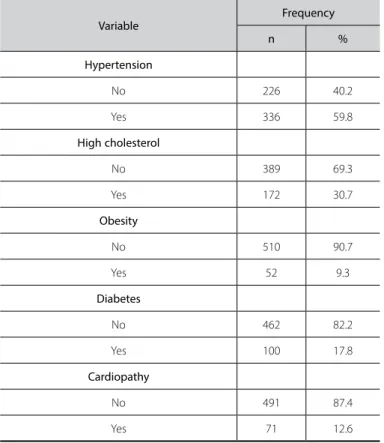
Prevalence of chronic diseases was of 59.8% (table 2). Among the self-reported clinical conditions, the highest prevalence was observed for hypertension (59.8%) and high cholesterol(30.7%). The lowestprevalencewasfor obesity (9.3%).
The frequency of leisure physical activity participation was low: only 18.3% were classified as active during leisure. Therefore, 81.7% of the studied population was classified as insufficiently active dur-ing leisure activities.
The data of table 3 describe the association between leisure physical activities and sociodemographic characteristics.The fre-quency of leisure physical activity practice was higher among male individuals, from younger age groups, with income above one minimum wage, with higher educational levels, among those who do not have a partner, and who have reported chronic disease.
193
Table 1. Distribution of the residents in urban areas according to sociodemographic characteristics.
Variable
Frequency
n %
Sex
Female 391 69.6
Male 171 30.4
Age
60-79 513 91.3
80 years 49 8.7
Marital status
With partner 280 49.8
With no partner 282 50.2
Education
Never went to school/can read and write 157 28.0
Elementay school 322 57.4
High school/College 82 14.6
Income
1 or less than 1 MW 459 81.7
More than1MW 103 18.3
Presence of chronic disease
No 226 40.2
Yes 336 59.8
Feira de Santana. BA. 2007.
Table 2. Distribution of the residents in urban areas according to clinical conditions.
Variable
Frequency
n %
Hypertension
No 226 40.2
Yes 336 59.8
High cholesterol
No 389 69.3
Yes 172 30.7
Obesity
No 510 90.7
Yes 52 9.3
Diabetes
No 462 82.2
Yes 100 17.8
Cardiopathy
No 491 87.4
Yes 71 12.6
Feira de Santana. BA. 2007.
Table 3. Frequency of the physical activity practice in leisure according to sociode-mographic characteristics and clinical conditions.
Variable Prevalence % PR CI (95%) P value Sex
*Male 22.8 - - 0.076
Female 16.4 0.71 0.50-1.02
Age
60-79 19.7 - - 0.006
80 and older 4.1 4.82 1.22-18.9
Income
> 1 minimum wage
per month 31.1 - - 0.001
≤ 1 minimum wage per
month 15.5 0.49 0.34-0.71
Education
Elementary school I/
Elementary school II 18.6 - - 0.067
High school/College 28.0 0.66 0.43-1.00
Never went to school/
Can read and write 12.1 1.54 0.95-2.48
Marital status
*with partner 20.7 - - 0.157
With no partner 16.0 1.29 0.91-1.84
Presence of chronic disease
No 19.9 - - 0.438
Yes 17.3 1.15 0.81-1.63
No 17,3 1.15 0.81-1.63
Feira de Santana, BA, 2007.
Table 4. Prevalence ratios adjusted with their respective confidence intervals(95%) between studied characteristics and leisure physical activity obtained in the analysis of multiple logistic regression.
Variable PR CI (95%)
Age
60-79* 1.00
80 orolder 4.88 1.14 - 20.86
Income
≤ 1minimum wage per month 1.00
More than 1 minimum wage per month* 0.38 0.23 - 0.63
194
DISCUSSION
Urban growth had decrease of spaces available for physical and leisure activities practice as a consequence.Such fact, joined with social problems such as urban violence, long work hours and tech-nological easier access, favor the adoption of sedentary habits.
Taking into consideration this reality, the present study had the aim to analyze the frequency and factors associeted with insufficient leisure physical activity among elderly subjects resi-dent in urban areas of one county in the northeast of Brazil.
It was observed in the studied population that the par-ticipation of elderly residents of urban areas in leisure physical activities was low: only 18.3%, that is, more than 80% of the elderly presented insufficient levels of leisure physical activity. The findings in this research evidence data of high concern, since regular practice of physical activity is a protective behavior for the development of obesity, cardiovascular diseases, type II diabetes, colon cancer16and hypertension17, besides contributing
to the improvement of wellness sensation18.
The practice of physical activities favors social interaction, improves self-assuredness (belief of the individual in his/her ca-pacity to perform specific tasks) and provides higher sensation of control over the events and demands of the environment. Moreover, increase in the physical activity level is related to improvement in the depression and anxiety symptoms, bet-ter tolerance to stress and increase in self-esteem19,20, reducing
isolation and favoring socialization of new groups21.
In a study with elderly from Florianópolis22, SC, findings
dif-ferent from the ones found in the present study were observed, since most part of the elderly was considered non-sedentary (59.3%), being the domain leisure the one which contributed the most to the active condition of the male sex and the domain domestic activities to the female sex; another study carried out in the city of Pelotas20 with male individuals from 40 years old
cor-roborates the data of this research, with 82.9% of the individuals being classified as insufficiently active in leisure.
The regional characteristics concerning the access to physical activity practice and leisure activities may be important elements to explain the differences.
After the multivariate analysis, the age group and income variables kept statistically significant association with insufficient physical activity.
Evidence in the literature highlight that younger subjects, single, with lower number of children, with more years of ed-ucation, higher income and white, presented higher physical activity level23-25.
Insufficient spaces and available leisure activities in public spaces, joined with barriers such as: available time, need to com-pensate for low income of retirement, institutionalization and functional losses consequent of the aging process are aspects which may influence on the decrease of physical activity practice in the free time along the years.
In a study conducted in the city of Salvador, BA26,
preva-lence of sedentarism in leisure of 72% was identified; being it
more frequent in women aged between 40-59 years and men older than 60 years, in individuals with low educational level and among the married and separated, corroborating hence the findings of the present study. The life conditions and life style are crucial to determine existence conditions which characterize one population27.
Possible contributions to the increase of the physical activity level of the population are the construction of leisure equipment (courts, walking tracks, soccer fields, swimming pools) and the designing of education and health programs aimed at changes in behavior and encouragement of adoption of public active life styles, such as inclusion of physical activities among the activi-ties developed in the primary health care, through the Family Health Strategy.
Based on our findings here, prevention actions can be grounded on interventions which are able to lead to higher so-cial integration with performance of active leisure activities and on public policies of better income distribution.
The results obtained represent useful information for health management, being rawmaterial for public policies of health intervention.
Among the limitations of the study, we can mention the outlining of the research itself. The fact of being a transversal study hampers the evaluation of direct cause relations among the studied variables. The sample plan was not designed for specific study of the elderly population (includes one population sample aged 15 years or older); therefore, some important aspects for this specific population group may have not been considered since it was not a sample selected to represent the elderly population of the county.
Moreover, life expectancy bias may have occurred, since it is a relevant aspect in studies with older individuals. Despite these limitations, the study assessed an expressive number of individu-als (N= 562), including elderly residents of all the subdistricts of the studied county, which made is possible to estimate the fre-quency of leisure physical activities participation in this county and its relation with other variables.
CONCLUSION
Thus, the study was able to provide useful and valid infor-mation which may contribute to the policies on health atten-tion and guarantee of quality of life in different phases of life and to guide intervention measures aimed at this population group which is experiencing continuous growth in the Brazi-lian population.
ACKNOWLEDGEMENTS
The Fapesb-CNPQ scholarship for the researcher in the Interins-titutional Doctorate Program –Federal University of Santa Catarina--State University of Santa Cruz.
195
REFERENCES
1. Siqueira FV, Facchini LA, Piccini RX, Tomasi E, Thumé E, Silveira DS, et al. Atividade física em adultos e idosos residentes em áreas de abrangência de unidades básicas de saúde de municípios das regiões Sul e Nordeste do Brasil. Cad Saúde Pública 2008;24:39-54.
2. Mazo Gz, Cardoso AS, Dias RG, Balbé GP, Virtuoso JF. Do diagnóstico à ação: grupo de estudos da terceira idade: alternativa para a promoção do envelhecimento ativo. Rev Bras Ativ Fís Saúde 2009;14:65-70. (falta numeração das páginas)
3. Bicalho PG, Hallal PC, Gazzinelli A, Knuth AG, Velásquez-Meléndez G. Atividade física e fatores associados em adultos de área rural em Minas Gerais, Brasil. Rev Saúde Pública 2010;44:884-93.
Petroski EL, Pelegrini A, Glaner MF. Insatisfação corporal em adolescentes rurais e urbanos. Revista Motricidade 2009;5:13-25.
4. Pitanga FJGL, Almeida AB, Freitas MM, Pitanga CPS, Beck CC. Padrões de atividade física em diferentes domínios e ausência de diabetes em adultos. Revista Motricidade FTCD / CIDESD 2010;6:5-17.
5. Pitanga FJG, Lessa I. Prevalência e fatores associados ao sedentarismo no lazer em adultos. Cad Saúde Pública 2005;21:870-7.
6. Pitanga FJG, Lessa I. Associação entre inatividade física no tempo livre e internações hospitalares em adultos na cidade de Salvador –Brasil. Rev Bras Cineantropom Desempenho Hum 2008;10:347-53.
7. zancheta L, Barros MBA, César CLG, Carandina L, Goldbaum M. Inatividade física e fatores associados em adultos, São Paulo, Brasil. Rev Bras Epidemiol 2010;13:387-99.
8. ACSM. American College of Sports Medicine: Position stand on exercise and physical activity for olders adults. Medicine Science Sports Exercise 2010;30:992-1008
9. Santana MS, Chaves EMM. Atividade Física e Bem-Estar na Velhice. Rev Salud Pública 2009;11:225-36.
10. OMS. Organização Mundial de Saúde. Bulletin of the World Health Organization 2001;79:161-70.
11. Lwanga SK, Lemeshow R. Sample size determination in health studies a practical manual. Geneva: WHO; 1991.
12. Ademoli NA, Azevedo MR. Padrões de atividade física de pessoas com transtornos mentais e de comportamento. Ciên Saúde Colet 2009;14:243-51.
13. Hosmer JR, Lemeshow S. Appled Logistic Regression. John Wiley & Sons: New York: John Wiley & Sons; 1989.
14. Oliveira NF, Santana VS, Lopes AA. Razões de proporções e uso do método Delta para intervalos de confiança em regressão logística. Rev Saude Publica 1997;31:90-9.
15. Guthold R. Worldwide Variability in Physical Inactivity A 51-Country Survey. Am J Prev Med 2008;34: 486-94.
16. Barroso WKS, Jardim PCBV, Vitorino PV, Bittencourt A, Miquetichuc F. Influência da atividade física programada na pressão arterial de idosos hipertensos sob tratamento não farmacológico. Rev Assoc Med Bras 2008;54:328-33.
17. Reijneveld S, Westhoff M, Hopman-Rock M. Promotion of health and physical activity improves the mental health of elderly immigrants: results of a group randomized controlled trial amog Turkish immigrants in the Netherlands aged 45 and over. J Epidemiol Community Health 2003;57:405-11.
18. Guerra RO. Atividade física e o idoso: Pontos e Contrapontos. Coleção Mata da Casa. Cultura e Contem-poraneidade na educação física e no desporto. E agora?. São Luiz (MA): Ed. especial; 2002.
19. Correa LQ, Rombaldi AJ, Silva MC. Atividade física e sintomas do envelhecimento masculino em uma população do sul do Brasil. Rev Bras Med Esporte 2011;17:228-31.
20. Franklin B, Bonzheim K, Warren J, Haapaniemi S, Byl N, Gordon N. Effects of a contemporary, exercise--based rehabilitation and cardiovascular risk-reduction programo n coronary patients with abnormal baseline risk factors. Chest 2002;122:338-43.
21. Benedetti TRB, Borges LJ, Petroski EL, Gonçalves LHT. Atividade física e estado de saúde mental de idosos. Rev Saúde Pública 2008;42:302-7.
22. Masson CR, Dias da Costa JS, Olinto MTA, Meneghel S, Costa CC, Bairros F. Prevalência de sedentaris-mo em mulheres adultas da cidade de São Leopoldo, Rio Grande do Sul, Brasil. Cad Saúde Pública 2005;21:1685-94.
23. Camões M, Lopes C. Fatores associados à atividade física na população portuguesa. Rev Saúde Pública 2008;42:208-16.
24. Cunha IC, Peixoto MRG, Jardim PCB, Alexandre VP. Fatores associados à prática de atividade física na população adulta de Goiânia: monitoramento por meio de entrevistas telefônicas. Rev Bras Epidemiol 2008;11:495-504.
25. Pitanga FJG, Lessa I. Prevalência e fatores associados ao sedentarismo no lazer em adultos. Cad Saúde Pública 2005;21:870-7.