THE MODERATING EFFECTS OF CULTURE ON THE
RELATIONSHIP OF TRANSFORMATIONAL LEADERSHIP AND
AFFECTIVE ORGANIZATIONAL COMMITMENT
Magdalena Grasser
Dissertation submitted as partial requirement for the conferral of Master in HR Management and Organizational Consultancy
Supervisor:
Elsa Maria Dias Dinis, ISCTE Business School, Invited Assistant Professor
Acknowledgements
First and foremost, I would like to express my very great appreciation to my supervisor, Elsa, for her invaluable advice, support and guidance. A very special thanks goes to Mercer and Mercer Sirota, and in particular Konrad Deiters and Peter Rutigliano, who provided me with
the data for this research. Furthermore, I am particularly grateful for the assistance given by Christian Margreitter, PhD.
Last but not least I would like to thank my family, in particular to my ever interested and encouraging parents Ruth and Otmar, and my friends who have always provided me with love
Abstract
Due to increasing global competition and demographic shifts, companies seek ways of attracting and cultivating relationships with valuable talent. Therefore, affective organizational commitment, as a predictor for long-term relationships with a company, experienced a renewed focus from practitioners and scholars alike. This thesis aims to add more insights to this area of interest by providing an investigation of the moderating effects of the cultural dimension masculinity/femininity on the relationship between transformational leadership and affective organizational commitment. For this, 915 questionnaires of an employee engagement survey of a Life-Sciences company, provided by Mercer Sirota, have first been split into two groups, based on their country of origin’s masculinity score. Then, they were analyzed using linear regression. Despite the limited explanatory power of the tested model, H0 was rejected. The small but existing differences between masculine and feminine cultures may result from divergent value expectations in masculine and feminine societies. The study, however, faced some severe limitations due to the nature of the data. Therefore, it is recommended for future researchers to replicate this study with primary data, focusing more on the individual’s values rather on country-level cultural values. For companies and managers, potential lies in reviewing their HR practices, specifically recruitment, selection and onboarding and train their employees in intercultural sensitivity.
Keywords: Transformational Leadership, Affective Organizational Commitment, Masculinity/Femininity, Cross-Cultural Management
Classification according to JEL Classification System:
M160 International Business Administration
Abstract (in Portuguese)
Devido à crescente competição a nível global e a alterações demográficas, as empresas procuram formas de atrair e formar relações com talento de alto valor acrescentado. O compromisso organizacional afetivo como preditor de relações a longo prazo com uma empresa tem sido alvo de um foco renovado de atenção quer por profissionais como por académicos. Esta tese procura trazer novos contributos para esta área de interesse ao fornecer uma investigação sobre os efeitos moderadores da masculinidade como dimensão cultural na relação entre liderança transformacional e compromisso organizacional afetivo. Para o efeito, 915 questionários de um inquérito sobre o envolvimento dos colaboradores na empresa Life-Sciences, providenciado pela Mercer Sirota, foram inicialmente divididos em dois grupos, com base no índice de masculinidade do seu país de origem. Consequentemente, estes foram analisados usando regressão linear. Ainda que a significância do modelo testado fosse limitada, H0 foi rejeitada. As diferenças, ainda que ligeiras, existentes entre culturas masculinas e femininas podem ser o resultado de expetativas a nível de valores divergentes em sociedades masculinas e femininas. No entanto, este estudo sofreu de várias limitações de alguma magnitude devido à natureza dos dados. Como tal, é recomendado que investigadores no futuro repliquem este estudo com dados primários, focando-se mais nos valores dos indivíduos do que em valores culturais a nível de país. Para empresas e gestores, será proveitoso rever as suas práticas de RH, nomeadamente recrutamento, seleção e integração, e formar os seus colaboradores em sensibilidade intercultural.
Keywords: Liderança Transformacional. Comprometimento Organizacional; Masculinidade/
Feminilidade, Gestao Cross-Cultural
Classification according to JEL Classification System:
M160 International Business Administration
Content
Introduction and Relevance of Topic ... 2
Theoretical Background ... 4 Definition of Commitment ... 4 Leadership ... 11 Culture ... 18 Methodology ... 28 Purpose ... 28 Instrument ... 28 Procedure ... 29
Data Preparation and Analysis ... 31
Results and Discussion ... 33
Limitations ... 39
Future Research Direction ... 41
Practical Implications ... 42
HR Practices – Recruitment and Selection ... 42
HR Practices – Onboarding and Socialization ... 42
Training for Employees and Leaders ... 43
Practical Advice for Team Leaders ... 44
Conclusion ... 46
Bibliography ... 47
Annex ... 56
Measures ... 57
1
Table of Figures and Tables
Figure 1: Meyer et al. (1991) ... 6
Figure 2: Cultural Value-as-a-moderator Model ... 26
Figure 3: Participants' Country of Origin ... 33
Figure 4: Age Distribution of Participants ... 34
Figure 5: Job Functions of the Participants ... 34
Table 1: Summary of Differences Related to Cultural Values (Power Distance) ... 21
Table 2: Summary of Differences Related to Cultural Values (Uncertainty Avoidance) ... 21
Table 3: Summary of Differences Related to Cultural Values (Individualism-Collectivism) . 22 Table 4: Summary of Differences Related to Cultural Values (Femininity-Masculinity) ... 22
Table 5: Summary of Differences Related to Cultural Values (Short/Long Term Orient.) . ... 23
Table 6: Summary of Differences Related to Cultural Values (Indulgence-Restraint) ... 23
Table 7: Model Summary of Feminine Countries ... 35
2
Introduction and Relevance of Topic
In an unpredictable world, staying competitive becomes increasingly difficult for organizations. Due to demographic shifts, continued globalization and increasing global competitions, companies are forced to explore innovative ways of attracting, and most importantly, retaining valuable talent. Researchers have chosen organizational commitment as an insightful predictor of stable and long-term relationships of employees and their companies (Korek et al., 2017). For practitioners, the topic is of equal relevance. This is reflected by the increased attention to the topic in renowned management magazines and publications. The Association for Talent Development (ATD), for example, published a bulletin from Pangarkar and Kirkwood (2013) with the title “Four Ways to Gain Employees Commitment” in which they commented that
“Employee engagement is the holy grail for every business leader. It’s described in a variety of ways but generally defined as when employees fully invest emotionally, mentally, and physically so they focus on achieving the organization’s objectives” (para. 1).
Furthermore, a Gallup study in 2014 found that only three out of ten employees felt engaged and committed to their organization (Sorenson, 2014). Additionally, the article titled “Engage Your Employees or Lose Billions” has been published in Forbes Magazine in which Alvino (2014) explains the relation between favorable work behaviors and organizational commitment. What is more, companies not only start to focus on commitment to increase their profitability, but also because they consider the focus on their employees’ well-being necessary. William Davies (2015) described in his “The Atlantic” article “All the Happy Workers” the societal need for emotionally committed and happy workers by stating “…this is the monistic philosophy of the 21st-century manager: Each worker can become better, in body, mind, and output” (para. 45).
Another important aspect is, that the fragmentation of the literature has been lamented by Human Resource Directors and Organizational Development scholars alike and calls for further research on the matter (Meyer et al., 2002).
This enforced focus on commitment by companies, combined with the development of HR practices targeting employee well-being and the fragmentation of the organizational commitment literature call for a review of the concept of commitment. Furthermore, increased
3
globalization calls for research into commitment in the context of multicultural business settings. To manage corporations of size, some members of these organizations are expected to show the way- leaders. These leaders face similar challenges all around the globe, one of these being the question on how to foster organizational commitment in multinational corporations. Thus, the aim of this paper is to provide future directions for business professionals and researchers alike on how to increase affective organizational commitment in multinational corporations, focusing on the employees’ perspective.
To achieve this, the work will provide a modern summary of commitment and leadership literature within the context of cross-cultural management and analyze the relation between these factors.
In the first chapter of this paper, the theoretical groundwork will be laid for the concepts of organizational commitment, transformational leadership and culture, which will allow the formulation of the hypothesis. The second chapter will describe the methodology used to investigate the stated hypothesis. In particular, the data gathering process is described, which was thankfully supported by Mercer Sirota. In the third chapter the results of the analysis will be presented and discussed. Furthermore, the limitations of this study as well as future research directions and practical implications will be postulated. Finally, the last chapter will summarize the insights that were gained throughout the paper.
4
Theoretical Background
In the following chapters, the main concepts investigated in this paper, namely commitment, transformational leadership and culture, will be defined and set into context with each other.
Conceptualization of Commitment
Although studied for decades, it is difficult to synthesize the diverse findings in the field of organizational commitment. Being a focus of several, diverse disciplines, e.g. psychology, sociology and management, organizational commitment remains a concept which is fragmented, incomplete and partly contradictive in its definition and measurements (Mercurio, 2015).
Broadly speaking, commitment describes the connection that an employee feels with their organization, the identification with the values and goals of the organization as well as the perceived employee-organization fit. At present, Herscovitch and Meyer’s (2002) definition of the concept seems to be the most widely accepted. According to Herscovitch and Meyer (2002) organizational commitment is a stabilizing force that gives direction to behavior. It is a mind-set that can take different forms and binds an individual to a course of action that is of relevance to a target. There is a clear distinction possible between exchange-based forms of motivation and commitment, which can even influence an employee’s behavior in the absence of extrinsic stimuli.
Concerning the conceptualization of commitment, Mowdays at al. (1982) work, lay the groundwork for further advancements in the highly fragmented field, by focusing on attitudinal and behavioral commitment, which is since established in the literature. Mowdays at al. (1982) offer the following definition of attitudinal commitment, which will be the relevant concept for this paper:
Attitudinal commitment focuses on the process by which people come to think about their relationship with the organization. In many ways it can be thought of as a mindset in which individuals consider the extent to which their own values and goals are congruent with those of the organization.
Meyer and Allen (1990) however theorized that attitudinal and behavioral commitment may influence each other rather than being two mutually exclusive perspectives. As a matter of fact,
5
Meyer and Allen (1991) suggested to not view these seemingly controversial theories as types of commitment but as components of the concept. Based on Meyer and Allen’s work, numerous researchers reviewed the existing theoretical frameworks and proposed multidimensional models that define commitment as nuanced, with coinciding bases and meanings that integrate the before mentioned theories and concepts (Jaros et al., 1993). Furthermore, Meyer and Allen (1991) established consensus in the scientific community as to that organizational commitment is a multifaceted construct (Meyer and Allen, 1990; Meyer and Allen, 1991). Confirmatory factor analyses have generally supported their hypothesis. (e.g., (Dunham, Grube, and Castañeda, 1994; Meyer, Allen, and Gellatly, 1990).
According to Meyer and Allen (1991), three major concepts can be distinguished:
Affective commitment: Affective commitment can be defined as the emotional
attachment to an organization as manifested by an individual’s identification with, and involvement in, that organization (Meyer and Allen, 1991).
Normative commitment: Through the internalization of values and norms by
the individual, a psychological state arises in which an obligation towards the organization can develop. It motivates the individual to reciprocate certain benefits and positive attributes to an organization. (Meyer and Allen, 1991).
Continuance commitment: In this form of commitment, the focus clearly lies
on a transactional point of view. This form of commitment arises if an individual is lacking reasonable alternatives to the current engagement with their organization. Furthermore, it can be a result of fear for losing the investment of cost and time into the organization (Meyer and Allen, 1991). Balfour and Wechsler (1996) theorized that this form of commitment could even stem directly from the “exchange” with the organization through rewards.
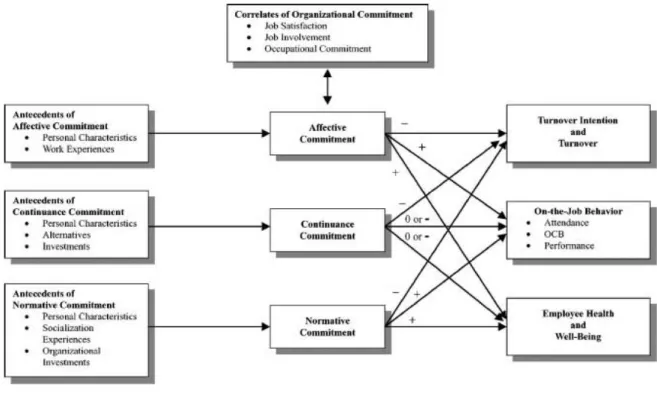
It is important to highlight that Meyer and Allen (1991) considered affective commitment (the desire to remain in the organization), continuance commitment (the need to remain in the organization), and normative commitment (the obligation to remain in the organization) as interrelated and emphasized the fact that they can occur simultaneously within an individual. In figure 1, Meyer and Allen’s work (1991) depicts the three concepts that make up organizational commitment, as well as potential antecedents and consequences.
6
Figure 1: Meyer et al. (1991)
Focus on Affective Commitment
In 2002, Meyer and Herscovitch consolidated the existing literature around the concept of organizational commitment and asked future researchers to define the essence of organizational commitment. In the following research, which is still far from conclusive, affective commitment was found to have the strongest correlation with relevant business variables. (Cooper-Hakim and Viswesvaran, 2005; Meyer et al., 2002). According to Solinger et al. (2008), affective commitment also correlated with a broader variety of favorable behavioral variables such as information sharing, support of co-workers and working additional hours. Mercurio (2015) wrote that "affective commitment was found to be an enduring, demonstrably indispensable, and central characteristic of organizational commitment". These findings lead to the conclusion that Reaffective commitment bears the potential to be the core of commitment and is of utmost importance to scholars and business professionals.
What Is Affective Organizational Commitment – Definition
Affective commitment is a term used to describe an employee’s emotional attachment towards an organization.
7 Sheldon (1971) defined affective commitment as an
“attitude or orientation toward an organization which links or attaches the identity of the person to the organization”.
For Buchanan (1974) commitment is a
“partisan, affective attachment to the goals and values, and to the organization for its own sake, apart from its purely instrumental worth” (p.533)
Mowday, Porter (1982) and their team theorized commitment to be
“the relative strength of an individual’s identification with and involvement in a particular organization.” (Mowday et al. 1979)
Jaros et al. (1993) defined affective commitment as
“the degree to which an individual is psychologically attached to an employing organization through feelings such as loyalty, affection, warmth, belongingness, fondness, pleasure, and so on” (p. 954).
Eventually, Meyer and Herscovitch (2002) concluded that affective commitment is the intrinsic motivation or involvement of individuals in a course of action “that develops from an identification, association, and attachment with the larger organization’s values and objectives.” They describe the defining mindset of affective commitment to be desire – individuals want to pursue goals of relevance for the organization, if they are strongly, affectively committed (Meyer and Herscovitch, 2002).
Meyer and Allen (1991) define job satisfaction, job involvement, and occupational commitment as correlates of organizational commitment, meaning that although the concepts are correlated and similar due to their “affective” nature, they are distinguishable from affective organizational commitment. Meyer et al. (2002), proposed that, although the correlations prove to be strong, they are not of sufficient magnitude to suggest construct redundancy.
Furthermore, organizational commitment is distinguishable from employee engagement, as engagement describes the perception regarding the work itself whereas in organizational commitment, the organization is considered as a whole Christian et al. (2011). According to Macey and Schneider (2008) organizational commitment could be a facet of engagement through the emotional attachment to the organization represented by affective commitment
8
results in willingness support to the organization, to identify with the organization and feel pride to be part of the company.
Antecedents of Affective Organizational Commitment
The question remains, which antecedents lead to organizational commitment. Meyer et al. (2002), grouped the primary antecedents in four groups: demographic variables, individual differences, work experiences, and alternatives/investments.
On an individual level, demographic variables such as age, gender, education and tenure show an overall low correlation. Herscovitch and Meyer (2002) proposed that any situational or personal variable which contributes to the individual becoming more involved in a course of action, the identification with the organization and the derived association with a company enforces the likelihood of affective organizational commitment.
Furthermore, in terms of individual difference variables, while task self-efficacy had a low but positive correlation (ρ = .11), external locus of control had a negative correlation with affective commitment (ρ = −.29) (Meyer et al., 2002)
For work experience, organizational support, transformational leadership, role ambiguity, role conflict as well as aspects of justice were measured. They generally showed the strongest correlations with affective commitment, with transformational leadership showing a correlation of (ρ = .46) (Meyer et al., 2002).
In terms of alternatives/investment, only minor correlations with affective commitment have been found (Meyer et al., 2002).
In further studies, Bartlett (2001) found that employees’ perception of access and involvement in organizational practices seem to have a positive effect on an individual’s affective commitment. Moreover, Bartlett (2001) found perceived access to training to strongly correlate with commitment. Similarly, Vance (2006) proposed training and development to be crucial factors for the development of commitment as they foster employees’ efficacy and self-esteem.
Socialization, high-commitment HR practices and strong interpersonal relationships at the workplace also seem to positively correlate to the development of affective organizational commitment (Morrow, 2011).
9
Consequences of Affective Organizational Commitment
As aforementioned, affective commitment is the most vital component of commitment as it correlates the strongest with desired business outcomes.
The most obvious relation of variables is the impact of commitment on turnover intentions. Not only does affective commitment have a significant negative impact on turnover (Albrecht and Andreetta, 2011; Cooper-Hakim and Viswesvaran, 2005; Meyer et al., 2002), it is also the most correlative as a distinguished construct compared to normative and continuance commitment. (Solinger et al., 2008). This relation can already be observed at early engagement stages as, according to Porter et al. (1976), employees in the absence of a positive impression of the company in the first week of employment were more likely to leave the organization. On a similar note, affective commitment may lead to lower absenteeism rates, even though so far the correlations have been weaker than those of turnover intentions. (Mowday, Porter, and Steers, 2013; Solinger et al., 2008)
In his meta-analysis Solinger et al. (2008) supported previous findings (Cooper-Hakim and Viswesvaran, 2005; Meyer et al., 2002) that showed affective commitment, in comparison to continuance and normative commitment, to have a stronger predictive relationship with performance (affective = .16, normative = .06, continuance = −.07) and organizational citizenship behaviors (affective = .32, normative = .24, continuance = −.01).
In terms of out-of-role behavior, employees with a high level of commitment show increased levels of engagement and extra effort, beyond their role. (Cooper-Hakim and Viswesvaran, 2005; Meyer et al., 2002). Additionally, affective organizational commitment studies postulate a positive correlation, as well as a predictive relationship, with organizational citizenship behaviors (Meyer et al., 2002).
Previously, research on organizational commitment focused primarily on business related outcomes, relevant to the employer. However, an increasing number of researchers now focus on employee-centric outcomes such as stress, family-work conflict and health. Still, there is considerable disagreement on the effect of affective commitment on these variables. (Schmidt, 2007). Begley and Czajka (1993) argue that commitment may act as a buffer of work stressors on the employee’s well-being, which was later further investigated by Schmidt (2007), who confirmed that affective commitment may have a positive impact on work stress by decreasing feelings of emotional exhaustion and burnout. Reilly (1994) argues that the opposite might be
10
the case in that committed employees could experience more severe reactions to stress than non-committed employees.
In conclusion, commitment can be described as a mindset that binds an individual to a chosen course of action that is of relevance to a target, in this case an organization. The most relevant of the tree commitment dimensions is affective organizational commitment, the emotional attachment to an organization, as it correlates the most with desired business outcomes such as reduced turnover, higher performance, lower stress-levels for employees and Organizational Citizenship Behavior (OCB). Furthermore, affective commitment shows a strong relation with four primary antecedents, whereby transformational leadership, from the group of work experience antecedents, has the strongest correlation overall.
11
Conceptualization of Leadership
Transactional versus Transformational Leadership
Leaders no longer represent a collection of “traits” as the Universalist paradigm would suggest. Neither are they seen as executors of specific, situationally appropriate behavior as suggested by the Behavioral paradigm. The focus on charismatic and transformational leadership led to a new school of thought regarding leadership. Today, leaders embody change agents who apply a combination of various influence mechanisms to transform their followers into inspired, motivated and energized employees and teams (Day, 2014). According to Judge and Piccolo (2004), a search of keywords in scholarly materials 1990 to 2003 in the PsycINFO database revealed that there have been more studies on transformational and charismatic leadership than on all other popular theories of leadership combined.
The first to introduce the concepts of transactional and transformational leadership was Burns in 1978. He identified the difference between transactional and transformational leadership to be what followers and leaders offer one another, which has since been supported and refined by numerous researchers:
Transformational leaders go beyond short-term goals. They offer their employees a purpose and concentrate on higher order intrinsic needs (Kuhnert and Lewis, 1987). In transformational leadership, the creation of meaningful work and challenging tasks, the extension of the decision latitude, the enlarged job control, and empowerment are in focus (Avolio et al., 2004; Bass, 1990).
On the contrary, for transactional leadership, the exchange or the promise of rewards for good and threat for poor performance characterizes effective leadership (Bass, 1990).
However, Bass (1985) argued against Burns’ theory that transactional and transformational leadership represent opposite ends of a single continuum. He considered them as separate concepts and highlighted that the best leaders show both, transactional as well as transformational behavior. Furthermore, he elaborated that the two concepts might even augment each other (Bass and Avolio, 1993, p. 69), which so far has not been sufficiently tested. Bass (1998) formulated this augmentation effect as the degree to which “transformational leadership styles build on the transactional base in contributing to the extra effort and performance of followers” (p. 5). Howell and Avolio (1993) support this point of view, arguing
12
that transformational leadership is complementing transactional leadership. In general, transformational leadership is seen as moving beyond transactions in order to improve followers’ performance and satisfaction by influencing their needs and values (Bass, 1999). Therefore, in this paper, the focus will lie on transformational leadership.
Definition of Transformational Leadership
Over the years of research, there have been several possible definitions as to what transformational leadership is.
According to Bennis and Nanus (1986), transformational leaders have a clear vision of the future of their company, are social architects who mobilize their followers to identify with the group and the organization, create trust within their organization and are capable of creatively deploying themselves.
Kouzes and Posner (2012) characterized a transformational leader as someone who is capable of modeling the way, inspiring a shared vision, challenging the process, enabling others to act and encouraging the heart.
Additionally, Podsakoff, MacKenzie, Moorman and Fetter (1990) identified articulating a vision, providing an appropriate model, fostering acceptance of group goals, elevated expectations in performance, providing individual support and individual consideration to be the essence of transformational leadership.
According to Bass (1990a), transformational leaders elevate and broaden their employees’ interest in and acceptance of the organizational purpose and mission. They motivate individuals to look beyond their self-interest in favor of the benefit of the group.
Until today, the most widely spread and accepted conceptualization of transformational leadership is the one of Bass (1999). According to Bass (1999), transformational leadership behavior is characterized by four concepts: idealized influence, inspirational motivation, intellectual stimulation, and individualized consideration.
Intellectual Stimulation
According to Bass and Avolio (1997), to intellectually stimulate their employees, leaders motivate them to look at old problems in a new way by increasing the followers’ autonomy, competency and accountability. This assignment of a novel, challenging task forces the followers to find new approaches and appropriate strategies as well as to show effort. (Korek
13
et al., 2017). Through the delegation of important tasks, they force their followers to “stretch” to grow beyond their role and develop leadership potential themselves. (Bass and Riggio, 2006) Furthermore, Intellectual Stimulation also describes the extent to which a leader is risk taking, challenges assumptions and solicits creativity in their followers. (Judge and Piccolo, 2004) To enable their followers to be more innovative, leaders convey to their followers that they are empowered and trusted (Bass and Riggio, 2006).
Individual Consideration
Individualized consideration describes the degree to which a leader acknowledges and attends to the differences among their employee’s needs. They usually act as mentors or coaches to enhance the employee’s abilities, knowledge and enable them to grow and develop (Bass, 1990).
Furthermore, the leader provides support and guidance with the results of not only helping their employees thrive, but also improving their performance, potential and leadership capacity. (Judge and Piccolo, 2004)
Idealized Influence
Idealized influence represents the admirable behavior of a leader that causes followers to identify with the leader. The leader serves as a positive role model for followers and displays conviction, stands for their conviction and appeals to the follower’s emotions. (Bass, 1990; Judge and Piccolo, 2004)
With idealized influence comes great power and influence, as employees identify with and trust in the leader. Through setting high moral standards and establishing ethical codes of conduct, the leaders gain respect and trust from their followers. The leaders excite and inspire their followers by showing them a sense of purpose and persuades them to let go of self-interest in favor of collective goals. Furthermore, they convey the idea that the employees are capable of accomplishing great things with extra effort. (Bass, 1998; Bass and Riggio, 2006)
Inspirational Motivation
Inspirational motivation is the degree to which a leader can communicate an inspiring and appealing vision to their followers. These leaders articulate ambitious standards for performance and confidence about goal-attainment whilst actively highlighting the follower’s role in achieving these results. Inspirationally motivating leaders provide meaning for their tasks and encourage their employees to find innovative solutions to upcoming problems. (Judge
14
and Piccolo, 2004) Recent studies by Piccolo and Colquitt (2006) and Purvanova et al. (2006) support this rationale further.
Charismatic and Transformational Leadership
Combined, Individual Influence and Inspirational Motivation best represent the concept of a leader’s charisma. (Bass and Riggio, 2006). In fact, there seems to be “little real difference” (Conger and Kanungo, 1998, p. 15) between charismatic and transformational leadership. Charismatic leaders achieve transformational effects through the alignment of the follower’s self-concept. According to Shamir et al. (1993), they “increase the intrinsic value of effort and goals by linking them to valued aspects of the follower's self-concept, thus harnessing the motivational forces self-expression, self-consistency, self-esteem and self-worth". In his earlier work, Bass (1985) highlighted that, although being an integral aspect of transformational leadership, charisma was insufficient to “account for the transformational process”, it is important to emphasize, that the charisma dimensions clearly have the most influence of the four transformational dimensions and show the strongest correlation with the outcome variables (Conger and Kanungo, 1998, p. 15).
This correlation appears to be mediated through two psychological processes: personal identification and value internalization.
Firstly, followers perceive their transformational or charismatic leader to have extraordinary qualities, which they tend to idolize and emulate psychologically as well as behaviorally. (Conger, 1989) Psychologically, they often adopt the same ideals, morals and value systems as their leader. In terms of behavior, they tend to imitate desirable behaviors that they see their leader perform to earn the leader’s approval. (Shamir et al., 1993) According to Lindholm (1988), this identification with the leader results in a sense of empowerment and positive energy for the follower. This stems from the process of transference through which employees often try to compensate for imperfect value systems, unfulfilled desires or a fractured self-perception. The leader seems to represent a walking example of what the employee seems to lack or want. (Kets DeVries, 1988).
Secondly, transformational leaders tend to use ideological explanations and heroic, inspiring visions. By internalizing the inherent values, ideals and goals, the followers make them part of themselves and “come to view their work role as inseparably linked to their self-concept and self-worth" and "carry out the role because it is a part of their essential nature and destiny".
15
(Yukl, 2006) On an operational level, this means that the followers perceive the assigned task as their own (Day, 2014).
The question remains, why and how certain leaders are perceived as charismatic. Bono and Judge (2003) judge investigated in their meta-analysis, the leaders’ personality and found that neuroticism had a negative and extraversion a positive correlation to charisma-related dimensions (Bono and Judge, 2004). Furthermore, Bass and Riggio (2006) associated self-confidence, openness to experience, resilience and dominance with transformational leadership. However, Conger and Kanungo (1987, 1998) argue that “charisma lies in the eye of the beholder”, or in other words, the origin of a leader’s charisma lies in the attributions that followers make which depend on the leader’s behavior, their competence, the ability to manage problems and contextual characteristics. Therefore, self-sacrifices and acting in unconventional ways to achieve the common vision and the benefit for the team not only help to earn the followers trust but also their admiration (Conger and Kanungo, 1987, 1998). Often, the shared vision is rather radical and even denounces the status quo in favor of a better future, which displays the leader’s confidence in his or herself and their follower’s capabilities (Day, 2014). Additionally, highly developed social and interpersonal skills oftentimes result in leaders being called “charismatic”. Especially skills in nonverbal and emotional communication enable the leader to form an emotional bond with their followers. (Riggio, 1987)
Transformational Leadership and Organizational Commitment
Transformational leadership has numerous, desirable consequences for the organization as well as its employees. More precisely, leadership appears to be a significant predictor of affective organizational commitment (Korek et al., 2017).
Numerous studies investigated the effect of transformational leadership on organizational commitment and identified meaningful work (Korek et al. 2017), job satisfaction (Brown and Keeping, 2005), empowerment and development (Avolio et al., 2004) as well as high team cohesion (Pillai and Williams, 2004), and collective self-efficacy (Bass and Riggio 2006) as mediators and moderators of the relation between transformational leadership and affective organizational commitment.
Meaningful Work
According to Arnold et al. (2007), perception of purpose in the work of employees correlated with transformational leadership behavior of their supervisor. Korek et al. (2017) argue that
16
meaningful work, knowledge about the relevance of one’s task as well as the awareness about one’s contribution to the company’s goals should reciprocate with extra effort, an enhanced feeling of belonging, a strengthening of the emotional bond and eventually increased affective organizational commitment.
Satisfaction
Bass (1999) postulated that followers of transformational leaders ought to be more satisfied with their leaders and subsequently with their jobs as a whole. Since this publication, numerous researchers were able to validate this assumption (Ross and Offerman, 1997; Gang Wang et al., 2011, Judge and Piccolo, 2004). In fact, Judge and Piccolo (2004) found that transformational leadership appeared to have a stronger relation with follower satisfaction and motivation than with job performance. However, despite being weaker than satisfaction, also job performance appeared to have a positive relation to transformational leadership on an individual, team and organizational level (Gang Wang et al., 2011).
Empowerment
Through mentoring processes, career guidance, appropriate training opportunities and challenging task assignments the transformational leader enhances the follower’s leadership ability, self-esteem and sense of empowerment. (Sosik et al., 2004) These factors support the development of affective commitment towards the organization (Vance, 2006)
Team Cohesion
In a team, all group members should be exposed to the same leadership behavior and therefore perceive group-directed activities in a similar way. Furthermore, social interactions within the group further enforce this homogeneity of perceptions with regard to leadership behavior. This cohesion is a prerequisite to conceptualize transformational leadership on the group level and serves as proxy for the team climate. (James et al., 2008). According to Korek et al. (2017), this group-level leadership tends to increase the emotional attachment, identification, sense of belonging and feeling of collective efficacy of an employee. Therefore, Cole and Bedeian (2007) postulated transformational leadership to moderate work commitment on a cross-level. Collective Self-Efficacy
Through their ability to cognitively reframe potentially stressful situations as challenges, transformational leaders achieve higher levels of intrinsic motivation from their followers and enhance their collective sense of efficacy (Bass and Riggio, 2006). Through this, followers tend
17
to react less negatively to demanding situations and additionally report lower levels of stress and burn out (Seltzer et al., 1989).
To sum up, transformational leadership appears to be the most widely recognized and impactful theory in management literature. Transformational leaders inspire their employees to follow their ambitious vision for the future, motivate them intrinsically, challenge them on an intellectual level and consider their followers’ individual needs. Charisma, which is an integral part of transformational leadership, makes the employee identify with the leader, mimic their behavior and internalize the leader’s values. This in turn has positive effects on how a follower perceives his or her working environment and consequently leads the employees to develop a strong emotional bond with the leader and the company. This relationship appears to be stronger or weaker, based on the personality of the individual follower, which is a product of an individual’s context, experiences, and demographic factors such as culture.
18
Conceptualization of Culture
Definition and Importance of Culture
Every person has his or her unique experiences, interests and personality. Nevertheless, we share some basic needs, as group animals need contact, closeness and group affiliation. Through our interactions, we define the unwritten rules on how to be a good member of the group and how the group is different from another, which is commonly referred to as culture. (Hofstede, n.d.).
This fact bears important consequences for how businesses are managed and more importantly, the practices that are applied to steer them. In 1980, Hofstede stated that cultural values relate to the beliefs of nations and the aggregate management practices. Newman and Nollen confirmed this contention in 1996 when investigating the fit between national culture and management practices in 176 work units of a US-based multinational located in 16 European and Asian countries. Their results showed that being culturally sensitive lead to higher return on assets, sales and in some cases higher bonuses. These findings were supported by more recent studies in Mexico, Poland and the US. (Robert et al., 2000)
On the other hand, Kirkman and Shapiro (2001) argue, in their yet to be tested model, that rather than impacting organizational outcomes directly, cultural values might create resistance to management practices which in turn lead to negative organizational implications.
Regardless of the actual lever, business professionals and scholars agree that culture is a relevant concept to explore. In 1970, Roberts rightfully claimed that more advancement in the field of culture, its definition and concept, is needed to further cross-cultural management and numerous researchers have taken up the cause (Roberts, (1970).
In her own definition, Roberts (1970), described culture as the
“shared norms and values that bind together members of a society or organization as a homogeneous entity”
According to Hofstede (1980a, 25) culture is the
“collective programming of the mind which distinguishes the members of one human group from another”
19
Erez (1994) and later Ashkanasy and Jackson (2002) refer to culture as “a set of shared core values, norms, and modes of action”.
Furthermore, House, Wright and Aditya (1997) highlighted the
“shared affective, attitudinal, and behavioral orientations of culture”
In their work, Kirkman et al. (2017) combined firstly the psychological view of culture, which resides within individuals and is represented by the “beliefs, values, assumptions and behaviors that people in a society or organization share” (M. H. Bond, 2004) with secondly, the contextual view of culture, which resides outside of individuals and is the ‘‘hypothetical, latent, normative value system that underlies and justifies the functioning of societal institutions’’ (Schwartz, 2014).
Up until today, most definitions of culture base themselves, at least partly, on the work of Hofstede (1980b) who dominated the cross-cultural research over the last 35 years with a value-based approach and measures. To put it into perspective, the Social Science Citations Index shows that Hofstede’s work has been cited 1,800 times since 1999 and is therefore way more widely cited than others (Hofstede, 2001). Even Trompenaar (1993), who published a competing framework, acknowledges Hofstede’s immense impact on the cross-cultural management practice. Furthermore, according to Smith and Bond (1996) as well as Kirkman et al. (2006), large-scale studies published following Hofstede’s work “have sustained and amplified [Hofstede’s] conclusions rather than contradicted them.” Moreover, Kirkman et al.’s (2006) review indicates that Hofstede’s framework was used by researchers to choose different countries of different cultures to increase variance, and that most of these predicted differences by Hofstede were supported. These findings show evidently the relevance of Hofstede’s values for cross-cultural research.
It has to be highlighted though that Hofstede´s work has been criticized by several researchers for the over-simplification of culture through its reduction to five dimensions, the neglection of the changes of culture over time and the differences between individuals within the culture (Sivakumar and Nakata, 2001).
However, despite the publication of competing dimensions (e.g. Dorfman and Howell, 1988; Trompenaar, 1993, House et al. 2004; Peltokorpi and Froese, 2014) and the mentioned limitations, researchers favored the Hofstede’s five-dimension framework because of its clarity, simplicity and resonance with business professionals (Kirkman et al., 2006).
20
Cultural Dimensions
The anthropologists Kreober and Kluckhohn (1952) argued in his article that there ought to be universal dimensions of culture:
In principle ... there is a generalized framework that underlies the more apparent and striking facts of cultural relativity. All cultures constitute so many somewhat distinct answers to essentially the same questions posed by human biology and by the generalities of the human situation. ... Every society's patterns for living must provide approved and sanctioned ways for dealing with such universal circumstances as the existence of two sexes; the helplessness of infants; the need for satisfaction of the elementary biological requirements such as food, warmth, and sex; the presence of individuals of different ages and of differing physical and other capacities. (pp. 317-18).
In consequence, in the second half of the twentieth century many researchers started to investigate the basic problems that societies face to make up the distinct dimensions of culture. As mentioned above, the six dimensions of Hofstede are the most widely recognized. The following dimensions have been first published by Hofstede in 1980 and have since been refined and extended (Hofstede, 2011). Each of the dimensions is expressed on a scale that runs from 0 to 100 and which, in some cases, represents extremes of a continuum.
Power Distance (PD)
“Power Distance has been defined as the extent to which the less powerful members of organizations and institutions (like the family) accept and expect that power is distributed unequally.” (Hofstede, 2011) This definition suggests that followers equally accept the level of inequality in a society as the leaders do and that some societies are more unequal than others. Further differences with impact on businesses are:
21
Small Power Distance Large Power Distance
Use of power should be legitimate and is subject to criteria of good and evil
Power is a basic fact of society antedating good or evil: its legitimacy is irrelevant Older/more senior people are neither respected
nor feared
Older/more senior people are both respected and feared
Hierarchy means inequality of roles, established for convenience
Hierarchy means existential inequality
Subordinates expect to be consulted Subordinates expect to be told what to do Income distribution in society rather even Income distribution in society very uneven
Table 1: Summary of Differences Related to Cultural Values (Power Distance) That Have An Impact On Business.
Uncertainty Avoidance (UA)
Uncertainty Avoidance indicates the level of a society’s tolerance for ambiguity and of how comfortable members of this culture feel in unstructured situations. Uncertainty avoiding cultures try to reduce the possibility of encountering novel, unknown and surprising situations by strict behavioral codes, laws and rules. Furthermore, they believe in an absolute Truth. (Hofstede, 2011) Further differences with impact on businesses are:
Weak Uncertainty Avoidance Strong Uncertainty Avoidance
Ease, lower stress, self-control, low anxiety Higher stress, emotionality, anxiety, neuroticism
Tolerance of deviant persons and ideas: what is different is curious
Intolerance of deviant persons and ideas: what is different is dangerous
Comfortable with ambiguity and chaos Need for clarity and structure Changing jobs is no problem Staying in jobs even if disliked
Dislike of rules- written or unwritten Emotional need for rules – even if not obeyed
Table 2: Summary of Differences Related to Cultural Values (Uncertainty Avoidance) That Have An Impact On Business.
Individualism – Collectivism (IND-COL)
Individualism and its counterpart, collectivism, are to be understood from a societal and not from an individual perspective. They show the degree of group integration of people in a society. Whereas individual cultures are characterized by loose ties between individuals who
22
only take care of themselves and their immediate family, collectivistic cultures exhibit strong, cohesive in-groups and often, extended families (Hofstede, 2011). Further differences with impact on businesses are:
Individualism Collectivism
“I”-consciousness “We”-consciousness
Speaking one’s mind is healthy Harmony should always be maintained Others classified as individuals Others classified as group
Personal opinion expected: one person one vote
Opinions and votes predetermined by in-group
Task prevails over relationship Relationship prevails over task
Table 3: Summary of Differences Related to Cultural Values (Individualism-Collectivism) That Have An Impact On Business.
Masculinity – Femininity (MAS-FEM)
Masculinity and Femininity in this context refer to societal and not individual characteristics. Masculine cultures are driven by competition, success and achievement, whereby the winner will define success. In feminine cultures, success is achieving a high quality of life and caring for others. People in masculine cultures want to be the best compared to people in feminine cultures who want to like what they are doing (Hofstede, 2011). Further differences with impact on businesses are:
Femininity Masculinity
Men and women should be modest and caring Men should be and women may be assertive and ambitious
Sympathy for the weak Admiration for the strong
Competing is not so openly endorsed Winning is important for both genders
Work in order to live Live in order to work
Table 4: Summary of Differences Related to Cultural Values (Femininity-Masculinity) That Have An Impact On Business.
Short-Term Orientation - Long-Term Orientation (STO-LTO)
One question of societies is how to maintain links with the past while finding solutions for the challenges of the present and future. In a long-time-oriented culture, the notion that the world is in constant flux is prevalent and thus is preparation for the future. Countries with high scores in these dimensions are considered pragmatic and encourage innovative efforts and change in
23
order to prepare for the future. In short-time-oriented cultures, the world is as it was created and the past is honored. It provides a moral compass through traditions, norms and morals (Hofstede, 2011). Further differences with impact on businesses are:
Short-Term Orientation Long-Term Orientation
Personal steadiness and stability: a good person is always the same
A good person adapts to the circumstances
There are universal guidelines about what is good and evil
What is good and evil depends upon the circumstances
Service to others is an important goal Thrift and perseverance are important goals
Table 5: Summary of Differences Related to Cultural Values (Short Term-Long Term Orientation) That Have An Impact On Business.
Indulgence – Restraint (IND-RES)
This dimension defines the extent to which gratification of basic and natural desires as well as enjoying life and having fun are allowed. Cultures high on Restraint tend to control the satisfaction of needs and regulates it through strict moral and societal norms (Hofstede, 2011). Further differences with impact on businesses are:
Indulgence Restraint
A perception of personal life control A perception of helplessness: what happens to me is not my own doing
Freedom of speech seen as important Freedom of speech is not a primary concern More likely to remember positive emotions Less likely to remember positive emotions
Table 6: Summary of Differences Related to Cultural Values (Indulgence-Restraint) That Have An Impact On Business.
Focus on Masculinity/Femininity
Research on culture and their effects on organizational outcomes is a relatively mature field, which has been investigated for over half a decade. Nevertheless, to construct a more complete understanding of the impacts of cultural values, Kirkman et al. (2006) urged future researchers to investigate the effects of individual cultural values across countries and on an individual and group/organizational level.
In their meta-analysis of 180 studies in business and psychology journals, consolidating 22 years of research on Hofstede’s cultural framework, Kirkman et al. (2006) found that only 12 of the 64 studies at the individual level included other cultural values than IND-COL (Lytle et
24
al., 1995; Kirkman and Shapiro, 1997). Undoubtedly, the relations explored with the IND-COL values showed significant effects (Kirkman and Shapiro, 2001). However, five studies (Earley, 1986; Clugston, 2000; Mitchell et al., 2000; Kirkman and Shapiro, 2001; Harpaz et al., 2002), that included additional values to IND-COL showed unique variances beyond IND-COL, suggesting that the evaluation of other dimensions would lead to important insights. Furthermore, they argued that other concepts, PD, UA and the MAS-FEM dimension, are clearly relevant at a group/organizational level and that future research should investigate these relations.
Dorfman and Howell (1988) found that the relationship between assertive leadership and both, employee’s performance and satisfaction was moderated by cultural socialization (e.g. strong beliefs in the cultural values of a society). This view was later supported by Sousa-Poza and Sousa-Poza (2000), who found in their analysis of 21 countries good relationships with management, had a positive influence on job satisfaction across all countries. The dimension most associated with assertiveness is MAS-FEM and will therefore be the focus of this paper. The fourth of Hofstede’s dimension, masculinity (MAS) – femininity (FEM), is defined as ‘the extent to which the dominant values in society are ‘‘masculine’’ – that is, assertiveness, the acquisition of money and things, and not caring for others or the quality of life (Hofstede, 1980b, 46). Additionally, achievement, opportunities for career advancement and performance are desirable. Furthermore, Barbuto and Moss (2006) argue that the main driver of motivation in masculine cultures are extrinsic, contingent rewards, and that they are positively related to assertive influence tactics. Moreover, masculinity is associated with the importance to be involved in the decision-making process (Nordholm and Westbrook, 1982), which might indicate a desire for independent work. Good relationships with one’s direct superior and colleagues appear to be of lesser importance (Nordholm and Westbrook, 1982).
In contrast, femininity refers to cultures low in masculinity. In this case, interaction-related facets of work are valued. It is seen as desirable to have good working relationship with your direct manager, to cooperate with colleagues, have strong team cohesion and resolving conflicts in a non-competitive manner (Nordholm and Westbrook, 1982).
Furthermore, this dimension describes the value distribution between genders. In one of his IBM studies, Hofstede found that whilst feminine values vary less than their masculine counterparts, men’s values can differ significantly from one country to another. They may range from very competitive and assertive – and with that maximally different from feminine values
25
– to modest and caring. The men in feminine cultures have the same caring and modest values as women whereas women in masculine countries show assertiveness, but not as much as men. Furthermore, this dimension tends to be a taboo in masculine cultures (Hofstede et al., 1998).
The Mediating and Moderating Effects of Masculinity/Femininity
As previously mentioned, there is strong indication that national cultural values have an impact on workplace attitudes, behaviors and other organizational outcomes. (Kluckhohn, 1961; Hall, 1976; Hofstede, 1980a; Trompenaars, 1993; Ronen and Shenkar, 1985; Schwartz, 1994). At this point, it is important to mention that Hofstede (1980a, 2001) argued against applying his culture dimensions for other levels of analysis than country level studies. In their meta-analytic examination, Taras et al. (2010) found that the predictive power of cultural values decreased when moving from country (q = .35 for country), to group/organizational (q = .21 for group/organization) or even individual level (q = .18 for individual). This is probably due to the “reduction of measurement error at the aggregated level” (Taras et al., 2010). Nevertheless, Kirkman et al. (2017) found in their meta-analysis that a majority of researchers have adapted the dimensions to organizational, group or even individual level. For the purpose of this paper, only the country and organizational level will be considered.
A number of researchers investigated the mediating role of culture on commitment. Wiener (1982) suggested in his model of antecedents and consequences of organizational commitment that the feelings of obligation towards the organization might derive from the internalization of normative pressures. Meyer and Allen (1991) support his proposition by postulating that cultural socialization is an antecedent to normative organizational commitment. Randall (1993) broadened this view by indicating that masculine values foster normative and continuance commitment whereas feminine cultural values increase affective commitment. Furthermore, Clugston (2000) found strong support for the assertion that culture, including uncertainty avoidance, collectivism and masculinity have a significant influence on affective, continuance and normative commitment on an organizational and supervisor level.
Cultural values seem to play an important role as moderators of relationships between job characteristics and affective organizational commitment. The reason for this is that cultural values supposedly affect how employees value different job characteristics, which consequently influence these characteristics’ effects on job satisfaction and commitment (Warr, 2007). Further studies highlight that living in a certain culture involves exposure to valued behaviors
26
and role relationships that might affect the importance attached to different job characteristics (Huang and van de Vliert, 2003; 2004); Erez, 1994).
Therefore, Warr (2007) argues that the relevance of job characteristics on job satisfaction, an antecedent of affective organizational commitment, are moderated by cultural values (Warr, 2007). Huaff et al., (2015) later supported this view. With regard to masculinity, studies appear to confirm a positive relation between job satisfaction and assertiveness (Williamson et al., 2005; Lounsbury et al., 2007; Williamson et al., 2013). In contrast, in a study of around 2.000 managers from over 15 Canadian and European subsidiaries of a US multinational, no moderating effects for MAS-FEM were found between organizational commitment predictors, include ng participative management) and actual commitment. (Palich et al., 1995)
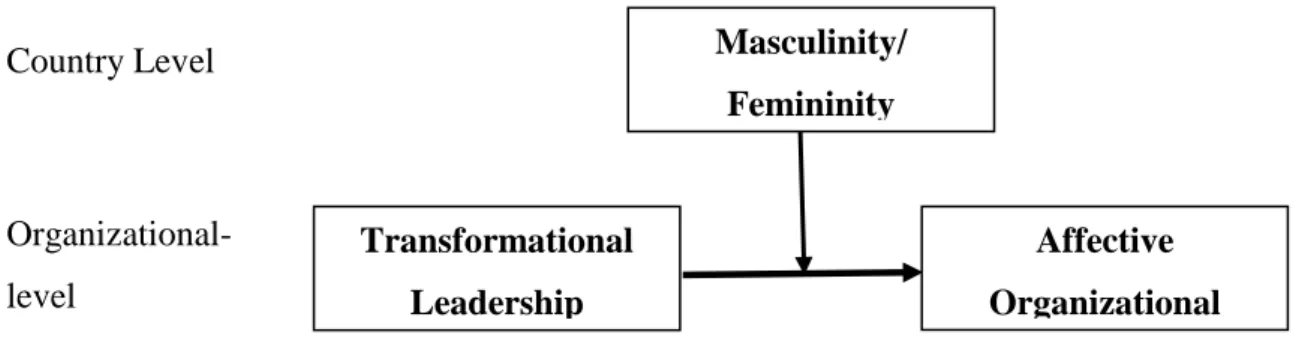
Therefore, the moderating effect on the relationship between transformational leadership and organizational commitment of cultural values is to be tested and leads to the following hypotheses:
H0: Countries with a high value in masculinity show no difference in the relation between transformational leadership and affective org. commitment than countries with a high value in femininity
H1: Countries with a high value in masculinity show a weaker positive relation between transformational leadership and affective org. commitment than countries with a high value in femininity
Country Level
Organizational-level
Figure 2: Cultural Value-as-a-moderator Model: National Culture’s Influence in the Relationship between Transformational Leadership and Affective Organizational Commitment
In conclusion, culture, as one of the defining forces that shapes the rules of interactions, has a considerable impact on how businesses are run. Hofstede’s cultural dimensions allow the categorization of countries based on the manifestation of cultural values. One of these
Transformational Leadership Affective Organizational Commitment Masculinity/ Femininity
27
dimensions, MAS-FEM, appears to be have a relation with desirable business outcomes, as the underlying values impact the perception of individuals regarding important drivers of affective organizational commitment, such as leadership. Therefore, the postulated hypotheses are to test the impact of cultural values on the relationship between transformational leadership and affective organizational commitment in the following chapter.
28
Methodology
The following chapter outlines the strategy in planning the research process, selecting measures and data analysis.
Purpose of this study
Globalization, the fourth industrial revolution and talent scarcity increase the competition about market but also human resources. This leads to a renewed focus on organizational commitment and the question on how it can be managed in the light of multicultural business settings. The main objective of this research is to provide practical advice for business professionals as well as future direction for researchers on how to foster affective organizational commitment in multinational corporations.
Thus, this paper will provide a modern synthesis of the scholarly literature of affective organizational commitment and transformational leadership within the broader context of cross-cultural management. Furthermore, the study will analyze the moderating effects of cultural values on the relationship between transformational leadership and affective organizational commitment.
Instrument
To test the hypotheses, which focus on the analysis of relating, existing constructs, the thesis bases its findings on quantitative data has (Edmondson and McManus, 2007). The field of transformational leadership and organizational commitment is, despite its fragmentation, a relatively mature field. This supports the decision for a quantitative approach, which was carried out in form of employee engagement surveys. Profound understanding of how to design and implement successful employee survey, was provided by the HR consultancy Firm Mercer Sirota. Their qualitative questionnaires are based on 321 norms (as measures are labeled in Mercer Sirota) which are selected based on the clients need. Therefore, the amount and content of the norms asked in the surveys vary widely. Besides the demographic variables, the majority of these norms is based on a 5-level Likert scale ranging from very unfavorable to very favorable and include a not applicable (n/a) option. Around 10% of the norms follow another scale and have therefore been excluded to ensure comparability.
29
Procedure
Data gathering
The consultancy firm Mercer Sirota provided the secondary data, with which the analysis will be performed. With over forty years of experience in the field of employee engagement surveys, Mercer Sirota established a solid database, combining employee engagement survey from over 331 companies in 51 industries. The data was collected in employee surveys between 2012 and 2016 and includes answers from over 4.762.175 respondents. This collection of data comprises over 3.600 projects which took place in 173 countries. The surveys are considered as one-time events. If there was another survey performed in the same company, it was counted as a separate project. Employees from all managerial levels and various functional occupations were respondents of the surveys.
Measures
To ensure that the results of the analysis were as valid and reliable as possible, validated scales were, whenever possible, the basis for the selection of most of the 21 norms. A detailed overview on which measures were used can be found in the annex.
For measuring affective organizational commitment, the Organizational Commitment Questionnaire (OCQ) (Mowday et al., 1979) has been applied. The reason of the choice for this questionnaire is its substantial contribution and application in research on affective commitment over the past 50 years. In addition, no other questionnaire achieved a comparable level of validity or reliability (Hall et al., 1970; Hrebiniak and Alutto, 1972; Buchanan, 1974; Kanter, 1977). Furthermore, it has been thoroughly tested in various contexts and has been found psychometrically valid and sound (Cook and Wall, 1980). Mowday et al. (1979) used the OQC with over 2,563 employees in various industries including university settings, hospitals, engineer and automobile companies as well as retail management trainees and psychiatric technicians. In their testing, evidence of convergent, predictive and discriminant validity has been found.
The questionnaire consists of 15 items that aim to measure the attitudes of employees about their organization. To control for response bias, the questions are phrased negatively and positively and measure variables of commitment such as pride in the organization, willingness
30
to invest extra effort into the organization and feelings of attachment (Mowday et al., 1979). From these measures, nine were selected as the best match with the existing secondary data. To measure transformational leadership, the Multifactor Leadership Questionnaire (MLQ), a standard instrument for assessing transformational and transactional leadership behavior (Bass and Avolio, 2000; Avolio and Bass, 2004) was used. The MLQ was chosen, because it is the most widely applied and studied questionnaire to measure transformational-transactional leadership. In their meta-analysis, Lowe, Kroeck, and Sivasubramaniam (1996) found 22 published and 17 unpublished studies that used the Multifactor Leadership Questionnaire (Avolio, Bass, and Jung, 1995). In their analysis of the three transformational leadership dimensions, overall validities ranged from .71 for charisma to .60 for intellectual stimulation. Even though the validity decreased somewhat when applying organizational measures such as supervisory performance appraisals, the validities remained far from negligible and generalized across studies. These results were somewhat supported by Judge and Piccolo (2004), who found relatively high levels of validity (.44) as well, which were -despite being impressive- not nearly as strong as suggested by Lowe, Kroeck, and Sivasubramaniam (1996).
Out of the 68 items of the MLQ, 24 were chosen for this study based on their linguistic match to the questions from the employee engagement surveys.
As previously mentioned, the cultural measure MAS-FEM derives from Hofstede (Hofstede, 1980). His country scores are based on an interval scale running from 0 to 100. Hofstede´s work and measures represent the most accepted and widely spread set of data on cultural values, despite recent critique, which highlights that Hofstede´s cultural indices might have lost some of their predictive validity over the years (Kirkman and Gibson, 2006; Taras et al., (2012). For the purpose of this study, the predictive value of Hofstede is more than sufficient and therefore these concerns shall be considered part of the limitations of this particular analysis.
Selection of project
To identify the most relevant project for this paper, the aforementioned measures were compared to the norms used in the surveys. Project 2330 had the highest amount of fitting measures, four of which matched the OCQ and 17 items, which fit the MLQ measures. A more detailed overview of these measures can be found in the annex.