CUIDADO É FUNDAMENTAL
UNIVERSIDADE FEDERALDO ESTADODO RIODE JANEIRO. ESCOLADE ENFERMAGEM ALFREDO PINTO
R E V I S T A O N L I N E D E P E S Q U I S A
RESEARCH
CUIDADO É FUNDAMENTAL
UNIVERSIDADE FEDERALDO ESTADODO RIODE JANEIRO. ESCOLADE ENFERMAGEM ALFREDO PINTO
DOI: 10.9789/2175-5361.2017.v9i3.795-802
DOI: 10.9789/2175-5361.2017.v9i3.795-802 | Stelmak AP; Freire MHS | Share applicability recommended…
Aplicabilidade das ações preconizadas pelo método canguru*
Share applicability recommended by kangaroo method
Aplicabilidad compartir recomendado por método canguro
Alessandra Patrícia Stelmak1; Márcia Helena de Souza Freire2How to quote this article:
Stelmak AP; Freire MHS. Share applicability recommended by kangaroo method. Rev Fund Care Online. 2017 jul/sep; 9(3):795-802. DOI: http://dx.doi.org/10.9789/2175-5361.2017.v9i3.795-802
ABSTRACT
Objective: To identify the prevalence of the actions recommended by the MC in practice care for preterm newborns and/or low birth weight, by the nursing staff of the intensive neonatal care which is state reference for the MC. Method: Quantitative descriptive research, conducted through by applying a structured questionnaire with 37 mid-level nursing professionals in the Neonatal Intensive Care Unit, from February to April 2014.
Results: Welcoming, encouraging touch, breastfeeding and environmental control are the actions performed by the team, each having 97% of practical applicability, and actions less executed, the diaper in the lateral position (83%), and the bathroom wrapped in swaddling clothes (58%). Conclusion: This team performs the care of humanized actions as recommended by the MC, and understands the importance of care for the development of newborns. There is the need of permanent education process in service.
Descriptors: Kangaroo Method, Humanization of Assistance, Premature, Public Health Nursing, Health Policy.
* Extracted from Thesis “Nursing Care Algorithms based on Kangaroo Method: a participatory construction” presented in the Master
Professional Nursing Course - Nursing Department of the Federal University of Paraná (UFPR) Curitiba/PR, Brazil/November 2014.
1 Nurse, Master, Specialist in Neonatology, acting in the Neonatal Intensive and Semi-intensive Care Unit of the Hospital de Clínicas at
the Federal University of Paraná (UFPR). Curitiba-PR, Brazil. E-mail: [email protected].
2 Nurse, Ph.D. in Epidemiology by the Public Health University at USP/SP, Associate Professor of the Graduation Course and the
RESUMO
Objetivo: Identificar a prevalência das ações preconizadas pelo MC na
prática de cuidados ao recém-nascido pré-termo e/ou baixo peso, pela equipe de enfermagem de uma unidade de terapia intensiva neonatal que é referência estadual para o MC. Método: Pesquisa descritiva quantitativa, realizada através da aplicação de um questionário estruturado com 37 profissionais de enfermagem de nível médio, em Unidade de Terapia Intensiva Neonatal, de fevereiro a abril de 2014. Resultados: O acolhimento, o incentivo ao toque, o aleitamento materno e o controle ambiental são as ações mais executadas pela equipe, apresentando cada uma 97% de aplicabilidade prática, e como ações menos executadas, a troca de fralda em decúbito lateral (83%), e o banho envolto em cueiros (58%). Conclusão: Esta equipe realiza as ações humanizadas de cuidado conforme preconizados pelo MC, e compreende a importância desses cuidados para o desenvolvimento infantil dos recém-nascidos. Existe necessidade de processo de educação permanente em serviço.
Descritores: Método canguru, Humanização da Assistência, Prematuro,
Enfermagem em Saúde Pública, Política de saúde.
RESUMEN
Objetivo: Identificar la prevalencia de las acciones recomendadas por el MC en los cuidados del recién nacido prematuro y/o bajo peso de nacimiento, por el equipo de enfermería de una unidad de terapia intensiva prenatal, referencia estatal para el MC. Método: Estudio descriptivo cuantitativo, llevado a cabo mediante la aplicación de un cuestionario estructurado con 37 profesionales de enfermería de nivel técnico, en una Unidad de Terapia Intensiva Neonatal, de febrero a abril del 2014. Resultados: La acogida, el incentivo al roce, la lactancia materna y el control ambiental son las acciones más empleadas por el equipo, presentando cada una de ellas el 97% de aplicabilidad práctica. Por otro lado, hay acciones menos ejecutadas, como el cambio de pañales en decúbito lateral (83%) y el baño envuelto en paños (58%). Conclusión: Este equipo realiza las acciones humanizadas del cuidado de acuerdo con las recomendaciones del MC y comprende la importancia de estos cuidados para el desarrollo infantil de los recién nacidos. Existe la necesidad del proceso de educación permanente en servicio.
Descriptores: Método Canguro, Humanización de la Asistencia,
Prematuro, Enfermería en la Salud Pública, Política de Salud.
INTRODUCTION
Technological innovations in the last years have contributed to an increase in life expectancy of premature newborns, but there are new concerns arising from these advances, especially the quality of life.1
Working with the vulnerability of preterm newborns (PTNB) and/or with low birthweight (LBW) becomes a constant challenge for health professionals, who need to be alert to the needs and specificities of care, because the newborns are in the organs maturing in antagonistic environment to uterine conditions.2
The preterm birth condition requires NB’s efforts to adapt in extra-uterine environment, which may result in both physical and mental problems, over child development.1
The NICU environment should promote the security needed for the care and survival of PTNB and/or LBW,
however they are unfavorable to organ maturation process, due to excessive light, noise and stimuli that the brain is not yet prepared to receive.
In this sense, as a national public policy, the Kangaroo method is a set of perinatal humanized care given to the PTNB and/or LBW aimed at minimizing the effects of premature birth and improve the future quality of life of these NBs.2
Pretending to mitigate the possible deleterious effects of this birth condition, and the hospitalization of the PTNB and/or LBW in a Neonatal Intensive Care Unit (NICU), the KM is shown as a strategy for a paradigm changing in the offered care to this population.
Historically, this practice began in the 80’s, in Bogota (Colombia) by promoting skin-to-skin contact, also known as the kangaroo position, which aimed to promote the thermal stability of the NB, by the lack of necessary incubators for heating the NBs.3
This new practice of care, not only reduced child mortality rates, as well as decreased the abandonment of NBs in the NICU, increased the bond between NB/family and breastfeeding rates.2
With these benefits, this practice quickly has spread to the five continents, and Brazil was highlighted globally to adopt the KM as National Public Policy in 2000, broadly divided into three sequential steps.2The first step corresponds to the
hospitalization of the PTNB and/or LBW in the NICU or Conventional Neonatal Intermediate Care Unit (UCINCo). In the second stage, which occurs in Kangaroo Neonatal Intermediate Care Unit (UCINCa), the mother returned to the hospital in rooming arrangements, as caregiver of the premature children, and takes complete care under supervision and guidance of a team until the NB achieve ideal weight to have discharge, which may vary between hospitals, but aims at a discharge with autonomous and safe maternal care for home continuity. The third stage corresponds to outpatients monitoring, where the NB will be followed by the service to achieve 2500g, and then he will be attended in basic health care.2
In these three stages the NB and family care involve a set of actions that seek to welcome parents, allowing their involvement in the therapeutic process of their children, encouraging them to early touch to achieve the kangaroo position, inserting them in care and promoting early bond formation.2
After some years of implementation of the KM, it is believed to need to verify that the actions recommended by the KM are being practiced in hospitals emerging the following guiding question: How often are the neonatal care actions recommended by the KM being applied in a neonatal unit that is state reference for the KM? Therefore, this study aimed to identify the prevalence of the actions recommended by the Kangaroo Method (KM), in the care practice to preterm newborn and/or with low birthweight, by the nursing staff of a neonatal intensive care unit that is
state reference for the KM, and identify paradigm changes occurring after the KM implementation process.
METHOD
This article shows some results of a thesis developed in the Professional Nursing Master’s Program in UFPR. This is a descriptive quantitative study, developed in the NICU of a large teaching hospital in Curitiba, during February to April 2014.
Professional of the mid-level nursing between assistants and technicians were the participants, trained to apply KM in the three shifts, morning, afternoon and evening. There are 49 professionals of the nursing staff of this service, 10 of them without performing the 30 hours training course in KM, and two were absence during the data collection period, thus participating 37 professionals in the study.
The choice of participants was intentional, with the justification for obtaining the opinion of people already sensitized to the realization of humanized care, and midlevel professionals were chosen because it was considered that the KM success is closely related to their care given to the PTNB and/or LBW.
The inclusion criteria were: professional working in the NICU, with training course of 30 hours accomplished by the KM tutors, sign the Informed Consent Form, to be present on the day of data collection, not having been absent due to vacation, sick leave or other removal from service. As exclusion criteria it was to not meet one of the above criteria.
As data collection technique the application of a structured questionnaire containing 22 objective questions (Annex 1) in addition to the identification data were used by the lead author. The participant was instructed to draw the care alternatives with ‘X’ that he performed in humanized care given the preterm and/or LBW newborns. It is important to point out that on these issues there were options such as ‘sometimes’, ‘always’ or ‘never’ so they were considered positive responses, that is a satisfactory applicability, those whose actions were carried out with greater frequency to 50%.
For the treatment of the data, descriptive statistics were used with absolute numbers and percentage, and the results were organized and presented in table and chart. This study was conducted considering the criteria for Human Being Research, according to the National Council 466/2012, and approved by the Ethics in Health Sciences Sector Committee of the Federal University of Paraná under number 376,485.
RESULTS AND DISCUSSION
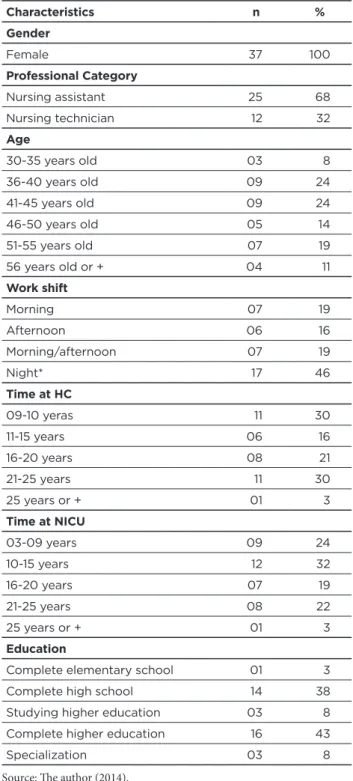
Table 1 – Socio-demographic characteristics of nursing assis-tants and technicians of the NICU HC/UFPR Curitiba/PR (2014) Characteristics n % Gender Female 37 100 Professional Category Nursing assistant 25 68 Nursing technician 12 32 Age 30-35 years old 03 8 36-40 years old 09 24 41-45 years old 09 24 46-50 years old 05 14 51-55 years old 07 19 56 years old or + 04 11 Work shift Morning 07 19 Afternoon 06 16 Morning/afternoon 07 19 Night* 17 46 Time at HC 09-10 yeras 11 30 11-15 years 06 16 16-20 years 08 21 21-25 years 11 30 25 years or + 01 3 Time at NICU 03-09 years 09 24 10-15 years 12 32 16-20 years 07 19 21-25 years 08 22 25 years or + 01 3 Education
Complete elementary school 01 3 Complete high school 14 38 Studying higher education 03 8 Complete higher education 16 43
Specialization 03 8
Source: The author (2014). * Divided servers for three nights.
The 37 nurses interviewed were exclusively female, 68% of nursing assistants and 32% nursing technicians. The age of the participants ranged from 30-61 years old with an average of 44.9 years old. Regarding to working time in the institution, this variable ranged between nine and 28 years, averaging 16, and there was a great expressiveness of work at the institution over 21 years totaling 33% (n = 12). For
the years of work performed in the NICU, more than half of the sample (51%) worked between 10-20 years with care focused on the newborns. It is worth mentioning that 25% performed these activities for over 20 years. In the case of a Federal University Hospital, where the hiring is done through a public tender, with job stability, there is almost no turnover of people, and workers usually conclude the period for retirement. This explains the high numbers of working time in the hospital, the NICU and the average age of the study participants. Despite the level of education required for the position being of the middle level, 51% of respondents had completed higher education (Table 1).
When asked about the applicability of the actions recommended by the KM, the interviewees were encouraged to reflect on their actions aimed at PTNB and/or LBW, and then point out the actions involving the KM performed in their work routines, as well as express knowledge of the eligibility criteria in the 2ndand 3rdstages of the KM.
Before reading each question, many of the nurses reported that at that time they had the opportunity to recall several actions that they are not usually related to the practice of KM, because they understand as a routine work. This can be interpreted as the need for the KM appropriation in full and everyday applicability.
Cross-sectional study conducted in seven centers in Ahmedabad district (India) in 2012, involving 145 nurses about the knowledge of the KM showed a low knowledge about actions involving the KM, only 33% of professionals properly listed the components of the KM, involving in that country: the skin to skin contact, exclusive breastfeeding, early discharge and support the mother in kangaroo practice.
As said before, the KM gives opportunity to approach parent to the newborn, interrupted by the need for hospitalization, and encourages their participation in the therapeutic process.2 Breastfeeding is strongly encouraged
in the KM, and to facilitate the suction of the PTNB and/ or LBW retaining the feeding tube, which was traditionally set at the edge of the upper lip, replaced in the KM by setting ‘kitten type’ in bone zygomatic, for the release of the orbicularis muscle of the lips.2
Within the care recommended by the KM are the environmental adjustments, seeking to reduce the noise, the light, the excesses of handlings the newborn, thereby reducing the stress to promote comfort to the NB.2For the
comfort, actions as appropriate posture, involvement in the nest, containment measures, and the use of glucose before painful procedures were used.2 The verification of weights,
bath wrapped in swaddling clothes, are protective actions
aimed for the NB.2Among many actions, KM seeks to
respect the uniqueness of each NB/family, to preserve and stimulate family bonds, to better child development, and human assistance.
In Brazil, the Ministry of Health largely invests in training of professionals and awareness of them to the KM implementation processes in maternity hospitals.3Although
the KM is on the rise among the states, a recent study revealed that the greatest difficulties to the implementation and strengthening of the KM are in managerial/administrative aspects, that is difficulty in adapting physical structure to hold the 2nd stage, UCINCa; insufficient human resources;
inadequacy of material and organizational resources; lack of institutional support.5 The method is revealed as a complex
working process, which requires behavioral changes of those who perform the care given the PTNB and/or LBW.
In the chart below, there are the results of the actions recommended by the KM and its adherence percentages according to the nursing staff.
Chart 1 – Actions recommended by the kangaroo method
and applicability in practice to the PTNB and/or LBW, NICU HC/UFPR Curitiba-PR (2014)
Source: The author (2014).
It is seen with the results presented in Chart 1 that the actions recommended by theKM are carried out by this team of nursing, with varying prevalence, and that the pillars of ‘Home’ and ‘Environmental Adaptation’ are the most representative care humanization process in the PTNB and/ or LBW performed by the participants, with 97% of practical applicability. Regarding the NB, parents and relatives hosting, the study scenario reveals that this is a highly institutionalized practice.
The negative impact on the hospitalization of a child, can be minimized by a successful hosting, and security relationship provided by this time, triggering the parent posture during the hospitalization.6According to the
participants, the NICU has been developing improvements in hosting process for years, as being one of the guidelines of the National Policy of Hospital Humanization. Receiving the infant, parents and family in a humane way has become a primary care to bond success of NB/family relationship and family/team.
Based on the results of this research, a high prevalence (97%) of professionals that encourage early touch to the newborn was observed, in an attempt to start the formation of emotional bonds (94%). The bond formation between mother/father/NB is recognized as one of the major benefits achieved by the KM.
French study involving 60 parents of PTNB has shown that effective communication between health professionals with parents significantly reduce the level of stress generated by this moment and recognize the attitudes of professionals in the NICU as a key to have bond with the newborn and security for the development of care.7
Another care widely encouraged by the nursing team, which favors the formation of bonding and comfort to NB is the kangaroo position, found in 83% of positive answers in encouraging this care practice.
This has contrasted findings that the KM is recognized
by the nursing team predominantly as kangaroo position8
and the kangaroo position is revealed as action further encouraged by health professionals.4,9 This study finds that
although the skin to skin contact started the KM, and the global expansion for this nursing staff, the KM is much more than the kangaroo position, is a set of actions aimed at a more humanized care to the newborn, with family insertion, minimizing the stimulating effects received during hospitalization in the NICU and UCINCo seeking the best child development.
Regarding the promotion of breastfeeding, 97% of respondents claim that this care is done routinely in the service, but they did not strongly relate this practice to the KM, but to the Friendly Child Hospital Initiative.
Study in a maternity in Piauí, with 19 mothers of preterm infants showed that the nursing staff constantly guides on the techniques and the importance of breastfeeding, and recognizes the KM as a facilitator of this process.10
On the other hand, a similar study conducted in India on breastfeeding and Kangaroo method, similar to this research, the association of KM was low, only 33% recalled breastfeeding as an integral action of KM and only 27.6% believe that the KM increases breastfeeding rates.4
When asked if they performed care to minimize the stressors effects produced by noise and light in the NICU, it was found that 97% of respondents are concerned with lower sounds and lights, seen as harmful to the comfort of the NB as well as preserving the times of ‘nap’ (75%), periods to not perform procedures to preserve sleep and rest of the NB, however, they say that often due to the dynamics of the NICU, number of procedures and complications, this care may be compromised.
Concern about noise levels is justified by the fact that exposure to long-term noise can affect hearing aid structures and manifest in the form of difficulties in thinking, talking, spelling, reading, writing or calculating. As a consequence it may affect the social, intellectual, emotional and language
of the child, and even cause deafness, by overcoming the hearing limits.11
Similar findings indicate that health professionals at NICU recognize it as a highly noisy environment and that this noise can be harmful to newborns but also to themselves seeking to minimize talking and quickly turn off of the alarms.12
Many authors on this theme agree that the noise level in the NICU worldwide is still higher than recommended, even checking all the efforts of professionals in minimizing them.1,13-14
These data indicate the urgency to carry out educational activities of everyone involved in caring for a further reduction in noise levels in the NICU, and thus preserving the hearing acuity of newborns.
Another important care is reducing the light on the NB, widely introjected (97%) in the attitudes of professional respondents of this study. Although the NICU is presented within the norms of conditioning and lighting control, the interviewees described actions to decrease the light effect on the NB with the use of dark cloth, to the comfort and reduction of stress and to provide an environment of sleep and condition the NB to day and night recognition.
It is known that premature infants are more prone to develop ocular disorders such as retinopathy of prematurity, strabismus and refractive errors resulting from neurological damage due to toxicity of light, and sensory deprivation in the 28-40 week period, being the period of development of the visual system.15
Another important factor relating to premature vision refers to the fact that the pupillary response of the NB is established between 30-34 weeks of gestation. However, if preservation of the light does not occur continuously focus on the retina of newborns can result in losses in visual acuity.2
A recent study conducted in a NICU in Minas Gerais showed that nursing professionals recognize environmental stimulation, such as major stressors and cause disruption of newborns and using mechanisms to minimize these effects.16
On routine care present in all NICU, bath, weight, hygiene and diaper changing expending great efforts of the PTNB and/or LBW, but if they are carried out in a protective way as recommended by the standard of the KM, they should provide comfort, organization, security, and especially reduction of clinical complications resulting from these procedures,2they were asked if performed such
care as recommended by the KM in order to respect the individualities, trying to run the adequate care, maintaining the moments of sleep and rest and using swaddling clothes to provide greater security to the NB, and avoiding heat loss.
The bath as a routine in the unit during the data collection period was held in the morning and were not being respected weekly intervals. In the course of the interviews, two “sensitization” were conducted by the unit nurses during the day, to suit the bath routine and newborn weight, with certification of the NICU Reference State in Kangaroo Method. Among the participants, 42% reported performing
the bath wrapping the baby in swaddling clothes, and 53% reported weighing the NB protected with cloths.
It should be noted from the affirmative answers that only one participant reported that already perform such care as the precepts of the KM while the other said to perform this procedure keeping that involvement of care only after the sensitization.
Using the wrapped bath is a humane way to conduct hygiene and comfort to the NB, as well as providing security and keeping him calm and protected during the procedure by referring the idea of uterine return.17
Regarding hygiene and diaper changing, they were asked if they performed diaper changing in the lateral position, preventing the elevation of the lower limbs, which can lead to increased abdominal pressure and gastroesophageal reflux-threatening aspiration.2It was observed that 83% said
they did not change the diaper in the lateral position. Most of the respondents reported that they ignored the need and importance of this care, and they have never seen it at the study site, someone performing the technique as recommended by the KM. However, other respondents reported having heard about this concern during the course of KM, but they did not perform the mechanical act of raising the legs and hygiene.
The daily care such as hygiene and diaper changing may be actions that generate stress to the NB when held adversely to the lateral position, because it demands great effort to restore the previous balance to handling them.18
It was noticed that the basic care was performed mechanically, with no needs of assessment and individualities to the NB, since the diaper changing was carried out as a 3/3 routine, regardless of the state of sleep, NB weight, urinary frequency, etc., not prioritizing the least handling.
This result shows the need for a new awareness of the team, based on scientific evidence to good care practices for the newborn in the NICU, and the importance of each humanized care action given the PTNB and/or LBW in an attempt to preserve them from losses inherent of care in the neonatal stage. Another care recommended by the KM, is to fix the ‘kitten type’ probe in the zygomatic bone,2
showing poor adherence, only 44% of respondents reported performing the setting as recommended by the method. There were no studies to report the experience of using the ‘kitten type’ probe.
Several participants said they did not remember the criteria for the second stage of KM, since they had attended the KM course more than two years ago, and usually the nurses are responsible for electing the mothers and their newborns. Similar findings which aimed to identify the knowledge of nursing technicians on the application of KM and analyze its importance in assisting in the NICU, found that the staff had knowledge of the KM, however, they found it difficult to identify the stages of the KM in daily work.19
CONCLUSION
It is noticed that in this study scenario, there is a KM of strengthening movement, and expressive adherence to recommended actions for the reception, inclusion of parents in the care, breastfeeding promotion and environmental adaptation, and that care centered in the family shows great representation in the process of humanization.
Although advances have been verified over the KM implementation process, showing the importance of this study having a gap between the knowledge gained in the training of the KM and the practical applicability of these actions, especially in the protective actions for the NB bath, weight and hygiene, and poor adherence fixing the gastric tube ‘type kitten’ in the zygomatic bone, which can be attributed to the mechanism imposed by decades of work in the NICU, reflecting the slow changes in work processes. Considering the complexity of the KM and the specifics of working with the PTNB and/or LBW, the educational processes in the NICU should be permanent in an attempt to continued awareness of professionals focused on providing assistance to the potential development of each NB.
From these results and their discussion with other authors, it is concluded that investments in training for the implementation of actions recommended by Public Policy, such as the Kangaroo Method, they are extremely relevant to the processes of behavioral and paradigm shifts of professionals of health. Despite full adherence to all care recommended by the Kangaroo Method are not observed, there is the transition from a technicist care to humanist care, and it is believed that it will be increasing every day.
Finally, it is highlighted that this research had no obstacles to its realization, and that the information here generated allows research replication in other NICU scenarios and generating useful information for the process of nursing care management to preterm and/or low birth weight newborn.
REFERENCES
1. Vieira MEB, Linhares MBM. Desenvolvimento e qualidade de vida em crianças nascidas termo em idades pré-escolar e pré-escolar. J Pediatr (Rio J). 2011 jul/ago.; 87(4):281-91. Available from: <http://www.scielo.br/scielo.php?pid=S0021-75572011000400003&script=sci_abstract&tlng=pt>. 2. Ministério da Saúde (BR). Secretaria de atenção à saúde.
Departamento de ações programáticas estratégicas. Atenção humanizada ao recém-nascido de baixo peso: método canguru. 2ªed. Brasília, 2011. Available from: <http://bvsms.saude.gov.br/bvs/ publicacoes/metodo_canguru_manual_tec nico_2ed.pdf>. 3. Ministério da Saúde (BR). Secretaria de atenção à saúde.
Departamento de ações programáticas estratégicas. Atenção humanizada ao recém-nascido de baixo peso: método canguru: caderno do tutor. Brasília, 2011.
4. Dalal A, Bala, DV, Chauhan S. A cross-sectional study on knowledge and attitude regarding kangaroo mother care practice among health Care providers in ahmedabad district. Int J Med Sci Public Health, v.3,issue, 3, p.253-256, 2014.
5. Gontijo TL, Xavier CC, Freitas MIF. Avaliação da implantação do Método Canguru por gestores, profissionais e mães de recém-nascidos. Cad saúde pública. 2012 maio.; 28(5):935-44. Available from: <http://bases.bireme.br/cgi- bin/wxislind.exe/iah/ online/?IsisScript=iah/iah.xis&src=google&base=LILACS&lang=p&n extAction=lnk&exprSearch=625491&indexSearch=ID>.
6. Hennig MAS, Gomes MASMG, Morsch DS. Atenção humanizada ao recém nascido de baixo peso: método canguru e cuidado centrado na família: correspondências e especificidades. Physis: revista de Saúde Coletiva, 2010; 20(3): 835-52. Available from: <http://www.arca. fiocruz.br/xmlui/handle/icict/1782?show=full>.
7. Guillaume S, Michelin N, Amrani E, Benier B, Durrmeyer X, Lescure S, et al. Parents’ expectations of staff in the early bonding process with their premature babies in the intensive care setting: a qualitative multicenter study with 60 parents. BMC Pediatr. 2013 Feb.; 13(18) Available from: <http://www.biomedcentral.com/1471-2431/13/18>. 8. Hennig MAS, Gomes MASM, Gianini NOM. Conhecimentos e
práticas dos profissionais de saúde sobre a “atenção humanizada ao recém-nascido de baixo peso - método canguru”. Rev bras saúde mater infant. (Online). 2006;6(4): 427-36. Available from: <http://www.scielo.br/scielo.php?script=sci_arttext&pid =S1519-38292006000400010>.
9. Silva JR, Thomé CR, Abreu RM. Método mãe canguru nos hospitais / maternidades públicos de Salvador e atuação dos profissionais da saúde na segunda etapa do método. Rev CEFAC (online). 2011 maio/ jun.; 13(3):522-33. Available from: <http://dx.doi.org/10.1590/S1516-18462011000300016>.
10. Coêlho LS, Dias AA, Landim CAP, Lima JVF, Pessoa da Silva MN, Abdalla CM. Amamentação do recém-nascido prematuro no método canguru: percepções de puérperas sobre o cuidado de enfermagem. Rev pesq cuid fundam online. 2013 dez.; 5(6): 284-292. Available from: <http://www.seer.unirio.br/index.php/cuidadofundamental/ article/viewArticle/3484 acesso em: 09/08/14>.
11. Pinheiro EM, Guinsburg R, Nabuco MA, Kakehashi TY. Noise Neonatal Intensive Care Unit and inside the incubator. Rev latinoam enferm. 2011 Sep/Oct.; 19(5):1214-21. Available from: <http://www. ncbi.nlm.nih.gov/pubmed/22030587>.
12. Daniele D, Pinheiro EM, Kakehashi TY, Balieiro MMFG. Conhecimento e percepção dos profissionais a respeito do ruído na Unidade Neonatal. Rev Esc Enferm USP. 2012; 46(5):1041-48. Available from: <http://www.revistas.usp.br/reeusp/article/ view/48123>.
13. Correia, CQOS, Mendonça AEO, Souza NL. Produção científica sobre ruídos na unidade de terapia intensiva neonatal: revisão integrativa. Rev enferm UFPE [on line]. 2014; 8(1): 2406-12. Available from: <http://www.revista.ufpe.br/revistaenfermagem/ index.php/revista/article/download/4270/9803>.
14. Wang D, Aubertin C, Barrowman N, Moreau K, Dunn S, Harrold J. Examining the effects of a targeted noise reduction program in a neonatal intensive care unit. Arch dis child fetal neonatal ed. 2014 May; 99(3):203-8. Available from: <http://www.ncbi.nlm.nih.gov/ pubmed/24356177>.
15. Ruas TCB, Gagliardo HR, Martinez CS, Ravanini SG. A comparação de funções apendiculares desencadeadas pela visão em lactentes nascidos pré-termo e a termo no primeiro trimestre de vida. Rev
bras crescimento desenvolv hum. 2010;20(3): 680-7. Available from: <http://pepsic.bvsalud.org/scielo.php?script=sci_arttext&pid =S0104-12822010000300003>.
16. Fontes FS, Rodrigues BMRD, Pacheco STA, Araújo BBM. Cuidado ao recém-nascido prematuro na perspectiva da reorganização comportamental - um olhar de enfermagem Rev pesq cuid fundam [online] 2011 jul./set.; 3(3):2045-52. Avilable from: <http://www.seer. unirio.br/index.php/cuidadofundamental/article/view/1471/pdf_409 acesso em: 09/10/14>.
17. Balbino AC, Cardoso MVLML, Silva RC, Moraes KM. Recém-nascido pré-termo: respostas comportamentais ao manuseio da equipe de enfermagem. Rev enferm UERJ. 2012 dez.; 20(esp.1):615-20. Available from: <http://www.e-publicacoes.uerj.br/index.php/ enfermagemuerj/article/view/5908>.
18. Hemkemeier J, Fermino VC, Ribeiro IM. Percepção de familiares referente ao banho humanizado: técnica japonesa em recém-nascidos. Rev ciência saúde. 2012 jan/jun.; 5(1):2-8. Available from: <http://revistaseletronicas.pucrs.br/ojs/index.php/faenfi/article/ view/9135>.
19. Silva RA, Barros MC, Nascimento MHM. Conhecimento de técnicos de enfermagem sobre o método canguru na unidade neonatal. Rev bras promoç saúde (Impr.). 2014 jan/mar.; 27(1):124-30. Available from: <http://ojs.unifor.br/index.php/RBPS/article/view/2375>. Received on: 09/09/2015 Reviews required: No Approved on: 09/09/2015 Published on: 10/07/2017 _________
Author responsible for correspondence:
Alessandra Patricia Stelmak Rua Fátima Bark, 515, Capão Raso Curitiba/PR, Brazil ZIP-code: 81130-270 Telephone: (41) 3018-8208/ (41) 8864-5170
Can you point me in the list below, which the care recommended by the Kangaroo that you perform in your daily activities to premature newborns and/or low birth weight, parents and family:
( ) Search host parents on the first visit to the RN; ( ) I do guidance Sobreo the Kangaroo;
( ) Search encourage parents to touch their children and place them later in care;
( ) I worry about the bond formation between RN and family and encourage parents to do the first care with your child;
( ) I am attentive to the parents and family during the visit; ( ) Encourage the mother to initiate breastfeeding;
( ) Search group care to preserve more moments of sleep and rest;
( ) I care about the comfort of the RN and I always try to comfort him the nest; ( ) Tail off room lights whenever possible;
( ) I speak down and bother to reduce the noise in the room; ( ) Respect the nap of time whenever possible;
( ) Manage nonpharmacologic analgesia (25% glucose) before painful procedures; ( ) Encouraging the kangaroo position;
( ) Put the infant in the kangaroo position;
( ) Realize the bath as the MC guidelines, maintaining the RN in the winding and respecting the days bath; ( ) Realize weighing RN wrapped in swaddling cloth or cloth diaper;
( ) Realize the diaper in the lateral position;
( ) I know when to perform the fixing of the SOG, “kitten type” and so do I; ( ) I check and turn off the alarm as soon oximeter start playing;
( ) I know the criteria for the mother to start the 2nd stage of the MC in UCINCa (2nd stage); ( ) I know the criteria for the RN participate in the 2nd stage in UCINCa (2nd stage); ( ) I know the criteria in the 3rd stage of the MC.