Acta Scientiarum
http://www.uem.br/acta ISSN printed: 1806-2636 ISSN on-line: 1807-8672
Doi: 10.4025/actascianimsci.v38i4.31828
Acta Scientiarum. Animal Sciences Maringá, v. 38, 4, p. 375-382, Oct-Dec., 2016
Elephant grass silage with the addition of crambe bran conjugated
to different specific mass
Arilson Moraes Cardoso1, Saulo Alberto do Carmo Araujo2*, Norberto Silva Rocha4, Felipe Nogueira Domingues3, Jorge Cardoso de Azevedo1 and Lilian de Araujo Pantoja2
1
Programa de Pós-graduação em Ciência Animal, Universidade Federal do Pará, Castanhal, Pará, Brazil.2Universidade Federal dos Vales do Jequitinhonha e Mucuri, Diamantina, Rodovia MGT-367, Km 583, 5000, 39100-000, Diamantina, Minas Gerais, Brazil. 3Universidade Federal do Pará, Castanhal, Pará, Brazil. 4Programa de Pós-graduação em Zootecnia, Universidade Federal dos Vales do Jequitinhonha e Mucuri, Diamantina, Minas Gerais, Brazil. *Author for correspondence. E-mail: [email protected]
ABSTRACT. This study aimed to evaluate the effects of inclusion of crambe bran concentrations (Crambe abyssinica Hochst.) with different specific masses in elephant grass silage (Penninsetum purpureum Schum.). For that, the bromatological and microbiological compositions of the experimental silages were determined. We used 48 mini silos distributed in a completely randomized design, arranged in a factorial 4 × 3, four levels of inclusion of crambe bran (0; 10; 20 and 30%) and three specific masses (400; 500 and 600 kg MN m-3), with four replications. After 240 days of fermentation the silos were opened. It was observed linear
effect on DM, CP, NDFap, ADFap, HEM, LIG, NFC, TC and population of bacteria that produce lactic acid with the addition of crambe meal. There was interaction between the crambe bran factors and specific masses on the values of pH and N-NH3. For MM variables and yeast count there was a negative linear
effect due to the evaluated specific mass. The inclusion of crambe bran helps to increase the fermentative profile and the bromatological composition of elephant grass silages studied, and the best results were obtained with the addition of 30% of this coproduct, based on the natural matter.
Keywords: additive, coproduct, Penninsetum purpureum, bromatological composition, fermentation.
Silagem de capim Elefante com adição do farelo de crambe conjugado a diferentes massas
específicas
RESUMO. Objetivou-se avaliar os efeitos da inclusão de concentrações do farelo de crambe (Crambe abyssinica Hochst.), com diferentes massas específicas, na ensilagem de capim-elefante (Penninsetum purpureum Schum.). Para tanto foram determinadas as composições bromatológica e microbiológica das silagens experimentais. Foram utilizados 48 minissilos distribuídos em delineamento inteiramente casualizado, arranjado em esquema fatorial 4 × 3, sendo quatro concentrações de inclusão do farelo de crambe (0; 10; 20 e 30%) e três massas específicas (400; 500 e 600 kg de MN m-3), com quatro repetições.
Após 240 dias de fermentação os silos foram abertos. Foi observado efeito linear para os teores de MS, PB, FDNcp, FDAcp, HEM, LIG, CNF, CT e para a população de bactérias produtoras de ácido lático com a inclusão do farelo de crambe. Houve interação entre os fatores farelo de crambe e massas específicas sobre os valores de pH e N-NH3. Para as variáveis MM e contagem de leveduras houve efeito linear negativo em
função da massa específica avaliada. A inclusão do farelo de crambe contribui para incrementar o perfil fermentativo e a composição bromatológica das silagens de capim-elefante estudadas, sendo os melhores resultados obtidos com a adição de 30% deste coproduto, com base na matéria natural.
Palavras-chave: aditivo, coproduto, Penninsetum purpureum, composição bromatológica, fermentação.
Introduction
The silage production of tropical grasses either in an area designed for direct production or as a way of using produced surplus in pasture or forage areas, during the favorable period of time to the forage growth, made up an interesting strategy for the livestock roughage supplementation (Faria et al., 2010). In Brazil one of the main forage used for this goal is the elephant grass (Pennisetum purpureum
Schum.), characterized by its high capacity of biomass production and proper nutritional value.
376 Cardoso et al.
Acta Scientiarum. Animal Sciences Maringá, v. 38, 4, p. 375-382, Oct-Dec., 2016
increase in the nutrients loss due to effluents production. In addition, the reduced carbohydrate ratio (2.5% on average) also constitutes an important obstacle for the exclusive tropical grasses silage (Muck, 2010; Santos et al., 2010).
Thus, the high moisture content together with the low carbohydrate ratio of these forages at the moment of cutting can result in secondary fermentations, mainly the ones promoted by
Clostridium bacteria. Such microorganisms act on the breakdown of sugars, lactic acid, proteins and amino acids, promoting excessive productions of butyric acid, acetic acid, ammonia and carbon dioxide, which results in effective losses in silage quality (Cândido, Neiva, & Rodriguez, 2007).
In this stream, the use of products aiming to enhance the silage efficiency of these forages, either through the improvement of fermentation characteristics or by the reduction of inherent to the process losses, constitute fundamental practice for obtaining good quality grasses silage (Ferrari Junior, Paulino, Possenti, & Lucenas, 2009). The use of DM rich additives (generally higher than 80%) and with adequate supply of nutrients can enable the moisture absorption, increasing the DM content of the ensiled material, and even promote improvements in the bromatological composition of the produced silage.
The number of studies regarding the inclusion of moisture absorbents additives in grass silage has grown over the last years (Pires et al., 2009; Rêgo et al., 2010; Santos et al., 2014). In tropical regions the crambe bran (Crambe abyssinica Hoschst.) a co-product of the biofuel agribusiness, presents certain particularities in its bromatological composition, such as: high DM content and crude protein (Carrera et al., 2012; Souza, Goes, Silva, Yoshihara, & Prado, 2015). Thus, the use of crambe bran as an additive for tropical grasses ensilage will enable the increase of dry matter content and even enhance the crude protein content of the silage, making it possible to reduce the costs with the use of protein concentrates in diets, besides reducing possible impacts with the discharge of this co-product directly in the environment.
In order to obtain the proper results for the action of lactic acid producing bacteria, besides the DM and carbohydrate ratio content, the efficient removal of oxygen from the ensiled mass is a necessary condition to enable the growth of anaerobic lactobacilli. The regulation of efficiency of the oxygen removal from the mass to be ensiled is directly modulated by the specific mass adopted in the silage, which is influenced by the type of silo, applied pressure load, total compression time,
thickness of added layers and DM content and average size of forage particle (Jobim, Nussio, Reis, & Schmidt, 2007).
We aimed at evaluating the effect of increasing the inclusion of crambe bran as an additive in elephant grass ensilage with different specific masses, and for this the bromatological and microbiological compositions of silage were determined.
Material and methods
The study was carried out on Fazenda Experimental do Moura which belongs to the Federal University of Vales do Jequitinhonha and Mucuri (UFVJM), located in Curvelo, Minas Gerais, Brazil.
For producing silage elephant grass (Pennisetum purpureum Schum) was used, Napier cultivar, derived from a 1.2 ha forage area, implanted in the second half of October 2012. The crambe bran (Crambe abyssinia Hochst.) was provided by the company Caramuru Alimentos S.A., to be used as an additive in the ensilage. The use of crambe bran was performed with no previous treatment, being physically similar to soybean meal for this co-product.
The elephant grass cutting happened in the middle of January 2014, respecting the average height of it – 1.7 m -, which corresponded to 60 days of growth after the standardization cut. The grass was manually cut, with the help of cutting tools (machete and cleaver), and it was performed close to the ground. Immediately after the necessary amount cutting, grass was chopped in a stationary machine set to obtain ± 10 mm length particles. The chopped material was homogenized and reserved for filling the mini silos.
The mini silos were made in polyvinyl chloride (PVC) tubes, whose dimensions were 60 cm height and 15 cm diameter. The mini silos were made up of a top cover with inner rubber seal on the side and valve type “Bunsen” for gases free escape. After closing the mini silos, they were properly sealed with silica gel to avoid oxygen inlet.
We used a completely randomized design, arranged in 4 × 3 factorial scheme, with four concentrations of crambe bran inclusion (0; 10; 20 and 30%), regarding natural matter (NM) and three specific masses (400; 500 and 600 kg of NM m-3),
with four repetitions.
Elephant grass silage with crambe bran 377
Acta Scientiarum. Animal Sciences Maringá, v. 38, 4, p. 375-382, Oct-Dec., 2016
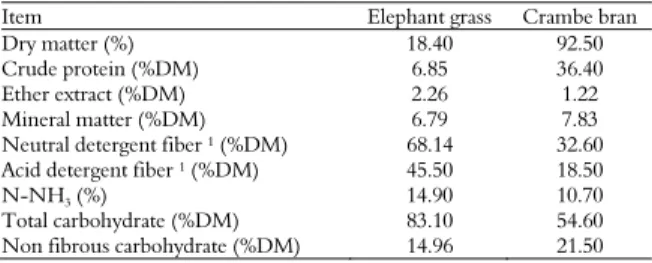
Department (DZO - UFVJM). The microbiological evaluations were carried out in the Integrated Laboratory of Multiuser Research of Vales do Jequitinhonha and Mucuri (LIPEMVALE/UFVJM, Diamantina-MG). The bromatological composition of elephant grass and crambe bran, both collected right before the ensilage, is presented in Table 1.
After 240 days of fermentation the silos were opened. The silages were individually removed from the mini silos, homogenized and, afterwards, we took some samples for laboratory analysis.
Table 1. Bromatological composition of elephant grass and crambe bran (Crambe abyssinica Hochst.) used for producing the experimental silages.
Item Elephant grass Crambe bran
Dry matter (%) 18.40 92.50
Crude protein (%DM) 6.85 36.40
Ether extract (%DM) 2.26 1.22
Mineral matter (%DM) 6.79 7.83
Neutral detergent fiber ¹ (%DM) 68.14 32.60
Acid detergent fiber ¹ (%DM) 45.50 18.50
N-NH3 (%) 14.90 10.70
Total carbohydrate (%DM) 83.10 54.60
Non fibrous carbohydrate (%DM) 14.96 21.50
¹corrected for ash and protein.
For evaluating the fermentation parameters, determinations of hydrogenionic potential (pH) and ammonia nitrogen (N-NH3) were carried out. For
determining the pH, the juice of each experimental silage was extracted, with the help of a hydraulic press, and afterwards the direct reading with the digital pHmeter was performed. To quantify the content of N-NH3, a new silage juice was extracted,
properly identified, kept in sulfuric acid to 0.036 N and frozen for being determined through the distillation with magnesium oxide later (AOAC, 2005).
The sample preparation for microbiological analysis was constituted through previous dilution, weighing 25 g of silage, adding to 225 mL of peptone bacteriological water 0.1% sterile (121oC for
15 minutes) and stirred for 20 minutes at 150 rpm. From the diluted extracts (10-1 to 10-6) the
inoculations for evaluating the lactic acid bacteria (LAB), yeast and filamentous fungi (mold) were performed. For the total score of microorganisms 0.1 mL of each dilution as distributed, in triplicate and spread with Drigalsky handle in Lactobacilli MRS agar (De Man Rogosa Sharpe, Difco) added nystatin (0.4%), for counting lactic bacteria, and the Petri dishes were incubated at 30oC for 96 hours (Ávila,
Pinto, Sugawara, Silva, & Schwan, 2008).
For scoring the filamentous fungi the Potato Dextrose Agar (PDA) was used, adding chloramphenicol (100 mg L-1), and the samples were
incubated at 28oC for 120 hours and the pH of the
middle of culture was adjusted for 3.5. In the yeast scoring the YEPG means was used (0.3% yeast extract; 0.3% malt extract; 0.5% peptone; 1.0% glucose; 2.0% agar per liter, containing 100 mg L-1 of
chloramphenicol), and the samples were incubated at 28oC for 72 hours, adjusting the pH to 3.5 (Ávila
et al., 2008). Plaques presenting between 30 and 300 colony forming units (CFU) per Petri dish were considered able to be scored. The present microorganisms numbers were counted as CFU and expressed as logarithm to the base 10.
In order to evaluate the bromatological composition the samples were pre-dried in a forced ventilation oven at 55ºC for 72 hours and, afterwards, scrunched in a knife mill Willey type with a 1 mm sieve. The dry matter content (DM) of the experimental silages was determined in final drying oven at 105ºC for 16 uninterrupted hours. The crude protein analysis (CP), mineral matter (MM) and ether extract (EE) were carried out secondly (AOAC, 2005).
The neutral detergent fiber analysis corrected for ash and protein (NDFap) and acid detergent fiber corrected for ash and protein (ADFap), using thermostable amylase, were determined according to the methodology described by Mertens (2002). The total carbohydrates (TC), the non-fibrous carbohydrates (NFC) were obtained according to Sniffen, O'Connor, Van Soest, Fox, and Russell (1992), through the application of the equations:
TC = 100 - (%CP + %EE + %MM), e
NFC = 100 - (%CP + %EE + %NDFap + MM).
Data were analyzed by multiple regressions through the software R (R. development team, 2006). We considered level 5% of probability (p < 0.05) through the method of least squares.
Results and discussion
The effect (p < 0.05) of crambe bran addition for the bromatological composition was observed: DM, CP, NDFap, ADFap, TC and NFC contents; and for the microbiological composition: lactic acid producing bacteria (LAB) and filamentous fungi (FF) (Table 2).
A T p I D p N L F Y M N A T N E D N m g d T p T Z g t t q t p t p g w w h f 378 Acta Scientiarum Table 2: Effects parameters and on
Item
0 DM 20 pH 4
N-NH3 7
LAB 6 FF 3 YE 4 MM 9 CP 5 NDFap 71 ADFap 45 TC 82 NFC 11 EE 3 Dry matter contents (D (ADFap), lignin (LIG), N. Lactic acid bacteria masses and CB×SM in
The incr concentrations grass promote dry matter DM This fact was present in the The CB addit and 19.9 perce 10; 20 and 30% Zanine, Sant (2006) reporte increasing add grass ensilage, the high DM composition o Data from addition in e technique to e co-product an ensilage proc quantified it, the CB inclus per effluents i this co-produc
Regarding 10 and 20% proper values good quality e within the int and Nussio (2 silages (28 to adding CB r which may h high amount environment undesirable m and yeast), fermentations
m. Animal Scienc of increasing addi n the bromatologi
Crambe bran(%
0 10 2
0.0 28.6 33
.7 4.5 4
.6 6.8 4
.3 6.9 7
.9 3.2 3
.0 4.0 3
.1 8.4 8
.8 14.1 21
1.0 63.7 52
5.0 40.3 34
2.0 74.3 67
1.0 10.5 14
.0 2.9 2
DM) are in %. Crude p total carbohydrates (TC (LAB), filamentous fun nteraction between the c
reasing addit s (CB) in the ed linear grow M content of influenced b e crambe bran tion resulted in
entage points f % of CB, respe tos, Ferreira,
ed linear incr dition of citru
and this resp content prese of this additive m this study
lephant grass enhance the D n interesting ad
cess. Althoug the increase i sion might ha n the ensilage ct.
the CB additi provided an s (28.6 and 3
ensilage produ terval reported 2009) for trop 35% of DM). resulted in lo have affected of water in th more likely f microorganism thus ena , besides sign
ces
ition of crambe b ical composition o
%)
20 30 4
3.8 39.9 2
4.4 4.4 4
4.8 3.9 7
7.6 7.6 7
3.2 2.9 3 3.6 4.1 3 8.4 8.6 8
1.2 24.7 1
2.4 47.4 6
4.5 32.5 3
7.2 62.9 7
4.9 15.6 1
2.8 2.7 3 protein contents (CP), n
C) and non-fibrous carb ngi (FF) yeast (YE) are crambe bran and specific
tion of cram ensiled mass o wth (p < 0.05) the experimen y the high D n composition
n an increase o for the concen ectively. In cor Oliveira, an rease of DM d
us pulp in th onse is also ex ent in the brom
.
pointed tha ensilage is a DM contents, t dditive absorb gh this study
in DM conten ave enabled lo
s with higher
on, the concen increase of D 33.8%, respec uction. These d by Zopollat pical grass wi . The treatme ow DM conte
this silage qu he ensiled mas
for the develo ms (Clostridium
bling the nificantly incr
ran (Crambe abyssi of elephant grass s
SM (kg NM m-3
) 400 500 60
8.8 30.9 32 4.6 4.53 4.4 7.1 6.27 6.0 7.0 7.19 7.3 .43 3.28 3.1 .94 3.89 3.8 8.72 8.58 8.4 4.8 16.7 18 60.9 58.4 56 8.9 37.7 36 3.2 71.4 69 2.3 13 13 .22 3.26 3.4 neutral detergent fiber c bohydrates (NFC), are e e expressed in LOG UF c masses concentrations
mbe bran of elephant ) upon the ntal silages. M content (Table 1). of 8.0; 13.8 ntrations of rroboration nd Pereira
due to the he elephant xplained by matological
at the CB an efficient
urning this bent for the y has not
nt through ower losses addition of
ntrations of DM to the
ctively) for results are tto, Daniel, th additive ent without ent (20%), uality. The s turns the opment of
m bacteria secondary reasing the
inica Hochst.) and ilages.
E
00 CB SM
.7 * M
49 * *
07 * *
33 * M
16 * M
84 M *
43 M *
.6 * M
.0 * M
.5 * M
.5 * M
.5 * M
44 M M
corrected for ash and p expressed in % of DM a FC g-1 of forage 1Proba
s. * p < 0.05. M = mea
losses by ef addition of of interval t quality silag ensiled mat mass compr fermentation oxygen that et al., 2010). The com CB and SM with smalle combination and 400 kg among the e highlighted DM conten specific mat tropical gra fermentation inclusion of high intens determining grass silages
Figure 1. Effe concentrations grass silages. E CB*SM; R2= 0
Maringá, v. 38 d specific masses o
ffects1
M CB*SM
M Ŷ
* *
M Ŷ
M Ŷ
M Ŷ
M Ŷ
M Ŷ
M Ŷ
M Ŷ
M Ŷ
M Ŷ
M Ŷ
protein (NDFap), acid d and the ammoniac nitro bilities of P < F, CB: aningless.
ffluents (Sant 30% of CB re than the recom ge (39.9%). Th
erial can brin ression, which n process due t will be held .
mbination of th M of 600 kg N
er pH value, n of the treatm g MV m-3 of
evaluated silage the great imp nts associated w
tter for the pro ass silages. T
n process, it f absorbent ad sity of specifi g to provide (Jobim et al.,
ects of interaction and specific mas Equation Ŷ = 9 0.76.
8, 4, p. 375-382, on the evaluation
Regression equa
Ŷ = 21.36 + 0.6042x
Ŷ = 4.98 + 0.13x
Ŷ = 3.75 - 0.03x
Ŷ = 6.50 - 0.0051x
Ŷ = 10.41 – 0.0048x
Ŷ = 4.50 + 0.68x
Ŷ = 76.35 - 0.8268x
Ŷ = 44.62 – 0.4399x
Ŷ = 81.41- 0.65x
Ŷ = 10.35 + 0.18x
Ŷ = 2.35 - 0.08x detergent fiber correcte ogen (N-NH3) is expres
Concentration of cram
os & Zanine, esulted in a hig mmended one he high DM co ng problems in will directly r e to the great d in this mat
he treatments NM m-3 resul
on the othe ment without SM presented es (Figure 1). T portance of th
with the high oduction of p Thus, to obta t is suggeste dditives is con ic matter, wh greater quality 2007).
n between the cra sses (SM) in the .01-0.13*CB-0.00
Cardoso et al.
Oct-Dec., 2016 of fermentation
ations R2
x 0.91 0.55 0.25 0.41 0.30 0.95 0.95 0.88 0.96 0.39 0.45 ed for ash and protein
ssed in % of TOTAL-mbe bran, SM: specific
, 2007). The gher increase for adequate ontent of the n the ensiled reflect on the t quantity of terial (Santos
with 30% of lted in silage er hand, the CB addition d higher pH These results he increase of h intensity of roper quality ain a proper
ed that the nnected with hich may be
y to tropical
Elephan
Acta Sci
It is benefic increase also h reducti carbohy to mod ensiled of ene produc Cân as a influen improv CB pre the elep produc the pH Alth conside fermen silages w and ade value c differen Zopolla the inte which e due to from th describ which evaluat The e SM o N-NH the inc greater The D efficien the pr when t the un importa conditi the pre On content can b fermen the new The the ex Clostrid amoun
nt grass silage w
entiarum. Anima
s noteworthy cial effects due es, the bromat have specifica on of pH ydrates conten dule the ferm masses, once ergy for the
ing bacteria (L ndido et al. (20 substrate for ncing on the
ving the nutrit esented higher phant grass (T t directly infl over the high hough the pH ered a good c ntation, we can with 10; 20 an equate standar close to 4.2. In
nt additive atto et al. (20 erval of the ev emphasizes th
the adopted ad his study prese
ed by the men suggests an ed silages. e combination of 600 kg NM H3 content (Figu
crease of the removal of o DM elevation nt to decrease
oteolysis exte there are not ndesirable mic ant to highlig ons were adeq sentation of pH
the other h t, influenced b be explained ntation due to
wly ensiled ma e silage N-NH xtension of th
dium bacteria, ts by other sila
with crambe bra
al Sciences
to emphasize e to the DM tological comp ally contribut . Mainly t nt (NFC) take mentation prof they constitut developmen LAB).
007) reported t r the develo
e fermentatio ive value of si r content of N Table 1), the ad luenced a gre her levels of inc H of the silag criterion for t n suggest that nd 30% of CB rd of conserva
n a study revi in tropical 009) reported
valuated pH v e discrepancy dditive. Howe ented values cl ntioned author
adequate pH
n of treatments m-3 resulted in
ure 2). This a DM content oxygen from n through C the N-NH3
ends during enough acid c roorganisms a ght that, in th quately establis
H values. hand the decr
by the increase by better a lower prese ass (Santos et a H3 content is a
he proteolytic once it is pr age microorga
an
e that besides and specific m position of CB
ted towards the non-fibr fundamental file of the ne te the main sou nt of lactic
that the NFC pment of L on process ilage. Thus, as NFC compared
ddition of this eater reduction
clusion. ge is not isol
the evaluation the experime inclusion pre ation and final
iewing the us grass ensil great variation value (3.5 to 5 of this parame ever, all the res ose to the inte rs (mean pH 4 H value for
s with 30% do n silage with lo nswer is based t associated w the ensiled m CB addition production, o the fermenta conditions so are avoided. I is study; the shed, accordin
rease of N-N e of specific m
conditions ence of oxygen al., 2010).
a real indicato c activity of
roduced in sm anisms and a sm
the mass can the rous role ewly urce acid acts LAB, and s the d to co-n of ated n of ental sent pH e of lage, n in 5.3), eters sults erval 4.4), the CB ower d on with mass. was once ation that It is acid ng to NH3 mass, of n in or of the mall mall enzym silage 10% repor for tr study lower Figure bran ( elepha SM+0 T silage cram to th reduc silage activi allow produ T a grea quali of th devel Reis, A popu of CB the f cond the in reduc the fu LAB decre T incre greate in the is g micro ferme proba conte Maring
matic action o e must presen
(Ferreira et al rted that the N ropical grass si y all the treatm
r than the reco
e 2. Effect of the CB) inclusion an ant grass silages
0.0013*CB*SM; R
The population es had a linea be bran additi e elevation of ction of bacte es. In these ity is substant wing the lactic ucts to rapidly The elevation o
at indicator to ty during the hese microor lopment of Cl
& Moreira, 20 A linear decre ulation of the s B was observe filamentous fu
itions and in ncrease of spec ction of oxyge ungi growth, a indicates big eases these fun The increasing ase in the DM er specific ma e experimenta reater develo oorganisms entation. In ad ably have en ents of the ens
gá, v. 38, 4, p. 37
of the plant its nt N-NH3 co
l., 2005). Zop N-NH3 conten
ilage are highe ments presente ommended val
interaction betw nd specific masses . Equation: Ŷ = R2
= 0.62.
ns of lactic aci ar increase (p ion. This prob f silages DM, w
erial activity i conditions, th tially reduced c acid bacteri y stabilize the p of the LAB po determine the ensilage, once rganisms inh
ostridium type 005).
ease (p < 0 silage with an d. According t fungi grow be higher pH (5 cific mass ther en in the ensil and also a grea gger productio ngi’s growth.
g addition of M content, wh ass, resulted in l silages. In th opment of L
that per ddition, the in nriched the e
siled mass, too
75-382, Oct-Dec
self. Well-pres ontents lower pollatto et al. ( nts frequently er than 15%. I ed N-NH3 co
lue.
ween the levels of s (SM) in the N-= 28.44-0.81*CB
d bacteria (LA p < 0.05) wit
bably happene what resulted n the experim he Clostridium
or does not ia to produce pH of the silag opulation cons e good fermen e the intense a hibits the po
bacteria (Bern
0.05) in the increasing ad to Ávila et al. ( etter under ae
.0 to 6.0), i.e. re was a conse led mass, narro ater concentrat
on of acids, w
f CB promote hich together w n a proper pH
ese conditions LAB due to rform seco nclusion of C energy and p . And this may
379 c., 2016 served r than (2009) found In this ntents crambe -NH3 of
-0.039* AB) in th the ed due in the mental
380 Cardoso et al.
Acta Scientiarum. Animal Sciences Maringá, v. 38, 4, p. 375-382, Oct-Dec., 2016
enhanced the LAB development in relation to the other microorganisms. This explanation can be grounded when the composition of the co-product analyzed in this study is observed (Table 1).
A linear decrease (p < 0.05) was observed in the yeast population of the silage with SM increase. In general, it has been reported that the yeast are associated with the presence of oxygen in the newly ensiled mass (Muck, 2010). Thus, the SM increase caused greater oxygen reduction and, consequently, decreased the development of yeast population, providing better conditions of anaerobiosis for the ensilage process.
The compared results between the fermentation process (pH and N-NH3) and the microbiological
composition prove the potential of using the CB as an additive for the elephant grass ensilage. In this chain, when the effects of the CB inclusion with the greater SM are evaluated the final product quality is enhanced. Based on this answer, the CB inclusion in concentrations of 20 and 30% in relation with the natural matter, under more intense SM (600 kg de NM m-3), would be the most indicated treatments
for obtaining a better quality product. However, although we did not observe any problems related with the profile of silages fermentation, the high DM content obtained with the greater concentration of CB can result in possible problems at the moment of compression, mainly when the ensilage is performed in large scale (on the field). In this case, adopting a more conservative view, the addition of 20% of CB is the best way to use this co-product.
The increasing addition of CB in the elephant grass ensilage linearly increased (p < 0.05) the crude protein contents (CP) of the experimental silages. This answer is due to the high crude protein content (36.4%) present in the bromatological composition of CB (Table 1). The increasing addition of CB resulted in expressive increases of 8.30; 15.40 and 18.90% of CP for the treatments with addition of 10; 20 and 30% of CB in relation with the control treatment (Table 2). The increase in the CP contents, due to the use of additives in the ensilage, has been reported only for products which present higher CP contents than the mass to be ensiled, and this effect is more intensified when the CP content is higher or even, due to the added concentration (Santos et al., 2010; Zopollatto et al., 2009).
It is noteworthy to mention that even presenting an expressive increase in the CP contents due to the increasing inclusion of CB; the results did not affect the pH variables, N-NH3 and the microbiological
composition. It would be expected that the sharp increase in the nitrogen content could enhance the
elephant grass buffering capacity, promote expressive increase in the N-NH3 content that,
consequently, would damage the fermentation profile of the ensiled mass. Probably, this response was not observed due to the adequate protein:energy ratio for the evaluated treatments. In this case the hypothesis of ensilage enrichment with the CB addition can be consolidated, once this co-product presents high CP contents and a satisfactory NFC content in its constitution (Table 1).
In general the elevation in the crude protein content obtained in this study can represent an important protein increase in ruminant diets, in such way it reduces the use of protein foods, which constitute the most expensive part in the costs with animal nutrition. Additionally, the inclusion of CB in animal nutrition, independently of the way it is used, constitutes a rational and efficient way to provide a proper destiny to the high volume of this co-product, easing possible impacts with the direct dumping of this “waste” in the environment.
A linear decrease (p < 0.05) was observed in the silage MM contents with the increase of SM. In this case, the compression pressure might have brought bigger losses by effluents, which can explain the reduction in the MM contents under more intense SM. Tavares et al. (2009) working with Tanzania grass silage, observed that as the density was higher, there was an increase in the nutrients losses (carbohydrates, proteins and minerals) through the effluent. Although the effluents are mainly composed by water, big amounts of other compound soluble are present, such as proteins, organic acids, sugars, carbohydrates and the minerals.
The silages NDFap and ADFap were influenced (p < 0.05) by the CB concentrations and presented a decreasing linear response, once this co-product has lower contents of these constituents in its bromatological composition (Table 1).
Elephant grass silage with crambe bran 381
Acta Scientiarum. Animal Sciences Maringá, v. 38, 4, p. 375-382, Oct-Dec., 2016
The TC content of the silages presented decreasing linear response (p < 0.05) towards the crambe bran concentrations. This co-product has low total carbohydrates content, which is influenced by the high concentration of crude protein in its constitution. This response is easily explained when we analyze the way how the TC content is calculated (Sniffen et al., 1992). In this case, the higher the CP and EE contents are, the lower the carbohydrate proportion in the food will be. Thus, when adding an increasing amount of crambe bran in the mass to be ensiled, there will be a lower concentration of total carbohydrates. However, we must highlight that the decrease in the TC contents happens more sharply due to the effective reduction of fibrous carbohydrates, as previously observed in the variables NDFap and ADFap. It is important to note that the fibrous carbohydrates do not constitute instant energy source for the fast pH reduction by the LAB action. Thus, the soluble carbohydrates contents are more important to provide a better quality fermentation profile. This way, as the pH contents for the experimental silages were similar to the evaluated treatments, the TC reduction through the increasing inclusion of CB did not bring effective losses for the ensilage process.
The increasing inclusion of CB promoted a linear increase (p < 0.05) in the NFC content of the experimental silages. The CB can be considered an important source of NFC because it presents a similar value (21.5%) to the foods which are traditionally used as ensilage additives, such as: cottonseed meal (19.2%), corn gluten meal (20.0%) and soybean hulls (17.6%), according to what was reported in literature Rocha Júnior et al. (2003). The NFC constitution of the additives for ensilage constitutes a major factor for enhancing the fermentation profile of the mass to be ensiled. The simple sugars constitute the main energy source rapidly available for the LAB populations.
The ether extract contents (EE) were not different for any of the studied treatments. Probably the reduced EE contents in the crambe bran and in the elephant grass ensiled mass can have been decisive for this response. Although crambe is defined as an oleaginous plant, the crambe bran consists in the co-product obtained after the extraction of vegetal oil through specific solvents (Carrera et al., 2012). In this case, the high efficiency of the extraction through solvents provides an effective reduction in the EE contents of this co-product (Table 1).
The presented results for the bromatological composition of the experimental silages demonstrated the potential of using the CB as an
additive to enrich the nutritional value of tropical grasses silages. In this study, the CP and NFC contents increased and the NDFap and ADFap contents linearly reduced as there was linear effect for the increasing CB addition, the use of this co-product aiming to nutritionally enrich the elephant grass silage must suggest the 30% addition of CB based on the natural matter.
Through the results evaluation we can suggest the 30% addition of crambe bran (based on the natural matter) in the elephant grass ensilage. Although there was a DM content higher than the recommended one (39.9%) for a proper quality silage, this treatment presented the best results for the parameters: fermentation profile and bromatological composition. However, we presume that the CB doses which are higher than the studied ones in this experiment can promote an excessive increase of DM in the ensiled mass, which can affect the compression of the ensiled mass in the silo, directly damaging the fermentation profile and, consequently, the final product quality. It is noteworthy to mention that the knowledge regarding the moisture content of tropical grasses at the moment of cutting is fundamental for determining the level of inclusion of this additive in the ensiled mass. Thus, the higher the grass moisture content, the greater the necessity of additive inclusion will be to increase the dry matter content of the ensiled mass.
Conclusion
The crambe bran presents great potential to be used as an additive in the elephant grass ensilage, and the indicated dose, based on the natural matter, is 30% of this co-product.
Acknowledgements
We would like to thank the company Caramuru Alimentos S.A. for providing the crambe branused in this study. We thank FAPEMIG, CNPq and CAPES for the financial support through the scholarships.
References
Association Official Analytical Chemist [AOAC]. (2005).
Official Methods of Analysis (18th ed.) Gaitherburg, MY: AOAC.
Ávila, C. L. S., Pinto, J. C., Sugawara, M. S., Silva, M. S., & Schwan, R. F. (2008). Qualidade da silagem de cana-de-açúcar inoculada com uma cepa de
382 Cardoso et al.
Acta Scientiarum. Animal Sciences Maringá, v. 38, 4, p. 375-382, Oct-Dec., 2016
Bernardes, T. F., Reis, R. A., & Moreira, A. L. (2005). Fermentative and microbiological profile of marandu-grass ensiled with citrus pulp pellets. Scientia Agricola, 62(3), 214-220.
Cândido, M. J. D., Neiva, J. N. M., & Rodriguez, N. M. (2007). Características fermentativas e composição química de silagens de capim-elefante contendo subproduto desidratado do maracujá. Revista Brasileira de Zootecnia, 36(5), 1489-1494.
Carrera, R. A. B., Veloso, C. M., Knupp, L. S., Souza Júnior, A. H., Detmann, E., & Lana, R. d. P. (2012). Protein co-products and by-products of the biodiesel industry for ruminants feeding. Revista Brasileira de Zootecnia, 41(5), 1202-1211.
Faria, D. J. L., Garcia, R., Tonucci, R. G., Tavares, V. B., Pereira, O. G., & Fonsecxa, D. M. (2010). Produção e composição do efluente da silagem de capim-elefante com casca de café. Revista Brasileira de Zootecnia, 39(3), 471-478.
Ferrari Junior, E., Paulino, V. T., Possenti, R. A., & Lucenas, T. L. (2009). Aditivos em silagem de capim Elefante Paraíso (Pennisetum hybridum cv. Paraíso).
Archivos de Zootecnia, 58(222), 185-194.
Jobim, C. C., Nussio, L. G., Reis, R. A., & Schmidt, P. (2007). Avanços metodológicos na avaliação da qualidade da forragem conservada. Revista Brasileira de Zootecnia, 36(esp.), 101-119.
Macedo Júnior, G. L., Zanine, A. M., Borges, I., & Pérez, J. R. O. (2007). Qualidade da fibra para a dieta de ruminantes. Ciência Animal, 17(7), 7-17.
Mertens, D. R. (2002). Gravimetric determination of amylase-treated neutral detergent fiber in feeds with refluxing in beakers or crucibles: collaborative study.
Journal of AOAC International, 85(6), 1217-1240. Muck, R. E. (2010). Silage microbiology and its control
through additives. Revista Brasileira de Zootecnia, 39(supl.), 183-191.
Pires, A. J. V., Carvalho, G., Garcia, R., Carvalho Junior, J., Ribeiro, L. S. O., & Chagas, D. M. T. (2009). Capim-elefante ensilado com casca de café, farelo de cacau ou farelo de mandioca. Revista Brasileira de Zootecnia, 38(1), 34-39.
Rêgo, M. M. T., Neiva, J. N. M., Rêgo, A. C., Cândido, M. J. D., Clementino, R. H., & Restle, J. (2010). Nutritional evaluation of elephant-grass silages with byproduct of annato. Revista Brasileira de Zootecnia, 39(10), 2281-2287.
Rocha Júnior, V. R., Valadares Filho, S. C., Borges, A. M., Magalhães, K. A., Ferreira, C. C. B., Valadares, R. R. D., & Paulino, M. F. (2003). Determinação do valor energético de alimentos para ruminantes pelo sistema de equações. Revista Braseleira de Zootecnia, 32(2), 473-479. Santos, E. M., & Zanine, A. M. (2007). Silagem de
gramíneas tropicais. Colloquium Agrariae, 2(1), 32-45. Santos, I. A. P., Domingues, F. N., Rêgo, A. C., Souza, N.
S. S., Bernardes, T. F., Barata, Z. R. P., & Moraes, C. M. (2014). Palm kernel meal as additive in the elephant-grass silage. Revista Brasileira de Saúde e Produção Animal, 15(3), 592-603.
Santos, M., Gómez, A., Perea, J., García, A., Guim, A., & Pérez, M. (2010). Fatores que afetam o valor nutritivo das silagens de forrageiras tropicais. Archivos de Zootecnia, 59, 25-43.
Sniffen, C. J., O'Connor, J. D., Van Soest, P. J., Fox, D. G., & Russell, J. B. (1992). A net carbohydrate and protein system for evaluating cattle diets: II. Carbohydrate and protein availability. Journal of Animal Science, 70(11), 3562-3577.
Souza, K. A., Goes, R. H. d. T. B., Silva, L. H. X., Yoshihara, M. M., & Prado, I. N. (2015). Crambe meal in supplements for culling cows: animal performance and carcass characteristics. Acta Scientiarum. Animal Sciences, 37(1), 47-53.
Tavares, V. B., Pinto, J. C., Evangelista, A. R., Figueiredo, H. C. P., Ávila, C., & Lima, R. (2009). Efeitos da compactação, da inclusão de aditivo absorvente e do emurchecimento na composição bromatológica de silagens de capim-tanzânia. Revista Brasileira de Zootecnia, 38(1), 40-49.
Zanine, A. M., Santos, E. M., Ferreira, D. J., Oliveira, J. S., & Pereira, O. G. (2006). Avaliação da silagem de capim-elefante com adição de farelo de trigo. Archivos de Zootecnia, 55(209), 75-84.
Zopollatto, M., Daniel, J. L. P., & Nussio, L. G. (2009). Aditivos microbiológicos em silagens no Brasil: revisão dos aspectos da ensilagem e do desempenho de animais.
Revista Brasileira de Zootecnia, 38(supl.), 170-189.
Received on May, 4, 2016. Accepted on July, 26, 2016.