Compliance with standard precautions by nursing professionals in
high complexity care
Cumprimento às precauções-padrão por profissionais de enfermagem no atendimento de alta
complexidade
Cumplimento de las precauciones estándar por profesionales de enfermería en la atención de alta
complejidad
Daniela Rosa Floriano1
Luana Silva Rodrigues1
Cintia Machado Dutra1
Silmara Elaine Malaguti Toffano1
Fernanda Maria Vieira Pereira2
Suzel Regina Ribeiro Chavaglia1
1. Universidade Federal do Triângulo Mineiro. Uberaba, MG, Brasil.
2. Universidade Federal Fluminense. Rio de
Janeiro, RJ, Brasil.
Corresponding Author: Daniela Rosa Floriano.
Email:[email protected].
Submitted on 08/31/2018. Accepted on 12/17/2019.
DOI: 10.1590/2177-9465-EAN-2018-0263
A
bstrActObjective: To evaluate the compliance with Standard Precautions by nursing professionals from high complexity units. Methods: Quantitative, descriptive and cross-sectional study, carried out in a Brazilian public hospital between January and March 2017. Data collection was performed through the application of an instrument with demographic and professional variables and the Brazilian version of Compliance with Standard Precautions Scale (CSPS-PB). Data were analyzed using descriptive and inferen-tial statistics with IBM SPSS® software. Results: A total of 148 professionals participated. The rate of compliance with SP was
65.0%. There was a statistically significant difference only in relation to the professional category (p<0.001). Conclusion and implications for practice: Compliance with SP by nursing professionals was lower than expected and there was association of compliance with SP mean scores only for professional category. These results may contribute to direct strategies to encourage adherence to SP, improving the safety of professionals and patients.
Keywords: Nursing; Occupational Exposure; Universal Precautions.
r
esumoObjetivo: Avaliar o cumprimento às Precauções-Padrão (PP) por profissionais de enfermagem de unidades de alta complexidade. Métodos: Estudo quantitativo, descritivo e transversal, realizado em um hospital público brasileiro, entre janeiro e março de
2017. A coleta de dados foi realizada por meio da aplicação de um instrumento, com variáveis demográficas e profissionais
e a versão brasileira da Compliance with Standard Precautions Scale (CSPS-PB). Os dados foram analisados por meio da estatística descritiva e inferencial no software IBM SPSS®. Resultados: Participaram 148 profissionais de enfermagem. A
taxa de cumprimento às PP foi de 65,0%. Houve diferença estatística significativa apenas com relação à categoria profissional (p<0,001). Conclusão e implicações para a prática: O cumprimento às PP pelos profissionais de enfermagem foi abaixo
do esperado e houve associação dos escores médios de cumprimento às PP apenas para a categoria profissional. Esses
resultados podem contribuir para direcionar estratégias de incentivo a adesão às PP, melhorando, assim, a segurança dos
profissionais e do paciente.
Palavras-chave: Enfermagem; Exposição ocupacional; Precauções universais.
r
esumenObjetivo: Evaluar el cumplimento de Precauciones Estándar (PE) por profesionales de enfermería en la atención de alta com-plejidad. Métodos: Estudio cuantitativo, descriptivo,transversal, realizado en un hospital público brasileño, entre enero y marzo
de 2017. Colección de datos por medio de un instrumento, con variables demográficas y profesionales y la versión brasileña
del Compliancewith Standard PrecautionsScale(CSPS-PB). Datos analizados a través de estadística descriptiva e inferencial en software IBM SPSS®. Resultados: Participaran 148 profesionales. Tasa de cumplimento de PE de 65,0%. Hay una diferencia
estadística significativa en relación con la categoría profesional (p<0,001). Conclusiones e implicaciones para la práctica: El cumplimiento de las normas por profesionales estuvo abajo del esperado y hubo asociación de los escores medios de cumplimiento a las PE apenas para una categoría profesional. Los resultados pueden ser útiles para direccionar estrategias de incentivo a las PE, mejorando la seguridad de profesionales y pacientes.
Palabras clave: Enfermería; Exposición Ocupacional; Precauciones Universales.
INTRODUCTION
The Intensive Care Unit (ICU) is considered to be the most traumatic, tense and aggressive due to the dynamics, comple-xity and specialty of the sector’s work routine and occupational risks. Among the professionals of these units, the nursing team is constantly exposed to occupational hazards, mainly the bio-logical one.1-3
Nursing care for critically ill patients in the ICU or in the Emergency Room (ER) requires the maximum of professionals in the intense routine of care, demanding of the professional, a high degree of attention, skill, and agility in the execution of care and use of resources, with constant monitoring of patients, which contributes to the risk of accidents.1,2
With a view to reducing accidents with biological material, it is important to adhere to preventive measures, such as Standard Precautions (SP).3-5 SP have been established by the Centers for Disease Control and Prevention and adopted worldwide and are intended to protect health care professionals and ensure safe patient care, preventing infections in the provision of care.4,5
Considering that behavioral factors such as decision-making not to use Personal Protective Equipment (PPE) or low
percep-tion of risk of exposure can influence compliance with SP.4-9 Considering that factors such as work hours, professional category, time of professional experience, and the need for im-provements in working conditions in critical sectors, this study had the objective of evaluating compliance with SP by nursing professionals who worked in high complexity care.
METHOD
Type and place of study
This is a descriptive and cross-sectional study of a quan-titative approach, carried out at the high complexity care units (Adult ICU, Coronary ICU, Hemodynamics, Adult and Child Emergency) of a public teaching hospital in the interior of Minas Gerais (MG), Brazil.
Population
All 178 nursing professionals (nurses, technicians and nursing assistants) were invited to participate in the study. The list of names was made available by the Nursing Division. The inclusion criterion considered was: to act in nursing (nurse, te-chnician and nursing assistant) and be designated to selected sectors, at the moment of data collection. Those who held ad-ministrative positions or who were retired were excluded. There were three refusals to participate; 17 professionals transferred
from the sector and 10 were on leave, and the final population
was composed of 148 participants.
Data collection
Data collection was performed by the researchers through individual approaches to the participants, in the work sector and in all shifts, between January and March 2017. For this purpose, a semistructured instrument was applied, with demographic and
professional variables, built by the researchers and validated
by five experts in the area as to form and content. The Brazilian
version of the Compliance with Standard Precautions Scale (CSPS-PB), translated and validated for Brazil, was also used to assess compliance with SP8,9, for nursing professionals. The authors of the CSPS-PB allowed the use in this investigation.
The CSPS-PB is a 20-item Likert scale, with four respon-se options that indicate the frequency of compliance with SP, comprising “always”, “often”, “rarely” or “never”. The scale is
multidimensional composed of five dimensions: Use of Protective
Equipment (PPE) (six items); disposal of sharps (three items); waste disposal (one item); decontamination of used articles and spills (three items) and prevention of cross-infection from person to person (eight items). The SP compliance score varies from zero to 20, and the closer to 20, the better the compliance of professionals.
Data analysis
Data analysis was performed using IBM SPSS® softwa-re, version 19. Demographic and professional variables were analyzed using descriptive statistics with central tendency (mean, median) and dispersion (standard deviation) measures.
For the analysis of compliance with SP, “never”, “often” and “rarely” response options were grouped indicating noncom-pliance, and the response option “always” corresponded to compliance with the assessed practice. For the inverted items (two, four, six and 15), the analysis occurred inversely. Bivariate inferential statistics were used to evaluate the association of mean compliance scores to SP with sex, professional category, working time and weekly workload.
Ethical aspects
All the ethical aspects of Resolution 466/2012 of the National Health Council were contemplated and the project was approved by the Ethics Committee in Research with Human Beings of the University (opinion No. 1,676,218/2016).
RESULTS
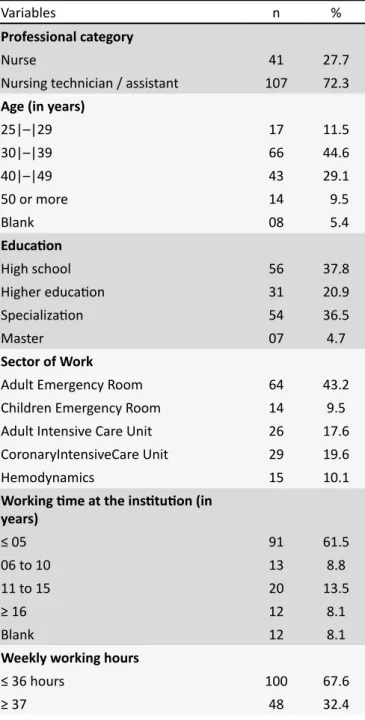
A total of 148 nursing professionals participated; most of which being women (N=117/77, 7%), with median age of 38 years (Minimum = 26, Maximum = 63), nursing technicians and assistants, and acting in the Adult Emergency Room (TABLE 1). The overall compliance score with SP was 13.0 indicating a compliance of 65.0% (N=146). In Table 2, the association between the professional variables was described.
Women (N=114) had a mean score of 12.8 (SD=2.5) and
men (N=32) 12.8 (SD=2.6). There was no statistically significant difference between the genders (p=0.955).
The nurses (N=41) presented mean compliance scores of 11.7 (SD=2.5) and nursing technicians / assistants 13.2 (SD=2.5), demonstrating that these complied with the SP more
than the nurses (p<0.001).
ten years (N=87, SD=2.6) presented mean scores of 12.8, and
there was no statistical difference between the groups (p=0.931).
The weekly workload ranged from 24 to 96 hours; with a me-dian of 36 hours and the working time in the institution ranged from two to 35 years, with a median of 11 years. Those who worked up to 36 hours (N=100) had mean scores of 12.9 (SD=2.6) and those who worked over 37 hours (N=46) 12.6 (SD=2.4), however,
there was no statistically significant difference in SP compliance
and weekly workload (p=0.612).
The SP compliance rate according to CSPS-PB items
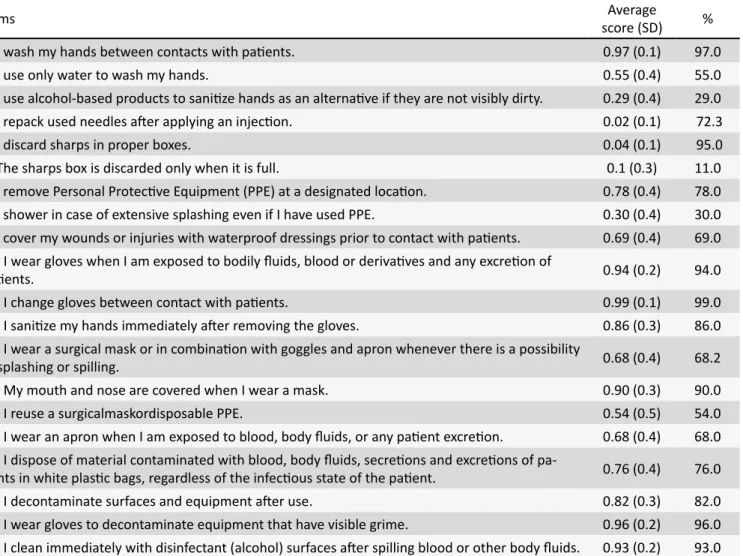
was described in Table 3. Considering that all participants who answered all CSPS-PB items (N=148), the median score was 13.0 (Minimum = 5, maximum 18), which indicates compliance with SP of 65%.
The compliance with the item “hand hygiene between con-tacts with patients” was 97% and “hand hygiene after removing disposable gloves”, 86%.
In the item about “disposing of sharps in self-contained containers”, 95% of the professionals responded to this prac-tice, that is, not all professionals discard correctly. Regarding “hand hygiene after removing disposable gloves”, the alterna-tive “always” corresponded to 86%. At the same time, only one professional (0.7%) answered “often” in the item “change gloves when changing patient”, while the rest of the team answered “all times” for this item.
As for the “use of mask, protective goggles and apron when there is possibility of splashes in the eyes and mucous mem-branes”, the rate was 68.2%. Regarding the “use of an apron /
capote when there is a risk of exposure to blood, body fluids or
any excretion of patients” compliance was of 67.6%. For the item “repacking used needles”, the rate was 72.3%.
DISCUSSION
Participated in the research more nursing technicians and assistants than nurses. Considering that the nursing team is mostly composed of technicians and assistants (77.0%) and most of the participants, young people, which corroborates with the literature.10-13
As to the little experience in the hospital, this data is justified
since it is a teaching hospital, which hired health professionals of all categories, through an open competitive examination. In this aspect, a Brazilian study pointed to an increase in accidents after the introduction of safe devices with engineering control, being
one of the possibilities of justification, the absence of training to
the newly admitted professionals.13
Considering that all professionals should follow the measures of SP, the compliance rate to SP was below expected (65%), that is, it did not happen in its entirety.
When analyzing the answers of each of the CSPS-PB items for some items, compliance with SP for hand hygiene, use of PPE, bath after extensive spattering and needle repacking was unsatisfactory. These data corroborate with the literature, since
Table 1.
Nursing professionals (N=148) working in
high--complexity sectors of a public teaching hospital,
accor-ding to individual, sectoral and professional variables.
Uberaba, MG, 2017.
Variables
n
%
Professional category
Nurse
41
27.7
Nursing technician / assistant
107
72.3
Age (in years)
25|–|29
17
11.5
30|–|39
66
44.6
40|–|49
43
29.1
50 or more
14
9.5
Blank
08
5.4
Education
High school
56
37.8
Higher education
31
20.9
Specialization
54
36.5
Master
07
4.7
Sector of Work
Adult Emergency Room
64
43.2
Children Emergency Room
14
9.5
Adult Intensive Care Unit
26
17.6
CoronaryIntensiveCare Unit
29
19.6
Hemodynamics
15
10.1
Working time at the institution (in
years)
≤ 05
91
61.5
06 to 10
13
8.8
11 to 15
20
13.5
≥ 16
12
8.1
Blank
12
8.1
Weekly working hours
≤ 36 hours
100
67.6
≥ 37
48
32.4
Table 2.
Association of professional variables (N=148)
according to mean scores of compliance with SP (N=148)
of nursing professionals from high complexity sectors of
a public teaching hospital. Uberaba, MG, 2017.
Variables
p
Gender
0.955
Professional Category
< 0.001
Working time in the hospital
0.931
compliance with SP was not fully answered by professionals and
can be affected by factors such as individual, organizational and
work-related factors.4-8
One of the concerns regarding the results presented is the hand hygiene between contacts with patients after removing the gloves, since Regulatory Standard 32 (NR-32)14 states that the use of gloves does not replace the hand hygiene process, which should occur at least before and after the use of the same. Similar results were observed in a study that indicated adherence of 65.6% of the professionals to this practice, even though it was recognized as simple and important in the prevention and control of infections related to health care.10
In an exploratory study on the conformity of the care prac-tice of maintenance of the double lumen temporary catheter for hemodialysis, hand hygiene by health professionals presented one of the worst adherence rates to the practice (83.9%). The authors also emphasize that hand hygiene and behavioral change of professionals should be priority measures in health programs and actions, as they are fundamental and impair the quality of services and patient safety.19
Hand hygiene is the most important and least costly pro-cedure to prevent transmission of health care-related infections and should be part of all educational campaigns, strengthening both periodicity and technical concepts.14
Regarding the use of PPE, in this study it was low. Different
data were reported in a survey15, in which 97.1% of respondents said they always wear disposable gloves when there is possibility of contact with blood or secretions. However, they showed poor adhesion to the apron, goggles and protective mask.16
The use of disposable gloves, when there is possibility of contact with blood or other secretions, revealed that there is still negligence in complying with this measure by some profes-sionals, and resembles unsatisfactory results obtained in other researches, not reaching 100% for the use of this PPE8. Results from a qualitative research on adherence to SP in ICU showed that the procedure glove was the most used PPE by nursing
te-chnicians and the apron was cited as the most difficult to adhere,
followed by glasses, mask and ear protector. The interviewees also stated that there was no adherence of 100% of the SP me-asures, and even that, aware of the risks, they practiced unsafe
Table 3.
Average scores and rate of compliance with the SP, according to the CSPS-PB scale items (N=148), Uberaba,
MG, 2017.
Items
score (SD)
Average
%
1. I wash my hands between contacts with patients.
0.97 (0.1)
97.0
2. I use only water to wash my hands.
0.55 (0.4)
55.0
3. I use alcohol-based products to sanitize hands as an alternative if they are not visibly dirty.
0.29 (0.4)
29.0
4. I repack used needles after applying an injection.
0.02 (0.1)
72.3
5. I discard sharps in proper boxes.
0.04 (0.1)
95.0
6. The sharps box is discarded only when it is full.
0.1 (0.3)
11.0
7. I remove Personal Protective Equipment (PPE) at a designated location.
0.78 (0.4)
78.0
8. I shower in case of extensive splashing even if I have used PPE.
0.30 (0.4)
30.0
9. I cover my wounds or injuries with waterproof dressings prior to contact with patients.
0.69 (0.4)
69.0
10. I wear gloves when I am exposed to bodily fluids, blood or derivatives and any excretion of
patients.
0.94 (0.2)
94.0
11. I change gloves between contact with patients.
0.99 (0.1)
99.0
12. I sanitize my hands immediately after removing the gloves.
0.86 (0.3)
86.0
13. I wear a surgical mask or in combination with goggles and apron whenever there is a possibility
of splashing or spilling.
0.68 (0.4)
68.2
14. My mouth and nose are covered when I wear a mask.
0.90 (0.3)
90.0
15. I reuse a surgicalmaskordisposable PPE.
0.54 (0.5)
54.0
16. I wear an apron when I am exposed to blood, body fluids, or any patient excretion.
0.68 (0.4)
68.0
17. I dispose of material contaminated with blood, body fluids, secretions and excretions of
pa-tients in white plastic bags, regardless of the infectious state of the patient.
0.76 (0.4)
76.0
18. I decontaminate surfaces and equipment after use.
0.82 (0.3)
82.0
19. I wear gloves to decontaminate equipment that have visible grime.
0.96 (0.2)
96.0
acts, such as needle repacking, puncture, withdrawal of access and medication administration without the use of gloves.17
Another point concerns needle repacking, which, although widely discussed by NR-3214, as an insecure and unsafe prac-tice, it is present in the exercise of nursing professionals in this study. It is noteworthy that the hospital provides safe devices with engineering control such as needles, syringes, peripheral venous catheter and others. In a study on this problem, it was found that 60% of the participants have the habit of repacking, bending or disconnecting needles from the syringes with their hands after use.12
In a Brazilian philanthropic hospital, 77.7% of the accidents with biological materials occurred through cutaneous lesions with piercing-cutting materials, 52.7% of which were triggered during procedures and 11.1% due to improper disposal.18
In another investigation, with 66 nursing professionals, of whom 83.33% were nursing technicians, the majority (66.7%)
had insufficient knowledge about SP; no nurse recognized the
disposal of sharps as a measure of SP; and no professional described all the recommendations, which is alarming, consi-dering that such conduct is fundamental to reduce exposure to accidents with biological material and provide improvements in the quality of care.19
As limitations of this study it is highlighted that the cross--sectional design and the use of a scale answered by the
partici-pants themselves in the workplace, which may not reflect in their
entirety the compliance of the same with the SP.
Despite the limitations, these results contribute to prioritize the actions of training programs and permanent education. The results cannot yet be extrapolated to other populations.
CONCLUSION
Compliance with SP by nursing professionals was lower than expected and there was an association of mean compliance scores with SP only for the professional category. These results may contribute to direct strategies to encourage adherence to SP, thus improving the safety of professionals and patients.
FUNDING
By Research Foundation of the State of Minas Gerais (FA-PEMIG) for the funding support, project APQ number 00149/16.
REFERENCES
1. Silva RSS, Madeira MZA, Fernandes MA, Batista OAM, Brito BAM, Carvalho NAR. Riscos ocupacionais entre trabalhadores de enfermagem em Unidade de Terapia Intensiva. Rev Bras Med Trab [Internet]. 2017; [cited2018 Aug 6]; 15(3):267-75. Available from: file:///C:/ Users/susana/Downloads/v15n3a12.pdf
2. Rodrigues PS, Sousa AFL, Magro MCS, Andrade D, Hermann PRS. Acidente ocupacional entre profissionais de enfermagem atuantes em setores críticos de um pronto-socorro. Esc Anna Nery [Internet]. 2017 Apr/Jun; [cited 2018 Aug 6]; 21(2):e20170040. Available from: http:// dx.doi.org/10.5935/1414-8145.20170040
3. Mendonça KM, Tipple AFV, Sousa ACS, Pereira MS, Rapparini C. Acidentes com material biológico em serviços de urgência e emergência. Cienc Enferm [Internet]. 2014 Aug; [cited 2018 Aug 6]; 20(2):65-71. Available from: http://dx.doi.org/10.4067/S0717-95532014000200007
4. Gould DJ, Moralejo D, Drey N, Chudleigh JH, Taljaard M. Methods to improve healthcare worker hand hygiene to decrease infection in patient care. Cochrane Database Syst Rev [Internet]. 2017 Sep; [cited 2018 Oct 26]; 1(9):CD005186 Available from: https://www.cochrane. org/CD005186/EPOC_methods-improve-healthcare-worker-hand-hygiene-decrease-infection-patient-care
5. Bouchoucha SL, Moore KA. Factors Influencing Adherence to Standard Precautions Scale: A psychometric validation. Nurs Health Sci [Internet]. 2018; [cited 2018 Oct 26]; 1-8.Available from: https:// onlinelibrary.wiley.com/doi/epdf/10.1111/nhs.12578
6. Cunha QB, Camponogara S, Freitas EO, Pinno C, Dias GL, Cesar MP. Fatores que interferem na adesão às precauções padrão por profissionais da saúde: revisão integrativa. Enferm Foco [Internet]. 2017 Feb; [cited 2018 Aug 6]; 8(1):72-6. Available from: http://revista. cofen.gov.br/index.php/enfermagem/article/view/980/358
7. Souza V, Cortez EA, Carmo TG. Medidas educativas para minimizar os riscos ocupacionais na equipe de enfermagem da UTI. Rev Pesqui Cuid Fundam (Online) [Internet]. 2017 Apr/Jun; [cited 2018 Aug 6]; 9(2):583-91. Available from: http://dx.doi.org/10.9789/2175-5361.2017.v9i2.583-591
8. Pereira FMV, Lam SC, Gir E. Cultural adaptation and reliability of the compliance with standard precautions scale (CSPS) for nurses in brazil. Rev LatinoAm Enferm [Internet]. 2017 Mar; [cited 2018 Aug 6]; 25:e2850. Available from: http://www.scielo.br/scielo.php?pid=S0104-11692017000100311&script=sci_arttext&tlng=pt
9. Lam SC. Validation and cross-cultural pilot testing of compliance with standard precautions scale: self-administered instrument for clinical nurses. Infect Control Hosp Epidemiol [Internet]. 2014 May; [cited 2018 Aug 6]; 35(5):547-55.Availablefrom: https://www.ncbi.nlm.nih. gov/pubmed/24709724
10. Dourado CARO, Barros DCC, Vasconcelos RVD, Santos AHS. Inquérito sobre conhecimento, atitude e prática de higiene das mãos pelos profissionais da enfermagem. Rev Enferm UFPE On Line [Internet]. 2017 Mar; [cited 2018 Aug 6]; 11(3):1136-45. Available from: https://periodicos.ufpe.br/revistas/revistaenfermagem/article/ viewFile/13488/16206
11. Machado MH, Aguiar Filho W, Lacerda WF, Oliveira E, Lemos W, et al. Características gerais da enfermagem: o perfil sócio demográfico. Enferm Foco [Internet]. 2015; [cited 2018 Aug 6]; 6(1/4):11-7. Available from: http://biblioteca.cofen.gov.br/wp-content/uploads/2016/07/ Características-gerais-da-enfermagem-o-perfil-sócio-demográfico. pdf
12. Lima IAS, Oliveira GG, Rodrigues ARG, Sousa MNA. Acidentes ocupacionais com perfurocortantes: estudo com profissionais de enfermagem. Rev Interdisc Saúde [Internet]. 2015 Jan/Mar; [cited 2018 Aug 6]; 2(1):26-43. Availablefrom: http://interdisciplinaremsaude. com.br/Volume_3/Trabalho_03.pdf
13. Carvalho PCF, Reis RK, Pereira FM, Malaguti-Toffano SE. Injury rates from peripheral catheters with or without safety devices in a Brazilian public hospital. Am J Infect Control [Internet].2016 Jul; [cited 2018 Oct 16]; 1;44(7):853-4. Available from: https://linkinghub.elsevier.com/ retrieve/pii/S0196-6553(16)00060-2
14. Ministério do Trabalho e Emprego (BR). Portaria N.°485, 11 de novembro de 2005. Aprova a Norma Regulamentadora n.º 32 (Segurança e Saúde no Trabalho em Estabelecimentos de Saúde). [Internet]. Brasília (DF): Diário Oficial da União; 2005[cited 30 Nov 2018]. Available from: http://sbbq.iq.usp.br/arquivos/seguranca/ portaria485.pdf
16. Piai-Morais TH, Orlandi FS, Figueiredo RM. Fatores que influenciam a adesão às precauções-padrão entre profissionais de enfermagem em hospital psiquiátrico. Rev Esc Enferm USP [Internet]. 2015; [cited 2018 Aug 6]; 49(3):478-85.Available from: http://www.scielo.br/pdf/reeusp/ v49n3/pt_0080-6234-reeusp-49-03-0478.pdf
17. Brand CI, Fontana RT. Biossegurança na perspectiva da equipe de enfermagem de Unidades de Tratamento Intensivo. Rev Bras Enferm [Internet]. 2014 Jan/Feb; [cited 2018 Aug 6]; 67(1):78-84. Available from: http://dx.doi.org/10.5935/0034-7167.20140010
18. Dornelles C, Carvalho LA, Thofehrn MB, Nunes NJS, Fernandes HN. Exposição de profissionais de saúde ao material biológico: estudo no ambiente hospitalar. J Nurs Health [Internet]. 2016 Apr; [cited 2018 Aug 6]; 1(1):64-75. Available from: https://periodicos.ufpel.edu.br/ojs2/ index.php/enfermagem/article/view/5463