EFFECTS OF STORAGE AND SOLVENT TYPE IN A LIPOPHYLIC CHEMICAL
PROFILE OF THE SEAWEED
Dictyota menstrualis*
Diana Negrão Cavalcanti1,2**; Marcelo Augusto Vasconcelos Gomes2; Angelo Cunha Pinto1; Claudia Moraes de Rezende1; Renato Crespo Pereira2 and Valéria Laneuville Teixeira2
1
Instituto de Química, Universidade Federal do Rio de Janeiro Programa de Pós-Graduação em Química Orgânica
(CEP 21.941-590, Rio de Janeiro, RJ, Brasil)
2
Universidade Federal Fluminense - Departamento de Biologia Marinha (Caixa Postal 100.644, 24.001-970, Niterói, RJ, Brasil)
**Corresponding author: [email protected]
A
B S T R A C TCrude extracts from specimens of the brown seaweed Dictyota menstrualis, known to produce diterpenes as their major secondary metabolites, were analyzed according to storage procedures before extraction, and the solvent types used to obtain the crude extracts. The specimens of D. menstrualis were submitted to three types of storage procedures, such as wet, dry, and frozen and were extracted with a mixture of dichloromethane:methanol (2:1) and acetone. Qualitative differences were not observed by GC/MS analyses of all crude extracts containing mainly the diterpenes pachydictyol A (I), 6-hydroxy-dichotoma-3,14-diene-1,17-dial (II), 6-hydroxy-2,7-cycloxenia-3,14-diene-1,17-dial (III), and 6-acetoxy-dichotoma-3,14-diene-1,17-dial (IV). The most efficient and selective extraction of the compounds with intermediate polarity produced by D. menstrualis was obtained using acetone, but with less mass production. In general, the storage procedures produced very similar results, but the frozen samples furnished low amount of total diterpenes. According to these results on chemical analysis of crude extracts of seaweeds, the choice of solvent to extraction should be considered as important aspect to better screening bioactive compounds.
R
E S U M OOs extratos brutos de espécimes da alga parda D. menstrualis, conhecida por produzir diterpenos como principais metabólitos secundários, foram analisados quanto ao modo de armazenamento antes da extração e tipo de solvente utilizado na obtenção do extrato bruto. Os solventes utilizados foram uma mistura diclorometano:metanol (2:1) e acetona. Os espécimes de D. menstrualis foram submetidos a três formas de armazenamento, denominados fresco, seco e congelado. Não foram observadas diferenças qualitativas nas amostras obtidas de quaisquer dos extratos brutos na análise por CG/EM, sendo compostas pelos diterpenos pachydictyol A (I), 6-hidroxi-dichotoma-3,14-dieno-1,17-dial (II), 6-hidroxi-2,7-cicloxenia-3,14-dieno-1,17-dial (III) e 6-acetoxi-dichotoma-3,14-dieno-1,17-dial (IV). Os resultados indicaram que a extração mais eficaz para os componentes de média polaridade de D. menstrualis foi obtida com o uso de acetona, que promoveu extração mais seletiva, mesmo apresentando menor rendimento em massa. Quanto à forma de armazenamento das algas, foi constatado que as metodologias não diferiram significativamente entre si, apesar da tendência de algas congeladas fornecerem o menor rendimento no total de diterpenos. Portanto, nos trabalhos envolvendo análises químicas de extratos brutos de macroalgas marinhas, a escolha do solvente de extração deve ser considerada como fator importante na varredura de substância bioativas.
Descriptors: Dictyota menstrualis, Gas chromatography, Crude extract, Chemical profile. Descritores: Dictyota menstrualis, Cromatografia gasosa, Extrato bruto, Perfil químico.
I
NTRODUCTIONThe knowledge about the chemical composition of marine organisms is an essential element for assessing chemotaxonomic, chemical ecology, and natural products studies, including that pointed to evaluate the ecological/biological roles.
Seaweeds produce hundreds of secondary metabolites, including terpenoids (major sesqui- and diterpenes), acetogenins, amino acid-derived compounds, unusual fatty acids, polyphenols (= phlorotannins) and metabolites produced through mixed biosynthesis that have terpenoid and phenol portions (BLUNT et al., 2006, and previous review cited therein). Several of these secondary metabolites are capable of inhibit herbivory or exhibit a wide action against other adverse agents in the marine
environment (PAUL et al., 2006; AMSLER ;
FAIRHEAD, 2006).
Among the Phaeophyceae (brown seaweeds) of both tropical and warm temperate marine regions,
Dictyota species are known to produce feeding deterrents secondary metabolites against herbivores, such as the well-studied family of structurally similar dictyol diterpenes, including pachydictyol A, dictyol E, dictyol B, dictyol B acetate, and dictyol H, which have been shown to be active anti-feedant metabolites in ecological assays (see Pereira et al., 1994 for
Parhyale hawaiensis and Hay and Steinberg, 1992, for review about remaining herbivore species). Natural concentrations of pachydictyol A, found in some species of Dictyota, can inhibit herbivory by tropical parrotfish species, by the temperate fishes Lagodon rhomboides and Diplobus holbrooki, and by the sea urchin Diadema antillarum. On the other hand, this same metabolite does not inhibit feeding by the sea
urchin Arbacia punctulata, the cosmopolitan
polychaete Platynereis dumerilii, or the amphipod
Parhyale hawaiensis, and has further been shown to
increase feeding in the amphipod Ampithoe
longimana. Dictyol E reduces herbivory in L. rhomboides, D. holbrooki and Arbacia punctulata, but is not an effective defense against A. longimana and
Platynereis dumerilii. Finally, pachydictyol A, dictyol B, and dictyol H significantly inhibit herbivory in the rabbitfish Siganus doliatus.
Seaweed secondary metabolites are not a qualitative or quantitatively absolute or invariant characteristic of a species. To the contrary, the yields of secondary metabolites can be changed by intrinsic characteristics of the seaweed, environmental, and genetic aspects (e.g. see AMSLER ; FAIRHEAD, 2006; PAUL et al., 2006), or by extrinsic aspects related to biochemical activity (e.g. KLEINER, 1991), heat (e.g. NEWMAN et al., 1992), light (e.g. CORK and KROCKENBERGER, 1991), vacuum (e.g. HAY et al., 1988), extraction solvent (e.g. MUZIKA et al.,
1990), drying procedure (e.g. LINDROTH; PAJUTEE, 1987), duration of extraction (e.g. ZOBEL; BROWN, 1988), storage and extraction of procedures (CRONIN et al., 1995).
The brown seaweed Dictyota menstrualis
can be considered a model for chemical ecology studies in Brazilian coast. Previous studies revealed that their crude extract act as anti-feedant metabolites against crab and amphipod (PEREIRA et al., 2000). In contrast, natural concentrations of the well-known pachydictyol A, also found in this species from the Brazilian coast, were not deterrent to the same amphipod species (PEREIRA et al., 1994). In fact, an uncommon and most polar diterpene found as second major metabolite in D. menstrualis is responsible for the chemical defense activity previously observed in this algal species (PEREIRA et al., 2000).
Marine ecologists have rarely assessed how methodologies used in sample preparation affect the extractibility and stability of secondary metabolites. The purpose of this study was to evaluate the type of storage or extraction procedure and the effect of solvent in yields of lipophylic chemical profile of the brown seaweed Dictyota menstrualis.
M
ATERIAL ANDM
ETHODS Collect and ExtractionSpecimens of D. menstrualis were collected at Praia Rasa, Búzios, RJ, in April, 16, 2003 (Voucher specimens have been deposited at the Herbarium Bradeanum of the Universidade do Rio de Janeiro, HRJ 10.017).
A mixture of dichloromethane-DCM:methanol-MeOH (2:1) and acetone were used in the two types of solvents employed in the extraction of lipophylic chemicals of D. menstrualis. On the other hand, the specimens of D. menstrualis were submitted to three types of storage procedures: wet- in which the specimens were immersed in solvent just after the collect (wet procedure); dry- the specimens were dried under natural conditions during 24 h and after extracted with solvents (dry procedure), and frozen- when the specimens were frozen by 90 days and after submitted to extraction with appropriated solvent (frozen procedure). Thesame number of aliquots (n= 5), extractions (n= 3) and volume of solvent (15 mL) were used for each procedure. Evaporation of the solvent under reduced pressure yielded residues submitted to previous purification.
Technical aspects
The samples were injected in split mode (1:20) and the oven temperature program was as follows: 160°C, 4°C/min to 260°C, then 15°C/min to 290°C (15 min). The temperature of the injector and detector were maintained at 270°C and 290°C, respectively.
Chromatographic analyses by Thin Layer Chromatography (TLC) were carried out in silica gel
60 F254 plates (E. Merck, Darmstadt) and the
compounds were visualized by UV light (254 and 365 nm) and stained with ceric sulphate 2% in sulfuric acid, followed by heating.
Partial Purification of the Extracts of D. menstrualis
Two methods were carried out to partial purification of the extracts obtained from D. menstrualis: partition with hexane (ALVES, 2000) and by a silica gel 60 column chromatography with a ring of active charcoal on their surface (MARCHI, 1994).The column was eluted with a 50% hexane:ethyl acetate (EtOAc), and ethyl acetate (100%). In the partition process, a total of 193 g of seaweed were extracted with acetone and the obtained organic residue (8 g) was submitted to partition with 300 mL of hexane/water (3 x) to obtain 2 g of a hexanic extract (about 5 % of the alga – dry weight).
In the filtration process, the crude extract was put in a silica gel 60 Mesh column with active charcoal on their surface. A total of 2.0 g of sílica and 0.030 g of charcoal were used for each 1.0 g of crude extract. The elution was carried out with 70 mL 50% hexane: EtOAc, followed by 40 mL EtOAc (100%).
Analysis of the Purified Extracts by GC/MS
All samples were diluted in EtOAc, maintained the final concentration of 15 mg/mL. A total of 1 µL of each sample was injected, with split mode (1:20); double analysis for each sample.
R
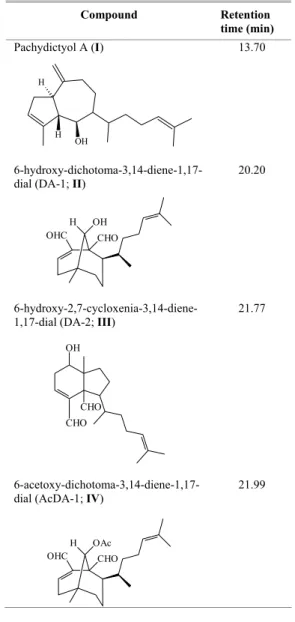
ESULTS The Major CompoundsFour diterpenes, pachydictyol A (I), 6-hydroxy-dichotoma-3,14-diene-1,17-dial (II), 6-hydroxy-2,7-cycloxenia-3,14-diene-1,17-dial (III), and 6-acetoxy-dichotoma-3,14-diene-1,17-dial (IV), were found in D. menstrualis, with different retention times (min) observed by GC analysis, 13.70, 20.20, 21.77, and 21.99, respectively (Table 1). According to this first analysis, they are the four major diterpene metabolites found in the Brazilian D. menstrualis
studied.
Extraction Before Purification
The extraction carried out previous by to the purification procedure furnished 47, 28, 15 and 10% of compounds II, III, IV and I, respectively (Fig. 1).
At first, this is the chemical profile of D. menstrualis
obtained from crude extract without treatment.
Extract Analysis After Partial Purification
The analysis by GC/MS confirmed the similarity between the fractions obtained after the two types of partial purification (Fig. 2). However, the use of a silica gel column chromatography furnished better yields and more substances than major diterpenes I to
IV. In fact, both purification procedures produced very similar chemical profile, but the analysis by TLC revealed that after the partial purification by column produce mainly loss of most polar compounds.
Table 1. Retention times of the major secondary metabolites from D. menstrualis by GC analysis.
Compound Retention time (min)
Pachydictyol A (I)
OH H H
13.70
6-hydroxy-dichotoma-3,14-diene-1,17-dial(DA-1; II)
CHO OHC
OH H
20.20
6-hydroxy-2,7-cycloxenia-3,14-diene-1,17-dial(DA-2; III)
OH
CHO CHO
21.77
6-acetoxy-dichotoma-3,14-diene-1,17-dial(AcDA-1; IV)
CHO OHC
OAc H
IV 15% III
28%
II 47%
I 10%
Fig. 2. GC chromatogram of the fractions purified partially of the crude extract of D. menstrualis. (A) Partition with n-hexane; (B) Column in sílica gel + active coal.
5.00 10.00 15.00 20.00 25.00 30.00 0
100000 200000 300000 400000 500000 600000 700000 800000 900000 1000000 1100000 1200000 1300000 1400000
Time-->
Abundance TIC: DMA.D
5.00 10.00 15.00 20.00 25.00 30.00 0
100000 200000 300000 400000 500000 600000 700000 800000 900000 1000000
Time-->
Abundance
TIC: AC1.D
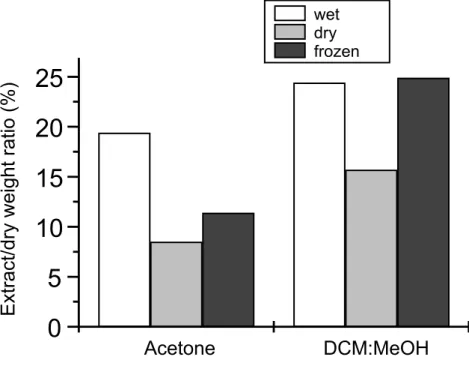
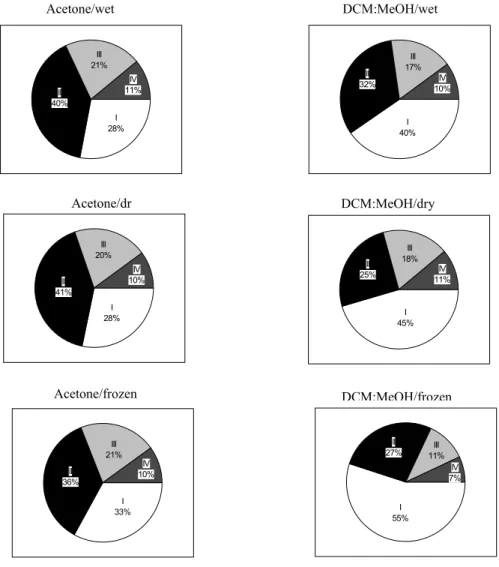
Before partial purification by column, extracts were obtained using acetone and DCM:MeOH from all storage procedures (Fig. 3). The ratio between the major components of the extract of D. menstrualis
without purification reveals that II is the major diterpene, ranging from 36 to 41% in samples (wet, dry and frozen) extracted with acetone, and 25 to 32% in these same sample types extracted with a mixture of solvents – DCM: MeOH – 2:1. Both solvents produced very similar ratio between the major compounds found in D. menstrualis. However, the extraction using acetone produced higher mass of each compound. Compared to ratio of compounds in the crude extract before purification (Fig. 4), the extraction with acetone alone is more realistic due to yield of high amount of the diterpene II.
D
ISCUSSIONResults of this investigation indicate that storage, extraction, and quantification methods need to be optimized for analyses of individual compounds from the algae.
Throughout the analysis by GC/MS it was possible to verify that the chemical profile of the brown seaweed Dictyota menstrualis is constituted by
four major secondary metabolites I-IV. Among these compounds, the diterpene II is known to exhibit ecological role as chemical defense against herbivores (PEREIRA et al., 2000). However, recent complementary analysis revealed that this Brazilian seaweed possess four other minor compounds besides those found in this study (CAVALCANTI et al., 2006; TEIXEIRA et al, 2001). According to these evidences it is possible to suggest that GC/MS can be an efficient method to supply information about major secondary metabolites from D. menstrualis mainly to use in ecological studies.
According to storage type, previous works on frozen specimens of D. ciliolata and D. menstrualis
(CRONIN et al., 1995) should quantities of less pachydictyol A (I), dictyol E, dictyol B acetate and dictyodial. According to our results, the concentrations of the four secondary metabolites did not differ among the storage treatments (wet, dry, and frozen). In fact, our results suggest that some variations was obtained by use of different solvents, better than due to storage mode of the alga. At first, we could think that DCM:MeOH would be a better option to obtain higher mass of compounds from D. menstrualis. In the partially purified fractions, the importance of each component was always less than that found in no
Fig. 3. Yield in weight of the crude extracts of D. menstrualis obtained by different storage methods and extraction procedures (solvents).
Acetone
DCM:MeOH
0
5
10
15
20
25
Ext
ra
ct
/d
ry
w
e
ig
h
t
ra
ti
o
(%
)
Fig. 4. Percentual area of the major components of the partially purified extracts obtained by different storage methods and extraction procedures (solvents).
purified extracts. In those extracts obtained using acetone, a higher proportion of the polar components
II, III and I was observed, while from those extracts
produced with DCM:MeOH, the component I was
better extracted. However, the crude extract from D. menstrualis with acetone was better selective than indicated by previous study (CRONIN et al., 1995).TLC analysis demonstrated that extraction with acetone produce the most efficiency to obtain the major secondary metabolites from D. menstrualis, while the extraction with DCM:MeOH extract metabolites minor, other than these major compounds. Although with less mass yield (13%) compared to DCM:MeOH extraction (21%), it was possible to recuperate most of the extract after partial purification and their fractions were quali- and quantitatively very similar to that obtained by extraction with DCM:MeOH.
Several studies used a mixture of solvents such as dichloromethane (or chloroform)and methanol to extraction of natural products from marine
organisms (e.g. SIAMOPOULOU et al., 2004;
CRONIN et al., 1995; BHEEMASANKARA RAO et al., 1994; SCHLENK; GERWICK, 1987). However, among the studies that used only one high polarity solvent to extraction (e.g. ethyl acetate, acetone, ethanol or methanol) the minor high polarity components were isolated, much of them exhibiting biological activities (e.g. DURÁN et al., 1997;
NINOMYA et al., 1995; BOUAÏCHA et al., 1993;
ISHITSUKA etal., 1984).
According to our results on the chemical
profile of D. menstrualis by GC/MS, storage
procedures and solvent types, the choice of solvent to extraction should be considered as an important aspect to better screening bioactive compounds. Many
IV 11% III 21%
II 40%
I 28%
IV 10% III 17% II
32%
I 40%
IV 10% III 20%
II 41%
I 28%
IV 11% III 18% II 25%
I 45%
IV 10% III 21%
II 36%
I 33%
IV 7% III 11% II 27%
I 55%
Acetone/dr DCM:MeOH/dry
species of Dictyota are referred to produce dictyols, representatives of the prenylated guaiane diterpenes, including four compounds known for D. menstrualis. Then, this chemical procedure can be required to obtain better realistic chemical profile of Dictyota
species.
A
CKNOWLEDGEMENTSNational Brazilian Research Council (CNPq) supported this research. R.C.P., A.C.P., C.M.R. and V.L.T. thank CNPq for the Research Productivity Fellowships. D.N.C. gratefully acknowledges CAPES for providing PhD Fellowship.
R
EFERENCESALVES, A. B. Constituintes químicos de Burlemarxia
rodriguesii Menezes & Semir (Velloziaceae).
Dissertação (Mestrado). Instituto de Química, Universidade Federal do Rio de Janeiro. Rio de Janeiro, 2000.
AMSLER, C. D.; FAIRHEAD, V. A. Defensive and sensory chemical ecology of brown algae. Adv. bot. Res., v. 43, p. 1-91, 2006.
BHEMASANKARA RAO, C. H.; TRIMURTULU, G.; SREEDHARA, C. H.; VENKATA RAO, D.; BOBZIN, S. C.; FAULKNER, J. D. Diterpenes from the brown alga Dictyota bartayresiana. Phytochemistry, v. 37, p. 509-513, 1994.
BLUNT, J. W.; COPP, B. R.; MUNRO, M. H. G.; NORTHCOTEC, P. T. ; PRINSEP, M. R. Marine natural products. Nat. Prod. Rep., v. 23, p. 26-78, 2006. BOUAÏCHA, N.; TRINGALI, C.; PESANDO, D.;
MALLÉA, M.; ROUSSAKIS, C. ; VERBIST, J. F. Bioactive diterpenoids isolated from Dilophus ligulatus.
PlantaMed., v. 59, p. 256-258, 1993.
CAVALCANTI, D. N.; TEIXEIRA, V. L.; REZENDE, C. M.; PINTO, A. C. Diterpenoid constituents from the brown alga Dictyota menstrualis (Dictyotaceae, Phaeophyta). Nat. Prod. Communicts, v. 1, p. 609-611, 2006.
CORK, S. J.; KROCKENBERGER, A. K. Methods and pitfalls of extracting condensed tannins and other phenolics from plants: insights from investigations on Eucalyptus leaves. J. chem. Ecol., v. 17, p. 123-134, 1991.
CRONIN, G.; LINDQUIST, N.; HAY, M. E.; FENICAL, W. Effects of storage and extraction procedures on yields of lipophilic metabolites from the brown seaweeds Dictyota ciliolata and D. menstrualis. Mar. Ecol. Prog. Ser., v. 119, p. 265-273, 1995.
DURÁN, R.; ZUBÍA, E.; ORTEGA, M. J.; SALVÁ, J. New diterpenoids from the alga Dictyota dichotoma.
Tetrahedron, v. 53, p. 8675-8688, 1997.
HAY, M. E.; STEINBERG, P.D. The chemical ecology of plant-herbivore interactions in marine versus terrestrial communities. In: ROSENTHAL, J. A.; BERENBAUM, M. R. (Ed.). Herbivores: their interactions with secondary metabolites, evolutionary and ecological
processes. San Diego, CA: Academic Press, 1995. p. 371-413.
HAY, M. E.; DUFFY, J. E.; FENICAL, W.; GUSTAFSON, K. Chemical defense in the seaweed Dictyopteris delicatula: differential effects against reef fishes and amphipods. Mar. Ecol. Prog. Ser., v. 48, p. 185-192, 1988.
ISHITSUKA, M.; KUSUMI, T.; TANAKA, J.; CHIHARA, M.; KAKISAWA, H. NEW diterpenes from the brown alga Pachydictyon coriaceum. Chem. Lett., p. 151-154, 1984.
KLEINER, K.W. Stability of phenolic and protein measures in excised oak foliage. J. chem. Ecol., v. 17, p. 1243-1251, 1984.
LINDROTH, R. L.; PAJUTEE, M. S. Chemical analysis of phenolic glycosides: art, facts, and artifacts. Oecologia, v. 74, p. 144-148, 1987.
MARCHI, E. Análise cromatográfica dos extratos hexânicos de Mikania glomerata Spreng. Dissertação (Mestrado). Instituto de Química-São Carlos, Universidade de São Paulo. São Paulo,1994.
MUZIKA, R. M.; CAMPBELL, C. L.; HANOVER, J. W. ; SMITH, A. L. Comparison of techniques for extracting volatile compounds from conifer needles. J. chem. Ecol., v. 16, p. 2713-2722, 1987.
NEWMAN, R. M.; HANSCOM, Z.; KERFOOT, C. The water-cress glucosinolate-myrosinase system: a feeding deterrent to caddisflies, snails, and amphipods.
Oecologia, v. 92, p. 1-7, 1992.
NINOMYA, M.; MATSUKA, S.; KAWAKUBO, A.; BITO, N. Jpn. KokaiTokkyoKoho JP, 285, 877, 1992. PAUL, V. J.; PUGLISI, M. P.; RITSON-WILLIAMS, R.
Marine chemical ecology. Nat. Prod. Rep., v. 23, p. 153-180, 2006.
PEREIRA, R. C.; CAVALCANTI, D. N. E; TEIXEIRA, V. L. Effects of secondary metabolites from the tropical Brazilian brown alga Dictyota menstrualis on the amphipod Parhyale hawaiensis. Mar. Ecol. Prog. Ser., v. 205, p. 95–100, 2000.
PEREIRA, R. C.; TEIXEIRA, V. L.; KELECOM, A. Chemical defenses against herbivores in marine algae. 1. The brown alga Dictyota dichotoma (Hudson) Lamouroux from Brazil. An. Acad. bras. Ci., v. 66, p. 228-235, 1994.
SCHLENK, D.; GERWICK, W. H. Dilophic acid a diterpenoid from the tropical brown seaweed Dilophus guineensis. Phytochemistry, v. 26, p. 1081-1084, 1987. SIAMOPOULOU, P.; BIMPLAKIS, A.; ILIOPOULOU, D.; VAGIAS, C.; COS, P.; BERGHE, D. V. ; ROUSSIS. Diterpenes from the brown algae Dictyota dichotoma and Dictyota linearis.Phytochemistry, v. 65, p. 2025-2030, 2004.
TEIXEIRA; V. L.; CAVALCANTI, D. N.; PEREIRA, R. C. Chemotaxonomic study of the diterpenes from the brown alga Dictyota menstrualis. Biochem. Syst. Ecol., v. 29, p. 313-316, 2001.
ZOBEL, A. M.; BROWN, S. A. Determination of furano-coumarins on the leaf surface of Ruta graveolens with an improved extraction technique. J. Nat. Prod., v. 51, p. 941-946, 1988.