Article
J. Braz. Chem. Soc., Vol. 27, No. 3, 484-492, 2016. Printed in Brazil - ©2016 Sociedade Brasileira de Química 0103 - 5053 $6.00+0.00
A
*e-mail: [email protected]
#Members of the National Research Council of Argentina (CONICET).
Synthesis of Organotin Substituted Tricyclic Macrodiolides
Flavia C. Zacconi,a Romina A. Ocampo,b,# Julio C. Podestáb,# and Liliana C. Koll*,b,#
aFacultad de Química, Pontificia Universidad Católica de Chile, Vicuña Mackenna 4860,
Macul, 78204336 Santiago, Chile
bInstituto de Química del Sur (INQUISUR), Departamento de Química, Universidad Nacional
del Sur, Av. Alem 1253, 8000 Bahía Blanca-BA, Argentina
The radical addition of triorganotin hydrides, R3SnH (R = n-butyl, phenyl, neophyltin), to four
unsaturated diesters of (11R,12R)-9,10-dihydro-9,10-ethaneanthracene-11,12-dimethanol leads to products of cyclohydrostannation with an average yield of around 80%. Whereas the addition of these hydrides to diacrylate and dimethacrylate leads to the expected mixtures containing two and four distereoisomeric cyclized products respectively, the addition to methyl- and di-2-phenylcinnamate yields only four out of the sixteen possible stereoisomers. The observed high stereoselectivity is consistent with a radical tandem cyclohydrostannation mechanism. Full proton (1H), carbon 13 (13C) and tin 119 (119Sn) nuclear magnetic resonance (NMR) data are given.
Keywords: organotin substituted macrodiolides, cyclohydrostannation, stereoselective tandem cyclization
Introduction
Macrocyclic structures are commonly found in natural products and pharmaceutical molecules and provide privileged scaffolds for medicinal chemistry programs in modern drug discovery.1 They have had an enormous
impact on the fields of chemistry, biology and medicine.1-5
Macrocyclic natural products continue to serve as invaluable starting points and to drive and inspire organic and medicinal chemists to discover new and better drugs.1,6,7 Different from
synthetic small molecule drugs, characteristics macrocyclic natural products typically include 10 or more membered ring architecture.This unique structural feature and conformational flexibility of the macrocyclic ring can offer subsequent functional advantages, e.g., it has the potential of being highly potent, as well as selective when key functional groups interact with biological targets.1 In addition, from a
chemistry point of view, macrocyclic compounds can offer diverse functionality and stereochemical complexity in a conformationally restricted fashion. Moreover, they may have favorable druglike properties, including good solubility, increased lipophilicity, enhanced membrane penetration, improved metabolic stability and good oral bioavailability with desirable pharmacokinetic and pharmacodynamic
properties.1,4 Their biological and medicinal activities
have made the macrolides very important target molecules of synthetic studies.8 A number of synthetic strategies
and methodologies have been developed for macrolide synthesis.9 Commonly, these syntheses involve many steps
and the global yields are very low.10 On the other hand,
organotin(IV) compounds have various biocidal activities and show a toxicity, which is dependent on both the number and nature of the organic groups attached to the tin atom. They have found applications as fungicides, acaricides, antifoulings, disinfectants, wood preservatives and others.11
The compounds include both alkyl and aryl organotin derivatives. In addition, some of them, like triphenyltin carbohydrates, have antitumor activity.12 However, we have
not found reports of the biological activity of stannilated macrodiolides.
We have recently reported a method for the synthesis of new 11 membered macrodiolides.13 The starting materials
for building these cycles are open-chain systems with two carbon−carbon double bonds conjugated with electron withdrawing substituents, like ester group, i.e., activated for radical reactions, as shown in Figure 1.
symmetry.14 We found that the addition of triorganotin
hydrides (R3SnH) to the unsaturated diesters leads to
stannylated macrocycles with high stereoselectivity through a cyclohydrostannation tandem mechanism.13
In order to determine the effect of the structural features of unsaturated diesters on cyclohydrostannation reactions, we considered it of interest to carry out a study on the addition of organotin hydrides to some unsaturated diesters of (11R,12R )-9,10-dihydro-9,10-ethaneanthracene-11,12-dimethanol with C2 symmetry,15 and to compare the results
obtained with those of other C2 symmetry unsaturated
diesters with different structural arrangements.
Results and Discussion
The addition, under free radical conditions, i.e., argon
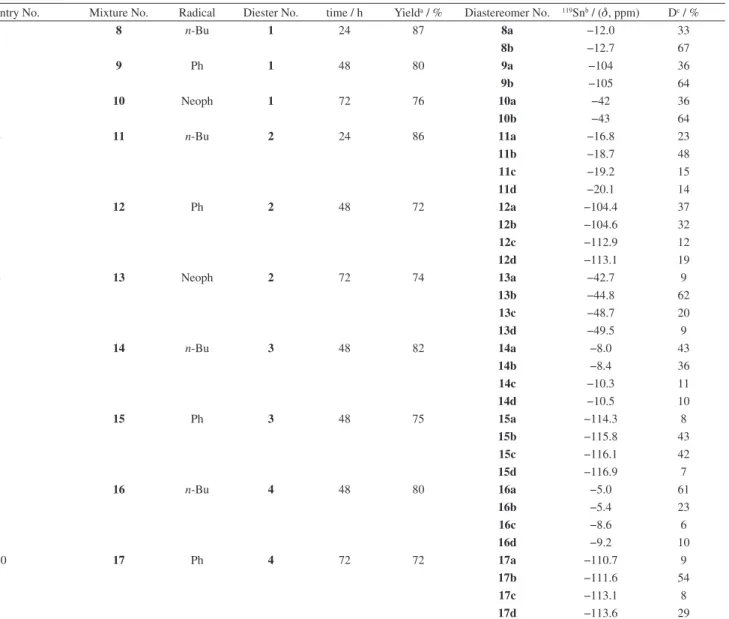
atmosphere, 75 °C and azobisisobutyronitrile (AIBN) as radical initiator, of tri-n-butyl- (5), triphenyl- (6), and trineophyltin (7) hydrides, to [(9R,10R,11S,12S )-9,10-dihydro-9,10-ethanoanthracene-11,12-diyl)bis(methylene)] diacrylate (1) in toluene leads, in all cases, to products of cyclohydrostannation (type I compounds, Scheme 1). These results were obtained using ratios organotin hydride/diester 1
= 2.1 (tin hydride concentration = 0.12 mol L−1) as well as 1.3
(tin hydride concentration = 0.074 mol L−1, Scheme 1). It is
to note that in these cases neither products of double addition (II, Scheme 1) nor products of polymerization were obtained. Because with substrate 1 the cyclohydrostannation leads to the creation of only one new stereogenic center, a maximum of two diastereomers are expected in each case. The tin 119 nuclear magnetic resonance (119Sn
NMR) spectroscopic analysis of the crude products obtained in the additions of triorganotin hydrides 5, 6, and
7 to diester 1 showed, in each case, the anticipated two signals corresponding to the 119Sn atom present in each
diastereomer. It also showed that the stereoisomers were formed in different proportions, clearly indicating some degree of diastereoselection (Table 1). It is to add that the proportion among the diastereomers in the mixtures (8a-8b,
9a-9b and 10a-10b) was almost the same in the three cases studied, as shown in Table 1.
O O
O O
Figure 1. Carbon−carbon double bonds conjugated with electron withdrawing ester group.
O H
R1
R2
O O
H
R1
R2
O
AIBN, 75 °C
Toluene O O
O
SnR3 O
R3Sn
Polymers
Neoph = Neophyl = CH2
R3SnH +
O
O O
O R1
R3Sn
R2 R
2
R1
R2
R1
R1
R2
Diester No. R1 R2
2 Me H
3 Me Ph
4 Ph Ph
Hydride No. R
5 n-Bu
6 Ph
7 Neoph
Cycles No. R R1 R2 8ab n-Bu H H 9ab Neoph H H
10ab Ph H H
11ad n-Bu Me H 12ad Neoph Me H
13ad Ph Me H
14ad n-Bu Me Ph 15ad Ph Me Ph
16ad n-Bu Ph Ph 17ad Ph Ph Ph Cycles No. R R1 R2
I II
1 H H
Scheme 1. Triorganotin hydrides additions to unsaturated diesters 1-4. Me, n-Bu, Ph and Neoph represents methyl, n-butyl, phenyl and neophyl, respectively. O
O
O O
O H
R1 R2
O O
H
R1 R2 O
AIBN, 75 °C
Toluene O O
O
SnR3
O
R3Sn
Polymers
Neoph = Neophyl = CH2
R3SnH +
O
O O
O R1
R3Sn
R2 R 2
R1 R2
R1
R1 R2
Diester No. R1 R2
2 Me H
3 Me Ph
4 Ph Ph
Hydride No. R
5 n-Bu
6 Ph
7 Neoph
Cycles No. R R1 R2
8ab n-Bu H H
9ab Neoph H H
10ab Ph H H
11ad n-Bu Me H
12ad Neoph Me H
13ad Ph Me H
14ad n-Bu Me Ph
15ad Ph Me Ph
16ad n-Bu Ph Ph
17ad Ph Ph Ph
Cycles No. R R1 R2
I II
The hydrostannation of dimethacrylate 2 with triorganotin hydrides 5-7 (Table 1, entries 4-6) creates two new stereocenters and leads to the four diastereomers expected. In all the cases studied, one of the four diastereomers was formed in higher proportion than the other ones.
Thus, the addition of tri-n-butyltin hydride 5 to diester 2 leads to a mixture of four products that contains diastereomer 11b (Table 1) in 48%. Similarly, in the mixture of products resulting from the addition of triphenyltin hydride 6 to ester 2 predominates the stereoisomer 12a
(37%). The hydrostannation of 2 with trineophyltin hydride 7 to compound 2 leads to a mixture containing diastereomer 13b in 62%. The latter suggests that both the slow speed of the attack and the bulk of the neophyl
substituent combine to achieve a higher selectivity in the cyclohydrostannation.
On the other hand, in the case of the disubstituted acrylates 3 and 4 where four new stereogenic centers are created and therefore 16 diastereomers should be expected, only four diastereomers are formed instead. This indicates that the addition to these substrates take place with very high diastereoselectivity (Table 1, entries 7-10). As shown in Table 1, the yields of these reactions were in a range of 72-87%. Reaction’s times for the hydrostannations with
n-Bu3SnH 5 were 24 h for the less substituted esters 1 and
2, and 48 h for the more crowded diesters 3 and 4. Whereas the addition of Ph3SnH 6 to diesters 1-3 took 48 h and 72 h
to ester 4, the hydrostannations with trineophyltin hydride 7
needed 72 h with diesters 1 and 2, and no reaction was
Table 1. Addition of triorganotin hydrides to unsaturated diesters 1-4 (Scheme 1)
entry No. Mixture No. Radical Diester No. time / h Yielda / % Diastereomer No. 119Snb / (d, ppm) Dc / %
1 8 n-Bu 1 24 87 8a −12.0 33
8b −12.7 67
2 9 Ph 1 48 80 9a −104 36
9b −105 64
3 10 Neoph 1 72 76 10a −42 36
10b −43 64
4 11 n-Bu 2 24 86 11a −16.8 23
11b −18.7 48
11c −19.2 15
11d −20.1 14
5 12 Ph 2 48 72 12a −104.4 37
12b −104.6 32
12c −112.9 12
12d −113.1 19
6 13 Neoph 2 72 74 13a −42.7 9
13b −44.8 62
13c −48.7 20
13d −49.5 9
7 14 n-Bu 3 48 82 14a −8.0 43
14b −8.4 36
14c −10.3 11
14d −10.5 10
8 15 Ph 3 48 75 15a −114.3 8
15b −115.8 43
15c −116.1 42
15d −116.9 7
9 16 n-Bu 4 48 80 16a −5.0 61
16b −5.4 23
16c −8.6 6
16d −9.2 10
10 17 Ph 4 72 72 17a −110.7 9
17b −111.6 54
17c −113.1 8
17d −113.6 29
aAfter column chromatography; b119Sn NMR in CDCl
observed with diesters 3 and 4 after 96 h. These results would indicate that it is the steric volume rather than the reactivity of the organotin hydrides the factor that rules the cyclohydrostannations. It should be noted that we were unable to separate by column chromatography (silica-gel 60, 70-230 mesh) the mixtures of diastereomers generated in these reactions.
The main proton (1H) and carbon 13 (13C) NMR
characteristics of the mixtures 8-17 are summarized in Tables 2-4. The 13C NMR chemical shifts were assigned
through the analysis of the multiplicity of the signals by means of polarization transfer (DEPT) experiments and taking into account the magnitude of nJ (13C, 119Sn)
coupling constants.16 The use of some key signals in
the 13C NMR spectra enabled us to establish a quick
structural assignment of the stannylated macrocycles. Thus, the formation of the cycles gives rise to the existence of two carbonyl signals, only one of them showing
3J (119Sn,13C) coupling constants. Other key signals are
those corresponding to the carbons resulting from the
Table 2. Selected 13C NMR values for the mixtures of cyclohydrostannation products of diesters 1 and 2a
R R1 R2 Mixture No.
n-Bu H H 8
Ph H H 9
Neoph H H 10
n-Bu Me H 11
Neoph Me H 13
Ph Me H 12
O
O O
O
R3Sn R1 13 14 15 16 17 18 19 11 12 20 R2
R2 R1
Mixture No. C14
3J (119Sn, 13C)
C15 2J (119Sn, 13C)
C16 3J (119Sn, 13C)
C17 C18 C20
1J (119Sn, 13C)
8abb 175.96 (36.2)
176.79 (28.6) 43.39 (14.4) 45.08 (14.8) 30.35 (20.2) 31.55 (34.4) 33.33 33.71 172.32 173.00 13.91 (376.1) 17.52 (336.3)
9abc 175.15 (25.8)
176.09 (29.6) 44.67 (15.0) – 30.62 (40.0) 30.67 (42.1) 31.45 32.67 171.99 172.56 15.75 (209.2) 16.51 (288.0)
10abd 175.56 (24.9)
176.38 (23.4) 42.29 (14.7) 44.17 (17.5) 31.06 (47.6) 31.14 (48.2) 33.01 33.22 172.07 172.27 15.28 (340.2) 15.74 (388.0)
11abe 176.70 (10.2)
177.46 (13.9) 177.50 (10.1) 177.61 (8.2) 44.27 (8.6) 44.43 (18.2 44.86 (8.8) 44.93 (18.3) 46.57 (25.3) 46.87 (20.3) 47.08 (17.2) 47.79 (18.2) 37.16 35.56 – – 175.36 175.53 175.60 176.63 30.35 (266.4) 29.96 (270.0) 30.73 (316.2) 31.75 (302.1)
12abf 176.60 (4.3)
176.90 (5.2) 176.94 (6.3) 177.01 (10.0) 39.28 (16.5) 39.29 (18.3) – – 26.66 (24.7) 26.73 (23.6) – – 37.17 37.24 – – 17649 176.51 176.54 176.71 16.75 (180.2) 16.85 (175.2) – –
13abg 176.67 (11.9)
177.00 (13.5) 177.09 (9.6) 177.30 (10.6) 38.08 (18.7) 38.20 (nd) 38.24 (22.8) 38.37 (18.1) 46.98 (21.8) 47.55 (32.0) 48.05 (23.6) 48.52 (19.8) 35.45 36.41 – – 175.23 175.31 176.41 176.44 30.77 (220.5) 31.26 (210.0) 31.49 (246.2) 31.65 (206.3)
a In CDCl
3; chemical shifts, d, in ppm with respect to tetramethylsilane; nJ (119Sn, 13C) coupling constants, in Hz (in brackets); only carbon atoms are numbered. Other signals: b9.32 (312.1); 13.51; 13.55; 13.64; 27.34 (79.8); 29.07 (16.7); 31.18; 42.48; 42.59; 42.68; 42.77; 46.65; 46.76; 46.99; 68.70; 68.99; 69.19; 69.58; 123.62; 123.67; 124.56; 124.61; 124.67; 125.95; 126.29; 140.04; 140.06; 140.09; 142.67; 142.71; 142.76. c14.03; 15.76; 16.51; 22.53; 24.95; 26.82; 33.03; 33.23; 33.49; 38.02; 42.18; 42.58; 42.71; 46.51; 46.59; 46.66; 46.96; 68.42; 68.73; 69.13; 69.26; 123.50; 123.55; 124.45; 124.55; 125.21; 125.34; 125.81; 126.16; 127.97; 139.90; 139.98; 142.55; 142.65; 151.09; 151.14. d23.32; 25.06; 30.30; 42.28; 46.51; 46.59; 46.80; 68.54; 68.83; 69.14; 69.35; 123.49; 123.56; 124.53; 125.87; 126.21; 128.39; 128.78; 128.83; 136.71; 136.95; 137.19; 138.38; 138.70; 139.89; 142.68. e10.07 (308.1); 10.44 (325.1); 13.61; 13.65; 19.75; 20.14; 26.48; 27.37 (56.4); 27.43 (440.0); 29.05 (20.1); 29.14 (20.3); 68.33; 68.46; 68.52; 69.08; 69.11; 69.52; 69.97; 70.04; 123.62; 123.65; 123.68; 124.47; 124.55; 124.62; 125.90; 125.91; 126.26; 139.93; 139.99; 140.14; 140.17; 142.63; 142.65; 142.71; 142.82. f23.35; 25.08; 27.27; 29.38; 29.62; 31.67; 42.21; 42.44; 45.66; 45.77; 45.88; 66.29 66.40; 66.43; 67.94; 67.61; 67.64; 67.80; 68.09; 118.99; 121.31; 123.34; 124.29; 125.25; 125.52; 126.03; 126.23; 127.18; 127.44; 127.56; 128.00; 128.28; 128.40; 128.57; 128.72; 128.81; 136.72; 136.83; 136.96; 137.08; 137.19; 137.33; 138.87; 139.19; 139.25; 140.00; 142.78; 145.94. g14.06; 19.98; 20.06; 22.56; 24.44; 25.24; 26.86; 28.81; 33.24; 33.41; 33.50; 33.76; 34.62; 34.85; 35.80; 41.81; 42.34; 42.40; 42.60; 43.43; 44.01; 44.58; 44.74; 46.38; 46.49; 66.83 67.95 68.24; 68.89; 68.92; 69.10; 69.29; 69.68; 124.65; 124.73; 125.39; 125.49; 125.57; 125.93; 126.30; 128.07; 128.44; 139.96; 140.04; 140.15; 140.25; 142.62; 142.75; 142.87; 151.18; 151.31; 151.39.
R R1 R2 Mixture No.
n-Bu H H 8
Ph H H 9
Neoph H H 10
n-Bu Me H 11
Neoph Me H 13
Ph Me H 12
O
O O
O
R3Sn R1 13 14 15 16 17 18 19 11 12 20 R2
ring closure (C-15 in Tables 2 and 3). These signals show second order 2J (119Sn,13C) coupling constants, and the
DEPT experiments indicate that these carbons are either tertiary, when the starting diester is 1; or quaternary, when the starting diesters are 2-4.
These cyclohydrostannations have been explained assuming that the triorganotin radical will add to the backbone of one of the unsaturated groups leading to the alkyl radical A (Scheme 2), which in turn adds to the less substituted carbon of the other olefinic group, leading to the product of endocyclization, i.e, the radical B. The final step is hydrogen transfer from the organotin hydride to the cyclic radical to give the product of cyclohydrostannation C
(Scheme 2).13
It is known that when this tandem radical cyclization process takes place with very high regio- and diastereoselectivity, the endocyclization mode is favored.17
Both polar and steric effects may affect radical cyclization. Since carbon radicals are nucleophilic, the presence of electron-withdrawing substituents activates alkenes toward addition by such radicals. Steric effects are also critical in determining the ease of carbon radical addition to alkenes, so that substitution at the olefin site of radical attack reduces the rate of addition.18
In the case of esters 1 and 2, the two factors that dominate the rate of addition to the olefins, i.e., electronic and steric, are both favorable: the alkene substituent (ester group) is electron withdrawing and the β carbon of acrylate
Table 3. Selected 13C NMR values for the mixtures of cyclohydrostannation products of diesters 3 and 4a
R R1 R2 Mixture No.
Ph Me Ph 15
Ph Ph Ph 17
O O O O 3Sn R1 13 14 15 16 17 18 19 11 12 20 R2
R2 R1
n-Bu Me Ph 14
n-Bu Ph Ph 16
Mixture No. C14
3J (119Sn, 13C)
C15 2J (119Sn, 13C)
C16 3J (119Sn, 13C)
C17 C18 C20
1J (119Sn, 13C)
14b 176.85 (11.8)
176.48 (26.3) 176.52 (11.6) 176.54 (22.1) 43.31 (19.0) 43.37 (14.1) – – 45.50 (18.3) 45.56 (20.1) 45.92 (17.9) 46.11 (14.3) 42.48 42.57 – – 168.14 168.18 168.21 168.24 42.21 (260.5) 42.27 (203.7) 42.29 (206.1) 42.39 (244.6)
15c 175.69 (27.7)
175.83 (16.8) 176.61 (22.1) 176.71 (10.5) 45.38 (20.2) 45.44 (15.6) – – 64.50 (19.6) 66.30 (20.2) 66.40 (nd) 65.58 (18.8) 43.34 43.37 – – 167.70 167.93 168.02 168.98 34.03 (200.7) 34.31 (248.4) 34.51 (248.2) 35.87 (220.3)
16d 172.80 (7.2)
173.76 (7.9) 173.86 (14.2) 174.65 (26.2) 45.50 (10.4) 45.60 (22.2) – – 64.96 (28.7) 66.39 (24.1) 66.70 (32.1) 66.81 (30.0) 54.17 54.26 – – 167.16 167.22 169.10 169.22 34.19 (200.2) 34.25 (nd) 36.63 (326.2) 36.68 (238.4)
17e 173.77 (18.1)
173.79 (14.1) 174.04 (20.2) 174.06 (12.1) 39.97 (21.9) 40.06 (15.7) – – 54.73 (22.2) 54.57 (24.1) 54.69 (nd) 54.30 (nd) 44.84 44.95 – – 167.17 167.26 168.73 169.23 44.84 (nd) 44.95 (nd) 45.29 (415.9) 45.43 (369.8)
aIn CDCl
3; chemical shifts, d, in ppm with respect to TMS; nJ (119Sn, 13C) coupling constants, in Hz (in brackets); only carbon atoms are numbered. Other signals: b10.08 (312.5); 10.10 (299.2); 13.57; 14.04; 19.03; 19.12; 19.46; 19.59; 27.40 (57.3); 28.97 (19.5); 29.68; 30.34; 66.20; 66.36; 66.60; 66.83; 66.91; 66.96; 67.14; 67.23; 123.18; 123.50; 124.21; 125.35; 125.48; 125.94; 126.06; 126.33; 126.72; 126.89; 127.12; 128.26; 128.36; 128.42; 128.46; 129.68; 135.87; 139.09; 139.17; 140.08; 140.12; 140.20; 140.22; 142.89; 142.92; 143.05; 144.70; 145.09; 145.19. c13.86; 13.95; 22.47; 25.14; 26.75; 28.88; 29.56; 30.13; 30.19; 31.46; 41.91; 42.28; 42.41; 46.06; 66.69; 67.09; 67.95; 68.63; 123.34; 125.31; 125.93; 126.13; 128.08; 128.19; 128.31; 129.53; 135.66; 136.98; 139.01; 140.09; 142.84. d10.08 (300.0); 13.61; 27.40 (57.8); 28.92 (19.4); 29.65; 30.32; 41.69; 42.05; 42.17; 45.08; 45.20; 66.36; 66.41; 66.49; 66.68; 66.70; 66.80; 66.81; 67.01; 123.20; 123.38; 123.58; 125.31; 125.39; 125.46; 125.88; 126.12; 126.95; 127.22; 127.77; 127.80; 128.09; 128.19; 128.24; 128.31; 128.56; 128.62; 128.64; 129.10; 129.40; 129.68; 130.66; 132.54; 133.02; 134.53, 135.12; 135.81; 136.18; 136.18; 139.76, 139.81; 139.89; 139.99; 140.04; 140.34; 140.38; 142.80; 142.66; 142.73; 143.69.e20.70; 22.62; 25.28; 26.93; 29.67; 30.35; 31.50; 33.31; 34.68; 41.31; 42.02; 42.35; 66.01 66.19; 66.52 66.53; 66.91; 67.03; 67.09; 67.12; 125.26; 125.87; 126.08; 127.09; 128.15; 128.18; 128.26, 128.37; 128.66; 129.73; 130.71; 134.56; 137.37; 138.86; 138.95; 139.09; 139.86; 139.96; 140.32; 140.43; 141.51, 141.57; 142.63; 142.69.
R R1 R2 Mixture No.
Ph Me Ph 15
Ph Ph Ph 17
O
O O
O R3Sn
R1 13 14 15 16 17 18 19 11 12 20 R2
R2 R1
n-Bu Me Ph 14
Table 4. 1H NMR characteristics of the mixtures of diastereomers obtained from diesters 1-4
Mixture No. Chemical shift / (d, ppm)a
8ab 0.64-0.90 (m, 30H), 1.62-1.71 (m, 1H), 1.82-2.00 (m, 1H), 2.04-2.28 (m, 2H), 2.97 (c, 2H), 4.06 (s, 2H), 4.23-4.41 (m, 4H), 6.93-7.27 (m, 8H)
9ab 1.12-1.62 (m, 2H), 2.16-2.38 (m, 2H), 2.47-2.74 (m, 2H), 1.77-3.00 (m, 2H), 3.56-3.64 (m, 1H), 3.86-3.98 (m, 4H), 4.22-4.28 (m, 2H), 6.89-7.51 (m, 23H)
10abd 0.57-0.71 (m, 1H), 1.01 (m, 2H), 1.22-1.29 (m, 1H), 1.47 (s, 9H), 1.67 (s, 9H), 1.84-2.42 (m, 3H), 2.95-3.49 (m, 8H), 4.14 (s, 2H), 4.19-4.26 (m, 2H), 4.35-4.49 (m, 2H), 7.04-7.31 (m, 23H)
11a-d 0.49-0.88 (m, 17H), 0.95-1.56 (m, 18H), 2.07-2.24 (m, 2H), 2.26-2.66 (m, 1H), 2.69-3.44 (m, 2H), 4.04-4.07 (m, 2H), 4.16-4.48 (m, 4H), 6.96-7.22 (m, 8H)
12a-d 1.16-1.19 (m, 1H), 1.47 (m, 2H), 1.61 (s, 3H), 1.76-2.27 (m, 2H), 2.68-2.90 (m, 3H), 3.03-3.65 (m, 2H), 3.81-4.23 (m, 4H), 4.48-4.53 (m, 2H), 6.94-7.48 (m, 23H)
13a-d 0.68-1.05 (m, 6H), 1.08 (s, 18H), 1.12 (s, 3H), 1.16 (s, 3H), 1.29-1.38 (m, 2H), 1.82-2.33 (m, 2H), 2.63-3.15 (m, 3H), 4.01 (d, 2H), 4.08-4.39 (m, 4H), 6.77-7.47 (m, 23H)
14a-d 0.93-1.42 (m, 33H), 2.02 (m, 1H), 2.65-2.91 (m, 2H), 3.07-3.19 (m, 2H), 3.98-4.15 (m, 4H), 4.18-4.25 (m, 2H), 6.78-7.62 (m, 18H)
15a-d 1.98-2.07 (m, 3H), 2.09-2.27 (m, 6H), 3.35-3.53 (s, 1H), 3.74-3.86 (m, 1H), 4.04-4.09 (m, 4H), 4.33-4.46 (m, 2H), 6.96-7.74 (m, 33H)
16a-d 0.62-0.77 (m, 15H), 1.11-1.32 (m, 8H), 1.45-1.61 (m, 2H), 2.10-2.21 (m, 2H), 3.21-3.45 (m, 2H), 3.68 (s, 1H), 3.74-3.96 (m, 2H), 4.12-4.15 (m, 2H), 4.21-4.41 (m, 4H), 6.52-7.83 (m, 28H)
17a-d 2.11-2.25 (m, 2H), 3.48 (s, 1H), 3.60 (t, 1H), 3.77-3.96 (m, 4H), 4.28-4.48 (m, 2H), 6.57 (s, 1H), 6.67-7.89 (m, 43H) aIn CDCl
3; chemical shifts, d, in ppm with respect to tetramethylsilane.
A B
- R3Sn
.
R3SnR3SnH
+ R3Sn O
H R1 R2
O O
H
R1 R2 O
O
O O
O R1
R3Sn
R2 R2
R1
.
O
O O
O
R3Sn R2
R1
R2 R1
O
O O
O R1
R3Sn
R2 R2
R1
C
Scheme 2. Mechanism of the cyclohydrostannations.
A B
- R3Sn
.
R3SnR3SnH
+ R3Sn
O H
R1
R2
O O
H
R1
R2
O
O
O O
O
R1
R3Sn
R2 R2
R1
.
O O
O
O
R3Sn
R2
R1
R2
R1
O
O O
O
R1
R3Sn
R2 R2
R1
and methacrylate esters are unsubstituted and therefore there is no steric hindrance for the addition. The addition of tri-n-butyl- and triphenyltin hydrides to esters 3 and 4
follows a similar pattern, even though the α and β carbons of both esters are substituted. On the other hand, the fact that the trineophyltin hydride does not add to unsaturated diesters 3 and 4 is not surprising, because we have found that, due to steric factors, this hydride also do not add to β-substituted methyl propenoates.19 This could be attributed
to the steric blocking effect exerted by this substituent to the approach of the bulky trineophylestannyl radical. Also, the presence of two bulky substituents (diester 4, R1 = R2 = Ph) leads to an increase in the stereoselectivity
of the cycloaddition (Table 1, entries 9 and 10).
The additions of the triorganotin hydrides used, R3SnH (R = tri-n-butyltin, triphenyl, trineophyltin), to
diacrylate 1 leads to the two expected diastereomers, one of them in higher proportion, an average diastereomeric excess of around 30%. The additions of the same hydrides to dimetacrylate 2 yield the normal mixture of four diastereomers, again with one of them in higher proportion than the other three. In the case of the hydrostannation with trineophyltin hydride, one of the four diastereomers is formed in a 62% proportion, due, probably, to the steric volume of the neophyl groups. The additions of Bu3SnH
and Ph3SnH to the more substituted dimethyl- 3 and
diphenylcinnamtes 4 showed a higher diastereoselectivity than those to esters 1 and 2: only four of the sixteen possible diastereomers were formed. Here, again, one of the four diastereomers was formed in higher proportion than the other three: an average of 43% in the case of the additions to diester 3 and of 57% in the additions to diester 4.
The cyclohydrostannation of unsaturated diesters derived from TADDOL could be explained taking into
account the high Thorpe-Ingold effect exerted by the four phenyl groups attached at C-6 and C-7 (type III compounds, R = Ph; Figure 2). This is supported by recent studies of our group on the addition of organotin hydrides to unsaturated diesters derived from (4S,5S )-2,2-dimethyl-1,3-dioxolan-4,5-dimethanol (type III compounds, R = H; Figure 2) that lack of substituents at carbons C-6 and C-7. These hydrostannations lead to mixtures of products of diaddition and cyclohydrostannation in proportions that depend on the organotin hydride used. Thus, using triphenyltin hydride 6,
the yield of diaddition product was 100%.
If we compare, in Figure 2, the unsaturated diesters 1
and 2 (type IV compounds) with type III diesters, that possess R = H, it can be seen that diesters IV also lack substituents at the carbons equivalent to C-6 and C-7 of diesters III, i.e., the carbons attached to the ester oxygen atom (C-13). This would indicate that the effect exerted by the ligand (9S,10S)-9,10-dihydro-9,10-ethanoanthracene is higher than that of the dioxolane ring of type III compounds. Moreover, the Thorpe-Ingold’s effect of the ligand (9S,10S)-9,10-dihydro-9,10-ethanoanthracene is similar to that exerted by the dioxolane plus four phenyl groups attached to C-6 and C-7 (TADDOL’s derivatives) together.
Another point is that whereas the radical additions of triorganotin hydrides R3SnH (R = tri-n-butyltin and
triphenyl) to diesters 3 and 4 lead to mixtures of the corresponding four diastereoisomeric medium-sized cycles, in the case of TADDOL’s cinnamates only the triphenyltin hydride adds.13 The presence of four bulky phenyl groups
at C6 and C7 in TADDOL derivatives (type III compounds,
R = Ph; Figure 2) determines higher diastereoselectivities in the additions, facilitates intramolecular cyclization (Thorpe-Ingold effect) and increases the selectivity of the
O O
O O
R1
O O
R1
R1= H, Me
1
2
3 4 5
6
7
III
O O
1 7
12 13
6
11
2
3 4 5
8 9
10 13
O
R1 R1
O
14 14
15 16
16
15
IV
R R
R R
R= H, Ph
Figure 2. Unsaturated diesters of (4S,5S)-2,2-dimethyl-1,3-dioxolan-4,5-dimethanol (III) and diesters 1 and 2 (type IV compounds).
O O
O O
R1 O O R1
R1= H, Me
1
2
3 4 5
6
7
III
O O
1 7
12 13
6
11
2
3 4 5
8 9
10 13
O R1 R1
O
14 14
15 16
16
15
IV
R R
R R
substrate so that the α,β-disubstituted unsaturated diesters react only with the more reactive hydride (Ph3SnH).
Conclusions
In conclusion, the addition of triorganotin hydrides, R3SnH (R = tri-n-butyltin, triphenyl, trineophyltin) to
unsaturated diesters of (11R,12R )-9,10-dihydro-9,10-ethaneanthracene-11,12-dimethanol leads to products of cyclohydrostannation in the four unsaturated systems studied. If we compare the hydrostannation of the unsaturated diesters 1-4 with that of the unsaturated diesteres of TADDOL that also possess C2 symmetry, it
could be said that both reactions follow the same pattern. However, one important difference is that whereas TADDOL’s di(α-methyl) and di(α-phenyl) cinnamates do not react with tri-n-butyltin hydride 5,13 the unsaturated
diesters 3 and 4 do react, leading to the corresponding mixtures of tri-n-butyltin substituted macrocycles 14a-d
and 16a-d in good yields. On the other hand, recent studies on the addition of organotin hydrides to unsaturated diesters derived from (4S,5S )-2,2-dimethyl-1,3-dioxolan-4,5-dimethanol (type III compounds, R = H; Figure 2) indicate that in these systems predominate the products of diaddition rather than those of cyclohydrostannation. Considering our present and previous results, it would be possible that the effect of the ligand (9S,10 S )-9,10-dihydro-9,10-ethanoanthracene should be similar to that exerted by the Thorpe-Ingold’s effect of the four phenyl groups attached to C-6 and C-7 plus the dioxolane group in TADDOL’s derivatives, together.
The results of these studies may bestow insight into the factors governing this type of intramolecular radical cyclization reactions. Although it was not possible to separate the mixtures obtained, these were achieved with high diastereoselectivity. The cyclohydrostannylation of unsaturated diesters of (11R, 12R )-9,10-dihydro-9,10-ethaneanthracene-11,12-dimethanol is a simple, fast and highly diastereoselective method to obtain new macrodiolides with potential biological applications.
Experimental
Materials and methods
1H, 13C and 119Sn NMR spectra were obtained in a
Bruker ARX 300 instrument at 300 K, in 5 mm diameter tubes, using 10% (m/v) solutions of the compounds and were recorded in CDCl3 (300 MHz for 1H, 100 MHz for 13C and 111.8 MHz for 119Sn). Chemical shifts (d) was
given in parts per million (ppm) downfield relative to
tetramethylsilane (TMS), for 1H and 13C; and relative to
Me4Sn, for 119Sn. Coupling constants (nJ) were in Hz.
Infrared (IR) spectra were recorded with a Nicolet Nexus FT 470/670/870 spectrophotometer. Irradiations were conducted in a reactor equipped with four 250 W lamps with peak emition at 350 nm. All the solvents and reagents used were analytical reagent grade. Triorganotin hydrides were prepared by reduction of the corresponding chlorides with lithium aluminum hydride following common procedures and the starting (11R,12R )-9,10-dihydro-9,10-ethaneanthracene-11,12-dimethanol unsaturated diesters were prepared as recently described.10 The reactions were
performed under argon atmosphere.
Addition of triorganotin hydrides to [(9R,10R,11S,12S
)-9,10-dihydro-9,10-ethanoanthracene-11,12-diyl)bis(methylene)] diesters
The same procedure was used in all the reactions between unsaturated esters and triorganotin hydrides. One experiment is described in detail to illustrate the methods used.
Addition of tri-n-butyltin hydride (5) to [(9R,10R,11S,12S
)-9,10-dihydro-9,10-ethanoanthra-cene-11,12-diyl)
bis(methylene)] diacr ylate (1). Synthesis of (4R
a n d 4S, 9 aR, 1 0R, 1 5S, 1 5 aS) - 4 - [ ( t r i bu t y l s t a n ny l )
methyl]-5,6,9a,10,15,15a-hexahydro-1H-10,15-[1,2]
b e n ze n o n a p h t h o [ 2 , 3 c ] [ 1 , 6 ] d i ox a c y c l o u n d e c i n e
-3,7(4H,9H)-diones (8ab)
Diester 1 (0.30 g, 0.80 mmol) in dry toluene (10 mL) was treated with tri-n-butyltin hydride (0.30 g, 1.04 mmol), using AIBN as radical initiator (0.049 g, 0.3 mmol), in argon atmosphere at 75 ºC, during 24 h. Optimal time of reaction and adequate excess of organotin hydride were determined in previous runs by both monitoring the reaction by taking samples at intervals and observing the disappearance of the nSn-H absorption in the IR spectrum, and also by checking
that the 1H NMR spectrum of the reaction mixture did not
show the presence of unreacted olefin. The 119Sn NMR
spectrum of the crude product showed that, under these reaction conditions, two compounds were formed: one in 33% (compound 8a) and the other in 67% yield (8b). The solvent was eliminated under reduced pressure and the crude product thus obtained was directly purified by column chromatography using silica-gel 60. The mixture of adducts 8ab (0.46 g, 0.69 mmol, 87%) was eluted with hexane:diethyl ether (80:20, v/v) as a dense oil. IR (film) νmax / cm−1 3071, 3040, 2966, 2920, 2867, 2848, 1731, 1467,
Supplementary Information
Supplementary information (spectral data for IR, 1H, 13C and 119Sn NMR of the obtained compounds) is available
free of charge at http://jbcs.sbq.org.br as PDF file.
Acknowledgements
This work was supported by grants from ANPCyT (Capital Federal, Argentina / BID, PICT project No. 2644), CONICET (Buenos Aires, Argentina, PIP project No. 112-201101-00828), and Universidad Nacional del Sur (Bahía Blanca, Argentina, PGI 24/Q041). Fellowships from CONICET to F. C. Z. and R. A. O. are acknowledged.
References
1. Driggers, E. M.; Hale, S. P.; Lee, J.; Terrett, N. K.; Nat. Rev. Drug Discovery 2008, 7, 608; Mallinson, J.; Collins, I.; Future Med. Chem. 2012, 4, 1409.
2. Krahn, D.; Ottmann, C.; Kaiser, M.; Curr. Med. Chem. 2011, 18, 5052.
3. Marsault, E.; Peterson, M. L.; J. Med. Chem. 2011, 54, 1961. 4. Erb, W.; Zhu, J.; Nat. Prod. Rep. 2013, 30, 161.
5. Wessjohann, L. A.; Ruijter, E.; Garcia-Rivera, D.; Brandt, W.; Mol. Diversity 2005, 9, 171.
6. Ruan, B. F.; Zhu, H. L.; Curr. Med. Chem. 2012, 19, 2652. 7. Lipinski, C. A.; Lombardo, F.; Dominy, B. W.; Feeney, P. J.;
Adv. Drug Delivery Rev. 2001, 46, 3.
8. Omura, S.; Macrolides Antibiotics: Chemistry, Biochemistry, and Practice, 2nd ed.; Academic Press: Orlando, 2002. 9. Nakata, T. In Total Synthesis of Macrolides; Omura, S., ed.;
Academic Press: Orlando, 2002, ch. 4.
10. Shindo, M.; Top. Heterocycl. Chem. 2006, 5, 179 and references therein cited.
11. Davies, A. G. In Application, Environmental Issues, and Analysis; Davies, A. G., ed.; Wiley-VCH Verlag GmbH & Co. KgaA: Weinheim, 2004, ch. 23.
12. Caruso, F.; Bol-Schoenmakers, M.; Penninks, A. H.; J. Med. Chem. 1993, 36, 1168.
13. Gerbino, D. C.; Koll, L. C.; Mandolesi, S. D.; Podestá, J. C.; Organometallics 2008, 27, 660; Gerbino, D. C.; Scoccia, J.; Koll, L. C.; Mandolesi, S. D.; Podestá, J. C.; Organometallics 2012, 31, 662.
14. Gerbino, D. C.; Koll, L. C.; Mandolesi, S. D.; Podestá, J. C.; Synthesis 2005, 15, 2491.
15. Zacconi, F. C.; Koll, L. C.; Podestá, J. C.; Tetrahedron: Asymmetry 2011, 22, 40.
16. Doddrell, D.; Burfitt, I.; Kitching, W.; Lee, C.-H.; Mynott, R. J.; Considine, J. L.; Kuivila, H. G.; Sarma, R. H.; J. Am. Chem. Soc. 1974, 96, 1640; Mitchell, T. N.; Podestá, J. C.; Ayala, A. D.; Chopa, A. B.; Magn. Reson. Chem. 1988, 26, 497.
17. Porter, N. A.; Chang, V. H.-T.; J. Am. Chem. Soc. 1987, 109, 4976; Porter, N. A.; Chang, V. H.-T.; Magnin, D. R.; Wright, B. T.; J. Am. Chem. Soc. 1988, 110, 3554; Porter, N. A.; Lacher, B.; Chang, V. H.-T.; Magnin, D. R.; J. Am. Chem. Soc. 1989, 111, 8309.
18. Walling, C.; Tetrahedron 1985, 41, 3887; Giese, B.; Angew. Chem., Int. Ed. Engl. 1983, 22, 753.
19. Chopa, A. B.; Zúñiga, A. E.; Podestá, J. C.; J. Chem. Res., Sinop. 1989, 234.
Submitted: July 6, 2015