Article
J. Braz. Chem. Soc., Vol. 26, No. 1, 171-177, 2015. Printed in Brazil - ©2015 Sociedade Brasileira de Química 0103 - 5053 $6.00+0.00
A
*e-mail: [email protected]
Integrative Approach Using GC-MS and Easy Ambient Sonic-Spray Ionization
Mass Spectrometry (EASI-MS) for Comprehensive Lipid Characterization of
Buriti (
Mauritia flexuosa
) Oil
Giovana A. Bataglion,a Felipe M. A. da Silva,b Jandyson M. Santos,a Milene T. Barcia,c
Helena T. Godoy,c Marcos N. Eberlina and Hector H. F. Koolen*,a,b
aInstitute of Chemistry, University of Campinas (UNICAMP), 13083-970 Campinas-SP, Brazil
bDepartament of Chemistry, Federal University of Amazonas (UFAM), 69077-000 Manaus-AM, Brazil
cDepartment of Food Science, Faculty of Food Engineering, University of Campinas (UNICAMP),
13083-862 Campinas-SP, Brazil
Buriti (Mauritia flexuosa L. f.) é uma palmeira extensamente distribuída pelas florestas da Amazônia brasileira. Dos frutos do buriti é extraído um óleo que é popularmente utilizado como alimento e com fins medicinais. Neste trabalho reportamos a aplicação de uma abordagem integrativa baseada em espectrometria de massas (MS) utilizando cromatografia a gás acoplada a espectrometria de massas com ionização por elétrons (GC-MS) e espectrometria de massas ambiente com ionização por sonic-spray (EASI-MS) com o objetivo de se obter uma caracterização lipídica abrangente do óleo de buriti. Análises por GC-MS revelaram a presença de diversos ácidos graxos, esteróis além de tocoferóis. EASI-MS permitiu a caracterização de triacilgliceróis e ácidos graxos nos modos positivo e negativo de ionização, respectivamente. Adicionalmente, a capacidade antioxidante foi avaliada para as frações lipofílica e hidrofílica. Os resultados revelaram uma capacidade antioxidante lipofílica (LAC) de 1,8 ± 0,01 e uma hidrofílica de 8,3 ± 0,01 µmol equivalentes de Trolox (TE) g−1, indicando que o óleo de buriti compreende uma valiosa fonte de
compostos antioxidantes com potencial em diversas aplicações.
Buriti (Mauritia flexuosa L. f.) is a palm widely distributed in the Amazon Rain Forest of Brazil. Oil is extracted from buriti fruit and popularly used as a food resource and for medicinal purposes. Herein we report the use of an integrative approach based on mass spectrometry (MS) techniques comprising gas chromatography coupled to electron ionization mass spectrometry (GC-MS) and easy ambient sonic-spray ionization mass spectrometry (EASI-MS) with the objective to provide comprehensive lipid characterization of buriti oil. GC-MS analysis revealed the presence of many fatty acids (oleic, palmitic and linoleic), sterols beyond α- and β-tocopherol in buriti oil. EASI-MS allowed the characterization of fatty acids and many triaclyglycerides (TAG) in the negative and positive ion mode, respectively. Additionally, the antioxidant capacity (AC) was measured by the oxygen radical absorbance capacity assay (ORAC); this test was carried with the lipophilic and hydrophilic fractions of the buriti oil. Results revealed a lypophilic antioxidant capacity (LAC) of 1.8 ± 0.01 and hydrophilic antioxidant capacity (HAC) of 8.3 ± 0.01 µmol Trolox equivalents (TE) g−1 indicating that the buriti oil comprises a reliable source of antioxidant
compounds that can be more explored for food purposes.
Keywords: buriti oil, fatty acids, triacylglycerides, mass spectrometry, Amazonian resources, lipids
Introduction
Reactive oxygen species, when present in high concentrations in organisms, can cause deleterious damages
on cell constituents like proteins and DNA inducing several pathologies.1 Phytochemicals of fruits and its vegetable oils
with antioxidant properties have been considered important for the prevention of diseases such as cancer, cardiovascular and neurodegenerative diseases.2 Most of the antioxidants
activities and extensively studied.3 Beyond these compounds,
tocopherols play an important role among natural antioxidant compounds.4 Tocopherols are isoprenoids, originating from
the precursor isopentenyl diphosphate, and are synthesized by plants and other photosynthetic organisms, with acute antioxidant activity, and its beneficial effects are still unclear, and are currently the focus of extensive research efforts.5 The
Amazon region has suitable climatic conditions for a large number of underexploited native and exotic palm trees with interest to the agricultural industry, which can offer a future income source for local people. Buriti (Mauritia flexuosa
L. f.), belonging to the Arecaceae Family and to the genus
Mauritia, is a palm widely distributed in the Amazon Rain Forest of Brazil.6 This dioecious tropical palm has high
ecological, cultural and economic value, however destructive harvesting practices to obtain the fruits undermine the palm’s potential in rural and regional economies.7 Swamps,
which are dominated by M. flexuosa, are populary known as buritizais in Brazil, occurring throughout the Amazon region and making its resources accessible to the harvesters in large quantities.8 From buriti fruit, an oil is extracted and
popularly used as a food resource and also with medicinal purposes.9 The lipid content of the buriti oil studied by gas
chromatography with flame-ionization detector (GC-FID) displayed the presence of triaclyglycerides (TAG), free fatty acids (FFA) and α- and β-tocopherols.10 GC-FID
and high performance-liquid chromatography coupled to photodiode array absorbance or fluorescence detector are the most popular techniques for the characterization of edible oils.11,12 However, methods based on mass spectrometry
(MS) have been gained attention due to its speed, sensitivity and specificity. GC coupled to MS has the capability of identifying compounds using their mass to charge ratio (m/z), thus increasing accuracy and provide reliable results. Additionally, new methodologies that require minimal to no sample preparation have been successfully used for vegetable oil characterization.13,14 Recently, easy ambient
sonic-spray ionization mass spectrometry (EASI-MS) method has been reported for the characterization of many
edible oils such as: olive, hazelnut, soybean, grape seed, palm and canola, allowing the detection of TAG and
FFA.15,16 EASI-MS can be performed directly on a paper
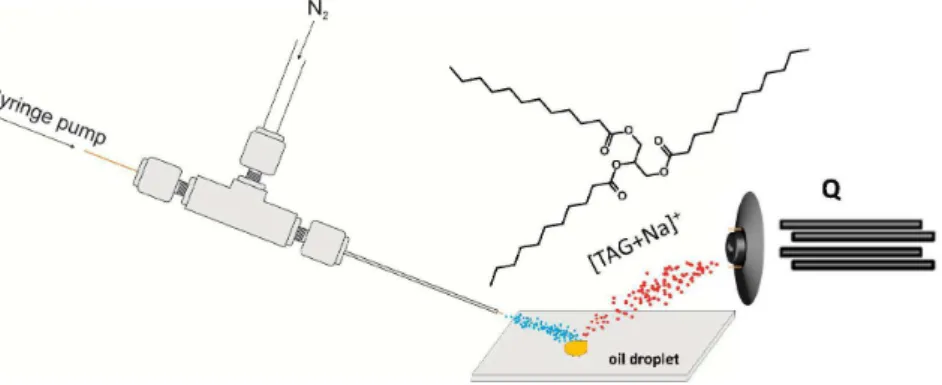
where the sample was applied. Figure 1 displays the EASI source scheme, which uses supersonic spray to create a supersonic cloud of charged droplets which bombard the surface, causing desorption and ionization of the analytes. Due to its ionization softness, it often produces intact molecular species, which facilitates mixture analysis with less background noise from solvent ionization.1
It is of interest to the general public, medical experts and food science researchers to know the antioxidant capacity and the major lipid compounds present in the consumed Amazonian vegetable oils. Based on this interest, the objectives of this study were to evaluate the antioxidant capacity, antimicrobial activity and the lipid content characterization based on an integrative approach MS techniques, comprising GC-MS and EASI-MS with the objective to provide a comprehensive characterization of buriti oil.
Experimental
Chemicals
All solvents were of HPLC quality, and all chemicals were analytical grade (> 99%), being the methanol, hexane, and chloroform obtained from Tedia and the acetonitrile from J. T. Baker. Water was of ultrapure quality (Milli-Q). 2,2'-azobis(2-amidinopropane) dihydrochloride (AAPH), 6-hydroxy-2,5,7,8-tetramethylchroman-2-carboxylic acid (Trolox), fluorescein and α-tocopherol were purchased from Sigma-Aldrich.
Sample preparation
The buriti oil was purchased in the Ver o Peso market in Belém city, Pará state, Brazil. The method previously employed by Santos et al.17 was used to extract the
hydrophilic and lipophilic fractions of the fruit oil with slight modifications. In brief, 1 g of buriti oil sample was extracted with 10 mL of dichloromethane (lipophilic fraction) and then, the residual part was dissolved in methanol and considered as the hydrophilic fraction. All the fractions were centrifuged at 4000 rpm for 10 min at 4 °C and stored at
−80 °C until analysis. The lipophilic fraction was evaporated to dryness under nitrogen stream and re-dissolved in acetone. This sample solution was used to measure the lipophilic antioxidant capacity (LAC); meanwhile the hydrophilic fraction was used directly to measure the hydrophilic antioxidant capacity (HAC). For the lipid characterization by GC-MS, the crude virgin oil was dissolved in chloroform (20 µL mL−1, v:v). The same sample was prepared at the
concentration of 50 µL mL−1 (v:v) in a mixture of chloroform
and methanol (1:1, v:v) for EASI analysis. The degradation level of buriti oil was assessed by the peroxide index assay according to previous works18 after the purchase of the
samples and the values expressed in meq O2 kg−1.
Oxygen radical absorbance capacity (ORAC) assay
The ORAC procedure used an automated plate reader with 96-well plates.19 Analyses were conducted in system
composed of one probe, fluorescein; a peroxyl radical generator, AAPH; and Trolox as a control standard. All reagents were prepared in 75 mmol L−1 potassium
phosphate buffer (pH 7.4) just before the analyses. In 20 µL of the diluted samples was added 120 µL of fluorescein (0.378 µg mL−1) and 60 µL of AAPH (0.108 g L−1) in
each well, which were let during 80 min at 37 °C in an automated microplate reader (BMG Labtech) until reaction completion. Fluorescence conditions were as follows: excitation at 485 nm and emission at 520 nm. The standard curve was constructed using Trolox (80-1500 µmol L−1)
solution. The area under the curve (AUC), relative fluorescence versus incubation time, was calculated as shown in equation 1. The AUC differences between the extract and blank were taken and used for calculations.
(1)
where f is the fluorescence reading.
Antimicrobial activity
The minimal inhibitory concentrations (MICs) were determined by microbroth dilution assays as recommended by the Subcommittee on Antifungal Suscetibility Testing of the US National Committee for Clinical Laboratory
Standards (NCCLS) using a previous methodology.20
The assays were performed on 96 well plates with 100 µL of Mueller Hinton Broth (MHB), 100 µL of extract solutions and 5 µL of test bacterial suspensions at 1.0 × 10⁷ colony forming units (CFU) mL−1. The extracts
assayed were successively dissolved in dimethylsulfoxide (DMSO) at initial concentration of 500 µg mL−1 until
80 µg mL−1, and the incubation was made at 37 °C for
24 h. The microorganisms tested were Escherichia coli
(ATCC 10538), Staphylococcus epidermidis (field strain),
Escherichia coli (ATCC 10799), Candida tropicalis
(field strain), Candida dubliniensis (ATCC 778157),
Candida glabrata (ATCC 30070) and Candida albicans (ATCC 1031). In these tests, chloramphenicol and ketoconazole were used as experimental positive controls, while DMSO served as the negative control. Each sensitivity test was performed in triplicate for each microorganism evaluated.
Statistical analysis
All assays for the antioxidative activities were conducted in triplicates. Data were presented as mean ± standard deviation (SD). Statistical analysis was done in MS Excel (Microsoft Windows 2003) using Student’s t-test, significant difference in means between the samples was determined at the 5% confidence level (p < 0.05).
GC-MS analysis
Analyses were carried out on a GC-MS system from Agilent Technologies consisting of a gas chromatograph (7890A) coupled to a quadrupole mass spectrometer (MSD 5975 C) operating in the electron ionization (EI) mode (70 eV). The chromatographic separations were performed on a HP-5-MS fused silica capillary column (30 m × 250 mm i.d., 0.25 µm film thickness) from Agilent Technologies using helium as carrier gas (1 mL min−1). The
injector, GC-MS interface and MSD source temperatures were 275, 310 and 230 °C, respectively. The following oven temperature program was used: initial temperature 150 °C, held for 2.0 min, ramped at 5 °C min−1 to 300 °C
and held for 10 min. A solvent delay time of 5 min was used to protect the ion multiplier of the MS instrument from saturation. The MS was operated in full scan mode being the m/z range from 50 to 550. An aliquot of 1 µL of the samples was injected using the splitless injection mode.
EASI-MS analysis
home-made EASI source21 operating in the positive and
negative ion modes. Nebulizing gas (N2) 3 L min− 1 and
a methanol flow rate of 20 µL min−1 were used to form
the sonic-spray. The surface-entrance angle was 30°. The samples were dropped on a paper surface (brown Kraft envelope paper), and mass spectra were collected for about 30 s, initially scanning over the range of m/z 200-1200. As EASI is a soft ionization source, no TAG fragments were observed in the spectra, and TAG were observed only at the range of m/z 800-1000. The results were obtained from triplicate measurement. Data were acquired and processed in LCMS solution v.3.70 software.
Results and Discussion
Antioxidant assay
It is of interest to the general public, medical experts and food science researchers to know the antioxidant capacity and the major compounds present in the consumed natural resources.7 Due to the multifunctional characteristics of
phytochemicals found in vegetable oils, the antioxidant efficacy of a plant extract is best evaluated based on results obtained by commonly accepted assays, taking into account different oxidative conditions, system compositions, and antioxidant mechanisms.22 Based on such conditions
the oxygen radical absorbance capacity (ORAC)23 assay
was chosen. The LAC and HAC of the buriti oil were 1.8 ± 0.01 and 8.3 ± 0.01 µmol Trolox equivalents (TE) g−1, respectively. These results are lower for LAC
and higher for HAC when compared to the standard
α-tocopherol (2.1 ± 0.01). The higher value observed for HAC might be possible due to synergistic effects of the pool of antioxidants present in that fraction. Results of the antioxidant capacities (AC) obtained for buriti oil are similar to those presented for the Amazonian vegetable oil sacha inchi (ranging from 6.5 to 9.8 µmol TE g−1),24 which
is the unique study about AC of Amazonian vegetable oil by the ORAC assay, once the common Amazonian fruit pulps are analyzed.25 When compared to non-Amazonian
oils such as grape seed oil (total antioxidant capacity: 1.04 µmol TE g−1)26 it is observed that in such samples the
vitamin E derivatives rule the AC. In this sense, buriti oil comprises a reliable source of antioxidant compounds that can be more explored for food purposes.
Antimicrobial activity
Buriti fruit is described as a source of antimicrobial compounds; the phenolic extracts displayed moderate activity against S. aureus and P. aeruginosa,7 hexanic
extracts from the mesocarps displayed activity against the same bacteria.27 Previous tests with the pure buriti oil did
not display any antimicrobial activity against some gram-positive and gram-negative bacteria.28 In this study, tested
virgin buriti oil did not display any antimicrobial activity against the tested bacteria and fungi, even with its chemical diversity. This observation can be interpreted as a possible antagonism effect, a fact that can be explained by the low concentration of phenolic compounds described as potent antimicrobial agents28 and the high antimicrobial activity
observed for fruit extracts is explained by these phenolic compounds.
GC-MS analysis
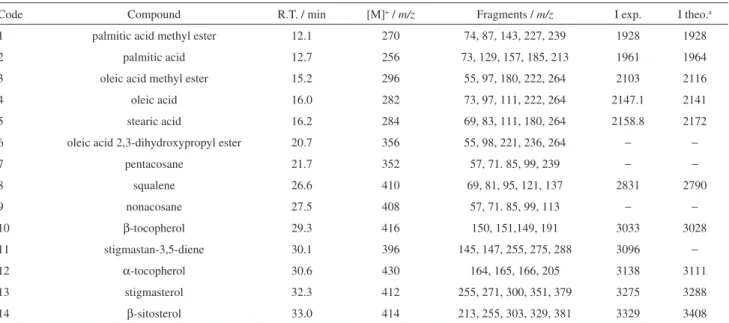
GC-MS is an important analytical technique that has a broad range of applicability due to its capability in identifying compounds using both the retention times and the relative abundances of the characteristic product ions, thus increasing accuracy and providing reliable results. Thence, we included it in our integrative approach in order to complement EASI results. Figure 2 shows the total ion current (TIC) chromatograms obtained for the buriti oil, where fatty acids, esters, alkanes, phytosterols and tocopherols were identified. The palmitic and oleic acids were the most abundant compounds observed for buriti oil by GC-MS, confirming previous data10 where those compounds
constitute 20% and 71% of the FFA composition from the buriti oil respectively. Besides the main FFA, stearic acid, methyl esters for the palmitic and oleic acids and oleic acid monoglyceride (2,3-dihydroxypropyl ester) were detected, all described herein for the first time in buriti oil.
Phytosterols already described for buriti oil10 such
as stigmasterol, β-sitosterol and campesterol were also identified in this study. However, we describe for the first time the presence of the hydrocarbon stigmastan-3,5-diene, already described only for olive oil as a dehydratation product of β-sitosterol29 and an important marker for refined
oils.30 Another important hydrocarbon identified was
squalene, a triterpene precursor with antioxidant proprieties and antimicrobial activity.31 Additionally, pentacosane and
nonacosane, common higher hydrocarbons are described for the first time in the buriti oil. Besides these compounds,
α- and β-tocopherol were idenfied in buriti oil, according to previous reports that display high tocopherol contents in this source32 and related to the biological activities reported
for this oil.25 This high content of tocopherols in buriti oil
EASI-MS analysis
EASI-MS provides faster analysis with no sample preparation, using a more simple apparatus when compared to other techniques.35 The proofing of authenticity of an
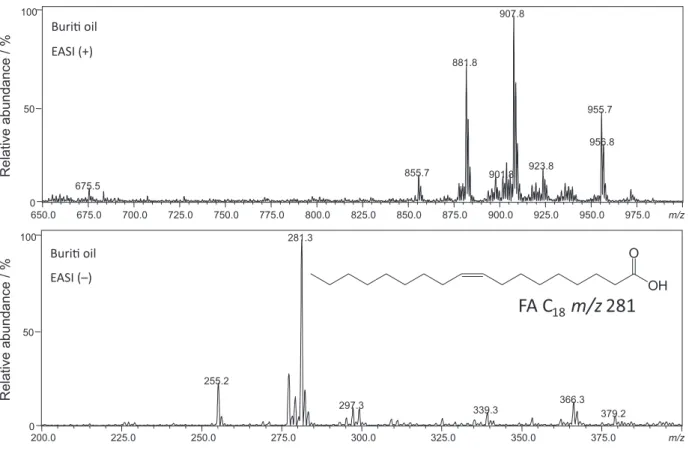
Amazonian oil with important commercial value can easily be achieved by this technique. The TAG profile of the buriti oil was obtained in the positive ion mode, where the
sodium adduct [M + Na]+ was identified. TAG constituted
for palmitic (P), linoleic (L), oleic (O), linolenic (Ln) and stearic (S) acids were identified. For the buriti virgin oil, the main m/z observed (Figure 3) were 907, corresponding to OOO/SLO, and 881 corresponding to POO. Those m/z can be proposed as markers of the buriti oil through comparison with other oil profiles where those ions are not present or are present in low intensities such as in soybean oil,14 which
Figure 2. Total ion chromatogram for the buriti oil obtained by GC-MS.
Table 1. Lipids identified in the buriti oil by GC-MS
Code Compound R.T. / min [M]+ / m/z Fragments / m/z I exp. I theo.a
1 palmitic acid methyl ester 12.1 270 74, 87, 143, 227, 239 1928 1928
2 palmitic acid 12.7 256 73, 129, 157, 185, 213 1961 1964
3 oleic acid methyl ester 15.2 296 55, 97, 180, 222, 264 2103 2116
4 oleic acid 16.0 282 73, 97, 111, 222, 264 2147.1 2141
5 stearic acid 16.2 284 69, 83, 111, 180, 264 2158.8 2172
6 oleic acid 2,3-dihydroxypropyl ester 20.7 356 55, 98, 221, 236, 264 − −
7 pentacosane 21.7 352 57, 71. 85, 99, 239 − −
8 squalene 26.6 410 69, 81, 95, 121, 137 2831 2790
9 nonacosane 27.5 408 57, 71. 85, 99, 113 − −
10 β-tocopherol 29.3 416 150, 151,149, 191 3033 3028
11 stigmastan-3,5-diene 30.1 396 145, 147, 255, 275, 288 3096 −
12 α-tocopherol 30.6 430 164, 165, 166, 205 3138 3111
13 stigmasterol 32.3 412 255, 271, 300, 351, 379 3275 3288
14 β-sitosterol 33.0 414 213, 255, 303, 329, 381 3329 3408
is commonly added in Amazonian oils.36 Other TAG were
identified in the profile such as PPL (m/z 853), PPO (m/z
855), LLL/LnOO (m/z 901), LLO/LnOO (m/z 903), LOO/ SLL (m/z 905) and SOO/SSL (m/z 909). Previous works revealed the TAG composition of buriti oil via matrix assisted laser desorption/ionization mass spectrometry (MALDI-MS)36 and by liquid chromatography with fluorescence10
being described the same markers as main constituents of the buriti oil. The EASI analysis in the negative ion mode provided the FFA profile of the buriti oil, where oleic acid (m/z 281, 42%) was observed as being the main constituent reinforcing the data observed by GC-MS. Other FFA constituents observed were: linoleic acid (m/z 279, 13%) and palmitic acid (m/z 255, 10%). The FFA profiles obtained by this technique display just the main compounds in the oil. In this context, an integrative approach with GC-MS is need for the identification of the minor FFA, their esters and phytosterols present in the sample.
Conclusions
The ORAC assay for this sample was performed by the first time where the lipophilic and the hydrophilic fractions displayed distinct AC, being the first one close to the tocopherols standard and the second higher. A synergism was observed for the hydrophilic compounds of the oil. The
virgin buriti oil did not display any antimicrobial activity against the tested strains. The lipid content of the buriti oil was fully characterized by an integrative approach using GC-MS and EASI-MS. Among previously described lipids, we additionally describe the presence of the hydrocarbons squalene, pentacosane, nonacosane and stigmastan-3,5-diene and the methyl esters of the palmitic and oleic acids along with the corresponding monoglyceride of the oleic acid. These findings are valuable for the food, pharmaceutical and cosmetic industries.
Acknowledgements
We would like to thank Conselho Nacional de Desenvolvimento Científico e Tecnológico (CNPq), Fundação de Amparo à Pesquisa do Estado do Amazonas (FAPEAM) and Fundação de Amparo à Pesquisa do Estado de São Paulo (FAPESP) for the scholarship for G. A. B. (process No. 2012/21395-0).
References
1. Valko, M.; Leibfritz, D.; Moncol, J.; Cronin, M. T. D.; Mazur, M.; Tesler, J.; Int. J. Biochem. Cell Biol.2007, 39, 44. 2. Chalamaiaha, M.; Kumar, B. D.; Hemalatha, R.; Jyothirmayi,
T.; Food Chem. 2012, 135, 3020.
3. Pokorný, J.; Eur.J. Lipid Sci. Technol.2007, 109, 629. 4. Golli, F.; Azzi, A.; BioFactors2010, 36, 33.
5. Brigelius-Flohe, R.; Galli, F.; Mol. Nutr. Food Res. 2010, 54, 583.
6. Delgado, C.; Couturier, G.; Mejia, K.; Fruits2007, 62, 157. 7. Koolen, H. H. F.; da Silva, F. M. A.; Gozzo, F. C.; de Souza,
A. Q. L.; de Souza, A. D. L.; Food Res. Int. 2013, 51, 467. 8. Koolen, H. H. F.; Soares, E. R.; da Silva, F. M. A.; de Souza,
A. Q. L.; Rodrigues-Filho, E.; de Souza, A. D. L.; Rev. Bras. Farmacogn.2012, 22, 189.
9. Koolen, H. H. F.; Soares, E. R.; da Silva, F. M. A.; de Oliveira, A. A.; de Souza, A. Q. L.; de Medeiros, L. S.; Rodrigues-Filho, E.; Cavalcanti, B. C.; Pessoa, C. O.; de Morais, M. O.; Salvador, M. J.; de Souza, A. D. L.; Nat. Prod. Res.2013, 27, 2118. 10. Santos, M. F. G.; Alves, R. E.; Ruíz-Méndez, M. V.; Grasas
Aceites2013, 64, 531.
11. Mo, S.; Dong, L.; Hurst, W. J.; van Breemen, R. B.; Lipids 2013, 48, 949.
12. Li, G.; You, J.; Suo, Y.; Song, C.; Sun, Z.; Xia, L.; Zhao, X.; Shi, J.; Food Chem. 2011, 125, 1365.
13. Fernandes, A. M. A. P.; Fernandes, G. D.; Simas, R. C.; Barrera-Arellano, D.; Eberlin, M. N.; Alberici, R. M.; Anal. Methods 2013, 5, 6969.
14. Cabral, E. C.; Cruz, G. F.; Simas, R. C.; Sanvido, G. B.; Gonçalvez, L. V.; Leal, R. V. P.; Silva, R. C. F.; Silva, J. C. T.; Barata, L. E. S.; Cunha, V. S.; França, L. F.; Daroda, R. J.; Sá, G. F.; Eberlin, M. N.; Anal. Methods2013, 5, 1385.
15. Riccio, M. F.; Saraiva, S. A.; Marques, L. A.; Alberici, R.; Haddad, R.; Moller, J. C.; Eberlin, M. N.; Catharino, R. R.;
Eur.J. Lipid Sci. Technol.2010, 112, 434.
16. Simas, R. C.; Catharino, R. R.; Cunha, I. B. S.; Cabral, E. C.; Barreira-Arellano, D.; Eberlin, M. N.; Alberici, R. M.; Analyst 2010, 135, 738.
17. Arnao, M.; Cano, A.; Acosta, M.; Food Chem. 2001, 73, 239. 18. Barbosa, B. S.; Koolen, H. H. F.; Barreto, A. C.; da Silva, J. D.;
Figliuolo, R.; Nunomura, S. M.; Acta Amazonica 2009, 39, 371. 19. Dávalos, A.; Gómez-Cordovés, C.; Bartolomé, B.; J. Agric.
Food Chem. 2004, 52, 48.
20. Koolen, H. H. F.; da Silva, F. M. A.; de Souza, A. Q. L.; de Medeiros, L. S.; Rodrigues-Filho, E.; de Almeida, R. A.; Ribeiro, I. A.; Pessoa, C. O.; de Morais, M. O.; da Costa, P. M.; de Souza, A. D. L.; Nat. Prod. Res.2012, 26, 2013.
21. Haddad, R.; Milagres, H. M. S.; Catharino, R. R.; Eberlin, M. N.; Anal. Chem.2008, 80, 2744.
22. Prior, R. L.; Wu, X.; Schaich, K.; J. Agric. Food Chem. 2005,
53, 4290.
23. Dudonné, S.; Vitrac, X.; Coutière, P.; Woillez, M.; Mérillon, J. M.; J. Agric. Food Chem. 2009, 57, 1768.
24. Chirinos, R.; Zuloeta, G.; Pedreschi, R.; Mignolet, E.; Larondelle, Y.; Campos, D.; Food Chem. 2013, 141, 1732. 25. da Costa, P. A.; Ballus, C. A.; Teixeira-Filho, J.; Godoy, H. T.;
Food Res. Int. 2010, 43, 1603.
26. Fernandes, L.; Casal, S.; Cruz, R.; Pereira, J. A.; Ramalhosa, E.;
Food Res. Int. 2013, 50, 161.
27. Silveira, C. S.; Pessanha, C. M.; Lourenço, M. C. S.; Neves-Junior, I.; Menezes, F. S.; Kaplan, M. A. C.; Rev. Bras. Farmacogn. 2005, 15, 143.
28. Ferreira, B. S.; Almeida, C. G.; Faza, L. P.; Almeida, A.; Diniz, C. G.; Silva, V. L.; Grazul, R. M.; Hyaric, M. L.; Molecules 2011, 16, 5875.
29. Cert, A.; Lanzón, A.; Carelli, A.; Albi, T.; Amelotti, G.; Food Chem. 1994, 49, 287.
30. P u u p p o n e n - P i m i a , R . ; N o h y n e k , L . ; M e i e r, C . ; Kahkonen, M.; Hei-nonen, M.; Hopia, A.; Oksman-Caldentey, K. M.; J. Appl. Microbiol. 2011, 90, 494.
31. León-Camacho, M.; Serrano, M. A.; Constante, E. G.; Grasas Aceites2004, 55, 227.
32. Zanatta, C. F.; Mitjans, M.; Urgatondo, V.; Rocha-Filho, P. A.; Vinardell, M. P.; Food Chem. Toxicol.2010, 48, 70.
33. Rostad, C. E.; Pereira, W. E.; J. High Resolut. Chromatogr. 1986, 9, 328.
34. Zhao, C. X.; Liang, Y. Z.; Fang, H. Z.; Li, X. N.; J. Chromatogr. A 2006, 1096, 76.
35. Alberici, R. M.; Simas, R. C.; de Souza, V.; de Sá, G. F.; Daroda, R. J.; Eberlin, M. N.; Anal. Chim. Acta. 2010, 659, 15. 36. Saraiva, S. A.; Cabral, E. C.; Eberlin, M. N.; Catharino, R. R.;
J. Agric. Food Chem. 2009, 57, 4030.
Submitted: July 2, 2014
Published online: October 3, 2014