Interaction of lipoprotein lipase polymorphisms with body
mass index and birth weight to modulate lipid profiles in
children and adolescents: the CASPIAN-III Study
Interação de polimorismos da lipoproteína lipase com índice de massa corporal
e peso ao nascer para modular o peril lipídico em crianças e adolescentes:
o estudo CASPIAN-III
Gholamreza Askari
I, Motahar Heidari-Beni
II, Marjan Mansourian
III, Mohammad Esmaeil-Motlagh
IV, Roya Kelishadi
VIsfahan University of Medical Sciences, Isfahan, Iran
ABSTRACT
CONTEXT AND OBJECTIVE: Interactions between body mass index (BMI), birth weight and risk param-eters may contribute to diseases rather than the individual efects of each factor. However this hypothesis needs to be conirmed. This study aimed to determine to what extent variants of lipoprotein lipase (LPL) might interact with birth weight or body weight in determining the lipid proile concentrations in children and adolescents.
DESIGN AND SETTING: Substudy of the third survey of a national surveillance system (CASPIAN-III Study) in Iran.
METHODS: Whole blood samples (kept frozen at -70 °C) were randomly selected from 750 students aged 10-18 years. Real-time polymerase chain reaction (PCR) and high-resolution melt analysis were performed to assess S447X (rs328), HindIII (rs320) and D9N (rs1801177) polymorphisms.
RESULTS: The AG/GG genotype in D9N polymorphism was associated with higher LDL-C (low-density lipoprotein cholesterol) and lower HDL-C (high-density lipoprotein cholesterol) concentration. Signii-cant interactions were found for D9N polymorphism and birth weight in association with plasma HDL-C concentration, and also for D9N polymorphism and BMI in association with plasma triglyceride (TG) and HDL-C levels. HindIII polymorphism had signiicant association with birth weight for HDL-C concentration, and with BMI for TG and HDL-C levels. Signiicant interactions were found for S447X polymorphism and BMI in association with plasma TG and HDL-C concentrations.
CONCLUSION: We found signiicant interactive efects from LPL polymorphisms and birth weight on HDL-C concentration, and also efects from LPL polymorphisms and BMI on TG and HDL-C concentrations.
RESUMO
CONTEXTO E OBJETIVO: Interações entre índice de massa corporal (IMC), peso ao nascer e parâmetros de risco podem contribuir para doenças, em vez de efeitos individuais de cada fator. No entanto, essa hipótese precisa de conirmação. Este estudo visou determinar o quanto variantes de lipoproteína lipase (LPL) podem interagir com peso de nascimento ou peso corporal na determinação das concentrações do peril lipídico em crianças e adolescentes.
DESENHO E LOCAL: Sub-estudo da terceira pesquisa de sistema nacional de vigilância (Estudo CASPIAN-III) no Irã.
MÉTODOS: Foram selecionadas aleatoriamente amostras de sangue total (mantidas congeladas a -70 °C) de 750 estudantes com idades entre 10-18 anos. Reação de polimerase em cadeia (PCR) em tempo real e análise de fusão de alta resolução foram realizados para avaliar polimorismo de S447X (rs328), HindIII (rs320) e D9N (rs1801177).
RESULTADOS: Genótipo AG/GG em polimorismo D9N foi associado com concentração maior de LDL-C (colesterol do tipo lipoproteína de baixa densidade) e menor de HDL-C (colesterol do tipo lipoproteína de alta densidade). Interações signiicativas foram encontradas para polimorismo D9N e peso ao nascer em associação com concentração plasmática de HDL-C, bem como para polimorismo D9N e IMC em associa-ção com níveis plasmáticos de triglicérides (TG) e HDL-C. Polimorismo HindIII teve associaassocia-ção signiicativa com peso de nascimento para concentração de HDL-C, e com IMC para níveis de TG e HDL-C. Interações signiicativas foram encontradas para polimorismo S447X e IMC em associação com concentrações plas-máticas de TG e HDL-C.
CONCLUSÃO: Encontramos efeitos interativos signiicativos de polimorismo LPL e peso de nascimento sobre concentração de HDL-C, bem como efeitos de polimorismos LPL e IMC sobre concentrações de TG e HDL-C.
IPhD. Assistant Professor, Discipline of Nutrition,
Food Security Research Center, Department of Community Nutrition, School of Nutrition and Food Sciences, Isfahan University of Medical Sciences, Isfahan, Iran.
IIDoctoral Student, Discipline of Nutrition,
Food Security Research Center, Department of Community Nutrition, School of Nutrition and Food Sciences, Isfahan University of Medical Sciences, Isfahan, Iran.
IIIPhD. Assistant Professor, Discipline of
Biostatistics, Department of Biostatistics and Epidemiology, School of Health, Isfahan University of Medical Sciences, Isfahan, Iran.
IVMD. Professor of Pediatrics, Department of
Pediatrics, Ahvaz Jundishapur University of Medical Sciences, Ahvaz, Iran.
VMD. Professor of Pediatrics, Child Growth
and Development Research Center, Research Institute for Primordial Prevention of Non-communicable Disease, Isfahan University of Medical Sciences, Isfahan, Iran.
KEY WORDS:
Lipoprotein lipase. Body mass index. Birth weight. Polymorphism, genetic. Gene-environment interaction.
PALAVRAS-CHAVE:
INTRODUCTION
Adverse levels of serum lipoprotein cholesterols among children and adolescents are important risk factors for coronary artery and early stages of atherosclerosis. Serum lipid and lipoprotein levels in childhood are generally good predictors of their con-centrations in young adulthood.1 Elevated triglycerides (TG) and depressed HDL-C are the most common abnormalities of lipids and lipoproteins associated with obesity. his situation has been named atherogenic dyslipidemia.2
Some important genetic disorders increase the susceptibility to chronic diseases. Nonetheless, body weight, lifestyle habits and environmental factors, including the intrauterine environment, are important in determining the disease process.3,4
Several enzymes are involved in the metabolism of serum lip-ids. Lipoprotein lipase (LPL) has an important role in metabo-lism and transporting of lipids. It plays a major role in hydroly-sis of chylomicrons and very low-density lipoproteins. he LPL gene has 10 exons and is located on chromosome 8p22. Recently, a number of more common single-nucleotide polymorphisms (SNPs) in the LPL gene have been described. hese are related to lipid concentration, e.g. S447X (C--›G nucleotide 1595), HindIII (+495T > G) and D9N (G--›A nucleotide 280). It has been found that D9N has small deleterious efects on lipid proiles, whereas S447X has small beneicial efects on serum lipids in adults.5
Among perinatal characteristics, unfavorable birth weight and further growth trajectory are the most important factors relating to metabolic abnormalities.6 he association between birth weight and the components of metabolic syndrome and other risk factors of cardiovascular disease (CVD) during child-hood and adolescence remains controversial. Some studies have reported strong associations between low or high birth weight and the risk of CVD, while others have not found any associa-tion.7,8 It has been suggested that some genes involved in meta-bolic processes may have diferent efects on people with diferent birth weights. Investigation on whether an adverse intrauterine environment and birth weight might alter the expression of genes relating to the lipid proile is clinically relevant.9,10 Ruiz et al. hypothesized that some genes (APOE, APOC3 and PPARγ2 genes) might interact with birth weight to determine the blood lipid proile later in life. heir results suggested that the intrauter-ine environment would interact with the genetic background to determine plasma lipid proile levels in later life.10
Genetic factors are considered to be important determi-nants of plasma lipoprotein levels in adults. However, the role of genetics in determining plasma lipoproteins in children and adolescents is less clear. he increasing prevalence of dyslipid-emia in children may be due to complex interactions between genetic and environmental factors. Studies have reported inter-actions between the LPL gene and lifestyle, in association with
lipid proile concentrations in adults.11,12 However, to the best of our knowledge, interactions with factors like birth weight have not been examined.
Some LPL genotypes have been found to have signiicant asso-ciations with changes to TG and HDL-C levels in obese subjects. hese indings support the need for further studies to investigate the role of these polymorphisms in obesity.13 he interaction between body mass index (BMI) and the LPL genotype may explain the del-eterious role of obesity on lipid proile levels.14
Interactions between BMI, birth weight and risk parameters may contribute towards diseases, rather than the individual efects of each factor. However, this hypothesis needs to be conirmed. he link between BMI or birth weight and plasma lipid levels has been documented. Nonetheless, the interactions of single nucleo-tide polymorphisms (SNPs) and BMI or birth weight on plasma lipid levels are limited, particularly in children and adolescents.
OBJECTIVE
This study aimed to determine to what extent variants of LPL genes might interact with birth weight or body weight in determining the blood lipid profile concentration in children and adolescents.
METHODS
Study population
his study was conducted as a substudy of the “school-based nationwide health survey”, which was the third survey of the school-based surveillance system named the Childhood and Adolescence Surveillance and PreventIon of Adult Non-communicable disease (CASPIAN-III) Study.
he survey was conducted among 5570 students aged 10-18 years who were recruited by means of multistage ran-dom cluster sampling from urban and rural areas of 27 provin-cial counties in Iran. Students who had any chronic disease or who were taking medications were not included in this study. Complete data were obtained from 5528 students (2726 girls, 69.37% urban, mean age 14.7 ± 2.4 years) and were reported. Details of the data collection and sampling were published pre-viously.15 For the current study, we randomly selected 750 whole blood samples that had been kept frozen at -70 °C.
his survey was approved by ethics committees and other rel-evant national regulatory organizations. Written informed con-sent was obtained from parents and oral ascon-sent from the children and adolescents involved.
Physical examination and biochemical measurements
to modulate lipid proiles in children and adolescents: the CASPIAN-III Study | ORIGINAL ARTICLE
was calculated as the weight (kg) divided by the height squared (m2). According to the World Health Organization (WHO) dei-nition, normal weight was deined as a BMI Z-score between 1 and -2, wasting as a BMI Z-score between -2 and -3, risk of over-weight as a BMI Z-score between 1 and 2, overover-weight as a BMI Z-score between 2 and 3, and obesity as a BMI Z-score of more than 3.16 Birth weight was categorized as low birth weight (less than 2,500 g), normal (2,500-4,000 g) or high birth weight (more than 4,000 g).
To assess blood lipid levels, students were invited to go to the healthcare center nearest to their school. Fasting venous blood samples was taken. High-density lipoprotein cholesterol (HDL-C) and triglycerides (TG) were measured using auto-analyzers. HDL-C was measured ater precipitation of non-HDL-C with dextran sulfate-magnesium chloride. he low-density lipoprotein cholesterol (LDL-C) levels in serum samples with TG < 400 mg/dl were calculated in accordance with the Friedewald equation. Total cholesterol (TC) was measured by means of an autoanalyzer.
he biochemical analyses were performed in the central pro-vincial laboratory in each county. he methods used in these lab-oratories were in accordance with those of the National Reference laboratory, which is a WHO-collaborating center in Tehran.15
DNA extraction
DNA was extracted from peripheral blood using the QIAamp DNA blood mini-kit (Qiagen, Germany), in accordance with the manufacturer’s protocol. Real-time polymerase chain reac-tion (PCR) and high-resolureac-tion melt (HRM) analyses were per-formed in the Corbett rotor-gene 6000 device (Corbett Research Pty Ltd, Sydney, Australia). Primers were designed using Beacon Designer 7.91 with the aim of lanking the genomic regions (Premier Biosot International, USA) and were synthesized by TIB MOLBIOL (Germany).
Amplicons from all the genes were generated under the following conditions, using the Type-it HRM kit (Qiagen, Germany): one cycle at 95 °C for 15 minutes; 40 cycles at 95 °C for 15 seconds, 60 °C for 15 seconds and 72 °C for 15 sec-onds; and one cycle of 95 °C for 1 second, 72 °C for 90 seconds and a melt from 70 °C to 95 °C rising at 0.1 °C per second. he ampliication mixture had a total volume of 25 μl and included 12.5 μl of HRM PCR master mix, 1.75 μl of 10 μM primer mix, 2 μl of genomic DNA as template and 8.25 μl of RNase-free water. For each genotype reaction, we included sequence-proven major and minor allele homozygote and heterozygote controls. he HRM analysis was performed using instrument sotware, which allowed clustering of the samples into groups based on diference plots that were obtained by analyzing the diferences in melting curve shape between known controls and samples. he primer sequence used for LPL S447X rs328
was F: GCAGAAAGGAAAGGCACCTG, R: CAGGATGCC CAGTCAGCT; for LPL HindIII rs320, it was F: TCCAAGATA ATCTCAACCT, R: TAACAATAA- CAGCACACTATA; and for LPL D9N rs1801177, it was F: TCCAAGATAATCTCAACCT, R: GGAATGAGG- TGGCAAGTG.
Statistical analysis
he data were described by calculating the frequencies (per-centages), means and standard deviation (SD). he diferences between general characteristics based on LPL polymorphism levels were tested by means of the independent t test for quan-titative variables and the chi-square test for qualitative variables. Separate analysis of covariance (ANCOVA) was done using each lipid proile as the dependent variable. Interactions between LPL gene variants and birth weight or BMI were assessed by using a cross-product term between genotypes and birth weight or BMI, on serum lipid levels that adjusted for age, sex, and physical activity. Statistical signiicance was evaluated through ANCOVA by using a custom model. Chi-square tests were used to assess Hardy-Weinberg expectations. he statistical analyses were per-formed using the SPSS statistical sotware package (version 20.0, SPSS Inc., Chicago, Illinois, USA). P-values of less than 0.05 were considered statistically signiicant.
RESULTS
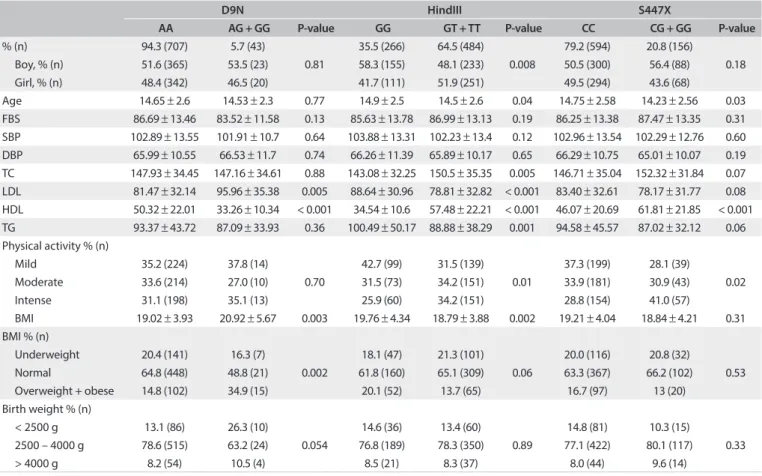
he characteristics of the study participants according to geno-types are presented in Table 1. he P-values for Hardy-Weinberg
expectations were 0.419 for D9N polymorphism, 0.105 for HindIII polymorphism and 0.06 for S447X polymorphism. he genotypic distribution of the three SNPs was in Hardy-Weinberg equilibrium (P > 0.05 for all). Overall, subjects with the variant allele (AG or GG genotype) and those with the AA genotype in D9N polymorphism did not difer signiicantly according to sex, age, fasting blood pressure (FBS), systolic blood pressure (SBP), diastolic blood pressure (DBP), TC, TG or physical activity. LDL-C concentration and BMI were signiicantly higher among those with the AG or GG genotype than among those with the AA genotype. HDL-C concentration was signiicantly lower among those with the AG or GG genotype than among those with the AA genotype.
here were no signiicant diferences in relating to age, FBS, DBP, SBP, TC, LDL-C, TG or BMI between the CC genotype and the CG/GG genotype in S447X polymorphism. Compared with carriers of CC in S447X polymorphism, those with the CG/GG genotype were slightly younger (14.23 ± 2.56 versus 14.75 ± 2.58; P = 0.03) and had higher HDL-C concentration (61.81 ± 21.85 ver-sus 46.07 ± 20.69; P < 0.001). Physical activity was signiicantly dif-ferent between the groups. hose with the CC genotype had higher percentages of physical activity in each category (mild, moderate or intense) than those with the CG/GG genotype.
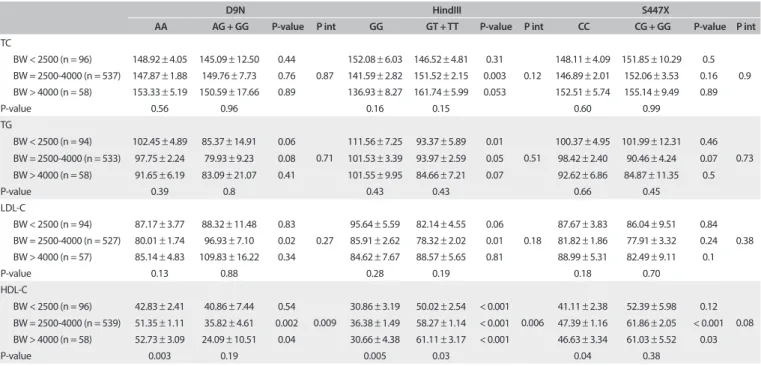
he interaction efects between LPL genetic variants and birth weight on serum lipid levels ater adjustment for age, sex, physical activity and BMI are presented in Table 2. In stratiied analyses, the
association between the LPL polymorphisms and plasma lipid pro-ile concentrations varied according to the birth weight.
Signiicantly higher LDL-C and lower HDL-C concentration in relation to the G allele was conined to individuals with nor-mal birth weight, in D9N polymorphism. For instance, among subjects with normal birth weight, plasma HDL-C concen-tration was signiicantly lower in those with the AG/GG gen-otype than in those with the AA genotype (35.82 ± 4.61 and 51.35 ± 1.11 mg/dl, respectively; P = 0.002). We observed a
strong interaction between D9N polymorphism and birth weight in relation to HDL-C concentration.
Among those who had normal birth weight, the T allele in HindIII polymorphism was associated with signiicantly higher TC concentration (GG compared with GT/TT: 141.59 ± 2.82 and 151.52 ± 2.15 mg/dl, respectively; P = 0.003). his association was marginally signiicant among those with high birth weight (P = 0.053). Subjects with low birth weight and the GT/TT geno-type had lower TG level (P = 0.01). his association was margin-ally signiicant among those with normal birth weight (P = 0.05). Only among normal birth weight subjects was the T allele associated with signiicantly depressed LDL-C concentration (P = 0.01). We observed a strong interaction between HindIII polymorphism and birth weight in relation to HDL-C concen-tration. Subjects with low, normal and high birth weight and the GT/TT genotype had higher HDL-C concentration than those
with the GG genotype (P < 0.001).
Combinations of carrying the G allele in S447X polymor-phism with normal or high birth weight were signiicantly asso-ciated with higher HDL-C concentration. No signiicant inter-action was documented between birth weight and S447X polymorphism in relation to lipid proile concentrations.
Table 1. Characteristics of the study population across the lipoprotein lipase gene polymorphisms: the CASPIAN-III study
FBS = fasting blood pressure; SBP = systolic blood pressure; DBP = diastolic blood pressure; TC = total cholesterol; LDL = low-density lipoprotein; HDL = high-density lipoprotein; TG = triglyceride; BMI = body mass index.
D9N HindIII S447X
AA AG + GG P-value GG GT + TT P-value CC CG + GG P-value
% (n) 94.3 (707) 5.7 (43)
0.81
35.5 (266) 64.5 (484)
0.008
79.2 (594) 20.8 (156)
0.18 Boy, % (n) 51.6 (365) 53.5 (23) 58.3 (155) 48.1 (233) 50.5 (300) 56.4 (88)
Girl, % (n) 48.4 (342) 46.5 (20) 41.7 (111) 51.9 (251) 49.5 (294) 43.6 (68)
Age 14.65 ± 2.6 14.53 ± 2.3 0.77 14.9 ± 2.5 14.5 ± 2.6 0.04 14.75 ± 2.58 14.23 ± 2.56 0.03 FBS 86.69 ± 13.46 83.52 ± 11.58 0.13 85.63 ± 13.78 86.99 ± 13.13 0.19 86.25 ± 13.38 87.47 ± 13.35 0.31 SBP 102.89 ± 13.55 101.91 ± 10.7 0.64 103.88 ± 13.31 102.23 ± 13.4 0.12 102.96 ± 13.54 102.29 ± 12.76 0.60 DBP 65.99 ± 10.55 66.53 ± 11.7 0.74 66.26 ± 11.39 65.89 ± 10.17 0.65 66.29 ± 10.75 65.01 ± 10.07 0.19 TC 147.93 ± 34.45 147.16 ± 34.61 0.88 143.08 ± 32.25 150.5 ± 35.35 0.005 146.71 ± 35.04 152.32 ± 31.84 0.07 LDL 81.47 ± 32.14 95.96 ± 35.38 0.005 88.64 ± 30.96 78.81 ± 32.82 < 0.001 83.40 ± 32.61 78.17 ± 31.77 0.08 HDL 50.32 ± 22.01 33.26 ± 10.34 < 0.001 34.54 ± 10.6 57.48 ± 22.21 < 0.001 46.07 ± 20.69 61.81 ± 21.85 < 0.001 TG 93.37 ± 43.72 87.09 ± 33.93 0.36 100.49 ± 50.17 88.88 ± 38.29 0.001 94.58 ± 45.57 87.02 ± 32.12 0.06 Physical activity % (n)
Mild 35.2 (224) 37.8 (14)
0.70
42.7 (99) 31.5 (139) 0.01
37.3 (199) 28.1 (39)
0.02 Moderate 33.6 (214) 27.0 (10) 31.5 (73) 34.2 (151) 33.9 (181) 30.9 (43)
Intense 31.1 (198) 35.1 (13) 25.9 (60) 34.2 (151) 28.8 (154) 41.0 (57)
BMI 19.02 ± 3.93 20.92 ± 5.67 0.003 19.76 ± 4.34 18.79 ± 3.88 0.002 19.21 ± 4.04 18.84 ± 4.21 0.31 BMI % (n)
Underweight 20.4 (141) 16.3 (7)
0.002
18.1 (47) 21.3 (101) 0.06
20.0 (116) 20.8 (32)
0.53 Normal 64.8 (448) 48.8 (21) 61.8 (160) 65.1 (309) 63.3 (367) 66.2 (102)
Overweight + obese 14.8 (102) 34.9 (15) 20.1 (52) 13.7 (65) 16.7 (97) 13 (20) Birth weight % (n)
< 2500 g 13.1 (86) 26.3 (10)
0.054
14.6 (36) 13.4 (60)
0.89
14.8 (81) 10.3 (15)
0.33 2500 – 4000 g 78.6 (515) 63.2 (24) 76.8 (189) 78.3 (350) 77.1 (422) 80.1 (117)
to modulate lipid proiles in children and adolescents: the CASPIAN-III Study | ORIGINAL ARTICLE
he interaction efects between LPL genetic variants and BMI on serum lipid level, ater adjustment for age, sex, physical activity and birth weight, are presented in Table 3. We observed
interaction between D9N polymorphism and BMI in relation to
TG and HDL-C concentrations (P < 0.001 and P = 0.04, respec-tively). Underweight and normal-weight individuals with the AG/GG genotype had lower HDL-C level than those with the AA
genotype (P = 0.01).
Table 2. Interactions between lipoprotein lipase gene variants and birth weight, in relation to serum lipid levels in Iranian children and adolescents: the CASPIAN-III study
Pint = P interaction; TC = total cholesterol; BW = birth weight; TG = triglyceride; LDL-C = low-density lipoprotein; HDL-C = high-density lipoprotein.
Data are mean ± Standard Error (SE). Model adjusted for age, sex, physical activity and BMI.
D9N HindIII S447X
AA AG + GG P-value P int GG GT + TT P-value P int CC CG + GG P-value P int
TC
BW < 2500 (n = 96) 148.92 ± 4.05 145.09 ± 12.50 0.44
0.87
152.08 ± 6.03 146.52 ± 4.81 0.31
0.12
148.11 ± 4.09 151.85 ± 10.29 0.5
0.9
BW = 2500-4000 (n = 537) 147.87 ± 1.88 149.76 ± 7.73 0.76 141.59 ± 2.82 151.52 ± 2.15 0.003 146.89 ± 2.01 152.06 ± 3.53 0.16
BW > 4000 (n = 58) 153.33 ± 5.19 150.59 ± 17.66 0.89 136.93 ± 8.27 161.74 ± 5.99 0.053 152.51 ± 5.74 155.14 ± 9.49 0.89
P-value 0.56 0.96 0.16 0.15 0.60 0.99
TG
BW < 2500 (n = 94) 102.45 ± 4.89 85.37 ± 14.91 0.06
0.71
111.56 ± 7.25 93.37 ± 5.89 0.01
0.51
100.37 ± 4.95 101.99 ± 12.31 0.46
0.73
BW = 2500-4000 (n = 533) 97.75 ± 2.24 79.93 ± 9.23 0.08 101.53 ± 3.39 93.97 ± 2.59 0.05 98.42 ± 2.40 90.46 ± 4.24 0.07
BW > 4000 (n = 58) 91.65 ± 6.19 83.09 ± 21.07 0.41 101.55 ± 9.95 84.66 ± 7.21 0.07 92.62 ± 6.86 84.87 ± 11.35 0.5
P-value 0.39 0.8 0.43 0.43 0.66 0.45
LDL-C
BW < 2500 (n = 94) 87.17 ± 3.77 88.32 ± 11.48 0.83
0.27
95.64 ± 5.59 82.14 ± 4.55 0.06
0.18
87.67 ± 3.83 86.04 ± 9.51 0.84
0.38
BW = 2500-4000 (n = 527) 80.01 ± 1.74 96.93 ± 7.10 0.02 85.91 ± 2.62 78.32 ± 2.02 0.01 81.82 ± 1.86 77.91 ± 3.32 0.24
BW > 4000 (n = 57) 85.14 ± 4.83 109.83 ± 16.22 0.34 84.62 ± 7.67 88.57 ± 5.65 0.81 88.99 ± 5.31 82.49 ± 9.11 0.1
P-value 0.13 0.88 0.28 0.19 0.18 0.70
HDL-C
BW < 2500 (n = 96) 42.83 ± 2.41 40.86 ± 7.44 0.54
0.009
30.86 ± 3.19 50.02 ± 2.54 < 0.001 0.006
41.11 ± 2.38 52.39 ± 5.98 0.12
0.08
BW = 2500-4000 (n = 539) 51.35 ± 1.11 35.82 ± 4.61 0.002 36.38 ± 1.49 58.27 ± 1.14 < 0.001 47.39 ± 1.16 61.86 ± 2.05 < 0.001
BW > 4000 (n = 58) 52.73 ± 3.09 24.09 ± 10.51 0.04 30.66 ± 4.38 61.11 ± 3.17 < 0.001 46.63 ± 3.34 61.03 ± 5.52 0.03
P-value 0.003 0.19 0.005 0.03 0.04 0.38
Table 3. Interactions between lipoprotein lipase gene variants and body mass index, in relation to serum lipid levels in Iranian children and adolescents: the CASPIAN-III study
Pint = P interaction; TC = total cholesterol; TG = triglyceride, LDL-C = low-density lipoprotein; HDL-C = high-density lipoprotein. Data are mean ± Standard Error
(SE). Model adjusted for age, sex, physical activity and birth weight.
D9N HINDIII S447X
AA AG + GG P-value P int GG GT + TT P-value P int CC CG + GG P-value P int
TC
Underweight (n = 148) 3.71 ± 147.91 15.80 ± 143.48 0.66
0.92
5.78 ± 143.05 4.25 ± 150.26 0.19 0.87
4.03 ± 147.92 6.96 ± 146.79 0.65 0.42
Normal (n = 468) 2.32 ± 150.16 9.43 ± 153.09 0.67 3.34 ± 143.56 2.57 ± 153.61 0.008 2.46 ± 148.22 4.00 ± 157.10 0.06
Overweight + obesity (n = 116) 4.17 ± 151.86 9.51 ± 150.31 0.97 5.51 ± 147.91 4.96 ± 154.32 0.51 4.12 ± 152.65 9.06 ± 145.57 0.64
P-value 0.73 0.72 0.65 0.75 0.59 0.29
TG
Underweight (n = 146) 4.42 ± 83.01 18.84 ± 75.56 0.63
< 0.001
6.93 ± 87.51 5.09 ± 79.72 0.27
< 0.001
4.81 ± 82.83 8.32 ± 78.95 0.73
< 0.001
Normal (n = 461) 2.79 ± 90.24 11.25 ± 90.79 0.43 4.01 ± 98.49 3.10 ± 85.12 0.002 2.96 ± 89.94 4.80 ± 86.67 0.47
Overweight + obesity (n = 116) 4.94 ± 119.96 11.34 ± 92.90 0.09 6.53 ± 115.85 5.94 ± 116.42 0.82 4.90 ± 120.48 10.83 ± 89.32 0.11
P-value < 0.001 0.28 0.02 < 0.001 < 0.001 0.68
LDL-C
Underweight (n = 142) 3.48 ± 81.73 14.53 ± 97.96 0.66
0.91
5.36 ± 89.47 4.04 ± 78.92 0.16
0.35
3.77 ± 83.82 6.71 ± 78.01 0.15
0.76
Normal (n = 460) 2.15 ± 84.11 8.67 ± 98.90 0.07 3.11 ± 89.19 2.39 ± 82.66 0.04 2.29 ± 85.41 3.72 ± 82.68 0.39
Overweight + obesity (n = 115) 3.86 ± 86.35 8.75 ± 99.05 0.17 5.05 ± 92.71 4.67 ± 84.93 0.27 3.83 ± 89.43 8.65 ± 81.90 0.41
P-value 0.59 0.80 0.77 0.61 0.52 0.87
HDL-C
Underweight (n = 148) 2.21 ± 52.55 9.43 ± 28.45 0.01
0.04
3.05 ± 35.58 2.24 ± 59.63 < 0.001 0.02
2.35 ± 48.21 4.06 ± 62.93 0.002
0.03
Normal (n = 469) 1.38 ± 50.32 5.63 ± 36.54 0.01 1.77 ± 34.41 1.35 ± 57.21 < 0.001 1.44 ± 46.55 2.33 ± 60.75 <0.001
Overweight + obesity (n = 117) 2.47 ± 43.77 5.67 ± 33.67 0.06 2.88 ± 31.91 2.62 ± 49.78 < 0.001 2.39 ± 40.17 5.29 ± 53.23 0.004
In joint analysis, combinations of carrying the T allele (GT/TT genotype) with normal weight were signiicantly asso-ciated with higher TC and HDL-C levels, and also with lower TG and LDL-C concentrations, than those of subjects with the GG genotype in HindIII polymorphism. Among underweight
and overweight/obese subjects, carrying the T allele was associ-ated with higher HDL-C concentration than that of subjects with the GG genotype (P < 0.001). Moreover, interaction between HindIII polymorphism and BMI was found for TG and HDL-C concentrations (P < 0.001 and P = 0.02, respectively).
Underweight, normal weight and overweight/obesity in sub-jects with the G allele were associated with elevated HDL-C con-centrations in S447X polymorphism. Interaction between S447X polymorphism and BMI existed in relation to TG and HDL-C concentrations (P < 0.001 and P = 0.03, respectively).
Linear regression models ater adjustment for confound-ers showed that D9N polymorphism was signiicantly positively related to LDL-C in the normal birth weight group (â ± standard error (SE) = 18.51 ± 6.57; P-value = 0.005), and signiicantly nega-tively related to HDL-C in the normal and > 4000 g birth weight groups (â ± SE = -17.68 ± 4.52; P-value = < 0.001; and â ± SE = -26.53 ± 5.02; P-value = 0.03, respectively). However, D9N poly-morphism was not signiicantly associated with total cholesterol and TG in any of the birth weight groups. HindIII polymorphism was positively related to HDL-C and negatively related to TG, in all the birth weight groups. In addition, HindIII had a beneicial efect on LDL-C (â ± SE = -9.98 ± 2.85; P-value = 0.001) in the normal birth weight group. hus, HindIII polymorphism may improve lipid proiles. S44X polymorphism was signiicantly posi-tively associated with HDL-C alone, in all the birth weight groups (birth weight < 2500 g: â ± SE = 11.36 ± 4.34; P-value = 0.003; birth weight 2500-4000 g: â ± SE =15.31 ± 2.19; P-value = 0.001; and birth weight > 4000 g: â ± SE = 16.89 ± 3.02; P-value = 0.01). In diferent BMI categories, a signiicant adverse association was found between D9N polymorphism and HDL-C (underweight: â ± SE = -19.49 ± 8.44; P-value = 0.02; normal: â ± SE = -17.44 ±
4.88; P-value = < 0.001; and overweight + obese: â ± SE = -11.46 ±
5.22; P-value = 0.02). A signiicant association was found for HindIII and S447X polymorphisms in relation to elevated HDL-C, in all BMI categories. In addition, HindIII polymorphism had a beneicial efect on other lipid proiles in the normal BMI category (these data were not shown).
DISCUSSION
We showed that the AG/GG genotype in D9N polymorphism is associated with higher LDL-C and lower HDL-C concentrations. However, these associations were observed only among individu-als who had normal birth weight, and among underweight and normal-weight subjects according to BMI. Signiicant interactions
were found for D9N polymorphism and birth weight in associa-tion with plasma HDL-C concentraassocia-tions, and also for D9N poly-morphism and BMI in association with plasma TG and HDL-C levels. Our data suggest that the efect of LPL polymorphisms on the lipid proile is modulated by either birth weight or BMI.
One case-control study in Australia showed that D9N poly-morphism did not signiicantly inluence HDL-C or TG.17 Other studies showed that D9N polymorphism had an adverse efect on serum lipids, and increased the risk of CVD.18,19 It is possible that D9N polymorphism leads to deiciency of LPL secretion.17
he importance of the gene/environment interaction has been discussed in relating to human disease processes and disease prevention. Regulation of lipid proile concentrations is a compli-cated and poorly understood process that may depend on inter-actions of both environmental and genetic factors. Researchers have hypothesized that the interactions between some genetic polymorphisms and environmental factors may be related to serum lipid levels.20,21 Several studies have investigated the inlu-ence of weight or birth weight on plasma lipid levels.22 LPL poly-morphisms also afect lipid concentrations.23 However, the inter-action between BMI or birth weight and the polymorphisms of LPL, on serum lipid levels, is not well known, particularly among children and adolescents. It is noteworthy to mention that in the current study, HindIII polymorphism had a signiicant associa-tion with birth weight, in relaassocia-tion to HDL-C concentraassocia-tion, and with BMI in relation to TG and HDL-C levels. he GT/TT geno-type in HindIII polymorphism is associated with higher TC and HDL-C and lower TG and LDL-C concentrations.
HindIII polymorphism is a thymine to guanine base tran-sition at potran-sition +495 in intron 8 and is one of the most com-mon polymorphisms in the LPL gene.24 he association between HindIII polymorphism and TG is more controversial. While some studies have shown signiicant associations between HindIII polymorphism and hypertriglyceridemia,25,26 these ind-ings have not been conirmed by others.27,28 However, most stud-ies have proposed that this polymorphism is a modulator of plasma lipid levels.29,30 he mechanism of its efect on plasma lipid levels remains to be determined.24
In this study, plasma HDL-C levels were signiicantly higher in individuals with the G allele (CG or GG genotype) than in those with the CC genotype in S447X polymorphism. Signiicant interactions were found for S447X polymorphism and BMI in association with plasma TG and HDL-C concentrations.
to modulate lipid proiles in children and adolescents: the CASPIAN-III Study | ORIGINAL ARTICLE
this efect was possibly due to increased LPL activity.30 A meta-analysis on previous studies among adults showed that S447X polymorphism decreased TG and increased HDL-C, and there-fore decreased the CVD risk.32
he key role of LPL is in postprandial lipid metabolism. However, it is also involved in metabolism of fasting lipid. S447X polymorphism afects postprandial lipemia, and this may be a mechanism for its efects on TG and HDL-C concentrations.31
However, the mechanism for the efects of this polymor-phism on serum lipid metabolism remains obscure. One study suggested that S447X polymorphism might alter LPL transla-tion,33 but its mechanism is unclear.32
A previous study speculated that the gene encoding LPL played an important role in dyslipidemia in an Asian popu-lation.13 LPL has a central role in lipid metabolism. here is a clear relationship between LPL activity and lipid concentrations. Insulin is a major regulator of LPL activity. Since insulin levels and activity are related to body weight, it can be hypothesized that LPL activity is afected by obesity. It has been shown that LPL polymorphisms afect plasma lipid concentration to a greater or lesser degree in individuals with diferent BMI levels.13,14
To the best of our knowledge, no previous study has reported on interactions between LPL polymorphisms and birth weight or between LPL polymorphisms and BMI interactions, in relation to serum lipid concentrations in children and adolescents. It is plausible that interactions between birth weight or BMI and the LPL polymorphisms in association with serum lipid concentra-tions might occur through their efects on LPL activity.
Studies have shown that there are low TG concentrations in overweight and obese individuals who carry the T allele, which in turn might be due to increased LPL activity. Furthermore, over-weight and obese individuals with the GG genotype have been found to have higher serum TG levels than their non-obese coun-terparts.11 A cross-sectional study showed that, among obese sub-jects, carrying the S447X allele alone was associated with lower TG concentrations. hus, TG levels were modiied signiicantly by interactions between LPL polymorphism and BMI in adults.34 We also observed signiicant interactions between LPL polymor-phisms and BMI in association with lipid proile in children and adolescents.
On the other hand, another study that investigated interac-tions between obesity and the S447X polymorphism showed that subjects with S447X polymorphism and normal BMI had signii-cantly lower TG concentration. However, no signiicant difer-ence was documented for those with excess weight.35 In another study, the HindIII polymorphism was strongly correlated with hypertriglyceridemia in obese subjects.36
he responsiveness of LPL to glucose or insulin stimuli is delayed in the adipose tissue of obese subjects. herefore, it is
supposed that obesity might lead to a condition that may increase genetic susceptibility to hyperlipidemia and diabetes.37
It has been found that birth weight might afect cardiovascu-lar events and the components of metabolic syndrome.38,39 Some researchers have proposed that this relationship is genetically mediated.40 Among adult men, higher birth weight has been cor-related with decreased TC levels.41 Several studies have reported a U-shaped association between birth weight and cardiovascu-lar risk factors in children and adolescents.42,43 Numerous cohort and experimental studies on animals have conirmed that fetal programming of adult diseases exists, and have suggested that undernutrition during fetal life and low birth weight can lead to future disease.44,45 Reduced fetal growth may have adverse conse-quences on liver growth. Poor liver growth may cause disorders of blood lipid metabolism.10
However, the underlying molecular and genetic mechanisms of the association of birth weight with disease in later life are not clearly understood.44 We observed signiicant interactions between LPL polymorphisms and BMI in association with some lipid proiles in children and adolescents. No previous data from children are available for comparison.
Interactions between BMI and LPL polymorphisms or between birth weight and LPL polymorphisms may explain how subjects with a certain genotype fail to maintain homeostasis and ideal levels of plasma lipids only ater the environmental chal-lenge of increasing obesity. Our results showed that the difer-ences in the lipid proile levels of underweight, normal weight and overweight/obese subjects or between birth weight catego-ries might be partly because of diferent interactions between some SNPs and BMI or birth weight in the population studied.
According to the linear regression model, our indings sug-gest that there is a beneicial association between HindIII or S447X polymorphism and lipid proile, particularly with regard to HDL-C levels, in all categories of birth weight or BMI. We can conclude that these two polymorphisms may improve lipid pro-iles in children and adolescents. However, D9N had undesirable efect on lipid proiles.
Study limitations and strengths: he main limitation of this study is the cross-sectional nature of the associations. Other pos-sible study limitations include the small sample size in some sub-groups, particularly in the groups of individuals with birth weight > 4000 g and with the AG/GG genotype for D9N. he strengths of this study are its novelty in the pediatric age group, and its inclu-sion of a relatively large number of population-based samples.
CONCLUSION
polymorphism and birth weight, in relation to HDL-C concen-trations, and also signiicant efects between LPL polymorphism and BMI in relation to TG and HDL-C concentrations. he clini-cal signiicance of these associations needs to be conirmed in future longitudinal studies.
REFERENCES
1. Frontini MG, Srinivasan SR, Xu J, et al. Usefulness of childhood non-high density lipoprotein cholesterol levels versus other lipoprotein measures in predicting adult subclinical atherosclerosis: the Bogalusa Heart Study. Pediatrics. 2008;121(5):924-9.
2. Daniels SR. Complications of obesity in children and adolescents. Int J Obes (Lond). 2009;33 Suppl 1:S60-5.
3. Kelishadi R, Poursafa P. A review on the genetic, environmental, and lifestyle aspects of the early-life origins of cardiovascular disease. Curr Probl Pediatr Adolesc Health Care. 2014;44(3):54-72.
4. Kelishadi R, Cook SR, Motlagh ME, et al. Metabolically obese normal weight and phenotypically obese metabolically normal youths: the CASPIAN Study. J Am Diet Assoc. 2008;108(1):82-90.
5. Wang LN, Yu Q, Xiong Y, et al. Lipoprotein lipase gene polymorphisms and risks of childhood obesity in Chinese preschool children. Eur J Pediatr. 2011;170(10):1309-16.
6. Ziaoddini H, Kelishadi R, Kamsari F, Mirmoghtadaee P, Poursafa P. First nationwide survey of prevalence of weight disorders in Iranian children at school entry. World J Pediatr. 2010;6(3):223-7.
7. Kelishadi R, Haghdoost AA, Jamshidi F, Aliramezany M, Moosazadeh M. Low birthweight or rapid catch-up growth: which is more associated with cardiovascular disease and its risk factors in later life? A systematic review and cryptanalysis. Paediatr Int Child Health. 2015;35(2):110-23. 8. Gomes FM, Subramanian SV, Escobar AM, et al. No association between
low birth weight and cardiovascular risk factors in early adulthood: evidence from São Paulo, Brazil. PloS One. 2013;8(6):e66554. 9. Hovi P, Kajantie E, Soininen P, et al. Lipoprotein subclass proiles in
young adults born preterm at very low birth weight. Lipids Health Dis. 2013;12:57.
10. Ruiz JR, Labayen I, Ortega FB, et al. Birth weight and blood lipid levels in Spanish adolescents: inluence of selected APOE, APOC3 and PPARgamma2 gene polymorphisms. The AVENA Study. BMC Med Genet. 2008;9:98.
11. Baik I, Lee S, Kim SH, Shin C. A lipoprotein lipase gene polymorphism interacts with consumption of alcohol and unsaturated fat to modulate serum HDL-cholesterol concentrations. J Nutr. 2013;143(10):1618-25. 12. Pyun JA, Kim S, Park K, et al. Interaction Efects of Lipoprotein Lipase
Polymorphisms with Lifestyle on Lipid Levels in a Korean Population: A Cross-sectional Study. Genomics Inform. 2012;10(2):88-98. 13. Emamian M, Avan A, Pasdar A, et al. The lipoprotein lipase S447X and
cholesteryl ester transfer protein rs5882 polymorphisms and their relationship with lipid proile in human serum of obese individuals. Gene. 2015;558(2):195-9.
14. Socquard E, Durlach A, Clavel C, Nazeyrollas P, Durlach V. Association of HindIII and PvuII genetic polymorphisms of lipoprotein lipase with lipid metabolism and macrovascular events in type 2 diabetic patients. Diabetes Metab. 2006;32(3):262-9.
15. Kelishadi R, Heshmat R, Motlagh ME, et al. Methodology and Early Findings of the Third Survey of CASPIAN Study: A National School-based Surveillance of Students’ High Risk Behaviors. Int J Prev Med. 2012;3(6):394-401.
16. Gupta N, Goel K, Shah P, Misra A. Childhood obesity in developing countries: epidemiology, determinants, and prevention. Endocr Rev. 2012;33(1):48-70.
17. van Bockxmeer FM, Liu Q, Mamotte C, Burke V, Taylor R. Lipoprotein lipase D9N, N291S and S447X polymorphisms: their inluence on premature coronary heart disease and plasma lipids. Atherosclerosis. 2001;157(1):123-9.
18. Corsetti JP, Gansevoort RT, Navis G, Sparks CE, Dullaart RP. LPL polymorphism (D9N) predicts cardiovascular disease risk directly and through interaction with CETP polymorphism (TaqIB) in women with high HDL cholesterol and CRP. Atherosclerosis. 2011;214(2):373-6. 19. Izar MC, Helfenstein T, Ihara SS, et al. Association of lipoprotein lipase
D9N polymorphism with myocardial infarction in type 2 diabetes: the genetics, outcomes, and lipids in type 2 diabetes (GOLD) study. Atherosclerosis. 2009;204(1):165-70.
20. Guo SW. Gene-environment interaction and the mapping of complex traits: some statistical models and their implications. Hum Hered. 2000;50(5):286-303.
21. Zhou Y, Yin R, Deng Y, Li Y, Wu J. Interactions between alcohol intake and the polymorphism of rs708272 on serum high-density lipoprotein cholesterol levels in the Guangxi Hei Yi Zhuang population. Alcohol. 2008;42(7):583-91.
22. Friedemann C, Heneghan C, Mahtani K, et al. Cardiovascular disease risk in healthy children and its association with body mass index: systematic review and meta-analysis. BMJ. 2012;345:e4759. 23. Rebhi L, Kchok K, Omezzine A, et al. Six lipoprotein lipase gene
polymorphisms, lipid proile and coronary stenosis in a Tunisian population. Mol Biol Rep. 2012;39(11):9893-901.
24. Long S, Tian Y, Zhang R, et al. Relationship between plasma HDL subclasses distribution and lipoprotein lipase gene HindIII polymorphism in hyperlipidemia. Clin Chim Acta. 2006;366(1-2):316-21. 25. Gerdes C, Gerdes LU, Hansen PS, Faergeman O. Polymorphisms in
the lipoprotein lipase gene and their associations with plasma lipid concentrations in 40-year-old Danish men. Circulation. 1995;92(7):1765-9. 26. Mitchell RJ, Earl L, Bray P, Fripp YJ, Williams J. DNA polymorphisms at
the lipoprotein lipase gene and their association with quantitative variation in plasma high-density lipoproteins and triacylglycerides. Hum Biol. 1994;66(3):383-97.
to modulate lipid proiles in children and adolescents: the CASPIAN-III Study | ORIGINAL ARTICLE
28. Jemaa R, Fumeron F, Poirier O, et al. Lipoprotein lipase gene polymorphisms: associations with myocardial infarction and lipoprotein levels, the ECTIM study. Etude Cas Témoin sur l’Infarctus du Myocarde. J Lipid Res. 1995;36(10):2141-6.
29. Radha V, Mohan V, Vidya R, et al. Association of lipoprotein lipase Hind III and Ser 447 Ter polymorphisms with dyslipidemia in Asian Indians. Am J Cardiol. 2006;97(9):1337-42.
30. AshokKumar M, Veera Subhashini NG, Kanthimathi S, et al. Associations for lipoprotein lipase and peroxisome proliferator-activated receptor-gamma gene and coronary artery disease in an Indian population. Arch Med Res. 2010;41(1):19-25.
31. Nettleton JA, Stefen LM, Ballantyne CM, Boerwinkle E, Folsom AR. Associations between HDL-cholesterol and polymorphisms in hepatic lipase and lipoprotein lipase genes are modiied by dietary fat intake in African American and White adults. Atherosclerosis. 2007;194(2):e131-40.
32. Turlo K, Leung CS, Seo JJ, et al. Equivalent binding of wild-type lipoprotein lipase (LPL) and S447X-LPL to GPIHBP1, the endothelial cell LPL transporter. Biochim Biophys Acta. 2014;1841(7):963-9. 33. Ranganathan G, Unal R, Pokrovskaya ID, et al. The lipoprotein lipase
(LPL) S447X gain of function variant involves increased mRNA translation. Atherosclerosis. 2012;221(1):143-7.
34. Garenc C, Pérusse L, Gagnon J, et al. Linkage and association studies of the lipoprotein lipase gene with postheparin plasma lipase activities, body fat, and plasma lipid and lipoprotein concentrations: the HERITAGE Family Study. Metabolism. 2000;49(4):432-9.
35. Arca M, Campagna F, Montali A, et al. The common mutations in the lipoprotein lipase gene in Italy: efects on plasma lipids and angiographically assessed coronary atherosclerosis. Clin Genet. 2000;58(5):369-74.
36. Ko YL, Ko YS, Wu SM, et al. Interaction between obesity and genetic polymorphisms in the apolipoprotein CIII gene and lipoprotein lipase gene on the risk of hypertriglyceridemia in Chinese. Hum Genet. 1997;100(3-4):327-33.
37. Ma YQ, Thomas GN, Ng MC, et al. The lipoprotein lipase gene HindIII polymorphism is associated with lipid levels in early-onset type 2 diabetic patients. Metabolism. 2003;52(3):338-43.
38. Kuzawa CW, Adair LS. Lipid proiles in adolescent Filipinos: relation to birth weight and maternal energy status during pregnancy. Am J Clin Nutr. 2003;77(4):960-6.
39. Xiao X, Zhang ZX, Li WH, et al. Low birth weight is associated with components of the metabolic syndrome. Metabolism. 2010;59(9):1282-6.
40. Evagelidou EN, Giapros VI, Challa AS, et al. Serum adiponectin levels, insulin resistance, and lipid proile in children born small for gestational age are afected by the severity of growth retardation at birth. Eur J Endocrinol. 2007;156(2):271-7.
41. Lawlor DA, Owen CG, Davies AA, et al. Sex diferences in the association between birth weight and total cholesterol. A meta-analysis. Ann Epidemiol. 2006;16(1):19-25.
42. Dabelea D, Pettitt DJ, Hanson RL, et al. Birth weight, type 2 diabetes, and insulin resistance in Pima Indian children and young adults. Diabetes Care. 1999;22(6):944-50.
43. Gale CR, Martyn CN, Kellingray S, Eastell R, Cooper C. Intrauterine programming of adult body composition. J Clin Endocrinol Metab. 2001;86(1):267-72.
44. Pellanda LC, Duncan BB, Vigo A, et al. Low birth weight and markers of inlammation and endothelial activation in adulthood: the ARIC study. Int J Cardiol. 2009;134(3):371-7.
45. Barker DJ. A new model for the origins of chronic disease. Med Health Care Philos. 2001;4(1):31-5.
Sources of funding: This study was funded by Iran National Science Foundation (Grant No. 89000784) and Isfahan University of Medical Sciences, Isfahan, Iran. The project was approved by Isfahan University of Medical Sciences, Isfahan, Iran
Conlict of interests: None
Date of irst submission: April 25, 2015
Last received: August 20, 2015
Accepted: August 26, 2015
Address for correspondence:
Roya Kelishadi
Child Growth and Development Research Center
Research Institute for Primordial Prevention of Non-communicable Disease
Isfahan University of Medical Sciences Isfahan 81754 – Iran