254
Revista da Sociedade Brasileira de Medicina Tropical 47(2):254-256, Mar-Apr, 2014 http://dx.doi.org/10.1590/0037-8682-0215-2013
Case Report
INTRODUCTION
Address to: Dr. Guilherme Sousa Ribeiro. Instituto de Saúde Coletiva/UFBA. Rua Basílio da Gama s/n, Campus Universitário Canela, 40110-040 Salvador, BA, Brasil.
Phone: 55 71 3283-4707
e-mail: [email protected]
Received 15 October 2013
Accepted 22 January 2014
Puerperal brain cryptococcoma in an HIV-negative woman
successfully treated with fl uconazole: a case report
José Edward Hagan
[1],[2], Jesângeli Sousa Dias
[3],[4], José Caetano Villasboas-Bisneto
[2],
Melissa Barreto Falcão
[3], Albert Icksang Ko
[1],[2]and Guilherme Sousa Ribeiro
[2],[5][1]. Department of Epidemiology of Microbial Diseases, Yale School of Public Health, New Haven, CT, USA. [2]. Centro de Pesquisas Gonçalo Moniz, Fundação Oswaldo Cruz, Ministério da Saúde, Salvador, BA. [3]. Hospital Couto Maia, Secretaria de Saúde do Estado da Bahia, Salvador, BA. [4]. Faculdade de Medicina da Bahia, Universidade Federal da Bahia, Salvador, BA. [5]. Instituto de Saúde Coletiva, Universidade Federal da Bahia, Salvador, BA.
ABSTRACT
Cryptococcus spp. cerebral abscesses are uncommon in immunocompetent subjects. The recommended induction treatment is the administration of amphotericin B plus fl ucytosine combined with resection for lesions ≥3cm. In this paper, we describe an HIV-negative woman diagnosed with a large cryptococcoma in the immediate postpartum period. The lesion was not resected, and due to amphotericin B intolerance, she received an extended course of fl uconazole monotherapy. There was no disease recurrence during the 4 years of follow-up. The abrupt onset of her symptoms following delivery suggests that she developed a postpartum immune reconstitution syndrome. This case also demonstrates that in specifi c situations fl uconazole monotherapy can be attempted in immunocompetent patients with cryptococcoma.
Keywords:Cryptococcus. Immune reconstitution infl ammatory syndrome. Treatment.
Most cases of central nervous system (CNS) infection caused by Cryptococcus spp. manifest as meningitis. In sporadic cases,
Cryptococcus spp. CNS infection can result in the formation of a cryptococcoma, which can resemble a neoplastic mass. Cryptococcal disease typically occurs in immunocompromised individuals. Although Cryptococcus gattii infections have been increasingly recognized in immunocompetent hosts1-3, the incidence of brain cryptococcoma remains very low in healthy individuals3. We report a novel case of a large CNS cryptococcoma in an human immunodefi ciency virus (HIV)-negative woman that was successfully treated with fl uconazole. Her symptoms developed during the immediate postpartum period, suggesting a presentation exacerbated by postpartum immune reconstitution.
CASE REPORT
In December 2006, a 25-year-old female, who worked as a primary school teacher in a small city in northeast Brazil, was referred to a neurologist with complaints of progressively worsening right-sided paresthesias and muscle weakness. She denied having
any other symptoms, including pulmonary complaints. Her current symptoms began abruptly in the week following an otherwise uneventful pregnancy and spontaneous vaginal delivery of a healthy baby. She was previously healthy, but recalled that six years prior she had experienced a two-week episode of right-sided paresthesias and headache that resolved spontaneously.
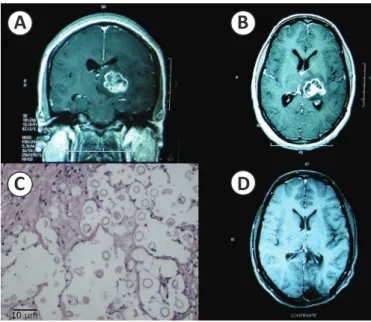
The initial physical exam was unremarkable except for word-fi nding difword-fi culties and weakness and numbness of the right-sided extremities. There was no papilledema on fundoscopic examination, and routine laboratory studies were normal. A computed tomography scan of the brain without contrast revealed a heterogeneous mass that was further evaluated by magnetic resonance imaging (MRI). Post-gadolinium infusion images revealed a 3cm x 2cm heterogeneously enhancing lesion arising in her left thalamus with a well-defi ned rim of enhancement and central hypointense areas suggestive of necrosis
(Figure 1A and 1B). Based on the radiographic appearance, the patient was presumptively diagnosed with glioblastoma multiforme. While awaiting surgical evaluation, prophylaxis with dexamethasone and phenytoin was initiated, resulting in some initial improvement in her symptoms. A non-stereotactic biopsy of the mass was performed without resection. The pathological examination revealed numerous budding encapsulated organisms consistent with Cryptococcus sp. without granulomata or multinucleated giant cells (Figure 1C). The tissue was not sent for microbiologic studies due to a primary suspicion of CNS malignancy; therefore, the species and serotype could not be determined.
255
Hagan JE et al - Brain cryptococcoma treated with fl uconazole
DISCUSSION
A
B
C
D
FIGURE 1 - Central nervous system cryptococcoma. T1-weighted post-gadolinium coronal (A) and transverse (B) MRI images revealing a 3cm x 2cm enhancing mass in the left thalamus with central hypointensity suggestive of necrosis. C: Hematoxylin and Eosin stain of brain biopsy tissue at 40x revealing numerous budding encapsulated organisms consistent with Cryptococcus
species. D: T1-weighted post-gadolinium transverse magnetic resonance imaging (MRI) image revealing post-craniotomy changes but no evidence of an intra-parenchymal mass.
peripheral blood culture was negative for bacteria and fungus. A cerebrospinal fl uid (CSF) examination revealed no cells, glucose level of 58mg/dL (normal=50-80), and protein level of 33mg/dL (normal=15-45). An India ink stain was negative, and a CSF cryptococcal antigen latex agglutination assay (IMMY, Norman, Oklahoma, USA) was positive.
Dexamethasone therapy was discontinued, and treatment with amphotericin B was initiated due to a diagnosis of CNS cryptococcoma. Flucytosine was not commercially available in Brazil at the time. Her hospital course was immediately complicated by a pruritic body rash, severe hypokalemia and hypomagnesemia, and ventricular arrhythmia; all of these symptoms resolved after the withdrawal of amphotericin B. She was, therefore, treated with fl uconazole, 800mg/day i.v. for 2 months, which was well tolerated until her discharge from the hospital. The patient’s symptoms resolved over 17 months of continuous oral fl uconazole therapy (8 months of 600mg/ day and 9 months of 300mg/day), and a follow-up brain MRI showed complete resolution of the lesion (Figure 1D). The patient was followed for four years after her treatment, during which time she experienced mild residual neuromotor symptoms but displayed no evidence of disease recurrence.
Our patient was negative for HIV and did not have any prior or subsequent history of recurrent infection, suggesting that she did not have a signifi cant undiagnosed humoral or
cellular immunodefi ciency. Although we could not determine
the Cryptococcus species that caused her disease, our patient lived in the northeast region of Brazil, where Cryptococcus gattii accounts for 66% of the cryptococcal isolates4.In Brazil,
75% of the cryptococcal infections in HIV-negative patientsare due to Cryptococcus gattii4, which is increasingly recognized
worldwide as a cause of infection in immunocompetent hosts2,3.
In these patients, cryptococcal disease is more likely to manifest as a cryptococcoma, as compared to immunosuppressed patients3. Nevertheless, the likelihood of a brain mass caused
by Cryptococcus in immunocompetent individuals is extremely low compared with immunocompromised patients1,3.
Our patient’s symptoms began within the fi rst week after
delivering a healthy baby. Although several cases of cryptococcal meningitis in immunocompetent pregnant women have been described5,6, to our knowledge, only two cases of cryptococcoma
during pregnancy have been previously reported7,8. The presence
of antecedent symptoms six years before this illness suggests the possibility of a prior infection that was spontaneously controlled until recrudescence and growth of the cryptococcoma during the relative immunosuppression of pregnancy, in which cell-mediated immunity is particularly affected. Additionally, the abrupt onset of her symptoms following delivery may suggest an inflammatory response related to postpartum immune
reconstitution. This infl ammatory response occurs rapidly
after delivery and may result in the unmasking of previously occult infectious diseases, such as mycobacterial infections, including tuberculosis; viral infections; and fungal infections, such as Cryptococcus. This phenomenon has been described in several case reports, in which symptoms of previously quiescent
cryptococcal disease presented or signifi cantly worsened during
the late third trimester or immediate postpartum period9.
The recommended therapy for CNS cryptococcoma includes
induction therapy with amphotericin B and fl ucytosine for at least
6 weeks, followed by 6-18 months of consolidation therapy with
fl uconazole. Surgical excision and debulking are indicated as
adjunct therapies for lesions that are greater than or equal to 3cm10.
Our patient was intolerant of amphotericin B and did not undergo surgical resection but was successfully treated with 2 months of
i.v. and 17 months of oral fl uconazole. Fluconazole monotherapy
is effective for cryptococcal meningitis in immunocompetent patients11 and has been successfully used without surgical resection
in both invasive pulmonary and thyroid cryptococcoma12,13.
However, fl uconazole monotherapy without surgical resection has
not been previously described in the successful treatment of CNS cryptococcoma. Our patient had complete resolution of the brain lesion in a follow-up MRI and remained free of disease recurrence
for 4 years of follow-up. This fi nding suggests that extended fl uconazole monotherapy can be attempted in immunocompetent
patients with cryptococcoma caused by a susceptible organism who are intolerant of amphotericin B and who are not good candidates for surgical resection.
256
Rev Soc Bras Med Trop 47(2):254-256, Mar-Apr, 2014
ACKNOWLEDGMENTS
FINANCIAL SUPPORT
REFERENCES
Ethics approval to publish this case report was granted by the
Hospital Couto Maia Ethics Committee. The patient provided written informed consent to have her case details published.
The authors thank the Hospital Couto Maia, Bahia Secretary of Health for providing the infrastructure for the care of the patient.
This work was supported by the National Institutes of Health through the Fogarty International Clinical Research Scholars and Fellows Program at Vanderbilt University (R24 TW007988) and the American Relief and Recovery Act, and through grants, NIAID R01 AI052473 and FIC D43 TW00919.
1. Li Q, You C, Liu Q, Liu Y. Central nervous system cryptococcoma in immunocompetent patients: A short review illustrated by a new case. Acta Neurochir 2010; 152:129-136.
2. Centers for Disease Control and Prevention (CDC). Emergence of
Cryptococcus gattii- Pacifi c Northwest, 2004-2010. MMWR Morb
Mortal Wkly Rep 2010; 59:865-868.
3. Chen S, Sorrell T, Nimmo G, Speed B, Currie B, Ellis D, et al. Epidemiology and host- and variety-dependent characteristics of infection due to Cryptococcus neoformans in Australia and New Zealand. Clin Infect Dis 2000; 31:499-508.
4. Nishikawa MM, Lazera MS, Barbosa GG, Trilles L, Balassiano BR, Macedo RCL, at al. Serotyping of 467 Cryptococcus neoformans isolates from clinical and environmental sources in Brazil: Analysis of host and regional patterns. J Clin Microbiol 2003; 41:73-77.
5. Costa ML, Souza JP, Oliveira Neto AF, Pinto e Silva JL. Cryptococcal meningitis in HIV negative pregnant women: Case report and review of literature. Rev Inst Med Trop Sao Paulo 2009; 51:289-294.
6. Pereira CAP, Fischman O, Colombo AL, Moron AF, Pignatari ACC. Neurocriptococcose durante a gravidez. Revisão da literatura. Relato de dois casos. Rev Inst Med Trop Sao Paulo 1993; 35:367-371.
7. Nucci A, Maciel Jr JA, Queiroz LS, Montenegro MA, Carvalho RB. Pseudocystic form of neurocryptococcosis in pregnancy: case report. Arq Neuropsiquiatr 1999; 57:678-682.
8. Mitchell DH, Sorrel TC, Allworth AM, Heath CH, McGregor AR, Papanaoum K, et al. Cryptococcal disease of the CNS in immunocompetent
hosts: Infl uence of cryptococcal variety on clinical manifestations and
outcome. Clin Infect Dis 1995; 20:611-616.
9. Singh N, Perfect JR. Immune reconstitution syndrome and exacerbation of infections after pregnancy. Clin Infect Dis 2007; 45:1192-1199.
10. Perfect JR, Dismukes WE, Dromer F, Goldman DL, Graybill JR, Hamill RJ, et al. Clinical practice guidelines for the management of cryptococcal disease: 2010 update by the Infectious Diseases Society of America. Clin Infect Dis 2010; 50:291-322.
11. Yamaguchi H, Ikemoto H, Watanabe K, Ito A, Hara K, Kohno S. Fluconazole monotherapy for cryptococcosis in non-AIDS patients. Eur J Clin Microbiol Infect Dis 1996; 15:787-792.
12. Huang CJ, Yang MC, Ueng SH. Large cryptococcoma mimicking lung cancer in an HIV-negative, type 2 diabetic patient. J Thorac Imaging 2005; 20:115-117.
13. Kagan E, Madden MB, Parsons CH. Successful treatment of a locally invasive cryptococcoma mimicking primary thyroid cancer with