Literature Reviews
FAMILIES WITH TWINS – A SYSTEMATIC REVIEW
1Luísa Andrade2, Maria Manuela Martins3, Margareth Angelo4, Júlia Martinho5
1 Extract from the thesis - Luzes e sombras em famílias de gêmeos, from the Graduate Program in Nursing, Abel Salazar Biomedical Sciences Institute, Universidade do Porto, 2013.
2 Doctoral student in Nursing at the Abel Salazar Biomedical Sciences Institute. Adjunct professor of the Higher School of Nursing, Universidade do Porto. Porto, Portugal. E-mail: [email protected]
3 Doctoral student in Nursing. Coordinator professor of the Higher School of Nursing, Universidade do Porto. Porto, Portugal. E-mail: [email protected]
4 Doctor in School Psychology. Full professor at the Universidade de São Paulo. São Paulo, Brazil. E-mail: [email protected] 5 Doctoral student in Nursing. Adjunct professor of the Higher School of Nursing, Universidade do Porto. Porto, Portugal. E-mail:
ABSTRACT: Parenthood is among the developmental transitions that set major challenges for contemporary families. When there is a twin pregnancy, those challenges increase. Our aims in this study are understanding the parental experience in families with twins and identifying the factors which condition parental experience in such families. It is a literature review focusing on studies published between 2000 and 2012 based on reference data. The articles were analyzed considering the aims, participants, phases of data collection, tools used; and results achieved regarding the dimensions involved in parenting experiences faced by parents of twins. In the 19
studies identiied, maternity was the main focus of research. Women with twin children showed lower scores on well-being, higher
stress risks, exhaustion and depression. The experience of these families was different, more demanding and complex than singletons’ parents. Understanding of this matter becomes crucial to contributing to better health for families.
DESCRIPTORS: Families. Parents. Twins.
A FAMÍLIA NA VIVÊNCIA DA GEMELARIDADE – REVISÃO
SISTEMÁTICA
RESUMO: A parentalidade é uma das transições desenvolvimentais que mais desaios colocam à família contemporânea. Quando
ocorre uma gravidez gemelar, esses desaios são exponenciados. Foi nosso propósito conhecer a experiência parental de famílias com gêmeos e identiicar os factores que condicionam as suas experiências parentais. Para o efeito, procedemos à análise de artigos publicados
entre 2000-2012 em bases de dados referenciais. Os artigos foram analisados tendo em conta: objetivos, participantes, momentos de
recolha de dados, instrumentos e resultados obtidos, considerando as variáveis que integram a vivência da parentalidade em pais de gêmeos. Nos 19 estudos identiicados, a maternidade foi o foco
central das pesquisas. As mulheres com ilhos gêmeos obtiveram scores mais baixos de bem-estar, aumentando o risco de estresse, exaustão e depressão. A experiência destas famílias foi diferente, mais exigente e complexa que nos pais com ilhos singulares. Compreender esta problemática torna-se fundamental para potenciar ganhos em saúde na família.
DESCRITORES: Família. Pais. Gêmeos.
LA FAMILIA EN LA PERSPECTIVA GEMELAR – UNA REVISIÓN
SISTEMÁTICA
RESUMEN: La paternidad es una de las transiciones del desarrollo que plantea más desafíos a la familia contemporánea. En un embarazo gemelar estos retos son engrandecidos. Los objetivos del estudio fueron conocer la experiencia de la paternidad en familias con gemelos
y analizar los factores que inluyen en sus experiencias de paternidad. Para este propósito se analizaron artículos publicados entre 2000-2012 en bases de datos referencia. Los artículos fueron analizados teniendo en cuenta: objetivos, participantes, tiempo de recolección
de datos, instrumentos utilizados y los resultados, atendiendo las variables que integran la experiencia de paternidad gemelar. En los
19 estudios identiicados, la maternidad era el foco central de investigación. Las mujeres con gemelos han tenido resultados más bajos de bienestar, aumentando el riesgo de estrés, agotamiento y depresión. La experiencia de las familias fue diferente, más exigente y
compleja que para otros padres. Comprender el tema es fundamental para maximizar la salud de la familia. DESCRIPTORES: Familia. Padres. Gemelos.
INTRODUCTION
Families are the base units in the organiza-tion of society, and they have two fundamental roles: one is the creation of a sense of belonging, and the other is to enable their members to develop and build their own individuality.1-2
Each family has its own history and path. In light of the Bertalanffy General Systems Theory,3
applied to families, they constitute systems composed of subsystems that have a complex and evolutionary mode of operation, which is revealed in the interactions of their members and confers on them an identity.4 In this unique
and complex process, there are transitions that encompass vital continuous and discontinuous processes of the human being.5 The transition to
parenthood is one of the greatest challenges fac-ing families and the people who compose them. This transition to and experience of parenthood have been the target of several studies,6-10 which
created room for the establishment of interven-tions by healthcare professionals to promote fam-ily health at times such as this that are particularly critical and intense.
Some studies suggest that the transition to parenthood is experienced differently by men and women,6,8 has implications for the marital
relationship11-12, and reveals itself as harder than
expected,13 as it becomes a fundamental element in
family health.8 They also point to the importance
of the couple being aware of the changes that can take place in the transition to parenthood.14
The complexity of this transition may also include circumstances that make it more diverse and demanding, such as parenthood with twins. Twinning has always sparked the interest of the
scientiic community in matters as diverse as
understanding life experience,15 understanding
the importance of genetics and the environment in human development,16 deepening our
under-standing of matters of identity and individual-ity,17 and understanding the experience of having
twins.18-20
In this sense, focusing our attention on this last aspect, two questions arise: what changes in families after the birth of twins? What reper-cussions occur in the subsystems that make up families with twins? Looking for an answer to this concern, we have set up an investigation to get to know parenthood experiences with twins and analyze the factors that condition these
ex-MATERIAL AND METHODS
We ran a systematic review based on the recommendations of Cochrane:21 formulate the
question; locate and select the studies; do a critical assessment of the studies considering the partici-pants of studies; and the health problem in analysis and results.
In order to identify relevant studies, we used the reference databases: ISI Web of Science -- Sci-ence Citation Index Expanded (SCI-EXPANDED); Social Sciences Citation Index (SSCI); Arts & Humanities Citation Index (A&HCI); Conference Proceedings Citation Index -- Science (CPCI-S); Conference Proceedings Citation Index -- Social Science & Humanities (CPCI-SSH); Scopus data-base -- Subject Areas: Life Sciences; Health Sciences (100% Medline); Physical Sciences; and Social Sci-ences and the Humanities.
To describe the research, the following topics
were deined: “parenting,” “twins” and “multiple
birth.” Considering the speciic characteristics of
the selected databases: in the Scopus, we used the terms “parenting” and “twins” or “multiple birth” at keyword+title+abstract; in the Web of Science, we regarded as topics of research “parenting” and “twins” or “multiple birth” in articles, considering the general category of Social Sciences.
We included in this review studies met our
previously deined inclusion and exclusion crite -ria. The inclusion criteria were: primary studies published between 2000 and 2012 and available in the databases used; with families with bio-logical twins; the central focus of the study was the experience of families with twins. We also considered the reliability and the relevance of the studies, the critical assessment having been sup-ported by MAStARI critical appraisal tools.22 The
exclusion criteria were: op-ed articles or secondary studies; families with single children or adopted twins; studies focusing on parenting practices or phenomena related to twinning itself; and without the complete text available.
The analysis process was based on an inter-pretative reading of the articles, emphasizing the similarities and divergences of the contents rela-tive to experiences in families of twins.
To proceed to the selection of relevant stud-ies, we considered the proposed review protocol.
We identiied 483 articles (Scopus, 274; Web of Science, 275), 66 of which are common to both reference databases, and proceeded to reading the respective abstracts. In the step of the process
“identiication of studies,” we excluded 16 articles
because they did not meet the 1st inclusion
crite-ria, that is, to be primary studies; 51 articles were out because they did not meet the 2nd inclusion
criteria, that is, the participants were not families with twins; and, lastly, 393 articles did not focus on the study of experiencing parenthood with twins -- they focused on parenting practices, the
experience of being a twin brother, and the inlu -ence of genetics and the environment on people,
using twin brothers. We selected 23 articles, and we eliminated four, because the whole text was not available (4th exclusion criteria), resulting in
19 articles. With regard to methodological qual-ity and in view of results obtained (moderate and high), we decided to include all of these articles.
RESULTS
In this review, we found 19 publications between 2000 and 2012 that met the criteria. Of
these studies, ive were in the United Kingdom,
one in Finland, one in Belgium, one in Sweden,
ive in the United States, one in Australia, ive in
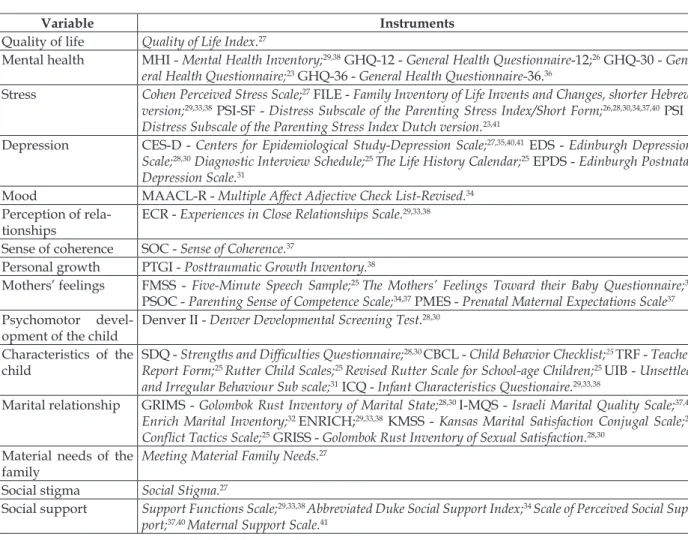
Israel, and one was jointly developed with France. With regard to methodological quality and the results obtained (moderate and high), we decided to include all the articles. Table 1 lists the articles by chronological data of publication; table 2 shows the instruments used, when applicable.
Table 1 - Summary of the selected studies
Study number/ Author/Year/
Country
Objective/Participants/Design/Results
E1. Colpin, Munter, Nys, Vandemeule-broeck(2000) Bel-gium.23
Objective: to study the pre- and postnatal determining factors of parenting stress. Partici-pants: women expecting twins (n=40). Design: prospective cohort. Data collection: 27 preg-nancy weeks and 1 year after birth. Results: personal well-being and the prenatal support of the spouse were predictors of stress in women one year after birth.
E2. Ellison, Hall (2003) United States.24
Objective: to identify the areas of the quality of life of mothers which showed the greatest im-pact due to the birth of twins. Participants: women with: 1 - one child per conception (n=10), 2 - twins with low risk at birth (n=12), ages between 4 and 5 or 9 and 10 years old, 3 - twins with high risk at birth with ages between 1 and 5 (n=11), 4 - one child (n=4) or twins (n=6) conceived via medically assisted conception (MAC) with ages between 8 months and 11 years old. Design: focal group, discussion points: stress and family needs, social support, health of the children, marital satisfaction and impact on the self of the woman. Results: birth had higher impact on: marital satisfaction, family needs, stress and maternal depression. Almost all areas of quality of life were more affected for mothers of twins.
E3. Tully, Mofit, Caspi (2003) United Kingdom.25
Objective: to compare parental adjustment, parenthood and the behavior of children of fami-lies with different types of conception. Participants: mothers, twins, and professors of these conceived by in vitro fertilization (IVF) or ovary induction (OI) (n=121) and naturally (n=121). Design: cross-sectional. Data collection: when the twins were 5 years old. Results: no signii -cant differences were identiied between the groups, with the exception of parent behavior. The mothers who conceived naturally revealed higher inconsistency with regard to discipline.
E4. Glazebrook, Sheard, Cox, Oates, Ndukwe (2004) United Kingdom.26
E5. Ellison, Hota-misligil, Lee, Rich-Edwards, Pang, Hall (2005) United States.27
Objective: to determine if psychosocial risks in families that conceived via MAC were associ-ated with the number of children per pregnancy. Participants: women who conceived after MAC: 1 - one child (n=128), 2 - twins (n=111), 3 - triplets (n=10). Design: cross-sectional. Data collection: 12 and 48 months after labor. Results: the birth of multiples increased psychosocial risks and was associated with needs of families, decrease in quality of life, social stigma, and maternal depression.
E6. Olivennes, Golombok, Ramogi-da, Rust and Follow-up team (2005) United Kingdom.28
Objective: to establish the nature and scope of the dificulties of parents and the development of twins conceived by resorting to MAC.
Participants: mother and child(ren) conceived via MAC: 1 - one child (n=344), 2 - twin children (n=344). Design: cross-sectional. Data collection: children between 2 and 5 years old. Results: the percentage of mothers with twins with paid work was lower; they had more parental stress and depression; they had more dificulty and less pleasure in their relationships with their children; and they were less willing to have more children. No differences were noted in marital satisfaction and sexual interest, but sexual activity was less frequent in mothers of twins. Twins had lower scores in language, ine motor adaptive skills, and social interaction.
E7. Findler, Taub-man-Ben-Ari, Jacob (2007) Israel.29
Objective: to analyze the contributions to the temper of the baby, attachment to the mother, and support of the maternal grandmother in mental health and marital adaptation of women. Participants: Mothers of twins: 1 - term babies (n=78), 2 - preterm (n=70). Design: prospective cohort. Data collection: 3 weeks and one year after hospital discharge. Results: the mental health of the mothers was associated with lower levels of stress, anxiety in the attachment and good marital adaptation. The primiparous mothers of term twins showed better mental health than the ones who already had children or who had preterm twins. The support of the maternal grandmother promoted training to help the mother to deal with the temper of the children, and it was a more signiicant contributing factor in preterm situations.
E8. Golombok, Olivennes, Ramo-gida, Rust, Freeman and follow-up team.
(2007) United King -dom/France.30
Objective: to understand the dificulties of parenthood focusing on the psychological and social-emotional well-being of the parents and on the development of triplets who were born after IVF/intracytoplasmic sperm injection (ICSI). Participants: Mothers and children in fami-lies with children conceived via IVF/ICSI: 1 - one child (n=30), 2 - twin children (n=15), 3 - triplets (n=10). Design: cross-sectional. Data collection: children between 2 and 3 years old. Results: women who had more than one child per pregnancy showed higher levels of paren-tal stress, and mothers of multiples reported lower frequency of sexual relations. Twins and triplets also had lower scores in language.
E9. Sheard, Cox, Oates, Ndukwe Glazebrook (2007) United Kingdom.31
Objective: to explore the impact of the birth of multiples via IVF on the mental health of the mother. Participants: primiparous women who conceived via IVF: 1 - one child per concep-tion (n=119), 2 - twins (n=49), 3 - triplets (n=7). Design: cross-secconcep-tional. Data collecconcep-tion: 6 weeks after birth. Results: children in multiple births weighed less at birth, were more pre-term and remained on average more days at the hospital. A strong correlation was observed between the temper of the children and depression, and depression was also higher in moth-ers of multiples after labor. The mothmoth-ers of multiples more often reported problems with topics such as being tired, stressed and depressed. The mothers who conceived an only child spoke more of how well they felt.
E10. Sydjo, Wadsby, Sydsjo, Selling (2008) Sweden.32
Objective: to analyze the differences in marital relations and in parenthood in primiparous couples. Participants: 1 - Mothers (n=86) and fathers (n=79) of one child, 2 - mothers (n=13) and fathers (n=13) of twins conceived by IVF and 3 - mothers (n=157) and fathers (n=144) of one child conceived naturally. Design: cross-sectional. Data collection: 5 years after birth. Results: only in families of twins were no more children born. The largest decrease between the two assessments took place in parents of twins. Considering the subscales, the signiicant differences between the groups were: for men, sexual relations and parenthood; for women, sexual relations, parenthood, conlict resolution, equality of roles, and life conception.
E11. Taubman-Ben-Ari, Findler, Bendet, Stanger, Ben-Shlomo, Kuint (2008) Israel.33
E12. Damato, An-thony, Maloni (2009) United States.34
Objective: to determine the relationship between parental stress, social support and sense of competence, and the mood of mothers with twins. Participants: mothers of twins (n=162). Design: cross-sectional. Data collection: in the 2 irst years after birth. Results: competence and parental anguish were related to maternal mood. Low parent competence was associated with negative mood, less anguish and higher parent competence to positive mood.
E13. Choi, Bishai, Minkovitz (2009) United States.35
Objective: to assess the relationship between the birth of multiples and symptoms of depres-sion in mothers. Participants: Mothers of: 1 - one child (n=7293), 2 - more than one child (n=776) by conception. Design: cross-sectional integrated to a longitudinal study. Data col-lection: 9 months after birth. Results: mothers of multiples were more prone to symptoms of depression, parental being stress regarded as one of the main causes.
E14. Vilska, Unkila-Kallio, Punamäki, Poikkeus, Repokari, Sinkkonen, Tiitinen, Tulppala (2009) Fin-land.36
Objective: to assess the mental health of fathers and mothers of twins. Participants: couples who conceived: 1 - one child (n=270), 2 - twins (n=55) by MAC, 3 - one child (n=251), 4 - twins (n=11) naturally. Design: prospective cohort. Data collection: 2nd quarter of pregnancy, 2 months and 1 year after birth. Results: women who conceived via MAC had fewer symp-toms of depression during pregnancy. Mothers and fathers of twins, 2 months after birth, had higher levels of anxiety and depression that were sustained one year after birth, but mothers of twins conceived via MAC had fewer symptoms of anxiety than other mothers of twins. Sleep dificulties as well as social dysfunction were more common in parents of twins.
E15. Baor, Soskolne (2010) Israel.37
Objective: to assess stress in primiparous mothers of twins considering prenatal expectations and coping mechanisms. Participants: mothers of twins who conceived: 1 - naturally (n=98), 2 - with IVF (n=88). Design: prospective cohort. Data collection: between the 33rd and 36th week of pregnancy and 6 months after birth. Results: the rate of C-sections was higher in twin conceptions by IVF, the babies were preterm, with lower weight and more neonatal complica-tions. Women who conceived via IVF had more positive prenatal expectations, poorer coping mechanisms and higher levels of stress 6 months after birth. The mother’s expectations did not have the power to predict the mother’s stress.
E16. Taubman-Bem-Ari, Findler, Kuint (2010) Israel.38
Objective: to examine the factors that contributed to personal growth of mothers after the birth of preterm twins. Participants: mothers of: 1 - one term child (n=75), 2 - term twins (n=72), 3 - preterm twins (n=64). Design: prospective cohort. Data collection: irst weeks and 1 year after birth. Results: mothers of preterm twins were subjected to higher stress, had worse mental health, noticed the temper of the children as more dificult, showed more negative feelings about their children and received more support from their mothers. However, they experienced higher personal growth and this was positively associated with marital adapta-tion. In the other two groups, personal growth was associated with the perceived support of the maternal grandmother.
E17. Bolch, Davis, Umstad, Fisher (2012) Australia.39
Objective: to investigate the experiences of mothers with twin children with special needs. Participants: mothers with twins between 12 months and 6 years old with a history of admis-sions to the Neonatal Intensive Care Unit (NICU) (n=10). Design: thematic analysis. Data col-lection: interview. Results: they expressed concern with the dificulties of having more than one child and with their health needs. They reported practical and psychological problems.
E18. Baor, Soskolne (2012) Israel.40
Objective: to assess levels of maternal stress after the birth of twins considering social resourc-es. Participants: mothers of twins conceived via IVF (n=88). Design: prospective cohort. Data collection: 3rd trimester of pregnancy, 6 months after birth. Results: clinical levels of maternal
stress were identiied in 41% of the sample. Social support and professional activity were more signiicant in the experience of maternal stress.
E19. Lutz, Burnson, Hane, Samuelson, Maleck, Poehlmann (2012) United States.41
Objective: to assess the inluence of family support on maternal stress.
Participants: mothers with preterm children: 1 - one child per conception (n=123), 2 - twins (n=27). Design: prospective cohort. Data collection: 3rd trimester of pregnancy, 24 months af-ter birth. Results: only functional support resulted in a factor of protection. The mothers of twins reported higher stress levels.
* The selected studies that were presented in the table were organized by considering the date of publication and were identiied with
a corresponding number, preceded by ‘E’ [that stands for ‘estudo’, which is ‘study’ in Portuguese].
Table 2 - Variables and instruments used in the studies
Variable Instruments
Quality of life Quality of Life Index.27
Mental health MHI - Mental Health Inventory;29,38 GHQ-12 - General Health Questionnaire-12;26 GHQ-30 - Gen-eral Health Questionnaire;23 GHQ-36 - General Health Questionnaire-36.36
Stress Cohen Perceived Stress Scale;27 FILE - Family Inventory of Life Invents and Changes, shorter Hebrew version;29,33,38 PSI-SF - Distress Subscale of the Parenting Stress Index/Short Form;26,28,30,34,37,40 PSI - Distress Subscale of the Parenting Stress Index Dutch version.23,41
Depression CES-D - Centers for Epidemiological Study-DepressionScale;27,35,40,41 EDS - Edinburgh Depression Scale;28,30Diagnostic Interview Schedule;25 The Life History Calendar;25 EPDS - Edinburgh Postnatal Depression Scale.31
Mood MAACL-R - Multiple Affect Adjective Check List-Revised.34 Perception of
rela-tionships
ECR - Experiences in Close Relationships Scale.29,33,38
Sense of coherence SOC - Sense of Coherence.37
Personal growth PTGI - Posttraumatic Growth Inventory.38
Mothers’ feelings FMSS - Five-Minute Speech Sample;25 The Mothers’ Feelings Toward their Baby Questionnaire;38 PSOC - Parenting Sense of Competence Scale;34,37 PMES - Prenatal Maternal Expectations Scale37 Psychomotor
devel-opment of the child
Denver II - Denver Developmental Screening Test.28,30
Characteristics of the child
SDQ - Strengths and Dificulties Questionnaire;28,30 CBCL - Child Behavior Checklist;25 TRF - Teacher
Report Form;25 Rutter Child Scales;25 Revised Rutter Scale for School-age Children;25 UIB - Unsettled and Irregular Behaviour Sub scale;31 ICQ - Infant Characteristics Questionaire.29,33,38
Marital relationship GRIMS - Golombok Rust Inventory of Marital State;28,30 I-MQS - Israeli Marital Quality Scale;37,40 Enrich Marital Inventory;32 ENRICH;29,33,38 KMSS - Kansas Marital Satisfaction Conjugal Scale;27 Conlict Tactics Scale;25 GRISS - Golombok Rust Inventory of Sexual Satisfaction.28,30
Material needs of the family
Meeting Material Family Needs.27
Social stigma Social Stigma.27
Social support Support Functions Scale;29,33,38 Abbreviated Duke Social Support Index;34 Scale of Perceived Social Sup-port;37,40 Maternal Support Scale.41
Based on the abovementioned results, we decided to carry out synthesis and analysis of the data that, in our view, contributed the most to the understanding of the matter, as well as the nature of the supporting studies.
The objectives of the studies under analysis
were to identify variables that inluenced the qual -ity of life of parents,24 focusing in particular on
mental health,29,31,35-36 psychosocial well-being26,30
and parental stress.23,26,37,40-41 They also covered
marital adaptation,29,32-33 parental adjustment25,32
and behavior25 and development of children,28,30
seeking to identify the determining factors of this process23,27-30,33-34,37-38,40 and using twinning
parent-hood as a reference.
The studies favored the quantitative para-digm. Higher participation by mothers reveals the importance that is socially attributed to mother-hood.
From the comparative analyses used in some of the research, we considered the difference
types of conception,25-26,32,36-37 number of births per
pregnancy26-28,30-33,35-36,38,41 and gestation period.29,38
DISCUSSION
In the irst decades of the 21st century,
inves-tigation of twinning parenthood focused on
deter-mining the variables that inluenced adaptation to
parenthood, as well as consequences in personal and family life. The articles reviewed here showed results that helped answer the initially formulated questions, allowing us to understand the implica-tions of twinning for parenthood. Emphasis was given to results that showed impact on family subsystems from a systemic perspective.
develop-twins for items relating to language,28,30 ine motor
adaptive skills, and personal-social.28
Mothers of twins more frequently reported
dificult experiences,28,31 questioning of parenthood
and experiencing doubts.31 They felt tired,
report-ing that their expectations regardreport-ing motherhood were different from the reality, and now it was
a job that was harder and with more dificulties
than they had thought. As a consequence, they experienced stress and/or depression, reporting also less feelings of pleasure with twins and less desire to have more children than other mothers.28
The quality of life of women decreased with the birth of multiple children.27
The impact of the birth of twins on the mari-tal subsystem was initially like an implosion, with varied repercussions in marital life. However, this impact varied considerably with renegotiation of roles and reorganization of work. Participation of spouses in caring for children and housework revealed important elements for reducing this impact.24
Marital adaptation was associated signii -cantly and positively with support provided by maternal grandmothers, in women with high levels of stress. Grandmothers’ roles came out as relevant in the complex management of chores for the couple, contributing to the marital relationship
in the irst weeks after labor.33
Decreases in marital satisfaction, although
without statistical signiicance, was consistent with
increases in the number of children per concep-tion.27 No differences were reported with respect to
sexual interest;28 however, in mothers of multiples,
sexual activity was less frequent.28,30
With respect to parental subsystems, moth-ers of twins had the perception that their children
had more dificult tempers,33 which increased
ma-ternal emotional vulnerabilty.31 However, personal
well-being and support of spouses, noticed by women in the last trimester of twin pregnancies, was a predictor of less parental stress experienced by them, one year after birth.23
Therefore, according to the studies included in this review, twinning can bring to family
sub-systems multiple vulnerabilities and dificulties in
daily management, with work overload in repeti-tive execution of family routines and, consequently, fewer hours of sleep; some of these stress factors
were identiied in families of twins. Another factor
that worked as a stressor was the previous existence of other children, for the inclusion and diversity of family needs that this fact represented.24
Multiple births increased the inancial needs
of families.24,27 The percentage of women in
fami-lies with twins who had paid work was lower than for other mothers. More than half the mothers of twins did not go back to work outside the home (one year after birth), while women who conceived one child worked, on average, 20 hours per week.
The inancial situation of families of twins wors
-ened, and the implications were not just inancial,
as it interfered also with social status and may also
have inluenced the mental health of the women.26
Many women had to give up their jobs and careers, and if some women thought of this option as an opportunity, others felt that leaving their profes-sions and careers led to partial loss identity and independence.24
Opening the ield to the social context where
the family was included, it was found that in American society, this associated twining to infer-tility and to medically assisted reproduction, for which the mothers of twins felt more vulnerable to public assessments of their fertility and medical history.24,27
In puerperium, nursing care in the context
of the home increased safety and self-conidence
among women, and it became important sup-port that needs to be adopted. The puerperium
is regarded as a new and dificult period in the
life of women, and this care becomes particularly relevant in the birth of twins.42 Some authors23;43
contend that couples who expected twins needed
speciic support information to prepare them to
take care of twins, suggesting counseling and prenatal guidance. Emphasis was also given to how important it is for mothers of twins to be able to discuss their personal experiences and feelings
with professionals. Being aware of dificulties ex -perienced by these parents, as well as strategies to
be adopted, is important for eficacy of care.20 Care
for families of twins should start at the moment of diagnosis.42 Follow-up for parents of twins must
be assured by expert health professionals during pregnancy and after birth, in the family context. It is important, therefore, to understand the prob-lems of families with twins, so as to provide the best support according to their needs.44
We understand that much remains to be done, and it is essential, then, to continue to de-velop investigation in this scope, to validate and deepen the results obtained. It is also our opinion that there must be longitudinal studies27 to identify
reproduction. Research is also required in the qualitative paradigm, to understand the process and optimize the provided support. The inclusion of fathers in the population under study is regarded as an element that improves understanding of the matter,28,30 and that is also our understanding.
FINAL CONSIDERATIONS
This review provides information on the needs of families that experience twinning parent-hood. As the authors of this review are nurses, concerned with intervention directed to the effec-tive needs of these families, they understand that investigation results that support practice based
on scientiic knowledge are essential. They also
believe that this is an area where we must continue to develop studies, with different approaches, to strengthen the potential for nursing intervention in training and developing facilitating strategies in these families, including different contexts and cultures, enabling reports given by subjects who live this experience.
The results obtained in this review are en-couraging as they propose the creation of interven-tions and support services that meet the demands of the families with twin children and that are not mere generalizations of interventions created for other audiences.
REFERENCES
1. Carter B, McGoldrick M, Preto NG. The expanded family life cycle: individual, family, and social perspectives. 4 ed. Boston (US): Pearson; 2010.
2. Dias MO. Um olhar sobre a família na perspetiva
sistémica: o processo de comunicação no sistema familiar. Gestão e Desenvolvimento. 2011; 19:139-56. 3. Bertalanffy LV. Teoria geral dos sistemas:
fundamentos, desenvolvimento e aplicações. Petrópolis (RJ): Vozes; 2008.
4. Kaakinen JN, Gedaly-Duff V, Hanson SH. Family
health care nursing: theory, practice and research. 4 ed. Philadelphia (US): F.A. Davis Co.; 2010. 5. Meleis AI. Transitions theory: middle range and
situation speciic theories in nursing research and
practice. New York (US): Springer Publishing Co.;
2010.
6. Sevón E. ‘My life has changed, but his life hasn’t’: making sense of the gendering of parenthood during the transition to motherhood. Femin Psychol. 2012; 22(1):60-80.
7. Cecilio MS, Scorsolini-Comin F. Relações entre conjugalidade e parentalidades adotiva e biológica.
8. Holmes EK, Sasaki T, Hazen NL. Smooth versus
rocky transitions to parenthood: family systems in
developmental context. Fam Relat. 2013;
62(5):824-37.
9. Montigny F, Lacharité C, Amyot É. The transition to fatherhood: the role of formal and informal support structures during the post-partum. Texto Contexto Enferm. 2006; Out-Dez; 15(4):601-9.
10. Johansson K, Aarts C, Darj E. Firs-time parents’
experiences of home-based postnatal care in Sweden. Ups J Med Sci. 2010 May; 115(2):131-7.
11. Kohn JL, Rholes SW, Simpson JA, Martin AM,
Tran S, Wilson CL. Changes in marital satisfaction across the transition to parenthood the role of adult attachment orientations. Pers Soc Psychol Bull. 2012; 38(11):1506-22.
12. Hernandez J, Hutz C. Transição para a parentalidade: ajustamento conjugal e emocional. Psico. 2009 Out-Dez; 40(4):414-21.
13. Beestin L, Hugh-Jones S, Gough B. The impact of maternal postnatal depression on men and their ways of fathering: an interpretative phenomenological analysis. Psychol Health. 2014; 29(6):717-35. 14. Brotherson S. From partners to parents: couples and
the transition to parenthood. Int J. Childbirth Educ. 2007 Jun; 22(2):7-12.
15. Beiguelman B. O estudo de gémeos. São Paulo (SP): Sociedade Brasileira de Genética; 2008.
16. Burri AV, Cherkas L, Spector TD. Exploring genetic
and environmental inluences on miscarriage rates:
a twin study. Twin Res Hum Genet. 2010 Apr; 13(2):201-6.
17. Barbetta NL, Panhoca I, Zanolli ML. Gémeos monozigóticos: revelações do discurso familiar. Rev Soc Bras Fonoaudiol. 2008; 13(3):267-71.
18. Leonard LG, Denton J. Preparation for parenting multiple birth children. Early Hum Dev. 2006; 82(6):371-8.
19. Bryan E. Multiple-birth children and their families. What nurses need to know. Semin Neonatol. 2002 Jun; 7(3):241-6.
20. Damato E. Parenting multiple infants. Newborn Infant Nurs Rev. 2005 Dec; 5(4):208-14.
21. Higgins JPT, Green S. Cochrane handbook for systematic reviews of interventions. Chichester
(UK): Wiley Blackwell; 2008.
22. The Joanna Briggs Institute. Joanna Briggs Institute Reviewers: 2011 Edition. Adelaide (AU): The Joanna Briggs Institute; 2011.
23. Colpin H, Munter A, Nys V. Pre and postnatal determinants of parenting stress in mothers of one-year-old twins. Marriage Family Rev. 2000 Oct; 30(1):99-107.
Correspondence: Luísa Andrade
Rua Doutor António Bernardino de Almeida 4200-072 - Porto, Portugal
E-mail: [email protected]
Received: October, 18, 2013 Approved: March, 18, 2014
25. Tully LA, Mofitt TE, Caspi A. Maternal adjustment,
parenting and child behaviour in families of school-aged twins conceived after IVF and ovulation induction. J Child Psychol Psychiatry. 2003 Mar; 44(3):316-25.
26. Glazebrook C, Sheard C, Cox S, Oates M, Ndukwe
G. Parenting stress in irst-time mothers of twins and
triplets conceived after in vitro fertilization. Fertil Steril. 2004 Mar; 81(3):505-11.
27. Ellison M, Hotamisligil S, Lee H, Rich-Edwards J, Pang S, Hall J. Psychosocial risks associated with multiple births resulting from assisted reproduction. Fertil Steril. 2005 Oct; 83(5):1422-8.
28. Olivennes F, Golombok S, Ramogida C, Rust J. Behavioral and cognitive development as well as family functioning of twins conceived by assisted reproduction: findings from a large population study. Fertil Steril. 2005 Sep; 84(3):725-33.
29. Findler L, Taubman-Ben-Ari O, Jacob K. Internal and
external contributors to maternal mental health and marital adaptation one year after birth: comparisons of mothers of pre-term and full-term twins. Women Health. 2007; 46(4):39-60.
30. Golombok S, Olivennes F, Ramogida C, Rust J, Freeman T. Parenting and psychological development of a representative sample of triplets conceived by assisted reproduction. Hum Reprod. 2007 Sep; 22(11):2896-902.
31. Sheard C, Cox S, Oates M, Ndukwe G, Glazebrook C. Impact of a multiple, IVF birth on post-partum mental health: a composite analysis. Hum Reprod. 2007 Jun; 22(7):2058-65.
32. Sydsjö G, Wadsby M, Sydsjö A, Selling KE.
Relationship and parenthood in IVF couples with twin and singleton pregnancies compared with spontaneous singleton primiparous couples-a prospective 5-year follow-up study. Fertil Steril. 2008 Mar; 89(3):578-85.
33. Taubman-Ben-Ari O, Findler L, Bendet C, Stanger V,
Ben-Shlomo S, Kuint J. Mothers’ marital adaptation
following the birth of twins or singletons: empirical
evidence and practical insights. Health Soc Work. 2008 Aug; 33(3):189-97.
34. Damato EG, Anthony MK, Maloni JA. Correlates
of negative and positive mood state in mothers of twins. J Pediatr Nurs. 2009 Oct; 24(5):369-77. 35. Choi Y, Bishai D, Minkovitz C. Multiple birth are
a risk factor for postpartum maternal depressive symptoms. Pediatrics. 2009 Apr; 123(4):1147-54.
36. Vilska S, Unkila-Kallio L, Punamäki L, Poikkeus
P, Repokari L, Sinkkonen J, et al. Mental health of mothers and fathers of twins conceived via assisted reproduction treatment: a 1-year prospective study. Hum Reprod. 2009 Feb; 24(2):367-77.
37. Baor L, Soskolne V. Mothers of IVF and spontaneously conceived twins: a comparison of prenatal maternal expectations, coping resources and maternal stress. Hum Reprod. 2010 Jun; 25(6):1490-6.
38. Taubman-Ben-Ari O, Findler L, Kuint J. Personal
growth in the wake of stress: the case of mothers of preterm twins. J Psychol. 2010 Mar-Apr; 144(2):185-204. 39. Bolch C, Davis P, Umstad M, Fisher J. Multiple
birth families with children with special needs: a qualitative investigation of mother’ experiences. Twins Res Hum Genet. 2012 Aug; 15(4):503-15. 40. Baor L, Soskolne V. Mothers of IVF twins: the
media-ting role of employment and social coping resources in maternal stress. Women Health. 2012; 52(3):252-64.
41. Lutz K, Burnson C, Hane A, Samuelson A, Maleck
S, Poehlmann J. Parenting stress, social support, and mother-child interactions in families of multiple and sigleton preterm toddlers. Fam Relat. 2012 Oct; 61(4):642-56.
42. Rodrigues DP, Fernandes AFC, Silva RM, Rodrigues MSP.O domicilio como espaço educativo para o
autocuidado de puérperas: binômio mãe-ilho. Texto
Contexto Enferm. 2006 Abr-Jun; 15(2):277-86. 43. Bryan E. Educating families, before, during and after
multiple birth. Semin Neonatol. 2002 Jun; 7(3):241-6. 44. Garel M, Charlemaine E, Blondel B. Conséquences