1
Centro Universitário Unilasalle, Programa de Pós-Graduação em Saúde e Desenvolvimento Humano. Av. Victor Barreto, 2288, Sala 27, Prédio 8, Centro, 92010-000, Canoas, RS, Brasil. Correspondência para/Correspondence to: MCS ASSIS. E-mail: <[email protected]>.
2
Hospital de Clínicas de Porto Alegre, Serviço de Nutrição e Dietética. Porto Alegre, RS, Brazil. 3
Universidade Federal do Rio Grande do Sul, Escola de Enfermagem, Departamento de Assistência e Orientação Profissional. Porto Alegre, RS, Brazil.
4
Universidade Federal do Rio Grande do Sul, Faculdade de Medicina, Programa de Pós-Graduação em Medicina: Ciências Médicas. Porto Alegre, RS, Brazil.
Decreased calorie and protein intake is a
risk factor for infection and prolonged
length of stay in surgical patients:
A prospective cohort study
Diminuição da ingestão de calorias
e proteínas é fator de risco para
infecção e internação prolongada
:
estudo de coorte prospectivo
Michelli Cristina Silva de ASSIS1
Carla Rosane de Moraes SILVEIRA2
Mariur Gomes BEGHETTO3
Elza Daniel de MELLO4
A B S T R A C T
Objective
The aim was to assess whether postoperative calorie and protein intakes increase the risk of infection and prolonged length of stay in a tertiary care university hospital in Southern Brazil.
Methods
intakes were considered adequate if equal to or greater than 75% of the prescribed amount, and length of stay was considered prolonged when above the average for specialty and type of surgery. Data was analyzed using Poisson regression.
Results
Of the 519 study patients, 16.2% had adequate nutritional therapy. Most of these patients were men with ischemic heart disease and acquired immunodeficiency syndrome. After adjusting for confounders, inadequate nutritional therapy increased risk of infection by 121.0% (RR=2.21; 95%CI=1.01-4.86) and risk of prolonged length of stay by 89.0% (RR=1.89; 95%CI=1.01-3.53).
Conclusion
Most patients did not have adequate nutritional therapy. Those with inadequate nutritional therapy had a higher risk of infection and longer length of stay.
Keywords: Infection. Length of stay. Nutrition therapy. Surgery. Patients.
R E S U M O
Objetivo
Avaliar se a quantidade de calorias e proteínas ingeridas no pós-operatório aumenta o risco de infecção e de permanência hospitalar prolongada, em um hospital universitário no Sul do Brasil.
Métodos
Estudo de coorte prospectivo, aprovado por Comitê de Ética e Pesquisa. A amostra consistiu de adultos hospitalizados submetidos à cirurgia eletiva. Os critérios de exclusão foram pacientes que não tinham condições para avaliação do estado nutricional e aqueles com menos de 72 horas de hospitalização. O estado nutricional foi avaliado na admissão e a cada sete dias até a alta hospitalar ou óbito. Dados clínicos, demográficos, informações sobre as variáveis independentes e os desfechos, foram coletados dos prontuários. Avaliação da ingestão alimentar foi conduzida pelos pesquisadores seis vezes por semana. A quantidade de calorias e proteínas ingeridas foi considerada adequada se igual ou maior que 75% da quantidade prescrita, e permanência hospitalar foi considerada prolongada quando acima da média de acordo com a especialidade e tipo de cirurgia. Os dados foram analisados por meio de regressão de Poisson.
Resultados
De 519 pacientes avaliados, 16,2% tiveram adequada terapia nutricional. A maioria destes pacientes eram masculinos com doença cardíaca isquêmica e síndrome da imunodeficiência adquirida. Após ajuste para variáveis de confusão, inadequada terapia nutricional aumentou o risco de infecção em 121,0% (RR=2,21; IC95%=1,01-4,86) e o de permanência hospitalar prolongada em 89,0% (RR=1,89; IC95%=1,01-3,53).
Conclusão
A maioria dos pacientes não recebeu terapia nutricional adequada, aqueles sob inadequada terapia nutricional tiveram aumento do risco de infecção e permanência hospitalar prolongada.
Palavras-chave: Infecção. Tempo de internação. Terapia nutricional. Cirurgia. Pacientes.
I N T R O D U C T I O N
Malnutrition can be defined as a “cellular imbalance between the supply of nutrients and
energy and the body’s demand for them to ensure
growth, maintenance, and specic functions”1
(p.157). The prevalence of malnutrition is high in the hospital setting, with rates sometimes estimated to be as high as 50% in hospitalized adults2.
Nutritional depletion in hospitalized patients can be caused by the combination of many different factors, such as the underlying disease, comorbidities, intake difficulties,
medication side effects, physical inactivity3,4, and
health care workers’ lack of focus on nutritional
therapy5,6.
during hospital stay7. Although adequate food
intake is essential for the clinical management of
malnutrition, Kowanko et al.8 found that over
one-third of patients in intensive care consume less than 50% of the calories provided by the standard hospital diet. In a recent study, Bauer
et al.9 also found that approximately 50% of
patients reported eating half or less of their meals, and these patients were four times more likely to be malnourished than patients who ate more than half of the meals.
Some possible consequences of hospital malnutrition are prolonged hospital stays, increased mortality rates, and an increased risk of complications, such as hospital infections, falls,
and wound healing problems1,10.
Although nutritional therapy is essential for the effective treatment of malnourished
patients11. Hiesmayr et al.12 studied a European
population and found that low food intake was an independent risk factor for mortality. However, this was a one-day cross-sectional study, and it did not assess long term outcomes.
Despite the fact that the aforementioned studies demonstrate the negative effects of low food intake and the importance of early postoperative nutritional interventions, in our setting this practice still seems uncommon.
Given the importance of nutritional therapy in treating hospital malnutrition, the present study aimed to assess, in a tertiary care university hospital in Southern Brazil, the postoperative calorie and protein intakes of elective surgery patients and whether intake affects the risk of infection and prolonged hospital stay.
M E T H O D S
An observational prospective cohort study was conducted in a tertiary university hospital. Written Informed Consent was provided by each participant, and the study was approved by the
hospital’s Research Ethics Committee under
Protocol number 110307.
Patients undergoing elective digestive, general, proctologic, thoracic, urological, and vascular surgery were recruited between August
1st, 2011 and October 25th, 2012 from the Hospital
de Clínicas de Porto Alegre, in the state of Rio Grande do Sul in Southern Brazil. Eligible patients
were identified through the hospital’s electronic
database. The patients who could not undergo nutritional assessment were excluded, as well as those admitted to the regular surgical unit, those with a planned hospital stay of fewer than 72 hours, and those admitted for tests. Participants were recruited by convenience sampling (according to the availability of the research during the research period). Nutritional status and adherence to nutritional therapy were not assessed in patients transferred to the intensive care unit after inclusion in the study, but upon leaving the intensive care unit, patients were followed-up and assessed until hospital discharge.
Data was collected from digital patient
records from Hospital de Clínicas de Porto Alegre.
Demographic and clinical data, as well as information related to the variables of interest and patient outcomes were prospectively collected starting at hospital admission or up to 48 hours before surgery, until hospital discharge or death. Data regarding clinical characteristics, surgical complications, and hospital infection were collected daily from physical and digital patient records. The trained researchers who conducted
the present study assessed the patients’ food
intake by nutritional interviews. Nutritional interviews during the hospital stay were conducted daily, from Monday to Friday, except for holidays. Patients answered the questions by themselves or aided by the researcher. The interview consisted of standardized questions
formulated for the study on the patients’ food
After inclusion in the study, patients underwent anthropometry, including measurements of height, weight, mid-upper arm and calf circumferences, triceps skinfold thickness, and bioelectrical impedance analysis to assess body composition (fat and lean mass). Nutritional status was classified according to the World Health
Organization’s criteria for body mass index, which
involves a different categorization system for adult and elderly patients (over 60 years of age) and to the subjective global assessment. This assessment protocol was repeated every 7 days, after inclusion.
Endpoint infection was collected from notes by the Infection Control Committee in the electronic system. The endpoint prolonged length of stay was the duration (in days) of hospital stay, and prolonged was defined as a stay longer than the 2010 mean or median stay (the year preceding the study), by type and extent of surgery, as well as the underlying disease that led to the surgery in each study specialty.
The study exposure variable of interest was the nutritional therapy received by the patients in terms of calorie and protein content. Intake was considered adequate when the patient consumed at least 75% of the calories and proteins prescribed. Covariates consisted of age, subjective nutritional assessment, body mass index on hospital admission, surgery extent, surgery contamination risk, postoperative complications, and cancer.
The statistical analysis was done by PASW (SPSS Inc., Quarry Bay, Hong Kong, China) version 18. Continuous variables with normal distribution were expressed as mean ± Standard Deviation (SD), and categorical data were expressed as absolute figures or percentages. Comparison between the groups was done by the Chi-square
test for categorical variables, and the Student’s
t test for continuous variables. Poisson regression
with robust variance and binary outcome was used to calculate the relative risk, adjusted for confounders. The variables in the Poisson regression were selected from univariate analysis,
considering p<0.20. This model included the
variables: age, gender, comorbidities, nutritional status, type of anesthesia, potential surgical contamination, ASA score (American Society of Anesthesiologists, Schaumberg, Illinois, United States), duration of surgery, intensive care unit stay, and postoperative complications.
R E S U L T S
A total of 1,074 potentially eligible patients were identified for the study. Of these, 383 did not meet the eligibility criteria because they had pacemakers (n=30) (could not undergo bioelectrical impedance analysis), underwent gastroplasty (n=48), and were directly admitted into the surgical intensive care unit (n=257), among other reasons (n=48). A total of 691 patients were included in the study, and since 170 did not undergo surgery and 2 could not undergo dietary assessment, the final sample consisted of 519 patients. Excluded patients (n=555) had
shorter schooling (p<0.001) than included
patients, but there was no significant difference between the other baseline demographic and clinical characteristics (data not shown).
Clinical and demographic characteristics of the final sample (n=519) are displayed in Table 1. Patients who had adequate calorie intake were mostly male and had a higher percentage of ischemic heart disease and acquired immunodeficiency syndrome. Nutritional status, type of surgery, intensive care unit stay, and postoperative complications did not differ significantly by group.
Table 1. Clinical and demographic sample characteristics. Porto Alegre (RS), Brazil, 2013.
Age, years Sex (male)
Education (years of schooling)
None
Less than 8 years More than 8 years
Clinical Comorbidities
Cancer Diabetes
Ischemic Heart Disease COPD
Heart Failure Renal disease AIDS
Body mas index
Underweight Normal weight Overweight Obese
Subjective Global Assessment
Well nourished Moderately malnourished Severely malnourished Weight (kg) Lean mass (kg)
Type of surgery
Urologic Digestive Proctologic General surgery Thoracic Other ICU admission Postoperative complications Variables 323 41 378 100 315 72 30 19 11 10 9 22 209 181 107 445 56 17 187 104 81 46 36 65 46 104
Total sample (n=519)
60.0 ± 13.0 (62.2) (7.9) (72.8) (19.3) (60.7) (13.9) (5.8) (3.7) (2.1) (1.9) (1.7) (4.2) (40.3) (34.9) (20.6) (85.9) (10.8) (3.3) (36.0) (20.0) (15.6) (8.9) (6.9) (12.5) (8.9) (20.0) 73.6 ± 15.4 48.5 ± 12.8
Yes (n=84) 65 7 63 14 49 9 10 3 2 -5 3 32 30 19 74 7 3 39 12 10 3 7 13 5 16 (77.4) (8.3) (75.0) (16.7) (58.3) (10.7) (11.9) (3.6) 2.4) -(6.0) (3.6) (38.1) (35.7) (22.6) (88.1) (8.3) (3.6) (46.4) (14.3) (11.9) (3.6) (8.3) (15.5) (6.0) (19.0) 74.5 ± 14.9 49.7 ± 12.6 60.1 ± 12.0
No (n=435) 252 34 315 86 266 63 20 16 9 10 4 19 177 151 88 371 49 14 148 92 71 43 29 52 41 88 60.0 ± 13.0
73.5 ± 15.5 48.3 ± 12.9 (59.3) (7.8) (72.4) (19.8) (61.1) (14.5) (4.6) (3.7) (2.1) (2.3) (0.9) (4.4) (40.7) (34.7) (20.2) (85.5) (11.3) (3.2) (34.0) (21.1) (16.3) (9.9) (6.7) (12.0) (9.4) (20.2) 0.950 0.002 0.800 0.620 0.360 0.009 0.960 0.850 0.160 0.001 0.930 0.720 0.580 0.350 0.080 0.300 0.800 p
Consumed more than 75% of the diet prescribed
Note: Values presented as mean ± standard deviation or number and percentage.
COPD: Chronic Obstructive Pulmonary Disease; AIDS: Acquired Immunodeficiency Syndrome; ICU: Intensive Care Unit.
Table 2. Calories and proteins prescribed and consumed by patients who did and did not receive adequate nutritional therapy. Porto Alegre (RS), Brazil, 2013.
Calories prescribed/day Calories intake/day Protein prescribed (g/day) Protein intake (g/day)
1,603.0 1,057.0 0,064.3 0,040.0 122.0 406.0 021.0 016.2
Total sample (n=519)
M SD 1,698.0 1,476.0 0,070.0 0,057.0 472.0 104.0 014.0 019.0 Yes (n=84) M SD 1,525.0 0,708.0 0,059.5 0,026.3 117.0 180.0 022.0 019.0 No (n=435) M SD
Adequate nutritional therapy
<0.010 <0.001 <0.001 <0.001
p
Note: M: Média; SD: Standard Deviation.
Calorie and protein intakes and their association with infection and
prolonged length of stay
Univariate analysis (Table 3) suggested that the risk of infection was higher in patients who consumed less than 75.0% of the calories and proteins prescribed (RR=2.15; 95%CI=0.88-5.20), underwent major surgery (RR=3.25; 95%CI=1.79-5.91), were contaminated during surgery (RR=3.57; 95%CI=1.82-6.99), were malnourished (RR=2.39; 95%CI=1.21-4.72), had cancer (RR=1.55; 95%CI=1.02-2.38), or presented postoperative complications (RR=4.19; 95%CI=2.93-6.0). Univariate analysis also found that the risk of prolonged length of stay (Table 4) was higher in patients who underwent major surgery (RR=1.63; 95%CI=1.16-2.30), were contaminated during surgery (RR=1.14; 95%CI=0.60-2.14), had diabetes (RR=1.49; 95%CI=1.06-2.09), had chronic obstructive pulmonary disease (RR=1.81; 95%CI=1.10-2.98), and presented postoperative complications (RR=2.15; 95%CI=1.64-2.83). Moreover, patients who consumed less than
75.0% of the calories and proteins prescribed (RR=1.71; 95%CI=0.89-3.25) also had a higher risk of prolonged length of stay.
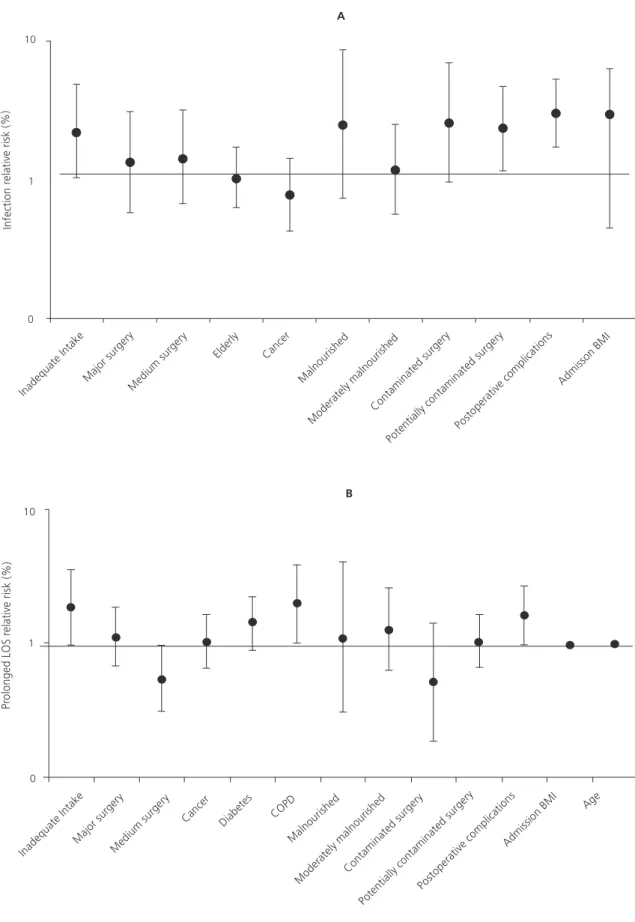
Multivariate analysis showed that the consumption of less than 75.0% of the prescribed calories and proteins led to an increased risk of infection of 121.0% (RR=2.21; 95%CI=1.01-4.86) (Figure 1A). Multivariate analysis also found that major surgery (RR=1.35; 95%CI=0.58-3.10), medium-sized surgery (RR=1.44; 95%CI= 0.66-3.14), potentially contaminated surgery (RR=2.31; 95%CI=1.15-4.65), and postoperative complications (RR=2.98; 95%CI=1.70-5.23) significantly increased the risk of infection (Figure 1A).
Multivariate analysis showed that consuming less than 75.0% of the prescribed calories and proteins was a risk factor for prolonged length of stay, increasing the risk of prolonged stay by 89.0% (RR=1.89; 95%CI=1.01-3.53) (Figure 1B). Multivariate analysis also showed that patients who underwent major surgery and had postoperative complications had 12.0%
Table 3. Infection risk in patients grouped by clinical features. Porto Alegre (RS), Brazil, 2013.
Cal. and Prot. intake <75% Major surgery
Old age Cancer Malnutrition Contaminated surgery Postoperative complications Features
24.4 28.3 19.3 19.7 35.3 30.0 43.7
Feature present Feature absent
10.7 14.3 13.7 12.6 14.8 08.4 10.3
Incidence of infection (%)
2.15 (0.88-5.20) 3.25 (1.79-5.91) 1.49 (0.94-2.10) 1.55 (1.02-2.38) 2.39 (1.21-4.72) 3.57 (1.82-6.99) 4.19 (2.93-6.00) RR (95%CI)
Note: Cal: Calories; Prot: Protein.
Table 4. Prolonged hospital stay risk in patients grouped by clinical features. Porto Alegre (RS), Brazil, 2013.
Cal. and Prot. intake <75% Major surgery
Diabetes COPD
Contaminated surgery Postoperative complications Features
34.5 41.4 37.5 47.4 31.3 47.6
Feature present Feature absent
21.4 25.4 25.2 26.1 23.4 21.8
Prolonged length of stay (%)
1.71 (0.89-3.25) 1.63 (1.16-2.30) 1.49 (1.06-2.09) 1.81 (1.10-2.98) 1.14 (0.60-2.14) 2.15 (1.64-2.83) RR (95%CI)
Figure 1. Adjusted relative risk for the outcomes infection (A) and prolonged length of stay (B). Porto Alegre (RS), Brazil, 2013.
(95%CI=0.66-1.88) and 61.5% (95%CI= 0.98-2.65) higher risks of prolonged length of stay, respectively, than patients not exposed to these factors (Figure 1B).
D I S C U S S I O N
The present prospective cohort study aimed to analyze the nutritional therapy offered to patients hospitalized for elective surgery, and to assess whether low calorie and protein intakes during stay, among other factors, is associated with a higher risk of specific hospital-related outcomes. Most (83.3%) patients in the study consumed less than 75.0% of the prescribed calories and proteins, and only 16.2% had adequate calorie-protein intake. A retrospective
study13 found that only 25.0% of the patients
consumed enough calories and proteins by the fourth day of stay. In a 10-year comparative prospective study of hospitals in Switzerland, the authors found that the proportion of undernourished
patients remained unchanged (69.0 versus 70.0%)
after the implementation of a nutritional program14.
The mean calorie and protein intakes by patients with inadequate nutritional therapy were less than half (48%) the prescribed amount.
Similar results were found by Hiesmayr et al.12,
who reported that 64% (n=3673) of patients consumed less than half of their meals, and by
the Nutrition Care Day study7, which found that
90% of patients consumed ≤50% of their meals.
Patients with inadequate calorie-protein intake (less than 75% of the prescribed amount) had an increased risk of certain unfavorable outcomes, such as a 121% increase in infection risk and an 89% increase in the risk of prolonged length of stay, after adjusting for confounders.
Hiesmayr et al.12 also found that low food intake
was an independent risk factor for mortality during stay. On the other hand, high calorie and protein intakes led to improved quality of life in a randomized study comparing two groups of
patients at nutritional risk15.
The rate of infection in surgery patients at a university hospital was estimated to be 6.0%
by Medeiros et al.16. However, the infection rate
found by the present study (22.1%) was similar
to that reported (23.6%) by Villas Boas & Ruiz17.
Additionally, the risk of infection was 35% higher in the study patients who underwent major
surgery. A Brazilian study18 has found that
improved pain control and reduced surgical trauma contribute to reduce length of stay after major thoracic surgery, and, in agreement with the present findings, suggested that the risk of prolonged stay after major surgery was 12.0% higher than after other types of surgery. Other studies have also suggested that the risk of prolonged stay is 3.1 times higher in patients with postoperative complications (fistula, evisceration,
and surgical wound dehiscence)19,20.
Some authors21,22 have also found
associations between malnutrition, moderate or severe nutritional risk, and prolonged length of stay or infection. This finding is consonant with the present study. In univariate analysis, malnourished patients according to the subjective global assessment had a higher risk of infection.
Oral food intake is more physiological, respects the normal transit of nutrients through the gastrointestinal tract, presents fewer complications, and has lower costs than enteral
or parenteral feeding23. Nevertheless, low calorie
and protein intakes were observed regardless of the route of feeding. These results were corroborated
by other studies24 which found that enteral
feeding does not ensure adequate calorie intake, especially in patients undergoing intensive
therapy25. Parenteral nutrition may be better able
to meet caloric requirements26, but this could not
be verified by the present study as few patients (0.8%) received such feeding.
The taste of hospital food, limited meal choices, and meals served too early were some of the reasons cited by patients for the low calorie and protein intakes during stay. Disease or treatment factors did not appear to influence
calorie intake27. The present study did not aim to
Furthermore, recent practices such as shorter fasts
and preoperative dietary counseling28,29 have not
yet been implemented by the Brazilian health system. Studies of the Enhanced Recovery After Surgery pathway show that these practices can help to reduce hospital lengths of stay after abdominal surgery by as much as 25% with no
adverse effects30.
The prospective study design ensured collection of independent and outcome variables. While convenience sampling may have led to selection bias, the inclusion of patients in different stages of disease and treatment may have led to a representative assessment of patients undergoing surgery in the study hospital. Factors that may have led to underestimated calorie and protein intakes, such as consumption of different diets and non-hospital food, can be considered study limitations, as well as the fact that nutritional therapy was considered adequate when calorie and protein intakes were at least 75% of the prescribed amount, since other studies generally consider nutritional requirements and total energy
expenditure27.
C O N C L U S I O N
Most patients did not have adequate calorie and protein intakes; those with inadequate nutritional therapy had an increased risk of infection and were more likely to have prolonged length of hospital stays. By successfully assessing the effects of hospital nutritional therapy on hospitalization outcome, the present study found that adequate nutritional therapy (consumption of >75% of prescribed nutrients) protects against infection and prolonged length of hospital stays. These findings suggest that efforts must be made to ensure that patients receive and consume sufficient calories and proteins during stay.
A C K N O W L E D G E M E N T
This study was sponsored by Hospital de Clínicas de Porto Alegre Research Incentive Fund.
C O N T R I B U T O R S
MCS ASSIS carried out the study; made substantial contributions to study conception and design, and data acquisition, analysis, and interpretation; drafted the paper and revised it for important intellectual content; and approved the final version for publication. CRM SILVEIRA helped to draft the manuscript and collect data. MG BEGHETTO made substantial contributions to study conception and design, and data analysis and interpretation. ED MELLO conceived the study; participated in its design and coordination; and helped to draft the manuscript. All authors read and approved the final manuscript.
R E F E R E N C E S
1. Lamb CA, Parr J, Lamb EI, Warren MD. Adult malnutrition screening, prevalence and management in a United Kingdom hospital: Cross-sectional study. Br J Nutr. 2009; 102(4):571-5. http://dx.doi.org/ 10.1017/S0007114509236038
2. Mello ED, Beghetto MG, Teixeira LB, Luft VC. Des-nutrição hospitalar: cinco anos após o IBRANUTRI. Rev Bras Nutr Clin. 2003; 18(2):65-9.
3. Akner G, Cederholm T. Treatment of protein-energy malnutrition in chronic nonmalignant disorders. Am J Clin Nutr. 2001; 74(1):6-24.
4. Naber TH, Schermer T, de Bree A, Nusteling K, Eggink L, Kruimal JW, et al. Prevalence of malnutrition in nonsurgical hospitalized patients and its association with disease complications. Am J Clin Nutr. 1997; 66(5):1232-9.
5. Boog MCF, Silva JB. Percepções de enfermeiras sobre o processo de cuidados nutricional. Rev Bras Nutr Clín. 2001; 16(1):17-22.
6. Roubenoff R, Roubenoff RA, Preto J, Balke CW. Malnutrition among hospitalized patients. A problem of physician awareness. Arch Intern Med. 1987; 147(8):1462-5. http://dx.doi.org/10.1001/ archinte.1987.00370080098019
7. Agarwal E, Ferguson M, Banks M, Bauer J, Capra S, Isenring E. Nutritional status and dietary intake of acute care patients: Results from the Nutrition Care Day Survey 2010. Clin Nutr. 2012; 31(1):41-7. http://dx.doi.org/10.1016/j.clnu.2011.08.002 8. Kowanko I, Simon S, Wood J. Energy and nutrient
intake of patients in acute care. J Clin Nurs. 2001; 10(1):51-7.
9. Bauer J, Bannister M, Crowhurst R, Denmeade SL, Horsley P, McDonald C. Nutritionday: An Australian hospital’s participation in international
10. Goiburu ME, Goiburu MMJ, Bianco H, Díaz JR, Alderete F, Palacios MC, et al. The impact of malnutrition on morbidity, mortality and length of hospital stay in trauma patients. Nutr Hosp. 2006; 21(5):604-10.
11. Zaloga GP. Parenteral nutrition in adult inpatients with functioning gastrointestinal tracts: Assessment of outcomes. Lancet. 2006; 367(9516):1101-11. http://dx.doi.org/10.1016/S0140-6736(06)68307-4 12. Hiesmayr M, Schindler K, Pernicka E, Schuh C, Schoeniger-Hekele A, Bauer P, et al. Decreased food intake is a risk factor for mortality in hospitalized patients: The NutritionDay survey 2006. Clin Nutr. 2009; 28(5):484-91. http://dx.doi.org/10.1016/j. clnu.2009.05.013
13. Leistra E, Willeboordse F, van Bokhorst-de van der Schueren MA, Visser M, Weijs PJ, Haans-van den Oord A, et al. Predictors for achieving protein and energy requirements in undernourished hospital patients. Clin Nutr. 2011; 30(4):484-9. http://dx. doi.org/10.1016/j.clnu.2011.01.008
14. Thibault R, Chikhi M, Clerc A, Darmon P, Chopard P, Genton L, et al. Assessment of food intake in hospitalized patients: A 10-year comparative study of a prospective hospital survey. Clin Nutr. 2011; 30(3):289-96. http://dx.doi.org/10.1016/j.clnu.20 10.10.002
15. Rüfenacht U, Rühlin M, Wegmann M, Imoberdorf R, Ballmer PE. Nutritional counseling improves quality of life and nutrient intake in hospitalized undernourished patients. Nutrition. 2010; 26(1): 53-60. http://dx.doi.org/10.1016/j.nut.2009.0 4.018
16. Medeiros AC, Neto TA, Filho AMD, Pinto FEL Jr, Uchôa RAC, Carvalho MR. Infecção hospitalar em pacientes cirúrgicos de hospital universitário. Acta Cir Bras. 2003; 18(Suppl.1):15-8.
17. Villas Boas PJF, Ruiz T. Ocorrência de infecção hos-pitalar em idosos internados em hospital uni-versitário. Rev Saúde Pública. 2004; 38(3):372-8. 18. de Lima NF, Carvalho AL. Early discharge following
major thoracic surgery: Identification of related factors. Rev Port Pneumol. 2003; 9(3):205-13. 19. Markar SR, Karthikesalingam A, Low DE. Outcomes
assessment of the surgical management of esophageal cancer in younger and older patients. Ann Thorac Surg. 2012; 94(5):1652-8. http://dx. doi.org/10.1016/j.athoracsur.2012.06.067 20. van Ramshorst GH, Nieuwenhuizen J, Hop WCJ,
Arends P, Boom J, Jeekel J, et al. Abdominal wound dehiscence in adults: Development and validation of a risk model. World J Surg. 2010; 34(1):20-7. http://dx.doi.org/10.1007/s00268-009-0277-y 21. Kyle UG, Pirlich M, Schuetz T, Lochs H, Pichard C.
Is nutritional depletion by Nutritional Risk Index associated with increased length of hospital stay? A population-based study. J Parenter Enteral Nutr.
2004; 28(2):99-104. http://dx.doi.org/10.1177/01 4860710402800299
22. Almeida AI, Correia M, Camilo M, Ravasco P. Length of stay in surgical patients: Nutritional predictive parameters revisited. Br J Nutr. 2013; 109(2):322-8. http://dx.doi.org/10.1017/S0007114512001134 23. Osland E, Yunus RM, Khan S, Memon MA. Early
versus traditional postoperative feeding in patients undergoing resectional gastrointestinal surgery: A meta-analysis. J Parenter Enteral Nutr. 2011; 35(4):473-87. http://dx.doi.org/10.1177/0148607 110385698
24. Isidro MF, Lima DSC. Adequação calórico-proteica da terapia nutricional enteral em pacientes cirúrgicos. Rev Assoc Med Bras. 2012; 58(5):580-6. http://dx.doi.org/10.1590/S0104-4230201200 0500016
25. Assis MCS, Silva SMR, Leães DM, Novello CL, Silveira CRM, Mello ED, et al. Nutrição enteral: diferenças entre volume, calorias e proteínas prescritos e admi-nistrados em adultos. Rev Bras Ter Intensiva. 2010; 22(4):346-50.
26. Casaer MP, Mesotten D, Hermans G, Wouters PJ, Schetz M, Meyfroidt G, et al. Early versus late parenteral nutrition in critically ill adults. N Engl J Med. 2011; 365(6):506-17. http://dx.doi.org/10.10 56/NEJMoa1102662
27. Dupertuis YM, Kossovsky MP, Kyle UG, Raguso CA, Genton L, Pichard C. Food intake on 1707 hospitalised patients: A prospective comprehensive hospital survey. Clin Nutr. 2003; 22(2):115-23. http://dx.doi.org/10.1054/clnu.2002.0623 28. Varadhan KK, Neal KR, Dejong CH, Fearon KC,
Ljungqvist O, Lobo DN. The enhance recovery after surgery (ERAS) pathway for patients undergoing major elective open colorectal surgery: A meta-analysis of randomized controlled trials. Clin Nutr. 2010; 29(4):434-40. http://dx.doi.org/10.1016/j. clnu.2010.01.004
29. Ren L, Zhu D, Wei Y, Pan X, Liang L, Xu J, et al. Enhanced Recovery After Surgery (ERAS) program attenuates stress and accelerates recovery in patients after radical resection for colorectal cancer: A prospective randomized controlled trial. World J Surg. 2012; 36(2):407-14. http://dx.doi.org/10. 1007/s00268-011-1348-4
30. Fearon KC, Ljungqvist O, Von Meyenfeldt M, Revhaug A, Dejong CH, Lassen K, et al. Enhanced recovery after surgery: A consensus review of clinical care for patients undergoing colonic resection. Clin Nutr. 2005; 24(3):466-77. http://dx.doi.org/10. 1016/j.clnu.2005.02.002