Air pollution and its impacts on health in
Vitoria, Espirito Santo, Brazil
Clarice Umbelino de FreitasI, Antonio Ponce de LeonII, Washington JugerII, Nelson GouveiaIII
I Laboratório de Investigação Médica. Hospital das Clínicas. Faculdade de Medicina. Universidade de São
Paulo. São Paulo, SP, Brasil
II Instituto de Medicina Social. Universidade Estadual do Rio de Janeiro. Rio de Janeiro, RJ, Brasil
III Departamento de Medicina Preventiva. Faculdade de Medicina. Universidade de São Paulo. São Paulo, SP, Brasil
ABSTRACT
OBJECTIVE: To analyze the impact of air pollution on respiratory and cardiovascular morbidity of children and adults in the city of Vitoria, state of Espirito Santo.
METHODS: A study was carried out using time-series models via Poisson regression from hospitalization and pollutant data in Vitoria, ES, Southeastern Brazil, from 2001 to 2006. Fine particulate matter (PM10), sulfur dioxide (SO2), and ozone (O3) were tested as independent
variables in simple and cumulative lags of up to ive days. Temperature, humidity and variables
indicating weekdays and city holidays were added as control variables in the models.
RESULTS: For each increment of 10 µg/m3 of the pollutants PM
10, SO2, and O3, the percentage of relative risk (%RR) for hospitalizations due to total respiratory diseases increased 9.67 (95%CI
11.84-7.54), 6.98 (95%CI 9.98-4.17) and 1.93 (95%CI 2.95-0.93), respectively. We found %RR = 6.60 (95%CI 9.53-3.75), %RR = 5.19 (95%CI 9.01-1.5), and %RR = 3.68 (95%CI 5.07-2.31) for respiratory diseases in children under the age of ive years for PM10, SO2, and O3, respectively. Cardiovascular
diseases showed a signiicant relationship with O3, with %RR = 2.11 (95%CI 3.18-1.06).
CONCLUSIONS: Respiratory diseases presented a stronger and more consistent relationship with the pollutants researched in Vitoria. A better dose-response relationship was observed when using cumulative lags in polynomial distributed lag models.
DESCRIPTORS:Child. Adult. Air Pollution, adverse effects. Respiratory Tract Diseases, epidemiology. Cardiovascular Diseases, epidemiology. Time Series Studies.
Correspondence: Clarice Umbelino de Freitas Av. Dr. Arnaldo, 455 2° andar Cerqueira Cesar
01246-903 São Paulo, SP, Brasil E-mail: [email protected]
Received: 8 Oct 2014 Approved: 21 Apr 2015
How to cite: Freitas CU, Ponce de Leon A, Juger W, Gouveia N. Air pollution and its impacts on health in Vitoria, Espirito Santo, Brazil. Rev Saude Publica. 2016;50:4.
Copyright: This is an open-access article distributed under the terms of the Creative Commons Attribution License, which permits unrestricted use, distribution, and reproduction in any medium, provided that the original author and source are credited.
2
Air pollution and health in Vitoria, Brazil Freitas CU et al.
DOI:10.1590/S1518-8787.2016050005909
INTRODUCTION
he efects of air pollution on health are detected in several cities around the world. his
led the World Health Organization (WHO) to propose reduction targets from decreasing Air Quality Guidelines, replacing the previous regulations, in force until 200516. Studies on the impact of air pollution on health in Latin American countries yield results similar to those in other locations in the world12. Most studies refers to air pollutants resulting primarily or secondarily from burning fossil fuels: ine particulate matter (PM10), sulfur dioxide (SO2), carbon monoxide (CO), nitrogen oxides (NOx), and ozone (O3). As for health outcomes, respiratory and cardiovascular diseases are the ones most commonly associated with air pollution16.
Vitoria is part of a geographical area of great urbanization called Greater Vitoria metropolitan area. It is the fourth most populous city of the Espirito Santo state (327,801 inhabitants in a 98 km2 area) according to data collected by the Brazilian Institute of Geography and Statistics (IBGE) in 2010. It is surrounded by a river island called Vitoria Bay. It has two ports that are a part of the largest port complex in Brazil (Port of Vitoria and Port of Tubarao). Since 2000, the city has had an Rede Automática de Monitoramento da Qualidade do Ar (RAMQAR – Automatic Air Quality Monitoring Network ). his RAMQAR has three
stations (Figure 1) and measures the parameters of PM10, SO2, O3,CO, and hydrocarbons in the neighborhoods of Jardim Camburi, Enseada do Sua, and Vitoria Centroa. Carapina station, located in a municipality close to Vitoria, monitors the meteorological parameters, in addition to measuring PM10.
Large industrial projects were implemented in the Greater Vitoria Region since the early
1970s, and industry was identiied as the main source of pollution in the areaa. According to the same source, the growth of car leet and real-estate projects has changed the area proile
in recent years. An inventory of sources carried out by the Instituto Estadual de Meio Ambiente e Recursos Hídricos (IEMA – Institute for Environment and Water Resources of Espirito Santo) in 2011 indicates dust resuspension (68.0%), which has various origins, industries (21.0%), and vehicles (4.0%) as the main causes for PM10 levels. Industrial emissions accounted for almost all SO2 emission to the atmosphere and for more than half of NOx emission, and a small relative share for hydrocarbon emission. In turn, vehicles were the main responsible for emitting CO and hydrocarbons (around 50.0%)b. Data collected by the IBGE Cities website in 2005 indicate an 83,859 car leet, with an increasing trend, reaching 124,534 in 2014 of a
total of 191,143 vehicles in all modesc.
Publications on the efects of air pollution in several Brazilian cities use diferent approaches,
which has prevented comparisons between findings. Aiming at contributing to this comparison, the methodology used in this study was applied to various Brazilian cities
that have air quality monitoring. his study aimed at estimating the risk of illness due to
respiratory and cardiovascular diseases and its relation to air pollution in Vitoria.
METHODS
Data of hospital admissions according to place of residence were obtained in the Hospital Information System (HIS) of DATASUS from 2001 to 2006 for the city of Vitoria, from an information website created for the Projeto de Avaliação de Impacto da Poluição do Ar nas Cidades Brasileiras (Air Pollution Impact in Brazilian Cities Assessment Project). he project
aimed at measuring the impact of air pollution on health, using the same methodology for various locations, and exploring environmental monitoring models.
he website refers to the Autorizações de Internação Hospitalar (AIH – Hospital Admission Authorizations) systematized by the Department of Computer Science of the Brazilian
Uniied Health System (SUS), obtained from DATASUS. he bases were grouped per day,
i.e., daily counts of hospital admissions due to the investigated causes: respiratory diseases a Instituto Estadual de Meio
Ambiente e Recursos Hídricos. Relatório da qualidade do ar: Grande Vitória: 2013 [Internet]. Vitória (ES): Instituto Estadual de Meio Ambiente e Recursos Hídricos; 2013 [cited 2014 Sept 14]. Available from: http:// www.meioambiente.es.gov.br/ download/Relat%C3%B3rio_ Anual_de_Qualidade_do_ Ar_2013.pdf
b Instituto Estadual de Meio
Ambiente e Recursos Hídricos. Meio ambiente: estudo mostra como está a qualidade do ar na GV [Internet]. Diário Oficial de Poderes de Estado. Vitória (ES) 11 maio 2011, 3. [cited 2015 Nov 26]. Available from: http://www.dio.es.gov.br/portal/ visualizacoes/pdf/#/p:1/e:241
c Instituto Brasileira de
(ICD10: J00-J99) at all ages (TRD), respiratory diseases (ICD10: J00-J99) in children under
the age of ive years (CRD), and cardiovascular diseases (ICD10: I00-I99) in adults over 39 years old (CVD), used as dependent variables in the models. he pollutant variables
were grouped according to monitoring stations and meteorological variables in the same website. Meteorological and pollutant data from three monitoring stations in the city of Vitoria, provided by IEMA, were grouped in daily averages for PM10 and SO2, and the largest 8h-concentration for O3, minimizing losses in case the stations were considered individually.
he bases were evaluated for information continuity, accepting losses of up to 15.0% of days in the period for each environmental variable. he concentration values of PM10, O3, and SO2 were used as exposure variables, and temperature and relative humidity as controls.
Using the data provided by the website as a source of information, a time-series analysis was performed with the ares library developed for the R applicationd, using the same methodology applied in cities that have joined the project. For each participating municipality, explanatory models were created for the counts of hospital admissions due to causes studied over time.
he proposed models are part of the class of Generalized Additive Models (GAM), with the
option of Poisson regression. In this class of models, the average daily number of health
events was described as the sum of functions of explanatory variables. he terms whose
association with the outcome was linear, e.g., weekdays and holidays, were included in the model multiplied by a slope. Variables that were nonlinearly related to the outcome were included in the model by smooth functions, e.g., splines, according to the equation:
n(E(Y ))= X +
t 1tS (X )
i iti = p
2
Σ
ℓ
ℓ
in which Yt and X1t are the numbers of morbid events and the level of a given pollutant on day t, respectively; X
it are the predictor variables, including time, and Si are the smoothing
functions, using natural splines. When indicator variables for weekdays and national or local
holidays were added, its signiicance was tested. Holidays with signiicance of up to 0.09 were grouped according to the direction of the efect: positive or negative. In the time-series
modeling process, the aim was to minimize the Akaike Information Criterion (AIC) and optimize the Partial Autocorrelation Function (PACF).
After building the working model (Core Model) containing all control variables and checking
their suitability, pollutants in lags of up to ive days (simple lag) were added individually. he cumulative efect in that period was also analyzed from a polynomial distributed lag model. his model, in addition to considering the latency of the efect of pollutants, minimizes the
instability in the estimation process, typical of analyses that use multiple lags13.
he efect was estimated for each pollutant linearly added to the working model, providing
the percentage of relative risk (%RR) for each increment of 10 µg/m3. his is derived from RR using the following formula: %RR = (e10β- 1)*100. his amount expresses the percentage change in the average number of hospital admissions for a variation of 10 µg/m3 in pollutant concentration. A 5% signiicance level was assumed in all estimates.
RESULTS
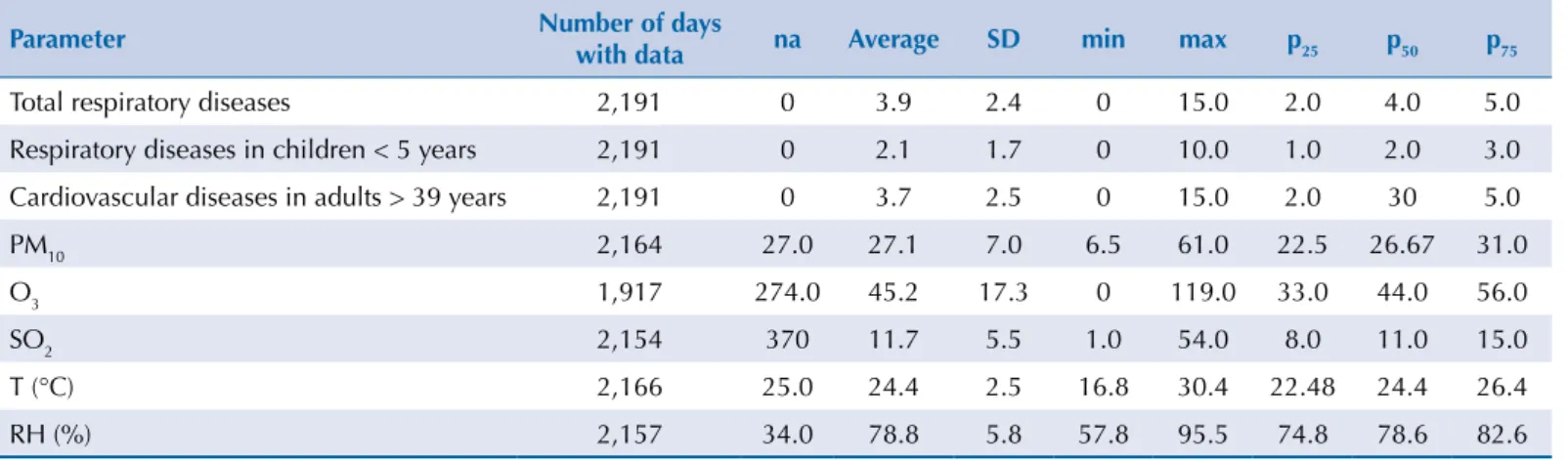
We found a smaller number of child admissions, with an average of two per day due to respiratory diseases. Losses of meteorological and pollutant data were below 15.0% from January 2001 to December 2006, a limit established as acceptable for the period (Table 1).
Despite the characteristic seasonality of pollutants, annual PM10 averages remained constant and around 27 µg/m3 in the period. SO
2 showed an increasing trend, with levels ranging from 5.87 µg/m3 in 2001 to 14.06 µg/m3 in 2006. Ozone data showed discontinuity between 2005 and 2006 because of problems in the monitoring station, not allowing trend observation (Figure 2).
d Junger WL. Análise, imputação
de dados e interfaces
4
Air pollution and health in Vitoria, Brazil Freitas CU et al.
DOI:10.1590/S1518-8787.2016050005909 Residue analysis indicated a good adjustment of the model for researched outcomes. Even with the small number of hospital admissions due to respiratory diseases in children under the age
of ive years, the distribution of standardized residues compared with the normal distribution
in quantiles was similar to the distribution for cardiovascular and all respiratory diseases.
Upon adding pollutants in simple lag in the models, a signiicant relationship was found
for PM10 at lag 0 with %RR = 4.40 (95%CI 0.64-8.23) when analyzing TRD. A relationship was
found at lag 2 for CRD: %RR = 2.55 (95%CI 0.08-5.08) also for O3. Cardiovascular diseases were not related to any of the pollutants studied in this lag structure. Table 2 presents %RR
of the polynomial distributed lag model from zero to ive days for increments of 10 µg/m3 in pollutant levels and their overall value. he overall value reached high levels in the period
City limit
Air quality monitoring station Vitoria
Vitoria Brazil
Espirito Santo
Espirito Santo
0 1.778
kilometers Scale: 1:44,440
Figure 1. Air quality monitoring stations. Vitoria, ES, Southeastern Brazil.
Table 1. Basic descriptive parameters. Vitoria, ES, Southeastern Brazil, 2001-2006.
Parameter Number of days
with data na Average SD min max p25 p50 p75
Total respiratory diseases 2,191 0 3.9 2.4 0 15.0 2.0 4.0 5.0
Respiratory diseases in children < 5 years 2,191 0 2.1 1.7 0 10.0 1.0 2.0 3.0
Cardiovascular diseases in adults > 39 years 2,191 0 3.7 2.5 0 15.0 2.0 30 5.0
PM10 2,164 27.0 27.1 7.0 6.5 61.0 22.5 26.67 31.0
O3 1,917 274.0 45.2 17.3 0 119.0 33.0 44.0 56.0
SO2 2,154 370 11.7 5.5 1.0 54.0 8.0 11.0 15.0
T (°C) 2,166 25.0 24.4 2.5 16.8 30.4 22.48 24.4 26.4
RH (%) 2,157 34.0 78.8 5.8 57.8 95.5 74.8 78.6 82.6
5
Air pollution and health in
V
itoria, Br
azil
Freitas CU et al.
DOI:10.1590/S1518-8787.2016050005909
3: ozone; SO
2: sulfur dioxide
Daily pollutant lev
els (PM
10
, SO
2, and Ozone).
V
itoria, ES, Southeastern Br
6
Air pollution and health in Vitoria, Brazil Freitas CU et al.
DOI:10.1590/S1518-8787.2016050005909 for hospital admissions due to total respiratory diseases and in children under the age of
ive years. CVD were related only to ozone.
DISCUSSION
Health outcomes presented a more robust and consistent relationship when considering the
cumulative efects of pollutants from zero to ive days in Vitoria. Hospital admissions due to total respiratory diseases and respiratory diseases in children under the age of ive years
were related to all researched pollutants, most strongly associated with PM10. Admissions
due to cardiovascular diseases were associated only to variations in ozone levels. he results
expressed in %RR indicate how much the average daily number of admissions increases for each increment of 10 µg/m3 of the pollutant.
he PM10 levels (27 µg/m
3) in Vitoria from 2001 to 2006 remained below the annual average
of 50 µg/m3 of the air quality standards proposed by the Brazilian National Environmental Council (CONAMA), and close to the 20 µg/m3 recommended by WHO guidelines.
Table 2. Percentage of relative risk* and 95% conidence interval for hospital admissions due to total respiratory diseases. respiratory diseases in children under the age of ive years. and cardiovascular diseases in adults over 39 years old. Vitoria. ES. Southeastern Brazil. 2001-2006.
Pollutant Lag TRD CRD < 5 years CVD > 39 years
%RR 95%CI %RR 95%CI %RR 95%CI
PM10
Current day 1.52 -1.85 5.02 0.27 -4.34 5.09 -1.55 -4.87 1.88
1-day lag 2.11 0.12 4.13 1.43 -1.28 4.22 -0.14 -2.12 1.88
2-day lag 2.26 0.37 4.18 1.97 -0.62 4.62 0.66 -1.23 2.6
2-day lag 1.98 0.15 3.85 1.87 -0.65 4.45 0.84 -1.02 2.75
2-day lag 1.28 -0.43 3.03 1.13 -1.23 3.56 0.39 -1.39 2.2
2-day lag 0.16 -2.74 3.16 -0.22 -4.23 3.95 -0.68 -3.62 2.35
Cumulative 5 days 9.67 7.54 11.84 6.60 3.75 9.53 -0.49 -2.46 1.52
O3
Current day -0.50 -2.32 1.34 0.33 -2.13 2.86 1.03 -0.88 2.98
1-day lag 0.08 -0.91 1.07 0.84 -0.49 2.2 0.26 -0.77 1.3
2-day lag 0.47 -0.49 1.43 1.06 -0.23 2.36 -0.14 -1.13 0.87
2-day lag 0.67 -0.27 1.63 0.96 -0.32 2.26 -0.16 -1.14 0.83
2-day lag 0.69 -0.24 1.63 0.57 -0.68 1.83 0.19 -0.76 1.16
2-day lag 0.52 -1.19 2.25 -0.13 -2.41 2.21 0.92 -0.86 2.73
Cumulative 5 days 1.93 0.93 2.95 3.68 2.31 5.07 2.11 1.06 3.18
SO2
Current day 1.36 -3.4 6.35 -0.25 -6.53 6.44 -5.21 -9.88 -0.31
1-day lag 0.20 -2.44 2.91 0.55 -2.98 4.2 -2.1 -4.83 0.72
2-day lag -0.15 -2.74 2.5 1.08 -2.38 4.66 0.37 -2.39 3.2
2-day lag 0.29 -2.29 2.94 1.34 -2.11 4.91 2.13 -0.65 4.98
2-day lag 1.53 -0.97 4.09 1.33 -1.99 4.76 3.14 0.45 5.9
2-day lag 3.61 -0.87 8.29 1.04 -4.81 7.25 3.38 -1.34 8.33
Cumulative 5 days 6.98 4.17 9.88 5.19 1.5 9.01 1.42 -1.41 4.34
PM10: particulate matter smaller than 10µ; O3: ozone; SO2: sulfur dioxide; TRD: Hospital admissions due to total respiratory disea-ses; CRD < 5 years: Hospital admissions due to respiratory diseases in children under the age of ive years; CVD > 39 years: Hospital admissions due to cardiovascular diseases in adults over 39 years old
Nevertheless, the efect of air pollution was found on residents of Vitoria. his supports the
WHO recommendation to always seek lower exposure levels for health protection, even in
cities of little pollution, as the dose-response relationship is linear when the efects of air
pollutants are analyzed without a safe dose4,16. Vitoria has a mixed exposure characteristic (industry and vehicles contribute to pollutant levels) and must have a PM10 composition
diferent from other urban centers where vehicles predominate. To understand the efects
of each type of exposure source, speciation studies on particulate matter are required, but this is not available in the location.
Although a period of more data completion was considered for the study, gaps in the
information on ozone levels were noted. hese gaps, although within tolerable limits
according to the criteria established by the authors, are found on a single period of 2005,
which may have inluenced the results of the analysis of this pollutant.
Among the pollutants, PM10 presents the most frequent and consistent relationship with cardiovascular and respiratory tract diseases, although it is not always possible to separate
the efects of other pollutants, as they are all present in the air we breathe1. A review study on the mechanisms of action of PM10 indicates the onset of oxidative stress and the
systemic inlammatory process that may be related to the anatomical and physiological lung
remodeling and the atherosclerotic process1. We found a relationship between respiratory diseases and PM10 in Vitoria. his pollutant was not related to hospital admissions due to cardiovascular diseases.
Bell et al.2 performed a meta-analysis of time-series studies and found a relationship between ozone and overall mortality and mortality due to cardiovascular diseases considering American cities and other locations. Deaths from respiratory diseases were not associated
with ozone levels. In a recent publication of 34 studies evaluating the efects of PM10, PM2,5, CO, NO2, SO2, and O3 on myocardial infarction, no signiicant relationship was found between the latter pollutant and this outcome10. Exposure to ozone was signiicantly associated to hospital admissions due to respiratory diseases in children8,11 and cardiovascular diseases in adults over 39 years old living in Cubatao, on the coast of the state of Sao Paulo11. In the city of Sao Paulo, this relationship was observed for respiratory diseases in children, with a weaker association than the one found in this study. In Sao Paulo, the risk of admissions was evaluated for increments of 10 µg/m3, which allowed the comparison with our indings5.
he literature shows that efects on health continue to be detected even in low exposure
to sulfur dioxide15. his should become a greater concern in Vitoria, as an increasing trend of this pollutant was observed in the studied period. his trend persisted, as noted in the
Relatório Anual de Qualidade do Ar de Vitória de 2013 (2013 Annual Vitoria Air Quality Report), which analyzed the past 10 years.
In a literature survey on efects of air pollution on the health of residents of Vitoria, three publications were found. he irst one9 explores the attributable proportion of deaths due to respiratory diseases in the elderly and children in the Brazilian urban population, including
Vitoria, by the application of the coeicient of dose-response relationship in time-series studies performed in the cities of Rio de Janeiro and Sao Paulo. he second one3 analyzes the rates of outpatient care for asthma according to Vitoria neighborhoods. he third
one14 explores time-series models – both those already established in the literature and principal component analysis. With the two approaches, the authors aim at establishing a dose-response relationship between pollutants and hospital admissions in children, indicating a better suitability of the model and the pollution impact when using principal
component analysis. With this approach, %RR = 3.00 was found for the increment of
10.49 µg/m3 of PM
10, while the %RR obtained from the conventional approach was 2.00 for the same pollutant increment. While it is diicult to compare when using diferent
analysis methodology, this study found the highest estimate for children under the age of
ive years, with %RR = 6.6 for each increment of 10 µg/m3 of PM
8
Air pollution and health in Vitoria, Brazil Freitas CU et al.
DOI:10.1590/S1518-8787.2016050005909
he AIH information system does not represent the totality of hospitalizations in Brazil. It refers to services paid by the Brazilian Uniied Health System and its coverage varies
among states. The information system of the Comunicação de Internação Hospitalar
(CIH – Hospital Admission Communications), which has a record of admissions in hospitals
not covered by SUS, is available on DATASUS from 2008 on. he CIH accounted for 16.9%
of hospitalizations in Vitoria in 2008. Estimating from this proportion, this study may have used more than 80.0% of the hospitalizations in the city. However, interpreting the results
requires caution. hey should be considered as the impact of air pollution on admissions
recorded in hospitals related to by SUS.
Studies aimed at measuring the impact of pollution on health are a tool used by Health Surveillance technicians to discuss prevention and control activities with regulatory agencies or the judiciary6. On the one hand, the health sector has little legal power to require measures to correct the contamination of the environment. On the other, it has instruments that allow measuring the damage caused by this contamination in the population, although these are complex measurement techniques that are not always accessible to primary care services.
The Brazilian Ministry of Health proposes assessing and monitoring damage to health caused by air pollution using time-series studies as a surveillance activity7. In a recent study7, PM
10 was proposed as an exposure indicator and hospital admissions due to respiratory diseases as an effect indicator for the purposes of monitoring impacts of air pollution on health in Brazilian cities. Since the health sector does not have legal mechanisms for air pollution control, its contribution to the implementation of policies involves quantifying the impact of pollution on people’s disease burden. Although they only measure the acute effects of air pollution, time-series studies can be used to raise awareness of managers and the population, supporting the adoption of policies aimed at improving the air we breathe. The environmental area of Vitoria can use these studies to advance the air quality control policies in the city. Encouraging the continuity and diversity of approaches that aim at relating harsh environmental conditions to their impacts on health is not only desirable, but necessary for structuring Environmental Health in Brazil and Latin America as a whole.
REFERENCES
1. Anderson JO, Thundiyil JG, Stolbach A. Clearing the air: a review of the effects of particulate matter air pollution on human health. J Med Toxicol. 2012;8(2):166-75. DOI:10.1007/s13181-011-0203-1
2. Bell ML, Dominici F, Samet JM. A meta-analysis of time-series studies of ozone and mortality with comparison to the national morbidity, mortality, and air pollution study. Epidemiology. 2005;16(4):436-45. DOI:10.1097/01.ede.0000165817.40152.85
3. Castro HA, Hacon S, Argento R, Junger WL, Mello CF, Castiglioni Junior N et al. Doenças respiratórias e poluição atmosférica no Município de Vitória, Espírito Santo, Brasil. Cad Saude Publica. 2007;23 suppl 4:S630-42. DOI:10.1590/S0102-311X2007001600023
4. Daniels MJ, Dominici F, Samet JM, Zeger SL Estimating particulate matter-mortality
dose-response curves and threshold levels: an analysis of daily time-series for the 20 largest US cities. Am J Epidemiol. 2000;152(5):397-406. DOI:10.1093/aje/152.5.397
5. Freitas C, Bremner AS, Gouveia N, Pereira LA, Saldiva PH. Internações e óbitos e sua relação com a poluição atmosférica em São Paulo, 1993-1997. Rev Saude Publica. 2004;38(6):751-7. DOI:10.1590/S0034-89102004000600001
6. Freitas CU, Campos RAG, Silva MAFR, Panachão MRI, Moraes JC, Waissmann W et al. Can live in the surroudings of a petrochemical complex be a risk factor for autoimmune thiroid disease? Environ Res. 2010;110(1):112-7. DOI:10.1016/j.envres.2009.10.009
8. Jasinski R, Pereira LA, Braga, ALF. Poluição atmosférica e internações hospitalares por doenças respiratórias e crianças e adolescentes em Cubatão, São Paulo, Brasil, entre 1997-2004. Cad Saude Publica. 2011;27(11):2242-52. DOI:10.1590/S0102-311X2011001100017
9. Marcilio I, Gouveia N. Quantifying the impact of air pollution on the urban population of Brazil. Cad Saude Publica. 2007;23 supll 4:S529-36. DOI:10.1590/S0102-311X2007001600013
10. Mustai H, Jabre P, Caussin C, Murad MH, Escolano S, Taflet M et al. Main air pollutants and myocardial infarction: a systematic review and meta-analysis. JAMA. 2012;307(7):713-21. DOI:10.1001/jama.2012.126
11. Nardocci AC, Freitas CU, Ponce de Leon ACM, Junger WL, Gouveia NC. Poluição do ar e doenças respiratórias e cardiovasculares: estudo de séries temporais em Cubatão, São Paulo,
Brasil. Cad Saude Publica. 2013;29(9):1867-76. DOI:10.1590/0102-311X00150012
12. Romieu I, Gouveia N, Cifuentes LA, Ponce de Leon A, Junger W, Vera J et al. Multicity study of air pollution and mortality in Latin America (the ESCALA study). Res Rep Health Eff Inst. 2012;(171):5-86.
13. Schwartz J. The distributed lag between air pollution and daily deaths. Epidemiology. 2000;11(3):320-6.
14. Souza JB, Reisen VA, Santos JM, Franco GC. Componentes principais e modelagem linear generalizada na associação entre atendimento hospitalar e poluição do ar. Rev Saude Publica. 2014;48(3):451-8. DOI:10.1590/S0034-8910.2014048005078
15. Souza SL, Pires JC, Martins EM, Fortes JD, Alvim-Ferraz MC, Martins FG. Short-term effects of air pollution on respiratory morbidity at Rio de Janeiro – Part II: health assessment. Environ Int. 2012;43(1):1-5. DOI:10.1016/j.envint.2012.02.004
16. World Health Organization (WHO). Air quality guidelines: global update 2005: report on a working group meeting; 2005 Oct. 18-20; Bonn, Germany. Copenhagen: World Health Organization; 2005.
Funding: Brazilian Ministry of Health (Process 1297/2008).
Authors’ Contribution: Data collection and organization, analysis and manuscript proposal: CUF. Data analysis
1
DOI: 10.1590/S01518-8787.2016050005909err ERRATA Rev Saúde Pública 2016;50:4err
In “Air pollution and its impacts on health in Vitoria, Espirito Santo, Brazil”. Rev. Saude Publica [online]. 2016, vol. 50, 4. Epub 15-Mar-2016. ISSN 1518-8787. http://dx.doi.org/10.1590/ S1518-8787.2016050005909, the Journal corrects the author’s last name.
Where you read:
Juger, Washington
You should read: