Caroline GavaI Jocieli MalacarneI
Diana Patrícia Giraldo RiosI
Clemax Couto Sant'AnnaII
Luiz Antônio Bastos CamachoIII Paulo Cesar BastaIII
I Programa de Epidemiologia em Saúde Pública. Escola Nacional de Saúde Pública Sérgio Arouca. Fundação Oswaldo Cruz. Rio de Janeiro, RJ, Brasil
II Instituto de Puericultura e Pediatria Martagão Gesteira. Faculdade de Medicina. Universidade Federal do Rio de Janeiro. Rio de Janeiro, RJ, Brasil
III Escola Nacional de Saúde Pública Sérgio Arouca. Fundação Oswaldo Cruz. Rio de Janeiro, RJ, Brasil
Correspondence: Caroline Gava
Travessa José Carreteiro, 235 Engenhoca 24110-444 Niterói, RJ, Brasil
E-mail: [email protected] Received 3/5/2012
Approved: 8/3/2012
Article available from: www.scielo.br/rsp
Tuberculosis in indigenous
children in the Brazilian
Amazon
Tuberculose em crianças indígenas
da Amazônia brasileira
ABSTRACT
OBJECTIVE: Assess the epidemiological aspects of tuberculosis in Brazilian
indigenous children and actions to control it.
METHODS:An epidemiological study was performed with 356 children from
0 to 14 years of age in Rondônia State, Amazon, Brazil, during the period 1997-2006. Cases of TB reported to the Notifi able Diseases Surveillance System were divided into indigenous and non-indigenous categories and analyzed according to sex, age group, place of residence, clinical form, diagnostic tests and treatment outcome. A descriptive analysis of cases and hypothesis test (χ2)
was carried out to verify if there were differences in the proportions of illness between the groups investigated.
RESULTS: A total of 356 TB cases were identifi ed (125 indigenous, 231
non-indigenous) of which 51.4% of the cases were in males. In the indigenous group, 60.8% of the cases presented in children aged 0-4 years old. The incidence mean was much higher among indigenous; in 2001, 1,047.9 cases/100,000 inhabitants were reported in children aged < 5 years. Pulmonary TB was reported in more than 80% of the cases, and in both groups over 70% of the cases were cured. Cultures and histopathological exams were performed on only 10% of the patients. There were 3 cases of TB/HIV co-infection in the non-indigenous group and none in the indigenous group. The case detection rate was classifi ed as insuffi cient or fair in more than 80% of the indigenous population notifi cations, revealing that most of the diagnoses were performed based on chest x-ray.
CONCLUSIONS: The approach used in this study proved useful in demonstrating
inequalities in health between indigenous and non-indigenous populations and was superior to the conventional analyses performed by the surveillance services, drawing attention to the need to improve childhood TB diagnosis among the indigenous population.
DESCRIPTORS: Child. Indigenous Population. Tuberculosis,
Brazil remains among the 22 countries responsible for approximately 80% of the world’s tuberculosis (TB) cases,a despite reductions of more than 20% and 30%
in the incidence and mortality for TB in Brazil from 1990 to 2007.1,5
High incidence of TB is generally linked to precar-ious living conditions; for this reason, the spatial distribution of the disease is not homogenous, and cases are concentrated in specifi c groups, such as homeless people, prisoners, health professionals and ethnic minorities.14,15
Approximately 50% of Brazil’s total indigenous popu-lation is concentrated in the North of the country. For reasons that remain unexplored, the incidence of TB among indigenous peoples in both Brazil and other Latin American countries is higher than the incidence in other segments of the population.6-8 Around 50% of
RESUMO
OBJETIVO: Avaliar os aspectos epidemiológicos da tuberculose em crianças
indígenas brasileiras e as ações para seu controle.
MÉTODOS: Estudo epidemiológico com 356 crianças de 0 a 14 anos de
idade, em Rondônia, Amazônia, Brasil, de 1997 a 2006. Os casos, registrados no Sistema de Informação de Agravos de Notifi cação, foram classifi cados em indígenas e não indígenas, e analisados segundo sexo, faixa etária, local de residência, forma clínica, exames diagnósticos e resultado do tratamento. Foi realizada análise descritiva dos casos e teste de hipótese (χ2) para verifi car se
houve diferenças nas proporções de adoecimento entre os grupos investigados.
RESULTADOS: Foram identifi cados 356 casos de tuberculose (125 indígenas
e 231 não indígenas), dos quais 51,4% em meninos. Nos indígenas, 60,8% dos casos foram notifi cados em < 5 anos. A incidência média foi maior entre os indígenas: 1.047,9 casos/100.000 habitantes < 5 anos, no ano de 2001. A forma pulmonar foi registrada em mais de 80,0% dos casos e a cura ultrapassou 70,0% em ambos os grupos. Cultura e exame histopatológico foram utilizados em apenas 10,0% dos pacientes. Houve três casos de coinfecção com HIV em não indígenas e nenhum em indígenas. A detecção dos casos foi classifi cada como insufi ciente e/ou regular em mais de 80,0% das notifi cações em indígenas, mostrando que a maioria dos diagnósticos foi baseada na radiografi a de tórax.
CONCLUSÕES: A abordagem empregada mostrou-se útil para ilustrar
desigualdades em saúde entre indígenas e não indígenas, demonstrando-se superior às análises convencionais realizadas nos serviços de vigilância. Fica evidente a necessidade de um aprimoramento da investigação diagnóstica entre as crianças indígenas.
DESCRITORES: Criança. População Indígena. Tuberculose, epidemiologia.
Desigualdades em Saúde. Notifi cação de Doenças. Sub-Registro.
INTRODUCTION
a World Health Organization, TB Partnership Secretariat. The Global Plan to Stop TB 2011-2015: transforming the fi ght towards elimination of tuberculosis: WHO report 2010. Geneva; 2010 [cited 2011 Aug 3]. Available from: http://www.stoptb.org/assets/documents/global/plan/ TB_GlobalPlanToStopTB2011-2015.pdf
TB cases occur in children and adolescents in certain locations where indigenous populations live.3,13
Data on the epidemiological situation of TB in chil-dren and adolescents are limited, largely because the disease does not manifest itself in the same way as it does in adults.12,16 Sputum samples are rarely obtained
from children < 5 years old,20 and diagnostic confi
r-mation by culture occurs in less than 50% of tested samples from children.16 Diagnostic diffi culties are
exacerbated in developing countries as a result of technical problems and limited resources.22 Most cases
of pulmonary TB (PTB) in childhood are classifi ed as smear-negative. The establishment of a correct TB diagnosis in children has emerged as one of the most important challenges in this area.
b Instituto Brasileiro de Geografi a e Estatística. Demográfi co e contagem. Rio de Janeiro; 2011 [cited 2011 Aug 8]. Available from: http://www. sidra.ibge.gov.br/bda/default.asp
that deal with the subject are rare,4,13 and those that
have been performed indicate failures in the detec-tion and monitoring of reported cases. Investigadetec-tions performed with native populations in Australia, Canada and the United States indicate a higher incidence of TB in individuals < 15 years old than in children from other ethnic groups.17,21,24 The lack of resources for TB
control, poverty and diminished access to diagnosis and treatment also aggravate the epidemiological situation and can partly explain these discrepancies.
This study aimed to assess the epidemiological aspects of tuberculosis in Brazilian indigenous children and the actions for its control.
METHODS
An epidemiological study in reported TB cases with 356 children from zero to 14 years old in Rondônia, Northern Brazil, from 1997 to 2006.
The state of Rondônia is situated in the Brazilian Amazon region. It borders Bolivia (on the South and West) and the Brazilian states of Acre (West), Amazonas (North) and Mato Grosso (East). Rondônia has an area of 237,590 km2, and 1,562,409 inhabitants
are distributed over 52 municipalities.According to the 2010 IBGEb Demographic Census 0.4% (817,963
indi-viduals) of the Brazilian population and 0.8% (12,015 individuals) of the population in Rondônia declared themselves as indigenous.
Data were obtained from the National Notifiable Diseases Surveillance System (SINAN), present in all of the country’s states and municipalities and managed by the Ministry of Health, Brazil. New TB cases reported from January 1, 1997 to December 31, 2006 were included and duplicate records were excluded. The ethnicities of the cases were not available in the SINAN database and were inferred from the name and surname, home address and location of the health unit that reported the case. It is a traditional practice among the indigenous people of Rondônia to take the ethnic group as a surname (e.g., Antônio Oro Waran Xijein). This classifi cation method has been applied in other contexts11 and has proven useful in revealing health
inequalities in epidemiological research focusing on ethnicity and race. The classifi cation used here was performed independently by one of the authors and a researcher who had prior experience working among the indigenous people of Rondônia. The inter-rater reliability was considered nearly perfect (Kappa statistic: 0.97). Cases of TB were analyzed according to sex, age group (zero to four; fi ve to nine; and ten to 14 years
old), place of residence (urban; rural), clinical form (pulmonary – PTB; extrapulmonary – EPTB; both pulmonary and extrapulmonary – PTB+EPTB) and treatment outcome (cure; abandonment; death; trans-ference; change of diagnosis).
The diagnostic tests for TB were included in the data analysis: I) direct observation of acid-fast bacilli (AFB) in sputum (positive; negative); II) culture for
Mycobacterium tuberculosis in sputum (positive; negative); III) thorax radiography (normal; suggestive of TB; suggestive of another disease); IV) tuberculin skin test – TST (0 to 4 mm; 5 to 9 mm; or ≥ 10 mm); V) anti-HIV serology (positive; negative); and VI) histopathological slides (AFB-positive; suggestive of TB; not suggestive of TB).
Regarding the performance of the diagnostic tests described above, a classifi cation system was created to compare the tests used for TB diagnosis among children in Rondônia with the national recommendations.14 The
cases were classifi ed into four categories:
• Insuffi cient (no diagnostic tests recorded or only one recorded)
• Fair (at least two tests recorded) • Good (three tests recorded)
• Excellent (four or more tests recorded)
The sum of new TB cases in children (according to the three age groups shown, the year of occurrence and the ethnicity – indigenous or non-indigenous) was used as the numerator, and the sum of the populations (according to the same classifi cations) was used as the denominator to calculate the incidence rates; this quotient was multiplied by 100,000.
Population data were obtained from the IBGE Demographic Censusesb performed in 2000 and 2010,
which contained specifi c data on the indigenous and non-indigenous populations in the age groups of interest. Estimates of intercensal population were based on average annual growth rate of 2.9% and -1.2% for the indigenous and non-indigenous groups, respectively. An electronic database was generated and the analyses were performed with the help of the Statistical Package for the Social Sciences version 9.0 (SPSS Inc., Chicago, IL, USA). The statistical signifi cance of differences in proportions was assessed with the Chi-squared test (2),
with a 5.0% signifi cance level.
This study is part of a research project named “Tuberculose entre os povos indígenas de Rondônia”
Rondônia), which was approved by the Research Ethics Committee of the Escola Nacional de Saúde Pública Sérgio Arouca (CEP/ENSP) (Process no 14/07).
RESULTS
A total of 356 cases of TB were identifi ed. Although indigenous people represented less than 1.0% of the state’s population, 35.1% of the total TB cases belonged to this ethnic group (Table 1).
Cases were slightly more common in boys in both groups (52.8% in the indigenous group and 50.6% in the non-indigenous group). Among indigenous people, 84.8% originated in the state’s rural areas, whereas among non-indigenous people, 87.9% came from urban areas (data not shown; p < 0.0001).
Most of the cases among indigenous children were concentrated in the zero to four age group (60.8%), and most of the cases among non-indigenous people were concentrated in the ten to 14 age group (46.8%). Despite marked fl uctuations, a comparative analysis of the groups showed that, on average, TB incidence was higher among indigenous people over the whole period; largely among children zero to four years old. The incidence rate peaked at 1,047.9 cases/100,000 inhabitants in this group in 2001 (Table 1).
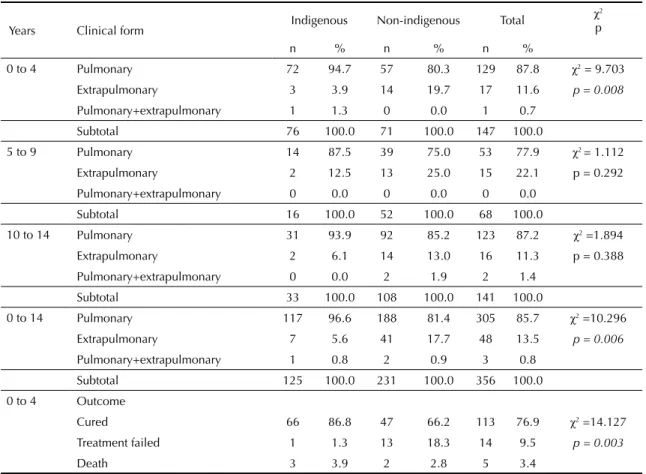
The pulmonary form of TB predominated, representing more than 80.0% of the notifi cations in both groups. The proportion of pulmonary cases was higher among indigenous children (93.6%) than among non-indige-nous children (81.4%) (p = 0.006). The difference in the distribution of clinical forms was more accentuated in the zero to four age group, 94.7% of the indigenous cases had the pulmonary form, whereas the pulmonary manifestation was responsible for 80.3% of the reported cases in non-indigenous group (p = 0.008) (Table 2). There was a higher concentration of extrapulmonary cases in the five to nine age group (22.1%), with pleural and peripheral lymph nodes affected in 44.0% and 24.0% of children, respectively (data not shown). Overall cure rates for the whole period were above 70.0% except in non-indigenous children < 5 years of age (66.2%) in both ethnic groups. However, cure rates were higher in indigenous patients than in non-indigenous in all age groups (Table 2). Treatment compliance was better among indigenous patients, among whom there was a lower failure rate in all age groups (Table 2).
Except for sputum smear, thorax radiography and Tuberculin Skin Tests (TST), other complementary exams were not performed or were not reported in more than 88.0% of the cases in both groups (Table 3).
Sputum smears were underused, especially in indig-enous cases, among whom the test was performed in 26.4% of notifi cations (Table 3). Even in the group of children zero to four years old, where a greater avail-ability of sputum samples would not be expected, there was a difference between the groups, with greater rates of sputum smears reported in non-indigenous people (9.9%) than in indigenous people (2.6%) (p = 0.009). A high proportion of children underwent thorax radi-ographies (Table 3). Thorax radiographs of indigenous people presented results suggestive of TB more often than those of non-indigenous children in the zero to four year old age group (p = 0.047) (Table 3).
TST were not performed on most children in either group. The frequency of strong reactions (≥ 10 mm) was higher in non-indigenous subjects in the zero to four year old age group.
Culture of sputum and histopathological examination were not performed in more than 95.0% and 88.0% of the cases reported, respectively. Forty eight cases of extrapulmonary TB were reported, seven in indigenous and 41 in non-indigenous children. Histopathological exams should have been performed in all these cases. However, no record of histopathological exams were found in 85.7% of these cases in indigenous and 70.7% in non-indigenous children (data not shown). Histopathological exams were not performed for diag-nostic confi rmation among indigenous children zero to four years old (Table 3), and cultures were taken in two cases (2.6%); no record of the results was avail-able for consultation.
There were three cases of TB/HIV co-infection in non-indigenous children, which corresponded to a prevalence of 1.3%; there was no record of co-infection among the indigenous children (Table 3).
Case detection methods were fair or insuffi cient for most subjects, but the utilization of diagnostic tests was lower among indigenous children. Around 6.0% of the total numbers of notifi cations were considered very good (Table 4).
DISCUSSION
Indigenous children, particularly those zero to four years old, present higher rates of tuberculosis than non-indigenous children in Rondônia. The diagnoses among children in this age group were almost entirely clinical. Pulmonary TB was also more common among indigenous children.
childhood TB diagnosis.14 It is probable that the
accu-racy of many diagnoses were compromised.
Even if the incidence rate has been overestimated, the data indicate that TB constitutes a serious public health problem for indigenous children. Incidences of this magnitude have been recorded only in Brazilian prisioners18 and in native populations in Canada in the
pre-chemotherapy era.10
The high incidence of TB in children identifi ed is consistent with the equally elevated incidence in indigenous adults in the Amazon region.2,6 These fi
nd-ings suggest that contact control must be intensifi ed to facilitate opportune treatment of latent tuberculosis infection. As shown in non-indigenous people, BCG vaccine coverage above 90% in indigenous people2,3
appears to present limited utility for the prevention of TB (especially pulmonary TB) in children.
Table 1. Incidence (per 100,000 inhabitants) of tuberculosis cases, according to age group and background (indigenous or
non-indigenous). Rondônia, Northern Brazil, 1997 to 2006.
Year
Age group Indigenous Non-indigenous Total
(years) Cases Incidence rates Cases Incidence
rates Cases Incidence rates
1997
0 to 4 11 807.4 13 8.2 24 15.0
5 to 9 0 0 8 4.8 8 4.8
10 to 14 1 97.6 17 10.2 18 10.8
1998
0 to 4 5 356.7 3 1.9 8 5.1
5 to 9 2 171.7 5 3.1 7 4.3
10 to 14 1 94.9 11 6.7 12 7.3
1999
0 to 4 5 346.7 8 5.2 13 8.3
5 to 9 1 83.5 7 4.3 8 4.9
10 to 14 5 461.0 14 8.6 19 11.6
2000
0 to 4 10 673.8 10 6.5 20 12.9
5 to 9 1 81.1 8 5.0 9 5.6
10 to 14 3 268.8 14 8.7 17 10.5
2001
0 to 4 16 1047.9 7 4.6 23 15.0
5 to 9 5 394.1 7 4.5 12 7.6
10 to 14 4 348.3 11 6.9 15 9.4
2002
0 to 4 7 445.6 6 4.0 13 8.6
5 to 9 1 76.6 8 5.1 9 5.7
10 to 14 8 677.1 6 3.8 14 8.9
2003
0 to 4 10 618.6 11 7.4 21 14.0
5 to 9 1 74.5 4 2.6 5 3.2
10 to 14 2 164.5 5 3.2 7 4.5
2004
0 to 4 4 240.5 6 4.1 10 6.7
5 to 9 3 217.1 2 1.3 5 3.3
10 to 14 2 159.9 12 7.9 14 9.1
2005
0 to 4 3 175.3 5 3.5 8 5.5
5 to 9 0 0.0 1 0.7 1 0.7
10 to 14 7 543.9 12 7.9 19 12.5
2006
0 to 4 5 284.0 2 1.4 7 4.8
5 to 9 2 136.7 2 1.4 4 2.7
10 to 14 0 0.0 6 4.0 6 4.0
1997-2006
0 to 4 76 4891 71 4.7 147 9.7
5 to 9 16 123.9 52 3.3 68 4.3
10 to 14 33 282.4 108 6.9 141 8.9
Total 125 311.4 231 5.0 356 7.6
The large number of cases in the group of indigenous children zero to four years old suggests that a large number of children were infected and fell ill due to the active and continuous transmission of Mycobacterium
tuberculosis in villages inhabited by indigenous people during the study period. Primary research data collected among different ethnicities in Rondônia and other Brazilian regions2,3,6 identifi ed a high prevalence and
Table 2. Clinical form and outcome of treatment of notifi ed Tuberculosis cases, according to age group and background
(indigenous or non-indigenous). Rondônia, Northern Brazil, 1997 to 2006.
Years Clinical form Indigenous Non-indigenous Total
χ2 p
n % n % n %
0 to 4 Pulmonary 72 94.7 57 80.3 129 87.8 χ2 = 9.703
Extrapulmonary 3 3.9 14 19.7 17 11.6 p = 0.008
Pulmonary+extrapulmonary 1 1.3 0 0.0 1 0.7
Subtotal 76 100.0 71 100.0 147 100.0
5 to 9 Pulmonary 14 87.5 39 75.0 53 77.9 χ2 = 1.112
Extrapulmonary 2 12.5 13 25.0 15 22.1 p = 0.292
Pulmonary+extrapulmonary 0 0.0 0 0.0 0 0.0
Subtotal 16 100.0 52 100.0 68 100.0
10 to 14 Pulmonary 31 93.9 92 85.2 123 87.2 χ2 =1.894
Extrapulmonary 2 6.1 14 13.0 16 11.3 p = 0.388
Pulmonary+extrapulmonary 0 0.0 2 1.9 2 1.4
Subtotal 33 100.0 108 100.0 141 100.0
0 to 14 Pulmonary 117 96.6 188 81.4 305 85.7 χ2 =10.296
Extrapulmonary 7 5.6 41 17.7 48 13.5 p = 0.006
Pulmonary+extrapulmonary 1 0.8 2 0.9 3 0.8
Subtotal 125 100.0 231 100.0 356 100.0
0 to 4 Outcome
Cured 66 86.8 47 66.2 113 76.9 χ2 =14.127
Treatment failed 1 1.3 13 18.3 14 9.5 p = 0.003
Death 3 3.9 2 2.8 5 3.4
Source: National Notifi able Diseases Surveillance System (SINAN) of Ministry of Health, Brazil The italic numbers indicate the strata which are statistically different.
Table 3. Tuberculosis cases notifi ed according to diagnosis exams, age group 0 to 4 years. Rondônia, Northern Brazil, 1997 to 2006.
Groups
Exams
Sputum-smear
(p-value = 0,009) n %
X-Ray
(p-value = 0,047) n %
Histopathology
(p-value = 0,029) n %
Indigenous Positive 2 2.6 Suggestive of TB 70 92.1 AFBa positive 0 0.0
Negative 2 2.6 Normal 1 1.3 Suggestive of TB 0 0.0
Not performed 72 94.7 Other disease 0 0.0 Not suggestive of TB 0 0.0
Not informed 0 0.0 Not informed 0 0.0
Not performed 5 6.6 Not performed 76 100.0
Non-indigenous Positive 7 9.9 Suggestive of TB 56 78.9 AFBz positive 1 1.4
Negative 9 12.7 Normal 6 8.5 Suggestive of TB 5 7.0
Not performed 55 77.5 Other disease 0 0.0 Not suggestive of TB 0 0.0
Not informed 0 0.0 Not informed 2 2.8
Not performed 9 12.7 Not performed 63 88.7
aAFB: acid-fast bacilli. There were three cases of TB/HIV co-infection in the non-indigenous group and none in the indigenous group
a high risk of TB infection and confi rmed an elevated rate of transmission in indigenous areas in the coun-try’s interior, particularly in the Amazon region. This scenario poses additional challenges for organizing health care services, especially with respect to early detection and opportune treatment of TB cases among indigenous Brazilian children.
This study may have included diagnostic errors, as underutilization of diagnostic tests suggested that, in many cases, diagnosis was based solely on a chest x-ray. Diagnoses in this age group should consider the clinical background, nutritional status, BCG scar and family history of contact with a sputum-positive patient from whom acid-fast bacilli were isolated. However, the available data did not include these elements.
Unlike TB cases in adults, children present a greater probability of developing primary TB, thus increasing the chance of extrapulmonary manifestations, espe-cially pleural and lymphatic involvement. The enhanced proliferation of bacilli may lead to dissemination and neurological problems9,16 in small children or in
subjects with impaired cellular immunity (e.g., HIV co-infection).
Most cases (94.9%) reported among indigenous chil-dren zero to four years old in Rondônia presented the pulmonary form of the disease. A sizable proportion of extrapulmonary forms (13.3%) was observed in the group of children fi ve to nine years.
The low proportion of extrapulmonary forms of TB may indicate that other respiratory diseases were wrongly diagnosed as TB, illustrating the diffi culties faced in correctly identifying the disease in children. According to Newton et al,16 TB can be confused with a great
number of diseases prevalent in childhood, including pneumonia, viral and generalized bacterial infection, serious malnutrition and HIV. Communication diffi cul-ties can also contribute to classifi cation errors, as many ethnic groups do not speak Portuguese.
A recent study of indigenous children and adoles-cents of the Suruí ethnicity in RO4 showed important
differences between the approaches of the local health service and international recommendations, including the initiation of treatment without confi rmation of the TB diagnosis.
According to Sant´Anna et al,19 TB diagnosis in
child-hood requires a distinct approach, integrating clinical, radiological and epidemiological data, as the iden-tifi cation of Mycobacterium tuberculosis in sputum is diffi cult. The symptoms of TB in children can be indicative of other diseases and radiological fi ndings are non-specifi c factors that pose additional diffi culties in arriving at a correct diagnosis.20
Several regions of the world have implemented a scoring system based on clinical and epidemiological data to minimize mistakes in TB diagnosis in children.9,23
The Ministry of Health of Brazil has used a scoring system for childhood TB diagnosis since 2002. They recommend that every child suspected of having TB be evaluated with a combination of clinical and radiological
fi ndings, as well as interpretation of the tuberculin skin test, BCG vaccine status, nutritional state and history of recent contact with an adult suffering from tuberculosis. This system is validated at different times and shows a sensitivity of 86.0% and a specifi city between 87.0% and 100.0%.19 The system is also operationally simple
enough to be adopted in routine care for both indigenous and non-indigenous children.
Due to diffi culties in diagnosis, it is reasonable to assume that children who were wrongly classifi ed as TB cases were more likely to have a favorable outcome. This assumption could partly explain the high cure rates recorded over the study period, especially among indigenous children zero to four years old who showed an 86.8% cure rate following treatment.
Errors in the classification and/or codification of cases in information systems are known limitations of epidemiological analyses. Inadequate coverage of the health systems, in addition to limited access to health facilities, may contribute to low detection and the underreporting of cases in our data set. As a result of this and considering the small size of the Indigenous
Table 4. Detection of cases according to background (indigenous or non-indigenous). Rondônia, Northern Brazil, 1 997 to 2006.
Case detection Indigenous Non-indigenous Total p
n % n % n %
Insuffi cient 72 57.6 70 30.3 142 39.9 < 0.0001
Fair 34 27.2 110 47.6 144 40.4
Good 11 8.8 38 16.5 49 13.8
Very good 8 6.4 13 5.6 21 5.9
Total 125 100.0 231 100.0 356 100.0
χ2 = 37.886
population in Rondônia, there was a wide variation in the estimates of the incidence during this period. The difference in the proportion of Indigenous children affected by TB compared to non-Indigenous was high. However, caution is needed in interpreting these results due to the failings cited. Further studies are necessary to better address this issue.
Even with these limitations, the national health infor-mation systems constitute important bases for broad epidemiological studies in a population. The approach used in this study proved useful in revealing inequalities
in health and surpassed the conventional analyses performed by health surveillance services, which aim to outline the epidemiological TB situation solely on the basis of absolute rates in a given location.
1. Barreto ML, Teixeira MG, Bastos FIP, Ximenes RA, Barata RB, Rodrigues LC. Successes and failures in the control of infectious diseases in Brazil: social and environmental context, policies, interventions, and research needs. Lancet. 2011;377(9780):1877-89. DOI:10.1016/S0140-6736(11)60202-X
2. Basta PC, Coimbra Jr. CEA, Camacho LAB, Santos RV. Risk of tuberculous infection in an indigenous population from Amazonia, Brazil. Int J Tuberc Lung Dis. 2006;10(12):1354-9.
3. Basta PC, Coimbra Jr. CEA, Welch JR, Correa Alves LC, Santos RV, Bastos Camacho LA. Tuberculosis among the Xavante indians of the Brazilian Amazon: an epidemiological and ethnographic assessment. Ann Hum Biol. 2010;37(5):643-57. DOI:10.3109/03014460903524451
4. Basta PC, Rios DPG, Alves LCC, Sant'Anna CC, Coimbra Junior CE. Estudo clínico-radiológico de crianças e adolescentes indígenas Suruí, Região Amazônica. Rev Soc Bras Med Trop. 2010;43(6):719-22. DOI:10.1590/S0037-86822010000600024
5. Bierrenbach AL, Duarte EC, Gomes ABF, Souza MFM. Tendência da mortalidade por tuberculose no Brasil, 1980 a 2004. Rev Saude Publica. 2007;41(Supl.1):15-23. DOI:10.1590/S0034-89102007000800004
6. Bóia MN, Carvalho-Costa FA, Sodré FC, Porras-Pedroza BE, Faria EC, Magalhães GA, et al. Tuberculose e parasitismo intestinal em população indígena na Amazônia brasileira.
Rev Saude Publica. 2009;43(1):176-8.
DOI:10.1590/S0034-89102009000100023
7. Coimbra Jr. CEA, Basta PC. The burden of tuberculosis in indigenous peoples in Amazonia, Brazil.
Trans R Soc Trop Med Hyg. 2007;101(7):635-6.
DOI:10.1016/j.trstmh.2007.03.013
8. Culqui DR, Trujilo OV, Cuerva N, Aylas R, Salaverry O, Bonilla C. Tuberculosis en la población indígena del Perú 2008. Rev Peru
Med Exp Salud Publica. 2010;27(1):8-15.
DOI:10.1590/S1726-46342010000100003
9. Graham SM. The use of diagnostic systems for tuberculosis in children. Indian J Pediatr. 2011;78(3):334-9. DOI:10.1007/s12098-010-0307-7
10. Gryzbowski S, Styblo K, Dorken E. Tuberculosis in Eskimos. Tubercle. 1976;57(4 Suppl):S1-58.
11. Imbiriba EB, Basta PC, Pereira ES, Levino A, Garnelo L. Hanseníase em populações indígenas do Amazonas, Brasil: um estudo epidemiológico nos municípios de Autazes, Eirunepé e São Gabriel da Cachoeira (2000 a 2005). Cad Saude Publica. 2009; 25(5):972-84. DOI:10.1590/S0102-311X2009000500004
12. Marais BJ. Childhood tuberculosis: epidemiology and natural history of disease. Indian J Pediatr. 2011;78(3):321-7. DOI:10.1007/s12098-010-0353-1
13. Marques AMC, Pompilio MA, Santos SC, Garnês SJA, Cunha RV. Tuberculose em indígenas menores de 15 anos, no Estado de Mato Grosso do Sul.
Rev Soc Bras Med Trop. 2010;43(6):700-4.
DOI:10.1590/S0037-86822010000600020
14. Ministério da Saúde, Secretaria de Vigilância em Saúde, Programa Nacional de Controle da Tuberculose. Manual de recomendações para o controle da tuberculose no Brasil. Brasília (DF); 2011.
15. Nava-Aguilera E, Andersson N, Harris E, Mitchell S, Hamel C, Shea B, et al. Risk factors associated with recent transmission of tuberculosis: systematic review and meta-analysis. Int J Tuberc Lung Dis. 2009;13(1):17-26.
16. Newton SM, Brent AJ, Anderson S, Whittaker E, Kampmann B. Paediatric tuberculosis.
Lancet Infect Dis. 2008;8(8):499-510.
DOI 10.1016/S1473-3099(08)70182-8
17. Robertus LM, Konstantinos A, Hayman NE, Paterson DL. Tuberculosis in the Australian Indigenous population: history, current situation and future challenges. Aust N Z J Public Health. 2011;35(1):6-9. DOI:10.1111/j.1753-6405.2010.00663.x
18. Sanchez A, Larouzé B, Espinola AB, Pires J, Capone D, Gerhardt G, et al. Screening for tuberculosis on admission to highly endemic prisons? The case of Rio de Janeiro State prisons. Int J Tuberc Lung Dis.
2009;13(10):1247-52.
19. Sant’Anna CC, Orfaliais CTS, March MFBP. A retrospective evaluation of a score system adopted by the Ministry of Health, Brazil in the diagnosis of pulmonary tuberculosis in childhood: a case control study. Rev Inst Med TropS Paulo. 2003;45(2):103-5. DOI:10.1590/S0036-46652003000200010
20. Sant’Anna CC, Hijjar MA. Recent contribution of the World Health Organization to control childhood tuberculosis. Rev Saude Publica. 2007;41(Suppl 1):117-20. DOI:10.1590/S0034-89102007000800016
21. Schneider E. Tuberculosis among American Indians and Alaska Natives in the United States, 1993-2002. Am J Public Health. 2005;95(5):873-80. DOI:10.2105/AJPH.2004.052456
22. Starke JR. Diagnosis of tuberculosis in children.
Pediatr Infect Dis J. 2000;19(11):1095-6.
23. Tidjani O, Amedone A, ten Dam HG. The protective effect of BCG vaccination of the newborn against childhood tuberculosis in an African community.
Tubercle. 1986;67(4):269-81.
24. Yip D, Bhargava R, Yao Y, Sutherland K, Manfreda J, Long R. Pediatric tuberculosis in Alberta: epidemiology and case characteristics (1990-2004).
Can J Public Health. 2007;98(4):276-80.
REFERENCES