Submitted24 September 2013 Accepted 5 February 2014 Published6 March 2014
Corresponding author
Relena Rose Ribbons, [email protected]
Academic editor
Kerry Woods
Additional Information and Declarations can be found on page 20
DOI10.7717/peerj.293
Copyright
2014 Ribbons
Distributed under
Creative Commons CC-BY 3.0
OPEN ACCESS
Disturbance and climatic e
ff
ects on red
spruce community dynamics at its
southern continuous range margin
Relena Rose Ribbons
Harvard Forest, Harvard University, MA, United States
Environmental Conservation Department, University of Massachusetts-Amherst, MA, United States
Bangor University, School of Environment, Natural Resources and Geography, Bangor, United Kingdom
ABSTRACT
Red spruce (Picea rubens) populations experienced a synchronous rangewide decline in growth and vigor starting in the 1960s, likely caused by climate change and a com-bination of environmental disturbances. However, it is not yet known if populations continue to decline or have recovered. Red spruce growing near its southern range margin in Massachusetts is a species of concern, in light of the vulnerability to climate change. This study uses population data from 17 permanent plots coupled with tree-ring data to examine radial growth rates, determine the growth-climate relation-ship, and document disturbance events. Red spruce at these plots ranged from 90 to 184 years old, and comprised 15 to 29 m2/ha basal area. Red spruce seedlings and saplings were common at plots with previously high overstory spruce abundance, indicating it could return to a more dominant position under favorable growing conditions. However, permanent plot measures over a 50 year time span did not indicate any consistent trends for changes in basal area or density for red spruce or other woody species. Climate data show that mean annual minimum, maximum, and summer temperatures have increased over the last 100 years. Dendroclimatological analyses indicated that red spruce growth was sensitive to both temperature and precipitation. Prior to the 1960s, spruce at these sites showed a positive response to precipitation; however after a multi-year drought in the 1960s showed an increasingly negative correlation with precipitation. There has been a negative growth response to regional warming, as spruce radial growth was mostly constrained by increasing temperatures, potentially coupled with the associated increasing drought-dress. I suggest the change in climate response is potentially due to a physiological threshold response to increasing temperatures, which may cause spruce to continue to decline or be lost from the lower elevation sites, while the high elevation sites has a persistent spruce population.
Subjects Conservation Biology, Ecology, Environmental Sciences, Plant Science
INTRODUCTION
Climate and global change are altering forests across the northeastern United States (Loarie et al., 2009;Treyger & Nowak, 2011). Climate change can profoundly alter forest ecosystems, including migration of species to maintain viable populations within specific-climate envelopes (Petit, Hu & Dick, 2008), and via altered seed production and regeneration rates due to increased carbon dioxide (Mohan, Clark & Schlesinger, 2004). Tree species at their southern range margins are likely to experience heat stress and exhibit reduced growth, with boreal species at southern limits most at risk because they are already living at the edge of their environmental tolerance. Evidence of vegetation communities changing with a warming climate in the eastern U.S. is already being observed (Beckage et al., 2008;Mcmahon, Parker & Miller, 2010;Treyger & Nowak, 2011). Decreased habitat suitability at southern latitudes, resulting from direct and indirect anthropogenic influences (e.g., non-sustainable forestry practices and climate change), might cause species to migrate north as climate becomes less favorable for their ideal growing conditions (Allen, Macalady & Chenchouni, 2010). In Massachusetts, red spruce forests are highly vulnerable to future climate change (The Manomet Center for Conser-vation Sciences, 2010). In New England, annual temperatures have risen an average of +0.08±0.01◦C per decade over the last century, and+0.25±0.01◦C per decade for the
past three decades (Hayhoe et al., 2007). The greatest changes over the last 35 years have been in winter, with almost a degree C per decade increase (Hayhoe et al., 2007).
In the 1980s, red spruce (Picea rubensSarg.) experienced widespread decline in vigor (Hornbeck & Smith, 1985;Reams & Van Deusen, 1993;Scott et al., 1984) and health throughout New England (Battles et al., 2003;Siccama, Bliss & Vogelmann, 1982;Webb et al., 1993), and in disjunct populations in the Southern Appalachians (Cogbill & White, 1991;Silver et al., 1991). Much of the research on red spruce within the Northeast focused on winter injury and the long-term influences of consecutive winter injury years (Lazarus et al., 2006) or the decline of high-elevation spruce-fir forests (Battles et al., 2003). Acid deposition effects on red spruce are well-documented (Likens, Driscoll & Buso, 1996), especially in high elevation forests where it is linked directly to red spruce mortality and in-directly affects red spruce via increased susceptibility to winter injury (Lazarus et al., 2006). Moore, Van Miegroet & Nicholas (2008)found evidence of a rebound (increased growth or vigor) of high-elevation red spruce after declining in the southern Appalachians. Dendrochronology studies documented a sustained gradual decrease in radial growth measurements throughout red spruce’s northern range (Cook, Johnson & Blasing, 1987; Johnson, Cook & Siccama, 1988;Siccama, Bliss & Vogelmann, 1982). Previous studies document decreased red spruce growth associated with high temperatures (Cook & Johnson, 1989).Hamburg & Cogbill (1988)noted red spruce displacement by hardwood species in the southern Appalachians.
decline of red spruce observed in many high-elevation populations (Van Deusen, Reams & Cook, 1991). While this decline seemed fairly ubiquitous in red spruce populations, it is unclear if these populations are still declining or have recovered from since the 1960s (Gavin, Beckage & Osborne, 2008;Lazarus et al., 2006), especially at low-elevations.
This study used red spruce tree-ring data coupled with population dynamics data documented in continuous forest inventory (CFI) plots, to explore the largely un-studied long-term dynamics of low-elevation (500–700 m a.s.l.) red spruce in western Massachusetts. I used tree-rings to investigate climate sensitivity to temperature and precipitation, the impact of climate change on spruce growth rates at their southern continuous range margin, and past disturbance history to elucidate the role of disturbance events and climate change as the mechanism behind observed changes in spruce growth. Based on prior studies indicating spruce’s sensitivity to warm temperatures (negative correlations between temperature and ring-widths;Cook, Johnson & Blasing, 1987;Johnson, Cook & Siccama, 1988) and the recent warming documented in New England, I tested two hypotheses: (1) red spruce has declined in basal area and growth rates over the last 50 years in Massachusetts; and (2) red spruce growth rates were negatively correlated with mean maximum summer temperatures (heat stress).
MATERIALS AND METHODS
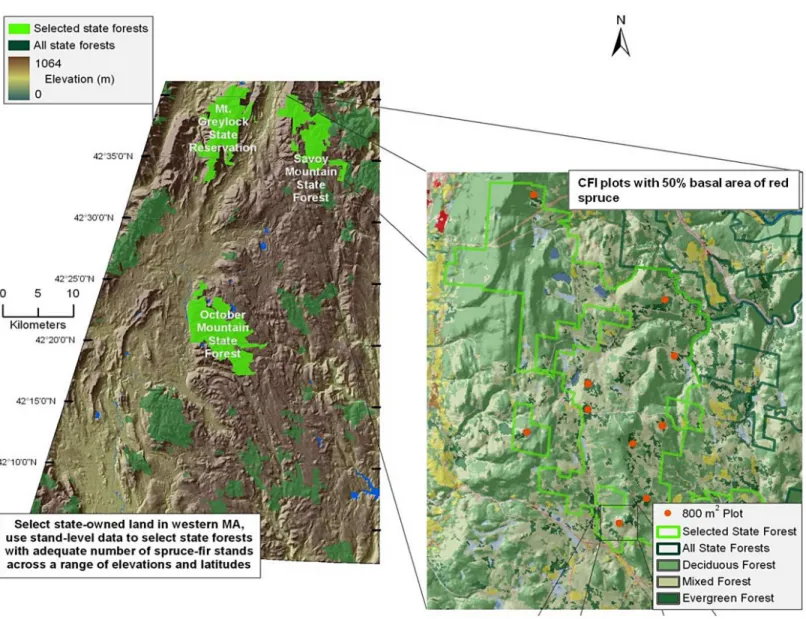
Study areaRed spruce in Massachusetts is located primarily in the western portion of the state (Burns & Honkala, 1990). Study sites were located in the Western Massachusetts Taconic Mountains and Berkshire Plateau region, including portions of four State Forests: Mount Greylock (MG), Savoy Mountain (SM), October Mountain (OM), and Middlefield Forest (MF) (Fig. 1). These four spruce-dominated forests were selected because they contained Continuous Forest Inventory (CFI) plots that were established in the 1960s to monitor the status of Massachusetts state forests over time (see below).
The climate is characterized by cold winters (average−5◦C) and moderately warm summers (average 19◦C). Average annual rainfall is 109 cm, 55% of which falls from April to September (Scanu, 1988). Average seasonal snowfall is 180 cm. The Berkshire region is underlain by igneous and metamorphic rocks, especially gneiss and schist (Scanu, 1988). Mount Greylock is comprised mainly of granite and limestone bedrock. Soils are primarily rocky glacial tills, with sand and gravel deposits proximate to waterways (Motts & O’Brien, 1981). Plots at Mount Greylock are located at higher elevations (678–978 m a.s.l.) than the three other forests (540–724 m a.s.l.;Table 1). Field sites were established with permission from the Department of Conservation and Recreation undertaken with a special use permit.
Site selection and vegetation characterization
Figure 1 Map of sampled forests and red spruce distribution.Map of site locations in western Massachusetts, with key forests highlighted in green. Inset shows the complete range of red spruce.
Table 1 Location and plot information for each CFI forest.Location (decimal degrees) of each CFI forest. Note the number of plots at each forest.
Mount greylock October mountain Savoy forest Middlefield forest
Latitude 42.622364 42.358235 42.594551 42.401972
Longitude −73.181151 −73.1771771 −73.0288963 73.0808754
Elevation 678–959 m 540–613 m 528–724 m 542 m
Number of plots 7 5 4 1
seedling and shrub species were estimated in a 5 m radius subplot located in the plot center, to determine regeneration of red spruce and other tree species. Dead spruce trees were tallied, although individual tree-mortality comparisons were not made due to the loss of individual tree markers and painted numbers. Total basal area, red spruce basal area, and red spruce density were calculated for each sampling period (1960, 1980, 2000, and 2010) using past CFI data. Additionally, basal area and density of all trees except red spruce were calculated for each sampling period. Relative importance values were calculated at each site as the sum of relative basal area and relative density for each species. Stand dynamics data were analyzed using linear mixed models inR Core Team (2013)with the nlme package (Pinheiro et al., 2013). Nomenclature followsGleason & Cronquist (1991).
DENDROCHRONOLOGICAL METHODS
Field data collectionAll overstory red spruce (>10 cm DBH) trees within each plot were cored at DBH with an increment borer. When<10 red spruce occurred within a plot, additional red spruce located outside the plot were cored until at least 10 trees were obtained from each site). Two cores per tree were extracted to identify any locally absent rings and to provide a better estimation of whole-tree radial growth. 213 cores were successfully cross-dated and used for disturbance and climate analysis.
Sample preparation and measurements
All cores were dried, mounted, and sanded using progressively finer sandpaper, up to 600-grit. Each core was visually crossdated within each tree first using the list method (Yamaguchi, 1991) and cores were compared among trees within each plot. Cores were then measured to 0.001 mm precision using to an Olympus SZ40 microscope and a Velmex measuring system (Velmex, East Bloomfield, NY, USA) interfaced with Measure J2X software. Ring widths were used to statistically verify the accurate dating of all tree rings using Spearman’s correlation analyses (with a criticalr-value of 0.33) available in the COFECHA tree-ring software (Holmes, 1981).
Data analysis
of one-third the length of the longest core. Data were first detrended with a negative exponential curve, then detrended with a−2/3 smoothing spline, with interactive detrending used on individual cores when necessary (e.g., when growth trends appeared inflated by poorly fitted detrending curves). Residual chronologies from ARSTAN-averaged ring-width indices across an entire sampling site with autocorrelation removed-was used for climate analysis.
To track the climate response over time, residual ARSTAN chronologies were correlated against mean monthly maximum and minimum temperature and precipitation from the prior March to October of the current year from 1896 to 2009. Climate data from the PRISM project (Prism Climate Group, 2011) were correlated with tree ring widths using Dendroclim2002 moving interval analysis to analyze the chronologies from the previous March to the current October months using a moving window of 40 years (Biondi & Waikul, 2004). Only significant correlation values are plotted in the DendroClim2002 output, which has red to indicated significantly positive values, and blue to indicate significantly negative values. To assess whether sites exhibit temporal stability in their climate response I examined the DendroClim output graphs looking for consistent colored bars over the entire time period which suggests a temporally stable response, or vice versa to establish a temporally non-stable climate response. I also used response function analysis (RFA), a multiple regression technique that uses principal components of monthly climate data to estimate indexed values of ring widths and examine how climate influenced radial growth over the entire time period (Fritts, 1976). RFA was implemented in DendroClim and uses bootstrapping techniques to determine significance levels (α=0.05l;Speer, 2010).
Ring width chronologies were used to calculate average yearly growth rates in basal area increment (BAI expressed as mm2/year). To calculate BAI, the radius of an individual tree is multiplied by the number Pi (3.14) to equal the area of the circle. The annual increment for yearXis defined by the following equation:X−(X−1)/(X−1), whereXis the basal area at yearX(last year of growth) andX−1 is the basal area of the tree measured up to the year previous toX(Johnson & Abrams, 2009).
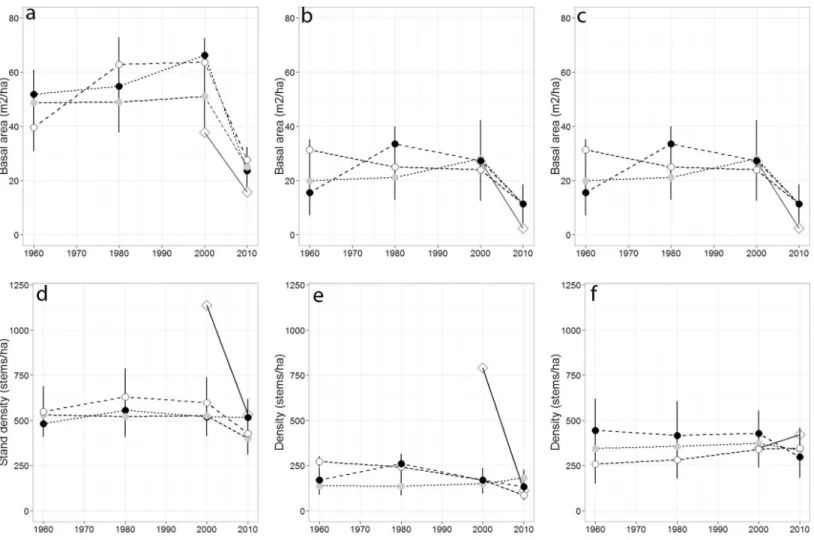
Figure 2 Basal area and density for all trees, red spruce only, and non-red spruce trees among the four forests over time.(A) Total basal area of trees (m2/ha), (B) basal area of red spruce, (C) basal area of non-spruce species (D) Total stand density (stems/ha), (E) density of red spruce, and (F) density of non-red spruce in MG (black circle), OM (open circle), SF (grey circle), and MF (open diamond) forests across sampling years.
RESULTS AND DISCUSSION
Stand compositionTable 2 Stand dynamics for overstory and understory tree species across CFI forests.Species overstory relative importance values (IV; relative density∗relative dominance )/ha, and the most common sapling densities in the CFI forests.
MG OM SF MF
2010 (%) 2010 (%) 2010 (%) 2010 (%)
Overstory species
Abies balsamea 11.8 6.0 1.7 6.6
Acer rubrum 8.5 19.8 26.4 33.2
Acer saccharum 3.7 — 6.9 —
Betula alleghaniensis 13.2 6.0 5.7 11.4
Betula papyrifera 8.4 4.6 2.5 4.4
Fagus grandifolia 5.9 2.2 8.2 —
Fraxinus americana — 0.4 7.8 —
Picea rubens 39.8 39.2 30.7 15.2
Prunus serotina 4.4 3.4 3.6 —
Tsuga canadensis — 10.3 5.9 29.3
Other species 2.2 8.0 0.6 —
Saplings (Density/ha)
Abies balsamea 185.4 154.5 617.9 12.4
Acer pensylvanicum 119.5 12.4 185.4 —
Acer rubrum — 185.4 — 49.4
Betula alleghaniensis 49.4 129.8 80.3 37.1
Fagus grandifolia 61.8 271.9 278.0 —
Ilex verticillata — — — 74.1
Picea rubens 262.0 143.4 216.3 74.1
Pinus strobus — 185.4 — —
Tsuga canadensis — 86.5 — —
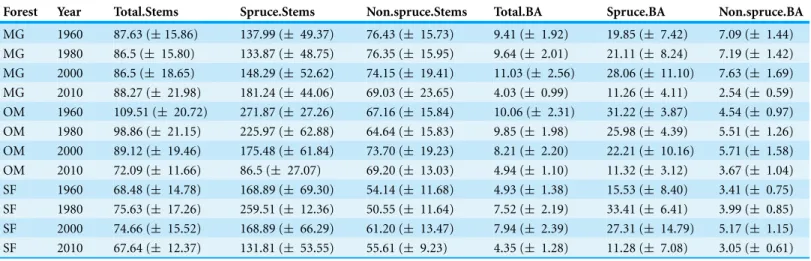
Sharp declines in red spruce densities were observed at OM after 1980 (272 to 168 stems/ha) and at MF since the 1980s (790 to 111 stems/ha;Table 2). The density of all other species declined 20–50% at three of the four study sites between 2000 and 2010; however the density of other species did not significantly differ since 1960 either by forest (p=0.80) or sampling year (p=0.72). At MF forest, the density of species other than spruce increased approximately 15%. Paper birch relative importance increased in each forest, while American beech and red maple increased in importance at three of the forests (Table 2). Saplings present within sampled forests were largely American beech, red maple, and balsam fir. Some sites still supported a healthy population of understory red spruce, indicated by abundant red spruce saplings (216–262/ha).
Radial growth and climate response
Table 3 Stand basal area and density among forests over time.Mean (±standard error) stand, red spruce, and non-spruce basal area and density within MG, OM, and SF forests over four sampling years. MF was excluded since it has 1 CFI plot established in 2000.
Forest Year Total.Stems Spruce.Stems Non.spruce.Stems Total.BA Spruce.BA Non.spruce.BA
MG 1960 87.63 (±15.86) 137.99 (± 49.37) 76.43 (± 15.73) 9.41 (± 1.92) 19.85 (± 7.42) 7.09 (± 1.44) MG 1980 86.5 (± 15.80) 133.87 (± 48.75) 76.35 (± 15.95) 9.64 (± 2.01) 21.11 (± 8.24) 7.19 (± 1.42) MG 2000 86.5 (± 18.65) 148.29 (± 52.62) 74.15 (± 19.41) 11.03 (± 2.56) 28.06 (± 11.10) 7.63 (± 1.69) MG 2010 88.27 (± 21.98) 181.24 (± 44.06) 69.03 (± 23.65) 4.03 (± 0.99) 11.26 (± 4.11) 2.54 (± 0.59) OM 1960 109.51 (± 20.72) 271.87 (± 27.26) 67.16 (± 15.84) 10.06 (± 2.31) 31.22 (± 3.87) 4.54 (± 0.97) OM 1980 98.86 (± 21.15) 225.97 (± 62.88) 64.64 (± 15.83) 9.85 (± 1.98) 25.98 (± 4.39) 5.51 (± 1.26) OM 2000 89.12 (± 19.46) 175.48 (± 61.84) 73.70 (± 19.23) 8.21 (± 2.20) 22.21 (± 10.16) 5.71 (± 1.58) OM 2010 72.09 (± 11.66) 86.5 (± 27.07) 69.20 (± 13.03) 4.94 (± 1.10) 11.32 (± 3.12) 3.67 (± 1.04) SF 1960 68.48 (± 14.78) 168.89 (± 69.30) 54.14 (± 11.68) 4.93 (± 1.38) 15.53 (± 8.40) 3.41 (± 0.75) SF 1980 75.63 (± 17.26) 259.51 (± 12.36) 50.55 (± 11.64) 7.52 (± 2.19) 33.41 (± 6.41) 3.99 (± 0.85) SF 2000 74.66 (± 15.52) 168.89 (± 66.29) 61.20 (± 13.47) 7.94 (± 2.39) 27.31 (± 14.79) 5.17 (± 1.15) SF 2010 67.64 (± 12.37) 131.81 (± 53.55) 55.61 (± 9.23) 4.35 (± 1.28) 11.28 (± 7.08) 3.05 (± 0.61)
drought in the 1960s (Fig. S6). Raw red spruce ring widths for each forest (Fig. S1) show trends of declining radial growth rates over time, which is consistent with natural decreases in growth as trees mature. Detrending was used to remove growth-trends which extend beyond a 32 year frequency, so as to emphasize decadal-to-annual variability in tree growth rates. This process rules out natural declines in ring-widths due to age and suggests an external force (such as climate or environmental disturbance) limited spruce growth. The ARSTAN chronologies (Figs. S2andS3) are more conservative in response to climate parameters, and were used for remaining analyses.
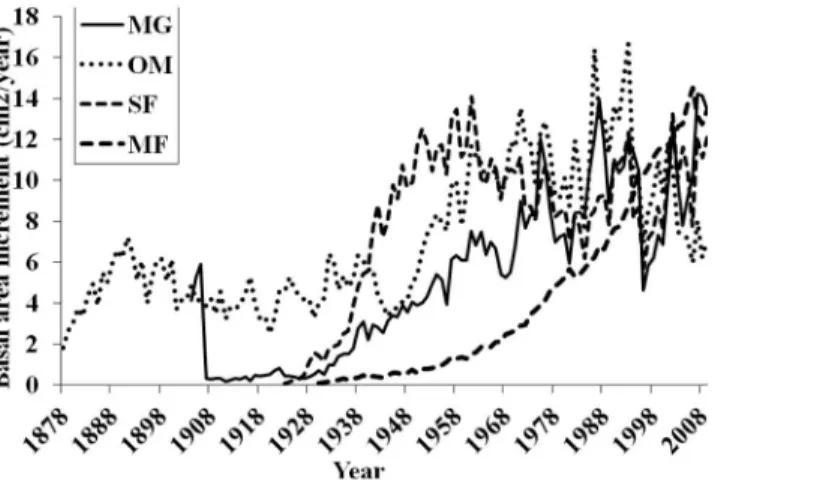
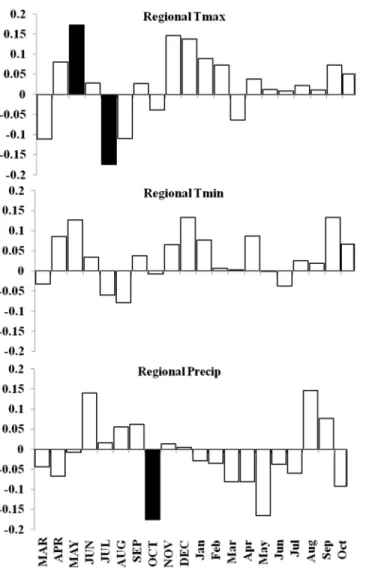
Basal area increment (BAI) was calculated using both cores from a tree, averaged across plots and within forests (Fig. 6). BAI curves show that on average, SF and OM forests declined over the last century, while MF and MG increased in BAI. Response Function Analysis (RFA) for regional climate data showed a significantly positive response of spruce radial growth with maximum monthly temperatures in May, and negative responses with maximum temperature in July and October precipitation (Fig. 6). RFA responses to temperature and precipitation differed across the four forests (Figs. S8–S11), with specific trends explained below.
Forest-level trends in BAI and RFA
conditions. Taken together, only MG and MF forests have increasing BAI, while OM and SF show trends of declining BAI.
Similar to the regional response, MG RFA had a significantly positive relationship with maximum temperatures in May and a negative relationship with precipitation in October (Fig. 7). OM RFA showed spruce was negatively related to maximum temperatures in July and positively related with minimum temperatures in December, and had no significant growth response to precipitation (Fig. 7). SF RFA had a significant response to November maximum temperatures, with no significant responses to minimum temperatures and precipitation (Fig. 7). MF RFA had a significant positive response to precipitation in August, and no significant responses to temperatures (Fig. 7).
Temporal stability in climate-growth response at a regional and forest-scale
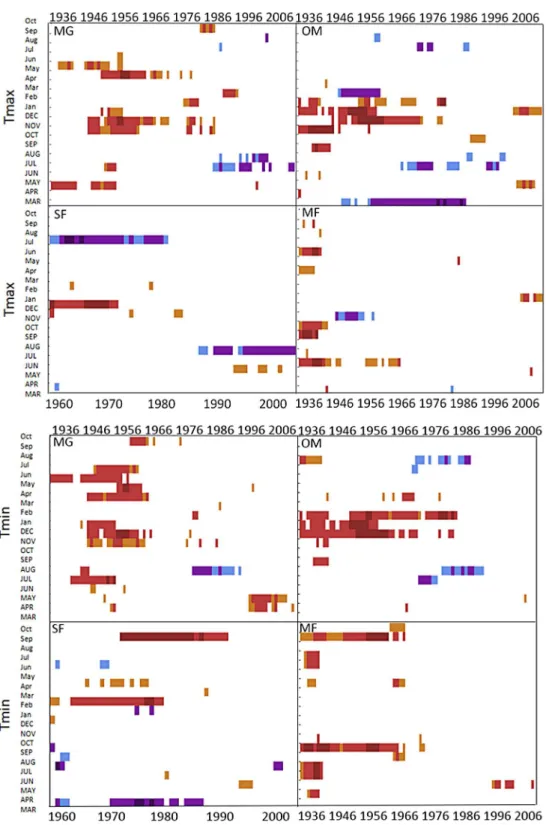
Moving interval analysis (using a moving 40 year window) with the regional ARSTAN chronologies showed that spruce growth had a consistent positive correlation (as indicated by dark red bards) with wintertime temperatures from the late 1930s until the late 1960s. After the 1960s spruce growth was then negatively correlated with the previous years’ summer temperatures until the early 1990s, after which it was positively associated with previous years’ May temperatures (Fig. 5). Regional spruce growth was positively associated with current years’ August precipitation for the last 3 decades. Red spruce growth at MG was positively correlated with average maximum and minimum winter temperatures from November of the previous year to February of the current growing year, from 1936 until 1966 (Fig. 3). After 1956, radial growth was negatively correlated with maximum March temperatures from the previous year, as indicated by the dark blue bars, remained consistently negative until 1986, after which the relationship was no longer significant. Previous year’s July temperatures showed a marginally significant negative relationship with growth beginning in 1966 to the mid-1990s at MG (Fig. 3).
Figure 4 Dendroclim precipitation correlations with forest chronologies.Moving interval analysis graphs from DendroClim showing correlations between a site’s residual chronology and monthly pre-cipitation for each forest.
Spruce growth relationships with precipitation varied among sites. Until 1956, MG growth was positively correlated with January precipitation (Fig. 4) and then after 1976 was negatively correlated with previous year’s October precipitation. From the mid 1960s and 1970s to the present, spruce growth was positively correlated with current August precipitation at the MG, MF, and SF sites and with previous August precipitation at both the MF and SF sites. No strong correlations existed between precipitation and radial growth at OM for more than a few years, except for a negative correlation with June precipitation from the mid-1950s to the late 1970s, suggesting that precipitation was not the primary limiting factor influencing radial growth at this site (Fig. 4).
Disturbance history
Figure 6 Basal area increments for each forest.Basal area increment averages for each forest with calculations truncated when fewer than two core replicates.
SF, I observed a pulse of moderate and minor disturbance events in the 1930s, which is the decade of the 1938 Hurricane (Boose, Foster & Fluet, 1994;D’Amato, Orwig & Foster, 2008). During this decade, disturbance events were noted in 25% of trees at MG, 22% of trees at OM, and 16% of trees at SF.
There was a pulse of major growth increases seen in OM spruce cores during the 1930s and 2 periods of moderate increases in the 1920s and 1980s. Significant growth reductions were seen in OM spruces during the 1950s, 1970s, and especially the 1990s, when all sampled trees exhibited growth reductions during this decade. This is consistent with the stand dynamics hypothesis for red spruce decline as supported byReams & Van Deusen (1993), which contends that the new growth released in the 1920s and 1930s at these sites naturally slowed in growth and increased competition led to some mortality. SF spruce experienced growth increases during the 1940s and 1950s and over 80% of trees experienced growth declines during the 1960s. Unlike the other sites, very little disturbance was detected in MF spruce cores, including no major growth releases in any decade examined. The most dramatic period of growth declines occurred at 3 of the 4 forests during the 1990s, when 70–100% of the trees experienced sharp growth reductions.
Figure 7 Response function analyses for regional ARSTAN chronology with maximum and minimum monthly temperatures and precipitation.Response function analyses for the regional ARSTAN chronol-ogy showing the period response for red spruce over previous year’s climate parameters (months shown in capitals) and current year’s climate parameters, with black bars indicating significant responses with maximum and minimum temperatures and precipitation (Tmax, Tmin, Precip).
Red spruce populations at some forests have sustained radial growth declines since the 1940s–1960s period (see raw-ring widths for each forest inFig. S1). Tree growth rates naturally decrease as they age or increase in size (Fritts, 1976), so a trend of declining radial growth or ring increment is expected; however since these populations are not very old, the patterns of declining ring-widths are not explained by allometry and are not common to all populations. During the 1960s the Northeast experienced a severe drought, which could have contributed to spruce water limitation. Some individual trees rebounded in radial growth beginning in the 1990s (Figs. S2andS3); likely due to stand disturbance events such as growth releases and decreased proximate competition within the stand.
the northeast. The highest maximum temperatures were observed during the 1990s and the residual ARSTAN chronology also shows the lowest values for spruce radial growth during this time period, supporting the theory that the increased temperatures have led to decreased radial growth. Despite mortality of older red spruce, MG sites show continued spruce establishment and recruitment, which is why stand density remained consistent, which is consistent with recent findings at other high-elevation or higher latitude sites (Van Doorn et al., 2011;Kosiba et al., 2013). In contrast, several OM sites have declined in both overstory and understory spruce density, reducing the likelihood of spruce retention. SF and MF sites have maintained a red spruce canopy but have little to no spruce regeneration, making it less likely that red spruce will persist.
Non-stable climate growth relationships
Temperature had a much stronger influence on red spruce radial growth than precipitation over time across the region and the 4 forests (Figs. 3–5), although this relationship was not temporally stable. While a consistent climate-growth relationship was observed across the Massachusetts sites during the first half of the twentieth century, a distinct shift in this relationship began in the 1960s, but was variable across sites. Non-stable climate relationships can be explained by either climate change or a physiological tolerance/threshold response as suggested byCook & Johnson (1989). The physiological threshold response can be best explained as stress-induced physiological changes within trees that alter how they grow in response to climate (e.g., after an extreme drought trees may decrease their water uptake and efficiency;D’Arrigo et al., 2008;Driscoll et al., 2005; Wilmking et al., 2005;Wilmking et al., 2004). Studies have documented unstable climate responses for other red spruce populations (Johnson, Cook & Siccama, 1988;Conkey, 1986;Conkey, 1988) and several other boreal species (Andreu-Hayles et al., 2011;Shi et al., 2010) and attributed them to stand history events such as logging or past land use which were consistent across sites. The variability in responses across these sites supports and climatic-threshold response, since my disturbance history analysis shows periods of release but not consistently across sites.
Changes in maximum and minimum winter temperatures influenced red spruce radial growth over the past century at these sites. Prior to the 1960s, spruce growth was positively associated with minimum and maximum winter temperatures (Fig. 3). After the 1960s, there was a distinct shift with spruce growth negatively correlated with maximum and minimum summer temperatures. This suggests growth was limited by the high summer temperatures in the 1960s, either directly by making it too warm for the trees to grow optimally; or indirectly because there was a concurrent large-scale drought during this decade. These trends are similar toCook, Johnson & Blasing (1987)andMclaughlin et al. (1987), who observed that late summer temperatures (previous July maximum) negatively influenced red spruce radial growth in Northeastern forests.
Precipitation
precipitation, while SF and MF continue to have a positive correlation with precipitation. The threshold response model proposed byCook & Johnson (1989)is supported by these data. The 1960s drought represented a prominent climate event, after which precipitation was no longer a limiting factor at MG and OM sites, and increased precipitation was correlated with decreased ring-widths at these sites. High-elevation forests tend to be more limited by temperature (Schweingruber, 1996), and low-elevation sites are typically more sensitive to precipitation (Cook & Johnson, 1989).Webb et al. (1993)found that range-edge red spruce in bog sites were slower-growing but had more robust populations, while upland sites supported increasingly drought sensitive populations. In contrast, my study sites displayed decreasing drought sensitivity after the extensive drought of 1960. Only one forest, MF, showed a significant precipitation response in DendroClim, unique in comparison to the three other forests sampled.
Prior to 1960, growth at MF was positively correlated with precipitation from March of the previous year. After 1960, MF had a strong positive correlation with precipitation from the previous September and August of the current growing season with radial growth in red spruce at MF. The precipitation-growth response at MF shifts after the 1960s, similar to the pattern of temperature response which shifts in the 1960s, suggesting a precipitation threshold exists at MF.B¨untgen et al. (2006)found a similar lack of stability between the growth/climate relationships for populations of Norway spruce, and suggest an increasing sensitivity to drought could be altering the climate-growth response due to increased evapotranspiration. While I did not directly measure rates of evapotranspiration, drought stress is a plausible explanation for declining radial growth of red spruce in some sites in Western Massachusetts forests-specifically induced by the 1960s drought, while other sites started to decline in the 1940s.
Non-climatic environmental stressors
A variety of factors influence spruce growth in western Massachusetts where climate change is likely to have a large influence on populations at their range margin. The climatic-threshold theory states that trees shift their growth patterns and carbon allocation (i.e., ring widths) in response to climate conditions. This theory specifically predicates that climate is the main stressor that has induced physiological changes in tree growth (Cook & Johnson, 1989), and accurately describes the patterns in ring-widths observed at my sites although it is possible that forest dynamics are also contributing factors. In contrast, I would expect uniform responses to environmental triggers like pollution or acid deposition across all sites, which I do not see in Western Massachusetts. Pollution would also not discriminate across stand types (second-growth vs. old-growth) and some studies have shown the widespread decline to be especially prevalent in second-growth stands (Van Deusen, 1987).
winter injury) and it was not recorded historically in CFI notes. Additional foliar and soil chemistry studies could provide insights into nutrient cycling and other aspects of these red spruce forests, and should be pursued to tease apart the potential effects in Western Massachusetts. In New York and Vermont, acid deposition was considered to be more of a driving force for decline of red spruce, especially because of altered foliar and soil chemistry (Battles et al., 2003;Mclaughlin et al., 1987). In those high elevation forests, acid deposition may have exacerbated red spruce decline, and with the introduction of the Clean Air Act in 1970 a recovery of high-elevation red spruce populations would have been likely (Van Deusen, 1990). While this mechanism may be an important driver in other areas, we do not see evidence for acid deposition leading to decline in western Massachusetts red spruce populations. I observed that red spruce importance values were consistent over time, and found no evidence of a decadal-scale decline in basal area increment from the 1960’s to the present, which would have supported an acid deposition explanation.
CONCLUSIONS
Red spruce may be especially susceptible to climate change in Massachusetts because populations are isolated geographically, and may not have the topographic landscape conducive to tracking climate, which could lead to a range contraction (Morin, Viner & Chuine, 2008). Conversely, species such as tulip poplar (Liriodendron tulipifera) or pin oaks (Quercus palustris) which are at their northern range limit in Massachusetts may enjoy enhanced growth as climate continues to warm. Western Massachusetts red spruce chronologies demonstrate a changing climate-growth relationship. Temperature stress increases susceptibility to drought-induced growth reductions, making precipitation a limiting factor when temperatures increase. This shift from positive to negative growth correlations reinforces the hypothesis that the climate where these trees established has changed over the past 100 years, and is now warmer than ideal for growing conditions of red spruce. It is likely that a variety of co-factors have influenced red spruce populations, including a reduction of pollution levels associated with acid deposition, which might alleviate growth stress, and competition-induced red spruce mortality. Radial growth declines and reduced seedling and sapling abundance, suggests that red spruce may not maintain viable populations in Massachusetts forests at low-elevations. However, red spruce will persist at high-elevation sites like Mount Greylock, where spruce regeneration and basal area are increasing.
ACKNOWLEDGEMENTS
ADDITIONAL INFORMATION AND DECLARATIONS
Funding
Funding for this project was provided by a McIntire-Stennis Research Grant. The funders had no role in study design, data collection and analysis, decision to publish, or preparation of the manuscript.
Grant Disclosures
The following grant information was disclosed by the author: McIntire-Stennis Research Grant.
Competing Interests
The author declares there are no competing interests.
Author Contributions
• Relena Rose Ribbons conceived and designed the experiments, performed the experiments, analyzed the data, contributed reagents/materials/analysis tools, wrote the paper, prepared figures and/or tables, reviewed drafts of the paper.
Field Study Permissions
The following information was supplied relating to ethical approvals (i.e., approving body and any reference numbers):
Massachusetts Department of Conservation and Recreation Special Use Permit.
Supplemental Information
Supplemental information for this article can be found online athttp://dx.doi.org/ 10.7717/peerj.293.
REFERENCES
Allen CD, Macalady AK, Chenchouni H. 2010.A global overview of drought and heat-induced tree mortality reveals emerging climate change risks for forests.Forest Ecology and Management 259:660–684DOI 10.1016/j.foreco.2009.09.001.
Andreu-Hayles L, D’arrigo R, Anchukaitis KJ, Beck PSA, Frank D, Goetz S. 2011.Varying boreal forest response to Arctic environmental change at the Firth River, Alaska.Environmental Research Letters6:Article 045503DOI 10.1088/1748-3182/6/4/049502.
Battles JJ, Fahey TJ, Siccama TG, Johnson AH. 2003.Community and population dynamics of spruce-fir forests on Whiteface Mountain, New York: recent trends, 1985–2000.Canadian Journal of Forest Research33:54–63DOI 10.1139/x02-150.
Beckage B, Osborne B, Gavin DG, Pucko C, Siccama T, Perkins T. 2008.A rapid upward shift of a forest ecotone during 40 years of warming in the Green Mountains of Vermont. Proceedings of the National Academy of Sciences of the United States of America105:4197–4202
Biondi F, Waikul K. 2004.DENDROCLIM2002: A C++program for statistical calibration of climate signals in tree-ring chronologies.Computers & Geosciences 30:303–311
DOI 10.1016/j.cageo.2003.11.004.
Boose ER, Foster DR, Fluet M. 1994.Hurricane impacts to tropical and temperate forest landscapes.Ecological Monographs64:369–400DOI 10.2307/2937142.
B¨untgen U, Frank D, Schmidhalter M, Neuwirth B, Seifert M, Esper J. 2006.Growth/climate response shift in a long subalpine spruce chronology.Trees20:99–110DOI 10.1007/s00468-005-0017-3.
Burns RM, Honkala BH. 1990.Silvics of North America: 1. Conifers; 2. Hardwoods. In:Agriculture handbook 654, vol 2. Washington, DC: US Department of Agriculture, Forest Service, 877. Cogbill CV, White PS. 1991.The latitude-elevation relationship for spruce-fir forest and treeline
along the Appalachian mountain chain.Vegetatio94:153–175DOI 10.1007/BF00032629. Conkey LE. 1986.Red spruce tree-ring widths and dnsities in eastern North America as indicators
of past climate.Quaternary Research26:232–243DOI 10.1016/0033-5894(86)90107-9.
Conkey LE. 1988.Decline in old-growth red spruce in western Maine- an analysis of wood density and climate.Canadian Journal of Forest Research18:1063–1068DOI 10.1139/x88-161.
Cook ER. 1985.A time series approach to tree-ring standardization. PhD Dissertation, University of Arizona, Tucson, AZ, USA.
Cook ER, Johnson AH. 1989.Climate change and forest decline: a review of the red spruce case. Water, Air, and Soil Pollution48:127–140DOI 10.1007/BF00282374.
Cook ER, Johnson AH, Blasing TJ. 1987.Forest decline: modeling the effect of climate in tree rings.Tree Physiology3:27–40DOI 10.1093/treephys/3.1.27.
Copenheaver CA, Black BA, Stine MB, Mcmanamay RH, Bartens J. 2009. Identifying
dendroecological growth releases in American beech, jack pine, and white oak: Within-tree sampling strategy.Forest Ecology and Management257:2235–2240
DOI 10.1016/j.foreco.2009.02.031.
D’Amato AW, Orwig DA. 2008.Stand and landscape-level disturbance dynamics in old-growth forests in western Massachusetts.Ecological Monographs78(4):507–522DOI 10.1890/07-0593.1. D’Amato AW, Orwig DA, Foster DR. 2008.The influence of successional processes and
disturbance on the structure of Tsuga Canadensis forests.Ecological Applications18:1182–1199
DOI 10.1890/07-0919.1.
D’Arrigo R, Wilson R, Liepert B, Cherubini P. 2008.On the ‘Divergence Problem’ in northern forests: a review of the tree-ring evidence and possible causes.Global and Planetary Change 60:289–305DOI 10.1016/j.gloplacha.2007.03.004.
Driscoll WW, Wiles GC, D’arrigo RD, Wilmking M. 2005.Divergent tree growth response to recent climatic warming, Lake Clark National Park and Preserve, Alaska.Geophysical Research Letters32:L20703DOI 10.1029/2005GL024258.
Fritts HC. 1976.Tree rings and climate. New York: Academic Press.
Gavin DG, Beckage B, Osborne B. 2008.Forest dynamics and the growth decline of red spruce and sugar maple on Bolton Mountain, Vermont: a comparison of modeling methods.Canadian Journal of Forest Research38:2635–2649DOI 10.1139/X08-106.
Gleason HA, Cronquist A. 1991.Manual of vascular plants of northeastern United States and adjacent Canada. New York: New York Botanical Garden. 910 p.
Hayhoe K, Wake CP, Huntington TG, Luo L, Schwartz MD, Sheffield J, Wood E, Anderson B, Bradbury J, DeGaetano A, Troy TJ, Wolfe D. 2007.Past and future changes in climate and hydrological indicators in the US Northeast. Climate Dynamics 28:381–407
DOI 10.1007/s00382-006-0187-8.
Holmes R. 1981.Computer assisted quality control in tree-ring dating and measurement. Tree-Ring Bulletin44:69–75.
Hornbeck JW, Smith RB. 1985.Documentation of red spruce growth decline.Canadian Journal of Forest Research15:1199–1201DOI 10.1139/x85-199.
Johnson SE, Abrams MD. 2009.Age class, longevity and growth rate relationships: protracted growth increases trees in the eastern United States. Tree Physiology 29:1317–1328
DOI 10.1093/treephys/tpp068.
Johnson AH, Cook ER, Siccama TG. 1988.Climate and red spruce growth and decline in the northern Appalachians.Proceedings of the National Academy of Sciences of the United States of America85:5369–5373DOI 10.1073/pnas.85.15.5369.
Kosiba AM, Schaberg PG, Hawley GJ, Hansen CF. 2013.Quantifying the legacy of foliar winter injury on woody aboveground carbon sequestration of red spruce trees.Forest Ecology and Management302:363–371DOI 10.1016/j.foreco.2013.03.006.
Lazarus BE, Schaberg PG, Hawley GJ, DeHayes DH. 2006.Landscape-scale spatial patterns of winter injury to red spruce foliage in a year of heavy region-wide injury.Canadian Journal of Forest Research36:142–152DOI 10.1139/x05-236.
Likens GE, Driscoll CT, Buso DC. 1996.Long-term effects of acid rain: response and recovery of a forest ecosystem.Science272:244–246DOI 10.1126/science.272.5259.244.
Loarie SR, Duffy PB, Hamilton H, Asner GP, Field CB, Ackerly DD. 2009.The velocity of climate change.Nature462:1052–1055DOI 10.1038/nature08649.
Lorimer CG, Frelich LE. 1989.A methodology for estimating canopy disturbance freuency and intensity in dense temperate forests.Canadian Journal of Forest Research19:651–663
DOI 10.1139/x89-102.
Mclaughlin SB, Downing DJ, Blasing TJ, Cook ER, Adams HS. 1987.An analysis of climate and competition as contributors to decline of re spruce in high elevation Appalachian forests of the eastern United States.Oecologia72:487–501DOI 10.1007/BF00378973.
Mcmahon SM, Parker GG, Miller DR. 2010.Evidence for a recent increase in forest growth. Proceedings of the National Academy of Sciences of the United States of America107:3611–3615
DOI 10.1073/pnas.0912376107.
Mohan JE, Clark JS, Schlesinger WH. 2004.Genetic variation in germination, growth, and survivorship of red maple in response to subambient through elevated atmospheric CO2. Global Change Biology10:233–247DOI 10.1046/j.1365-2486.2004.00726.x.
Moore PT, Van Miegroet H, Nicholas NS. 2008.Examination of forest recovery scenarios in a southern Appalachian Picea-Abies forest.Forestry81:183–194DOI 10.1093/forestry/cpn013. Morin X, Viner D, Chuine I. 2008. Tree species range shifts at a continental scale:
new predictive insights from a process-based model.Journal of Ecology 96:784–794
DOI 10.1111/j.1365-2745.2008.01369.x.
Motts W, O’Brien AO. 1981.Geology and hydrology of wetlands in Massachusetts. Amherst, MA: University of Massachusetts, Amherst.
Petit RJ, Hu FS, Dick CW. 2008.Forests of the past: a window to future changes.Science 320:1450–1452DOI 10.1126/science.1155457.
Pinheiro J, Bates D, DebRoy S, Sarkar D, the R Development Core Team. 2013.nlme: linear and nonlinear mixed effects models. R package version 3.1-111.
Prism Climate Group. 2011.Oregon State University.Available athttp://prism.oregonstate.edu. R Core Team. 2013.R: A language and environment for statistical computing. Vienna: R Foundation
for Statistical Computing.Available athttp://www.R-project.org/.
Reams GA, Van Deusen PC. 1993.Synchronic large-scale disturbances and red spruce growth decline.Canadian Journal of Forest Research23:1361–1374DOI 10.1139/x93-173.
Scanu RJ. 1988.Soil survey of Berkshire county. Massachusetts: USDA Soil Conservation Service.Available fromhttp://www.ma.nrcs.usda.gov/technical/soils/soils berkshire.html
(accessed 20 April 2010).
Schweingruber FH. 1996.Tree rings and environment-dendrochronology. Bern: Paul Haupt Verlag. Scott JT, Siccama TG, Johnson AH, Breisch AR. 1984.Decline of red spruce in the Adirondacks,
New York.Bulletin of the Torrey Botanical Club111:438–444DOI 10.2307/2995893. Shi CM, Masson-Delmotte V, Daux V, Li ZS, Zhang QB. 2010.An unstable tree-growth
response to climate in two 500 year chronologies, North Eastern Qinghai-Tibetan Plateau. Dendrochronologia28:225–237DOI 10.1016/j.dendro.2009.12.002.
Siccama TG, Bliss M, Vogelmann HW. 1982.Decline of red spruce in the Green Mountains of Vermont.Bulletin of the Torrey Botanical Club109:162–168DOI 10.2307/2996256.
Silver WL, Siccama TG, Johnson C, Johnson AH. 1991.Changes in red spruce populations in montane forests of the Appalachians, 1982–1987.American Midland Naturalist125:340–347
DOI 10.2307/2426238.
Speer JH. 2010.Fundamentals of tree-ring research. Tucson: University of Arizona Press. The Manomet Center for Conservation Sciences and the Massachusetts Division of Fisheries
and Wildlife. 2010.Climate change and Massachusetts fish and wildlife: Volume 2 Habitat and Species Vulnerability.Available athttp://www.cakex.org/virtual-library/2258.
Treyger AL, Nowak CA. 2011.Changes in tree sapling composition within powerline corridors appear to be consistent with climatic changes in New York State.Global Change Biology 17:3439–3452DOI 10.1111/j.1365-2486.2011.02455.x.
Van Deusen PC. 1987.Testing for stand dynamics effects on red spruce growth trends.Canadian Journal of Forest Research17:1487–1495DOI 10.1139/x87-231.
Van Deusen PC. 1990.Stand dynamics and red spruce decline.Canadian Journal of Forest Research 20:743–749DOI 10.1139/x90-098.
Van Deusen PC, Reams GA, Cook ER. 1991.Possible red spruce decline-contributions of tree-ring analysis.Journal of Forestry89:20–24.
Van Doorn NS, Battles JJ, Fahey TJ, Siccama TG, Schwarz PA. 2011.Links between biomass and tree demography in a northern hardwood forest: a decade of stability and change in Hubbard Brook Valley, New Hampshire.Canadian Journal of Forest Research41:1369–1379
DOI 10.1139/x11-063.
Wilmking M, D’arrigo R, Jacoby GC, Juday GP. 2005. Increased temperature sensitivity and divergent growth trends in circumpolar boreal forests.Geophysical Research Letters 32:L15715DOI 10.1029/2005GL023331.
Wilmking M, Juday GP, Barber VA, Zald HSJ. 2004.Recent climate warming forces contrasting growth responses of white spruce at treeline in Alaska through temperature thresholds.Global Change Biology10:1724–1736DOI 10.1111/j.1365-2486.2004.00826.x.