Evaluation of Newborn Arm Circumference
as an Indicator of Low Birth Weight1
JoAo GUILHERME BEZERRA ALVES,~ GEISY m
DE SOUZA
LIMA,~ GEISER NERY DA COSTA A~EVEDO,~ VIRGINIA BUARQUE
CORDEIRO CABRAL,~ RUBEN SCHINDLER MOGGI,~ &
ROBERTO NUNES~
A sample of 1,024 newborns in Recife, Brazil, was studied to help determine the precision with which arm circumference measurements could be used to indicate low birth weight. The results support the view that when birth weight data are unob- tainable, arm circumference measurements may be of value in screening for new- borns needing speciaicare.
L
ow birth weight (LBW), defined bythe World Health Organization as a
weight of less than 2,500 g at birth, is closely associated with high morbidity and mortality in the first year of life. The
incidence of LBW
varies with socio-economic conditions, ranging from 2-4%
in industrialized countries to rates ex-
ceeding 15% in developing countries.
The result is that 90% of the 15 million LBW babies that come into the world
each year are born in developing coun-
tries (2, 2).
In the rural areas of the Brazilian
Northeast, where LBW and infant mor-
tality have risen in a similar fashion since 1982, more than half of all babies are de- livered at home. This creates difficulties
*This article will also be published in Portuguese in the Bolefin de la Oficina Sanitaria Panamericana,
111(3):215-217,199l.
Toordinator of Instruction, Maternal and Child In- stitute of Pemambuco (Institute Matemo Infantil de Pemambuco-IMP); and Assistant Professor, Faculty of Medical Sciences of Pernambuco. Mail- ing address: Rua Rui CaIaca, 94/802; Espinheiro, Recife-PE; Brazil. CEP: 52.020.
Thysician, JMIl?
4Associate Professor, Faculty of Medical Sciences of Pernambuco.
for determining birth weight-difficulties only heightened by the fact that even in-
hospital deliveries often lack access to
proper equipment in good working order
for determining the weight of the new-
born (3, 4).
Measurement of arm circumference, al-
ready widely used as a parameter for de-
termining malnutrition in older children
(5-8), has previously been described as
useful for detecting low-weight new-
borns in the neonatal period (9). In this
regard, some authors have found a
strong association between an arm cir-
cumference below 9 cm and a birth
weight of less than 2,500 g (9, 10).
Because this measurement method is
so simple and practical as to be usable in virtually any primary or other health care
facility, our study sought to determine
the sensitivity and specificity of arm cir-
cumference as an indicator of LBW in a
group of babies born in the Northeast Brazilian city of Recife in 1988.
MATERIALS AND METHODS
The study population consisted of
1,024
infants
born at the Women’s CareCenter at the Maternal and Child Insti-
A
newborn infant’s arm circumference
being measured in the course of the study.
tute of Pemambuco (IMP) from July to
December 1988. All the infants were
weighed within the first hour of life by
one of the researchers and were evalu-
ated in terms of the WHO definition of
low birth weight.
In addition, each newborn’s arm cir-
cumference was measured by two of the
researchers working separately, and the
average of the two measurements was
taken as the final result. These readings
were made with a Japanese fiberglass
tape measure graduated in 0.1 cm incre-
ments, which was always placed gently
and firmly at the midpoint of the left arm
with the infant supine.
RESULTS
The weights
of the study infants
ranged from 960 g to 4,300 g, the mean
being 3,101 g with a standard deviation
of 582 g. Their arm circumferences were
in a range of 6.0-12.1 cm, the average
being 9.98 cm and the standard deviation
0.97 cm. The respective frequencies of
low birth weight and an average arm cir-
cumference below 9 cm were 12.00% and
12.51%, respectively, with a correlation
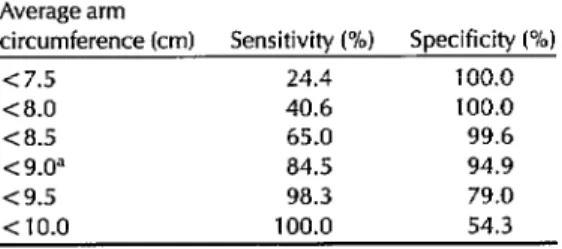
coefficient of +0.79. Data regarding the
sensitivity and specificity of arm circum-
ference as an indicator of low birth
weight are shown in Table 1.
DISCUSSION AND CONCLUSIONS
Low birth weight was found in 12% of
the cases studied, a frequency similar to
that found by the Brazilian Pediatric Soci-
ety in the city of Recife in 1986 (11). In
this same vein, Dias et al. (3) found that
the frequency of low birth weight in Re-
de rose from 10.20% in 1982 to 15.30% in
1984. Nationally, low birth weight and in-
fant mortality have exhibited a notewor-
thy rise in Brazil since 1982, trends that
have accompanied the economic down-
turn confronting the country.
Table 1. Sensitivity and specificity of different newborn arm circumference values for deter- mining low birth weight.
Average arm
circumference (cm) Sensitivity (%) Specificity (%) < 7.5 24.4 100.0
<8.0 40.6 100.0
<a.5 65.0 99.6
< 9.0” 84.5 94.9
<9.5 98.3 79.0
<lO.O 100.0 54.3
aPositive predictive value = 90.4%, negative predictive value = 98.3%.
REFERENCES
Our results showed a close relation- ship between low birth weight and arm
circumference. Previous studies of these
two parameters by Gueri et al. (9), Lan- dicho et al. (IO), and Vaquera et al. (22)
have found correlation coefficients simi-
lar to ours.
We also found that an average arm cir-
cumference below 9 cm indicated low
birth weight with a sensitivity of 84.5%
and a specificity of 94.9%. A similar Re- cife study by Dias found a sensitivity of 98.5% and a specificity of 81.5% (4).
An arm circumference of less than 9 cm
has also been described as strongly asso- ciated with mortality in the first year of life. Vaquera et al. (12) found the risk of
infant mortality 10 to 17 times higher
among neonates with an arm circum-
ference below 9 cm than among the gen-
eral newborn population. Landicho et al.
(10) also affirm that this anthropometric measure is an indicator of high mortality in the first year of life.
Birth weight is an essential indicator
for identifying populations at risk and
overseeing and evaluating maternal and
child care programs. Under conditions
where this weight is unobtainable, we
believe arm circumference can serve as a
useful value in screening for newborns needing special care during the first year of life, especially in the neonatal period.
1.
2.
3.
4.
5.
6.
7.
8.
9.
10.
11.
12.
Puffer RR, Serrano CR Pafferns
of
birfh- weighfs. Washington, DC: Pan ATerican Health Organization; 1987. (PAHO Scien- tific Publication 504).World Health Organization, Division of Family Health. The incidence of low birth weight: a critical review. World Health Sfaf Q. 1980;33:197.
Dias MLCM, Camarano MR, Lechtig A. Drought, recession, and prevalence of
low birth weight babies in poor urban
populations of the Northeast of Brazil. J Trap Pediafr. (In press).
Dias MCLM. Perimetro do brace, da coxa
e da panturrilha do recem-nascido coma
indicadores de baixo peso e do peso insa- tisfatorio ao nascer. [Master’s thesis]. Re-
cife: Universidade Federal de Pemam- buco; 1986.
JeIliffe DB, Jelliffe EF. An evaluation of upper arm measurements used in nutri-
tional assessment. Am J Clin Nufr.
1980;33:2058-59.
Margo G. Assessing malnutrition with the arm circumference. Am J Clin Nutr.
1980;33:385-87.
Trowbridge FL, Staehling N. Sensitivity
and specificity of arm circumference indi- cators in identifying malnourished chil- dren. Am ] Clin Nutr. 1980;33:687-96. Velzeboer MJ. The use of arm circum- ference in simplified screening for acute malnutrition by minimally trained health workers. 1 Trap Pediafr. 1983;29:159-66. Gueri M, Jutsum P, Knight P, Hinds V The arm circumference at birth and its re- lations to other anthropometric parame- ters. Arch Latinoam Nutr. 1977;27(4): 403-10.
Landicho B, Lechtig A, Klein RE. Anthro- pometric indicators of low birth weight. J
Trap Pediatr. 1985;31:301-05.
Sociedade Brasileira de Pediatria. An-
tropometria do ye&m-nascido: caracferi’sficas anfropom&icas do ye&m-nascido e esfudo de algumas varidveis maternas nas capitais e re- @es brasileiras. 1989.
Vaquera MV Townsend JW, Arroyo JJ, Lechtig A. The relationship between arm circumference at birth and early mortality. J Trap Pediafr. 1983;29:167-74.