PB 247
Substitution of amalgam restorations: participative training to
standardize criteria
Substituição de restaurações de amálgama: um treinamento
participativo para padronização de critérios
Elaine Toledo Pitanga Fernandes* Efigênia Ferreira e Ferreira**
ABSTRACT: Considering that the variations on clinical judgment with respect to replacement of restorations are a problem which affects dentistry, the aim of this study was to elaborate, implement and evaluate a programme of participative training to standardize criteria for the evaluation of amalgam restorations. Five professors of Inte-grated Clinic of the School of Dentistry of the University of Vale do Rio Doce (UNIVALE), Brazil, visually and radio-graphically evaluated 28 extracted permanent teeth presenting amalgam restorations. The research was developed in four distinct phases: first - the teeth were evaluated according to individual criteria to determine whether resto-rations should be replaced or not; second - the examiners participated in a training programme with the objective of standardizing the evaluation criteria; third - soon after the training, the teeth were re-evaluated using the adopt-ed standardizadopt-ed criteria; fourth - five months after the training, the procadopt-edures on third phase were repeatadopt-ed. For each restoration the examiners registered the main reason for considering the restoration: satisfactory, requiring total substitution, requiring partial substitution or requiring finishing/polishing. After participating in the training programme the examiners presented a statistically significant reduction (sign test: Z = 0.4989, p = 0.0022) in indi-cating the need to substitute restorations, result which was maintained five months after training. This programme of participative training can be organized and implemented to standardize the criteria to evaluate amalgam restora-tions achieving satisfactory results with an impact on clinical practice.
DESCRIPTORS: Dental amalgam; Dental restoration, permanent.
RESUMO: Considerando que variação no julgamento clínico de substituição das restaurações é um problema que afeta a maioria dos profissionais, objetivou-se neste trabalho elaborar, implementar e avaliar um programa de trei-namento participativo para padronização de critérios na avaliação de restaurações de amálgama. Cinco professores da Disciplina de Clínica Integrada do Curso de Odontologia da Universidade Vale do Rio Doce (UNIVALE) avaliaram através de exame visual e radiográfico 28 dentes permanentes extraídos contendo restaurações de amálgama. Na 1ª fase deste estudo, os examinadores avaliaram os dentes conforme seus critérios individuais para substituição ou permanência das restaurações. Na 2ª fase, os examinadores participaram de um programa de treinamento objetivando padronizar os critérios de avaliação. Na 3ª fase, logo após o treinamento, reavaliaram os dentes com critérios já padronizados. Na 4ª fase, cinco meses após o treinamento, repetiram-se os procedimentos da 3ª fase. Para cada restauração, os examinadores registravam em formulário próprio a principal razão para considerá-la satisfatória, com necessidade de substituição total, com necessidade de substituição parcial ou com necessidade de acabamento/polimento. Após a participação no programa de treinamento, o grupo de examinadores apresentou uma redução estatisticamente significante (“sign test”: Z = 0,4989, p = 0,0022) na indicação de substituição das restaurações, resultado que se manteve, mesmo decorridos cinco meses após o treinamento. É possível organizar e implementar um programa de treinamento participativo para padronização de critérios na avaliação de restaura-ções de amálgama e obter resultados satisfatórios com impacto na prática clínica.
DESCRITORES: Amálgama dentário; Restauração dentária permanente.
INTRODUCTION
Amalgam has been extensively used as a den-tal restorative material for more than 150 years. Because of factors such as cost, simplicity of use, adequate mechanical properties and durability
amalgam is still the material of choice for restora-tions in posterior teeth6.
In spite of continuous improvements to its properties, the number of amalgam restorations
* MSc, Senior Lecturer in General Dentistry, School of Dentistry, University of Vale do Rio Doce.
248 249
248 249
replaced remains large. Studies confirm that den-tal surgeons spend more than half of their clinical time replacing restorations7.
Studies undertaken with the objective of analyzing the causes of these substitutions have found secondary caries as the most frequent rea-son reported10,11,20. However, other reasons have
also been identified, such as restoration fractures, marginal infiltration, deficient anatomical form and over-contouring of restorations13. Mjör,
Tof-fenetti12 (2000) confirm that, although clinical
di-agnosis of secondary caries is the most common reason to substitute a restoration, scientific basis for this diagnosis is weak.
Among other factors, the lifetime of a resto-ration depends on the criteria used to diagnose failures or, in other words, the need for substi-tution14. Attempts have been made to establish
and standardize these criteria with the objective of finding more realistic and accurate criteria to clinically evaluate restorations1,18. However, the
quality of restorations is still based on subjective parameters which are difficult to define and fre-quently subject to the individual criteria applied by each professional5.
Uncertainties in clinical evaluation lead to unnecessary substitutions, reducing lifetime of restorations19, as well as life expectancy of teeth14.
The large number of substitutions of restorations which are undertaken in the Discipline of Inte-grated Clinic of the Dentistry Course in the School of Health Sciences (FACS) in the University of Vale do Rio Doce (UNIVALE) led to the development of this research. Its objective was to elaborate, implement and evaluate a programme of participa-tive training for selection and standardization of criteria to evaluate amalgam restorations, based on the evaluation of a group of professors of Inte-grated Clinic.
MATERIAL AND METHODS
The group of examiners consisted of profes-sors, each with a clinical experience of 15 to 25 years. These professors are supervisors of the Dis-cipline of Integrated Clinic of the dentistry course of the FACS of the UNIVALE. A total of 28 perma-nent human teeth extracted for clinical reasons were chosen. These teeth had class I (14) or class II (14) restorations with doubtful characteristics re-garding the need for amalgam replacement based on the criteria described in the literature. Teeth with obvious carious lesions were not included.
Lifetime of the restorations and type of alloy used were not taken into consideration. This study was approved by the Committee of Ethics in Research of the Federal University of Minas Gerais (UFMG) (ETIC 155/99).
Soon after extraction the teeth were decontam-inated in a solution of buffered 10% formaldehyde (Laboratory of the School of Dentistry, Federal Uni-versity of Minas Gerais, BH, Brazil)4, mechanically
cleaned [low-speed handpiece with a Robson brush (Dentamerica, California, USA) and polishing paste (Herjos-F, Rio de Janeiro, Brazil)], and fixed in blocks of acrylic resin (Artigos Odontológicos Clás-sico Ltda., SP, Brazil). Four teeth were fixed in each block, of which two were restored and the other two (did not belong to the sample) were used to maintain interproximal contacts and simulate a clinical situation. After being identified, the blocks were stored in saline solution (Sidepal, Guarulhos, Brasil) to avoid the dehydration of the samples. Each block was X-rayed (buccolingual direction) to obtain radiographs comparable to bitewing ra-diographs17.
The research was developed in four distinct phases:
• In the first phase (pre-training) the restora-tions were evaluated by the examiners accord-ing to the need for replacement or not of the restoration through visual examination and radiographic analysis using the examiner’s personal criteria. An exploratory probe was not used because it was considered inappro-priate and contra-indicated for the clinical evaluation of restorations8. The radiographic
exam was undertaken with the aid of a light box.
For each restoration the examiners stated in writing if the restoration in question was sat-isfactory, required total replacement, required partial replacement (stating the location of the problem) or required finishing/polishing (stat-ing the location of the problem). The same protocol was followed for the evaluation in the post-training phases.
248 249
248 249
• In the third phase (post-training), at the same interval, the blocks of teeth examined in the first phase (pre-training) were re-numbered, and re-evaluated by the examiners who were unaware that they were evaluating the same teeth. The evaluation of the teeth proceeded in the same way as in the first phase. How-ever, instead of using individual criteria the participants used the criteria standardized during the training phase.
• In the fourth phase (verification), five months after the end of the training programme, aim-ing to evaluate the retention of knowledge, the procedure of the third phase was repeated.
RESULTS AND DISCUSSION
The training programme induced a reduction of 13% in the need to replace restorations (Table 1). This result was statistically significant (sign test: Z = 0.4989, p = 0.0022). Relating this percentage to the total number of exams (28 teeth examined by 5 examiners – 140 exams) we can see that eigh-teen restorations would have been substituted un-necessarily if only individual criteria were used. Therefore, if need for replacement had been based on the standardized criteria, damage to teeth could be avoided, and there would be a cost reduction of the treatment.
The retention of knowledge was demonstrated when we see that the percentage of substitution in the verification and post-training phase remains stable (sign test: Z = 0.199, p = 0.61) (Table 1).
Graph 1 shows the changes in diagnoses before and after training and in the verification phases due to changes in behaviour.
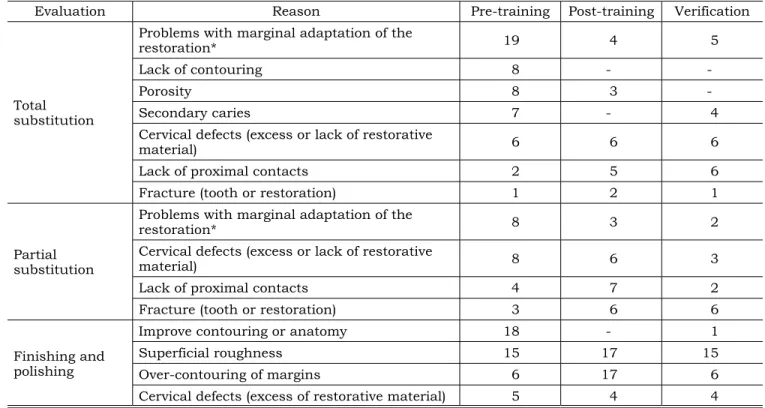
The changes in behaviour can be observed based on the significant increase of 27% (from 15% to 42%) in the number of restorations con-sidered satisfactory (Graph 1) and also based on the reduction of need for replacement (total and partial) and the reduction of need for finishing and polishing, besides the variation of reasons reported
to justify the need to substitute the restorations evaluated (Table 2).
Secondary caries were found to be the main reason to substitute amalgam restorations7,10,20.
However, in this study, in the pre-training phase, the examiners indicated problems of marginal adaptation as the principal reason to substitute amalgam restorations (Table 2), a result also found by Nuckles et al.13 (1991). Secondary caries
ap-peared as the forth (9.46%) reason for the need for substitution (total or partial) and was observed only in the pre-training phase.
The previously cited studies that reported sec-ondary caries as the main reason for the substi-tution of amalgam restorations are transverse in design and in vivo12. These studies reflect everyday
dental practice and were undertaken with the aim to evaluate the prevalence and reasons for sub-stituting restorations in a particular location. The examiners were not calibrated and the samples were not pre-selected. In this study, the sample of teeth was pre-selected to allow the calibration of examiners following already established crite-ria for the evaluation of amalgam restorations. Therefore, the reasons for different results may be due to the difference in the aims and design of the studies12.
42 40 41
27 27
17 16 12
27
15 15
21
0 10 20 30 40 50
Satisfactory Finishing and
polishing substitutionPartial substitutionTotal
Pre-training Post-training Verification
Ama
lg
am
re
st
ora
tio
ns
(%
)
GRAPH 1 - Comparison of the results of the evaluation
of amalgam restorations undertaken by five examin-ers before and after the training programme and in the verification phase.
TABLE 1 - Frequency of need for substitution or not (percentage) of amalgam restorations evaluated by five
examin-ers, before and after the training programme.
Evaluation Pre-training (%) Post-training (%) Verification (%)
Substitution (total and partial) 44* 31*+ 33+
Substitution not indicated (satisfactory and need
for finishing and polishing) 56* 69*+ 67+
250 251
250 251
The reporting of problems of marginal adapta-tion as a reason for substituadapta-tion (total or partial) reduced from 27 teeth in the pre-training phase to seven in the post-training phase, as well in the verification phase. The behaviour of the examiners in the pre-training phase was expected, since many professionals wrongly associate marginal defects in restorations with secondary caries and, therefore, recommend unnecessary substitutions5,11,12. The
change in the approach of the examiners in the post-training phase probably resulted from the change of emphasis during the training because marginal defects were not included in the criteria that justified substitution of a restoration1,8,16.
Barbakow et al.2 (1988) showed that 100% of
amalgam restorations show marginal defects six months after placement. Therefore, deficiency in marginal integrity is not a reason to substitute a restoration. Periodical recalls to monitor restora-tions and the caries risk of patients or to repair margins are preferable to total substitution15. This
approach seems to have been a consensus among the examiners in the post-training phase, since there was an increase in the number of reports of over-contouring of margins (from six to seventeen)
with the indication of need for finishing and polish-ing rather than substitution.
Analyzing Table 2, we observe a marked re-duction from the pre- to the post-training phase through the excessive worry about the contouring of restorations, both as need for substitution (from eight to zero) and finishing and polishing (from eighteen to zero). Since the era of Black, the qual-ity of restorations has been associated to smooth, polished and intact margins. If restorations did not comply with this standard appearance they would have to be replaced9. The evaluations of
the examiners in the pre-training phase were ex-pected, representing the conduct adopted by the majority of professionals. The post-training phase reflects a change in behaviour of the examiners. Restorations that were previously deficient were considered clinically acceptable. Taking into ac-count the number of years of clinical experience of the examiners, who were used to an essentially restorative dentistry, these results can be consid-ered very satisfactory.
The criterion of absence of proximal contacts was less reported as a reason for substitution in the pre-training than in the post-training phase.
TABLE 2 - Frequency of reasons (absolute value) reported by the examiners to justify the need for partial or total
substitution, or finishing and polishing (before and after the training programme).
Evaluation Reason Pre-training Post-training Verification
Total substitution
Problems with marginal adaptation of the
restoration* 19 4 5
Lack of contouring 8 -
-Porosity 8 3
-Secondary caries 7 - 4
Cervical defects (excess or lack of restorative
material) 6 6 6
Lack of proximal contacts 2 5 6
Fracture (tooth or restoration) 1 2 1
Partial substitution
Problems with marginal adaptation of the
restoration* 8 3 2
Cervical defects (excess or lack of restorative
material) 8 6 3
Lack of proximal contacts 4 7 2
Fracture (tooth or restoration) 3 6 6
Finishing and polishing
Improve contouring or anatomy 18 - 1
Superficial roughness 15 17 15
Over-contouring of margins 6 17 6
Cervical defects (excess of restorative material) 5 4 4
250 251
250 251
This confirms the excessive worry of the examiners about superficial aspects of the restoration mask-ing functional defects in their evaluation before training. During training there was a consensus that absence of proximal contacts is a reason to replace a restoration due to the damage that could be caused to the periodontium. This explains the increase in the number of times that this criterion was used as a reason to substitute restorations after training.
The programme of training tested in this study was initiated by a process of deepening our theo-retical understanding before the elaboration of the table of criteria (literature review, group partici-pation, consensus and development in writing to facilitate understanding, resulting in clinical appli-cation). The high level of cooperation and participa-tion within the group was a factor that facilitated discussion and consensus.
The methodology of the training programme included two sessions of calibration: the first one with slides and the second with permanent human extracted teeth, containing amalgam restorations, as suggested by Courts3 (1997). The examiners
re-ported greater difficulty in agreement when evalu-ating the restorations of extracted teeth compared to those of the slides, reporting that defects were more evident on slides due to higher magnifica-tion.
During the evaluation of the training pro-gramme the examiners emphasized the importance of the two week intervals between sessions which allowed time to assimilate the new discussed con-cepts, rethink their behaviour and consider the clinical implications. The participants recognized their changes in attitude from one session to an-other reporting how their new concepts had been applied clinically.
Five months after the conclusion of the train-ing programme the group of examiners re-exam-ined the same teeth following the same methodol-ogy. It is important to emphasize that during this period of time there was no formal contact between the researcher and the group. This disguised the fact that a new evaluation would be undertaken. A small increase was found in the need for replace-ment of amalgam restorations in this verification phase (33%) when compared with the post-train-ing phase (31%). This result was not statistically significant (sing test: Z = 0.199 p = 0.61) but con-firms the maintenance of the results reached after participation in the training programme.
It should be emphasized that in a clinical situ-ation the applicsitu-ation of criteria developed during the calibration using extracted teeth cannot be separated from the inherent needs of the patient.
These new concepts should be incorporated into the dentistry curriculum so that students do not start practicing without defined criteria for the evaluation of amalgam restorations to the benefit of the community served.
CONCLUSIONS
A programme of participative training can be organized and implemented to standardize the cri-teria for the evaluation of amalgam restorations with satisfactory results having an impact in clini-cal practice.
The possibility of using this methodology for other aspects of clinical practice widens the pos-sibility of other calibrations which will significantly benefit teaching and consequently quality of treat-ment offered by future professionals.
REFERENCES
1. Anusavice KJ. Criteria for placement and replacement of dental restorations. J Dent Res 1988;67:795-6.
2. Barbakow F, Geberthuel T, Lutz F, Schuepbach P. Main-tenance of amalgam restorations. Quintessence Int 1988;19:861-70.
3. Courts FJ. Standardization and calibration in the evalu-ation of clinical performance. J Dent Educ 1997;61:947-50.
4. Deery C, Fyffe HE, Nugent Z, Nuttall NM, Pitts NB. The ef-fect of placing a clear pit and fissure sealant on the validity and reproducibility of occlusal caries diagnosis. Caries Res 1995;29:377-81.
5. Elderton RJ. Clinical studies concerning re-restoration of teeth. Adv Dent Res 1990;4:4-9.
6. Felipe LA, Vieira LCC, Danker AL. Amálgama dental: fatos e controvérsias. Rev Assoc Paul Cir Dent 1999;53:41-5. 7. Friedl KH, Hiller KA, Schmalz G. Placement and
replace-ment of amalgam restorations in Germany. Oper Dent 1994;19:228-32.
8. Kidd EAM. Caries diagnosis within restored teeth. Adv Dent Res 1990;4:10-3.
252 PB 10. Mjör IA. The reasons for replacement and the age of
failed restorations in general dental practice. Acta Odontol Scand 1997;55:58-63.
11. Mjör IA, Qvist V. Marginal failures of amalgam and composite restorations. J Dent 1997;25:25-30.
12. Mjör IA, Toffenetti F. Secondary caries: a literature review with case reports. Quintessence Int 2000;31:165-78.
13. Nuckles DB, Sneed WD, Bayne JB, Collins DE, Hook CR, Welsh EL. Faculty differences in replacement decisions for amalgam restorations. Quintessence Int 1991;22:533-40.
14. Oleinisky JC, Baratieri LN, Ritter AV, Felipe LA, Frei-tas SFT. Influence of finishing and polishing procedures on the decision to replace old amalgam restorations: an in vitro study. Quintessence Int 1996;27:833-9.
15. Paterson FM, Paterson RC, Watts A, Blinkhorn AS. Initial stages in the development of valid criteria for the replacement of amalgam restorations. J Dent 1995;23:137-43.
16. Pimenta LAF, Navarro MFL, Consolaro A. Second-ary caries around amalgam restorations. J Prosthet Dent 1995;74:219-22.
17. Rudolphy MP, van Amerongen JP, Penning CH, ten Cate JM. Validity of bite-wings for diagnosis of secondary caries in teeth with occlusal amalgam restorations in vitro. Caries Res 1993;27:312-6.
18. Ryce C, Mjör IA. Avaliações clínicas diretas. In: Hörs-ted-Bindslev P, Mjör IA. Dentística Operatória Moderna. 2ª ed. São Paulo: Santos; 1993. p. 269-83.
19. Serra MC, Pimenta LAF, Paulillo LAMS. Dentística e manutenção de saúde bucal. In: Kriger L (Coordenador). ABOPREV Promoção de saúde bucal. São Paulo: Artes Médicas; 1997. p. 201-54.
20. Wilson NHF, Trevorburke FJ, Mjör IA. Reasons for placement and replacement of restorations of direct re-storative materials by a selected group of practioners in the United Kingdom. Quintessence Int 1997;28:245-8.