R E S E A R C H
Open Access
Inhibitory and attentional control: the
interaction between
“
professional activity
”
and bilingualism
Lisandra Rutkoski Rodrigues
1*and Márcia Cristina Zimmer
2Abstract
This study investigates the consequences of bilingualism on inhibitory and attentional control. Findings garnered from studies about the so-called bilingual advantage in such executive functions are still controversial. This investigation tested 40 (20 monolinguals and 20 bilinguals) highly-educated middle-aged (ranging from 36–58 years old) businesspeople in two nonverbal cognitive tasks, the Simon task and the Attentional Network Task (ANT). No significant statistical differences were found in the interference effect between the groups, nor was there a bilingual advantage in any of the three attentional networks. The results suggest that variables such as level of education and professional activity might compete with the bilingual advantage, acting as possible research confounds.
Keywords:Cognition, bilingualism, executive functions, inhibitory control, attention
Background
It has been a while since the number of bi/multilingual speakers has outnumbered the total of monolingual speakers on the globe. In fact, in 1998, over two thirds of the world population was bilingual (Baker and Jones 1998), and that number has increased significantly over the last two decades. According to the Associated Press (2001), 66 % of the world’s children are raised bilingual. Never before did so many people make use of different lan-guages in their everyday life as they do now, for professional and academic reasons, or simply out of cultural interest.
The ability to speak more than one language has al-ways been intriguing, and has led researchers to con-ducting investigations whose findings suggest that bilingualism can actually enhance some of bilinguals’ cognitive processes throughout life (e.g. Bialystok et al. 2004; Bialystok et al. 2005a, b). Those processes are called “executive functions” (EFs), an umbrella term comprising a wide range of cognitive processes and be-havioral competencies (Chan et al. 2008) such as: verbal reasoning, problem-solving, planning, sequencing, the ability to sustain attention, resistance to interference
(inhibition), utilization of feedback, multitasking, cogni-tive flexibility, and the ability to deal with novelty. Ac-cording to Alvarez and Emory (2006), indications have been found for the sensitivity but not for the specificity of EF measures to frontal lobe functioning, signaling the involvement of both frontal and non-frontal brain areas. Regarding language production in bilinguals, Abutalebi and Green (2007) point out the involvement of cortical and subcortical structures that make use of inhibition to resolve lexical competition and to select the intended lan-guage. The single network mediating the representation and the control of a person’s L1 and L2 is made up of the following: the prefrontal cortex, the anterior cingulate cor-tex, the basal ganglia and the inferior parietal lobule.
Bilingualism, however, has not always been seen as beneficial to human cognition. The first studies carried out in the late 19thand early 20th centuries found that bilinguals performed poorly in tests which measured their IQ (Darsie 1926; Saer 1923), and such an idea lin-gered along the first decades of the 20thcentury. Only in the 1960s did bilingualism acquire a positive status, when Peal and Lambert’s work (1962) indicated that Canadian bilingual children had a better performance than monolingual ones, especially on tests requiring symbol manipulation and reorganization.
* Correspondence:[email protected]
1Pontificia Universidade Catolica do Rio Grande do Sul, Porto Alegre, Brazil Full list of author information is available at the end of the article
In the last two decades or so, bilingualism has become a point of interest for cognitive sciences such as psycho-linguistics and neuropsycho-linguistics. A substantial number of studies have consistently found significant cognitive dif-ferences between bilinguals and monolinguals in some age groups. Regarding disadvantages, all related to lin-guistic performance, bilingual children usually have a smaller vocabulary in each of their languages–although their total vocabulary is bigger than that of a
monolin-gual child – and are also slower in lexical access
(Bialystok and Feng 2011). The same is true for bilingual adults and the elderly. They all tend to be slower in pic-ture naming tasks, to obtain lower scores on verbal flu-ency tasks (Gollan et al. 2002), to show slower semantic fluency (Gollan et al. 2002), and to experience more interference in lexical decision (Ransdell and Fischler 1987). Besides, bilingual speakers are more susceptible to tip of the tongue states, (Gollan and Acenas 2004) which consist of“a temporary inaccessibility of information that one is sure exists in long-term memory and is on the verge of recovering”(Abutalebi and Green 2007, p. 250).
However, most of the differences tend to be advanta-geous and are related to cognitive performance. Bilingual children, for example, outperform monolinguals when faced with problems containing conflicting or misleading cues, especially on conditions in which the demands for inhibitory control (the ability one has to deliberately in-hibit dominant, automatic, or prepotent responses when it is necessary; Miyake et al. 2000) are high (Martin-Rhee and Bialystok 2008). Furthermore, they show greater mental flexibility (Peal and Lambert 1962), enhanced metalinguistic awareness (Cummins 1978), and in-creased creativity (Kessler and Quinn 1987). The same is true for bilingual adults, especially when it comes to nonverbal tasks demanding higher executive control skills. In the Simon task (Bialystok et al. 2004), for ex-ample, bilinguals have shorter reaction times (RTs) for both congruent and incongruent trials (Bialystok et al. 2004; Bialystok et al. 2005a, b; Bialystok 2006), and in the Attentional Network task (ANT) (Fan et al. 2002), bilinguals usually show faster RTs, a smaller conflict ef-fect and smaller switch costs (Costa et al. 2008).
As a whole, the so-called bilingual advantage corre-sponds not only to a greater inhibitory and attentional control, but also to a 4.1-year delay on the onset of the symptoms of dementia like Alzheimer’s (Bialystok et al. 2007; Craik et al. 2010), given that bilingualism also pro-motes cognitive reserve, i.e. the protective effects of ex-perience against cognitive decline with aging (Bialystok 2009). Such advantage is closely intertwined with the con-cept of code-switching–a complete shift to another lan-guage for a word, phrase or sentence (Grosjean 2001).
Grosjean (2001, p. 2) explains that“the state of activa-tion of the bilingual’s languages and language processing
mechanisms, at a given point in time, has been called the language mode”. In the monolingual language mode, a bilingual person partially deactivates one language, whereas in the bilingual language mode, a base language is chosen, the other language is activated and called on in the form of code-switches and borrowings. Code-switching demands a greater executive and attentional con-trol, and probably has strong effects on nonverbal tasks as well. That is due to the fact that language control in bilin-guals relies on a neural system shared with more general cognitive control processes, that is, the dorsal anterior cin-gulate cortex, which is responsible for detecting and aiding the resolution of conflicts not only in the verbal, but also in the nonverbal domain (Abutalebi et al. 2012).
Green (1998) designed the Inhibitory Control Model (the IC Model) in order to explain bilinguals’ability to speak one language rather than another, to code-switch, and also to translate between the languages spoken. If Green’s model is right, bilinguals are able to control their two language systems by inhibiting potential com-petitors for production at the lemma level, by virtue of their language tags. Each lexical concept is associated with a lemma that specifies its syntactic properties, lead-ing to the activation of an associated word form.
Inhibitory control and attention are the EFs chosen for the present study because although inhibitory con-trol in bilinguals has been extensively investigated, the results are still controversial, for a lot of studies have not been able to replicate the bilingual advan-tage found by Bialystok et al. (2004), as pointed out by Hilchey and Klein’s (2011) and Paap and Greenberg’s (2013) reviews. Regarding attention, this study used a model composed by three networks, namely, executive control, orienting and alerting networks. The three atten-tional networks have been the focus of several studies in-cluding bilinguals (e.g. Costa et al. 2008, 2009; Hernandez et al. 2010; Marzecová et al. 2013; Videsott et al. 2012), and the bilingual advantage seems not to be restricted only to the executive control network.
The orienting network corresponds to the ability to se-lect specific information from among multiple sensory stimuli. It can be measured by shorter RTs in trials where a spatial cue is offered, giving information on the location. There are two types of orienting: 1) exogenous orienting, when the flash of a cue automatically captures attention to a specific location, and 2) endogenous orienting, when a central arrow points to one of two lateralized target presentation locations (Raz and Buhle 2006). In the ANT task, responses to spatial cued trials are subtracted from responses to center cued trials, allowing us to measure the efficiency of the orienting network (Costa et al 2008).
The alerting network refers to the ability to increase and maintain response readiness in preparation for an impending stimulus. There are two types of alertness: phasic alertness (task specific) and intrinsic alertness (a general cognitive control of arousal). The efficiency of this network can be measured by the ANT task by sub-tracting the responses to trials that offer a temporal cue from those that do not (Raz and Buhle 2006).
Considering the issues above, this experimental study of empirical nature investigated middle-aged monolin-guals and bilinmonolin-guals matched in age, education and pro-fession (businesspeople), in two nonverbal cognitive tasks. The Simon task (Bialystok et al. 2004) was used for testing inhibitory control and attention, while the ANT task (Fan et al. 2002) assessed the executive con-trol network (with an inhibitory concon-trol component) and the alerting and orienting networks. The purpose of fo-cusing on these groups of participants was twofold, rep-licating some of the experiments conducted previously with another population of participants regarding: 1) age; and 2) profession. Concerning age, the findings on the so-called bilingual advantage in such EFs are still controversial, and we perceived a lack of studies on the effects of bilingualism regarding middle-aged adults, as compared to the considerably high number of studies and robust findings on the bilingual advantage among other age groups, such as children and elderly people. Concerning profession, businesspeople are naturally faced with strong cognitive demands on a daily basis while negotiating and making online administrative and financial decisions. They are required to be extremely objective when it comes to critical decisions, being able to focus on tasks and problems and ignoring distracting stimuli, not allowing themselves to be influenced by minor issues that are not urgent. Thus, their problem solving, multitasking and inhibitory control skills are constantly demanded. As a result, the cognitive demands of their professional activity could act as a natural com-petitor with bilingualism in strengthening these EFs. It is important to underscore the fact that no previous work has addressed such population in any of these regards,
nor has the ANT task been applied to such age group with the same format and purposes. Furthermore, what seems to be unique about this specific population is the fact that it must be the sample with the highest level of education, at least among Brazilian studies, and that alone deserves careful investigation.
Method
Participants
There were 40 participants in this experiment, divided into two groups, 20 monolingual and 20 bilingual busi-nesspeople (managers or directors) working in different companies located in Porto Alegre, Canoas, São Leopoldo, Portão, Pelotas and Rio Grande, in Rio Grande do Sul, Brazil. They were matched in age (36 – 58) and education (they all had at least one university degree), and were all right-handed. There were 15 male and 5 female monolinguals, mean age 47.2 years and educational level 18.6 years; and 14 male and 6 female bilinguals, mean age 48.1 years and educational level 18.4 years. There were more men than women because direction and management activities in Brazil seem to be still mostly performed by men. Thirty-eight participants had Brazilian Portuguese as L1 (two bilinguals had German/Pomeranian or Italian as L1), but they were all born and raised in Brazil. Participants’ L2 varied (15 spoke English as L2, three spoke Spanish, and two spoke Brazilian Portuguese). The bilinguals use their L2 for dif-ferent purposes and in difdif-ferent situations: in frequent or sporadic business meetings and trips, conference calls via Skype, phone calls and sometimes at home or travel-ling with friends and family. The study was approved by the Ethics Committee of UCPel (RS), Brazil (document nr. 16028/2012). Most of the participants were con-tacted, interviewed and tested at their work places by the same examiner using the same equipment and in-structional protocols. The participants were asked about video game use (the ones who used to be or still were regular players were ruled oud) for it promotes strong speed advantages to answer to the stimuli to such a de-gree that bilingualism can do little to further improve the RTs measured by the tasks (Bialystok et al. 2005a, b). However, due to their professional activity, all of them are very familiar with computers. No instruments were used to measure social economic status, but it was as-sumed to be equivalent among them, considering their level of education and jobs. No reward was offered to them, who were invited to be part of an experiment which would investigate the cognitive differences result-ing from the use of an L2 on a regular basis.
Apparatus
started each interview with a participant signing a Free and Informed Consent Form, followed by a Screening Ques-tionnaire and a Linguistic Background QuesQues-tionnaire (Zimmer and Bonini 2008), to be answered orally, question by question. The former questionnaire contained questions about personal information such as handedness, level of education, history of health problems and medicine use. Participants who followed a prescription of antidepressants or anxiolytics or anything else that could interfere with the results of the research were ruled out at this stage. The lat-ter contained questions about their social life, professional activity, the languages spoken, as well as travelling and in-tercultural experience. Questions regarding the age and context of acquisition of their L2/L3, and the amount and frequency of use of their language(s) regarding speaking, reading and writing allowed us to classify the participants as monolinguals or bi/multilinguals. Neither fluency nor proficiency were the key issues to classify them as bi/multi-linguals, but the regular use of two or more languages (Grosjean 2010). Only one participant was ruled out after the Screening Questionnaire, while nobody was ruled out after the Linguistic Background Questionnaire. The exam-iner filled out the questionnaires, which were then followed by two computerized cognitive tasks. The data concerning such tasks were collected with a Microboard Netslim 10” netbook, containing Windows XP, and the software E-prime 1.2.
Instruments
Simon task
The Simon task (Bialystok et al. 2004) is used to measure the effects of the EFs inhibitory control and attention, as-pects of processing which decline with aging. It is“based on stimulus–response compatibility and assesses the extent to which the prepotent association to irrelevant spatial in-formation affects participants’ response to task-relevant nonspatial information”(Bialystok et al. 2004, p. 291).
The design is as follows: what the participants see on the screen is a sequence of stimuli in the shape of col-ored rectangles (brown, blue, yellow, pink, green and red) that are presented on either the left or the right side of a computer screen, arranged in four different condi-tions: center/2 colors, lateral/2 colors, center/4 colors and lateral/4 colors. Each color is associated with a re-sponse key that is on one of the two sides of the key-board, aligned with the two stimulus positions. On congruent trials, the key that is the correct response for that color is on the same side as the stimulus, while on incongruent trials, the correct response key is on the op-posite side. Participants must press the right key as quickly and accurately as possible, since level of accuracy and RTs are measured.
In the Simon task, we can calculate the Simon effect. According to Lu and Proctor (1995, p. 174),“the Simon
effect refers to the fact that responses are faster when the stimulus location corresponds to the location of the assigned response than when it does not”. It is obtained by subtracting responses to congruent trials from those to incongruent ones. Since congruent trials offer no con-flict, i.e., no irrelevant spatial information, faster RTs are expected, resulting in positive RTs for Simon effects. When negative RTs are obtained, though, one could as-sume that participants have learnt to deal with the con-flict caused by the irrelevant location information, having internalized the task rules.
ANT task
The ANT task was developed by Fan et al. (2002). It com-bines a cue reaction time task (Posner 1980) and a flanker task (Eriksen and Eriksen 1974). With the ANT, we can assess the three attentional networks. According to Costa et al. (2008, p. 65), this task “is especially appropriate to assess potential differences between monolinguals and bi-linguals, since it relies minimally on linguistic and mem-ory processes that may interact with bilingualism”, and its multidimensionality allows drawing a set of interesting predictions in terms of the potential conditions that may be affected by bilingualism.
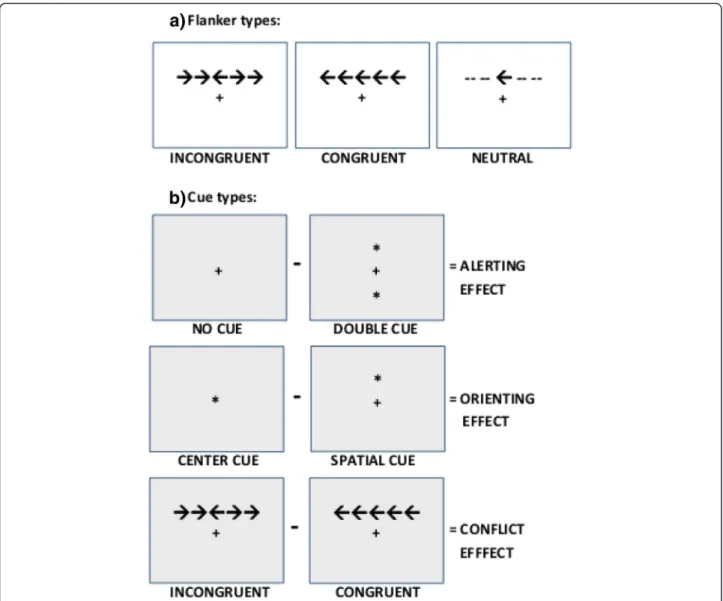
Participants are instructed to press as quickly and ac-curately as possible the right button of the mouse (lo-cated at the frontal part of the computer keyboard, in a fixed position, allowing for stability of movements) with their right hand if a central arrow points to the right (→) and the left button of the mouse with their left hand if it points to the left (←). The central arrow is pre-sented below or above a fixation point (+) with two flanker arrows pointing to the same or different direc-tion than the target arrow (see Fig. 1a). There is also a neutral condition. If they point to the same direction it is a congruent trial, if not, it is an incongruent one. Re-sponses tend to be slower for incongruent trials, reflecting the time required to resolve the conflict between the tar-get stimulus and the flanker information which must be ignored, and so assessing the executive control network.
To assess the alerting network, a cue in the form of an asterisk (*) is presented before the target stimulus.
Re-sponses tend to be faster if the target is preceded by an alerting cue. For the orienting network to be assessed, the cue is presented (*) to signal the position in the
screen where the target stimulus is going to appear. Again, responses tend to be faster when there is a cue signaling where the target will appear, below or above the fixation point.
Procedures
Simon task
which were all then repeated in the reverse order, produ-cing 48 trials for each of them. Each condition was pre-ceded by a set of practice trials, four for the 2-color conditions and eight for the 4-color conditions, which were identical to test trials. Participants had to complete all eight practice trials correctly to move on to test trials; if not, the program recycled until all practice trials were completed successfully.
In the 2-color conditions, participants were instructed to press 1 when they saw a blue rectangle and 0 when they saw a brown one. In the 4-color conditions, partici-pants were instructed to press 1 when they saw a green or a pink rectangle, 0 when they saw a red or a yellow one. Trials began with a sound (a computer “bing”) and a fixation cross (+) that appeared in the center of the screen for 300 ms. Immediately after the cue, the stimu-lus appeared and remained on the screen until a re-sponse was made. The rere-sponse clock started at the
onset of the stimulus. The fixation cross and the sound reappeared 500 ms after the response to signal the next trial. When the stimuli were presented in lateral posi-tions, the order of trials was randomized and divided equally between congruent and incongruent items.
ANT task
(+) appeared on the center of the screen for 400 ms; (b) a cue (*) was presented for 100 ms; (c) a fixation period
for 400 ms after the cue; (d) the target arrow and the flankers were presented simultaneously until partici-pant’s response or up to 1700 ms; then, (f ) the target and flankers disappeared after response and the next trial began. The fixation cross appeared at the center of the screen during the whole trial (Costa et al. 2008; Fan et al. 2002). The final scores were obtained by subtracting: RT no cue from RT double cue (Alerting effect); RT center cue from RT spatial cue (Orienting effect); and RT incon-gruent from RT conincon-gruent (Conflict effect) (see Fig. 1b).
Design
The participants performed the Simon task (Bialystok et al. 2004), and the ANT task (Fan et al. 2002). In both, “RT” and level of “Accuracy” were taken as dependent variables, and“Language Group”(monolingual/bilingual) was taken as an independent variable. In order to choose the appropriate statistical tests, we contrasted the nor-mality hypothesis for all the pairs of samples with the Shapiro–Wilk and the Kolmogorov-Smirnov tests. Since we were dealing with independent factors, we also used the Levene test to see the homogeneity of variance. Re-sults indicated that some of our variables did not show normality or homogeneity and so were measured by non-parametric tests such as the Mann-Whitney, while others could be measured by Independent Samples t-tests. Because we were dealing with second language re-search, we used a p-value below 0.05 as a cut-off point for all the statistical tests.
Results
Simon task
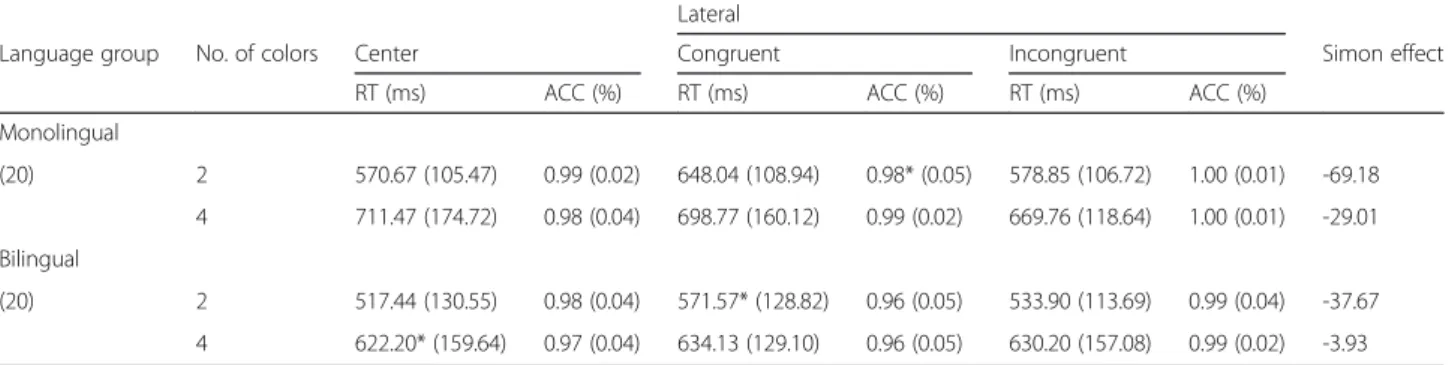
The mean RTs for the correct trials and accuracy scores in each of the Simon conditions are presented in Table 1. Non-parametric tests were run for all the accuracy scores because our variables did not show normality or homogen-eity. Mann-Whitney tests revealed no significant statistical differences between the groups in most conditions, since
both language groups made very few errors in all four con-ditions, with the mean percentage of errors ranging from 0 to 4 %–bilinguals (2 %) and monolinguals (1 %). The only significant statistical difference in terms of accuracy was the lateral congruent 2-color condition, in which monolinguals outperformed bilinguals (Z = -2.12,p= .03) (see Table 1).
The RTs for the center 2-color and 4-color conditions, and the lateral congruent 2-color and 4-color conditions were also examined with Mann-Whitney tests. Signifi-cant statistical differences were found in the center 4-color condition, favoring bilinguals (Z = -2.07, p= .04), and in the lateral congruent 2-color condition, also favoring bilinguals (Z = -2.58, p= .01). The RTs for the lateral incongruent 2-color and 4-color conditions were examined with Independent Samples t-tests, with no significant statistical differences.
Regarding the Simon effect (also shown in Table 1), no significant statistical differences were found, as indicated by an Independent Samples t-test for the 2-color Simon effect, and by a Mann-Whitney test for the 4-color Si-mon effect. As a matter of fact, both bilinguals and monolinguals had faster RTs in incongruent trials than in congruent ones, resulting in negative RTs for the Si-mon effects for both groups in the 2- and 4-color condi-tions, thus revealing no interference effects.
ANT task
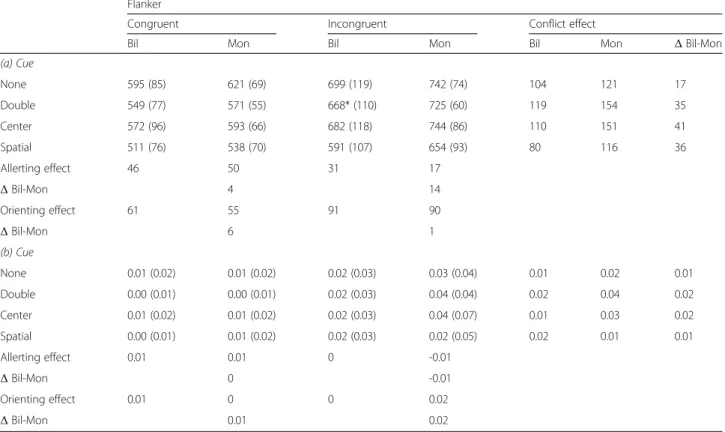
The mean RTs (ms) for the correct trials and error rates (%) in each of the ANT conditions are presented in Table 2. The error rates (see Table 2b) ranged from 0 to
4 % – bilinguals (1 %) and monolinguals (2 %) – for
which Mann-Whitney tests were run, revealing no sig-nificant statistical differences between the groups. Mann-Whitney tests were run for two RT scores: the spatial cue congruent condition, with no differences between the groups, and the double cue incongruent con-dition, revealing significant statistical differences favoring bilinguals (Z = -2.27,p= .02) (see Table 2a). All the other RT scores were examined with Independent Samples t-tests, but no significant statistical differences were found.
Table 1Mean Reaction Time (RT) (in Milliseconds) and Accuracy (ACC) for Simon Task and Language Group
Lateral
Language group No. of colors Center Congruent Incongruent Simon effect
RT (ms) ACC (%) RT (ms) ACC (%) RT (ms) ACC (%)
Monolingual
(20) 2 570.67 (105.47) 0.99 (0.02) 648.04 (108.94) 0.98* (0.05) 578.85 (106.72) 1.00 (0.01) -69.18
4 711.47 (174.72) 0.98 (0.04) 698.77 (160.12) 0.99 (0.02) 669.76 (118.64) 1.00 (0.01) -29.01
Bilingual
(20) 2 517.44 (130.55) 0.98 (0.04) 571.57* (128.82) 0.96 (0.05) 533.90 (113.69) 0.99 (0.04) -37.67
4 622.20* (159.64) 0.97 (0.04) 634.13 (129.10) 0.96 (0.05) 630.20 (157.08) 0.99 (0.02) -3.93
Note. Source: Study data. Standard deviations are in parentheses
Both bilinguals and monolinguals obtained higher RTs in all the incongruent conditions, resulting in positive RTs for Conflict effects, revealing the expected difficulty to re-spond to trials with incongruent flankers. Even though bi-linguals (103 ms, SD= 47.30) suffered less interference than monolinguals (135 ms,SD= 72.48) in terms of Con-flict effect, a Mann-Whitney test revealed no significant statistical differences between the groups. The same is true about the Alerting effect, bilinguals (44.25 ms,SD=
26.00) and monolinguals (40.37 ms, SD= 27.60), and
about the Orienting effect, bilinguals (67.32 ms, SD= 28.33) and monolinguals (62.74 ms,SD= 28.53). Also for these two effects, Independent Samples t-tests revealed no significant differences between the groups.
Discussion
Simon task
There was only one significant statistical difference in accuracy favoring monolinguals, but accuracy is not the focus of our study. Concerning RTs, bilinguals were fas-ter than monolinguals in two conditions, the cenfas-ter 4-color and the lateral congruent 2-4-color conditions. How-ever, it is important to say that central and lateral con-gruent conditions are neutral for they do not offer any
conflict (i.e. no irrelevant spatial information). Bilinguals were expected to be faster in both congruent and incon-gruent trials, or to show an advantage in the Simon
ef-fect. However, both bilinguals and monolinguals
presented faster RTs in incongruent trials, resulting in negative RTs for the Simon effect, but with no significant differences. In face of negative RTs, one could claim that the Simon effect is null. As Bialystok (2004, p. 291) points out, “numerous studies with this task have con-firmed that the irrelevant location information results in reliably longer reaction times (RTs) for incongruent items”. Such tasks are very sensitive to the parameters in the experiment, such as timing, stimuli characteris-tics, etc. However, negative RTs for the Simon effect have been found in several studies conducted in Brazil using different versions of the Simon task (e.g., Bandeira 2010; Finger et al. 2011; Kramer 2011; Martins 2010; Pinto 2009) to different age groups, with different types of bilinguals, which means that such pattern deserves a more careful investigation, especially because the design of the Simon task ap-plied to our participants, and in some of the other Brazilian studies mentioned above, is the same one used by Bialystok et al. (2004) in Study 2.
Table 2Mean Reaction Times (in Milliseconds) (a) and Error Rates (%) (b) for Bilingual and Monolingual Participants Broken for Flanker Type and Cue Type
Flanker
Congruent Incongruent Conflict effect
Bil Mon Bil Mon Bil Mon ΔBil-Mon
(a) Cue
None 595 (85) 621 (69) 699 (119) 742 (74) 104 121 17
Double 549 (77) 571 (55) 668* (110) 725 (60) 119 154 35
Center 572 (96) 593 (66) 682 (118) 744 (86) 110 151 41
Spatial 511 (76) 538 (70) 591 (107) 654 (93) 80 116 36
Allerting effect 46 50 31 17
ΔBil-Mon 4 14
Orienting effect 61 55 91 90
ΔBil-Mon 6 1
(b) Cue
None 0.01 (0.02) 0.01 (0.02) 0.02 (0.03) 0.03 (0.04) 0.01 0.02 0.01
Double 0.00 (0.01) 0.00 (0.01) 0.02 (0.03) 0.04 (0.04) 0.02 0.04 0.02
Center 0.01 (0.02) 0.01 (0.02) 0.02 (0.03) 0.04 (0.07) 0.01 0.03 0.02
Spatial 0.00 (0.01) 0.01 (0.02) 0.02 (0.03) 0.02 (0.05) 0.02 0.01 0.01
Allerting effect 0.01 0.01 0 -0.01
ΔBil-Mon 0 -0.01
Orienting effect 0.01 0 0 0.02
ΔBil-Mon 0.01 0.02
Note. Source: Study data. Standard deviations are in parentheses
*Statistically significant differences (p< 0.05); Bil (Bilingual); Mon (Monolingual);
In Bialystok et al. (2004), a bilingual advantage in the interference effect was found in Studies 1 and 2 for both middle-aged and old-aged participants, being more pro-nounced for the younger groups, showing that
bilingual-ism “did not attenuate the age-related decline in
inhibitory effectiveness”(Bialystok et al. 2004, p. 293), as the authors had expected. Other studies using the Simon task with different age groups have not been able to rep-licate Bialystok et al.’s results regarding the interference effect: children (Bialystok et al. 2005a, b; Martin-Rhee and Bialystok 2008); and young adults (Bialystok 2006; Bialystok et al. 2005a, b; Humphrey and Valian 2012; Paap and Greenberg 2013). Moreover, countering Hilchey and Klein’s 2011 statement that older aged groups have been understudied, there are various Brazilian stud-ies, such as Pinto’s (2009) and Kramer’s (2011), including our own, addressing middle-aged adults, and again Pinto’s and Kramer’s studies, plus Billig’s (2009) and Martins’s (2010) studies addressing elder individuals, which have not been able to replicate Bialystok et al.’s (2004) results either.
We cannot ignore, in face of so many results pointing to no bilingual advantage in the interference effect, that the massive impossibility to replicate Bialystok et al.’s 2004 results might rely on the fact that their study might present methodological inconsistencies regarding demo-graphic factors, once they included populations with different nationalities and certainly dramatic cultural dif-ferences, and the data were even collected in different countries. Subsequent studies have taken more appropri-ate measures to minimize as much as possible such dif-ferences, including type of bilingualism and social economic status. The latter, as reinforced by Morton and Harper (2007) and Mezzacappa (2004), might have an impact on the bilingual advantage, and also covary with executive ability, for higher social economic status tends to be associated with better performance on mea-sures of cognitive functioning.
Our study, contrary to Bialystok et al.’s (2004), investi-gated a more homogeneous sample, since all the partici-pants were born and raised in Brazil, were extremely familiar with computers and were controlled for video game use. Another differing variable between Bialystok et al.’s 2004 study and ours refers to the instruments used to select the participants. While they used instru-ments such as PPVT–III, Catell Intelligence task, Digit Span tasks, we used the screening and the linguistic background questionnaires (Zimmer and Bonini 2008). These differences regarding control of variables may ac-count for the difficulty found by us and other re-searchers to replicate Bialystok et al.’s findings. Furthermore, it is important to bear in mind the fact that no other study included a homogeneous profes-sional group with such strong cognitive demands, nor
with such high levels of education. Both “profession” and “level of education” could be the key variables interfering with the bilingual advantage in this par-ticular study.
ANT task
Contrary to the results in the Simon task, in the ANT task, incongruent trials were more difficult than congru-ent ones, resulting in longer RTs for both groups. The same is true for alerting and orienting cues: trials with no cues were more difficult than the ones with double cues; and trials with center cues were more difficult than the ones with spatial cues. However, it is important to point out that such conclusions are based on the obser-vation of the averages, once we did not run tests within participants to compare their performance regarding the different types of trials, that being one of the limitations of our study. Regarding the tests between participants, no significant statistical differences were found in any of the three attentional networks.
Conclusion
This study was an attempt to replicate previous experi-ments on the so-called bilingual advantage concerning inhibitory and attentional control in two nonlinguistic interference tasks (the Simon task and the ANT task), and to contribute to the number of studies of this nature by including middle-aged participants as well. We also sought an effect of the variable“Profession”as a possible natural competitor with bilingualism in strengthening such EFs. Our results seem to corroborate our assump-tions, since no bilingual advantage was found whatso-ever in the interference effect or in any of the three attentional networks for this professional group. How-ever, in order to reinforce that, it is advisable that in fu-ture studies a control group with the same age and level of education but a different profession be included to be compared to the businesspeople in both tasks. Further-more, it is important to keep in mind that there is still a lot of controversy (Hilchey and Klein 2011; Paap and Greenberg 2013) concerning all the findings regarding the effects of bilingualism on cognition in studies both abroad and in Brazil. Thus, further studies should be ex-tremely thorough regarding their bilingual and monolin-gual populations in order to avoid methodological inconsistencies.
Competing interests
The authors declare that they have no competing interests.
Authors’contributions
LRR carried out the experimental studies, the statistical analysis and drafted the manuscript. All authors read and approved the final manuscript.
Author details
1Pontificia Universidade Catolica do Rio Grande do Sul, Porto Alegre, Brazil. 2Centro Universitário Ritter dos Reis, Porto Alegre, Brazil.
Received: 8 February 2016 Accepted: 7 April 2016
References
Abutalebi J, Green D. Bilingual language production: The neurocognition of language representation and control. J Neurolinguistics. 2007;20:242–75. doi: 10.1016/j.jneuroling.2006.10.003.
Abutalebi J, Della Rosa PA, Green DW, Hernandez M, Scifo P, Keim R, et al. Bilingualism tunes the anterior cingulate cortex for conflict monitoring. Cereb Cortex. 2012;22:2076–86. doi:10.1093/cercor/bhr287.
Alvarez JA, Emory E. Executive function and the frontal lobes: a meta-analytic review. Neuropsychol Rev. 2006;16(1):17–42. doi:10.1007/s11065-006-9002-x. Associated Press (2001). Some facts about the world's 6,800 tongues. Retrieved
from the Web 11/7/12. http://edition.cnn.com/2001/US/06/19/language. glance/index.html.
Baker C, Jones SP. Encyclopedia of bilingualism and bilingual education. Clevedon: Multilingual Matters; 1998.
Bandeira MHT. Diferenças entre crianças monolíngues e multilíngues no desempenho de tarefas de funções executivas e na transferência de padrões de VOT (Voice Onset Time) entre as plosivas surdas do pomerano, do português e do inglês. 2010. (Unpublished master’s thesis). Universidade Católica de Pelotas (UCPel), Pelotas.
Bialystok E. Effect of bilingualism and computer video game experience on the Simon task. Can J Exp Psychol. 2006;60:68–79. doi:10.1037/cjep2006008. Bialystok E. Bilingualism: the good, the bad, and the indifferent. Bilingualism.
2009;12:3–11. doi:10.1017/S1366728908003477.
Bialystok E, Feng X (2011). Language proficiency and its implications for monolingual and bilingual children. In: Durgunoglu, A., & Goldenberg, C. (Ed.). New York, NY: Challenges for language learners in language and literacy development. Guilford Press, p. 121-140.
Bialystok E, Craik FIM, Klein R, Viswanathan M. Bilingualism, aging, and cognitive control: evidence from the Simon task. Psychol Aging. 2004;19:290–303. doi:10.1037/0882-7974.19.2.290.
Bialystok E, Craik FIM, Grady C, Chau W, Ishii R, Gunji A, et al. Effect of bilingualism on cognitive control in the Simon task: Evidence from MEG. Neuroimage. 2005a;24:40–9. doi:10.1016/j.neuroimage.2004.09.044. Bialystok E, Martin MM, Viswanathan M. Bilingualism across the lifespan: the rise
and fall of inhibitory control. Int J Bilingualism. 2005b;9:103–19. doi:10.1177/ 13670069050090010701.
Bialystok E, Craik FIM, Freedman M. Bilingualism as a protection against the onset of symptoms of dementia. Neuropsychologia. 2007;45:459–64. doi:10.1212/ WNL.0b013e3181fc2a1c.
Billig JD. Bilinguismo e envelhecimento: Efeitos no controle cognitivo. 2009. (Unpublished master’s thesis). Universidade Federal do Rio Grande do Sul (UFRGS), Porto Alegre.
Carlson SM, Meltzoff AN. Bilingual experience and executive functioning in young children. Dev Sci. 2008;11(2):282–98. doi:10.1111/j.1467-7687.2008.00675.x. Chan RC, Shum D, Toulopoulou T, Chen EY. Assessment of executive functions:
Review of instruments and identification of critical issues. Arch Clin Neuropsychol. 2008;23(2):201–16. doi:10.1016/j.acn.2007.08.010. Costa A, Hernández M, Sebastián-Gallés N. Bilingualism aids conflict resolution:
evidence from the ANT task. Cognition. 2008;106:59–86. doi:10.1016/j. cognition.2006.12.013.
Costa A, Hernández M, Costa-Faidella J, Sebastián-Gallés N. On the bilingual advantage in conflict processing: Now you see it, now you don’t. Cognition. 2009;113:135–49. doi:10.1016/j.cognition.2009.08.001.
Craik FIM, Bialystok E, Freedman M. Delaying the onset of Alzheimer’s disease: bilingualism as a form of cognitive reserve. Neurology. 2010;75:1726–9. doi:10.1212/WNL.0b013e3181fc2a1c.
Cummins J. Bilingualism and the development of metalinguistic awareness. J Cross-Cult Psychol. 1978;9:131–49. doi:10.1177/002202217892001. Darsie ML. The mental capacity of American-born Japanese children. Comp
Psychol Monogr. 1926;3:1–89.
Eriksen BA, Eriksen CW. Effects of noise letters upon the identification of a target letter in a nonsearch task. Percept Psychophys. 1974;16:143–9. doi:10.3758/ BF03203267.
Fan J, McCandliss BD, Sommer T, Raz A, Posner MI. Testing the efficiency and independence of attentional networks. J Cogn Neurosci. 2002;14:340–7. doi: 10.1162/089892902317361886.
Finger I, Zimmer MC, Fontes ABAL. El bilingüismo en el mantenimiento de las funciones cognitivas a lo largo del curso de envejecimiento. In: XII Congreso de la Sociedad LatinoAmericana de Neuropsicología, Santiago - Chile. XII Congreso de la Sociedad LatinoAmericana de Neuropsicología - Programa y Resúmenes. Santiago: Pontifícia Universidad Católica de Chile, 13-13; 2011. Gollan TH, Acenas LAR. What is a TOT? Cognate and translation effects on
tip-of-the-tongue states in Spanish-English and Tagalog-English bilinguals. J Exp Psychol Learn Mem Cogn. 2004;30:246–69. doi:10.1037/0278-7393.30.1.246. Gollan TH, Montoya RI, Werner G. Semantic and letter fluency in Spanish-English
bilinguals. Neuropsychology. 2002;16:562–76. doi:10.1037/0894-4105.16.4.562. Green DW. Mental control of the bilingual lexico-semantic system. Bilingualism
Lang Cogn. 1998;1:67–81. doi:10.1017/S1366728998000133.
Grosjean F. The bilingual’s language modes. In: Nicol JL, editor. One mind, two languages: bilingual language processing. Oxford: Blackwell; 2001. p. 1–22. Grosjean F. Bilingual: Life and reality. Cambridge, Mass.: Harvard University Press; 2010. Hernandez M, Costa A, Fuentes LJ, Vivas AB, Sebastian-Galles N. The impact
of bilingualism on the executive control and orienting networks of attention. Bilingualism Lang Cogn. 2010;13(03):315–25. doi:10.1017/ S1366728909990010.
Hilchey MD, Klein RM. Are there bilingual advantages on nonlinguistic interference tasks? Implications for plasticity of executive control processes. Psychon Bull Rev. 2011;18:625–58. doi:10.3758/s13423-011-0116-7. Humphrey AD, Valian VV. Multilingualism and cognitive control: Simon and
flanker task performance in monolingual and multilingual young adults. In: 53rd Annual meeting of the psychonomic society, Minneapolis, MN. 2012. Kessler C, Quinn ME. Language minority children’s linguistic and cognitive
Kramer R. Effects of bilingualism on inhibitory control and working memory: A study with early and late bilinguals. 2011. (Unpublished master’s thesis). Universidade Federal de Santa Catarina (UFSC), Florianópolis. Lu C-H, Proctor RW. The influence of irrelevant location information on
performance: A review of the Simon and spatial Stroop effects. Psychon Bull Rev. 1995;2:174–207. doi:10.3758/bf03210959.
Martin-Rhee MM, Bialystok E. The development of two types of inhibitory control in monolingual and bilingual children. Bilingualism Lang Cogn. 2008;11:1–13. doi:10.1017/S1366728907003227.
Martins SA. Diferenças entre idosos bilíngues e monolíngues no desempenho de tarefas relacionadas às funções executivas, memória de trabalho e memória emocional de longo prazo. 2010. (Unpublished master’s thesis). Universidade Católica de Pelotas (UCPel), Pelotas.
Marzecová A, Asanowicz D, Krivá LU, Wodniecka Z. The effects of bilingualism on efficiency and lateralization of attentional networks. Bilingualism Lang Cogn. 2013;16(03):608–23. doi:10.1017/S1366728912000569.
Mezzacappa E. Alerting, orienting, and executive attention: Developmental properties and sociodemographic correlates in an epidemiological sample of young, urban children. Child Dev. 2004;75:1373–86. doi:10.1111/j.1467-8624. 2004.00746.x.
Miyake A, Friedman NP, Emerson MJ, Witzki AH, Howerter A. The unity and diversity of executive functions and their contributions to complex“frontal lobe”tasks: A latent variable analysis. Cogn Psychol. 2000;41:49–100. doi:10.1006/cogp.1999.0734.
Morton JB, Harper SN. What did Simon say? Revisiting the bilingual advantage. Dev Sci. 2007;10:719–26. doi:10.1111/j.1467-7687.2007.00623.x.
Paap KR, Greenberg ZI. There is no coherent evidence for a bilingual advantage in executive processing. Cogn Psychol. 2013;66:232–58. doi:10.1016/j. cogpsych.2012.12.002.
Peal E, Lambert W (1962) The relation of bilingualism to intelligence. Psychological Monographs: General and Applied, v. 76 (Whole no. 546), p. 1-23. doi: 10.1037/h0093840
Pinto LMC. A relação entre o bilinguismo e as funções executivas no envelhecimento. 2009. (Unpublished master’s thesis). Centro Universitário Ritter dos Reis (Uniritter), Porto Alegre.
Posner MI. Orienting of attention. Q J Exp Psychol. 1980;32:3–25. doi:10.1080/ 00335558008248231.
Ransdell SE, Fischler I. Memory in a monolingual mode: when are bilinguals at a disadvantage? J Mem Lang. 1987;26:392–405.
doi:10.1016/0749-596X(87)90098-2.
Raz A, Buhle J. Typologies of attentional networks. Nat Rev Neurosci. 2006;7:367–79. doi:10.1038/nrn1903.
Saer DJ. The effect of bilingualism on intelligence. Br J Psychol. 1923;14:25–38. doi:10.1111/j.2044-8295.1923.tb00110.x.
Videsott G, Della Rosa PA, Wiater W, Franceschini R, Abutalebi J. How does linguistic competence enhance cognitive functions in children? A study in multilingual children with different linguistic competences. Bilingualism Lang Cogn. 2012;15(04):884–95. doi:10.1017/S1366728912000119.
Zimmer MC, Bonini JS. Benefícios cognitivos verbais e não-verbais decorrentes do bi/multilinguismo. 2008. Projeto de pesquisa docente UCPel. 40f.
Submit your manuscript to a
journal and benefi t from:
7Convenient online submission 7Rigorous peer review
7Immediate publication on acceptance 7Open access: articles freely available online 7High visibility within the fi eld
7Retaining the copyright to your article