RBGN
Review of Business Management
DOI: 10.7819/rbgn.v0i0.3429 Received on
08/08/2016
Approved on
04/24/2017
Responsible editor:
Prof. Dr. Guilherme Shiraishi
Evaluation process:
Double Blind Review
Christmas, consumption and materialism:
discourse analysis of children’s Christmas letters
Georgiana Luna Batinga
Marcelo de Rezende Pinto
Sara Pimenta Resende
Pontifícia Universidade Católica de Minas Gerais, Postgraduate in Management, Belo Horizonte, Brazil
Abstract
Purpose – his article reports the results of an empirical research that
sought to understand the many meanings referring to Christmas that appear in letters written by children and sent to Santa Claus. It is based on the idea that, by means of a playful activity such as writing Christmas letters, children would be able to bring up a variety of issues referring to their daily lives.
Design/methodology/approach – This research, which is of
interpretative nature, made use of elements belonging to discourse analysis. Discourse analysis is a theoretical and methodological ield linked to Linguistics, which studies language in movement, producing meaning since it is a social practice.
Findings – he results point to discursive marks that suggest traces
of materialism and secularism in the narratives and stories created by children concerning Christmas. Moreover, Santa Claus is directly associated with the date and stands out as an emblematic igure in children’s imagination.
Originality/value – Reporting Christmas imagery and the creation
of its meanings by children can help unveil essential issues, or at least point out “clues” referring to the degree of symbolism that is present in the various social and cultural manifestations of contemporary society.
Keywords – Christmas; consumption; materialism; secularism.
1
Introduction
he celebration of Christmas is a paradox in itself, since it is considered a prominent religious holiday as well as one of the most profitable occasions for tradespeople in the Christian world. here are those who also consider it part of the non-Christian world – after all, thanks to the inluence of American hegemony and the popularity of the mythical Santa Claus, the date also increases sales in countries where Christianity is not the main religion (Belk, 1989; Schmidt, 1991).
In this context, Christmas can be considered one of the main events that increase sales and consumption. It is interesting to note that few articles which take the ields of marketing and consumer research into account have devoted attention to issues involving Christmas. In Brazil, one can mention only the work of Casotti, Campos and Walther (2008), Oliveira and Vieira (2010), and Pinto and Cruz (2014). However, one can find interesting discussions about Christmas in texts from other ields of research. For example, in an introduction to a 1993 essay called Unwrapping Christmas, Daniel Miller discussed the topic under the title A Christmas heory, exposing the dilemmas associated with the date – seen as a ritual that has lost many of its characteristics, and that has been inluenced by the intense consumption brought about by the obligation to exchange gifts.
From a critical standpoint, Miller (1993) emphasizes the fundamental tension between the conception of Christmas, a Christian festivity, a ritual of family celebration – a place marked by afection – and the idea that this celebration is being corrupted by a “commercialization” process – with its association with the impersonal sphere of the market (Coelho, 2006).
In the same sense, Miller (1993) also conducts his essay with relections on recurrent criticism of the “materialism” associated with the market as instances of the “contamination” of Christmas, capable of “destroying its spirit.” In
this analysis, the family is central to establishing opposition to commerce, a relationship that Miller understands as a version of a classic opposition in anthropological thought: Marcel Mauss’ opposition between gift and commodity.
Mauss’ paradigm (2001), proposed in his book Essay on the Gift, presents a situation
of opposition between industrial society, which represents the commodity system, and preindustrial society, which represents the system of gifts. In his book, the author discusses the intentions behind exchanges in so-called “primitive societies” which, in the form of a gift, are opposed to the systems of buying and selling of “Western societies.” Both types of society harbor the two systems: markets and gifts, but the diference between them lies in the rules that govern the system of exchanges, present, above all, in the relationships between people and objects. In this context, the obligation to “give a gift” is expressed in a mythical or symbolic way in which the established communion and alliance are relatively indissoluble (Duarte, 2010).
he act of giving can also be deined as a symbolic exchange in social relationships (Belk & Coon, 1993), since, according to McCracken (2003), goods, here represented by gifts, are imbued with cultural meaning and symbolic properties that go beyond their commercial and utilitarian values, and are in constant movement, moving from a culturally constituted world, transferring themselves to the good itself to only then distance themselves from it and transfer themselves to consumers, who shall then give the good its inal meaning.
he so-called “Christmas spirit”, an allusion to Dickens’ work, AChristmas Carol, is supposedly responsible for bringing about a change capable of making impersonal goods become gifts exchanged within families, with afection as the fundamental motivation for the establishment of social bonds, thus allowing for distance from the commodiication and impersonality that characterize the contemporary world. his is the criticism of the “commercialization” or “materialization” of Christmas, to which the counterpoint is the urgent need to resuscitate this “Christmas spirit.” To Miller (1993, p. 31), “it is from the spirit of Christmas that one expects the transmutation of the image of fetishized commodities as the death of authentic social life into the very instruments of this crucial idea of a pure society.”
In this context, something crucial to this discussion gains importance: the establishment of meaning through consumption. It is assumed that individuals interpret their relationship with the world, in its various spheres, not only in terms of projects and goals, but also in social conventions and rules imbricated to a human society (Slater, 2002). herefore, according to this same author, all consumption is cultural, because it is through it that we (re)produce cultures, social relationships and society itself. In addition, all forms of consumption are culturally speciic, since as they are continually articulated in relation to meaningful and speciic ways of life.
In this sense, when we bring the discussion to one of Christmas’ most relevant audiences
– children –, the previously discussed issues gain complexity and lead to the following questions: What are the symbols present in children’s imagination referring to the Christmas celebration? How do children establish, based on socially shared meanings, their imagination concerning Christmas? Are materialism and secularism in fact connected to Christmas? It was from the doubts brought about by these questions that this empirical research emerged, aimed at unraveling the meanings related to Christmas gifts
in the letters written by children and addressed to Santa Claus.
We started from the idea that, through means of a playful activity such as writing Christmas letters, children could bring up different issues related to their daily lives. Taking into account that consumption can be considered an “operator” of current society, that is, researching consumption can be an enlightening way of understanding society, since it relects and refracts various aspects of society, the idea of “deciphering” “naïve” Christmas letters written by children, since diferent cultural meanings are involved, can be a revealing way of unveiling issues already mentioned here – such as materialism, secularism and Christmas. It is at this point that lies the gap in which the research proposal rests.
A few justifications of why this work is timely and relevant for researchers aligned to the studies of marketing and consumption in Brazil are briely presented below. Firstly, as emphasized by Barbosa (2006), there is still a lack
of discussions about consumption in national
consumer and marketing literature, as well as about practices, patterns and consumption rituals in diferent social groups in the Brazilian context.
Taking children into account, this inding seems to make sense. Secondly, the study sheds light on Christmas, a festivity with an expressive symbolic richness, in which diferent cultural constructions are articulated. Finally, the option of using the theoretical-methodological approach of Discourse Analysis seems to be relevant in the study, since, in the ield of marketing and consumer studies in Brazil, the choice can still be considered innovative, while at the same time considering the ambiguities, luidity and contradictions of “real life” and exploring the constructed meanings and experiences of those who are researched.
the article to discuss the relationship between materialism, secularism and Christmas. Another section was created to present the methodological course adopted in the study. Next, the letters are analyzed and, inally, the closing considerations of the article are made.
2
Christmas: origins and meanings
Christmas is a Christian feast celebrating the birth of Jesus Christ. Although there is no historical account to prove the exact day of his birth, the Christian church began celebrating the “Feast of Nativity” on December 25th from the 4th century on by the Western Church, and from the 5th century on by the Eastern Church. Many historians dated its irst celebration in Rome in the year 336 AD, when Roman emperor Constantine I made Christianity the new official religion of the empire. Despite its Christian origin, its celebration, from the beginning, was always associated with pagan rituals that celebrated the end of the year. hus, when the North American continent was colonized by English Christians, they brought with them customs, rituals and religious feasts interspersed with religious and pagan traditions (Karnal, Pundy, Fernandes, & Morais, 2007).
Christmas, as it is seen in Brazil, is a very close reproduction of American Christmas. McKechnie and Tynan (2006) recognize the inluence of American Christmas practices on the celebrations of many Western cultures, so understanding the history of Christmas in the United States is relevant to understanding he meanings attributed to this date on Brazilian soil.
In the 17th and 18th centuries, the Christmas celebration had not yet spread, and faced opposition in England and by many American settlers, speciically Puritans, Baptists, Presbyterians, and Quakers. At this time, Christmas was the most important feast for the Church of England, but the English Puritans disagreed with the way the feast was carried out, for in their opinion it had lost its Christian centrality and had become a secular and profane
party, with the inclusion of rites and festivities that were far removed from their genuine and pure sense (Barnett, 1954, apud Miller, 1993).
Miller (1993) reinforces the idea that the Puritan founders of the United States were not, in fact, responsible for implementing the practice of Christmas. he author believes that the inluence spread from the work of certain writers who wrote on the subject, but mainly from English writer Charles Dickens’ book A Christmas Carol, which brings back the spirit of Christmas. It is only in the middle of the 19th century, however, that the author inds records proving that the tradition of celebrating Christmas settled in once and for all in the US, and “it is only from this point on that we begin to ind the crystallization of a range of attributes of modern Christmas from a variety of regional sources into a single, homogenized version that has regional basis” (Miller, 1993, p. 4).
Another fact that collaborates to establish the celebration of the date is the oicialization of December 25th as a national American holiday. he formal recognition of the holiday diminishes the initial resistance of the Puritans to the date, and perhaps this fact contributed to their eventual acceptance. “It is suspected that the recognition of the date was a sign of an emerging national self-consciousness, which found symbolic expression in the Christmas festival” (Barnett, 1946, p. 19-21, apud Belk, 1987).
“obligation” to ofer gifts to the poor. At that time, there was no “exchange” of gifts, but rather donation. Following socioeconomic changes and developments, practices changed and thus began the ritual of exchanging gifts among friends, relatives and neighbors. At the end of the 19th century, this custom spread signiicantly throughout the US and became a traditional seasonal practice among adults and children (Barnett, 1946, p. 80, apud Belk, 1987).
The ritual of giving and the intense commercialization of Christmas became more evident with the rise and growth of department stores in the early 1870s. “Emerging from simple and small establishments, department stores grew after the Civil War to become giants of modern retail, great bastions on the skylines of urban America and primary institutions in the rise of consumer culture” (Schmidt, 1991). Department stores became a “threat to churches, because of their high popularity; they were considered the new cathedrals of Urban America, places elected as the new centers for celebration of the holiday” (Schmidt, 1991, p. 12). Perhaps that is why they are considered one of the greatest promoters of Christmas, often more than churches themselves. By the end of the 19th century, department stores began to promote advertising campaigns on a large sale. he irst Macy’s store was opened in 1862, and, in the mid-1870s, it was already an attraction in itself, drawing in thousands of consumers during the holiday season (Schmidt, 1991).
he review of national marketing literature on the subject points to a “silencing” about the date. his is curious, given its economic, social, cultural and symbolic relevance, and its status as rich phenomena for marketing researchers. A review of Portal Spell and of the annals of
the Meeting of the National Association of Postgraduate in Administration, both maintained by the National Association of Postgraduate Courses in Administration (ANPAD) brought
only three papers, namely: Casotti, Campos and Walther (2008), who carried out a study with
young upper middle class university students in Rio de Janeiro, about the meanings attributed to Christmas by young people. he results indicated that young Brazilian people value traditions, although they do not participate actively in it, since it ofers few elements that are to their liking. However, childhood memories are a place of refuge, and raw material for future plans.
Oliveira and Vieira (2010) sought to understand the influence of religious aspects on the establishment of meanings attributed to Christmas gifts exchanged by young Christians, based on the religious aspects related to the individual perception of the lifestyle and the meanings that these goods represent in individuals’ relationships. Religion appears as an important value in the individual cognitive structure of these consumers, because material and symbolic religious practices, such as those performed at Christmas, guide the individual decision-making process, as well as the establishment of meanings and, consequently, the processes of individual and collective decision within the consumer market.
he most recent and also more focused article, written by Pinto and Cruz (2014), describes an empirical research with the objective of studying consumption experiences related to Christmas in cities in the Minas Gerais countryside, in order to investigate consumption in this important date, from a regional, Brazilian perspective. he results suggest that Christmas represents a symbolic-imaginary place in the experience of these people, and is an important moment for a better understanding of consumption acts, their subjects and contexts.
a god of materialism and hedonism in modern consumer culture. A few years later, Belk and Bryce (1993), based on analysis of ilms produced at different times, came to the conclusion that Christmas has become a postmodern spectacle. Both researchers have claimed that Christmas celebration has moved from churches to shopping malls. From a managerial perspective, Laroche, Saad, Kim & Browne (2000) sought to identify the efects of moderators such as general information, speciic information, and vendor assistance in shopping for clothes on Christmas.
Other more recent articles can be mentioned, however. Among them, we can mention the works of Clarke (2006; 2007), who sought to measure the spirit of Christmas. Tynan and McKechnie (2009), in an experiential approach, sought to understand how consumers establish hedonic meaning through the family Christmas celebration. hrough the analysis of 422 letters sent to Santa Claus by Australian children, O’Cass and Clarke (2001) suggested that children, in their Christmas buying behavior, are oriented towards famous brands. Also through analysis of children’s Christmas letters, Halkoaho and Laaksonen (2009) concluded that children’s letters for Santa Claus contain expressions of need, wishes, desires and dreams related to Christmas. hese authors also emphasized that Christmas seems to be more of a “festival” of gifts than a feast with spiritual characteristics.
Among the various possibilities of “reading” and theoretical “cuts” related to the phenomena attached to the date, this article chose the materialism imbricated in all situations of consumption on Christmas, a theme that will be unveiled in the next section.
3
Materialism and secularism in
Christmas
Materialism is the importance that a consumer attaches to worldly possessions, and at the highest levels of materialism, such possessions take center stage in the life of the individual, and are seen as powerful sources of satisfaction
or dissatisfaction (Belk, 1984), or, yet, “it is the importance attached to the possession and acquisition of material goods in the attainment of desired life goals or states” (Richins & Dawson, 1992, p. 304). Materialism is also linked to conspicuous consumption, whose satisfaction is sustained much more in the reaction that can be caused in others than in the usefulness of the goods/services that are acquired. Moreover, it is common to associate it also with an excessive search for status through possessions and negative feelings, such as envy, self-centeredness, possessiveness, insecurity, lack of principles and moral values (Ponchio, Aranha & Todd, 2007).
hus, articles on materialism occupy a place of importance in the studies of consumption and allow for numerous conjunctures, such as: formalization of materialism among children and adolescents; materialism and indebtedness; materialism, well-being, satisfaction and/or happiness, environment, family stress level, relationship between community and material values, relationship between materialistic and post-materialist values with social structures, gender, age and education diferences, among others (Ponchio et al., 2007).
In the context of this article, it should be mentioned that materialism has a close relationship both with the concepts of possession and consumption as well as with the act of giving. his articulation seems to be obvious, since the ownership of goods, as emphasized by Richins and Dawson (1982), is at the core of the concept of materialism. Possession that can be provided not only by purchasing, but also by the consumption of the good and by acquisition through the receiving of gifts.
as the “Christmas paradox,” materialism and consumerism intensify at this time of year; this is a paradox because the Christian religion rejects materialism (Barnett, 1946, p. 79 apud Belk, 1987).
Although often treated together or alternately when discussing the holiday, there is a signiicant diference between materialism and Christmas secularism; however, both are evident during this time, in the call for consumption and the emphasis on Christmas shopping. From October on, it is possible to observe in supermarkets, department stores and malls the symbols and elements of Christmas – decorations, trees, Santa Claus, panettones, advertisements
and elaborate shop windows. “It is during the Christmas season that shopping malls and department stores gain strength and stand out as the most favorable place to celebrate the date, even more than church itself, which suggests the degree of materialism and secularism embodied in the date” (Schmidt, 1991, p. 18).
he increasing secularization of Christmas is associated with the evident emergence and formalization of its image. Among the elements that point to the secularization of the date, Santa Claus stands out. His emblematic image associated with the tradition of giving, often considered the “god of materialism,” Santa Claus appears in shopping malls, department stores, charity campaigns, advertising, and decoration, among others. His igure has become the most popular and visible symbol of the festival. His origins and variations “relect in an interesting way the persistent struggle between religious and secular forces for the dominance of Christmas.” Nowadays, Santa Claus is a “central igure of secular Christmas, which represents a total distance from religion;” many people believe that Christmas only survives because he represents a motive for those who do not celebrate the date as a religious feast (Barnett, 1946, p. 24, apud Belk, 1987).
Santa Claus can also be seen as a means of sacralizing gift-giving to children, distinguishing
these gifts from other ones that are given throughout the year. hus, Christmas gifts acquire a diferent form from common goods and services (Belk, 1987). Whether he is or not considered a sacred or secular igure, the fact is that he has been described as the most famous brand in the world – and his physical presence, represented by fat and bearded old men with rosy cheeks, is often the center of attention (Barnett, 1946, apud
Belk, 1987) and part of children’s imagination up to a certain age; it also usually inspires countless advertisements (Belk, 1987).
Having discussed certain essential theoretical questions for this study, the text will contemplate points related to the methodological course adopted for the empirical research.
4
Method
his study, taking into account the nature of the phenomenon investigated, was based on a qualitative research strategy. Therefore, the adoption of an interpretative perspective for the conduct of all work is implicit. his perspective assumes multiple and emergent realities; historical and socially constructed contexts; facts and values; truth as provisional; and social life as processual (Denzin & Lincoln, 2006, Charmaz, 2009).
To reach the proposed objectives, this study used Discourse Analysis (DA) elements. In the process of data analysis, DA proposes to go beyond the text in order to ind the conditions that produced it, to access its meanings, considering the social, historical and ideological conditions in which it was produced (Gondim & Fisher, 2009). DA “[...] considers language as a phenomenon that must be studied not only in relation to its internal system, as a linguistic formation, but also as an ideological formation, which manifests itself through a socio-ideological competence” (Brandão, 1986, p. 18).
their imagination, is a real and concrete igure, to whom they relate in the extent to which he responds to their letters. Personal letters appear as a “textual gender, present in interpersonal relationships, as one of the key elements for the construction of verbal interactions, thus enabling, the efectiveness of the processes of socialization and sociability of individuals” (Silva, 2002, p. 22).
One of the oldest communicative practices in the history of mankind, letters represent at the same time the medium and the very object of analysis of this study. Personal letters establish direct communication between two parties (sender and recipient); reliability conferred on the document; the possibility of interlocution (of exchange); and the construction of speciic (social) relationships in speciic circumstances (Bazerman, 1999). he author explains that personal letters, although they resorted to models, always sought to demystify formal and elaborate writing, without, however, breaking with the social norms present in the communicative routines developed by the social groups to which the subjects belong. heir primary purpose was to nurture social and afectionate relationships, maintaining a tone of sincerity, warmth and informality.
It is emphasized that letters, the corpus of this study, were examined assuming that the discursive statements that are found in them are “socially based practices that explicitly or implicitly present the marks of the ideology that constitutes them, and are therefore not neutral” (Saraiva, Carrieri, Pimentel, & Souza-Ricardo, 2009, p. 17), which say more than what is expressed through speech (Bakhtin, 2006).
he process of organizing and preparing for the analysis of the charts followed the orientation that is inherent to the adopted method. In this sense, to DA, there is no clear distinction between this stage of organization and the stage of analysis. In DA, organizing data means manipulating it theoretically, questioning it, and confronting it with the theory used in the study – and it is in this process of reading, of coming and going, that the categories are
identiied and analysis begins. he analyst has the role of looking for the discursive marks used by the enunciator, the images constructed and sustained in the text, manifested in linguistic materiality, which point to what one wishes to ind: a) the main aspects of lexical analysis; b) the main themes and igures (explicit or implicit) in the discourses, c) the main semantic paths structured from the themes and igures; d) the main interdiscursive and intradiscursive aspects; and e) the main aspects of the discursive syntax.
Briely, this study deals with analysis and examination of the discursive and socio-cognitive factors that compose the particularities of this genre, in an attempt to discover elements that point to materialism and the secularization of Christmas in the imagination of children who participated in this study. hus, its methodological course includes analysis of the textual part contained in its corpus. A total 21 “letters addressed to Santa Claus” were written by children between the ages of 7 and 10, all students from a school in the city of Belo Horizonte. he approach took place in the children’s school environment: the classroom. hey were asked to write a letter to Santa Claus about Christmas; beyond that, the contents of the rest of the letter were free. No previous explanation or approach on the subject was made. To write letters, the children used their own school supplies, sheets from their notebooks, and pencils. And although nothing was mentioned about drawings or gifts, all children, as well as writing, “embellished” their letters with drawings and colors that refer to the symbolic elements of Christmas and “asked” Santa Claus for gifts.
5
Data analysis
5.1
Reading of the letters
This category opens the discussion of data because it considers that the whole process of communicative construction occurs with and through the reading of the letters. he writing of the letters, object of this study, consisted of a single style – writing in the irst person, requesting something and reporting facts of life,
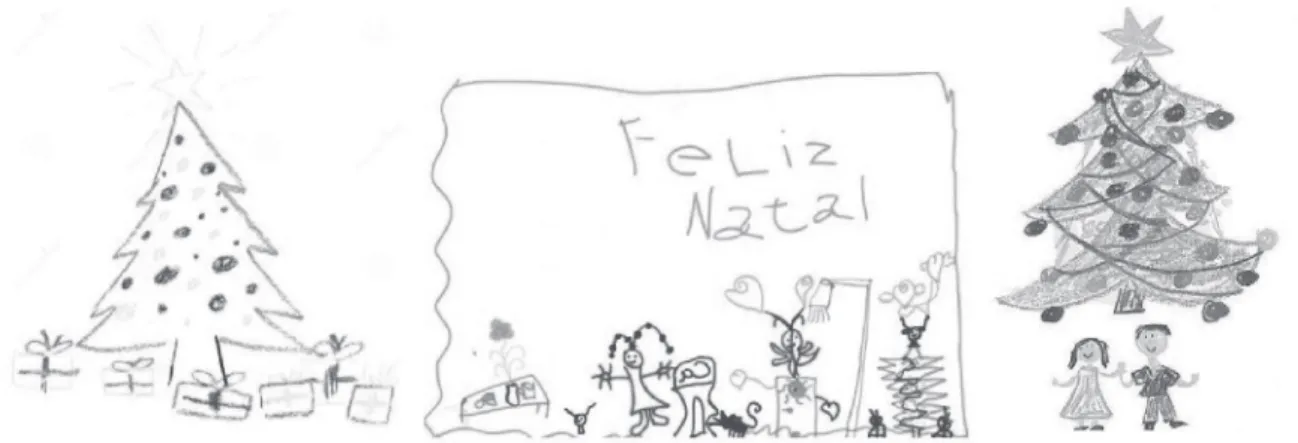
characterizing them as personal letters. In relation to illustrations, they are in line with the number of handwritten letters, even if the drawing is a simple one. Neatness in calligraphy is emphasized, care in framing the sheet from the notebook with a well-crafted colored border, predominance of green and red point to the importance that the letter has, in this social act, to its senders.
Figure 1: Drawings taken from children’s letters Source: Research data (2015)
he presence of drawings in all the letters points to the visual expression used by children, who, from an early age, are socialized through children’s literature, with books that are, for the most part, full of illustrations. Colors, strokes, and shapes illustrate stories, or, from pictures, words draw plots and write stories. In children’s culture, the articulation between the verbal and the visual is constant. Children draw and write, write stories and draw, write letters and draw again (Iavelberg & Menezes, 2012).
he drawings are representative igures of Santa Claus, Christmas trees, gift boxes, stars, toys they want to receive, hearts and human igures that represent themselves, and, in some cases, are hand-in-hand with another child (Figure 1). By observing the drawings, it is possible to read the cultural and symbolic representations about what they believe to be Christmas. he drawings reproduce Christmas elements represented by
symbols, referring to the consumption of products and decoration items, emptied of their meanings and, therefore, depleted of the genuine meaning of Christmas itself. Santa Claus is their most visible face. In addition to the drawings, the letters also contained the expressions “Christmas”, “Merry Christmas”, “Ho Ho Ho”, “It’s Christmas”, and “Peace”, all highlighted in colored pencils.
to the calligraphy. It is in the “letter” that these subjects found an appropriate and “cosy” space to establish a communicative bond, to express their feelings, in the search for fulillment of their dreams, established in their beliefs, aligned with a relationship of intimacy and conidence.
(1) Hi, Santa, my name is Maicon. I’m 8 years old and my mother is here by my side. We’re talking about you sir that God always sends good people to make children smile. On Christmas Eve may you come visit me. I want to be one of the children who smile too, I don’ know what to ask you for, but I ask you not to forget me on Christmas Eve. I like toy cars and Spider-Man. God be with you.
(2) Santa Claus my name is Yan, I’m 9 years old and I have a big dream my dream is to have the giant green Hulk because my mother gave me the little Hulk. Please my dear old man make my dream come true I will be very happy. May God be with you.
(3) Santa Claus, my name is Claudia and I’m only 10 years old, I study in the irst grade 1. (...). I really need clothes and also to get a Nonster High [sic] doll. Santa forgive me if I asked for a lot, I just told you my request. Merry Christmas.
he tone of the accounts is loaded with spontaneity. In the fragments (1), (2) and (3) there are several interactive strategies used by the speakers to carry out the purpose of their speeches, which is to establish a relationship that concludes with the objective of sealing a friendship and conquering the sympathy of the reader, as can be seen in “my mother is here by my side. We (sic) talking about you sir that God always sends good people to make children smile;” “On Christmas Eve may you come visit me.” Praise, grace and sympathy are entrances that seek to build negotiating spaces through interactive strategies that translate politeness and at the same time intimacy, by referring to Santa Claus as “my
dear old man.” Now, it is known that referring to someone in this way, in the diminutive and using codenames, is a social norm used by people who are likely to be in a closer relationship with each other.
hroughout the interaction, this place is constructed, enunciatively and interactively, or, rather, the legitimacy of this place is negotiated with the interlocutor: sometimes he speaks of himself (“my name is Yan, I’m 9 years old and I have a big dream;” “I’m Claudia and I’m only 10 years old, I study in the irst grade 1”), or talks about the sender (“We’re talking about you sir that God always sends good people to make children smile”). hus, in this dialogical game, in which they are intent on carrying out its purposes, the discourse moves to its central point, when, at last, the children explain their requests: “I like toy cars and spider man”; “My dream is to have the giant green Hulk”; “I really need clothes and also to be given a Monster High doll.”
the activity of writing is presented as the moment of showing oneself, to see and show one’s face next to the other. And it must be understood as such that the letter is simultaneously a glance that turns to the recipient (through the missive he receives, he feels looked at) and a way for the sender to ofer himself to his gaze for what it says.
More than that, letters are a means by which it is possible to “read” and “decipher” the mechanisms and clues that relect and/or promote the dialogical movements inscribed in it, capable of revealing intentions and revelations that will be analyzed in the next categories.
5.2
he meanings of Christmas
There are different opinions about Christmas in the discourses, which sometimes link it to religious elements and meanings, positive attitudes and values supported, above all, in the Christian tradition, and the discourse reinforces the materiality and consumerism present at Christmas, which, although it is a religious date, has incorporated these aspects over the decades (Belk, 1987).
(1) Christmas is a very special day, it’s the day that Jesus was born Christmas, and besides getting gifts, the city is all decorated. I’m waiting for Christmas like crazy because we decorate the Christmas tree. HO HO HO! CHRISTMAS IS HERE. (Lucia, 8 years old).
(2) Christmas is a very special day because we celebrate the birthday of Jesus Christ, and as a symbol we use a good old man called Santa Claus (...). When we think of Christmas, we think of Santa Claus, shooting stars, gifts. etc (Carol, 9 years old).
(3) To me, Christmas represents the day that Jesus was born. He received several presents and so [sic], every Christmas we get lots of gifts and this is very cool. At
the birth of Jesus everyone went there to see him and everyone brought gifts. (...). Christmas to me is the best thing. (Téo, 9 years old).
Discursive fragments (4), (5) and (6), relect the conception of Christmas constructed by these children. he letters suggest that the festival is remembered as a day diferent from the others, a special day in their lives (according to the lexical selection “it’s a special day”; “it’s a very special day”; “Christmas is the best thing to me”), where feelings of pleasure, contentment, and much anticipation for their arrival (the lexical selection “I’m waiting for Christmas like crazy”) manifest.
In their reports, the children recapture the most genuine meaning of Christmas by associating it with the birth/birthday of Jesus (“it is the day that Jesus was born”, “we celebrate the birthday of Jesus Christ”), however, it is a displacement of the discursive argument, in search of a construction of meaning attributed to Christmas, that distances itself from the reason behind the date, made explicit by themselves. Although it represents the birth of Jesus, it is implicitly understood that the reason why Christmas is such a special day, is awaited with such expectation, is because of the possibility of realizing personal desires to get gifts and have fun with elements and props that constitute the festivity (as can be seen in the lexical selections: “and besides getting gifts, the city is all decorated”; “When we think of Christmas, we think of Santa Claus, falling stars, gifts”; “every Christmas we get lots of gifts and this is very cool”). For them, Christmas is special, above all, because of the possibility of receiving gifts.
several gifts and so, every Christmas we get lots of gifts”) And this “is very cool”, pointing once again to the attraction that the date exerts on children, motivated by the strong appeal of the gift ritual.
These interpretations reinforce the argument presented in the introductory section that supports the idea that all consumption has strong cultural components, since it is through it that we (re)produce cultures, social relationships and society itself. In children’s speech, it is possible to perceive the parade of ideas that make Christmas the synonym of consumption of goods, ornaments, toys, receiving gifts, essentially materialistic elements.
Lit and decorated cities, Christmas trees, Santa Claus, falling stars, gifts are all interdiscursive elements, which, together, show the secular meaning that is given to Christmas, confirming the distancing of the religious meaning of the date. hese elements, mentioned here, elucidate the syncretism that involves the date, which, since the mid-19th century, was already completely immersed in them (Belk, 1987). To Belk (1987), the confrontation of meanings concerning Christmas is no longer between religious and secular, but between sacred and profane values in a secular world. he culmination of this deconstruction occurs when Santa Claus is seen as the symbolic representation of Jesus Christ himself, to which is attributed the afectionate codename “good old man”, used especially in the Brazilian popular language, according to discursive fragment (5), evidenced in the lexical selection (“Christmas is a very special day because we celebrate the birthday of Jesus Christ, and as a symbol we use a good old man called Santa Claus”).
5.3
he centrality in Santa Claus
he igure of Santa Claus is associated, above all, to the tradition of giving. He has become the most popular and most present symbol of the festivity (Belk, 1987). Some characteristics deine him as a supernatural being, immutable, eternal, ever present, year after year. Children worship
him through letters and requests and he, in turn, rewards the good and excludes the wicked. He thus assumes the role of a divinity to children, whose belief is enough to characterize him in this way. Although his image is remembered by adults and children, at this time of year the relationship he establishes with children is undoubtedly very particular and special, since his story is told to the little ones, who from the irst contact they establish with this narrative, come to believe in his existence. Believing in Santa Claus and other characters is part of childhood, regardless of religion or belief to which the child belongs.
Fragments (7), (8) and (9) represent the strength of this belief.
(1) To me, Christmas represents Santa Claus and gifts; he meaning of Christmas (...), gifts and Christmas trees. (Lucas, 8 years old)
(2) Christmas. I wait for Christmas all year long with lights in the streets in the squares. I want Christmas trees and lots of Christmas gifts. I wait for Santa Claus and expect the best Christmas of all. A hug. HOHOHO: Santa Claus is here. (Dudu, 9 years old)
(3) The Christmas symbol is [sic] the colors green and red, a tree full of lights, star at the top of the tree and “Santa Claus” (...). (Bela, 9 years old)
“it is through the solicitude of parents and the precautions they take to be accomplices of this iction.” Belk (1987) believes that this association is so strong that he has been considered the “god of materialism”, which, in accordance with his image, also reinforces and encourages children to associate Christmas with gifts, according to the fragments (7), (8) and (9) evidenced in “to me Christmas represents Santa Claus and gifts” and “I want Christmas trees and lots of Christmas gifts. I wait for Santa Claus.” In (7) the word “gift” appears twice, in the interval of a single line. However, gift-giving does not occur with “grace”, it is linked to a ritual of “exchanging” based on social obligations of a role that should be incorporated by the child. hese social obligations are translated into the facts of obedience to parents, teachers, positive attitudes with colleagues, good results in school, among others.
Here is a brief discussion of the degree of utilitarianism observed in the relationship between the child and Santa Claus. his utilitarian relationship commits more to Lévi-Strauss’ condition of reciprocity, since it is built to give, receive and reciprocate and opposes the gift of Mauss, because he believes in the existence of a perfect exchange system. he gift is “any provision of good or service, without guarantee of return, with a view to creating, nourishing or re-creating social bonds between people” (Godbout, 1999, 29). The gift is placed at the service of the afective bond between people, while reciprocity foresees social relationships based on “commercial exchange.”
Mauss diferentiates between these gifts, goods, and symbols of utilitarian exchange. To the author, it is not individuals, but collectivities that maintain reciprocal obligations, through family and community groups (Sabourin, 2008, p. 132). However, modernity refuses to believe in the existence of the gift because it represents an inverted image of the material interest of modern society. “he true gift could only be gratuitous” in modern society; since gratuitousness is impossible,
the true gift is impossible, “the free gift does not exist” (Douglas, 1989, apud Godbout, 1999, p. 15).
These arguments are explored in the context of the letters and used to move Santa Claus to gift-giving. his conditional, associative and argumentative relationship between meriting the gift, inds adherence to what was defended by Lévi-Strauss (2003, p 11):
[...] throughout the year, we invoke the visit of Santa Claus, to remind children that his generosity will be measured by their good behavior; And the periodic character of the distribution of gifts has the utility of disciplining children’s claims, of reducing to a short period the moment in which they truly have the right to demand gifts.
These elements are present in speech fragments (10) and (11):
(1) his year I would like to receive the doll called Elza from the movie Frozen, A Freezing Adventure. If I can’t get this doll, it can be a Barbie, because I really like dolls. I was very obedient this whole year and I studied a lot too, I did not ight, I did not hit anybody and I respected all my friends, family and Mom and Dad too (Maria, 9 years old).
(2) I would very much like to receive a remote control police car, I behaved very well this year at school, so I think I deserve to receive this gift. (Leo, 6 years old)
(“I was very obedient this whole year and I studied a lot too, I did not ight, I did not hit anybody and I respected all my friends, family and Mom and Dad too”). This association of kindness and obedience with its due reward, materially represented by the gift, dialogues with the thought of Belk (1987, p. 91) who believes that there is an intention to “sacralize the act of giving children at Christmas, distinguishing them from the other gifts received throughout the year, acquiring a diferentiated form of common goods.”
6
Final considerations
his study dealt with the identiication and analysis of discursive and socio-cognitive marks that suggested elements of materialism and secularism present in the plots and narratives outlined in letters addressed to Santa Claus written by 21 children. he particularities of this kind, which promote direct communication between two parties, based on trust, the exchange and the construction of social relationships (Bazerman, 1999) was set up as a corpus that favored reaching the purpose of this study. By looking at the narratives and drawings in children’s letters, it was possible to “read” the recurring cultural and symbolic representations of their discursive memories of what they believe Christmas to be.
Although different opinions about Christmas appear in the discourses, which sometimes link it to Christian tradition and refer to positive attitudes and values, the plots and drawings point to elements that make up materialism and secularism, reproduced in Christmas symbols, consumption of gifts, products and decorating items, which are depleted in their meanings and distance themselves from the genuine sense of the date. Santa Claus is the most visible face of them all. It is also evidenced in the act of giving gifts in the utilitarian relationship established with Santa Claus, opposing the gift of Mauss, which presupposes exchange without any intention other than to “create, feed or recreate the social bonds between people and places themselves at the service of the afective bond between people” (Godbout, 1999, p. 29).
It is worth emphasizing that, despite all the complexity involved, the objective of the work was, without claiming to be conclusive, to bring up provocative questions that serve as a basis for further research. After all, the content generated here cannot answer so many emerging questions, as well as the visualization of possible categories that have arisen throughout the entire process of analysis of the collected data that had not previously been glimpsed. he analysis of discourse as a theoretical-methodological perspective that consists of unveiling the efects of meaning provoked by certain discursive arguments, that is, where they depart, where they depart to, by whom they are used, for what purpose and who consumes them, adhering to the work proposal.
Faced with the discussions conducted from the discursive categories, another relection to be made has bearing on the inquiries that motivated this study. By going back to them, it is possible to airm that many are the symbols present in children’s imagination related to Christmas: lights, pine trees, but, indisputably, the igure of Santa Claus and the presence of gifts. his seems to conirm Miller’s (1993) thesis by arguing in favor of the idea that Christmas is losing its “spirit” to give rise to yet another festivity with eminently commercial characteristics. In addition, it can be noted in the speeches that the igure of Santa Claus goes beyond his role of being a “gift-giver” icon to also become an educator, in that it serves to mark out a child’s behavior, rewarding the good and punishing those children who have behaved badly throughout the year.
Going back to the provocative issues listed at the beginning of this paper, we can airm that, in the light of what was discussed earlier, we revealed, through analysis of children’s Christmas letters, interesting symbolic “codes” related to this important festive date in our calendar.
the Christmas festivities may also be considered a limitation. The lack of other information about the respondents that could contribute to a deepening of the analysis could also be considered a limitation. Seeking to point out managerial contributions to the study, it is worth mentioning that marketers from diferent types of organizations, as well as managers of retail enterprises, can use the results and relections raised by the study to improve their understanding of consumers regarding the symbolic issues involved on Christmas.
Finally, it is not hard, at this point, to defend the idea that further studies need to be undertaken to continue what was begun here. There may be several themes involved, methodological approaches proposed, as well as theoretical “clipping” and articulations assumed in order to understand different traditions and habits, and their contributions to the establishment of social relationships related to Christmas. hus, surveys that contemplate other strata of children, taking into account age, income proile and diferent regions, as well as children from families with diferent formats and religions, can be included in the list of suggestions for future studies. Further research could also accompany children after the Christmas holidays, evaluating the impact of receiving or not receiving requested gifts on their perceptions regarding Santa Claus. Gender issues as well as discussions concerning meritocracy could also be interesting possibilities. From a methodological point of view, researchcould be conducted on the basis of the drawings made by children, as well as on the results of their speech in groups.
In sum, in view of all these considerations, it is valid to state that the presented results are an interesting contribution to the studies of marketing and consumption, because unraveling the imagination surrounding Christmas and the construction of its meaning by children can serve to unveil essential issues or at least point out “clues” referring to the degree of symbolism present in diferent social and cultural manifestations of contemporary society. In addition, the results of the study can be added to others that seek to understand all the complexities involved in
constructing meanings linked to the objects and ideologies present in “naïve” Christmas letters written by children, and makes visible the divisions, categories and even social classiications made by social practices of everyday life.
References
Bakhtin, M. (2006). Marxismo e filosofia da linguagem. São Paulo: Hucitec.
Barbosa, L. (2006). Apresentação. In L. Barbosa, & C. Campbell (Orgs), Cultura, consumo e identidade
(pp. 7-18). Rio de Janeiro: Editora FGV.
Baudrillard, J. (2004). O sistema dos objetos. São
Paulo: Perspectiva.
Bazerman, C. (1999). Letters and the social grounding of diferentiated genres. In D. Barton, & N. Hall, N. (Eds.). Letter writing as a social practice (pp. 15-29). Amsterdam: John Benjamins
Publishing Company.
Belk, R. W. (1984). Three scales to measure constructs related to materialism: Reliability, validity, and relationships to measures of happiness. Advances in consumer research. 11(1),
291-297.
Belk, R. W. (1987). A child’s christmas in America: Santa Claus as Deity, Consumption as Religion. Journal of American Culture, 10(1),
87-100.
Belk, R. W. (1989). Materialism and the modern U.S. Christmas. In E. Hirschman, (Ed.), Interpretive consumer research (pp.
115-135). Provo, UT: Association for Consumer Research. Retrieved from https://www.acrwebsite. org/search/view-conferenceproceedings. aspx?Id=12180.
Belk, R & Coon, G. (1993). Gift giving as agapic love: An alternative to the exchange paradigm based on dating experiences. Journal of Consumer Research, 20 (3), 393-415.
postmodern mall. International Journal of Research in Marketing, 10(3), 277-296.
Brandão, H. H. N. (1986). Introdução à análise do discurso. Campinas, SP: UNICAMP.
Casotti, L. M., Campos, R. D., & Walther, L. C. C. L. (2008). Natal com Neve no Brasil? Um estudo exploratório dos significados, do imaginário e das práticas de consumo de jovens no Rio de Janeiro. Anais do Encontro de Marketing,
Rio de Janeiro, RJ, Brasil, 3.
Charmaz, K. (2009). A construção da teoria fundamentada: Guia prático para análise qualitativa. Porto Alegre: Bookman.
Clarke, P. (2006). Christmas Gift Giving Involvement. Journal of Consumer Marketing,
23(5), 283-291.
Clarke, P. (2007). A measure for Christmas spirit.
Journal of Consumer Marketing, 24(1), 8-17.
Coelho, M. C. (2006). O valor das intenções: Dádiva, emoção e identidade. Rio de Janeiro: FGV
Editora.
Denzin, N. K., & Lincoln, Y. S. (2006). O planejamento da pesquisa qualitativa: Teorias e abordagens (2a ed.). Porto Alegre: Bookman.
Duarte, A. (2010). A antropologia e o estudo do consumo: Revisão crítica das suas relações e possibilidades. Antropológica, 14(2), 363-393.
Foucault, M. (1992). A escrita de si. In E. Cordeiro (Ed.), O que é um autor? (pp. 129-160). Portugal: Veja/Passagens.
Gondim, S. M. G., & Fisher, T. (2009). O discurso, a análise do discurso e a metodologia do discurso do sujeito coletivo na gestão intercultural.
Cadernos Gestão Social, 2(1), 9-26.
Godbout, J. T. (1999). O espírito da dádiva. Rio de Janeiro: FGV.
Halkoaho, J., & Laaksonen, P. (2009). Understanding what Christmas gifts mean to children. Young Consumers, 10(3), 248-255.
Iavelberg, R., & Menezes, F. C. (2012). O cultivo do desenho infantil na aprendizagem
compartilhada. Anais do Encontro Nacional de Pós-Graduação em Administração - ENANPAD, Rio de Janeiro – RJ, Brasil, 36.
Karnal, L., Pundy, S., Fernandes, L. E. & Morais, M. V. (2007). História dos Estados Unidos, das origens ao século XXI. São Paulo: Editora Contexto.
Laroche, M., Saad, G., Kim, C., & Browne, E. (2000). A Cross-Cultural study of in-store information search strategies for a christmas gift.
Journal of Business Research, 49(2), 113-126.
Lévi-Strauss, C. (2003). Papai Noel supliciado.
Revista Alceu, 4(7), 5-18.
McCracken, G. (2003). Cultura e consumo: Novas abordagens ao caráter simbólico dos bens e das atividades de consumo. Rio de Janeiro: Mauad.
McKechnie, S., & Tynan, C. (2006). Social meanings in Christmas consumption: An exploratory study of UK celebrants’ consumption rituals. Journal of Consumer Behavior, 5(2), 130-144.
Mauss, M. (2001). Ensaio sobre a Dádiva. Lisboa: Edições 70.
Miller, D. (1993). Unwrapping Christmas. Oxford: Clarendon Press.
O’Cass, A., & Clarke, P. (2001). Dear Santa, do you have my brand? A study of the brand requests, awareness and request styles at Christmas time.
Journal of Consumer Behavior, 2(1), 37-53.
Oliveira, J. S., & Vieira, F. G. D. (2010). Com os pés na Igreja e as mãos nas compras: Compreendendo a influência religiosa na constituição dos significados atribuídos ao consumo de presentes de Natal por jovens cristãos.
Anais do Encontro de Marketing, Florianópolis, SC, Brasil, 4.
Pinto, M. R., & Cruz, R. C. (2014). Experiências de consumo no Natal de cidades do interior de Minas Gerais. Gestão & Regionalidade, 30(89),
35-48.
no contexto de consumidores de baixa renda do município de São Paulo. Revista Gerenciais, 6(1),
13-21.
Richins, M. L., & Dawson, S. A. (1992). A consumer values orientation for materialism and its measurement: Scale development and validation. Journal of Consumer Research, 19(3), 303-316.
Saraiva, L. A. S., Carrieri, A. P., Pimentel, T. D., & Souza-Ricardo, A. G. (2009). Introdução: Estudos organizacionais e análise do discurso: Aproximações possíveis. In A. P. Carrieri et al. (Orgs.). Análise do discurso em estudos organizacionais (pp. 11-19). Curitiba: Juruá.
Sabourin, E. (2008). Marcel Mauss: Da dádiva à questão da reciprocidade. Revista Brasileira de Ciências Sociais, 23(66), 131-208.
Schmidt, L. E. (1991). he commercialization of the calendar: American Holidays and the culture of consumption, 1870-1930. The Journal of American History, 78(3), 887-916.
Slater, D. (2002). Cultura do consumo e modernidade. São Paulo: Nobel.
Silva, J. Q. G. (2002). Um estudo sobre o gênero carta pessoal: Das práticas comunicativas aos indícios de interatividade na escrita dos textos (Tese de doutorado).
Faculdade de Letras da Universidade Federal de Minas Gerais, Belo Horizonte, MG, Brasil.
Tynan, C., & McKechnie, S. (2009). Hedonic meaning creation though Christmas consumption: A review and model. Journal of Customer Behavior, 8(3), 237-255.
Notes
¹ A preliminary version of this article “Natal, Consumo e Materialismo: Uma análise discursiva de cartas infantis de Natal” was presented on XVIII Seminários em Administração – SEMEAD; Georgiana Luna Batinga, Marcelo de Rezende Pinto, Sara Pimenta Resende; São Paulo – SP; 04, 05 e 06 de novembro de 2015
About the authors:
1. Georgiana Luna Batinga, Postgraduate in Management, Pontifícia Universidade Católica de Minas
Gerais, Brazil. E-mail: [email protected]
ORCID
0000-0002-1807-9824
2. Marcelo de Rezende Pinto, Phd in Management, Universidade Federal de Minas Gerais, Brazil.
E-mail: [email protected]
ORCID
0000-0002-3251-2460
3. Sara Pimenta Resende, Postgraduate in Management, Pontifícia Universidade Católica de Minas Gerais,
Brazil. E-mail: [email protected]
ORCID
0000-0002-3733-611X
Contribution of each author:
Contribution Georgiana
Luna Batinga
Marcelo de Rezende Pinto
Sara Pimenta Resende
1. Deinition of research problem √ √ √ 2. Development of hypotheses or research questions (empirical studies) √ √ √ 3. Development of theoretical propositions (theoretical work) √ √ √
4. heoretical foundation / Literature review √
5. Deinition of methodological procedures √ √
6. Data collection √ √
7. Statistical analysis
8. Analysis and interpretation of data √
9. Critical revision of the manuscript √ √