1 Rev. Bras. Pesq. Tur. São Paulo, 11(1), pp. 1-18, jan./abr. 2017.
DOI: http://dx.doi.org/10.7784/rbtur.v11i1.1142
The brand identity of Gramado, Brazil, that generates the
image of a "tourism destination model" and the brand
relationships with internal stakeholders
Os componentes da identidade de marca de Gramado/Brasil que
ge-a suge-a i ge-age de desti o tu ísti o odelo e os elge-a io ge-a e tos
da marca com os stakeholders internos
Los componentes de la identidad de marca de Gramado/Brasil que
generan su i
age de desti o tu ísti o odelo las ela io es de
la marca com los stakeholders internos
Vanessa Acosta de Azambuja1
Marlei Salete Mecca2
Abstract: This research aims to describe the components of Gramado/Brazil brand identity that generate its "tourist destination model" image, and to verify if there are strong relationships between the brand and the i ter al stakeholders of this desti atio . The ai theory used i this study is the “relatio al et ork ra d" model by Hankinson (2004). This is a descriptive and qualitative study. It is a case study, using interviews and documentary resources such as a dissertation and a report. The research universe is composed of government individuals, the private sector, the employees and the local community of Gramado, in a total of 21 respond-ents. Organizational and analytical procedures of discursive data are guided by assumptions and techniques of content analysis. Among the results it stands out that symbolic and functional attributes have the highest oc-currence in the answers of respondents. Particularly, tourist attractions/events are what differentiates Gramado from its competitors. Also, Gramado lacks a strategic planning and active participation of internal stakeholders.
Keywords: Tourism destination. Brand identity. Relationships. Gramado.
Resumo: Esta pesquisa objetiva descrever os componentes da identidade de marca de Gramado/Brasil que ge a sua i age de desti o tu ísti o odelo , assi o o e ifi a se há fo tes ela io a e tos e t e a marca e os stakeholdersi te os dessa desti ação. A p i ipal teo ia utilizada este estudo é o odelo ede
1 University of Caxias do Sul (UCS). Caxias do Sul, RS, Brazil. Preparation of the theoretical framework, data collection and analysis, writing and preparation of the paper.
2 University of Caxias do Sul (UCS). Caxias do Sul, RS, Brazil. Research supervision, data analysis, critical re-view; final approval.
2 Rev. Bras. Pesq. Tur. São Paulo, 11(1), pp. 1-18, jan./abr. 2017.
Azambuja, V.A.; Mecca, M.S. The brand identity of Gramado, Brazil, that generates the image of a "tourism destination model" and the brand relationships with internal stakeholders
ela io al da a a de Ha ki so . “e do u estudo de aso, são ealizadas e t e istas e o sultadas outras fontes de evidência, como uma dissertação e uma reportagem. Integraram o universo da pesquisa su-jeitos do Poder Público, da iniciativa privada, dos trabalhadores e da comunidade local de Gramado, totalizan-do 21 entrevistatotalizan-dos. Os procedimentos organizativos e analíticos totalizan-dos datotalizan-dos discursivos pautam-se por supos-tos e técnicas da análise de conteúdo. Dentre os resultados, está que os atribusupos-tos com maior ocorrência nas respostas dos entrevistados são os simbólicos e os funcionais, destacando-se atrativos/eventos turísticos como aquilo que diferencia Gramado de seus concorrentes. Também, é constatada a falta de um planejamento es-tratégico com a participação ativa dos stakeholders internos.
Palavras-chave: Destinação turística. Identidade de marca. Relacionamentos. Gramado.
Resumen: Esta investigación tiene como objetivo describir los componentes de la identidad de marca de Gra-mado/Brasil que generan su imagen de "destino turístico modelo", así como la verificación de relaciones fuer-tes entre la marca y los stakeholders internos de ese destino. La principal teoria utilizada en este estudio es el
odelo “red rela io al de la ar a" de Ha ki so 2004 . Sie do u aso de estudio, so realizadas e tre is-tas y consultadas otras fuentes de prueba, como una tesis de maestría y un artículo. Integraran el universo de la investigación sujetos del gobierno, del sector privado, de los trabajadores y de la comunidad local de Grama-do, un total de 21 entrevistados. Los procedimientos de organización y de análisis de datos discursivos se guían por los supuestos y técnicas de la análisis de contenido. Entre los resultados está que los atributos de mayor ocurrencia en las respuestas de los encuestados son los simbólicos y los funcionales, destacando atraccio-nes/eventos turísticos como lo que diferencia Gramado de sus competidores. También se observa la falta de planificación estratégica con la participación activa de los stakeholders internos.
Palavras-clave: Destino turístico. Identidad de marca. Relaciones. Gramado.
1 INTRODUCTION
This research aims to describe the components of the brand identity of Gramado, Brazil which contribute to the image
of odel tou is desti atio , a d e if if
there is a strong link between the brand and the internal stakeholders of the destination. The objectives were set from the observation of the image that the Brazilian Ministry of Tourism (MTur), other Brazilian and interna-tional destinations, and tourists have of Gramado - as it is described following -, and the relationship found in the literature be-tween brand image and identity.
The Report Brazil Experiences: learning from the National Tourism 2008/2009, of the benchmarking tourism project, states that Gramado is "[...] a management model and
efe e e i the atio al tou is MTu ,
2008, p. 50). The public policies on tourism (discussion on the municipal land use
plan-ning) stand out, as well as the tourism infra-structure, urban cleaning and public re-strooms, public-private partnerships in the realization of events and the management of
the Ch ist as of Light fo the i o ation and inclusion of community. In 2010, there was another milestone in the project in which "[...] the development and management of themat-ic events stood out as a strategy for reducing the seasonality and also the use of theming for differentiation [...]". (MTur, 2010, p. 4).
On other occasions, managers of sev-eral places went to Gramado for benchmark-ing purposes. For example, the twinnbenchmark-ing agreement between Gramado and Óbidos, Portugal, enables benchmarking on the
Ch ist as of Light a d othe e e ts of
inter-est PMG, . With espe t to the Ch istas of Light , G a ado istas isited a e
3 Rev. Bras. Pesq. Tur. São Paulo, 11(1), pp. 1-18, jan./abr. 2017.
Brazil in 2014 (PMG, 2014b). Still, in 2013, authorities from Caldas Novas, Brazil visiting the town considered Gramado a successful model of tourism and public management (Secom, 2013). In the same year, the Nigerian Ambassador to Brazil visited the destination to learn about tourism-driven economy (PMG, 2013b). During the Tourism Festival of Gramado in 2013, an entourage from Chile visited the City Hall to gather information about infrastructure, tourist attractions and events (PMG, 2013c).
Gramado is also considered a "model tourism destination" by tourists. The destina-tion was awarded in 2010, 2011 and 2012 Best Winter Destination in Brazil, and Best Tourist Town in Brazil in 2011 and 2012, by the Vi-agem e Turismo (Travel and Tourism) maga-zine, from a survey conducted among the readers (PMG, 2013d).
Also, the importance of this research relates to one of the benefits of the brand identified by Clarke (2000): to provide a focus for a joint effort of producers, so that they can work for a common result. When promoting a destination as a single identity is relevant that all its attractions and tourism services, as well as the local community, are part of this identi-ty. In this context, a brand identity can serve as a relational network of stakeholders within the place (Hankinson, 2004). The image of the destination should be favorable for all stake-holders, not only to customers. For this to occur, the relational network should ensure that the different stakeholders in tourism are able to express and discuss their issues and interact in order to direct efforts and achieve collective results (Saraniemi, 2010).
However, for Konecnik and Go (2008), the research on branding (creation and brand management) of destinations slightly over-looks the concept of brand identity, focusing
on the perspective of the perceived image. This makes the research linking the ields of brand marketing and tourism little developed.
2 CONCEPTS AND THEORETICAL MODELS
For Reynolds (1965), the image is the
tou ist s e tal o st u tio of fe i p
es-sions from many information of a tourism destination. Kotler and Gertner (2002) state that the image of a country can be activated in the minds of people by simply mentioning the name, even in the absence of brand manage-ment activities.
On its part, brand "[...] is not limited to a name on a label, but creates and adds a no-ticeable consumption value to the consumer" (Pimentel, Pinho & Vieira, 2006, p. 286). With-in the brands, the product is not limited to its functionality, linking to that the worlds of meanings embedded in this (Norberto, 2004). Still, the brand is inscribed in a symbolic field that arose from a professional strategy, using the real, in order to create a competitive ad-vantage in the market (Norberto, 2007). Karamarko (2010) adds that the brand por-trays the identity of a destination.
For Karamarko (2010), the brand iden-tity represents the associations that the brand wants to create in the minds of consumers. Aaker (1996) sustains that the brand identity represents the self-image and the desired image on the market of a product. Thus, it is understood that the brand identity of tourism destinations is formed by its characteristics, which internal stakeholders perceive and wish to convey in order to generate the image to tourists. Pimentel, Pinho and Vieira (2006) claim that image is a concept linked to the receiver while identity is linked to the sender.
4 Rev. Bras. Pesq. Tur. São Paulo, 11(1), pp. 1-18, jan./abr. 2017.
Azambuja, V.A.; Mecca, M.S. The brand identity of Gramado, Brazil, that generates the image of a "tourism destination model" and the brand relationships with internal stakeholders
to product attributes, proposing four perspec-tives of brand identity: brand as product; brand as organization; brand as person; and brand as symbol. As for the brand as product
it comprises: scope, attributes, quality/value, uses, users, and country of origin of the prod-uct. Scope is the association of a brand to a class of products, so that the customer call the class by the brand name. Attributes are the characteristics of a product that provide the customer with benefits. Quality is an extreme-ly important attribute that is considered sepa-rately and is related to value, since the latter enhances the concept, adding the price di-mension. Uses refers to the uniqueness of a particular use or application that some brands have. A brand can also be positioned depend-ing on the type of users. And, finally, a brand can be linked to a country of origin, which would give it credibility (Aaker, 1996).
With respect to the brand as organiza-tion, this perspective includes organizational attributes, and local versus global. The attrib-utes of the organization are more difficult to copy than product´s attributes, since they involve people, culture, values, and organiza-tional programs, i.e. less tangible aspects than the attributes of the product. Referring to local versus global, when a brand chooses to be recognized as local, its tradition is empha-sized to create a bond with customers and express pride, being more sympathetic to-wards the needs and attitudes of the locality. When a brand chooses to act global, it aims the prestige, a larger public and mission, and it projects a cosmopolitan personality. A global brand, in general, signals that it is advanced in technology, able to invest in Research and Development, and follow the advances in the countries wherein it competes. The role of the
brand as organization is to provide credibility
to their products or their sub-brands products (Aaker, 1996).
With respect to brand as person it in- cludes: brand personality; brand-customer relationships. A brand can be described with adjectives much like the personality of an in-dividual. Also, the brand personality can be the base upon which the brand-customer rela-tionship is built (Aaker, 1996). De Chernatony (1999) also associates the relationships with personality, adding the interactions between employees, between employees and custom-ers, and between employees and other stake-holders
And brand as symbol involves visual imagery/metaphors and brand heritage. The symbols, such as a figure, a color, a product design, facilitate brand recognition and recall (Aaker, 1996).
5 Rev. Bras. Pesq. Tur. São Paulo, 11(1), pp. 1-18, jan./abr. 2017.
confusion in tourists i d; a d politi al responsibility –places fall within the responsi-bility of governments, whose members can be changed every election, which may result in decisions inconsistent with long-term goals. Parkerson and Saunders (2005) consider that the destinations also differ from corporate brands, because unlike corporations, a city has no organizational structure converging into a single focus.
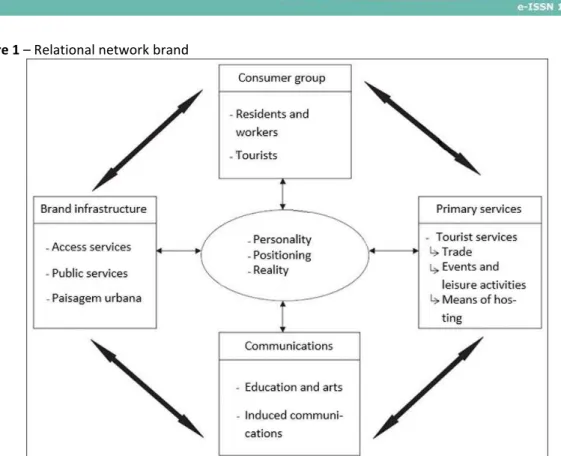
Considering the above-mentioned differences, in 2004, Hankinson had already put forward a specific conceptual model of destination branding (Figure 1), in which the author conceptualized brands as relationships. In this way, the brand has a personality that allows it to form a relationship with the con-sumer. Regarding services, there is interaction between service providers and consumers, and the encounter between them provides an opportunity for the development of a real relationship through the provision of a posi-tive experience. For this, it is also necessary the relationship of the brand with the other stakeholders.
Hankinson (2004) posits that the prod-uct-experience cannot be controlled like a manufactured product. Consumer are free to choose which elements of the local product they want to consume. Because the destina-tion is complex in terms of public and stake-holders, the branding must be coordinated, not managed. Herein lies the relevance of the brand as relationships, a feature addressed by Hankinson (2004). Different from Morgan and
P it ha d s pe spe ti e, ho stated
that brand should be shared and "bought" by all stakeholders; Bregoli (2012) does not use the term "bought" to refer to the role of the stakeholders with respect to the brand identi-ty of a destination, expressing that the con-struction of an identity is a participatory
pro-cess rather than vertical: he reveals that brand
ide tit guides the stakeholde s eha io if
they believe in brand values, if that identity is coherent with the values of the destination and the local community. This is in line with
Ha ki so s a o e-mentioned concept of co-p odu tio a d Pike s idea that the identity branding must come from re-search of the values of the host community, among other factors. Pike (2008) suggests that to achieve that a group project representative of the community should be formed.
‘etu i g to Ha ki so s
od-el, which presents the components of the
a d ide tit , it is efe ed to as the ela-tio al et o k a d . It o sists of a a d
core and four categories of brand relation-ships.
The core represents the brand identity of a place and consists of personality, posi-tioning and reality. The four categories of rela-tionships are with: primary services, brand infrastructure, media, and consumers. De-scribing the brand core, Hankinson indicated that brand personality is characterized by functional attributes (tangible features, which meet environmental and utilitarian needs); symbolic attributes (intangible, which meet the need for social approval, self-expression and self-esteem), and experiential (linking functional and symbolic attributes together
a d hi h des i e ho the tou ists e pe
i-ence makes them feel). On its part, the
a d s positio i g is the ide tifi atio of
6 Rev. Bras. Pesq. Tur. São Paulo, 11(1), pp. 1-18, jan./abr. 2017.
Figure 1 – Relational network brand
Source: Adapted from Hankinson (2004)
Hankinson does not restrict the brand identity to the communication plan, i.e. to the definition of personality and positioning
in-luded i the a d s p o otio . The author agrees with Keller and Machado (2006, p. 7), whose vision is that, when the consumer trusts and is loyal to a brand, they expect it to provide them "[...] usefulness through the consistent operation of the product, in addi-tion to adequate price, promoaddi-tion, and distri-bution programs". Thus, it is important to in-clude product strategies in branding, so that the facilities and services are in accordance with communication; distribution strategies, so that the transportation to the facilities and services are as promised in communication; and price strategies, to ensure that the rate charged is consistent with the quality and with the promotional message. Therefore, when
Hankinson (2004) referred to his model as relational network brand and he designed it as a brand core and four categories of relation-ships, the author conveys that the relational network is formed throughout the whole pro-cess of branding. This includes planning, de-velopment, and implementation.
7 Rev. Bras. Pesq. Tur. São Paulo, 11(1), pp. 1-18, jan./abr. 2017.
and public relations). Consumers include visi-tors (the target segments should not be con-flicting); the residents (there should be com-patibility between tourism and the interests of the community), and employees of local or-ganizations.
3 METHODOLOGY
This is a qualitative and descriptive study and adopts the case study method. One of the features of case study is resorting to more than one source of evidence in the data collection, thus this work uses as collection techniques interviews with internal stake-holders (being the brand identity a concept associated with the sender) and additional research sources. The interviews include dif-ferent groups of subjects: public sector; pri-vate sector; local community and employees. Among the sources of additional research there are the dissertation by Vargas (2003), in which the setting of the research is Gramado, and a reportage associated with the object of study. This allows a triangulation, and thus the development of converging lines of research, resulting in more conclusive and accurate re-sults (Yin, 2010).
Twenty-one subjects were inter-viewed, since "in qualitative research the re-searcher's concern is not with the numerical representativeness of the group searched, but with the deepening of the understanding of a social group, an organization, an institution, a path etc." (Goldenberg, 2004, p. 14). That number was reached as follows. Initially, we sought to interview the target subjects of the MTur benchmarking program, who are re-sponsible for some tourist organizations of Gramado, for conducting the main events in the destinations and for the association with the Casa do Colono (Settler's House). Taking into consideration the internal stakeholders
p ese ted i the Ha ki so s odel, it
was necessary to interview subjects from the local community, tourism employees, and responsible for the infrastructure (public au-thorities). However, some of the companies from the benchmarking program refused in-terviews. Thus, besides the members of the organizations that agreed to participate, the representatives of all professional associations
li ked to G a ado s tou is o pa ies e e
interviewed. Following the criteria of inter-viewing subject representatives of certain groups, we decided to interview representa-tives of the nine neighborhood associations of Gramado, although we only managed to con-tact four of them. A representative of the
emplo ees lass asso iatio as also i te
-viewed.
For the reasons exposed next, the
the-o eti al f a e the-o k adthe-opted is the Ha ki sthe-o s
(2004) relational network brand model. Con-sidering that destinations are amalgams of products and services, which offer a total ex-perience in a place, according to Buhalis (2000), and that Hankinson (2004) considers strong relationships with stakeholders the key for a successful experience, we believe that this is an appropriate model to characterize the brand identity of the destination. This is the general objective of the master's thesis of the first author of this article, in which she used the model of Hankinson (2004) in full.
8 Rev. Bras. Pesq. Tur. São Paulo, 11(1), pp. 1-18, jan./abr. 2017.
Azambuja, V.A.; Mecca, M.S. The brand identity of Gramado, Brazil, that generates the image of a "tourism destination model" and the brand relationships with internal stakeholders
The dissertation presented other models, such as those of Saraniemi (2010), Saraniemi (2011), Konecnik and de Cher-natony (2013), which address the relations between stakeholders; but not as a central concept, differently from Hankinson (2004). Also, Hankinson (2004) specifies the stake-holders, contrary to Saraniemi (2010),
Konecnik a d de Che ato s odels,
and the elements of brand identity.
Returning to the objectives, to de-scribe the components of brand identity this
stud e a i es Ha ki so s ele e ts
of the brand identity: personality, positioning and reality. For this, we asked the following questions: 1) Do you think that Gramado is a
odel tou is desti atio "? Whi h att i
-utes does Gramado have that makes it a "tourism destination"? 3) Which are
G a ado s top o petito s i te s of tou
-ism destinations? 4) From the cited attributes which differentiate Gramado from competi-tors? 5) What kind of tourist visits Gramado and your business?
Through the description of the identity components we verified if there were strong relationships between the brand and the in-ternal stakeholders (public power, communi-ty, employees, and private organizations) that must share a common brand identity vision. Hankinson (2004) considers the residents and
the o pa ies e plo ees a d o su e s.
Also, the consensus between internal stake-holders is verified through the description of the elements of brand identity and a large agreement on these indicates strong relation-ships between them.
Regarding the organizational and
ana-l ti aana-l p o edu es, these d a o Ba di s
(2004) content analysis techniques. The tech-niques used are the thematic analysis and
categorical analysis. Firstly, the thematic
anal-ysis is carried out to identify the themes that make up the discourse of the subjects. It fol-lows a comparison between the answers of the three groups of stakeholders found in the thematic analysis. Finally, the categorical anal-ysis is done, grouping recording units (theme) in categories according to common character-istics (Bardin, 2004), and, in this article, based on the theories of Hankinson (2004) and Aaker
. Aake s theo does not integrate
" a d" a d desti atio ", o etheless, it as
included due to the spontaneous appearance of organizational attributes of Gramado on the
espo de ts a s e s.
4 RESULTS
Through the interviews, it was verified that tourism marketing of Gramado is of the Municipal Secretary of Tourism responsibility. With regard to destination branding, Hankinson (2004) considers that the function of an entity is to coordinate rather than man-aging. That is because, unlike companies, whose production sectors are under the con-trol of management, in a destination, the cus-tomer is free to choose which elements to consume; all products and services of the amalgam are co-authors in building the brand identity. Despite institutional promotion of the destination, there is still the dissemination and delivery of products and services by the components of the amalgam. Therefore, the answers of all internal stakeholders are con-sidered.
In response to question 1 (Do you
thi k that G a ado is a odel tou is
9 Rev. Bras. Pesq. Tur. São Paulo, 11(1), pp. 1-18, jan./abr. 2017.
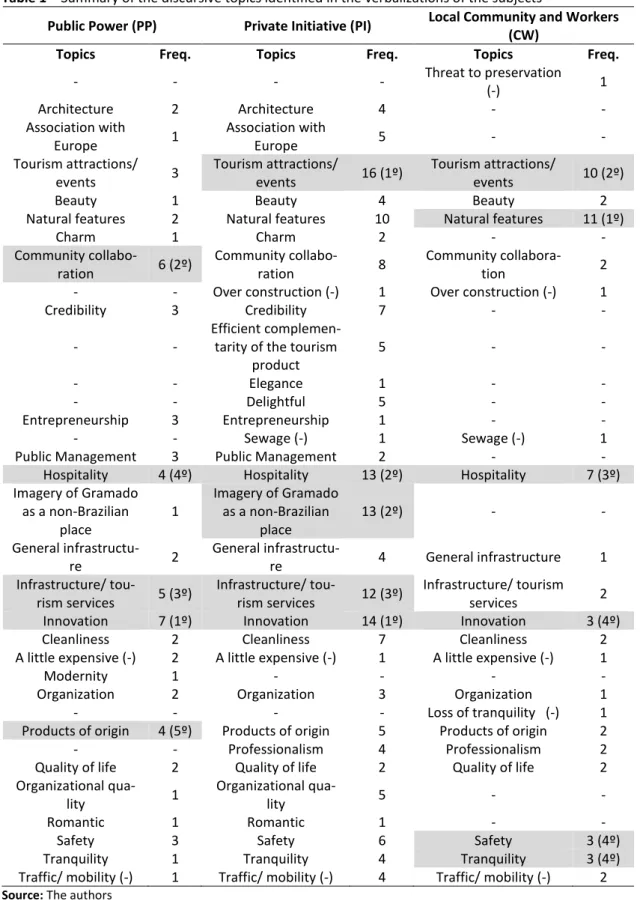
2004), in response to question 2 (Which at-tributes does Gramado have that makes it a "model tourism destination"?), they reported the brand personality. Therefore, the thematic analysis of the answers unveiled 34 compo-nents of the brand identity of Gramado (Table 1).
It is pertinent to refer that two sub-jects of the public authorities, two of the pri-vate sector, and one from the community and employee stated that Gramado is "a model tourism destination" due to various factors. The subject 1 (PP) explains: "[...] we can find a detail more beautiful elsewhere, an element, but not the set. [...] It's not one thing, it's not a waterfall, is a set ". For Bahl (2004), the exist-ence of attractions is not enough for tourism, it is necessary to combine them with ease of access and the permanence of tourists, thus making them tourism products. The subject 7 (PI) says: "In Gramado there is a set of things combined to get the result [...] we receive a lot of technical visits at Christmas of Light. [...] to copy a garland, a snowman [...] do the same in their hometown, but it won't have the name Gramado behind." This concurs with
Kotle s pe spe ti e that if the e is a e lusi e tapest of po e ful st ategies,
based on a unique configuration of various activities that are mutually reinforced, the competitors can imitate certain aspects, but not the whole "tapestry". To imitate every-thing, competitors will have high expenses and will produce a pale imitation, without achieving the same performance.
The most cited attribute by the three groups of stakeholders was tourism attrac-tions/events (29 events), due to the large number and innovation. Many options are offered to the visitor all year long to avoid seasonality and to increase the length of stay. Regarding innovation of tourism
attrac-tions/events, novelty (Johannessen, Olsen & Lumpkin, 2001) is focused on creating themed parks and events. Theme parks like the Snow-land (with artificial snow) was referred often. For example, the subject 10 (PI) explains that among: "[...] the major points of interest, the most recent wherein Gramado has innovated is the Snowland, which brought to Gramado a new way to enjoy the snow, regardless if it's 40 degrees on the street." Vargas (2013) re-ports that theme-based events in Gramado contribute to the "disneyfication", since Walt Disney World parks, in the United States, in-fluence the Christmas of Light and the Chocofest. The subject 13 (PI) likened Gramado to Disney parks due to the themed events. Thus, in addition to the association of Gramado with European imagery, there is also this "disneyfication".
Tourism attractions/ events still appear as one of the attributes (the other is general infra-structure) that differentiate Gramado from competitors (positioning), in response to question 4 (From the cited attributes which differentiate Gramado from competitors?). The competitors mentioned in response to
uestio Whi h a e G a ado s top o
pet-itors in terms of tourism destinations?) are national highlights (Rio de Janeiro, Sao Paulo and Foz do Iguaçu), a winter destination (Campos do Jordão), and towns in the region (Bento Gonçalves and Canela), according to the reports: "[...] unique in several factors, particularly, in terms of events "(subject 3, PP); "What it has is the unique experience [...] to be in a place that has all the things that you would like, not to mention the events [...]" (subject 12, PI); "Christmas of Light, in which other municipalities are not investing"
(sub-je t , CW ; [...] thi gs that othe ities do 't
have, [...] the Snowland, [...]" (subject 18,
10 Rev. Bras. Pesq. Tur. São Paulo, 11(1), pp. 1-18, jan./abr. 2017.
Azambuja, V.A.; Mecca, M.S. The brand identity of Gramado, Brazil, that generates the image of a "tourism destination model" and the brand relationships with internal stakeholders
year long, every month, at least, there is an attraction. Unlike any other place." (Subject
19, CT)
Table 1 – Summary of the discursive topics identified in the verbalizations of the subjects
Public Power (PP) Private Initiative (PI) Local Community and Workers (CW)
Topics Freq. Topics Freq. Topics Freq.
- - - - Threat to preservation
(-) 1
Architecture 2 Architecture 4 - -
Association with
Europe 1
Association with
Europe 5 - -
Tourism attractions/
events 3
Tourism attractions/
events 16 (1º)
Tourism attractions/
events 10 (2º)
Beauty 1 Beauty 4 Beauty 2
Natural features 2 Natural features 10 Natural features 11 (1º)
Charm 1 Charm 2 - -
Community
collabo-ration 6 (2º)
Community
collabo-ration 8
Community
collabora-tion 2
- - Over construction (-) 1 Over construction (-) 1
Credibility 3 Credibility 7 - -
- -
Efficient complemen-tarity of the tourism
product
5 - -
- - Elegance 1 - -
- - Delightful 5 - -
Entrepreneurship 3 Entrepreneurship 1 - -
- - Sewage (-) 1 Sewage (-) 1
Public Management 3 Public Management 2 - -
Hospitality 4 (4º) Hospitality 13 (2º) Hospitality 7 (3º) Imagery of Gramado
as a non-Brazilian place
1
Imagery of Gramado as a non-Brazilian
place
13 (2º) - -
General
infrastructu-re 2
General
infrastructu-re 4 General infrastructure 1
Infrastructure/
tou-rism services 5 (3º)
Infrastructure/
tou-rism services 12 (3º)
Infrastructure/ tourism
services 2
Innovation 7 (1º) Innovation 14 (1º) Innovation 3 (4º)
Cleanliness 2 Cleanliness 7 Cleanliness 2
A little expensive (-) 2 A little expensive (-) 1 A little expensive (-) 1
Modernity 1 - - - -
Organization 2 Organization 3 Organization 1
- - - - Loss of tranquility (-) 1
Products of origin 4 (5º) Products of origin 5 Products of origin 2
- - Professionalism 4 Professionalism 2
Quality of life 2 Quality of life 2 Quality of life 2 Organizational
qua-lity 1
Organizational
qua-lity 5 - -
Romantic 1 Romantic 1 - -
Safety 3 Safety 6 Safety 3 (4º)
Tranquility 1 Tranquility 4 Tranquility 3 (4º)
Traffic/ mobility (-) 1 Traffic/ mobility (-) 4 Traffic/ mobility (-) 2
11 Rev. Bras. Pesq. Tur. São Paulo, 11(1), pp. 1-18, jan./abr. 2017.
Now we compare the topics of the three groups of respondents to verify if there are strong relationships between the brand
and the internal stakeholders. Most of the topics are repeated in the three groups. Those which appear in only one group are: elegance, efficiency and complementarity of the tourism product, modernity, threat to preservation, loss of tranquility, and delightful - 20.59 per-cent of the total. Some of these topics appear as well in the reports of the other groups in different words, such as Efficient complemen-tarity of the tourism product (satisfactory per-formance of all on the supply chain), cited by five subjects of the private initiative who claim that the public authorities and entrepreneurs contribute to efficiency; the subjects of Public Power cited the efficiency of the public admin-istration and entrepreneurs separately. For example: "[...] the private sector invests in the establishments and the public authorities take care of the city" (subject 4, PI); "The
munici-palit does t i est, ut eated the o
di-tions for businesses to do so." (Subject 1, PP); and "Our cuisine is very diverse. Our hospitali-ty too, we have over 11,000 bed spaces. We have the best tourist infrastructure of Rio Grande do Sul. Also the stores have a qualified context [...]." (Subject 2, PP).
Threat to preservation, referred by the subject 17 (CE), is associated with the topic
over construction, pointed to by 12 subjects (PI) and 18 (CE), as they both refer to the re-duction of vegetation due to the growth of the city. Loss of tranquility – too many people in the high season -, pointed to only by the sub-ject 17 (CE), is associated with tranquility – present in other periods - (cited by one of the subjects of the Public Power, four of the pri-vate initiative, and three from the local
com-munity and employees); and traffic/ mobility, because traffic congestion causes stress.
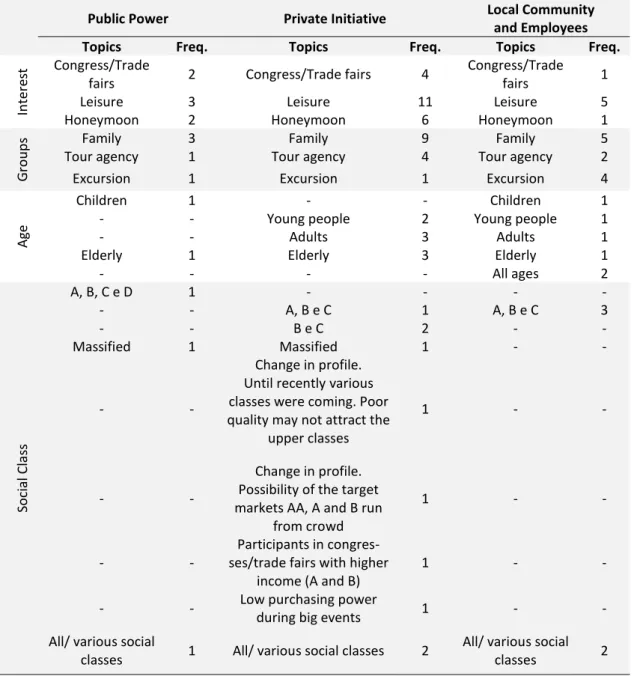
As to the target markets of Gramado (part of the destination brand personality) we present in Table 2 the elements cited in al-phabetical order and separated into sets, in response to question 5 (What kind of tourist visits Gramado and your business?). It is noted that as to interest, groups, and the age of tourists, the answers of the three types of respondents are similar. Most visitors seek entertainment, other go to congresses/ trade fairs. Many people travel with family, particu-larly during the Christmas of Light (October to January), there are also many groups coming through tour operators or excursions. The ages are varied. In general, the town is not the destination of choice for young people looking for nightlife, except during the Film Festival in August. On the other hand, some attractions are popular among students, as the Gramado Zoo.
There are differences with regard to the social class of the visitors. Several social classes were referred, being in agreement with the subject 2 (PP) who considered that destination marketing is not targeted at a spe-cific segment. The target are the upper class tourists, for example, when promotional bro-chures refer to the luxury and create a high-quality souvenirs brand; at the same time, the authorities promote among other segments (i.e. excursionists – those who do not spend the night) the various attractions of Gramado and the options in terms of budget accommo-dation, in an attempt to increase the length of stay and the use of tourism facilities.
12 Rev. Bras. Pesq. Tur. São Paulo, 11(1), pp. 1-18, jan./abr. 2017.
Azambuja, V.A.; Mecca, M.S. The brand identity of Gramado, Brazil, that generates the image of a "tourism destination model" and the brand relationships with internal stakeholders
what, for him, results in accumulation of peo-ple, pushing away upper class tourists. Mariano (2013), reports that in that year there were 25 projects for new hotels or guest
houses aiti g fo the Ma o s app o al, a d
just the larger projects accounted for more than 5,000 bed spaces in destination (half of the beds until then). At the time, it was decid-ed for the non-approval of new hotels with more than 30 rooms for 90 days, because it was believed that too many projects would cause medium-and long-term impacts. There were already problems, namely: traffic con-gestion; lack of parking spaces; queues at res-taurants on weekends; a modification in the destination features due to over construction; and the high number of empty beds off-season (around 40 percent). During the mora-torium, the Municipal Plan would be re-evaluated, and a commission of experts would be formed to propose rules and to consult the Plan Committee (which included some profes-sional associations in the area of tourism and some members of neighborhood associa-tions).
The subject 13 adds that the target segments AA, A and B search for quality ser-vices, threatened by the increasing supply of hotel rooms with the consequent drop in pric-es. For him, the trend is that only those who spend little will attend the city in large num-bers:
There is a project of 300 apartments to be divided into 12 quotas. It makes 300 times 12 to see how many people that is. And these apartments have kitchen. So, first of all, these people don't come to a hotel; se o dl , the do t go out to eat. [...] 300 families that will only spend with grocery shopping. Is not the same thing as if you do the cost-benefit ratio of the cost they represent to the town and we're going to be subsidizing
a good part of what they consume in the public service.
This shows that marketing is not lim-ited to promotion, as Keller and Machado (2006) refer, rather it includes product, price and distribution strategies consistent with promotion. A product strategy put forward by the authorities of Gramado to enhance the competitiveness of the hotels on the market with oversupply is investing in innovative companies, thematic or installed in the rural area (Mariano, 2013). This concurs with
Por-te s diffe e tiatio st ateg : to de
el-op unique products by highlighting a peculiar feature or other factors.
Regarding the excursions, the subject 17 (CE) refers that the people from Gramado dislike the large number of them in the Christmas of Light, and their low spending. However, he believes that even lower classes benefit the destination. The subject 12 (PI) confirms: "the Chocofest was widely criticized because the businessmen say, not all of them, that Chocofest doesn't attract clients with good purchasing power. The same happens
ith the Ch ist as of Light. Also the su je t
12 mentions the lack of strategic planning involving all stakeholders and considers it a solution for the mobility problems: "There is no strategic planning, things just happen. In-stitute fares for the circulation of buses [...].
The it is s all a d, so eti es, it does t
have room for all this crowd. Some things are
o se sual a d othe s a e t. The e is o
tour-13 Rev. Bras. Pesq. Tur. São Paulo, 11(1), pp. 1-18, jan./abr. 2017.
ists; thus, if each component transmit a dis-tinct identity, that will reflect on the visitors' perception on the overall experience. And therefore, Hankinson (2004) posits that the relational network must be present during the entire process of branding, from planning to implementation. Because the destination is a complex of publics and stakeholders, in which
each consumer is free to choose the elements to consume (the "product experience" cannot be controlled in the same way that a manufac-tured product is), the branding must be a co-ordinated, unmanaged process, so that stake-holders have proactive role in the construction of brand identity.
Table 2 – Summary of Gramado target markets as indicated by the respondents
Public Power Private Initiative Local Community and Employees
Topics Freq. Topics Freq. Topics Freq.
In
tere
st Congress/Trade
fairs 2 Congress/Trade fairs 4
Congress/Trade
fairs 1
Leisure 3 Leisure 11 Leisure 5
Honeymoon 2 Honeymoon 6 Honeymoon 1
G
ro
u
p
s Family 3 Family 9 Family 5
Tour agency 1 Tour agency 4 Tour agency 2
Excursion 1 Excursion 1 Excursion 4
Age
Children 1 - - Children 1
- - Young people 2 Young people 1
- - Adults 3 Adults 1
Elderly 1 Elderly 3 Elderly 1
- - - - All ages 2
Soci
al
Cl
as
s
A, B, C e D 1 - - - -
- - A, B e C 1 A, B e C 3
- - B e C 2 - -
Massified 1 Massified 1 - -
- -
Change in profile. Until recently various classes were coming. Poor quality may not attract the
upper classes
1 - -
- -
Change in profile. Possibility of the target markets AA, A and B run
from crowd
1 - -
- -
Participants in congres-ses/trade fairs with higher
income (A and B)
1 - -
- - Low purchasing power
during big events 1 - -
All/ various social
classes 1 All/ various social classes 2
All/ various social
classes 2
Source: The author
Despite the similarities of the attrib-utes mentioned, there are noticeable dif-ferences between the internal stakeholders
2 Rev. Bras. Pesq. Tur. São Paulo, 11(1), pp. 1-18, jan./abr. 2017.
Azambuja, V.A.; Mecca, M.S. The brand identity of Gramado, Brazil, that generates the image of a "tourism destination model" and the brand relationships with internal stakeholders
does what believes it is their part, but does not act to
gether.
What is mention here is not the judgement about whether it is better to attract higher or lower class tourists, but the existing conflict regarding the high sea-son, between the characteristics of the brand identity of Gramado caused by the lack of a precise definition of the target au-dience. For Hankinson (2004), a destination should not attract groups of visitors with conflicting needs, as, for example, attract to a busy destination people seeking tranquili-ty. Also, defining the target audience is rele-vant for decision-making related to other characteristics of the brand identity, which, in Gramado, are: infrastructure quality/ tourism services; price; general infrastruc-ture, mobility; and natural features, linked to overbuilding and the accelerated growth that has destroyed vegetation.
However, the precise definition of the target audience is difficult when it comes to tourism destinations, given the different natures of their stakeholders. Or-ganizations have more flexibility to choose their target audience, and the profit can come from both quantity and quality of services. That is possible because they have the right to free enterprise, present in the Federal Constitution of Brazil (1988); which Garcia (2008) defines as the guarantee that everyone has to free creation and manage-ment of enterprises, which includes the freedom to determine how the activity will be developed, the form, quality, quantity and price of their products or services. However, the public authorities have a greater social role, and they cannot guide their choices only considering the profit that
tourists bring to the destination and the con-
sequent increase in tax collection aimed at the well-being of the population and tour-ists.
Their role goes beyond the welfare of the society wherein they operate and, according to the Article 23 of the Federal Constitution/88: "The Union, the States, the Federal District, and the municipalities, in common have the power: X – to fight the causes of poverty and the factors leading to substandard living conditions, promoting the social integration of the unprivileged sectors of the population". Therefore, a destination should be open to all. Still, the existence of popular events such as Christ-mas of Light, contributes a great deal to the formation of the image of Gramado as a "model tourism destination" and makes the destination competitive in face of the coastal destinations during the summer.
Therefore it is important that the different stakeholders can discuss their is-sues and interact as Saraniemi (2010) sug-gests. All the local community must partici-pate, even those who do not work directly with the tourism, when considering a desti-nation as an amalgam. In addition, accord-ing to Bregoli (2012), the construction of identity is a process more participatory ra-ther than vertical. Pike (2008) suggests the formation of a community group project for that construction.
3 Rev. Bras. Pesq. Tur. São Paulo, 11(1), pp. 1-18, jan./abr. 2017.
Categories Sub-categories Freq.
SYMBOLIC ATTIBUTES
Hospitality/service (+) 24
Leisure 19
All social classes 18
Family groups 17
Non- Brazilian imagery (+) 14
Children, adults, and elderly 11
Honeymoon 9
Congresses/trade fairs 7
Tour agency groups 7
Excursion groups 6
Europeanizationimagery (+) 6
FUNCTIONAL ATTRIBUTES
Tourism attractions/ events (+) 29 Natural features (+) Vegetation, climate, relief, Lago Negro (Black
Lake), rural area, etc. 23 Tourism infrastructure/ services (+) 19
Products of origin (+) 11
General infrastructure (-) Transportation network/traffic/mobility 7 9
Sewage 2
General infrastructure (+) Neigh o hoods at osphe e, side alks,
flowers, etc. 7
Architecture (+) 6
A place a little expensive (+) 4 Natural features (-) Vegetation/over construction and threat to
preservation 3
ORGANIZATI-ONAL
ATTRI-BUTES
Innovation (+) 24
Cooperation of the community (+) 16
Credibility (+) 10
Professionalism (+) 6
Organizational quality (+) 6
Efficient complementarity of the tourism product (+) 5
Public Management (+) 5
Entrepreneurship (+) 4
EXPERIENTIA-LATTRIBUTES
Safe (+) 12
Clean (+) 11
Tranquil (+) 8
Beautiful (+) 7
Organized (+) 6
Quality of lifedade (+) 6
Delightful (+) 5
Charming (+) 3
Romantic (+) 2
Elegant (+) 1
Modern (+) 1
Loss of tranquility (-) 1
Source: The authors
The stakeholders of Gramado associ-ate to the image of a "model tourism
attrib-4 Rev. Bras. Pesq. Tur. São Paulo, 11(1), pp. 1-18, jan./abr. 2017.
Azambuja, V.A.; Mecca, M.S. The brand identity of Gramado, Brazil, that generates the image of a "tourism destination model" and the brand relationships with internal stakeholders
utes (111 cases, 28.61 percent). The difference between these categories of attributes does not reach 10 percent. On the other hand, the sum of the percentages of organizational at-tributes (76 occurrences, 19.59 percent) and
experiential attributes (63 occurrences, 16.24%) is 35.83 percent, less than one per-cent difference from symbolic attributes. This shows the relevance of the categories with the highest percentages for the construction of the brand identity of Gramado. It is natural that the symbolic attributes have the highest frequencies, because as Norberto (2007) points out, the brand is inscribed in a symbolic field. This author, in 2004, has pointed out that through the brand a product becomes more than its functional properties, it includes the worlds of meanings embedded in it.
It was noted that there is an intrinsic relationship between the symbolic and func-tional attributes regarding the definition of target audience (symbolic attribute). Such definition affects the decisions relating to oth-er features of the brand identity, for example quality of the tourism infrastructure/services, price, general infrastructure and natural fea-tures, which are functional attributes.
5 FINAL CONSIDERATIONS
The findings show that the image of Gramado as a "model tourism destination" is constructed through branding. Such identity is composed of 34 elements. The most men-tioned attribute for all three groups of stake-holders interviewed is tourism attrac-tions/events, with 29 occurrences. This attrib-ute is also a differentiation factor of Gramado from other competitors (positioning) – which, in general, are Brazilian tourism destinations. The attributes were divided into four catego-ries: symbolic attributes (35.57 percent),
func-tional attributes (28.61 percent), and organi-zational attributes and experiential attributes on a smaller scale.
It was also verified, by comparison between the topics mentions by the three groups of stakeholders, that there are weak-nesses in the relationships between internal stakeholders due to the differences found,
espe iall ith ega d to isito s so ial lass.
It has been found that, currently, the market-ing of Gramado is not directed to any specific target audience in terms of social class. How-ever, some subjects in this study would like the marketing strategy to be targeted at the AA, A and B classes, while others do not con-sider a restriction. Also, one of the respond-ents pointed to a lack of strategic planning that would set the target audience. This diver-gence is reflected in a conflict between the characteristics of the brand identity of the destination, as, for example, between massifi-cation and quality of the tourism infrastruc-ture/ services. Therefore, it is important to define more precisely the target audience. However, this definition is difficult to make when it comes to tourism destinations, given the different natures of the stakeholders.
We can highlight some contributions of this research to the knowledge on destina-tion branding: 1) the identificadestina-tion of difficul-ties in defining the target audience of the brand-destination due to the different natures of the stakeholders, which demonstrates the significant distinction between this type of branding and branding in general; 2) in addi-tion to the funcaddi-tional, symbolic and experien-tial attributes – adopted by Hankinson (2004)
5 Rev. Bras. Pesq. Tur. São Paulo, 11(1), pp. 1-18, jan./abr. 2017.
on the definition of target audience, leading to deeper considerations. This research is not an end in itself; it unfolds new paths to be fol-lowed in this field of knowledge.
REFERÊNCIAS
Aaker, D. A. (1996). Criando e administrando marcas de sucesso. São Paulo: Futura.
Bahl, M. (2004).Legados étnicos & oferta turísti-ca. Curitiba: Juruá.
Bardin, L. (2004). Análise de Conteúdo. 3. ed. Lisboa: Edições 70.
Buhalis, D.(2000). Marketing the competitive
destination of the future. Tourism Management, (21), 97-116.
Constituição da República Federativa do Brasil de 1988. (1988). Brasília. Recuperado em 30
nov, 2014, de
http://www.planalto.gov.br/ccivil_03/Constituic ao
/Constituicao.html
De Chernatony, L. (1999). Brand management through narrowing the gap between brand iden-tity and brand reputation. Journal of Marketing Management, (15), 157-179.
Goldenberg, M. (2004). A arte de pesquisar:
como fazer pesquisa qualitativa em Ciências sociais. 8. ed. Rio de Janeiro: Record.
Gomes, C. J. V. (2008). Constituição de 1988: o Brasil 20 anos depois – Estado e economia em vinte anos de mudanças (v. 4). Brasília: Senado Federal.
Hankinson, G. (2004). Relational network brands: towards a conceptual model of place brands. Journal of Vacation Marketing, 10 (2), 109-121.
Hankinson, G. (2007). The management of des-tination brands: Five guiding principles based on recent developments in corporate branding theory. Journal of Brand Management, 14 (3), 240-254.
Johannessen, J. A., Olsen, B. & Lumpki, G.T. (2001). Innovation as newness: what is new,
how new, and new to whom? European Journal of Innovation Management, 4 (1), 20-31.
Karamarko, N. (2010). System of tourist destina
tion management as a Croatian identity. Tour-ism & Hospitality Management - Conference Proceedings, 950-966.
Keller, K. L. & Machado, M. (2006). Gestão estra-tégica de marcas. São Paulo: Pearson Education do Brasil.
Kotler, P. (1997). Marketing management: anal-ysis, Planning, Implementation, and Control. 9. ed. Upper Saddle River, NJ: Prentice-Hall.
Kotler, P. (2009). Marketing para o século XXI: como criar, conquistar e dominar mercados. São Paulo: Ediouro.
Kotler, P. & Gertner, D. (2002). Country as brand, product, and beyond: a place marketing and brand management perspective. Journal of Brand Management, 9 (4), 249-261.
Mariano, N. (2013, 3 de agosto). Gramado en-frenta sintomas de esgotamento. Zero Hora. Recuperado em 23 out, 2013, de http://zerohora.clicrbs.com.br/rs/economia/em pregos-e-carreiras/noticia/2013/ 08/gramado-
enfrenta-sintomas-de-esgotamento-4222541.html
Meler, M. & Ruzic, D. (1999). Marketing identity of the tourist product of the Republic of Croatia.
Tourism Management, 20, 635-643.
Ministério do Turismo – Mtur. (2008). Relatório final do Vivências Brasil: aprendendo com o turismo nacional 2008/2009 - etapa Serra gaú-cha. Brasília: MTur.
Ministério do Turismo – Mtur.(2010). Caderno de subsídios:eventos como solução criativa con-tra a sazonalidade 2010. Brasília: MTur.
Norberto, E. (2004). Estratégias corporativas de marcas e estratégias sociais de diferenciação: uma análise a partir do automóvel. Tempo So-cial, 16 (2), 203-208.
6 Rev. Bras. Pesq. Tur. São Paulo, 11(1), pp. 1-18, jan./abr. 2017.
Azambuja, V.A.; Mecca, M.S. The brand identity of Gramado, Brazil, that generates the image of a "tourism destination model" and the brand relationships with internal stakeholders
Pimentel, E., Pinho, T. & Vieira, A. (2006). Ima-gem da marca de um destino turístico. Turismo – Visão e Ação, 8 (2), 283-298.
Porter, M. E. (1989). Vantagem competitiva:
criando e sustentando um desempenho superior. Rio de Janeiro: Campus.
Prefeitura Municipal de Gramado – PMG. (2008). Gramado e Óbidos unidas pelo turismo. Recuperado em 7 jul, 2013, de http://www.gramado.rs.gov.br/index.php/Gram ado-e-Obidos. html
Prefeitura Municipal de Gramado – PMG. (2013a). Comitiva de Bragança Paulista visita Gramado. Recuperado em 7 jul, 2013, de http://www.gramado.rs.gov.br/index.php/ Insti-tucionais/Comitiva-de-Braganca- Paulista-visita-Gramado.html
Prefeitura Municipal de Gramado – PMG. (2013b). Embaixador da Nigéria visita Gramado.
Recuperado em 7 jul, 2013, de http://www.gramado.rs.gov.br/index.php/Instit ucionais/ Embaixador-da-Nigeria-visita-Gramado.html
Prefeitura Municipal de Gramado – PMG. (2013c). Nestor recebe comitiva chilena.
Recupe-rado em 7 jul, 2013, de
http://www.gramado.rs.gov.br/index.php/Instit ucionais/Nestor-recebe-comitiva-chilena.html
Prefeitura Municipal de Gramado – PMG. (2013d). Gra ado o orre ais u a ez a
Me-lhor Desti o de I er o do Brasil. Recuperado
em 9 dez, 2013, de
http://www.gramado.rs.gov.br/ in- dex.php/Turismo/Gramado-concorre-mais-uma-vez-a-Melhor-Destino-de-Inverno-do-Brasil. html
Prefeitura Municipal de Gramado – PMG. (2014a). Nestor recebe o Prefeito de Iguape (SP). Recuperado em 7 fev, 2014, de http://www.gramado.rs.gov.br/index.php/Instit
ucionais/ Nestor-recebe-o-Prefeito-de-Iguape-SP.html.
Prefeitura Municipal de Gramado – PMG. (2014b). Gramado recebe visita de comitiva de Ourinhos-SP. Recuperado em 3 mar, 2014, de http://www.gramado.rs.gov.br/index.php/ Tu- rismo/-Gramado-recebe-visita-de-comitiva-de-Ourinhos-SP.html
Reynolds, W. (1965). The role of the consumer in image building. California Management Revi-ew, (7), 69-76.
Secretaria Municipal de Comunicação e Eventos
– Secom. (2013). Prefeitura de Caldas Novas encaminha comitiva à Gramado para estudar modelo de turismo. Recuperado em 10 jul, 2013, de
http://www.caldasnovas.go.gov.br/prefeitura- de-caldas-novas-encaminha-comitiva-a-gramado-para-estudar-modelo-de-turismo/
Vargas, D. P. (2013). Turismo e Imaginário: o percurso histórico do chocolate em Gramado/RS (Dissertação de Mestrado em Turismo). Universidade de Caxias do Sul.
Yin, R. K. (2010). Estudo de caso: planejamento e métodos. 4. ed. Porto Alegre: Bookman.
____________
Dados dos Autores
Vanessa Acosta de Azambuja
Maste s deg ee i Tou is f o the Postg aduate Program in Tourism from the University of Caxias do Sul –UC“. Ba helo s deg ee i Tou is of the Fede -al University of Pelotas – UFPEL. Email: [email protected]
Marlei Salete Mecca