134 Rev. Bras. Pesq. Tur. São Paulo, 11(1), pp. 133-153, jan./abr. 2017.
Price formation of tourist hotels of the city of São
Luís/Maranhão
1Formação de Preço dos Hotéis Turísticos da Cidade de
São Luís/Maranhão
La formación de precios de hoteles turísticos de la Ciudad del São
Luís / Maranhão
Mauro Santos2 Luiz Carlos da Silva Flores3
Abstract: A hotel is a business establishment that provides accommodation and food services, and for that, it has physical structures that meet the specific and basic conditions to receive guests, in exchange for payment. Pricing in this sector may have a focus on cost, market competition, and the perception of value. The formation of price takes into account demand, segmentation, weather, competition behavior and characteristics of the property, among others. The aim of this paper is to analyze the pricing strategies in the lodging facilities in São Luís, Maranhão, Brazil. The study is justified by the importance of pricing for hotel management, from the reality of the hotel industry in São Luis. We adopted descriptive research procedures, predominantly quantitative in a sample of 31 hotel companies of São Luís, with managers from these establishments. Data were analyzed with support software R version 3.2.1. The research shows that the hotel chain in São Luis do Maranhão uses tools and price management strategies recommended by the legislation and other support for price management. It is concluded that there is an effort of the management of hotels to professionalize the calculation of daily rate, using techniques that give them more security in the decision and pricing, abandoning the informal or empirical methods, without abandoning the market research.
Keywords: Tourism. Hospitality. Pricing.
1 This pape is pa t of the esults of the Maste ’s thesis p ese ted i the Postg aduate p og a i Tourism and Hospitality, in the University of Vale do Itajaí - UNIVALI, in 2015.
2 University Center of Maranhão (UniCEUMA), São Luís, MA, Brazil. Conception and design of the scientific work; acquisition and interpretation of data; writing.
3 University of Vale do Itajaí (UNIVALI), Balneário Camboriú, SC, Brazil. Supervision; critical review; final ap-proval.
135 Rev. Bras. Pesq. Tur. São Paulo, 11(1), pp. 133-153, jan./abr. 2017.
Resumo: O hotel é um estabelecimento comercial com o objetivo de prestação de serviços de hospedagem e alimentação, e para isso, possuem estruturas físicas que satisfaçam as condições específicas e básicas para re-ceber hóspedes, em troca de pagamento. A precificação nesses empreendimentos pode ter enfoque nos custos, mercado, concorrência e na percepção de de valor. Alguns fatores podem ser considerados na formação de preços, tais como, demanda, segmentação, meteorologia, comportamento da concorrência e característica do estabelecimento entre outros. O objetivo deste artigo é analisar as estratégias de formação de preços nos meios de hospedagem em São Luís/Maranhão/Brasil. O estudo justifica-se pela relevância da precificação para a gestão hoteleira, a partir da realidade do setor hoteleiro em São Luís do Maranhão. Foi adotado procedimentos de pesquisa descritiva, predominantemente quantitativa, em uma amostragem de 31 empresas hoteleiras de São Luís, sendo os respondentes os gestores desses estabelecimentos. Os dados foram analisados com apoio sof-tware R versão 3.2.1. A pesquisa aponta que a rede hoteleira em São Luís do Maranhão utiliza as ferramentas e estratégias de gestão de preços recomendados pela legislação e outras de apoio para gestão dos preços. Conclui-se que há um esforço da gestão dos hotéis para profissionalizar os métodos de cálculo da diária, utilizando téc-nicas que lhes deem maior segurança na decisão e formação de preços, abandonando os métodos informais ou empíricos, sem abandonar a pesquisa de mercado.
Palavras-chave: Turismo. Hotelaria. Formação de preço.
Resumen: El hotel es un establecimiento comercial con el fin de proporcionar servicios de alojamiento y comida, y para eso, tienen estructuras físicas que cumplan las condiciones específicas y básicas para recibir a los invitados, a cambio del pago. El precio de estas empresas puede tener un enfoque en los costos, la competencia del mercado y la percepción de valor. Algunos factores que pueden considerarse en la formación de precios, tales como la demanda, la segmentación, el clima, el comportamiento de la competencia y las características de la propiedad, entre otros. El propósito de este artículo es analizar las estrategias de precios en hoteles turísticos de la Ciudad de São Luís do Maranhão/Brasil. El estudio se justifica por la importancia de la fijación de precios para la dirección del hotel, de la realidad de la industria hotelera en São Luís. Fue adoptado procedimientos descriptivos, predo-minantemente cuantitativos en una muestra de 31 empresas hoteleras de São Luís, y los encuestados gerentes de estos establecimientos. Los datos se analizaron con el apoyo Del software R versión 3.2.1. La investigación muestra que la cadena de hoteles en São Luís do Maranhão utiliza las herramientas y estrategias de gestión de precios recomendados por la legislación y otras formas de apoyo para la gestión de precios. Se concluye que hay un esfuerzo de la gestión de hoteles para profesionalizar a los métodos de cálculo tasa diaria, utilizando técnicas que les dan más seguridad en la decisión y la fijación de precios, el abandono de los métodos empíricos o infor-males, sin abandonar la investigación de mercado.
Palabras clave: Turismo. Hospitalidad. La formación de precios.
1 INTRODUCTION
Tourism is an important world eco-nomic activity, driving GDP growth in many countries. According to the World Travel and Tourism Council – WTTC the total contribu-tion of Tourism & Travel to global GDP in 2013 was US$ 6.9 billion, equivalent to 9.5 percent of global GDP and, in 2014, it rose 5.7 percent, which corresponds to a contribution of US$ 7.3 billion. This phenomenon occurs, motivated by the economic activities carried out by the trade, including the hotel industry,
travel agencies, airlines, transportation ser-vices, restaurant and entertainment among others offered to tourists (WTTC, 2014).
135 Rev. Bras. Pesq. Tur. São Paulo, 11(1), pp. 133-153, jan./abr. 2017.
The hospitality industry in Brazil can be divided into three groups: the first are the independent hotels – which are mostly small businesses and represent almost 70 percent of the establishments in the country. The sec-ond group consists of the national hotel chains; and, the third comprises the major in-ternational chains that have settled in the country in recent years (Meira, 2012; Mendes, 2016).
The growth of the hotel industry has been keeping up the pace with the changes and demands in tourism. The hotel sector should be prepared to meet the new de-mands that arise from technological tools and the emergence of new generations (Cas-tillo & Quintero, 2013) and demand in major events such as those which took place re-cently in Brazil (Rio+20 in 2012, World Cup in 2014, Olympic and Paralympic Games in 2016).
In this way, managers need to adjust management systems to act in this competi-tive environment. Among other activities, they should adopt procedures that allow de-termining and assigning costs, the pricing for-mation of products, calculation of contribu-tion margin and break-even point (Vieira & Souza, 2005). Also including market and com-petition variables (Cogan, 2013; Porto, 2014), such as the number of beds spaces in the re-gion, the demand, the management of the hotel, independent or chain – national or in-ternational, and the hotel classification.
The guiding research problem of this study is to know how managers work the pro-cess of formation of daily rates in the lodging industry, more specifically in the city of São Luís. Thus, the objective of this study is to an-alyze the factors that influence the
decision-making process for formation of daily rates in lodging in São Luís, MA.
Within the hotel sector, many varia-bles influence the decision-making of daily rates, such as market, cultural, natural, and social variables. The pricing in these estab-lishments can be made from the perspective of costs, market, competition, or value. Some factors should be considered in the policy of price formation, such as demand, events, market segmentation, internal promotions, weather, behavior of the competition, and characteristics of the establishment (Plana-gumà & Julve, 2012; Castillo & Quintero, 2013).
Pricing is a complex subject studied in several areas of the human knowledge and applied social sciences relating to manage-ment and finance, economics, accounting and marketing (Porto, 2014). Regardless of the approach, its importance is evident, given that it is through the results obtained by the sales and materialized in the prices of prod-ucts that the accommodation establishments ensure their survival over time (Heo & Lee, 2011).
Several papers have been published with the focus on the study of price manage-ment in hosting, such as: Becerra, Santaló & Silva (2013); Pinto and Santos (2012), Heo and Lee (2011), among others. Thus, demon-strating the interest in the subject, mainly by the influence that the sector suffers from en-vironmental factors such as competition, the internet, new ways of management, client behavior and economy.
136 Rev. Bras. Pesq. Tur. São Paulo, 11(1), pp. 133-153, jan./abr. 2017.
discussing the pricing techniques used by ho-tel companies in São Luís.
2 HOTEL INDUSTRY
The hotel industry is a key activity for tourism because of the revenues from tour-ists and jobs created (MTUR, 2015). The in- dustry is linked to the tourism demand and is composed of hotels, guesthouses and hos-tels, which offer a service, particularly to tourists (Mello & Goldenstein, 2016).
The hotel sector is an industry of ser-vice and products, featuring specific charac-teristics of an organization whose core objec-tives are the offer of lodging, food, entertain-ment, security, and well-being services (Maurício & Ramos, 2011; Ferrando, Prus-aczyk, & Tejera, 2012).
According to Duduche, Costa, Silva, Igarashi and Góis (2011, p. 106), the hotel
o pa ies a e se i e supplie s hi h ha e
as main activity accommodation, differenti-ating from other economic activities, and
de-pe di g o lie ts fo its fu tio i g .
Depending on its constitution, hotel companies can be organized in chains (net-works) or they can be independent units (Pinto & Santos, 2012). The separation be-tween the ownership of the property and the management of the business is more com-mon and evident in the segment of the high-end hotel brands, in which the larger opera-tors or brand stand out, of international and domestic chains. There are various types of agreements between owners and operators, but generally, the strategic choice of the big-gest players is providing hotel management services. In turn, the so-called independent hotels are managed by their owners or, in
some special cases, by a third party. How-ever, the large administrators, brand owners, make demands to manage the hotels that must be met still in the project phase of new construction (Mello & Goldenstein, 2016).
Regarding the size, the Resolution of CNTUR No. 1,023 describes the rules for the classification of a hotel company, according the annual revenue (Mauricio & Ramos, 2011), shown in Table 1:
Table 1 - Size of the hotel company by annual revenue Size CNTUR Resolution 1,023
(An-nual revenue) Small Business Less than R$ 100,000.00 Medium
Busi-ness
Between R$ 100,000.00 and 250,000.00
Large Business More than R$ 250,000.00
Source: Adapted from Maurício and Ramos (2011)
137 Rev. Bras. Pesq. Tur. São Paulo, 11(1), pp. 133-153, jan./abr. 2017.
modation.
Another criterion used for the classifi-cation of enterprises is the number of em-ployees (Ricci, 2011), as presented in Table 2 below:
Table 2 – Classification of enterprises according to the sector and number of employees
Size Commerce
and Services
Industry
Micro Business 9 19
Small Business 10 to 49 20 to 99 Medium Business 50 to 99 100 to 499 Source: Sebrae (2008 as cited Ricci, 2011)
It turns out that the hotel companies can take on various shapes and sizes, from micro, small and large enterprises, or from in-dependent hotels to national and interna-tional hotel chains; however, all of them have to consider the management system.
Hotel accommodations, according to Anjos and Grigolo (2013) require an organiza-tion composed of human, material, techno-logical, financial, and information resources, regulated by the market laws whose main goal is to satisfy the customers who, suppos-edly, have different travel motivations.
In this context the type of tourism ac-commodation stands out, responds to a num-ber of factors, including the purpose of creat-ing a service accommodation typically for tourism, to meet the specific needs of the tourist, because of the tourism flow and growth of the commercial activity and ex-changes (Castillo & Quintero, 2013).
It is observed that in the context of the hotel company the accommodation ser-vice is considered to be its core activity, from
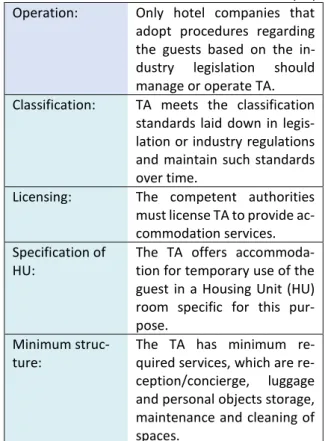
which the concept of tourism accommoda-tion originates (TA) and the attributes that differentiates it from other establishments, presented in Table 3 – Attributes of tourism accommodation (Planagumà & Julve, 2012; Maurício & Ramos, 2011):
Table 3 - Attributes of tourism accommodation (TA) Operation: Only hotel companies that adopt procedures regarding the guests based on the in-dustry legislation should manage or operate TA. Classification: TA meets the classification
standards laid down in legis-lation or industry regulegis-lations and maintain such standards over time.
Licensing: The competent authorities must license TA to provide ac-commodation services. Specification of
HU:
The TA offers accommoda-tion for temporary use of the guest in a Housing Unit (HU) room specific for this pur-pose.
Minimum struc-ture:
The TA has minimum quired services, which are re-ception/concierge, luggage and personal objects storage, maintenance and cleaning of spaces.
Source: Adapted from Planagumà and Julve (2012) and Marício and Ramos (2011)
In this sense, the hotel is an establish-ment where the tourist will find lodging and meals in exchange for payment for these ser-vices. The lodging service includes the recep-tion, concierge, telephony, housekeeping, and the area of direct contact with the client. Food and beverage services (F&B) are also available in TA (Oliveira & Spena, 2012).
138 Rev. Bras. Pesq. Tur. São Paulo, 11(1), pp. 133-153, jan./abr. 2017.
ve use of one or more guests (double or tri-ple), appropriate location for storing clothes and personal objects; the suite consists of a bedroom with living room (Ye, Law, & Zhang, 2011).
Therefore, the management aims to organize, plan, coordinate and control the ac- tivities and services offered by the business be it a hotel, guesthouse, resort, flats or other type. The manager must be prepared to take care of all the departments, from the accommodation of the guests, food, finance,
marketing activities, among other
(Tomazzoni & Bittencourt, 2013).
The services of personnel manage-ment, finance, accounting, purchasing and controls such as assets and inventory, the verification and cost controls are the respon-sibility of the administrative sector (Duduche et al, 2011), as well as the formation of prices.
Classification of tourism accommodation
The goal of the hotel classification is to offer the guest a reference of accommoda-tion that faithfully reflects the levels of com-fort, services and rates expected according to their different motivations and goals, ena-bling the comparison between the various lodging facilities available in a region (Bertoli Neto, 2013).
According to the Brazilian Association of the Hotel Industry – ABIH, the classification is an dissemination instrument of clear and objective information about lodging services, being an important mechanism of communi-cation with the market, enabling fair compe-tition and helping tourists, Brazilians and for-eigners, in their choices (ABIH, 2015).
The Brazilian System of Accommoda-tion ClassificaAccommoda-tion maintains the use of stars and adopts the following segmentation: ho-tel (from one to five stars); Resort (four or five stars); Farm Hotel (from one to five stars); Bed & Breakfast (from one to four stars); Historic Hotel (three to five stars); Inn (from one to five stars); and Flat/Apart-hotel (three to five stars). There are still other clas-sifications used by companies and specialized bodies, such as Luxury, Upscale, Midscale, Economy and Budget (Mello & Goldenstein, 2016).
The Brazilian rating system is not mandatory and the lodging companies that adopt it must fulfill some requirements such as infrastructure, related to facilities and equipment; services, related to customer of-fer; sustainability, the actions related to the use of resources in a manner that is environ-mentally responsible, socially just and eco-nomically viable (ABIH, 2015).
Pricing in accommodation establishments
139 Rev. Bras. Pesq. Tur. São Paulo, 11(1), pp. 133-153, jan./abr. 2017.
financial point of view, but also from the op-erational perspective, because it helps regu-late the stocks and production pressures.
We highlight that accommodation rates are influenced by supply and demand, i.e., the revenue is subject to the amount and sale price of the products and services of-fered; also, sales are dependent on the
con-su e s’ pu hases (Pa oli , 4).
The price and quality, allied to the physical and operational aspects of the hotel enterprise, guide the society and enable it to compare means of accommodation. This per-spective underlies the development of hotel classification (Roim & Pereira, 2012), which is in the case of Brazil the SBClass and the star categories.
Within the hotel industry, Parolin (2014) notes that maximization of revenues encourages efficient management of de-mand and billing. Especially, because it in-volves the selection and the use of marketing tools key to market and competition analysis, and to develop pricing strategies for each segment.
In this regard, Fernando et al. (2012) pinpoint that accommodation establish-ments draw on three pricing strategies: cost-based pricing, market-cost-based pricing and a combination of cost and market strategies. Nevertheless, Porto (2014) indicates three strategies to form the prices in the hotel in-dustry: cost strategies, client-based strate-gies, and pricing through the study of compe-tition.
According to Schütze (2008) the hotel companies must focus on the pricing model and choose between three approaches: (a)
dynamic pricing, in which the remaining ca-pacity is fixed in price dynamically, widely
used by hotels with focus on competition; (b)
pre-fixed constant pricing, based on a catego-rization of the different types of customers and focuses on capacity fixing between these classes with the strategic use of service levels or packages; and, (c) pre-fixed mixed pricing, which consists in the combination of differ-ent strategies, i.e. constant and decreasing prices for expected or uncertain low-demand days with last-minute bonus for the remain-ing capacity.
Lunkes (2009) refers four strategies to set the price of products: costs, competitors, market, and a mixed strategy of these. De-spite some disagreement, all authors suggest an inner vision, on offer – products and costs
– and an external perspective, on demand – customers and market, and some add a mixed approach.
On his part, Cardoso (2011) classifies pricing strategies into two methods: the in-formal or empirical, and in-formal or scientific. The informal or empirical method, based (a)
o I tuitio o o the o e o a age ’s
empirical knowledge; (b) on Competitors, fo-cusing on prices charged by these, after a sur-vey of prices; and (c) Trial and Error, in which the price is set and the behavior of sales mon-itored.
The formal or scientific method in-cludes three techniques, the 3Cs, the Texas
Restaurant Association (TRA) markup
method, and the gross margin method. In the
140 Rev. Bras. Pesq. Tur. São Paulo, 11(1), pp. 133-153, jan./abr. 2017.
regard to TRA, it is a financial model of costs, considering the cost of goods sold (COGS), payroll and operating expenses. Finally, the gross margin method is based on costs, from which the average gross profit is calculated – difference between revenue and COGS di-vided by the number of customers (Cardoso, 2011). Adding to this discussion, Ferrando et al. (2012) argue that price setting must resort to strategies based on costs, competition, and/or demand.
Kotler and Keller (2012), and Cogan (2013) describe eleven strategies for pricing in the lodging industry; the methods con-verge to pricing based on value, based on market, and strategies based on costs. More-over, at the time of setting the price that will be on the "price list" or negotiated with the tourists, markup calculation, break-even av-erage occupancy by housing unit calculation, the price of the competition, or the Yield Management or Revenue Management are also used.
Following, we describe three of these pricing strategies that accommodation estab-lishments managers use to set prices of ser-vices: value, cost, and daily rates
Value-based pricing
Value-related aspects are guided by the perception of the benefits of the product which is a complex of tangible (facilities, tech-nology, bed-making and cleaning of rooms) and intangible (brand reputation, added value of services, attentive staff) attributes that must be offered to a market for evalua-tion and acquisievalua-tion, use or consumpevalua-tion (Costa, 1987).
The knowledge of the hospitality
products is key to defining pricing strategies, thus future results depended on its current performance, broadening the demand for the product through the loyalty of consum-ers, the word-of-mouth and other post-pur-chase behaviors (Santos, Vassallo, & Rabahy, 2009).
The perceived value is part of the ho- tel product, because in this sector a conside- rable attention has been devoted to the anal-ysis of the managerial processes based on re-views, quality perception and attitudes of tourists. Therefore, the concept of perceived value has been widely used to assess the per-formance of the product by the guests (San-tos et al., 2009). Knowledge of expectation and perception of quality of services pro-vided allows the managers to have a detailed parameter of each sector, making possible the implementation of changes and improve-ments in quality to get the loyalty of actual and potential customers (Souza, Meira & Maske, 2012).
Pricing strategies based on perceived value focus on setting the prices based on the perception of quality and especially in the corporation brand and image.
Cost-based pricing
141 Rev. Bras. Pesq. Tur. São Paulo, 11(1), pp. 133-153, jan./abr. 2017.
accounting is to keep the administration well informed about the situation of the com-pany, aiding the decision-making, ranging from setting the price of services, purchase of equipment, avoiding waste and losses (Ba-tista, Silva, Silva, & Almeida, 2016).
In this sense, the design of the cost system should meet all these demands. Some requirements at the time of creation of the cost system include the study of the adminis-trative structure, the context, the compe-tences and the responsibilities of each person in each sector, and create a chart of accounts where such information is coded and ready to generate reports (Carvalho, Pedrosa, Yo-shitke & Paulo, 2004).
Calculation of daily rate
The calculations that use cost infor-mation are financial approaches, according to which prices are determined to get a fair profit above all costs associated with the pro-duction (Collins & Parsa, 2006). The determi-nation of the daily rate, which will be negoti-ated, is a decision that entails aspects related to individual price offers per booking, define it for a category of products that implicates price over time, as well as discounts (Aziz et al., 2011).
It is worth noting, therefore, that the calculations or methods for determining daily rates of housing units are characterized by the markup calculation, average price calcu-lation that uses the break-even point and the contribution margin, the revenue manage-ment (RM), and empirical or informal meth-ods of calculation (Cross, 1998; Petrocchi, 2007; Cardoso, 2011). Although the empirical methods are recommended only to assist sci-
ence, many accommodations establishments still determine their prices based on these methods, intuition, trial and error or they es-tablish the rates lower, equal to or greater than those of the competitors (Machado, Machado & Iolanda, 2006).
However, Boaria and Anjos (2014) verified, in the study of the use of revenue management in hotels in Foz do Iguaçu, that the use of scientific methods can assist the management. It allows the hotel manager to anticipate and predict sales prices, trying to obtain greater profitability through the crea-tion of a rate plan, taking into account the history of previous years, events and special occasions, anticipating the occupation and creating a consistent rate plan.
3 METHODOLOGY
To know the variables that contribute to the pricing in the hotel sector in São Luís (MA) we used descriptive research design, a quantitative approach and survey proce-dures. The survey consists of collecting data on a population from a selected sample (Dencker, 1998), providing knowledge about the lodging industry of São Luís and the iden-tification of management strategies and the methods for the calculation of daily rates.
142 Rev. Bras. Pesq. Tur. São Paulo, 11(1), pp. 133-153, jan./abr. 2017.
For improved data reliability, the respond-ents should be involved directly with the management of the hotel and knowledgea-ble on pricing practices, and one representa-tive per establishment, which may be the owner, or managing director, or general man-ager, or administrative manman-ager, and or com-mercial/ marketing manager.
The questionnaire uses the state-of- the art of lodging pricing (Becerra & Silva, 2013; Pinto & Santos, 2012; Ferrando, Prus-aczyk, & Tejera, 2012; Martinéz & Guillen, 2011; Ye, Law, & Zhang, 2011; Lu & Shiu, 2011; Han & Kim 2010; Hung, Shang, & Wang, 2010; Schwartz, 2008; Zong, Tang, & Huang, 2008). The objective is to identify the strate-gies and methods used for the formation of daily rates. For this purpose, we used close-ended questions and a quantitative 5-point Likert scale, with options to select the an-swers that best describe the reality of the ac-commodation establishment. To know the level of use of a pricing strategy, also to de-tect the method that the manager uses to set the negotiated daily rate, the questionnaire uses a scale of 1 to 5, where 1 is "never uses" and 5 "uses e f e ue tl .
Data analysis was carried out with R software version 3.2.1 and Microsoft Excel. The description of categorical variables was performed, using absolute and relative fre-quencies, while for the quantitative variables we used means, standard deviations, and confidence intervals. The Likert scale (1 to 5) was transformed into a scale of 0 to 100, and the closer to 100 (one hundred), the greater was the frequency of use of strategies to form the daily rate and the methods to set the daily rate.
4 ANALYSIS AND RESULTS of the methods for price formation
In this section we present the results of research, starting with the profile of the re-spondents and of the establishments investi-gated, then we describe the methods used for the formation of prices.
Profile of the respondents: 31 lodging com-panies participated in this research; respond-ents were people who occupied the positions of general manager (39 percent), sales man-ager (23 percent), manman-ager (13 percent), ad-ministrative manager (10 percent) and other operational functions (16 percent). No own-ers responded to the survey. Of these man-agers, most have higher education in the ar-eas of administration and tourism. They are working in the area of tourism and hospitality for over 5 years, thus assigning greater relia-bility of the survey responses.
143 Rev. Bras. Pesq. Tur. São Paulo, 11(1), pp. 133-153, jan./abr. 2017.
Table 4 – Tipology of the tourism accommodation es-tablishments (TAE)
Variables (n=31) N %
Ti- po-logy
Hotel 22 71.0%
Guesthouse 6 19.4%
Flat/Apart-Hotel 1 3.2%
Historic Hotel 1 3.2%
Resort 1 3.2%
TAE Ca- te-gor y
Simple * 6 19.4%
Economic ** 5 16.1%
Tourism *** 12 38.7%
Superior **** 6 19.4%
Luxury ***** 2 6.4%
Source: Data research
The Table shows that most hotel com-panies of São Luís was classified on typology Hotel (71 percent), followed by Hostels (19.4 percent), and others, Flat/Apart-Hotel, His-toric Hotel, Resort, have little representation with one (3.2 percent) establishment of each category.
The SBClass classification (ABIH, 2015) organizes hotel companies by categories ac-cording to the degree of comfort: Simple (* a star), Economic (** two stars), Tourist (*** three stars), Superior (**** four stars) and Luxury (***** five stars). From the set of ho-tels studied, 38.7 percent are classified as to the degree of comfort in the tourism gory (***), 19.4 percent belong to the cate-gory Simple (*), 19.4 percent are Superior (****), 16.1 percent are Economic (**) and only 6.4 percent are classified in category Luxury (*****).
According to the respondents, in gen-eral, these hotels offer HUs with double, sin-gle, suite, and other typologies of rooms, for example, triple room and other options to in-clude extra beds.
In addition to accommodation, hotels
also offer other services in order to add more value and to differentiate in the market (Espinet, Saez, Coenders, & Fluvià, 2003). Re-spondents indicated that hotels offer other products and services besides the bed, such as internet, minibar, laundry services, meet-ing rooms for events, services of tour guides, souvenir shop, spa, garage and saunas, among others.
This study verifies that 65 percent of the hotels considered are independent com-panies. In these establishments, there may be a price management customization, using empirical methods based on intuition, com-petition or trial and error (Cardoso, 2011). The other establishments, 25 percent are part of national chains and 10 percent of in-ternational chains, in these cases the scien-tific methods of formation of prices are more prevalent.
On the topic of the management of prices, according to the respondents, the task of planning and implementing pricing policy is the responsibility of general manager (32 percent), sales and market relations manager (29 percent), manager (19 percent) and ad-ministrative manager (19 percent). Only one (3 percent) establishment has a revenue management (RM) responsible for price man-agement.
Lodging is an industry of goods and services, and the daily rate includes the room (rental of the housing unit) its use and related services, in the period of 24 hours, in accord-ance with check-in and check-out time (Maurício & Ramos, 2011; Petrocchi, 2007).
144 Rev. Bras. Pesq. Tur. São Paulo, 11(1), pp. 133-153, jan./abr. 2017.
costing methods used and the main expenses that make up the final price of the daily rate in the hotel companies in São Luís.
5.1 Costing methods used
The costing methods aim to support the rela-tionship between price, cost, sales volume (occupation) and profit (Lunkes, 2009). Table 5 classifies the costing methods used for pric-ing in “ão Luís’ accommodation establish-ments, reported by respondents of survey:
Table 5 – Most used costing methods
Costing methods N %
Variable or direct 16 51.6
Absorption 11 35.5
Activity based (ABC) 10 32.3
Others 02 6.5
Source: Data research
Table 5 shows that the most com-monly used costing method is the Variable or Direct costing (51.6 percent), followed by Ab-sorption costing (35.5 percent) and Activity-Based Costing - ABC (32.3 percent). It should be highlighted that the Absorption method is an accounting procedure accepted by the tax legislation of Brazil (Cardoso, 2011), in which all the expenses related to the effort of ser-vice provision will be distributed individually for all services rendered (Lunkes, 2009; Cogan, 2013). Managers prefer the variable or direct costing method, because it allows the distribution of costs, facilitating the man-agement of the accounts. The answers show that hotel companies make use of two or more methods, absorption costing recom-mended by tax legislation (Bruni, 2008) and another to complement their management needs (Bruni, 2008), which may be variable or the activity-based – ABC, highlighting that the
methods are not exclusive (Nakagawa, 2012). The hotel company can use a method com-plementary to each other.
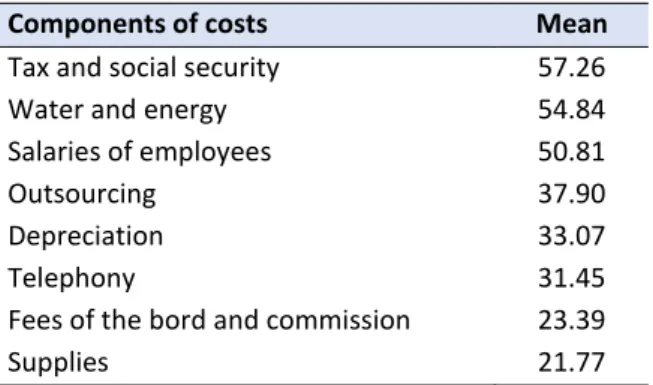
In order to know which expenses most influence the composition of the daily rates, as Leitão and Silva (2006) and Bernardi (1996) refer, the respondents classified the spending items, as shown in Table 6.
Table 6 – Components of costs in price formation
Components of costs Mean
Tax and social security 57.26
Water and energy 54.84
Salaries of employees 50.81
Outsourcing 37.90
Depreciation 33.07
Telephony 31.45
Fees of the bord and commission 23.39
Supplies 21.77
Source: Data Research
Table 6 shows the costs that most in-fluence the daily rates: tax and social security (57.26 percent), water and energy (54.84 percent), salaries (50.81 percent), outsourc-ing (37.90%), depreciation (33.07%), teleph-ony (31.45 percent), commission and board fees (23.39%) and supplies and consumables (21.77 percent).
These results agree with Mendes (2016), Vice President of Research and Trends of FOHB. He has stated, "The costs of energy, supplies, and the evident tax in-creases, as the charges in payroll, push the
145 Rev. Bras. Pesq. Tur. São Paulo, 11(1), pp. 133-153, jan./abr. 2017.
perience for guests .
The water and energy represent a high cost due to laundry and restaurant ser-vices, and the use of air conditioning, espe-cially in this region of high temperatures throughout the year.
Given that it is a service, the supplies and consumables have low impact on prices, while the revenue or board fees account for the expenses, not being suitable to the costs of the services (Vieira & Souza, 2005; Bruni, 2008; Silva & Lins, 2013).
It is important to point out that the system of calculation and allocation of costs is essential to the formation of prices, calcu-lation of the contribution margin and breake-ven point, as well as to the profits of the hotel company (Vieira & Souza, 2005).
The best price can decide the success or failure of the tourism establishment, be-cause it will attract and retain customers, and it is through the price that the establishment knows if the operation is profitable or not (Leitão & Silva, 2006).
5.2 Strategies for pricing
The hotel company that has the more information the more prepared it will be to face the challenges, and to react faster to competitors and to the pricing decision-mak-ing process (Steed & Gu, 2004; Cross, 1998). Pricing strategies entail competition, market and costs policies because in an highly competitive and innovative environ-ment, in which the customer is increasingly more demanding, the pricing is more related to the implications of the market than to the costs. However, from the cost analysis it is possible to set the prices and subsequently
submit them to the market (Collins & Parsa, 2006).
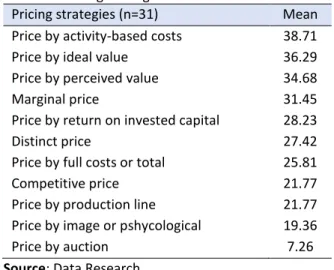
Table 7 shows the pricing strategies used by accommodation establishments, as indicated by the managers:
Table 7– Pricing strategies
Pricing strategies (n=31) Mean
Price by activity-based costs 38.71
Price by ideal value 36.29
Price by perceived value 34.68
Marginal price 31.45
Price by return on invested capital 28.23
Distinct price 27.42
Price by full costs or total 25.81
Competitive price 21.77
Price by production line 21.77
Price by image or pshycological 19.36
Price by auction 7.26
Source: Data Research
It can be seen in the table that the most common strategies for setting the daily rate is the "price by Activity-based Costs" (38.71 percent). The methodology Activity Based Costing (ABC) allows a better percep-tion of costs through analysis of the activi-ties performed by the company and their re-spective relations with the product, minimiz-ing distortions caused by "arbitrary indirect costs" apportionment used by traditional methods (Cardoso, 2011). The ABC also con-tributes to decisions related to the improve-ment of processes, services, products, cus-tomers and investments in new capacity, en-abling the establishment to fulfill its goals with greater efficiency, efficacy and effec-tiveness (Nakagawa, 2012), aiming at the maximum profitability of all sectors and of all its employees (Carvalho et al., 2004)
146 Rev. Bras. Pesq. Tur. São Paulo, 11(1), pp. 133-153, jan./abr. 2017.
strating that the hotel companies in São Luís are in line with the studies of Lu and Shiu (2011) and Santos et al. (2009), in so far as they seek to explain the satisfaction of guests in hotel products consumption from the eval-uation of structural and human components. In addition, many consider that pricing is the most important decision that the hotel panies need to make, since this task com-prises various formulas or methods of calcu-lation to get to the daily rate. The establish-ments must evaluate the best way to reach to this "number" and should adopt a strategy related to the price policy and a method of calculation, which is the practice, i.e., the ac-tivity held to establish the price to be negoti-ated (Martínez & Guillén, 2011; Lere, 1979).
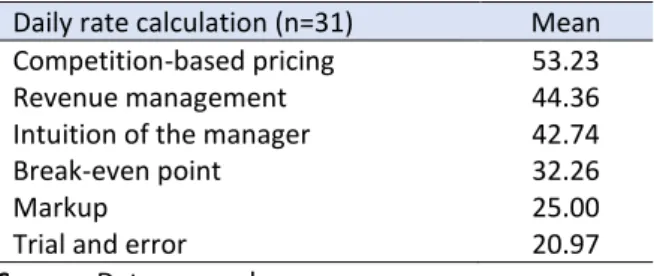
Table 8 identifies the level of use of calculation methods to get to the daily rate.
Table 8 – Daily rate calculation or method
Daily rate calculation (n=31) Mean Competition-based pricing 53.23
Revenue management 44.36
Intuition of the manager 42.74
Break-even point 32.26
Markup 25.00
Trial and error 20.97
Source: Data research
Table 8 above shows, according to the respondents, that most used method to set the daily rate is the "the price is fixed according to the price of competitors" (53.23 percent). Following appear the Revenue Management (RM), Intuition of the Manager, Price Calculation considering the Breakeven Point, Calculation of Markup. The less used is the price set by means of Trial and Error.
Strategies based o o petito s’
price are an empirical method (Cardoso, 2011) built upon the prices of rivals. These
should be used with great caution and care. If on one hand they allow a company to get a desired portion of the market and to increase the volume of sales in the short term, on the other hand, it can lead to inadequate prices and the gains achieved could be compen-sated quickly by competitors (Collins & Parsa, 2006). This method of pricing entails aspects related to the analysis of the prices of the ac-commodation establishments, copying their prices, aggressive pricing and offer of promo-tional prices (Kotler & Keller, 2012).
The RM method, or Yield Manage-ment, stands out as a method of administra-tion characterized by maximizing revenue through the effective and efficient manage-ment of demand and supply (Heo & Lee, 2011).
According to Aziz et al. (2011), in the hotel industry, the revenue management is committed to assist the tourism accommoda-tion establishment in determining the daily rate, maximizing the yield.
The methods based on the intuition of the Manager, also considered an empirical method (Cardoso, 2011), are characterized by the fact that the pricing comes from the
usi ess a age o the o e ’s k o ledge.
In this research, the method has some prominence given the fact that the sample has 65 percent of independent hotels, and this is a common practice in this type of management.
147 Rev. Bras. Pesq. Tur. São Paulo, 11(1), pp. 133-153, jan./abr. 2017.
the occupancy rate necessary to produce particular profit or daily rate that should be practiced (Vieira & Souza, 2005). This level of occupation is called break-even point; at this level of activity, the hotel will have no profit or loss (Lunkes, 2009).
The Markup is an index calculated on the total cost of a product or service for the formation of price, based on the idea of cost plus pricing or price margin, which is adding to the unit cost of the product, or service to a profit margin to get the sale price (Cogan, 2013). The determination of price markup on costs will have results only if the price markup really generate the expected level of sales (Kotler & Keller (2012).
It is noted that increasingly hotel
chains (national or international) are using formal or scientific methods and abandoning the informal or empirical ones (Cardoso, 2011). In addition, it is common practice cost-based pricing (calculation of Markup or Break-even Point), however it stands out that the rate is determined by market and competition analysis (Cogan, 2013; Pinto & Santos, 2012; Zong et al., 2008). It turns out that there is a rise of RM method. However, in the independent hotels, the use of informal methods still dominates, such as competition-based pricing, the intuition of the manager and, less use of trial and error to set the price, as shown in Table 9 – Pricing per type of hotel management.
Table 9 – Pricing per type of hotel management
Method used
Type of management Independent Internacional
Chain
National Chain
Markup 23.75
32.50 27.50 56.25 63.75 26.25
16.67 41.67 75.00 16.67 25.00 0.00
31.25 28.13 75.00 18.75 37.50 15.63 Break-even point
Revenue Management Intuition of the manager Competition-based pricing Trial and error
Source: Data Research
Based on the table above the National and International chains use more the RM to set the daily rate compared to Independent accommodation establishments. With a good use of the RM, the hotelier anticipates the sales prices in order to enhance profitability through a rate plan, taking into account the history of previous years, events and special occasions, anticipating the occupation and coming up with a coherent rate plan. This sys-tem gives greater confidence to hoteliers and proves that the revenue management is a viable alternative for corporations that wish
to remain and stand out in the national and international market (Boaria & Anjos, 2014).
149 Rev. Bras. Pesq. Tur. São Paulo, 11(1), pp. 133-153, jan./abr. 2017.
5 FINAL CONSIDERATIONS
Price is an element of the marketing mix that generates revenue and therefore should be planned to minimize the effects of the business environment, increas-ingly dynamic and threatening to companies. The features of the hotel enterprises are the provision of bed and food, but many offer also other aggregated services that will influ-ence the daily rate.
Hotel companies can use a variety of techniques and tools, from the manager's knowledge, to the costs of the services and the prices of the competition.
In this study, we verified a balance be-tween micro, small and large-sized compa-nies in the lodging industry in São Luís, as well as regarding the type of management, inde-pendent units, national and international chains.
As for cost strategies, the most used is the variable or direct method, as the national legislation recommends, though the majority also uses a second method of support, with emphasis to the absorption method and the ABC, to the formation of prices.
The study identified that the main costs influencing the daily rates are the ac-counts of Tax and Social Security, Water and Energy spending, Salaries (50.81 percent), Outsourcing (37.90 percent) and Deprecia-tion (33.07 percent).
The main strategies to price for-mation, the study verified, are the activity-based price (ABC), the price for ideal value, and the price for perceived value, while the most referred strategy for the calculation of daily rate was the based on competitors, fol-lowed by Revenue Management.
In conclusion, it appears that there is an effort of the management of the hotels in San Luís to make the calculation of daily rate more professional, using techniques more re-liable for making decision about prices, aban-doning the informal or empirical methods.
As limitation of research, we pinpoint that the definition of the prices in a competi-tive environment undergoes more pressure of the external environment and thus we sug-gest further research focusing on customers.
REFERENCES
ABIH - Associação Brasileira da Indústria Hote-leira. (2015). Relação de hotéis associados. Available: www.abih-ma.org.br. Accessed Jan. 15
Anjos, S. J. G. & Grigolo, L.C.A.(2013). O poder da informação no processo decisório do hotel. In. Tomelin, C. A.; Ruschmann D. V. D. M. (Orgs). Tu-rismo, ensino e práticas interdisciplinares. São Paulo: Manole.
Aziz, H. A., Saleh, M.; Rasmy, M. H.; Elshishiny, H. (2011). Dynamic room pricing model for hotel revenue management systems. Egyptian Infor-matics Journal, Cairo, n. 12, p. 177 – 183.
Batista, F.F., Silva, S.C.F., Silva, R.A.C., & Almeida, F.M.M. (2016). A contabilidade de custos como ferramenta gerencial em uma empresa hoteleira: estudo de caso aplicado no Hotel Vitória de Uba-poranga-MG. IX SEGeT - Simpósio de Excelencia em Gestão e Tecnologia, 2012. Available: <http://www.aedb.br/seget/arquivos/ arti-gos12/22716832.pdf> Accessed Sep., 2016
Becerra, M., Santaló, J., & Silva, R. (2013). Being better vs. being diferente: differentiantion, com-petition, and pricingn strategies in the Spanish hotel industry. Tourism Management, n. 34, p. 71
150 Rev. Bras. Pesq. Tur. São Paulo, 11(1), pp. 133-153, jan./abr. 2017.
Bernardi, L. A. (1996). Política e formação de preços: uma abordagem competitiva sistêmica e integrada. São Paulo: Atlas.
Bertoli Neto, L. (2013). Classificação hoteleira: uma exigência do mercado internacional de via-gens e turismo. In: Ruschman, D. V.; Tomelin, C. A. (Org.). Turismo, ensino e práticas interdiscipli-nares. Barueri, SP: Manone.
Boaria, F. & Anjos, S.J.G. (2014). Revenue Mana-gement a Gestão de Receitas na hotelaria em Foz do iGuaçu – PR. Revista Turismo - Visão e Ação- Eletrônica, v. 16, n.1, Jan.-Abr.
Brasil. (2015). Lei complementar nº 123, de 14 de dezembro de 2006. Institui o Estatuto Nacional da Microempresa e da Empresa de Pequeno Porte. Diário Oficial da República Federativa do Brasil. Brasília, DF, 14 dez. 2006. Availbale: http://www.in.gov.br. Accessed Sep. 7, 2015.
Bruni, A. L. (2008). A administração de custos, preços e lucros: com aplicação na hp12c e excel. 2. ed. São Paulo: Atlas.
Cardoso, J.F. (2011). Custos e preço de venda: um estudo em restaurantes à la carte. Revista Hospi-talidade, São Paulo, v. 8, n. 2, p. 103 – 120.
Carvalho, J. D. S. G.; Pedrosa Júnior, C.; Yoshitake, M.;& Paulo, E. Controle de custos aplicado ao se-tor hoteleiro. Fundação Visconde de Cairu, Salva-dor, p. 1 - 11, 2004.
Castillo, G. G. & Quintero, J. A. J. (2013). Retos es-tratégicos de la indústria hotelera española del si-glo xxi: horizonte 2020 em países emergentes.
Tourism & Management Studies, v. 9, n. 2, p. 13 – 20.
Cogan, S. (2013). Custos e formação de preços: análise e prática. São Paulo: Atlas.
Collins, M. & Parsa, H. G. (2006). Pricing strategies to maximize revenues in the lodging industry.
Hospitality Management, Columbus, n. 25, p. 91
– 107.
Costa, J. I. P. (1987). Marketing: noções básicas. Florianópolis: Imprensa Universitária, 1987.
Cross, R. G. (1998). Revenue management = ma- ximização de receitas: táticas radicais para domi-nar o mercado. Tradução de Caetano Manuel Fil-gueira Pimentel. Rio de Janeiro: Campus.
Dencker, A. F. M. (1998). Métodos e técnicas de pesquisa em turismo. São Paulo: Futura.
Duduche, K.; Costa, A. D.; Silva, A. J.; Igarashi, D. C. C.; & Góis, J. L. (2011). Custeio baseado em ati-vidade: proposta de implantação em uma em-presa hoteleira. Perspectivas Contemporâneas, Campo Mourão, v. 6, n. 2, p. 101 - 125, jul./dez.
Espinet, J. M.; Saez, M.; Coenders, G.; Fluvià, M. (2003). Effect on prices of the attributes of holi-day hotels: a hedonic prices approach. Tourism Economics, Catalan, v.9, n.2, p. 1 - 13.
Ferrando, O. R.; Prusaczyk, V. G.; & Tejera, L. N. (2012). Determinación de precios en la industria de la hotelería. Revista del instituto internacional de costos, Montivideu (Uruguay), p. 211 – 227. Edição especial XII Congresso.
Han, H. & Kim, Y. (2010). Intention to pay conven- tional - hotel prices at a green hotel – a modifica-tion of the theory of planned behavior. Journal of Sustainable Tourism, Busan, v. 18, n. 8, p. 997 – 1014.
151 Rev. Bras. Pesq. Tur. São Paulo, 11(1), pp. 133-153, jan./abr. 2017.
n. 30, p. 243 – 251.
Hung, W.T., Wang, F.C., & Shang, J.K. (2010). Pric-ing determinants in the hotel industry: Quantile regression analysis. International Journal of Hos-pitality Management, v.29, n.3, p.378-384, Set.
Kotler, P. & Keller, K. L. (2012). Administração de marketing. 14. ed. São Paulo: Person Education do Brasil.
Lage, B. H. G. & Milone, P.C. (2001). Economia do turismo. 7. ed. São Paulo: Atlas.
Leitão, C.R.S. & Silva, J.D.G. (2006). Utilização do custeio variável no gerenciamento de hotéis: uma pesquisa no setor hoteleiro no nordeste brasi-leiro. Revista Contabilidade Vista & Revista, v. 17, n.13, p. 25 - 43, jul./set.
Lere, J. C. (1979). Formação de preços: técnicas e práticas. Rio de Janeiro: Livros técnicos e científi-cos.
Lu, I.Y. & Shiu, J. Y. (2011). Decision-making framework of customer perception of value in Taiwanese spa hotels. Social behavior and per-sonality, Taiwan, v. 39. n. 9. p. 1183 – 1192.
Lunkes, R. J. (2009). Informações de custos: um estudo em empresas hoteleiras na cidade de Flo-rianópolis - SC. Turismo em análise, São Paulo, v. 20, n. 2, p. 345 – 368.
Martinez, S.C. & Guillén, M.J.Y. (2011). Los pre-cios de referencia en la evaluación online Del ser-vicio hotelero. Estudios de Economia Aplicada, v. 29, n. 3, p. 825 – 844.
Maurício, N. R.; Ramos, K. C. M. (2011). Gestão na hotelaria. Revista F@pciência, Apucarana- PR, v. 8, n. 11, p. 99 - 113.
Meira, J.V.S. (2012). A qualidade dos serviços na
hotelaria brasileira: uma avaliação das redes ho- teleiras sob a ótica de seus gestores. Dissertação de Mestrado. UNIVALI: Balneário Camboriu.
Mendes, P. (2016) Perspectivas de Desempenho da Hotelaria, Fórum de Operadores Hoteleiros do Brasil – FOB, Ed. 3, nov 2015. Available: <http://www.hosteltur.com.br/154200_ pers- pectivas-desempenho-da-hotelaria-fohb-aponta-revpar-66-maior-em-2016.html>. Accessed in September, 2016.
Mello, G. & Goldenstein, M. (2016). Perspectivas da hotelaria no Brasil, Turismo-BNDES Setorial 33, p. 5-42, Available in: <http://www.bndes.gov.br/ SiteBNDES/export/sites/default/bndes_pt/ Gale-
rias/Arquivos/conheci-mento/bnset/set3301.pdf.> Accessed Septem-ber, 2016
MTUR – Ministério do Turismo. (2010) Segmenta- ção do turismo e o mercado. Brasília: Ministério
do Turismo. Availbale:
<http://www.turismo.gov.br> Accessed in July, 2015.
Nakagawa, M. (2012). ABC: custeio baseado em atividade. 2. ed. São Paulo: Atlas.
Oliveira, G.B. & Spena, R. (2012). Serviços em ho-telaria. Rio de Janeiro: Senac Nacional.
Parolin, C. F. (2014). Revenue management: es-tudo de caso do gerenciamento de receitas em uma rede hoteleira. Cultur, Florianopolis, v. 8, n. 1.
Petrocchi, M. (2007). Hotelaria: planejamento e gestão. 2. ed. São Paulo: Pearson Prentice Hall.
152 Rev. Bras. Pesq. Tur. São Paulo, 11(1), pp. 133-153, jan./abr. 2017.
Porto, G. (2014). Formação e gestão de preços. Rio de Janeiro: Editora FGV.
Planagumà, L. P. & Julve, J. G. (2012). Gestión de precios en un sistema de revenue management hotelero en línea. Revista de Turismo y Patrimo-nio Cultural, Girona (España). v. 10, n. 5, p. 511 – 520.
Ricci, G.L. (2011). Estudo sobre as especificidades das pequenas e médias empresas hoteleiras da região central do estado de São Paulo. XXXI En-contro Nacional de Engenharia de Produção. Belo Horizonte, MG, Brasil, 04 a 07 de outubro, p.01-15.
Roim, T.P.B. & Pereira, J.I.M. (2012). A classifica-ção hoteleira e sua importância para a qualidade dos serviços prestados pelos meios de hospeda-gem. Revista Científica Eletrônica de Turismo, Garça, SP: n. 17.
Santos, G.E.O.; Vassallo, M.D.;& Rabahy, W.A. (2009). Determinantes do valor percebido e da in-tenção de retorno no turismo receptor brasileiro.
Revista Brasileira de Pesquisa em Turismo, v. 3, n. 3, p. 34 - 56.
Schütze, J. (2008). Pricing strategies for perisha-ble products: the case of Vienna and the hotel res-ervation system hrs. com. Springer-Verlag, Graz, n. 8.
Schwartz, Z. (2008). Time, Price, and Advanced Booking of Hotel Rooms. International Journal of Hospitality & Tourism Administration, Cham-paign, v. 9, n. 2, p. 128 – 146.
Silva, R.N.S. & Lins, L.S. (2013). Gestão de Custos: contabilidade, controle e análise. São Paulo: Atlas.
Souza, E.C., Meira, J.V.S., & Maske, D.C. (2012). A Medição da Qualidade dos Serviços Prestados em
Hotéis de Balneário Camboriú, SC: Uma Aplicação do Modelo SERVQUAL. Revista Rosa dos Ventos, 4(IV), p.544-555, out-dez.
Steed, E. & Gu, Z. (2004). An examination of hotel roon pricing methods: pratised and proposed.
Journal of Revenue and Pricing Management, Ce-dar City, v. 3, n.4, p. 369 – 379.
Toni, D. De., Mazzon, J. A. (2011). Configuração da Imagem de Preço de Produto: Proposição e Teste de um Modelo Teórico e Escala para a Men-suração da Imagem de Preço de Produto (E-MIPP). Anais..., EnANPAD
Tomazzoni, E. L.; Bittencourt, R. (2013). Análise das Ferramentas de Gestão Estratégica de Hote-laria Familiar: estudo de quatro organizações da região turística da Serra Gaúcha. Turismo em Análise, São Paulo, v. 24, n. 1, p. 65 - 89, abr.
Vieira, W. Q. & Souza, M. J. B. (2005). Gestão de custos nos hotéis de lazer da região sul do Brasil.
Turismo: visão e ação, Itajaí, v. 7, n. 3 p. 427 – 438.
Ye, Z.Z.Q. & Law, R., & Zhang, Z. (2011). Determi-nants of hotel room price. International Journal of Contemporary Hospitality Management, v. 23, n. 7, p. 972 – 981.
Zanella, L.C. (2001). Administração de custos em hotelaria. 2. ed. Caxias do Sul: EDUCS.
Zong, J.; Tang, F-F.; & Huang, J. M. (2008). Online pricing dispersion of Chinese Hotels. Journal of China Tourism Research, Pequim, n. 4, p. 248 - 260.
WTTC-World Travel & Tourism Council. (2014).
Brazil is leading the travel & tourism economy in
Latin America. Available:
153 Rev. Bras. Pesq. Tur. São Paulo, 11(1), pp. 133-153, jan./abr. 2017.
_______________
Information on the authors
Mauro Santos
Maste ’s deg ee i Tou is a d Hospitalit , Post-graduate Program in Tourism and Hospitality, Univali and Federal Institute of Maranhão. Pro-fessor at University Center of Maranhão - UniCEUMA. Email: [email protected]
Luiz Carlos da Silva Flores
PhD in Production Engineering, Professor in the Postgraduate Program in Tourism and Hospital-ity, MA and PhD levels. University of Vale do Itajaí
– UNIVALI – Balneário Camboriú/SC. Email: