Resumo
O objetivo do artigo é propor uma reinterpretação do tradicional efeito flypaper, fenômeno que ocorre quando as transferências do governo central para os governos locais aumentam o gasto público mais do que aumentos na renda privada. Aqui as transferências mais altas podem induzir menor eficiência na coleta de impostos do que os aumentos na renda. Inicialmente construímos um modelo que aponta a possibilidade de existência de efeito flypaper no contexto de um modelo de maximização padrão por parte dos governos locais. Depois construímosscores de eficiência para os municípios brasileiros usando Free Disposable Hull (FDH), levando em consideração dois produtos: a quantidade de impostosper capita
coletados localmente – receita tributária – e o tamanho da economia informal – base tributária. Final-mente, usando mínimos quadrados dois estágios e regressões Tobit, em que o instrumento é construído a partir das regras de cálculo das transferências não condicionais estabelecidas na Constituição de 1988, e onde encontramos evidência de que as transferências têm o efeito oposto (negativo) ao da renda sobre a eficiência na taxação, chegou-se à reinterpretação do efeito flypaper.
Palavras-Chave
efeito flypaper, eficiência, coleta de impostos Abstract
The purpose of this article is to propose a reinterpretation of the traditionalflypaper effect according to which central government transfers to local governments increase public spending by more than do increases in private income. Here, higher transfers from the federal government might induce less ef-ficiency in local tax collection opposed to the income effect. Initially, we build a model in order to point out the possible existence of that flypaper effect in a context of standard maximization on the part of local governments. Next, we construct efficiency scores for Brazilian municipalities using Free Disposable Hull (FDH), taking into consideration two outputs: amount of per capita local tax collected -tax revenue- and the size of local informal economy - tax base. Last, using two stages least squares and Tobit regressions, which the instruments is built upon the rules established in the 1988 Brazilian Constitution and where we find that unconditional transfer funds to municipalities, we estimate that transfers have the opposite effect (negative) of consumer’s income on efficiency of taxation, which leads us to a reinterpretation of the flypaper effect.
Keywords
flypaper effect, efficiency, tax collection
JEL Classiication H20, H21, C67, C14 Enlinson Mattos Fabiana rocha Paulo arvate
Artigo recebido em março de 2010 e aceito para publicação em março de 2011.
Professor Adjunto da Escola de Economia de São Paulo/CEPESP - Fundação Getúlio Vargas - Endereço
q para contato: Rua Itapeva, 474 Bela Vista- São Paulo - CEP: 01332-000 - Email: enlinson.mattos@ fgv.br
Professora Titular do Departamento de Economia - Universidade de São Paulo - Endereço para contato:
AAv. Prof. Luciano Gualberto,908 - Cid. Universitária - São Paulo - CEP: 05508-010 - E:mail: [email protected]
Professor Doutor Escola de Administração de Empresas - Fundação Getúlio Vargas - Endereço para
Introduction
The difference between effects of consumer’s incomes and intergovernmental trans� fers on public expenditure, the flypaper effect, is extensive ((Hines and THaler (1995)), however the literature has dedicated modest attention to the response of subnational governments in terms of tax collection. an exception is Hamilton (1986), who demonstrates that the deadweight loss from taxation can be a possible cause of the empirically observed flypaper effect.
nevertheless, efficiency in tax collection is particularly relevant in a context of fis� cal federalism. Given the vertical imbalances, local governments receive transfers from higher levels of the government in order to match their revenues and spending ((eicHenGreen and von HaGen (1996)). These transfers enable local govern�)). These transfers enable local govern� ments to provide the same level of public services while reducing the tax burden on local voters. However, they may also decrease the efficiency of tax collection due to their direct impact on the allocation of resources used to collect tax (defined as inputs) and their direct impact on tax revenue and tax base (output).
The purpose of this paper is to investigate the effect of intergovernmental trans� fers as compared to consumer’s income (flypaper effect) on the efficiency of tax collection for 3,335 Brazilian municipalities in 2004. in order to do so we initially extend Hamilton’s model by allowing for a tax collection function as a mechanism to gather tax revenue. The model points out the possible existence of the flypaper effect in a context of standard maximization on the part of local governments, which reinforces that its magnitude is an empirical dispute.
next, we construct relative efficiency scores in tax collection for each municipality. it is possible to rank the (relative) efficiency of tax collection comparing the fiscal performance of each municipality with a tax frontier. We take into consideration two outputs and two inputs. in terms of output, we measure revenue collection by the amount of per capita local tax collected and the availability of tax base by the proportion of workers in the local formal economy. as inputs, we use per capita capital investments accumulated and depreciated by the rate of 3% and the number of workers in direct or indirect local public administration divided by the popula� tion. Finally, we establish the relationship between the efficiency scores, transfers and income.
but an econometric artifact (there is no “fiscal illusion”), we also test alternative specifications in order to avoid possible misspecification biases.
The results suggest that federal transfers to municipalities negatively affect the efficiency scores while consumer’s income has the opposite effect. This leads to a reinterpretation of the traditional flypaper effect, which establishes that elevates in transfers increase public spending more than do increases in private income. according to our results, higher transfers from the federal government might in fact induce less efficiency in local tax collection as compared to increases in private income.
The paper is organized into four sections, being the first of it this introduction; the second section lays out a simple model that restates the flypaper effect in terms of efficiency of taxation, and not in terms of expenditure levels; the third section presents the empirical implementation. it introduces the estimation methodology, provides the rationale for the construction of the instrumental variable, and pre� sents the data and the results for the relative efficiency scores; the fourth section discusses the empirical estimates of the flypaper effect and presents the decom� position of the flypaper effect on tax collection units, inputs and outputs; the fifth section concludes this paper.
2 The Flypaper Effect Revisited - A Simple Model
This paper recognizes that intergovernmental transfers are determined through a political process and that grant receipts are an outcome of the underlying preferen� ces of the elected representatives. The bargaining process can be formally reduced to two stages. First, there exists a “federal budgetary stage” which determines how to distribute an exogenous budget across municipalities. The second stage considers the intergovernmental grant as given, and it consists in allocating these federal grants and private income between public and private consumption. since the first stage is the political process which is being instrumented in our setup and which is described below, we only discuss here that the correlation between preferences for the public good and grant receipts can be positive, which invalidates the direct use of these transfers in the regression analyses. Those transfers might be correla� ted with unobservable political variables ((Baron and FerejoHn (1987, 1989), Pereira (1996), Grossman (1994), KniGHT (2002)).
cause of the flypaper effect and postulates that grants allow for lower local taxes. This extension seems a reasonable strategy because the main assumption here is that only local taxation is distortionary, and that it is this effect that local pressure groups attempt to circumvent. at this point, it is necessary to define the concept of relative efficiency.
Definition 1: A local government is defined as relatively efficient if either there is no other local government that uses the same amount of (or less) input to produce more outputs or that produces the same amount of (or more) outputs with less use of inputs. Otherwise, that local government is considered inefficient and the degree of efficiency (φ) is calculated by taking into consideration the output distance between the efficient and inefficient unity.
Formally, consider an economy with a composite good (x), a locally provided public service (G), and a representative agent.1
The representative agent maximizes the following utility function:
) , (x G
U (1)
Following Hamilton (1986), we assume that local taxes are distortionary.
The individual’s budget constraint can be written as:
) (T g x
y≥ + (2)
where y is real income and g(T) represents the shadow cost of local taxes in terms of private consumption with the following properties: i) g(0)=0, ii) g´(T)>1, and iii) g´´(T)>0if T > 0.2
The government’s budget constraint contains two sources of revenues, T, which is the revenue from local taxes and t, an intergovernmental grant. The budget con� straint is, therefore,
G
t
T
+
≥
(3)1 if we assume a majority voting process for determining public good (G), the outcome of this process reflects the demand of the median voter (Gm). With slight modification in the model, one can obtain the same results.
We also assume that the household utility function is smooth and strongly quasi-concave, which is increasing in both of its arguments (y�g(T) and T+t). after subs� tituting for both constraints, we can rewrite the utility function of the household as:
(
( ),
)
U
=
U y
−
g T T
+
t
(4)it should be mentioned that the government aims at maximizing the utility func� tion of the representative household and that its choice variable is T, which allows characterizing the solution of the local government as:
-
U
1g
´(
T
)
+
U
2=
0
(5)a formal statement of the flypaper effect is that the marginal public expenditure due to a grant (
dG dt
/
= +
1
dT dt
/
) is greater than the marginal public expenditure arising from an equivalent increase in total community income (dG dy/ =dT dy/ ).We assume that the amount of taxes collected is a function of the inputs used to that end. specifically, that depends on how much capital (K) and labor (l) is em� ployed to collect revenues for the government and how efficient these resources are put together (φ):
( , , ) i i i i
T = f K L φ (6)
Where i =1,…,n corresponds to the number of municipalities in Brazil and φi is a parameter that captures how efficient these inputs are combined to collect revenues.
consider the total differentiation (omitting the subscripts on K and l),
(7)
equation (7) reveals that in order to compensate for an increase in local taxes, the municipalities can i) increase efficiency ( ) or ii) increase the capital or labor level, which is the size of the local government whose objective is to collect tax revenue ([f dKK + f dLL ]). The government’s size to collect tax revenue (capital and
allocated to auditing, or to decrease investments that can help in the tax collection such as electronic tax payment system and record which connects their database with their counterparts in different spheres of the government.
To consider the partial effect of a change in the amount of transfer (t), and the amount of own income (y), on the efficiency scores, totally differentiate equation (5) and use equation (7) to obtain:
12 22 2
11 1 12 22
´
[ ´ ´´ 2 ´ ]
i
d U g U
dt U g U g U g U fφ φ φ − = − − + (8) 11 12 2
11 1 12 22
´
[ ´ ´´ 2 ´ ]
i
d U g U
dy U g U g U g U fφ
φ
φ −
=
− − + (9)
The “revisited flypaper effect” on the efficiency score is the result of:
(10)
which is the difference between the transfer effect and the income effect on the efficiency of tax collection. The denominator of equation (10) is negative since it is the second derivative of the government’s maximization condition using its cor� respondent budget constraint and the term is positive. Therefore, the final effect can be positive or negative depending on the relative sign of
(
U g U
12´
−
22)
and11 12
(
U g U
´
−
). in order to have a negative flypaper effect on efficiency scores, that is, equation (10) lower than zero, a sufficient condition is (U g U12 ´− 22) (− U g U11 ´− 12)>0. since the second term of the numerator (U g U11 ´− 12) is negative, once it is assumed that the public good is normal (dG/dy>0) (leads equation (9) to be positive), this is equivalent to having either a positive or low negative value for the term12 22
(U g U´− ). in par ticu lar, a suff icient cond ition can be written as
12 22 11 12 (U g U´− ) < (U g U´− )
.3
This means a lower effect, in absolute terms, on efficiency scores of grants than that one caused by income variation. This is what we label new flypaper effect, that
is, the difference in the effect of transfers on tax collection efficiency compared to the standard effect of transfers on spending.
3 Empirical Implementation
3.1 Setting the Empirical Procedure
The empirical procedure involves two stages:
The goal of the first stage is to construct a tax frontier. it is similar to a production frontier in the firm’s problem of producing output where the government’s output is taxes. in other terms, the idea is to measure the “wastefulness” of taxation.
as observed by alfirman (2003), the difference between the fiscal frontier and current taxation cannot be considered strictly as a measure of inefficiency, repre� senting in fact the level of unused tax potential. Given that the existence of unused tax potential may also be caused by the preference of municipalities’ residents (they voluntarily prefer a low provision of public goods and services), inefficiency is only part of the story. We totally agree with this argument, but since we cannot determine the sources of the level of unused tax potential, we will treat the whole thing as coming from inefficiency.
in a frontier framework it is possible to rank the efficiency of tax collection by comparing the fiscal performance of each municipality with a tax frontier (fiscal potential). along with the tax frontier, the highest possible level of output (revenue collection) is observed for a given level of input. conversely, it is possible to deter� mine the lowest level of input necessary to attain a given level of output. This way, it is possible to identify inefficient procedures in terms of input efficiency and in terms of output efficiency. The goal of the second stage is to identify the vari� ables correlated with the inefficiency scores.4 more precisely, we try to determine which characteristics of the municipalities explain the high degree of heterogeneity observed in the scores.
The following tax collection efficiency function is estimated:
1 2
i o i i i
EffScore =β +βTransfers +β Income +γControls+ε (11)
where
Effscore
i corresponds to the computed efficiency score for municipality i.,i
Transfers
is our variable of interest and measures the amount of transfers received by municipality i.,Income
i is the per capita income of that municipality, andi
Controls
represents a vector of other exogenous variables that are believed to explain the technology or preferences involved in determining (relative) efficiency.The local government, however, may have incentives to collect less revenue from its own sources in order to receive higher transfers, or at least it can be less efficient in tax collection if that action can imply higher grant receipts. This is a typical endo� geneity problem in econometrics and we attempt to solve it by building an instru� mental variable. This variable must be correlated with tax collection efficiency only through the instrumented variable, and not with the residuals. This identification strategy is also attractive because of the possible selection on “unobservables”, i.e., a municipality may be receiving a specific amount of transfers due to political power and groups of interest which are not observed by the researcher. The construction of the instrument aims to eliminate these biases.
3.2 The Instrumental Variable
The Brazilian municipalities can decide upon fines, exemptions and tax rates on two specific taxes in Brazil: the service tax (iss) and the residential property tax (iPTU). another source of revenues is the intergovernmental transfers that could come from the state and federal spheres.
Brazilian municipalities in fact depend heavily on transfers as a source of revenues. according to the Government Finance statistics Yearbook, imF, 2003, tax revenues average only 24% of total revenue for Brazilian municipalities. This large share of transfers received by Brazilian municipal governments led shah (1994, p. 42) to argue that
“municipal governments in Brazil (...) should be the envy of all [local] governments in developing, as well as in industrial countries”.
through the federal income tax and a federal tax on industrialized products (con� sumer tax). in general terms, the mPF has two formulas to supply funds. First, it is related to state capitals and countryside. considering that the new constitution (1988) preserved the law number 5172 (1966), the mPF resources go 10% to the state capitals, 86.4% to the countryside municipalities and the remainder is shared among the countryside municipalities with more than 142,633 inhabitants. The coefficient of each state capital is determined through the product of two factors: a population factor (coefficients from 2 to 5) and a per capita income factor (coef� ficients from 0.4 to 2.5). The first factor considers the share of the population of a specific capital city compared to the sum of the population of all capital cities. The larger the population share of the capital city, the larger the factor. When the popu� lation share is 4.5% or higher, the population factor is set to 5. accordingly, the per capita factor is the inverse of the fraction between municipalities’ per capita income and Brazil’s per capita income, in percentage terms. This number can go as high as 2.5%. For the countryside municipalities, there is a fixed coefficient depending on population and the state in which the city is located. For those countryside municipalities with more than 142,633 inhabitants there is still 3.6% of the mPF to be divided according to similar criteria established for state capitals. The rest of residuals is distributed according to a formula established in 1989 (complementary law number 62) that takes into consideration the population (0.6 to 4 � from less than 10,188 habitants to more than 156,216 habitants).
The actual transfer of resources from one sphere of government to another, how� ever, is the result of either political dissatisfaction with the current rule of distri� bution or take into account the change in the variables used in the redistribution criteria over time. since the level of population and per capita income are adjusted annually for Brazilian municipalities, the coefficients of redistribution among mu� nicipalities adjust as well.5
The problem is that these two variables (population and per capita income) can be correlated with unobservable variables, and as a consequence, with the decision of tax collection. in particular, if the change in these two variables implies a decrease in the transfers received by a particular municipality, it can claim an attenuation of its loss. Depending on its political status, it can obtain a different formula for adjustment.
Therefore, a municipality whose population decreased (increased) does not necessa� rily have its participation in the transfer funds automatically decreased (increased)
proportionally. There is an ongoing process of bargain based on the municipality’s political status after which attenuation coefficients are applied. after that, muni� cipalities can still complain and negotiate their redistributive grants until 30 days after the final publication of those data. last, even municipalities with similar population and income per capita might have different coefficients because they belong to different states. Given that the “rules” used to transfer resources from the states and central government to the municipalities change constantly, these diffe� rent rules render the use of unconditional transfers as instrument endogenous.6
This way it is necessary to find an instrumental variable that is associated with tax collection efficiency only through transfer, but not caused by the efficiency in tax collection, and that still captures unobservable effects.
We use the coefficients established in the rule of transfers described above to build our instrument. This way, we have a different distribution of transfers from the one generated by the rule in place in 2004, which allows us to eliminate the contemporaneous bias. Two reasons justify this as a valid instrument: i) The rule of distribution was legally defined, and so is definitely exogenous;7 ii) The rule of distribution was initially established several years ago and has been changed often, as discussed before. Therefore, it is reasonable to assume that the stock effect has been reduced.8
The instrument is built as follows. First, we collect data on federal government revenues that come mostly from two taxes in 2004: income tax and a tax on in�
6 Becker (1996) uses the amount of unconditional transfers to each unit as an instrument for to� tal grants. Knight (2002) chooses one instrument based on the political power of congressional delegations to account for the exogenous part of grants variation related to highway spending in the U.s. However, his strategy has some drawbacks. in particular, if delegates typically serve in committees according to their preferences, this may not be exogenous to highway spending. a second instrument is the proportion of state representatives in the majority party. Given that the majority party is the same during a long period of time, this is clearly a variable that captures preferences of the voters in the state. in any case, the F�test for the instrumental variable is very low and the instrumental variables have different signs depending on whether they are measured at the House or at the senate level. Gordon (2004) applies the underlying change in the data used as criteria to transfer grants as instrument to identify the causal effect of intergovernmen� tal transfers. in particular, she uses the updated data given in 1990 census, which in turn leads to a discontinuous change in the grants distributed across municipalities. To some extent, her identification strategy resembles the one used in this paper. The census�determined change in grants from 1980 to 1990 can be instrumented by the change in the number of children and poor children in each district in that period. However, the use of updated variables is problematic when the updating process is known beforehand. The consequences in terms of grant payments can be taken into consideration on the part of the communities. This reduces the statistical advantages of a sharp discontinuity in the data as discussed in the paper.
7 For instance, Blundell, Duncan and meghir (1998) use tax reform in the U.s. as an exogenous instrument for marginal tax variation among individuals. see also Hausman and Poterba (1987) for a discussion on this topic.
dustrialized products; next, we multiply this amount by 22.5% to find the amount to be distributed to the municipalities in 2004;9 last, we multiply the resulting amount by the individual coefficients explained above to obtain the specific amount of transfers to each municipality. This amount corresponds to the instrument for transfer and we label it Transfers from rule (TFr).
3.3 Data and Efficiency Scores
in order to calculate the efficiency scores, we use two inputs defined as capital and labor.10 Percapita capital investments from 1980 to 2004 accumulated and depre� ciated by the rate of 3% are used as a proxy for capital (K).11,12 labor is calculated using the number of workers in direct or indirect local public administration divi� ded by the population in 2004.
The outputs are the amount of tax collected per capita and proportion of formal workers in the local economy.We dispute that the objective of tax administrator is not restricted to tax collection, and that it should also include availability of tax ba� ses. There is a cost related to determination of tax base as well as policies that can tax these bases. The reduction of informal workers might decrease auditing costs. if the local governments only want to increase taxes, they can do so by imposing higher tax rates on those that already pay taxes. However, these individuals might have an incentive to misreport income/wealth/transactions after this increase in taxes since they already pay enough taxes, which in turn raises the auditing costs. eventually, this policy could even cause future electoral loss on the incumbents. a much more efficient alternative would be to design a policy where everyone pays taxes with a smaller tax rate. Given that the tax rates would be lower, given tax revenues the local government would have less auditing costs what could be welfare�enhancing.13
9 constitutional reform n. 55/07 increased the amount transferred in 1% what makes the original amount 22.5%.
10 in a previous version of this paper, total municipal expenditures per capita are also used as input. The results are available upon request.
11 We have tested alternative rates of depreciation ( 5% and 8%), and the results were similar. 12 There is a distinction between formal (clT) and informal workers in Brazil. The informal
workers do not have the legal right of job tenure. We could say that their job tenure is more precarious than that of formal workers. The expression ‘clT’ has its origin in law 5452 of may of 1943, entitled the consolidation of labor laws (clT in Portuguese). This law establishes the rules of labor relations in the private sector. The data used to build the variable tax collection was taken from ipeadata (2004). The variable that captures informality (inf) is taken from the censUs (2000), for instance, see Bajada (2002) and Giles and caragata (1998).
These variables allow us to calculate input and output relative efficiency scores whose range goes from 0 to 1. every municipality on the production possibility frontier receives the maximum score 1. For instance, the input efficiency score indicates how much less input a municipality can use to obtain the same level of output of the efficient municipality. similarly, the output efficiency score indicates how much more output could be produced (if the municipality were in the produc� tion frontier) given the level of its inputs.
This paper employs Free Disposable Hull (FDH) methodology.14 in public sector applications, particularly the evaluation of local government efficiency, most studies use nonparametric techniques such as Data envelopment analysis (Dea) or Free Disposable Hull (FDH).
For instance, from the spending side, Gupta and verhoeven (2001) use FDH to evaluate the efficiency of public spending on education and health for 37 african countries. afonso, schuknecht and Tanzi (2005) analyze the public efficiency of ocDe countries also using FDH. sousa, cribari�neto and stosic (2005) apply a Dea approach to measure expenditure efficiency of Brazilian municipalities.
on the other hand, from the revenue side, Thirtle et al. (2000) use Dea to mea� sure tax efficiency in 15 indian states. Forund et al. (2005) evaluate the perfor� mance of local taxes offices of norway using Dea. Barros (2007) analyses the technical and allocative efficiency of tax offices in lisbon also using Dea, while Katharaki and Tsakas (2010) do the same for Greek tax offices. sousa, araújo and Tannuri�Pianto (2009) use Dea and FDH to calculate efficiency taxation scores for Brazilian municipalities.
The major advantage of FDH is that it imposes only weak assumptions on the pro� duction technology but still allows for comparison of efficiency levels among pro� ducers. The production set is not necessarily convex. That guarantees the existence of a continuous FDH which is going to be used as a dependent variable to identify the best practices in government tax collection, that is, to assess what determines (relative) efficiency. Besides, this methodology allows the detection of the most obvious cases of inefficiency since for each municipality classified as inefficient at least another municipality with better performance can be found in the sample.
There are, however, some drawbacks. First, is the possibility of efficiency by de� fault, that is, the labeling of a municipality as efficient simply because there are not enough similar municipalities for comparison. Therefore, the ranking of efficiency reflects a lack of information that would allow adequate comparisons instead of effective superiority. second, is the presence of outliers. several approaches are available to deal with this problem, for example, descriptive methods (Wilson (1993, 1995)) and the order�m approach (simar (2003)). However, they require that the data be handled in great extent manually what is complicated given the great number of municipalities that must be analyzed. Besides, given the output complexity and the different environmental conditions faced by municipalities, the possibility of biased estimates of the frontier still remains.
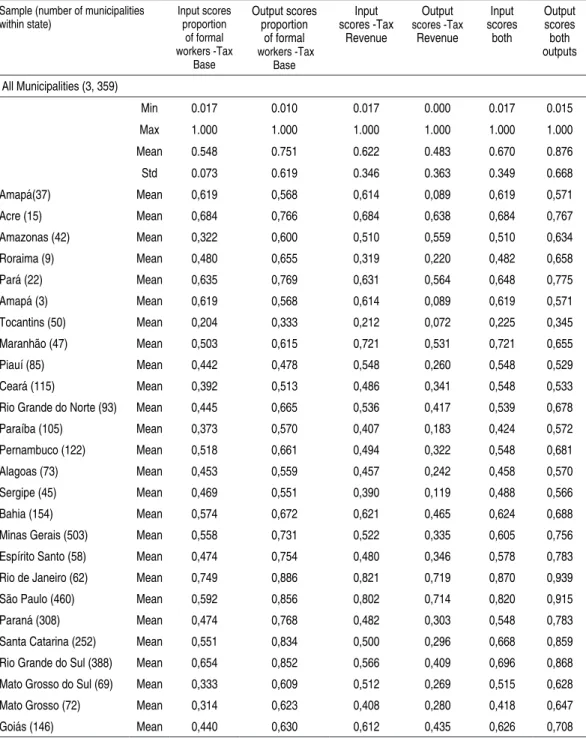
We claim that by using such structure, it is possible to exclude the tax price effect on tax collection determinants. suppose that we want to find out the determinants of tax collection in two different municipalities. one of them spends twice as much on tax collection activities as the other. if the two municipalities are similar in their characteristics, we expect to have the double amount of revenue collected in the municipality whose expenditure in tax collection is higher. That unit can audit more; can spend more money in training the auditors etc. We must take into consideration the cost/effort to collect tax in the municipalities in order to com� pute the determinants of tax collection. The cost to collect tax is the price paid to generate tax revenue and availability of tax base. By using the FDH methodology, we ‘rank the municipalities’ tax collection activity considering their input (price). The results are summarized in Table 2.15
Table 2 - Relative Efficiency Scores
Sample (number of municipalities within state) Input scores proportion of formal workers -Tax Base Output scores proportion of formal workers -Tax Base Input scores -Tax Revenue Output scores -Tax Revenue Input scores both Output scores both outputs
All Municipalities (3, 359)
Min 0.017 0.010 0.017 0.000 0.017 0.015
Max 1.000 1.000 1.000 1.000 1.000 1.000
Mean 0.548 0.751 0.622 0.483 0.670 0.876
Std 0.073 0.619 0.346 0.363 0.349 0.668
Amapá(37) Mean 0,619 0,568 0,614 0,089 0,619 0,571
Acre (15) Mean 0,684 0,766 0,684 0,638 0,684 0,767
Amazonas (42) Mean 0,322 0,600 0,510 0,559 0,510 0,634
Roraima (9) Mean 0,480 0,655 0,319 0,220 0,482 0,658
Pará (22) Mean 0,635 0,769 0,631 0,564 0,648 0,775
Amapá (3) Mean 0,619 0,568 0,614 0,089 0,619 0,571
Tocantins (50) Mean 0,204 0,333 0,212 0,072 0,225 0,345
Maranhão (47) Mean 0,503 0,615 0,721 0,531 0,721 0,655
Piauí (85) Mean 0,442 0,478 0,548 0,260 0,548 0,529
Ceará (115) Mean 0,392 0,513 0,486 0,341 0,548 0,533
Rio Grande do Norte (93) Mean 0,445 0,665 0,536 0,417 0,539 0,678
Paraíba (105) Mean 0,373 0,570 0,407 0,183 0,424 0,572
Pernambuco (122) Mean 0,518 0,661 0,494 0,322 0,548 0,681
Alagoas (73) Mean 0,453 0,559 0,457 0,242 0,458 0,570
Sergipe (45) Mean 0,469 0,551 0,390 0,119 0,488 0,566
Bahia (154) Mean 0,574 0,672 0,621 0,465 0,624 0,688
Minas Gerais (503) Mean 0,558 0,731 0,522 0,335 0,605 0,756
Espírito Santo (58) Mean 0,474 0,754 0,480 0,346 0,578 0,783
Rio de Janeiro (62) Mean 0,749 0,886 0,821 0,719 0,870 0,939
São Paulo (460) Mean 0,592 0,856 0,802 0,714 0,820 0,915
Paraná (308) Mean 0,474 0,768 0,482 0,303 0,548 0,783
Santa Catarina (252) Mean 0,551 0,834 0,500 0,296 0,668 0,859
Rio Grande do Sul (388) Mean 0,654 0,852 0,566 0,409 0,696 0,868
Mato Grosso do Sul (69) Mean 0,333 0,609 0,512 0,269 0,515 0,628
Mato Grosso (72) Mean 0,314 0,623 0,408 0,280 0,418 0,647
Goiás (146) Mean 0,440 0,630 0,612 0,435 0,626 0,708
cities include their capital city as one of them. The state of são Paulo, the richest and most developed one, has 25 cities classified as efficient, while rio Grande do sul has 18 and santa catarina 15. in most cases, when states of the southeast/ south region have an efficient city, that one is the capital city, (approximately 70%). Piauí, the poorest state in Brazil, has no efficient city while maranhão, the second poorest, has two, and one of them is the capital city, são luís.
The results also indicate that 95 municipalities present at least one type of effi� ciency (input or output for the three different outputs: tax collection, tax base or both). almost 15% (13 out of 95) are state capitals. other municipalities such as manacapuru (amazonas), rorainópolis (roraima), Bacabal (maranhão), vila velha (espírito santo) and são joão de miriti (rio de janeiro) are also efficient in all criteria.
The variables of interest are intergovernmental transfers to the municipalities and consumer’s income. according to our theoretical model (equation 10) it could be the case that the higher these transfers, the higher the level of inefficiency com� pared to the effect of consumer’s income. a negative sign of transfers and/or an effect lower than the counterpart income effect would imply that municipalities are revenue�dependent on central and state government assistance. if this is the case, the central government should design a new transfer policy that would induce municipalities to increase efficiency and use all their tax potential, reducing this perverse flypaper effect to a minimum.
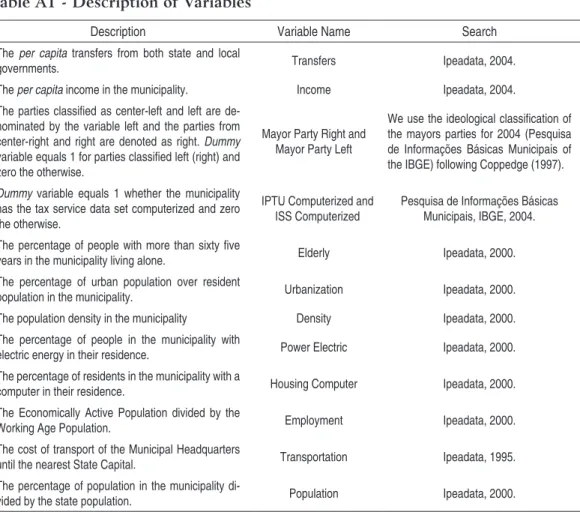
The control variables aim to capture specific characteristics of the municipalities such as technology, economic and social characteristics, and fiscal indicators. We also include the ideology of mayors and municipal groups of interest.16 The sources and descriptive statistics of the data are provided in the Appendix (Table a1 and a2).17
16 a branch of the political economy literature aims to show that a group of citizens lobby for go� vernmental actions to benefit their members (olson (1965), PelTzman (1976) and BecKer (1983)). The incorporation of political institutions into models of local government was perfor� med primarily by romer and rosenthal (1980, 1982), Filimon, romer, and rosenthal (1982), courant, Gramlich and rubinfield (1979). These papers propose an agenda�setter model, whe� re budget�maximizing bureaucrats set the agenda for local spending referenda. voters usually choose a high level of spending due to the binary (high or low) menu of choices proposed by the bureaucrats.
4 Empirical Estimates of the Flypaper Effect
4.1 Results
as observed before, the main problem with estimating equation (11) concerns the endogeneity of the level of transfers received by each municipality. municipalities with low revenue collection and low tax bases could receive a higher level of trans� fers from the central government, and have the incentives to do so.
in the first stage, we consider a regression of actual level of transfers in each muni� cipality on the eligible transfers according to 1989 complementary law and all the controls. in the second stage, we use the predicted transfers for each municipality from the first stage as instrument for the actual transfers and consider the compu� ted relative efficient scores as dependent variables.
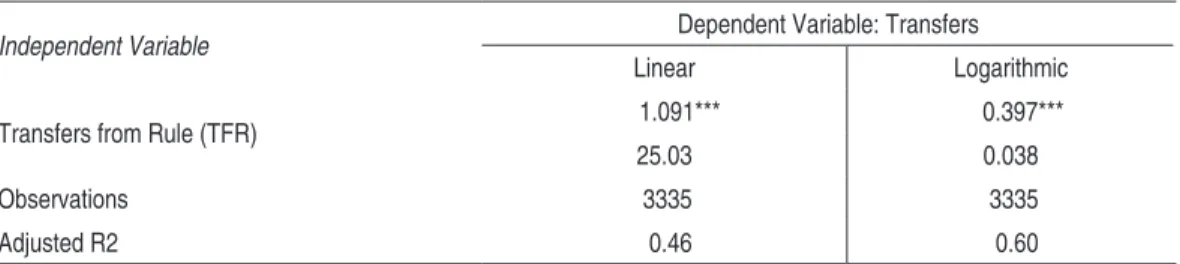
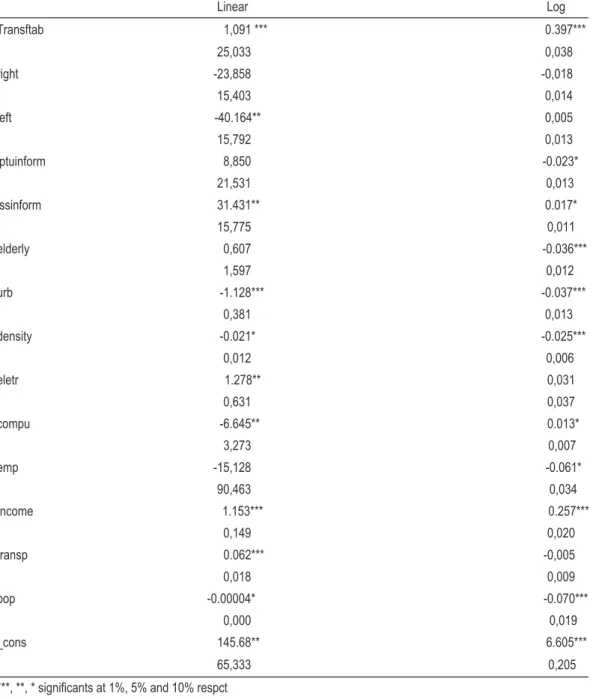
initially, we present the results for the first stage, that is, the one associated with the calculation of the instrument and evaluation of its adequacy. The instrument is significant and valid since its exclusion from the above regressions reduces drama� tically the adjusted r2 (see Appendix – Table a3). 18
Table 3 - Instrumental Variable – First Stage
Independent Variable Dependent Variable: Transfers
Linear Logarithmic
Transfers from Rule (TFR) 1.091*** 0.397***
25.03 0.038
Observations 3335 3335
Adjusted R2 0.46 0.60
note:*** significant at 1% level. The standard error is italicized and control variables were omitted.
in the second stage we use the log of output�oriented FDH scores as dependent varia� bles in a regression analysis in order to find the exogenous factors that affect municipa� lities’ performances. Given that the efficiency scores assume values between zero and one, the ordinary least squares (ols) estimator of the parameters will be inconsistent, that is, it will not converge on probability to the true unknown parameter. The use of the log of scores, however, will lead to unbiased ols estimates as long as the scores only assume strictly positive values. Besides the ols estimator will be inefficient, and
the problem worsens with the proportion of censored observations in the sample (see Greene (1981)). Due to the small number of censored observations in the sample there is not much reason for concern. To deal with the problem of endogeneity we use ols twice (two�stage least squares) as discussed before. another reason for using the log of efficiency scores is due to Becker (1996). she argues that the choice of the mo� del influences the significance of the traditional flypaper effect on expenditures, with the logarithmic specification reducing the significance of the flypaper effect. This way a logarithmic version would avoid the possible inflated bias on the flypaper estimates due to misspecification modeling.a Tobit model would also be used to deal with cen� sored observations. Parameters are usually estimated by maximum likelihood (ml), and the assumptions of normality and homoskedasticity are required so that inconsis� tent parameter estimates are obtained. several papers have used a two stage approach, where efficiency is estimated in the first stage and then the estimated efficiencies are regressed on exogenous covariates in the second stage. However, as pointed by simar and Wilson (2007), non�parametric efficiency estimates are serially correlated what makes conventional methods (ols and Tobit) inconsistent in the second stage regres� sion. They suggest bootstrap procedures to deal with the problem. since there is no consensus on the literature regarding the subject we estimate equation (12) using both 2sls and Tobit:19
1 2
o
i i i i
EffScore =a Transfers Incomeβ β β Controlsγε (12)
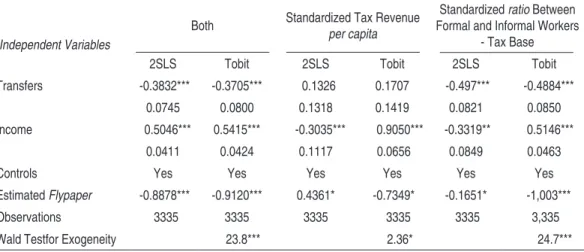
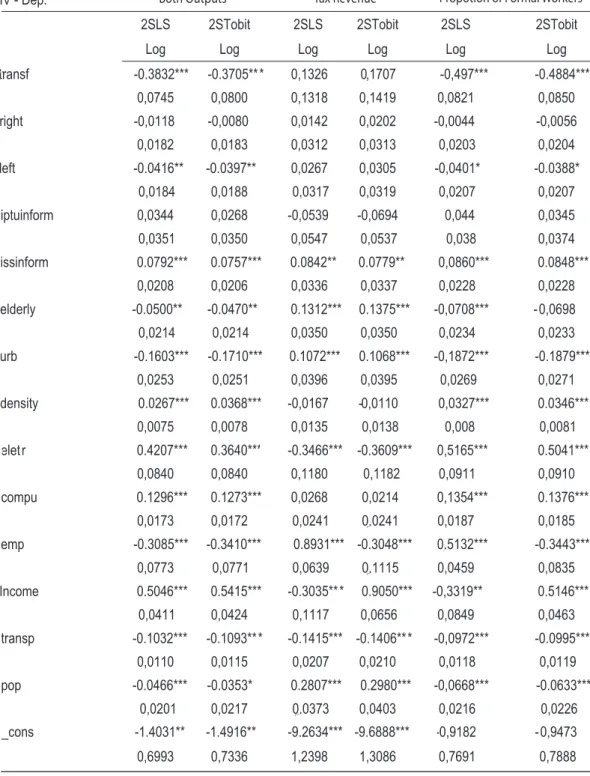
Table 4 presents the logarithmic regression estimates using our instrumental vari� able for transfers. The first and second columns present the results when both tax revenue and availability of tax base are considered as outputs. The results for tax revenues and the availability of tax base taken separately as products are presented from the third to sixth columns.20, 21
19 in fact we also run simar and Wilson (2007) robust standard errors but considering only a two stages estimation procedure (ignoring the endogeneity of transfers). The results are similar and are available upon request.
20 The full estimates using Tobit are in Table a4 in the appendix. The full estimations using 2sls are available upon request.
Table 4 - Flypaper Effect on Relative Efficiency Score
Independent Variables
Both Standardized Tax Revenue
per capita
Standardized ratio Between Formal and Informal Workers
- Tax Base
2SLS Tobit 2SLS Tobit 2SLS Tobit
Transfers -0.3832*** -0.3705*** 0.1326 0.1707 -0.497*** -0.4884***
0.0745 0.0800 0.1318 0.1419 0.0821 0.0850
Income 0.5046*** 0.5415*** -0.3035*** 0.9050*** -0.3319** 0.5146***
0.0411 0.0424 0.1117 0.0656 0.0849 0.0463
Controls Yes Yes Yes Yes Yes Yes
Estimated Flypaper -0.8878*** -0.9120*** 0.4361* -0.7349* -0.1651* -1,003***
Observations 3335 3335 3335 3335 3335 3,335
WaldTestfor Exogeneity 23.8*** 2.36* 24.7***
Note: ***, **, * significant at 1%, 5% and 10%. standard errors in italics.
equation (12) shows that the flypaper effect (revisited) on efficiency score in tax collection comes from the difference between consumer’s income and transfer effects on those scores. if transfers induce lower efficiency response compared to consumer’s income, the final result is negative.
Table 4 presents our main results. in particular, it shows that there is a negative and significant flypaper effect on tax collection efficiency for all specifications, except 2sls when tax revenue is the only output. For instance, in column 1 the flypaper effect estimated implies a decrease in the efficiency of –0.912 = (� 0.3832)�(+0.5046)). it is precisely estimated in five out of six specifications. The mean value of our estimated (and significant) flypaper effect is �0.75. That is our reinterpretation of the flypaper effect, i.e., transfers reduce tax collection efficiency compared to income effect.
The only exception is given in column 3, where a positive flypaper effect is obser� ved.22 That is possible in our model (see equation 9), and a plausible explanation is that the marginal disutility of taxes could be large enough due to its distortion that an increase in transfers induce policies to reduce inefficiency in tax collection and, therefore, to decrease the marginal cost of public funds.
Three points addressed by this paper deserve further attention in order to guaran� tee the robustness of the results. The first one is to calculate efficiency scores using Data envelopment analysis (Dea). The second one is to deal with the problem of outliers. The third one is to use as output tax revenue instead of tax revenue per ca-pita. sousa, araújo e Tannuri�Pianto (2009) estimate Dea�crs (Dea with constant returns to scale), Dea�vrs (Dea with variable returns to scale) and FDH in order to estimate residuals efficiency scores for 3438 Brazilian municipalities. They first compute robust efficiency score by combining bootstrap and jackknife resampling, and then regress the resulting efficiency scores on municipalities´characteristics. The residuals of the regressions (ols and quantile) measure pure techni� cal efficiency, that is, efficiency after accounting for exogenous factors.
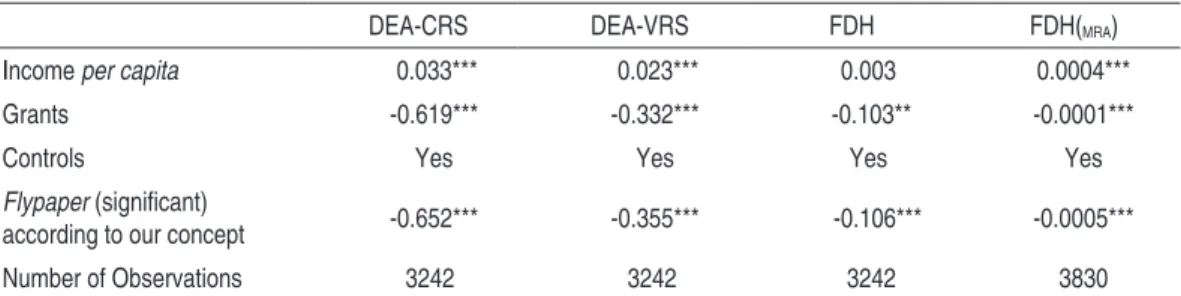
although their purpose is completely different from ours, their work tackles these three points and provides further evidence on the revisited flypaper effect (Table 5). The same evidence is obtained using quantile regressions which allow the im� pacts of the independent variables to be different across the distribution of tax efficiency scores. We also present in the last column of the Table 5 our correspon� dent result, i.e., we present our ols estimation considering the log of our FDH efficiency scores. although they are not fully comparable (our efficiency scores consider standardized per capita data), the flypaper effect can be observed in all of the estimations. moreover, in all of them, the effect is significant. actually our coefficient seems to be the lower bound among all the estimates available.23
Table 5 - Determinants of Robust Efficiency Scores (OLS Regressions)
***, **, * significant at 1%, 5% and 10%. source: sousa, araújo, and Tannuri�Pianto (2009), Table 4, p. 18. last column corresponds to our ols estimates using the log of efficiency scores as the dependent variable.
23 another restriction to our results concerns spatial aspects given that we do not take them into consideration. although they might be very important, we understand that a theoretical model which motivates its inclusion would be necessary. as discussed in Brueckner (2003), including spatial effects only “to control for spatial interaction” can lead to biased estimation for all para� meters, spatially related and others. Therefore, since we aim at testing our theoretical model, our results can be understood as conditional on the absence of spatial effects. Future work can be conducted to enhance such comprehensive effects in the flypaper effect.
DEA-CRS DEA-VRS FDH FDH(MRA)
Income per capita 0.033*** 0.023*** 0.003 0.0004***
Grants -0.619*** -0.332*** -0.103** -0.0001***
Controls Yes Yes Yes Yes
Flypaper (signiicant)
according to our concept -0.652*** -0.355*** -0.106*** -0.0005***
4.2 Decomposing the Effect on Tax Collection Efficiency – SUR Analysis
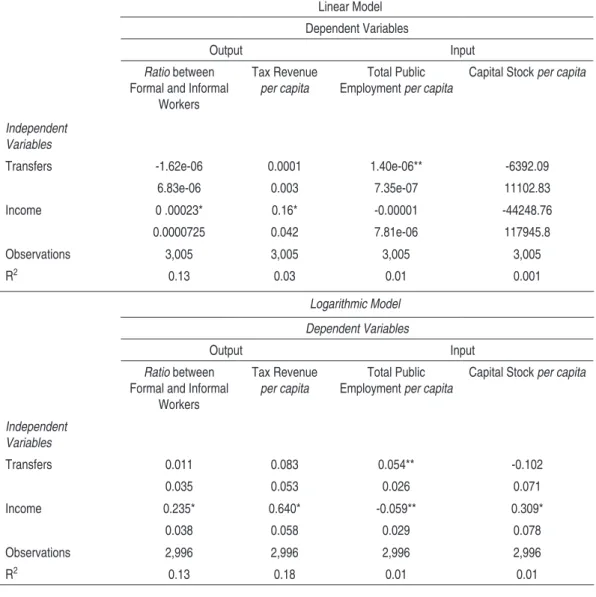
in order to determine the channel through which transfers are affecting the effi� ciency scores, we also estimated an equation for each of the outputs and inputs. We use the same parameter vector in all the equations. since the disturbances in the different equations include at least one factor in common, given that the efficiency in tax collection implies that the output could be increased and/or the input could be decreased, we employ the seemingly unrelated regression model (sUr). The results are presented in Table 6:
Table 6: Seemingly Unrelated Regression
Linear Model
Independent Variables
Dependent Variables
Output Input
Ratio between Formal and Informal
Workers
Tax Revenue
per capita
Total Public Employment per capita
Capital Stock per capita
Transfers -1.62e-06 0.0001 1.40e-06** -6392.09
6.83e-06 0.003 7.35e-07 11102.83
Income 0 .00023* 0.16* -0.00001 -44248.76
0.0000725 0.042 7.81e-06 117945.8
Observations 3,005 3,005 3,005 3,005
R2 0.13 0.03 0.01 0.001
Logarithmic Model
Independent Variables
Dependent Variables
Output Input
Ratio between Formal and Informal
Workers
Tax Revenue
per capita
Total Public Employment per capita
Capital Stock per capita
Transfers 0.011 0.083 0.054** -0.102
0.035 0.053 0.026 0.071
Income 0.235* 0.640* -0.059** 0.309*
0.038 0.058 0.029 0.078
Observations 2,996 2,996 2,996 2,996
R2 0.13 0.18 0.01 0.01
The estimates in Table 6 indicate that income is important to explain positively the proportion of formal workers (output), the tax revenue per capita (output) and the capital stock per capita (input), but it affects negatively the total public em� ployment (input). if the municipalities are richer (higher income per capita), then they have incentive to collect more tax revenues and to increase the proportion of formal workers. This might be the result of better policies used to audit tax collec� tion or due to the decrease in the marginal cost of auditing, given that it is easier to observe wealthier individuals. The results of capital stock per capita suggest that once the municipalities earn more income, then they are able to spend more money on capital stock. However, the negative effect on total public employment per capita is surprising. one possible explanation is that as income increases, the private sector grows faster than its public counterpart, which decreases the partici� pation of public workers in that local economy. nevertheless, this result deserves further investigation in the future. Transfers, however, are important to explain positively only total public employment per capita (input), i.e, the higher the level of transfers, the more local governments tend to hire public workers. This result relates to the ones obtained by arvate, marconi, moura and Palombo (2008), who have shown the appropriation on salaries in Brazilian states´governments.
These findings suggest that the economic response of the municipalities when there is an increase in money resources varies according to the nature of these resources. in particular, when exogenous money is in play, municipalities seem to appropriate it by hiring more public workers. if the increase in resources comes from wealthier consumers (income effect), then we observe an increase in outputs (formal workers and tax revenue) and a decrease in input (public workers). in other terms, the results in this paper suggest that intergovernmental transfer causes the (relative) inefficiency through excess of labor input while (consumer’s) income effect plays in the direction of improving tax collection efficiency.
last, it is important to mention that when tax revenue per capita is the dependent variable (column 2 in both linear and logarithmic models), then we have an empiri� cal correspondence to the theoretical model proposed by Hamilton (1986). For the linear model, it is possible to see that the marginal effect of income (significant and positive) is one thousand times larger than transfer (which is not significant) to increase tax revenue.
5 Concluding Remarks
increase public spending by more than do increases in private income. Here, higher transfers from the federal government might induce less efficiency in local tax col� lection opposed to the income effect.
We initially develop a simple theoretical model where the revisited flypaper effect is derived. We then try to verify if the theoretical result is empirically plausible, estimating the flypaper effect on tax collection efficiency for Brazilian munici� palities in 2004. initially we apply a nonparametric methodology (Free Disposable Hull� FDH) to construct efficiency scores in tax collection for each municipality, taking into consideration two outputs: amount of per capita local tax collected � tax revenue� and the size of local formal economy � tax base. This strategy eliminates the price effect of tax collection, since it captures its extension by taking into consideration the associated cost of tax imposition and/or auditing. after that we build an exogenous instrument for intergovernmental transfers from the rules de� fining the amount of unconditional funds that legally must be transferred to the municipalities. The aim of the instrument is to eliminate the endogenous charac� teristic of intergovernmental transfers due to political factors (veiGa and PinHo (2007)).
our results suggest that unconditional grants affect negatively the efficiency in tax collection as opposed to consumer’s income, leading to a reinterpretation of the flypaper effect.
one lesson that comes from our results is that local governments in Brazil should seek additional revenues in their own resources. This does not mean though to implement some new taxes, but to exploit more efficiently the existing tax base.
if the result obtained here and the lesson that comes out of it is general enough, that is a question for further investigation. Following the traditional literature on the flypaper effect, grant receipts and taxes can only be equivalent resources theo� retically, but we only know that if we look carefully at other fiscally decentralized economies.
References
aFonso, a.; scHUKnecHT, l; Tanzi, v. 2005. Public sector efficiency: an international comparison, PublicChoice, vol. 123, n. 3�4, june, p. 321�342. alFirman, l. 2003. estimating stochastic frontier tax potential: can indonesian
BaileY. s.; connollY, s. 1998. The flypaper effect: identifying areas for further research. Public Choice, 95: 335�361.
BajaDa, c. 2002. How reliable are estimates of the underground economy? Eco-nomics Bulletin, vol. 3, no. 14, p. 1�11.
Baron, D.P.; FerejoHn, j.a. 1987. Bargaining and agenda formation in legisla� tures. The American Economic Review, 77(2):303�309.
Baron, D.P.; FerejoHn, j.a.1989. Bargaining in legislatures. American Political Science Review, 83 (4):1181�1206.
Barros, c. P. 2007. Technical and allocative efficiency of tax offices: a case study, J. Public Sector Performance Management, 1, p. 41�60.
BecKer, e.1996. The illusion of fiscal illusion: Unsticking the flypaper effect. Public Choice, 86: 85�102.
BecKer, G. 1983. a theory of competition among pressure groups for political influence. Quarterly Journal of Economics, august: 371�400.
BlUnDell, r.; DUncan, a.; meGHir, c.1998. estimating labor supply res� ponses using tax reforms, Econometrica, p. 243�249.
BrUecKner, j. (2003). strategic interaction among governments: an overview of theoretical studies. International Regional Science Review, 26, 175�188. coUranT, P. n.; GramlicH e. m.; rUBinFielD, D. 1979. The stimulative
effects of intergovernmental grants, or Why money sticks where it hits. in Fis-cal federalism and grants-in-aid, mieszkowski and oakland (eds.), Washington Urban institute.
eicHenGreen, B.; von HaGen, j. 1996. Fiscal federalism and monetary union � is there a trade of between federalism and budgetary restrictions, NBER Working Paper 5517, cambridge: massachusetts.
Filimon, r.; romer, T.; rosenTHal, H. 1982. asymmetric information and agenda control. Journal of Public Economics, February: 51�70.
FørsUnD, F.r; KiTTelsen, s.; linDseTH, F. 2005. Efficiency and productivity of Norwegian tax offices, memorandum 29/2005, University of oslo, Depart� ment of economics.
Giles, D.e.; caraGaTa, P.j. 1998. The learning path of the hidden economy: tax and growth effects in New Zealand. Department of economics, University of victoria.
GorDon, n.2004. Do federal grants boost school spending? evidence from Title i, Journal of Public Economics 88(9�10): 1771�92.
Greene, W.H.1981. on the asymptotic bias of the ordinary least squares estimator of the Tobit model, Econometrica, 49, 505�513.
Grossman, P.j. 1994. a political theory of intergovernmental grants. Public Choice, 78: 295�303.
GUPTa, s.; verHoeven, m. 2001. The efficiency of government expenditures experiences from africa. Journal of Policy Modeling, 23, 433�467.
HaUsman, j.; PoTerBa, P. 1987. Household behavior and the tax reform act of 1986, Journal of Economic Perspectives, p. 101�119.
HamilTon, j. H.1986. The flypaper effect and the deadweight loss from taxation. Journal of Urban Economics 19: 148�155.
Hines, j. r.; THaler, r.H.1995. anomalies: the flypaper effect. Journal of Eco-nomic Perspectives 9 (4): 217�26.
imF. 2003. Government Finance statistics Yearbook.
iBGe. instituto Brasileiro de Geografia e estatística, Pesquisa de informações Básicas municipais, (http://www.ibge.gov.br).
iPea. instituto de Pesquisa e economia aplicada, ministério do Planejamento.
(http://www.ipeadata.gov.br).
KaTHaraKi, m.; TsaKas, m. 2010. assessing the efficiency and managing the performance of Greek tax offices. Journal of Advances in Management Research, vol. 7, issue 1, p. 58�75.
KniGHT, B. 2002. endogenous federal grants and crowd�out of state government spending: theory and evidence from the Federal Highway Program. American Economic Review, vol. 92, 71�92.
olson, m. 1965. The logic of collective action. cambridge, massachusetts: Harvard University Press.
PelTzman, s. 1976. Toward a more general theory of regulation. Journal of Law and Economics, august: 211�48.
Pereira, P.T.c. 1996. a politico�economic approach to intergovernmental lump� sum grants. Public Choice, 88: 185�201.
riBeiro, e. P. 1998. Transferências intergovernamentais e esforço fiscal dos estados brasileiros. Anais do XXI Encontro Brasileiro de Econometria.
romer, T.; rosenTHal, H.1980. an institutional theory of the effect of inter�an institutional theory of the effect of inter� governmental grants. National Tax Journal, December: 451�58.
romer, T.; rosenTHal, H. 1982. median voter or budget maximizers: evidence from school expenditure referenda. Economic Inquiry, october: 556�78. sHaH, a.1994. The reform of intergovernmental fiscal relations in developing and
emerging market economies. Washington: World Bank.
simar, l.; Wilson, P.W. 2007. estimation and inference in two�stage, semi� parametric models of production process. Journal of Econometrics, vol. 136(1), p. 31�64.
soUsa, m. da c. s.; criBari�neTo, F.; sTosic, B. 2005. explaining Dea technical efficiency scores in an outlier corrected environment: the case of public service in Brazilian municipalities. Brazilian Review of Econometrics, number 2, p. 289�315.
soUsa, m. da c.s.; araújo, P.; TannUri�PianTo, m.e. 2009. residual and technical tax efficiency scores for Brazilian municipalities: a two�stage approach, Anais do XXXI Encontro Brasileiro de Econometria.
THirTle, c., B.; sHanKar, P.; cHiTKara, s.; cHaTTerjee; moHanTY. 2000. size does matter: technical and scale efficiency in indian state jurisdic� tions. Review of Development Economics, 4, 340�352.
veiGa, l.G.; PinHo, m.m. 2007. The political economy of intergovernmental grants: evidence from maturing democracy. Public Choice, published on line, august.
Wilson, P.1993. Detecting influential observations in deterministic non�parametric frontiers models with multiple outputs. Journal of Business and Economic Sta-tistics, 19(3), p. 319�323.
Appendix
Table A1 - Description of Variables
Description Variable Name Search
The per capita transfers from both state and local
governments. Transfers Ipeadata, 2004.
The per capita income in the municipality. Income Ipeadata, 2004.
The parties classiied as center-left and left are de -nominated by the variable left and the parties from center-right and right are denoted as right. Dummy
variable equals 1 for parties classiied left (right) and zero the otherwise.
Mayor Party Right and Mayor Party Left
We use the ideological classiication of the mayors parties for 2004 (Pesquisa de Informações Básicas Municipais of the IBGE) following Coppedge (1997).
Dummy variable equals 1 whether the municipality has the tax service data set computerized and zero the otherwise.
IPTU Computerized and ISS Computerized
Pesquisa de Informações Básicas Municipais, IBGE, 2004.
The percentage of people with more than sixty ive
years in the municipality living alone. Elderly Ipeadata, 2000.
The percentage of urban population over resident
population in the municipality. Urbanization Ipeadata, 2000.
The population density in the municipality Density Ipeadata, 2000.
The percentage of people in the municipality with
electric energy in their residence. Power Electric Ipeadata, 2000.
The percentage of residents in the municipality with a
computer in their residence. Housing Computer Ipeadata, 2000.
The Economically Active Population divided by the
Working Age Population. Employment Ipeadata, 2000.
The cost of transport of the Municipal Headquarters
until the nearest State Capital. Transportation Ipeadata, 1995.
The percentage of population in the municipality
2
65
Est. Econ., são Paulo, 41(2): 239-267, abr.-jun. 2011
Variable TR PFW Both Transfers Income Mayor Party Right Mayor Party Left IPTU Computerized
ISS Computerized
Min. 0.01 0 0.015 193.100 30.430 0 0 0 0
1st Q 0.29 0.037 0.312 533.700 107.510 0 0 1 0
Median 0.46 0.066 0.066 689.000 186.530 0 0 1 1
Mean 0.48 0.126 0.126 819.700 192.240 0.4 0.353 0.885 0.696
3rd Q. 0.64 0.135 0.135 967.900 250.050 1 1 1 1
Max. 1 1 1 7.775.900 954.650 1 1 1 1
Variable Elderly Urbanization Density Power Electric Housing
Computer Employment Transportation Population TCR
Min. 0.056 0 0 17.430 0.002 0.25 0 908 0
1st Q 10.336 43.200 12.920 87.920 0.998 0.508 221.300 5196 221.300
Median 12.986 62.740 26.030 96.580 2.621 0.562 376.000 11113 376.000
Mean 13.054 61.410 119.500 90.340 3.962 0.561 428.700 40513.9 428.700
3rd Q. 15.671 81.090 54.040 99.250 5.445 0.606 542.400 24278 542.400
Max. 28.698 100.000 12.700.000 100.000 41.405 0.932 5.949.000 10838581 5.949.000
Table A3- First Stage Regression