SCREENING INDIGENOUS AUSTRALIA: SPACE, PLACE AND MEDIA IN
FRANCES CALVERT’S TALKING BROKEN
Peter Kilroy*
King’s College London London, UK
Abstract
Drawing on the ields of postcolonial studies and media theory, this article analyzes Frances Calvert’s 1990 documentary, Talking Broken, which, inter alia, looks at the role of space, place and media amongst Australia’s “other” Indigenous community, Torres Strait Islanders. he article explores the historical and geographical complexity of the space-place-media relation, particularly in terms of the centre-periphery relations between the Torres Strait and the Australian mainland, and considers the extent to which Calvert, ater the Australian bicentenary of 1988, is able to absorb and playfully challenge such formulations. More broadly, it considers the extent to which contemporary Indigenous media might go further and enact a shit from absorbing and challenging such formulations to taking control of media institutions themselves.
Keywords: Postcolonial Studies; Indigenous Media; Torres Strait Islands; Documentary Film
* Peter Kilroy is a British Academy Postdoctoral Fellow at the Menzies Centre for Australian Studies and the Department of Film Studies at King’s College London,
UK. His main research interests are in colonial, postcolonial and Indigenous media, with a particular emphasis on photography, phonography, and ilm. His email address is [email protected]
particularly apt to be addressed from the perspective of recording and communications media and vice versa.
Such a move would not only involve treating media as a series of semiotic surfaces to be analyzed (e.g. applying a “literary” analysis to a “reading” of postcolonial photographs or ilms, etc.), but also “placing” such media, i.e. locating them in a set of social, economic and cultural contexts (e.g. the role of radio, television or ilm in the construction of Indigenous place, or the incorporation of colonial media within Indigenous land rights claims, etc.).
I ofer this observation less as a polemic or detailed argument, however–one could easily cite counter examples (footnote 2)–and more as an invitation to explore some of the possibilities of mutual dialogue through a speciic case study: the spatial and ilmic representation (or cultural and technological mediation) of Australia’s “other” Indigenous community, Torres Strait Islanders and their descendants.
Prologue: Postcolonial Studies and Media heory
Nearly two decades ago, the art historian María Fernández (1999) wrote an important polemical article about the relative lack of mutual engagement between postcolonial studies and media theory. Polemical generalizations aside (neither are unitary ields, nor do they sit still1), one might be forgiven for hoping for greater mutual engagement today. However, despite growing moves towards a contemporary rapprochement2 (and Indigenous media studies seems to me the most fruitful meeting ground at present, e.g. Wilson and Stewart; Hokowhitu and Devadas), it is still possible to leaf through canonical readers in both ields (e.g. Ashcrot, Griiths and Tiin; hornham, Bassett and Marris) and ind a relatively limited set of mutual references. his is puzzling, not least because postcolonial studies’ thematic interest in questions of space, place, property and land, and how they are mediated by language, seems
140
Peter Kilroy, Screening Indigenous Australia: Space, Place and Media ...Space, Place and the Torres Strait Islands
he Torres Strait Island region–home to Australia’s Melanesian Indigenous community–comprises a series of ive island groups situated between Papua New Guinea to the north and the Australian mainland to the south, between the Coral and Arafura Seas, and, beyond that, the Paciic and Indian Oceans to the East and the West (Beckett 26-32), and that anomalous and heavily mediated spatial position is an important part of what I want to address in this article. For more than 200 years, the Strait has, in many idiosyncratic ways, deined and challenged Australia, or represented its spatial limit-point as well as its dangerously porous border. In other words, it is the periphery that redeines the centre, nationally and internationally.
When Captain Cook and crew navigated the east coast of the continent in 1770, from south to north, he only took possession in the name of the King when he discovered the dotted line that divided the landmass from its “other”, its outside, and that line was marked by the Torres Strait Islands (Cook, 22 August 1770). hey represented the geographical beginning and end of what would become “Australia”. hese islands, though, were not claimed by Cook; they were “outside” Australia, on the other side of the dotted line, despite forming part of Joseph Bank’s “Labyrinth of Shoals”, the Great Barrier Reef (Banks, 20 July 1770).
However, by the mid-nineteenth century the islands had become a site of considerable strategic signiicance, not least in being at the centre of a booming global trade in pearl shell and bêche-de-mer (sea cucumber) (Beckett ch. 2). his entangled them, as well as making them global agents, in an international trading network spanning Europe and Asia, Papua New Guinea and Australia. Given this strategic signiicance, the colony of Queensland came to annex the islands between 1872 and 1879 bringing them oicially “inside” the Commonwealth of Australia upon federation in 1901 (Beckett ch. 2). he price of this inclusion, however, was that the islands would become part of Australia’s dangerously porous border during the Second World War, subject to Japanese attack, and ater the war, such a border threatened
an opening to the Cold War threat from the north (Beckett ch. 3). In 1992, the successful outcome of one of Australia’s most famous land rights cases, Mabo v. Queensland No. 2, which began on the eastern Torres Strait Island of Mer, threatened to set a precedent for the continent as a whole (Sharp 1999; Graham 1990, 1997), and today, when Australia has outsourced much of its “processing” of asylum seekers to Manus Island and Nauru to the north, the Torres Strait is once again oten posed as a threatening opening to the nation-state–to the body politic–both in terms of the low of people and the low of wildlife and diseases, etc.
All of which is to say that the Torres Strait Islands are marked by a hybrid spatial inbetweenness that has to be policed, mediated and anxiously repeated, lest a border breach leads the periphery to redeine or challenge the centre. his occurs on both an east-west axis between Asia and Europe and a north-south axis between Papua New Guinea and Australia. Like a hyphen that both joins and separates, the islands are both a bridge and a barrier between such compass points and, as a consequence, have long been “screened” as a medical, political or economic threat, or “screened of ” as a protected, invisible or exoticized “other”.
However, in part because of an extensive, and heavily mediatized, anthropological expedition to the islands in 1898, which included photographic, phonographic and cinematic representations (Herle and Rouse), Torres Strait Islanders have also long been “screened” as cinematic subjects or, perhaps, objects. Indeed, there is a one hundred and twenty year history of ilmic representations of Torres Strait Islanders (see the ilm and television section), much of which has, up until relatively recently, codiied a set of conventions that attempt to conceal, mitigate or otherwise assimilate the complexity of this hybrid spatial inbetweenness by representing the islands as either isolated, set apart and disconnected from the complexities of colonial modernity or, oten more likely, as passively subject to them.
he Australian Bicentenary (1988)
which commemorated two hundred years since the irst leet of convicts and “settlers” sailed from Portsmouth, England and landed in Botany Bay, just south of their inal chosen destination of Port Jackson or modern-day Sydney Harbour. As part of a wider and building set of concerns with Indigenous cultural politics and national refashioning (Bennett, Buckridge, Carter and Mercer; Turner), this period was marked by three important trends in Torres Strait ilm: one was a numerical proliferation of documentary ilms, where previously there had only been a small number; two was an explicit thematic concern with politics, land rights and cultural ownership; and three was a re-use or “remediation” of prior ilms and other archival media in order to address those concerns (such as photographs, maps and sound recordings, etc.; and I will come back to the question of remediation later). It should be noted that 1988 was also the year in which the Torres Strait launched a campaign to secede from the state of Queensland marking this as a time of ferment and redeinition across the Torres Strait and Australia more generally (Sharp 1993, chs 7-8).
Frances Calvert: Talking Broken
One of the key protagonists of this post-88 movement was the Australian-born and Berlin-based ilmmaker Frances Calvert, and I want to focus here on her debut ilm, Talking Broken, which was released in 1990 just ater the bicentenary and the secession attempt.3 his 76 minute ilm, funded jointly by the UK and Germany,4 is a “post-colonial” portrait of the local/global complexity of Islander life circa late 1980s Australia, with thematic sections covering tourism, politics, economics, sex, religion and media. he “Broken” of the title is a form of Torres Strait Creole (sometimes called Yumplatok), which is spoken alongside English and several other Indigenous languages on the islands, including Kala Lagaw Ya and Meriam Mir (he State Library of Queensland), but in my reading it is also a metaphor for forms of productive, strategic and globally mediatized hybridity, an impurity without nostalgia for the pure. In that sense, the ilm’s subtitle, “voices from the Torres Strait”, is less an attempt to reclaim an essentialized Indigeneity under threat from a global and mediatized
modernity and more an exploration of the complexity and fractured multiplicity of contemporary Indigenous lives. “he theme”, Calvert suggests in a 1997 interview, “is social change and the question was always”
how do Torres Strait Islanders see their development and their future in a First World country in view of the fact that they are Melanesians, and see themselves as separate from Australian Aborigines and Papuans? I interviewed countless people and became friends with many. Talking Broken is about this encounter and the way they constructed their identity. (Calvert 1999, 12)
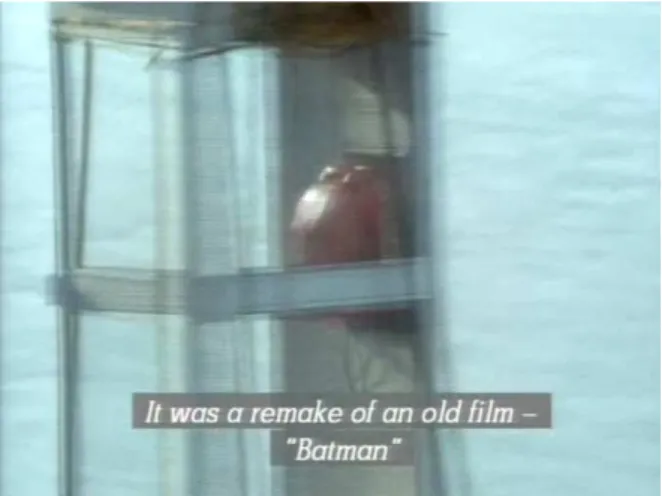
I want to look at this ilm for two inter-related reasons. he irst is that it explicitly thematizes the relationship between space, place and media in a postcolonial context, particularly in relation to ilm, television, radio and telephony, and the second is that it is set in a wider media context that includes national distribution (in educational institutions and museums, etc.) and international distribution (for TV, ilm festivals and DVD sales, etc.). I will attempt to address some of these themes by focusing in particular on the ilm’s characteristically idiosyncratic leitmotif: an aerial shot of a helicopter bearing a telephone-booth on a wire (igure 1).
Figure 1: Screenshot from Talking Broken – he “talking bro-ken” motif, 1 © 1990 Frances Calvert
temporal convention of arrival,7 and it occurs in jarring or discontinuous sequences, breaking with the spatial convention of establishing that arrival in a particular location.8 To that extent, it functions more as a visual punctuating marker and a commentary on the relationship between space, place and media. Indeed, apart from its striking visual appeal, one of the reasons why I think Calvert focuses on the telephone-booth as a motif is that such a relationship becomes an analogue of the spatial ambiguities of the islands. Just as the Torres Strait Islands are separated and joined together by the sea, the telephone-booth separates out private linguistic spaces (or intimacies) that are joined together within an interconnected or networked public space. he telephone-booth therefore becomes the ideal space within which to have Calvert’s protagonists announce the coming topic at hand, and laying this image over shots of the islands serves to make the spatial connection.
Unlike prior such establishing shots in earlier ilms, such as Frank Hurley’s, for example, where you may glimpse a faint shadow or mirrored relection of a ilming aircrat or its triumphant departure or return, the ilmed helicopter in this context becomes a direct mirror image of the invisible ilming helicopter, highlighting the immediate presence of both. here is a sense of symmetrical reciprocity between them: the one focused on the relationship between light and vision, the other on the relationship between distance and sound. In both cases, there is an implied commentary on the technological mediation of the senses.
his leads on to the other great cliché of Torres Strait ilm: the use of, oten decontextualized and exoticized, anthropological ield recordings of Indigenous Torres Strait music played over the aerial opening sequence. Calvert breaks with this convention, and thus with the illusion of representing the Torres Strait as if from an unmediated “Islanders” point of view, by always accompanying the “talking broken” telephone motif with a dense soundtrack of ambient sounds (the sea, wind, etc.), recordings of Torres Strait Islanders literally talking Broken/Yumplatok on the telephone and Karlheinz Stockhausen’s 1968 composition, Stimmung.9 “Stimmung” has many associated meanings in German,
but they centre on the idea of a mood, atmosphere or tuning, with the root implication of a voice (in this case, a series of non-linguistic voices, oten using overtones, that are “tuned” like an instrument, or indeed a radio).
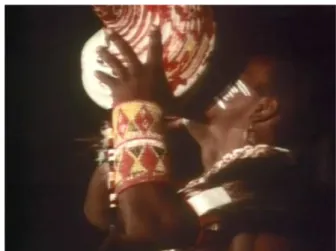
Figure 3: Screenshot from Talking Broken – Shell horn © 1990 Frances Calvert
In my reading, Stockhausen’s Stimmung becomes a meditation on the uncanny voice, the voice that, through the use of such overtones, becomes difficult to individuate or to distinguish from mediation or instrumentation: how many voices are there? Where does one begin and end? Are these amplified, modified or processed voices? Indeed, are they voices at all or are they instruments?10 I think that these questions are playing through Calvert’s use of both the recorded telephonic voices and the “talking broken” telephone-booth motif more generally: less a binary of broken versus fixed, then, and more a meditation on the complexities of linguistic and cultural hybridity or mediation.
Calvert’s use of this leitmotif is part and parcel of a broader igure of irony, or ironic reversals, in her early work (Calvert and Purser 311). For example, in her subsequent ilm, Cracks in the Mask (1997), Calvert takes an ironically inverted ethnographic gaze and directs it back at European museums and their Indigenous holdings (Calvert and Purser 307-308).11 As I mentioned earlier (footnote 10), the use of music in the ilm was also deliberately and self-consciously ironic. Indeed, to some extent, Calvert’s early ilms, and
144
Peter Kilroy, Screening Indigenous Australia: Space, Place and Media ...commentary on, and absorption of, prior Torres Strait ilm per se. his includes the playful use of prior, and particularly silent ilm, conventions (such as the aerial shot and intertitles, etc.), and the direct appropriation and re-signiication of carefully edited archive ilm. Two illustrative examples of the latter appear in Talking Broken. In the irst, Calvert cuts from an interview about contemporary Indigenous absorption within a capitalist world system to an archive clip of the pearling industry taken from a 1937 government propaganda ilm, he Native Problem in Queensland. his juxtaposition has an added resonance in that he Native Problem was, in part at least, made in response to a mass strike on the islands in 1936 (he National Film and Sound Archive). In the second, Calvert cuts from a somewhat martial contemporary school assembly on Boigu Island, where the students sing the Australian national anthem, “Advance Australia Fair”, to a shot of lag-wielding colonial discipline and paternalism in the same ilm. In both cases, she leaves the soundtrack of the irst shot running over the selected images of the second in order to make the point. he ironic collapse of (post-)colonial past and present is striking, playful and efective at re-signifying the images. However, in both cases, the juxtapositional shit from one set of shots to the next implies historical continuity without the need to provide a detailed historical narrative. his is more of a fragmentary invocation or evocation of experiential “pastness” than it is an historical narrative (Baron). To that extent, the ilm owes a certain debt to the cultural discourses of postmodernism (irony, pastiche, fragmentation and bricolage, etc., Calvert and Purser 311), but it is not, I think, reducible to that context. Such a disjuncture between past and present, “pastness” and history is structurally embedded in the use of archive media in ilm more generally (Baron).
Space, Place and Media
However one might choose to characterize this process of archival appropriation, the broader igure of irony undoubtedly plays an important role in Calvert’s early work, and it is particularly heightened in the crucial “media” section of the ilm, which begins with a series
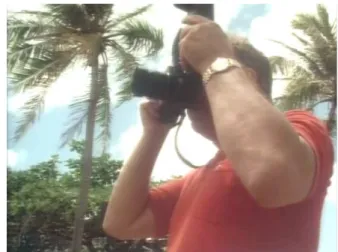
of visual and verbal puns: irstly, a shot of a photograph being taken of an Anglican bishop (Kiwami Dai from Saibai Island) alongside a group newly conirmed by him on hursday Island (igure 4).
Figure 4: Screenshot from Talking Broken – Photography © 1990 Frances Calvert
Figure 6: Screenshot from Talking Broken – “[T]he coming of light entertainment” © 1990 Frances Calvert
Figure 5: Screenshot from Talking Broken – he “talking bro-ken” motif, 2 © 1990 Frances Calvert
Figure 8: Screenshot from Talking Broken – Ephraim Bani © 1990 Frances Calvert
Figure 7: Screenshot from Talking Broken – Television © 1990 Frances Calvert
Figure 10: Screenshot from Talking Broken – Video arcade © 1990 Frances Calvert
146
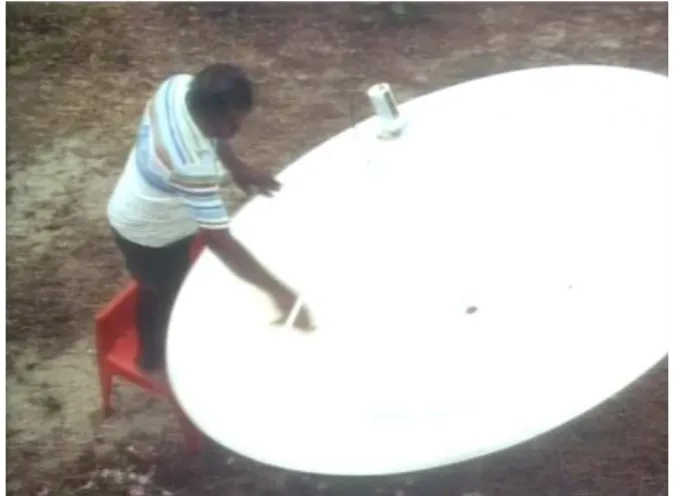
Peter Kilroy, Screening Indigenous Australia: Space, Place and Media ...Figure 11: Screenshot from Talking Broken – Satellite dish © 1990 Frances Calvert
Such juxtaposed sequences are undoubtedly intended to be ironic and jarring, and they do make signiicant inroads into re-signifying the images, particularly the archival photographs, but the point here is not, I think, to make a simplistic claim to “pristine” Indigenous local identities being destroyed by
globalized media, but rather to focus on the complexity of contemporary local/global hybridization and the extent to which such hybridity has a long past that precedes colonization, has outlived it and will continue in and through contemporary media rather than outside of them. Indeed, as the main protagonist in the debate, Bani goes on to discuss the importance of not dismissing such media forms per se, but of controlling them, and this is a crucial tenet of contemporary Indigenous media theory (e.g. Hokowhitu and Devadas): not only is control over representations important–but control over the means and institutions of representations (e.g. TV channels, media outlets, etc.).
As Calvert lingers on a Torres Strait Islander polishing a satellite dish (igure 11), Bani suggests that:
[…] the counter-attack for this outer inluence–outer impact–is inventing our own programmes, promoting our culture through media.12
his sentiment tallies with Calvert’s description of the ilm as “post-colonial”, by which she means an exploration of how Indigenous groups “are reacting
[to the lingering ater-efects of colonialism], how they have been inluenced, how they are trying to take power into their own hands” (McInerney 24). Such a reclamation of power refers as much to the cultural politics of media as to wider political and economic issues. Indeed, for the cultural politics of media to be efective in warding of the type of disempowering state paternalism that anthropologist Jeremy Beckett (ch. 7) refers to as “welfare colonialism”, there is a necessary correlation between culture, politics and economics, a point that Bani understood all too well. In reference to the ilm, Marie McInerney makes a similar point by suggesting that such welfare colonialism is seductive, but ultimately disenfranchising, in ofering the allure of money but without the positive correlate of power:
Now they are learning that some government schemes have to fail, that policies change with governments, and that paternalism can be comfortable but has its price. (McInerney, 24)
Efective methods of taking back control must operate across the realms of culture, politics and economics, albeit with diferent strategic points of emphasis at diferent times.
Conclusion
of the ownership and/or production of such media themselves and their institutions. Examples include the Torres Strait Media Association, the Torres Strait Regional Authority (Charles), Torres Strait Online Television, the ilms of Llew Cleaver, Aaron Fa’aoso, Murray Lui, Aven Noah, Rhianna Patrick and Douglas Watkin (see the ilm and television section), or the music and videos of highly successful performers like Christine Anu and Mau Power, to choose but a small representative sample. Whilst there is much work to be done, and critical vigilance is always required, these developments have seemingly been made possible through a combination of political agitation, media training and the reduced costs and wider availability of recording and communications media, etc.
I would suggest that there is a broader lesson here for an engagement between postcolonial studies and media theory that stresses the interplay of semiotic and contextual registers, not least because the signiicance of such an approach is not just methodological; there are core political and ethical issues to consider in relation to Indigenous identities, reception histories and media production. It is clearly the case that appropriating such media for the purposes of Indigenous cultural continuity or revival, or for Indigenous attempts to wrest back control of media production, poses cultural, political and economic risks: not least the risk of being re-appropriated in turn by a global neoliberalism that absorbs, or even actively solicits, Indigenous representations, but in so doing marketizes and/or neutralizes any critical commentary. In other words, such absorption runs the risk of naturalizing the market in order to neutralize critique. Any attempt at media reclamation in that context is therefore encrusted with prior histories and problematic and fractious presents, but, in an era of global media saturation, therein lie some of the most important strategic and creative choices for the future.
Acknowledgements
Special thanks are due to Frances Calvert for extremely useful comments on an earlier drat of this article and for her generosity of time and spirit. All are greatly appreciated.
Notes
1. Fernández appears to have in mind mainly new media theory from the early to late-1990s that addressed, and sometimes celebrated, the growth of digital media but oten without detailed reference to global power diferentials (Fernández 59). Conversely, the postcolonial studies (plural) that emerged in the atermath of some of its core early protagonists (e.g. Homi Bhabha, Edward Said and Gayatri Chakravorty Spivak) oten used the theories and methods of comparative literature to address such power diferentials but without sustained engagements with the role that other media might play. he point is that these are broad-brush observations rather than uncritical absolutes.
2. Merten and Krämer; Weaver-Hightower and Hulme; Schwarz and Eckstein; and Sandra Ponzanesi and Waller.
3. he documentary was shot on 16mm ilm and released also on VHS and DVD. It has been distributed in Australia, America and Europe and has been screened at more than a dozen festivals, including in the Torres Strait (McInerney 24), and on television in the UK, Australia and Germany (Calvert n.d.).
4. he choice of funding bodies indicates both something of the practical vagaries of ilm funding (Calvert was based in Germany and found funding easier to come by there and in the UK than in Australia, despite the project having the “stamp of an Australian ilm”) as well as something of the international focus of the ilm (McInerney 24). Calvert directed the ilm, partly at least, in response to the German audiences’ perceived reaction against didactic documentaries and towards a more discursive or polemical style (McInerney 24).
5. In the Papuan portion of Frank Hurley’s 1921 ilm,
Pearls and Savages, Hurley suggests that “[t]he natives regard the lying men as gods come from the skies” and proceeds with a shot of Papuans in boats seemingly reverently circling the sea plane.
6. A similar re-signiication of the aerial shot occurs later in the ilm when Calvert juxtaposes a sweeping aerial view of the islands with the soundtrack of a speech about colonialism, self-governance and land rights by the prominent island igure, Chairman Mau.
148
Peter Kilroy, Screening Indigenous Australia: Space, Place and Media ...8. Calvert suggests that, unlike the linearity of her second ilm, Cracks in the Mask (1997), Talking Broken is structured more like a “mosaic” (Calvert 1999, 12).
9. In an interview in 1997, Calvert talks about similar musical choices in Cracks in the Mask (1997). She suggests that she wanted the music “to work in an ironic way” (Calvert 1999, 16). I will come back to the important question of irony in her work a little later.
10. For example, at one point Calvert combines the soundtrack of such voices with a shot of a shell horn being blown (igure 3).
11. It is worth stressing that the impetus behind such an inversion came from Ephraim Bani himself at the end of Talking Broken (Calvert and Purser 307-308). his made Cracks in the Mask something of a sequel (Calvert and Purser 308).
12. In a characteristically wry commentary on this statement, Calvert follows Bani’s discussion with a short “home video” section ilmed by the “boys of Moa Island one night in our absence”. Although ilmed in a jocular tone, implied themes from this short section include family, global environmental issues, religion and music.
References
Ashcrot, Bill, Gareth Griiths, and Helen Tiin. he Post-Colonial Studies Reader (2nd ed.). London/New York: Routledge, 2005. Print.
Baron, Jaimie. he Archive Efect: Found Footage and the Audiovisual Experience of History. London/New York: Routledge, 2014. Print.
Beckett, Jeremy. Torres Strait Islanders: Custom and Colonialism. Cambridge: Cambridge University Press, 1987. Print.
Bennett, Tony, Pat Buckridge, David Carter, and Colin Mercer. Celebrating the Nation: A Critical Study of Australia’s Bicentenary. St. Leonards: Allen & Unwin, 1992. Print.
Bolter, Jay D., and Richard Grusin. Remediation:
Understanding New Media. Cambridge, MA: MIT
Press, 1999.
Calvert, Frances. “Peter Malone interviews Frances Calvert.” Nelen Yubu, 71 (1999): 9-17. Print.
Calvert, Frances, and Emily Purser. “Moving Images, Making Meanings.” Derrière les images. Neuchâtel: Musée d’ethnographie, 1998. 307-336. Print.
Dixon, Robert. Prosthetic Gods: Travel, Representation and Colonial Governance. Brisbane: University of Queensland Press, 2001. Print.
Fernández, María. “Postcolonial Media heory.” Art Journal, 58.3 (1999): 58-73. Print.
Herle, Anita, and Sandra Rouse. Cambridge and the Torres Strait: Centenary Essays on the 1898 Anthropological Expedition. Cambridge: Cambridge University Press, 1998. Print.
Hokowhitu, Brendan, and Vijay Devadas. he Fourth Eye: Māori Media Aotearoa New Zealand. Minneapolis/ London: University of Minnesota Press, 2013. Print.
McInerney, Marie. “Germans Fund Australian’s Torres Strait Islanders Film.” he Canberra Times, 6 May 1991: 24. Print.
Merten, Kai and Lucia Krämer, eds. Postcolonial Studies Meets Media Studies: A Critical Encounter. New York: Columbia University Press, forthcoming 2016. Print.
Ponzanesi, Sandra, and Marguerite Waller, eds. Postcolonial Cinema Studies. London/New York: Routledge, 2011. Print.
Pratt, Mary L. “Fieldwork in Common Places.” Writing Culture: he Poetics and Politics of Ethnography. Eds. James Cliford, and George Marcus. Berkeley/Los Angeles/London: University of California Press, 1986. 27-50. Print.
Sharp, Nonie. Stars of Tagai: he Torres Strait Islanders. Canberra: Aboriginal Studies Press, 1993. Print.
______.
No Ordinary Judgement: Mabo, he
Mur-ray Islanders’ Land Case
. Canberra: Aboriginal
Studies Press, 1996. Print.
Schwarz, Anja, and Lars Eckstein. Postcolonial Piracy. London: Bloomsbury Academic, 2014. Print.
hornham, Sue, Caroline Bassett, and Paul Marris. Media Studies: A Reader (3rd ed.). Edinburgh: Edinburgh University Press, 2009. Print.
Turner, Graeme. Making it National: Nationalism and Australian Popular Culture. St. Leonards: Allen & Unwin, 1994. Print.
Virilio, Paul. War and Cinema: he Logistics of Perception. London: Verso, 2009. Print.
Weaver-Hightower, Rebecca, and Peter Hulme.
Postcolonial Film: History, Empire, Resistance. London/ New York: Routledge, 2014. Print.
Wilson, Pamela, and Michelle Stewart, eds. Global Indigenous Media: Cultures, Poetics and Politics. London: Duke University Press, 2008. Print.
Film and Television
Bleakley, John W., dir. he Native Problem in Queensland. Department of Health and Home Afairs, 1937. Film.
Charles, Brett, dir. Ailan Kastom. Letield Productions, 2013. Film.
Calvert, Frances, dir. Talking Broken. Talking Pictures, 1990. Film.
______. Cracks in the Mask. Talking Pictures, 1997. Film.
Cleaver, Llew, dir. Douglas Pitt. SBS Television, 2001. Television.
______. Native Title: Return to Ugar. SBS Television, 2001. Television.
______. Torres Strait Islander Autonomy: Masig. SBS Television, 2001. Television.
Fa’aoso, Aaron, dir. Bit of Black Business – Sharpeye. Scarlett Pictures, 2007. Film.
Graham, Trevor, dir. Land Bilong Islanders. Yarra Bank Films, 1990. Film.
______. Mabo: Life of an Island Man. Film Australia/ Tantamount Productions, 1997. Film.
Haddon, Alfred C., dir. Torres Strait Islanders. Cambridge University, 1898. Archive Film.
Hall, Ken, dir. Lovers and Luggers. Cinesound Productions, 1937. Film.
Holmes, Cecil, dir. he Islanders. Australian
Commonwealth Film Unit. 1968. Film.
Hurley, Frank, dir. Pearls and Savages. Stoll Hurley Productions, 1921. Film.
______. he Hound of the Deep. Stoll Hurley Productions, 1926. Film.
Hylands, Andrea, and Peter Hylands, dirs. Ken haiday Snr: he Sea, the Feather and the Dance Machine. Creative Cowboy Films, 2011. Film.
______. Alick Tipoti: Zugub, the Mask, the Spirits and the Stars. Creative Cowboy Films, 2012. Film.
Lui, Murray, dir. Tombstone Unveiling. Central Australian Aboriginal Media Association, 2000. Film.
Noah, Aven, dir. Small Island, Big Fight. Film Australia, 2000. Film.
Patrick, Rhianna, dir. A Close Shave. ABC TV, 2002. Television.
______. Coming of the Light. ABC TV, 2006. Television.
Robinson, Lee, dir. King of the Coral Sea. Southern International, 1954. Film.
Watkin, Douglas, dir. Malaytown Stories. Douglas George Watkin, 2006. Film.
______. Troubled Waters. ABC TV, 2007. Television.
______. Frangipani Land Forever. ABC TV, 2008.
Television.
______. Green Warrior. ABC TV, 2008. Television.
______. Lagau Danalaig. Lacework Productions, 2012. Film.
Websites
Australian Screen, Pearls and Savages, n.d. Web. 22 Feb. 2016. <http://aso.gov.au/titles/documentaries/pearls-and-savages/>.
Banks, Joseph, “he Endeavour Journals, 1770 July 20”, Nov. 2005. Web. 22 Feb. 2016. <http://gutenberg.net. au/ebooks05/0501141h.html#jul1770>.
Calvert, Frances, “Talking Broken,” n.d. Web. 22 Feb. 2016. <http://www.calvert-ilm.com/talking.html>.
Cook, James, “he Endeavour Journals,” 2004. Web. 22 Feb. 2016. <http://southseas.nla.gov.au/journals/cook/ contents.html>.
he National Film and Sound Archive, he Native
Problem in Queensland, n.d. Web. 22 Feb. 2016. <http://www.nfsa.gov.au/digitallearning/mabo/info/ nativeProblemInQld.htm>.
he State Library of Queensland, “Languages of the Torres Strait Islands,” 2016. Web. 22 Dec. 2016. <http://www. slq.qld.gov.au/resources/atsi/languages/torres-strait>.