http://dx.doi.org/10.1590/0104-530X1668-14
Resumo: Crises de marca, decorrentes de falhas no produto, têm se tornado mais frequentes em razão do aumento da complexidade dos produtos. As crises geradas por campanhas de recall são únicas, inesperadas e podem gerar deterioração da relação favorável estabelecida entre a marca e o consumidor, afetar a imagem de marca e reduzir o brand equity. Suas consequências envolvem prejuízos inanceiros de curto e longo prazo para a marca, para a empresa e, eventualmente, para a categoria como um todo. Este artigo é fruto de uma pesquisa exploratória qualitativa realizada por meio de um estudo de caso único na indústria de alimentos. Seu objetivo é veriicar empiricamente a aplicação das teorias sobre crise de marca e recall em um caso brasileiro recente. Os resultados encontrados estão alinhados com as suposições elaboradas com base no referencial teórico. Como contribuição adicional para o tema, o estudo apresenta o efeito de uma crise real ao longo do tempo.
Palavras-chave: Crise de marca; Recall; Efeito de uma crise de marca.
Abstract: Brand crises due to product fail has become more frequent due to increases in products complexity. Crisis generated by recall campaigns are unique, unexpected and can lead to deterioration of the established favorable relationship between brands and consumers, affecting the brand image and its brand equity. The consequences involve short and long-term inancial losses for the brand, the company and eventually to the category as a whole. This article is based on a qualitative exploratory research with a single case study in the food industry. Its objective is to verify empirically the application of the theories of brand recall and crisis in a recent Brazilian case. The results meets the assumptions developed based on theoretical framework. The study presents as additional contribution the effect of a real crisis overtime.
Keywords: Crisis management; Recall; Brand crisis effect.
Crisis management and its impact on brand image
Gestão de crise e seu impacto na imagem de marca
Alexandre Borba Salvador1
Ana Akemi Ikeda1
Edson Crescitelli1
1 Departamento de Administração, Faculdade de Economia, Administração e Contabilidade – FEA, Universidade de São Paulo – USP,
Avenida Professor Luciano Gualberto, 908, Butantã, CEP 05508-010, São Paulo, SP, Brazil, e-mail: [email protected]; [email protected]; [email protected]
Received Sept. 25, 2014 - Accepted Apr. 22, 2015
Financial support: None.
1 Introduction
The study of brands has been gaining relevance once the strengthening of brand equity could represent an increase in the productivity of marketing investments (Aaker, 1996a; Keller, 1993). People understand brands by observing their manifestations and the more these are coherent and consistent with their initial proposal, the better the consumer will understand the design of the brand (Semprini, 2010). However, a manifestation that fails to be consistent with the design of the brand could weaken it, as in cases of brand crisis. Brand crisis could be caused by product failure, social responsibility gap, corporate misbehavior, executive misbehavior, poor business results, spokesperson misbehavior and controversy,
loss of public support or controversial ownership (Greyser, 2009).
recall campaigns would be unique and unexpected (Anwar, 2014; Coombs, 2007b), and could generate deterioration of established favorable relationship between the brand and the consumer (Cleeren et al., 2013; Van Heerde et al., 2007), affecting the brand image and reducing the brand equity built over the life of the brand (Aaker, 1996b; Anwar, 2014).
In Brazil, some cases brand crisis gained prominence in recent years. In 2013, a consumer has declared having consumed Coca-Cola with rat pieces, which would have caused him serious health problems (Melo, 2013). Air Bus, the aircraft manufacturer, new statements about a 2007 plane crash, has started a new wave of demonstrations of the families of the victims against TAM (Souza, 2014). In early 2014, Burger King Employees were recorded playing in the water tank in one of its stores (Vieira, 2014), which generated a great impact on social networks. The ADES brand convened in 2013 a product recall campaign due to a failure in production (Procon-SP, 2015). In 2014, Toddynho brands and São Lourenço also announced a recall campaign due to product harm (Procon-SP, 2015). Product harm crises and recall campaigns have become more frequent in Brazil. According to Procon-SP (consumer protection agency) in 2013 they were held 101 campaigns, representing a 55% increase over 2012 and more than triple compared to 2002.
This is an exploratory study with the main objective of analyzing the consequences of a brand crisis caused by a recall campaign, comparing the theoretical framework with a real Brazilian case, with an embedded single case study (Campomar, 1991; Martins, 2008; Yin, 2009). This case refers to a local crisis of a local brand owned by a multinational company. The main stages of the study, speciied in protocol, were the investigation of cases at Procon (Consumer Protection Agency), contact with relevant companies to request information, analysis of articles about the case in newspapers, interview with the marketing manager responsible for the brand in question.
Aiming to increase the collaboration of the company in the provision of information, the article have preserved the privacy by referring only to “company”, “brand”, “product” and “competitors”. It shows the variations in volume, market share and brand health indicators comparatively with the pre-crisis period and do not present absolute data.
There is an extensive literature addressing product harm crises based on experiments and tests. However, there are few studies conducted with data from real cases, especially in Brazil. As a scientiic contribution, this study brings the consequences of a recall involving brand and product based on a Brazilian case. The literature review will present
the main references on brand crisis due to product harm, factors inluencing the effects of crises and its expected effects. The assumptions will be presented by the end of the review. The case study will show a summary of the key information obtained. The results of the triangulation will be discussed in the light of the theoretical framework. Finally, considerations will be presented, limitations and suggestions of future studies.
2 Theory
The theory review follows the sequence: crisis settings and recall, factors inluencing the effects of crises and different effects expected to crises arising from failure product.
2.1 Brand crisis caused by product harm and recall campaign
Crisis is a no routine, unexpected and sudden event that creates uncertainty and threatens the priority goals of the organization, able to cause inancial losses and undermine the company’s reputation (Coombs, 2007a; Dean, 2004) and which could not be resolved with routine procedures (Tsang, 2000). Crises can harm stakeholders physically, inancially or emotionally (Coombs, 2007a). The effects of a product harm crisis can extrapolate the sphere of the brand and product (spillover effect), affecting the corporation as a whole (Roehm & Tybout, 2006).
Product harm crises could generate expensive recall campaigns. The Consumer Protection Agency of São Paulo (Procon-SP, 2015) deines recall as “the procedure, speciied by law, and to be adopted by suppliers, to call back consumers due to defects found in products or services placed on the market, thus avoiding the occurrence of accidents caused by consumption”. Its purpose is “to protect and preserve consumer’s life, health, integrity and safety, and to avoid moral and material damages.” This call could also be spontaneously made by the company as soon as it detects the defect or problem with any product (Matos & Veiga, 2003). Although the recall campaign object is to solve a potential p roblem, it could also show to society a control process failure (Kalaignanam et al., 2013).
would jeopardize the survival of the business, affecting sales and eroding conidence and business reputation (Anwar, 2014).
2.2 Factors inluencing the efects of crises
Some of the studies addressing product crises focus on the backgrounds of the crisis that inluence consumer response. Familiarity with the product, brand and company (Dawar & Lei, 2009; Dean, 2004; Siomkos & Kurzbard, 1994) as well as a good reputation of the company (Siomkos & Kurzbard, 1994) could mitigate the negative impacts. However, the wide dissemination of the case, boosted by the interest from the media according to the perceived risk involved and the relevance of the company (Greyser, 2009; Van Heerde et al., 2007; Siomkos & Kurzbard, 1994) could increase its visibility.
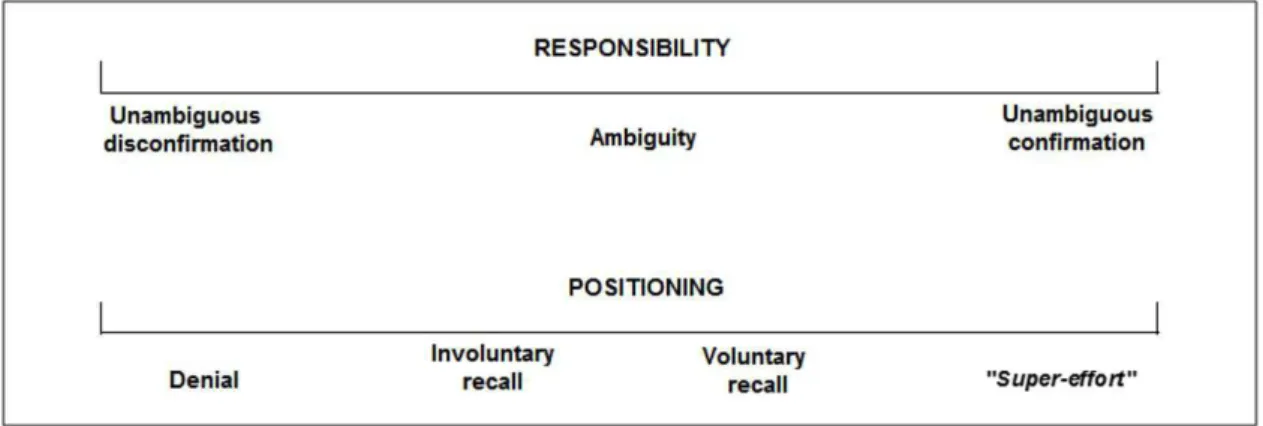
The positioning of the company towards the beginning of the dissemination of the crisis and its response also directly inluence its effects (Dawar & Pillutla, 2000; Greyser, 2009; Siomkos & Kurzbard, 1994; Souiden & Pons, 2009). In view of the dissemination of the triggering problem, the company could unambiguously deny its responsibility, could be ambiguous regarding the admission of guilt or unambiguously admit to be guilty over the problem. In case where society understands that the company would be responsible for the problem, the more unambiguous is the admission of guilt, the lower the negative impact on the brand and the company (Dawar & Pillutla, 2000). The company’s action also inluence how the society perceive crisis. The greater the effort and demonstration of the company’s effort to reverse the situation, collecting the products with risk and compensating those affected, the greater the willingness of society to mitigate the effects of the crisis (Greyser, 2009; Siomkos & Kurzbard, 1994).
Figure 1 illustrates the two continua between assuming responsibility and intensity of action (positioning).
Souiden & Pons (2009) have concluded that, in a study on the frequent recall campaigns conducted in the automotive industry, the denial of the defect has a strong negative impact on the image of the manufacturer and the impact on the image is signiicantly positive when the company makes the recall voluntarily. Besides that, an even more positive effect is perceived when the manufacturer subsequently announces a campaign to improve the product and process (Souiden & Pons, 2009). Some elements associated with brand and product could also inluence how the crisis would affect the brand and the business. Leading brands tend to suffer less than brands with small market share due to the greater credibility they have with consumers (Greyser, 2009). Traditional brands, with strong reputation, creates a relationship with stakeholders, what reinforces brand image and reduces fragilities (Assiouras et al., 2013).
2.3 Expected efects
A brand crisis caused by product harm triggering a recall campaign could affect the brand, the company as a whole, the category in which the brand is inserted and its competitors.
The temporary withdrawal of the product from the market could affect sales, causing loss of sales, market share and high costs with the recall campaign, including logistics costs from the product withdrawal, communication campaigns and destruction costs of the product withdrawn (Assiouras et al., 2013). More than that, there could be a reduction in the eficiency of the brand’s investment in marketing (Assiouras et al., 2013; Cleeren et al., 2013; Van Heerde et al., 2007). The crisis could also have negative brand associations and relect on the brand equity, causing a reduction
in the price of the company’s stocks (Cleeren et al., 2013; Dawar & Pillutla, 2000), and a reduction in the company’s reputation with stakeholders (Coombs, 2007b; Van Heerde et al., 2007). As result of the exposure of the corporate brand to the problem and the relationship of the product in question with other products and brands of the company, there could be a crossed effect between items under the same brand, and with the entire portfolio of the corporation (Anwar, 2014; Cleeren et al., 2013; Van Heerde et al., 2007; Tsang, 2000).
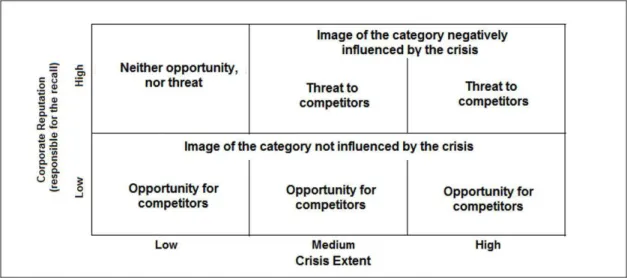
According to the reputation of the company involved and the extent of the problem, the category as a whole could lose with the crisis or the competitors could gain volumes and consumers lost by the company with problems (Siomkos et al., 2010). If the crisis is triggered by a product that represents the category, the category as a whole could be adversely affected by the problem with the extrapolation of the problem beyond the brand involved (spillover effect); if the product has a small connection with the category, the latter would be little affected by the problem (Roehm & Tybout, 2006). If the category is not negatively affected by the recall, competitors tend to be more aggressive to quickly attract the consumers not served by the brand withdrawn (Assiouras et al., 2013; Tsang, 2000) and the productivity of the investment of competitors may increase (Cleeren et al., 2013; Van Heerde et al., 2007). Thus, for competitors, the combination of these antecedents could indicate opportunities and risks arising from a problem in the category. Figure 2 illustrates these scenarios.
In cases where the responsible company has a low reputation, the crisis tend to affect less the image of the category; and then, there would be a growth opportunity for competitors, either through immediate sales volumes, or by improving their image
towards consumers. In cases involving competitors with high reputation, the extent of the crisis (large number of parties affected by the crisis or severity of the problem) could pose a threat to competitors or harm the image of the entire category. A problem in a product from a company with high reputation that has a large extension could take the credibility and increase the perception of risk across the category (Siomkos et al., 2010).
The crisis could also have a positive effect on the management and image of the corporation. A well-managed crisis could improve the corporate image, assigning the image of a socially responsible company. A good management during the crisis could also reduce recovery times and make the corporation stronger after the extreme experience (Kalaignanam et al., 2013; Tsang, 2000). Still, a brand that has already been through a recall would be more sensitive to future crises, and the negative effects may be increased by the recurrence (Siomkos & Kurzbard, 1994; Siomkos et al., 2010).
The effects of a product harm crisis could directly affect the product in question, the products under the same brand, the sale and the image of the other products of the company, the reputation and the market value of the company. It could reduce the eficiency of the investment in marketing of the brand involved and even increase the eficiency of the investment of competitors, and could go beyond the brand and affect the category as a whole. The crisis could also leave a residual effect of making the corporation stronger after experiencing the extreme experience of a recall, but also leave the brand more sensitive to future crises. Chart 1 summarizes the key assumptions investigated in the case study discussed in this article.
3 Case study
After the veriication of the theoretical framework, the case study evolved with the analysis of the incidents reported in publications in newspapers and magazines at the time and interview with a marketing executive of the company for the contextualization of the events and obtaining qualitative details about the case. The “company” provided research information from market monitoring panels and health tracking of the brand. The numerical results of the effects of the brand crisis then gained signiicance and will be show in this sequence. To protect the identity of the brand and company, the study will present quotes generically as “brand”, “company”, “product”, “competitor 1”, “competitor 2”.
The case studied refers to a leading product in its segment in the food and beverage market. The owner of the brand is a multinational company, leader in different segments. The company appears in the ranking of the world’s 100 most reputable companies of GLOBAL RepTrak™ 100 (Reputation Institute, 2015), and is listed in the ranking of “Biggest and Best” companies in Brazil (Exame, 2010).
According to the interviewed executive, a few days before the notiication of recall, customer service monitoring detected a variation above the regular range, which triggered an alert for the analysis of samples of lots available for sale. In new analyses, Quality Control has detected a small variation in the stability of a few lots. This variation of stability could cause a change in the product, but without any pathological risk. The Supply Chain area made the tracking of lots and found that the go to market system had already largely distributed the products to clients and consumers. After a series of meetings and internal alignments with global headquarter, the “company” took the decision to announce the recall campaign in order to protect consumers, clients, the brand and the company. ANVISA (Brazilian National
Health Surveillance Agency) was informed and then the process of communication began.
The communication plan encompassed clients, consumers, employees, suppliers, government agencies and the press. Sales team was responsible for the communication with clients (communication of recall, product return procedure, updates on the case). Salespeople and sales managers received communications about the fact with explanations and guidance on how to proceed with the clients. Customer service has increased the availability of lines to clients. The “company” top management got involved directly with the communication with the key accounts. An oficial notice in communication channels of high visibility and digital media (according to the procedure speciied by Procon) has started the communication process with consumers. The Customer Service has increased its positions to ensure the support to consumers with questions and complaints. Despite having no relation with the product, the company deployed a medical team to monitor consumers who reported any health discomfort to the Customer Service and questions about its relationship with the consumption of the product. The press relations also worked actively to try to answer the questions from journalists before the publication of articles about the recall.
The “company” has notiied employees about the recall and the development of the case through internal notices, by sending e-mails and through communication panels. There were also meetings held with the company’s directors and their teams to provide explanations about the case and advise on the direction of questions within the company (oficial channels). An oficial notice of the company were send to suppliers. Some suppliers directly involved in the product were involved in the analysis and deinition of the action plan. The area of government affairs, which reports to the Legal vice presidency, has maintained government agencies informed
Chart 1. Main effects expected from a recall on the product, brand and category.
ASSUMPTIONS REFERENCES
Assumption 1: A brand crisis caused by problem harm leads to losses in volume and market share.
Anwar (2014); Assiouras et al. (2013); Cleeren et al. (2013); Van Heerde et al. (2007); Tsang (2000) Assumption 2: A brand crisis caused by product harm
may generate negative brand associations.
Aaker (1996b); Anwar (2014); Assiouras et al. (2013); Dawar & Lei (2009); Dawar & Pillutla (2000) Assumption 3: A crisis of medium extent of the brand
of a high reputation company represents a threat to the business of competitors by having the potential to affect negatively the entire category.
Roehm & Tybout (2006); Siomkos et al. (2010)
Assumption 4: Due to the crisis, competitors may become more aggressive aiming to win over consumers of the product that triggered the crisis.
Assiouras et al. (2013); Tsang (2000)
during the process through direct and frequent contact. The “company” made itself available to media / press with active and responsive contact through the corporate communication area and the associated public relation ofice.
The clients backed the recall promoted by the company. However, they pressured the company for a rapid resolution of the problem, and that the removal of the leader from the shelves represented business losses. With the release of the product’s commercialization, many clients (retailers) requested a copy of the release documentation from ANVISA (Brazilian National Health Surveillance Agency) to re-purchase the product. Many clients have also requested higher investments in promotions at the point of sale after the return to commercialization.
Competitors mainly took advantage of the removal of the products from the sales area and inventories to store the retail and gain more space. The main competitor (“competitor 1”) maintained its standard communication in advertising and tactically reinforced its presence at the point of sale seeking to ill the gaps of the “product”. A newly launched product from a large multinational manufacturer (“competitor 2”) took the opportunity to rapidly increase its distribution and spread the dissemination and experimentation through a major investment in communication. This competitor managed to maintain a growing volume in the year following the recall.
Some regional competitors took advantage of their local force to gain share through pricing actions, which in the medium term proved to be a bad strategy because they managed to achieve a large sales volume in the short term, which consumed their inventories throughout the supply chain, but that subsequently represented sales losses due to the lack of inventory.
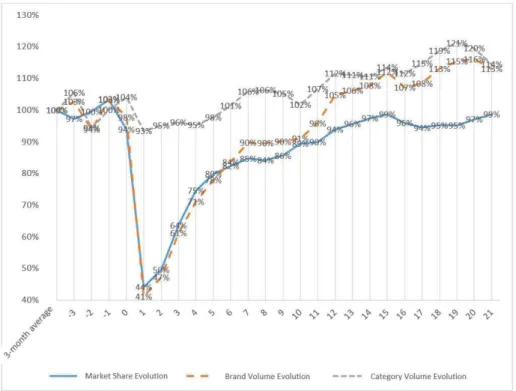
With the recall campaign, not only the brand, but also the category lost volume initially, and only six months after the recall, the category recovered the same level as before the recall. After this recovery, the category continued with the growth pace, reaching a volume 21% higher after twenty months from the beginning of the recall. The brand volume reached 40% of its average volume in the month following the announcement of the recall, but after a year, the “brand” managed to recover its pre-crisis volume. After the recall, the brand reached 99% of the market share rate before the crisis in the 15th and 21st month,
but without exceeding this milestone. Figure 3 illustrates these variations.
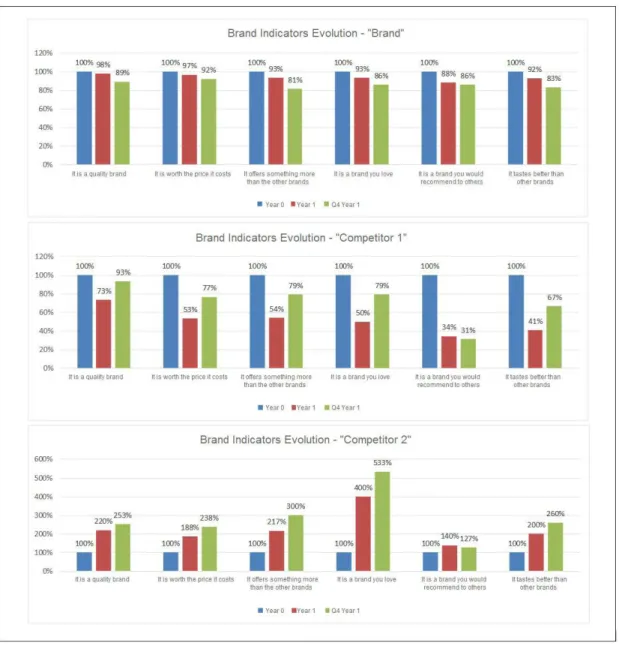
According to the brand tracking information, the product recall has also affected hoe consumers perceive brands. The data analysis provided by the “company” considers the variation in relation to the year in which the recall took place (“year 0”). Figure 4 shows these variations among data from subsequent years (“year 1”) and the last quarter of the “year 1” were compared. The “brand” loses in
relation to quality perception (It is a quality brand), value (It is worth the price it costs), differentiation of offer (It offers something more than the other brands), recommendation (A brand that would be recommended to others) and superiority in lavor (It tastes better than other brands). “Competitor 1” shows a greater fall in “year 1”, yet demonstrates a trend of reversal in the last quarter of “year 1”. “Competitor 2”, launched a few months before the recall, indicates large growth in all indicators.
Once only variations are shown, it is worth noting that the igures have a great difference in order of magnitude and even with the variations, the “brand” at the end of “year 1” still has higher indicators in relation to the main competitor (“competitor 1”). “Competitor 2”, with a recently launched product,
had a small basis for comparison in the “year 0”, which allows the large variations shown.
4 Analysis of information based on
the theoretical framework
Chart 2 summarizes the results of this analysis. Sales research panel indicates a 60% loss of volume due to the removal of the product from the market and the prohibition of its commercialization. The lack of a simultaneous removal of the entire product from the market and the denial of a few retailers to return the product subject to recall and suspend its sales (claiming that they did not accept the sales loss) explains the existence of certain “product” in the market, even with sales prohibition. Due to the product’s sales drop, above the fall in the category,
the market share declined almost proportionally to the volume at irst. The data presented suggests the conirmation of Assumption 1: A brand crisis caused by problem harm leads to losses in volume and market share.
The evolution of brand indicators also points to a decline in remembrance and value perception, recognition of the superiority of the value proposal, quality and wear of the emotional relationship with the brand. The image crisis caused by the recall could explain this trend could, which would suggest the conirmation of Assumption 2: A brand crisis caused by product harm may generate negative brand associations.
The product volume evolution and the category over time, suggests that the category as a whole suffers from a crisis triggered by the leading brand, losing volume for the irst six months. After this period, the volume of the category recovers and the market share of the leader does not return to pre-crisis levels at least in the twenty months after the crisis. The reduction in the volume initially meant a threat for the category, as well as wear on the image of the main competitor over time. However, the faster volume recovery by the category than the recovery of the leader meant an opportunity for competitors in terms of volume. It suggests only a partial conirmation of Assumption 3: A crisis of medium extent of the brand of a high reputation company represents a threat to the business of competitors by having the potential to affect negatively the entire category. The behavior of the new entrant (“competitor 2”) compared to the leading competitor (“competitor 1”) would suggest that a brand previously established in
the market is more strongly affected by a brand crisis caused by product harm than an entrant brand, with lower association with the category. In this sense, the opportunity for pre-established brands and new entrants would happen differently.
After having the suspension of the sale announced and product recall initiated, regional competitors made discount actions to stimulate the attraction of consumers not served by the leader. “Competitor 2” also intensiied its investments in communication with the change of scenario of the category. At the point of sale, competitors with direct and indirect sales teams, with retail service, sought to improve their levels of performance and reach the gaps left on the shelves by the leader. It suggests the conirmation of Assumption 4: Due to the crisis, competitors may become more aggressive aiming to win over consumers of the product that triggered the crisis.
The crisis would still have left a positive residual effect by informally approximate different areas of the “company”, favoring interdepartmental collaboration and bringing the organization even closer to the market, as shown by Tsang (2000).
5 Conclusions, limitations and
suggestions for future studies
Given the upward trend of cases of crisis, it is essential to increase the number of studies addressing brand crisis and the effects caused on the brand. This study identiied the consequences of a brand crisis caused by a recall campaign, through an embedded single case study, suggesting the partial conirmation of an assumption and the full conirmation of three
Chart 2. Main effects observed in this case study.
ASSUMPTIONS OBSERVED EFFECTS
Assumption 1: A brand crisis caused by problem harm leads to losses in volume and market share.
Immediate loss of approximately 60% of the sales volume and market share of the “brand”. Immediate reduction of 5% in the volume of the category (Chart 2).
Assumption 2: A brand crisis caused by product harm may generate negative brand associations.
The brand health indicators of the tracking indicated drop in perception of value, recognition of the
superiority of the value proposal, perceived quality, and emotional relationship with the brand (Figure 4).
Assumption 3: A crisis of medium extent of the brand of a high reputation company represents a threat to the business of competitors by having the potential to affect negatively the entire category.
Immediately after the recall, the category loses 5% of its volume and takes six months to return to pre-recall levels. One year after the event, the volume of the category was already 12% higher than the pre-recall volume (Chart 2).
The main brand health indicators of “competitor 1” experienced a higher decline that the “brand” in the irst year post-recall.
Assumption 4: Due to the crisis, the competitors may become more aggressive aiming to win over consumers of the product that triggered the crisis.
Assiouras, I., Ozgen, O., & Skourtis, G. (2013). The impact of corporate social responsibility in food industry in product-harm crises. British Food Journal, 115(1), 108-123. http://dx.doi.org/10.1108/00070701311289902.
Campomar, M. (1991). Do uso de “estudo de caso” em pesquisas para dissertações e teses em administração. Revista de Administração, 26(3), 95-97.
Cleeren, K., Van Heerde, H., & Dekimpe, M. G. (2013). Rising from the Ashes: how brands and categories can overcome product-harm crises. Journal of Marketing, 77(2), 58-77. http://dx.doi.org/10.1509/jm.10.0414.
Coombs, W. T. (2007a). Protecting organization reputations during a crisis: the development and application of situational crisis communication theory. Corporate Reputation Review, 10(3), 163-176. http://dx.doi. org/10.1057/palgrave.crr.1550049.
Coombs, W. T. (2007b). Attribution theory as a guide for post-crisis communication research. Public Relations Review, 33(2), 135-139. http://dx.doi.org/10.1016/j. pubrev.2006.11.016.
Crescitelli, E., & Shimp, T. (2012). Comunicação de Marketing: integrando propaganda, promoção e outras formas de divulgação. São Paulo: Cengage Learning.
Dawar, N., & Lei, J. (2009). Brand crises: the roles of brand familiarity and crisis relevance in determining the impact on brand evaluations. Journal of Business Research, 62(4), 509-516. http://dx.doi.org/10.1016/j. jbusres.2008.02.001.
Dawar, N., & Pillutla, M. M. (2000). Impact of product harm crises on brand equity: the moderating role of consumer expectations. JMR, Journal of Marketing Research, 37(2), 215-226. http://dx.doi.org/10.1509/ jmkr.37.2.215.18729.
Dean, D. H. (2004). Consumer reaction to negative publicity: effects of corporate reputation, response, and responsibility for a crisis event. Journal of Business Communication, 41(2), 192-211. http://dx.doi. org/10.1177/0021943603261748.
Donnelly, K. A.-M., Karlsen, K. M., & Dreyer, B. (2012). A simulated recall study in five major food sectors. British Food Journal, 114(7), 1016-1031. http://dx.doi. org/10.1108/00070701211241590.
Exame. (2010, 14 de outubro). Melhores e Maiores 2006. São Paulo: Exame. Recuperado em 20 de abril de 2015, de http://exame.abril.com.br/negocios/melhores-e-maiores/
Greyser, S. A. (2009). Corporate brand reputation and brand crisis management. Management Decision, 47(4), 590-602. http://dx.doi.org/10.1108/00251740910959431.
Hair, J., Anderson, R., & Tatham, R. (2007). Análise multivariada de dados (6. ed.). Porto Alegre: Bookman.
Kalaignanam, K., Kushwaha, T., & Eilert, M. (2013). The impact of product recalls on future product reliability and future accidents: evidence from the automobile of the four assumptions made based on the theory
on brand crisis.
The methodology used indicates as a limitation the non-extrapolation of its results. Information about prices, investments and communication were not available. As a contribution, this study brings the analysis of the application of theoretical assumptions on the market reality (Hair et al., 2007). The result relects a speciic event that occurred with the leading brand of a segment of the food and beverage category, but scholars and managers could use its lessons as insights for new studies or for crisis management plans.
After the occurrence of the crisis, the departmental boundaries became closer, with an increased interaction and informal collaboration between the Marketing, Sales, Operations, Finance, Human Resources and Legal areas. The experience of the crisis apparently brought the corporation closer, reinforcing the team spirit and the connection with the market (consumers and clients). This strengthening of the corporation after the crisis (Kalaignanam et al., 2013; Tsang, 2000) is a topic little explored in Brazil by scientiic research in general management and human resources.
There is a consensus that the period of detection of the problem and the response can make the difference between being a protagonist in crisis management or have a responsive role. The growing number of cases of recall is followed by technological advances to capture, store and analyze information from different sources, formats and input speeds; this phenomenon known as big data (Zikopoulos & Eaton, 2012). The cross-analysis of information from production and quality reports, the tracking of social networks and customer service reports, and macro factors (such as variations in temperature and humidity by region) through predictive systems could trigger alarms when detecting situations with increased probability of problems that could trigger a crisis.
In the marketing literature, few cases of crisis have been studied focusing on the competitors and how they prepare not only for their brand crises, but also to minimize the impact and capture the opportunities eventually generated by problems with product leaders.
References
Aaker, D. (1996a). Measuring brand equity across products and markets. California Management Review, 38(3), 102-120. http://dx.doi.org/10.2307/41165845.
Aaker, D. (1996b). Criando e administrando marcas de sucesso. São Paulo: Futura.
Siomkos, G., Triantafillidou, A., Vassilikopoulou, A., & Tsiamis, I. (2010). Opportunities and threats for competitors in product-harm crises. Marketing Intelligence & Planning, 28(6), 770-791. http://dx.doi. org/10.1108/02634501011078156.
Souiden, N., & Pons, F. (2009). Product recall crisis management: the impact on manufacturer’s image, consumer loyalty and purchase intention. Journal of Product and Brand Management, 18(2), 106-114. http:// dx.doi.org/10.1108/10610420910949004.
Souza, B. (2014). Airbus culpa má gestão da TAM por queda de avião em 2007. São Paulo: Exame.
Tsang, A. (2000). Military doctrine in crisis management: three beverage contamination cases. Business Horizons, 43(5), 65-73. http://dx.doi.org/10.1016/S0007-6813(00)80011-7.
Van Heerde, H., Helsen, K., & Dekimpe, M. G. (2007). The impact of a product-harm crisis on marketing effectiveness. Marketing Science, 26(2), 230-245. http:// dx.doi.org/10.1287/mksc.1060.0227.
Vieira, R. (2014). Funcionários que nadavam em caixa d’água são demitidos. São Paulo: Exame.
Yin, R. K. (2009). Case study research: design and methods. In L. Bickman & D. J. Rog (Eds.), The Sage Handbook of Applied Social Research Methods (2. ed., Vol. 5). Thousand Oaks: Sage Publications. 661 p.
Zikopoulos, P., & Eaton, C. (2012). Understanding big data: analytics for enterprise class hadoop and streaming data. New York: McGraw Hill.
industry. Journal of Marketing, 77(2), 41-57. http:// dx.doi.org/10.1509/jm.11.0356.
Keller, K. L. (1993). Conceptualizing, measuring, and managing customer-based brand equity. Journal of Marketing, 57(1), 1-22. http://dx.doi.org/10.2307/1252054.
Martins, G. (2008). Estudo de caso: uma reflexão sobre a aplicabilidade em pesquisas no Brasil. Revista de Contabilidade e Organizações, 2(2), 8-18.
Matos, C. A., & Veiga, R. T. (2003). Os efeitos da publicidade negativa nas atitudes dos consumidores. Caderno de Pesquisas em Administração, 10(2), 69-86.
Melo, L. (2013). Rato na Coca-Cola nunca existiu, conclui TJ-SP. São Paulo: Exame.
Procon-SP. (2015). Recuperado em 20 de abril de 2015, de http://sistemas.procon.sp.gov.br/recall/
Reputation Institute. (2015). Recuperado em 20 de abril de 2015, de http://www.reputationinstitute.com/thought-leadership/global-reptrak-100
Roehm, M. L., & Tybout, A. M. (2006). When will a brand scandal spill over, and how should competitors respond? Journal of Marketing Research, 43(3), 366-373. http:// dx.doi.org/10.1509/jmkr.43.3.366.
Semprini, A. (2010). A marca pós-moderna (2. ed.). São Paulo: Estação das Letras e Cores.