
INTRODUCTION
The preparation of polymer-clay nanocomposites represents an important application of montmorillonite (MMT) clays. Among the methods adopted to make compatible the hydrophilic clay with the polymer, generally hydrophobic, the incorporation of ammonium salts or quaternary ammonium salts having long alkyl chains in the interlayer spacing of the clay prevails [1]. More recently, oligomeric and polymeric compatibilizing agents have also been used [2, 3]. Clays modiied by polymeric salts present improved thermal stability and makes it possible the preparation of nanocomposites of polymers, which due to their nonpolarity are incompatible even with the clays modiied by long alkyl chains ammonium surfactant salts. For example, nanocomposites of polypropylene (PP) and polyethylene (PE),
presenting both intercalated and exfoliated structures, have been obtained with clays modiied by polymeric surfactants [4, 5]. Nanocomposites ofp-conjugated polymers and MMT have also been studied [6-8]. Among them are those of polythiophenes, a family of conductive polymers presenting functional groups which make them candidates for diverse applications such as microelectronic devices [9], catalysts [10], chemical and biosensors [11, 12], among others.
Studies focusing on nanocomposites of poly (3-alkylthiophenes) with MMT were published recently, showing that these materials have improved electrical conductivity and photoluminescence [13-16]. The reported nanocomposites were made with both sodium-MMTs and organo-MMTs intercalated with non-polymeric surfactants. The sodium-MMT nanocomposite was obtained through in situ polymerization in solution and had intercalated structure
Organo-montimorillonites containing a reactive thiophene group for
polythiophenes nanocomposites
(Montmorilonitas organoilizadas contendo grupos tiofeno reativos para
preparação de nanocompósitos de politiofenos)
J. C. Macêdo-Fonsêca1*, A. A. A. Tino2, M. P. A. Silva-Alves2, R. M. Souto-Maior2
1Unidade Acadêmica do Cabo de Santo Agostinho, Universidade Federal Rural de Pernambuco, Condomínio Logístico Cone Suape Multimodal, BR 101 Sul, n° 5225, Ponte dos Carvalhos, Cabo de Santo Agostinho, PE
2Departamento de Química Fundamental, Universidade Federal de Pernambuco, Av. Jornalista Anibal Fernandes, s/nº, Recife, PE, Brazil 50740-560
Abstract
A sodium montmorillonite clay (Na+MMT) was modiied with different contents of a reactive salt derived from thiophene
(trimethyl-(2-thiophen-3-yl-ethyl)-ammonium bromide) (TMETA). The thiophene salt in the organoclay (xtioMMT) was oxidatively polymerized in situ, giving rise to montmorillonite clay intercalated with a polythiophene salt (xpoltioMMT). Analysis by Fourier transform infrared spectroscopy shows a difference in organization of the salt inside the clay lamellae, before and after its polymerization. X-ray diffraction indicates that the salts, whether polymeric or not, are arranged as a monolayer for all compositions. Differently to the expected, the thermal stability of the organoclays decreases upon polymerization suggesting degradation of TMETA in the polymerization reaction.
Keywords: montmorillonite, thiophene, quaternary ammonium salt, organoclay.
Resumo
Uma argila montmorilonita sódica (Na+MMT) foi modiicada com diferentes teores de um sal quaternário de amônio reativo,
derivado de tiofeno, brometo de (3-tienil)-2-etiltrimetilamônio (TMETA). O sal de tiofeno intercalado na argila foi polimerizado in situ por via oxidativa, originando uma argila montmorilonita intercalada com um sal de politiofeno (xpoltioMMT). A análise de espectroscopia de infravermelho com transformada de Fourier mostra a diferença entre as maneiras de organização do sal no espaçamento interlamelar das argilas, antes e após a polimerização do sal. A análise de difração de raios X indicou que independente do sal se encontrar na forma polimérica ou monomérica, este se arranja na forma de monocamada para todas as composições de sal intercalado. Diferente do esperado, a estabilidade térmica da argila organofílica diminui após a polimerização do sal orgânico intercalado, sugerindo que ocorreu degradação do TMETA durante a reação de polimerização.
[17], while the nanocomposites made with organoclays presented structures containing mainly intercalated domains when prepared by the melt-cooled and solvent cast method [13, 14, 17]. A polythiophene having ammonium moieties in its lateral alkyl chains was used in the construction of organic-inorganic superlattices [18], and ammonium quaternary salts derived from thiophene were used as both monomers and induction agents for the formation of mesoporous structures in polythiophenes-silica composites which presented intense luorescence [19]. In this paper the results of the preparation and characterization of MMT clays modiied by a quaternary ammonium salt containing a thiophene moiety trimethyl-(2-thiophen-3-yl-ethyl)-ammonium bromide (TMETA) and MMT clays modiied by a polythiophene obtained by in situ polymerization of the salt were present. The objective of this work was the preparation and characterization of organoclays with increased potential of exfoliation for the preparation of polythiophenes nanocomposites.
EXPERIMENTAL
Materials: a cloisite® Na+ montmorillonite (Na+MMT)
with cation exchange capacity (CEC) of 90 meq/100 g from Southern Clay Products was used. Trimethylamine solution (31-35% in ethanol, approximately 4.2 M), 3-thiopheneethanol (99%), and phosphorous bromide (1.0 M solution in dichloromethane) from Sigma-Aldrich were used as received.
Synthesis of TMETA: the ammonium salt of thiophene was synthesized in two steps (Fig. 1) based on literature procedures [20, 21], as described below.
3-(2’-bromoethyl) thiophene: a solution of PBr3 in CH2Cl2 (13 mL, 13 mmol) was added dropwise to 3-thiopheneethanol (5.0 g, 39 mmol), dissolved in 5 mL of anhydrous methylene chloride, at 0 °C and under N2 atmosphere. The mixture was stirred for 48 h at room temperature and the reaction was terminated by the addition of 50 mL of a saturated aqueous sodium chloride solution. The organic layer was separated, treated with 10% aqueous NaHCO3, followed by 10% aqueous NaHSO3. The organic solution was dried over anhydrous magnesium sulfate. After
iltration the solvent was removed by rotary evaporation
leaving a slightly yellow oil. Vacuum distillation of this oil gave 4.01 g (59%) of 3-(2’-bromoethyl) thiophene. MS (ESI): tr= 8.2 min; m/z (%) = 190, 194 (50) [M+]; 111 (65);
97 (100); 77 (28); 67 (20); 45 (85). (C6H7SBr). H1 NMR(300
MHz, CDCℓ3): δ 7.3 (dd, J5’,4’= 4.9 Hz and J5’,2’=3.0 Hz, 1H);
δ 7.1 (d, J=2.1 Hz, 1H); δ 7.0 (d, J2’,5’= 4.9 Hz, 1H); δ 3.6 (t, J=7.5 Hz, 2H); δ 3.24 (t, J=7.5 Hz, 3H).
TMETA: to 3-(2-bromoethyl) thiophene (5.9 g, 30.8 mmol) under N2 atmosphere, 10 mL of a 4.0 M solution of trimethylamine in ethanol was added. The reaction
mixture was reluxed and stirred for 10 h. The solvent was
then removed by rotary evaporation yielding a white solid,
which was puriied by recrystallization from isopropanol;
yield 5.19 g (98%). FT-IR (KBr): 3070, 3045, 3004, 2926, 2860, 1542, 1486, 1034, 978, 766, 624 cm-1. 1H RMN (300
MHz, D2O; δ): 7,4 (dd, J5’,4’= 5 Hz and J5’,2’= 3 Hz, 1H); δ
7.2 (s,1H); δ 7.0 (d, J2’,5’= 5 Hz, 1H); δ 3.5-3.4 (m, 2H); δ
3.07(m, 2H); δ 3.1 (s, 9H). 13C RMN (300 MHz, D
2O; δ): δ
23.5 (CH2); δ 53.0 (CH3); δ 53.04 (CH3); δ 53,08 (CH3); δ 66.2 (CH2); δ 122.8; 126.9; 128.0; 135.6.
Preparation of montmorillonites intercalated with TMETA: MMT modiied by TMETA was prepared according
to [22]. The organoclays were named xtioMMT where x is the amount of salt loaded which was 0.5, 1.0 and 1.5 CEC equivalents. Na+MMT (1 g) was stirred in 90 mL distilled
water for circa 24 h at room temperature (26 °C) until a homogenous suspension was formed. The appropriate amount of TMETA, dissolved in 10 mL of distillated water was added to the Na-MMT suspension. The mixture was stirred at 70 °C for 3 h and then allowed to stand for 24 h. The slurry was centrifuged and the supernatant discarded. The organoclay was repeatedly washed with distilled water and centrifuged, until a clear supernatant was obtained. The organoclay was oven dried at 60 °C and powdered.
Polymerization of TMETAin the interlayer spacement of MMT: the organoclay (xtioMMT) (1 g) and anhydrous ferric chloride (4:1 mol/mol in relation to the nominal salt content in the clay) dispersed in 50 mL of dry chloroform were stirred at room temperature (26 °C), under N2 atmosphere. After 40 h of stirring, the slurry was centrifuged and the supernatant discarded. The precipitate was repeatedly washed with methanol until the supernatant was clear. The clay (xpoltioMMT) was oven dried at 60 °C and powdered.
Fourier transform infrared (FTIR) spectroscopy: FTIR spectra were recorded on a Bruker ISF66 instrument. Pressed pellets of the samples in KBr were used.
X-ray diffraction (XRD): data were collected with a Siemens Diffract ACT 1000 diffractometer, using Cu-Kα radiation (λ=0.154 nm), from 2θ = 1.5° to 30° and a step size of 0.02 º/min. The basal spacing values (d001) were calculated by Bragg’s law: d001= λ/(2sinθ).
Thermogravimetric analysis (TG): was carried out on
a Netzch STA 449F3-Jupiter analyzer under a lowing N2
atmosphere (20 mL/min) at a scan rate of 10 °C/min from 40 to 800 °C.
RESULTS AND DISCUSSION
FTIR spectroscopy
Fig. 2 shows the FTIR spectra of TMETA, Na+MMT,
Figure 1: Synthetic route to trimethyl-(2-thiophen-3-yl-ethyl)-ammonium bromide.
[Figura 1: Rota sintética do brometo de (3-tienil)-2-etiltrimetilamônio.] 3-thiopheneethanol
PBr3/CH3Cl2 N(CH3)3/EtOH
Sample
O-H
(cm-1)
CH
(arom.)
(cm-1)
CH
(arom.)
(cm-1)
H3C-N+
υasym.
(cm-1)
H3C-N+
υsym.
(cm-1)
CH2
υasym
(cm-1)
CH2
υsym
(cm-1)
CH
asym
(cm-1)
SiO
(cm-1)
TMETA - 3070 3045 3004 2946 2926 2860 1486 -
Na+MMT 3636 - - - 1045
50tioMMT 3629 3117 3044 3024 2966 2944 2871 1484 1047
100tioMMT 3631 3117 3044 3024 2966 2944 2871 1482 1047
150tioMMT 3626 3117 3044 3024 2966 2944 2871 1484 1050
50poltioMMT 3634 - - - 1482 1050
100poltioMMT 3632 - 3056 3029 2977 2946 2929
2873
2852 1482 1050
150poltioMMT 3628 3073 3051 3021 2977 2946 2929
2874
2861 1484 1050 50tioMMT, 100tioMMT and 150tioMMT. The spectrum of
TMETA (Fig. 2a) shows bands at 3070 and 3045 cm-1 attributed
to the aromatic Cb-H and Ca-H stretchings respectively, and at 3004 and 2946 cm-1 due to the n
asymH3C-N + and n
symH3C-N +,
respectively [23, 24]. The bands at 2926 and 2860 cm-1
correspond to the nasymC-H and nsymC-H respectively, in
methylene groups. The characteristic aromatic ring nasymC=C
appears at 1542 cm-1 [25], and a strong band at 1486 cm-1 is
due to the asymmetric C-H bending vibrations in the CH3 groups [26]. The spectrum of Na+MMT (Fig. 2b) shows an
O-H stretching band at 3636 cm-1 due to structural hydroxyl
groups and a broad H-O-H stretching band at approximately 3450 cm-1 due to adsorbed water [27], a strong broad band
at 1045 cm-1 due to Si-O stretching vibrations and bands at
526 and 467 cm-1 attributed to Si-O-Al and Si-O-Si bending
vibrations, respectively [28]. In the spectra of 50tioMMT (Fig. 2c), 100tioMMT (Fig. 2d) and 150tioMMT (Fig. 2e) bands of TMETA can be seen in the 3200-2800 cm-1 region
and at 1480 cm-1. As expected, the intensity of the bands
attributed to intercalated TMETA in these spectra increases with increasing salt concentration.
In Table I the main peaks of the spectra presented in Fig. 2 are summarized, as well as those of the spectra of 50poltioMMT, 100poltioMMT and 150poltioMMT, not shown. The Si-O stretching band frequency of Na+MMT, at
1045 cm-1, shifts to higher wavenumbers in the organoclays,
moving to 1047 cm-1 in the tioMMT clays and to 1050 cm-1
in the poltioMMT clays. This shift indicates the existence of a strong interaction of the intercalated salts with the silane groups on the surface of the lamellae [29], conirming the intercalation of TMETA and suggesting that upon polymerization a stronger interaction is established between the organic polycationic species and the clay.
As also shown in Table I the bands characteristic of TMETA are shifted to higher wave numbers in the xtioMMTs. The CH2 asymmetric and symmetric stretching bands shifted from 2926 to 2944 cm-1 and from 2860 to 2871
cm-1, respectively. These bands have been associated to the
conformational order/disorder of long alkyl chains [30]. It
has been shown that alkylamines conined in silicate galleries
are not as ordered as in bulk crystalline solid form, but as the concentration of amines inside the galleries increases the alkyl chains tend to adopt an all-trans conformation so that the CH2 stretching bands are shifted back to a value close to that presented when in bulk crystalline amine [31]. Figure 2: FTIR spectra of (a) TMETA, (b) Na+MMT, (c) 50tioMMT,
(d) 100tioMMT and (e) 150tioMMT.
[Figura 2: Espectros de infravermelho com transformada de Fourier (FTIR) do (a) TMETA, (b) Na+MMT, (c) 50tioMMT, (d)
100tioMMT e (e) 150tioMMT.]
3500 500
4000 (a)
(b)
(c)
(d) (e)
Wavenumber (cm-1)
T
ra
n
s
m
ita
n
c
e
3000 1500 3000
C-H2
dsym
C-H2 C-H
Si-O Table I - Main FTIR peaks of TMETA, Na+MMT and the organoclays.
[Tabela I - Principais picos apresentados no FTIR no sal TMETA, Na+MMT e argilas organofílicas.]
Therefore, we can infer from the band shifts observed that TMETA is less ordered in the silicate galleries than in bulk.
Upon polymerization of TMETA instead of one, two bands appear in the region of the nasymC-H2 for both 100poltioMMT
and 150poltioMMT. One of the bands is shifted down to a wavenumber closer to that of the bulk crystalline TMETA and the other is shifted to a value slightly higher than that of the intercalated less organized TMETA. The same phenomenon is observed for the nsymC-H2 band. This
indicates that the polymerized species in the poltioMMTs are present in different forms of organization giving rise to the two absorptions. Table I also shows that the band due to the Ca-H stretching of the thiophene ring, which disappears upon polymerization of thiophenes [32] is still present in 100poltiofMMT and 150poltiofMMT. The change in color of the clays from beige to the reddish-browns, characteristic of conjugated polythiophenes, as well as the changes in other infrared vibrations as discussed above, lead to think that oligomeric species have been formed.
X-ray diffraction
Fig. 3 presents the XRD patterns for Na+MMT,
50tioMMT, 100tioMMT and 150tioMMT. Na+MMT has a
diffraction peak at 2q = 7.92º (d(001) = 1.118 nm). This peak is shifted to lower angles in the organoclays indicating expansion of the basal spacing and a successful intercalation. The basal spacing values are essentially the same for 50tioMMT, 100tioMMT and 150tioMMT, contrary to the typical increase observed when large quaternary ammonium cations, such as hexadecyltrimethylammonium bromide, are intercalated in montmorillonite clays [29, 33], but in line with the results obtained by [34, 35] for studies with benzyltrimethylammonium and benzyltriethylammonium, which have structures closer to that of TMETA.
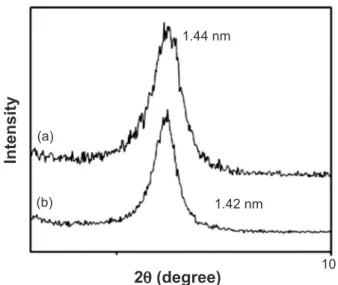
XRD pattern of the clays intercalated with the polymerized TMETA shows a small decrease in the interlayer spacing when compared to the tioMMTs organoclays, particularly for the organoclays 50tioMMT and 100tioMMT, as illustrated in Fig. 4 which presents the XRD patterns for 100tioMMT e 100poltioMMT. Similarly, a decrease in the basal spacing of montmorillonite intercalated with aniliniun ions upon polymerization to polyaniline was observed in [7], which showed that the intercalated polymeric chains
lied lat between the layers. A decrease in the half width of the peak is also observed in Fig. 4 indicating an increase in homogeneity of the sample with polymerization [36, 37].
Thermal analysis
The thermogravimetric analyses for Na+MMT and the
organoclays are shown in Fig. 5 and the thermogravimetric
events are summarized in Table II. The irst event between
40 and 100 ºC is common to all MMTs and is due to the loss of free water and of water inside the clay’s lamellae. These losses were 7.94% for Na+MMT, 3.21% for both 50tioMMT
and 100tioMMT, and 1.98% for 150tioMMT showing that the hydrophilic character of the clay has been considerably lowered upon intercalation. A decrease in the quantity of water lost with an increase in the amount of alkylic salts intercalated has been reported in the literature, and it has also been observed that for intercalation above the CEC water loss remains constant [38]. In this study a decrease in water loss is observed for 150tioMMT in relation to 50tioMMT and 100tioMMT which indicates that the Na+
cations have not been completely exchanged in these clays. A second event of thermal degradation, between 200 and 500 ºC, is observed for the organoclays exclusively and characterizes the decomposition of TMETA. The onset of decomposition occurs at 315.1 °C for 50tioMMTand at 408.1 °C for 100tioMMT. The increase in the temperature Figure 3: X-ray diffraction patterns of clays (a) Na+MMT, (b)
50tioMMT, (c) 100tioMMT and (d) 150tioMMT.
[Figura 3: Difratogramas de raios X das argilas (a) Na+MMT, (b)
50tioMMT, (c) 100tioMMT e (d) 150tioMMT.] (a)
(b)
(c)
1.44 nm 1.43 nm
1.12 nm
1.42 nm
(d)
4
2q (degree)
In
te
n
s
ity
8
6 10
Figure 4: X-ray diffraction patterns of montmorillonites (a) 100tioMMT and (b) 100poltioMMT.
[Figura 4: Difratogramas de raios X das montmorilonitas (a) 100tioMMT e (b) 100poltioMMT.]
(a)
(b)
1.44 nm
1.42 nm
2q (degree)
In
te
n
s
ity
of degradation for 100tioMMT might be attributed rather to the slower diffusion rate of the salt in the more crowed interlayer spacing than to a greater stability of the salt in 100tioMMT when compared to that in 50tioMMT [39, 40]. For 150tioMMT two events due to TMETA degradation are
observed. The irst at 202.8 ºC is due to the decomposition
of excess salt adsorbed, on the clay’s surfaces or inside the lamellae [41], and the second at 403.2 ºC happens due to degradation of the ionically linked salt exchanged for the Na+ cations. An extensive study by [38], using ten different
compositions of hexadecylammoniun and a sodium montimorillonite, showed a clear decrease in the temperature of degradation with an increase in salt content.
As expected the weight percent of decomposed salt increases with increasing intercalation being 5.86%, 7.88% and 9.03% for 50tioMMT, 100tioMMT and 150tioMMT,
respectively. As discussed below these values indicate that only part of the salt loaded in the preparation mixture was adsorbed in the clay. An estimative of the values actually incorporated are shown in Table III. Incorporated values were estimated from the thermogravimetric data and should rest between a maximum and a minimum value obtained according to equation:
X = S% x 10
5
76,4 (M-y) x (100-S%) (A)
where X is the loaded surfactant, S% is the % of weight loss of thiophene salt in the organoclay, M is the molecular weight of the thiophene salt; y is 0 if all Br – remains and 80
if no Br – remains [29]. The maximum value is calculated
assuming that no bromide anion was incorporated while the minimum is obtained assuming the incorporation of Figure 5: TG analysis curves of (a) Na+MMT, 50tioMMT, 100tioMMT, 150tioMMT and (b) 50poltioMMT, 100poltioMMT,
150poltioMMT.
[Figura 5: Curvas de análise TG de (a) Na+MMT, 50tioMMT, 100tioMMT, 150tioMMT e (b) 50poltioMMT, 100poltioMMT,
150poltioMMT.]
100
W
e
ig
h
t
(%
)
a) 50tioMMT
100tioMMT
Na+MMT 150tioMMT 95
90
80
100
Temperature (ºC) 500
300 700
200 400 600 800
85
75
70
100
b)
W
e
ig
h
t
(%
) 50tioMMT
100tioMMT 150tioMMT
95
90
80
100
Temperature (ºC) 500
300 700
200 400 600 800
85
75
70
Dehydratation TMETA Decomposition Dehydroxylation
Tonset (ºC)
Water content
(wt%)
Tonset (ºC)
Organic content (wt%)
Tonset (ºC)
Organic content (wt%)
Tonset (ºC)
Na+MMT 66.9 7.94 - - - - 583.0
50tioMMT 61.3 3.21 - - 315.1 5.86 537.3
100tioMMT 68.9 3.21 - - 408.1 7.88 750.5
150tioMMT 74.0 1.98 202.8 4.07 403.2 4.96 591.5
50poltio MMT 78.9 4.95 - - 292.4 4.36 543.7
100poltioMMT 83.4 4.76 - - 325.8 5.41 637.2
150poltioMMT 81.6 4.88 230.1 2.14 351.1 3.45 449.5
Table II - Thermal events and weight loss for Na+MMT and organoMMT.
both the ammonium cation and its bromide counter ion. For 50tioMMT the incorporated value is very close to the loaded value if no bromine has been incorporated, but as the amount of salt added increases, the relative amount of incorporated salt clearly decreases as seen for 100tioMMT and 150tioMMT. This is in accordance with literature results
which points to the dificulty of incorporation of small
quaternary ammonium cations [34, 35].
Between 500 and 800 ºC an event characterizing dehydroxilation of the clay is observed in Table II. For Na+MMT it starts at 583 ºC and for 50tioMMT at 537.1 ºC.
For 100tioMMT and 150tioMMT dehydroxilation starts at 750.5 and 591.5 ºC, respectively. The thermogravimetric events for the organoMMTs after in situ polymerization of the intercalated salt are the same as those of the parent organoclays (Table II). An increase in dehydration temperature and in the water lost relative to the respective parent organoclay is observed indicating a decrease in hydrophobicity after polymerization of the salt. A decrease in the onset of degradation of the polymeric salt and in the weight loss is also observed. The decrease in weight loss might be due to the degradation of part of the salt during polymerization and the washing off of the degradation products during work up. The polymerization of thiophenes by oxidative coupling with ferric chloride leaves HCl as a by-product [42] and the presence of residual halide ions has been shown to cause the decomposition of surfactant salts inside the clay lamellae [41].
CONCLUSIONS
TMETA can be exchanged for the sodium cations in Na+MMT, as indicated by the expansion of the basal
spacing, shown by X-ray diffraction, and by the presence of bands characteristic of TMETA in the FTIR spectra of the
modiied clays. FTIR also indicates that the salt intercalated
in the silicate galleries is less organized than in the bulk solid state. The amount of TMETA intercalated is lower than the salt loaded in the preparation mixture, and as the amount of salt loaded is increased intercalation increases but not proportionally, as calculated from thermal analysis data.
TMETA can be polymerized inside the lamellae giving rise to oligomeric conjugated species which interact more strongly with the clay than the mono-cations, as inferred from their FTIR spectra. Polymerization also leads to a decrease in basal spacing along with an increase in the homogeneity of the basal spacing sizes in the sample, and to a decrease in the thermal stability of the organoclay.
ACKNOWLEDGEMENTS
We are thankful to FACEPE, CNPq and CAPES for inancial support, to Southern Clay products for donating
the montmorillonite clay used in this work and to CETENE (Centro de Tecnologias Estratégicas do Nordeste) for the use of their analytical facilities.
REFERENCES
[1] S.S. Ray, M. Okamoto, Prog. Polym. Sci. 28 (2003) 1539-1641.
[2] P. Liu, Appl. Clay Sci. 38, 1-2 (2007) 64-76.
[3] J. Zhang, E. Manias, C. Wilkie, J. Nanosci. Nanotechn.
8, 4 (2008) 1597-1615.
[4] Z.M. Wang, H. Nakajima, E. Manias, T.C. Chung,
Macromolecules 36, 24 (2003) 8919-8922.
[5] J. Zhang, D.D. Jiang, C. Wilkie, Thermochim. Acta 430, 1-2 (2005) 107-113.
[6] K.R.L. Castagno,V. Dalmoro, R.S. Mauler, D.S. Azambuja, J. Polym. Res. 17, 5 (2009) 647-655.
[7] G.M. Nascimento, M.L. Temperini, J. Mol. Struc. 1002, 1-3 (2011) 63-69.
[8] R.M.G. Rajapakse, S. Higgins, K. Velauthamurty,
H.M.N. Bandara, S. Wijeratne, R.M.M.Y. Rajapakse, J.
Compos. Mater. 45, 5 (2010) 597-608.
[9] L.C.T. Shoute, Y. Wu, R.L. McCreery, Electrochim.
Acta, 110 (2012) 437-445.
[10] R.S. Sulub, W. Martínez-Millán, M.A. Smit, Int. J. Electrochem. Sci 4 (2009) 1015-1027.
[11] X. Ma, G. Li, H. Xu, M. Wang, H. Chen, Thin Solid
Films 515, 4 (2006) 2700-2704.
[12] A. Uygun, A.G. Yavuz, S. Sen, M. Omastová, Synth. Table III - TMETA adsorbed in the organoclays (calculated from TG data) [29].
[Tabela III - Percentuais de TMETA adsorvido nas argilas organofílicas (calculados através dos resultados de TG) [29].]
Sample organoclays relative to CECTMETA adsorbed in the BTMTA Loaded inthe preparation relative to CEC (%)
Min (%) Max (%)
50tioMMT 32.6 47.9 50
100tioMMT 44.8 65.9 100
150tioMMT 52.0 76.4 150
50poltioMMT 23.9 35.7
-100poltioMMT 29.9 44.0
-Metals 159, 19-20 (2009) 2022-2028.
[13] B.K. Kuila, A.K. Nandi, Macromolecules 37 (2004) 8577-8584.
[14] B.K. Kuila, A.K. Nandi, J. Phys. Chem. B 110, 4 (2006) 1621-31.
[15] B.K. Kuila, A.K. Nandi, J. Appl. Polym. Sci. 111 (2008) 155-167.
[16] Y. Yu, C. Jen, H. Huang, P. Wu, C. Huang, J. Yeh, J.
Appl. Polym. Sci. 91 (2004) 3438-3446.
[17] J.C. Macêdo-Fonsêca, I.S. Silva, R.M. Souto-Maior, Synth. Met. 159, 21-22 (2009) 2215-2218.
[18] M. Era, S. Yoneda, T. Sano, M. Noto, Thin Solid Films 438-439 (2003) 322-325.
[19] Z. Yang, X. Kou, W. Ni, Z. Sun, L. Li, J. Wang, Chem.
Mater. 19, 25 (2007) 6222-6229.
[20] G. Li, S. Bhosale, T. Wang, Y. Zhang, H. Zhu, J.H.
Fuhrhop, Angew. Chem. Int. Ed. 42, 32 (2003) 3818-3821. [21] K.K. Stoke, K. Heuze, R.D. Mccullough, Macromolecules 36 (2003) 7114-7118.
[22] S.M.L. Silva, P.E.R. Araujo, K.M. Ferreira, E.L. Canedo, L.H. Carvalho, C.M.O. Raposo, Polym. Eng. Sci. 49, 9 (2009) 1696-1702.
[23] J.E. Osterholm, P. Sunila, Synth. Met. 18 (1987) 169-176.
[24] Ľ. Jankovič, J. Madejová, P. Komadel, D. Jochec-Mošková, I. Chodák, Appl. Clay Sci. 51, 4 (2011) 438-444. [25] G. Louarn, J.P. Buisson, S. Lefrant, L.D.P. Cristalline, Synth. Met. 57 (1993) 587-592.
[26] M. Kozak, L. Domka, J. Phys. Chem. Solids 65, 2-3 (2004) 441-445.
[27] F.A. Miller, C.H. Wilkins, Anal. Chem. 24 (1952)
1253-1294.
[28] J. Madejova, Vib. Spectrosc. 31 (2003) 1-10.
[29] Y. Xi, R.L. Frost, H. He,J. Colloid Interface Sci. 305, 1 (2007) 150-158.
[30] R.A. Vaia, R.K. Teukolsky, E.P. Giannelis, Chem. Mater. 6, 16 (1994) 1017-1022.
[31] Y. Li, H. Ishida, Langmuir : the ACS J. Surf. Colloids 48, 12 (2003) 2479-2484.
[32] R.M. Souto Maior, H. Eckert, Macromolecules 1279, 10 (1990) 1268-1279.
[33] H. He, Y. Ma, J. Zhu, P. Yuan, Y. Qing, Appl. Clay Sci. 48, 1-2 (2010) 67-72.
[34] T. Polubesova, G. Rytwo, S. Nir, C. Serban, L. Marguliest, M. Galilee, K. Shmona, Clay Clay Miner. 45, 6 (1997) 834-841.
[35] S.-M .Koh, J.B. Dixon, Appl. Clay Sci. 18, 3-4 (2001) 111-122.
[36] M.A. Osman, E.P. Rupp, U.W. Suter, Polymer 46 (2005) 8202-8209.
[37] K. Yoon, H. Sung, Y. Hwang, S. Kyun Noh, D. Lee, Appl. Clay Sci. 38, 1-2 (2007) 1-8.
[38] S.I. Marras, A. Tsimpliaraki, I. Zuburtikudis, C. Panayiotou, J. Colloid Interface Sci. 315, 2 (2007) 520-527. [39] H. He, Z. Ding, J. Zhu, P. Yuan, Y. Xi, D. Yang, R.L. Frost, Clay Clay Miner. 53, 3 (2005) 287-293.
[40] W. Xie, Z. Gao, W.P. Pan, D. Hunter, A. Singh, R. Vaia,
Chem. Mater. 13, 9 (2001) 2979-2990.
[41] L. Cui, D.M. Khramov, C.W. Bielawski, D.L. Hunter,
P.J. Yoon, D.R. Paul, Polymer 49, 17 (2008) 3751-3761. [42] V.M. Niemi, P. Knuuttila, N. Oy, J. Korvola, Polymer 33, 7 (1992) 1559-1562.



![Table III - TMETA adsorbed in the organoclays (calculated from TG data) [29].](https://thumb-eu.123doks.com/thumbv2/123dok_br/18892936.425554/6.892.208.700.177.371/table-iii-tmeta-adsorbed-organoclays-calculated-tg-data.webp)
