459
Metallurgy and materials
Metalurgia e materiais
Characterization of basic
oxygen furnace slag and
granite waste mixtures to
Portland cement production
Abstract
The aim of this paper is to analyze mixtures of basic oxygen furnace slag and granite waste in order to produce Portland cement. X-ray patterns were carried out in both the basic oxygen furnace slag and granite waste. Then, mixtures were pre-pared to obtain the binary basicity of 0.5, 0.9 and 1.2. The mixtures were melted at 1500°C. Two cooling steps were performed. The irst cooling step was accomplished inside the furnace in order to determine the phases formed during the melting step. The second cooling process was carried out in water in order to obtain an amor-phous structure. Images via scanning electrons microscopy and EDS spectrum were obtained for the mixtures cooling in water. The results showed that basic oxygen fur-nace slag contains a higher percent of CaO. A binary basicity of 4.6 was determined. The granite waste appeared as mainly a quartz phase. During the slow cooling step, silicates (akermanite and gehlenite) were formed. On the fast cooling step, amorphous structures were obtained. In addition, images obtained via scanning electrons micros-copy showed glass structures. EDS spectrum indicated that the glass structures were composed for calcium silicates. Thus, the results suggest that mixtures using basic oxygen furnace slag and granite waste presented characteristics desirable for Portland cement production.
Keywords: Basic oxygen furnace, granite waste, solid waste, Portland cement.
http://dx.doi.org/10.1590/0370-44672016690046
Luiz Alberto Baptista Pinto Junior
Mestre
Diretor da Arquipélago Engenharia Guarapari - Espírito Santo – Brasil [email protected]
Anna Paula Littig Berger
Engenheira Metalúrgica, Mestranda Instituto Federal de Educação, Ciência e Tecnologia do Espírito Santo - IFES Vitória - Espírito Santo – Brasil [email protected]
Eduardo Junca
Doutor, Professor
Universidade do Extremo Sul Catarinense - UNESC Criciúma - Santa Catarina – Brasil
Felipe Fardin Grillo
Doutor, Professor
Universidade do Extremo Sul Catarinense - UNESC Criciúma - Santa Catarina – Brasil
Ney Pinheiro Sampaio
MSc, Engenheiro Metalúrgico
Diretor da NPSampaio Consultorias e Representações Belo Horizonte - Minas Gerais - Brasil
José Roberto de Oliveira
Doutor, Professor Doutor
Instituto Federal de Educação, Ciência e Tecnologia do Espírito Santo - IFES Vitória - Espírito Santo – Brasil [email protected]
1. Introduction
Increasing industrial production increases waste generation, which has a cost for its disposal such as transport to send it to the landills and environmental control. Thus, the reuse of waste is an alternative for the companies.
In the metallurgical sector, solid, liquid and gaseous wastes are gener-ated, such as sludge, dust and slag (from blast furnace and basic oxygen furnace) (Vieira et al., 2006). In this sector,
sev-eral researches have been performed in
order to reuse blast furnace slag (BFS) to produce Portland cement (Garcia et al.,
2014; Heikal et al., 2015; Saade et al.,
Fe2O3, CaO, MgO, SO3, K2O, Ti2O5, P2O5 (Sanjuán et al., 2015; Ma et al., 2015).
According to Iacobescu et al., (2015),
the main phases detected in Portland ce-ment are tricalcium silicate-3CaO.SiO2 (C3S), dicalcium silicate-2CaO.SiO2 (C2S), tricalcium aluminate-3CaO.Al2O3 (C3A) and iron tetracalcium aluminate 4CaO. Al2O3.Fe2O3 - (C4AF).
The use of basic oxygen furnace slag (BOFS) can be also an alternative to produce Portland cement, once contain CaO and SiO2 (Goodarzi and Salimi, 2015). However, its use is restricted due CaO/SiO2 relationship (around 4) and
free CaO, which cause expansion and long time to stabilize the Portland cement (Arribas et al., 2015). Besides, the free
CaO decrease the slag vitriication, which can interfere on the hydraulic properties. BOFS shows little hydraulic activity due slow hydration from C2S. Thus, addition range of 6-15% of Al2O3 in BOFS favor the C2F and C4AF formation, which gives higher hydraulicity to Portland cement. In addition, research has showed that slag hydraulic activity increased to higher Al2O3/Fe2O3 relationship (CONJEAUD
et al., 1981). According to Lea (1970),
increasing the CaO/SiO2 favors the slag
hydraulicity. However, increasing the CaO content increase also the viscosity. Such fact dificult the granulation and formation of a glassy structure.
In this way, granite waste (GW) may become a potential input on the Portland cement production, once contain higher SiO2 and lesser CaO contents, as can be noted in Table 1. Such fact indicates a pos-sibility to produce Portland cement, since decrease the BOFS basicity (CaO/SiO2).
Thus, the aim of this paper is to characterize mixtures containing basic oxygen furnace slag and granite waste in order to produce Portland cement.
Elements
(%) SiO2 Al2O3 Fe2O3 MgO CaO Na2O K2O TiO2
Junca et al.,
2015 65.9 13.4 1.4 1.0 4.2 2.6 4.4 -Singh et al.,
2016 72.57 15.63 - 0.83 - 4.21 6.76 -Tchadjié et
al., 2016 60.51 17.49 8.71 3.27 1.64 1.95 3.72 1.42
Hojamber-diev et al.,
2011 65.1 14.0 4.34 0.45 0.46 0.48 0.74 - Table 1
Chemical composition of granite waste.
2. Materials and methods
Basic oxygen furnace slag and granite waste compositions have been published previously (Arrivabene et al.,
2012). Table 2 summarize the results. It is noted that BOFS is composed mainly for
CaO (46.0%) and SiO2 (10%), with binary basicity of 4.6. The granite waste contain mainly SiO2 (59.6%) and Al2O3 (18.1%). Other elements were also determined in lesser percentages, such as MgO, MnO,
Fe2O3, FeO, P2O5, Na2O, K2O and TiO2. Thus, mixed between BOFS and granite waste can become an alternate to decrease the binary basicity in order to produce Portland cement.
Table 2
Chemical composition of basic oxygen furnace slag and granite waste.
Elements
(%) CaO SiO2 Al2O3 MgO MnO Fe2O3 FeO P2O5 Na2O K2O TiO2
BOFS 46.0 10.0 1.5 7.0 6.0 - 27.0 2.0 - - -GW 4.6 59.6 18.1 2.8 1.0 4.8 - - 3.1 3.7 0.9
To fulfil the characterization, X-ray patterns were obtained in order to determine the phases present in both materials. Tests were carried out using a Bruker diffractometer, equipped with
Cu Kα (λ= 1,5418Å) tube. Scan range of 5-80º, step width of 0.2º and dura-tion time of 5 seconds were used. Size analyses were accomplished via mas-tersizer 2000 equipment, which uses
laser diffraction technique to obtain the data. The assays were performed using water as dispersive medium, and ultrasound was turned on for 5 minutes.
2.1 Mixtures composition
The mixtures were prepared with addition of BOFS and GW in order to obtain binary basicity (CaO/SiO2) of
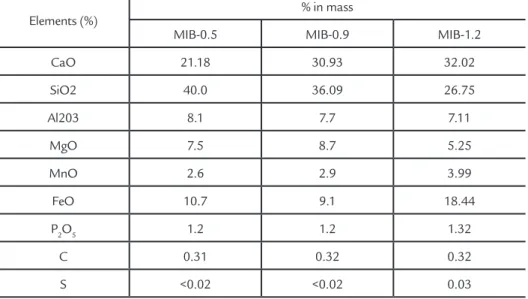
0.5, 0.9 and 1.2. Table 3 shows the chemical composition obtained via mass balance. The initials MIB means
461
Table 3 Mixtures chemical composition used in the melting process.
Elements (%)
% in mass
MIB-0.5 MIB-0.9 MIB-1.2 CaO 21.18 30.93 32.02 SiO2 40.0 36.09 26.75 Al203 8.1 7.7 7.11
MgO 7.5 8.7 5.25 MnO 2.6 2.9 3.99 FeO 10.7 9.1 18.44 P2O5 1.2 1.2 1.32
C 0.31 0.32 0.32 S <0.02 <0.02 0.03
2.2 Melting and cooling process
The melting tests were performed at 1500°C for 15 minutes. It was used an InductoTherm induction furnace. Two different cooling were performed. Slowly cooling (into the furnace) was
carried out in order to identify phases with indicative of hydraulicity. In this step was used 300 g of each mixture. Fast cooling (in water) was also per-formed in order to obtain a glassy
structure. In this step was used 7 kg of each mixture. X-ray patterns were ob-tained in both tests to obtain the phases present. Same conditions mentioned previously were used.
3. Results and discussion
3.1 Raw material characterization
X-ray pattern was obtained from BOFS (Figure 1). Basic oxygen furnace slag contain silicate (ran-quinite and larnite), which are im-portant to produce Portland cement. It was also noted free calcium oxide (Lime), what is harmful to produce Portland cement. Calcium hydroxide, calcium carbonate, iron oxide and
magnesium oxide were also found. Similar compositions were mentioned by Gutt and Nixon (1972) and Motz and Geiseler (2001).
In addition, Figure 2 shows the ray pattern from granite waste. X-ray pattern from granite waste showed quartz as mainly components. This suggests a potential to utilization in
Portland cement production with BOFS in order to adjust the binary basicity. Quartz is also a vitrifying ele-ment, which favor amorphous struc-ture formation. Albite and anorthite, were also detected. Such phases have been detected for several researchers in granite waste composition (Li et al.,
2013; Junca et al., 2015).
Figure 1 X-ray pattern from basic oxygen furnace slag.
Size analysis showed that BOFS is range
of 0.479-2187.76 µm, with 90% lesser than 1258.92 µm, and 50% lesser than 478.63 µm. The size analyses from granite waste showed range of 0.414-181.97 µm, with 90% lesser 60.25 µm, and 50% lesser 13.18 µm.
3.2 Molten mixture characterization
Figure 3 shows the X-ray patterns obtained from MIB-0.5, MIB-0.9 and MIB-1.2 slowly cooling into the furnace.
Figure 3
X-ray patterns obtained
via slow cooling inside the furnace. a) MIB-0.5; b) MIB-0.9; c) MIB-1.2.
Addition of granite waste in the BOFS took silicates formation (ak-ermanite and gehlenite). These com-pounds were not detected in the initial composition in both BOFS and granite waste, which suggests that such phases
were formed by chemical composition adequation, i.e. addition of granite waste decreased the mixture binary basicity, which provided the silicates formation. Reduction of unstable ox-ides (FeO and MgO) and stabilizing
oxides dissolution (SiO2 and Al2O3) were also observed.
Figure 4 shows the X-ray patterns obtained via fast cooling in water, which indicates that amorphous struc-tures were obtained in all mixstruc-tures.
Figure 4
X-ray patterns obtained via fast cooling in water.
a) MIB-0.5; b) MIB-0.9; c) MIB-1.2.
Such fact indicates the formation
of silicate glassy structure. According to Smolczyk (1980) and Murphy et al., (1997), formation of glassy structure suggests the possibility to use it in Port-land cement production.
(a) (b)
(c)
(a) (b)
463
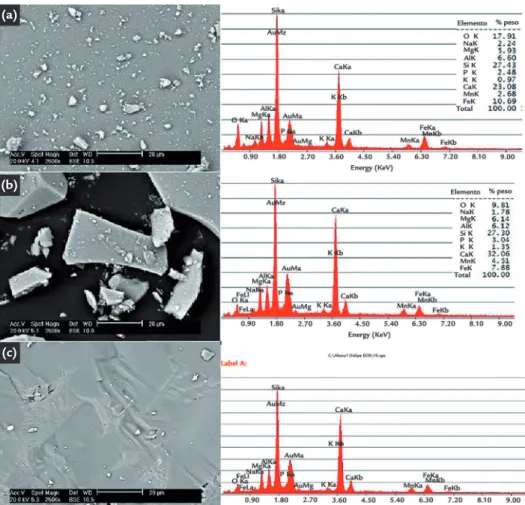
Scanning electrons microscope images (Figure 5) showed that glassy structures were formed under fast
cooling in water for MIB-0.5, MIB-0.9 and MIB-1.2 mixtures. EDS spectrum also indicates that glassy structures
are composed mainly by silicon and calcium, which suggests formation of calcium silicate.
(a)
(b)
(c)
Figure 5 Image obtained via scanning electron microscopy and EDS spectrum to fast cooling in water. a) MIB-0.5; b) MIB-0.9; c) MIB-1.2.
4. Conclusion
Basic oxygen furnace slag showed a higher binary basicity (4.6). It is also composed by silicates (ranquinite and larnite). Granite waste is composed mainly by quartz, and less content of CaO. Mixtures under slowly cooling showed formation of silicates
(akerman-ite and gehlen(akerman-ite). This fact was correlat-ed with chemical composition it causcorrelat-ed by addition of granite waste. Mixtures under fast cooling produced an amor-phous structure, as it is also necessary to Portland cement production. Addition-ally, the fast cooling produced a glassy
structure, as it was noted via scanning electrons microscope. EDS spectrum also suggested that glassy structures are formed for calcium silicates. The results obtained indicates a possible utilization of mixtures of granite waste and BOFS to produce Portland cement.
5. Acknowledgements
The authors would like to thank
FAPES (State of Espírito Santo’s Research and innovation Support Foundation), process 68853777/14 and IFES (Federal Institute of Education, Science and Tech-nology of Espírito Santo).
6. References
ARRIBAS, I., SANTAMARÍA, A., RUIZ, E., LÓPEZ, V.O., MANSO, J.M. Electric arc furnace slag and its use in hydraulic concrete. Construction and Building Ma-terials, v. 90, p. 68–79, 2015.
ARRIVABENE, L.F., PINTO JUNIOR, L.A.B., OLIVEIRA, J.R., TENÓRIO, J.A.S., ESPINOSA, D.C.R. Viabilidade técnica da fabricação de cimento com mis-tura de escória de aciaria LD e resíduo de granito. REM – Revista Escola de Mi-nas, v. 65, n. 2, p. 241-246, 2012.
CONJEAUD, M., GEORGE, M.C., SORRENTINO, F.P. A new steel slag for cement manufactore: mineralogy and hidraulicity. Cement and Concrete Research, v. 11,
p. 85-102, 1981.
cement-blast furnace slag mortars activated using water glass: Effect of tempe-rature and alkali concentration. Construction and Building Materials, v. 66, p.
323–328, 2014.
GOODARZI, A.R., SALIMI, M. Stabilization treatment of a dispersive clayey soil using granulated blast furnace slag and basic oxygen furnace slag. Applied Clay Science, v.108, p. 61–69, 2015.
GUTT, W., NIXON, P.J. Steel-making slag as a skid resistant roadstone. Chemistry and Industry, v. 17, p. 503-504, 1972.
HEIKAL, M., AL-DUAIJ, O.K., IBRAHIM, N.S. Microstructure of composite ce-ments containing blast-furnace slag and silica nano-particles subjected to elevated thermally treatment temperature. Construction and Building Materials, v. 93, p.
1067–1077, 2015.
HOJAMBERDIEV, M., EMINOV, A., XU, Y. Utilization of muscovite granite waste in the manufacture of ceramic tiles. Ceramics International, v. 37, p. 871–876,
2011.
IACOBESCU, R.I., ANGELOPOULOS, G.N., JONES, P.T., BLANPAIN, B., PON-TIKES, Y. Ladle metallurgy stainless steel slag as a raw material in Ordinary Por-tland Cement production: a possibility for industrial symbiosis. Journal of Cleaner Production. p. 1-10, 2015.
JUNCA, E., OLIVEIRA, J.R., ESPINOSA, D.C.R., TENÓRIO, J.A.S. Iron recovery from the waste generated during the cutting of granite. v. 12, p. 465-472, 2015. LEA, F.M. The chemistry of cement and concrete. (3. Ed.). London: Edward Arnold
Ltd, 1970. 727 p.
LI, Y., YU, H., ZHENG, L., WEN, J., WU, C., TAN, Y. Compressive strength of ly ash magnesium oxychloride cement containing granite wastes. Construction and Building Materials, v. 38, p. 1–7, 2013.
MA, S., LI, W., ZHANG, S., GE, D., YU, J., SHEN, X. Inluence of sodium gluconate on the performance and hydration of Portland cement. Construction and Building Materials, v. 91, p. 138–144, 2015.
MOTZ, H., GEISELER, J. Products of steel slags in opportunity to save natural re-sources. Waste Management, v. 21, p. 285-293, 2001.
MURPHY, J.N., MEADOWCROFT, T.R., BARR, P.V. Enhancement of the cemen-titious properties of steelmaking slag. Canadian Metallurgical Quartely, v. 36, p.
315-31, 1997.
SAADE, M.R.M., SILVA, M.G., GOMES, V. Hydration of quaternary Portland ce-ment blends containing blast-furnace slag, siliceous ly ash and limestone powder.
Cement and Concrete Coposites, v. 55, p. 374-382, 2015.
SANJUÁN, M.A., ARGIZ, C., GÁLVEZ, J.C., MORAGUES, A. Effect of silica fume ineness on the improvement of Portland cement strength performance. Construc-tion and Building Materials, v. 96, p. 55–64, 2015.
SINGH, S., NAGAR, R., AGRAWAL V. Performance of granite cutting waste con-crete under adverse exposure conditions. Journal of Cleaner Production, v. 127, p.
172-182, 2016.
SMOLCZYK, H.G. Slag structure and identiication of slags. In: INTERNATIONAL CONGRESS CHEMISTRY OF CEMENT, 7, 1980. Paris. Proceedings... Paris: Septima, 1980. sub-theme III-1, v.1, p. 1-17.
TCHADJIÉ, L.N., DJOBO, J.N.Y., RANJBAR, N., TCHAKOUTÉ, H.K., KENNE, B.B.D., ELIMBI A., NJOPWOUO, D. Potential of using granite waste as raw mate-rial for geopolymer synthesis. Ceramics International, v. 42, p. 3046–3055, 2016.
VIEIRA, C.M.F., ANDRADE, P.M., MACIEL, G.S., VERNILLI JR, F., MON-TEIRO, S.N. Incorporation of ine steel sludge waste into red ceramic. Materials Science and Engineering A, v. 427, p. 142–147, 2006.