Artigo
*e-mail: [email protected]
INFLUENCE OF Ni ADDITION TO A LOW-LOADED PALLADIUM CATALYST ON THE SELECTIVE HYDROGENATION OF 1-HEPTYNE
Cecilia R. Lederhos*, Juan M. Badano, Mónica E. Quiroga e Pablo C. L’Argentière
Instituto de Investigaciones en Catálisis y Petroquímica / Facultad de Ingeniería Química, Universidad Nacional del Litoral, Santiago del Estero 2654, 3000 Santa Fe, Argentina
Fernando Coloma-Pascual
Servicios Técnicos de Investigación, Facultad de Ciencias, Universidad de Alicante, Apartado 99, E-03080 Alicante, Spain
Recebido em 27/4/09; aceito em 30/10/09; publicado na web em 12/3/10
Semi-hydrogenation of alkynes has industrial and academic relevance on a large scale. To increase the activity, selectivity and lifetime of monometallic catalysts, the development of bimetallic catalysts has been investigated. 1-Heptyne hydrogenation over low-loaded Pd and Ni monometallic and PdNi bimetallic catalysts was studied in liquid phase at mild conditions. XPS results suggest that nickel addition to Pd modiies the electronic state of palladium as nickel loading is increased. Low-loaded Pd catalysts showed the highest selectivities (> 95%). The most active prepared catalyst, PdNi(1%), was more selective than the Lindlar catalyst.
Keywords: bimetallic catalysts; alkyne; Lindlar.
INTRODUCTION
Petroleum cuts contain mixtures of unsaturated and aromatic compounds. Acetylenic hydrocarbons are very unstable; by selec-tive hydrogenation at mild conditions these compounds may be transformed to oleinic compounds. Alkenes have industrial and academic relevance on a large scale; industries such as petrochemical, pharmaceutical and agrochemical use these compounds as raw materi-als.1 Semi-hydrogenation reactions allow a reduction in operational
costs and also enable high selectivities to alkenes.
Classical heterogeneous catalysts for carbon-carbon multiple bond hydrogenation contain noble metals such as Pd, Pt, Ru, Rh, which are highly active and selective.2 Many authors have found that supported
palladium catalysts present the highest catalytic activity for the semi-hydrogenation of alkynes to alkenes.3,4 The typical commercial catalyst
used since 1952 for selective hydrogenation of alkynes is the Lindlar catalyst,that contains palladium poisoned with lead (Pd/CaCO3, 5% Pd modiied with Pb(OAc)2).5 In the last decade the cost of this noble
metal has increased greatly and the world tendency is to develop cheaper catalysts by reducing the Pd content and by using cheaper metals. The use of low cost metals, such as Ni, has been studied, for example, for the semi-hydrogenation of alkynes. Partially reduced Ni-Al mixed oxide6 or nickel nanoparticles7,8 are some of the catalysts thus tried.
Alonso et al.7 developed a mild and simple methodology for eficient
stereoselective semi-hydrogenation of alkynes based on both in situ generated Ni(0) nanoparticles and H2. Recently, Dhakshinamoorthy and Pitchumani8 found that nickel nanoparticles entrapped in a clay
matrix (2.84 wt% Ni) exhibited good activity for the reduction of a wide range of substrates, in the absence of an external hydrogen source. Zhao et al.9 prepared a nano-nickel catalyst modiied by ruthenium for
hydrogenation and hydrodechlorination; the NiRu catalyst exhibited a higher selectivity than the Ni catalyst. This was attributed to an in-teration between Ni and Ru: Ni transferred electrons to Ru. Choi and Yoon10 also found low activities and selectivities when using nickel
boride catalysts for the selective hydrogenation of non terminal alkynes. To increase the activity and/or the selectivity and lifetime of mono-metallic catalysts in many hydrogenation reactions, some authors have
prepared bimetallic catalysts. The use of Ni, Ag, Au, Ge, Sn, Pb as second metals added to supported palladium catalysts has been stud-ied.11-14 The major part of these studies has used bimetallic catalysts for
the semi-hydrogenation of short chain alkynes.11-13,15 There are fewer
papers dealing with the selective hydrogenation of long chain terminal alkynes.16 To increase the selectivity to the alkene, milder conditions
of hydrogen pressure and temperature are normally used.3
In previous papers17 we have studied the semi-hydrogenation of
a long chain alkyne (1-heptyne) using high-loaded Pd and Ru sup-ported catalysts. The inluence of different supports (alumina and an activated carbon) as well as reaction and reduction temperatures, were analyzed in those papers.
The objective of this paper is to obtain low-loaded Pd and Ni monometallic and Pd-Ni bimetallic catalysts, and to study the in-luence of the nickel content on the activity and selectivity of the bimetallic catalysts during the semi-hydrogenation of 1-heptyne, a high molecular weight terminal alkyne.
EXPERIMENTAL
Catalyst preparation
All of the catalysts were prepared using γ-Al2O3 Ketjen CK 300 (SBET: 180 m2 g-1, cylinders of 1.5 mm diameter) as support.
A commercial Lindlar catalyst in powder form was provided by Aldrich (Cat. Nº 20 573-7, 5% Pd on calcium carbonate, poisoned with lead) and used for comparative purposes.
Catalyst characterization
The metal loading of the mono and bimetallic catalysts was determined by spectrophotometric analysis, previous digestion of the samples,18 in a Metrolab 1700 UV-VIS equipment. Dispersion
values were obtained by hydrogen chemisorption in a Micromeritics Accusorb 2100e equipment at 373 K. 0.2 g samples were irst reduced in situ in the presence of a hydrogen stream, then chemisorption was performed using the method proposed by Benson et al..19 An atomic ratio H:M equal to 1 was used for all of the calculations.20-22
The electronic state of the surface supericial species and their atomic ratios were determined by X-ray Photoelectron Spectroscopy (XPS). Measurements were acquired in a VG-Microtech Multilab equipment with a MgKα (hν: 1253.6 eV) radiation source and a pass energy of 50 eV. The analysis pressure during data acquisition was kept at 5.10-7 Pa. Samples were treated in situ in the presence of a H
2
stream following the same pretreatment conditions for each catalyst. A careful deconvolution of the spectra was made and the areas of the peaks were estimated by calculating the integral of each peak after subtracting a Shirley background and itting the experimental peak to a combination of Lorentzian/Gaussian lines of 30-70% pro-portions. The reference binding energy (BE) was C 1s peak at 285.0 eV. Determinations of the supericial atomic ratios were made by comparing the areas under the peaks after background subtraction and corrections due to differences in escape depth and in photoionization cross sections.23
Temperature Programmed Reduction (TPR) measurements were carried out in a Micromeritics Auto Chem II instrument equipped with a thermal conductivity detector. The calcined samples were treated at 373 K for 30 min under an argon stream in order to eliminate humidity. Then the samples were cooled down to 200 K in the same atmosphere, and then they were heated up to 723 K at 10 K min–1 in
a 5% (v/
v) hydrogen/argon mixture stream.
Catalytic test reaction
1-Heptyne selective hydrogenation was performed in a batch stainless steel stirred tank reactor equipped with a magnetically dri-ven stirrer with two blades in counter-rotation, which was operated at 750 rpm. The inner wall of the reactor was completely coated with PTFE in order to neglect the catalytic action of the steel of the reactor found by other authors.24 Catalytic tests were carried out in
triplicate with an experimental error of 3%. The reaction was carried out at 303 K and 150 kPa of H2 pressure using 0.75 g of catalyst in a total volume of 75 mL. A 5% (v/
v) solution of 1-heptyne (Fluka, Cat.
N° 51950) in toluene (Merck, Cat. N° TX0735-44) was used as feed. The reactant:palladium molar ratio used was 1100 for the palladium mono and bimetallic catalysts and for the Lindlar catalyst, and the reactant:nickel used for NiAl was 170.
The possibility of diffusional limitations during the catalytic tests was investigated following procedures previously described.25
Experi-ments were carried out at different stirring velocities in the 180-1400 rpm range. The constancy of the activity and selectivity above 500 rpm ensured that external diffusional limitations were absent at the rotary speed selected (750 rpm). To ensure that the catalytic results were not inluenced by intra-particle mass transfer limitations, the catalyst particles were crushed up to 1/
4 of their original size. Then,
several runs using the crushed catalysts were carried out. In every case, the conversion and selectivity values obtained were the same
than those corresponding to the catalyst that was not crushed. Hence, it can be accepted that internal diffusional limitations were absent in the operational conditions of this work.
Reactant and products were analyzed by gas chromatography using a lame ionization detector and a HP INNOWax Polyetilen-glycol capillary column. The only compounds detected by GC were 1-heptyne, 1-heptene and n-heptane.
Activity results were expressed as Turn Over Frequencies (TOF), calculated from the initial values of the conversion vs. time curves, assuming a zero order reaction kinetics with respect to the alkyne.26
RESULTS AND DISCUSSION
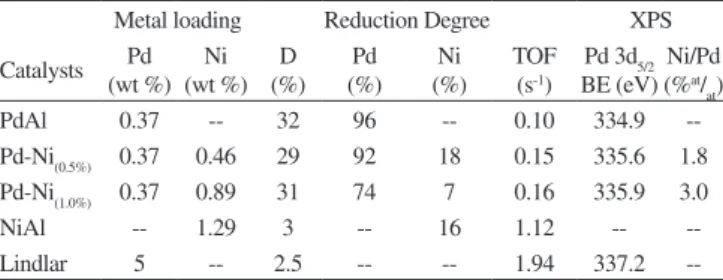
Table 1 shows the values of metal loading (%), dispersion (%), reduction degree (%) of the metals as determined by TPR, binding energy (BE) of the Pd 3d5/2 peak and Ni/Pd atomic ratios as obtained by XPS for all of the catalysts studied. The activity values expressed as TOF (s-1) are also included in this table.
The dispersion results showed in Table 1 indicate that the addition of nickel to the palladium monometallic catalyst does not modify its metallic dispersion. The dispersion values obtained are also coincident with those previously reported.27
As it can be seen in Table 1 the XPS results for the palladium monometallic catalyst treated in hydrogen at 573 K show that the Pd 3d5/2 signal is located at 334.9 eV; according to the literature, it can be assigned to Pd°.24,28,29 For the nickel monometallic catalyst reduced
at 673 K, the BE for Ni 2p3/2 was 853.5 eV, which can be assigned to electro-deficient nickel species (Nin+), probably corresponding to
nickel interacting with aluminum.30 The BE of the Pd 3d
5/2 signal in the
bimetallic catalyst increases with the nickel content: 335.6 and 335.9 eV for 0.5 and 1.0 Ni wt %, respectively (see in Table 1). According to the literature, these values correspond to electron-deicient palla-dium (Pdn+, with n+ between 0 and 2).28,31 As previously reported,27
AES and XPS studies show that nickel addition as a second metal to Pd catalysts modiies the electronic state of palladium leaving it more electron-deicient as nickel loading is increased. Table 1 also shows that the supericial atomic ratio Ni/Pd increased as the nickel loading was raised. The Pd 3d5/2 peak BE in the Lindlar catalyst was 337.2 eV indicating that palladium is present as an electron-deicient species (Pdn+).
Figure 1 shows the TPR proiles of mono and bimetallic catalysts. The palladium monometallic catalyst (Figure 1a) presents a main peak at low temperature (287 K), that according to the literature12,21,32,33
could be attributed to the reduction of PdO particles to metallic palla-dium. This proile also shows an inverted peak at 339 K which could be assigned to the decomposition of the β-PdH phase.12,21,29,32,34 This
proves that at the reduction temperature adopted for the PdAl catalyst (573 K) the palladium β-hydride phase was eliminated.
The TPR proile of the Ni monometallic catalyst in Figure 1b shows a main peak of Ni reduction at c.a. 600 K that can be attribu-Table 1. Metal loading (%), dispersion (D), reduction degree (%), initial activ-ity (TOF) and XPS results for PdAl, NiAl, Pd-Ni catalysts and Lindlar catalyst
Metal loading Reduction Degree XPS Catalysts (wt %)Pd (wt %)Ni (%)D (%)Pd (%)Ni TOF(s-1)
Pd 3d5/2 BE (eV)
Ni/Pd (%at/
at)
PdAl 0.37 -- 32 96 -- 0.10 334.9 --Pd-Ni(0.5%) 0.37 0.46 29 92 18 0.15 335.6 1.8 Pd-Ni(1.0%) 0.37 0.89 31 74 7 0.16 335.9 3.0
NiAl -- 1.29 3 -- 16 1.12 --
--ted to NiO species with a weak metal-support interaction.35-39 It is
well known that nickel monometallic catalysts prepared from nitrate salts are reduced at temperatures between 600 to 1000 K when the contact between NiO and alumina is intimate.6,36,38,39 The patterns of
reduction depend on the nature of the metal-support interactions, which can be modiied by the calcination temperature employed during the preparation of the monometallic nickel catalysts.6 Hence
the hydrogen consumption can be attributed to the reduction of NiO species with a weak interaction with the support. This is in agreement with the XPS results.
The TPR proiles of the bimetallic catalysts are presented in Figures 1c and 1d. Up to 500 K the bimetallic reduction proiles are very similar to those corresponding to those of monometallic Pd. The TPR proiles of Pd-Ni(0.5%) and Pd-Ni(1.0%) have their main peaks at 287 or 286 K, respectively, corresponding to PdO re-duction, as was determined for the monometallic PdAl catalyst. However, these signals corresponding to the bimetallic catalysts are narrower than that corresponding to the monometallic one. The decomposition peak for the β-PdH phase was also present in the bimetallic catalysts at 316 or 307 K when 0.5 or 1.0 wt % of Ni was added as a second metal. The shifts of the signals of the bimetallic catalysts to lower temperatures show that the decom-position of the β-PdH phase is more easily accomplished when nickel loading is increased. The reduction temperature adopted for Pd bimetallic catalysts (673 K) ensures the elimination of the β-PdH phase. Furthermore, as showed in Figures 1c and 1d, the bimetallic catalysts with 0.5 and 1.0 Ni wt % have peaks at 598 and 621 K, respectively, due to the reduction of NiO species to
Niº.38-40 The position of these peaks is slightly modiied as the Ni
loading is increased. A similar behavior was observed by other authors when studying Ni monometallic catalysts.37 More work is
necessary to get a better insight on this problem.
According to the results of degree of reduction of Table 1 the
Pd-Ni(1.0%) catalyst had the lowest percentage of reduced Ni and Pd. This
suggests the presence of a stronger Pd-Ni interaction in this catalyst than in the other bimetallic catalysts. However, the interaction of Pd and Ni with the support cannot be neglected.
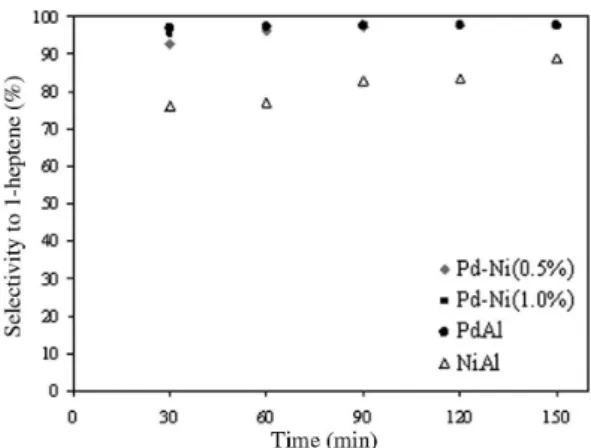
Figure 2 shows the selectivity to 1-heptene (%) as a function of time for the monometallic and bimetallic catalysts. It can be observed that, except for the supported nickel catalyst, all the other catalysts have excellent selectivities to 1-heptene, the desired product, with values higher than 97%. It can also be seen that the selectivity was high and constant (c.a. 98%) and it is not affected by the nickel content. Therefore it can be said that the addition of Ni as a second metal to the alumina supported palladium catalysts has no inluence on the selectivity to 1-heptene. The nickel monometallic catalyst
had the lowest selectivity values (between 76 and 91%) as it can be seen in Figure 2.
Figure 3 shows the total conversion of 1-heptyne (%) as a func-tion of time for the mono and bimetallic catalysts studied. It can be clearly seen that the nickel addition to the palladium monometallic catalyst rises the total conversion; the increment of the nickel content leads to higher total conversion values. However, the supported nickel monometallic catalyst shows a considerable higher total conversion than that obtained with the palladium monometallic catalyst and also with the bimetallic catalysts, although it is the less selective system.
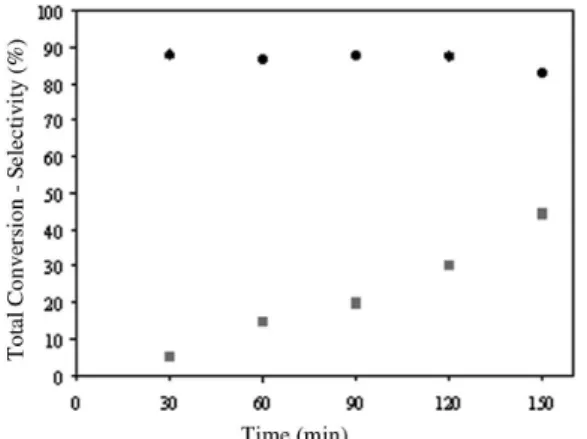
Values of total conversion (%) and selectivity to 1-heptene (%) as a function of time are shown in Figure 4 for the Lindlar catalyst. This reference catalyst shows a relatively high selectivity to the desired product (c.a. 87%), although lower than that obtained with the palladium mono and bimetallic catalysts (c.a. 98%). The 1-hep-tyne total conversion values obtained with the commercial Lindlar catalyst are higher than those obtained with the Pd-Ni catalysts at 120 min reaction time, although its selectivity decreases markedly. As previously mentioned the Lindlar catalyst contains electron-deicient palladium species. Nijhuis et al.41 have found that palladium modiied with Pb(OAc)2 during the Lindlar catalyst preparation gets electron deicient and that this electron deiciency enhances the Pd-alkyne interaction. It should be also considered that 1-heptene is adsorbed more weakly than 1-heptyne on these species. Hence, once formed, 1-heptene molecules are more easily desorbed than the alkyne molecules.
Figure 5 compares the selectivity to 1-heptene as a function of the total conversion for all of the catalysts. It can be seen that up to Figure 1. TPR traces of PdAl (a), NiAl (b) and bimetallic catalysts: Pd-Ni(0.5%)
(c) and Pd-Ni(1.0%) (d)
Figure 2. Selectivity to 1-heptene (%) vs. time (min) for monometallics: PdAl (•), NiAl (∆) and bimetallics: Pd-Ni(0.5%) () and Pd-Ni(1.0%) (■)
a value of 30% of 1-heptyne total conversion, the Pd-Ni bimetallic catalysts and the Pd monometallic catalyst are more selective than the Lindlar catalyst. The lowest values in selectivity to 1-heptene, in the whole evaluated conversion range, are those of the nickel monometallic catalyst.
From the TOF values displayed in Table 1 it may be concluded that the mono and bimetallic Pd catalysts have moderate activities, similar among them. It can be seen in Table 1 that the activity of the palladium catalysts increased slightly with nickel loading. The Lindlar catalyst is the most active one.
Coq and Figueras42 concluded, after analyzing a wide number
of papers on the matter of palladium bimetallic catalysts, that the disappearing of the β-PdH phase plays an important role on the activity and selectivity of the reactions. These authors state that the disappearance of the β-PdH phase considerably decreases the alky-nes hydrogenation rate to alkaalky-nes, thus increasing the selectivity to alkenes. It is well known that in the case of alkyne hydrogenations on supported Pd catalysts, the β-hydride phase may act as a hydrogen source that promotes overhydrogenation, with a consequent decrease in the selectivity to alkene formation.43 Hence the high selectivities
obtained with our Pd mono and bimetallic catalysts could be attribu-ted, at least in part, to the disappearance of the β-PdH phase. From academic and industrial points of view the achievement of high selectivity values of the desired products is the most appreciated characteristic of any catalyst.
There is not a simple interpretation to explain the inluence of the second metal on the Pd performance. The alkynes semi-hydrogenation
reactions are more or less sensitive to geometrical and electronic effects, being the latter the most important ones. The properties of palladium based bimetallic catalysts are related to the preparation method, which affects the electronic and chemical state of Pd and of the second metal, as well as their spatial distribution. The Pdn+ species
are weak electron donors as compared to Pdº species. This modiica-tion of the electronic state of palladium could be responsible for the better catalytic behavior, moreover considering the high electronic density of the triple bond. As observed by XPS, the nickel addition to the palladium catalyst promoted the electron deiciency of Pd. The higher the nickel content, the higher the palladium electron deiciency. However, the inluence of geometrical effects and/or mixed sites on the activity of bimetallic catalysts can not be discarded.
The most active prepared catalyst was Pd-Ni(1.0%), which resulted much more selective than the Lindlar catalyst. Also the Pd-Ni(1.0%) was more active than the monometallic Pd catalyst which indicates a positive synergetic effect of Ni over Pd. Besides, this bimetallic catalyst presents another advantages, which are the low Pd loading (0.4 wt %) and the low cost of the nickel precursor. Moreover, the Lindlar catalyst has the disadvantage that it cannot be pelletized and must be operated under slurry conditions; hence, the reactant solution must be puriied after reaction by an expensive procedure to recover the catalyst.
CONCLUSIONS
Several low-loaded Pd monometallic and Pd-Ni bimetallic catalysts were prepared and evaluated in the semi-hydrogenation of 1-heptyne.
The XPS results suggest that nickel addition as a second metal to Pd catalysts modiies the electronic state of palladium leaving it more electron-deicient as nickel loading is increased.
All of the palladium catalysts presented higher selectivities to 1-heptene (c.a. 98%) than the Lindlar catalyst (76-88%). The addi-tion of Ni as a second metal to alumina supported palladium has no inluence on the selectivity to 1-heptene. The high selectivities obtained with the Pd mono and bimetallic catalysts could be attri-buted, at least in part, to the disappearance of the β-PdH phase. The activities of the palladium catalysts increased with the nickel content: PdAl < Pd-Ni(0.5%) < Pd-Ni(1.0%), indicating a positive synergetic effect of Ni over Pd. Up to 30% of 1-heptyne total conversion, Pd-Ni(1.0%) presented a higher conversion to 1-heptene than the classical Lindlar catalyst. The differences in activities can be attributed, at least in part, to electronic effects, due to the presence of different Pd electron-deicient species on the surface on the catalysts, as determined by XPS. However, the inluence of geometrical effects and/or mixed sites cannot be neglected.
Nickel proved to be a good promoter for the palladium monome-tallic catalyst as it caused an increment in the total conversion without modifying the high selectivity to 1-heptene of PdAl. Pd-Ni(1.0%) was the most active catalyst prepared, being its selectivity to 1-heptene higher than that obtained with the Lindlar catalyst. This bimetallic catalyst presents the advantages of low Pd loading and low cost of the nickel salt.
ACKNOWLEDGMENTS
The experimental assistance of C. Mázzaro and the inancial as-sistance of UNL, CONICET and ANPCyT are greatly acknowledged.
REFERENCES
1. L’Argentière, P. C.; Cagnola, E. A.; Quiroga, M. E.; Liprandi, D. A.; Appl. Catal. A: Gen. 2002, 226, 253.
Figure 5. Selectivity to 1-heptene (%) vs. total conversion (%) for PdAl (•), Pd-Ni(0.5%) (), Pd-Ni(1.0%) (■), Lindlar catalyst () and NiAl (∆)
2. Teschner, D.; Vass, E.; Hävecker, M.; Zafeiratos, S.; Schnörch, P.; Sauer, H.; Knop-Gericke, A.; Schlögl, R.; Chamam, M.; Wootsch, A.; Canning, A. S.; Gamman, J. J.; Jackson, S. D.; McGregor, J.; Gladden, L. F.; J. Catal. 2006, 242, 26; Kačer, P.; Kuzma, M.; Ćervenỳ, L.; Appl. Catal. A: Gen. 2004, 259, 179; Choudary, B. M.; Lakshmi Kantam, M.; Mahender Reddy, N.; Koteswara Rao, K.; Haritha, Y.; Bhaskar, V.; Figueras, F.; Tuel, A.; Appl. Catal. A: Gen. 1999, 181, 139.
3. Nishimura, S.; Handbook of Heterogeneous Catalytic Hydrogenation for Organic Synthesis, John Wiley & Sons, Inc.: Canada, 2001. 4. Chen, B.; Dingerdissen, U.; Krauter, J. G. E.; Lansink Rotgerink, H. G.
J.; Möbus, K.; Ostgard, D. J.; Panster, P.; Riermeier, T. H.; Seebald, S.; Tacke, T.; Trauthwein, H.; Appl. Catal. A: Gen. 2005, 280,17. 5. Lindlar, H.; Dubuis, R.; Org. Synth. 1966, 46, 89.
6. Abelló, S.; Verboekend, D.; Bridier, B.; Pérez-Ramírez, J.; J. Catal. 2008, 259, 85.
7. Alonso, F.; Osante, I.; Yus, M.; Adv. Synth. Catal. 2006, 348, 305. 8. Dhakshinamoorthy, A.; Pitchumani, K.; Tetrahed. Lett. 2008, 49, 1818. 9. Zhao, Z.-F.; Wu, Z.-J.; Zhoy, L.-X.; Zhang, M.-H.; Li, W.; Tao, K.-Y.;
Catal. Commun. 2008, 9, 2191.
10. Choi, J.; Yoon, N. M.; Tetrahed. Lett. 1996, 37, 1057.
11. Huang, W.; McCormick, J. R.; Lobo, R. F.; Chen, J. G.; J. Catal. 2007, 246, 40; Huang, W.; Pyrz, W.; Lobo, R. F.; Chen, J.G.; Appl. Catal. A: Gen. 2007, 333, 254.
12. Zhang, Q.; Li, J.; Liu, X.; Zhu, Q.; Appl. Catal. A: Gen. 2000, 197, 221. 13. Sárkány, A.; Horváth, A.; Beck, A.; App. Catal. A: Gen. 2002, 229, 117. 14. Spee, M. P. R.; Boersma, J.; Meijer, M. D.; Slagt, M. Q.; van Koten, G.;
Geus, J. W.; J.Org. Chem. 2001, 66, 1647.
15. Sárkány, A.; Geszti, O.; Sáfrán, G.; Appl. Catal. A: Gen. 2008, 350, 157; Hamilton, C. A.; Jackson, S. D.; Kelly, G. J.; Spence, R.; de Bruin, D.; Appl. Catal.A: Gen. 2002, 237, 201.
16. Jung, A.; Jess, A.; Schubert, T.; Schütz, W.; Appl. Catal. A: Gen. 2008, 362, 95; Papp, A.; Molnár, Á.; Mastalir, Á.; Appl. Catal. A: Gen. 2005, 289, 256; Mastalir, Á.; Király, Z.; J. Catal. 2003, 220, 372; Mastalir, Á.; Király, Z.; Szöllösi, Gy.; Bartók, M.; Appl. Catal. A: Gen. 2001, 213, 133; Mastalir, Á.; Király, Z.; Berger, F.; Appl. Catal A: Gen. 2004, 269, 161.
17. Lederhos, C.; L’Argentière, P. C.; Fígoli, N. S.; Ind. Eng. Chem. Res. 2005, 44, 1752; Lederhos, C.; L’Argentière, P. C.; Coloma-Pascual, F.; Fígoli, N. S.; Catal. Lett. 2006, 110, 23.
18. Mudakavi, J. R.; Kamakrishna, T. V.; J. Ind. Inst. Sci. 1979, 61, 151; Kenigsburg, M.; Stone, I.; Anal. Chem. 1955, 27, 1339.
19. Benson, J. E.; Hwang, H. S.; Boudart, M. ; J. Catal. 1973, 30, 146. 20. Roma, M. N. S. C.; Cunha, D. S.; Cruz, G. M.; Cobo, A. J. G.; Braz. J.
Chem. Eng. 2000, 17, 4.
21. Wang, C.-B.; Lin, H.-K.; Ho, C.-M.; J. Molec. Catal. A: Chem. 2002, 180, 285.
22. Quincoces, C. E.; Dicundo, S.; Alvarez, A. M.; González, M. G.; Mat. Lett. 2001, 50, 21; Pompeo, F.; Nichio, N. N.; Souza, M. M. V. M.; Cesar, D. V. M.; Ferretti, O. A.; Schmal, M.; Appl. Catal. A: Gen. 2007, 316, 175.
23. Borade, R.; Sayari, A.; Kaliaguine, S.; J. Phys. Chem. 1990, 94, 5989. 24. Hu, S.; Chen, Y.; J. Chin. Chem. Engrs. 1998, 29, 381.
25. Liprandi, D. A.; Quiroga, M. E.; Cagnola, E. A.; L’Argentière, P. C.; Ind. Eng. Chem. Res. 2002, 41, 4906.
26. Niklasson, C.; Anderson, B.; Schoon, N.; Ind. Eng. Chem. Res. 1987, 26, 1459.
27. L’Argentière, P. C.; Cañón, M. M.; Fígoli, N. S.; Ferrón, J.; Appl. Surf. Sci. 1993, 68, 41.
28. http://srdata.nist.gov/xps/, accessed in May 2009.
29. Dantas Ramos, A. L.; Alves, P. D. S.; Aranda, D. A. G.; Schmal, M.; Appl. Catal. A: Gen. 2004, 277, 71.
30. Hillebrecht, F. U.; Fuggle, J. C.; Bennett, P. A.; Zolnierek, Z.; Phys. Rev. B 1982, 27, 2179.
31. Barrio, V. L.; Arias, P. L.; Cambra, M. B.; Güemez, M. B.; Pawelec, B.; Fierro, J. L. C. Catal. Commun. 2004, 5, 173.
32. Noronha, F. B.; Schmal, M.; Primet, M.; Frety, R.; Appl. Catal. 1991, 78, 125.
33. Noronha, F. B.: Aranda, D. A. G.; Ordine, A. P.; Schmal, M.; Catal. Today 2000, 57, 275; Kennedy, D. R.; Webb, G.; Jackson, S. D.; Lennon, D.; Appl. Catal. A: Gen. 2004, 259, 109.
34. Chen, G.; Chou, W.-T.; Yeh, C.-T.; Appl. Catal. 1983, 8, 389; Gaspar, A. B.; Dieguez, L. C.; Appl. Catal. A: Gen. 2001, 201, 241.
35. Cardenas-Lizana, F.; Gómez-Quero, S.; Keane, M. A.; Appl. Catal. A: Gen. 2008, 334, 199.
36. Hoffer, B. W.; Dick van Langeveld, A.; Janssens, J. P.; Bonne, R. L. C.; Lok, C. M.; Moulijn, J. A.; J. Catal. 2000, 192, 432.
37. Kim, P.; Kim, H.; Joo, J. B.; Kim, W.; Song, I. K.; Yi, J.; J. Molec. Catal. A: Chem. 2006, 256, 178.
38. Li, G.; Hu, L.; Hill, J. M.; Appl. Catal. A: Gen. 2006, 301, 16. 39. Hou, Z.; Yokota, O.; Tanaka, T.; Yashima, T.; Appl. Catal. A: Gen. 2003,
253, 381.
40. Mukainakano, Y.; Yoshida, K.; Okumura, K.; Kunimori, K.; Tomishige, K.; Catal. Today 2008, 138, 101.
41. Nijhuis, T. A.; van Koten, G.; Moulijn, J. A.; Appl. Catal. A: Gen. 2003, 238, 259.
42. Coq, B.; Figueras, F.; J. Mol. Catal A: Chem 2001, 173, 117.