FWMG Muniz
KS Sena
CC de Oliveira
DM Ver
ıssimo
RS Carvalho
RS Martins
Authors’affiliations:
FWMG Muniz, KS Sena, CC de Oliveira, DM Verıssimo, Department of Dental Practice, School of Pharmacy, Dentistry and Nursing, Federal University of Ceara, Fortaleza, Ceara, Brazil
R de S Carvalho, RS Martins, Discipline of Periodontology, School of Pharmacy, Dentistry and Nursing, Federal University of Ceara, Fortaleza, Ceara, Brazil
Correspondence to: F. W. M. G. Muniz
Department of Dental Practice School of Pharmacy
Dentistry and Nursing Federal University of Ceara 949, Alexandre Barauna Street
Fortaleza, Ceara, Brazil
Tel.: +555195716463/+558596520187 E-mail: [email protected]
Dates:
Accepted 22 September 2014
To cite this article:
Int J Dent Hygiene13, 2015; 117–124. DOI: 10.1111/idh.12112
Muniz FWMG, Sena KS, de Oliveira CC, Verıssimo DM, Carvalho RS, Martins RS. Efficacy of dental floss impregnated with chlorhexidine on
reduction of supragingival biofilm: a randomized controlled trial.
© 2014 John Wiley & Sons A/S. Published by John Wiley & Sons Ltd
Efficacy of dental floss impregnated
with chlorhexidine on reduction of
supragingival biofilm: a randomized
controlled trial
Abstract: Background: The use of a toothbrush has a limited ability to control the dental biofilm in interproximal areas. Therefore, specialized devices, such as dental floss, may be useful for these
specific areas.Objective: This study aimed to investigate the efficacy
of dental floss impregnated with 5% chlorhexidine gluconate on the
reduction of the supragingival biofilm.Methods: This research was
parallel, single-blind, controlled and randomized, and contained a sample of thirty dental students from the Faculty of Pharmacy,
Dentistry and Nursing of the Federal University of Ceara, Brazil, who
were divided equally into three groups. The negative control group (NC) did not utilize any kind of interproximal cleaning; the positive control group (PC) used waxed floss without impregnation twice a day; and the test group (T) used the same dental floss, which was impregnated with 5% chlorhexidine gluconate, twice a day. For all groups, this study lasted for 15 days. The presence of a biofilm was evaluated on four surfaces (mesiobuccal, distobuccal, mesiolingual
and distolingual) by the Quigley–Hein Index, resulting in four scores
for each tooth.Results: Group T had the lowest plaque scores,
showing a significant difference compared to group NC (P<0.001)
and group PC (P<0.001). Group PC also displayed a significant
difference compared to NC (P <0.001).Conclusion: It was concluded
that the use of dental floss impregnated with 5% chlorhexidine gluconate resulted in additional reductions in the supragingival biofilm relative to the results achieved with conventional waxed floss on the anterior teeth of a well-motivated and well-instructed population.
Key words: biofilms; chlorhexidine; dental devices; dental plaque; dental plaque index; home care; oral hygiene; therapeutic use; treatment efficacy
Introduction
non-proximal sites (5), suggesting that interdental cleaning is often not executed in an adequate manner.
To remedy this problem, several interproximal cleaning devices are regularly available, including single tufted brushes, toothpicks and dental floss. In choosing the most appropriate interdental device for each patient, the size and morphology of the interdental spaces should be considered (6). Additionally, the skill and ability of the patient to use these devices should be respected (7). Subjects without attachment loss who brush and floss regularly have less gum bleeding compared to those who solely use a toothbrush (8), indicating that dental floss could be beneficial for these patients.
According to Zimmer et al. (9), only a small portion of the population uses dental floss on a daily basis, and its consump-tion is greater in individuals with higher socioeconomic levels. Many people avoid flossing because they consider it to be time-consuming, awkward, difficult to use, and it shreds easily between teeth (3). It is also known that the frequency of floss-ing increases when its use is constantly encouraged (10), but all dental professionals do not routinely recommend this behaviour. All of these difficulties make the process of flossing less universal in its applicability.
Despite these evidences, one systematic review established that toothbrushing and dental flossing provide no benefit, when compared to toothbrushing alone, on removing plaque and reducing gingivitis (6). In addition, another systematic review found that there is weak and very unreliable evidence which suggests that flossing plus toothbrushing may be associ-ated with a small reduction in plaque (11). However, it is still possible to found, in the literature, that flossing is effective, but it depends on the patient’s situation whether it should be carefully recommended by a dental professional (6, 12).
In addition to the mechanical control of dental biofilms, it is possible to use chemical control, and chlorhexidine is the gold standard for this purpose. Chlorhexidine is a dicationic com-pound that is able to join anionic comcom-pounds, such as phos-phate and carboxyl radicals from the tooth surface and salivary glycoproteins. Its action damages the cytoplasmic membrane, leading to bacterial cell lysis (13). Additionally, chlorhexidine has a retention capacity and remains in oral tissues for a prolonged time, exhibiting a high substantivity (14).
Despite its potential benefits, chlorhexidine displays some disadvantages after extensive use, such as taste alterations and teeth and oral tissue pigmentation (15). However, although it has been suggested that chlorhexidine (CHX) and sodium lau-ryl sulphate (SLS) may counteract in the oral cavity (16), the SLS/CHX interaction studies showed that the antiplaque activity of 0.2% CHX mouthrinse is not reduced when imme-diately preceded or followed by toothbrushing with an SLS-containing dentifrice (17). In case of rinsing with CHX before or after toothbrushing during 30 s, an additional reduction of 33% for plaque and 26% for gingivitis has been determined (18).
This study aimed to verify the efficacy of the use of dental floss impregnated with 5% concentrated chlorhexidine gluco-nate on the reduction of the supragingival dental biofilm.
Materials and methods
Ethical aspects
The study was approved by the Ethical Committee of the Federal University Ceara under protocol 215/03, and all volun-teers signed an informed consent form.
Study type
This study followed the CONSORT statement, and it was designed as a single-centre, parallel, single-blind, controlled and randomized clinical trial.
Sample selection
Thirty dental students of both genders from the Faculty of Pharmacy, Dentistry, and Nursing of Federal University Ceara were selected for this study. Recruitment consisted of a conve-nience sample, carried out from November 2011 to April 2012. Those volunteers who fulfilled the following criteria were included.
As inclusion criteria, all volunteers had to be in a good general health, they had to display interproximal spaces without any dia-stema or gingival recession. Only volunteers with gingival index equal to zero were included in this study. Moreover, they were right-handed and had not taken classes in periodontics.
Smokers and patients with any kind of dental prosthesis, caries or any other biofilm retentive factor, with exception of dental calculus, were excluded from this study. Those who used systemic antibiotics within 3 months prior to the start of the study and those who possessed systemic conditions that exerted an effect on periodontal health, such as diabetes, were also excluded.
Experimental design
Thirty dental students were equally divided into three groups. The negative control group (NC) (n=10) did not use any kind of interproximal cleaning device and only used a toothbrush to eliminate the supragingival plaque; the positive control group (PC) (n=10) used the same toothbrush and a waxed dental floss without any impregnation twice a day; and the test group (T) (n=10) also used a toothbrush and the same dental floss impregnated with 5% chlorhexidine gluconate twice a day.
At baseline, all volunteers were examined by the same calibrated investigator (FWMGM), who also performed prophylaxis and supragingival scaling and planing, with the pur-pose of making the dentition 100% free of plaque, calculus and extrinsic pigmentation. Prophylaxis was performed with Robson brush, rubber cup and prophylactic paste. Disclosing tablets, composed of fuchsine basic 2% (Eviplacâ
; Biodin^amica, Ibipor~a, Brazil), were used to confirm the absence of dental biofilm. Su-pragingival scaling and planing were performed, when neces-sary, with a Gracey curettes and a sickle Point Morse 0–00.
another researcher (KSS). For this study, only the anterior teeth were selected for evaluation, totalling twelve interproxi-mal spaces on the upper arch and twelve on the lower arch. The choice to use only anterior teeth only was a tentative to facilitate flossing by the volunteers and also to make the dental biofilm visualization easier for the examiner.
The systematic use of the dental floss was established according to the American Dental Association (ADA) recom-mendations (19). The volunteers were instructed to introduce the dental floss in each interproximal space and perform three buccal–lingual movements against the mesial surfaces and three more against the distal surfaces. With the exception of the initial visit, daily oral hygiene procedures were not super-vised. The researcher motivated the volunteers to perform this procedure twice a day in 12-h intervals. Subjects used only one piece of dental floss on the lower arch and another on the upper arch. On the posterior teeth, regardless of group distri-bution, the use of any of dental floss was allowed.
At baseline appointment, the volunteers received a printed frame that had 30 cells, each cell represented a period of the day, being two cells for each day. They were asked to mark one cell immediately after flossing. These printed frames were received in the last appointment (day 15) and assessed how often the floss was used.
To achieve standard conditions, each volunteer received a kit that contained a new toothbrush with soft bristles (Reach Eco; Johnson & Johnsonâ
, New Brunswick, NJ, USA) and a manipulated dentifrice composed of carboxymethyl cellulose 5% gel and 8% mint essence. Furthermore, the volunteers were requested to not use any kind of antiseptic mouthwash during the 15 study days. Dental floss was distributed to the volunteers at the baseline appointment and at the 7th day of the experimental period. On day 15, subjects attended another appointment to complete the study, when the clinical evalua-tion was performed.
Laboratory phase
The laboratory phase used is an adaptation of the protocol developed by Oppermannet al.(20) in toothpicks impregnated with chlorhexidine. Initially, 30-cm lengths of waxed dental floss (Reach Dental Floss –Total Care; Johnson & Johnsonâ
) were cut with the help of a ruler. In an autoclave, these floss segments were sterilized and then placed in previously sterilized falcon tubes with a solution of 5% chlorhexidine gluconate.
During 24 h, these falcon tubes remained in a microbiologi-cal oven at a constant temperature of 37°C as a tentative to impregnate the solution on the floss. After that time, the floss passed through a drying stage in the same microbiological oven for the same period of time and was then subsequently placed in appropriate packages. The dental floss for the PC group passed only through the autoclave process. The period between dental floss preparation and its distribution to volunteers did not exceed 1 week. As this is the first work performed in this field, and the dental floss’ expiry date was
not assessed so far, it was assumed that this amount of time was reasonable to achieve a positive clinical result.
Visually, no change was observed in any sterile floss. It is worth noting that the researchers were extremely careful in all laboratory stages, such as temperature control, as a tentative to avoid any changes in the dental floss properties. After this pro-cess, the chlorhexidine antimicrobial activity was not assessed.
Clinical evaluation
Fifteen days after the baseline appointment, the presence of the dental biofilm was evaluated only on four surfaces, result-ing in four scores for each tooth (mesiobuccal, distobuccal, me-siolingual and distolingual). This amount of time was chosen for this study because 15 days after the biofilm control, carried out by a dental professional, the biofilm accumulation assess-ment may appear significantly. The four surfaces were assessed according to the Quigley–Hein Index (21), modified by Tureskyet al.(22).
One calibrated examiner (FWMGM), who was unaware of the kind of dental floss used by the volunteers, performed these clinical analyses. At first, the biofilm was disclosed with tablets composed of 2% basic fuchsine. The volunteers were asked to masticate the tablet and smoothly spread the disclosing with tongue help. Before to assess any score, the teeth were washed and dried with gentle air jets to remove the tablet excess.
In that same appointment, before teeth disclosing, the same examiner (FWMGM) performed a visual search for any tooth and tongue extrinsic pigmentation. Another researcher (KSS) asked the volunteers whether they had experienced any side effect since the beginning of the study, such as palate altera-tions and any kind of hypersensibility.
Sample size estimate
The sample size calculation was based on results obtained in a clinical trial that also used mechanical and chemical biofilm control (23). This study found a meanSD of plaque scores in the control group of 1.810.21 and 1.44 0.28 in the test group after 6 months of treatment. Through Student’st-test, it was estimated a sample size of eight volunteers per group tak-ing into consideration a power of 80% and an alpha of 5%. However, a dropout rate of approximately 20% was added to the sample size totalling 30 volunteers.
Randomization
A simple randomization process was carried out to distribute the subjects into three group, negative control, positive control and test groups, using a random command from Microsoft Excel 2007 (Microsoft Corporation®
, S~ao Paulo, S~ao Paulo, Brazil) by one of the researchers (CCO). The volunteers were related in a column, according to its complete names, and then in another column, it was distributed three sequences of ten numbers (1, 2 and 3), which was related to each experimental group (1 –
test). After that, the RAND function in Excel was executed to gen-erate the distributions of subjects for each group. The results from this process were kept as a secret until the beginning of the base-line appointments. Only on that day, the researcher responsible for oral hygiene instructions (KSS) was able to know in what group each volunteer was designed to. The researcher responsible for clinical examinations (FWMGM) did not have any contact with this process, remaining blind during the whole study.
Intraexaminer calibration
Training on the plaque scores was provided with the help of a calibrated examiner. Each score was extensively discussed until similar criteria were established. After the training period, intraexaminer calibration was performed by examining five dental students twice within at least a 1-h interval.
To assess intraexaminer calibration, the intraclass correlation coefficient (ICC) (24) was calculated with SPSS 9.0 (SPSS, Chicago, IL, USA). The scores obtained by the Quigley–Hein Index for each tooth/surface were considered in the calcula-tions. The ICC was 0.92, indicating an excellent level of int-raexaminer calibration (25).
Statistical analysis
Plaque scores were considered as the primary outcome variable. The Kruskal–Wallis test, followed by the Dunn’s test, was used to assess differences between groups regarding the plaque scores.
Kolmogorov–Smirnov was used to test the pattern distribu-tion regarding the age in the samples. When the normality dis-tribution was found, it was used one-way ANOVA to compare
the mean ages between the three groups.
Only the positive control group and test group used dental floss in this study. To compare the average use of dental floss between those two groups, it was used Student’s t-test for independent samples. In all those tests, a value of P <0.05 was considered to represent a significant difference.
Results
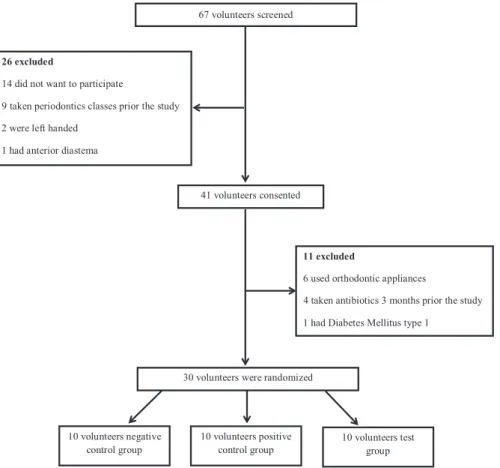
From the 67 volunteers evaluated to participate in the study, 30 were randomized to the experimental groups (Fig. 1). All volunteers completed this clinical trial without any complica-tions or side effects, such as dental or tongue staining and loss of taste. The subject characteristics are shown in Table 1. All the volunteers were adults with ages between 18 and 26 years. According toANOVAtest, there are no age differences between
the three groups (P=0.994) (Table 1).
The adherence to dental floss used was measured through a printed frame, and it was noticed a high compliance in both groups. Group PC had a mean use of 89.0 8.61%, and group T had 93.457.94%. Student’s t-test showed no differences between the average use of dental floss between group PC and group T (P=0.245) (Table 1).
At the end of baseline appointment, all the volunteers started the study with mean plaque score zero. After 15 days, the mean plaque score of all teeth examined was 2.96 0.07,
67 volunteers screened
26 excluded
14 did not want to participate
9 taken periodontics classes prior the study
2 were left handed
1 had anterior diastema
30 volunteers were randomized 41 volunteers consented
11 excluded
6 used orthodontic appliances
1 had Diabetes Mellitus type 1
10 volunteers negative control group
10 volunteers positive control group
10 volunteers test group
4 taken antibiotics 3 months prior the study
2.570.07 and 2.140.08 in groups NC, PC and T, respec-tively. Group T had the lowest plaque scores, showing signifi-cant differences relative to groups NC (P<0.001) and PC (P<0.001). Group PC also showed a significant difference compared to NC (P <0.001) (Table 1).
When only the plaque scores for the mesiobuccal and disto-buccal surfaces was analysed, the group T had also the lowest plaque scores, showing significant differences between groups NC (P <0.001) and PC (P=0.015). Group PC also showed significant differences relative to group NC (P<0.001) (Table 1). On the other hand, when only the mesiolingual and distolingual surfaces were analysed, only group T had signifi-cant differences from groups NC (P<0.001) and PC (P=0.015) (Table 1).
Discussion
This study evaluated the efficacy of dental floss impregnated with chlorhexidine gluconate 5% on the reduction of the su-pragingival biofilmin vivo. This is the first time that a dental floss impregnated with chlorhexidine has been described in the literature.
Dental students were selected as participants in this study because they present, according to Kleisner and Imfeld (26), sufficient levels of knowledge, similar patterns of biofilm con-trol, good manual dexterity and similar ages. The Quigley– Hein Index (21), modified by Turesky et al.(22), was used to allow small changes in the evaluations of the biofilm amount and also for being one of the most frequently used indices in product testing (27, 28). All those conditions are very important to show the efficacy of the dental floss impregnated with chlorhexidine. On the other hand, the results of the pres-ent study cannot be extrapolated as if an effect study was per-formed, as assessment of gingival inflammation and tooth staining would be necessary, and therefore, further studies need to be conducted in these areas. Additionally, it is not possible to say that the results would be the same if this study was conducted in the general population with smaller cleaning
ability. As a tentative to enlarge the external validity, dental students that did not taken classes in periodontics were used, as this is the first class that teaches brushing techniques.
In this study, disclosed biofilm was used to assess plaque scores. Although the use of disclosing solutions in the manage-ment of biofilm control can be somehow discouraging for some patients, the use of disclosing solutions combined with index scales enables comparisons between new and existing oral hygiene products (28). The choice for disclosing tablets was based on the fact that this technique is largely used and proba-bly removes less plaque when compared to liquid disclosing applied with cotton, which may requires scratches on tooth surfaces.
Only anterior teeth were used in this study, mostly as a tentative to promote an easier visualization and usage to the volunteers. The manipulated dentifrice was made only by carboxymethyl cellulose gel and mint essence, which has no effect on dental biofilm. For that reason, the group test (dental floss impregnated with chlorhexidine) was the only group that received an additional benefit by the chemical control of biofilm during the study. However, these facts decrease the external validity and may be a limitation of the study.
After the laboratory phase, the dental flosses impregnated with chlorhexidine were not tested for any antimicrobial activity. This is another limitation of this study; however, the efficacy of this process was previously certified by Oppermann et al. (20) in toothpicks. Additionally, our research group intend to assess the antimicrobial activity in further study, estimating the expiry date as well.
This unsupervised study used print frames as a tentative to reduce any possible compliance matter. The volunteers were asked to fulfil the frame as soon as they used the dental floss, which assessed how often the floss was used. Despite all the difficulties related to flossing (3), the returned frames indicated that the volunteers followed the given instructions conscien-tiously, as the compliance rate was considered higher (a mean use larger than 89% in both groups). The choice of use only right-handed was a tentative to avoid variations in flossing
Table 1. Subject characteristics, dentalfloss use frequency and mean biofilm index after 15 days
Group NC Group PC Group T P-value
Age 21.302.87 21.402.22 21.301.49 –
Gender (female/male) 7/3 8/2 7/3 –
Dental floss use frequency – 89.008.61% 93.457.94% 0.245*
Mean plaque scores 2.960.07 2.570.07 2.140.08 <0.001†
<0.001‡
<0.001§ Mean plaque scores (mesiobuccal
and distobuccal surfaces only)
2.900.09 2.430.10 2.000.10 <0.001†
<0.001‡ 0.015§ Mean plaque scores (mesiolingual
and distolingual surfaces only)
3.010.10 2.710.10 2.280.10 0.15†
<0.001‡ 0.015§
*P-value obtained from Student’st-test for independent samples.
quality between right-handed, two-handed and left-handed (29). If left-handed were included in this study, it is not possi-ble to say that the results would be the same because it seems that they clean their teeth in a different manner when com-pared to right-handed (29).
Even more, this study did not assess clinical attachment loss and probing depth, which represent a potential selection bias. If these clinical parameters have been evaluated, it is possible that the differences would be even greater. The gingival index was not assessed in the last appointment because this study aimed to investigate only the antiplaque effect of the dental floss impregnated with chlorhexidine.
This study found out that the dental floss groups, whether or not the floss was impregnated with chlorhexidine gluconate, exhibited lower levels of biofilms in than the group that did not use any device for interproximal cleaning. This result is supported by the classic study of Gjermo and Fl€otra (1970) (30), which established the use of dental floss for the mechani-cal control of dental biofilms. There was a 40% reduction in the amount of biofilm in the interproximal areas for the group that used dental floss for over 15 days (30). However, significant reductions were not observed between the group that used toothpicks and the group that did not use any kind of interproximal cleaning device. In a study by Terezhalmy et al. (31), various types of dental floss, such as unwaxed, woven, shred-resistant and powered flosser, in association with the use of a toothbrush, similarly reduced the level of dental biofilms to a significantly greater extent than the use of a toothbrush alone.
In contrast with these results, a systematic review concluded that routine instruction to use dental floss is not supported by the literature, and the dental professionals should analyse care-fully what patient should benefit the most from this type of interproximal cleaning device (6). Additionally, another clinical trial did not report any additional benefits of the use of dental floss when it was compared to the use of a toothbrush alone (9). That study found that after 8 weeks, the group that used only a toothbrush and toothpaste showed a reduction of inter-proximal biofilms that was quite similar to the group that used toothbrush, toothpaste and dental floss. On the other hand, this study did not provide specific instructions on the use of dental floss to their volunteers, which indicates that the proper flossing technique is difficult to achieve. It also indicates the need for an accurate manual dexterity to obtain the proper efficacy of dental floss. In the present study, at baseline, all volunteers were instructed on the proper way to use this device.
This study results showed that dental floss impregnated with 5% chlorhexidine gluconate provided statistically signifi-cant lower biofilm indices than those of the other two groups. Chlorhexidine is a substance that exhibits bactericidal and bacteriostatic characteristics, and it damages the bacterial cyto-plasmic membrane, leading to lysis (13). These characteristics may have influenced the superiority of group T parameters, especially on the mesiolingual and distolingual surfaces, as only this group showed significant differences, when only
these surfaces were analysed, relative to the other two groups. Compared to buccal surfaces, lingual surfaces most likely required more accurate manual dexterity for proper interproxi-mal hygiene, which explains the lack of significant differences between groups NC and PC for the mesiolingual and distolin-gual surfaces. When the mechanical action of flossing was combined with the chemical action of chlorhexidine, it was possible to achieve more satisfactory results in reducing the interproximal biofilms on these surfaces.
These results corroborate with the results of other studies that combined mechanical and chemical methods to control dental biofilms. In a study by Sharma et al.(23), essential oil mouthwash was used daily combined with dental floss. A reduction in the biofilm index of 13% was observed in the group that used only dental floss, and a 55% reduction was observed in the group that used dental floss plus essential oil mouthwash, demonstrating that, when mechanical and chemi-cal methods are combined, biofilm control is more effective than that achieved with either individual method. In addition, a study by Gisselsson et al.(32) showed that after 3 years, the number of caries lesions was lower in children that used dental floss combined with chlorhexidine 1% gel than in children that used dental floss and a placebo gel.
The results of this study should be analysed carefully before dental floss impregnated with 5% chlorhexidine gluconate is used on a large scale. So far, this study does not have the intention to influence the clinicians to start recommend the dental floss impregnated with chlorhexidine. Mainly, because chemical control of biofilm should be prescribed only for patients that do not beneficiate of mechanical control alone, but also because this is the first clinical trial developed in this field and some few limitations, hereby presented, should be clarified in further studies. First of all, more investigations of the laboratory phase are needed, mainly, to assess how is the chlorhexidine action after the impregnation. Further clinical trials with longer experimental periods should be performed to confirm or reject the absence of side effects, especially in non-professional individuals with a larger sample. Furthermore, the ability to reduce gingivitis of this floss should also be evalu-ated in a new study, using specific bleeding index, such as Eastman Interdental Bleeding Index and L€oe-Silness Gingival Index.
Conclusion
In conclusion, within the limitations of the present study design, the use of dental floss impregnated with 5% chlorhexi-dine gluconate produced additional reductions in the supragin-gival biofilm relative to the use of conventional waxed floss on the anterior teeth of well-motivated and well-instructed right-handed individuals.
Acknowledgements
Barbosa, from the Faculty of Dentistry of Piracicaba (FOP-UNICAMP), and Paulo Goberl^anio Barros Silva, from the Fac-ulty of Dentistry of Federal University Ceara, for their statisti-cal support.
Clinical relevance
Scientific rationale for study
The proper flossing technique is difficult to achieve, resulting in a poor control of biofilm in the interproximal area. Chlorh-exidine is considered as the gold standard to control supragin-gival biofilm. The control of biofilm can be enhanced with the combination of mechanical and chemical methods.
Principalfindings
The dental floss impregnated with chlorhexidine gluconate 5% showed the lowest plaque scores when compared to the use of conventional waxed floss and the use of a conventional tooth-brush.
Practical implications
The use of dental floss impregnated with gluconate chlorhexi-dine can be a useful product in the management of supragingi-val plaque on the anterior teeth of a motivated and well-instructed population.
Conflict of interest and sources of funding
The authors declare no conflict of interests between them and the company that gave the products to realize this study. John-son & JohnJohn-son (Fortaleza, Ceara, Brazil) provided some of the toothbrushes and dental floss used in this study.
References
1 Han X, Kawai T, Taubman MA. Interference with immune-cell-mediated bone resorption in periodontal disease.Periodontol 2000 2007;45: 76–94.
2 Santos A. Evidence-based control of plaque and gingivitis. J Clin Periodontol2003;30(Suppl. 5): 13–16.
3 Laing E, Ashley P, Gill D, Naini F. An update on oral hygiene products and techniques.Dent Update2008;35: 270–272, 275–276, 278–279.
4 Salvi GE, Della Chiesa A, Kianpur P, Attstrom R, Schmidlin K, Zwahlen M, Lang NP. Clinical effects of interdental cleansing on supragingival biofilm formation and development of experimental gingivitis.Oral Health Prev Dent2009;7: 383–391.
5 Lang NP, Cumming BR, Loe H. Toothbrushing frequency as it relates to plaque development and gingival health. J Periodontol 1973;44: 396–405.
6 Berchier CE, Slot DE, Haps S, Van der Weijden GA. The efficacy of dental floss in addition to a toothbrush on plaque and parameters of gingival inflammation: a systematic review.Int J Dent Hyg2008; 6: 265–279.
7 Zanatta FB, Moreira CH, Rosing CK. Association between dental floss use and gingival conditions in orthodontic patients. Am J Orthod Dentofacial Orthop2011;140: 812–821.
8 Wolff A, Pritsch M, Dorfer C, Staehle HJ. Experimental study determining the mechanical properties of dental floss holders.Clin Oral Investig2011;15: 417–425.
9 Zimmer S, Kolbe C, Kaiser G, Krage T, Ommerborn M, Barthel C. Clinical efficacy of flossing versus use of antimicrobial rinses. J Periodontol2006;77: 1380–1385.
10 Schuz B, Wiedemann AU, Mallach N, Scholz U. Effects of a short behavioural intervention for dental flossing: randomized-controlled trial on planning when, where and how.J Clin Periodontol2009;36: 498–505.
11 Sambunjak D, Nickerson JW, Poklepovic Tet al.Flossing for the management of periodontal diseases and dental caries in adults. Cochrane Database Syst Rev2011;7: CD008829.
12 Warren PR, Chater BV. An overview of established interdental cleaning methods.J Clin Dent1996;7: 65–69.
13 Herrera D, Roldan S, Santacruz I, Santos S, Masdevall M, Sanz M. Differences in antimicrobial activity of four commercial 0.12% chlorhexidine mouthrinse formulations: an in vitro contact test and salivary bacterial counts study. J Clin Periodontol 2003; 30: 307–314.
14 Shahani MN, Subba Reddy VV. Comparison of antimicrobial substantivity of root canal irrigants in instrumented root canals up to 72 h: an in vitro study.J Indian Soc Pedod Prev Dent2011;29: 28–33.
15 Lopez-Jornet P, Plana-Ramon E, Leston JS, Pons-Fuster A. Short-term side effects of 0.2% alcohol-free chlorhexidine mouthrinse in geriatric patients: a randomized, double-blind, placebo-controlled study.Gerodontology2012;29: 292–298.
16 Barkvoll P, Rolla G, Svendsen K. Interaction between chlorhexi-dine digluconate and sodium lauryl sulfate in vivo.J Clin Periodon-tol1989;16: 593–595.
17 Van Strydonck DA, Timmerman MF, Van der Velden U, Van der Weijden GA. Chlorhexidine mouthrinse in combination with an SLS-containing dentifrice and a dentifrice slurry.J Clin Periodontol 2006;33: 340–344.
18 Van Strydonck DA, Slot DE, Van der Velden U, Van der Weijden F. Effect of a chlorhexidine mouthrinse on plaque, gingival inflam-mation and staining in gingivitis patients: a systematic review. J Clin Periodontol2012;39: 1042–1055.
19 American Dental Association (ADA), Chicago. How to floss. Avail-able at: http://www.ada.org/sections/professionalResources/pdfs/ activity_how_to_floss.pdf (accessed 20 May 2012).
20 Oppermann RV, Martins R, Cerveira G. Effect of toothpick with chlorhexidine on plaque and gingivitis.J Dent Res2000;79(Suppl. 1): 575.
21 Quigley GA, Hein JW. Comparative cleansing efficiency of manual and power brushing.J Am Dent Assoc1962;65: 26–29.
22 Turesky S, Gilmore ND, Glickman I. Reduced plaque formation by the chloromethyl analogue of victamine C.J Periodontol 1970; 41: 41–43.
23 Sharma N, Charles CH, Lynch MCet al.Adjunctive benefit of an essential oil-containing mouthrinse in reducing plaque and gingivi-tis in patients who brush and floss regularly: a six-month study. J Am Dent Assoc2004;135: 496–504.
24 Shrout PE, Fleiss JL. Intraclass correlations: uses in assessing rater reliability.Psychol Bull1979;86: 420–428.
26 Kleisner J, Imfeld T. Evaluation of the efficacy of interdental cleaning devices. How to design a clinical study.J Clin Periodontol 1993;20: 707–713.
27 Zanatta FB, de Mattos WD, Moreira CH, Gomes SC, Rosing CK. Efficacy of plaque removal by two types of toothpick.Oral Health Prev Dent2008;6: 309–314.
28 Pretty IA, Edgar WM, Smith PW, Higham SM. Quantification of dental plaque in the research environment.J Dent2005;33: 193–207. 29 Kadkhodazadeh M, Khodadustan A, Amid R, Darabi A. Plaque
removal ability in left- and right-handed patients in different parts of the oral cavity.J Periodontal Implant Dent2012;4: 24–28.
30 Gjermo P, Flotra L. The effect of different methods of interdental cleaning.J Periodontal Res1970;5: 230–236.
31 Terezhalmy GT, Bartizek RD, Biesbrock AR. Plaque-removal efficacy of four types of dental floss. J Periodontol 2008; 79: 245–251.